HOA Built a $9 Million Lakefront Hotel Over My Old Landfill—Then the Gas Inspector Ordered Everyone Out 10 Minutes Before the Ribbon Cutting
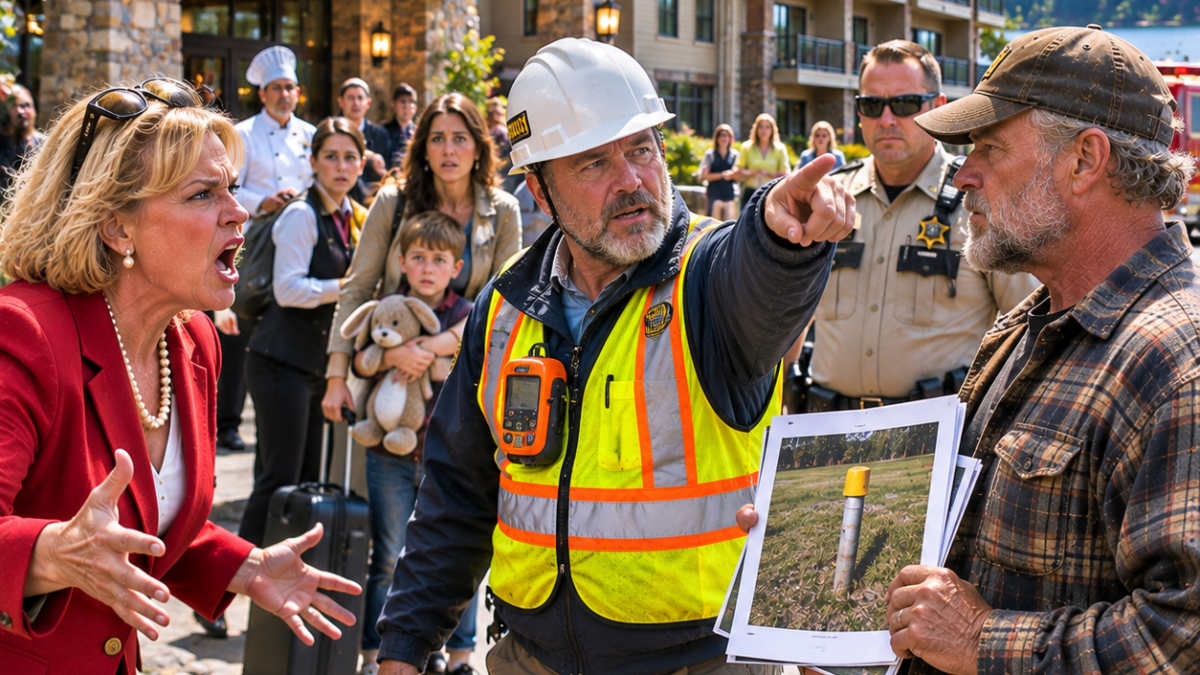
HOA Built a $9 Million Lakefront Hotel Over My Old Landfill—Then the Gas Inspector Ordered Everyone Out 10 Minutes Before the Ribbon Cutting.
The gas inspector stopped in the middle of the new hotel lobby, looked down at the meter in his hand, and said four words that erased a $9 million opening ceremony in less than ten seconds.
“Everyone out. All floors.”
Ten minutes before the HOA president was supposed to cut the ribbon, families were climbing the stairs toward the exits, hotel workers were abandoning carts in the hallway, and the inspector was pointing through the glass at a capped pipe I had warned them never to touch.
My name is Tom Mercer.
I own fourteen acres along Bell Lake.
Most people who see the property now notice the water first.
Tall cottonwoods.
A wide view across the lake.
A gravel lane running toward the shore.
What they don’t see is what sits beneath the upper portion of the land.
An old closed landfill.
It stopped accepting waste long before I owned it.
My father bought the property afterward because the price was low.
When I was young, I thought he’d gotten lucky.
Later he corrected me.
“We didn’t buy cheap land.”
He pointed toward the grass-covered hill.
“We bought land with chores.”
He was right.
A closed landfill doesn’t simply disappear because somebody spreads soil over it and plants grass.
Buried material keeps changing.
Settling.
Breaking down.
Producing gas.
The site had a thick soil cover.
Drainage channels.
Gas vents.
Monitoring points.
Twice a year, a company came out to inspect the ground and test several points.
Some pipes allowed gas to vent.
Others existed for monitoring.
You didn’t park equipment over them.
You didn’t bury them.
You didn’t decide one was ugly and cut it shorter.
You kept access open.
You documented everything.
And you listened when the people with meters told you something had changed.
After Dad died, all of that became my responsibility.
I ran a repair shop across town.
Engines.
Hydraulic systems.
Farm equipment.
Small construction machinery.
PART2:
Most of my days were spent solving problems you could physically see.
Broken belt.
Leaking hose.
Bad bearing.
Bent shaft.
The landfill was different.
The most important things happening there were usually invisible.
That was why I respected the records.
For years, nothing dramatic happened.
Then Bell Lake HOA came to me with a proposal.
They wanted to lease the lower portion of my property.
Not the landfill itself.
The old gravel storage yard beside the lake.
Their neighborhood already had a clubhouse and common dock nearby.
They wanted something bigger.
A small lakefront hotel.
Thirty rooms.
Dining room.
Covered porch.
Meeting space.
Guests of residents could stay there.
The public could book rooms too.
PART3:
Revenue, they told me, would help maintain neighborhood lake facilities.
The HOA created a separate company to build and operate it.
The project budget was $9 million.
I didn’t take that number from gossip.
It appeared in the financing documents.
Later they put it on a gold sign near the road.
BELL LAKE LODGE
A $9 MILLION COMMUNITY INVESTMENT.
At first, I liked the idea.
My lease payment would be fixed.
I would still own the land.
And the lower gravel yard wasn’t doing much except collecting weeds and property taxes.
My mother loved the plan.
She remembered Dad spending weekends clearing drainage around the old landfill.
“One day we’ll eat lunch down there,” she told me.
“No cooler. No folding chairs. Somebody else can wash the dishes.”
I laughed.
I wanted that too.
But I wasn’t signing anything until the ground was reviewed.
I hired an attorney.
Then an environmental engineer.
Her name was Nancy Hale.
Nancy had a gift for explaining complicated things without pretending they were simple.
She walked the entire property with me, the HOA project team, and Diane Mercer—no relation to me—who was president of the association.
Nancy marked the old waste boundary.
She pointed out the vent pipes.
Monitoring points.
Drainage.
Then she explained why the hotel needed to stay where the original drawing placed it.
“Buried waste can keep producing methane for decades.”
Diane nodded.
Nancy continued.
“Gas can move through soil.”
She pointed toward the proposed hotel.
“Buildings create enclosed spaces.”
Another pause.
“If methane gets into those spaces and accumulates, you can have a serious safety problem.”
Nobody argued.
The proposed hotel footprint sat on the old gravel yard outside the buried-waste boundary.
Nancy approved the concept subject to engineering details.
The lease incorporated the reviewed site plan.
And it included clear restrictions.
No construction on the capped landfill area.
No digging there without separate approval.
No blocking vents.
No interfering with monitoring points.
No relocating landfill infrastructure without professional review and my written consent.
The hotel could be built.
The landfill still had to function.
Diane came to my repair shop before we signed.
Spread the final drawing across my workbench.
She placed one finger on the green strip behind the hotel.
“This stays grass.”
I looked at her.
“No expansion there.”
“Understood.”
“No service building later.”
“Understood.”
“No storage.”
“Understood.”
“No utilities unless Nancy approves them.”
She smiled.
“Tom, we’re building a hotel, not invading your landfill.”
I signed.
Construction began in spring.
For the first few months, the building looked exactly like the plan I’d approved.
Foundation on gravel yard.
Main structure toward the lake.
Porch facing the water.
Nothing uphill.
I didn’t visit every day.
I had my shop.
Customers.
Parts deliveries.
And my mother needed rides to medical appointments twice a week.
Construction professionals were being paid to handle construction.
I expected them to follow the drawings.
That expectation turned out to be expensive.
Late in August, I drove past the site and saw orange paint.
A line ran from the back wall of the hotel.
Across the gravel.
Into the grass above.
Into the landfill area.
I stopped.
Construction manager at the time was a man named Rob.
I called him.
“What are those marks behind the building?”
“Rear service addition.”
“What addition?”
“Laundry. Storage. Kitchen expansion.”
“That isn’t on my plan.”
“It’s on the revised set.”
I went there immediately.
Rob brought his drawings.
We laid them across the hood of my truck.
The lake-facing side was familiar.
The rear wasn’t.
A long narrow wing had been added.
Laundry.
Storage.
Service hallway.
Expanded kitchen support.
Part of it crossed directly into the green area Diane had promised would remain untouched.
I tapped the page.
“Where did you get the landfill boundary?”
Rob pointed to a note.
EXISTING FILLED GROUND — SUITABLE PREPARATION REQUIRED.
I looked at him.
“This isn’t ordinary fill.”
“What is it?”
“Landfill.”
Rob looked uphill.
Then back at the drawing.
“Closed landfill?”
“Yes.”
He called his office.
Work in that strip paused.
For one day.
The next morning Diane appeared at my shop.
Folder.
Polite smile.
“The original kitchen isn’t large enough.”
“Then redesign the kitchen.”
“We need service space.”
“You have land inside the approved footprint.”
“We’re trying to make the building functional.”
“You’re trying to put it somewhere the lease says you can’t.”
She opened her folder.
Inside was a short geotechnical letter.
Several shallow test holes had found firm material.
Suitable for proposed work subject to designer requirements.
Diane tapped it.
“The ground was checked.”
“For what?”
“Stability.”
“That isn’t the only issue.”
I called Nancy.
Put her on speaker.
Sent the letter while Diane waited.
Nancy called back before Diane left.
“These are shallow tests.”
Diane said nothing.
Nancy continued.
“They don’t establish the waste boundary.”
Silence.
“They don’t address landfill gas.”
Diane closed her folder.
“And they do not replace the approved environmental site plan.”
Diane finally said:
“Our project team will speak to you.”
I sent a written objection that afternoon.
To Diane.
Rob.
HOA property manager.
County building office.
Nancy.
I attached the landfill map.
I didn’t say:
The building is about to explode.
I didn’t know that.
I said:
Construction appears to extend into a restricted portion of the closed landfill and has not received the required environmental review.
The county asked for revised plans.
Rob said the disputed area would remain untouched until review.
For nearly three weeks, the orange marks sat there.
Then I received an email.
REAR SERVICE AREA REVISED.
NO EXPANSION INTO RESTRICTED GROUND.
Attached:
Tiny plan.
The rear wing appeared shifted closer to the main hotel.
A narrow gravel strip separated it from the landfill boundary.
I forwarded it to Nancy.
She answered:
I can’t verify this at this scale. Request full-size drawing and field survey before foundations.
I forwarded that request.
Project manager replied:
Survey information to follow.
That was where I made my mistake.
Not the first mistake in the project.
But mine.
I saw:
REVISED.
NO EXPANSION.
SURVEY TO FOLLOW.
And treated those phrases as though somebody had already checked.
I went back to work.
One week later, concrete trucks arrived.
By the time I reached the site—
Rear foundation poured.
Rob was gone.
New project manager.
Different hard hat.
Different drawings.
Same concrete.
He showed me the construction set.
“County has this version.”
I looked at the slab.
That sentence meant almost nothing to me anymore.
County receiving a drawing wasn’t the same as every relevant office understanding the landfill beneath it.
I photographed everything.
Called Nancy.
“I should’ve checked sooner.”
She didn’t waste time telling me yes.
“Get your surveyor.”
“Now?”
“Now.”
Survey cost:
$1,800.
The surveyor used permanent markers.
Historic boundary records.
Foundation corners.
Lake reference points.
His drawing was clear.
The rear service wing crossed into the landfill by almost twelve feet.
Not the whole hotel.
Not a fuzzy line.
A measurable strip.
Laundry room.
Storage.
Part of the service corridor.
I sent the survey everywhere.
HOA disputed it.
Their attorney said different site information had been used.
Nancy requested that information.
County requested it too.
Meanwhile, construction continued outside the disputed strip.
I asked my lawyer:
“Can I lock the construction gate?”
She said:
“That may create a separate contract dispute without fixing the environmental problem.”
I hated that answer.
But she was right.
So we sent a formal notice under the lease.
Produce the site records.
Stop disputed work.
Preserve documents.
Prepare for court if necessary.
I was used to repairs.
Find defect.
Replace part.
Test.
Done.
Here, every problem seemed to lead to another office.
Another consultant.
Another version of a drawing.
Then Beth called.
Beth worked for the company that inspected the landfill.
She’d been coming twice a year since before Dad died.
“Tom.”
“Yeah?”
“I can’t reach monitoring point three.”
“What do you mean?”
“Building’s in the way.”
I drove there.
Monitoring point three had stood near the old gravel-yard edge.
Short pipe.
Easy to miss if you didn’t know what it was.
Beth had the previous inspection sheet.
Photo attached.
Short monitoring pipe beside a flat white stone.
Farther uphill:
A taller gas vent.
Yellow tag wired around it.
KEEP OPEN AND ACCESSIBLE.
We walked the construction fence.
Hotel wall now occupied the area around monitoring point three.
The white stone sat in broken concrete.
Then Beth stopped.
The tall vent was gone.
Near ground level:
Round black cap.
Almost flush with new gravel.
She lifted one hand.
“Don’t touch that.”
“I wasn’t planning to.”
She photographed it.
Then showed me another project document.
The pipe had been classified as:
UNUSED WATER SERVICE.
CAP BELOW FINISHED GRADE.
I read it again.
“That isn’t a water line.”
“No.”
“Who changed it?”
“Don’t know.”
A hotel worker walked past inside carrying folded towels.
Opening hadn’t happened yet.
But staff were setting up.
Housekeeping.
Kitchen.
Management.
Real people were already working inside the building.
That changed the problem for me.
Up until then, it had been:
Lease violation.
Boundary dispute.
Construction defect.
My land.
My expenses.
Now someone was preparing rooms where guests would soon sleep.
Beth called Nancy.
Nancy told us:
Notify site manager immediately.
I went to the construction office.
Steve was the latest manager.
I showed him the old photograph.
“This is a landfill gas vent.”
He looked.
Then toward the rear of the hotel.
“Project records call it a water service.”
“They’re wrong.”
He called the plumbing foreman.
Speakerphone.
The foreman remembered his crew cutting the pipe lower and installing the black cap.
“Why?”
“Work order.”
“Did you trace it?”
“No.”
“Did you see a yellow tag?”
Pause.
“I wasn’t there for the cutting.”
Steve asked:
“Who gave you the drawing?”
“Project office.”
Steve ordered the work records preserved.
Then he called Paula.
Hotel manager.
He asked her to clear staff out of the rear service wing temporarily.
That was the first useful action I’d seen that day.
Through the office window, I watched Paula redirect a housekeeper pushing towels.
Then she placed a sign on the service door.
RESTRICTED ACCESS
INSPECTION PENDING.
Paula asked me:
“Should everybody go home?”
I answered:
“I don’t know.”
She looked disappointed.
“I own the ground. I’m not qualified to clear a hotel.”
Then I gave her Nancy’s number.
That evening, I wrote a one-page chronology.
Dates.
Photos.
Boundary survey.
Monitoring point blocked.
Vent cut.
Vent misidentified.
I sent it to everyone.
Then asked the county:
Has this hotel received permission to open?
Answer came the next morning.
Limited staff setup had been approved in completed areas.
Final overnight occupancy had not yet been issued.
Then another sentence:
Project file contains documentation stating rear addition lies outside landfill boundary.
That was new.
I called Aaron, the county plan reviewer.
“My survey says twelve feet inside.”
“We received a response.”
“Send me the complete file.”
I had been imagining “the county” as one person with one folder.
It wasn’t.
Landfill records.
Building department.
Environmental file.
Site planning.
Different desks.
Different submissions.
Different people.
Nancy returned with a landfill gas specialist named Eric.
They inspected.
That morning, indoor readings did not reach emergency evacuation levels.
Diane seized on that immediately.
She emailed the board:
HOTEL PASSED TODAY’S AIR CHECK.
Paula forwarded it to me.
Question mark.
I called Nancy.
“Did it pass?”
“No.”
She sounded angry.
“Our report says additional testing is required.”
She sent a correction.
Methane had been detected in soil near the capped vent and inaccessible monitoring area.
Indoor readings at that moment had not triggered evacuation.
Those were not the same statement.
Conditions could change with:
Weather.
Barometric pressure.
Heating.
Cooling.
Kitchen exhaust.
Laundry equipment.
Door position.
Building occupancy.
The hotel had been mostly idle.
Eric wanted testing with systems operating.
They also needed to know what had been constructed beneath the rear slab.
Could they simply uncap the vent?
No.
Eric didn’t want someone removing a cap without understanding whether the pipe was damaged or where gas would migrate.
Careful answer.
Not satisfying.
But correct.
Then the complete county file arrived.
I opened it on my shop computer after closing.
I found the response to my survey.
Combined drawing.
Hotel.
Landfill.
Road.
At first, it looked convincing.
The rear wing sat outside the landfill boundary.
Then I noticed something.
An old service road bent around a permanent concrete marker.
On my survey, the bend and marker lined up.
On the project overlay—
The marker had moved.
Not physically.
On paper.
I got a ruler.
Measured.
Twelve feet.
I called my surveyor.
He came the next morning.
Spread:
Historic landfill map.
His field survey.
Project overlay.
For nearly ten minutes, he said nothing.
Then:
“They shifted the layer.”
“What does that mean?”
“Imagine tracing the landfill boundary on transparent plastic.”
“Okay.”
“Then sliding the plastic twelve feet before placing it over the building drawing.”
I looked at the hotel.
“So the building didn’t move off the landfill.”
“No.”
“The landfill moved on the drawing.”
“That’s what it appears.”
“Fraud?”
He shook his head.
“Don’t jump there.”
“Could be mistake?”
“Yes.”
He pointed to the permanent marker.
“That is why fixed reference points exist.”
He prepared a short technical explanation.
Measurements.
Reference points.
No accusation.
I took it to Diane.
She read slowly.
“Who prepared this overlay?”
“Project manager handled revisions.”
“Call him.”
“He’s gone.”
“His records?”
“Management company should have them.”
There had now been three project managers.
Outside Diane’s office, a banner hung from a light pole.
GRAND OPENING.
She stared through the window.
“We have deposits.”
I waited.
“Rooms booked.”
Nothing.
“A wedding party arriving next week.”
“I know.”
“You make this sound like I built it alone.”
“I didn’t.”
“What do you want me to do?”
“Stop letting mistakes pile up.”
She rubbed her forehead.
Then sent a preservation request for the former manager’s project records.
Two days later, the handover file surfaced.
Inside was the full-size version of the little drawing that had told me:
NO EXPANSION INTO RESTRICTED GROUND.
Revision note:
USE UPDATED WASTE BOUNDARY SUPPLIED BY PROJECT OFFICE.
Attached:
Shifted landfill map.
Then I found a construction checklist.
Ground preparation.
Checked.
Drain lines.
Checked.
Concrete.
Checked.
Then:
GAS BARRIER BENEATH SLAB.
OMITTED.
LANDFILL GAS VENT SYSTEM BENEATH SLAB.
OMITTED.
Reason:
NOT REQUIRED — BUILDING OUTSIDE WASTE LIMITS.
I read it twice.
The wrong boundary didn’t merely justify the rear wing.
It justified leaving out the systems intended to protect the building from landfill gas.
I called Nancy.
“Found something.”
“Send it.”
I sent the checklist.
She called back almost immediately.
“I’m forwarding this to the county gas inspector.”
Opening schedule was on the desk.
Kitchen startup:
7:00.
Laundry equipment:
8:00.
Staff and invited families:
10:00.
Ribbon cutting:
Noon.
Tomorrow.
I photographed it.
Nancy called again.
“That’s tomorrow?”
“Yes.”
“Send it to Paula.”
Paula already knew.
She had been told to keep the rear wing closed.
But the board still planned the reception.
“No overnight guests,” she said.
“Does that make the building safe for a reception?”
“I don’t know.”
“Neither do I.”
She sounded exhausted.
“I have one schedule saying set up the hotel.”
Pause.
“One saying don’t use the rear wing.”
Another pause.
“And no single instruction covering the whole building.”
Nancy arranged for county gas inspector Daniel Reed to arrive early the next morning.
He would test the building.
Review drawings.
Review omitted protection.
Until then:
Rear wing closed.
I visited my mother that evening.
Her pale blue shirt for opening lunch hung from the kitchen door.
“We aren’t going tomorrow.”
She took it down.
“Something happened?”
“Not yet.”
I explained.
Shifted map.
Missing protection.
Capped vent.
She folded the shirt.
Then asked:
“Have you eaten?”
I almost said no time.
Instead, I sat.
Twenty minutes.
Sandwich.
Coffee.
Then made another timeline.
One question remained at the bottom:
WHO CALLED THE GAS VENT A WATER PIPE?
I asked Steve for construction photographs.
Three arrived.
Photo one:
Original vent.
Yellow tag still attached.
Photo two:
Pipe cut lower.
Photo three:
Black cap.
Fresh gravel.
That happened during hotel construction.
Not decades earlier.
Not forgotten maintenance.
I sent the photographs to Nancy and Daniel.
Opening morning, I reached the hotel at 7:30.
Delivery truck at kitchen.
Flowers going through front door.
Bread smell.
Staff working.
And the rear wing door—
Open.
I found Paula.
“Why?”
She turned.
Laundry technicians were inside.
Scheduled startup.
Dryers.
Exhaust system.
Clipboard said:
8:00 test.
Paula immediately stopped them.
“Everybody out of that wing.”
One technician said:
“We need machines ready before—”
“Stop.”
He stopped.
That was the problem in one small scene.
Laundry company had one schedule.
Hotel manager had another.
Florist had another.
Kitchen had another.
Board had another.
Everybody followed instructions.
Nobody owned the complete picture.
Daniel arrived just before eight.
Hard case.
Meters.
Folder marked with Nancy’s name.
First questions:
Which systems ran?
Which rooms occupied?
Where were employees?
Which doors open?
How long had dryers operated?
He wasn’t interested in HOA politics.
Good.
Nancy arrived.
They spread the drawings across a dining table.
Original site plan.
Revised construction set.
Survey.
Shifted boundary.
Daniel followed the permanent marker from sheet to sheet.
Then said:
“This location discrepancy is not resolved.”
Steve said:
“We were told the revised boundary was accepted.”
“By whom?”
Steve opened the email.
Former project manager:
REVISED SITE INFORMATION INCORPORATED INTO COUNTY RESPONSE.
Daniel read it.
“This says submitted.”
Steve waited.
“It doesn’t say field location confirmed.”
Nobody spoke.
That sentence could have described the entire project.
Submitted became approved.
Revised became verified.
Outside became safe.
Each step slightly more confident than the paper beneath it.
Daniel and Nancy began testing.
I stayed out of the way.
Paula gathered staff in the front meeting room.
Rosa, one of the housekeepers, folded welcome cards.
She’d asked me earlier whether she was about to lose her new job.
I couldn’t answer.
At 9:15, property manager Jeff arrived carrying more handover records.
He had found the utility drawing used by the plumbing contractor.
Vent circled in red.
Typed instruction:
REMOVE OBSTRUCTION AT PROPOSED SERVICE PATH.
Handwritten underneath:
OLD WATERLINE — CAP.
Initials.
Former project manager.
Then Jeff found something worse.
An email from Beth.
Sent before the rear foundation was poured.
To project manager.
Diane copied.
It listed:
Monitoring point three.
Gas vent number.
Photographs.
Yellow tag visible.
KEEP ACCESS CLEAR.
The project manager had received it.
Before concrete.
Before pipe cutting.
Before the checklist said gas protection wasn’t needed.
I showed Diane.
“Do you remember this?”
She looked at the date.
“I remember receiving site updates.”
“Did you read the attachment?”
“I don’t remember.”
“Project manager did.”
She saw the handwritten waterline note.
“He told us these were old services.”
“Beth told him exactly what they were.”
Diane sat.
Outside, somebody was tying a ribbon between two posts.
She watched.
Then asked:
“How much of the building has to come down?”
I answered:
“I don’t know.”
That was the truth.
I wasn’t an engineer.
Owning the dirt didn’t make me one.
“What do you want from me?”
“Stop telling people it’s cleared.”
“I haven’t said that today.”
“Then tell them inspection is still happening.”
She called the board.
“Hold arrivals outside.”
Better.
Late.
At ten, guests began arriving anyway.
Invitation said ten.
Families.
Children.
Flowers.
Gift bags.
Volunteers.
Several people were directed into the front lobby for cold drinks.
Paula moved check-in outside once she saw it.
But some families were already inside.
Staff upstairs finishing rooms.
Kitchen workers moving.
The hotel filled in little pieces.
Nobody had made one big decision to occupy it.
At 10:30, Daniel came out of the service corridor.
Spoke quietly to Nancy.
Asked the kitchen gas equipment shut down for part of the next test.
Then:
No more people inside.
His meter had shown something that required closer investigation.
He didn’t shout.
Didn’t say the hotel would explode.
Didn’t say everybody was safe either.
He kept testing.
That made me more nervous than either extreme.
Around eleven, Nancy found me near the fence.
“The capped vent isn’t the only issue.”
“What else?”
“We have to understand the pathway.”
“Into the building?”
“Yes.”
“Can restoring the pipe fix it?”
“Not enough information.”
She looked toward the rear wing.
“We need to know where gas is moving through soil and service trenches, and where it can accumulate.”
I looked through the lobby windows.
A little boy had dropped napkins.
Rosa helped pick them up.
His stuffed rabbit sat on the welcome table.
Nothing looked dangerous.
That was the problem.
Methane doesn’t care whether the lobby looks finished.
At 11:45, Diane asked:
“Can we move everyone onto the porch and do the ribbon outside?”
Paula looked at Daniel.
He was testing near the service corridor.
Then floor penetrations.
Then utility spaces.
The kitchen exhaust had been operated under controlled conditions.
Doors had been opened.
Closed.
Systems changed.
Daniel entered the lobby with his meter held low.
Stopped.
Looked at the screen.
Moved several feet.
Checked again.
Nancy came over.
They exchanged a few words.
Then Daniel looked at Paula.
“Stop the event.”
Diane stepped away from the ribbon.
“Outside?”
Daniel lifted his radio.
Then said:
“Everyone out.”
Paula froze.
“All floors. Use the stairs. Move to the upper parking lot.”
Her clipboard went down.
Supervisors moved.
Kitchen called.
Upstairs rooms cleared.
Diane caught Daniel’s sleeve.
“We’re supposed to cut the ribbon in ten minutes.”
He stepped back.
“Ma’am, start walking.”
That was when the welcome drinks spilled.
The little boy backed into the table while his mother grabbed his hand.
His stuffed rabbit dropped.
Dragged through orange punch.
I went to the side door.
Held it open.
Rosa came toward me pushing a housekeeping cart.
Daniel called:
“Leave it.”
She did.
Walked out empty-handed.
Jeff directed families uphill.
Paula kept people moving.
Nobody ran.
A few tried to stop for photographs.
She told them:
“Keep going.”
Through the lobby glass, Daniel pointed toward the gravel strip behind the rear wing.
“That capped pipe.”
Then:
“Who covered it?”
Diane looked at me.
I opened my folder.
Beth’s old photograph.
Vent standing chest-high.
Yellow tag.
Date visible.
I held it up.
“Before anybody answers, look at the date.”
Daniel glanced at it.
Then handed it back.
“Keep that safe.”
He pointed outside.
“Paperwork later. People first.”
He was right.
In the upper parking lot, Paula counted staff.
Supervisors reported cleared areas.
Jeff counted invited families.
Rosa stood beside me.
“My purse is inside.”
Paula asked:
“Medication?”
“No.”
“Then leave it.”
One man asked if he should move his car.
Another asked about food delivery.
Instructions:
Stay outside.
Keep lower driveway clear.
Nobody reentered.
Diane stood beside the gold hotel sign.
Someone had attached a decorative bow to it.
$9 million.
Thirty rooms.
Zero occupants allowed inside.
The boy with the rabbit sat on a curb.
His mother tried drying it with napkins.
I had clean shop towels in my truck.
I brought two.
She asked:
“Do you work here?”
“I own the ground.”
She looked toward the building.
I didn’t explain.
“Stay up here until they say otherwise.”
Fire crew arrived.
Daniel and responders took control of the building.
I stayed outside the barrier.
That was difficult.
For months, I’d been trying to make people look at the site.
Now they were.
And the best thing I could do was stand out of the way.
By early afternoon:
Everyone accounted for.
No injuries.
No fire.
No explosion.
Hotel remained closed.
Daniel met with:
Nancy.
Paula.
Steve.
Diane.
Me.
He explained:
Methane had been detected inside the hotel.
Some readings were high enough to require evacuation.
Gas was also present beneath and around the rear service wing.
Conditions could vary.
Open doors might lower readings temporarily.
Turning equipment off might change air movement.
That did not fix the source.
Diane asked:
“Can we reopen the front rooms?”
“No.”
“Can we restore the vent and reopen?”
Nancy answered.
“No.”
Diane looked at her.
“The vent isn’t the only problem.”
Nancy pointed toward the rear wing.
“The protection omitted beneath that slab matters.”
Daniel issued written restrictions.
Controlled entry for qualified inspection teams.
No guests.
No overnight stays.
No food service.
No casual setup.
Paula gathered staff.
Opening canceled.
That was harder to watch than Diane losing the ribbon ceremony.
Rosa looked at the ground.
A kitchen worker asked:
“Do we get paid today?”
Paula said yes.
After that?
She didn’t know.
I went home.
My mother waited on the porch.
She’d seen evacuation pictures in the neighborhood group.
“Everybody got out?”
“Yes.”
She moved over.
I sat.
For several minutes, nothing.
Then I said:
“I should’ve pushed harder before concrete.”
“You did push.”
“I stopped after that little revised drawing.”
She didn’t tell me it didn’t matter.
It did.
Instead:
“You know what to do differently now.”
That was fair.
The investigation took weeks.
Less dramatic.
Much more expensive.
Engineers opened selected areas.
Tested soil.
Checked service trenches.
Compared:
Approved plans.
Construction plans.
Field conditions.
Historic landfill records.
The picture came together.
Front hotel:
Built on the original gravel-yard footprint.
Rear service wing:
Crossed onto buried waste.
Gas barrier beneath that portion:
Omitted.
Sub-slab venting:
Omitted.
Reason:
Project map showed building outside landfill.
Monitoring point:
Lost beneath construction.
Existing gas vent:
Cut.
Capped.
Misidentified as water service.
The methane source:
Old buried waste.
Likely pathways:
Soil migration.
Utility trenches.
Floor openings.
Service penetrations.
Nobody claimed one capped vent explained every reading.
It didn’t have to.
There were enough failures to require major correction.
Bell Lake HOA held a residents meeting.
Not at its new hotel.
At the school gym.
The irony wasn’t lost on anyone.
Hotel budget appeared on a screen.
$9 million already committed.
Now more money required.
One resident asked:
“Why didn’t Tom’s survey stop construction?”
Another:
“When did the board know?”
Diane started by listing consultants.
Engineer.
Builder.
Project manager.
Designer.
Contractor.
Then Ron Jenkins stood.
Older resident.
Customer at my repair shop.
“Who you hired isn’t the question.”
Room quieted.
He continued.
“What did you do when those people disagreed?”
That ended the deflection.
Jeff presented the chronology.
My first objection.
Nancy’s request for full-size plan.
Survey showing twelve-foot conflict.
Beth’s email identifying the vent.
Shifted boundary overlay.
Utility drawing calling vent waterline.
Checklist:
GAS BARRIER — OMITTED.
VENT SYSTEM — OMITTED.
People watched the warnings arrive in date order.
Before the foundation.
During construction.
Before opening.
Diane eventually stopped trying to smooth the story.
“We wanted the hotel open before summer bookings.”
Nobody spoke.
She continued:
“When the revised boundary information came back, I accepted the interpretation that allowed construction to continue.”
A woman in front asked:
“Did you order the vent capped?”
“No.”
“Did you know it was being capped?”
“No.”
“Were you sent the email identifying it as a gas vent?”
Diane looked at the screen.
“Yes.”
That answer stayed in the room.
Diane resigned as HOA president that night.
No arrest.
No shouting.
No dramatic escort.
Just resignation.
It didn’t repair the hotel.
Didn’t bring Rosa’s job back.
Didn’t restore my land.
But someone else would oversee the next decisions.
The board brought in an outside project supervisor.
Records were preserved.
Claims followed between:
Hotel company.
Builder.
Designers.
Consultants.
Insurers.
Former project management.
I wasn’t interested in deciding everybody’s percentage of blame.
My responsibility was the ground I still owned.
First repair proposal:
Leave rear wing.
Add gas controls around it.
New venting.
New monitoring.
Long-term systems.
Nancy said some version might be technically possible.
But it would be complex.
And it left a building sitting on ground my lease never allowed them to occupy.
I said no.
Not because I wanted the entire hotel demolished.
I didn’t.
Front portion was where it belonged.
I wanted the restricted land restored.
And a plan understandable enough that I could live with it for the next twenty years.
Final agreement:
Rear service wing removed.
Landfill cover restored.
Damaged vent system repaired.
Monitoring point replaced in accessible location.
Laundry moved offsite.
Kitchen reduced.
Interior functions reorganized inside approved footprint.
Additional gas protection installed where required.
Permanent monitoring.
Alarms.
Independent inspections.
Clear access for landfill technicians.
A dedicated fund for future environmental maintenance.
And the part I insisted on:
No future site revision could appear as a tiny email drawing marked REVISED.
Changes affecting the landfill required:
Readable plans.
Proper professional review.
Survey verification where necessary.
My written approval before work.
The HOA reimbursed my documented:
Survey.
Engineering.
Legal expenses.
Not $9 million.
Not some giant court jackpot.
I wasn’t trying to become rich from their mistake.
I was trying to keep a $9 million mistake from becoming a permanent obligation attached to my land.
Repair took months.
I watched the rear wing come down from behind a safety boundary.
Careful demolition.
Environmental supervision.
Controlled disturbance of the cover.
When the old vent system was restored, Beth photographed the new pipe.
The yellow tag from Dad’s era was gone.
The replacement had a permanent label.
LANDFILL GAS VENT — KEEP CLEAR.
Monitoring point three was replaced where Beth could actually reach it.
She walked over.
Removed the cap from the testing port.
Connected her equipment.
Then looked at me.
“I can reach everything again.”
It was one of the quietest victories of the entire dispute.
The hotel eventually opened.
Not when Diane announced a date.
Not when the carpet arrived.
Not when the ribbon appeared.
Not when somebody sent an email saying the latest test looked good.
It opened after:
Required corrections.
Independent inspections.
Operating-system testing.
Accepted reports.
Written authorization.
Paula came back as manager.
Some staff returned.
Some had moved on.
Rosa had taken a job at another inn near her children’s school.
I saw her in the grocery store.
“How is it?”
“Good.”
“You coming back?”
She shook her head.
“My kids know where I am after school now.”
Then smiled.
“That’s worth more than a nicer lobby.”
I couldn’t argue.
Months later, my mother and I finally had our lunch.
No ribbon.
No ceremony.
Tuesday afternoon.
Quiet.
We sat on the porch looking across Bell Lake.
She ordered soup and half a sandwich.
I got the burger.
Halfway through lunch she looked through the window toward the lobby.
“You kept the folder.”
“Two copies.”
She smiled.
Afterward, we walked beside the hotel.
Beyond the fence, the restored grass rose toward the old landfill.
Where the rear wing had once stood:
No laundry room.
No storage hallway.
No concrete slab.
Just restored cover.
A clearly marked gas vent.
My mother stopped.
“Somebody checks that?”
“Beth.”
“She can get to it?”
“Anytime.”
She took my arm.
We walked toward the parking lot.
At the service gate was a new sign.
LANDFILL MONITORING ACCESS
KEEP CLEAR AT ALL TIMES
24-HOUR CONTACT: SITE OPERATIONS
I opened the latch.
Closed it.
Opened it again.
Smooth.
That small thing mattered.
Dad had said we bought land with chores.
The HOA spent $9 million building something beautiful beside those chores.
The problem wasn’t that they built a hotel near a landfill.
That could be managed.
The problem was what happened every time somebody met an inconvenient warning.
The landfill boundary didn’t fit the new wing.
So the boundary moved on a drawing.
The gas system complicated construction.
So it became “not required.”
The vent blocked the service path.
So it became an “old waterline.”
My survey threatened the schedule.
So it became a disagreement needing later review.
Nancy’s first test required more work.
So Diane called it a passed air check.
One small simplification at a time.
Until the building itself became the place where reality caught up.
People later asked:
“Did you know the hotel was dangerous before opening day?”
No.
If I’d known exactly what Daniel’s meter would show, I would have pushed for evacuation before anyone entered.
What I knew was narrower.
The approved footprint had changed.
Part of the rear wing crossed the landfill boundary.
A monitoring point was inaccessible.
A known gas vent had been cut and capped.
Required protection appeared to have been omitted.
Those were facts.
And facts were enough to justify checking.
That distinction matters.
Nobody needed me standing outside screaming:
THE HOTEL IS GOING TO EXPLODE.
It didn’t explode.
Nobody was hurt.
There was no fire.
No cinematic disaster.
The real success was that people got out before a bad set of conditions became worse.
Daniel once came to my shop months later.
Needed a mower blade sharpened.
While I worked, he looked at the photographs pinned near my desk.
One showed the hotel’s opening morning.
Gold sign.
White ribbon.
Empty parking lot after evacuation.
He said:
“You know what people keep telling me?”
“What?”
“That you shut the hotel down.”
I laughed.
“I didn’t have a gas meter.”
“Exactly.”
He leaned against the bench.
“You raised a question.”
“You answered it.”
“The meter answered it.”
That sounded right.
I handed him the sharpened blade.
He paid.
Then said:
“Keep those old pictures.”
“I have two copies.”
He laughed.
Apparently my mother wasn’t the only one who knew me.
The HOA eventually adopted new project-review rules.
Nobody found them exciting.
That was a good sign.
Any construction outside normal association property required full title verification.
Environmental restrictions had to be included in construction documents, not simply kept in a separate consultant’s file.
Changes affecting restricted land required confirmation from the relevant specialist.
No board officer could describe preliminary testing as final clearance.
And the original source documents had to remain attached when maps were revised.
That last rule came directly from the twelve-foot shift.
A layer shouldn’t be able to move quietly because nobody remembered what it was tied to.
My own habits changed too.
When somebody sends me a drawing that says:
REVISED.
I ask:
Revised by whom?
Using what reference?
Verified where?
Approved by who?
And does the person whose name is on it agree that it says what you’re telling me it says?
Maybe that sounds exhausting.
It’s less exhausting than evacuating a hotel.
A year after reopening, the Bell Lake Lodge was doing reasonably well.
Not as profitable as the original projections.
Smaller kitchen.
Offsite laundry.
Higher monitoring costs.
Insurance changes.
But guests stayed.
Families ate on the porch.
The building did what the original project was supposed to do.
Exist beside the lake without pretending the old landfill wasn’t there.
That mattered to me.
I didn’t want failure for the sake of being right.
My mother liked the porch.
Every few months she’d ask:
“Everything still getting checked?”
“Yes.”
“Gas pipes?”
“Yes.”
“Drainage?”
“Yes.”
“Beth?”
“Still complains about weeds.”
“Good.”
She’d smile.
Dad would’ve liked that answer.
He never trusted land that looked too easy.
The strangest part of the whole dispute is that the hotel became safer once everybody stopped trying to make the landfill disappear.
The waste remained underground.
The vent remained visible.
The monitoring points remained accessible.
The records said exactly where the restricted area was.
Nobody tried landscaping over the ugly parts.
They learned what Dad had understood.
You don’t protect property by pretending its problems aren’t there.
You protect it by maintaining them.
Years later, people still remember opening day.
Some remember the little boy and his wet stuffed rabbit.
Some remember Diane standing beside the ribbon.
Some remember the hotel workers crossing the parking lot in uniforms they’d barely had time to wear.
I remember Daniel’s meter.
He walked through a lobby that looked finished.
Wood paneling.
Stone fireplace.
Flowers.
Cold drinks.
Gold lettering.
Everything people associate with completion.
Then the invisible part of the property told a different story.
His meter changed.
He stopped.
Checked again.
And the entire $9 million building became secondary to six words:
“Everyone out. All floors. Now.”
That wasn’t the moment the project failed.
The project had been failing quietly for months.
When the boundary shifted.
When the survey wasn’t resolved.
When the vent became a waterline.
When gas protection disappeared from the checklist.
Opening day was simply the first moment everybody had to stop and listen.
Diane had once stood at my workbench and promised that nothing would touch the landfill.
Eleven months later, she stood in the hotel lobby while the gas inspector pointed through the glass at the pipe her project had cut and buried.
The ground had never changed.
Only the drawings had.
And in the end, the oldest thing on the property—the landfill everyone wanted hidden behind a beautiful lakefront hotel—was the one thing that refused to be ignored.








