HOA Built a $500K Pool 140 Feet Inside My Ranch—Then the Survey They Used Was Signed by a Dead Man
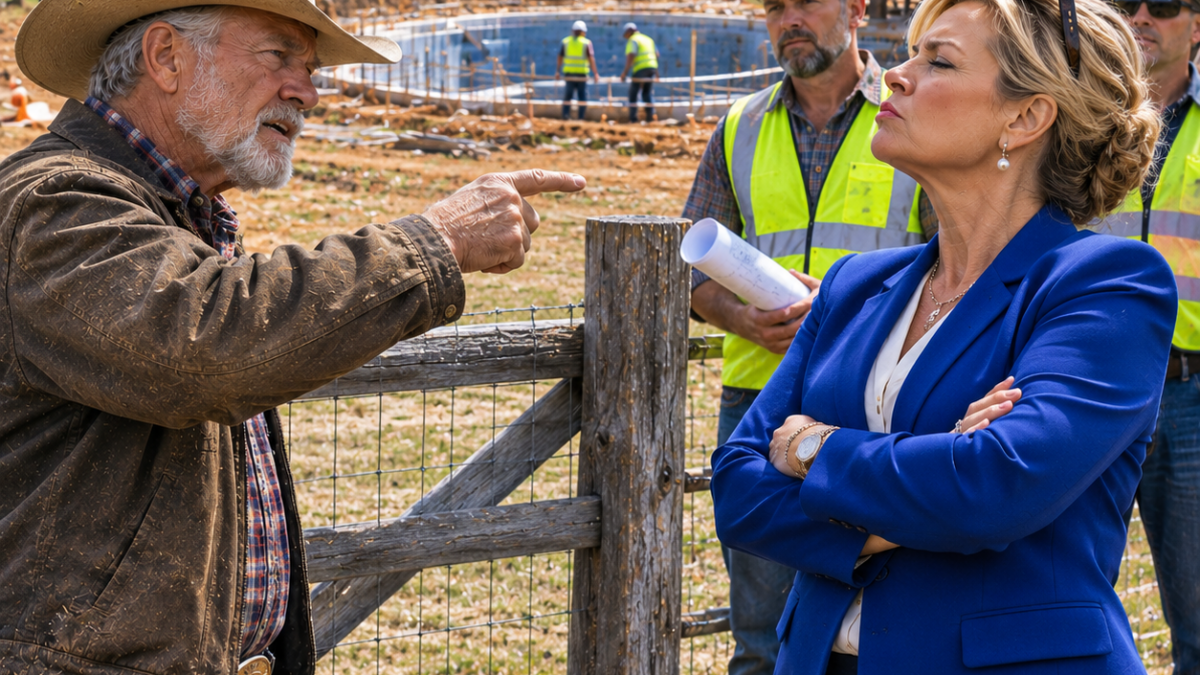
PART2:
For most of my adult life, the northeast corner stayed quiet.
Then Hollow Creek Estates arrived.
One hundred eighty homes built on what used to be the old Dutton farm beyond the creek.
Stone entrances.
Walking paths.
Clubhouse.
Tennis courts.
Uniform mailboxes.
The usual.
The subdivision itself never bothered me.
People need places to live.
They bought their property.
I had mine.
For four years, we mostly stayed out of each other’s way.
The HOA complained about ranch dust once.
One homeowner complained that cattle smelled like cattle.
I told him I would speak to them.
Another asked whether I could avoid running my tractor early on Sunday mornings.
Sometimes I could.
Sometimes hay did not care what day it was.
Nothing serious.
Nothing that prepared me for that Tuesday morning.
I had gone out early to check the northeast herd.
There should have been twenty-six cattle grazing near the fence.
Instead, they were clustered farther south.
That was my first sign something had disturbed them.
Then I heard machinery.
Heavy equipment.
Diesel engines.
Reverse alarms.
Metal tracks grinding across hard ground.
I drove the pickup over the rise.
And stopped.
Where grass had been the previous afternoon, there was now an excavation.
Not a small one.
A huge rectangular hole.
Men in hard hats.
A skid steer.
Excavator.
Gravel trucks.
PVC.
Steel.
Forms.
Stacks of materials.
They were building something.
On my ranch.
I got out.
Walked toward the nearest worker.
“What is this?”
He pointed toward a younger man in a white hard hat.
“Foreman.”
The foreman saw me coming.
His shoulders stiffened.
“You in charge?”
“For this phase.”
“What are you building?”
He hesitated.
“A pool.”
I looked toward the hole.
“A what?”
“Community aquatic facility.”
I almost laughed.
“On whose property?”
He blinked.
“Hollow Creek HOA.”
“No.”
His fingers tightened around the clipboard.
“Sir, we’re working off an approved permit.”
“This is Callaway Ridge.”
“We were told this is common property.”
“By who?”
His eyes moved away from me.
Toward the fence.
That was when I saw the yellow post.
Or what was left of it.
The post Grandpa had driven into the northeast corner was gone.
Only a short yellow stump remained.
Cut almost perfectly level with the grass.
I walked toward it.
Fresh sawdust.
Bright.
Pale.
Not weathered.
The cut was so clean that whoever had done it had used a power saw.
My chest tightened.
“Who cut this?”
The foreman said nothing.
I turned.
“Who cut my post?”
He swallowed.
“I’m not sure.”
“Were you here?”
His eyes dropped.
Before I could push harder, tires crunched behind us.
White SUV.
It came down the temporary gravel track like the driver had every right to be there.
Door opened.
Gerald Whitmore stepped out.
President of the Hollow Creek Estates HOA.
Silver hair.
Beige blazer.
Pressed pants.
Rolled blueprints tucked under one arm.
Gerald liked to dress as if every disagreement might turn into a television interview.
He walked directly toward me.
“Callaway.”
I pointed at the excavation.
“What the hell is this?”
He did not slow.
“That pool is legal.”
“That wasn’t the question.”
“You’re standing on Hollow Creek property.”
I stared at him.
Then laughed once.
“Try again.”
Gerald jabbed a finger toward the fence.
“Your fence is encroaching on association land.”
“You put a swimming pool inside my pasture.”
“You have it backward.”
“No.”
I pointed at the yellow stump.
“You cut my boundary post.”
His expression changed.
Barely.
But it changed.
Not anger.
Not surprise.
Fear.
Gone in half a second.
Then his face hardened.
“You’ve been occupying HOA property for years.”
“My family has owned this ranch since before your subdivision existed.”
“That doesn’t make your fence correct.”
He unrolled one of his documents.
Then shoved it toward me.
“County-recorded survey.”
I took it.
Hollow Creek Estates.
2019 plat.
Stamped.
Signed.
Recorded.
Everything looked official.
The boundary on that survey ran more than two hundred feet west of where Grandpa’s fence had always stood.
According to Gerald’s paper, not only was the pool on HOA land—
so was part of my pasture.
My fence.
And the yellow post.
Gerald folded his arms.
“You have forty-eight hours to remove your encroaching fence.”
I looked up.
“What?”
“If you don’t, our attorney will seek enforcement and damages.”
“You’re threatening me with fines?”
“I’m informing you of your legal exposure.”
I looked back at the survey.
Perfect stamp.
Perfect linework.
Perfect recording number.
Perfect signature block.
Something about that bothered me.
Real ranch records are rarely perfect.
Coffee stains.
Handwritten corrections.
Old references.
Margins.
This thing looked like somebody had made it yesterday for a presentation.
Gerald smiled.
“Now do you understand?”
I looked at him.
“No.”
His smile faded.
“I understand that you showed up with paperwork prepared before I knew there was a dispute.”
“It has been recorded since 2019.”
“Then why wait until you started digging a pool to mention it?”
He did not answer.
I glanced toward the foreman.
The young man looked sick.
Gerald noticed.
“Tony.”
The foreman snapped his eyes toward him.
“Get the crew moving.”
Tony nodded.
But he did not move immediately.
Gerald turned back to me.
“Forty-eight hours, Reed.”
Then he walked away.
I watched his SUV leave.
The construction crew started working again.
For the first time in my life, I stood beside Grandpa’s yellow post and had no idea whether the paper in my hand had just legally erased everything he taught me.
I called the sheriff’s office.
Deputy Tom Raider arrived about an hour later.
Tom and I had known each other for years.
Not friends exactly.
Small-county acquaintances.
He had pulled me over once for a burned-out trailer light.
I had helped tow his brother’s pickup out of mud.
That kind of relationship.
Tom walked the excavation.
Looked at the cut post.
Then studied Gerald’s survey.
He exhaled slowly.
“Reed.”
“What?”
“They’ve got paperwork.”
“So?”
“So right now this looks civil.”
“They came onto my ranch and cut a post.”
“I know.”
“And dug a pool.”
“I can see that.”
“You’re telling me they can keep digging?”
“I’m telling you I can’t decide a boundary dispute with my patrol truck parked in a pasture.”
I hated that answer.
Tom hated giving it.
“Until a judge determines which line controls, I’m limited.”
I pointed at the stump.
“Forget the pool for a minute.”
He looked down.
“Who cut that?”
“I don’t know.”
“Is cutting a survey marker civil?”
“If it’s actually a legally significant monument, that matters.”
“It is.”
“Can you prove it?”
I opened my mouth.
Nothing came out.
Grandpa had called it the boundary post.
Everybody in the family called it the boundary post.
But did that make it an official survey monument?
I did not know.
Tom crouched.
Touched the fresh sawdust.
“Recent.”
“This morning or last night.”
“Probably.”
He stood.
“I’ll document it.”
“Can you stop them?”
“Not yet.”
I looked at the excavation.
“By the time a judge sorts this out, they’ll have concrete.”
Tom followed my eyes.
“Get a lawyer.”
“I will.”
“And Reed?”
“What?”
“Don’t touch their equipment.”
“They’re on my land.”
“Maybe.”
I looked at him.
He raised both hands.
“I know what you believe.”
“You believe Gerald?”
“I believe paper creates enough doubt that I’m not arresting construction workers while lawyers are about to argue property lines.”
He was right.
I hated him for about thirty seconds anyway.
That night, I could not sleep.
I sat in Grandpa’s old office.
Same oak desk he had used for ranch accounts.
Some of his paperwork was still there because I had never been able to bring myself to throw it away.
Tax receipts.
Feed invoices.
Fence diagrams.
Old grazing leases.
At around midnight, I found a brittle envelope.
2009 BOUNDARY SURVEY.
I opened it.
Inside was a faded plat.
Surveyor:
Nina Alvarez.
I remembered the name.
Grandpa had hired her after an argument with the Dutton family about a creek crossing.
The plat showed the boundary exactly where our fence stood.
I flipped it over.
Grandpa’s handwriting.
Thin.
Shaky.
Post is only marker.
True iron sits 12 paces toward old oak.
I read it twice.
True iron?
I looked out the dark window.
Old oak.
There was only one oak Grandpa could have meant.
A huge tree standing west of the yellow post.
I suddenly remembered something from childhood.
Grandpa telling me never to move stones around that tree.
I had assumed he was worried about roots.
At sunrise, I drove to Marcus Webb’s office.
Marcus was the best land attorney within three counties.
He was not cheap.
He was also the kind of man who could read a deed for ten minutes without speaking and make everyone in the room nervous.
I put Gerald’s survey down.
Then Grandpa’s.
Marcus read both.
Then the note.
He looked up.
“Reed.”
“Yes?”
“If they cut that yellow post because they thought the post itself established the boundary, somebody is trying to erase physical evidence.”
“That’s what I think.”
“But your grandfather’s note says the actual monument is elsewhere.”
“Yes.”
“Do you know what it is?”
“No.”
“Then find it.”
“I was going to.”
“No.”
He leaned forward.
“Find it before they do.”
That sentence changed the morning.
Marcus immediately started paperwork for an emergency stop-work order.
“The hearing will probably be in three days.”
“Three days?”
“If I can get it accelerated.”
“They can pour concrete in three days.”
“I know.”
I looked toward the window.
“What do I do until then?”
“Document.”
“I’m getting tired of that word.”
“Get more tired.”
He pushed Gerald’s survey toward me.
“And go to county records.”
I drove straight there.
Delores Finch worked behind the property counter.
She had worked for the county longer than Gerald had lived there.
I gave her the recording number.
She pulled the 2019 Hollow Creek plat.
Then I showed her Grandpa’s deed.
She laid them side by side.
Her glasses slipped down her nose.
She measured.
Then measured again.
“This boundary moved.”
“How much?”
She checked.
“About two hundred twelve feet.”
My stomach tightened.
“Can that happen?”
“With a lawful conveyance, correction, new monument evidence, court action—yes.”
“Any of that here?”
She searched the linked instruments.
“No deed.”
“No court order?”
“No.”
“No boundary agreement?”
“Not attached.”
“When was the plat filed?”
Delores frowned at her screen.
“Saturday.”
“What?”
“Saturday afternoon.”
“County records was closed.”
“Our electronic filing system wasn’t.”
“Who submitted it?”
She clicked.
Then looked at me.
“Gerald Whitmore.”
I felt cold.
“HOA president.”
“Yes.”
She looked at the surveyor’s certification.
Then back at the computer.
“Something else.”
“What?”
“You’re the second person asking about this plat since yesterday.”
I leaned over the counter.
“Who was first?”
Delores turned the sign-in log.
A name written shakily.
T. Brant.
Tony Brant.
The pool foreman.
I stared.
“He was here?”
“Yesterday afternoon.”
“What did he ask for?”
“Everything related to the Hollow Creek boundary.”
“Did he copy it?”
“Photographed every page.”
I remembered Tony staring at the yellow stump.
His shaking hands.
Gerald telling him to get the crew moving.
“What did you tell him?”
“The same thing I’m telling you.”
“Which is?”
“The lines do not match.”
I left county records and went searching for Nina Alvarez.
Her office sat behind an old hardware store.
Small survey company.
Two pickups outside.
One survey tripod leaning against the wall.
Nina was in her late sixties.
Gray hair tied back.
She recognized Grandpa’s name before she recognized mine.
“Amos Callaway?”
“My grandfather.”
“He was stubborn.”
“That sounds right.”
I handed her the 2009 plat.
She smiled.
“I remember this.”
Then I showed her the yellow-post photograph.
Her smile disappeared.
“What happened?”
“Somebody cut it.”
She looked at Gerald’s survey.
Her face went pale.
“Where did you get this?”
“County.”
Nina sat down.
“I set that corner.”
“The yellow post?”
“No.”
She shook her head.
“The post was visual.”
“What was the legal monument?”
“A brass cap.”
My heartbeat picked up.
“Where?”
“Buried.”
“How deep?”
“About ten inches, maybe a foot.”
“Near the old oak?”
Nina looked at me.
“Your grandfather told you?”
“He left a note.”
She read it.
Then nodded.
“That’s right.”
I handed her the 2019 plat.
She studied the certification.
Then said:
“Two years ago, somebody came here.”
“Who?”
“Developer.”
“Name?”
“Lyle Draper.”
I knew the name.
Lyle had developed several subdivisions in the county.
“What did he want?”
“He offered me fifty thousand dollars.”
“For what?”
“To ‘update’ my old field records.”
I stared at her.
“He wanted you to change the boundary?”
“He called it correcting outdated control data.”
“What did you say?”
“I told him to leave.”
“Did you report it?”
“I told another surveyor. I should’ve done more.”
She stood abruptly.
Grabbed a tool bag.
“Where are you going?”
“With you.”
“Why?”
“Because if somebody is cutting witness markers and trying to replace an old survey, I want to see whether my brass cap is still there.”
We waited until after dark.
Not because we were planning anything illegal.
Because construction stopped at sunset.
I did not want Gerald or his crew watching us search.
Near midnight, Nina and I crossed the pasture.
Flashlight with red lens.
Metal detector.
The pool excavation looked like an open wound.
Grass removed.
Earth piled high.
Forms waiting.
The sight made me furious.
Then headlights appeared.
Nina grabbed my sleeve.
We moved behind my cattle trailer.
White SUV.
Lights off.
A pickup behind it.
Gerald stepped out.
Two men with shovels followed.
Then another vehicle stopped farther back.
A man in a charcoal suit emerged.
Lyle Draper.
I felt Nina stiffen beside me.
Gerald pointed toward the yellow stump.
“Dig there.”
The men started.
Nina leaned close.
“They’re looking for the monument.”
For almost an hour, we watched them dig around the stump.
Gerald paced.
Lyle smoked.
Finally one of the men said:
“Nothing.”
Gerald stepped into the hole.
“Check again.”
They did.
Nothing.
Lyle laughed.
“Then the post was all there was.”
Gerald smiled.
“Good.”
Lyle said:
“Once the monument is gone, no judge on earth can prove where the line was.”
I felt Nina’s fingers close around my arm.
Those words erased any doubt I had left.
This was not a survey disagreement.
They were looking for evidence.
They wanted it gone.
They filled the shallow hole badly.
Then left.
We waited until the headlights disappeared.
Nina whispered:
“They dug in the wrong place.”
I pulled Grandpa’s note from my pocket.
Twelve paces toward old oak.
I stood at the stump.
Counted.
One.
Two.
Three.
My boots sank into wet grass.
Eight.
Nine.
Ten.
Eleven.
Twelve.
Old oak.
Nina swept the detector.
Nothing.
Again.
Then—
a sharp electronic scream.
We both froze.
“There.”
I got on my knees.
Started scraping.
Topsoil.
Roots.
Red clay.
About ten inches down, my fingers hit metal.
Smooth.
Cold.
Round.
I cleared it.
Brass cap.
Nina wiped dirt away.
Her license number.
CALLAWAY LINE.
For a moment neither of us spoke.
I thought about Grandpa.
The yellow post.
His hand on my shoulder.
As long as that post stands—
except Grandpa had been smarter than that.
He had given people something obvious to look at.
Then protected the truth underground.
A twig snapped behind us.
I spun around.
Someone stood near the trailer.
Orange safety vest.
Hands raised.
Tony Brant.
The foreman.
My heart hammered.
“What are you doing here?”
His face looked worse than it had the day before.
“I cut it.”
Nina stepped beside me.
“What?”
Tony swallowed.
“The yellow post.”
My fists clenched.
“You cut my grandfather’s marker?”
“Gerald paid me five thousand dollars.”
I stepped toward him.
Nina caught my arm.
Tony kept talking quickly.
“He told me it was an old fence post.”
“You expect me to believe that?”
“No.”
He shook his head.
“I don’t expect you to believe anything.”
Then he opened the back of his truck.
Pulled out a blue tarp.
Unrolled it.
Yellow metal.
The missing top half.
Grandpa’s post.
Tony looked at the ground.
“I took it with me.”
“Why?”
“I don’t know.”
“That’s not an answer.”
“I knew something felt wrong.”
He looked at me.
“After I cut it.”
He took a folder from the truck.
“I went to county records.”
“Delores told me.”
“I saw the old documents.”
His voice broke slightly.
“That’s when I realized the pool was inside your property.”
He handed me the folder.
Original construction contract.
Site plan.
And there it was.
The pool location.
One hundred forty feet inside the Callaway line.
Not Gerald’s 2019 line.
The real line.
Nina leaned over my shoulder.
“They knew.”
Tony nodded.
Then showed me a yellow sticky note attached to the plan.
Handwriting.
DON’T SHOW CALLAWAY UNTIL CONCRETE IS POURED.
I looked at Tony.
“Gerald wrote this?”
“Yes.”
“From the beginning?”
“Yes.”
My anger became something colder.
“So why help him?”
Tony looked ashamed.
“I needed money.”
“That’s your explanation?”
“My wife’s medical bills.”
He rubbed his face.
“He said it was a boundary dispute. He said once the pool was poured, lawyers would settle it.”
“And you believed him?”
“I wanted to.”
That answer sounded true.
Tony took another breath.
“There’s more.”
“What?”
“Walt Prior.”
“Who?”
“HOA treasurer.”
“What about him?”
Tony looked toward the dark subdivision.
“Ask him where the money came from.”
At dawn, Marcus Webb sat at his conference table with Tony’s folder open.
Grandpa’s yellow post rested against the wall.
Photographs of the brass cap lay beside Nina’s field notes.
Marcus read Tony’s statement.
Then looked at me.
“The boundary fraud is one problem.”
“One?”
He tapped the pool contract.
“This project is almost half a million dollars.”
“So?”
“HOAs don’t normally find half a million dollars in a sofa cushion.”
He picked up his phone.
Called someone.
“Carla?”
Pause.
“Marcus Webb.”
Another pause.
“I have something involving a recorded plat, potentially false survey documentation, intentional monument removal, and a large HOA capital project.”
He listened.
Then:
“I’m sending you documents.”
He hung up.
“Who was that?”
“Special Agent Carla Moreno.”
“With?”
“State Fraud Unit.”
I stared at him.
Marcus pointed at Tony’s folder.
“Find the treasurer.”
Walt Prior lived in Hollow Creek.
I knocked at his door at eight-thirty.
He opened wearing a wrinkled gray polo.
Eyes red.
He looked like he had not slept.
“Mr. Prior?”
“Yes.”
“Reed Callaway.”
His face collapsed.
“I know.”
“I need to ask about the pool.”
Walt stepped back.
“Come in.”
His kitchen table was covered with papers.
I did not have to ask twice.
“One hundred eighty thousand dollars.”
“What?”
“Gerald took one hundred eighty thousand from the reserve fund.”
“For the pool?”
“First payment.”
“Did the board approve it?”
“He called it a special recreational capital project.”
“Did homeowners know?”
“They think the pool is on HOA property.”
I sat across from him.
“You knew it wasn’t?”
“No.”
He looked at me quickly.
“Not at first.”
“When did you know?”
“Yesterday.”
His phone buzzed.
We both looked.
Gerald.
Where are you, Walt?
Walt turned pale.
“He knows I’m talking.”
“How?”
“He watches everything.”
“Do you have records?”
Walt looked toward the papers.
“Yes.”
“Keep them.”
“I’ve been keeping them.”
“Then give them to someone who can protect them.”
He shook his head.
“You don’t understand.”
“Then explain.”
“Gerald has people convinced you’re trying to take HOA land.”
“That doesn’t change the ledger.”
“No.”
“But it makes me the traitor if I show anyone.”
I leaned forward.
“Walt.”
He looked at me.
“If he stole from those homeowners, hiding it doesn’t protect them.”
He swallowed.
“I need time.”
I stood.
“Don’t take too much.”
By afternoon, Gerald had turned Hollow Creek against me.
Forty homeowners gathered outside my ranch gate.
Signs.
STOP STEALING OUR POOL.
HONOR THE SURVEY.
CALLAWAY = LAND GRAB.
I stood behind my fence.
Gerald had a megaphone.
“He’s extorting this community!”
People shouted.
“He wants us to pay for land his own family illegally fenced!”
More shouting.
I wanted to walk out there with Tony’s folder.
Wanted to show them everything.
Marcus stopped me.
“Not yet.”
“They’re calling me a thief.”
“Let them.”
“That’s easy for you to say.”
“No.”
Marcus looked at the crowd.
“It’s hard for me to say.”
Then:
“But our hearing is coming. Don’t give Gerald a preview of every document.”
I scanned the crowd.
One woman near the back did not shout.
Ellen Maddox.
I had seen her walking near the creek.
She looked at Gerald.
Then at me.
Not angry.
Uncertain.
That look mattered.
Because doubt is where truth gets room to breathe.
That night, at 12:41, somebody pounded on my door.
I grabbed my flashlight.
Opened it.
Walt Prior.
Sweating.
Ledger clutched to his chest.
“I told him.”
“Told who?”
“Gerald.”
My stomach dropped.
“About what?”
“The brass monument.”
“What the hell, Walt?”
“He cornered me.”
“Where?”
“Clubhouse.”
“Why would you tell him?”
“I panicked.”
He looked sick.
“I’m sorry.”
I took the ledger.
“What did he say?”
“He asked where it was.”
“And?”
“I told him under the oak.”
I looked at the clock.
12:41.
Walt whispered:
“He’s going to destroy it.”
I was moving before he finished.
I called Tom Raider from the truck.
“Gerald knows where the monument is.”
Tom’s voice changed instantly.
“Where are you?”
“Heading there.”
“Do not confront him.”
“He’s going to destroy it.”
“I heard you.”
“I’m not letting him.”
“Reed.”
“What?”
“Stay back.”
Silence.
“If I catch them tampering with it, this stops being a civil boundary argument.”
That made me slow down.
Nina had refused to leave the ranch after our discovery.
She joined me near the pasture.
We crouched in tall grass about fifty yards from the oak.
Then we heard it.
Diesel.
Heavy.
Skid steer with a hydraulic breaker attachment.
It climbed the hill.
Gerald stood in the headlights.
Another man drove.
Gerald pointed.
“Right there.”
The machine rolled toward Grandpa’s brass cap.
My hands dug into the grass.
Nina whispered:
“Wait.”
The breaker lifted.
Steel point.
Six inches above the cap.
Gerald shouted:
“Break it!”
Blue and red lights exploded across the hill.
Sirens.
Two sheriff vehicles.
Tom Raider stepped out behind his open door.
“Gerald Whitmore!”
The skid-steer operator froze.
“Shut the machine down!”
Engine stopped.
Silence rushed into the pasture.
Tom advanced.
“Step away from the survey monument.”
Gerald lifted his hands.
Then smiled.
That arrogant smile.
“You’re making a mistake, Deputy.”
Tom kept moving.
“Hands where I can see them.”
“The recorded plat says I’m standing on association land.”
Tom stopped ten feet away.
Gerald continued.
“You have no authority to arrest me for working on my own property.”
Tom looked at the brass cap.
Then at Gerald.
“Tampering with a survey monument.”
Gerald’s smile weakened.
“Trespass.”
More deputies arrived.
“Criminal mischief.”
Gerald’s face tightened.
“You can’t prove that marker controls anything.”
He had no idea what Delores Finch had found.
At nine the next morning, Judge Patricia Lamont took the bench.
I had slept maybe forty minutes.
Gerald had posted bail.
He sat beside his attorney wearing a dark suit.
Calm again.
The 2019 survey spread across the table.
Marcus stood.
“Your Honor, this case began as an emergency property-boundary dispute.”
Judge Lamont looked over her glasses.
“I’ve read the filings.”
Marcus nodded.
“Since yesterday, the evidence has expanded.”
He presented Nina’s 2009 survey.
The recovered brass monument.
Photographs.
Grandpa’s deed.
Tony’s site plan.
Then Tony himself.
“Mr. Brant,” Judge Lamont said, “did you cut the yellow post?”
Tony stood.
His hands shook.
“Yes, Your Honor.”
“Why?”
“Gerald Whitmore paid me.”
Gerald’s attorney objected.
The judge allowed Tony to continue within proper scope.
Tony explained.
Five thousand dollars.
Told the post was obsolete.
Later discovered the conflicting plats.
Retrieved the cut section.
Preserved the site plan.
Then Marcus displayed the yellow sticky note.
DON’T SHOW CALLAWAY UNTIL CONCRETE IS POURED.
The room went silent.
Gerald’s attorney leaned close to him.
Whispered.
Then Delores Finch took the stand.
She carried one sheet.
Marcus asked:
“Ms. Finch, who certified the 2019 Hollow Creek plat?”
She adjusted her glasses.
“R. Keane.”
“License number?”
“30417.”
“Did you verify the license?”
“Yes.”
“What did you find?”
Delores looked toward the judge.
“That surveyor died in 2016.”
Silence.
I heard someone in the gallery gasp.
Gerald’s attorney stopped writing.
Judge Lamont leaned forward.
“The plat was recorded in 2019?”
“Yes.”
“Under the certification of a surveyor deceased for approximately three years?”
“Yes, Your Honor.”
Gerald went pale.
That perfect survey suddenly looked different.
Not authoritative.
Impossible.
The signature belonged to a dead man.
Special Agent Carla Moreno testified next about the financial side.
By then, Lyle Draper had started talking.
Fast.
He had been questioned around three in the morning.
Facing evidence from the monument, Tony’s files, and records connected to the development plan, he decided Gerald was no longer worth protecting.
The plan was bigger than the swimming pool.
The pool was bait.
Hollow Creek’s reserve fund financed the project.
Once construction established apparent HOA occupation of the strip, Gerald and Lyle intended to use the altered boundary to support expansion.
Forty additional lots.
Developer profit.
HOA expansion.
Land that belonged to Callaway Ridge.
The homeowners had never been told.
They were not partners.
They were financing the setup.
Walt’s ledger supported the money trail.
One hundred eighty thousand dollars already drained from reserve funds.
Additional commitments coming.
Judge Lamont looked toward Gerald.
Then the documents.
Then me.
Her ruling started with the property issue.
Emergency stop-work order.
No construction.
No alteration of survey evidence.
No entry beyond lawful access without authorization.
The 2019 plat could not be relied on pending investigation into its authenticity.
The 2009 monument and earlier chain of title controlled the preliminary boundary showing.
Then the pool.
Located approximately 140 feet inside Callaway Ridge according to the credible field evidence before the court.
Construction stopped permanently under that project authorization.
Removal required.
Restoration required.
Costs to be borne by the responsible parties under subsequent orders and agreements.
Then she addressed Gerald.
“These records will be referred to the appropriate prosecuting authorities.”
Gerald stared at the table.
Outside the courthouse, reporters waited.
So did homeowners.
Ellen Maddox walked toward me.
Her eyes were wet.
“We believed him.”
I said nothing.
“We stood at your gate calling you a thief.”
“You didn’t have the documents.”
“We had his word.”
“That’s not the same thing.”
She looked ashamed.
“He kept telling us you wanted our pool.”
“I wanted my pasture.”
“I know that now.”
Behind her, more Hollow Creek residents gathered.
Nobody had protest signs.
Walt stood with the ledger.
That evening, the board removed Gerald as president.
Not unanimously.
But decisively.
Walt turned the complete financial records over to investigators.
The same neighborhood social page that had accused me of extortion began filling with screenshots of apologies.
I did not read all of them.
There are only so many different ways a person can say:
We didn’t know.
Gerald’s criminal case took longer.
Real cases do.
Search warrants.
Records.
Interviews.
Financial tracing.
Survey licensing records.
Development communications.
Lyle Draper cooperated.
Tony cooperated.
Walt cooperated.
Eventually, Gerald was charged.
Forgery-related offenses.
Fraud.
Tampering with survey evidence.
Property crimes connected to the attempted destruction.
He continued insisting the land was his long after everyone else stopped pretending.
The pool came out first.
A week after the court’s order, excavators returned.
Same pasture.
Same machines.
Different purpose.
Instead of digging deeper, they filled the hole.
Tony Brant arrived with the first dirt truck.
I watched from the fence.
He came over before unloading.
“Mr. Callaway.”
“Reed.”
He looked toward the yellow post lying beside my barn.
“I’m sorry.”
“I know.”
“I shouldn’t have taken the money.”
“No.”
“I shouldn’t have cut it.”
“No.”
He looked down.
“The court’s considering my cooperation.”
“So I heard.”
“I don’t expect you to speak for me.”
“I won’t.”
He nodded.
“That’s fair.”
I looked toward the truck.
“You helped stop him.”
“After helping him.”
“Yes.”
Both things could be true.
Tony had made a serious choice.
Then another one.
The second did not erase the first.
But it mattered.
I held out my hand.
He hesitated.
Then shook it.
“You cut a post,” I said.
He looked confused.
“And then you cut yourself loose.”
Tony laughed once.
Not because it was especially funny.
Because I think he needed permission to breathe.
The excavators filled the pool excavation.
Layer by layer.
Dirt.
Compaction.
Topsoil.
Seed.
It took weeks before the ground looked remotely normal.
Months before grass covered everything.
The HOA’s money situation was worse.
Investigators traced project funds.
Lyle’s seized assets helped recover part of what had been taken and committed.
Insurance and civil claims covered other portions.
Hollow Creek homeowners eventually recovered most of the reserve damage tied to the scheme.
Not instantly.
Not painlessly.
Some assessments still increased because lawyers and audits cost money.
That bothered me.
Those families had been manipulated.
Gerald had turned them against me using their own money.
I never enjoyed watching them pay for cleaning up his decisions.
The board changed.
New president.
Independent review of major capital projects.
Two signatures for reserve withdrawals above certain thresholds.
Outside verification of boundary documents before construction near adjacent property.
Walt stayed as treasurer temporarily.
He offered to resign.
The board asked him to finish the audit transition first.
I never completely forgot that he told Gerald where the brass cap was.
Neither did he.
But I also knew why that night ended with police catching Gerald in the act.
Walt came to my door.
He brought the ledger.
He warned me.
People are complicated.
Sometimes cowardice and courage show up in the same person only hours apart.
Nina and I reset the northeast corner after the pasture restoration.
The brass monument stayed exactly where it was.
She cleaned it.
Verified it.
Recorded fresh coordinates.
Filed updated field notes.
Then we installed a new yellow witness post.
Same color Grandpa used.
Bright enough to offend the eyes.
I drove it into concrete beside the true monument.
Nina laughed.
“Your grandfather would’ve hated the concrete.”
“He’d have liked that nobody can pull it easily.”
“He probably would’ve hidden another monument just to be safe.”
“Wouldn’t surprise me.”
I stood there with one hand on the yellow post.
For the first time, I understood what Grandpa had been trying to teach a ten-year-old boy.
The post was never the boundary.
Paper was not the boundary either.
Neither was a fence by itself.
The boundary existed because history, monuments, records, and people all supported the same truth.
Gerald had tried to manipulate every part he could see.
Cut the yellow post.
Replace the map.
File the plat.
Start construction.
Create something expensive enough that everyone would say:
Surely the line must be there.
Who would build a half-million-dollar pool on land they did not own?
That was the trick.
Make the lie expensive enough and people start assuming somebody must have checked.
Gerald counted on that.
The construction crew assumed the permit was valid.
The homeowners assumed the board had verified ownership.
The county system accepted a document that looked complete.
Tony accepted money and cut what he was told was an old fence post.
Everybody trusted the person before them to have asked the question.
Until somebody finally did.
My criminal involvement mostly ended after giving statements and evidence.
Gerald later entered a guilty plea resolving the principal charges against him, including fraud, forgery-related conduct, and destruction or attempted destruction of survey evidence.
He received criminal penalties and restitution obligations under that agreement.
Lyle Draper faced his own consequences under his cooperation deal.
Tony received substantially more lenient treatment because he confessed, preserved the missing yellow post, produced the original project documents, and testified.
That did not make what he did right.
It made the truth possible to prove faster.
The day the last criminal matter connected directly to my property ended, I did not go to court.
I worked cattle.
Around four in the afternoon, Ellen Maddox drove out.
She brought a pie.
“I don’t know what people bring ranchers.”
“Usually problems.”
She laughed.
“So pie is better?”
“By a wide margin.”
We sat on the porch.
She looked toward the northeast pasture.
“Can you still see where the pool was?”
“If you know where to look.”
“What do you see?”
“Slight grade difference.”
“I see grass.”
“That’s the goal.”
She was quiet.
Then:
“I’m sorry.”
“You already said that.”
“I know.”
“Then stop apologizing.”
She looked surprised.
“You believed your HOA president.”
“I should’ve checked.”
“Yes.”
She nodded.
Then I smiled slightly.
“So should Gerald.”
That finally made her laugh.
The new Hollow Creek board never built the pool.
Not there.
A few years later, they approved a smaller recreation project entirely within their recorded property.
They hired a surveyor before final design.
Nina called me after hearing about it.
“Progress.”
“Bare minimum.”
“At our age, Reed, sometimes bare minimum is progress.”
Fair.
Tony eventually started his own small site-preparation company.
He came by once before bidding a job near the ranch.
Not because he needed my permission.
Because he wanted to confirm the line.
He stood beside the new yellow post.
“I’ll never cut one of these again.”
“That’s probably wise.”
“Even if someone pays me five thousand.”
“Especially then.”
Walt retired from the HOA board after the audits were complete.
He sent me a copy of the final accounting.
One sentence handwritten at the bottom:
I should have spoken sooner.
I wrote back:
Yes.
Then underneath:
But you spoke before it was too late.
I mailed it.
That was enough.
Years later, the thing I remember most is not Gerald being taken into custody.
It is not the courtroom gasp when Delores explained that the surveyor whose name certified Gerald’s 2019 plat had been dead since 2016.
It is not the half-million-dollar pool being filled back in.
It is Tony standing in the dark with Grandpa’s yellow post under a blue tarp.
A man who had done the wrong thing.
Holding the evidence that could help make it right.
And Nina kneeling beside a brass cap buried ten inches below the earth.
Grandpa’s line.
Still there.
Untouched.
Waiting.
The yellow post had been cut.
The survey had been manipulated.
The homeowners had been lied to.
A swimming pool had been dug into my pasture.
But none of those things changed where Callaway Ridge ended.
That line had existed before Gerald Whitmore wanted the land.
It existed while his machines were digging.
And it existed after his pool disappeared beneath fresh soil.
One evening, after the new post was installed, I walked out alone.
The cattle had moved back into the northeast pasture.
They grazed over the place where concrete forms had once stood.
The ground was quiet.
I stopped beneath the old oak.
Knelt.
Brushed loose soil away from the brass cap.
Nina’s number.
CALLAWAY LINE.
Then I looked at the yellow post.
Grandpa had once told a ten-year-old boy:
“As long as that post stands, nobody gets to tell you where your land ends.”
He had been wrong about one thing.
The post had not stood.
Someone had cut it down.
And for a little while, Gerald Whitmore believed that was enough.
What Grandpa had really left me was better than a post.
He left a record.
A monument.
A memory.
And the instinct to question anybody who showed up with perfect paperwork and expected me to stop looking.
I stood.
Put my hand against the new yellow post.
Across the creek, lights were coming on in Hollow Creek Estates.
Families eating dinner.
Children riding bikes.
Ordinary people who had almost lost hundreds of thousands of dollars because one man convinced them that authority and confidence were the same thing as truth.
Behind me stretched six hundred forty acres my family had protected for three generations.
The ranch had not grown.
I had not taken anything from Hollow Creek.
The legal boundary after the fight was the same boundary Grandpa had shown me when I was ten.
That was what Gerald never understood.
You cannot steal land simply by drawing a different line.
You cannot make a fake survey true by recording it.
You cannot turn trespass into ownership by pouring concrete fast enough.
And you cannot erase a boundary just because you cut down the thing pointing toward it.
The yellow post was only the marker.
The truth had been underneath it the whole time.








