HOA Built a $2M Lake on My Farm—Then My Lawyer Told Me to Let Them Fill It!
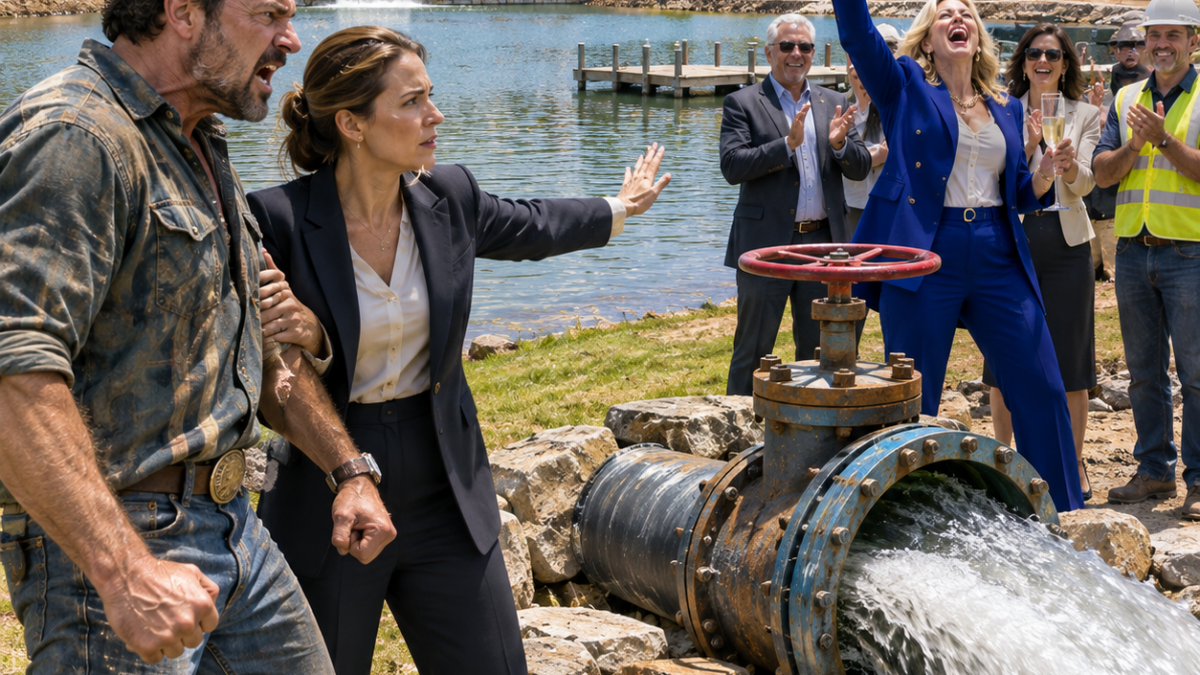
“THIS LAKE IS FINISHED, DANIEL—GREEN VALLEY HAS ALMOST TWO MILLION DOLLARS INVESTED HERE, SO YOU CAN EITHER ACCEPT IT OR SPEND THE NEXT TEN YEARS FIGHTING YOUR OWN NEIGHBORS!” HOA president Patricia Monroe shouted as water began rushing through a twelve-inch pipe into the valley my family had owned since 1978.
I was already walking toward the control valve when my lawyer Rebecca Hayes grabbed my arm and said, “Don’t touch it. Let them fill the lake,” even though the dam, dock, walking trail, benches, landscaping, and almost the entire new basin sat on land my father had never sold.
Then the rising water exposed an old Lawson boundary pin beneath the mud, the bank inspector discovered Patricia had submitted a deed carrying my dead father’s copied signature, and a hidden pipe under the brand-new dam began pulling water into an underground system nobody on the HOA board had been told existed.
By the time Green Valley Estates finished building the lake on my farm, it looked beautiful.
That almost made it worse.
If it had looked like a disaster from the beginning, anger would have been easier.
Instead, the lower valley of Lawson Farm looked like something out of a real-estate brochure.
A wide blue basin stretched between two wooded hills.
Fresh stone covered the dam.
A walking trail curved along the shoreline.
Young maple trees had been planted every thirty feet.
Benches faced the water.
A small wooden dock extended from the eastern bank.
Near the entrance stood a new stone sign.
GREEN VALLEY COMMUNITY LAKE.
Almost two million dollars.
That was what the HOA had spent.
There was only one problem.
Almost all of it belonged on my tax bill.
Not theirs.
My name is Daniel Lawson.
Lawson Farm sat outside Knoxville, Tennessee.
My father, Robert Lawson, bought the original 142 acres in 1978.
Back then, most of the area was cattle pasture, woods, gravel roads, and old family farms.
Dad raised Angus cattle.
Cut hay.
Maintained a small apple orchard.
Fixed everything himself whether he actually knew how or not.
I grew up repairing fences, feeding calves, clearing storm debris, and complaining that every other kid in school had easier chores.
Then I left for college.
Within a year, I missed the place.
Funny how quickly inconvenience becomes memory when you move away from it.
I eventually returned.
Started a small construction business.
Helped Dad more as he got older.
By the time he died, I was already handling most of the day-to-day work.
The farm came to me.
Around fifty cattle.
A hay lease on the upper field.
Old barn I used as a workshop.
The land was paid for.
That mattered.
I was not rich.
But waking up knowing the ground beneath your house belongs to you creates a kind of peace that is hard to explain until someone starts trying to take part of it.
Green Valley Estates arrived east of us years earlier.
A developer bought roughly two hundred acres.
More than a hundred homes went up.
Clubhouse.
Pool.
Walking trails.
Landscaped entrance.
Stormwater pond.
Most residents were decent people.
PART2:
Frank Miller bought eggs from me every Saturday.
Jennifer Parker brought her children over when calves were born.
William Grant once spent half a Saturday helping me repair a fence after a storm dropped a tree across it.
Green Valley itself was not the enemy.
Patricia Monroe became the problem.
At first, even that statement would have seemed unfair.
Patricia was good at getting things done.
She negotiated cheaper trash contracts.
Improved entrance landscaping.
Added security cameras.
Got contractors to finish work prior boards had allowed to drag on.
Residents liked her.
Then she started talking about Green Valley becoming a “destination community.”
That phrase eventually cost everyone a lot of money.
The first big idea was the lake.
Green Valley had a stormwater pond behind the clubhouse.
Calling it a pond was generous.
Mud.
Reeds.
Mosquitoes.
PART3:
Patricia wanted something worthy of the homes around it.
Fishing.
Kayaks.
Walking trail.
Community events.
Maybe paddle boats.
The concept drawings were beautiful.
The land was not available.
Green Valley did not own enough low ground.
I did.
The southern part of Lawson Farm contained a broad natural valley.
Seasonal creek.
Good winter grazing.
Soft ground during heavy rain.
And several old oak trees my father refused to cut.
One afternoon Patricia drove up with a man named Steven Dawson.
Steven introduced himself as a development consultant.
Patricia got straight to the point.
Green Valley wanted twenty-four acres.
My lower valley.
“For what?”
“The lake.”
“No.”
She offered $350,000.
“No.”
Steven raised it to $500,000.
Still no.
Patricia looked genuinely confused.
“It’s low pasture.”
“It’s my low pasture.”
“You could make more money selling it than grazing cattle there for twenty years.”
“Probably.”
“Then why refuse?”
Because Dad loved that valley.
Because my mother’s ashes had been scattered near the oak trees above it.
Because I did not want every acre of the farm converted into whatever produced the highest return per square foot.
But I did not owe Patricia all of that.
“I don’t want to sell.”
That should have ended the conversation.
Instead, Green Valley changed the offer.
A few months later Patricia returned.
No purchase this time.
Ninety-nine-year water and recreation easement.
I would technically retain ownership.
The HOA would build the lake.
Pay annual rent.
Manage access.
I still said no.
Steven asked:
“Why?”
“I don’t want a community lake in my pasture.”
Patricia smiled tightly.
“Progress is coming whether people like it or not.”
At the time, that sounded rude.
Later, it sounded like a warning.
For nearly a year, nothing happened.
Then survey flags appeared near my southern fence.
I assumed county drainage workers.
Next morning, an engineering crew was inside my pasture.
I drove down.
The supervisor apologized immediately.
“Green Valley hired us.”
“To survey what?”
“HOA stormwater property.”
“You’re standing on Lawson Farm.”
He checked his tablet.
According to his map, Green Valley owned a strip extending almost thirty acres into my valley.
I actually laughed.
“That map is wrong.”
He looked uncomfortable.
“I’m working from the file they gave me.”
Fair enough.
I asked him to leave until ownership could be confirmed.
He did.
That afternoon I called Rebecca Hayes.
Rebecca had handled Dad’s estate and several property issues for my business.
Quiet woman.
Very little wasted language.
Almost impossible to intimidate because she usually understood the document better than the person shouting.
She pulled my deed.
Then Green Valley’s recorded subdivision plat.
Boundary was clear.
The valley was mine.
Rebecca sent Patricia a letter.
No entry.
No construction.
No further survey work.
No physical alteration without my consent.
Green Valley’s attorney responded a week later.
According to them, my father had transferred twenty-nine acres to the original developer through a “development adjustment agreement.”
That stopped me.
Dad?
They sent the document.
ROBERT LAWSON.
Signature at the bottom.
Agreement supposedly dated March 14, 2008.
Green Valley claimed Dad had transferred the valley in exchange for drainage improvements.
The signature looked real.
Rebecca asked:
“Did he ever mention selling twenty-nine acres?”
“No.”
“Any payment?”
“No.”
“Tax change?”
“No.”
County records showed no deed transfer.
My family had continued paying taxes.
Dad fenced the valley.
Ran cattle there.
Insured it.
Maintained it.
Nothing in our records suggested he had surrendered ownership.
Rebecca suspected the document was not what Patricia claimed.
Then, before we finished proving that, the machines arrived.
Monday morning.
Diesel engines.
Three excavators.
Two bulldozers.
Dump trucks.
Workers came through the southeast access road and started clearing my pasture.
I drove down so fast I forgot my jacket.
The site superintendent was Daniel Foster.
I had worked with him once before.
He looked embarrassed when he saw me.
“Daniel?”
“What are you doing?”
“Lake excavation.”
“On my farm?”
His face changed.
“This is Green Valley property.”
“No.”
He showed me the construction packet.
Engineering drawings.
Boundary maps.
County grading permit.
Stormwater approval.
Construction authorization.
Everything looked legitimate.
Green Valley had already paid his company more than $600,000.
Daniel Foster was not stealing my land.
He had been handed professional-looking documents.
I told him I disputed ownership.
Called Rebecca.
She arrived before noon.
Patricia arrived shortly afterward.
The argument lasted nearly two hours.
Patricia had the supposed 2008 agreement.
Rebecca had my deed.
Tax records.
Recorded plat.
Chain of title.
Contractor shut down voluntarily while everyone argued.
Then Patricia’s attorney said Green Valley would ask the court for authority to continue construction.
Rebecca smiled.
“Please do.”
That surprised Patricia.
It surprised me more.
Two days later, the judge refused to make a final ownership ruling without discovery and expert review.
But he did not prohibit all construction.
Green Valley could continue limited work—
at its own risk.
Rebecca loved those words.
I did not.
“They can keep digging?”
“They can choose to.”
“They’re destroying my pasture.”
“I know.”
“How is that legal?”
“They presented facially valid documents and permits. Ownership is disputed. They assume the risk if they are wrong.”
“That sounds insane.”
“It’s expensive confidence.”
Green Valley chose expensive confidence.
Construction resumed.
Every week the basin grew.
Hundreds of truckloads of earth.
Dam.
Drainage lines.
Stone.
Trail.
Dock.
Landscaping.
The budget climbed.
$900,000.
$1.2 million.
$1.6 million.
Then nearly $2 million.
I documented everything.
Photos.
Video.
Equipment numbers.
Survey markers.
Daily logs.
No screaming at workers.
No blocking machines.
No cutting hoses.
No threats.
Rebecca repeated the same advice.
“Make your objection clear. Then let their decisions belong to them.”
Frank Miller came over one afternoon.
We stood behind my fence watching a bulldozer shape what had once been cattle pasture.
“I don’t know how you stay this calm.”
“I’m not calm.”
“You look calm.”
“Different thing.”
He laughed.
Then became serious.
“Most Green Valley residents think the HOA already won.”
“I know.”
“Patricia says your lawsuit is really about how much they owe you.”
“It isn’t.”
“What is it about?”
“Ownership.”
Frank stared at the construction site.
“Then why are they still building?”
That question eventually answered almost everything.
Green Valley had borrowed heavily.
Special assessment from homeowners.
Improvement loan from a regional bank.
The original approved lake budget was about $1.15 million.
Then the footprint expanded.
Design changed.
Cost climbed.
Stopping meant explaining why.
Explaining meant admitting a land problem.
Admitting a land problem threatened the bank.
Every dollar already spent became another reason Patricia insisted they continue.
That is how bad decisions grow.
One choice becomes justification for the next.
Then Rebecca broke the 2008 agreement apart.
Date:
March 14, 2008.
Dad was not in Tennessee.
He was in Texas.
My uncle died that week.
We had photographs.
Hotel receipts.
Flight information.
The document claimed Dad signed before a Tennessee notary named Linda Harper.
Linda was eighty-one and retired.
She still had her journal.
No Robert Lawson entry.
No land-transfer notarization.
Then Dad’s signature.
Real.
But copied.
Rebecca found the source.
Two years earlier, Dad had signed a fourteen-day temporary drainage access form after a storm blocked the creek.
Same signature.
Exactly.
Someone had lifted it.
Placed it onto a document claiming Dad transferred twenty-nine acres.
Green Valley’s attorney said the current board had no knowledge of what the original developer had done in 2008.
Possible.
But Rebecca sent Patricia everything.
Dad’s travel proof.
Notary journal.
Copied signature.
Tax history.
No recorded deed.
No payment.
No transfer.
Construction still did not stop.
Patricia said Green Valley had “separate evidence.”
Would not explain.
The lake reached $1.8 million.
Dam controls went in.
Trees.
Benches.
Dock.
Everything looked beautiful.
That made me angrier.
Ugly mistakes are easy to hate.
Beautiful ones tempt people to forgive how they happened.
Then came filling day.
I told Rebecca:
“We stop it.”
“No.”
I stared at her.
“No?”
“Let them fill it.”
“They’re about to put water into a lake built on my farm.”
“I know.”
“You filed the lawsuit.”
“I did.”
“And you want me to stand there?”
“Yes.”
Then she placed a bank document in front of me.
Green Valley’s lender required final title certification before releasing the final $420,000.
Patricia had submitted one.
Attached:
Warranty deed.
ROBERT LAWSON to GREEN VALLEY DEVELOPMENT COMPANY.
Dad’s signature again.
Not the 2008 agreement.
A separate deed.
Not recorded.
But submitted to the bank as evidence of ownership.
“This is fraud.”
“Possibly.”
“Then stop them.”
“Not yet.”
The bank had scheduled its final inspection for filling day.
County engineers would inspect the completed control system.
Rebecca wanted everybody looking at the same ground at the same moment.
Not separate emails.
Not competing maps.
Not Patricia explaining one thing to the bank and another to residents.
The actual project.
Still, safety came first.
Thomas Reed, our independent engineer, inspected the dam.
Normal filling was safe.
No downstream homes at risk.
Livestock removed.
No expected flooding beyond the basin.
So we waited.
The ceremony began in the morning.
Residents lined the walking trail.
Kids carried fishing poles even though the lake had no fish.
Photographer.
Board members.
Contractors.
Bank inspector.
County engineer.
Patricia held a bottle of sparkling cider.
Frank stood beside me.
“You’re actually letting them do this?”
“My lawyer told me to.”
“That might be the craziest sentence you’ve ever said.”
“I agree.”
Patricia gave a speech.
Thanked contractors.
Residents.
Board.
Called the lake:
“A two-million-dollar investment in Green Valley’s future.”
Then she opened the valve.
Water entered.
Slow at first.
Then faster.
Dark soil disappeared.
Small pools joined together.
The old valley started becoming a lake.
My lake, apparently.
Built by an HOA that insisted it owned my farm.
I leaned toward Rebecca.
“Tell me we’re stopping this.”
“No.”
“I could close that valve.”
“Do not touch it.”
“Rebecca.”
She put one hand on my arm.
“Let them finish.”
“Why?”
She looked toward the new dam.
“Because they still think this is only a property dispute.”
I waited.
“It isn’t.”
For nearly an hour, nothing happened.
Patricia smiled.
Bank inspector took photographs.
County engineer checked controls.
Water reached one depth marker.
Then another.
Then Thomas walked toward an old oak tree along the southern bank.
Something had caught his attention.
Line of stones.
I remembered them.
Dad once said an old tenant house had stood in the valley.
Thomas followed the stones.
Straight.
Long.
Not a house foundation.
Old wall.
He pulled the 1978 Lawson deed.
One boundary call read:
STONE WALL TO OLD MILLER SPRING.
The spring had disappeared decades earlier.
Or been buried.
Thomas measured.
The modern Green Valley survey boundary sat roughly forty feet too far west.
Patricia overheard.
“That’s impossible.”
Thomas ignored her.
The rising water softened the mud near the wall.
A county worker spotted metal.
Old iron pin.
Stamped with the Lawson parcel number.
Thomas checked coordinates.
Again.
Then a third time.
“That confirms it.”
The bank inspector stepped closer.
“Confirms what?”
Thomas pointed across the new lake.
“Green Valley’s boundary map is wrong.”
Rebecca asked:
“How wrong?”
Thomas pointed toward the dam.
“The entire dam is on Daniel’s property.”
Nobody spoke.
“Most of the dock too.”
Then the trail.
Landscaping.
Entrance area.
More Lawson land than even our first survey suggested.
The bank inspector asked Patricia for the deed.
She handed over the packet.
Rebecca stepped forward.
“That document is disputed.”
“Why?”
“Robert Lawson never signed it.”
Everything changed.
Patricia said Heritage Land Services had reviewed title.
The bank inspector frowned.
“Heritage didn’t issue our title policy.”
Patricia froze.
“Our policy came from Franklin Title Group.”
He opened the actual policy.
The valley was specifically excluded.
Title unresolved.
The bank had financed the project expecting Green Valley to cure ownership before final draw.
Patricia had told residents the bank had cleared title.
It had not.
Frank looked at her.
“You told us this was settled.”
“It was supposed to be.”
That sentence landed harder than any confession.
Then the county engineer noticed a large pipe entering the basin near the filling controls.
“What is that?”
Patricia said:
“Stormwater.”
He checked the approved plan.
“No. Stormwater enters from the north.”
Thomas followed the pipe.
It came from the Green Valley side.
Far too large for ordinary irrigation.
No approved plan showed it.
Rebecca looked at Patricia.
“What does it do?”
“I don’t know.”
Frank spoke quietly.
“I do.”
Everybody turned.
“Patricia told the board it was a future lake-circulation line.”
The county engineer frowned.
“Circulation from where?”
Frank pointed toward Green Valley’s old retention pond.
The engineer ordered the filling stopped.
Patricia protested.
Rebecca stepped in front of me.
“Not you.”
Important.
County authority closed the approved fill valve.
I never touched it.
Then we noticed something worse.
Water was moving through the unknown pipe.
Out of the new lake.
A whirlpool formed near the southern bank.
The water level began dropping.
Workers searched for controls.
Nothing on the approved drawings showed where they were.
As the level fell, the pipe mouth appeared.
Steel grate.
Behind it—
a large concrete tunnel.
Much older than the lake.
A worker shined a light inside.
Thirty feet in:
Heavy steel door.
Faded letters.
PROPERTY OF LAWSON FARM.
I had never seen it.
Patricia looked terrified.
Not angry.
Terrified.
Rebecca looked at me.
“This is why we let them fill it.”
Then the steel door moved.
Only a few inches.
Muddy water rushed around the frame.
Cold air pushed out from beneath my farm.
Thomas ordered everyone away.
Nobody knew what pressure existed inside.
Patricia said the tunnel probably belonged to an old farm drainage system.
Possible.
Rebecca stopped me from assuming more.
“We learn first.”
County canceled the ceremony.
Residents went home.
The basin remained partially filled overnight.
Next morning, inspectors entered the tunnel.
Thomas went with them.
I stayed outside because Rebecca said there was no reason for me to crawl through a questionable underground chamber merely because my family name was painted on the door.
She was right.
I disliked that.
Old agricultural records explained the original structure.
Before Dad purchased Lawson Farm, a dairy operation called Miller Creek Farm owned the valley.
Flooding was a problem.
The previous owner built an underground stormwater diversion chamber.
Dad later upgraded it in 1984.
The steel door was his.
That humbled me.
I had lived on Lawson Farm much of my life.
Still did not know everything under it.
But one pipe was modern.
Dark plastic.
Modern clamps.
Less than eight years old.
Connected from Green Valley into Dad’s old tunnel.
No county permit.
No Lawson agreement.
No easement.
Thomas traced it.
Green Valley’s old stormwater pond.
Irrigation pond.
Buried pumping station behind the clubhouse.
The HOA had apparently been moving water through my underground system for years.
No payment.
No recorded right.
Still, Rebecca did not believe drainage explained the entire project.
“Two million dollars is too much risk just for stormwater.”
Then the bank froze the final $420,000.
Contractors still owed.
Landscapers unpaid.
Dam company waiting.
HOA reserves low.
Emergency board meeting.
Patricia told residents the bank withheld money because of “Mr. Lawson’s boundary challenge.”
Rebecca whispered:
“There it is.”
She was making the financial crisis sound like my fault.
Frank interrupted.
“The bank is also questioning the ownership deed.”
Residents began asking:
Is the lake ours?
Will assessments rise?
Why did construction continue after Daniel sued?
Patricia kept saying Green Valley had acted in good faith.
Some residents probably had.
Some board members too.
Patricia’s own position was becoming harder to defend.
Frank revealed the original lake plan.
Budget:
$1.115 million.
Original footprint:
Smaller.
Mostly on Green Valley property.
Then Patricia and Steven expanded the basin west.
Onto my valley.
Board presentation:
LAWSON PARCEL ACQUIRED THROUGH HISTORICAL DEVELOPMENT AGREEMENT.
False.
Another slide:
CONFIRMED BY COUNCIL.
Rebecca asked:
“What council?”
Patricia said the developer’s legal team.
No legal opinion existed.
Susan Parker, an older former treasurer, remembered the document.
DAWSON PROPERTY COUNCIL LLC.
Owner:
Steven Dawson.
Not a law firm.
Not licensed attorneys.
A consulting company with “Council” in its name.
Yet the board had been shown its letter as if it were legal confirmation.
Then Rebecca found the source of Dad’s signature on the second fake deed.
A 2011 public farm-equipment loan filing.
Exact copy.
PDF metadata showed the warranty deed was created only four years earlier.
Not 2008.
Right when Patricia started pushing the lake project.
File creator:
SD-PROPERTY-01.
Steven Dawson.
Now the land dispute had a motive.
Steven owned Blue Creek Development Partners.
That company held an option on forty acres south of my farm.
The land did not touch the new lake.
Yet.
If Steven could gain a narrow connection through Green Valley’s new trail and utility area, his future subdivision could claim lake access.
An appraiser estimated that could add several million dollars in value.
The $2 million community lake was not merely an HOA amenity.
It was potential infrastructure for Steven’s private project.
Then Frank found the Green Valley agreement with Blue Creek.
“Future community integration opportunities.”
Vague.
Then another document.
Revenue sharing.
If Steven’s project gained Green Valley amenity access, the HOA would receive connection fees.
That gave Patricia a reason to support it.
Residents might benefit.
But only if the lake existed.
Only if Green Valley controlled the valley.
Only if I eventually surrendered.
Then county workers found another buried pipe.
Dry.
Modern.
Running south toward Steven’s optioned land.
Invoice hidden inside Green Valley’s lake budget:
SOUTHERN CIRCULATION EXTENSION.
$286,000.
HOA residents had paid for it.
Frank stared.
“We paid for Steven’s private development line?”
That was exactly what it looked like.
Patricia had signed the change order.
Then Steven stopped answering his phone.
His office closed.
Blue Creek’s website disappeared.
Green Valley suspended Patricia from financial decisions.
Then Rebecca received an anonymous package.
Emails.
Patricia and Steven.
STEVEN: LAWSON WON’T SELL WILLINGLY.
PATRICIA: THEN OLD AGREEMENT IS ONLY PATH.
STEVEN: NEED STRONGER PAPER.
PATRICIA: DO WHAT TITLE COMPANY REQUIRES.
STEVEN: RECORDED DEED WOULD TRIGGER QUESTIONS.
PATRICIA: BANK ONLY NEEDS EVIDENCE OF CONTROL.
I read the last line twice.
Rebecca looked at me.
“That is not someone confused about ownership.”
No.
Then:
STEVEN: IF DANIEL CHALLENGES AFTER CONSTRUCTION STARTS, PROJECT MOMENTUM WORKS IN OUR FAVOR.
PATRICIA: ONCE BASIN IS BUILT, HE WILL SETTLE.
There it was.
They expected the sunk cost to become leverage.
Build enough.
Spend enough.
Make removal painful enough.
Eventually I would accept money.
Then the final email:
STEVEN: FILL DAY IMPORTANT. FINAL INSPECTION UNLOCKS BANK FUNDS AND SOUTH CONNECTION.
PATRICIA: DANIEL MAY TRY TO STOP VALVE.
STEVEN: DON’T LET HIM.
PATRICIA: HE WON’T KNOW WHAT HE’S STOPPING.
Thomas stared.
“What south connection?”
We thought we knew.
The pipe toward Steven’s future development.
We were wrong.
The line continued.
Past the option property.
Downhill.
Toward an abandoned limestone quarry.
Owner:
Franklin Water Storage LLC.
Owner of that company:
Steven Dawson.
The quarry pit was deep.
Mostly dry.
Excellent bulk-water storage.
State records showed Franklin had applied for permits to sell water to construction and industrial customers.
The new lake could potentially collect water on my farm.
Through infrastructure paid for by Green Valley.
Send it toward Steven’s quarry.
Then sell it.
Thomas inspected the underground control panel.
Three settings.
NORTH RETURN.
LAKE HOLD.
SOUTH TRANSFER.
Meter showed:
2.4 million gallons already transferred during testing.
The lake itself had barely existed.
The transfer system was already being tested.
Then tankers arrived.
Work orders:
Blue Creek Development Partners.
Destination:
Franklin Water Storage.
Scheduled:
500,000 gallons.
The drivers believed they were loading water from a Green Valley-owned reservoir.
County stopped them.
Then Frank’s phone rang.
“Steven is at the dam.”
We drove there.
Steven stood beside the main control structure.
Toolbox.
Two maintenance workers.
Thomas shouted:
“Step away from that panel.”
Steven pulled the south-transfer lever.
Something heavy opened underground.
Water began rushing toward the hidden tunnel.
The surface spun.
Flow meter climbed.
“Shut it!”
Steven tried.
Lever stuck.
Thomas reached the emergency control.
Then his face changed.
“Downstream line is closed.”
Rebecca stared.
“Then where is the water going?”
Pressure climbed in another branch.
West.
Directly beneath the new dam.
Ground vibrated.
A crack appeared across the fresh stone walkway.
Then another.
Water bubbled through the soil.
Thomas shouted:
“Everybody off the dam!”
The western edge dropped nearly three feet.
People stumbled backward.
Muddy water burst upward.
The beautiful nearly two-million-dollar lake began draining.
County workers evacuated everyone.
Sheriff deputies moved Steven away.
Thomas opened the approved spillway.
Heavy pumps came in.
For six hours, crews stabilized the dam.
No homes flooded.
No workers were hurt.
By sunset the basin was almost empty.
Mud.
Broken stone.
Equipment tracks.
Rebecca stood beside me.
“Now do you understand why I didn’t want you touching that valve?”
“Yes.”
“If you had interfered with equipment you didn’t understand, somebody could blame you.”
“You suspected hidden infrastructure.”
“Yes.”
“You knew about the culvert?”
“No.”
That mattered.
Rebecca had not set a trap.
She had refused to let me become part of Green Valley’s mistake.
Next morning, crews excavated the damaged western section.
The pressure branch was an old abandoned Lawson drainage culvert.
Dad’s 1984 plans showed it sealed.
But someone had reopened it.
Modern plastic liner.
Contractor tag:
BLUE CREEK UTILITIES.
Steven’s company.
Installed eighteen months before main lake excavation.
That meant the transfer system came first.
The lake came later.
Steven had designed the “community lake” around moving water.
His private office contained full plans.
Lake.
Lawson tunnel.
South line.
Quarry.
Western culvert.
Underground holding chamber.
Another line headed west under my neighbor William Parker’s farm.
No permission.
No easement.
It reached a seasonal creek.
Overflow.
If quarry storage filled, Steven could dump excess water through William’s property.
William stood beside the plan for a long time.
Then looked at me.
“You too?”
“Apparently.”
He said something I never forgot.
“People see open land and think nobody’s using it.”
Then:
“They forget leaving land alone is also a use.”
The forensic accountant traced the lake budget.
Original:
$1.115 million.
Final committed:
$2.03 million.
Some increases normal.
Labor.
Stone.
Reinforcement.
But three change orders stood out.
$286,000 — SOUTHERN CIRCULATION EXTENSION.
$194,000 — WESTERN HYDROLOGIC BALANCING.
$312,000 — SUBSURFACE CAPACITY IMPROVEMENTS.
Most of the hidden transfer system.
Patricia signed all three.
Then deleted emails proved she knew more than she claimed.
STEVEN: WESTERN BRANCH GIVES US EMERGENCY DISCHARGE IF QUARRY STORAGE MAXES.
PATRICIA: DOES LAWSON KNOW?
STEVEN: NO NEED. PIPE STAYS BELOW GRADE.
PATRICIA: WHAT ABOUT PARKER?
STEVEN: SAME.
Another:
PATRICIA: KEEP WESTERN BRANCH INSIDE LAKE BUDGET. BOARD WILL REJECT IF SHOWN AS OFFSITE TRANSFER.
STEVEN: UNDERSTOOD.
That ended Patricia’s presidency.
Unanimous removal.
Every Steven-related contract terminated.
Bank fraud investigator Laura Mitchell reviewed the fake deed.
Digital records showed Patricia had forwarded it.
UPDATED OWNERSHIP SUPPORT ATTACHED. PLEASE PROCEED.
Did not prove she created it.
Did prove she submitted it.
Green Valley faced a financial disaster.
Contractors.
Engineers.
Legal bills.
Dam repairs.
Frozen bank funds.
The entire basin sat on my land.
If I demanded restoration, Green Valley might spend another fortune tearing everything out.
That gave me leverage.
I did not enjoy it.
Frank came to my porch with two coffees.
“What do you want?”
“My land recognized.”
“Done.”
“Every hidden line removed or legally abandoned.”
“Agreed.”
“William’s land restored.”
“Agreed.”
“Fake deed removed everywhere.”
“Absolutely.”
“And Dad’s name cleared.”
Frank nodded.
Then:
“What about the lake?”
I looked toward the valley.
The basin was ugly again.
But I remembered the first hour it held water.
Children with fishing poles.
Older couples smiling.
For a moment it looked like what it had always been sold as.
A place for neighbors to enjoy.
“I might let Green Valley keep it.”
Frank stared.
“After everything?”
“Under a real agreement.”
“Why?”
“Because tearing out two million dollars of useful work just to prove I can would be stupid.”
That changed the tone of negotiations.
But Rebecca insisted:
“No deal until we know every pipe.”
Good advice.
Three days later, William called.
Ground over the western line had collapsed.
New chamber.
Modern.
One branch lake.
One branch William’s creek.
Third headed north.
Toward an industrial area.
Franklin Bulk Water Services operated there.
Company records connected Steven again.
Now his private system was not only about quarry storage.
He planned multiple routes to monetize water.
Then state officials found an application describing:
GREEN VALLEY RESERVOIR.
Source supposedly controlled by Franklin Water Storage through a thirty-year operating agreement.
Attached:
Contract signed by Patricia.
Her actual signature.
Board never approved it.
She admitted signing.
Claimed Steven told her it was only for “permit research.”
Document said:
EFFECTIVE IMMEDIATELY.
Rebecca summed it up:
“She signed away water rights to a lake the HOA didn’t own.”
State suspended the application.
Steven’s financing collapsed.
Then things went quiet.
For a week.
We repaired fences.
Moved cattle.
Green Valley residents helped clean the site.
Jennifer brought her teenage boys.
Frank hauled debris.
William repaired a gate.
Three hours with neighbors picking up broken construction material did more for my opinion of Green Valley than months of meetings.
Communities are not boards.
Communities are people.
Then the final survey arrived.
Almost entire basin:
Lawson Farm.
Entire dam:
Lawson.
Most walking trail:
Lawson.
Dock:
Lawson.
Only a small eastern corner belonged to Green Valley.
Title case was over.
Green Valley did not own the lake site.
Rebecca also discovered a narrow strip extending from my valley toward the quarry road.
Mine.
Steven’s south-transfer route crossed my property for nearly half a mile.
No easement.
County disconnected it.
Capped both ends.
Recorded the abandonment.
Then Thomas found one final old valve near the orchard.
Dad’s era.
Hand-operated.
Metal plate:
EMERGENCY DRAIN TO MILLER CREEK.
Thomas smiled.
“This could save the lake.”
Dad’s old legitimate drainage system could become part of a safe redesigned reservoir.
Rebecca smiled too.
“Do not tell Frank yet.”
“Why?”
“Because now we negotiate.”
First time I laughed about the lake in weeks.
Then Steven came back.
At night.
Black pickup.
Fast.
Sheriff cruiser behind him.
He stopped beside the damaged dam carrying a red fuel can and a black bag.
Ran toward the temporary equipment shelter.
Thomas called 911.
I shouted Steven’s name.
He ignored me.
Poured fuel.
Lighter.
Flames.
Temporary pumps stabilizing the dam foundation shut down.
Groundwater pressure began rising.
Deputies chased Steven toward the Lawson tunnel.
He slipped.
Dropped the bag.
Was arrested before he could get inside.
Bag contained:
Valve diagrams.
Keys.
Portable drive.
Transfer records.
Handwritten note:
SOUTH TRANSFER.
WEST RELEASE.
INSURANCE LOSS.
One note did not prove everything.
Combined with the hidden network, earlier valve incident and fire—
it mattered.
Thomas opened Dad’s old emergency drain manually.
Pressure began falling.
Firefighters protected the electrical system.
County workers connected portable generators.
Two hours later, the dam stopped moving.
Nobody hurt.
That became the most important sentence in the entire story.
Nobody hurt.
County engineers inspected the next morning.
Most of the dam could remain.
Western section needed full reconstruction.
Thomas looked across the mud.
“You still want a lake?”
“I want one week without discovering another pipe.”
He laughed.
“That wasn’t my question.”
I thought about Dad.
He used to say land should serve people.
But people should never forget the land existed before their plans.
“Yes.”
Then:
“Maybe.”
Thomas nodded.
“Then build the right one.”
So we did.
Not Patricia’s lake.
Not Steven’s private water-transfer business.
A real lake.
On my property.
Under a real agreement.
Green Valley formally admitted Lawson Farm owned the basin.
Fake warranty deed withdrawn from:
Bank files.
County files.
HOA files.
Project files.
The supposed 2008 adjustment agreement was rejected as ownership proof.
Dad’s name cleared.
That mattered more to me than money.
Robert Lawson never sold that valley.
Never secretly transferred it.
Never gave Green Valley ownership.
Then came the lake agreement.
I refused to sell.
Instead:
Forty-year ground lease.
Basin.
Dam.
Walking trail.
Dock.
Narrow maintenance corridor.
Green Valley received recreational rights.
Fishing.
Kayaks.
Walking.
Small community events.
No commercial water sales.
No outside development connections.
No hidden infrastructure.
No transfer to another company without my written consent.
Annual rent based on independent appraisal.
Not revenge pricing.
Not free.
Green Valley also paid compensation for unauthorized construction and drainage use.
Insurance covered part.
Civil recovery against former officers and contractors covered part.
Residents did not receive one massive special assessment.
That was important.
Most homeowners had been misled too.
Every hidden transfer line was removed.
South line to quarry:
Cut.
North line toward industrial users:
Disconnected.
Western line across William’s farm:
Removed where practical.
Sealed elsewhere.
William compensated.
Old Lawson tunnel restored to original stormwater role.
Dad’s emergency drain incorporated into the new safety plan.
The damaged dam foundation was excavated.
Weak soil removed.
Old culvert gone.
Reinforced base.
Proper drainage.
Inspection sensors.
Every pipe on official plans.
Every valve labeled.
No south-transfer lever.
No hidden route to a quarry.
Frank began publishing weekly construction updates.
Real costs.
Engineering reports.
Title status.
Problems.
Delays.
No polished “everything is fine” language.
Green Valley’s governance changed too.
Independent title review before land projects.
Related-party disclosures.
Competitive bids.
No consultant could use a company name implying legal services unless it actually employed licensed lawyers.
And no HOA officer could approve infrastructure outside Green Valley without written permission from the actual landowner.
I asked Frank why that last rule needed to exist.
He shrugged.
“Apparently we needed it.”
Patricia still owned her home.
Some residents wanted her gone.
They could remove her from office.
They could not simply take her house because they were angry.
That mattered.
Rules have to protect people you dislike too.
Months later, Patricia came to my upper gate.
No attorney.
No board.
No Steven.
“I thought you would sell.”
“I know.”
“I thought once the project became too expensive to reverse, you’d accept money.”
“I know.”
She looked toward the valley.
“I kept telling myself Green Valley needed the lake.”
“You wanted the lake.”
She nodded.
“There’s a difference.”
Then:
“I still think the lake was a good idea.”
I laughed.
“So do I.”
She looked surprised.
“The idea wasn’t the problem.”
She understood.
The problem was:
Building first.
Asking later.
Using false paperwork.
Hiding offsite infrastructure.
Assuming enough money spent could create rights.
Patricia apologized.
Not perfectly.
Did not ask me to forgive her.
That helped.
I told her something Dad used to say.
“If you have to force somebody to say yes, you never really got a yes.”
She looked down.
Nodded.
We left it there.
Months later, the rebuilt lake was ready.
Second filling day.
No sparkling cider.
No photographer.
No giant banner.
No speech about property values.
Just engineers.
County workers.
Green Valley residents.
Rebecca.
Frank.
William.
Me.
Thomas stood beside the main valve.
“You want to do it?”
“Is that legal?”
“Yes.”
“Sure?”
“Very.”
I opened the valve.
Water entered slowly.
Every line had been checked.
Downstream path confirmed.
Emergency drain tested.
No hidden transfer.
No quarry.
No private development connection.
The water spread across the valley.
Past the old stone boundary.
Around the rebuilt dam.
Toward the dock.
Nothing shook.
Nothing cracked.
Nothing disappeared underground.
For the first time, I enjoyed watching the valley become a lake.
Frank stood beside me.
“You realize how strange this is?”
“What?”
“You sued us over the lake.”
“Yes.”
“And now you’re filling it.”
“I sued you because you built it on my farm without permission.”
“Details.”
“Important details.”
It took weeks to reach normal level.
Then Green Valley stocked fish under a state-approved plan.
Bass.
Bluegill.
Catfish.
Walking trail reopened.
Dock reopened.
Kayaks appeared.
Children fished.
William sat with me one Saturday watching three kids trying to untangle fishing line.
“This turned out better than I expected.”
“Same.”
“You miss the pasture?”
“Yes.”
That was honest.
A good ending does not erase every loss.
Dad’s cattle grazed there.
I remembered the valley before water covered it.
The lake did not delete those memories.
It added new ones.
I kept part of the western bank completely undeveloped.
No benches.
No lights.
No dock.
No weddings.
No food trucks.
Just grass.
Trees.
Simple fence.
Green Valley residents could walk there.
Nothing commercial.
Some places should stay quiet.
Lease payments went partly into a family trust.
Partly into a conservation fund.
Water testing.
Dam inspection.
Shoreline repair.
Habitat.
Ownership meant responsibility.
Dad taught me that long before Rebecca showed up with court filings.
The bank eventually restructured Green Valley’s loan after the forty-year ground lease was recorded.
Insurance recoveries and a smaller assessment covered the remaining shortfall.
Nobody enjoyed paying.
But residents finally knew what they were paying for.
A recreational lake.
Not Steven’s private water business.
Not underground infrastructure for another subdivision.
Not a quarry-transfer system.
A lake.
Simple.
Civil cases recovered part of the money Green Valley had spent on Steven’s private infrastructure.
Not everything.
Companies failed.
Assets had limits.
Lawyers cost money.
Winning does not make every dollar magically return.
Sometimes winning means stopping the damage before it becomes larger.
Steven’s criminal case produced serious consequences tied to the forged documents, financial representations, hidden water infrastructure, valve incident and equipment fire.
Patricia’s case ended differently.
Her role was different.
She faced her own penalties.
Restitution.
Restrictions.
Civil liability.
I did not celebrate either result.
Frank once asked:
“Are you disappointed Patricia didn’t get the same outcome as Steven?”
“No.”
“Why?”
“They didn’t do the same things.”
Justice should match conduct.
Not anger.
A year after the second filling, Green Valley held its first community fishing day.
Frank wanted to call it:
LAWSON LAKE DAY.
“No.”
“Why?”
“Sounds like I died.”
He laughed so hard he nearly dropped his coffee.
They called it Green Valley Lake Day.
Fine.
The deed knew whose land it was.
That was enough.
I stayed for about an hour.
Children lined the dock.
Parents sat on blankets.
William helped a boy remove a fish from his hook.
Jennifer brought food.
Nobody talked about Patricia.
Nobody talked about Steven.
Nobody talked about lawsuits.
For one afternoon, the lake was just a lake.
Rebecca arrived.
I handed her coffee.
“This is your fault.”
“What is?”
I pointed across the water.
“All this.”
She smiled.
“I told you to let them fill it.”
“That still sounds insane.”
“It worked.”
She was right.
The first filling forced every hidden assumption into the open at the same moment.
Wrong boundary.
Fake deed.
Bank title exception.
Old Lawson tunnel.
Secret transfer system.
Private water business.
Steven’s future development.
If I had physically blocked construction, Green Valley might have stopped with a half-built basin.
Then everybody could argue for years about what the project was eventually supposed to become.
Instead, they built enough of their own plan to reveal it.
Rebecca corrected me.
“You know why it really worked?”
“Why?”
“Because you objected first.”
That mattered.
I had not silently accepted construction.
I sent letters.
Filed suit.
Challenged title.
Warned contractors.
Documented the work.
Green Valley chose to continue at its own risk.
That distinction protected me.
Some people later told the story as if Rebecca and I had tricked the HOA.
We did not.
I wanted them to stop.
Rebecca simply understood that once they refused, physically interfering could make me part of the problem.
The trap was not ours.
The trap was their confidence.
Patricia and Steven believed spending nearly $2 million would become leverage.
They believed enough construction could turn:
No
into:
How much?
They believed the bank would accept questionable documents.
Believed residents would never inspect the change orders.
Believed nobody would trace buried pipes.
Believed a completed lake could make ownership less important.
It could not.
The truth stayed exactly where it had always been.
In my deed.
In the old Lawson boundary pin.
In Dad’s travel records.
In the notary journal.
In the bank title exception.
In Steven’s emails.
In the hidden pipes.
In the water meters.
In the old Lawson tunnel.
Money could not move any of those things.
Today, the lake is still there.
Legally.
Safely.
Green Valley residents use it every week.
The HOA pays rent under a recorded forty-year ground lease.
Lawson Farm still owns the basin and surrounding property.
Dad’s emergency drain protects the dam.
William Parker’s field is dry again.
Steven’s southern transfer route is gone.
The quarry connection is dead.
Franklin Water Storage never received the commercial rights it wanted.
The private water business ended before it could turn my family’s property into somebody else’s machine.
And the entrance sign?
The original said:
GREEN VALLEY COMMUNITY LAKE.
Frank asked whether we should remove it.
I thought about adding:
BUILT ON LAWSON PROPERTY WITHOUT PERMISSION.
Tempting.
Instead, we added one smaller line beneath it.
PRIVATE LAND — COMMUNITY ACCESS BY AGREEMENT.
Clear.
Respectful.
True.
Sometimes I sit on the western bank at sunset.
Cattle graze farther uphill now.
I still miss the old pasture.
But I hear children laughing near the dock.
See older couples walking the trail.
Watch fish break the surface near the reeds.
And I remember that first filling day.
I was furious because Rebecca would not let me close the valve.
I thought letting Green Valley put water into that basin meant surrender.
It did not.
Sometimes protecting what belongs to you does not mean yelling louder.
Sometimes it means knowing the boundary.
Saving every document.
Making your objection unmistakable.
Staying calm.
And letting people reveal exactly how far they are willing to go once they believe money can replace permission.
Green Valley spent almost two million dollars building a lake on my farm.
My lawyer told me to let them fill it.
And in the end, the water did something months of arguments never managed to do.
It exposed everything.