HOA Built 50 Homes Using My Ranch Road – I Made One Call and Closed It Forever
HOA Built 50 Homes Using My Ranch Road – I Made One Call and Closed It Forever.
There were fifty new homes, hundreds of furious residents, and one black iron gate standing between them and the only road they believed could get them out.
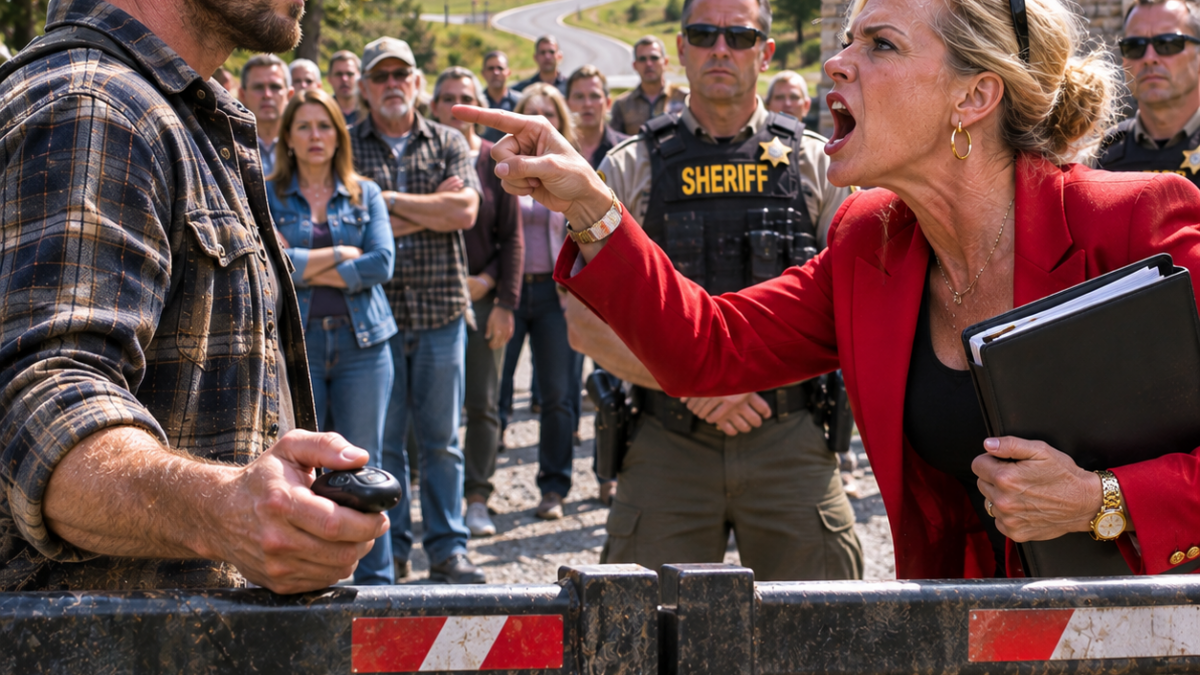
At the front of the traffic jam, HOA president Linda Crawford screamed that I was holding families hostage while I stood on my own ranch with the remote in one hand and the phone I had already used to make the most important call of my life in the other.
What Linda did not know was that the county had just uncovered the second road her developer was legally required to build—and the forged signature they had used to steal mine was about to bring their entire arrangement down.
Fourteen months earlier, I had buried my father.
Three days after the funeral, I left Colorado for a lineman contract in Alaska.
People thought that was strange.
Maybe it was.
My father, Earl Garrett, had spent almost seventy years on the same ranch outside Fort Collins.
He was born there.
Worked there.
Raised me there.
Buried my mother there.
And died there in the downstairs bedroom with the window open because he said hospitals smelled like surrender.
After the funeral, the ranch felt unbearable.
Everywhere I looked was him.
His gloves on the workbench.
His coffee mug beside the sink.
His coat behind the mudroom door.
The old blue tractor he refused to replace because “new machines have too many opinions.”
Even the kitchen chair across from mine seemed accusatory.
So when a contractor I knew called about a fourteen-month transmission-line job in Alaska, I said yes before he finished explaining the pay.
I told myself I was going for money.
Really, I was running.
I left the ranch in the hands of Hank Mercer.
Hank had worked for Dad since I was thirteen.
He was seventy-two, bowlegged, half deaf, and more loyal to the Garrett family than some blood relatives.
“Go,” he told me the morning I left.
“You sure?”
“I’ve kept this place standing through three droughts, two blizzards, and your father’s plumbing.”
“That’s not an answer.”
“It’s more than an answer.”
I smiled.
“What about the south pasture?”
“I’ll watch it.”
“Fence?”
“I’ll watch it.”
“Cattle?”
“Wade.”
“What?”
“Go.”
So I did.
Fourteen months later, I came home on an October afternoon with two duffel bags, a beard I hadn’t intended to keep, and enough money in the bank to finally replace the roof Dad had been patching one leak at a time.
The first few miles felt exactly like memory.
County road.
Cottonwoods.
Open pasture.
PART2:
The distant Front Range turning purple beneath the late-afternoon sky.
Then I turned onto Garrett Ranch Road.
Something felt wrong.
I slowed.
At first, I couldn’t identify it.
Then I saw the fence.
A section near the southern pasture had been replaced.
New posts.
New wire.
Not our work.
I stopped the truck.
Got out.
Walked closer.
Bolted to one of Dad’s old cedar fence posts was a plastic sign.
HAIL RIDGE ESTATES
RESIDENT ACCESS
I stared at it.
Never seen it.
Never approved it.
Then I heard tires behind me.
Not another truck.
Tiny feet.
A small pink pig trotted around my rear bumper.
“Biscuit?”
He grunted.
Biscuit had belonged to Dad.
PART3:
Technically, Dad said Biscuit belonged to nobody because “a pig with that much attitude can’t be owned.”
When I’d left, he was barely more than a piglet.
Now he was an overweight pink missile with mud on his nose.
He walked directly up to me like I’d been gone for lunch instead of fourteen months.
“Good to see you too.”
Biscuit snorted.
Then turned and started walking toward the south pasture.
I don’t believe animals deliver omens.
But I followed him anyway.
That’s when I found the road.
Dad’s southern hay field used to be uninterrupted grass for nearly half a mile.
Now a twenty-four-foot-wide gravel road cut across it.
Fresh compacted aggregate.
Drainage ditches.
Reflective markers.
Utility trenching along one side.
Tire tracks everywhere.
I stood in the middle of it.
“What the hell?”
Biscuit rooted at the shoulder.
The road climbed the ridge beyond our property.
I got back into the truck and followed it.
At the crest, my stomach dropped.
Houses.
Rows of them.
Brand new.
Modern farmhouse facades.
Black windows.
Stone veneers.
Two-car garages.
Landscaped yards.
Kids riding bicycles.
People walking dogs.
Amazon packages on porches.
Fifty homes.
Maybe more lots beyond them.
A carved stone monument at the entrance read:
HAIL RIDGE ESTATES
A woman watering flowers waved at me.
I didn’t wave back.
A man loading golf clubs into an SUV gave me the polite nod people give neighbors they haven’t met.
Neighbor.
That word felt wrong.
This had all been pasture.
Dad’s hay field ended at the ridge.
Beyond that had been eighty acres owned by the Hale family.
Apparently someone had developed it while I was gone.
That wasn’t my problem.
The road was.
I drove back to the ranch house.
Hank sat on the porch.
He saw my face.
Removed his cap.
That was enough.
“What happened?”
“Wade—”
“What happened to the south road?”
He looked down.
“Hank.”
“Your dad signed something before he got sick.”
My chest tightened.
“What?”
“Builder came around. Preston Hale.”
I knew the name.
Hale family had owned the ridge property for decades.
“What did Dad sign?”
“Temporary construction access.”
“For what?”
“Trucks.”
“Across the pasture?”
Hank nodded.
“How long?”
“Supposed to be during construction.”
“How long exactly?”
“I don’t know.”
“Did you read it?”
“I saw it once.”
“Did Dad?”
“Of course.”
“Then why are residents using it?”
Hank twisted the cap in his hands.
“Because after he died, nobody stopped them.”
I stared toward the south pasture.
“The license was temporary.”
“That’s what your dad said.”
“Did he grant an easement?”
“No.”
“You sure?”
“Wade.”
Hank looked at me.
“I knew your father fifty years.”
Fair.
Dad would loan you a tractor.
He would lend you money without interest if your barn burned.
He once let a neighbor graze twenty head on us for an entire summer because the man’s well failed.
But permanent land rights?
Never casually.
If Dad granted a road easement, there would be surveys, lawyers, maps, and probably handwritten notes explaining where everyone else was wrong.
“When did he sign?”
“Before you left. Maybe two years ago.”
“And it was only for construction?”
“That’s what he told me.”
“Why didn’t you call?”
Hank’s eyes dropped.
“I did.”
“What?”
“Alaska number you gave me stopped working after Christmas.”
I remembered.
Changed contractors.
Changed satellite provider.
Kept telling myself I’d update everybody later.
Shame arrived.
“You emailed?”
“Three times.”
I hadn’t checked the old account in months.
Work.
Grief.
Excuses.
“I should’ve—”
“Don’t.”
He put his cap back on.
“You came home.”
That night, I barely slept.
Every twenty minutes, headlights crossed my south pasture.
Cars going home.
Delivery vans.
Residents.
A road Dad allowed temporarily had become a neighborhood street.
At 6:40 the next morning, I heard an engine outside.
White Lexus SUV.
It came up my driveway fast and stopped hard near the porch.
A woman got out.
Blonde.
Mid-fifties.
Red blazer.
Black trousers.
Gold watch.
Leather binder under one arm.
She didn’t say hello.
“Are you Wade Garrett?”
“Depends who’s asking.”
“Linda Crawford. President of the Hail Ridge Homeowners Association.”
She climbed the porch steps without invitation.
“You’re blocking our road.”
I looked past her.
My truck was parked beside my barn.
“How?”
“Your cattle trailer is too close to the access corridor.”
“My cattle trailer is on my ranch.”
“It’s obstructing HOA traffic sight lines.”
I laughed.
She did not.
“Ms. Crawford—”
“Linda.”
“No.”
That threw her.
I continued.
“Why are Hail Ridge residents driving across my property?”
She opened her binder.
“Because Hail Ridge owns a perpetual right-of-way easement across the Garrett parcel.”
“Since when?”
“Your father granted it.”
“No.”
She smiled.
Not friendly.
Patient.
Condescending.
“I understand this may be upsetting because you’ve been away, but the legal work is settled.”
“Show me.”
She pulled out a document.
Photocopy.
Legal description.
Map.
Notary block.
My father’s name.
EARL GARRETT.
PERPETUAL ACCESS EASEMENT.
I read the first page.
Then second.
My pulse slowed instead of rising.
That happens when something is deeply wrong.
The signature looked like Dad’s.
Close.
But not quite.
He had a distinctive capital E.
The one on the document was nearly perfect.
Nearly.
“What date?”
Linda pointed.
I read it.
December 18.
I looked at her.
“You sure about this?”
“Completely.”
“Recorded?”
“Of course.”
“County book and page?”
She tapped the binder.
“Our counsel has all of that.”
“So you don’t know.”
“I don’t need to know.”
“Interesting.”
She shut the binder.
“The easement is HOA common access now. You have no authority to gate it, block it, narrow it, or interfere with resident traffic.”
“I haven’t done anything yet.”
“Good.”
She smiled.
“Keep it that way.”
Then she added:
“Fifty families rely on that road.”
There was a warning in the sentence.
“I’ll check the record.”
“You do that.”
She turned.
Then looked back at the pasture.
“And honestly, Wade, your father understood progress better than you seem to. That road raised the value of your frontage considerably.”
That almost made me laugh.
Instead, I said:
“My father died October eleventh.”
Linda stopped.
I held her eyes.
“The easement you just showed me is dated December eighteenth.”
For one fraction of a second, something flashed across her face.
Fear.
Then it vanished.
“You must be mistaken.”
“I’m not.”
“Perhaps it was executed earlier and recorded later.”
“The signature date says December eighteenth.”
She looked down at the binder.
Then back up.
“Our attorneys verified it.”
“Good.”
I stepped aside.
“Then you won’t mind if mine does too.”
She left without another word.
At 8:05, I was standing inside the county recorder’s office.
The title examiner was named Gil Ostrander.
Late sixties.
Wire-rim glasses.
Quiet voice.
The kind of man who treated land records like scripture.
I gave him the parcel number.
“My father owned it before me.”
Gil typed.
“Garrett Ranch?”
“Yes.”
“I know the place.”
“Need every recorded document affecting the south section.”
“Easements?”
“Especially.”
He typed for almost ten minutes.
Printed.
Scrolled.
Printed again.
Then frowned.
“Who says there’s an easement?”
“Hail Ridge HOA.”
“Perpetual?”
“That’s what they claim.”
He typed again.
“No.”
“No what?”
“No recorded perpetual easement.”
My shoulders loosened.
Then Gil added:
“But there is this.”
He pulled a scanned document.
Construction Access License.
Signed by Earl Garrett.
Preston Hale Development LLC.
Term:
Twenty-four months.
Purpose:
Temporary construction vehicles, grading equipment, utility installation related to Hail Ridge project.
Revocable for breach.
No permanent access rights created.
No transfer to homeowners.
No prescriptive rights.
No automatic extension.
Expiration date.
I stared.
October 11.
The date Dad died.
Same day.
My throat tightened.
Dad had signed the license exactly two years earlier.
It expired the day we buried him.
Fourteen months ago.
“Any extension?”
Gil searched.
“No.”
“Any amendment?”
“No.”
“Anything recorded December eighteenth?”
“No.”
I showed him Linda’s copy on my phone.
Gil leaned closer.
“Interesting.”
“That’s a polite word.”
“Where’d you get it?”
“HOA president.”
He read.
“Recording number?”
“There isn’t one on this copy.”
“Notary?”
He zoomed.
“Marsha Bell.”
He typed.
Then stopped.
“Huh.”
“What?”
“Her commission expired September thirtieth.”
Three months before the alleged signature.
My stomach went cold.
“Can a notary notarize after expiration?”
“No.”
“Can a dead man sign a perpetual easement?”
Gil looked over his glasses.
“Not successfully.”
I called Dana Whitfield before leaving the parking lot.
Best real estate attorney in Larimer County according to three people I trusted.
She told me to email every document.
Twenty minutes later, she called.
“Where are you?”
“Recorder’s office.”
“Come here.”
Dana’s office was above a bank downtown.
No mahogany.
No dramatic law books.
Whiteboards.
Maps.
Folders.
A dog asleep beneath a conference table.
She was early forties, black hair tied back, sleeves rolled up.
She read Linda’s document once.
Then again.
Tapped the notary stamp.
“Bad.”
“The signature?”
“Also bad.”
“Forgery?”
“Likely.”
“Likely?”
“I’m your lawyer. We use careful words.”
“My father was dead.”
“That part is less ambiguous.”
She pulled the temporary license.
“Your father did grant access.”
“Construction only.”
“Exactly.”
“Expired.”
“Fourteen months ago.”
“And residents have been using the road since.”
“Yes.”
“Did you know?”
“No.”
“Were you receiving rent?”
“No.”
“HOA fees?”
“No.”
“Maintenance payments?”
“No.”
“Any communication granting permission after expiration?”
“No.”
She leaned back.
“Good.”
“Can I gate it?”
“Eventually.”
“Eventually?”
“Do not lock fifty households in tomorrow morning.”
“It’s my road.”
“Yes.”
“They have no right.”
“Probably.”
“Probably?”
“Wade, ownership and emergency access are not the same question. These people bought homes believing they had access.”
“Not my problem.”
“It becomes your problem if you knowingly create an unsafe situation.”
I didn’t like that.
She knew.
“We do this clean.”
“How?”
“Notice.”
“How long?”
“Thirty days.”
“Why give them anything?”
“Because thirty days proves reasonableness.”
She pointed at Linda’s forged document.
“If they have another legal route, they build it. If they need an easement, they negotiate. If they claim necessity, they can go to court.”
“And if they ignore me?”
Dana smiled.
“Then you’re not the villain.”
That afternoon, she drafted formal notice.
Delivered to:
Hail Ridge HOA.
Preston Hale Development.
All registered agents.
The notice stated:
The temporary construction license had expired.
No recorded permanent easement existed.
Continued residential use was unauthorized.
Daily vehicular access would terminate in thirty days.
Emergency service access would not be obstructed.
HOA should immediately establish alternative lawful ingress and egress.
Dana also offered to discuss a paid temporary easement if necessary.
Insurance.
Traffic limits.
Maintenance.
Defined term.
Reasonable.
Fair.
Linda signed for the certified letter herself.
Day one.
Nothing.
Day five.
Nothing.
Day twelve.
Nothing.
Day twenty.
Still nothing.
Then Hank showed me Linda’s Facebook post.
A screenshot sent by a neighbor.
HAIL RIDGE COMMUNITY UPDATE:
Unfortunately, the returning owner of the neighboring Garrett parcel is attempting to disrupt our community by challenging long-established access rights.
His actions appear intended to extract money from hardworking families who have legally purchased homes with guaranteed road access.
The board will not submit to intimidation by a landlocked lunatic attempting to hold families hostage.
Landlocked lunatic.
I laughed.
Dana didn’t.
“Save everything.”
“I did.”
“Do not respond online.”
“I wasn’t going to.”
“You looked like you were going to.”
“I had a good reply.”
“No.”
“Want to hear it?”
“No.”
“Your loss.”
Day twenty-four, I attended their HOA meeting.
Hail Ridge held meetings in the sales clubhouse.
Fifty folding chairs.
Nearly all occupied.
I sat in the back.
Linda wore the red blazer again.
Preston Hale sat beside her.
I recognized him from county development filings.
Forty-something.
Tall.
Perfect hair.
Developer confidence.
The meeting began with landscaping.
Trash cans.
Holiday lighting.
Then “access dispute.”
Linda stood.
“Many of you have seen irresponsible online claims from Mr. Wade Garrett.”
I hadn’t posted anything.
“Our counsel assures us Hail Ridge possesses permanent access.”
A man asked:
“Then why did we get the thirty-day notice?”
“Harassment.”
Another:
“Can he really close the road?”
“No.”
She said it immediately.
No hesitation.
I raised my hand.
Linda saw me.
Her expression froze.
“You.”
“Me.”
Residents turned.
I stood.
“My name’s Wade Garrett.”
Murmurs.
I held up Dana’s proposed agreement.
“I’m not here to strand anybody.”
Linda interrupted.
“You are not recognized.”
A homeowner said:
“Let him talk.”
Others agreed.
Linda sat reluctantly.
I continued.
“My father gave the developer a temporary construction license. It expired fourteen months ago.”
Preston leaned forward.
“That’s disputed.”
“The county record isn’t.”
He said nothing.
“I’ve offered your HOA a temporary paid easement while you build lawful access.”
Someone asked:
“How much?”
“Fair market rate determined by appraisal. HOA carries insurance. Weight restrictions. Maintenance. Emergency access guaranteed.”
A woman in the third row said:
“That sounds reasonable.”
Linda stood.
“It isn’t.”
She walked toward me.
“Mr. Garrett has no authority to sell us something we already own.”
I handed her the letter.
She took it.
Looked at it.
Then tore it in half.
Once.
Twice.
Dropped the pieces.
“We don’t negotiate with squatters.”
The room went silent.
I stared at her.
“Squatter.”
“You abandoned that ranch for more than a year.”
“My deed didn’t.”
Preston stood.
“This meeting is over.”
I looked at the residents.
“Day thirty is Friday.”
Then left.
As I reached the door, I saw an elderly woman in the third row bend down.
She picked up the torn pieces of my offer.
Folded them carefully.
Put them in her purse.
Two nights later, Biscuit woke me.
You’ve never heard a pig scream until you’ve heard one convinced somebody is trespassing.
It was 1:17 a.m.
He squealed near the mudroom.
I grabbed boots and flashlight.
Headlights moved slowly along the south fence.
Engine off.
Parking lights only.
Two figures.
I stayed behind the barn.
Then heard:
SNAP.
Bolt cutters.
Fence wire dropped.
One figure held a flashlight.
The other cut.
I shouted:
“HEY!”
They ran.
One slipped.
Recovered.
Both reached a dark pickup parked beyond the property.
Gone.
I didn’t chase.
Dad taught me better.
Instead, I checked the trail cameras.
Dad installed them years earlier because teenagers used to cut through pasture during hunting season.
Camera one showed the truck.
Camera two showed faces.
Preston Hale.
Bolt cutters in his hands.
And behind him—
Linda Crawford.
Red blazer.
At one in the morning.
On ranch land.
Pointing toward the fence.
I called Dana.
She answered groggy.
“Wade?”
“You’re going to enjoy this.”
“That sentence scares me.”
I sent the footage.
Silence.
Then:
“Oh.”
“Yeah.”
“Do not call Linda.”
“Wasn’t going to.”
“Do not call Preston.”
“No.”
“Call sheriff non-emergency.”
“Now?”
“Now.”
The report was filed.
The fence was repaired.
The footage copied three ways.
Then Dana said:
“Tomorrow we contact county engineering.”
“Why?”
“Because I don’t believe fifty houses were approved with one road crossing an unrecorded temporary construction license.”
That question changed everything.
County engineer Miriam Sato met us the next afternoon.
Small woman.
Yellow safety vest.
Hard hat.
No wasted words.
She pulled the Hail Ridge final subdivision map.
Approved three years earlier.
There were two required access points.
The first:
Garrett Construction Access.
TEMPORARY ONLY.
The second:
East Connector Road.
Permanent.
Required before full buildout.
I leaned over the blueprint.
“Where’s East Connector?”
Miriam pointed.
Along the eastern edge of Hail Ridge.
Through developer-owned land.
Connecting to County Road 18.
“Never built.”
“Why?”
“You’d have to ask Hale.”
“Was it optional?”
“No.”
“Why were fifty certificates of occupancy issued?”
Her expression hardened.
“We’re checking.”
Dana asked:
“Could the developer substitute Garrett access?”
“Only with permanent recorded rights and county approval.”
“Any approval?”
“No.”
Miriam looked at us.
“I see no permanent easement in our file.”
I laughed once.
“The road they were required to build—”
“Was East Connector.”
“And they didn’t build it.”
“No.”
“Because mine was cheaper.”
Miriam didn’t speculate.
She didn’t need to.
East Connector required a bridge over a drainage channel.
Retaining wall.
More grading.
More money.
My father’s temporary gravel road had already existed.
Why spend a million dollars building the required road when you could quietly turn a temporary license into a fake permanent easement?
Dana looked at me.
“Day thirty-one.”
I knew what she meant.
Day thirty arrived.
Nothing from HOA.
No negotiated agreement.
No court filing.
No easement.
No construction on East Connector.
At 12:01 a.m., the deadline expired.
At 5:10, I drove to the south road.
The gate had been installed the previous afternoon.
Black steel.
Commercial operator.
Emergency override.
Fully inside my property.
Fire department had been given access credentials.
Sheriff’s office notified.
EMS notified.
County notified.
I wasn’t improvising.
I stood beside it as sunrise came over the ridge.
Biscuit sat near my boots chewing something he shouldn’t have found.
I held the remote.
Then called Dana.
“Ready?”
“Yes.”
“Make the call.”
She called county enforcement.
I closed the gate.
At 6:52, the first pickup arrived.
Stopped.
Driver stared.
At 7:05, five cars.
At 7:20, twenty.
At 7:45, the road backed up into Hail Ridge.
People honked.
Got out.
Called HOA.
By eight, nearly fifty vehicles were stacked along Ridge Road.
Parents.
Workers.
Contractors.
Delivery drivers.
One school bus turned around before reaching the mess.
Then the white SUV appeared.
Linda.
She drove around the line on the shoulder.
Stopped.
Door flew open.
Red blazer.
Binder.
Same uniform.
“Wade!”
I leaned against the fence.
“Morning.”
“OPEN THIS GATE.”
“No.”
“You have no authority.”
“Thirty-day notice expired.”
“We rejected your notice.”
“That’s not how notices work.”
“You are holding fifty families hostage.”
“No.”
“Nobody can leave!”
“They can walk. Emergency access is open. Daily vehicle access isn’t.”
“This is our only road!”
I looked at her.
“That’s unfortunate.”
She shook the gate.
“Open it!”
“No.”
“I’m calling the police.”
“Already did.”
Her hand stopped.
“What?”
Sirens sounded behind me.
Two sheriff’s cruisers.
Linda’s face brightened.
Wrongly.
Deputy Tom Reyes arrived first.
Forties.
Calm.
He had already seen Dana’s packet.
Linda rushed him.
“Arrest him.”
Reyes didn’t react.
“He has illegally barricaded a public egress.”
Reyes looked at me.
“Morning, Wade.”
“Tom.”
Linda froze.
“You know him?”
“County’s small.”
He pulled out the documents.
Deed.
Temporary license.
Expiration.
Title report.
Thirty-day notice.
Fire department access protocol.
Then he looked at Linda.
“Ma’am, based on what I’ve been given, Mr. Garrett owns the roadway corridor.”
“We have an easement.”
“Can you produce a recorded one?”
She held up the forged copy.
Reyes didn’t take it immediately.
“County book and page?”
She stared.
He had learned that question from Dana.
Linda’s face tightened.
“This is ridiculous.”
Reyes said:
“If there’s a competing property claim, that’s a civil matter.”
The exact phrase the HOA had used against me for more than a year.
I almost smiled.
Then someone screamed from the traffic line.
“Help!”
A man ran toward us.
“My wife—she’s having chest pain.”
Everything stopped.
I hit the remote instantly.
Gate opened.
“Where?”
“Blue Tahoe.”
Reyes radioed.
EMS had already been staged nearby because Dana insisted on planning for exactly this.
Ambulance arrived within minutes.
I waved it through.
No debate.
No conditions.
Nothing.
Linda pointed.
“SEE?”
She turned toward residents.
“He has to keep it open. This is an emergency access route.”
Dana’s voice came from behind her.
“Correct.”
Everyone turned.
Dana walked up carrying a folder.
“Emergency vehicles will always have immediate access.”
She stood beside me.
“Fire.”
“Ambulance.”
“Sheriff.”
“No questions.”
Then she looked at Linda.
“But ordinary residential traffic across private land ends today.”
A murmur moved through the crowd.
Linda went pale.
“There is no other exit.”
A voice behind Dana answered:
“Actually, there is.”
Miriam Sato stepped out of a county truck.
Hard hat.
Vest.
Rolled blueprint under one arm.
That was the call I’d made.
Not to deputies.
Not to some private security company.
Dana had called county engineering and development enforcement the moment the gate closed.
Miriam spread the subdivision plan across the hood of her truck.
Residents crowded closer.
She pointed to Hail Ridge.
“Original approval required two access points.”
Then tapped the east boundary.
“East Connector Road.”
Linda stared.
“That was conceptual.”
“No.”
Miriam’s voice remained flat.
“It was a condition of approval.”
Preston Hale arrived at that exact moment.
Black Escalade.
He got out.
Saw Miriam.
Stopped.
That told everyone more than words could.
She looked at him.
“Mr. Hale.”
“Miriam.”
“Where is East Connector?”
He smiled.
“Still under engineering review.”
“Three years later?”
“We encountered cost complications.”
“Your subdivision is occupied.”
“We had alternate access.”
She pointed toward my ranch.
“Temporary construction license.”
Preston glanced at me.
Then at the residents.
“It was extended.”
Dana stepped forward.
“By a dead man?”
Silence.
Linda’s mouth opened.
Closed.
Preston’s expression hardened.
“Wade.”
He approached.
“Let’s stop this circus.”
“This isn’t mine.”
He pulled a thick envelope from his jacket.
“I’ll buy the easement today.”
“How much?”
“Name it.”
Residents watched.
I looked at the envelope.
Then him.
“My father’s signature was forged.”
His eyes changed.
“That’s an accusation.”
“No.”
Dana held up a printed email.
“That would be the accusation.”
She looked at Linda.
“This is evidence.”
Linda’s face lost color.
Dana read the subject line.
“Extension signed. Use this if the ranch guy complains.”
Nobody moved.
“From Linda Crawford’s HOA email.”
She looked at Preston.
“Sent to your office eleven months ago.”
Someone gasped.
Linda whispered:
“That email was private.”
That may have been the dumbest thing she ever said.
Dana smiled faintly.
“You aren’t denying it.”
Linda looked around.
Fifty families.
Neighbors.
People who had trusted her.
Then she did something I never expected.
She ran.
Not on foot.
To the Lexus.
She jumped in.
Started it.
Accelerated toward the open emergency lane.
Deputy Reyes stepped in front.
Hand raised.
The SUV stopped less than a foot from his knees.
The entire crowd went silent.
Reyes walked to her window.
“Put it in park.”
Linda didn’t.
“Ma’am.”
Her hands shook.
“Put it in park.”
She did.
“Turn off the engine.”
She stared straight ahead.
Then shut it off.
Reyes said:
“Step out.”
This wasn’t a movie.
He didn’t throw her on the hood.
Didn’t handcuff her dramatically in front of everybody.
He simply escorted her aside to speak with investigators.
But by then, it didn’t matter.
The crowd had turned.
An elderly woman moved toward me.
Cane.
Gray hair.
Blue coat.
I recognized her.
Third row.
HOA meeting.
She reached into her purse.
Pulled out paper.
My torn offer.
She had taped it back together.
“My name is Ruth Dorsey.”
“I remember you.”
“I read this.”
She held it up.
“You offered insurance.”
“Yes.”
“Temporary access.”
“Yes.”
“Maintenance.”
“Yes.”
“Fair market compensation.”
“Yes.”
She turned toward the crowd.
“He didn’t try to trap us.”
Linda stood twenty yards away with a deputy.
Ruth raised her voice.
“We were lied to.”
Residents quieted.
“This man gave us thirty days.”
She shook the taped letter.
“Linda tore up the only fair offer anyone put on the table.”
Then she looked at Preston.
“And the developer never built the road he was required to build.”
A man near the front shouted:
“How fast can East Connector be finished?”
Miriam answered.
“Depends how much preliminary work is complete.”
Everyone looked at Preston.
He rubbed his jaw.
“Could be months.”
The crowd exploded.
Dana spoke with Miriam quietly.
Then with me.
We had anticipated this too.
I didn’t want fifty families stranded while the county fought with Preston.
So we offered one final temporary solution.
Ninety-day emergency license.
Not permanent.
Not residential entitlement.
Strictly time-limited.
Hail Ridge paid insurance.
Traffic controls.
Road maintenance.
Daily access during defined hours.
Emergency services always.
And every dollar of license payment went toward restoring my pasture afterward.
Most importantly:
The agreement terminated automatically once East Connector opened.
No prescriptive rights.
No extension by silence.
No claim of necessity.
No future easement.
Ruth looked at me.
“You’d still let us through?”
“For ninety days.”
“After all this?”
“You’re not Linda.”
That line spread through the crowd.
Maybe it was harsher than I intended.
Nobody complained.
Hail Ridge called an emergency board session that afternoon.
Linda had already stepped aside.
Preston didn’t attend.
Ruth was appointed interim president because apparently being the only person who saved the torn agreement made her the most trusted person in the neighborhood.
I liked that.
They signed.
The gate opened.
Traffic resumed.
But everything had changed.
The sheriff’s office investigated the forged extension.
County development enforcement investigated Hail Ridge approvals.
The notary whose expired stamp appeared on the document had not notarized it.
She signed an affidavit saying so.
That was bad for Linda.
Very bad.
Emails showed Preston knew the East Connector requirement remained outstanding.
He had delayed construction because estimates came in far higher than expected.
My father’s temporary road cost almost nothing.
So after Dad died, someone created paperwork making temporary access look permanent.
Cheap became convenient.
Convenient became assumed.
Assumed became entitlement.
Until I came home.
Within a week, Preston Hale’s remaining development permits were suspended pending compliance review.
He hired three attorneys.
Then four.
The county didn’t care.
East Connector construction started eleven days after the gate incident.
Amazing how quickly “months of engineering” becomes “mobilizing immediately” when fifty buyers, county inspectors, and lawyers are all asking the same question.
They worked six days a week.
Bridge culvert.
Retaining walls.
Drainage.
Base.
Paving.
Guardrails.
Lighting.
The road Hale should have built from the beginning.
Residents started stopping by the ranch.
Some apologized.
Some didn’t.
One man brought whiskey.
A woman brought bread.
A young couple came with their two daughters.
“We bought because Hale told us the south road was permanent.”
“I believe you.”
“We would’ve never bought otherwise.”
“I believe that too.”
The husband looked toward the pasture.
“Do you hate us?”
“No.”
“You sure?”
“I don’t know most of you well enough.”
He laughed.
Then became serious.
“We should’ve asked questions.”
“You bought a house.”
“Still.”
“Ask them now.”
That’s all I wanted.
Not revenge.
Questions.
Who owns the road?
Where is the easement?
Why wasn’t East Connector built?
Who signed the extension?
Why is the signature dated after Earl Garrett died?
Simple questions.
Expensive answers.
Linda resigned officially before the recall vote finished.
Ruth won the replacement election overwhelmingly.
Her first act as president was releasing every road-access document to residents.
Her second was hiring independent counsel.
Her third was banning Preston Hale from HOA meetings unless invited in writing.
I told her that one was petty.
She said:
“I learned from you.”
Fair.
Preston’s problems continued.
County fines.
Construction delays.
Civil claims.
The HOA sued the development company over misrepresentation.
Several homeowners joined.
My attorney filed separate claims for trespass, fence cutting, unauthorized use, and the forged property document.
I won’t pretend criminal court moved overnight.
It didn’t.
Investigations take time.
Forensic document review.
Emails.
Notary records.
Witness statements.
Hank’s testimony.
County records.
But the lie was no longer controlling anything.
That mattered more to me than headlines.
The East Connector opened eighty-seven days after my gate closed.
Three days before the temporary license expired.
That morning, Ruth called.
“It’s open.”
“I heard.”
“You coming?”
“Where?”
“First drive.”
“No.”
“Wade.”
“What?”
“You caused this.”
“I absolutely did not.”
She laughed.
“Come anyway.”
So I drove Dad’s old red Chevy over.
Biscuit came too.
He had developed a strange affection for Ruth because she brought apples.
A crowd gathered near the new connector.
County officials.
Residents.
Kids.
No giant ribbon.
Ruth said after everything that happened, ceremonial scissors felt inappropriate.
The first cars drove east.
People honked.
Some waved.
One teenager leaned out the passenger window and shouted:
“THANK YOU, WADE!”
I shouted back:
“USE YOUR OWN ROAD!”
Everybody laughed.
Even me.
At sunset, the last vehicle left the temporary south route.
Ruth drove it.
She stopped before crossing my gate.
Got out.
Walked over.
“That’s everybody.”
“You sure?”
“Counted.”
“Deliveries?”
“Redirected.”
“Emergency services?”
“County updated.”
I looked down the old gravel line.
For the first time since coming home, there were no resident headlights waiting behind us.
I pressed the remote.
Black gate swung shut.
Metal latch clicked.
Ruth watched.
“Feels good?”
I thought.
“Quiet.”
“Same thing?”
“Sometimes.”
She smiled.
Then handed me a pie box.
“Apple.”
“For what?”
“For not being an ass when you had every reason to be.”
“That’s a strange thank-you.”
“I’m seventy-six. I say what I want.”
Biscuit heard the word apple.
He pushed between us.
Ruth laughed.
“I brought him one too.”
“Traitor.”
She scratched behind his ear.
The road didn’t remain.
That surprised some people.
I could have kept it.
Paved it.
Charged access.
Maybe turned it into some profitable private lane.
Didn’t want it.
Hale’s company was required to remove the widened sections, restore drainage, reseed pasture, repair fencing, and return the corridor to the condition specified in Dad’s original license.
Some gravel remained because I still needed ranch access.
But the subdivision street disappeared from my field.
Grass returned.
Fence rebuilt.
The Hail Ridge Access sign came off Dad’s cedar post.
I kept it.
It’s in the barn now.
Not because I cherish it.
Because sometimes evidence becomes comedy after enough time passes.
Hank found me hanging it on the wall.
“What’s that for?”
“Decoration.”
“Ugly.”
“Historical.”
“Still ugly.”
He stared at it.
Then said:
“Your dad would’ve gone to jail.”
I laughed.
“Probably.”
“He wouldn’t have waited thirty days.”
“No.”
“He’d have chained the road day one.”
“Definitely.”
Hank smiled.
“You did it better.”
That meant more than he knew.
For months after Dad died, I’d wondered whether leaving for Alaska had been cowardice.
Maybe it was.
Maybe I should’ve stayed.
Maybe if I’d stayed, the fake easement never would’ve worked.
Maybe Linda and Preston counted on an absent owner.
Maybe Hank shouldn’t have had to watch strangers drive across our pasture while I climbed power poles two thousand miles away pretending grief was just another weather condition.
I carried that guilt.
Then Dana told me something.
“Wade, ownership isn’t attendance.”
“What?”
“You didn’t surrender the ranch because you left it.”
“I should’ve been here.”
“Maybe.”
She shrugged.
“But being absent didn’t give them permission to forge your father’s name.”
That distinction mattered.
People who cross boundaries love explaining why the boundary was inconvenient.
You weren’t using it.
You weren’t home.
You had plenty of land.
We needed access.
The road already existed.
Families depended on it.
The developer spent money.
All of those things can be true.
None of them creates permission by itself.
Dad understood that better than I did.
Months after the case settled, Gil Ostrander from the recorder’s office called me.
“Found something you’ll want.”
“What?”
“Your father’s original construction license file.”
“I have the license.”
“Not this.”
There was a handwritten note attached to the back.
Dad’s handwriting.
Large block letters.
I drove down.
Gil handed it over.
Dad had written:
TEMPORARY MEANS TEMPORARY.
IF HALE WANTS RESIDENT ACCESS, NEW AGREEMENT REQUIRED.
DO NOT ALLOW THIS TO BECOME PERMANENT BY HABIT.
I stared at the page for a long time.
Dad knew.
Of course he did.
Preston had probably already hinted that the temporary road could be convenient later.
Dad had anticipated exactly what might happen.
I laughed.
Then cried.
Gil pretended not to notice.
“Can I get a certified copy?”
“As many as you want.”
I framed one.
It hangs above my desk.
TEMPORARY MEANS TEMPORARY.
Dad could reduce an entire legal dispute to three words.
That was his talent.
Ruth stayed HOA president two years.
Hail Ridge became quieter after East Connector opened.
Residents stopped driving across my ranch.
Some still visited.
With permission.
That’s the key.
One afternoon, Ruth called.
“My grandson wants to see Biscuit.”
“That’s a sentence I never expected from an HOA president.”
“Can we come?”
“Yes.”
Ask.
Permission granted.
Simple.
They came through the front gate.
Her grandson fed Biscuit half an apple and nearly lost a finger because Biscuit had no table manners.
Ruth sat on Dad’s porch.
“I still have the letter.”
“The torn one?”
“Taped together.”
“Why?”
“Reminder.”
“Of what?”
“That the reasonable option can look weak when somebody arrogant is shouting.”
I liked that.
She looked over the pasture.
“Linda told us you were trying to extort us.”
“I know.”
“We believed her because certainty is comforting.”
I looked at her.
“Until it’s wrong.”
“Especially then.”
Preston eventually sold his remaining interest in Hail Ridge.
The development company survived, but not unchanged.
His reputation in the county did not.
Developers depend on relationships.
County engineers remember.
Title companies remember.
Banks remember.
Neighbors remember too.
Linda moved away.
Last I heard, Arizona.
I never spoke to her again.
I didn’t need to.
The final court settlement required compensation for the unauthorized road use, damaged fencing, legal fees, and restoration.
I didn’t become rich.
Didn’t want to.
The land was restored.
My title was clear.
My father’s name was cleared.
That was enough.
The forged easement was formally declared invalid.
That mattered most.
Because I could tolerate somebody calling me difficult.
Could tolerate Facebook insults.
Could tolerate angry neighbors.
What I could not tolerate was seeing Dad’s name used to justify something he had specifically refused to give.
That signature had bothered me from the second Linda placed it on my kitchen table.
Too smooth.
Too convenient.
Nine weeks after his funeral.
A dead man apparently granting away permanent access to people he’d never met.
They thought nobody would check.
That’s always the gamble.
Not that the lie is perfect.
That nobody will look closely.
Linda counted on authority.
Red blazer.
Binder.
HOA title.
Legal-looking paperwork.
Preston counted on construction.
Fifty occupied houses.
A working road.
Dependence.
They both believed facts would bend toward whatever had already been built.
But land records don’t care how many mailboxes exist at the end of the road.
A forged signature doesn’t become real because children ride bicycles on streets built after it.
And a temporary license does not become permanent because somebody ignored the expiration date long enough.
Years later, the ranch is still mine.
Hank eventually retired.
At least officially.
He still appears every morning around seven and criticizes whatever I’m doing.
Biscuit grew enormous.
The veterinarian says he’s overweight.
Biscuit disagrees.
I rebuilt the south fence.
Planted new grass.
Fixed drainage.
The scar where the road crossed the hay field faded gradually.
You can still see it from the air.
Probably always will.
I don’t mind.
Some scars are useful.
They remind you where the boundary was tested.
The black gate remains.
Not because I need it.
East Connector handles all Hail Ridge traffic now.
My gate mostly stays closed.
On it, I mounted a small steel sign.
GARRETT RANCH
PRIVATE ROAD
PLEASE ASK
Ruth saw it the first time.
“That’s all?”
“What else?”
“No threats?”
“No.”
“No ‘trespassers will be prosecuted’?”
“No.”
“No cameras?”
“There are cameras.”
“Of course.”
She smiled.
“Please ask.”
“Worked better than forgery.”
One spring morning, a new Hail Ridge resident stopped outside.
Young couple.
Hadn’t lived through any of it.
The husband walked to the gate.
Didn’t open it.
Called the number on the small sign.
“Mr. Garrett?”
“Speaking.”
“Sorry to bother you. My daughter lost her dog. Tracker says he crossed onto your pasture.”
“What kind?”
“Golden retriever.”
“Name?”
“Charlie.”
“Come through. Close the gate behind you.”
“Thank you.”
Ten minutes later, Charlie was found drinking from Biscuit’s water trough.
The little girl hugged the dog.
Then Biscuit.
Biscuit endured it because she had crackers.
The father thanked me five times.
No lawyer.
No county engineer.
No deputy.
No HOA meeting.
Just a question.
Can we come through?
Yes.
That’s what makes the whole disaster seem so absurd now.
Linda and Preston created lawsuits, investigations, angry residents, road construction, legal fees, county enforcement, and months of chaos because neither was willing to ask a question whose answer might have been no.
And the ironic part?
If Dad had still been alive and Hail Ridge came to him before selling homes, he might have negotiated.
Not permanent ownership.
Dad would never have given that away.
But limited access?
Maybe.
Payment.
Insurance.
Rules.
Maintenance.
Defined term.
He was stubborn, not unreasonable.
I was the same.
I proved it when I offered the thirty-day deal.
Linda tore it up.
That was her real failure.
Not the forgery.
Not even the fence cutting.
Those were consequences of something deeper.
She couldn’t tolerate the idea that another person had the right to say no.
Once you believe that, every boundary begins looking like an obstacle instead of somebody else’s right.
I think about the morning of the gate often.
Fifty cars.
Horns.
Angry people.
Linda screaming.
Deputies.
Ambulance.
Miriam opening the subdivision plans.
Preston standing there with an envelope.
Ruth holding the torn letter.
From the outside, it probably looked like I had planned some perfect revenge.
I hadn’t.
I was terrified.
Not of Linda.
Of getting it wrong.
What if a medical emergency happened?
What if residents turned violent?
What if my title research missed something?
What if a judge decided the road had become necessary?
What if Dad had signed something else I hadn’t found?
That’s why Dana kept saying:
By the book.
She was right.
The gate mattered because everything before the gate was documented.
The thirty-day warning.
The temporary license.
The expired term.
The title search.
The forged date.
The notary record.
Emergency protocols.
County plans.
Trail-camera footage.
Without those things, I would’ve been a furious rancher with a gate.
With them, I was a landowner enforcing a documented boundary after giving everyone a fair chance to solve the problem.
That distinction saved me.
It also saved the residents.
Because once the truth came out, I didn’t need revenge.
The road I wanted closed was closed permanently only after their lawful road opened.
That’s the ending I can live with.
Not fifty families ruined.
Not people unable to reach work.
Not children trapped behind a fence.
A developer built what he was supposed to build.
Residents got legal access.
My pasture came back.
My father’s agreement was honored exactly as written.
Temporary meant temporary.
That’s justice enough.
On the anniversary of Dad’s death, I sit on the porch.
Every year.
Coffee.
No phone.
Biscuit somewhere nearby.
The mountains turn orange in late afternoon.
Sometimes I can hear cars on East Connector.
Faint.
Far enough away.
I think about Dad signing that construction license.
He was probably sitting at the same kitchen table.
Reading every sentence.
Making notes.
Thinking two years ahead.
Then I think about the forged version Linda brought into my house.
Same name.
Different intent.
One signature was real.
One wasn’t.
And for fourteen months, the false one controlled fifty families because nobody bothered to check.
Until I came home.
People say one phone call closed Hail Ridge’s only exit.
That’s not quite right.
The phone call wasn’t magic.
Dana called the county.
The county brought the plans.
The plans exposed East Connector.
The forged extension collapsed.
The developer’s lie unraveled.
The gate was only the moment everybody finally had to look at the paperwork they should have read years earlier.
That’s the real lesson.
A gate can stop traffic.
A deed can stop entitlement.
But truth only works if somebody is willing to pull the file, read the dates, and ask why a dead man supposedly signed away his land nine weeks after his funeral.
Linda thought I was holding a remote.
She thought the power was in the gate.
It wasn’t.
The power was in the record.
The expired license.
The unsigned permanent easement.
The county plan.
The email.
My father’s death certificate.
Everything they had hoped nobody would put together.
The gate eventually closed.
The traffic moved somewhere else.
Grass grew back.
And Hail Ridge learned that needing somebody else’s road does not make it yours.
Dad would have understood that.
Actually, he already did.
He wrote it down for me years before I knew I’d need it.
TEMPORARY MEANS TEMPORARY.
And when the last Hail Ridge truck finally drove onto its own road ninety days later, I pressed the remote, watched the black gate swing shut, and heard the latch fall into place.
No horns.
No screaming.
No red blazer.
Just wind moving through the pasture.
Biscuit sleeping near my boots.
And, for the first time since I came home, nothing crossing my father’s land that didn’t belong there.








