HOA Built 40% of Its $2.5M Pool on My Ranch—Then I Dug Up the Yellow Boundary Post They Cut and Buried
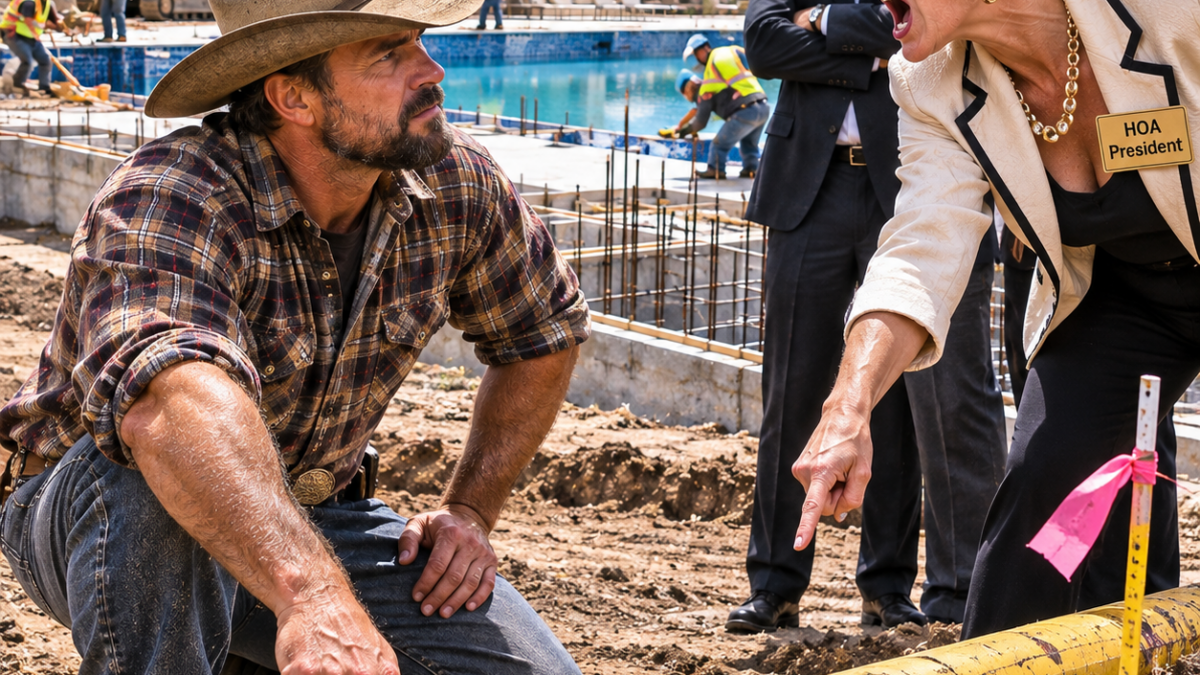
PART3:
The entire sales pitch was built around the idea that Oak Creek was not just a neighborhood.
It was a lifestyle.
I did not care.
Their pool was their business.
Until April.
I was checking cattle near the south pasture when excavators started.
Huge machines.
Tree clearing.
Rock breaking.
Dump trucks.
The noise echoed across the entire ranch.
My wife, Chloe, came outside one evening carrying coffee.
She watched the floodlights beyond our trees.
“They’re close.”
“Yeah.”
“Too close?”
I looked at the tree line.
“Maybe.”
Next morning I drove down in my F-250.
The construction footprint was enormous.
Rebar.
Formwork.
Retaining wall excavation.
Pump-house foundation.
The northern curve of the pool was pushed toward our boundary.
Too far.
I parked on my side.
Walked toward the construction line.
Rick stood beside the foreman.
Dave Higgins.
Big guy.
Gray beard.
Work boots.
Unlike Rick, Dave looked like he actually knew what concrete weighed.
Blueprints were spread across the Range Rover hood.
I stopped several feet away.
“Morning.”
Rick barely glanced up.
“If this is about construction noise, Mr. Callahan, we’re inside permitted hours.”
“I’m not here about noise.”
I pointed.
“That retaining wall is over my line.”
Dave looked at the excavation.
Then at Rick.
Rick smiled.
“No.”
“Yes.”
“We have a professional site plan.”
“So do I.”
“This project was surveyed with modern GPS.”
“Good.”
I pointed toward the cottonwoods.
“Then your surveyor should have found the yellow monuments.”
Rick laughed.
“Those rusty pipes?”
“They’re boundary markers.”
“They’re fifty years old.”
“So is the deed.”
His smile disappeared slightly.
“We used satellite-based equipment.”
I looked at Dave.
“Did you locate the recorded monuments before excavation?”
Dave shifted.
Rick answered for him.
“We located the legal boundary.”
“That wasn’t my question.”
Rick folded the blueprint.
“Mr. Callahan, this is a multi-million-dollar project.”
“I know.”
“We are not guessing.”
“Neither am I.”
He stepped closer.
“You ranchers have a tendency to treat historical habits as legal rights.”
I almost laughed.
“My deed isn’t a habit.”
“If you believe there is an issue, contact our attorney.”
“I’m telling you now because once you pour concrete, this gets expensive.”
His smirk came back.
“Stay off the construction site.”
“I’m standing on my land.”
“This is Oak Creek property.”
I looked down at my boots.
Then at him.
“We’ll see.”
I drove home angry.
But not worried.
I knew those yellow posts.
I had walked them with Granddad.
I had repaired fence beside them.
Moved cattle past them.
Hunted them in snow.
The next afternoon I went looking for the post nearest the pool excavation.
It should have been beside an old lightning-struck oak.
The tree was still there.
The post wasn’t.
I searched.
Nothing.
Walked fifty feet in both directions.
Found the next post.
Then measured back.
The missing one should have been exactly where I remembered.
Instead there was a pile of fresh pine limbs and disturbed dirt.
That made me stop.
I grabbed a shovel.
Moved branches.
Scraped away topsoil.
Three inches down:
Metal.
Yellow paint.
I dropped to my knees.
The post had not fallen.
Had not rusted.
Had not been hit accidentally.
It had been cut flush at ground level.
Clean.
Bright metal.
Fresh.
Tiny steel shavings still glittered in the dirt.
I sat there for a long moment.
Not because I did not understand.
Because I understood perfectly.
Someone had found the post.
Someone had known what it meant.
Someone had cut it.
Then buried the stump.
That changed everything.
A surveying mistake is one thing.
Removing the thing that proves the mistake is another.
I took photographs.
Wide shots.
Close-ups.
Metal shavings.
Cut surface.
Distances to the oak.
Distances to the next marker.
GPS location.
Then I covered it lightly so rain wouldn’t move the shavings.
I called Chloe.
“Come down here.”
Ten minutes later she arrived.
She crouched.
Looked.
Then said:
“That isn’t accidental.”
“No.”
“Rick?”
“Maybe.”
She looked toward the pool site.
“What do you want to do?”
I watched a cement truck pull in.
“Nothing yet.”
Chloe stared at me.
“They’re pouring.”
“I know.”
“You’re going to let them?”
“I’m going to document first.”
Rick had already ignored one warning.
If I ran down there screaming, he would call it a disputed boundary and keep building.
I needed something he could not talk around.
Monday morning I called Jim Miller.
Licensed surveyor.
Thirty-five years in the county.
Testified in boundary cases.
Knew historical plats better than most lawyers.
I told him:
“Emergency boundary survey.”
“How emergency?”
“They’re pouring a swimming pool.”
Pause.
“On your land?”
“I think so.”
“How much?”
“No idea.”
“And somebody cut one of Granddad’s yellow posts.”
Longer pause.
“Don’t touch it.”
“I didn’t.”
“I’ll be there tomorrow.”
Jim arrived with two survey technicians.
Total station.
Survey-grade GNSS receivers.
County plats.
Historical ties.
Monument records.
He started with undisturbed markers farther uphill.
Then worked south.
He did not care where I thought the line was.
That was why I hired him.
Surveyors who begin by trying to prove the client right are dangerous.
Jim wanted the answer.
Two days later he walked onto my porch carrying a rolled map.
Removed his cap.
“Tom.”
“How bad?”
“Depends which side you’re on.”
I stared.
He spread the map across the table.
Pink line.
True boundary.
Pool footprint.
Retaining wall.
Pump house.
Deck.
The line cut straight through them.
“Retaining wall is about twelve feet onto you.”
He pointed.
“Pump-house foundation varies from thirteen to fifteen.”
Then the pool.
“Deep-end shell crosses your line roughly eighteen feet at the widest point.”
Chloe leaned closer.
“How much total project area?”
Jim looked at us.
“Rough estimate?”
“About forty percent of the recreation footprint north of the legal boundary.”
I sat back.
Forty percent.
Not a fence.
Not a landscaping strip.
Not six inches.
A huge portion of the pool complex.
Jim pointed toward another page.
“I documented the severed monument.”
“Cut is recent.”
“Tool marks consistent with powered cutting equipment.”
“Photographed metal fragments.”
“Recorded everything.”
He looked at me.
“If they poured after removing that marker, somebody has explaining to do.”
I looked south.
Concrete forms already filled.
Gray shell hardening in the sun.
“Good.”
Chloe said:
“Good?”
I nodded.
“Now it’s expensive.”
Next afternoon the process server arrived.
Of course he did.
Black sedan.
Manila envelope.
Chloe answered.
We opened it at the kitchen table.
Oak Creek HOA.
High-end Denver law firm.
CEASE AND DESIST.
It accused me of:
Trespassing.
Harassing contractors.
Interfering with lawful construction.
Placing unauthorized survey stakes on HOA property.
Threatening delays.
Then:
Any further interference could expose me to claims for damages, increased construction costs, and injunctive relief.
I read it twice.
Then laughed.
Chloe did not.
She was staring at the law-firm letterhead.
“What?”
She tapped it.
“Why is Rick moving this fast?”
“Because he’s arrogant.”
“Maybe.”
“He thinks we’ll back down.”
“Maybe.”
She opened her laptop.
“But HOA boards are usually slow.”
“Rick isn’t.”
“Exactly.”
She looked toward the window.
“Two-and-a-half-million-dollar project.”
“Concrete poured before the boundary dispute is resolved.”
“Lawyer letter within twenty-four hours.”
“Someone cut a monument.”
She looked at me.
“There’s money somewhere we haven’t seen.”
Chloe had spent ten years in forensic accounting before marrying me.
She said she left corporate work because ranch bookkeeping was more honest.
That should tell you something about corporate accounting.
For four hours she worked.
State corporate registrations.
Contractor licensing.
HOA meeting minutes.
Vendor disclosures.
Permit documents.
Then:
“Tom.”
I came over.
She turned the screen.
MONTGOMERY CONTRACTING GROUP.
Owner:
Richard Montgomery.
I stared.
“That Rick Montgomery?”
“There aren’t many Richard Montgomerys at the same Oak Creek address.”
She opened HOA minutes.
Pool contract awarded to Montgomery Contracting.
$2.5 million.
Approved during a special board session.
I scrolled.
Conflict disclosure?
None visible.
Competitive bids?
Mentioned but not attached.
Rick had pushed the HOA to build the recreation center.
Then awarded the construction work to his own company.
Chloe continued.
“It gets better.”
“That usually means worse.”
She pulled up the original development plat.
Residential lots consumed nearly all buildable space.
The community center parcel was small.
Too small for the pool design shown in Rick’s renderings.
Unless the northern edge crossed our boundary.
I stared.
“He knew.”
Chloe nodded.
“If he kept the entire pool on HOA property, he would have to shrink the pool.”
“Move the pump house.”
“Change the retaining wall.”
“Probably drop part of the deck.”
“That reduces the contract scope.”
“His contract.”
I looked toward the cut yellow post in my mind.
The entire thing suddenly made sense.
The boundary was not inconvenient by accident.
The boundary was standing between Rick and the project he had promised.
And between Rick and part of his own contract revenue.
He needed more room.
My room.
So somebody removed the marker.
Then built over the line fast enough that he hoped nobody would stop it before demolition became economically painful.
Maybe he expected a court to say:
The pool is already built.
Pay Tom for an easement.
A few hundred thousand dollars.
Problem solved.
Rick keeps his project.
Rick keeps his company’s contract.
Oak Creek keeps its luxury amenity.
I become the difficult rancher who made everybody spend extra.
That was the plan.
I called David Harrison.
Property litigator.
Denver.
Known for being unpleasant in exactly the way you want your lawyer unpleasant when someone has poured an infinity pool eighteen feet into your ranch.
He reviewed everything.
Survey.
Photos.
Cease-and-desist.
Company records.
HOA minutes.
Then looked at me.
“What do you want?”
“My land back.”
“That’s not the same as money.”
“I know.”
“Do you want to sell them the strip?”
“No.”
“Easement?”
“No.”
“Settlement allowing the pool?”
“No.”
He leaned back.
“Good.”
“Why good?”
“Because then our position is simple.”
He tapped the survey.
“Remove it.”
He looked at the photograph of the cut post.
Then at Chloe’s corporate records.
“This is not a normal innocent encroachment.”
“No.”
“If we send Rick a polite warning, he will finish construction.”
“Then argue demolition is disproportionate.”
“That’s what Chloe and I thought.”
David smiled.
“We don’t warn him.”
“What do we do?”
“We freeze the project.”
Then he added:
“And let his own homeowners learn what he did before he convinces them to pay for it.”
Two nights later, Oak Creek held an emergency board meeting at a country-club banquet room because its new clubhouse was unfinished.
Chloe and I walked in with David.
About thirty homeowners attended.
Five board members at the front.
Rick in the middle.
He saw me.
His chair scraped backward.
“Callahan.”
“What are you doing here?”
David answered.
“Serving documents.”
Rick’s face darkened.
“This is a private HOA meeting.”
David smiled.
“My client owns part of the property your HOA is currently discussing.”
The room went quiet.
Rick stood.
“You’re trespassing.”
David looked around.
“Interesting word choice.”
Then he approached the board.
Passed out folders.
A woman at the far end said:
“Who are you?”
“Martha Gable?”
“Yes.”
“HOA treasurer?”
“Yes.”
“I’m David Harrison.”
“Counsel for Tom and Chloe Callahan.”
He placed the final folder in front of her.
“And you should probably start with page three.”
Rick slammed his palm on the table.
“This is harassment.”
David ignored him.
Martha opened the packet.
Stamped survey.
Pink-highlighted encroachment.
Her expression changed.
“What is this?”
Rick answered:
“Minor boundary discrepancy.”
I almost admired the confidence.
Martha pointed.
“Eighteen feet?”
“It can be resolved.”
She turned toward him.
“Forty percent?”
“The project footprint isn’t forty percent—”
David interrupted.
“The legally surveyed encroachment is shown precisely.”
“Retaining wall.”
“Pump-house foundation.”
“Deep end.”
“Portions of deck.”
A retired physician board member named Greg Halpern flipped pages quickly.
“Rick.”
“Did you know?”
“No.”
Rick said.
“This is new.”
I stepped forward.
“No.”
Every head turned.
I placed a photograph on the table.
Yellow stump.
Fresh cut.
Metal shavings.
“You found the boundary.”
Rick’s face hardened.
“No one touched your marker.”
“Somebody did.”
“Your accusation is outrageous.”
“Then you won’t mind an investigation.”
Martha looked at the photo.
“What is that?”
“My grandfather’s boundary monument.”
I said.
“Cut at ground level.”
“Buried.”
“Twenty yards from the pool.”
Greg stared at Rick.
Rick shook his head.
“Contractors move things.”
David said:
“Not recorded monuments.”
Then Chloe stepped forward.
She was calm.
That was always when I worried for the other person.
“Mrs. Gable.”
“Yes?”
“Who built the pool?”
Martha frowned.
“Montgomery Contracting.”
“And who owns Montgomery Contracting?”
Martha looked at Rick.
Then back at Chloe.
“I assume—”
“Richard Montgomery.”
Absolute silence.
Chloe placed the state registration in front of her.
“Your HOA president awarded a $2.5 million project to his own company.”
Martha stared.
Rick immediately said:
“The board approved the contract.”
Greg looked at him.
“Did you disclose ownership?”
“Everyone knew.”
“I didn’t.”
Martha said.
Another board member:
“Neither did I.”
Rick’s face reddened.
“It’s public information.”
Chloe nodded.
“Yes.”
“That’s how I found it.”
The homeowners started murmuring.
David lifted one hand.
“And now the important part.”
He displayed the original site plan.
“Your community center parcel does not comfortably accommodate the pool Rick promised while staying inside the recorded boundary.”
Another map.
“Move everything south legally, and the pool shrinks.”
“Deck shrinks.”
“Pump house moves.”
“Retaining design changes.”
“Contract value likely changes.”
He looked at Rick.
“Instead, the project moved north.”
“Onto the Callahan ranch.”
Rick stood.
“You’re inventing motive.”
“Maybe.”
David said.
“That’s what discovery is for.”
Martha’s face had changed completely.
She was no longer looking at us.
She was looking at Rick.
“How much has Montgomery Contracting already been paid?”
Silence.
“Martha.”
Rick began.
“How much?”
She reached for her laptop.
Rick stepped closer.
“This isn’t necessary.”
She looked up.
“Sit down.”
He froze.
That might have been the first order anyone on the board had given him in years.
He sat.
Martha opened the HOA financial portal.
Her face tightened.
“Seven hundred eighty thousand.”
Greg nearly stood.
“Already?”
“Mobilization.”
Rick said quickly.
“Materials.”
“Concrete.”
“Engineering.”
Martha turned.
“To your company.”
“Yes.”
“Without disclosing to us that you owned it.”
“I never hid it.”
Greg laughed.
“You literally never told us.”
The room erupted.
Rick tried to regain control.
“Everybody calm down.”
Nobody did.
David raised his voice just enough.
“Tomorrow morning we are seeking a temporary injunction stopping all work in the disputed area.”
The room quieted again.
“My clients are not offering an easement.”
“Not offering a sale.”
“Not offering a boundary adjustment.”
“They are seeking removal of everything built across their line.”
Someone asked:
“How much will that cost us?”
David looked at Rick.
“Excellent question.”
Then at the board.
“You should ask why your president created that exposure while his company was being paid to build it.”
That meeting destroyed Rick’s control before any judge ruled on anything.
By midnight, Oak Creek’s internal group chat was in open revolt.
Next morning Martha called Chloe.
“We suspended additional payments.”
Good.
Greg called David.
“We’re appointing independent counsel.”
Better.
By noon Rick had been removed from control of the project pending review.
By three, the judge granted a temporary injunction.
No further construction in the disputed area.
Concrete mixers stopped.
Tile deliveries stopped.
Crews stopped.
For the first time in weeks, the ranch became quiet.
I stood at the southern fence.
Pink survey ribbon fluttering.
Half-built pool beyond it.
I expected satisfaction.
Instead, I felt tired.
Chloe stood beside me.
“You okay?”
“Yeah.”
“No, you’re not.”
I looked at the pool.
“My grandfather drove those posts himself.”
“I know.”
“Somebody cut one because they thought nobody would care.”
Chloe took my hand.
“We care.”
The investigation found more.
A foreman eventually admitted one of Rick’s site supervisors ordered the yellow post removed after it conflicted with construction staking.
The explanation was:
“Obsolete marker.”
Nobody had verified that.
Because verifying it would have stopped work.
Emails showed Rick had been told weeks earlier that the project footprint was “tight against the northern ownership limit.”
Another message from a design consultant warned:
FINAL POOL GEOMETRY REQUIRES BOUNDARY CONFIRMATION PRIOR TO FORMING.
Rick replied:
PROCEED. SURVEY ALREADY RESOLVED.
Except it hadn’t been.
Then Chloe found the change-order structure.
Montgomery Contracting stood to earn more as project scope increased.
Larger pool.
Larger retaining system.
More concrete.
More mechanical work.
Rick did not merely want the big pool because it looked impressive.
The big pool paid him more.
That made the board furious.
Oak Creek filed claims against Montgomery Contracting.
Suddenly, for the first time, Rick was being attacked from both directions.
From us:
Encroachment.
Property damage.
Boundary destruction.
Restoration.
From his own HOA:
Undisclosed conflict.
Breach of contract.
Misrepresentation.
Construction losses.
Legal fees.
Rick tried offering me money.
First:
$150,000 for the strip.
No.
Then:
$275,000.
No.
Then:
$400,000 plus a landscaped buffer.
No.
David asked:
“You sure?”
“Yes.”
“That’s real money.”
“I know.”
“Your land is worth less than the offer on a per-acre basis.”
“I know.”
“Then why no?”
I looked at him.
“Because it isn’t about acreage.”
It was about precedent.
If someone cuts a monument, pours concrete, then pays enough afterward to keep what they built, what exactly did they learn?
That property lines have prices.
Maybe they do.
But I did not want mine priced by the person who crossed it.
The case reached Judge Evelyn Caldwell.
She was sixty-two.
Former county attorney.
Known for disliking theatrics.
David warned me:
“Answer only what you’re asked.”
“Don’t call Rick a thief.”
“Don’t talk about his sunglasses.”
“I wasn’t planning to.”
“Chloe was.”
Chloe smiled.
“I still might.”
Court was less dramatic than people imagine.
Maps.
Survey methodology.
Historical records.
Construction drawings.
Invoices.
Contracts.
Emails.
Photographs.
Jim Miller testified.
Calm.
Technical.
Precise.
He explained how he reestablished the boundary from multiple undisturbed monuments and recorded control points.
Rick’s attorney tried attacking the age of the yellow posts.
Jim answered:
“The age of a monument does not invalidate its location.”
Then:
“If anything, long-standing monuments tied consistently to recorded evidence strengthen the historical line.”
The attorney asked whether modern GPS could disagree.
Jim said:
“Equipment can be excellent.”
“Input can still be wrong.”
I liked that.
Rick’s construction surveyor testified.
His team had relied heavily on a developer base map.
They had not independently recover all historical monuments before staking final construction.
The cut post became central.
Not because one post alone established the line.
It didn’t.
Jim had reestablished the line without it.
But because its destruction showed someone encountered physical evidence inconsistent with the project and removed it rather than stopping.
Judge Caldwell stared at the photograph for a long time.
Then looked at Rick.
No speech.
Just looked.
That was worse.
The HOA’s independent counsel introduced the self-dealing contract.
Martha testified.
She had not known Rick owned Montgomery Contracting at the time the board approved the final construction agreement.
Greg said the same.
Rick insisted ownership was publicly available.
Judge Caldwell asked:
“Did you affirmatively disclose it to the board before the vote?”
Rick paused.
“My company’s role was discussed.”
“That was not my question.”
Silence.
“Did you tell the board, ‘I personally own the contractor receiving this contract’?”
Another pause.
“No.”
There it was.
The eventual ruling was simple where it mattered most.
The surveyed boundary stood.
Unauthorized structures crossed onto Callahan property.
I had not consented.
No easement existed.
No agreement existed.
No equitable claim justified forcing me to give up land merely because Oak Creek had spent money after I warned them.
The encroaching structures had to be removed.
Retaining wall.
Pump house portions.
Pool shell.
Deck.
Plumbing.
Everything crossing the line.
Then restoration.
Topsoil.
Drainage.
Vegetation.
New monument.
Costs were divided through the litigation based on contractual responsibility, with Montgomery Contracting carrying the largest exposure after Oak Creek prevailed on major claims against Rick’s company.
I expected Rick to explode.
He didn’t.
He sat there.
Gray.
Smaller somehow.
Sometimes people look most defeated when there is finally nothing useful left to argue about.
Outside court, reporters tried asking me questions.
I declined.
One asked:
“Mr. Callahan, do you feel vindicated?”
I said:
“I feel like my property line is where it was before.”
That was all.
Demolition started in October.
Cold morning.
Chloe and I sat on my truck tailgate.
Coffee.
Dave Higgins was back.
The foreman.
This time driving an excavator fitted with a hydraulic breaker.
He climbed down first.
Walked over.
Removed his hard hat.
“Tom.”
“Dave.”
“I should’ve listened.”
“You should’ve checked.”
He nodded.
“That too.”
“Did you know about the cut post?”
“No.”
I believed him.
“I knew Rick was pushing us hard.”
“I knew the layout was tight.”
“I should’ve stopped when you raised the line.”
“Yes.”
He swallowed.
“Sorry.”
I nodded.
“Do it right this time.”
He climbed back into the machine.
The breaker lifted.
Paused above the deep end.
Then came down.
CRACK.
The sound rolled across the pasture.
Blue tile fractured.
Concrete split.
Rebar exposed.
Chloe winced.
“That’s expensive.”
“Yep.”
Another strike.
CRACK.
Part of the wall collapsed inward.
This was the section that crossed eighteen feet onto my ranch.
Tens of thousands of dollars disappearing one blow at a time.
I expected to love it.
I didn’t.
It felt wasteful.
All that material.
All that labor.
Destroyed because one man decided a boundary was less important than his project.
Three weeks.
Jackhammers.
Excavators.
Dump trucks.
Concrete hauled away.
Pipes removed.
Pump-house foundation broken.
Retaining wall cut back.
Then soil.
Real restoration.
Not decorative mulch.
Compacted fill where required.
Topsoil.
Native seed.
Drainage corrections.
Young pines.
Finally Jim Miller came back.
County representative present.
New steel monument.
Thick.
Heavy.
Set deep into the original line.
We painted it yellow.
Chloe handed me the brush.
“You want to?”
I looked at the post.
Then shook my head.
“You do it.”
“Why?”
“Granddad already did his.”
She smiled.
Painted the first stripe.
I did the second.
For a while that was enough.
Then I made one decision Chloe called childish.
She was not entirely wrong.
I installed a windbreak fence along my side.
Ten feet tall.
Agricultural corrugated steel.
Quarter mile.
Legal.
Engineered.
Ugly.
Spectacularly ugly.
Chloe stood back after the first section went up.
“That’s revenge.”
“It’s livestock management.”
“We haven’t run cattle in this pasture for three months.”
“Future livestock management.”
She laughed.
“You’re impossible.”
“Yes.”
From Oak Creek’s pool deck, the sweeping ranch view disappeared behind galvanized steel.
Their redesigned pool was smaller.
Entirely on their side.
Still nice.
Probably nicer than anything I would ever build.
But no infinity view across my pasture.
Hank—no, wrong neighborhood. Jim came out once after the fence was finished and stared.
“Tom.”
“What?”
“That is the ugliest legal fence I have ever seen.”
“Thank you.”
“That was not praise.”
“I’m taking it as praise.”
Eventually, though, even that fence bothered me.
Not because Oak Creek complained.
Because every time I looked at it, I saw Rick.
I had built something on my ranch primarily because I wanted another person to dislike it.
That did not sit well.
A year later Chloe said:
“You know you can take it down.”
“I paid good money.”
“You paid good money to be angry in galvanized steel.”
I stared.
“That sounds like something your accountant brain made up.”
“It’s accurate.”
She was right.
I replaced half the solid sections with ranch fencing and planted a line of native evergreens.
Taller every year.
Better barrier.
Better view from our side.
Still private.
Still legal.
But no longer a monument to Rick.
That felt better.
Oak Creek changed too.
Martha became interim president.
Then refused to run permanently.
A younger homeowner named Sarah Kim took over.
First thing she did was create conflict-of-interest disclosure rules.
Second:
Independent competitive bidding over a certain threshold.
Third:
Every construction project touching an external property boundary required an independent survey before work.
I liked that one.
Sarah came to the ranch one afternoon.
No lawyer.
No binder.
“Mr. Callahan.”
“Tom.”
“We’re redesigning landscaping near the southern edge.”
“Okay.”
“I want to make sure nothing crosses.”
She handed me a survey.
Jim Miller’s line.
Same boundary.
She had hired another independent surveyor to verify it.
The lines matched.
I smiled.
“You did your homework.”
“I enjoy not being sued.”
“Good hobby.”
Then she asked:
“Would you object to pines on our side?”
“No.”
“How tall?”
“As tall as you want.”
“Okay.”
She hesitated.
“I’m sorry.”
“You weren’t on the board.”
“I bought here because Rick sold everyone this idea of what Oak Creek would become.”
She looked toward the smaller pool.
“We all wanted it.”
“That doesn’t make you responsible for what he did.”
“Maybe not legally.”
She said.
“But a lot of us liked the promises enough that we didn’t ask questions.”
That was honest.
I respected it.
Rick’s business did not survive the case.
Montgomery Contracting collapsed under legal costs, repayment obligations, and claims.
His Range Rover disappeared.
His house went up for sale.
I saw him once afterward.
Gas station.
He was driving an older pickup.
He saw me.
I expected anger.
Instead:
“You happy?”
Everyone asks that after losing something.
“No.”
He laughed bitterly.
“Bullshit.”
“I wanted my land back.”
“You got it.”
“Yes.”
“And you destroyed me.”
I looked at him.
“No.”
“You could’ve taken the money.”
“Yes.”
“You could’ve settled.”
“Yes.”
“You chose demolition.”
“Yes.”
His jaw tightened.
“That destroyed the contract.”
“No.”
I said.
“Building on my land destroyed the contract.”
“You knew what demolition would do.”
“Yes.”
“And you still—”
“Richard.”
I rarely used his first name.
He stopped.
“You found the post.”
Silence.
“You knew enough to find it.”
“You knew enough to remove it.”
“That happened before any lawsuit.”
He looked away.
I continued.
“That was the decision.”
“Everything after was paperwork.”
He got into his truck.
No apology.
I did not expect one.
Some people need the rest of their lives to decide what version of themselves they can live with.
That is their work.
Not mine.
The new yellow post remains.
I pass it often.
Some years the paint fades.
I repaint it.
Not because I’m afraid Oak Creek will move the line again.
Because I understand my grandfather better now.
He wasn’t obsessed with steel.
He was obsessed with clarity.
A fence can drift.
A memory can drift.
A handshake can become a different story twenty years later.
A monument says:
Here.
Not approximately.
Not depending on who has more money.
Here.
That matters.
I used to think property disputes were mostly about greed.
Now I think many are about stories.
Rick had a story.
Oak Creek was a luxury community.
Luxury communities have big pools.
The pool needed the mountain view.
The board had promised residents.
The project had financing.
Contracts existed.
Workers were hired.
Concrete was coming.
In that story, my boundary became unreasonable.
An old technical obstacle.
A rusty post.
Something smaller than the vision.
So it became easy to remove.
That is dangerous.
The moment your story becomes important enough that facts feel inconvenient, you are already in trouble.
The line did not care about Rick’s renderings.
It did not care about HOA votes.
It did not care about the $2.5 million contract.
It did not care that shrinking the pool would embarrass him.
The line was where the line was.
Chloe still jokes that the cut post was the most expensive piece of steel in Colorado.
Maybe.
That little stump exposed:
The encroachment.
The rushed project.
The missing boundary verification.
The self-awarded contract.
The profit motive.
The entire sequence.
If they had left it standing, construction might have stopped sooner.
Cheaper.
Less dramatic.
Instead, somebody cut it.
Buried it.
And made the dispute impossible to explain as an innocent mistake.
That was what changed the case.
Not because the post alone proved ownership.
The survey did that.
But because it proved somebody saw something they did not want to see.
There is a difference.
Years later, Oak Creek’s pool is open.
Smaller.
Legal.
Nice.
Sometimes I can hear kids laughing from the south pasture.
I don’t mind.
I never hated their pool.
I hated where they put it.
The distinction sounds simple because it is.
Sarah invited Chloe and me to the reopening.
I almost refused.
Chloe said:
“We should go.”
“Why?”
“Because normal neighbors attend things.”
“They sued us.”
“Rick sued us.”
“The HOA was named.”
“And now different people run it.”
I went.
The pool looked good.
Not enormous.
No infinity edge across my land.
But good.
Sarah handed me a drink.
“Want the tour?”
“I saw enough of the first version.”
She laughed.
A homeowner I recognized approached.
Greg Halpern.
The retired doctor from the old board.
“Tom.”
“Greg.”
He looked toward the pool.
“We should’ve caught it.”
“Probably.”
He smiled.
“You don’t make apologies easy.”
“No.”
“We should’ve asked who owned Montgomery Contracting.”
“Yes.”
“We should’ve insisted on the survey.”
“Yes.”
“We should’ve stopped the project when you complained.”
“Yes.”
He sighed.
“Anything else?”
“Probably.”
He laughed.
Then became serious.
“I’m sorry.”
“Thank you.”
That was enough.
Chloe and I stayed an hour.
Then walked home through our pasture.
At the yellow post she stopped.
“Think Granddad would’ve gone to their pool party?”
“No.”
“You sure?”
“Positive.”
“What would he do?”
“Sit on the porch and complain about the noise.”
She smiled.
“That sounds right.”
My grandfather believed land was a promise you keep.
Not because ownership makes you morally superior.
It doesn’t.
We were lucky to inherit this ranch.
I know that.
But stewardship means you do not surrender pieces of something merely because the person taking them is confident.
And it also means you do not spend the rest of your life building ugliness just because somebody once made you angry.
That second part took me longer to learn.
One morning a few years later, I found my son Ethan near the south line.
He was twenty-one.
Home from college.
Standing beside the yellow post.
“What?”
I asked.
He pointed.
“Why yellow?”
I laughed.
“Your great-grandfather.”
“He liked yellow?”
“No.”
“He liked people having no excuse.”
Ethan smiled.
Then asked:
“Was this the one?”
“Replacement.”
“The original was under here.”
I pointed near the base.
“The HOA cut it?”
“Someone working the project did.”
“And that’s what started everything?”
“No.”
I said.
“Everything had already started.”
“The post is just how we found out.”
He considered that.
Then:
“What if they offered enough money?”
“For what?”
“The strip.”
“Would you sell?”
I looked toward the trees.
Then Oak Creek.
Then our pasture.
“Maybe.”
He looked surprised.
“I thought the whole point was never sell.”
“No.”
“The point is nobody else decides.”
He waited.
I continued.
“If someday you own this ranch and selling five feet makes sense, that’s your decision.”
“Not mine.”
“Not your great-grandfather’s.”
“Not Oak Creek’s.”
“Just make sure you know what you’re giving up.”
“And make sure nobody creates the problem, then sells you the solution.”
He nodded.
That was the real lesson.
Not:
Never compromise.
Not:
Never sell land.
Not:
HOAs are evil.
People like simple morals.
Life rarely provides them.
My lesson was:
Check the line before you build.
Disclose the conflict before you vote.
Stop when somebody raises a legitimate problem.
And never destroy evidence because evidence is inconvenient.
Rick could have avoided almost everything with one sentence:
Tom, let’s survey it before we pour.
One sentence.
Maybe two days.
A few thousand dollars.
Instead, he trusted momentum.
Concrete arriving.
Board expectations.
Contract payments.
His own authority.
He thought once enough money had been poured into the ground, reality would have to adjust.
Reality did not.
The concrete adjusted.
With jackhammers.
I still have a section of the original cut yellow post.
Jim preserved the base for documentation, but a small severed upper piece was eventually released back to me.
It sits in my workshop.
Six inches of yellow steel.
Cut end bright when I first got it.
Now darkened with age.
Chloe wanted to mount it on a plaque.
I said no.
Too dramatic.
So naturally she did it anyway.
The plaque says:
CHECK BEFORE YOU POUR.
That’s all.
Customers sometimes ask.
I tell them the short version.
“Neighbor built a pool over the property line.”
“How far?”
“Eighteen feet.”
Their eyes widen.
“What happened?”
“They moved it.”
That makes them laugh.
Because moving a concrete pool sounds absurd.
It is.
So was building it there.
The longer version is not really about the pool.
It is about how easily people confuse money already spent with permission that never existed.
Oak Creek spent hundreds of thousands before it had the right answer.
Rick expected that expense to become leverage.
The court refused.
That mattered to me.
Because if enough spending can erase a boundary, then the wealthier party never needs to respect boundaries at all.
They simply build first.
Negotiate later.
I would not live under that rule.
Neither should anybody.
The replacement yellow posts still run along the southern edge.
Oak Creek’s landscaping ends on one side.
Our pasture begins on the other.
Somewhere near the middle sits the post Rick’s project tried to erase.
Every spring I repaint it.
Bright.
Visible.
Impossible to misunderstand.
Sometimes Oak Creek residents wave from the pool.
I wave back.
No war.
No feud.
No shouting.
Just neighbors separated by a line everyone finally agrees exists.
That is better than revenge.
Rick thought cutting one yellow post would remove the obstacle standing between him and his perfect $2.5 million project.
Instead, that clean cut became the one piece of evidence nobody could explain away.
It led to the survey.
The survey exposed the encroachment.
The encroachment exposed the financial conflict.
The financial conflict exposed why the project had been forced north in the first place.
And by the time the judge finished untangling what Rick Montgomery had tried to hide beneath concrete, rebar, and imported blue tile, Oak Creek still had a pool.
Just not on my ranch.
The Callahan land still ended exactly where my grandfather said it ended.
The replacement post still stood exactly where the original one had stood.
And every time I pass that yellow steel in the morning light, I think about the one thing Rick never understood until an excavator started breaking his luxury pool into pieces:
You can cut down a boundary marker.
You can bury it.
You can pour concrete over the line.
You can hire lawyers.
You can threaten the landowner.
You can spend millions trying to make your version of the map look permanent.
But none of that moves the dirt underneath it.
The line stays where it was.
And eventually, somebody measures.








