HOA Built 40% of Its $2.5M Pool on My Ranch—Then I Dug Up the Yellow Boundary Post They Cut and Buried
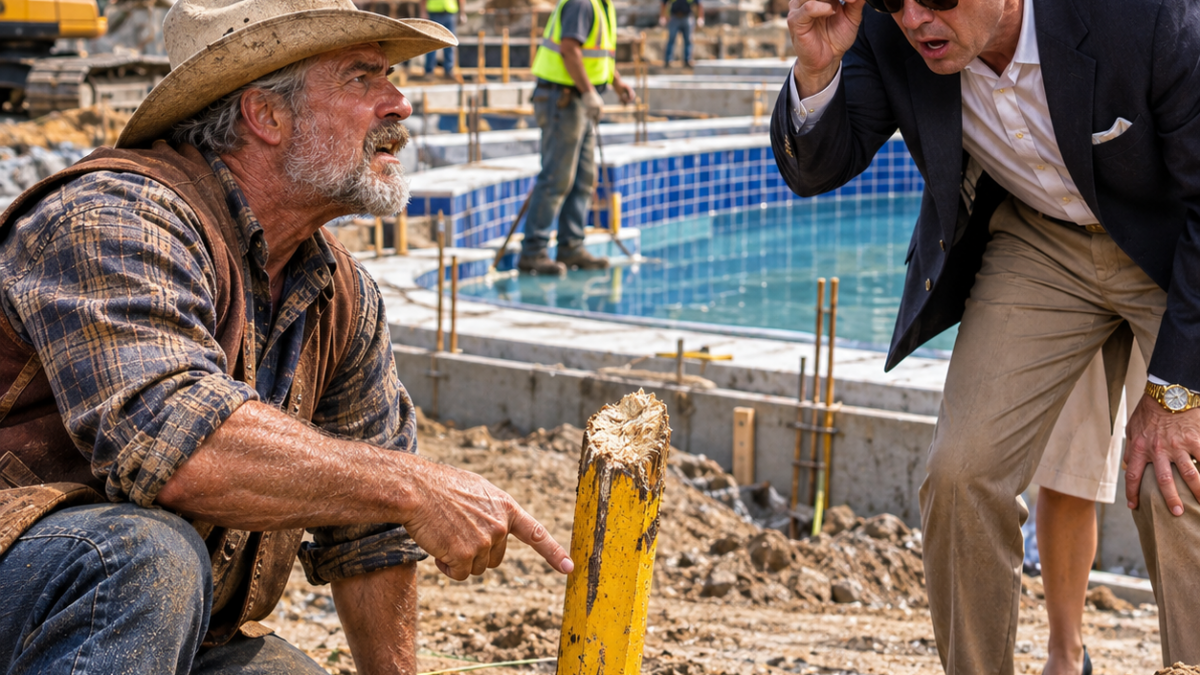
HOA Built 40% of Its $2.5M Pool on My Ranch—Then I Dug Up the Yellow Boundary Post They Cut and Buried.
The Oak Creek HOA poured an Olympic-sized luxury pool across my Colorado property line, threatened to sue me for interfering, and assumed an old rancher would eventually sell them the dirt they had already stolen.
Then I found my grandfather’s yellow steel boundary marker cut clean at ground level, buried beneath fresh soil, with bright metal shavings still scattered around the stump.
What their president did not know was that my wife had spent ten years tracing corporate fraud for a living—and once she followed the money behind that missing post, the HOA’s beautiful new pool became the most expensive hole Rick Montgomery had ever dug.
The first time I realized somebody had cut down my grandfather’s yellow boundary post, I wasn’t angry.
Not immediately.
Anger came later.
What I felt first was disbelief.
I was kneeling in loose Colorado dirt beside a lightning-scarred oak tree with both hands wrapped around three inches of exposed steel, staring at metal so freshly cut the center still shone silver beneath the dust.
For fifty years, that post had stood there.
My grandfather drove it into the ground in 1974 after a surveyor named Earl Whitcomb reestablished the southern boundary of our ranch following a fence dispute with the previous landowner.
Granddad didn’t trust wooden stakes.
“Wood rots,” he used to say. “Paint fades. People forget. Steel remembers.”
So he used heavy steel pipe.
Three inches thick.
Driven deep.
Painted safety yellow.
Every fifty yards along the southern boundary.
When I was a boy, my brother and I used them as landmarks when we rode horses.
Don’t cross the yellow posts.
That was the rule.
Beyond them was somebody else’s land.
Simple.
It had been simple for three generations.
Until Oak Creek arrived.
My name is Tom Callahan.
At the time this happened, I was sixty-one years old and running 150 acres outside what used to be the quieter edge of Colorado’s Front Range.
The ranch had belonged to my family since my grandfather bought it in the 1950s.
Back then, according to photographs, there wasn’t much around us except pasture, cottonwoods, two county roads, and mountains.
By the time I inherited the deed, Denver’s growth had been crawling steadily toward us for years.
First came wider roads.
Then warehouses.
Then subdivisions with names that sounded as if somebody had picked words out of a catalog.
Whispering Ridge.
Silver Meadow.
Pine Crest.
None of them had whispering ridges, silver meadows, or much pine.
Then a developer bought forty acres directly south of us.
A year later, Oak Creek Estates appeared.
There was no creek.
I checked.
What Oak Creek did have was money.
Lots of it.
Huge stucco houses.
Fake stone columns.
Black iron gates.
Landscaped medians.
Identical mailboxes.
Two-car garages that somehow contained six cars because nobody actually parked inside them.
The homes started above a million dollars.
Some went far beyond that.
At first, I didn’t care.
PART2:
People have a right to live where they want.
My ranch wasn’t a museum.
I understood development.
What I didn’t understand was why people would spend nearly two million dollars to move next to working agricultural land and then complain that cows smelled like cows.
That started almost immediately.
A woman called the county because our cattle were “visually disruptive.”
Another homeowner emailed me asking whether I could avoid running machinery before nine because her husband worked from home.
One man demanded I remove a manure pile because he could see it from his upstairs balcony.
I told him I’d ask the cows to revise their production schedule.
My wife, Chloe, made me promise I wouldn’t answer any more neighborhood emails without showing them to her first.
That was probably wise.
Chloe was fifty-six then.
Smartest person I’ve ever known.
She’d grown up in Boulder, gone into accounting, and spent more than a decade working forensic audits for companies that suddenly discovered several million dollars had developed legs.
She could look at a pile of invoices and tell you which one smelled wrong.
She left corporate work after we married, partly because she was tired of airports and partly because she claimed ranch bookkeeping was “the first honest set of numbers she’d seen in years.”
I never believed the second part.
She just loved the ranch.
PART3:
Oak Creek formed its HOA before half the homes were finished.
And that’s when I met Richard Montgomery.
Everyone called him Rick.
Rick was perhaps fifty.
Tall.
Trim.
Perfect teeth.
Perfect hair.
White Range Rover.
Designer sunglasses.
A watch that probably cost more than my first pickup.
He had the particular confidence of a man who had spent years mistaking compliance for respect.
He introduced himself at our gate one summer afternoon.
“Mr. Callahan?”
“Tom.”
“Richard Montgomery. President of the Oak Creek Homeowners Association.”
“Congratulations.”
He hesitated.
Apparently he wasn’t sure whether I meant it.
He handed me a business card.
“We’re trying to establish a positive relationship between Oak Creek and neighboring property owners.”
“Good.”
“There are a few quality-of-life matters we’d like to discuss.”
There it was.
I leaned against the gate.
“Such as?”
He had a list.
Dust from our road.
Agricultural equipment noise.
Outdoor lighting.
Cattle near the southern property line.
A rooster belonging to somebody a mile away that Rick somehow suspected was mine.
“Don’t own a rooster.”
“Well, residents have reported one.”
“Tell them I’ll launch an investigation.”
His smile thinned.
“We’re hoping everyone can be reasonable.”
“So am I.”
His eyes moved over my boots, jeans, faded shirt.
Then toward the F-250 behind me.
He had already decided what I was.
I knew that look.
People see dirt under your fingernails and assume it extends upward.
Rick didn’t understand that ranchers spend their lives measuring things.
Rain.
Feed.
Acreage.
Weight.
Water.
Fence length.
Grazing rotation.
Property.
Especially property.
We knew every inch of that southern line.
For a while, Rick remained merely annoying.
Then Oak Creek announced its community center.
The proposal was enormous.
Clubhouse.
Fitness center.
Tennis courts.
Outdoor kitchen.
Landscaping.
And the centerpiece:
A resort-style Olympic-length infinity pool overlooking the foothills.
Chloe read the brochure at breakfast.
“Infinity pool.”
“What happens if they reach infinity?”
She ignored me.
“Look where they’re putting it.”
She slid the rendering across the table.
Northern edge of Oak Creek.
Right against us.
I studied it.
“They don’t have enough land.”
Chloe looked up.
“You see it too?”
“They’ve got houses here.”
I pointed.
“Road here. Tennis courts here. Clubhouse there.”
“And pool.”
“Something doesn’t fit.”
“Maybe the rendering isn’t accurate.”
“Maybe.”
That April, machinery arrived.
The first excavator started at 6:58 one morning.
I remember because the cattle noticed before I did.
They lifted their heads toward the southern line.
Then came diesel.
Backup alarms.
Chains.
Dump trucks.
Oak Creek stripped nearly everything on its side.
Brush.
Young trees.
Old grass.
For several days, dust drifted across our pasture.
Then digging started.
Deep.
Wide.
I rode down on my quarter horse, Boone, to look.
Even from fifty yards away, something felt wrong.
Construction was too close.
The old tree line had once straddled portions of the boundary.
My grandfather’s yellow posts were harder to see through equipment and debris, but I knew the approximate alignment.
The pool excavation seemed north of it.
Our side.
That evening, Chloe stood beside me on the back porch.
Floodlights from Oak Creek cut through the trees.
“They’re close.”
“Too close.”
“You going down there?”
“Morning.”
“Take photos first.”
I looked at her.
“Yes, ma’am.”
“Don’t ‘yes, ma’am’ me. Document before confrontation.”
“You’re romantic.”
“I married you, didn’t I?”
“Moment of weakness.”
“Continuing one.”
Next morning I drove the truck down.
The work site looked like an invasion.
Concrete forms.
Rebar.
PVC pipes.
Block.
Stacks of tile.
Workers everywhere.
Rick stood beside a black pickup with a man I later learned was Dave Higgins, the construction foreman.
Blueprints were spread across the hood of Rick’s Range Rover.
I got out.
“Morning.”
Neither looked pleased.
Rick removed his sunglasses.
“Mr. Callahan.”
“You people are over my line.”
Dave looked toward the excavation.
Rick didn’t.
“We’ve had a professional survey.”
“So have I.”
“Ours is current.”
“Property doesn’t move because your survey is newer.”
Rick gave me that smile.
Patient.
Condescending.
“We’re using satellite positioning.”
I pointed toward the tree line.
“My boundary is marked with yellow steel posts recorded on the county plats.”
“Those old pipes?”
“Boundary monuments.”
He laughed.
Actually laughed.
Dave did not.
I noticed.
“Mr. Callahan,” Rick said, “this is a $2.5 million project. We don’t eyeball property lines.”
“Then your surveyor should have seen the posts.”
“Our surveyor established the legal boundary using modern coordinates.”
“Show me.”
Rick’s expression changed.
“Excuse me?”
“Show me your line.”
“This is an active construction site.”
“Half of it may be my active construction site.”
Dave cleared his throat.
“Rick, maybe we should—”
Rick cut him off.
“No.”
He folded the blueprint.
“Mr. Callahan, if you believe there’s a problem, contact our legal counsel.”
“I’d rather solve it before you pour concrete.”
“No problem exists.”
“I suggest you make sure.”
“I suggest you stay off HOA property.”
I stared at him.
Then at Dave.
Dave looked uncomfortable.
That mattered.
I said, “Yellow posts, Rick.”
He put his sunglasses back on.
“Rusty farm junk isn’t controlling a modern development.”
That sentence stayed with me.
I drove home.
Chloe was waiting.
“How’d diplomacy go?”
“He called Granddad’s boundary monuments rusty farm junk.”
“Oh.”
She put down her coffee.
“Now I’m angry.”
I laughed.
“That’s your threshold?”
“Never insult documentation.”
Next afternoon, I went looking for the nearest yellow post.
I knew exactly where it should be.
Lightning oak.
Five feet south.
That tree had been struck sometime in the 1980s.
One side blackened.
Still alive.
As boys, we’d tied a rope around it.
Boundary post had always sat a few steps away.
I found the tree.
No post.
I stood there.
Looked around.
Walked ten yards each direction.
Nothing.
At first, I doubted myself.
Memory is less trustworthy at sixty-one than at sixteen.
I called my brother, Nate, who lived in Wyoming.
“Remember the lightning oak on south fence?”
“Yeah.”
“Yellow post was north or south?”
“South. Five, six feet.”
“You sure?”
“Tom, you made me sit on it when we were kids and the paint stained my jeans. Mom whipped both of us.”
“Right.”
“Why?”
“Can’t find it.”
Pause.
“What do you mean can’t find it?”
“Exactly what I said.”
“Those things don’t walk.”
“No.”
I hung up.
Looked again.
Then noticed a pile of pine branches.
Fresh.
Wrong place.
Underneath, loose dirt.
Construction dirt.
I walked back to the truck.
Got a shovel.
Started digging.
Three inches down—
Clang.
Metal.
My heartbeat changed.
I scraped soil away.
Yellow paint.
Then bare steel.
Cut clean.
Not bent.
Not broken by machinery.
Cut.
The top half was gone.
Fresh metal shavings glittered in the dirt.
I sat back on my heels.
That was the moment everything changed.
Encroachment can be a mistake.
Surveyors make mistakes.
Contractors misread stakes.
Plans get shifted.
Nobody spends millions on construction hoping to tear it down.
But somebody had found that post.
Somebody knew what it meant.
Somebody cut it.
Then somebody covered the remains.
That wasn’t confusion.
That was intent.
I pulled out my phone.
Photographs.
Wide shot.
Tree.
Soil.
Stump.
Metal shavings.
Close-up.
Video.
I placed a tape measure beside the cut.
Then called Chloe.
“Come down.”
Her tone changed immediately.
“What happened?”
“Bring your good camera.”
She arrived ten minutes later.
One look.
“Oh.”
“Yeah.”
She crouched but didn’t touch anything.
“Don’t move the shavings.”
“I haven’t.”
“Footprints?”
“Site’s too disturbed.”
She photographed everything.
Then stood.
“Call Jim.”
Jim Miller had surveyed ranches, subdivisions, roads, mineral claims, and boundary fights for thirty-five years.
Sixty-seven.
Weathered face.
Permanent tan.
No patience for idiots.
I called.
“Jim.”
“Tom.”
“Need an emergency retracement survey.”
“Why?”
“HOA next door is building a pool.”
Long pause.
“That’s not usually an emergency.”
“They cut one of my monuments.”
Another pause.
“Don’t touch anything.”
“Already photographed.”
“Good.”
“Can you come tomorrow?”
“I’m coming tonight.”
Jim arrived before sunset.
He crouched beside the post for almost fifteen minutes.
Used a flashlight.
Magnifier.
Took measurements.
Then looked up.
“Cut wheel.”
“Sure?”
“Probably angle grinder. Could be abrasive saw.”
He pointed.
“See the heat discoloration?”
I did.
“That isn’t bulldozer damage.”
Chloe folded her arms.
“Can you document chain of evidence?”
Jim glanced at her.
“You’re Chloe?”
“Yes.”
“Tom said you were dangerous.”
“Only around spreadsheets.”
Jim smiled.
“I’ll document everything.”
Then he looked toward the Oak Creek lights.
“Have they poured?”
“Friday.”
“What day is it?”
“Wednesday.”
“Tell them to stop.”
I shook my head.
“Already did.”
“And?”
“They told me to call lawyers.”
Jim stood.
“Then maybe let them pour.”
Chloe stared at him.
I smiled.
“That’s what I was thinking.”
She looked between us.
“Both of you are enjoying this too much.”
No.
Not yet.
But I understood something simple.
If they stopped before pouring, Rick could claim mistake.
Move forms.
Shift plans.
Maybe apologize.
Once concrete went in, consequences became expensive.
I wasn’t sabotaging them.
I had warned them.
They chose to continue.
Friday morning, cement trucks arrived.
Chloe watched from the porch.
“You aren’t going down there?”
“No.”
“That feels unnatural.”
“I’ve told him.”
“Twice.”
“Now he owns his decision.”
Truck after truck crossed Oak Creek.
Concrete flowed.
The pool shell formed.
Pump house foundation.
Retaining wall.
Rebar disappeared beneath gray stone.
By Sunday evening, roughly seventy-two thousand dollars in concrete, reinforcement, plumbing, and imported tile infrastructure sat partly on land the HOA did not own.
Monday morning, Jim arrived with three crew members.
He brought equipment I’d never pretend to understand.
Survey-grade GNSS receivers.
Robotic total station.
Old plat maps.
Field books.
County records.
He found two undisturbed yellow posts further east and another uphill.
He tied them into recorded control points.
Checked historic bearings.
Measured.
Measured again.
Two days.
Tuesday afternoon, pink ribbons began appearing.
One beside the pool.
One through the deck form.
Another on the far side of the pump house.
Then a stake went into fresh concrete.
Oak Creek workers stopped and stared.
Rick appeared within twenty minutes.
I watched from our side.
Couldn’t hear everything.
Didn’t need to.
He pointed.
Jim didn’t move.
Rick pointed harder.
Jim continued working.
Dave Higgins stood with arms crossed.
At one point Rick kicked a wooden stake.
Jim calmly replaced it.
I liked Jim.
Wednesday evening, he came to the house.
Chloe put coffee on.
Jim unrolled the survey across our kitchen table.
“Bad.”
“How bad?”
He pointed.
“This is recorded boundary.”
Then another line.
“This is their construction.”
The difference was obvious.
“Retaining wall is twelve feet over.”
Chloe leaned closer.
“Pump house?”
“Fifteen.”
“Pool?”
Jim traced the deep end.
“Maximum encroachment eighteen feet.”
I whistled.
“Percentage?”
“About forty percent of the northern recreation footprint.”
Chloe sat back.
“That’s not a mistake.”
Jim tapped the map.
“I don’t make motive determinations.”
“I do.”
He smiled.
“The destroyed monument is fully documented.”
He slid photographs toward us.
High resolution.
Cut marks.
Shavings.
Soil disturbance.
“County copy?”
“Filed this afternoon.”
I looked out the kitchen window toward Oak Creek.
Pool lights illuminated the site.
“They poured eighteen feet onto me.”
Jim nodded.
“Yep.”
Before I could decide what to do next, Rick decided for me.
Thursday afternoon, Chloe called while I was checking irrigation.
“Process server.”
“What?”
“Come home.”
I drove back.
A thick envelope sat on the table.
Denver law firm.
Cease and desist.
The HOA accused me of trespass.
Harassment.
Interference.
Unlawful placement of survey stakes.
Potential damages from construction delays.
They threatened injunction.
Attorney fees.
Restraining order.
I read it twice.
Then a third time.
“They’re threatening me for putting survey stakes on my land.”
“Yes.”
“They cut my post.”
“Yes.”
“Poured a pool eighteen feet onto our ranch.”
“Correct.”
“And they want us to stop bothering them.”
“Essentially.”
I laughed.
Not because it was funny.
Because sometimes arrogance becomes so complete it turns absurd.
Chloe wasn’t laughing.
She was reading every page.
Then she stopped.
“What?”
“Contractor.”
“What about it?”
“Montgomery Contracting.”
“Rick’s name.”
“Could be coincidence.”
“You believe that?”
“No.”
She opened her laptop.
For four hours, Chloe disappeared into the thing she does.
Search.
Registry.
Licenses.
Corporate filings.
HOA minutes.
County permits.
Budgets.
Meeting attachments.
She printed.
Highlighted.
Built a timeline.
I made dinner.
She forgot to eat.
At 10:40 she said, “Tom.”
I knew the tone.
“What?”
“Come here.”
The Colorado business registration showed:
MONTGOMERY CONTRACTING LLC.
Managing member:
RICHARD A. MONTGOMERY.
I stared.
“Rick owns the construction company.”
“Yes.”
“The HOA hired its own president?”
“His company.”
“Board knows?”
“Minutes say he disclosed a ‘professional association.'”
“What does that mean?”
“Not ownership.”
She clicked another file.
“The contract is $2.5 million.”
“I know.”
“Cost-plus provisions.”
“English.”
“His company gets reimbursed for costs plus margin. Larger project, more revenue.”
She opened the original subdivision site plan.
“Look.”
Oak Creek had sold residential lots close to the northern edge.
Too close.
The remaining common tract was narrow.
Pool.
Clubhouse.
Tennis courts.
Parking.
Landscape buffers.
Everything promised in the marketing material physically could not fit without pushing north.
Onto us.
“If he moved the pool south?” I asked.
“Parking doesn’t work.”
“Downsize?”
“Works.”
“How much smaller?”
“Significantly.”
“And his contract?”
“Smaller.”
Chloe looked at me.
“He needed your dirt.”
I felt cold.
“So he didn’t just discover the problem during construction.”
“Maybe not.”
“He may have known before.”
“We need discovery to prove that.”
“Why destroy the post otherwise?”
She closed the laptop.
“Because the post proved the footprint was wrong.”
We sat quietly.
Outside, machinery idled.
I thought about Rick’s face when I’d warned him.
His laugh.
Rusty farm junk.
Then the letter threatening us.
“He thought we’d sell.”
Chloe nodded.
“Probably.”
“Pour first. Force easement later.”
“Maybe.”
“Make removal so expensive a judge says money damages are more reasonable.”
“That’s a common pressure point in encroachment disputes.”
I looked at her.
“You knew that?”
“I read.”
“Of course you do.”
She tapped the LLC page.
“But Rick has another problem now.”
“What?”
“He isn’t just exposing the HOA.”
She smiled without humor.
“He’s exposing himself.”
Next morning I hired David Harrison.
David was a Denver property litigator recommended by Jim.
Mid-fifties.
Gray suit.
Quiet voice.
Terrifyingly organized.
I expected courtroom theatrics.
What I got was worse.
A man who listened without interrupting.
I put the survey down.
He read.
Photos.
Read.
Cease and desist.
Read.
Corporate records.
Read.
HOA minutes.
Read.
Then he leaned back.
“Did you send written notice before the pour?”
“Email to Rick and foreman after first conversation.”
“Have it?”
Chloe slid it over.
“Did they respond?”
“Rick did.”
David read aloud.
“‘Our professionally established boundary is accurate. Construction will proceed as scheduled. Further interference will be considered trespass.'”
He looked at me.
“Excellent.”
“Excellent?”
“For you.”
He picked up the cut-post photograph.
“Who found this?”
“I did.”
“Who touched it?”
“Tom brushed soil away before calling me,” Chloe said.
“Then nobody else until surveyor.”
“Correct.”
“Surveyor documented?”
“Extensively.”
“Any workers admit cutting?”
“No.”
“That’s okay.”
He set it down.
“What do you want?”
“My land back.”
“They’ll offer money.”
“No.”
“Probably a lot.”
“No.”
“Six figures.”
“No.”
“Maybe seven depending on exposure.”
“No.”
He watched me.
“Why?”
“Because if I sell eighteen feet because someone stole it first, I’m teaching the next person that stealing works if your checkbook is thick enough.”
David nodded.
“Good.”
“Good legally?”
“No.”
He smiled.
“Good client clarity.”
Chloe asked, “What’s our strongest claim?”
“Encroachment. Trespass. Property damage. Destruction of monument. Depending on evidence, potential fraud and fiduciary issues are separate matters.”
“Criminal?”
“Possible referral. I won’t overpromise.”
I respected that.
“Can they force an easement?”
“They’ll argue relative hardship.”
“Meaning?”
“If removal costs millions and your harm can be compensated, they may ask equity to permit the structure.”
My jaw tightened.
“But?”
David tapped the cut post.
“Equity dislikes bad faith.”
Chloe smiled.
“Very much.”
“If we establish intentional encroachment, destroyed monument, prior warning, and self-dealing?”
David’s smile appeared.
“Then Mr. Montgomery has built himself a very expensive credibility problem.”
“What’s the move?”
David looked at Chloe’s documents.
“Don’t start with Rick.”
“Who?”
“The HOA.”
I frowned.
“He is the HOA.”
“No.”
David leaned forward.
“That’s what Rick needs everyone to believe.”
He tapped the board roster.
“These four people are his real problem.”
Treasurer Martha Gable.
Vice president Greg Stanton.
Secretary Priya Shah.
Director Michael Rosen.
“Homeowners too.”
David nodded.
“They are paying.”
Chloe understood first.
“You expose the conflict.”
“Yes.”
“You let the board realize Rick put them personally at risk.”
“Yes.”
I looked at David.
“Meeting.”
“Meeting.”
Oak Creek’s emergency board meeting happened two evenings later at a country club because their community center was still under construction.
We didn’t sneak in.
David sent notice that we would attend for legal service.
Apparently Rick assumed he could keep us outside.
He was wrong.
Thirty-plus residents filled the banquet room.
Five board members at a long table.
Rick in the center.
Navy blazer.
White shirt.
No tie.
That same confident posture.
Then he saw us.
It disappeared.
“Callahan.”
He stood.
“What are you doing here?”
David kept walking.
“Serving your association.”
“This is a private meeting.”
“So is litigation until filed.”
“What?”
David placed folders in front of each board member.
Rick stepped around the table.
“I told you all communications go through counsel.”
David handed him one too.
“Excellent. Forward it.”
Martha Gable opened hers first.
Woman in her sixties.
Retired banking executive, I later learned.
She did not look like someone who enjoyed surprises.
“What is this?”
David faced the room.
“My name is David Harrison. I represent Thomas and Chloe Callahan, owners of the adjoining ranch.”
Rick snapped, “This is inappropriate.”
David continued.
“Yesterday we filed an action regarding intentional trespass, structural encroachment, property damage, and destruction of a recorded boundary monument.”
The room changed.
Murmurs.
Martha looked at Rick.
“Intentional?”
Rick raised both hands.
“It’s nonsense.”
David said, “Page three.”
Thirty people turned pages.
There was something deeply satisfying about synchronized paper.
Martha found the survey.
She leaned closer.
Greg Stanton looked over.
“Is this stamped?”
“Yes.”
“County filed?”
“Yes.”
David pointed to a projected copy Chloe had prepared.
“The established legal boundary runs here.”
Line.
“Your retaining wall extends twelve feet onto the Callahan parcel.”
Another highlight.
“Pump facility fifteen.”
Then pool.
“The deep end reaches approximately eighteen feet.”
Someone in the audience said, “Jesus.”
Rick laughed nervously.
“Survey disputes happen. Our engineers have different coordinates.”
Martha asked, “Forty percent?”
David nodded.
“Approximately forty percent of the northern recreation footprint contains some degree of encroachment.”
Rick shook his head.
“This is sensational.”
I stepped forward.
“No, Rick. This is the part where sensational starts.”
He looked at me.
I held up a photograph.
“Page five.”
People turned.
Cut yellow post.
Bright steel.
Metal shavings.
Martha’s face hardened.
“What is that?”
“My grandfather’s recorded monument.”
Rick said immediately, “Old pipe.”
Jim Miller was not there, but his affidavit was.
David answered.
“Mr. Montgomery, licensed surveyor James Miller has identified and documented the monument as part of the historic boundary-control evidence.”
Greg looked at Rick.
“Was this removed?”
“No.”
“You just said it’s an old pipe.”
“I said I don’t know anything about it.”
“You knew enough to call it pipe.”
Rick’s eyes flashed.
“Because Callahan has been ranting about yellow posts for weeks.”
I said, “Before your pour.”
Silence.
That mattered.
David took over.
“Our client notified Mr. Montgomery before concrete placement.”
He turned to the homeowners.
“Your president was explicitly warned that construction had crossed the recorded boundary.”
Martha looked at Rick.
“You told us the rancher was complaining about noise.”
Rick’s face changed.
Only slightly.
But enough.
“I summarized.”
“You told us there was no boundary issue.”
“There wasn’t according to our survey.”
David said, “Then let’s discuss why a physical monument was cut.”
Rick pointed at him.
“You’re implying criminal conduct.”
“I’m describing evidence.”
“By whom?”
“Discovery will help answer that.”
Rick tried to regain control.
“We can solve this.”
He looked at me.
“Tom, if there’s a discrepancy, we’ll purchase the affected strip at fair market value.”
“No.”
He stared.
“Don’t be emotional.”
Martha’s head snapped toward him.
I smiled.
“That right there is your problem, Rick.”
“What?”
“You think ‘no’ is an emotional answer when a rancher says it.”
“You’d rather spend years in court?”
“No.”
“I can make you an excellent offer.”
“No.”
“Everything has a price.”
“Your land maybe.”
“Tom—”
“Mine doesn’t.”
Then Chloe stood.
She had been quiet until then.
I almost felt sorry for Rick.
Almost.
“Martha?”
The treasurer looked at her.
“I’m Chloe Callahan.”
“I know.”
“You should turn to page eight.”
Martha did.
LLC filing.
Her eyes moved.
Stopped.
Moved again.
Then lifted toward Rick.
“What’s Montgomery Contracting?”
Rick went pale.
One resident asked, “Isn’t that the contractor?”
Chloe nodded.
“Yes.”
She pointed.
“The Colorado filing identifies Richard Montgomery as managing member.”
Greg grabbed Martha’s copy.
“What?”
Priya Shah opened hers.
Michael Rosen swore under his breath.
Rick said, “The board knew I had a relationship with the company.”
Martha looked deadly calm.
“You said you had worked with them.”
“I disclosed.”
“You did not disclose ownership.”
“I did.”
“No.”
She flipped through papers.
“Meeting minutes say ‘professional relationship.'”
“I verbally explained—”
“No, you did not.”
A homeowner stood.
“Did our HOA president give himself the pool contract?”
Another voice:
“Two and a half million dollars?”
Rick held up both hands.
“The board approved competitive pricing.”
Chloe said, “Where are the competing bids?”
Martha looked at him.
“Rick?”
He hesitated.
That was enough.
Chloe continued.
“The original development layout doesn’t provide enough compliant space for the pool footprint that Montgomery Contracting proposed.”
A homeowner asked, “Meaning?”
She pulled up the zoning map.
“If constructed entirely on Oak Creek land, the design would have required a smaller pool, altered deck area, or elimination of another planned amenity.”
Greg’s face flushed.
“So bigger project means bigger contract.”
Rick exploded.
“That’s ridiculous.”
Chloe didn’t raise her voice.
“Maybe.”
She looked at him.
“Your invoices will answer it.”
That silenced him.
Then David delivered the legal part.
“Tomorrow we are seeking emergency injunctive relief.”
Martha looked over.
“Construction stops?”
“Yes.”
“For how long?”
“Until the encroachment is resolved.”
Rick said, “This is extortion.”
David ignored him.
“Our clients will not grant an easement.”
Rick scoffed.
“They’ll have to.”
David looked almost amused.
“No.”
“We have millions already invested.”
“That was your choice.”
“The court won’t order economically wasteful removal.”
“Maybe.”
David lifted the cut-post photo.
“Courts also don’t reward deliberate trespass.”
Then he looked at the board.
“And because the association has now received formal notice, any additional work inside the disputed area after tonight carries significantly greater risk.”
Chaos.
Residents shouting.
Board members arguing.
One man demanded to see invoices.
A woman asked whether assessments would increase.
Someone shouted at Rick.
Someone else demanded his resignation.
Martha stood.
“Everyone stop.”
She looked directly at Rick.
“Did you know about the boundary dispute before the pour?”
Rick said nothing.
“Answer.”
“Our survey supported—”
“Did you know Callahan claimed encroachment?”
“Yes.”
“And you did not tell the board?”
“It wasn’t credible.”
“Did you tell your crews to keep working after written notice?”
“I managed the project.”
Martha’s jaw tightened.
Then she asked the question that ended him politically before any judge did.
“Did you own Montgomery Contracting when this board awarded the contract?”
Rick looked around.
Thirty residents.
Four board members.
David.
Chloe.
Me.
“Yes.”
The room erupted.
We left.
Didn’t need the rest.
In the hallway outside, Chloe exhaled.
“You okay?”
“Fine.”
“You look disappointed.”
“I wanted somebody to throw a chair.”
David said, “That would complicate discovery.”
Chloe laughed.
The injunction came the next morning.
Construction stopped.
Yellow equipment sat frozen.
Concrete shell unfinished.
Workers disappeared.
Then the lawsuits multiplied.
Ours against Oak Creek and Montgomery Contracting.
Oak Creek against Montgomery Contracting.
Several homeowners demanded an independent audit.
The HOA retained separate counsel.
Rick retained personal counsel.
His board position evaporated within six days.
Martha became acting president.
And then the documents started coming.
Emails.
Invoices.
Change orders.
Survey notes.
Internal messages.
Discovery has a way of making arrogant people less mysterious.
The key email came from three months before construction.
Rick to project engineer:
Need full amenity footprint preserved. North side has flexibility. Rancher is old-school and boundary is poorly marked. If needed we can resolve strip after build.
Another:
Do not reduce pool dimensions. Marketing already committed.
Then a contractor message:
Existing yellow steel marker conflicts with excavation line.
Rick replied:
Remove obstruction. Survey controls.
Remove obstruction.
That sentence cost him dearly.
Dave Higgins, the foreman, eventually testified.
I didn’t hate Dave.
At first I thought I might.
But people inside bad decisions often look different once the person giving orders disappears.
David deposed him.
Dave admitted a worker had found the yellow post.
“What happened?”
“Called me.”
“And?”
“I called Mr. Montgomery.”
“What did he instruct?”
“He said survey line superseded it.”
“Did he order removal?”
Dave shifted.
“He said get it out of the work zone.”
“How?”
“I told crew to pull it.”
“Could they?”
“No. Too deep.”
“Then?”
“A worker used a grinder.”
“Who ordered burial of the stump?”
Long pause.
“Mr. Montgomery told us not to waste time excavating it.”
That was it.
The fight became less about whether they crossed the boundary and more about how expensive being wrong would become.
Oak Creek offered us money.
First offer:
$180,000 for the strip.
No.
$300,000.
No.
$450,000 plus landscaping.
No.
Their attorney came personally.
“Mr. Callahan, with respect, this is an unusually generous valuation.”
“I didn’t list the land.”
“You’re looking at years of conflict.”
“Your client created it.”
“The homeowners shouldn’t suffer for Montgomery’s actions.”
That was true.
And it bothered me.
Not everyone in Oak Creek was Rick.
Most had no idea.
Some were families.
Some retirees.
Some people who had simply bought houses in a development and trusted their board.
I didn’t want to punish thirty households for one man’s greed.
But the solution couldn’t be taking my land.
I said, “Move the pool.”
He sighed.
“Removal will exceed seven figures.”
“Then sue the contractor.”
“They are.”
“Good.”
“Couldn’t we negotiate an easement?”
“No.”
“Why not?”
I looked at him.
“Because my grandfather put steel in that ground so his grandchildren wouldn’t have to negotiate this line.”
He stopped.
That answer he understood.
Court came faster than expected.
Not final trial.
The key hearing on equitable relief.
Judge Elaine Caldwell presided.
Late sixties.
Silver hair.
Sharp questions.
No patience for drama.
Rick looked different.
No Range Rover swagger.
No sunglasses.
Gray suit.
Pale.
His attorneys argued hardship.
Removal disproportionate.
Pool substantially complete.
Callahans could be compensated.
Economic waste.
Oak Creek homeowners innocent.
Our side argued bad faith.
Intentional trespass.
Destroyed monument.
Pre-pour notice.
Financial self-interest.
Judge Caldwell studied the photograph of the yellow post for a long time.
Then looked over her glasses.
“Mr. Montgomery.”
His attorney stood.
“Your Honor—”
“I asked Mr. Montgomery.”
Rick rose.
“Yes, Your Honor.”
“You were informed of a boundary dispute prior to concrete placement?”
“Our survey—”
“Yes or no?”
“Yes.”
“And a physical marker existed in conflict with your proposed construction line.”
“An unverified pipe—”
“Your own foreman describes it in email as an existing yellow steel boundary marker.”
Rick looked at his lawyer.
“Yes.”
“And it was cut.”
“Yes.”
“Then buried.”
“I didn’t order—”
“The stump was covered.”
“Yes.”
Judge Caldwell leaned back.
“Mr. Montgomery, property law becomes very difficult to administer if every developer who dislikes a boundary monument simply grinds it off at grade.”
No one moved.
She looked toward Oak Creek’s counsel.
“I am sympathetic to innocent homeowners.”
Then toward us.
“I am equally mindful that equitable relief is not designed to reward a party who knowingly creates the hardship it later asks the court to excuse.”
That sentence ended the pool.
The court ordered removal of every structure crossing our line.
Retaining wall.
Pump foundation.
Pool shell.
Deck.
Plumbing.
Everything.
Restoration of grade.
Topsoil.
Vegetation.
Survey monument replacement.
Costs.
Damages.
The HOA would initially comply.
But because of Rick’s undisclosed conflict and contractual violations, Oak Creek recovered substantial costs from Montgomery Contracting and Rick’s insurance where applicable.
The criminal side moved separately.
I won’t pretend every dramatic claim people made around town turned into a felony conviction.
Real courts are messier than Facebook stories.
But the destroyed boundary monument and related conduct were referred for investigation.
Rick also faced civil claims over self-dealing and misrepresentation.
His company collapsed.
His reputation went first.
Then contracts.
Then credit.
By late summer, his Range Rover was gone.
A FOR SALE sign appeared outside his Oak Creek house.
I didn’t celebrate that.
Chloe did a little.
“Don’t look at me like that.”
“You drove past twice.”
“I had errands.”
“Oak Creek isn’t on the way to anything.”
“Scenic route.”
The demolition started in October.
That was the day I finally felt the anger leave.
Cold morning.
Blue sky.
First snow visible high on the Front Range.
Chloe and I sat on the tailgate of my F-250 with coffee.
Oak Creek residents had been notified.
Construction fencing installed.
Dave Higgins was back.
Different company now.
He came over before starting.
“Tom.”
“Dave.”
He put both hands in his jacket pockets.
“I owe you an apology.”
I waited.
“I knew something was wrong when we found that post.”
“Why didn’t you stop?”
He looked toward the pool.
“Rick was the client.”
“That isn’t an answer.”
“No.”
He nodded.
“It’s the excuse.”
I respected that more.
“I should’ve stopped.”
“Yeah.”
“I didn’t.”
“No.”
He looked at me.
“I’m sorry.”
I drank coffee.
Then said, “Do it right today.”
“I will.”
He walked back.
The excavator started.
Hydraulic breaker rose.
Paused over the deep end.
Then came down.
CRACK.
Imported blue tile shattered.
Concrete fractured.
Dust rose.
Chloe looked at me.
“You enjoyed that.”
“Deeply.”
Another strike.
CRACK.
Months of arrogance breaking into chunks.
They tore out pool shell.
Rebar.
Plumbing.
Pump house.
Wall.
It took weeks.
Not one dramatic afternoon.
Demolition is slower than construction when lawyers are watching.
Everything photographed.
Surveyed.
Loaded.
Removed.
When the last concrete left, dark topsoil arrived.
Native grasses.
Pines.
Brush.
Restoration.
Jim Miller supervised the new monument.
County representative present.
This time the steel post was heavier.
Deeper.
Bright yellow.
Jim handed me the paintbrush.
“Your family tradition.”
I painted the top.
Chloe took a photograph.
“Granddad would approve.”
“He’d say we used the wrong shade.”
“Probably.”
The HOA redesigned the community center.
Smaller pool.
Reduced deck.
One tennis court instead of two.
No infinity edge facing our ranch.
Martha Gable stayed president for another year.
She turned out to be decent.
One afternoon she came to our gate.
No lawyers.
No folders.
Just herself.
“I wanted to apologize.”
“You didn’t cut the post.”
“No.”
“You didn’t build the pool.”
“I was on the board.”
“You were misled.”
“I also didn’t ask enough questions.”
Chloe came outside.
Martha said, “We’ve adopted conflict-of-interest rules.”
Chloe smiled.
“Actual ones?”
“Painfully actual.”
“Good.”
Martha looked toward the steel post.
“I used to think property disputes were petty.”
I laughed.
“Until someone takes yours.”
“Exactly.”
Then she surprised me.
“Some residents want to repair relations.”
“Meaning?”
“We’d like to replace the tree buffer on our side.”
“Fine.”
“And maybe discuss agricultural education visits for neighborhood children.”
I stared.
“You want your children near cows now?”
She smiled.
“Apparently the cows are less visually disruptive than our former president.”
Chloe laughed so hard she had to turn away.
We did eventually let Oak Creek kids visit.
Not because I forgot.
Because boundaries don’t require permanent enemies.
That’s something Rick never understood.
A boundary is not hostility.
It’s clarity.
This is mine.
That is yours.
Respect it, and we can stand beside each other peacefully for generations.
Ignore it, and even friendly people become adversaries.
The last thing I built was the windbreak.
That part Chloe still argues was petty.
She’s probably right.
I hired an agricultural fencing company.
Quarter mile.
Ten feet tall.
Solid corrugated galvanized steel.
Entirely on our side.
Perfectly legal.
Structurally engineered.
Ugly enough to offend architecture itself.
The new Oak Creek pool faced it.
Their original marketing render showed swimmers looking across endless ranch pasture toward mountains.
Reality showed galvanized steel.
Martha called.
“Tom.”
“Yes?”
“Seriously?”
“What?”
“The wall.”
“Windbreak.”
“It’s ten feet tall.”
“Wind is serious.”
“It’s blocking the entire view.”
“Also effective for views.”
She sighed.
“Is this permanent?”
“Steel remembers.”
She started laughing.
“Your grandfather?”
“Smart man.”
Eventually vines grew along parts of it.
Oak Creek planted trees on its side.
Within several years, the wall became less ugly.
Maybe that was fitting.
Even consequences can soften without disappearing.
Rick left Colorado, as far as I know.
I heard Arizona.
Then Texas.
People asked whether I felt sorry for him.
That’s the wrong question.
I don’t enjoy another man’s collapse.
But consequences aren’t cruelty just because they’re expensive.
Rick had opportunities.
When I first warned him, he could have stopped.
When they found the post, he could have stopped.
Before the pour, he could have stopped.
After Jim’s survey, he could have stopped.
Instead, every stage became another decision to double down.
That is what destroyed him.
Not me.
Not Chloe.
Not Jim.
Not David.
Not the judge.
Rick kept betting that money would eventually turn wrong into right.
It didn’t.
Years later, the old yellow stump is still in my workshop.
Jim helped me remove it after the case ended.
Six-inch section.
Cut face visible.
I cleaned the dirt but left the grinder marks.
Chloe wanted to mount it.
I said that would be dramatic.
She mounted it anyway.
Small wooden base.
On a brass plate she engraved:
STEEL REMEMBERS.
It sits on a shelf near my grandfather’s photograph.
Sometimes visitors ask about it.
I tell the story.
Not all of it.
Just enough.
“HOA tried to build a pool on us.”
They laugh.
“No, seriously.”
“Seriously.”
“How much?”
“Eighteen feet.”
“What happened?”
I point at the metal.
“They cut the wrong post.”
That’s the whole story in five words.
They cut the wrong post.
Not because the steel itself defeated them.
Because cutting it revealed intent.
The thing Rick thought would erase the boundary became the evidence proving he knew exactly where it was.
That’s what arrogance does.
It mistakes destruction for control.
People often think property rights are abstract until somebody else decides your line is negotiable.
Ours wasn’t.
My grandfather bought that land.
My father worked it.
I grew up riding that boundary.
Chloe and I had spent decades keeping the ranch alive while everything around it became subdivisions, retail, traffic, and concrete.
The HOA was free to build luxury homes.
Free to install pools.
Free to plant ornamental pears and call drainage ditches creeks.
They simply weren’t free to take eighteen feet because their architect had promised residents a better view.
No amount of money changed that.
One spring morning, years after the case, I was repairing fence near the new post when a boy from Oak Creek came over.
Maybe twelve.
His family had attended one of the ranch days.
He stood on their side.
Didn’t cross.
Good kid.
“Mr. Callahan?”
“Yeah?”
“Is this the post?”
“What post?”
“The famous one.”
I looked at the bright yellow steel.
“This is the replacement.”
“Where’s the original?”
“Workshop.”
He stared.
“My dad said some guy cut it down.”
“Yep.”
“Why?”
“Wanted land that wasn’t his.”
The boy thought.
“Why didn’t he just ask to buy it?”
I smiled.
“Excellent question.”
“Would you have sold?”
“No.”
“Then what?”
“Then he’d build somewhere else.”
The boy looked toward Oak Creek’s smaller pool.
“That’s what happened anyway.”
“Eventually.”
He nodded as though adults remained baffling.
Correct.
Then he asked, “Can I pet the horse?”
“That one bites.”
His eyes widened.
“I’m kidding.”
“That’s not funny.”
“It was a little funny.”
He stayed on his side until I invited him through the gate.
That mattered.
Permission.
Respect.
Simple.
I sometimes think about Rick’s first words when I warned him.
State-of-the-art satellite GPS.
Modern survey.
Multi-million-dollar project.
He believed expensive systems made old evidence irrelevant.
But technology doesn’t erase history.
The county records mattered.
Original monuments mattered.
Emails mattered.
Corporate filings mattered.
Human choices mattered.
And the oldest thing on that job site—the yellow steel post my grandfather drove into Colorado earth half a century earlier—ended up telling the clearest truth of all.
This line was here before you.
You found it.
You knew it.
And you crossed anyway.
The pool is smaller now.
The ranch is still 150 acres.
Cattle still graze where they always did.
The southern trees have grown back thicker than expected.
Chloe still handles the books.
I still ignore most HOA emails.
Martha occasionally brings grandchildren over to see calves.
The galvanized wall is partly hidden by vines.
And every year, usually in early spring, I walk the southern line.
Not because I’m afraid somebody will move it.
Because my grandfather taught me something I’ve finally learned applies to more than land.
Boundaries don’t protect themselves.
You have to know where they are.
You have to maintain them.
You have to notice when somebody tests them.
And when someone tells you you’re unreasonable because you won’t surrender what was never theirs to take, you need to remember that “reasonable” is often the word powerful people use when they want your permission after they’ve already made their decision.
Rick Montgomery wanted eighteen feet.
That was all.
Eighteen feet of ranch land so his infinity pool would fit the brochure.
He assumed we’d eventually decide resistance wasn’t worth the money.
He assumed poured concrete would make theft permanent.
He assumed a rancher in dusty boots wouldn’t understand corporate filings, legal surveys, fiduciary conflicts, or injunctions.
He assumed wrong.
The funny part is, if he had stopped that first morning, moved the forms, downsized the pool, and apologized, the entire disaster would have ended for the price of redesign work.
Instead, he laughed.
Then he cut steel.
Then he buried it.
Then he poured concrete.
Then he threatened me.
By the time the dust settled, every attempt to hide the first mistake had become another exhibit proving the next.
So no, I don’t keep that cut piece of yellow steel because it reminds me of revenge.
I keep it because it reminds me how truth works.
You can cover it with soil.
You can build over it.
You can send lawyers.
You can spend millions making the wrong thing look permanent.
But if someone knows where to dig, the line is still there.
And sometimes the smallest buried piece of evidence is enough to bring an entire project crashing back onto the side of the boundary where it belonged.








