HOA Karen Blocked the Only Road to My Cabin With 3 Boulders—Then I Canceled the Marina Deal for All 12 Boats on My Private Lake
HOA Karen Blocked the Only Road to My Cabin With 3 Boulders—Then I Canceled the Marina Deal for All 12 Boats on My Private Lake
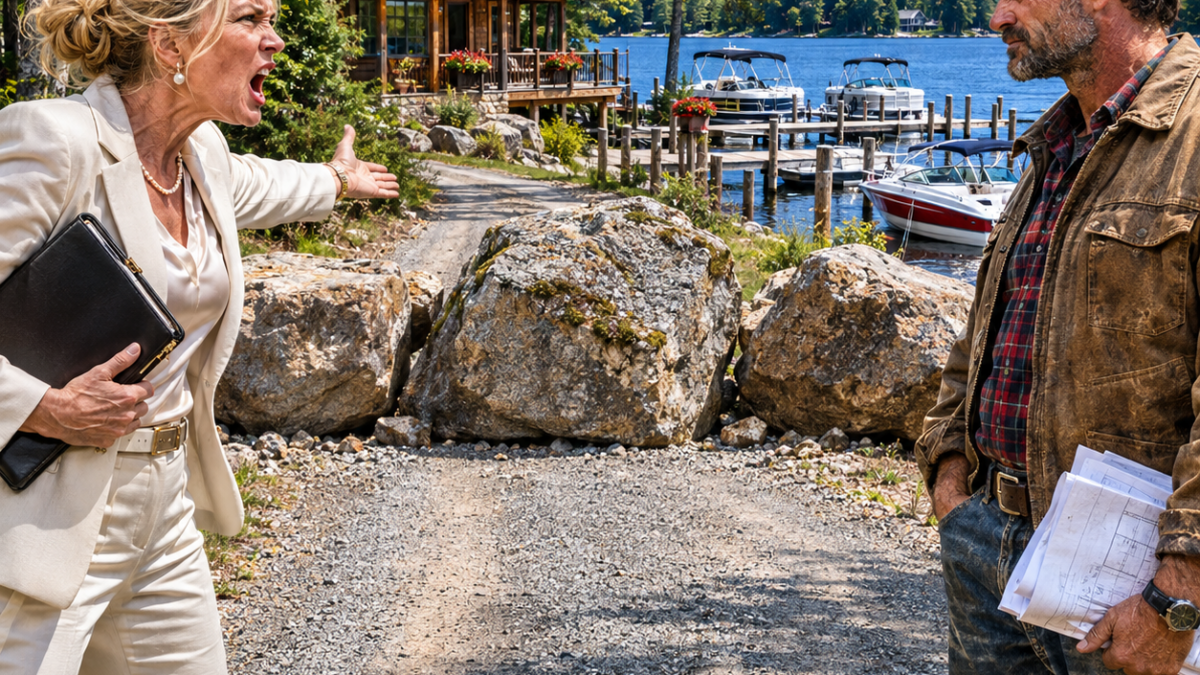
Three boulders the size of small cars were sitting across the only road to my cabin when I came home with groceries melting in the back of my truck, and the HOA president stood beside them holding a clipboard like she had just solved a problem.
She told me I could still walk through the eighteen-inch gap between the rocks, even though my recorded easement specifically guaranteed vehicle access to my home and she knew there was no second road through the ridge behind it.
Then I pointed through the trees at the twelve boats floating on my private lake, reached into my truck, and handed her the thirty-day notice terminating the HOA’s marina agreement—because Denise Harper had forgotten that the road she was blocking belonged to my access rights, while every boat slip she was selling depended entirely on my permission.
My name is Ethan Cole.
I repair things for a living.
Generators.
Water pumps.
Small engines.
Pressure washers.
Boat motors.
Anything with fuel, wires, bearings, or an owner who has already hit it with a wrench before calling me.
I am not a lawyer.
Not a developer.
Not a wealthy land investor.
I bought my cabin because I wanted fewer people around me, not more paperwork.
That makes what happened with Cedar Point almost funny.
Almost.
The property sat beside a narrow lake in western North Carolina.
About sixty acres of water.
Wooded shoreline.
Steep ridge along the south side.
One old earthen dam.
Bass.
Bluegill.
Too many turtles.
The cabin itself sat on a wooded point with a small workshop beside it.
Perfect for me.
PART2:
I bought the place from an older man named Walter McKee seven years earlier.
Before closing, I did something my father had taught me.
I read everything.
Not skimmed.
Read.
Title report.
Survey.
Recorded easements.
Lake documents.
Road rights.
Boundary descriptions.
That mattered because the property was unusual.
I owned almost the entire lake bed.
The dam.
Most of the shoreline.
The wooded point.
The cabin.
The launch.
Cedar Point Estates owned only a narrow strip of land along the north shore.
Years before I bought the property, Walter had allowed Cedar Point’s homeowners association to maintain a floating dock on that strip.
Twelve slips.
Residents only.
PART3:
No commercial rentals.
No outside memberships.
Annual payment.
Written rules for upkeep.
And one clause that later became very important:
Either party could terminate the arrangement by written notice.
Thirty days.
Simple.
The HOA did not own lake access.
It had permission.
There is a difference.
My own access had a similar history.
The only usable vehicle road to the cabin crossed a short section of HOA common land near their picnic lawn.
The road existed long before the subdivision.
My deed included a recorded right of ingress and egress.
Vehicle access.
Not foot traffic.
Not “reasonable pedestrian access.”
Not “whatever the HOA feels like allowing.”
Vehicle access.
That road mattered.
Behind my cabin, the land climbed into a rocky ridge.
On one side, water.
On the other, slope.
No second driveway.
No hidden forest road.
Nothing.
If you blocked that gravel lane, you blocked my house.
Everybody involved knew that.
Or should have.
For years, Cedar Point and I got along fine.
I paid no HOA dues because I was not part of their association.
They paid the annual lake fee required by the dock agreement.
Residents came down to their floating dock.
Used their boats.
Fished.
Mostly behaved themselves.
I knew several of them.
Paul Jenkins had a little fishing boat.
Carol and her husband owned a pontoon.
Frank Mercer had an old runabout he spent more time polishing than driving.
Normal people.
That matters.
Because when the trouble started, I could have treated everyone with a boat at that dock like an enemy.
They weren’t.
The problem was Denise Harper.
Denise became HOA president that spring.
Early fifties.
Very polished.
Always carrying a folder or clipboard.
The kind of person who said things like:
“Community vision.”
“Waterfront standards.”
“Unified appearance.”
She had big plans for Cedar Point.
New landscaping.
Picnic upgrades.
Decorative lighting.
Expanded marina.
She told residents she was going to transform the neighborhood into “a proper waterfront community.”
The problem was that the most important waterfront feature in her plan did not belong to Cedar Point.
The lake.
That belonged to me.
The first sign of trouble appeared on a Tuesday.
Yellow survey flags.
One near the bend where my gravel road crossed beside the HOA picnic lawn.
Then another.
Then six more.
They made an arc from the grass across the edge of my road.
At first I assumed utility work.
Maybe irrigation.
Fiber line.
Then I saw the pattern.
The flags curved directly across my driveway.
I called the HOA office.
Paula answered.
She had worked there before Denise became president.
Nice woman.
Always sounded like she was apologizing for something that had not yet happened.
“Cedar Point office.”
“Hi, Paula. Ethan Cole.”
“Morning, Ethan.”
“There are survey flags across my driveway.”
Pause.
“Let me check.”
Keyboard.
“Looks like picnic area improvements.”
“What kind of picnic improvement crosses a road?”
Longer pause.
“It says pedestrian safety boundary.”
“Whose road does it say they’re putting that boundary across?”
Silence.
“I’ll have Denise call you.”
Denise called ninety minutes later.
“The road edge is being formally defined.”
“It already is.”
“We’ve had complaints about vehicles cutting through the recreation lawn.”
“My driveway does not cut through the lawn.”
“It passes directly adjacent.”
“Yes.”
“That’s the issue.”
“What issue?”
“Vehicle interaction with pedestrians.”
I looked out the window.
The picnic lawn was empty.
“Then let’s meet.”
She agreed.
Next morning, I brought my property folder.
Road drawing.
Survey.
Recorded access instrument.
Denise brought a rendering.
Full-color.
Benches.
Flower beds.
Decorative boulders.
Families walking near the lake.
Beautiful picture.
Except my driveway had disappeared.
Where my road should have been, there was a walking path.
I placed my recorded road drawing beside her rendering.
“That isn’t defining the road.”
She looked at me.
“That’s closing it.”
“We’re restricting vehicles near the recreation area.”
“You’re restricting me from reaching my house.”
She tapped the rendering.
“You’ll still have pedestrian access.”
I thought I had misheard.
“Pedestrian?”
“We’re maintaining a walking route.”
“My house is a quarter mile beyond here.”
“You can walk through.”
“I have a truck.”
“I understand.”
“My business tools are in that truck.”
“Your contractor has also been bringing commercial vehicles through.”
There it was.
The excuse.
I was having my cabin roof repaired.
Luis Mendoza handled the job.
One delivery driver had backed too wide a week earlier and put a tire into the grass.
Shallow rut.
Maybe eight feet long.
I had already filled it.
Seeded it.
Photographed the repair.
I showed Denise.
“That damage is fixed.”
“This is about future prevention.”
“I’ll pay for damage my contractors actually cause.”
“That’s reactive.”
“That’s reasonable.”
“We can’t design community spaces around every owner’s work schedule.”
I stared at her.
“My home existed before your lawn rendering.”
She folded her arms.
“The board controls common property.”
“And my recorded access crosses that common property.”
No answer.
I put the road document directly over her picture.
“There.”
Clear line.
Driveway.
Vehicle route.
Denise did not even pick it up.
Instead she pointed to the walking gap in her rendering.
“You retain access.”
“No.”
“That is access.”
“That is not the access I purchased.”
Her expression changed.
Not anger.
Annoyance.
Like I was slowing down a project.
That was when I realized this was not about one damaged patch of grass.
My road was visually inconvenient.
Denise wanted the bend to feel like a continuous waterfront park.
Cars ruined the picture.
My truck ruined the picture.
Roofing trailers ruined the picture.
So she had simply deleted the road from the design.
I went home and emailed the complete access document to Denise, Paula, and the HOA board.
Subject:
RECORDED VEHICLE ACCESS — DO NOT OBSTRUCT.
Very subtle.
I also called Luis.
“Keep every wheel on gravel.”
He laughed.
“We’ve been doing that.”
“I know.”
“One delivery Friday.”
“I’ll guide him myself.”
“Problem?”
“HOA.”
He groaned.
That is a universal contractor response.
Thursday morning, the HOA sent me a formal notice.
VEHICLE TRAFFIC RESTRICTIONS.
My road access would be limited until I agreed to:
Restricted contractor hours.
Construction deposit.
Prior approval of commercial vehicles.
HOA approval of future contractors.
Temporary speed conditions.
I read it twice.
My sister Beth was at the cabin.
She had brought her ten-year-old son Noah because she was working a long weekend shift and he loved staying with me.
Noah was at the window watching a heron.
Beth read the notice.
“They can do this?”
“Not according to my deed.”
“Then call somebody.”
“I am.”
“When?”
“Lawyer Monday.”
She looked at me.
“Ethan.”
“What?”
“Monday?”
“Yes.”
“They’re already sending conditions.”
“They’re not actually going to block the road.”
Beth gave me the look sisters develop specifically for brothers who are saying something stupid.
“Don’t wait until they do.”
I should have listened.
I called Richard Wells anyway.
Property attorney.
His earliest appointment was Monday morning.
I emailed the documents.
Left a message.
Then went to work Friday.
Picked up generator parts.
Oil.
Belts.
Groceries.
Ice cream for Noah.
Probably the most important item in a ten-year-old’s opinion.
Beth had taken Noah into town for a dentist appointment.
The cabin was empty.
When I turned back into Cedar Point that afternoon, I saw the first boulder before I reached the bend.
Huge.
Gray.
Decorative.
Then the second.
Then third.
Across my road.
All three.
My truck stopped twenty feet away.
For a few seconds I just sat there.
Groceries in the bed.
Tools behind the seat.
Cabin visible through trees.
Road blocked.
Fresh scrape marks showed where machinery had dragged the rocks into position.
A landscaping truck was pulling away.
I jumped out.
Raised my hand.
The driver stopped.
He rolled his window down.
“Who ordered this?”
“Association.”
“Did they tell you this is my only driveway?”
He looked at the rocks.
“They said old service lane.”
“It’s my access road.”
He became uncomfortable.
“I just had placement instructions.”
“Who gave them?”
He pointed toward the picnic lawn.
Denise stood there.
Clipboard.
Of course.
I took the landscaping company’s name.
Photographed the truck.
Asked for the supervisor’s number.
The driver gave it to me.
I did not yell at him.
He had not drawn my road out of existence.
Denise walked over.
“You’re back.”
I looked at the rocks.
“You blocked my road.”
“We implemented the approved safety plan.”
“My home is there.”
She pointed between the boulders.
“You can walk through.”
The gap was maybe eighteen inches.
I looked at her.
“My truck.”
“You can leave it here temporarily.”
“Tools?”
“Carry what you need.”
“Deliveries?”
“Reschedule.”
“Roofing truck?”
“That is exactly the traffic we’re trying to manage.”
I could feel anger building.
“Move them.”
“When you sign the access conditions, we can discuss controlled vehicle passage.”
That sentence changed everything.
Not:
We accidentally blocked you.
Not:
We misunderstood the easement.
Not:
Let’s solve it.
Sign our conditions.
Then maybe you drive home.
My road had become leverage.
I took photographs.
Both directions.
Measured the gap.
Video showing truck on one side.
Cabin visible through trees on the other.
Then I called the sheriff’s non-emergency number.
While waiting, I carried groceries through.
One trip.
Two.
Three.
On the third, the paper handle tore.
Bag dropped.
Glass jar shattered on the gravel.
Tomato sauce everywhere.
I stood there holding two other bags while ice cream softened somewhere behind me.
That was when my hands started shaking.
Not when I saw the boulders.
Not when Denise gave me conditions.
Broken jar.
My own driveway.
I had to carry groceries through an eighteen-inch opening because someone who did not own my access decided a picnic lawn looked prettier without my truck.
I cleaned the glass.
Put it in a box.
Then walked into the cabin.
Opened the drawer where I kept the lake agreement.
I had read it when I bought the property.
Read it each year when the HOA payment arrived.
This time, I read every line.
Twelve slips.
Private residents only.
No outside commercial memberships.
Annual renewal.
No automatic perpetual right.
Thirty-day termination by either side.
Boat owners must receive reasonable opportunity to remove their property.
I sat at my kitchen table.
Thought.
I was angry enough to do something stupid.
Tow boats.
Lock gates.
Block docks.
All bad ideas.
Those boats belonged to people who had not moved my boulders.
So I did exactly what the agreement allowed.
Typed notice.
Effective thirty days after delivery, Cedar Point HOA’s permission to maintain boats and associated dock operations on my lake would terminate.
Current owners could schedule access to remove their boats.
No seizure.
No towing.
No storage fees during removal period.
HOA to provide owner and slip list.
I printed two copies.
Walked back through the rocks.
Denise was still there.
The sheriff had not arrived yet.
I handed her the envelope.
She looked at it.
“What’s this?”
“Notice.”
“Of?”
“Termination.”
Her smile disappeared.
She read the first page.
Then looked toward the lake.
Twelve boats rocked at the dock.
“You can’t retaliate against residents.”
“I’m not.”
“This is exactly retaliation.”
“You blocked my only road.”
“So you’re taking away community lake access.”
“I’m ending a contract the agreement says I can end.”
She stared.
I continued:
“Boat owners get thirty days to remove property.”
“We just renewed memberships.”
“That’s between you and them.”
Then a man came up from the dock carrying a red fuel can.
Paul Jenkins.
“Is something wrong?”
He looked at Denise.
Then me.
“I just paid her for another year.”
I turned.
“Another year of what?”
“My slip.”
Denise stepped forward.
“Paul, this is association business.”
He frowned.
“My eighteen hundred dollars is my business.”
I asked:
“When did you pay?”
“Last week.”
“For next season?”
“Yes.”
I looked at Denise.
Our current agreement was nearing seasonal renewal.
She had sold a year she did not yet possess.
I asked Paul:
“Receipt?”
He pulled out his phone.
Transaction.
$1,800.
Description:
ANNUAL LAKE MEMBERSHIP — GUARANTEED SLIP.
Guaranteed.
That word bothered me.
I asked:
“Can you send me a copy?”
Denise reached toward the screen.
“Don’t.”
Paul pulled the phone back.
“Why?”
“This is a legal dispute.”
“It’s my receipt.”
Good man.
I gave him my number.
“I’m not keeping your boat.”
“You’re not?”
“No.”
“You can schedule removal.”
He relaxed.
Then looked at Denise.
“You told me this was an HOA amenity.”
Denise said:
“It is.”
I corrected:
“You have a limited agreement to use part of my lake.”
Paul stared at her.
Nobody said anything.
I handed Denise the second notice.
“Sign only to acknowledge receipt.”
“No.”
“Fine.”
Paul said:
“I saw you hand it to her.”
“Thank you.”
But I didn’t turn Paul into a witness army.
I emailed the same notice to the HOA office.
Sent tracked mail.
Documented everything.
Deputy Aaron Blake arrived.
He looked at my access papers.
Looked at the road.
Looked at the rocks.
Spoke to Denise.
He did not perform television law.
He did not stand on the boulder and declare:
“Sir, you own this road!”
He said:
“This appears to involve recorded access rights and may require urgent civil relief.”
He made a report.
Documented the obstruction.
Told Denise the situation could become serious because there was no other vehicle route to my residence.
She pointed at the walking gap.
“He has access.”
Aaron looked through it.
Then at my truck.
Then at my cabin.
“I’m documenting that statement.”
Good answer.
The report did not move the rocks.
But it existed.
Luis called.
“Material truck got turned around.”
I closed my eyes.
“Supplier charging another delivery.”
“I’ll cover it.”
“Not your fault.”
“Do it anyway.”
Then Beth.
“Don’t bring Noah back tonight.”
“Why?”
I sent a picture.
Silence.
Then:
“What the hell?”
“Exactly.”
“Come stay with me.”
“My tools are here.”
“Ethan.”
“I need to stay.”
Long pause.
“Fine.”
Then:
“But don’t make every person with a boat your enemy.”
I looked through the cabin window at the dock.
She knew me too well.
“I won’t.”
“Promise.”
“I promise.”
That evening, Paula called.
She sounded nervous.
“I received your termination notice.”
“Good.”
“I’m compiling the boat list.”
“Thank you.”
Pause.
“How many slips does your agreement allow?”
“Twelve.”
Silence.
“Paula.”
“The membership list has nineteen.”
I sat up.
“What?”
“Nineteen paid lake memberships.”
“I have twelve slips.”
“I know.”
“Where are the other seven boats supposed to go?”
“New dock extension.”
“What extension?”
“Board ordered one.”
I walked toward the window.
Twelve existing boats.
Seven additional memberships.
“Delivery?”
“Monday.”
“Where?”
“Your launch.”
I actually laughed.
Not because it was funny.
“They blocked my road.”
“I know.”
“How is the dock truck getting through?”
Paula lowered her voice.
“There are instructions.”
“Send them.”
“I can send the delivery page, not personal payment records.”
“That’s all I want.”
Email arrived.
Flatbed carrying dock extension.
Route:
Enter Cedar Point.
Cross picnic lawn bend.
Follow private lane.
Unload at Ethan Cole launch.
At bottom:
ACCESS WILL BE OPENED BY ASSOCIATION CREW PRIOR TO DELIVERY.
I read that line twice.
Then called Denise.
She answered:
“What?”
“You can move the rocks for your dock truck.”
Silence.
“But not so I can drive home?”
“The dock delivery is scheduled.”
“So schedule the landscaper now.”
“We can discuss temporary access.”
“Temporary?”
“If you withdraw the lake termination notice.”
There it was.
Perfectly clear.
Road access in exchange for lake permission.
I looked at the broken grocery bag still sitting near the trash.
“No.”
“Then you’re choosing to make this difficult.”
I ended the call.
Because my next sentence would have been satisfying and useless.
Saturday morning, Richard Wells called.
My lawyer.
He had reviewed everything.
He came to the property.
Parked beside my trapped truck.
Walked the gravel.
Looked at the recorded document.
Then the ridge behind the cabin.
“You truly have no other vehicle route?”
“No.”
“Not an inconvenient one?”
“No.”
“Nothing around the lake?”
“Too steep.”
He wrote it down.
“Your recorded document specifically allows vehicle ingress and egress.”
“Yes.”
“Good.”
“Can you make them move the rocks?”
“I can demand it today.”
“And if they refuse?”
“Urgent court application.”
I wanted him to say:
Yes, give me one phone call and the rocks vanish.
He did not.
Lawyers who promise miracles before reading documents make me nervous.
Richard called the HOA attorney.
Sent demand.
Included:
Recorded access instrument.
Photographs.
Sheriff report.
HOA notice tying road access to new conditions.
Then I forwarded the dock delivery sheet.
Richard read:
ACCESS WILL BE OPENED BY ASSOCIATION CREW PRIOR TO DELIVERY.
He looked at me.
“They’re willing to open the road for their commercial truck.”
“Yes.”
“Then put the boulders back afterward.”
“Yes.”
“That helps.”
“It doesn’t move the rocks.”
“No.”
He closed the folder.
“But it proves this isn’t really about keeping vehicles away.”
Sunday morning, Paul walked to my cabin through the gap.
Folder under one arm.
“I’ve been asking questions.”
“Good.”
“I think I convinced my brother to make a bad decision.”
“What?”
“He bought one of the new slips.”
One of seven.
Paul showed me the membership contract.
Full year boat storage.
Lake access.
Guaranteed slip.
The lake described as:
CEDAR POINT ASSOCIATION-MANAGED WATERFRONT AMENITY.
No explanation that I owned it.
No explanation that the HOA had a terminable private agreement.
No warning that renewal depended on my consent.
I asked:
“Can I copy this?”
“Yes.”
Then Paul asked:
“If you get the road back, will you let us stay?”
There it was.
The question I had been thinking about.
I looked through the trees.
Twelve boats.
Several people I knew.
None had carried boulders onto my road.
But this was not just about anger anymore.
Denise had been selling access she did not control.
If I renewed, she learned nothing.
Worse, nineteen people would believe the arrangement was permanent.
“I’m ending the HOA agreement.”
Paul looked disappointed.
“I’m not deciding anything beyond that today.”
“So we all leave?”
“You get thirty days.”
“No charge from me to use the launch.”
“What about my renewal money?”
“Association received it.”
He nodded.
Not happy.
But listening.
“I’m not keeping anyone’s boat.”
“Okay.”
“And I’m not making you pay me again.”
“Okay.”
“That’s all I can promise right now.”
Before leaving, Paul took my written removal instructions.
No surprises.
That became important.
Monday morning, I called the dock company.
Dispatcher named Kelly.
“Cedar Point extension?”
“Yes.”
“I own the launch in your delivery instructions.”
Pause.
“Are you with the association?”
“No.”
“I haven’t authorized delivery.”
I emailed:
Lake agreement.
Termination notice.
Property map.
Photo of boulders.
Kelly called back.
“We’re holding the truck.”
Good.
Denise called eleven minutes later.
“You canceled our dock.”
“I told the delivery company they cannot use my property.”
“We paid a deposit.”
“That’s between you and them.”
“You will be responsible.”
“Send it to Richard.”
She hung up.
Then around ten, heavy equipment arrived.
Loader.
Same landscaping company.
Finally.
I walked down.
Operator had a printed order.
Move three boulders.
Open lane.
Remain on site.
After dock delivery:
Replace boulders.
I stared.
“So you’re opening my road?”
“For dock truck.”
“And closing it after.”
“That’s what this says.”
“Can I photograph that?”
He shrugged.
“Sure.”
Photo.
Sent to Richard.
He was at the courthouse filing the emergency application.
The operator called his supervisor.
I said:
“I want the road open permanently.”
Supervisor eventually told him to wait.
By noon, he left.
Rocks still there.
Wednesday hearing.
Those five days taught me how much a road matters.
Failed roof delivery.
Customer appointments moved because nobody could bring a generator to my workshop.
Trash.
Groceries.
Tools.
Beth refusing to bring Noah back until vehicle access was restored.
Walking every load between rocks.
Richard had me document everything.
Simple list.
Dates.
Costs.
Missed work.
Delivery charges.
He told me one important thing:
“Keep the road case separate from the lake.”
I looked at him.
“They’re connected.”
“Denise connected them.”
He tapped the access agreement.
“The court doesn’t need to decide whether you are generous about boats.”
Then the easement.
“It needs to decide whether the HOA can block your recorded vehicle access.”
He was right.
Wednesday courtroom.
Association argued pedestrian safety.
Construction damage.
Picnic lawn protection.
Richard showed my access document.
Photographs of repaired rut.
Then Denise’s own landscaping instruction.
Move rocks for HOA dock delivery.
Replace afterward.
Judge Elena Ward read it.
Looked toward the HOA attorney.
“You do not dispute the cabin has no other vehicle access?”
“No, Your Honor.”
“You do not dispute Mr. Cole holds a recorded vehicle-access right?”
“We dispute the scope—”
The judge looked at the document again.
“Vehicle ingress and egress appears fairly direct.”
Silence.
She issued temporary relief.
Road open.
No HOA interference with recorded access while the case continued.
It was not final victory.
Didn’t matter.
At four that afternoon, the loader returned.
This time:
Remove all three boulders.
Place beyond road corridor.
The first rose.
Then second.
Then third.
Underneath, the gravel was pale and crushed.
I took photographs.
Then I drove home.
That was it.
No music.
No cheering.
I pulled my truck beside the workshop.
Turned it off.
Sat with both hands on the wheel.
Five nights earlier, parking there had been normal.
Now it felt like winning something.
Luis rescheduled the roof delivery.
Beth brought Noah back.
He jumped out.
Looked down the road.
“Where are the giant rocks?”
“Picnic lawn.”
“Can they put them back?”
“No.”
“Cool.”
Then he ran toward the cabin.
Children understand court orders efficiently.
Beth stayed.
“What about the boats?”
“Notice stands.”
She looked toward the dock.
“Then talk to the owners directly.”
Already doing it.
Paula sent the list.
Twelve boats physically at the dock.
Seven additional paid memberships for nonexistent future slips.
I contacted all nineteen.
Same message.
Same wording.
HOA lake permission ends on stated date.
Current boat owners get scheduled removal access.
No launch fee.
I will not seize boats.
I have not sold replacement memberships.
Refund questions go to Cedar Point HOA.
Three current owners booked removals immediately.
Paul first.
His brother had no boat there yet, obviously.
Friday morning, Paul brought his trailer.
I guided him down the launch.
Boat came out cleanly.
He tied it.
Looked at me.
“I’d rather have it home than wonder for a month.”
“Fair.”
“Thanks for not making this hard.”
“You didn’t block my road.”
He nodded.
That sentence spread faster than I expected.
Then Carol called.
“Do I send the new fee to you?”
“What new fee?”
“For replacement access.”
“There is no replacement access.”
Silence.
“Denise emailed us.”
Carol forwarded it.
Message to all nineteen:
DRIVEWAY DISPUTE RESOLVED.
LAKE OPERATIONS EXPECTED TO CONTINUE UNDER NEW OWNER-APPROVED ARRANGEMENT.
DO NOT REMOVE BOATS OR REQUEST REFUNDS WHILE UPDATED TERMS ARE FINALIZED.
I read:
OWNER-APPROVED.
Twice.
I had approved nothing.
I emailed every member.
Correction.
No new agreement.
No guarantee.
Termination notice unchanged.
Then called Paula.
“Did Denise draft a new agreement?”
“Not that I can find.”
“Anything for my signature?”
“No.”
“When is she telling people this will be fixed?”
“There’s a meeting Saturday.”
“What meeting?”
“All lake members.”
“Why?”
Long pause.
“You’re listed as attending.”
I closed my eyes.
“Nobody asked me.”
“I know.”
Paula emailed the invitation.
CEDAR POINT LAKE MEMBERSHIP INFORMATION SESSION.
Bring membership receipts.
Lake owner will explain how your payments are protected.
That was clever.
Nineteen people had paid money.
Denise planned to put them in one room.
Then put me in front.
Make their lost memberships my problem.
Carol already believed I wanted more money.
Her husband thought I was using the road dispute to increase slip rates.
Denise had successfully rewritten the story.
So I did something my sister helped me understand.
I stopped preparing for nineteen enemies.
At the kitchen table, I had a list.
Paul — cooperative.
Frank — uncertain.
Carol — angry.
Beth saw it.
“Those are people.”
“I know.”
“You wrote angry beside Carol.”
“She was.”
“That’s not her whole situation.”
I looked.
Crossed it out.
Wrote:
Needs receipt clarified.
Beth sat down.
“I’m not telling you to renew anything.”
“I know.”
“I’m telling you not everyone there is Denise.”
That changed my meeting plan.
Road photographs moved to back of folder.
First page became practical.
Termination date.
Removal period.
Launch scheduling.
No fee.
No seizure.
No new agreement.
Simple.
Saturday morning, four removals were scheduled before the HOA meeting.
Frank came with a professional hauler.
Older man.
Retired.
His wife held the boat papers in a little plastic bag.
Frank watched the trailer back into the water.
“I thought this was supposed to be a quiet retirement place.”
“So did I.”
They loaded.
Drove out.
Three more boats left before lunch.
One dead battery.
One missing trailer key.
Normal problems.
I loved normal problems.
By one o’clock, seven boats remained.
I photographed the dock.
Then drove to clubhouse.
Full room.
More than nineteen people because spouses attended.
Receipts everywhere.
Denise stood near a screen displaying the lake.
She introduced me:
“Our waterfront partner, Ethan Cole.”
I stayed standing.
“I own the lake.”
The room quieted.
“The HOA had permission for twelve boat slips under a written agreement.”
I held it up.
“That agreement is ending.”
A man in back waved his receipt.
“Then why did you take my eighteen hundred dollars?”
“I didn’t.”
“You’re the lake owner.”
“Yes.”
“That’s what I paid for.”
“Who is named on your receipt?”
He looked.
“Cedar Point.”
“That’s who received your money.”
People murmured.
I passed my one-page removal sheet.
“I am not charging anyone to remove a boat.”
“I’m not asking you to pay me.”
“I’m not keeping your property.”
“You have time to remove it safely.”
Carol turned toward Denise.
“Then what was the owner-approved arrangement?”
Denise answered:
“The board reasonably expected normal cooperation once the driveway issue was resolved.”
I said:
“A judge ordered my road opened.”
“That doesn’t renew this agreement.”
Denise smiled tightly.
“His main concern was access.”
“No.”
“My concern was you blocking my home.”
Paul spoke from the side:
“Let him finish.”
People looked.
He said:
“I took my boat out Friday.”
“He didn’t stop me.”
Frank appeared near the doorway.
“My hauler got through this morning too.”
Those two statements did more than anything I could say.
Boat owners saw real people leaving normally.
No hostage boats.
No locked gates.
No revenge.
Denise tried to regain control.
“The association invested significant funds based on continued partnership.”
I opened the signed agreement.
“Twelve slips.”
“Thirty-day notice.”
“No guaranteed renewal.”
Then held up signature page.
“Your signature.”
She looked away.
A woman in front raised her hand.
“I paid for one of the new seven slips.”
Denise nodded.
“My boat was supposed to come next month.”
“Yes.”
“Did he approve the new dock?”
Denise hesitated.
“We believed approval could be obtained.”
The woman laid her receipt down.
“That isn’t what you sold me.”
There.
The room shifted.
Questions moved away from me.
Toward Denise.
Who authorized the extra memberships?
Where was renewal?
Why advertise guaranteed slips?
Why describe the lake as an HOA-owned amenity?
Where did deposits go?
I stayed twenty minutes longer.
Answered practical questions.
Launch angle.
Trailer access.
Scheduling.
Then Denise asked publicly:
“If we offer a higher annual payment, will you renew?”
“No.”
I wanted that answer heard.
Not filtered.
No.
Outside, board member George Wilkins followed me.
“I voted for the landscaping plan.”
I waited.
“The one I saw didn’t block your road.”
“Do you have it?”
“Maybe.”
“Find it.”
“I’m trying to help.”
“I know.”
“But send the full packet.”
Not just helpful page.
Everything.
Two days later, George sent it through counsel.
Original design:
Boulders along lawn.
Road open.
Later instruction from Denise:
Relocate three primary boulders across service lane.
Purpose:
TEMPORARY ACCESS CONTROL PENDING OWNER COMPLIANCE.
Owner.
Me.
Compliance.
Signing her conditions.
That was stronger than any speech.
HOA’s own paper proved road obstruction was pressure.
The board now had two problems.
Road case.
Lake-membership case.
Their lawyer proposed I suspend termination ninety days so they could sort refunds.
Richard asked me:
“What are you willing to give?”
“Extra removal hours.”
“Anything else?”
“I’ll help owners find haulers.”
“Another season?”
“No.”
“Good. Put the helpful parts in writing.”
I did.
I found nearby boat storage.
Transport service.
Sent contact information.
No affiliation.
No commission.
Four of seven remaining owners scheduled removal.
Three waited because Denise told them court action might preserve their memberships.
Carol was one.
I called.
“You don’t need HOA permission to remove your own boat.”
“She says leaving may hurt our refund claim.”
“I can’t give you legal advice on refunds.”
Silence.
“What can you tell me?”
“I can guarantee you a launch appointment.”
“No fee.”
“Road open.”
“That’s it.”
She sounded exhausted.
“I just want someone to tell me something I can trust.”
That line stayed with me.
I sent only what I could actually promise.
Then two owners canceled scheduled removals.
Why?
New HOA email.
DO NOT REMOVE BOATS PENDING LEGAL REVIEW.
I stood beside an empty launch after rearranging a paying repair job to be there.
No one came.
That cost me money.
Time.
Work.
I documented it.
The HOA then filed for court relief.
Claim:
Boat owners faced risk of forced removal.
Interesting.
Their filing did not mention:
My free appointments.
My extended hours.
Their own emails instructing owners not to use them.
Richard wanted everything.
Emails.
Confirmations.
Cancellations.
Photographs.
I had them.
The hearing happened the day before termination took effect.
Denise sat behind counsel with stacks of receipts.
I sat beside Richard with:
Signed twelve-slip agreement.
Termination notice.
Removal schedule.
Open-road photographs.
Emails.
Cancellations.
The HOA attorney argued seven boats remained and owners could suffer serious harm if access terminated.
Judge Ward looked at Richard.
“Has Mr. Cole offered removal access?”
“Yes.”
He handed her schedule.
She read.
Then the attached HOA email telling owners to pause removals.
She looked toward counsel.
“Why were owners instructed not to use these appointments?”
The attorney conferred with Denise.
Then:
“The association believed departures should wait until membership rights could be clarified.”
The judge held up email.
“This says removal may affect refund claims.”
“Yes.”
“On what legal basis?”
Silence.
“The association was evaluating its obligations.”
“That does not answer my question.”
I did not look at Denise.
I wanted to.
Wanted the movie moment.
Face falling.
Real life mattered more.
Richard explained contract.
Thirty-day termination.
Twelve slips.
No automatic renewal.
Five boats already removed peacefully.
I was asked directly:
“Mr. Cole, after the agreement ends, do you intend to prevent owners from retrieving boats?”
“No.”
“Sell them?”
“No.”
“Seize them?”
“No.”
“Charge removal fees?”
“No.”
“What are you ending?”
“Storage and recreational lake access under the HOA agreement.”
“Not collection access?”
“No.”
HOA argued members had paid for a year.
Judge looked at membership form.
“Who received payment?”
“Association.”
“Did Mr. Cole sign these membership contracts?”
“No.”
“Did he guarantee the slips?”
“No.”
She placed the membership form beside my lake agreement.
For the first time, all the documents were in front of someone Denise could not interrupt.
Judge refused to force another season of lake access.
Refund dispute did not create a new property right.
She directed a written collection schedule.
I agreed to twenty-one extra days.
Collection only.
No recreation.
No new boats.
No new memberships.
No pretending extension meant renewal.
That was fair.
Next morning, Paula sent corrected notice to every member.
LAKE AGREEMENT ENDED.
ETHAN COLE DID NOT SELL INDIVIDUAL MEMBERSHIPS.
REMAINING BOATS MUST BE COLLECTED.
REMOVAL ACCESS AVAILABLE.
Carol called within an hour.
“Saturday at nine?”
“Yours.”
Pause.
“Ethan.”
“Yes?”
“I’m sorry I thought you wanted more money.”
“You were told that.”
“I should have called sooner.”
“You’re calling now.”
Enough.
Boat removal took patience.
One motor would not start.
Marine mechanic scheduled.
One owner was away caring for his mother.
I allowed licensed hauler with written authorization.
Another had sold his trailer because HOA told him boat could stay indefinitely.
Transport company unavailable until two days after collection deadline.
Richard asked what I wanted to do.
“Give him two days.”
“In writing.”
“Of course.”
Old me might have worried helping someone would weaken my position.
Now I understood difference.
Clear written exception.
Specific owner.
Specific purpose.
Specific date.
Not surrender.
Good faith.
Final boat left Thursday afternoon.
Owner shook my hand.
“Thanks for not making this harder.”
“I wish it hadn’t happened.”
“Same.”
Trailer disappeared up road.
Dock sat empty.
Twelve boats gone.
Seven additional memberships had never received slips.
Nobody woke up to find boats dumped beside the road.
Nobody had property seized.
Nobody got surprise towing bills from me.
The HOA lost use of my lake because it abused the agreement that gave it permission.
That was enough.
Then dock itself.
It belonged to association.
I gave supervised contractor access.
Insured crew.
Shore protection.
Two days.
Every section removed.
Bolts.
Ropes.
Gangway.
Cleaned.
George attended for board.
Denise did not.
When the dock disappeared, that part of shoreline looked strange.
Open.
Natural.
George stood beside old gangway landing.
“I should’ve asked for final road plan.”
“You approved one that kept road open.”
“I still should’ve checked when instructions changed.”
I did not argue.
George had eventually asked questions when staying quiet would have been easier.
That matters.
People can fail first and still do better later.
Money took longer.
Association had already spent some new-membership funds on landscaping and dock deposit.
No neat pile waiting.
Seven people who bought nonexistent slips had refund claims.
Existing members had unused-season claims.
That was between them and Cedar Point.
Not me.
Some got refunds quickly.
Others payment plans.
Months later, Paul sent me photograph.
Refund notice.
$1,800.
Text:
BOAT’S HOME. MONEY’S BACK.
Good.
My road case continued.
Richard had strong documents.
Recorded access.
Original landscaping plan.
Changed instruction placing boulders across road.
HOA email tying access to conditions.
Order showing rocks would be opened for dock delivery and replaced afterward.
Final settlement confirmed:
Permanent vehicle access.
No HOA obstruction.
No conditioning road use on lake agreement.
No contractor-approval requirement beyond reasonable responsibility for actual damage.
If I damaged grass?
I fixed it.
If contractor damaged property?
I paid.
I had never objected to responsibility.
I objected to control.
Settlement also paid me $8,300 toward documented delivery costs, business losses, road-related expenses, and legal fees.
Not jackpot.
Not revenge.
Proven losses.
Good enough.
Most important part:
Road settled permanently.
Lake agreement finished permanently.
Association acknowledged it had no continuing right to keep boats on my lake or sell access.
Any future arrangement required new agreement.
I had no interest.
Board removed Denise before settlement completed.
She left board later.
I did not attend that meeting.
Did not need to.
I was finishing my roof.
Luis finally got materials through.
Took two days.
Last afternoon, he walked down road beside me.
Picnic benches had been moved farther from bend.
Boulders arranged decoratively beyond access corridor.
Kids could use lawn without running directly into driveway.
Delivery trucks had a clear turning path.
Luis looked around.
“This is better.”
“Yes.”
He pointed toward picnic lawn.
“Could’ve done this first.”
“Yes.”
That sentence summarized six months.
Could have talked first.
Could have measured.
Could have respected documents.
Could have asked.
Instead:
Boulders.
Conditions.
Threats.
Lawyers.
Nineteen memberships.
Court.
Refunds.
All because Denise cared more about making my road disappear from a rendering than solving an actual safety problem.
I paid Luis.
Then went inside.
My kitchen table had been covered in documents for weeks.
Road agreement.
Lake contract.
Receipts.
Emails.
Removal schedules.
Court orders.
I put them in a folder.
Moved folder to drawer.
Kept everything.
But stopped living around it.
The lake became quiet.
At first, too quiet.
No motors.
No cooler lids banging against docks.
No voices drifting across water.
Then other sounds returned.
Frogs.
Wind.
Rain on my repaired roof.
Noah throwing a paddle onto the cabin steps after being told twice paddles are not walking sticks.
Ordinary.
That became important.
Paul still waved when I drove through Cedar Point.
Carol stopped me once.
“We moved the boat to a public reservoir.”
“Like it?”
“Actually, yes.”
No bitterness.
That mattered too.
I had ended a contract.
I did not need to end every neighbor relationship.
People tend to make property conflicts moral wars.
Mine.
Yours.
Friend.
Enemy.
It does not have to work that way.
Paul paid for something he thought was legitimate.
Carol believed information her association president gave her.
Frank wanted somewhere safe to keep a retirement boat.
None had blocked my road.
Once I remembered that, decisions became easier.
The only person I needed to stop was the person trying to turn permission into ownership.
That was Denise.
She had confused several things.
Common property with unlimited board power.
A terminable dock agreement with permanent lake control.
Membership payments with ownership rights.
My willingness to cooperate with weakness.
And most importantly:
She confused physical obstruction with legal authority.
Three enormous rocks can stop a truck.
They cannot rewrite a recorded easement.
Nineteen receipts can create nineteen angry customers.
They cannot create nineteen lake slips without the lake owner’s consent.
A board newsletter can call water an “association-managed amenity.”
It does not change title.
Paper only works when the paper is real.
That lesson stayed with me.
Years later, I still repair generators at the cabin.
Road remains open.
Clearly marked.
Picnic lawn actually looks better now.
Boulders sit along its edge where they should have been from the beginning.
Sometimes children climb them.
Denise probably would hate that.
Not my problem.
No HOA boats returned.
I installed one small private dock for myself.
Nothing fancy.
My aluminum fishing boat.
Canoe.
No memberships.
No fees.
No committees.
Beth says I became territorial.
Maybe.
But territorial is different from unfair.
One Sunday, Noah—older now—asked:
“Why didn’t you just block their boats the day they blocked the road?”
Good question.
We were fishing.
I said:
“Because boats belonged to people.”
“But lake was yours.”
“Yes.”
“So you could.”
“Could what?”
“Lock them in.”
“No.”
“Why?”
I thought.
“Because being right about one thing doesn’t make every reaction right.”
He looked disappointed.
Teenagers prefer simpler justice.
I continued:
“Denise blocked something I legally had the right to use.”
“Okay.”
“If I had stopped people from collecting property they owned, what would I be doing?”
He frowned.
“Same thing?”
“Pretty close.”
He looked at his float.
Then:
“So you ended permission but let them leave.”
“Yes.”
“That’s less fun.”
“Law is often less fun.”
Ten seconds later he caught a bass and forgot entire lesson.
Still, I hope some stayed.
Because that became the part of the story I cared about.
Everyone loves the reversal.
HOA blocks my road.
I take their lake.
That is not exactly what happened.
I did not take their lake.
It was never theirs.
I stopped lending access.
That difference matters.
The contract existed because a former owner had been willing to share something private.
That arrangement survived for years because both sides respected limits.
Once Cedar Point began selling access beyond those limits while using my only road as leverage, the relationship stopped making sense.
So I ended it.
Lawfully.
With notice.
And made sure innocent people had time to remove property.
The road and lake were never bargaining chips to me.
They became bargaining chips because Denise tried to connect them.
“Withdraw your lake notice and we’ll discuss vehicle access.”
That sentence finished her position better than anything I could have invented.
My right to drive home was not supposed to depend on letting her sell boat slips.
Once court saw that clearly, rocks moved.
Everything after that was cleanup.
Legal cleanup.
Financial cleanup.
Boat cleanup.
Relationship cleanup.
Slow.
Boring.
Necessary.
I never got a dramatic apology from Denise.
No front-lawn confrontation.
No handcuffs.
No screaming resignation.
She simply lost support.
Then presidency.
Then board seat.
Honestly, that felt appropriate.
Her real power had come from people assuming she was speaking for everyone.
Once board documents showed she had changed the landscaping instructions herself, that assumption collapsed.
George admitted he had voted for a plan that kept my road open.
Other directors started asking questions.
Paula produced records.
Members compared receipts.
Boat owners realized “guaranteed” access had never been guaranteed by the person who owned it.
Denise’s authority shrank back to what it actually was.
One HOA officer.
That was all.
Nothing supernatural.
Nothing worth being afraid of.
The last weekend Beth and Noah stayed that summer, Noah came out carrying a fishing rod almost taller than he was.
“Can we go out?”
“After unloading.”
He groaned.
Then reached for a grocery bag.
I almost told him:
Take the light one.
Habit from carrying groceries between the boulders.
Then I looked at my truck.
Parked beside cabin.
Exactly where it belonged.
No gap.
No rocks.
No broken jar.
No three trips.
We unloaded everything together.
Ice cream still frozen.
Tools went straight to workshop.
Then I grabbed life jackets.
We launched my little boat.
No HOA dock anymore.
Just open shoreline.
Beth stood beside cabin waving.
Noah sat in bow.
We pushed away.
For a while, neither of us talked.
Water was glass.
Then Noah looked back toward the road.
“You can always drive home now?”
“Yes.”
“Forever?”
“As long as that recorded right exists.”
He nodded like that was enough.
It was.
I looked at the empty section of shoreline where twelve HOA boats once sat.
For years, I had viewed those boats as part of background.
Then for one week, they became leverage.
Then responsibility.
Then paperwork.
Eventually they became nothing again.
Just memory.
That was probably healthiest.
Property disputes have a way of making ordinary things symbolic.
Road becomes freedom.
Boulder becomes control.
Boat becomes revenge.
But when the dispute ends, a road should go back to being a road.
Something you drive home on.
A lake should go back to being water.
Somewhere a kid catches fish.
That was the ending I wanted.
Not Denise losing.
Not me winning.
Road open.
Lake quiet.
Neighbors still waving.
My cabin reachable.
And nobody selling anything that belonged to somebody else.
A few months later, I found the original HOA termination notice while cleaning my truck.
The duplicate copy.
Bent corner.
Coffee stain.
I almost threw it away.
Then remembered Denise standing beside the middle boulder.
“You can walk through.”
And me pointing through the trees.
“Those boats are on my water.”
She had replied:
“Our marina agreement is a separate matter.”
She was right.
She just did not understand how separate.
My road right existed whether or not I let Cedar Point use the lake.
Their lake permission existed only as long as the agreement allowed it.
She tried to tie the two together.
The documents pulled them apart again.
That is why I kept the notice.
Not as trophy.
Reminder.
When someone wants something from you, always know whether they own it, have a right to it, or merely have permission.
Those three things can look identical for years.
Until someone puts three boulders across your road.
Then the difference becomes everything.








