His Family Buried the Navy SEAL’s Inheritance—But His Dog Dug Up the One Thing They Missed
PART3:
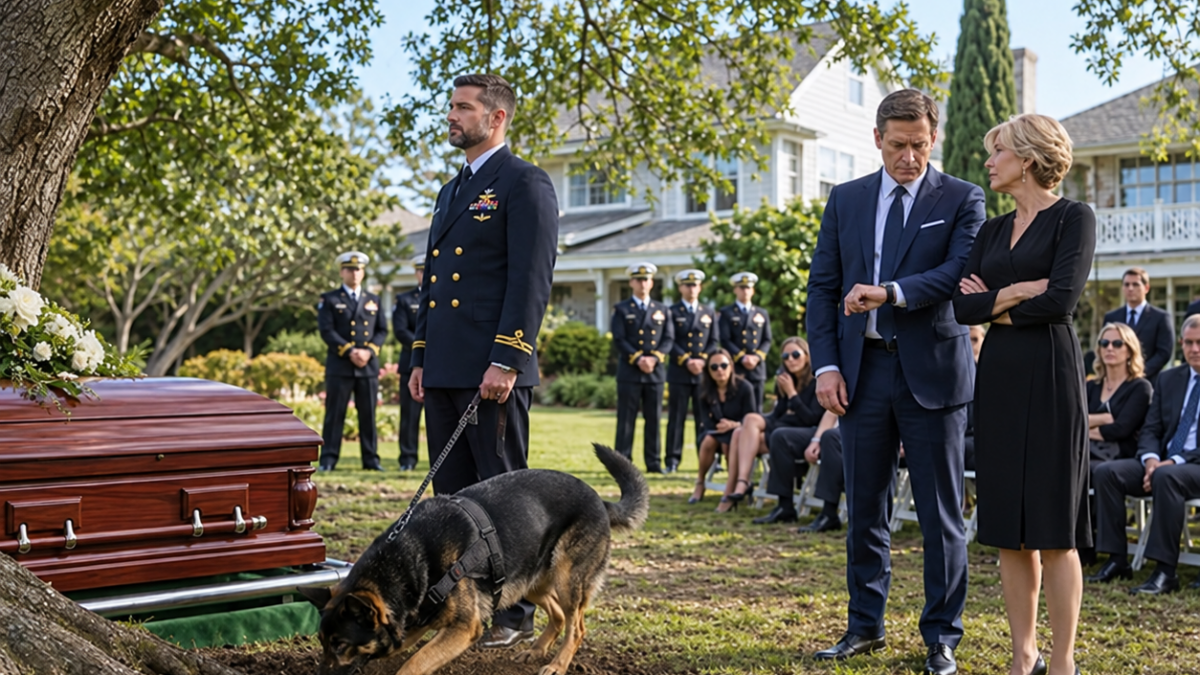
Beatrice was already halfway there, holding her umbrella low as if grief might splash.
I stood.
“What did you say?”
Arthur blinked as if surprised I had heard him.
“I only meant there’s a meeting with the attorney tomorrow, and Mother is exhausted.”
Mother.
He called Beatrice Mother when he wanted to sound like a man of breeding. Louis had called her by her first name and occasionally by worse ones when she wasn’t around.
“Then go,” I said.
Arthur’s mouth tightened.
“There’s no need to be hostile, Roman.”
“There’s every need.”
He glanced toward Titan.
“And what happens to the dog?”
Titan’s head lifted.
I felt the leash tense.
I looked Arthur dead in the eye.
“His name is Titan.”
“I know the dog’s name.”
“No,” I said. “You know what Louis called him. That doesn’t mean you know his name.”
Arthur’s eyes narrowed.
Beatrice called from under her umbrella, “Arthur.”
He forced a thin smile.
“Tomorrow, then.”
He walked away.
Titan watched him go with the same stillness he once used before alerting on explosives buried under dirt.
That should have told me something.
The next morning, the rain was gone, but the air still felt wet.
We gathered in the office of Jonathan Reed, Louis’s estate attorney. Reed was a small, careful man in his sixties with silver hair, rimless glasses, and the emotional expression of a locked filing cabinet. He had represented Louis for years, which meant he had been trusted. Louis did not hand trust out casually.
Arthur and Beatrice sat at the mahogany conference table like people waiting for a meal they had already tasted in their imagination.
Arthur tapped two fingers beside a leather portfolio.
Beatrice smelled faintly of expensive perfume and impatience.
I sat in the corner because I did not care about the money.
That is the truth.
I cared about Louis’s dog, Louis’s flag, and getting through that room without putting Arthur through a wall.
Titan lay at my feet, his chin resting across my boots.
Reed opened a folder.
“Before we begin, Chief Hayes requested that his will be read in full.”
Arthur leaned back.
“Fine. Let’s get to it.”
Reed looked at him over his glasses.
“Mr. Hayes was clear.”
Arthur waved a hand.
“Proceed.”
Reed broke the seal.
His voice was calm.
“To my stepmother, Beatrice Hayes, and my brother, Arthur Hayes, I leave the sum of ten thousand dollars each. I hope it brings you the peace you have always sought in material things.”
Arthur’s face changed color.
Beatrice sat very still.
I looked down at Titan.
His ears had lifted.
Reed continued before Arthur could interrupt.
“To my brother-in-arms, Roman David Miller, I leave the entirety of my estate in Dubois, Wyoming, including the cabin, the surrounding forty acres, all contents therein, and most importantly, the care and legal ownership of my partner, Titan.”
My throat closed.
Titan pressed his chin harder against my boot.
Reed’s voice softened for the first time.
“Roman, you watched my back in the sandbox. I know you’ll watch over my boy.”
I looked away.
The room blurred.
Arthur exploded.
“This is a joke.”
Reed folded the paper slightly.
“It is legally binding.”
“Ten thousand dollars?”
Beatrice’s voice cut in, sharp and brittle.
“Where is the rest?”
Reed turned toward her.
“Mrs. Hayes—”
“Don’t Mrs. Hayes me. Louis had millions. We know he did.”
Arthur leaned forward, eyes wild.
“The patent money. The accounts. The defense payout. Where is it?”
Reed’s expression did not change.
“Chief Hayes liquidated his investment accounts three months before his death.”
Arthur froze.
Beatrice’s lips parted.
“The funds,” Reed continued, “were converted into physical assets.”
“What kind of physical assets?” Arthur demanded.
“Bearer bonds. Gold bullion. Cash instruments. Possibly other stores of value.”
“Where?”
Reed placed both hands on the table.
“Chief Hayes did not disclose the exact location to me.”
“That’s convenient.”
“He stated only that they were secured on his Wyoming property and that the legal owner of that property would inherit all contents.”
Arthur’s eyes snapped toward me.
For the first time since I had known him, fear cracked through the greed.
“When does the deed transfer?” he asked.
Reed’s jaw tightened.
“Probate processing will take approximately ten days.”
Ten days.
I heard the number land in Arthur’s mind like a door opening.
I should have gone straight to Wyoming that afternoon.
That is the thought that would haunt me later.
But grief makes you slow in strange places.
Louis’s final military paperwork still needed signatures. His remaining gear in California had to be inventoried and shipped. Titan’s retirement documentation had to be finalized. Reed told me not to worry, that the property was locked, monitored by a neighbor, and remote enough that nobody would disturb it.
He did not know Arthur.
I knew Arthur was greedy.
I did not yet understand he was desperate.
That afternoon, while I stayed in California with Titan, Arthur and Beatrice boarded a first-class flight to Jackson Hole.
They rented a heavy-duty SUV.
They drove into Wyoming under a bruised evening sky.
And by the time I landed there a week later, Louis’s sanctuary had been gutted.
The cabin sat at the end of a long gravel drive outside Dubois, tucked against pine forest with mountains rising behind it like old guardians.
I had been there with Louis half a dozen times.
It was the only place I ever saw him sleep deeply.
The cabin was timber-framed, wide-porched, simple but beautiful. Louis built half of it himself after retirement. He said hammering nails gave his hands something to do when memories got loud.
Titan recognized the turnoff before I did.
He stood in the passenger seat of my old F-150, ears forward, whining softly.
“Yeah,” I said. “We’re here.”
His tail thumped once.
Then we came around the bend, and the sound died in his throat.
The back patio glass was shattered.
The front door hung crooked.
The porch light was broken.
I stopped the truck in the driveway and sat there staring.
Titan growled.
Low.
Controlled.
I had heard that growl in Afghanistan when something was wrong inside a building.
“Stay,” I said.
I stepped out slowly.
Glass crunched under my boots.
The local sheriff, Tom Higgins, was already there. Reed had called him after a neighbor reported the damage, but the county was stretched thin and the cabin was remote. Higgins was a big man in his fifties with a gray mustache, a tired face, and the kind of kindness that made bad news worse because he delivered it gently.
“Roman?”
“Yeah.”
He removed his hat.
“I’m sorry.”
I pushed the door open.
The smell hit first.
Broken wood.
Wet air.
Insulation dust.
Old leather.
Violation.
The living room looked like a war zone after the wrong army had passed through.
Couch cushions slashed.
Books pulled from shelves and scattered.
Drawers ripped out.
Drywall smashed open in ugly holes.
Floorboards pried up.
The kitchen cabinets stood open and empty. Louis’s coffee mug lay broken near the sink. His framed photographs had been knocked from the mantel. One picture of him and Titan in Afghanistan had been stepped on, the glass cracked across Louis’s face.
My hands curled.
Sheriff Higgins stood behind me.
“Looks like meth heads,” he said. “We get it sometimes. Remote cabins. Folks come up from the valley, look for copper, firearms, tools, anything they can pawn.”
I said nothing.
Higgins continued, “They tore through the basement too. Pantry. Storage. Looks like they were searching hard.”
Titan pushed past me.
I had forgotten I left the truck door open.
He entered the cabin slowly, nose working, body rigid.
“Titan,” I said.
He ignored me.
Not disobedience.
Work.
He moved from room to room, sniffing. Living room. Kitchen. Hallway. Bedroom. Basement stairs. His breathing changed when he reached the back door.
Short.
Sharp.
Focused.
He knew the scent.
I knew he knew.
“Titan.”
This time he looked at me.
His eyes were not confused anymore.
They were angry.
I turned to Higgins.
“This wasn’t meth heads.”
He frowned.
“How do you know?”
“Because they were looking for something specific.”
“Could still be.”
“No.” I bent and picked up the cracked photograph from the floor. “Meth heads don’t put the shelving unit back over a basement trapdoor.”
Higgins’s face changed.
“What trapdoor?”
I went cold.
Louis had told me once, drunk on half a glass of whiskey because medication had ruined his tolerance, that every man who trusted a bank too much deserved to meet a banker.
I had laughed.
He had not.
In the basement pantry, behind broken shelves, I found the cut padlock.
The steel trapdoor.
The empty cavity beneath the floor.
Inside the fireproof lockbox, Arthur had left Louis’s old uniforms, boots, and some stripped gear like insults packed in dust.
Higgins stood behind me.
“Well,” he said quietly, “that changes things.”
I wanted to call Arthur immediately.
I wanted to hear his voice and know.
But Louis had trained me better than that.
Do not alert the target before you understand the battlefield.
So I said nothing.
For three weeks, I rebuilt the cabin.
Not because I had money.
I didn’t.
My military pension barely covered my own bills, let alone property taxes on forty acres and an aging working dog with joint supplements more expensive than steak.
But leaving the cabin broken felt like letting Arthur win twice.
So I patched drywall.
Replaced glass.
Rebuilt shelves.
Swept until my back screamed.
Sorted Louis’s books.
Cleaned his photographs.
Repaired what I could and covered what I couldn’t.
Titan never left my side.
At night, I slept on a cot in the living room because the bedroom felt too much like trespassing.
Titan slept near the wood stove.
Sometimes, in the dark, I heard him rise and walk to the front door.
He would stand there for a while, listening.
Waiting.
Then he would return and lie beside my cot with a soft groan.
On the worst nights, when grief sat too heavily on my chest, Titan would nudge my hand until I touched his head.
We were both waiting for a man who had always come back before.
Winter softened into muddy spring.
Snow melted from the slopes and ran in thin streams through the property. The pines dripped. The ground around the cabin turned dark and soft. Birds returned. The air smelled like thaw, woodsmoke, and wet earth.
One morning, I was splitting firewood behind the cabin when Titan began acting strange.
He had been lying in the sun, chewing an old stick with the solemn focus of a retired operator who had earned peaceful work.
Then his head came up.
His nose twitched.
He stood.
Slowly.
His ears pointed toward the far edge of the property where the clearing met the forest.
There was an old oak tree there, split years ago by lightning. Half-dead. Massive roots twisted out of the ground like knuckles.
Titan walked toward it.
Not wandering.
Tracking.
His head lowered.
His tail stiffened.
His breathing changed.
I knew that pattern.
I had seen it in alleys outside Ramadi.
In abandoned compounds.
In roadside dust where something meant to kill us waited beneath a thin layer of dirt.
Short, sharp sniffs.
Scent cone.
Focus.
“Titan,” I called. “Leave it.”
He ignored me.
I set the axe down.
“Probably a badger, buddy.”
Titan put his nose to the muddy earth between two thick roots.
Then he started digging.
Hard.
Dirt flew behind him. Mud splattered his chest. His paws tore into the ground with a force that made his age disappear.
“Hey. No.”
I jogged toward him.
“Titan, leave it.”
He dug another foot.
Then suddenly stopped.
He stepped back.
Squared his shoulders.
And sat down hard in the mud.
Perfectly still.
Eyes locked on the hole.
My skin went cold.
The final response.
Titan had alerted.
Not on a badger.
Not on bone.
Not on food.
On a target.
“What did you find?” I whispered.
Titan whined without looking away.
I trusted that dog with my life.
More than once, he had found explosive residue where human eyes saw nothing. More than once, his nose had kept men breathing.
If Titan said something was buried there, something was buried there.
I ran to the shed and grabbed a steel spade.
The ground fought me.
Roots.
Rocks.
Clay.
Mud.
I dug until sweat ran down my back despite the cold. Dug until my shoulders burned. Dug until my hands blistered inside my gloves.
Titan sat beside the hole the entire time.
Watching.
Waiting.
After nearly an hour, the shovel struck something hard.
Not stone.
Metal.
A clean, hollow clink.
I dropped to my knees and cleared mud with my hands.
At the bottom of the hole, wrapped in layers of heavy waterproof tarp, was an olive-drab military ammunition crate.
Large.
Heavy.
The kind used for 40mm grenades.
My pulse hammered in my ears.
I hauled it out, slipping once in the mud. Titan stood and nudged the box with his nose, gave one loud bark, then trotted a few feet away and lay in the grass as if his part was finished.
I wiped mud from the latch.
The rubber seal was intact.
I opened it.
Air hissed out.
Inside, there was no gold.
No cash.
No bearer bonds.
On top of a stack of manila folders lay a single white envelope.
My name was written across it in Louis’s unmistakable messy handwriting.
Roman.
I sat back in the mud.
For a moment, I could not touch it.
Louis had been dead for weeks, and still he had reached up through the earth and grabbed me by the collar.
Finally, I opened the envelope.
Brother,
If you’re reading this, I’m gone, and Titan did his job.
I had to stop after the first sentence.
My eyes burned.
Titan watched me from the grass.
I wiped my face with the heel of my hand and kept reading.
I packed a rag with trace C4 residue into this crate before I buried it. Don’t worry, it’s inert. No danger. But my boy knows that scent better than he knows bacon, and he never misses a hide.
By now, Arthur and Beatrice have probably found the basement safe.
Let them have it.
I know my brother. I know greed. Greed does not search for a second trap after it thinks it has already won.
The bonds in that safe were bait.
I laughed once.
Not because anything was funny.
Because Louis was in the grave and still more alive than Arthur would ever be.
I kept reading.
The real legacy is in this box.
The money that will keep you and Titan safe is here.
But there is something else too.
Something Arthur will regret leaving behind.
Give him hell, Roman.
I reached into the crate and pulled out the first folder.
Inside was a leather-bound ledger.
Then a USB drive.
Then copies of wire transfers, shell company documents, forged signatures, offshore account numbers, scanned checks, emails, handwritten notes in Louis’s tight tactical shorthand.
Arthur’s name appeared again and again.
And again.
A memory surfaced.
Years before, after the patent sale, Louis had told me he hired Arthur as a temporary financial consultant.
“Trying to rebuild a bridge,” he had said.
I had asked, “With Arthur?”
Louis had shrugged.
“He’s my brother.”
I had said nothing because even hard men have soft blind spots where family is concerned.
Arthur had used that soft spot like an entry wound.
The ledger showed everything.
Arthur siphoning consulting fees.
Creating shell companies.
Forging approvals.
Moving chunks of Louis’s early contract payouts to cover collapsing real estate investments.
Money laundering.
Wire fraud.
Enough to destroy him.
But Louis had not stopped there.
The second folder was titled THE BAIT.
Inside were photographs of every bearer bond and gold coin placed in the basement safe.
Serial numbers.
Mint marks.
Dates.
An unfiled federal report identifying the assets as stolen property if removed from the premises by anyone other than me.
Louis had not hidden treasure.
He had set a trap.
Then, at the bottom of the crate, wrapped in velvet, was a black titanium hardware wallet.
Taped to the back was a twelve-word recovery phrase.
I stared at it.
The final page of Louis’s letter explained.
The bonds they stole are worth roughly three million.
The wallet holds the rest of the payout.
At the time I’m writing this, just over nine million.
It is legal. It is documented. Reed has the supporting paperwork sealed until probate closes.
Use it well.
Don’t waste it on revenge.
Use the ledger for justice.
There’s a difference.
Take care of Titan.
Take care of yourself.
And if you ever doubt whether you deserved any of this, remember that when everyone else wanted what I had, you were the one who sat beside me when I had nothing left to give.
That’s family.
—Louis
I sat in the mud beside the hole for a long time.
The mountains stood silent around me.
Titan chewed his stick.
Somewhere in the trees, water dripped from thawing branches.
Nine million dollars sat in my hand.
And I felt none of what Arthur must have felt when he opened the basement safe.
No thrill.
No hunger.
No sudden fantasy of yachts or mansions or cars.
I felt weight.
Responsibility.
Louis had not left me a fortune.
He had left me a mission.
That afternoon, I sat at Louis’s scarred kitchen table and plugged the USB drive into an encrypted laptop I had kept from contracting work after the Navy.
The files opened one by one.
Louis had built a fortress.
Not just financial documents.
Audio recordings.
Emails.
Photographs.
Metadata.
Bank trails.
Corporate filings.
Every stolen dollar mapped.
Every lie cross-referenced.
Every trap baited.
One folder contained drafts of reports to FinCEN, the FBI, the IRS Criminal Investigation Division, and the Securities and Exchange Commission.
Louis had known he might die before spring.
He had prepared accordingly.
That was Louis.
Cancer could eat his body, but it could not stop him from building an ambush.
I called Special Agent Gregory Mitchell from the FBI’s white-collar crime division.
I had met Mitchell years earlier during a case involving offshore accounts and hostage financing. He had a voice like gravel and the patience of a sniper.
“Miller,” he said. “Tell me you aren’t calling because you need bail money in Cheyenne.”
“Nothing like that.”
“Disappointing.”
“I need to hand-deliver evidence involving wire fraud, embezzlement, stolen bearer bonds, and a defense contract payout.”
Silence.
Then, “How much?”
“Arthur stole three million in bait.”
“Bait?”
“My friend Louis set a trap before he died.”
Another pause.
“I’m listening.”
“No,” I said. “You need to see this in person.”
Two days later, I flew to Los Angeles with Titan at my side and Louis’s evidence in a locked case.
By then, Arthur and Beatrice were living like thieves who thought speed could outrun consequence.
They leased a mansion in the Hollywood Hills.
Arthur bought a Porsche.
Beatrice purchased jewelry with cash converted from gold coins.
Arthur had also begun negotiations on a yacht in Newport Beach.
The Gilded Trust.
That name told me everything.
But cashing bearer bonds in the modern world was not as easy as Arthur imagined. Men like him believe stolen wealth becomes clean if you touch it with enough confidence. It doesn’t. It leaves fingerprints. Serial numbers. Suspicious broker records. Nervous phone calls. Paper trails.
Mitchell listened to my summary in a federal conference room while Titan lay under the table, bored.
When I finished, he leaned back and let out a long breath.
“Your friend was terrifying.”
“Yes.”
“I mean that as a compliment.”
“So would he.”
Mitchell tapped the folder titled THE BAIT.
“The stolen property report was drafted but never submitted?”
“Correct.”
“But the serial numbers are documented before the theft.”
“Yes.”
“And your brother-in-law equivalent—”
“Not my anything.”
“Arthur,” Mitchell corrected, “currently possesses or has liquidated part of that stolen property.”
“That’s the theory.”
Mitchell smiled.
It was not a friendly smile.
It was the smile of a man watching a case assemble itself.
“We need him to confirm possession.”
“I can get him to.”
Mitchell studied me.
“You sure?”
“He thinks I’m broke. He thinks I’m grieving. He thinks I’m stupid because I loved Louis and don’t care about luxury.”
“And what are you?”
I looked down at Titan.
“Angry.”
Mitchell nodded slowly.
“Angry can work if disciplined.”
I thought about Titan sitting beside the hole.
Final response.
Still.
Patient.
Certain.
“I know discipline.”
The call happened that afternoon.
Mitchell recorded it with warrants already moving through the system.
Arthur answered on the fourth ring.
“What do you want, Roman?”
His voice was sharp, but I heard tension under it.
“The probate is almost done,” he snapped. “You have the cabin. Mother and I got nothing. If you’re calling to complain, call the attorney.”
“I found something,” I said.
Silence.
“What?”
“I’ve been repairing the cabin.”
“Good for you.”
“The basement was torn up.”
“Well, you know how addicts are.”
“I found the trapdoor.”
Arthur said nothing.
“Someone emptied the safe.”
Still nothing.
“Then Titan found an ammo can buried near the old oak tree.”
I let that sit.
When Arthur spoke again, his voice had changed.
“What was in it?”
“A ledger.”
I heard him breathe.
“A leather book,” I continued. “USB drive. Bank records. Your name.”
“Roman—”
“I don’t care about Louis’s old business drama.”
That was the lie.
“I care about keeping the cabin and feeding the dog. I don’t have money for lawyers. If I turn this over, I get dragged into something I can’t afford.”
“What do you want?”
“One hundred thousand cash. You get the ledger and drive. I walk away.”
Arthur was silent long enough that I knew he believed me.
Greedy people always believe everyone else has a price because they cannot imagine another kind of person.
“Fine,” he said.
“Tomorrow. Noon. Newport Beach. My yacht. The Gilded Trust. Come alone. Bring the dog.”
I looked at Mitchell.
He nodded.
“I’ll be there,” I said.
Arthur hung up.
Mitchell grinned.
“He took the bait.”
I looked at Titan.
“Just like Louis said he would.”
The next day, Southern California looked offensively beautiful.
Blue sky.
Bright sun.
Clean wind off the water.
Newport Beach glittered with wealth arranged to look effortless. White yachts. Teak decks. Polished chrome. Men in linen. Women in sunglasses large enough to hide entire criminal conspiracies.
Titan walked at perfect heel beside me.
He wore his tactical harness.
Not because I expected trouble.
Because Arthur had asked me to bring him, and I wanted him to understand exactly whose legacy he had tried to steal.
The Gilded Trust sat at the end of the slip like a monument to poor character.
White hull.
Gold lettering.
Too much shine.
Arthur stood on the aft deck in a linen suit, trying to look in control.
Beatrice sat behind him on a white leather sofa with a mimosa in one hand and diamonds at her throat.
Probably Louis’s gold around her neck.
My hands stayed relaxed.
Titan’s ears moved.
He smelled my anger before anyone else saw it.
“Easy,” I whispered.
We stopped at the gangway.
Arthur looked down.
“You brought it?”
I unzipped my canvas duffel and lifted the leather ledger.
His eyes locked onto it.
“Bring it up.”
I walked aboard.
Titan followed, claws clicking on fiberglass.
Beatrice wrinkled her nose.
“Does the dog have to be here?”
Titan looked at her.
She shifted back.
“Yes,” I said.
I tossed the ledger onto the glass table.
It landed with a heavy thud.
Arthur lunged for it.
He flipped pages frantically until he saw what he feared.
Signatures.
Transfers.
Companies.
Dates.
His own handwriting in copied memos.
Then, because men like Arthur mistake temporary possession for victory, he laughed.
“You really are as stupid as he was.”
I said nothing.
He slammed the ledger shut.
“You could have ruined me with this.”
“Could have.”
He threw a manila envelope at my feet.
“There’s your hundred grand. Now get off my boat.”
I did not pick it up.
Arthur smirked.
“What? Too proud?”
“Your boat?” I asked. “Or Louis’s?”
His face hardened.
“He’s in the ground.”
Titan growled softly.
Arthur pointed at him.
“Control that animal.”
“He is controlled.”
Arthur stepped closer.
“I’m floating in millions, Roman. You’re living in a dead man’s cabin with a worn-out dog and a pension. Whatever moral victory you think you have, keep it. I’ll buy another one.”
Beatrice laughed.
That was the moment I decided mercy had been fully explored and rejected.
“The ledger was never the weapon,” I said.
Arthur frowned.
“What?”
I reached into my jacket and pulled out a single sheet of paper.
The serial numbers.
I placed it on top of the ledger.
Arthur stared.
“What is this?”
“Numbers.”
“I can see that.”
“Bearer bonds. Gold coins. Every asset Louis placed in the basement safe.”
Arthur’s face drained.
Beatrice set down her glass.
“He documented them before you stole them.”
“No,” Arthur whispered.
“He drafted the report too. FBI. FinCEN. IRS. SEC. All it needed was a date and signature.”
Arthur backed away.
“No.”
“Louis knew you would take them.”
“No.”
“He didn’t hide the money from you, Arthur. He showed you exactly where your greed wanted to look.”
The sound of engines cut across the marina.
Arthur turned.
Two Coast Guard boats moved into position, blocking the yacht’s exit.
At the same time, boots thundered on the dock.
Special Agent Mitchell came up the gangway with six federal agents behind him.
“Arthur Hayes,” he said, badge out. “You are under arrest for wire fraud, embezzlement, grand larceny, possession of stolen financial instruments, and money laundering.”
Beatrice screamed.
Not cried.
Screamed.
Arthur stumbled backward, hitting the railing.
“This is a setup!”
Mitchell smiled thinly.
“Yes.”
“He planted it!”
“Your brother?”
Arthur’s mouth opened.
No sound came.
Mitchell nodded to two agents.
They moved fast.
Arthur struggled once, but men like him are only brave when contracts and distance protect them. The agents turned him against the railing and cuffed him.
Beatrice sobbed as another agent read her rights.
Titan sat beside me, calm as stone.
Arthur looked back as they dragged him down the gangway.
“You get nothing!” he shouted. “The government will seize it all. You hear me? You get nothing!”
I reached into my pocket and felt the cold titanium edge of the hardware wallet.
Nine million dollars.
Legal.
Documented.
Untouched by Arthur.
I looked at Titan.
“We got everything we need.”
Titan barked once.
Arthur heard it.
I hope he carried that sound all the way to holding.
Six months later, the cabin looked like Louis again.
Not exactly the same.
It never would.
Some damage can be repaired, but not erased.
I replaced the broken windows. Rebuilt the pantry shelves. Restored the floorboards. Framed the cracked photograph instead of hiding the scar across Louis’s face. It belonged to the story now.
The legal process took time, but Arthur and Beatrice lost more than they stole.
The yacht was seized.
The mansion lease collapsed.
The Porsche disappeared into federal custody.
Arthur’s investors came forward. Then brokers. Then accountants. Greed leaves trails because greed believes it deserves roads.
Beatrice’s attorneys tried to paint her as an innocent woman misled by her stepson.
The diamond necklace purchased with converted gold disagreed.
Arthur eventually took a plea deal when prosecutors made it clear Louis’s evidence could bury him for decades. Beatrice received less time but lost the lifestyle she had chosen over decency.
I did not attend sentencing.
Louis would have.
He had a colder relationship with justice than I did.
I stayed in Wyoming with Titan.
That morning, while Arthur stood before a federal judge, I stood at the edge of Louis’s meadow watching contractors pour the foundation for the first kennel building.
Not a luxury home.
Not a sports car.
Not a yacht.
A sanctuary.
The Chief Louis Hayes K-9 Sanctuary.
That was what we called it.
Two hundred additional acres of mountain land purchased from a neighboring rancher who cried when I told him what it was for because his own retired police dog had died years earlier with no place to go when the department no longer needed him.
We built heated kennels with soft flooring.
A veterinary clinic.
Hydrotherapy rooms.
Open fields.
Shaded trails.
A memorial wall.
Housing for handlers who wanted to visit.
A retirement and rehabilitation facility for military and police working dogs injured, aging, or simply done giving pieces of themselves to human wars and human laws.
Louis’s crypto paid for it.
Titan’s nose made it possible.
The first retired K-9 to arrive was a Belgian Malinois named Ranger with nerve damage in one back leg and eyes that never stopped scanning corners.
Titan greeted him at the fence.
No posturing.
No dominance.
Just one old operator recognizing another.
Ranger stayed three weeks before he stopped pacing at night.
Then came Maggie, a bomb dog from Texas afraid of thunderstorms.
Then Duke, a police shepherd whose handler had died and whose department did not know what to do with a dog who still waited by passenger-side doors.
Then more.
And more.
The meadow filled with gray muzzles, limps, scars, and second chances.
I stood on the porch one evening as the sunset painted the Wyoming sky orange and purple.
Titan lay beside me, his muzzle resting on his paws.
He was older now.
His hips hurt more.
His hearing had begun to fade.
But his eyes still followed everything.
Down in the meadow, Ranger trotted beside Maggie while Duke rolled in grass like dignity had been overrated all along.
I looked at Titan.
“You know this is your fault.”
His tail moved once.
“You dug up a fortune and a federal case.”
Another tail thump.
“You also saved me.”
He lifted his head.
I had not meant to say that out loud.
But it was true.
After Louis died, I thought I was inheriting a dog and a broken cabin.
I did not understand that Louis had left me a reason to keep moving.
A mission.
A place where grief could become work.
A way to love him without standing forever beside his grave.
Titan nudged my hand.
I scratched behind his ear.
“Yeah,” I whispered. “I know.”
A year after the funeral, we held a dedication ceremony at the sanctuary.
I hated ceremonies.
Louis had hated them too, which was why I kept it small.
Veterans.
Handlers.
A few local officials.
Reed.
Sheriff Higgins.
Special Agent Mitchell, who claimed he came only because Wyoming had better views than his office.
We placed a bronze plaque near the entrance.
CHIEF LOUIS HAYES K-9 SANCTUARY
For the dogs who served, searched, guarded, found, fought, and loved without asking what it would cost them.
Below that, in smaller letters:
Founded in honor of Chief Petty Officer Louis Hayes and Titan, the dog who never missed a target.
When I saw Titan’s name, I had to walk away for a minute.
Titan followed.
Slowly.
His paws were gray now.
His movement stiff.
He stood beside me at the fence line and looked toward the old lightning-struck oak where everything had changed.
I knelt beside him.
“You found it,” I said.
He leaned into my shoulder.
“Good boy.”
He licked my chin once.
Then, because he was still Titan, he spotted a squirrel and immediately forgot the emotional weight of the moment.
Louis would have loved that.
Titan lived three more years.
Good years.
Years of sun on the porch, slow patrols through the sanctuary, stolen treats from veterans who pretended they were not spoiling him, and naps beside the wood stove where Louis used to sit.
When his final winter came, snow fell heavy over Dubois.
The sanctuary kept running.
Dogs still needed medication.
Meals.
Walks.
Reassurance.
Life does not pause politely for grief.
Titan began sleeping more.
Then eating less.
His back legs weakened.
Dr. Patel, who had moved out to work full-time at the sanctuary, told me gently what I already knew.
“He’s tired, Roman.”
I looked at Titan asleep on Louis’s old blanket.
“He’s earned tired.”
“Yes,” she said. “He has.”
On his last day, I carried him to the porch.
He hated being carried on principle but allowed it because his body had become less stubborn than his pride.
The meadow was covered in snow.
A dozen retired working dogs moved slowly below us, some playing, some sniffing, some simply existing in peace because Titan had once put his nose to the dirt and alerted on Louis’s final gift.
I sat beside him with Louis’s folded flag in my lap.
Titan rested his head on my thigh.
“You watched over him,” I whispered.
His ear moved.
“You watched over me.”
His breathing was slow.
“You built all this.”
A weak tail thump.
I smiled through tears.
“Don’t argue. You did.”
When Dr. Patel gave him the first injection, Titan relaxed with a sigh so deep it sounded like a soldier finally setting down his pack.
I bent close.
“Find him,” I whispered.
His eyes opened once.
Amber.
Tired.
Clear.
“Find Louis.”
Titan’s tail moved one final time.
Then he was gone.
I buried him under the old lightning-struck oak.
Not in the exact hole where he found the ammo crate.
Beside it.
Close enough.
We placed a second plaque there.
TITAN
Military Working Dog. Partner. Guardian.
He found what greed buried and gave loyalty somewhere to live.
People visit that tree now.
Veterans mostly.
Handlers.
Families.
Sometimes children who do not understand why their parents get quiet there.
They leave coins.
K-9 patches.
Tennis balls.
Once, someone left a worn leather leash.
I never moved it.
Years have passed.
The sanctuary is still here.
Bigger now.
Better funded.
Run by people smarter than me because Louis’s final gift was large, but even nine million needs discipline if it is going to become legacy instead of noise.
I still live in the cabin.
Louis’s cabin.
My cabin.
Our cabin, maybe.
The cracked photograph remains on the mantel.
Louis and Titan in Afghanistan.
The line through the glass still cuts across Louis’s face.
I could replace it.
I never will.
Some scars prove the thing survived.
Arthur writes letters from prison sometimes.
Not apologies.
Explanations.
Complaints.
Accusations.
He says Louis manipulated him.
He says I stole what should have belonged to blood.
He says Titan was just a dog.
I never answer.
There is no point explaining loyalty to a man who could stand at his brother’s grave and check his watch.
Beatrice has not written.
I hear she moved in with a cousin after release, far from California, far from yachts and marble kitchens and stolen gold.
Maybe that is punishment.
Maybe not.
I do not spend much time thinking about either of them.
That was the last thing Louis taught me.
Justice matters.
Revenge shrinks if you feed it too long.
Use the ledger for justice.
Don’t waste the money on revenge.
There’s a difference.
He was right.
The best revenge was not Arthur in handcuffs, though I admit that image warmed me through several cold nights.
The best revenge was Ranger sleeping peacefully through thunder.
Maggie learning to swim again.
Duke no longer waiting by a cruiser door that would never open.
The best revenge was a meadow full of old working dogs who had given humans everything and were finally asked for nothing.
The best revenge was Louis’s name on a gate no thief could tear down.
Sometimes, at sunset, I walk to the oak.
I stand there with my hands in my jacket pockets while wind moves through the grass and the mountains darken against the sky.
I think about the funeral.
The rain.
Arthur’s watch.
Beatrice’s dry eyes.
Titan’s whine when the rifles fired.
I think about the cabin destroyed.
The empty safe.
The box beneath the roots.
Louis’s handwriting.
Brother, if you’re reading this, I’m gone, and Titan did his job.
I smile every time.
Because of course Titan did his job.
He always did.
The world teaches people to look for treasure in vaults.
In accounts.
In gold.
In numbers on a screen.
Arthur believed inheritance was something you could steal if you moved fast enough and lied hard enough.
He never understood Louis at all.
Louis’s real inheritance was not buried in the basement.
It was not in the bonds.
It was not even in the crypto wallet, though that money built something beautiful.
Louis’s real inheritance was a dog who remembered his training.
A brother who kept his promise.
A trap set for greed.
A sanctuary built from grief.
A name carried forward by every old K-9 who lies down safely here and finally sleeps.
The vultures thought they picked the bones clean.
They forgot one thing.
Louis Hayes was a Navy SEAL.
He always had a contingency plan.
And Titan?
Titan never missed a target.








