Her Last Puppy Was Adopted, but the Nearly Blind Mother Refused to Leave the Shelter Door—Then the New Owner Came Back Carrying One Familiar Green Blanket
PART3:
“Of course.”
She opened the gate and guided me closer.
Hazel did not rush. She stepped carefully, testing the polished tile with her paws, one step at a time. Finch squirmed excitedly, little legs kicking against my arm.
When I crouched, Hazel moved her nose over him.
His head.
His ears.
His harness.
My hands.
Then his face again.
Finch licked her muzzle.
Hazel closed her eyes.
For a second, the entire noisy shelter seemed to fade.
There was only this nearly blind mother, thin and quiet, breathing in the scent of the last baby she had left.
I had seen mother dogs before. I knew puppies eventually left. That was normal. That was the goal, even. Puppies needed homes. Shelters could not keep families together forever. Every adoption opened space for another life to be saved.
I knew all that.
But knowing something does not stop it from hurting when you are close enough to see the cost.
I held out my hand.
Hazel sniffed my fingers.
Her nose was warm and dry at the edges. Her breath trembled slightly.
“I’ll take care of him,” I whispered.
It was a foolish thing to say to a dog who could not understand my words.
But Hazel leaned closer anyway, as if maybe she understood the shape of a promise even if the language was wrong.
A few minutes later, the lobby door opened.
I carried Finch out.
Everyone smiled.
Someone said, “Congratulations.”
A volunteer called, “Happy life, little guy.”
Finch looked over my shoulder.
His tail slowed.
Then the door closed behind us.
I did not see Hazel walk to it.
Not then.
I buckled Finch into the crate in the back seat, sat behind the wheel, and cried before starting the car. I told myself they were happy tears. New-dog tears. Overwhelmed tears.
But as I drove home, Finch curled into the green blanket the shelter had sent with him and pushed his nose deep into the fabric.
He stayed that way the whole drive.
Mark met us in the driveway like a man trying very hard not to look too excited.
“There he is,” he said, opening the back door. “Hey, buddy.”
Finch lifted his head, blinked, then wagged.
Within twenty minutes, our house had become Finch’s house.
He discovered the water bowl, tripped over the edge of the kitchen rug, carried a plush duck into the hallway, and fell asleep halfway on the dog bed we had placed near the cabinets. Mark sat on the floor beside him and whispered, “He’s perfect,” like he had not been pretending to be the practical one for months.
I should have felt only joy.
Instead, my mind kept returning to Hazel.
The way she had breathed Finch in.
The way her cloudy eyes had searched without seeing.
The way I had promised to take care of him while knowing I was carrying him away from the dog who had already done that with her whole body.
Around two o’clock, Finch woke and began exploring again. He ate a little. Drank water. Chewed the edge of the green blanket. Then, when he got tired, he did something strange.
He did not settle on the new bed.
He dragged the green blanket closer with his tiny teeth, stepped onto it, turned three times, and pressed his nose into one corner before lying down.
“That blanket must smell like the shelter,” Mark said.
“No,” I said quietly. “I think it smells like his mother.”
Mark looked at me.
I sat on the floor across from Finch and watched him sleep.
The house was safe.
The yard was fenced.
There were toys, food, blankets, a vet appointment scheduled, and two people ready to love him.
Finch had everything a puppy was supposed to get on adoption day.
So why did my chest hurt?
At 3:17 p.m., I called the shelter.
Maya answered.
I knew her name because she had been the one who reviewed Finch’s medical papers with me. Her voice was warm but tired, the voice of someone who had probably spoken to fifty adopters that day.
“Willow Creek Animal Rescue, this is Maya.”
“Hi,” I said. “This is Caroline Reed. I adopted Finch this morning.”
“Oh, Finch! How’s he doing?”
“He’s good. He’s settling in. He’s asleep on the blanket you sent.”
“That’s wonderful.”
I swallowed.
“How’s Hazel?”
There was a pause.
Not long.
Long enough.
“She’s okay,” Maya said carefully.
That was not an answer.
“What does okay mean?”
Maya exhaled softly.
“It means she’s not in medical distress.”
“But?”
Another pause.
“She’s by the front door.”
My throat tightened.
“What?”
“She went there after you left. We brought her bed. We put down her scent cloth. She followed a food trail halfway and then went back to the entrance. Every time the door opens, she lifts her head.”
I closed my eyes.
In the living room, Finch sighed in his sleep.
“She’s waiting for him,” I whispered.
“We can’t know exactly what she understands,” Maya said gently. “But yes. She seems to be waiting.”
I looked at Finch’s small body curled into the blanket.
“Could Hazel live with Finch?”
The question came out before I had fully measured it.
Maya did not answer right away.
She did not say yes.
She did not say no.
She said, “Come back. Let’s talk about what Hazel actually needs.”
That sentence changed everything.
Because it would have been easy for her to say, “That’s so kind, come get her.” It would have been easy for the shelter to celebrate one more adoption, especially for a nearly blind adult dog who would not be easy to place.
But Maya did not treat Hazel like an accessory to Finch.
She treated her like a whole life.
A dog with needs.
Fears.
Limits.
Dignity.
“I’m coming,” I said.
Mark looked up when I ended the call.
“What happened?”
“Hazel is waiting by the shelter door.”
His face shifted the way mine must have earlier.
“Oh, Caroline.”
“I need to go back.”
He looked at Finch, then at me.
“Do you want me to come?”
“Stay with him. I don’t know what’s going to happen yet.”
I picked up Finch’s green blanket.
Finch opened one eye as I lifted it.
“I’m sorry,” I whispered. “I’ll bring it back.”
Then I drove to the shelter with the blanket in the passenger seat and guilt sitting beside me like another person.
I did not know whether I was going back because of responsibility.
Or because of guilt.
Or because somewhere deep inside, beneath all my practical thoughts, I already knew what the right thing was.
When I stepped into the shelter lobby, the energy had changed.
Morning celebration had faded into late-afternoon exhaustion. The cupcakes were gone. The paperwork stacks were lower. A volunteer was mopping near the front desk. Somewhere in the back, a dog barked twice and stopped.
Maya met me near the hallway.
“She’s still there?” I asked.
Maya nodded.
“She drank water. She won’t eat. She gets up for every door.”
I looked down the hall.
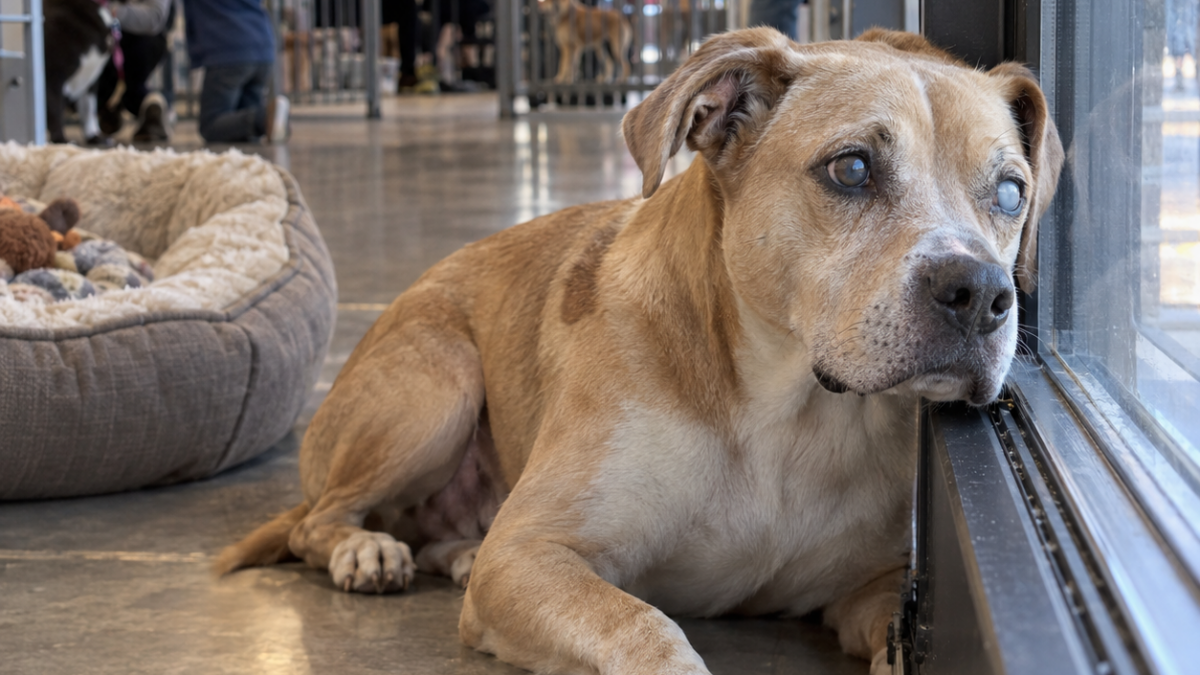
Hazel was lying near the entrance to the adoption wing, her body angled toward the lobby door. Her bed was against the wall ten feet away, padded and soft. A scent cloth rested in the center of it. Pieces of kibble had been placed in a careful trail.
Hazel was not on the bed.
She was at the door.
Exactly where Finch had disappeared.
I walked toward her slowly.
I did not call her name.
I did not touch her.
I simply knelt a few feet away and placed Finch’s green blanket on the tile.
Hazel froze.
Her ears lifted.
Her nose moved once.
Then again.
She rose with heartbreaking care.
One step.
Pause.
Another step.
Pause.
Her cloudy eyes stared past me, but her nose followed the truth.
When she reached the blanket, she lowered her head and breathed in.
I covered my mouth.
I expected her to curl up on it.
To rest.
To take comfort in the scent.
But Hazel did not lie down.
She sniffed the blanket once more, then lifted her head and turned toward the front door.
Waiting.
Not for Finch’s scent.
For Finch himself.
That was when I started to cry.
Not loudly.
Not dramatically.
Just the kind of crying that happens when your heart finally stops arguing with what it already knows.
“She thinks he’s coming back,” I whispered.
Maya crouched beside me.
“Maybe. Or maybe she knows his scent came from outside and she’s hoping to follow it. We have to be careful not to put human explanations on everything. But what we do know is that Hazel is bonded, she’s visually impaired, she’s been through a lot, and transitions are hard for her.”
I wiped my face.
“What would she need?”
“Patience. A quiet space. Slow introductions. A safe layout that doesn’t change too much. No stairs unsupervised. A family willing to let her move at her own pace. And Finch might be comforting, but he can’t be her entire world. She needs to learn the home, the people, the sounds. She needs stability.”
I nodded.
“She deserves that.”
“Yes,” Maya said. “She does.”
I looked at Hazel.
She had lowered herself beside the blanket now, but her nose still pointed toward the door.
“She spent seven weeks keeping him alive.”
“And probably longer than that surviving before anyone found them.”
“What happens if nobody adopts her?”
Maya’s face did not change, but her eyes did.
“We keep trying.”
That was the shelter answer.
Kind.
Hopeful.
Not a guarantee.
I thought of Hazel behind a gate, listening to doors open and close, wondering if every sound might be the last puppy she had protected. I thought of her warm bed waiting against the wall while she lay on cold tile because love had anchored her to the place where goodbye happened.
“I need to call Mark,” I said.
Maya nodded. “Take your time.”
I walked outside into the parking lot and called my husband.
He answered on the second ring.
“How is she?”
I looked through the glass door at Hazel.
“She’s waiting.”
Mark was quiet.
“I know this is sudden,” I said. “And I know we planned on one puppy. Hazel is mostly blind, and she’ll need a lot. It won’t be simple.”
“Do you want to bring her home?”
My breath caught.
“I don’t want to make an emotional decision that’s bad for her.”
“That’s not what I asked.”
I closed my eyes.
“Yes,” I whispered. “I want to bring her home.”
“Then ask what the shelter recommends. If they think our house could work, we’ll try.”
“You mean it?”
“Caroline,” he said softly, “you haven’t stopped thinking about her since you walked in the door. And Finch is asleep with his nose where that blanket was.”
I laughed through tears.
“He’s going to be confused when I bring home his mother.”
“He’s a puppy. He’s confused by his own feet.”
That broke something open in me.
When I went back inside, Maya was waiting.
“We’d like to try,” I said. “Not rush. Not force it. Whatever Hazel needs.”
Maya smiled then.
Not the bright adoption-day smile people give for puppies.
A smaller one.
Deeper.
“We can start with a foster-to-adopt,” she said. “That protects Hazel. It gives everyone time. If it’s right, we finalize. If she struggles, we reassess without shame.”
Without shame.
I needed that.
Because love is not only wanting to save something. Sometimes love is being honest enough to ask whether you are the right place for that life to heal.
We spent an hour talking.
Hazel’s medical history. Her vision. Her food. Her fear of slick floors. Her comfort with Finch. Her need for predictable spaces. Maya showed me how to approach her from the side with sound first, how to use my voice before touching, how to guide her without pulling. She gave me a harness, medication instructions, and a list of things to buy or move before bringing her fully into the house.
Then she asked if I wanted to bring Finch in for a supervised meeting before we made the final plan.
“Yes,” I said. “Please.”
I drove home, picked up Mark and Finch, and returned just before closing.
Finch recognized the shelter before we reached the door.
His little body perked up. His nose worked against the crate. When I carried him inside, he made the same tiny sound he had made that morning.
Hazel heard him.
From the hallway, she stood.
Her ears lifted.
Her whole body leaned forward.
Maya opened the gate.
“Slowly,” she reminded us.
I lowered Finch to the floor.
He saw Hazel and froze for half a second.
Then his tail began wagging so hard his back legs nearly slipped.
Hazel walked toward him carefully, guided by scent and sound. Finch wriggled, but somehow, as if instinct told him this moment mattered, he did not slam into her. He crawled forward and tucked himself under her chin.
Hazel inhaled.
Once.
Twice.
Then she rested her muzzle over his back.
The shelter went silent.
Even the volunteer at the desk stopped typing.
Hazel stood there with Finch pressed against her chest, eyes cloudy, body still, and for the first time since I had met her, she looked peaceful.
Not happy exactly.
Peaceful.
As if some terrible question inside her had finally been answered.
He is here.
He is safe.
I am here too.
That night, Hazel came home with us as a foster.
The first twenty-four hours were slow.
Not magical.
Not perfect.
Real.
Hazel bumped into the hallway wall once and froze until I sat on the floor and spoke softly. She refused the new bed until we placed Finch’s blanket beside it. She would not cross from the kitchen into the living room until Mark laid down a rug so her paws could trust the surface. She startled at the dishwasher. She sniffed every chair leg, cabinet edge, doorway, and corner like she was reading a map written in scent.
Finch followed her everywhere.
Sometimes too closely.
Hazel corrected him with a quiet rumble when he climbed on her head, and Finch rolled onto his back as if she had shattered his entire heart. Five seconds later, he tried again.
By the third day, Hazel knew where the water bowl was.
By the fifth, she walked from the back door to her bed without touching the wall.
By the seventh, she ate her whole breakfast.
By the tenth, she slept through the night with Finch curled against her belly.
I learned things too.
I learned not to move furniture casually.
I learned that a blind dog can still know exactly when cheese is opened from three rooms away.
I learned that Hazel loved morning sun but disliked wind in her face.
I learned that when she trusted a space, she moved with quiet confidence, but when something changed, she paused and waited for someone she trusted to speak.
I learned that motherhood had exhausted her, but it had not emptied her.
There was more to Hazel than sacrifice.
She liked having her chest scratched. She liked Mark’s voice best when he read out loud in the evenings. She liked lying near the kitchen while I cooked. She liked soft toys, not to chew, but to carry carefully from room to room as if relocating puppies no one else could see.
And slowly, she learned that Finch was not leaving through a door without her.
Two weeks after we brought her home, Maya came for the foster check.
Hazel greeted her at the door.
Not by sight.
By sound.
Her tail moved slowly, cautiously, then faster when Maya knelt and said, “Hi, sweet girl.”
Maya looked around the living room. Rugs down. Corners padded. Baby gate near the stairs. Hazel’s bed beside Finch’s smaller one. Water bowl in a stable holder. Blanket in the same place every day.
Then she looked at me.
“How is everyone doing?”
Finch chose that moment to trip over his own toy and bark at the floor.
Mark sighed. “Some of us are still developing basic coordination.”
Hazel stepped over Finch, walked to me, and leaned her shoulder against my leg.
That was my answer.
Maya smiled.
“I think she’s home,” she said.
The adoption was finalized the next week.
No crowd.
No cupcakes.
No cheering lobby.
Just me, Mark, Maya, Finch chewing his leash, and Hazel standing quietly with her nose turned toward my hand.
When I signed the papers, I thought about the first ones I had signed for Finch. How proud I had been. How certain. How unaware that love sometimes asks a second question after the first happy ending.
A puppy got a home that day.
But so did his mother.
Hazel did not come to us because she was easy.
She came because she had spent her life doing the hard part for someone else.
She had protected five puppies in an abandoned shed while her own body weakened. She had allowed rescuers near only after every baby was safe. She had watched, through cloudy eyes and scent and sound, as one by one they left for better lives. And when the last one disappeared, she did not celebrate.
She waited.
Because love, real love, does not stop at the door.
Months later, Finch grew into his paws.
Mostly.
Hazel gained weight. Her coat softened. Her cloudy eyes stayed cloudy, but her world became larger anyway. She learned the yard. The porch. The kitchen. The sound of my car. The exact cabinet where treats lived.
Sometimes, when Finch ran outside too fast, Hazel would lift her head from her bed and listen until he came back.
Only then would she sleep again.
People often told us Finch was lucky we adopted Hazel.
I never corrected them out loud.
But the truth was different.
We were the lucky ones.
Because sometimes the animal who needs a home most is not the one wagging at the front of the kennel.
Sometimes it is the one sitting quietly in the back, tired and overlooked, still listening for the baby she kept alive.
Sometimes the heart that looks the most broken is the one that has been strongest for the longest time.
And sometimes, when everyone else is cheering for the happy ending, love is lying beside the door, waiting for someone to notice the mother who made that ending possible.








