Her Jaw Was Shattered and Three Legs Were Broken—Then We Realized the Dying Cat Was Dragging Herself Toward the Door for Her Kitten
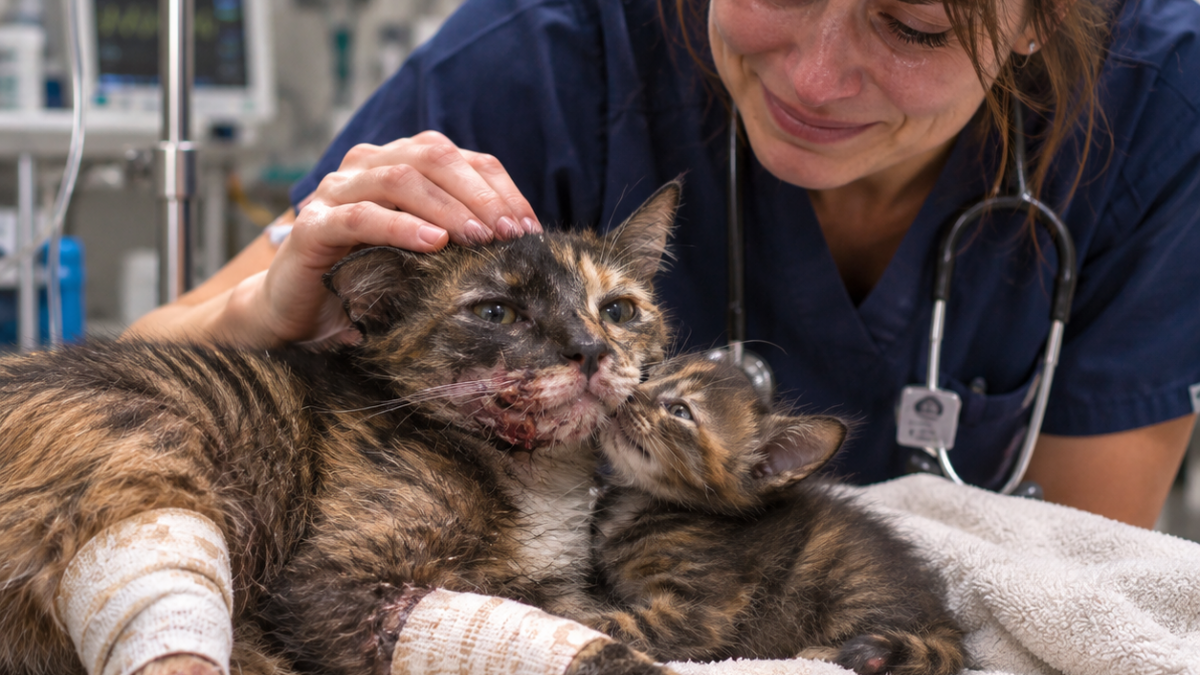
Her Jaw Was Shattered and Three Legs Were Broken—Then We Realized the Dying Cat Was Dragging Herself Toward the Door for Her Kitten
The little tortoiseshell cat arrived at our Pennsylvania clinic so badly injured that even our veterinarian quietly warned me she might not survive the afternoon.
Twenty minutes later, while we were fighting to keep her alive, she began dragging her broken body toward the door—and at first, I thought pain and fear had made her desperate to escape us.
Then a woman walked back into the clinic carrying a cardboard box, and the sound that came from inside revealed that this dying cat had been fighting for someone else the entire time.
I’d worked in veterinary care for twenty-four years by the afternoon Hope came through our doors.
Twenty-four years is long enough to convince yourself you’ve seen almost everything.
I’d watched a Labrador stumble into our clinic after being struck by a delivery truck and somehow wag his tail at every person who touched him.
I’d spent three nights bottle-feeding six premature kittens because their mother had died during an emergency delivery.
I’d held a retired police dog while his handler, a six-foot-three former state trooper, knelt on the examination-room floor and sobbed into the dog’s gray muzzle.
I’d seen cruelty.
I’d seen accidents.
I’d seen neglect disguised as ignorance and selfishness disguised as financial hardship.
I’d seen people spend money they didn’t have trying to save animals they loved, and I’d seen people walk away from animals who had loved them for years because treatment suddenly became inconvenient.
You learn a great deal about human beings when you work around sick animals.
Sometimes more than you want to know.
But nothing in those twenty-four years prepared me for the little tortoiseshell cat wrapped in a faded blue bath towel on a rainy Thursday afternoon in late September.
The woman carrying her came through the front door at 2:17 p.m.
I remember the exact time because I was standing behind the reception desk looking at the clock when the bell over the entrance rang.
The afternoon had been unusually quiet.
Rain had been falling since noon, the kind of steady Pennsylvania rain that turns country roads dark and slick and makes the hills disappear behind gray mist.
Our clinic sat just outside a small town called Briar Glen, about forty miles northwest of Harrisburg. We served everyone from suburban families with pampered golden retrievers to dairy farmers who arrived in mud-covered boots with barn cats tucked inside old feed boxes.
That afternoon smelled like disinfectant, wet asphalt, and coffee that had been sitting in the break room since lunch.
Then the door opened.
A woman rushed inside.
She was maybe fifty, wearing a green rain jacket soaked almost black across the shoulders. Her silver-blond hair had come loose from a ponytail, and her hands were trembling.
“Please,” she said.
That was all she managed at first.
Please.
I came around the desk.
“What happened?”
“I found her by Ridgeway Road.”
The bundle in her arms was so still that my first thought was that she had brought us a dead animal.
Then she pulled back the edge of the towel.
I saw the cat’s face.
PART2:
And for one terrible second, I forgot every professional response I’d learned.
Her dark tortoiseshell fur was soaked with rain and tangled with mud. Dried blood covered her chin and one side of her mouth. Her right cheek was swollen almost twice its normal size. One eye was nearly closed beneath bruised tissue.
Her body seemed impossibly small inside that towel.
“How long ago?” I asked.
“Maybe fifteen minutes. I was driving home. I almost passed her.”
The woman swallowed hard.
“I thought she was trash in the ditch.”
I touched two fingers gently against the cat’s chest.
Nothing.
Then—
There.
A movement.
Barely perceptible.
Her chest rose.
Fell.
Rose again.
“She’s alive.”
The woman covered her mouth.
I called toward the treatment area.
“Dr. Bell!”
Our veterinarian appeared almost immediately.
Aaron Bell had been practicing for thirty-one years, and there wasn’t much that rattled him. He was sixty-two, broad-shouldered, patient, and usually so calm that frightened animals seemed to settle when he entered a room.
When he saw the cat, his expression changed.
“Treatment room two. Now.”
Everything after that moved quickly.
We carried the cat through the double doors.
PART3:
My coworker Jamie pulled supplies from the emergency cabinet while I lowered the towel onto the examination table.
The cat didn’t move.
Up close, the injuries were worse.
Her jaw sat crooked.
One front leg was swollen around the wrist.
The opposite front leg seemed unstable near the shoulder.
Her left hind leg rested at an angle that made my stomach tighten.
There was road grit embedded in her fur.
Blood had dried inside one ear.
She was dangerously cold.
Aaron placed his stethoscope against her chest.
“Heart rate’s weak.”
“Temperature?” I asked.
Jamie checked.
“94.8.”
Far too low.
We moved fast.
Warm fluids.
Oxygen.
Pain control.
Careful stabilization.
Every movement mattered because we didn’t yet know how much internal damage she had.
I stood near her head while Aaron examined her mouth.
When he gently lifted the side of her lip, I saw enough to know this was not going to be simple.
“Multiple fractures,” he murmured.
Her jaw had been shattered.
Not broken cleanly in one place.
Shattered.
Later, the X-rays would show fractures on both sides of the mandible and severe trauma where the lower jaw met the skull.
The imaging also confirmed what we’d suspected about her legs.
Three were fractured.
Three.
The right foreleg.
The left foreleg.
The left hind leg.
Her pelvis had escaped major damage by inches.
Her spine appeared intact.
Her chest showed bruising but, miraculously, no collapsed lung.
The right eye had suffered serious trauma.
There were abrasions along her ribs.
She was dehydrated.
Underweight.
And based on her mammary development, she had recently given birth.
At the time, that detail registered only clinically.
Recently nursing.
Possibly stray.
Possibly abandoned.
Possibly separated from kittens before the accident.
We had no idea how important it was.
Aaron stood at the light board studying the X-rays.
I knew his face well enough to read what he wasn’t saying.
“What do you think?” I asked quietly.
He kept looking at the images.
“If she were stable, I’d say we’ve got options.”
“But she’s not stable.”
“No.”
He exhaled.
“The jaw can be repaired. The foreleg fractures are bad, but they’re repairable. The hind leg may need surgery. The eye—I’m not sure we save it.”
I looked at the cat.
She was lying under a warming blanket, oxygen tubing near her face.
“And if she makes it through stabilization?”
Aaron’s eyes met mine.
“Then we fight.”
“And if she doesn’t?”
He didn’t answer immediately.
That silence was familiar.
It was the silence professionals use when there isn’t a kind way to say something.
“If she starts crashing and we can’t control her pain, we need to make the humane decision.”
I nodded.
I’d had that conversation hundreds of times with families.
It never got easier.
But this cat had no family standing beside the table.
No owner crying into their hands.
No one saying, “Do whatever it takes.”
There was just us.
And the woman who had found her.
I suddenly remembered her.
“She’s still out front.”
Aaron glanced toward the door.
“Get whatever information you can. Exact location. Whether she saw another vehicle. Anything.”
I nodded and started to step away.
That’s when I heard it.
Scrape.
A faint sound.
So faint I almost dismissed it as the oxygen tubing brushing the table.
Then it came again.
Scrape.
I turned.
The cat’s right front paw—the least damaged of her legs, though even that limb was bruised—had moved several inches across the towel.
Her claws caught weakly in the fabric.
Her head lifted.
Maybe half an inch.
Then dropped.
“Sweetheart.”
I hurried back.
“Don’t move. Please don’t move.”
She tried again.
Her whole body trembled.
Her good eye opened.
She stared past me.
Not at Aaron.
Not at Jamie.
At the door.
I placed one hand gently against her shoulder.
“It’s okay.”
She released a faint sound from her damaged mouth.
Not a meow exactly.
More like air passing through pain.
Then she clawed at the towel again.
Toward the door.
Aaron came beside me.
“She’s disoriented.”
“Maybe.”
I adjusted the blanket.
“Or scared.”
That explanation made sense.
A severely injured cat wakes in a strange place surrounded by strangers, antiseptic smells, metallic sounds.
Of course she would want to escape.
Except she couldn’t escape.
She couldn’t even stand.
Yet every time someone passed in the hallway, her eye tracked the movement.
A technician walked by.
The cat lifted her head.
The receptionist opened a cabinet outside.
The cat tried to move.
Jamie stepped through the doorway carrying medication.
Again, the cat strained forward.
I couldn’t explain why, but something about it bothered me.
She wasn’t looking for a hiding place.
She wasn’t reacting to us with aggression.
She wasn’t even trying to pull away when we touched her.
She was waiting.
That’s the only word I can use.
Waiting.
I returned to the lobby.
The woman who’d brought her in was sitting on the edge of a chair, her wet jacket still zipped to her throat.
When she saw me, she stood.
“Is she alive?”
“Yes.”
The relief on her face lasted only until she saw mine.
“But she’s badly hurt,” I said. “Very badly.”
“What happened to her?”
“We believe she was struck by a vehicle. Her jaw is fractured in several places. Three legs are broken. She’s extremely weak.”
The woman sank back into the chair.
“Oh, God.”
“What’s your name?”
“Elena Ruiz.”
I handed her a clipboard.
“Can you show me where you found her?”
Elena nodded quickly.
“Ridgeway Road, just past the old Miller orchard. There’s a bend before the railroad crossing. She was on the east shoulder.”
“Did you see any other animals?”
She hesitated.
“No.”
“Any kittens?”
Her eyes sharpened.
“Kittens?”
“She’s been nursing recently.”
Elena stared at me.
Then she looked toward the front door.
“I heard something.”
“What?”
“When I picked her up.”
She frowned as if replaying the moment.
“I thought it was a bird. Or maybe something in the bushes.”
My stomach tightened.
“Where?”
“Near where she was lying.”
“How far?”
“Maybe twenty feet.”
She was already reaching for her keys.
“I’ll go back.”
“The road’s wet. Be careful.”
“I’ll go back.”
“Elena—”
“If there are babies out there, I’m going back.”
She didn’t wait for permission.
She hurried through the doors into the rain.
I stood there watching her cross the parking lot.
Our receptionist, Barb, looked at me.
“You think there are kittens?”
“I don’t know.”
But suddenly I remembered the cat pulling herself toward the treatment-room door.
Scrape.
Scrape.
My chest tightened.
“Call me if Elena comes back.”
I returned to the treatment area.
The cat was still alive.
That alone felt like a victory.
She tolerated the fluids.
Her temperature rose slowly.
Her heartbeat strengthened.
Aaron made calls to the specialty surgical center in Lancaster and to an orthopedic colleague in Harrisburg.
Then he did something I had seen him do only a handful of times.
He sat beside the table.
Not examining.
Not writing.
Just sitting.
“Meredith,” he said.
“Yeah?”
“This is going to cost money.”
I knew.
Our clinic maintained a small emergency charity fund, mostly from donations. We used it for genuine crisis cases where there was no owner, no rescue organization, and no realistic way to collect payment.
But this cat could consume most of it.
Possibly all of it.
“How much?”
“Depending on surgery? Eight to twelve thousand. Maybe more.”
I looked at her.
The cat’s good eye was half-open.
“Then we raise it.”
Aaron rubbed his forehead.
“You know I want to help her.”
“I know.”
“But wanting isn’t the same as having the resources.”
“Then we find resources.”
He looked at me.
Twenty-four years in veterinary medicine had taught me something else.
Sometimes dignity means accepting reality.
And sometimes dignity means refusing to let reality be decided by a number on a piece of paper.
I wasn’t ready to let a number decide for her.
“Give her tonight,” I said.
Aaron was quiet.
“Just tonight. Let her tell us whether she’s still fighting.”
He looked down.
The cat’s paw moved.
Toward the door again.
Aaron noticed.
“Stubborn little thing.”
“That’s not stubbornness.”
“What is it?”
I didn’t know yet.
“Something.”
At 2:58, the clinic door opened.
Barb shouted from the hallway.
“Meredith!”
I ran.
Elena stood in the lobby soaked through.
Mud covered her jeans.
Leaves clung to her sleeves.
She was holding a small cardboard produce box against her chest.
And from inside came a sound.
A thin, trembling cry.
My entire body went cold.
Elena looked at me.
“I found one.”
I walked toward her.
Inside the box, curled against an old dish towel Elena had apparently grabbed from her car, was a tortoiseshell kitten.
Tiny.
Maybe five weeks old.
Her fur was muddy and damp. She had the same patches of black, orange, and cream as the injured mother in the back room.
The kitten looked up at me.
“Mew.”
I closed my eyes for one second.
Then everything made sense.
The door.
The movement.
The waiting.
“Bring her.”
We took the kitten back.
I will remember what happened next for the rest of my life.
Hope was lying almost motionless when we entered.
Her eyes were closed.
Elena stood behind me holding the box.
The kitten cried.
Just once.
The mother’s eye opened.
Immediately.
Not slowly.
Not lazily.
Opened.
Her head lifted.
Higher than it had before.
The kitten cried again.
Hope’s paw scraped across the towel.
Her broken body strained toward the sound.
Elena began crying behind me.
“Oh my God.”
I placed the box beside the table.
The kitten climbed clumsily toward the edge.
“Mew.”
Hope made the smallest sound.
A broken, breathy murmur.
The kitten froze.
Then she pushed her nose through the opening in the box.
Hope stretched her neck as far as she could.
Their noses touched.
I had seen reunion behavior before.
Animals recognize scent.
They recognize voices.
They recognize family.
But something about the absolute ruin of Hope’s body made the moment unbearable.
Her jaw was shattered.
Three legs were fractured.
She was dehydrated, hypothermic, half-conscious from pain and trauma.
Yet that kitten made a sound, and somehow the mother found strength.
Elena was sobbing openly.
“I thought she was trying to get away,” I whispered.
Aaron stood beside us.
“So did I.”
I looked at Hope.
“No.”
She hadn’t been trying to escape.
She had been trying to go back.
Back to the ditch.
Back to the wet bushes.
Back toward a kitten she must have remembered leaving behind.
Her body had been destroyed.
But her purpose hadn’t.
We examined the baby immediately.
Aside from dehydration, fleas, and mild malnutrition, she was remarkably healthy.
We estimated her age at five to six weeks.
Old enough to eat softened food.
Young enough to still depend heavily on her mother.
We named her Grace.
The names weren’t planned.
Barb wrote “MOM CAT” and “KITTEN” on temporary charts.
Then Jamie looked at the injured mother and said, “She needs a name.”
Elena answered.
“Hope.”
Nobody argued.
“And the baby?” I asked.
Elena looked inside the box.
“Grace.”
Hope and Grace.
We kept them close, though we couldn’t let the kitten climb freely over Hope’s fractures.
We placed Grace in a secured warming enclosure next to her mother’s cage.
Whenever Grace cried, Hope’s heart rate changed.
Whenever Hope stirred, Grace moved toward the sound.
That first night, I stayed late.
Much later than I was scheduled.
The clinic closed at six.
At seven-thirty, the halls were quiet.
Rain continued tapping against the windows.
Hope’s temperature had climbed above ninety-seven.
Not normal.
But better.
Her breathing remained stable.
Grace slept curled against a stuffed towel next to the barrier between their enclosures.
I sat on a stool.
“You’re both causing a lot of trouble,” I whispered.
Hope opened one eye.
“Very expensive trouble.”
Her ear moved.
“Dr. Bell says twelve thousand dollars.”
Another ear twitch.
“You don’t have twelve thousand dollars, do you?”
Nothing.
“Yeah. Me neither.”
I reached through the cage opening and touched the top of her head.
“You know what? We’ll figure it out.”
That promise would become more complicated than I imagined.
The next morning we posted Hope’s story online.
We didn’t show graphic photographs.
Just one image of her wrapped safely in the blue towel, Grace visible beside her.
We explained that a severely injured nursing mother had been found along Ridgeway Road and that emergency treatment was underway.
The response began almost immediately.
Twenty dollars.
Fifty.
Ten.
One hundred.
A retired teacher mailed a check.
A teenager came into the clinic and emptied seventeen dollars and forty-three cents from a jar she’d been saving for concert tickets.
An elderly man named Mr. Bowman walked in with seventy-five dollars in cash and said, “My wife loved torties. She’s been gone six years. Use this for the mama.”
By noon, we’d raised more than three thousand dollars.
By evening, nearly seven.
I thought the hardest part would be keeping Hope alive.
I was wrong.
The first sign that something wasn’t right came from Elena.
She called me at home Friday night.
“I went back again.”
“Back where?”
“Ridgeway Road.”
I sat up on my couch.
“Why?”
“I kept thinking about whether there might be more kittens.”
“Did you find any?”
“No.”
She hesitated.
“But I found a carrier.”
“What?”
“A pet carrier.”
I stopped breathing for a second.
“Where?”
“Down the embankment. Maybe thirty yards from where I found Hope.”
“Could it be old?”
“Maybe. Except it’s clean inside.”
My stomach tightened.
“Bring it tomorrow. Don’t handle it more than necessary.”
“Meredith…”
“What?”
“There’s writing on it.”
“What kind of writing?”
“A name.”
The next morning, Elena brought in the carrier.
Cheap gray plastic.
Metal door.
One corner cracked.
Mud across the bottom.
And written on the underside in black permanent marker:
D. PIKE.
The name meant nothing to me.
It meant something to Barb.
She saw it and went still.
“That’s Darren Pike.”
“Who’s Darren Pike?”
“Owns Pike Property Services.”
I vaguely recognized the company.
Landscaping.
Rental management.
Private hauling.
They handled several apartment developments outside town.
Barb lowered her voice.
“He manages Meadow Creek Apartments.”
“So?”
“They had a cat problem this summer.”
“What kind of cat problem?”
“Strays.”
Now I understood.
Meadow Creek sat less than three miles from Ridgeway Road.
I’d heard complaints before about feral colonies around apartment complexes.
Elena frowned.
“You think she came from there?”
“We don’t know anything yet.”
And I meant it.
Evidence matters.
In veterinary medicine, assumption can be dangerous.
In accusations, it can destroy lives.
I wasn’t going to turn a marker on a carrier into a verdict.
But the possibility stayed with me.
That afternoon, Hope was transferred for surgery.
The first procedure focused on stabilizing her jaw and repairing the most urgent fracture in her foreleg.
She was under anesthesia for more than four hours.
I didn’t accompany her to the specialty hospital.
I stayed with Grace.
The kitten paced and cried for the first twenty minutes after Hope left.
I placed my hand inside the enclosure.
She climbed onto my wrist.
She weighed less than two pounds.
“Your mama’s tough,” I whispered.
Grace looked at me.
“She has to be.”
At 6:42 p.m., Aaron called.
“She’s out.”
I gripped the phone.
“Alive?”
“Alive.”
I sat down.
The relief came so quickly my knees weakened.
“How did it go?”
“Jaw repair went better than expected. Orthopedics stabilized the right foreleg. They’re waiting on the other limbs until she’s stronger.”
“And the eye?”
A pause.
“They couldn’t save it.”
I closed my eyes.
“Okay.”
“Meredith.”
“What?”
“She did well.”
I smiled through tears.
“Of course she did.”
Hope returned forty-eight hours later.
She looked fragile.
Shaved patches crossed her legs.
A feeding tube had been placed temporarily because eating with the jaw repair was impossible.
Her right eye had been removed, the area carefully sutured.
She wore bandages.
Hardware stabilized two fractures.
She looked, frankly, terrible.
But when Grace cried from the next enclosure, Hope’s ear turned.
Then she began purring.
Softly.
Unevenly.
But purring.
I had to step out of the room.
I was becoming too emotionally attached.
Anyone in this profession will tell you that’s dangerous.
You need compassion.
You also need boundaries.
If every case becomes yours, eventually every loss does too.
I’d learned that years earlier.
Or thought I had.
Hope ignored my professional boundaries completely.
The story spread around town.
People followed her progress online.
Donations exceeded the cost of her first surgeries.
Children made cards.
A local bakery sold “Hope Cookies” for a weekend and donated the proceeds.
Someone anonymously paid Grace’s entire vaccination and spay expenses in advance.
Then Darren Pike walked into our clinic.
It was Wednesday morning.
Hope had been with us six days.
Barb called me to reception.
“There’s someone asking about the roadside cat.”
Darren was in his late forties, stocky, clean-shaven, wearing khaki work pants and a navy polo shirt embroidered with PIKE PROPERTY SERVICES.
He had a manner I recognized immediately.
Not aggressive.
Not yet.
Controlled.
The kind of person accustomed to being treated as an authority because he spoke like one.
“You Meredith?”
“Yes.”
He nodded toward the hallway.
“I heard you people found a cat out on Ridgeway.”
“We’re treating a cat who was found there.”
“I think it might belong to one of my tenants.”
“Do you know which tenant?”
“No.”
“Then what makes you think she’s connected to your property?”
His mouth tightened.
“Because people are talking.”
“People talk.”
He looked at me.
“Someone found one of my carriers.”
There it was.
“Did you lose a carrier?”
“I use them for work.”
“What kind of work?”
“Animal removal.”
I didn’t react.
“You remove cats from your properties?”
“Strays. We have lease rules.”
“Where do you take them?”
“Different places.”
“Which shelters?”
His eyes narrowed.
“I came here to see the cat, not get interrogated.”
“I’m not interrogating you.”
“Sure sounds like it.”
“We don’t release animals or medical information to someone who can’t establish ownership.”
“I’m not claiming ownership.”
“Then you can’t see her.”
His jaw tightened.
“I want the carrier back.”
“The woman who found it has already contacted animal control.”
That was true.
Elena had called the county humane officer that morning.
Darren’s expression changed.
Only slightly.
But I saw it.
Fear.
Then anger covering fear.
“That carrier is company property.”
“Then I’m sure you can discuss it with them.”
He leaned closer.
“You people need to be careful what you’re putting online.”
“We haven’t accused anyone of anything.”
“Good.”
He smiled without warmth.
“Keep it that way.”
Then he left.
Barb looked at me.
“That wasn’t suspicious at all.”
“No accusations.”
“I’m not accusing.”
“Your eyebrows are.”
She lowered them.
“Sorry.”
Two days later, the first complaint appeared online.
An anonymous account claimed our clinic had fabricated Hope’s story to raise money.
Another said veterinary clinics routinely exaggerated injuries for donations.
Then someone wrote that Hope had probably been “a diseased feral” and taxpayers shouldn’t have to fund “garbage animals.”
The posts grew uglier.
Most people defended us.
I tried not to read them.
Then Friday morning, someone printed screenshots and taped them to our front door before we opened.
One included a photograph of me leaving work.
Underneath, someone had written:
SCAMMER.
I stood in the parking lot staring at it.
Aaron came behind me.
“Don’t touch it.”
I looked at him.
“We’re calling police.”
“It’s paper.”
“It’s harassment.”
I wanted to pretend it didn’t matter.
But my hands were shaking.
At fifty-two years old, I had lived enough life to know that cruelty from strangers is rarely about truth.
It’s about permission.
Once people decide you’re a villain, some of them feel permitted to treat you as one.
The police took a report.
Nothing more came of it immediately.
But the story had changed.
Hope’s recovery was no longer only about medicine.
It had become a fight over what had happened to her.
That afternoon, County Humane Officer Rachel Kim came to the clinic.
Rachel was thirty-six, direct, careful, and not easily impressed by emotion.
She examined Hope’s records.
Looked at photographs.
Reviewed the location where Elena found her.
Then she asked the question we’d all been thinking.
“Could these injuries be consistent with being thrown from a moving vehicle?”
Aaron considered it.
“Some could.”
“Could all of them?”
“Possibly.”
“Could they be caused by a car strike?”
“Absolutely.”
“So medically you can’t distinguish?”
“Not definitively.”
Rachel nodded.
“What about timing?”
Aaron pointed to the imaging.
“The trauma happened within hours of arrival. Not days.”
Rachel turned to Elena.
“You found the carrier down the embankment?”
“Yes.”
“Any blood?”
“Not that I saw.”
“Hair?”
“I didn’t check.”
“We’ll check.”
Then Rachel looked at me.
“You said she had recently been nursing.”
“Yes.”
“And the kitten was nearby.”
“Yes.”
“Any reason to believe there were others?”
“No. We searched.”
Rachel wrote something.
“Meadow Creek Apartments has had at least nine tenant complaints about unauthorized animal removal since June.”
The room went quiet.
“What kind of removal?” I asked.
“Tenants report outdoor cats disappearing.”
“Owned cats?”
“Some allegedly owned. Some community cats.”
“Allegedly?”
“Two owners didn’t have current tags or microchips. One did.”
My heart sank.
“What happened to that cat?”
“Found nineteen miles away.”
Elena whispered, “Nineteen?”
Rachel nodded.
“Someone had released him near a quarry.”
I thought of Hope beside Ridgeway Road.
Of Grace crying beneath wet leaves.
“Does Pike do the removal?”
“We’re investigating.”
“Can you stop him?”
“Not based on suspicion.”
That answer angered me.
I understood it.
But it still angered me.
Sometimes the law moves slower than suffering.
Hope didn’t care about investigations.
Her world had become simple.
Food.
Pain.
Sleep.
Grace.
And the stubborn work of standing again.
Her first attempt happened twelve days after her arrival.
I entered the treatment room at 6:20 in the morning.
Hope was awake.
Grace was eating from a small dish nearby.
“Morning, ladies.”
Grace ran toward the sound of my voice.
Hope watched.
Then she shifted.
I immediately moved closer.
“Easy.”
She placed weight on her right foreleg.
Then the right hind leg.
Her repaired left foreleg trembled.
Her body rose an inch.
Collapsed.
I reached for her.
“No, no, no.”
She tried again.
“Hope.”
Again.
This time she stood.
Three seconds.
Maybe four.
Her legs shook violently.
Her back curved.
Her one remaining eye widened with effort.
But she stood.
I started laughing.
“Look at you.”
Jamie came running.
“What?”
“Look.”
Hope stood again.
Jamie covered her mouth.
“Oh, my God.”
Grace walked beneath her mother’s belly.
Hope nearly lost balance.
“Grace, give her some room.”
I was crying now.
There are victories in veterinary medicine that would look meaningless to someone who wasn’t there for the suffering.
A dog eating half a spoonful after surgery.
A cat urinating without assistance.
A heartbeat becoming regular.
A frightened animal accepting a touch.
Hope standing for four seconds felt like watching someone cross an ocean.
We posted the video.
By lunchtime, it had been viewed more than eighty thousand times.
Messages arrived from across Pennsylvania.
Then Ohio.
Maryland.
New York.
A television station emailed us.
I declined the interview.
I didn’t want Hope turned into spectacle.
But the attention brought something unexpected.
A woman named Denise Harper called.
She lived at Meadow Creek Apartments.
“I think I know that cat,” she said.
My pulse changed.
“How?”
“There was a tortoiseshell mother behind Building C.”
“Did she have a kitten?”
“Four.”
I gripped the phone.
“Four?”
“At least.”
“When?”
“End of August.”
My stomach dropped.
“What happened to them?”
“Three disappeared.”
“When?”
“About two weeks before you found the injured one.”
“Was the mother still there?”
“For a while.”
“And the last kitten?”
“I thought it disappeared too.”
“Could that be Grace?”
“I’d need to see her.”
Denise came to the clinic that afternoon.
We didn’t allow her direct access to Hope, but I showed her photographs.
She stared.
“That’s her.”
“You sure?”
“She used to sleep behind my air-conditioning unit. I fed her.”
She pulled out her phone.
There were pictures.
Hope.
Healthy.
Bright-eyed.
Sitting beneath a wooden stairwell with four tiny tortoiseshell and black kittens clustered against her.
The date was August 29.
I felt sick.
“Can you send these to Officer Kim?”
“Yes.”
Denise swiped to another photograph.
“This is the last one I took.”
Hope was standing several yards from a man holding a gray pet carrier.
The man’s face was partially turned.
But the navy shirt was clear.
PIKE PROPERTY SERVICES.
“Is that Darren?”
Denise nodded.
“He told me he’d been ordered to clean up the stray problem.”
“What happened?”
“I told him I’d take the mother and kittens to a rescue when they were old enough.”
“And?”
“He said tenants weren’t permitted to run feeding stations.”
“Then what?”
“I went to work.”
Her voice cracked.
“When I came home, three kittens were gone.”
“Did you report it?”
“To apartment management.”
“Who answered?”
“Darren.”
Of course.
“What did he say?”
“That stray animals aren’t management’s responsibility.”
I felt anger rise.
“Was Hope gone too?”
“No. She came back the next morning with the remaining kitten.”
Grace.
Suddenly the story became even sadder.
Hope had already lost three babies before the roadside.
And despite whatever had happened, she had stayed with the last one.
Rachel Kim received Denise’s photographs.
Within twenty-four hours, the investigation widened.
Residents came forward.
A gray tabby disappeared in June.
A black-and-white cat in July.
A senior calico named Beans vanished from a first-floor patio in August and was later found twelve miles away.
Then came the first piece of evidence that couldn’t easily be explained away.
A resident had a doorbell camera facing the parking lot.
The video showed Darren carrying two traps toward his truck on September 10.
Inside them were cats.
One was Hope.
The other contained kittens.
The footage did not show what happened afterward.
But it showed Darren had possession of them.
Rachel interviewed him.
He claimed he delivered all trapped cats to a private rescue.
He couldn’t provide the rescue’s name.
Then he said a subcontractor handled transport.
He couldn’t provide a contract.
Then he said records had been discarded.
Every explanation created another problem.
Still, there was no proof he’d injured Hope.
And no proof the carrier found near Ridgeway Road had been used to transport her that afternoon.
Then Grace changed everything.
Not intentionally.
She was a kitten.
She just happened to be hungry at the right moment.
Three weeks after Hope arrived, Elena visited during one of Grace’s feeding sessions.
By then Elena came almost every other day.
She’d become part of the story almost without realizing it.
She brought towels.
Food.
Donations.
She sat beside Hope’s enclosure reading quietly so the cat would become accustomed to her voice.
That afternoon Grace climbed into Elena’s lap.
Elena laughed.
“You’re getting brave.”
Grace attacked the zipper on her jacket.
I noticed something near her shoulder.
A tiny pale patch beneath her fur.
“Hold on.”
I parted the hair.
There was a small scar.
Circular.
Almost healed.
“What’s that?” Elena asked.
“Could be an old puncture.”
I examined it more closely.
Then I noticed another near her flank.
And another.
Rachel happened to be stopping by later that day, so we showed her.
She photographed them.
Aaron examined Grace.
“These aren’t road injuries.”
“Animal bites?” Rachel asked.
“No.”
“What then?”
He frowned.
“Possibly trap-related. Wire pressure. Hard to say.”
Rachel stared at the kitten.
Then she asked, “Could she have escaped from a trap?”
“Maybe.”
That possibility led investigators back to Meadow Creek.
They searched a maintenance shed after obtaining permission from the property owner.
Inside they found six animal traps.
Three carriers.
A catch pole.
And records.
Darren had kept records after all.
Not official ones.
Personal notes.
Dates.
Building numbers.
Descriptions.
And beside some entries, locations.
Quarry Road.
Fairview industrial park.
Old Route 17.
Ridgeway.
Hope’s description appeared next to September 22.
TORTIE + 1 SMALL.
Beside it:
RIDGEWAY.
The humane officer called me that evening.
“Meredith.”
Something in her voice made me sit down.
“You found it.”
“We found enough.”
“What does that mean?”
“It means Pike recorded moving a tortoiseshell and one kitten to Ridgeway Road.”
My skin went cold.
“One kitten?”
“Yes.”
“But Grace was found there.”
“Correct.”
“And Hope?”
“We’re still establishing exactly what happened.”
“What about the other kittens?”
Silence.
“Rachel?”
“We found remains near Quarry Road.”
I closed my eyes.
“Oh.”
“Three kittens. Approximate age matches.”
I couldn’t speak.
Hope had had four babies.
Three had disappeared.
Three had been found dead.
The last one had survived in a roadside ditch.
Grace.
My anger was immediate and physical.
I wanted to call Darren.
I wanted to demand an explanation.
I wanted him to stand in front of Hope’s cage and look at what his decisions had done.
Instead, I sat in the empty break room holding the phone so tightly my fingers hurt.
“Can you charge him?”
“Yes.”
“With what?”
“Animal cruelty. Abandonment. Additional violations are being reviewed.”
I swallowed.
“Did he hit her?”
“We don’t know.”
That mattered.
Truth mattered.
“I don’t want people saying he did something we can’t prove.”
“Neither do I.”
“Then what can we prove?”
“We can prove he trapped her. We can prove he transported her. His notes place her at Ridgeway. We can prove he had no agreement with any rescue. We can prove other animals were dumped.”
I stared through the window in the break-room door.
Hope was sleeping in the treatment room.
Grace curled beside her.
Rachel continued.
“And we have another witness.”
“Who?”
“A maintenance employee.”
“What did he see?”
“He says Hope escaped the carrier when Pike opened it beside the road.”
My heart started pounding.
“And?”
“She ran toward the brush.”
“Grace.”
“Probably.”
“What happened to Hope?”
“The employee says Pike tried to block her with the truck.”
I stood.
“What does that mean?”
“He says Pike moved the vehicle forward.”
“Did he hit her?”
“We believe so.”
My hand went over my mouth.
“Why?”
“The employee claims Pike said he wasn’t chasing a stray cat through the woods.”
I couldn’t process the sentence.
Not because it was complicated.
Because it wasn’t.
It was so simple.
So ordinary.
A man had been inconvenienced.
A frightened mother cat had run toward her baby.
And he had decided her life was worth less than the inconvenience.
The maintenance employee, a twenty-three-year-old named Cody Mills, had kept quiet because Darren supervised him.
Darren had threatened to fire him if he told anyone.
Cody finally came forward after seeing Hope’s recovery video.
His statement described the entire incident.
Darren had trapped Hope and Grace behind Building C.
He drove them to Ridgeway Road.
He opened the carrier.
Grace bolted first and disappeared into the brush.
Hope tried to follow.
Darren grabbed for her.
She escaped.
Then, as she crossed in front of the pickup, Darren moved the truck.
Cody claimed he shouted.
Darren didn’t stop in time.
Maybe he hadn’t meant to crush her.
Maybe he’d thought she’d move.
Maybe anger made him reckless.
Whatever the intention, the result was the cat we had seen on our table.
Broken jaw.
Three fractured legs.
Destroyed eye.
Darren reportedly got out, looked at her, then said, “Leave it. She’ll be gone by tonight.”
Leave it.
She’ll be gone by tonight.
He drove away.
Hope did not.
Somehow, despite those injuries, she dragged herself from the road shoulder toward the bushes where Grace had disappeared.
Cody said he watched through the side mirror.
He thought she was dying.
He thought she couldn’t possibly make it.
He didn’t help.
That guilt broke him during his interview.
Rachel told me he cried through most of the statement.
He lost his job anyway.
But he testified.
The arrest happened four days later.
And for the first time since Hope arrived, I saw Darren Pike without confidence.
He came to the clinic before police found him.
I don’t know why.
Maybe he wanted to intimidate us again.
Maybe he knew what Cody had done.
Maybe he believed he could control the story if he controlled the people inside it.
He walked through the front door at 9:11 in the morning.
I was standing beside Barb.
“I need to speak with Dr. Bell.”
“You need to leave,” I said.
His face reddened.
“I wasn’t talking to you.”
“This is private property.”
“Oh, now you care about property rights?”
Barb reached toward the phone.
Darren pointed at her.
“Don’t.”
That single word changed the room.
Aaron came from the hallway.
“Darren.”
“I want my name taken off your social media.”
“We haven’t used your name.”
“You know exactly what you’re doing.”
Aaron remained calm.
“You need to leave.”
“You turned half this town against me over a damn stray cat.”
I felt something inside me become perfectly still.
“Her name is Hope.”
Darren laughed.
Actually laughed.
“Of course you named it.”
“Her.”
“What?”
“You keep saying ‘it.’ She’s a her.”
He stared at me.
“You think that matters?”
“Yes.”
“That’s your problem.”
“No.”
I stepped closer.
“Your problem is that you decided nothing mattered unless it mattered to you.”
His expression changed.
He pointed toward me.
“You have no idea what you’re talking about.”
“I know she had four kittens.”
He froze.
“I know three were found near Quarry Road.”
His mouth opened.
“I know the fourth was on Ridgeway.”
“Meredith,” Aaron warned softly.
But I couldn’t stop.
Not yet.
“I know she ran after that baby.”
Darren’s face drained.
“You don’t know anything.”
“I know she was lying in our clinic with three broken legs and a shattered jaw, and she still kept trying to crawl toward the door.”
He looked away.
“Why do you think she did that?”
“Stop.”
“Because she was trying to get back to her kitten.”
“I said stop.”
“She had more loyalty to that baby with half her body broken than you had to anything that depended on you when you were perfectly healthy.”
His face twisted.
“You’re insane.”
“No.”
I lowered my voice.
“I’m angry.”
The front door opened behind him.
Two county deputies entered with Rachel Kim.
Darren turned.
Rachel spoke calmly.
“Darren Pike?”
He stepped backward.
“What is this?”
“You need to come with us.”
“For what?”
She told him.
Animal cruelty.
Animal abandonment.
Unlawful interference with owned animals.
Additional charges pending.
Darren laughed again, but this time there was no confidence in it.
“This is ridiculous.”
One deputy reached for his arm.
Darren jerked away.
“Over cats?”
The entire lobby went silent.
Rachel looked at him.
“No, Mr. Pike.”
Her voice was quiet.
“Over what you did to them.”
He was taken out through the same doors Hope had spent her first afternoon staring toward.
I wish I could tell you that moment felt triumphant.
It didn’t.
Justice rarely feels the way people imagine.
There was satisfaction.
Relief.
But standing there, I mostly thought about three kittens buried near a quarry.
Justice could punish Darren.
It couldn’t return them.
Hope knew nothing about arrests.
She had her own battle.
Her second orthopedic surgery happened the following Monday.
One fracture healed beautifully.
Another didn’t.
There was concern she’d permanently lose function in the left foreleg.
We started physical therapy carefully.
Tiny movements.
Controlled support.
Gentle range-of-motion exercises.
She hated most of it.
Hope had become sweet with people she trusted, but she was perfectly capable of expressing displeasure.
Her damaged jaw made her vocalizations unusual.
That didn’t stop her.
The first time I stretched her recovering leg, she gave me a look so deeply offended that Jamie laughed.
“She’s cussing you out.”
“She should be grateful.”
Hope turned her head away from me.
“See? Rude.”
Grace became fearless.
Once she realized the clinic was safe, she treated the entire treatment room like her personal kingdom.
She attacked shoelaces.
Stole cotton balls.
Climbed onto clipboards.
Tried to sleep inside a clean laundry basket.
And whenever Hope rested, Grace stayed close.
We slowly allowed supervised contact.
The first time Grace climbed completely beside her mother, Hope began grooming her.
Her jaw movement was limited.
Her tongue didn’t work exactly as it had before.
But she groomed that kitten until Grace fell asleep pressed against her chest.
I stood outside the enclosure watching.
Aaron came beside me.
“You’re keeping them, aren’t you?”
“What?”
“You.”
“No.”
He smiled.
“I’m not.”
“Sure.”
“I already have two cats.”
“And?”
“And they hate everyone.”
“So three cats would improve morale.”
“I’m not adopting them.”
“Okay.”
“I’m serious.”
“Absolutely.”
But someone else was thinking the same thing.
Elena.
She never said it initially.
She had a husband.
A teenage daughter.
A twelve-year-old beagle named Milo.
Two indoor cats.
A small house.
A busy job at a dental office.
Every practical reason existed for her to remain only the rescuer who had found them.
Then one evening she sat beside Hope’s cage for almost an hour.
Grace slept in her lap.
Elena stroked the kitten’s back.
“My husband keeps asking what happens when they’re discharged.”
I looked at her.
“What do you tell him?”
“That they need a home.”
“And what does he say?”
“That I have a face.”
“What face?”
“The face I make when I’ve already decided something but I’m pretending I haven’t.”
I laughed.
“Smart man.”
“He says absolutely not.”
“Reasonable.”
“He bought a second litter box yesterday.”
I looked at her.
Elena smiled.
“He says it’s hypothetical.”
“Of course.”
“Very hypothetical.”
That was the first moment I realized Hope and Grace might already have a future.
The court case took months.
Darren’s attorney argued that the cats were feral and that his client had merely relocated nuisance animals.
The prosecutor argued that relocation did not justify abandonment, that several of the animals were owned or socialized, that Darren had knowingly placed them in dangerous environments, and that Hope’s injuries resulted from reckless conduct witnessed by Cody Mills.
There were attempts to discredit Cody.
He’d waited to report.
He’d been angry over unpaid overtime.
He’d changed small details in early statements.
The defense painted him as a disgruntled employee looking for revenge.
I testified about Hope’s condition.
I hated the courtroom.
The polished wood.
The silence.
The way everyone used calm words to describe suffering.
“Severe maxillofacial trauma.”
“Multiple limb fractures.”
“Ocular rupture.”
“Dehydration.”
“Acute pain response.”
Clinical language was necessary.
But sometimes clinical language makes horror sound neat.
The defense attorney asked me whether I could prove Hope’s injuries were caused by Darren’s truck.
“No.”
“Could she have been struck by another vehicle later?”
“Possible.”
“Could she have run into traffic after being released?”
“Possible.”
“So you don’t know how she was injured.”
“I know how she arrived.”
“That wasn’t my question.”
“I understand.”
“Can you state, under oath, that Mr. Pike caused the fractures?”
“Not from the medical evidence alone.”
He nodded as if he’d won something.
Then he asked, “Isn’t it true your clinic benefited financially from the publicity surrounding this cat?”
That question made something hot rise behind my ribs.
“Our clinic raised money for her treatment.”
“Did donations exceed the initial estimate?”
“Yes.”
“So you received more money than you expected.”
“For surgeries, medication, rehabilitation, and other rescue cases.”
“But money came in.”
“Yes.”
“Would it be fair to say this story was good publicity?”
I looked at him.
Then at Darren.
Then at the jury.
“No.”
The attorney frowned.
“No?”
“Publicity would have been good if none of this happened.”
He shifted.
“That’s not what I asked.”
“It is my answer.”
“Please answer only the question.”
I leaned slightly toward the microphone.
“A cat arrived unable to close her mouth, unable to stand, missing an eye, with three broken legs. Three kittens from the same family were later found dead. If you call that good publicity because people donated enough money to repair what cruelty destroyed, then we have very different definitions of good.”
The judge told me to answer more narrowly.
I apologized.
Darren wouldn’t look at me.
Cody testified the next day.
He almost fell apart.
He admitted everything.
He had helped Darren trap cats.
He had transported some.
He knew they weren’t going to shelters.
He kept quiet because he needed the job.
His mother had multiple sclerosis.
He was helping pay rent.
He had been afraid.
The defense attorney asked him why anyone should trust a man who admitted participating.
Cody looked at Hope’s photograph on the evidence monitor.
“Maybe they shouldn’t.”
The courtroom quieted.
He continued.
“But I saw that cat get hit.”
His voice shook.
“I saw her trying to crawl.”
He wiped his face.
“And I got back in the truck.”
Darren looked down.
Cody stared at him.
“He told me she’d be dead by dark.”
The attorney objected.
The statement was allowed.
Cody continued.
“I’ve heard that sentence every night since.”
There are moments when shame becomes accountability.
Not always.
But sometimes.
Cody wasn’t asking to be forgiven.
That mattered to me.
He wasn’t making himself the victim.
He was telling the truth too late because too late was still better than never.
The strongest evidence came from the records and surveillance footage.
Darren had trapped animals from Meadow Creek despite lacking authority to remove some owned pets.
He transported them away from the property.
He falsified internal maintenance notes claiming they had been transferred to rescues.
No rescue had received them.
The property company fired him before trial.
Several tenants filed civil claims.
The senior calico, Beans, was eventually reunited with her owner after a rescue group recognized her photograph.
Others were never found.
Darren ultimately accepted a plea after prosecutors added charges connected to multiple animals.
He received jail time, probation, restitution, a prohibition on owning or handling animals during the probation period, and mandatory community service after release.
Was it enough?
People asked me that.
I never knew how to answer.
What sentence equals suffering?
What number of months equals three dead kittens?
What amount of money restores an eye?
Justice in real life isn’t arithmetic.
It doesn’t erase.
It acknowledges.
It draws a line and says: this mattered.
For Hope, the best justice happened far away from the courtroom.
It happened on a Tuesday morning in January when she walked twelve steps without assistance.
I counted every one.
One.
Two.
Three.
Her gait was awkward.
Four.
Five.
The left foreleg turned slightly inward.
Six.
Seven.
She paused.
Eight.
Grace stood across the room playing with a felt mouse.
Nine.
Hope saw her.
Ten.
Eleven.
Twelve.
Then Grace ran forward and knocked directly into her.
Hope sat down.
I laughed so hard I cried.
“Your daughter has terrible timing.”
Hope looked offended.
Grace climbed over her.
By then Hope’s fur had grown back over most of the shaved areas.
Her face would always look different.
The missing right eye gave her expression an asymmetry that strangers sometimes found startling.
Her lower jaw remained slightly uneven.
One leg would probably always be stiff.
Cold weather might cause arthritis.
She’d need monitoring for years.
But she could eat.
Walk.
Climb onto a low couch.
Purr.
Complain.
Sleep beside Grace.
She was alive.
Elena’s husband stopped pretending the litter box was hypothetical.
His name was Martin.
He came to meet Hope one Saturday.
A quiet man with graying dark hair and work-worn hands, he crouched near the enclosure.
Hope watched him.
He didn’t reach for her.
Good choice.
“She doesn’t trust everybody immediately,” Elena told him.
Martin nodded.
“Neither do I.”
He sat on the floor.
Five minutes passed.
Grace climbed onto his shoe.
Ten minutes.
Hope moved closer.
Fifteen.
She sniffed his fingers.
Martin looked at Elena.
“Don’t say anything.”
“I didn’t.”
“You have the face.”
“What face?”
“The winning face.”
Twenty minutes later, Hope rested her chin against Martin’s wrist.
He sighed.
“Fine.”
Elena smiled.
“Fine what?”
“Both.”
I turned away because I was crying.
Again.
My coworkers had started making fun of me for it.
“Twenty-four years,” Jamie said once, “and you cry more now than when you started.”
“That’s because I’m old.”
“You’re fifty-two.”
“Exactly.”
Hope and Grace went home with Elena’s family on February 3.
Almost four and a half months after the rainy Thursday when Elena had first carried Hope through our door.
We made the discharge appointment at the end of the day so we wouldn’t be rushed.
Elena arrived with Martin and their daughter Sophie.
Sophie had decorated a large carrier with a soft blanket.
No writing.
No marker.
No company name.
Just a small fabric heart tied near the handle.
Their beagle waited at home.
Introductions would happen slowly.
Grace jumped into the carrier immediately.
Hope did not.
She stood beside it.
Her one eye moved from the carrier to the clinic door.
For a second, the memory hit me so hard I couldn’t breathe.
That first afternoon.
The broken body.
The scraping paw.
The desperate stare toward the door.
I knelt.
“Hey.”
Hope looked at me.
“Remember this?”
She obviously didn’t understand the words.
But I did.
“You spent your first day trying to get through that door.”
Her ear twitched.
“I thought you wanted to leave us.”
I swallowed.
“You weren’t leaving.”
I touched her gently beneath the chin.
“You were going back for her.”
Grace meowed from inside the carrier.
Hope turned immediately.
Some things never changed.
She walked inside.
Elena closed the door.
Then she hugged me.
Not politely.
Not quickly.
She held onto me.
“Thank you.”
I shook my head.
“You found her.”
“I almost didn’t.”
“But you did.”
“I nearly drove past.”
“But you stopped.”
She pulled back.
Tears filled her eyes.
“I keep thinking about that.”
“Don’t.”
“What if I’d been two minutes later?”
“Elena.”
“What if I didn’t see her?”
“You did.”
“What if—”
“You stopped.”
I held her shoulders.
“That’s the part you keep.”
She nodded.
Martin thanked Aaron.
Sophie cried while saying goodbye to Jamie.
Barb gave Grace a toy mouse she’d secretly purchased.
Then Elena carried the carrier toward the front door.
I watched.
Hope sat inside beside Grace.
Safe.
Warm.
Together.
The door opened.
Cold February air swept into the lobby.
For one irrational second, I wanted to stop them.
Not because I didn’t trust Elena.
Because letting go is difficult when you’ve helped keep something alive.
Then Hope looked back through the carrier door.
At me.
I don’t pretend animals think in human sentences.
I don’t pretend she was thanking me.
Maybe she was simply watching movement.
Maybe she recognized my scent.
Maybe she wondered why I wasn’t coming.
It didn’t matter.
I raised my hand.
“Go home.”
Elena carried her outside.
The door closed.
The clinic became strangely quiet.
I stood there for a long time.
Barb handed me a tissue.
“I wasn’t crying.”
“Of course not.”
“Dry air.”
“February.”
“Exactly.”
Life continued.
That’s another thing veterinary work teaches you.
The most important day of one family’s life can happen while another person is in the next room asking about flea medication.
The phones kept ringing.
A dachshund came in with an ear infection.
A Labrador ate half a kitchen sponge.
Someone found a stray rabbit.
Bills needed filing.
Floors needed mopping.
Hope’s cage was disinfected.
Grace’s blankets went into laundry.
The room became available for the next patient.
But the story didn’t end.
Three weeks later Elena sent a photograph.
Hope was asleep on a couch.
Grace was stretched across her stomach.
Martin’s beagle Milo slept on the rug beneath them.
The caption said:
I think they’re adjusting.
A month later came another.
Hope sitting in a patch of sunlight by the window.
Then Grace’s first birthday estimate.
Then a video of Hope stealing chicken from Martin’s plate.
She had learned to jump onto the couch despite the stiff leg.
She hated the vacuum cleaner.
Loved tuna.
Slept beside Sophie.
Followed Elena into the laundry room.
And every night, according to Elena, she checked the house until she found Grace.
If Grace was in Sophie’s bedroom, Hope settled outside the door.
If Grace was downstairs, Hope slept downstairs.
If Grace climbed onto the windowsill, Hope sat beneath it.
She had spent too much of her life losing babies.
Maybe some part of her had decided she would not lose the last one.
The donations left over from Hope’s care created something we hadn’t planned.
A small clinic fund.
We called it Hope’s Fund.
Not publicly at first.
Just among staff.
It paid for an elderly man’s cat when he couldn’t afford antibiotics.
It helped a family whose dog needed emergency stitches after a fence accident.
It covered formula for orphaned kittens.
People continued donating long after Hope went home.
Some mailed five dollars.
Some gave hundreds.
A local elementary school raised eight hundred and twelve dollars at a pet-food drive.
Mr. Bowman—the widower whose wife had loved tortoiseshell cats—sent twenty dollars every month.
“Don’t make a fuss,” he’d tell Barb.
We didn’t.
One spring morning, he finally met Hope.
Elena brought her for a checkup.
Mr. Bowman happened to be in the lobby with his terrier.
He recognized her immediately.
“That’s the girl?”
Elena smiled.
“That’s her.”
He crouched carefully.
Hope sniffed his hand.
Then leaned into it.
Mr. Bowman’s eyes filled.
“My wife would’ve loved you.”
I turned away.
Dry air again.
The strangest part of Hope’s story was how many people told us she changed them.
Not in dramatic ways.
Small ways.
A woman said she started keeping food in her car for stray cats.
A teenager began volunteering at a shelter.
A landlord installed insulated cat shelters near an approved colony instead of removing the animals.
Meadow Creek Apartments changed management companies and partnered with a local rescue to establish a trap-neuter-return program.
Denise Harper became one of the volunteers coordinating it.
Cody Mills eventually found work with a roofing company.
Months after the trial, he came to the clinic.
I almost didn’t recognize him.
He stood awkwardly by reception holding an envelope.
“I don’t know if I’m allowed here.”
“Why wouldn’t you be?”
He looked toward the floor.
“Because I helped.”
I didn’t argue with him.
He had.
“What do you need, Cody?”
He handed me the envelope.
Inside was three hundred dollars.
“I’ve been saving.”
“For what?”
“The fund.”
I looked at him.
“You don’t have to do this.”
“I know.”
“You said your mom needs help.”
“She’s okay right now.”
“Cody—”
“Please.”
His eyes were wet.
“I know money doesn’t fix it.”
“No.”
“I know saying sorry doesn’t fix it.”
“No.”
He nodded.
“I need to do something anyway.”
I accepted the envelope.
“Then we’ll use it.”
“For cats?”
“For whoever needs it.”
He swallowed.
“Okay.”
Before he left, he asked one question.
“Is Hope happy?”
I smiled.
“Yes.”
He closed his eyes.
Just briefly.
“Good.”
There are people who hurt animals because they enjoy power.
People who hurt them because they’re angry.
People who hurt them because animals are inconvenient.
And there are people who become part of harm because they’re afraid to speak.
The last group is complicated.
Silence can cause real suffering.
Cody learned that.
So did I.
For years, I believed compassion was mostly about what you did when suffering appeared in front of you.
Hope changed that.
Compassion is also what you’re willing to interrupt.
What you’re willing to question.
What you’re willing to refuse when someone with authority tells you something helpless doesn’t matter.
A year after Hope arrived, Elena brought her back on the anniversary.
September.
Another rainy Thursday.
I didn’t realize the date until Elena mentioned it.
“One year.”
I looked at Hope sitting on the examination table.
Healthy weight.
Glossy fur.
One bright eye.
Slightly crooked jaw.
Stiff left leg.
Alive.
Grace had grown into a sleek young tortoiseshell with endless energy.
She was in a carrier on the floor, furious that she wasn’t allowed to climb the curtains.
Aaron examined Hope.
“Heart sounds good.”
He checked her joints.
“Some arthritis beginning here.”
Elena frowned.
“Already?”
“Not surprising after that trauma. We’ll manage it.”
He inspected her mouth.
“Jaw looks stable.”
Then he stepped back.
“She’s doing extremely well.”
Elena smiled.
Hope walked to the edge of the table.
Toward me.
I held out my hands.
She stepped into my arms.
Hope wasn’t a cat who enjoyed being held for long.
Trauma had made her careful about restraint.
But that afternoon she remained against my chest.
Purring.
I touched the scar where her right eye had once been.
“You know,” I whispered, “you were supposed to be gone by dark.”
Elena looked at me.
She knew the significance.
Hope purred louder.
“But you didn’t cooperate.”
Grace meowed from the carrier.
Hope immediately turned her head.
We laughed.
“Still checking,” Elena said.
“Always.”
Elena opened the carrier after the examination.
Grace jumped out.
She went directly to Hope.
The mother touched her nose to her daughter’s forehead.
Such a small gesture.
People sometimes want miracles to look enormous.
A person walking after paralysis.
A terminal disease vanishing.
A lost child returned.
But after twenty-five years in veterinary medicine, I’ve learned miracles often look embarrassingly ordinary from the outside.
A cat eating breakfast.
A dog climbing stairs.
A scarred animal sleeping without fear.
A mother touching noses with the baby she refused to abandon.
Before they left, Elena stopped at the door.
“Meredith?”
“Yeah?”
“Do you ever think about what she was doing before I found her?”
“All the time.”
“She must’ve been trying to get back to Grace.”
I nodded.
Cody’s statement suggested the same thing.
After the truck hit Hope, she’d crawled toward the bushes.
Toward her kitten.
Elena stared at her.
“I don’t understand how.”
“Neither do I.”
“With three broken legs?”
“Animals don’t understand X-rays.”
Elena looked at me.
I smiled slightly.
“They don’t know when something is supposed to be impossible.”
That sentence stayed with me.
Hope did not know the statistical odds of surviving.
She did not know surgery would cost thousands of dollars.
She didn’t know strangers would donate.
She didn’t know a humane officer would investigate.
She didn’t know there would be a trial.
She didn’t know people would argue online about whether her suffering mattered.
She knew one thing.
Her baby was somewhere behind her.
And she moved.
Sometimes that’s all courage is.
Moving while broken.
Not because you believe you can save yourself.
Because something you love is waiting.
Years have passed since that rainy afternoon.
I’ve treated hundreds of animals since Hope.
Some recovered.
Some didn’t.
That’s the truth of this work.
Love cannot guarantee survival.
Money cannot guarantee survival.
Skill cannot guarantee survival.
Sometimes we do everything right and still lose.
I used to think those losses made stories like Hope’s more painful.
Now I think they make them more important.
Because survival is not owed to us.
Time isn’t owed to us.
One more morning, one more meal, one more warm place to sleep—none of it is guaranteed.
Hope was given another day because Elena saw something dark beside the road and stopped.
Grace survived because Elena returned.
Hope survived surgery because strangers decided a cat they’d never met was worth helping.
Other animals were protected because tenants finally spoke.
Darren faced consequences because Cody stopped protecting his own fear.
None of those choices alone saved everything.
Together they saved something.
Sometimes people ask me whether Hope understood what we did for her.
I always give the same answer.
I don’t know.
I know she learned our voices.
I know she recognized Elena.
I know she trusted certain hands.
I know she purred when Grace was beside her.
I know she stopped staring anxiously toward doors once she had a home where she always knew where her daughter was.
Maybe that is understanding enough.
On Hope’s fifth anniversary, Elena sent me another photograph.
Hope’s muzzle had begun showing faint silver hairs.
She was lying on a thick blanket near a fireplace.
Grace, fully grown, was curled against her side.
The two were almost impossible to separate visually, a tangle of black and orange fur.
Elena wrote:
She still wakes up if Grace leaves the room.
I stared at that message for a long time.
Then I thought back to the examination table.
The rain.
The faded towel.
The tiny broken paw scraping forward.
At the time, I believed I was witnessing fear.
I believed she was trying to escape.
I was wrong.
She was listening for someone she loved.
That realization changed the way I saw animals.
Maybe it changed the way I saw people too.
Because we spend so much time judging strength by the wrong things.
We think strength is standing tall.
Speaking loudly.
Winning arguments.
Never needing help.
Hope taught me strength can look like a six-pound cat who cannot stand.
Strength can have a shattered jaw.
Strength can tremble.
Strength can collapse after moving three inches.
Strength can need surgery, medication, donations, strangers, second chances, and weeks of rehabilitation.
Needing help does not erase courage.
Sometimes courage is the reason help has something left to save.
I keep one photograph of Hope in my locker.
Not the dramatic photographs from the first day.
Not the X-rays.
Not the image of her standing for the first time.
It’s a photograph Elena took months later.
Hope is lying on a couch.
Sunlight is coming through the window.
Grace is asleep with her head resting across Hope’s front leg.
Hope’s remaining eye is closed.
Nothing dramatic is happening.
No emergency.
No investigation.
No courtroom.
No miracle anyone passing by would notice.
Just safety.
That’s why I keep it.
Because when you work in veterinary medicine long enough, you can become accustomed to the crisis.
The blood.
The alarms.
The emergencies.
The impossible decisions.
You can forget what all the fighting is for.
It’s not for the dramatic recovery video.
It’s not for the praise.
It’s not for the story people tell afterward.
It’s for that photograph.
An animal sleeping somewhere she no longer has to be afraid.
A mother knowing her baby is beside her.
A broken body finally resting because it doesn’t have to keep crawling toward the door.
Twenty-four years into my career, Hope arrived and taught me something I should have understood long before.
The strongest thing in that examination room was not our medicine.
It wasn’t the surgical hardware holding her bones together.
It wasn’t the thousands of dollars people donated.
It wasn’t the investigation that brought the truth into public view.
It wasn’t even Hope’s incredible will to stay alive.
It was the reason she refused to stop trying.
She had been struck, abandoned, and left beside a wet Pennsylvania road by someone who had decided her life was disposable.
She had lost three babies.
Her jaw was shattered.
Three legs were broken.
Her eye was destroyed.
Her body had almost nothing left to give.
And still, when a door opened, she looked toward it.
Still, when footsteps passed, she listened.
Still, when we moved away, she tried to follow.
Not because she was afraid of being left behind.
Because somewhere outside that room was the last baby she had left.
And until she heard Grace cry again, Hope refused to believe her job was finished.
I’ve never forgotten that.
I don’t think I ever will.
Because sometimes the greatest proof of love isn’t that someone stays strong.
Sometimes it’s that they’re completely broken and still try to move toward the one who needs them.








