He was thin, exhausted, and so wary of human hands that even a gentle touch made his body tighten.
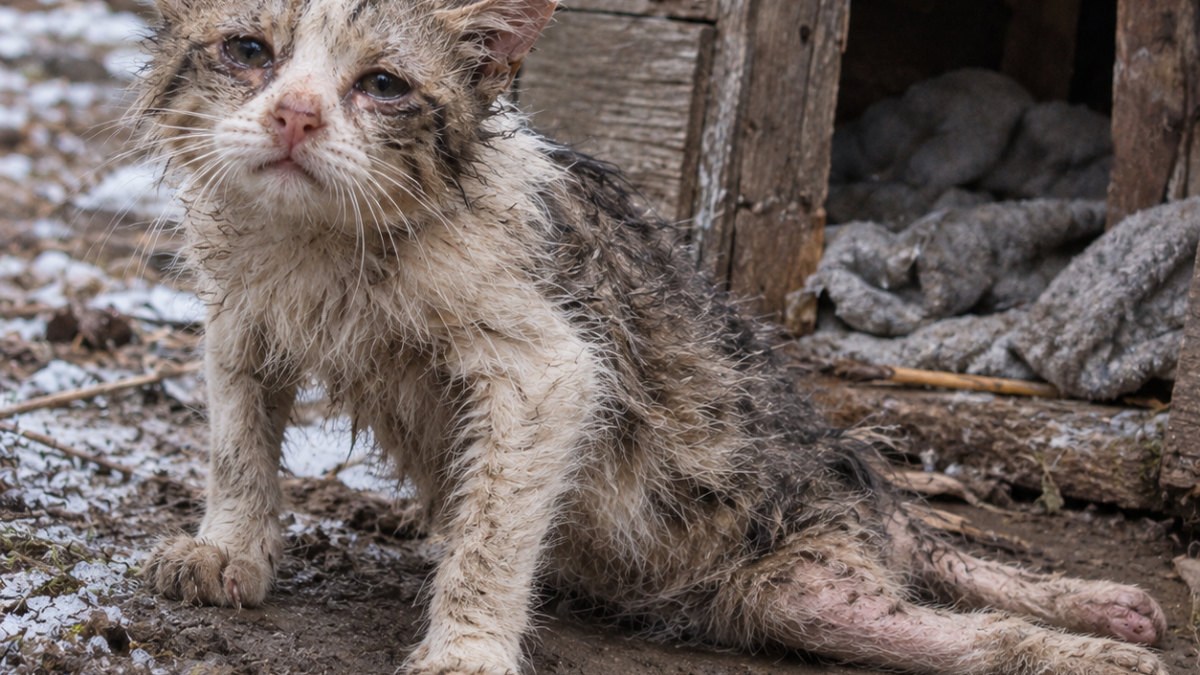
He was thin, exhausted, and so wary of human hands that even a gentle touch made his body tighten.
Then the clinic began talking about how little hope he had left—and the quiet cat who could not stand simply kept watching the people around him.
The first thing anyone noticed about Koksik was how still he was.
Not peaceful.
Not relaxed.
Still.
There is a difference.
Peace has softness in it.
A sleeping cat curls into himself.
His paws loosen.
His whiskers rest.
His breathing deepens.
Even when he is motionless, there is something comfortable in the shape of his body.
Koksik had none of that.
He lay on a cold patch of ground beside an old wooden shelter that looked as forgotten as he did.
The little structure might once have been a doghouse.
Or perhaps someone had built it for whatever animal happened to survive outside.
By the time rescuers saw it, several boards had warped.
One corner had sunk into the earth.
The roof leaned.
The entrance was dark.
Grass and dead leaves had collected around the sides.
And beside it—
half hidden where the wood met the ground—
was Koksik.
At first, nobody understood why he did not run.
Stray cats usually make decisions quickly.
A human approaches.
They retreat.
Hide.
Arch.
Hiss.
Disappear through a gap that seems far too small for an animal to fit through.
Koksik did none of those things.
He watched.
That was all.
His eyes followed movement.
One person stepped closer.
His ears shifted.
Another lowered a hand.
PART2:
Koksik’s shoulders tightened.
His front paws pulled slightly beneath his chest.
His body prepared to escape.
But escape never came.
His hind legs remained stretched behind him.
Completely still.
The rescuer stopped.
For a moment, neither of them moved.
Then she whispered,
“Oh, sweetheart.”
Koksik blinked.
His coat had probably once been beautiful.
Even beneath dirt and tangles, that much was obvious.
There was still softness hidden inside it.
Still color.
Still the outline of the cat he might once have been.
But neglect, exposure, illness, injury—or some combination of all of them—had changed what people saw first.
His fur was dull.
Matted in places.
Thinned in others.
His body beneath it was too narrow.
His hips showed.
His spine could be felt easily.
The muscles over his back legs had wasted badly.
Those legs looked almost separate from him.
Present.
But not participating.
The rescuer moved another inch closer.
Koksik flinched.
Not dramatically.
No swipe.
No bite.
No scream.
Just a small recoil.
As if experience had taught him that hands should be noticed before they arrived.
That response stayed with everyone.
Fear can be loud.
Koksik’s was not.
His fear looked tired.
He did not behave like an animal with enough strength left to fight every threat.
He behaved like an animal who had learned to conserve everything.
Energy.
Movement.
Hope.
The rescuer placed food several feet away.
Koksik smelled it.
His nose moved.
But his body did not.
She pushed the dish closer.
Still nothing.
For a hungry outdoor cat, that worried her.
She moved aside.
Gave him space.
Waited.
Minutes passed.
Koksik eventually lifted his head slightly.
It took effort.
He looked at the food.
Then at the woman.
Then back at the food.
His front legs shifted.
He tried to pull himself forward.
That was when the extent of the problem became impossible to misunderstand.
His chest moved.
His front paws gripped.
His shoulders worked.
But everything behind his waist dragged.
The hind legs followed only because the rest of him pulled them.
The rescuer covered her mouth.
Koksik managed several inches.
Stopped.
Breathed.
Then tried again.
Nobody needed a medical degree to know something was terribly wrong.
The food was moved to him.
He sniffed it.
Took a small bite.
Then stopped.
The woman crouched nearby but resisted the instinct to touch him.
“You don’t have to do anything.”
Koksik stared at her.
“We’ll do it.”
He could not understand the sentence.
But perhaps the voice mattered.
Perhaps tone matters before language ever does.
The rescue team approached slowly.
A blanket was slid beneath him.
Koksik tensed.
One front paw struck weakly at the edge.
Not enough to injure anyone.
Enough to say:
I know you are moving me.
They paused.
Let him see their hands.
Then continued.
His body weighed less than expected.
That frightened them.
A cat with thick fur can hide weight loss.
Koksik’s coat created an illusion from a distance.
Once lifted, the truth was obvious.
Too light.
Too little muscle.
Too much bone.
His back legs hung.
Someone supported them immediately.
Nobody let them drag.
Koksik’s eyes widened when he left the ground.
For perhaps the first time in a very long time, his body was moving without him having to pull it.
The rescuer held him close enough to keep him stable but not tight enough to trap him more than necessary.
Koksik did not relax.
Not yet.
His front claws remained partly extended against the blanket.
His head stayed raised.
Watching.
Always watching.
The broken wooden shelter disappeared behind them.
No one knew how long he had been there.
Days?
Weeks?
Longer?
No one knew whether someone had once fed him.
Whether he had belonged to anyone.
Whether his paralysis happened suddenly or gradually.
Whether he had crawled to that shelter after being injured.
Whether someone had placed him there.
There were too many missing pieces.
The people rescuing him had only the cat in front of them.
And that cat needed help now.
The clinic was warmer.
Koksik noticed that first.
His body had spent so much time against cold ground that warmth itself seemed to make him uncertain.
He was placed on a padded surface.
A veterinarian approached.
Koksik tried to pull backward using his front legs.
The movement was weak.
The veterinarian stopped.
Waited.
Spoke softly.
Then the examination began.
Temperature.
Heart.
Breathing.
Hydration.
Weight.
Skin.
Abdomen.
Front legs.
Back.
Tail.
Hind legs.
There was movement in the front half.
Strength, though reduced.
The hindquarters told another story.
Koksik’s back legs were completely paralyzed.
The words were quiet.
Nobody wanted to say them dramatically.
But hearing them made the room heavier.
Completely paralyzed.
Not simply weak.
Not temporarily refusing to stand because of fear.
Not exhausted from the rescue.
His rear legs were not functioning.
And paralysis was not the only concern.
His body was struggling with basic functions most healthy animals control without anyone thinking about them.
The veterinary team found signs that the problem affected more than movement.
There were deeper concerns.
Internal issues.
Functions that required monitoring and assistance.
His condition was complicated.
The veterinarian did not pretend otherwise.
Koksik had survived outside with a body that could not protect itself normally.
He could not run from dogs.
Could not jump onto a wall.
Could not climb away from danger.
Could not position himself easily.
Could not always keep himself clean.
Could not simply walk toward food or water whenever he needed either.
Everything required more effort.
That might help explain his thin body.
But it did not explain everything.
Blood work was taken.
Additional evaluations began.
His fur was gently separated where mats had tightened.
Skin beneath was checked.
He was cleaned.
Warmth provided.
Fluids.
Support.
Food offered.
Koksik barely ate.
That became one of the first major worries.
A body already thin needs nutrition.
But forcing too much too quickly can create other problems.
So they offered small amounts.
Something soft.
Strong-smelling.
Easy to eat.
Koksik sniffed.
Turned his head.
“Come on.”
Nothing.
The rescuer who found him sat nearby.
She put a small amount on her finger and held it within smelling distance.
Koksik watched.
Did not move.
She lowered her hand.
Waited.
Minutes later, he licked once.
Then stopped.
Everyone treated that single lick as progress.
Because when an animal is fragile, progress changes scale.
A healthy cat finishing a bowl is ordinary.
A sick cat accepting one lick can become the most important thing that happened all afternoon.
The first night at the clinic was difficult.
Koksik did not understand where he was.
Doors opened.
People moved.
Machines made sounds.
Dogs barked farther down the hall.
Other cats cried.
His bedding was soft, but softness was unfamiliar enough that he remained tense.
He tried several times to reposition himself.
Front legs worked.
Back legs did not.
Staff helped.
Slowly.
Always speaking before touching him.
“Hey, Koksik.”
That name had been given to him because every patient needed one.
“Koksik, I’m going to move you.”
The words did not matter yet.
The pattern would.
Voice.
Hand.
Gentle movement.
No pain beyond what his condition already caused.
Then quiet.
Again later.
Voice.
Hand.
Care.
Nothing terrible.
Trust often begins before anyone recognizes it.
Not with affection.
With predictability.
Koksik had no reason to trust the people around him.
They did not demand that he do it quickly.
The next morning, he still barely ate.
His eyes seemed dull.
The veterinarian reviewed results.
The conversation became harder.
His paralysis appeared serious.
The accompanying physical problems made long-term care complicated.
He was weak.
Underweight.
His appetite poor.
His response muted.
No one could promise that treatment would restore the function he had lost.
No one could even promise that he would stabilize enough to leave the clinic.
One person asked quietly,
“What kind of chances are we talking about?”
The veterinarian paused.
Not because she wanted to frighten them.
Because honest answers sometimes require silence first.
“Low.”
The word landed heavily.
Another question followed.
“Is he suffering?”
They discussed pain.
Comfort.
Neurological damage.
Basic functions.
The amount of intervention he might require.
Whether the body was failing in ways that could not be reversed.
And then the sentence rescuers fear most.
“At some point, we may have to ask whether continuing is kinder than letting him go.”
Nobody argued.
There are moments in rescue when love cannot mean insisting on survival at any cost.
Sometimes the compassionate decision is to stop.
Everyone in the room understood that.
They also understood something else.
Koksik was still there.
Breathing.
Watching.
Responding.
Not much.
But enough that no one felt ready to call the story finished.
The rescuer went to his enclosure afterward.
Koksik was lying on his side.
She sat on the floor.
“You heard them?”
His ear moved.
“Probably not.”
She smiled sadly.
“I did.”
Koksik looked toward her.
For the first time, she noticed the exact way he watched people.
Not begging.
Not reaching.
Not asking.
Just studying.
As though expectation itself had become dangerous.
She placed her hand near the opening.
Not inside.
Just close.
“You don’t have to trust me.”
Koksik’s eyes remained on her.
“We can start there.”
The next days became repetitive.
That was good.
Real recovery often looks boring from the outside.
Medication.
Cleaning.
Monitoring.
Food.
Water.
Repositioning.
Checking.
Waiting.
Again.
Again.
Again.
Koksik’s body needed routine more than drama.
His appetite remained inconsistent.
One meal he accepted several bites.
The next he barely showed interest.
One morning he seemed more alert.
That evening he withdrew again.
The people caring for him learned not to celebrate too loudly or despair too quickly.
A fragile body can move forward and backward in the same day.
They watched trends.
Not moments.
Was he maintaining temperature?
Was hydration improving?
Were internal functions manageable?
Was he becoming more responsive?
Could he tolerate nutrition?
Did he show signs of comfort when resting?
Each answer mattered.
His paralysis did not improve.
That became increasingly clear.
The hind legs remained still.
Whatever hope existed would not be measured only by whether Koksik stood.
That required everyone to rethink what “getting better” meant.
At first, improvement had been imagined as recovery of movement.
Maybe he would flex a paw.
Maybe he would push himself upright.
Maybe one morning the back legs would suddenly respond.
But medicine does not owe anyone a dramatic miracle.
Koksik’s body had its own limits.
If the legs never worked again, the real question became:
Could the rest of his life still be good?
Nobody knew yet.
He was too sick to answer.
So they kept treating the things they could.
His fur was cleaned carefully.
Mats removed.
Skin protected.
Bedding changed frequently.
He was kept dry and comfortable.
Meals adjusted.
His body checked for pressure points because animals who cannot reposition normally can develop painful sores.
The staff learned exactly how Koksik preferred to lie.
He liked his front half elevated slightly.
He tolerated being turned more easily if someone supported his chest first.
He disliked sudden movement near his head.
He accepted one technician more readily than others.
That technician started handling many of the difficult care tasks.
Not because Koksik loved her.
He did not yet love anyone.
But he tensed less when he heard her voice.
That was enough.
One evening she entered.
“Koksik.”
His eyes opened.
No flinch.
She approached.
He watched.
She changed part of his bedding.
Her hand brushed his shoulder.
Koksik remained still.
Not frozen.
Still.
A different kind of stillness than at the broken shelter.
The technician noticed.
“So we’re okay today?”
Koksik blinked.
She smiled.
“I’ll take it.”
The people around him began collecting these moments.
Tiny pieces of evidence.
He ate three bites more today.
He drank by himself.
He watched the door.
He did not recoil during cleaning.
He lifted his head when someone called him.
He slept deeply for twenty minutes.
None of these changed the diagnosis.
Together they changed the atmosphere.
Koksik was not recovering quickly.
But he was participating in his own survival.
When the local clinic reached the limits of what it could provide, the rescuers faced another decision.
They could continue the same supportive care and hope.
Or move him.
Travel would be stressful.
A different city meant unfamiliar people.
Another clinic.
More tests.
More expense.
More uncertainty.
But the team there might offer another perspective.
Another plan.
Perhaps better options for managing his paralysis and internal problems.
The rescuer looked at Koksik.
He was lying on a clean blanket.
Eyes half open.
“You really know how to make people work, don’t you?”
Koksik gave no reaction.
She laughed softly.
Then they arranged the transfer.
The trip to the second clinic required preparation.
Koksik needed support beneath his body.
Extra bedding.
Protection for his hind legs.
Food.
Water.
Medical records.
Someone sat close enough to monitor him throughout the drive.
When the carrier was lifted, Koksik became tense.
His front claws caught the blanket.
The rescuer placed a hand against his chest.
“Easy.”
He turned toward her voice.
“We’re not taking you back.”
She did not know whether that fear lived inside him.
But she did.
She had begun imagining what abandonment might feel like to an animal who could not walk away.
“You’re coming with us.”
The car moved.
Koksik remained alert for the first part of the trip.
Then exhaustion won.
His head lowered.
He slept.
The rescuer watched him.
There was something vulnerable about an animal sleeping during transport.
For once, Koksik had allowed his awareness to turn off while humans controlled where he went.
That might have meant nothing.
Or it might have been the beginning of trust.
She did not name it.
The second clinic started over.
New veterinarian.
New examination.
New hands.
New smells.
Koksik disliked it.
He retreated emotionally.
The little progress people thought they had seen seemed to vanish.
He stopped eating well again.
Flinched more.
Watched every movement.
The rescuers worried they had made a mistake.
Perhaps the transfer had been too much.
Perhaps familiarity had been more valuable than specialized care.
The veterinarian reassured them.
“Give him time.”
Time.
That word had become both comforting and cruel.
Koksik needed it.
Nobody knew how much he had.
The second clinic reviewed everything.
No simple procedure would suddenly return his hind-leg function.
The paralysis remained.
The deeper physical problems still required management.
The treatment plan focused on stabilization.
Comfort.
Nutrition.
Skin protection.
Monitoring.
Maintaining the healthiest body possible around a neurological condition that might not improve.
That answer was less dramatic than everyone secretly wanted.
No miracle surgery.
No promise.
No countdown toward walking.
Just care.
The rescuer sat beside Koksik after hearing it.
“So this is us.”
He stared.
“We stop asking you to become someone else.”
His ear moved.
“We just help this version of you.”
Koksik closed his eyes.
That became the turning point, though nobody recognized it then.
Not because his body suddenly changed.
Because the humans stopped measuring him against standing.
If Koksik never walked again, they would not make every day feel like failure.
They would build success differently.
Eat.
Gain weight.
Remain comfortable.
Accept care.
Stay clean.
Engage.
Rest.
Show interest.
Develop a routine.
Let personality return.
The goals became smaller.
And somehow, more meaningful.
The first visible improvement happened with food.
One morning, Koksik ate more than expected.
Not an entire meal.
But enough that the technician checked the bowl twice.
“Did he actually eat this?”
“Yes.”
“By himself?”
“Yes.”
The rescuer smiled.
“Don’t make a big deal.”
“I’m absolutely making a big deal.”
Koksik looked annoyed by the attention.
That itself felt encouraging.
A cat with opinions was preferable to a cat too weak to react.
The next meal went less well.
Nobody panicked.
Later, he ate again.
A pattern began.
Food became more consistent.
His body received what it needed.
Weight did not return instantly.
At first, even a small gain felt uncertain.
Then the scale moved.
A little.
Then a little more.
Muscle over his front half improved.
The sharpness along his spine began softening.
His coat remained rough, but nutrition slowly changed that too.
Healthy fur grows from a healthier body.
It takes time.
Koksik had time now.
That alone was something he had not seemed to possess beside the broken shelter.
His trust moved even more slowly.
A caregiver reached toward him.
He still sometimes flinched.
But the distance he pulled away became smaller.
Another week.
The hand approached.
He watched.
Did not retreat.
Touch.
One stroke along the head.
Then stop.
No forced affection.
No holding him down for comfort.
The people around Koksik learned an important distinction.
Care sometimes had to be done whether he wanted it or not.
Medication.
Cleaning.
Repositioning.
Medical procedures.
But affection did not.
Affection could wait for consent.
That gave Koksik one area of control.
If he turned away, hands stopped.
If he remained, they stayed.
If he leaned—
that meant more.
At first, he never leaned.
He tolerated.
That was enough.
One quiet afternoon, a woman sat beside him after treatment.
No food.
No medication.
No examination.
She simply stayed.
Koksik rested on a thick blanket.
His back legs behind him.
Front paws folded awkwardly beneath his chest.
He watched the room.
The woman read something on her phone.
Minutes passed.
She forgot to pay attention to him.
That may have helped.
Koksik turned his head.
Looked at her.
She sensed it and looked back.
Their eyes met.
Usually Koksik looked away quickly.
Not this time.
One second.
Two.
Three.
The woman smiled.
Not broadly.
Nothing that might frighten him.
“Hi.”
Koksik stayed.
She did not reach.
Did not interpret.
Did not tell anyone:
He trusts me now.
Because trust is too important to declare on behalf of someone else.
Instead, she remained beside him.
Koksik eventually closed his eyes.
Later, she told the rescuer,
“He looked at me.”
The rescuer laughed.
“He looks at people all the time.”
“No.”
The woman shook her head.
“This was different.”
Maybe it was.
Maybe it was not.
Nobody needed to prove it.
Something was changing.
That was enough.
As Koksik’s appetite improved, the physical transformation became easier to see.
His coat was groomed carefully.
Damaged areas cleaned.
Mats removed.
Newer fur came in softer.
The dullness began fading.
His face changed too.
Not shape.
Expression.
At first, every photograph showed tension.
Eyes wide.
Body held as if expecting interruption.
Later, his eyelids rested more naturally.
His ears no longer tracked every sound with the same urgency.
He slept.
Really slept.
That milestone nearly broke the rescuer.
She walked into the room and found Koksik lying on his side.
Eyes fully closed.
Front paws loose.
Breathing deep.
She froze near the doorway.
For one terrible second, fear went through her.
Then his chest rose.
Again.
He was asleep.
She almost cried.
A deeply sleeping animal believes, at least temporarily, that nothing will attack while he is unconscious.
Koksik had finally allowed himself that belief.
She backed out quietly.
Let him rest.
The hind legs never moved.
Days passed.
Then weeks.
Still nothing.
The veterinary team continued evaluating him.
No false hope.
No discouraging language beyond what the medical facts supported.
He was paralyzed.
That remained part of him.
The caregivers began learning what long-term life with paralysis might require.
How to protect the skin.
How to keep him clean.
How to monitor his body.
How to help with functions he could not control normally.
How to move him safely.
How to prevent injuries.
How to recognize discomfort.
It was a lot.
That mattered.
Special-needs animals can live meaningful lives.
They can also require significant work.
Pretending otherwise helps no one.
Koksik would need someone willing to accept routine tasks other cat owners rarely think about.
That made his future uncertain even after he stabilized.
First he had to survive.
Then he had to learn how to live.
Then somebody would have to choose that life with him.
But those problems belonged to later.
For now, Koksik ate.
He gained weight.
His coat improved.
And something almost funny began happening.
He complained.
The first time was during repositioning.
A caregiver adjusted him.
Koksik gave a small irritated sound.
She stopped.
Looked at him.
“Excuse me?”
Koksik stared.
She moved him slightly again.
Another protest.
The woman laughed.
“Oh, now you have opinions.”
Weeks earlier, Koksik had tolerated almost everything with frightening passivity.
Now inconvenience offended him.
That was progress.
He did not want to be moved when comfortable.
Did not always approve of cleaning.
Preferred certain blankets.
Disliked one particular type of food.
Wanted another.
He had preferences again.
Or perhaps he always had them and finally felt strong enough to express them.
The rescuers welcomed every complaint.
A silent animal can be easy to care for.
But silence is not always peace.
Koksik’s protests meant he expected people to listen.
Expectation is part of trust.
He began seeking warmth.
At the broken shelter, warmth had been whatever the weather allowed.
Now Koksik discovered blankets.
Soft bedding.
He seemed suspicious of thick bedding at first.
The surface shifted beneath him.
He had to adjust his balance.
But once settled, he understood.
Warm.
Soft.
Dry.
He began choosing the warmest part.
Sometimes a folded blanket.
Sometimes the place near a heater.
Sometimes beside a person.
That last one came later.
The first time Koksik voluntarily moved closer to someone, the distance was barely six inches.
He used his front legs to pull himself.
His body followed.
The caregiver assumed he wanted another position.
Then Koksik stopped with his shoulder touching her thigh.
She did not move.
Neither did he.
Several minutes passed.
His weight remained against her.
The woman looked down.
Koksik was awake.
He knew she was there.
He could have stopped farther away.
He did not.
She wanted to pet him.
Did not.
Not yet.
Koksik rested there.
Later, when he moved again, she finally whispered,
“Okay.”
She had tears in her eyes.
“Okay.”
Healing can look absurdly small to people who did not see the beginning.
A cat touches someone’s leg.
So what?
But they remembered the animal beside the broken shelter.
The way he flinched before a hand arrived.
The way his eyes expected nothing good.
Six inches can be a long journey.
Koksik crossed it.
His world slowly widened beyond the clinic.
At first, every day looked similar.
Treatment room.
Blanket.
Caregiver.
Food.
Sleep.
Then he spent time in a quieter home-like environment.
A place with normal sounds.
A kettle.
Footsteps.
Doors opening.
Television.
People talking.
Soft light.
A couch.
Indoor life required adjustment.
Koksik could not simply walk through rooms.
So the space was changed for him.
Low beds.
Safe flooring.
Nothing sharp where his hind legs might drag.
Easy access to water.
Predictable areas for care.
Clean blankets.
People who understood how to move him.
Koksik explored using his front legs.
Pull.
Pause.
Look.
Pull again.
The first room took time.
He sniffed corners.
Investigated furniture.
Stopped near a window.
A world existed outside.
Birds.
Cars.
Wind.
People.
Koksik watched.
He was no longer lying outdoors inside that world.
He was behind glass.
Warm.
Protected.
The distinction mattered.
A bird landed nearby.
Koksik’s head moved instantly.
His whole expression sharpened.
For several seconds, paralysis disappeared from everyone’s attention.
There was only a cat watching a bird.
The bird hopped.
Koksik’s front paws shifted.
Predatory focus returned.
His caregiver laughed.
“There you are.”
That phrase became common.
There you are.
Whenever something recognizably cat-like surfaced beneath the medical routine.
A tail flick of annoyance.
A stare at food.
A head turning toward a bird.
A quiet protest.
A purr.
The first purr was almost missed.
Koksik was resting while someone gently stroked the side of his face.
He had accepted petting before.
But usually he simply tolerated it.
This time, a faint vibration began.
The caregiver stopped.
Koksik looked at her.
She touched his cheek again.
There.
Soft.
Barely audible.
A purr.
She smiled.
“Really?”
Koksik closed his eyes.
The purr continued.
Nobody called the entire staff.
Nobody wanted to turn the moment into a performance.
But later, the message spread.
Koksik purred today.
That sentence traveled through the rescue team faster than many medical updates.
Because a purr did not mean his spine had healed.
It did not mean all pain was gone.
It did not solve his future.
It meant, for that moment, he had felt something good enough to express.
Comfort.
Connection.
Maybe both.
That mattered.
His back legs remained still.
That fact became easier to say without despair.
At the beginning:
His back legs are paralyzed.
The sentence felt like a verdict.
Later:
His back legs are paralyzed.
It became information.
Important information.
Life-changing.
But not the only information.
Koksik was eating well.
Koksik liked warm blankets.
Koksik preferred one food over another.
Koksik watched birds.
Koksik disliked being moved when comfortable.
Koksik sometimes purred.
Koksik was gaining weight.
Koksik leaned against people.
The paralysis took its place among the facts.
Not above all of them.
That shift mattered most for the people considering his future.
A permanent home would need to understand everything.
No one wanted an adoption based on emotion alone.
Koksik was easy to feel sorry for.
That was not enough.
He needed someone prepared.
A family willing to learn his care.
To clean him.
Monitor him.
Help him.
Accept accidents.
Protect his skin.
Understand that his body would always require more attention than an able-bodied cat.
Love without preparation could fail him again.
So nobody rushed.
The rescue team shared Koksik’s story carefully.
A paralyzed cat found beside a broken outdoor shelter.
Severely weak.
Low chances.
Transferred for additional treatment.
Improving.
Still paralyzed.
Looking for a future suited to his needs.
People responded emotionally.
Many offered kind words.
Some asked about adoption.
When they learned what daily care involved, several quietly stepped away.
That did not make them bad.
A special-needs animal should not be adopted by someone pretending the work does not exist.
Better an honest no than another abandonment.
Koksik had already been left behind once, whether literally or simply through neglect.
Nobody intended to let it happen again.
Meanwhile, Koksik continued improving.
The scale moved.
His body filled out.
The sharp ridge of his spine became less severe.
His shoulders grew stronger because they carried so much of his movement.
He learned to pull himself efficiently over soft surfaces.
His front legs became powerful.
When he wanted something, he could move faster than strangers expected.
One visitor placed a treat several feet away.
Koksik spotted it.
The visitor turned to ask a question.
When she looked back, Koksik was halfway there.
She laughed.
“He’s fast.”
His caregiver smiled.
“He’s motivated.”
Food had become important to Koksik in a new way.
At first, eating had been survival.
Now he enjoyed meals.
Recognized preparation sounds.
Lifted his head when bowls moved.
Sometimes protested if service seemed slow.
The rescue team loved this version of him.
Not because hunger was funny.
Because appetite meant his body expected tomorrow.
An animal who cares about dinner assumes there will be an evening worth eating through.
That is hope in practical form.
Koksik began interacting with other animals too.
Carefully.
His paralysis meant introductions needed supervision.
He could not run away quickly if frightened.
Another animal’s playful behavior could accidentally hurt him.
So distance came first.
Smell.
Sound.
Observation.
Then controlled proximity.
Koksik watched another cat from across the room.
His ears forward.
No panic.
The other cat approached cautiously.
Sniffed.
Koksik gave a small warning sound.
The cat stopped.
Good.
Koksik still knew how to set boundaries.
Later, the other cat tried again.
This time Koksik allowed a closer sniff.
No friendship formed instantly.
That was fine.
His world did not need to become a sentimental movie.
It needed normal relationships.
Some animals liked him.
Some did not care.
Some needed time.
Koksik learned the house rhythm.
Morning care.
Breakfast.
Cleaning.
Rest.
Activity.
Another meal.
Evening.
Blankets.
Night.
Routine was powerful.
For an animal whose past was unknown, predictability became a form of safety.
He knew where food appeared.
Who handled him.
Which sounds meant something.
Which footsteps belonged to familiar people.
He began lifting his head before certain caregivers entered fully.
Recognizing them by voice or sound.
One caregiver always greeted him the same way.
“Hey, handsome.”
At first, nothing.
Weeks later, Koksik’s ears moved at the phrase.
Then his head turned.
Eventually, on some days, his tail flicked.
The caregiver laughed.
“You know.”
Maybe he did.
Recognition creates belonging.
Koksik was no longer simply in a place where people helped him.
He was part of the place.
People noticed when he had a quiet day.
Noticed when he ate less.
Noticed when he was especially social.
Knew his preferences.
Remembered which blanket he liked.
Adjusted when he was uncomfortable.
That level of attention can transform an animal even when medicine cannot restore what was lost.
Koksik’s body did not fully recover.
That truth remained.
The back legs stayed still.
His care needs did not disappear.
He was never going to walk out of the clinic one morning on four normal legs and turn the story into the kind of miracle people prefer.
The actual miracle, if anyone insisted on using that word, was quieter.
Koksik wanted to live.
Not in a dramatic way.
He did not fight every procedure.
Did not heroically overcome paralysis.
He began participating.
Eating.
Watching.
Moving.
Connecting.
Resting.
Expressing preferences.
Those were signs of a life becoming his again.
The rescue team started considering permanent placement more seriously.
One family asked detailed questions.
Not only:
Is he friendly?
But:
How do you manage his daily care?
How often does he need help?
What should we watch for?
What type of bedding protects him best?
Can he be left alone safely?
How does he communicate discomfort?
Does he like other cats?
What does he eat?
What does he enjoy?
Those questions caught the rescuers’ attention.
People ready for a special-needs animal ask about the work before imagining the photos.
The family visited.
Koksik was resting when they arrived.
They did not rush toward him.
A woman sat on the floor several feet away.
A man remained farther back.
They spoke with the caregiver.
Koksik listened.
His head turned once.
Then back.
The woman did not call him repeatedly.
Did not wave food in front of him.
Did not force an introduction.
Eventually Koksik became curious.
He pulled himself slightly forward.
The woman kept her hand resting on the floor.
Koksik sniffed from a distance.
Then closer.
He stopped.
Watched her.
She spoke softly.
“Hi, Koksik.”
No movement.
She waited.
Koksik sniffed her fingers.
Then turned away.
That was the entire first meeting.
The family smiled.
Not disappointed.
That mattered.
“He doesn’t owe us affection.”
The rescuer looked at them.
Exactly.
They returned again.
Second visit.
Koksik remembered something.
Maybe scent.
Maybe voice.
Maybe nothing specific.
But he remained less tense.
The woman stroked his cheek once.
Koksik allowed it.
Third visit.
He stayed beside her longer.
The man learned how to support Koksik’s body properly.
They practiced parts of his care.
Not glamorous.
Cleaning.
Positioning.
Checking skin.
Understanding signs of trouble.
They asked more questions.
The rescue team answered honestly.
There would be difficult days.
Potential veterinary expenses.
Possibility of complications.
Paralysis creates lifelong risks.
There was no guarantee Koksik would remain medically stable forever.
The family listened.
Then said they still wanted him.
Nobody called that love yet.
Commitment perhaps.
Love would grow through repetition.
The same way trust had.
Moving day came quietly.
Koksik did not know what it meant.
His blankets were packed.
Food.
Supplies.
Medical records.
Items that smelled familiar.
The carrier was prepared carefully.
When he was lifted, he became tense.
The rescuer who had known him from the beginning held him for a moment.
She remembered the first blanket.
Cold ground.
Broken shelter.
Thin body.
Paralyzed legs.
Eyes that expected nothing.
Koksik looked at her now.
Heavier.
Cleaner.
Coat soft.
Expression calmer.
Still Koksik.
Still paralyzed.
Completely different.
She pressed her cheek lightly against his head.
“You made this difficult.”
Koksik gave a small irritated sound.
She laughed through tears.
“Yes. You.”
The new family brought him home.
The room prepared for him had been designed around reality.
Soft flooring.
Low bedding.
Safe areas.
Food and water within reach.
Nothing dangerous where his hind legs might catch.
Warmth.
Quiet.
No expectation that he would immediately understand.
Koksik was placed on his familiar blanket.
He looked around.
New walls.
New smells.
Different footsteps.
His body tensed.
The family did not crowd him.
They sat nearby.
Let the room exist around him.
Koksik remained still for a long time.
Old stillness threatened to return.
Watching.
Waiting.
But now the people around him knew the difference between fear and exhaustion.
They did not interpret silence as rejection.
Dinner arrived.
Koksik sniffed.
Ate.
That was enough for the first evening.
At night, he slept on the blanket he already knew.
The woman slept on a couch nearby.
Not because Koksik needed constant supervision.
Because she worried.
At 2 a.m., she woke to a soft sound.
Koksik was moving.
Pull.
Pause.
Pull.
Toward the edge of the blanket.
She sat up.
Almost rushed to help.
Then stopped herself.
Koksik moved farther.
He reached a water dish.
Drank.
Then looked around.
The woman smiled in the darkness.
He was mapping the room.
She let him.
The next morning, he explored farther.
His front legs pulled steadily.
The family had placed rugs to help him grip.
He followed one.
Reached a patch of sunlight.
Stopped.
The warmth touched his fur.
Koksik lowered himself.
Rested.
That became his first favorite place.
A rectangle of morning sun.
He returned the next day.
And the next.
The family adjusted their routines around him without turning him into the center of every moment.
That mattered.
Koksik did not need a home where every conversation was about how tragic he had been.
He needed breakfast.
Clean bedding.
Medical care.
Affection when wanted.
Privacy when not.
Normal life.
They gave him that.
At first, he was cautious around touch.
Even after everything.
A new home meant new context.
Trust is not fully transferable.
The woman might have been gentle during visits, but now she appeared in every part of his day.
Feeding.
Cleaning.
Moving him.
Medication.
Koksik had to learn again.
She stayed consistent.
Voice before touch.
Slow hands.
Stop when possible.
Continue when medically necessary.
No punishment for protest.
Koksik gradually relaxed.
One evening, after care, the woman sat beside him.
Tired.
She did not try to pet him.
Koksik moved closer.
His shoulder touched her leg.
She smiled.
Weeks later, he rested his head against her.
Months later, he demanded attention with a soft irritated sound when she stopped scratching his cheek too soon.
The transformation happened in pieces.
No single date anyone could circle.
Trust was not a door Koksik suddenly walked through.
It was a path.
And because he could not walk, perhaps it was fitting that he traveled that path the way he traveled everywhere.
Pull.
Pause.
Observe.
Continue.
The family learned his signals.
A tail flick meant annoyance.
A certain head movement meant he wanted repositioning.
A stronger vocal protest meant:
Absolutely not.
A quiet stare toward the kitchen could be translated easily.
Food.
Always food.
His appetite remained one of the happiest changes.
The cat who once barely ate now recognized meal times with precision.
If breakfast was late, Koksik noticed.
If food preparation happened for another animal, Koksik considered that a personal betrayal.
His family joked that paralysis had no effect on his ability to supervise the kitchen.
His body filled out gradually.
Not overweight.
Healthy.
His coat became softer.
Grooming improved.
The dull tangled fur from the broken shelter disappeared.
In its place grew a coat that looked cared for because Koksik was cared for.
Photographs from the beginning became difficult to look at.
The family kept one.
Not displayed publicly.
Just saved.
Koksik beside the weathered shelter.
Thin.
Still.
Eyes guarded.
Then they compared it to Koksik asleep in morning sunlight.
Same cat.
Same paralyzed legs.
Different life.
That comparison taught them something important.
Recovery did not require reversing every injury.
Koksik’s back legs never started working.
If recovery had been defined as walking, everyone would have called him a failure.
But look at everything that had returned.
Weight.
Appetite.
Fur.
Routine.
Expression.
Curiosity.
Preference.
Trust.
Sleep.
Comfort.
Relationship.
Life.
Those things mattered more than whether a leg moved.
His family eventually introduced him to another calm cat in the home.
Slowly.
Scent first.
Separated spaces.
Then visual contact.
Koksik remained cautious.
The other cat, Misha, was curious.
Misha approached too quickly once.
Koksik hissed.
Misha stopped.
The family smiled.
Good.
Koksik could defend his boundaries with a voice even if his legs could not carry him away.
Later, Misha approached more carefully.
They sniffed.
No drama.
Over time, they became comfortable sharing space.
Not inseparable.
Not a storybook friendship.
Sometimes Misha slept near Koksik.
Sometimes she took his warm spot and Koksik complained until a human moved her.
Other times Koksik ignored her completely.
Normal.
The family treasured normal.
Because Koksik’s early life had been dominated by abnormal needs.
Survival.
Medical uncertainty.
Paralysis.
Fear.
Now he could be irritated because another cat stole sunlight.
That was a privilege.
He learned indoor sounds.
Vacuum cleaner—
terrible.
Doorbell—
interesting.
Refrigerator—
occasionally associated with food.
Bag opening—
always worth investigating.
Rain against the window—
safe.
Thunder—
less safe.
Human footsteps—
recognizable.
His family discovered that he liked quiet music.
Or perhaps he simply liked the person who sat beside him while it played.
Either way, evenings became predictable.
Meal.
Care.
Blanket.
Someone sitting nearby.
Koksik sometimes rested against a leg.
Sometimes remained a few feet away.
No one took distance personally.
They had learned from him.
Love does not need constant physical proof.
Sometimes love is simply the person who knows exactly how to change your bedding without frightening you.
The person who notices an area of skin becoming irritated before it becomes painful.
The person who wakes early enough to keep your routine.
The person who does not resent the work your body requires.
That was Koksik’s life now.
Work, yes.
But chosen work.
No one pretended caring for him was effortless.
There were difficult nights.
Times his body needed more attention.
Occasional setbacks.
Veterinary visits.
Worry when he ate less.
Concern when his skin looked different.
Adjustments.
Laundry.
More laundry.
Special-needs care can be repetitive.
It can be tiring.
That does not make the animal a burden.
It means love has practical tasks attached to it.
Koksik’s family accepted those tasks before taking him home.
That was why the home lasted.
Months passed.
People who had been part of his rescue visited.
The first rescuer entered quietly.
Koksik was lying in sunlight.
He heard her voice.
His head lifted.
She froze.
“Do you remember me?”
No one could know.
Maybe.
Maybe not.
Koksik sniffed when she came closer.
Then allowed her to touch his cheek.
She sat down.
Tears appeared almost immediately.
His new family smiled.
“We warned you.”
“I know.”
She looked at Koksik.
“I remember when he wouldn’t eat.”
“He definitely eats now.”
As if summoned by the word, Koksik looked toward the kitchen.
Everyone laughed.
The rescuer stroked him again.
This time Koksik leaned.
Only slightly.
But she felt it.
That nearly broke her.
She remembered touching him beside the broken wooden shelter.
The flinch.
The tension.
The exhaustion.
Now he pushed his face gently toward her fingers.
Same gesture.
Different meaning.
“That’s enough,” she whispered.
Nobody asked what she meant.
They knew.
It was enough.
Not that his life was perfect.
Not that every loss had been restored.
Enough that he was safe.
Enough that he was comfortable.
Enough that he chose contact.
Enough that he had a tomorrow people were preparing for.
Koksik never needed to become a symbol.
But his story changed the people who knew it.
They became more careful with the word “hopeless.”
At the first clinic, the word had not been used carelessly.
His chances truly were poor.
Quality of life had to be considered.
Those conversations were responsible.
But “low chance” had never meant “no life.”
And survival itself was not the only measure.
What mattered was what came after survival.
Could Koksik enjoy anything?
Yes.
Could he trust?
Eventually.
Could he adapt?
Yes.
Could humans meet his needs?
Yes.
Could paralysis and comfort exist in the same body?
They did.
Could an animal who had once seemed emotionally absent develop preferences, relationships, routines and joy?
Koksik answered that repeatedly.
His life remained physically limited.
There were places he could not go without help.
Stairs were not his.
High windowsills were not his.
Running through rooms was not his.
But sunlight was.
Blankets were.
Food was.
Attention was.
Other cats were.
Birds outside the window were.
Warm hands were.
Sleep without fear was.
A home was.
The world does not have to be unlimited to be meaningful.
Koksik proved that without trying.
One winter morning, snow covered the ground outside.
Koksik sat near the glass.
He watched flakes fall.
His family wondered whether he remembered cold ground.
Whether animals connect weather with old suffering.
Nobody knew.
He stared for a long time.
Then turned away.
Moved toward his blanket.
Settled in warmth.
That was the only answer available.
Whatever the past contained, Koksik now had a choice.
Cold remained outside.
He remained inside.
Years are built from small choices like that.
Not dramatic rescue moments.
Ordinary mornings.
Koksik became older.
His care evolved.
His family adapted.
They never stopped monitoring the parts of his body affected by paralysis.
His front legs remained strong because they carried him.
His back remained carefully supported.
He was kept at a healthy weight because extra weight would make movement and care harder.
Veterinary appointments remained part of life.
He did not enjoy them.
That was normal too.
At one visit, Koksik protested so strongly during handling that the veterinarian laughed.
“Remember when everyone worried he had no fight left?”
His family smiled.
“He found it.”
Koksik glared.
The veterinarian completed the exam.
Stable.
That word became beautiful.
Not cured.
Stable.
Comfortable.
Eating.
Engaged.
For Koksik, stable represented everything people had once feared impossible.
His family stopped thinking of him primarily as a rescue story.
That may have been the greatest sign of success.
He was simply Koksik.
The cat who complained about breakfast.
The cat who loved a certain blanket.
The cat who wanted the warm spot.
The cat whose back legs did not work.
The cat who tolerated Misha until she crossed a line.
The cat who liked cheek scratches.
The cat who could stare at a human until they understood exactly what he wanted.
His history remained true.
It no longer entered every room before him.
That is what safety can do.
It gives an animal enough new days that the worst old day becomes proportionally smaller.
Not erased.
Never erased.
But no longer the entire map.
There had once been a cold patch of ground.
A broken shelter.
A thin cat.
Paralyzed legs.
A body barely holding on.
Hands approaching.
A flinch.
Then a blanket.
A clinic.
Hard conversations.
Low chances.
Another city.
More treatment.
More nights.
Food.
Weight.
Fur.
Touch.
Eye contact.
Purr.
Home.
When people look at transformation stories, they often want one moment.
The moment everything changed.
Koksik did not have one.
There was no single miracle.
No day when he woke up healed.
No dramatic first step because those back legs never took one.
His transformation existed in accumulation.
A meal eaten.
Then another.
A hand tolerated.
Then sought.
A night survived.
Then slept through.
An ounce gained.
A mat removed.
A wound avoided.
A blanket accepted.
A person recognized.
A protest voiced.
A purr offered.
A home entered.
A routine learned.
A life continued.
That was Koksik’s miracle, if anyone needed the word.
Repetition.
Care repeated until fear had competition.
Food repeated until hunger stopped defining the day.
Gentleness repeated until touch meant more than danger.
Presence repeated until people stopped feeling temporary.
Home repeated until Koksik believed it.
One evening, his family found him sleeping on his side.
Misha nearby.
The television low.
A lamp on.
Outside, the weather was cold.
Inside, Koksik’s fur caught the warm light.
He looked peaceful.
Not still.
Peaceful.
The distinction would have been obvious to anyone who saw him at the beginning.
His body was loose.
Front paws relaxed.
Breathing deep.
Tail resting naturally.
His hind legs remained exactly as they had for so long.
Unmoving.
They did not ruin the picture.
They were simply part of him.
The woman sat beside him.
Koksik woke.
Looked at her.
She stroked his face.
The purr began.
Soft.
Steady.
There was no audience.
No camera necessary.
No dramatic music.
Only Koksik.
A warm room.
A human hand.
The sound of an animal who finally felt safe enough to stop waiting for something bad to happen.
That may have been what everyone wanted for him from the beginning.
Not walking.
Not perfection.
Not a body returned to what it might once have been.
Safety.
The broken shelter had taught Koksik to remain still because he had few other choices.
The home taught him that stillness could mean something else.
Rest.
Comfort.
Trust.
When he stayed in one place now, it was not because his world had forgotten him.
It was because there was nowhere else he needed to be.
His food would come.
His bedding would stay dry.
Someone would notice if something hurt.
Someone would speak before touching him.
Someone would clean what he could not.
Someone would carry him when necessary.
Someone would let him move when he wanted.
Someone would be there tomorrow.
That final part may have taken the longest for Koksik to learn.
Tomorrow.
Animals abandoned or neglected do not understand promises.
They understand patterns.
Humans say:
Forever.
Animals experience:
Breakfast.
Then dinner.
Then breakfast again.
A gentle hand today.
The same hand tomorrow.
A person leaves.
The person returns.
Blanket.
Warmth.
Food.
Sleep.
Repeat.
Eventually the pattern becomes the promise.
Koksik had one now.
His family never needed him to understand the word forever.
They simply kept showing up.
And Koksik, who once watched every approaching hand with exhausted suspicion, eventually stopped bracing before the touch.
Sometimes he leaned toward it first.
That was enough.
More than enough.
Because the cat found beside the broken wooden shelter had not needed to become someone new.
He needed a world that finally allowed the cat already inside him to return.
The appetite.
The irritation.
The curiosity.
The purr.
The trust.
The quiet desire to be close without being trapped.
Those things had been there somewhere beneath the fear.
Care did not invent them.
Care gave them room.
Koksik’s back legs stayed paralyzed.
That part of the story never changed.
But almost everything around them did.
The cold ground became bedding.
The broken shelter became a home.
The thin body became a healthier one.
The dull coat became soft.
The flinch became tolerance.
Tolerance became trust.
Silence became protest.
Watching became participating.
Waiting became belonging.
And the people who once stood in a clinic discussing whether Koksik had any future eventually found themselves talking about something much more ordinary.
Whether he had already eaten.
Whether his favorite blanket needed washing.
Whether Misha had stolen his warm spot again.
Whether Koksik was pretending not to hear because he did not want to be moved.
That ordinariness was the ending nobody had dared to imagine.
Not a miracle where his legs suddenly worked.
Something quieter.
A life where they did not have to.
Koksik could still be Koksik.
Still eat.
Still complain.
Still purr.
Still watch snow from a warm window.
Still lean into a familiar hand.
Still sleep deeply enough that nobody mistook stillness for giving up anymore.
He had once been found beside a weathered shelter as if the world had forgotten him.
But the world had not ended there.
Someone saw him.
Someone stopped.
Someone lifted him.
Someone carried him farther when the first answers were not enough.
Someone stayed through the days when progress was invisible.
Someone measured hope in bites of food instead of footsteps.
Someone understood that a life did not have to look normal to be worth protecting.
And eventually, someone opened a door and made enough room for Koksik exactly as he was.
He never stood on four legs.
He never needed to.
Because for the first time in a very long time, he had people willing to stay beside him instead.








