He Was Locked Inside a Storage Unit for 47 Days—Then a Truck Driver Heard a Sound No Cat Should Have Been Able to Make
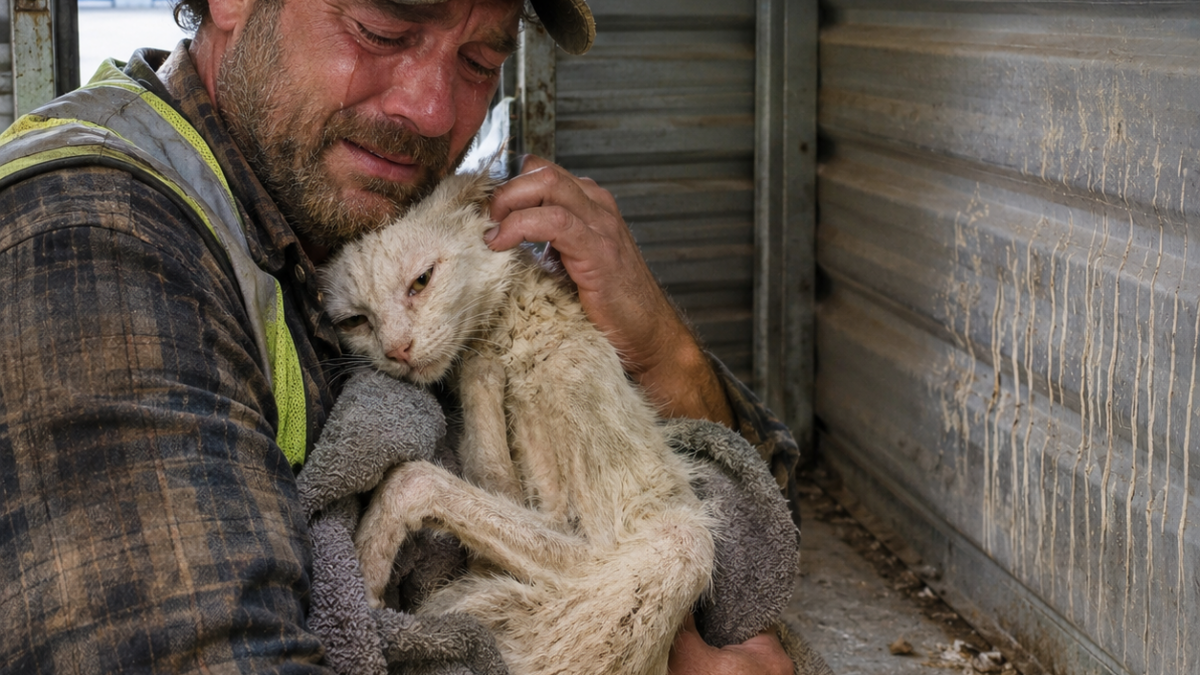
PART3:
He put one hand against the gravel and lowered his head.
Darkness.
The air coming out smelled stale.
Dust.
Old cardboard.
Something sour.
Then—
Click.
Caleb jerked backward.
“Jesus.”
He dropped onto one knee.
“Hey.”
Silence.
“Is somebody in there?”
Another click.
Slower.
Caleb’s heart started beating harder.
He stood and looked toward the office trailer.
“Damn it.”
He jogged across the gravel.
A woman in her sixties named Elaine Porter was behind the desk eating yogurt and reading a paperback.
She looked up as Caleb came through the door.
“Morning.”
“Who rents one-twenty?”
Elaine frowned.
“One-twenty?”
“Two doors down from mine.”
She turned toward an old desktop computer.
“Why?”
“There’s something inside.”
“That’s generally how storage works.”
“No.”
Caleb shook his head.
“Something alive.”
Elaine stopped.
“What?”
“I heard it.”
“A rat?”
“No.”
“Raccoon?”
“Maybe. I don’t know.”
She looked doubtful.
“That unit was locked after the lien sale.”
“When?”
“Beginning of August.”
Caleb stared at her.
“Forty-seven days ago.”
Elaine’s face changed.
“Yes.”
“Has anybody opened it?”
“No.”
“Then we need to.”
“I can’t just cut somebody’s lock.”
“Whose is it?”
“It belongs to the facility now.”
“Great. Then cut your lock.”
Elaine stood.
“Slow down.”
Caleb pointed toward the door.
“Something is in there making a noise.”
She followed him outside.
They stopped in front of Unit 120.
For almost a minute, nothing happened.
Elaine folded her arms.
“Caleb—”
Click.
She froze.
He looked at her.
“You heard that.”
Elaine stepped closer.
Click.
Her face lost color.
“What is that?”
“I don’t know.”
They returned to the office for bolt cutters.
The padlock resisted the first attempt.
Caleb adjusted the jaws.
Squeezed.
Metal snapped.
He removed the lock.
Elaine reached for the handle.
Caleb stopped her.
“Wait.”
“What?”
“If it’s a raccoon, stand back.”
Elaine did.
Caleb lifted the door.
It screeched upward six inches.
The smell hit first.
Hot metal.
Mildew.
Old fabric.
Urine.
Something deeper that made Caleb’s stomach turn.
He raised it halfway.
Sunlight pushed into a ten-by-ten-foot box filled with the abandoned remains of somebody’s life.
A stained mattress leaned against one wall.
Black garbage bags.
A broken television.
Two plastic storage bins.
A child’s bicycle without a front wheel.
An old recliner.
Clothes.
A lamp.
Cardboard boxes swollen with humidity.
Caleb stepped forward.
“Hello?”
Nothing.
Elaine stood behind him.
“Do you see anything?”
“No.”
Then he saw the cardboard in the far corner.
A flattened box.
And something white on top of it.
At first Caleb thought it was fabric.
Then the fabric breathed.
He stopped moving.
“Oh, my God.”
Elaine looked around him.
“What?”
“There.”
The shape was a cat.
Or what was left of one.
White fur clung tightly to a skeleton of ribs and hips.
The animal lay on his side with his head stretched toward the north wall.
One front paw was extended.
His mouth opened.
Closed.
Opened again.
Click.
Elaine made a strangled sound.
“Oh my God.”
Caleb crossed the unit in three steps and dropped to his knees.
“Hey, buddy.”
The cat’s eyes moved.
Barely.
His head did not.
Caleb reached toward him, then stopped.
He had grown up around barn cats.
He knew better than to grab an injured animal without thinking.
But this cat did not have enough strength to bite.
His gums were almost white.
His eyes were sunken deep into his skull.
His tongue appeared dry and dark.
“Water,” Caleb said.
Elaine turned.
“I’ll get some.”
“No bowl. Something shallow.”
She ran.
Caleb looked around the unit.
The temperature inside was brutal even with the door open.
Heat radiated from the walls.
Sweat rolled immediately down his back.
He looked at the animal again.
“How are you alive?”
The cat opened his mouth.
Click.
Caleb’s throat tightened.
“Yeah.”
He slid one hand beneath the cat’s chest.
The body weighed almost nothing.
The cat made no sound.
Caleb stopped.
“You’re okay.”
He did not know why people said that to animals when it was obviously untrue.
Maybe because they needed to say something.
“You’re okay.”
Elaine returned carrying a jar lid filled with water.
Caleb put it near the cat’s mouth.
The cat tried to move his head.
Couldn’t.
Caleb dipped two fingers.
Touched a drop to the cat’s lips.
The animal swallowed.
Once.
Then again.
Elaine began crying.
“Should we give him more?”
“Not too much.”
“How do you know?”
“I don’t.”
Caleb pulled out his phone.
“I’m calling a vet.”
The first clinic told him to come immediately.
“Do not let him drink a large volume at once,” the receptionist warned. “Keep him cool, but not cold. Bring him now.”
Caleb looked toward his truck.
It was too far to carry a critically weak cat in his arms safely.
“Do you have a box?”
Elaine nodded.
They found a shallow plastic tote in the office and lined it with towels.
When Caleb lifted the cat, the animal’s body folded against his hands with terrifying ease.
Four pounds, he thought.
Maybe five.
He could feel every bone.
Elaine whispered, “That’s an adult?”
“I think so.”
The cat’s head fell against Caleb’s wrist.
One eyelid fluttered.
“Stay with me, man.”
Caleb placed him inside the tote.
Before leaving, he glanced back into Unit 120.
Something caught his eye.
Marks.
At the bottom of the north-facing wall.
Hundreds of them.
Thin vertical streaks in the dull metal coating.
He stared.
But there was no time.
He ran.
The veterinary clinic was seventeen minutes away.
Caleb made it in eleven.
Dr. Hannah Ellis had been treating animals for sixteen years.
She would later tell people that the white cat was one of the few patients she remembered seeing carried through the door and immediately thinking:
This one should not still be alive.
The technician placed the tote on the treatment table.
Hannah looked inside.
“What happened?”
Caleb answered too quickly.
“Locked in a storage unit. Forty-seven days. Maybe. I don’t know. The notice was forty-seven days ago.”
The veterinarian stared at him.
“Forty-seven days?”
“Yes.”
“No access to food or water?”
“Nothing that I saw.”
She turned to the technicians.
“Get his weight. Glucose. Temperature. PCV. Chemistry. Place an IV carefully.”
The scale read 4.3 pounds.
Hannah looked at the cat.
“Adult male?”
Caleb nodded.
“Probably.”
She ran her hands gently along his frame.
“Should be ten, maybe eleven.”
Caleb stared.
“He lost more than half?”
“At least.”
The cat tried to raise his head.
Nothing happened.
Hannah checked his gums.
White.
She pinched the loose skin over his shoulders.
It stayed tented.
One second.
Two.
Three.
Four.
Five.
It slowly sank.
Hannah exhaled.
“How dehydrated?”
a technician asked.
“Critical.”
Caleb stood against the wall, hat in his hands.
“What does that mean?”
“It means he’s been without adequate fluid for a very long time.”
“He had something.”
Hannah looked at him.
“What?”
“I don’t know.”
“He could not survive forty-seven days with nothing.”
“I know.”
“Are you certain about the date?”
“There was an eviction notice.”
“That doesn’t prove the unit stayed sealed.”
“The manager says nobody entered.”
Hannah looked back at the cat.
“We’ll figure that out later.”
The first blood results were worse than she expected.
Severe dehydration.
Electrolyte abnormalities.
Liver stress.
Kidney values consistent with acute renal injury.
Muscle breakdown.
Anemia.
Hypoglycemia.
The cat’s temperature was low despite the heat he had come from.
His body had almost nothing left to regulate itself.
Hannah began carefully controlled IV fluids.
Too fast could create new problems.
Too much food too soon could kill him.
Starved animals could develop refeeding syndrome if calories were reintroduced aggressively.
His body had survived by cannibalizing itself.
Fat first.
Then muscle.
Anything available to keep the heart beating and brain functioning.
“He cannot eat a normal meal tonight,” Hannah told Caleb.
Caleb frowned.
“He’s starving.”
“Yes.”
“Then shouldn’t he eat?”
“Not much.”
“That makes no sense.”
“It will.”
She showed him the lab values.
“His system has adapted to starvation. If we suddenly give him a huge meal, his insulin response can shift electrolytes into cells too quickly. His heart could fail.”
Caleb looked at the cat.
“So even feeding him can kill him.”
“If we do it wrong.”
He rubbed one hand over his face.
“What are his odds?”
Hannah did not answer immediately.
Caleb looked at her.
“Don’t give me the nice version.”
“I don’t know.”
“That bad?”
“That unusual.”
She looked at the cat.
“If he was really in there forty-seven days, I don’t have a comparable case.”
Caleb remained at the clinic for four hours.
He had a load scheduled for Colorado.
At 2:15 p.m., his dispatcher called.
“You rolling?”
Caleb stared through the glass treatment-room door.
“No.”
“What’s wrong?”
“Cat.”
Silence.
“Did you say cat?”
“Yeah.”
“You hit one?”
“No.”
“I’m afraid to ask.”
Caleb explained.
His dispatcher, Leon, listened.
When Caleb finished, Leon said, “So you’re missing the Denver pickup because of a cat you found in a storage unit.”
“Yes.”
Another pause.
“Okay.”
Caleb had expected an argument.
“That’s it?”
“What do you want me to say?”
“I don’t know.”
“You’ve driven for me eight years. You’ve never missed a pickup.”
“Still.”
Leon sighed.
“We’ll reassign it.”
Caleb looked through the window.
The white cat had not moved.
“Thanks.”
“Is he gonna live?”
Caleb swallowed.
“I don’t know.”
“Call me tomorrow.”
That night the clinic gave the cat a temporary name for the chart.
Storage Cat.
Caleb hated it.
“Can we call him something else?”
Hannah looked up.
“Any ideas?”
Caleb thought about the snapped padlock.
The rusted metal latch.
The sound behind the door.
“Latch.”
Hannah smiled slightly.
“Latch?”
“That’s what got between him and the world.”
“Okay.”
She typed it.
LATCH.
MALE.
WHITE DOMESTIC SHORTHAIR.
APPROX. 4 YEARS.
4.3 LB.
Caleb went home at midnight.
He could not sleep.
Every time he closed his eyes, he saw the cat opening and closing his mouth.
Click.
Click.
Click.
At 4:30 in the morning, he made coffee.
At 5:10, he called the clinic.
Hannah answered.
“You’re awake.”
“So are you.”
“I’m working.”
“What’s my excuse?”
She looked toward the hospitalized cat.
“He made it through the night.”
Caleb sat down.
“Yeah?”
“Yes.”
“Did he eat?”
“A teaspoon.”
“That’s all?”
“That’s enough.”
“Did he drink?”
“Fluids are going through the IV.”
“Kidneys?”
“Still bad.”
He nodded even though she could not see him.
“I’m coming.”
“You don’t need to.”
“I know.”
He came anyway.
Latch looked worse in daylight.
That surprised Caleb.
At the storage unit, adrenaline had made everything unreal.
Inside the clinic, with clean white towels and fluorescent lights, the damage was harder to ignore.
The cat’s coat was not truly white anymore.
It had a yellow-gray cast.
His hips protruded sharply.
His belly was hollow.
When he breathed, Caleb could count ribs.
Hannah sat beside the kennel.
“We need to talk about something.”
Caleb’s stomach tightened.
“What?”
“Forty-seven days without food is possible in rare circumstances.”
“You said impossible yesterday.”
“I said forty-seven days without water was.”
“So he had water.”
“Somehow.”
“Maybe a leak?”
“That’s what I’m thinking.”
Caleb remembered the wall.
“The marks.”
“What marks?”
He stood.
“Inside the unit.”
Hannah frowned.
“There were scratches on the metal.”
“What kind?”
“Hundreds.”
“Where?”
“Low. Near the floor.”
She stared at him.
“Can you take pictures?”
Caleb was back at the storage facility an hour later.
Elaine met him outside.
“How is he?”
“Alive.”
Her hand went to her mouth.
“Thank God.”
“I need to see the unit.”
She unlocked the temporary latch.
The interior had cooled overnight.
Caleb immediately felt the difference.
The north wall was cool to the touch.
He crouched.
There.
Tiny beads of water.
Not many.
Barely visible.
Condensation collected where the metal met the concrete.
Caleb touched it.
Moisture coated his fingertip.
He stared at the scratches.
They were not really scratches in the sense he had first imagined.
More like hundreds of thin vertical streaks where repeated contact had worn dust and oxidation away from the wall.
The marks were concentrated four to six inches above the floor.
Exactly where the cat’s head might reach while lying on his side.
Elaine crouched beside him.
“What is that?”
Caleb touched the moisture.
“He drank the wall.”
She looked at him.
“What?”
“He drank the damn wall.”
He photographed everything.
The condensation.
The streaks.
The flattened cardboard.
The distance between the wall and where they found Latch.
Then he video-called Hannah.
The veterinarian watched silently.
“Turn the camera back.”
He did.
“Closer.”
Caleb crouched.
“You think this is it?”
Hannah stared at the image.
“It could be.”
“How much water is that?”
“Almost nothing.”
“Enough?”
“For forty-seven days?”
She paused.
“Apparently.”
Caleb looked around the metal room.
During the day it had been hotter than outside.
At night, temperatures dropped.
The north-facing wall cooled faster.
Humidity condensed along the lower metal surface.
A few tablespoons.
Perhaps less.
Night after night.
The image hit him so hard he had to stand.
Forty-seven nights.
Darkness.
Heat.
No food.
No voices.
No understanding of why the door never opened.
And somewhere in that box, the cat had discovered the only reliable thing the world still gave him.
A wet wall.
Caleb stepped outside.
Elaine followed.
“How could somebody leave an animal in there?”
He turned.
“You tell me.”
Her face changed.
“What?”
“You manage this place.”
“I didn’t know.”
“Who rented the unit?”
Elaine stiffened.
“Caleb.”
“Who?”
“I can’t give tenant information to you.”
“The hell you can’t.”
“It’s private.”
“He nearly died.”
“I understand.”
“No, you don’t.”
Her expression hardened.
“I did not put that cat in there.”
“I didn’t say you did.”
“You’re acting like it.”
Caleb took a breath.
He knew anger was taking over.
“Did you see the tenant during the eviction?”
Elaine looked away.
“That’s not your business.”
“It became my business when I carried four pounds of dying animal out of your building.”
“Call animal control.”
“I will.”
He did.
Animal control officer Marcus Dean arrived before noon.
Then a sheriff’s deputy.
Then a county investigator because of the possibility of intentional animal cruelty.
Unit 120 was photographed and sealed.
The scratches were documented.
The eviction notice collected.
The facility’s payment records were requested.
So were access logs.
There were none.
No electronic gate.
No cameras.
No digital keypads.
That complicated everything.
Elaine gave investigators the name.
Derrick Voss.
Thirty-six.
Last known address in Wichita.
He had rented Unit 120 for eighteen months.
Stopped paying in June.
Received delinquency notices in July.
The lien process began.
The unit was formally locked by management on August 1.
Elaine claimed she had opened it that morning during an inventory.
“Was the cat inside?” Marcus asked.
“No.”
“You’re sure?”
“Yes.”
“Did you inspect the entire unit?”
“I looked inside.”
“That isn’t what I asked.”
Elaine sighed.
“There was a lot of stuff.”
“Could an animal have been hiding?”
“Possibly.”
Marcus stared at her.
“Did you hear anything?”
“No.”
“Smell anything?”
“No.”
“See food? Cat litter? Bowls?”
Elaine paused.
That pause changed the investigation.
“What?”
“There was a plastic bowl.”
“Where?”
“Near the back.”
“For an animal?”
“I don’t know.”
“Was there water?”
“I don’t remember.”
“Food?”
“I don’t remember.”
Marcus wrote something down.
Elaine became defensive.
“I thought it was junk.”
“Did you contact Derrick?”
“Yes.”
“What did you tell him?”
“That the unit was being overlocked and proceeding to sale.”
“What did he say?”
“He said he’d take care of it.”
“Did he?”
“No.”
The investigators found Derrick two days later.
He worked part-time at an auto-body shop.
He denied knowing anything about a cat.
“Never owned one.”
Marcus showed him a photograph of Latch from the clinic.
Derrick glanced at it.
“Nope.”
“Never seen him?”
“No.”
“Was he in your storage unit?”
“How would I know?”
“You rented it.”
“I wasn’t living there.”
“When were you last inside?”
“June maybe.”
“Before the lock?”
“Yeah.”
“Did anyone else have your combination?”
“My ex.”
“What’s her name?”
Derrick hesitated.
“Why?”
“Name.”
“Samantha.”
Investigators contacted Samantha Voss.
She had separated from Derrick the previous year.
When Marcus showed her the photograph, she covered her mouth.
“That’s Snow.”
The case changed immediately.
“Snow?”
“That’s his name.”
“Whose cat?”
Samantha looked at the investigator.
“Derrick’s mother’s.”
“Did Derrick know him?”
“Of course he knew him.”
“Did he own him?”
“After his mom died.”
“When?”
“January.”
“What happened?”
Samantha looked sick.
“Derrick didn’t want him.”
Marcus leaned forward.
“Then tell me exactly what happened.”
The story came out slowly.
Derrick’s mother, Patricia Voss, had died after a short battle with pancreatic cancer.
She had lived alone with a white cat named Snow for nearly four years.
According to Samantha, Patricia adored him.
He slept on her bed.
Sat beside her during chemotherapy.
Waited outside the bathroom door.
When Patricia became too weak to care for herself, Samantha sometimes went over to feed him.
After Patricia died, Derrick inherited the remaining household contents.
He cleared the house quickly because it was being sold.
Furniture.
Boxes.
Tools.
Christmas decorations.
Patricia’s clothing.
Old photographs.
And Snow.
“He said he would find him a home,” Samantha told investigators.
“Did he?”
“I thought he had.”
“When did you last see the cat?”
“Late July.”
Marcus stopped writing.
“Where?”
“At the storage facility.”
Silence.
“Why was the cat there?”
Samantha’s eyes filled.
“I asked Derrick the same thing.”
“What did he say?”
“He said it was temporary.”
Marcus leaned forward.
“Tell me exactly.”
“He had been keeping some of his mother’s things in the unit. He said he was cleaning out his apartment and Snow kept getting underfoot. He put a litter box, food, water in the storage unit.”
“For how long?”
“I don’t know.”
“Days?”
“Maybe.”
“Did you tell him not to?”
“Yes.”
“What happened?”
“We fought.”
“Then?”
“He told me to mind my own business.”
Marcus set down his pen.
“August first the facility overlocked the unit.”
Samantha looked up.
“He knew?”
“That’s what we’re trying to determine.”
“He knew.”
“How?”
“Because he called me.”
“When?”
She thought.
“Beginning of August.”
“What did he say?”
“He was furious because they locked him out.”
Marcus’s face hardened.
“Did he mention Snow?”
Samantha began crying.
“Yes.”
The room became very quiet.
“What did he say?”
She wiped her face.
“He said, ‘That stupid cat is still in there.’”
Marcus did not move.
“And what did you say?”
“I told him to call the facility.”
“Did he?”
“He said he would.”
“Did you?”
Samantha closed her eyes.
“No.”
“Why?”
“I believed him.”
Marcus stared.
“For forty-seven days?”
“No.”
She shook her head frantically.
“I didn’t know the cat stayed there. Derrick told me later he’d handled it.”
“When?”
“A week later.”
“What exactly did he say?”
“I asked about Snow.”
“And?”
“He said, ‘It’s taken care of.’”
Marcus leaned back.
Derrick was questioned again.
This time, investigators had Samantha’s statement.
He changed his story.
Yes, Snow had belonged to his mother.
Yes, he knew the cat.
Yes, he had placed him temporarily in the storage unit.
But only for one night.
He claimed the cat must have hidden when he returned.
Then he said he assumed Snow escaped.
Then investigators showed him text messages Samantha had saved.
AUGUST 2:
SAMANTHA: Did you get Snow out?
DERRICK: Not yet. They changed the lock.
SAMANTHA: CALL THEM.
DERRICK: I’m at work.
SAMANTHA: He cannot stay in there.
DERRICK: It’s one day.
AUGUST 3:
SAMANTHA: Did you call?
DERRICK: Stop bothering me.
AUGUST 5:
SAMANTHA: What happened with Snow?
DERRICK: Taken care of.
Derrick stared at the printed messages.
Marcus asked, “How was it taken care of?”
No answer.
“Did you call the facility?”
Derrick rubbed his hands together.
“I don’t remember.”
“Phone records say no.”
“I might have gone there.”
“Elaine says you didn’t.”
“She could be wrong.”
“Did you cut the lock?”
“No.”
“Then how did you get the cat?”
Derrick’s face changed.
“I don’t know.”
“You don’t know how you rescued an animal trapped behind a padlock?”
“I assumed he got out.”
“How?”
“I don’t know.”
Marcus put the clinic photograph on the table.
Snow—now Latch—was lying under a heating blanket with an IV line in his foreleg.
“He didn’t get out.”
Derrick looked away.
“Look at him.”
“I’ve seen it.”
“Look.”
Derrick did.
“He weighed four-point-three pounds.”
Silence.
“He should have weighed ten to twelve.”
Derrick stared at the table.
“His kidneys were failing.”
Nothing.
“His body ate its own muscle to stay alive.”
Derrick’s jaw tightened.
“I didn’t mean for that.”
Marcus leaned forward.
“What did you mean?”
“I was going to go back.”
“When?”
“I don’t know.”
“One day?”
“Yes.”
“Two?”
“I had problems.”
“Three?”
“I said I had problems.”
“Seven?”
Derrick slammed his palm onto the table.
“My mother had just died.”
Marcus did not react.
“My job was falling apart. I was behind on rent. That storage place was threatening me. Everybody wanted money. Everybody wanted something.”
“And the cat?”
“He was another thing.”
There it was.
Marcus remained still.
Derrick realized what he had said.
He tried to correct it.
“That’s not what I mean.”
“What do you mean?”
“He was always crying.”
“Because?”
“He wanted back into my mother’s house.”
“Which had been sold.”
“Yes.”
“He lost the person he lived with.”
“I lost my mother too.”
Marcus nodded.
“Yes.”
Derrick looked surprised.
“Yes, you did.”
The investigator’s voice softened.
“And grief can make people do terrible things.”
Derrick’s eyes filled.
“Exactly.”
Marcus continued.
“But grief does not lock the door.”
Silence.
“Grief does not read a text saying an animal is trapped and ignore it.”
Derrick looked down.
“Grief does not tell someone the problem is handled when the animal is still inside.”
Derrick’s shoulders sagged.
“I thought somebody would hear him.”
Marcus stared at him.
That sentence was almost worse.
“You thought somebody would hear him.”
“Eventually.”
“In a facility with no staff after five.”
No answer.
“No cameras.”
Nothing.
“Half the units empty.”
Derrick whispered, “I was going back.”
Marcus looked at him for a long time.
“You had forty-seven days.”
Meanwhile, Latch knew nothing about investigations.
His world had become a veterinary kennel.
Fluids.
Needles.
Blankets.
Tiny meals.
Hands.
Voices.
Light.
The first week was touch and go.
He developed vomiting.
Then diarrhea.
His kidney values improved slightly and then worsened.
Hannah adjusted fluids.
His phosphorus shifted dangerously.
His potassium dropped.
Nutrition had to be increased by fractions.
The clinic celebrated grams.
4.3 pounds.
4.4.
4.45.
Then 4.4 again.
Caleb came every day he was in Wichita.
When work took him out of state, he called.
From Oklahoma.
Texas.
Colorado.
Nebraska.
“How’s Latch?”
Hannah always answered honestly.
“Stable.”
“Better?”
“Stable.”
“What does that mean?”
“It means he is alive today.”
Caleb learned not to demand more.
Three weeks after the rescue, Latch stood for the first time.
It happened at 6:12 in the morning.
Technician Bria Wilson had opened his kennel to change the towel.
Latch lifted his head.
Placed both front paws beneath himself.
Pushed.
His hind legs shook.
Bria stopped breathing.
“Come on.”
He rose.
For maybe two seconds.
Then collapsed.
Bria screamed.
Not in fear.
In joy.
Hannah came running.
“What?”
“He stood.”
“What?”
“He stood!”
Latch looked exhausted by the celebration.
Hannah laughed.
“Do it again.”
He did not.
“Of course.”
Bria took a photograph.
She sent it to Caleb.
He was parked at a truck stop outside Amarillo.
His phone buzzed while he was fueling.
He opened the picture.
Latch upright.
Barely.
Caleb sat in the cab afterward and cried.
A trucker named Ronnie knocked on the window.
“You okay?”
Caleb lowered it.
“Cat stood up.”
Ronnie stared.
“What?”
Caleb showed him the photo.
Ronnie nodded slowly.
“Right.”
He walked away.
Caleb laughed so hard he cried again.
By week five, Latch could walk four or five steps.
By week six, he could eat without assistance.
His coat remained ugly.
Thin.
Yellowish.
Dry.
But new white fur began appearing underneath.
His eyes looked less sunken.
He began grooming one paw.
That ordinary behavior made Hannah stop beside the kennel and smile.
“Look at you.”
Latch licked.
Paused.
Looked at her.
Licked again.
“You remember how to be a cat.”
The kidneys did not recover completely.
That was the permanent cost.
Hannah explained it to Caleb.
“He’ll probably have chronic kidney disease.”
“How bad?”
“Too early to stage perfectly.”
“What does that mean for his life?”
“Special diet.”
“Okay.”
“Routine bloodwork.”
“Okay.”
“Possibly subcutaneous fluids.”
“How often?”
“Depends.”
Caleb nodded.
“What else?”
“Monitoring weight. Hydration. Appetite.”
“Fine.”
Hannah looked at him.
“You understand this may be expensive.”
“Yes.”
“And time-consuming.”
“Yes.”
“And he may have future crises.”
“Yes.”
She smiled faintly.
“You’re not even pretending to think.”
“About what?”
“Adopting him.”
Caleb looked through the kennel door.
Latch was sleeping.
“I thought that part was obvious.”
“You’re gone half the month.”
“I can change routes.”
Hannah raised an eyebrow.
“You’re going to reorganize your job for a cat?”
“I’ve reorganized it for worse reasons.”
“Caleb.”
“What?”
“You need a real plan.”
He nodded.
“I have one.”
He did.
Leon moved him off the longest coast-to-coast assignments.
Caleb switched to regional routes.
His sister, Megan, agreed to help on overnight runs.
The duplex landlord allowed cats with a deposit.
Caleb bought a water fountain, kidney-support diet, a heated bed, stairs for the couch, and enough cat supplies to make the pet-store cashier ask how many cats he owned.
“One.”
She looked at the cart.
“One?”
“He had a rough month.”
Latch went home with Caleb four months after the storage-unit door opened.
He weighed nine pounds.
Still thin.
But alive.
The first night, Caleb opened the carrier in the living room.
Latch remained inside.
Caleb sat on the floor.
“No rush.”
Twenty minutes.
Nothing.
Forty.
Latch emerged.
He sniffed the rug.
The couch.
The wall.
Then stopped beside a stainless-steel water bowl.
Caleb watched.
Latch lowered his head.
Drank.
And drank.
And drank.
Caleb’s smile disappeared.
He understood the thirst was partly medical.
Kidney damage.
Dehydration history.
But still.
He saw the wall.
Those scratches.
Forty-seven nights.
He crouched.
“You don’t have to work for it anymore.”
Latch drank.
Caleb touched his back.
“You hear me?”
The cat kept drinking.
“It’s staying there.”
The water bowl remained full.
Always.
Caleb checked it obsessively.
Before bed.
After waking.
Before leaving.
After returning.
He bought a backup fountain.
Then another bowl.
Megan laughed.
“He has more water stations than some hotels.”
“Good.”
“You’re insane.”
“Probably.”
Latch developed habits.
He slept beneath the kitchen table.
He hated closed closets.
He panicked the first time Caleb accidentally shut the laundry-room door while Latch was inside.
The cat threw himself against it.
Caleb opened the door immediately.
Latch ran past him.
Hid under the bed.
Caleb sat on the floor outside.
“Okay.”
No response.
“I get it.”
Two hours later, Latch came out.
Caleb removed the laundry-room door from its hinges the next day.
Megan stared.
“You removed a door.”
“He doesn’t like it.”
“Most people would just remember not to close it.”
“I drive trucks. Memory is not a safety system.”
She laughed.
“You love him.”
Caleb looked offended.
“He’s all right.”
Latch jumped onto the couch beside him.
Megan smiled.
“Yeah.”
The cruelty case went forward.
Derrick Voss was charged under Kansas animal-cruelty statutes.
His attorney argued there had been no intent to kill.
That Derrick had been overwhelmed.
That he believed someone at the facility would discover the cat.
That his mother’s death had destabilized him.
Some of that was probably true.
Hannah testified about Latch’s condition.
She explained the dehydration.
Kidney damage.
Muscle wasting.
Starvation.
The clicking sound.
The danger of refeeding.
The fact that his survival exceeded anything she would normally expect.
The prosecutor showed photographs of the north wall.
The streaks.
The condensation.
The location of the body.
Hannah was asked whether those few drops could have kept him alive.
“They could have delayed death.”
“Is that the same as adequate access to water?”
“No.”
“How much moisture would we be talking about?”
“Potentially tablespoons.”
“Per night?”
“Possibly less.”
“And that was his water source?”
“Based on everything we observed, it is the only plausible one.”
The courtroom became silent.
Caleb testified next.
He described the clicking.
The lock.
The smell.
The cat on the cardboard.
Then the prosecutor asked what stayed with him most.
Caleb looked toward Derrick.
Not angrily.
Just steadily.
“The wall.”
“Why?”
“Because he kept going back to it.”
“How do you know?”
“The marks.”
“Could those have another explanation?”
“Maybe.”
The defense attorney objected.
The judge sustained.
Caleb nodded.
The prosecutor rephrased.
“What did you personally observe?”
“Hundreds of streaks where his head had been.”
“And what did you think when you saw them?”
Another objection.
This time the judge allowed limited testimony as personal reaction.
Caleb looked down.
“I thought about how many nights he must have done the same thing.”
His voice roughened.
“Hot all day.”
“Dark all night.”
“Nothing to eat.”
“Too weak to stand.”
“And still dragging himself back to that wall because sometimes it was wet.”
Derrick stared at the table.
Samantha testified last.
She hated it.
She cried through almost all of it.
The prosecutor showed the texts.
Derrick’s attorney asked whether she had called the facility herself.
“No.”
“So you also failed to ensure the cat was rescued.”
“Yes.”
The attorney paused.
Samantha looked at Derrick.
“I’ll regret that the rest of my life.”
The attorney did not ask another question.
The case did not end with decades in prison.
It was an animal-cruelty case, not a murder trial.
But Derrick pleaded guilty before the final hearing.
He received jail time, probation, fines, restitution toward veterinary expenses, mandatory counseling, and a prohibition on owning animals for a period established by the court.
Caleb did not attend sentencing.
People asked why.
He shrugged.
“Latch doesn’t care.”
The local radio station invited him for an interview six months after the rescue.
Caleb almost declined.
He hated microphones.
He hated being called a hero even more.
“You heard a sound,” the host said.
“Yeah.”
“And you stopped.”
“I was already stopped.”
The host laughed.
“You know what I mean.”
Caleb shifted in the chair.
“There wasn’t anything heroic about opening a door.”
“You saved his life.”
“I opened a door.”
“That sounds like the same thing.”
“No.”
Caleb looked through the studio glass.
“Hannah saved his life. The techs did. People donated. My dispatcher changed loads around.”
He paused.
“I just heard him.”
The host leaned closer.
“What do you remember most?”
Caleb knew the answer immediately.
“The wall.”
He told the story.
A month earlier, he had returned to the facility.
Elaine no longer worked there.
New management had taken over.
Unit 120 was empty.
They allowed Caleb inside.
The north wall was still there.
So were the marks.
Hundreds of little vertical streaks.
A section no larger than a dinner plate.
Caleb stood alone in the unit for almost ten minutes.
The radio host asked, “What did it look like?”
Caleb stared at the microphone.
“Like somebody had been trying to write something.”
“In scratches?”
“Yeah.”
“What do you think it said?”
Caleb was quiet.
He thought about the obvious answer.
Help.
Please.
I’m here.
But animals do not write messages.
Latch had not been creating symbolism.
He had been trying to drink.
That made it more powerful.
“I don’t think it said anything.”
The host waited.
Caleb continued.
“I think we’re the ones who need it to say something.”
“What do you mean?”
“He wasn’t trying to inspire anybody.”
“He was thirsty.”
“He found water.”
“So he kept going back.”
Caleb leaned toward the microphone.
“That’s survival.”
The interview spread farther than anyone expected.
Not nationally.
Not celebrity-level.
But enough.
Truckers shared it.
Animal-rescue pages reposted it.
People mailed donations to the clinic.
One envelope contained only ten dollars and a note:
FOR THE NEXT LATCH.
Caleb framed that one.
A year after the rescue, Latch weighed ten pounds.
Hannah was thrilled.
“You look almost respectable.”
Latch sat on the examination table.
He hated clinics now that he had enough strength to express opinions.
He swatted at her stethoscope.
“Good.”
Caleb frowned.
“He hit you.”
“I know.”
“That’s good?”
“He has boundaries.”
Latch swatted again.
Hannah laughed.
“Lots of boundaries.”
Kidney disease remained.
He required fluids twice a week.
Caleb learned how to administer them at home.
The first attempt was a disaster.
The fluid bag fell.
Caleb cursed.
Latch escaped.
Tubing wrapped around a chair leg.
Megan laughed so hard she had to leave the room.
“Useful,” Caleb called after her.
“Very helpful.”
By the fifth week, they had a routine.
Latch sat on Caleb’s lap.
Caleb inserted the needle beneath the loose skin behind his shoulders.
Fluids flowed.
Latch ate a kidney-safe treat.
Neither liked it.
Both tolerated it.
One evening after fluids, Caleb felt Latch’s head press beneath his chin.
He smiled.
“You’re welcome.”
Latch purred.
It was one of the first times Caleb had heard him do it loudly.
The clicking sound was gone.
Completely.
For months Caleb had feared he would hear it again.
Sometimes at night, when the house was quiet, a tiny mouth noise would wake him.
He would sit straight up.
Latch would be grooming.
Or eating.
Or licking his paw.
Normal sounds.
Caleb learned to sleep again.
The storage facility changed too.
New ownership installed cameras.
Electronic gate access.
Emergency contact procedures.
Written animal checks before lien locks were placed.
Caleb thought the last policy was ridiculous.
“Should’ve existed already.”
But it had not.
Now it did.
The new manager painted Unit 120.
The marks disappeared.
When Caleb heard, he was angrier than he expected.
He drove there.
Stood outside.
Looked at the freshly painted metal.
For a moment, he wanted to yell.
Then he realized something.
The wall did not need to become a monument.
Latch was home.
The evidence had done its job.
The lesson did not live in rust.
It lived in a white cat sprawled across his couch refusing to move when Caleb needed to sit down.
Two years after the rescue, Caleb’s trucking schedule changed again.
He took fewer nights away.
Not entirely because of Latch.
At least that was what he told people.
His sister knew better.
“You used to volunteer for every long haul.”
“I’m getting old.”
“You’re forty-four.”
“Ancient.”
“You bought a heated passenger-seat pad.”
“For my back.”
“It has paw prints.”
“Coincidence.”
Latch began riding with him on short trips.
The first time Caleb carried him toward the truck, the cat panicked when he saw the carrier.
Caleb stopped.
“Okay.”
He brought the carrier back inside.
Left it open for two weeks.
Put treats near it.
Then inside.
Eventually Latch slept there.
The next attempt went better.
Caleb placed the carrier on the passenger seat.
Door open.
Truck stationary.
Latch emerged.
Sniffed.
Climbed onto the dashboard.
Looked through the windshield.
Caleb laughed.
“You have no idea how big the world is.”
Months later, Latch traveled with him across Kansas.
Not constantly.
Only regional runs.
Caleb installed a secured litter box.
Water station.
Bed.
Harness.
The cat loved the sleeper berth.
At truck stops, other drivers would look through the windshield and see two green eyes staring back.
“That your co-driver?”
“Yeah.”
“He any good?”
“Terrible with logs.”
Latch became known at a handful of regular stops.
White cat.
Slightly thin flanks.
A patchy section of fur along one side.
Bright eyes.
Nobody looking at him now would guess that he had once been unable to raise his own head.
Three years after the storage unit, Caleb pulled into a rest area west of Salina during a thunderstorm.
Rain hammered the cab.
Latch was asleep in the passenger seat.
Caleb watched water run down the window.
He remembered the condensation.
A few tablespoons.
Maybe less.
He looked at Latch’s water bowl.
Full.
The cat woke.
Walked over.
Drank casually.
Then returned to bed.
Caleb smiled.
That became his favorite thing.
Not the weight gain.
Not the radio interview.
Not the attention.
Watching Latch walk away from water because he knew there would still be more later.
In the storage unit, every drop disappeared.
Every night’s condensation had been temporary.
Drink now or lose it.
Home taught him another reality.
Water returned.
Food returned.
Caleb returned.
Safety returned.
One night at a time.
Exactly like fear had been built.
Only in reverse.
Hannah saw the change too.
At yearly exams, Latch was less frantic about food.
His bloodwork remained imperfect but stable.
Kidney function would never be normal.
The damage was permanent.
But permanent damage was not the same as a ruined life.
People sometimes confused those things.
Latch had limitations.
And still had joy.
He had medication.
And still had zoomies.
He had scarred kidneys.
And still climbed onto the kitchen counter even though Caleb insisted he never did.
He had a thinner coat along his sides.
And still spent winter afternoons lying in sunbeams like he had personally invented them.
On the fourth anniversary of the rescue, Caleb drove to Unit 120 one last time.
He brought Latch.
Not inside.
He would never put the cat behind that door again.
He parked thirty feet away.
Opened the truck window.
Latch sat on the passenger seat.
The storage facility had changed.
Fresh paint.
New sign.
Security cameras.
The gravel had been partially paved.
Unit 120 looked like every other door.
Caleb sat quietly.
“You know that place?”
Latch looked outside.
Probably not.
Maybe scent triggered something.
Maybe not.
Caleb hoped not.
“Doesn’t matter.”
He started the engine.
Before pulling away, he looked at the building one last time.
Forty-seven days.
That number had once felt impossible.
Now it felt incomplete.
Because the story did not end on day forty-seven.
Day forty-eight happened.
Then day forty-nine.
Day fifty.
Day one hundred.
Day three hundred.
Day one thousand.
Latch had spent forty-seven days learning how little life could give him.
Then years learning how much.
The difference was one person hearing something faint enough to ignore.
A clicking mouth.
A sound that did not even resemble a proper cry for help.
That part bothered Caleb whenever people called him lucky.
“What if you’d parked farther away?”
Someone asked during the radio interview.
“What if your truck had been running?”
“What if you’d worn headphones?”
“What if you hadn’t gone that day?”
Caleb hated those questions.
Because there was no good answer.
If he had parked farther away, maybe Latch died.
If he had been there one day later, maybe Latch died.
If the September heat had lasted longer, maybe Latch died.
If the north wall had faced another direction, maybe Latch died.
Survival sometimes depends on unfairly small things.
A shadow.
A drop.
A crack beneath a door.
A stranger deciding to investigate a strange sound.
That was what made Latch’s story beautiful to some people.
To Caleb, it made it frightening.
The line between being found and disappearing could be almost invisible.
So he changed.
He became slower to dismiss things.
A dog loose near the highway.
A cat under a trailer at a truck stop.
A strange sound behind a dumpster.
He stopped.
Checked.
Called somebody.
Most of the time, it was nothing.
Once he spent twenty minutes trying to rescue what turned out to be a plastic grocery bag caught in a fence.
Megan laughed for weeks.
“I saw it moving.”
“It was wind.”
“It could have been something.”
“It said THANK YOU on the side.”
“That was the store logo.”
Caleb smiled.
“Still.”
He would rather stop for nothing than drive past something.
Years later, Hannah retired from full-time veterinary work.
At her final clinic open house, Caleb brought Latch.
The cat was older now.
His white coat had filled out as much as it ever would.
His kidneys required more attention.
He moved slower.
Hannah sat on a stool.
Latch walked toward her.
“Look at you.”
Caleb smiled.
“She remembers you.”
“He.”
“Whatever.”
Hannah ran a hand along the cat’s back.
“I honestly thought you were going to die.”
Latch blinked.
“Sorry.”
Caleb laughed.
“You tell all your patients that?”
“Only the rude survivors.”
Latch jumped onto her lap.
She looked at Caleb.
“Do you ever think about how impossible it was?”
“All the time.”
“What part?”
“The water.”
She nodded.
“Me too.”
The story had become almost legendary among clinic staff.
New technicians heard about the storage-unit cat.
Some assumed details had been exaggerated.
Forty-seven days?
Four-point-three pounds?
Condensation?
Then Hannah showed them the original chart.
The photographs.
The blood values.
The wall.
The impossible became documented.
But Hannah always added one correction.
“Don’t romanticize it.”
People looked at her.
“He suffered.”
She would say.
“He survived because his body found a way to delay death. That is remarkable. But it should never have been required of him.”
She hated when survival stories made cruelty sound meaningful.
As though suffering existed to produce inspiration.
Latch’s endurance did not excuse what happened.
It only meant the person responsible failed twice.
First by abandoning him.
Then by failing to finish him.
The years eventually caught up with him.
Not suddenly.
At ten, Latch’s kidney disease progressed.
Caleb noticed he was drinking more.
Eating less.
Losing weight.
The clinic adjusted treatment.
New medication.
More frequent fluids.
For months, he stabilized.
Then there were bad weeks.
Then good.
Caleb stopped overnight routes entirely.
Leon had retired by then.
His replacement offered Caleb a dispatcher position.
Office work.
He laughed at first.
“You want me behind a desk?”
“You’re already complaining about your knees.”
“That is unrelated.”
“You want to be home every night?”
Caleb looked at Latch.
“Yes.”
He took the job.
A man who had spent twenty years measuring life in highway exits suddenly came home at 5:30 every afternoon.
Latch learned the sound of his truck.
He waited near the door.
Not frantically.
He had never been a frantic cat after recovery.
Just there.
Caleb would enter.
Drop his keys.
“Hey.”
Latch blinked.
“Hard day?”
Blink.
“Same.”
They had dinner.
Caleb watched television.
Latch slept against his leg.
Their life became wonderfully small.
Then one November morning, Latch did not come for breakfast.
Caleb found him in his heated bed.
Awake.
Breathing.
But weak.
The old fear returned so fast Caleb almost tasted metal.
“Hey.”
Latch looked at him.
Caleb touched his side.
Too thin again.
Not storage-unit thin.
Never that.
But enough.
Hannah no longer worked full time, but the clinic called her when Caleb arrived.
She came anyway.
She examined Latch.
Checked bloodwork.
Kidney values were bad.
Very bad.
Caleb stood beside the table.
“Can you fix it?”
Hannah looked at him.
The question was unfair.
He knew that.
He asked anyway.
“Can you?”
“We can treat.”
“That isn’t what I asked.”
She was quiet.
“No.”
Caleb looked down.
Latch rested his head against the towel.
“How long?”
“Maybe days.”
He closed his eyes.
“Maybe less.”
“Is he hurting?”
“Nauseous. Weak. We can control discomfort.”
“Can I take him home?”
“Yes.”
Caleb nodded.
“Then we’re going home.”
For three days, he stayed beside him.
Water in every room.
Just as always.
Food offered.
Mostly refused.
Fluids.
Medication.
Warm blankets.
On the second night, Latch woke and walked slowly toward the kitchen.
Caleb followed.
The cat stopped at the water bowl.
Drank.
Then sat.
Caleb crouched.
Latch looked at him.
There was no way to know what animals remember.
No way to know whether a water bowl meant anything beyond thirst.
But Caleb thought of the wall.
He sat on the floor.
“Take all you want.”
Latch drank again.
The bowl remained full.
The next morning, he would not stand.
Caleb called Hannah.
She came to the house.
Megan came too.
Nobody rushed.
Nobody talked about fighting.
Latch had fought enough.
Caleb placed him on his lap.
The same cat he had once lifted from cardboard at four-point-three pounds.
Older now.
Loved.
Safe.
Tired.
Hannah prepared the injection.
Caleb’s hand shook.
“Give me a minute.”
“Take all the time you need.”
He stroked Latch’s head.
“You know what I always wanted to tell you?”
The cat’s eyes were half closed.
“I’m sorry it took forty-seven days.”
Megan began crying.
Caleb kept his eyes on Latch.
“I know it wasn’t me.”
His voice broke.
“But I’m sorry nobody came sooner.”
Latch breathed slowly.
Caleb rubbed his cheek.
“You were so damn quiet.”
Hannah looked away.
Caleb laughed once through tears.
“Except that clicking.”
He swallowed.
“You remember?”
The cat did not answer.
“Probably not.”
He leaned down.
“Good.”
Latch’s body relaxed against him.
Caleb whispered, “You don’t need the wall anymore.”
Hannah administered the medication.
Latch went peacefully.
At home.
Beside a full water bowl.
Caleb sat with him for a long time after.
Months later, he returned to the veterinary clinic carrying a framed photograph.
It showed Latch at eight years old sitting in the passenger seat of Caleb’s truck, white fur bright in afternoon sunlight, looking through the windshield.
Beneath the photograph was a small brass plate.
LATCH
FOUND SEPTEMBER 17, 2022
HE KEPT REACHING.
The clinic hung it near the treatment room.
Caleb refused a longer inscription.
People had suggested quotations.
Something about hope.
Survival.
Never giving up.
None felt right.
Because Latch had never decided to become a symbol.
He had been a cat trapped inside a metal room.
Thirsty.
Hungry.
Hot.
Weak.
And each night his body asked one simple question.
Is there anything left?
Sometimes the answer was almost nothing.
A few drops on cold metal.
But almost nothing was not nothing.
So he reached.
Again.
Then again.
Then again.
Until the morning someone finally heard him.
That was what Caleb carried with him for the rest of his life.
Not the cruelty.
Not Derrick.
Not the court.
Not even the terrible shape of Latch’s body when the door opened.
The wall.
Always the wall.
The north-facing metal panel that cooled after sunset.
The thin moisture gathering near the concrete.
The hundreds of tiny marks where a starving animal had returned night after night.
No dramatic rescue music.
No audience.
No certainty that morning would bring anything different.
Just one small body in the darkness doing the only thing it could still do.
Reaching.
One drop.
Then another.
One night.
Then another.
People like to imagine survival as something loud.
A battle.
A roar.
A heroic refusal to fall.
But sometimes survival makes almost no sound at all.
Sometimes it is a four-pound cat too weak to stand, opening and closing a dry mouth in the darkness.
Sometimes it is a tongue against cold steel.
Sometimes it is returning to the same tiny patch of wall because it gave you three drops yesterday and three drops might be enough to see another sunrise.
Latch spent forty-seven days inside that metal box.
But those forty-seven days were not the measure of his life.
The years afterward were.
The water bowls that never emptied.
The couch.
The warm bed.
The truck cab.
The sunlight through the windshield.
The veterinary technicians complaining when he became strong enough to swat them.
The food he demanded.
The doors Caleb removed because he never wanted Latch to feel trapped again.
The thousands of ordinary nights when darkness meant sleep instead of fear.
That was his real story.
Somebody locked him away.
But somebody else opened the door.
Somebody denied him water.
Somebody else kept three bowls full.
Somebody treated him like another problem.
Somebody else rearranged an entire life around keeping him safe.
Cruelty had forty-seven days.
Love got the rest.
And in the end, that was a much longer time.








