He Told Her to Blame the Cancer—Then the Nurse Returned and Saw the Blood He Couldn’t Explain
He Told Her to Blame the Cancer—Then the Nurse Returned and Saw the Blood He Couldn’t Explain
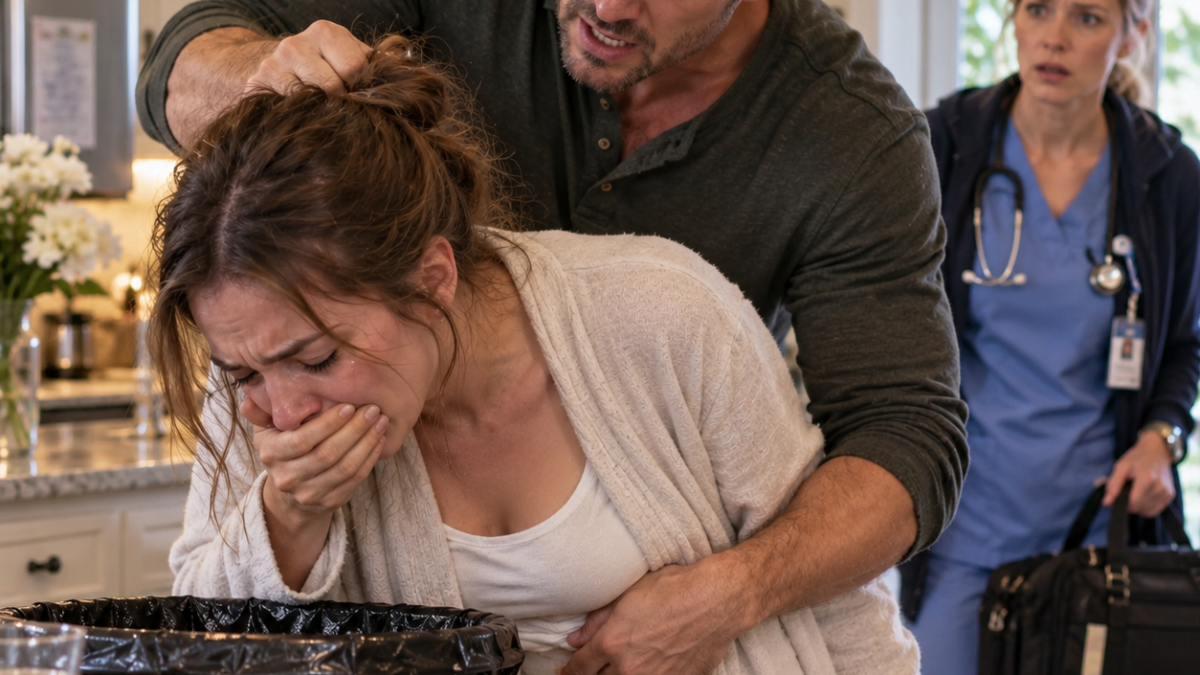
Three weeks after cancer surgery, Mara Whitcomb was too weak to fight back when her husband forced her over the trash can and pressed his finger into the tender place beneath her dressing.
Daniel believed the bleeding would look like another complication, another sad accident in a sick woman’s recovery, another lie she was too afraid to challenge.
But the home nurse had forgotten her bag, and when she came back through the front door, she carried more than medical supplies—she carried the proof that Daniel had been hurting his wife for weeks.
Three weeks after cancer surgery, Mara Whitcomb had learned to fear the sound of her husband becoming quiet.
Not angry.
Not loud.
Quiet.
Loud would have been easier to explain. Loud could be heard by neighbors through thin walls. Loud could make dogs bark and curtains move and people wonder later if they should have called someone. Loud left echoes.
Daniel had mastered quiet.
He could stand at the kitchen counter in their warm suburban home, smiling at a nurse with both hands folded, asking careful questions about wound care and medication schedules, nodding like a devoted husband who had read every discharge instruction twice. He could follow the nurse to the door and say, “Don’t worry, Rachel. I’ll take good care of her,” in a voice so gentle that anyone listening would believe care lived in him.
Then the door would close.
The car would pull away.
And silence would sharpen.
That evening, the house smelled of chicken, garlic, and lemon.
Before surgery, Mara might have loved that smell. She might have stood in the kitchen in fuzzy socks, leaning over the pan, telling Daniel he always used too much salt. She might have poured a little iced tea and joked that if the food tasted this good, she could forgive the kitchen mess.
But after surgery, food had become a negotiation with her body.
Some days she could manage soup. Some days toast. Some days two bites of rice felt like swallowing stones. Nausea rolled through her without warning, swift and humiliating, leaving her weak, sweating, and apologizing to rooms that did not care.
Daniel hated the apologizing most.
At first, he performed concern.
“You need to eat, sweetheart.”
“Try for me.”
“The doctor said protein matters.”
That was when Rachel Cole, the home nurse, was in the room.
Rachel was thirty-eight, practical, and steady, with dark hair usually twisted at the back of her neck and eyes that noticed more than people wanted noticed. She came every other day to check Mara’s surgical dressing, document healing, review medications, and make sure no infection had started around the incision site. She did not crowd Mara. She explained before touching. She warmed her hands when the house was cold. She asked questions twice if the first answer sounded rehearsed.
Mara both needed and feared her visits.
Needed them because Rachel was the only person who entered the house and looked directly at Mara instead of through Daniel’s version of her.
Feared them because Daniel hated witnesses.
That night, Rachel had changed the dressing at 6:18 p.m.
Mara remembered the time because Rachel said it aloud while entering the note.
“Clean dressing applied at eighteen-eighteen. Skin edges look good. No active bleeding. No redness spreading. Pain level?”
Mara sat stiffly in the recliner Daniel had moved into the living room, one hand pressed to the blanket over her lap.
“Four,” she said.
Rachel looked up.
“Four right now, or four because you don’t want Daniel to worry?”
Daniel stood behind Rachel with his hand resting on the back of the couch.
Mara felt his smile without seeing it.
“Five,” she corrected.
Rachel nodded as if that mattered.
It did.
“Any nausea today?”
“A little.”
Daniel answered before Mara could add anything.
“She’s been dramatic about food lately. I keep telling her she needs calories, but everything makes her gag.”
Rachel did not turn toward him.
“She just had cancer surgery. Nausea is not unusual.”
Daniel laughed softly.
“Of course. I only mean I’m trying to help her keep up her strength.”
Rachel peeled off her gloves and dropped them into the small disposal bag beside her supplies.
“What did she eat today?”
Daniel said, “Half a bowl of oatmeal, maybe two spoons of soup, and some crackers.”
Rachel looked at Mara.
Mara swallowed.
“That sounds right.”
“Did you keep it down?”
“Mostly.”
Rachel wrote that too.
Mara felt Daniel’s stillness behind her.
Mostly was dangerous. Mostly invited follow-up questions. Follow-up questions meant Daniel would later punish the part of her answer that had not stayed hidden.
PART2:
Rachel finished securing the dressing and smoothed medical tape carefully against Mara’s skin.
“Everything looks clean,” she said. “No fresh bleeding, no drainage. I want you to call if that changes.”
“I will.”
Rachel looked at her for a second too long.
Then she said, “You call me. Not just the agency line. My work phone is on the care sheet.”
Daniel stepped forward, all warmth again.
“Absolutely. We’ll call if anything looks off.”
Rachel packed her supplies into her nursing bag. The bag was navy canvas, square, worn at the corners, with a small white tag looped through the handle. Mara had watched it come and go enough times that the sight of it had begun to feel like proof someone outside the house still knew she existed.
Daniel walked Rachel to the door.
“Thank you again,” he said.
Rachel paused in the entryway.
“Mara, I’ll see you Saturday unless something changes.”
Mara nodded.
“Thank you.”
The front door closed.
A car door shut outside.
The engine started.
Daniel stood facing the door for a few seconds, listening.
Mara held very still.
The engine backed out of the driveway.
A moment later, the sound faded down the street.
Daniel turned.
His face had emptied.
That was the only way Mara could describe it. The concerned husband was gone. The careful eyes, the softened mouth, the steady voice he used in front of medical staff—it all disappeared so completely that Mara sometimes wondered if she had imagined the kinder version.
He walked into the kitchen.
The plate was already waiting for her.
Chicken sliced too thick. Rice. Green beans. A wedge of lemon squeezed over everything until the smell rose sharp and oily.
Mara’s stomach clenched.
Daniel carried the plate to the small table beside her recliner and set it down.
“Eat.”
“I’m trying.”
“You haven’t tried.”
“I just need a minute.”
He pulled the blanket from her lap and folded it over the arm of the chair with too much precision.
“No. What you need is to stop acting like the only person in this house with problems.”
Mara closed her eyes.
“Daniel, please.”
“Please what?”
PART3:
“I’m nauseous.”
“You’re always nauseous.”
“I can’t help it.”
He smiled once.
Not kindly.
“That’s convenient.”
She picked up the fork with a shaking hand and cut a tiny piece of chicken. The smell of lemon and fat struck the back of her throat. She put the bite in her mouth and tried to chew.
Her body rejected it before she could swallow.
Mara turned her head, gagging.
Daniel’s chair scraped backward.
“Don’t you dare.”
She tried to stand, but pain flashed through her abdomen. Her knees weakened. She reached for the small trash can near the recliner.
“I’m sorry,” she gasped.
Daniel grabbed the back of her neck.
Not hard enough to bruise where anyone would immediately see.
Hard enough to control.
He forced her head down toward the trash can.
“I’m tired of this,” he hissed. “Every meal turns into a performance.”
Mara’s stomach heaved. Tears sprang to her eyes.
“Daniel, stop.”
His fingers tightened at the back of her neck.
“You want everyone to think I don’t take care of you.”
“No.”
“You sit there with that wounded little voice and make me look like a monster.”
“I don’t.”
“You do.”
She tried to lift her head.
He pushed her lower.
The motion pulled at her surgical site and pain tore through her so sharply she saw white at the edges of her vision.
“Please,” she whispered.
Daniel leaned close.
His breath smelled faintly of wine.
“Rachel thinks you’re so fragile.”
Mara could not answer.
“She looks at me like I’m some idiot who can’t read instructions.”
“No, she doesn’t.”
His hand left the back of her neck.
For one second, Mara thought it was over.
Then he pressed one finger directly into the tender area beneath her fresh dressing.
Hard.
Pain exploded through her body.
Mara cried out, the sound breaking before she could stop it.
Warmth spread beneath the gauze.
Daniel did not move his finger immediately.
He held it there just long enough for terror to become memory.
Then he leaned closer and whispered, “Tell the nurse the cancer did it.”
Mara’s breath came in short, broken pulls.
A dark stain began blooming slowly through the clean gauze Rachel had placed only minutes earlier.
Daniel watched it appear.
Something like satisfaction flickered across his face, quickly hidden.
“If anyone asks,” he said, “your wound started bleeding when you got sick. Understand?”
Mara stared at the trash can.
Her whole body shook.
For months, she had made excuses for him.
Stress.
Fear.
Financial pressure.
He was scared of losing her.
He did not mean to grab so hard.
He did not mean to push.
He did not mean to leave pills just out of reach.
He did not mean to cancel visits.
He did not mean to answer her phone.
He did not mean to tell friends she was sleeping when she was wide awake in the recliner, listening to him laugh in the kitchen while her mother left another voicemail.
Daniel never meant anything.
That was what made him so dangerous.
Then they both heard it.
A car door.
Mara lifted her head.
Daniel froze.
Footsteps came up the walkway.
The front doorknob turned.
Daniel stepped away so fast he nearly struck the kitchen chair.
His expression changed before the door opened.
Concern returned like a mask pulled down from a shelf.
Rachel stepped inside carrying her coat over one arm.
“Sorry,” she called. “I forgot my—”
She stopped.
Her nursing bag sat on the floor near the entry table where she had accidentally left it.
But Rachel was not looking at the bag.
She was looking at Mara.
More precisely, she was looking at the dark stain spreading through the dressing she had checked, cleaned, photographed, and documented less than fifteen minutes earlier.
“What happened?” Rachel asked.
Daniel answered before Mara could speak.
“She got sick. Her wound started bleeding.”
Rachel did not look at him.
She looked at Mara.
“I asked her.”
Daniel moved close enough that his leg touched Mara’s chair.
Mara felt the pressure of him beside her. Not a hand. Not a threat anyone could photograph. Just proximity. A reminder. A command delivered by distance.
For months, she had understood those commands.
Smile.
Say you fell.
Say you forgot.
Say you took the wrong dose.
Say Daniel is tired.
Say Daniel is worried.
Say Daniel is taking good care of you.
Rachel’s eyes stayed on Mara’s face.
Not the dressing now.
Not Daniel.
Mara.
That was what made the truth possible.
For the first time in a long time, someone asked a question and waited as if Mara’s answer mattered more than Daniel’s version.
Mara swallowed.
“He pushed me over the trash can.”
Daniel went completely still.
The house seemed to hold its breath.
“And he pressed on my surgery site after you left.”
Daniel laughed nervously.
“She’s on medication. She’s confused.”
Rachel’s expression did not change.
“When I left this house,” she said, “that dressing was clean.”
Daniel’s smile twitched.
“She was vomiting. You know that can cause—”
“That dressing was clean,” Rachel repeated.
Then she looked back at Mara.
“Do you want me to stay?”
The question was so simple that Mara almost could not answer it.
Do you want me to stay?
Not, Can you prove it?
Not, Why didn’t you tell me earlier?
Not, Are you sure?
Not, But he seems so concerned.
Just a door opening.
“Yes,” Mara whispered.
Rachel’s voice remained calm.
“Do you feel safe being alone with him?”
Daniel’s jaw tightened.
Mara felt him beside her, felt the old fear rise like water.
“No.”
She reached for Rachel’s arm and tried to stand.
That was when Daniel moved between them and the front door.
Not lunging.
Not shouting.
Just stepping into place as if the house still belonged to him, the door still belonged to him, Mara’s exit still required his permission.
Rachel did not argue.
She simply reached into the nursing bag she had come back to retrieve.
Daniel stared at her hand.
“What are you doing?”
Rachel pulled out her work phone.
“I need you to step away from the door.”
“You’re calling the police over this?”
“I’m asking you to move.”
“You have no right to come into my house and—”
“I was invited into a patient’s home to provide medical care. My patient has reported assault and states she does not feel safe.”
Mara heard the words as if they belonged to someone else’s life.
My patient.
Assault.
Does not feel safe.
Daniel’s eyes flashed.
“You’re going to ruin my life because she got hysterical?”
Rachel unlocked the phone.
“No. I’m going to get her medical help.”
“What medical help? She’s bleeding because she’s sick.”
Rachel’s voice stayed level.
“I have a time-stamped wound photo from this visit. Fifteen minutes ago, the dressing was clean, dry, and intact.”
Daniel’s face changed.
Only for a second.
But Rachel saw it.
So did Mara.
What Daniel did not know was that Rachel’s agency required nurses to photograph certain surgical dressings during wound-care visits—with patient consent—so doctors could monitor healing between appointments. Less than fifteen minutes earlier, Rachel had taken a time-stamped photograph of Mara’s dressing. Clean gauze. Secure edges. No stain. No bleeding.
Now blood was spreading through the same area.
But that still was not the only reason Rachel had returned so quickly.
When Rachel reached her car, she had opened her tablet to finish Mara’s visit notes before leaving the driveway. She liked doing that while details were fresh: pain levels, appetite, wound appearance, medication compliance, patient mood, environmental concerns.
Environmental concerns.
She had paused over that field.
Not because of anything Daniel had done in the room.
Because of a pattern that had finally begun to bother her too much to dismiss.
A bruise on Mara’s upper arm after a “bathroom slip.”
An increased pain episode after Daniel had “helped her reposition.”
A reopened edge of dressing two visits after it had looked perfect.
Medication discrepancies that Daniel explained quickly each time.
Mara seeming foggier on days Daniel managed her pills.
Mara apologizing before answering basic questions.
Daniel answering questions meant for Mara.
Rachel had blamed recovery at first.
Cancer surgery was not clean in the way people wanted illness to be. Bodies swelled. Wounds ached. Nausea came in waves. Pain made memory strange. Medication schedules confused even careful patients. Caregivers became exhausted. Marriages strained.
But in her car, with the engine still off and the porch light glowing behind her, Rachel had opened the previous visit notes and seen the timing.
New bruise after nurse departure.
Unexplained bleeding between scheduled checks.
Increased sedation on evenings Daniel administered pain medication.
Mara reporting missed doses, Daniel insisting she forgot.
Wound clean during visit, irritated by next morning.
Once could be recovery.
Twice could be coincidence.
A pattern was information.
Then Rachel saw her bag was not on the passenger seat.
She looked toward the house.
The front curtains were drawn.
She remembered Daniel’s smile.
I’ll take good care of her.
Rachel had gone back inside faster than she had ever returned for a forgotten bag in her life.
Now Daniel stood between Mara and the front door, staring at the phone as if it were a weapon.
In a way, it was.
Not because it could hurt him.
Because it could reach people he did not control.
Rachel spoke into the phone.
“This is Rachel Cole, registered nurse with Meridian Home Care. I’m at a patient’s residence. Post-operative oncology patient. Patient reports physical assault by spouse, active wound bleeding after recent dressing change, and states she does not feel safe. I need EMS and police response.”
Daniel stepped toward her.
Rachel lifted one hand.
“Do not come closer.”
“You’re making a mistake.”
“Step away from the door.”
He looked at Mara.
The look was no longer quiet.
It was rage stripped of performance.
Mara flinched.
Rachel saw that too.
“Daniel,” she said, using his name carefully, “you need to move into the kitchen and keep your hands visible.”
He laughed.
“You think you’re a cop now?”
“No. I think you’re blocking a surgical patient from leaving.”
For one second, Mara thought he might grab Rachel.
Then a sound came from Rachel’s phone.
The dispatcher asking for confirmation.
Rachel gave the address clearly.
Daniel heard sirens in the future.
He stepped away from the door.
Not because he had become reasonable.
Because an audience was coming.
Rachel moved beside Mara.
“Can you stand?”
“I think so.”
“We’re not going far. Just away from him.”
Mara’s legs shook as Rachel helped her rise. Pain flashed beneath the dressing, and the warmth there frightened her more than she wanted to admit. Blood on gauze looked different when someone had put it there. Less like a symptom. More like a signature.
Rachel guided her toward the entryway, keeping herself between Mara and Daniel without turning her back fully on him.
Daniel stood in the kitchen, hands at his sides.
“This is insane,” he said. “She’s been unstable for weeks.”
Rachel did not answer.
Mara whispered, “I’m not unstable.”
Rachel squeezed her arm gently.
“I know.”
Two words.
Mara nearly broke at them.
They waited near the open front door because Rachel wanted visibility when responders arrived. The cold evening air slipped inside, sharp against Mara’s damp skin. A neighbor across the street opened her blinds. A car slowed. Daniel noticed and straightened his posture.
There it was again.
The performance preparing itself.
By the time the first police cruiser arrived, Daniel had put concern back on his face.
Two officers entered first. Officer Lena Brooks, tall and composed, with hair pulled tightly under her cap, and Officer Grant Mills, older, broad, careful-eyed. EMS followed close behind.
Daniel spoke immediately.
“My wife had a medical episode. The nurse misunderstood.”
Lena did not look impressed.
“Sir, step back.”
“I live here.”
“Step back.”
He did.
Rachel gave a concise report.
Recent cancer surgery.
Dressing changed and documented at 6:18 p.m.
Clean on departure.
Nurse returned minutes later for forgotten bag.
Patient reported husband forced her over trash can and pressed surgical site.
Patient stated she does not feel safe.
Active bleeding visible.
Photographic wound documentation available.
Mara watched Daniel’s face as the words entered the room.
With each sentence, his control slipped a little.
Not enough for strangers to notice if they did not know what to watch for.
But Mara knew.
His left jaw tightened.
His fingers flexed once.
He looked at the dressing, then at Rachel, then at the front windows.
Lena crouched slightly beside Mara, not too close.
“Ma’am, my name is Officer Brooks. Do you want medical care?”
“Yes.”
“Do you want to leave this residence tonight?”
Mara looked at Daniel.
He shook his head once, barely visible.
Rachel stepped closer.
“Yes,” Mara said.
The answer came out weak.
But it came out.
Daniel’s voice rose.
“She’s confused. She’s taken pain medication.”
Lena looked at him.
“Sir, you’ll have a chance to speak. Right now, she’s speaking.”
That sentence settled into Mara’s bones.
She’s speaking.
For so long, Daniel had spoken around her, over her, for her.
Now a stranger had named the simple fact he tried hardest to erase.
EMS checked Mara in the entryway first, then guided her carefully onto a stretcher chair. Rachel remained close, answering medical questions and making sure Mara’s words were not swallowed by Daniel’s interruptions.
Before they left, Rachel asked one question Mara had not expected.
“Does your husband have access to your medication?”
Mara looked at Daniel.
He stopped protesting.
Because yes.
He did.
He had insisted on it after surgery.
“You’re too weak to manage all those bottles,” he had said.
At first, it seemed practical. There were antibiotics, pain medication, anti-nausea pills, stool softeners, sleep aids, oncology follow-up prescriptions, and over-the-counter supplements Daniel claimed he had researched. Mara had been exhausted enough to let him arrange the pill organizer.
Then days blurred.
Sometimes pain medication came too late.
Sometimes too early.
Sometimes she woke heavy and confused, unable to remember conversations.
Sometimes Daniel told Rachel that Mara had refused medication when Mara remembered asking for it.
Sometimes pills seemed to disappear faster than expected.
But cancer recovery was foggy, and Daniel was confident.
Mara had doubted herself before she doubted him.
Now Rachel’s question pulled all those scattered moments into one terrible line.
“Yes,” Mara said. “He controls the pill organizer.”
Daniel laughed sharply.
“Controls? I help you. You asked me to help.”
Rachel looked at Lena.
“That needs to be documented.”
“It will be,” Lena said.
At the hospital, everything became light, questions, and warmth.
The emergency department smelled of antiseptic and coffee. Mara was moved into a private treatment bay. The dressing was removed by a doctor, not Rachel, while a nurse stood beside Mara and explained each step before touching her.
There was bleeding.
Not catastrophic.
But real.
The surgical area had been irritated by direct pressure. The doctor, Dr. Simone Patel, spoke carefully. The wound did not show the kind of spontaneous complication Daniel had described. It looked consistent with localized trauma.
Mara heard the phrase and stared at the ceiling.
Localized trauma.
Medical language had a strange mercy.
It made brutality sound smaller, but it also made it official.
Someone could argue with a wife.
It was harder to argue with documentation.
Rachel stayed until another nurse formally took over. She did not hover dramatically. She did not act like a rescuer expecting gratitude. She simply made sure the time-stamped dressing photo was transferred appropriately, her visit note was complete, and Mara had an advocate before leaving the hospital room.
Before Rachel walked out, Mara reached for her hand.
“You came back,” she whispered.
Rachel looked at her.
“I forgot my bag.”
Mara shook her head weakly.
“No. You noticed.”
Rachel’s face softened.
“Yes,” she said. “I noticed.”
Mara began crying then.
Quietly at first.
Then harder.
Not because she was safe.
She was not safe yet.
Not really.
She cried because someone had seen the pattern before she had found the courage to name it.
Officer Brooks came to the hospital later that night.
She spoke gently, but directly.
Daniel had given a statement claiming Mara became sick, panicked, pulled at her own dressing, and falsely accused him due to medication confusion. He said he was overwhelmed as a caregiver and worried about her mental state. He said Rachel was biased against him because he had corrected her once about medication instructions.
Mara listened.
Some part of her still expected Lena to believe him.
Daniel was good at believable.
He knew how to sound wounded by accusations.
He knew how to look tired instead of cruel.
He knew how to turn control into concern.
But Lena did not ask Mara to defend herself against his performance.
She asked what happened.
So Mara told her.
The trash can.
The hand at her neck.
The finger pressing into the dressing.
The whisper.
Tell the nurse the cancer did it.
Lena wrote each sentence down.
Then she asked about previous injuries.
Mara almost said there were none.
The lie rose automatically.
A reflex.
A survival habit.
Rachel’s earlier question returned.
Does your husband have access to your medication?
Mara looked at the IV line taped to her hand.
“Yes,” she whispered.
Lena paused.
“Yes, what?”
“Yes, there were other things.”
Once she began, the truth came in pieces.
A bruise on her upper arm Daniel said came from helping her stand.
The night he refused nausea medication because she had “made herself sick for attention.”
The morning she woke groggy and Daniel told Rachel she had taken extra pain medication, though Mara did not remember taking any.
The dressing that reopened after Daniel changed it alone.
The phone calls from her sister that Daniel “forgot” to tell her about.
The walker he moved across the room because, he said, she needed to stop acting helpless.
The time he stood in the bathroom doorway while she cried and said, “No one wants to hear about a sick woman who makes her husband miserable.”
Lena wrote.
Not dramatically.
Not with shock on her face.
Just steadily.
Mara learned something from that too.
A person could hear terrible things without making the speaker responsible for comforting them.
At midnight, a hospital social worker named Angela Reed came in. She was in her fifties, with silver at her temples and a voice soft enough not to startle but firm enough to hold a room together. She explained options.
Emergency protective order.
Safe discharge planning.
Advocacy services.
Notification of oncology team.
Medication review.
Contacting trusted family.
Evidence preservation.
Mara felt overwhelmed by the list.
Daniel had made her world small on purpose.
Rebuilding choices all at once felt like standing in bright sun after months in a locked room.
Angela seemed to understand.
“We do one thing at a time,” she said. “The next thing is deciding who, besides Daniel, you trust enough for us to call.”
Mara thought of her sister, Lila.
Daniel hated Lila.
That alone should have told Mara something years ago.
“Call my sister,” Mara whispered.
Lila arrived at 1:36 a.m. wearing pajama pants under a winter coat, hair wild, face pale with fear. She stopped at the doorway when she saw Mara in the hospital bed, then covered her mouth.
“Oh my God.”
Mara started apologizing immediately.
“I’m sorry. I know it’s late. I didn’t want to scare you. I should’ve—”
Lila crossed the room and took her hand.
“Stop apologizing for surviving something.”
Mara broke again.
Lila had been calling for weeks. Daniel answered sometimes and said Mara was sleeping. Other times, calls went to voicemail. Mara had sent short text replies Daniel helped compose.
Doing okay.
Just tired.
Recovery is slow.
Tell Mom not to worry.
Lila had worried anyway.
“I knew something was wrong,” she said, crying now. “I didn’t know what.”
“I didn’t tell you.”
“I know.”
“I was ashamed.”
“I know.”
“I thought if I said it out loud, I’d have to do something, and I didn’t think I could.”
Lila leaned her forehead against Mara’s hand.
“You did something tonight.”
Mara closed her eyes.
“No. Rachel did.”
“You told the truth.”
That was the part Mara could not yet accept as bravery.
It felt too small.
Two sentences.
He pushed me.
He pressed on my surgery site.
But sometimes a life changed through a sentence small enough to whisper.
The medication review began the next morning.
At first, Mara thought it would be simple. A pharmacist would count pills, compare bottles, ask about doses, and maybe confirm Daniel had mismanaged things.
It was not simple.
Daniel had brought her medication bag to the hospital after police requested it. He delivered it through an officer, not directly, along with a long written statement about being “deeply concerned” that Mara had become paranoid and inconsistent. He included printed articles about post-surgical confusion, medication side effects, and caregiver stress.
He had always liked paperwork when paperwork could serve him.
But this time, paperwork answered back.
Rachel’s agency provided visit records.
Pain level logs.
Medication reconciliation notes.
Photos.
Dates.
Times.
Mara’s reported symptoms.
Daniel’s explanations.
The hospital pharmacist compared those notes with pill counts and prescription fill dates. Dr. Patel reviewed the patterns with Mara’s oncology surgeon. Angela coordinated with Officer Brooks, who coordinated with investigators.
Slowly, a picture formed.
On evenings before Rachel’s visits, Mara’s pain medication was often under-administered, leaving her in higher pain during assessment. Daniel described her as “noncompliant” or “dramatic.”
On nights after Rachel documented improvement, extra sedating medication appeared to be missing or given too close together, based on Mara’s fogginess the next day and pill counts.
Anti-nausea medication had been withheld more than once despite Mara reporting vomiting.
A topical wound-care supply had been used improperly during times Daniel claimed he had “helped with dressing reinforcement.”
The pattern was not clean enough to explain itself in one sentence.
Real abuse rarely was.
It hid inside ambiguity.
A missed dose could be a mistake.
A bruise could be a fall.
A reopened dressing could be fragile healing.
A confused patient could be medication side effects.
A controlling husband could be an overwhelmed caregiver.
Each piece alone had room for doubt.
Together, they became a map.
Rachel sat with Angela and Officer Brooks two days later, going through her notes. Mara was not in the room for that meeting, but Lila later summarized it gently.
Rachel had blamed herself.
“She said she should have caught it sooner,” Lila told Mara.
Mara turned her face toward the window.
“No.”
“She’s a nurse. They do that.”
“She came back.”
“I know.”
“She came back.”
Those three words became an anchor.
The emergency protective order was granted.
Daniel was removed from the house pending further proceedings.
Mara did not go home immediately.
The hospital discharged her to Lila’s house instead, with home health transferred to a different service region Daniel did not know. Her medications were locked and managed by Mara and Lila together, with written schedules reviewed by a nurse. Her oncology team adjusted her nausea care. Her wound began healing again once no one was touching it in anger.
But leaving the house did not mean leaving fear.
Fear followed in strange ways.
It lived in the sound of a car slowing outside.
In the buzz of unknown numbers.
In the smell of lemon chicken.
In the bathroom mirror.
In anyone saying, “You’re confused,” too quickly.
It lived in Mara’s own instinct to explain Daniel before explaining herself.
The first week at Lila’s house, Mara apologized sixty-three times.
Lila counted.
Not out loud at first.
On the seventh day, Mara apologized because she dropped a spoon.
Lila looked at her.
“That’s sixty-three.”
“What?”
“Sixty-three apologies since Monday.”
Mara flushed.
“I’m sorry.”
Lila raised an eyebrow.
Mara stopped.
Then, unexpectedly, she laughed.
It hurt her incision, so she cried and laughed at the same time while Lila leaned against the counter and cried too.
Healing looked ridiculous sometimes.
Messy.
Undignified.
A woman in a bathrobe laughing over a dropped spoon because for once nobody was punishing her for the noise.
Daniel tried to reach her through other people.
First his mother.
Then a neighbor.
Then a mutual friend from church.
The messages sounded like him even when other mouths carried them.
He is devastated.
He never meant to hurt you.
Caregiving broke him.
You know illness changes people.
Maybe you both need counseling.
You don’t want to ruin his life.
Mara listened to the first message all the way through.
The second, she stopped halfway.
By the third, she handed the phone to Lila and said, “Block them.”
Lila did.
Not with a speech.
Not with a victory song.
Just tap, tap, done.
Mara loved her for the simplicity of it.
Rachel visited once after discharge, not as Mara’s assigned nurse, but with permission from the agency and Mara’s care team. She brought a small notebook with wide pages and a soft blue cover.
“For what?” Mara asked.
“Whatever you want it to be.”
Mara ran her fingers over the cover.
“I have enough medical logs.”
“It doesn’t have to be medical.”
Rachel sat in the chair across from her.
“For a while, everyone will ask you to remember things for evidence. Dates. Times. Doses. Exact words. That matters. But you also get to write things that are just yours.”
Mara opened the notebook.
The first page was blank.
That frightened her more than she expected.
“What should I write?”
Rachel thought about it.
“Maybe start with something Daniel doesn’t get to define.”
Mara looked down.
After Rachel left, she wrote one sentence.
I was not confused when I said no.
Then another.
I was not dramatic when I felt pain.
Then, after a long pause:
The cancer did not do this to me. He did.
She closed the notebook and slept for almost three hours.
The investigation moved slowly.
Daniel’s attorney argued caregiver stress, medical complexity, unreliable memory, emotional volatility related to cancer treatment. He painted Daniel as a tired husband overwhelmed by a demanding recovery. He did not deny every incident. That would have been too easy to challenge. Instead, he softened them.
A hand placed too firmly during a vomiting episode.
An accidental touch near the wound.
Medication confusion in a complicated schedule.
Marital strain under extraordinary pressure.
Mara read the summary of his statement with Angela beside her.
For a few minutes, shame returned so powerfully she wanted to disappear.
Because his version sounded possible.
That was what frightened her most.
Not true.
But possible.
Rachel’s documentation mattered because it narrowed the space where Daniel’s lies could breathe.
The time-stamped dressing photo.
The clean visit note.
The immediate return.
The visible bleeding.
The patient statement.
The question about safety.
The medication discrepancies.
The previous patterns.
The fact that Mara had reported fear before police arrived, not days later after coaching.
Evidence did not make telling the truth painless.
It made the truth harder to bury.
Mara’s surgeon, Dr. Helen Armitage, visited during a follow-up appointment two weeks later. She was a precise woman in her sixties with white hair, sharp eyes, and a voice that did not waste softness but used it well when necessary.
She examined the healing surgical site and nodded.
“Better.”
Mara looked away.
“I feel stupid for not leaving sooner.”
Dr. Armitage removed her gloves.
“That is not a medical diagnosis I accept.”
Mara blinked.
“What?”
“Stupid. I don’t accept it.”
Lila smiled from the chair in the corner.
Dr. Armitage continued, “You were recovering from major surgery and cancer treatment. You were physically vulnerable, medicated, dependent, and isolated. Someone used those conditions against you. That is not stupidity.”
Mara’s eyes filled.
“I kept lying.”
“You survived.”
“I protected him.”
“You protected the smallest life you could imagine having at the time.”
Mara swallowed.
The doctor’s voice softened.
“Now we help you imagine a larger one.”
That sentence stayed with her.
A larger life.
At first, Mara could not picture it.
Her life had narrowed to pill bottles, dressing changes, trash cans, Daniel’s footsteps, and the timing of Rachel’s visits. Even before surgery, Daniel had been shrinking her world gradually. He criticized friends until she stopped inviting them. Mocked her sister’s advice until Mara shared less. Managed finances because “numbers stressed her out.” Corrected her stories in public until she stopped telling them.
Cancer did not create Daniel’s cruelty.
It gave it access.
That realization came slowly.
Painfully.
In counseling, Angela asked Mara when she first felt afraid of disappointing him.
Mara wanted to say after surgery.
But memory refused.
She saw their second anniversary dinner, when Daniel did not speak to her for two days because she embarrassed him by sending back undercooked fish.
She saw the time he squeezed her wrist under a table when she disagreed with him in front of friends.
She saw him reading her texts because “married people shouldn’t need privacy.”
She saw herself laughing it off.
Calling him intense.
Particular.
Protective.
Tired.
She saw the long road to the trash can.
It had not begun that night.
It had only become impossible to deny there.
The criminal case did not become the dramatic courtroom scene people imagined.
Most cases did not.
There were statements, medical reports, negotiations, continuances, expert reviews. Daniel’s attorney tried to exclude Rachel’s previous notes as “speculative pattern evidence.” Prosecutors argued they were relevant to medical timeline and medication control. The judge allowed portions tied directly to documented care.
Daniel eventually accepted a plea involving assault and reckless endangerment, with additional conditions related to contact, counseling, probation, and restitution for certain medical costs. Medication-related allegations contributed to the case narrative but were harder to charge fully because Daniel’s manipulation had been designed to look like confusion.
Mara struggled with that.
“I want every single thing named,” she told Angela.
“I know.”
“It feels like he’s getting away with the parts that were hardest to survive.”
Angela nodded.
“Sometimes legal accountability captures only part of the harm.”
“That’s not fair.”
“No.”
“What do I do with that?”
Angela did not answer quickly.
“Build a life where the rest is not erased just because a court document couldn’t hold it.”
Mara hated that answer at first.
Then she began to understand it.
She made her own record.
In the blue notebook, she wrote what the plea did not say.
The day he moved the walker.
The pills that made the room tilt.
The chicken with lemon.
The way he smiled at Rachel.
The sentence whispered near the trash can.
Tell the nurse the cancer did it.
She wrote until the sentence lost some of its power.
Not all.
Some.
Months passed.
Mara’s hair began growing back unevenly after treatment, softer than before, curling at the edges in ways that made her look like a stranger to herself. Her wound healed into a scar. At first she could not look at it. Then she looked only with Lila in the room. Then alone.
One morning, she stood before the mirror after a shower and touched the skin near the scar gently.
No flinch.
No apology.
No one opened the door.
No one told her what caused her pain.
The scar belonged to her body.
The violence belonged to Daniel.
Those were different truths.
Rachel remained part of her life in small ways. Not as nurse, eventually. As witness. They met for coffee once after all professional boundaries had been appropriately closed and enough time had passed that it was allowed. Rachel arrived in jeans and a green sweater, looking younger without the badge and nursing bag.
Mara smiled when she saw her.
“I almost didn’t recognize you without the bag.”
Rachel laughed.
“I almost brought it out of habit.”
They sat near a window in a quiet café where no one knew Daniel, no one lowered their voice around cancer, and no one watched Mara’s plate as if eating were a test of character.
Mara ordered soup.
Then half a sandwich.
Then, defiantly, a lemon tart.
Rachel noticed but said nothing.
After a while, Mara asked the question she had been carrying.
“Why did you come back so fast?”
Rachel wrapped both hands around her mug.
“I really did forget my bag.”
“I know. But you could have waited in the car for a minute. You could have texted. You could have assumed everything was fine.”
Rachel looked out the window.
“I saw the pattern.”
“Before that night?”
“Part of it. Not enough. Or maybe enough and I didn’t trust it yet.”
Mara watched her.
Rachel’s voice tightened.
“Nurses are trained to document, assess, avoid assumptions. That’s important. But sometimes ‘don’t assume’ becomes an excuse not to name what we’re afraid we’re seeing.”
Mara was quiet.
“I should have asked more directly sooner,” Rachel said.
Mara shook her head.
“You asked enough that I could answer when it mattered.”
Rachel’s eyes filled.
“I don’t know if that’s true.”
“It is to me.”
They sat with that.
Then Mara picked up her fork and took a bite of the lemon tart.
It was sharp, sweet, bright.
For a second, the smell of lemon pulled her back to Daniel’s chicken, the trash can, the pain beneath the dressing.
Her hand trembled.
Rachel noticed.
Mara took another bite anyway.
“Good?” Rachel asked quietly.
Mara breathed out.
“Yes.”
That was another small victory.
Lemon did not belong to him forever.
A year after the night Rachel returned, Mara moved into a small townhouse with a blue front door and a little garden bed she did not yet know how to maintain. Lila helped her unpack. Mara’s mother brought too many towels. Dr. Armitage sent a card that said, Keep imagining the larger life.
Rachel sent nothing medical.
Just flowers.
Yellow tulips.
The first night alone in the townhouse, Mara expected fear to swallow her.
It visited.
Of course it did.
At 9:30, when the house settled.
At 10:15, when a car door shut outside.
At midnight, when the refrigerator clicked on.
But fear no longer had Daniel’s key.
Mara walked to the front door and checked the lock once.
Then she made tea.
Then she opened the blue notebook to a clean page and wrote:
Tonight, nobody is listening for me to make a mistake.
She slept on the couch because the bedroom felt too large.
That was fine.
A larger life did not have to be lived all at once.
Later, Mara became a volunteer patient advocate for a cancer support group, not because trauma had magically made her wise, and not because every survivor needed to turn pain into service. At first she only helped set up chairs and pour coffee. Then one evening, during a session about caregiving after surgery, a woman with a scarf around her head said softly, “My husband gets angry when I can’t eat.”
The room went still.
Mara felt every cell in her body remember.
She did not rush.
She did not ask for details in front of everyone.
She did not say, “Leave him,” as if leaving were a door anyone could open just because someone pointed at it.
After the meeting, she approached the woman quietly.
“My name is Mara,” she said. “Do you feel safe going home tonight?”
The woman stared at her.
That question.
The same door Rachel had opened.
Do you feel safe?
The woman’s eyes filled.
Mara sat beside her.
One thing at a time.
That was how rescue often worked.
Not as a grand escape.
Not as a single moment where everything became clear.
Sometimes it began because a nurse forgot a bag.
Sometimes because a photograph had a timestamp.
Sometimes because a woman finally said yes when asked if she wanted someone to stay.
Sometimes because the truth, once spoken, found another person willing to hold it without flinching.
Mara never forgot the trash can.
She never forgot Daniel’s whisper.
But she also never forgot the doorknob turning.
That sound became, over time, louder than his voice.
The turn of the knob.
Rachel stepping inside.
The instant Daniel’s face changed.
The moment the lie had to share the room with a witness.
For months afterward, Mara used to think Rachel saved her by coming back.
Later, she understood the fuller truth.
Rachel came back.
But Mara told the truth.
Both things were necessary.
The nurse could not speak the sentence Mara needed to say.
Mara could not have safely said it without someone standing there.
Survival was not one person’s courage.
It was a chain.
A nurse who noticed.
A patient who answered.
An officer who listened.
A doctor who documented.
A sister who came at 1:36 a.m. in pajama pants and did not ask why it had taken so long.
A counselor who helped Mara imagine a larger life.
And a woman who eventually learned that being sick did not make her unreliable, being hurt did not make her dramatic, and needing help did not make her weak.
Daniel had told her to blame the cancer.
But the cancer had not forced her head over a trash can.
The cancer had not pressed into a fresh surgical wound.
The cancer had not hidden medication or answered her phone or taught her to apologize for bleeding.
The cancer had taken enough from Mara.
She refused to let Daniel hide inside it too.
On the anniversary of the night she left, Mara invited Lila, Rachel, and Angela to the townhouse for dinner. Dr. Armitage could not come, but sent a note and a bottle of sparkling cider. Mara cooked soup because soup had been the first thing she could eat without fear. She also served bread, salad, and a lemon tart from the café where she and Rachel had met.
Lila noticed the tart and looked at her carefully.
“You sure?”
Mara smiled.
“Yes.”
They ate at a small wooden table near the window. Rain tapped softly against the glass. The blue front door was locked. Mara’s medication organizer sat on the kitchen counter, filled by her own hands, checked by no one unless she asked.
After dinner, Rachel helped carry plates to the sink.
Mara looked at her in the warm kitchen light.
“I used to think the worst moment was when he hurt me,” she said.
Rachel turned off the faucet.
“What do you think now?”
“The worst moment was before. When I thought no one would believe me if I said it.”
Rachel’s face softened.
“And now?”
Mara looked toward the dining table, where Lila was laughing with Angela about something small and ordinary.
“Now I know the truth doesn’t become real because someone believes it.” She touched the edge of the counter. “But being believed can help you survive telling it.”
Rachel nodded.
Outside, the rain continued.
Inside, Mara cut the lemon tart into four pieces.
No one watched to see if she would keep it down.
No one judged the size of her bite.
No one turned sickness into accusation.
Mara ate slowly.
The taste was bright and sharp and hers.
Later that night, after everyone left, she washed the plates and placed them in the drying rack. She checked the lock once. She turned off the kitchen light. In the hallway mirror, she caught sight of herself and paused.
She was thinner than before cancer.
Stronger than during Daniel.
Scarred.
Alive.
For years, Daniel had tried to make her doubt the evidence of her own body.
Pain meant she was dramatic.
Fear meant she was confused.
Bleeding meant the cancer did it.
But her body had been telling the truth the whole time.
That was what she understood now.
The body remembers harm, yes.
But it also remembers safety.
A nurse’s hand steadying her arm.
A sister’s voice at the hospital door.
A doctor saying stupid was not a diagnosis.
A locked blue door.
A quiet dinner.
A lemon tart.
A scar touched without fear.
Mara turned away from the mirror and walked into her bedroom.
She no longer slept on the couch.
The room was not too large anymore.
She climbed into bed, opened the blue notebook, and wrote one final sentence for the day:
He told me to blame the cancer, but I chose to name the truth.
Then she closed the notebook.
Outside, rain softened the dark windows.
Inside, Mara Whitcomb turned off the lamp.
No footsteps followed.
No quiet gathered into danger.
No one stood between her and the door.
For the first time in a long time, silence was only silence.
And she slept.








