He Said the Ranch Was Finally Paid Off—Then His Wife Asked the Question That Changed Everything
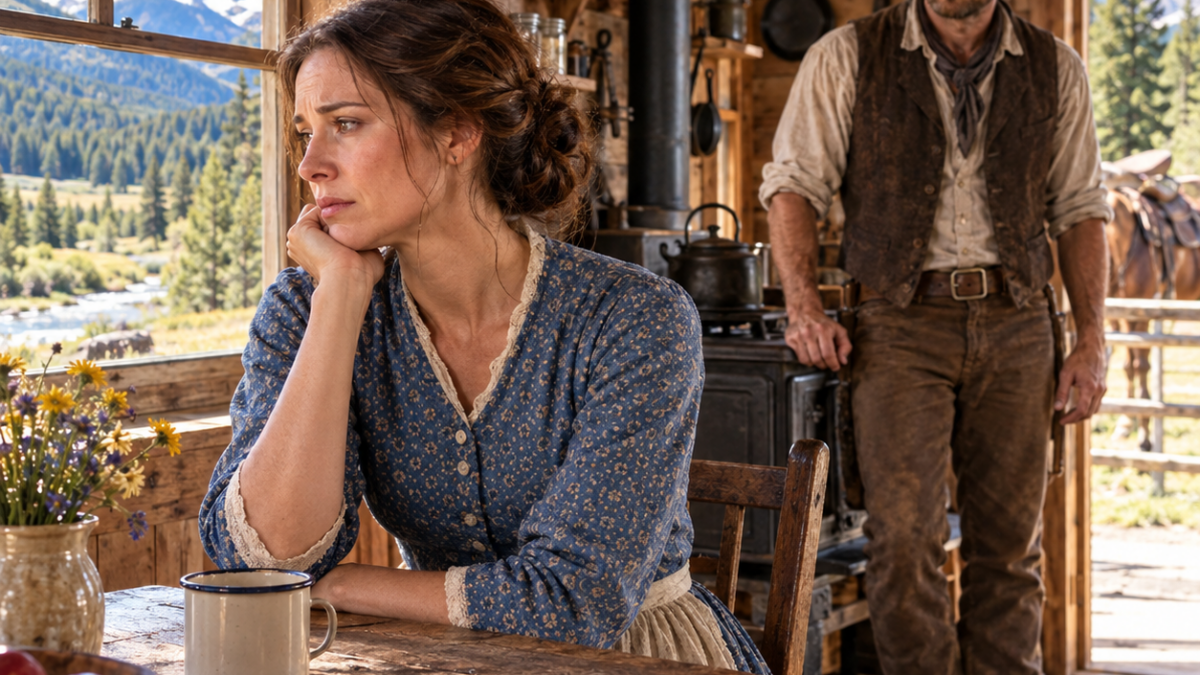
He Said the Ranch Was Finally Paid Off—Then His Wife Asked the Question That Changed Everything
Elias Hart came home with the paper that proved the ranch was finally theirs, expecting his wife to feel the relief he had carried in his bones for half their marriage.
But when Martha looked at him and asked, “When do we start living?” he realized the debt might be gone while the fear that built it still owned every hour of their lives.
Before Saturday came, Elias would have to choose between buying one more meadow for safety—or admitting that a man could protect his family so fiercely he forgot how to share a life with them.
Elias Hart walked back from Ellensburg late on a clear fall afternoon in 1888 carrying a folded piece of paper that had taken most of his marriage to earn.
It did not look like much.
A receipt.
Plain paper, black ink, one official signature, and a line acknowledging the final payment on the promissory note tied to the Hart place. Any stranger glancing at it might have seen nothing but ordinary business. A debt settled. A transaction closed. A man’s name written cleanly in a ledger where, for years, it had been paired with obligation.
But to Elias, that paper weighed more than a saddle.
For seventeen years, the note had lived in his chest.
It was there in winter when snow piled high against the barn doors and the herd bawled for hay. It was there in spring when mud swallowed wagon wheels and every board needing repair seemed to ask whether a man should spend on the house or pay down another few dollars. It was there at supper when Martha stretched beans with onion and bacon grease and called it plenty because plenty was a word they had learned to use carefully.
The debt had been with them when Samuel was born and Martha bit down on a towel rather than wake the neighbors before dawn. It had been there when Lucy took her first steps across the kitchen floor, between a flour barrel and a stove that smoked whenever the wind came wrong. It had been there on every birthday celebrated with practical gifts, every winter coat mended one more season, every visit postponed because travel cost money and money had somewhere else to go.
And now, as of that afternoon, it was paid.
Settled in full.
The Hart ranch, modest as it was, tired as it was, wind-scraped and weather-marked as it was, belonged to them outright.
Elias should have felt like a man standing on solid ground for the first time in his life.
Mostly, he felt like a man who had carried something heavy so long that his shoulders did not know how to sit without it.
He walked home from the wagon stop instead of asking for a ride. It was not far, and the day was too clear to waste from a wagon seat with some neighbor asking questions before Elias understood his own answer. The late October light lay low across the valley. Dry grass bent beneath the wind. Cottonwoods along the creek had turned yellow at the edges. Far off, the hills rose blue and brown beneath a sky so wide it could make a man feel both blessed and unfinished.
The Hart place came into view as he crossed the last rise.
The house stood sound.
That still surprised him sometimes.
Not fine, exactly. Not the sort of house that made travelers slow their horses and wonder who lived there. But sound. The roof had been patched well. The chimney drew clean. The porch sagged only where Elias already knew it sagged and planned to fix before the snow. Smoke lifted from the stove pipe. The barn doors were shut against the wind. The corral fence ran straight enough. The herd grazed beyond the low meadow, dark shapes moving slowly through the gold grass.
Everything he had spent his adult life trying not to lose was still there.
That should have been enough.
He touched the folded receipt inside his coat.
Then he looked north.
Past the fence line, beyond the edge of what was his, lay Whitfield’s meadow.
Good grass.
Reliable spring.
Land that held green longer than it had any right to in August.
Elias had been measuring it with his eyes for the better part of a month, though he had not yet spoken of it properly to Martha. Not because he intended to hide anything from her. Elias was not a secretive man in the ordinary sense. He did not gamble, drink away money, or meet men in town with plans he would not mention at home.
But he had a way of carrying decisions inside himself until they came out nearly finished.
Martha had once admired that.
In the early years, when everything was uncertain, Elias’s finished answers had felt like shelter. Roof first. Then stove. Sell three head, not five. Hold back hay. Pay Miller by November. Buy boots for Samuel before winter. Wait on the parlor curtains.
He came to her with conclusions, and because the conclusions were often wise, she learned to trust the silence before them.
Neither of them noticed when trust became distance.
Elias reached the porch, wiped his boots hard against the scraper, and opened the door.
Warmth met him first.
Then the smell of coffee and mending cotton.
Martha sat near the window, where the last light was strongest, a shirt spread across her lap. Her brown hair had silvered at the temples and been pinned back loosely, though several strands had escaped and fallen against her cheek. She was forty-one, though work and weather had added years around her eyes on some days and taken them away on others. In the right light, when she laughed, he could still see the girl who once agreed to marry a man with more stubbornness than land.
She looked up.
“You’re later than I thought.”
“Stopped at the bank.”
“I figured.”
He hung his hat on the peg.
The house waited.
Not really.
Houses did not wait.
PART2:
But this one had held the debt so long that Elias felt it listening with them.
He took the paper from inside his coat and set it on the table.
“We finally paid off the ranch,” he said. “That was the last payment.”
He said it the way a man reports the weather.
Clear.
Plain.
No ornament.
Martha’s needle stopped.
She did not ask him to repeat it. Some part of her had been waiting most of their marriage to hear those words and recognized them the instant they left his mouth.
“It’s paid?” she said.
Half question.
Half disbelief.
“It’s paid.”
The shirt settled across her lap.
For a moment neither of them said anything.
In that silence, Martha felt something she had not allowed herself to feel in longer than she could easily name. A loosening low in her chest, like a held breath she had forgotten she was holding. She looked at the paper. Then at Elias. Then at the room around them, the table scarred by years of meals and homework and accounts, the stove blackened at the edges, the shelf where Lucy had lined up three smooth stones from the creek, the chair Elias always meant to repair properly and never did because it still held.
Paid.
The word should have filled the room.
Instead, it entered quietly, almost shyly, as if unsure whether the Harts knew what to do with it.
Martha did.
Or she thought she did.
She imagined, foolishly maybe, the two of them sitting down properly that evening. Not eating in shifts. Not Elias rising as soon as his plate cleared because daylight remained and something always needed checking. Not Martha rinsing cups while mentally measuring flour for tomorrow. She imagined the good plates from the top shelf, the ones wrapped in cloth and saved for company that rarely came. She imagined coffee poured while it was still hot and drunk before it cooled. She imagined saying, Do you remember when we thought this day would never come? and hearing him answer not with plans, but with memory.
“We ought to mark it somehow,” she said.
Elias looked at her.
“Mark it?”
“Sit a while tonight. Use the good plates, maybe. Not rush off to the barn the second supper’s cleared.”
“We will,” he said.
He meant it when he said it.
That was the ache of it.
Elias was not lying. He was not dismissing her. He wanted, in that moment, to want what she wanted. But his eyes had already drifted past her, out the window, toward the fence line and the low meadow beyond it.
Land that was not his.
Not yet.
Martha saw the look.
Long marriage made a woman fluent in small weather.
She did not ask immediately.
PART3:
She poured coffee, because coffee gave hands something to do when the heart was not ready to speak. Elias sat. She placed a cup before him. The receipt remained between them like a third presence.
He picked it up once, unfolded it, looked at it again, and refolded it.
“It’s a good thing,” Martha said softly.
“Yes.”
“You don’t sound glad.”
“I am.”
“Are you?”
He looked at her then, surprised.
“I said I am.”
Martha almost smiled.
There had been years when that would have ended the matter. Elias said what he meant. If he said he was glad, he was glad. But age had taught Martha that a person could speak true and still not speak all.
He brought up the meadow before the coffee had finished cooling.
“Talked to Whitfield in town.”
Martha’s hand stilled around her cup.
“The meadow past the north fence?” Elias said. “The one with the spring. He’s looking to sell before winter.”
Martha did not answer right away.
Elias continued because silence, to him, was often a space meant to be filled with reason.
“Good grass. Water that doesn’t quit in August. Would carry us through a lean winter without touching the herd. Might let us run twenty more head come spring if we handle it right.”
He was not excited exactly.
He was certain.
There was a difference, though it had taken Martha years to learn how to tell them apart in him.
“Can we afford it?” she asked.
A fair question.
A practical one.
“We can now.”
Something in the way he said now, the receipt still folded fresh between them, told her everything about where his mind had gone the moment the old debt lifted.
He explained the rest without being asked.
Hay reserves.
Grazing flexibility.
Winter security.
What it would mean in a dry summer.
What a hard winter could do to a family that had not planned for one.
Martha listened.
She always listened.
She could have recited the case for that meadow back to him nearly word for word before he finished. Long marriage had made her fluent in her husband’s arithmetic. She knew the numbers beneath his sentences. She knew where fear hid inside terms like reserve and sound investment and room to grow.
When he finally paused, she asked, “Do you want it?”
Elias blinked as if the question did not quite fit the shape of what he had been saying.
“It’s good land,” he said. “Reliable water. We’d be foolish not to.”
“That’s not what I asked.”
He opened his mouth to explain the spring again.
Something in her face stopped him.
Martha set her cup down slowly, the way a person sets something down when she has decided, mid-motion, to say a thing she had not planned on saying that morning.
“Elias,” she said, “when do we start living?”
She did not say it sharply.
She did not say it like an accusation dressed up as a question.
If anything, she said it almost surprised at herself, as if the words had been sitting somewhere behind her ribs for longer than she had known and had finally found their own way out.
Elias sat with it.
The wind moved against the window.
A board creaked near the stove.
“We are living,” he said at last.
Quiet.
Certain.
The way he said most things.
Martha looked at him for a long moment.
Then she picked up her cup.
“All right.”
That was all.
No argument.
No tears.
No dramatic declaration about wasted years.
She let the subject go.
And something about the ease with which she let it go worried Elias more than an argument would have.
He heard the question again even after she turned back to the shirt in her lap.
When do we start living?
But he heard it wrong at first.
He heard it as, You failed me.
He heard it as, The work was not enough.
He heard it as, All those winters you fought to keep us fed and sheltered and paid another little piece of the note did not count as love.
It stung in a place he did not examine too closely.
So he did what he always did when something stung.
He got up.
“Need to check the east gate before dark.”
Martha’s needle paused.
“The east gate held fine this morning.”
“I know.”
He reached for his hat.
She did not call him back.
That evening, after supper, Martha poured coffee for both of them and sat at the table the way she used to before the note and the years wore the habit thin. Elias sat too for a while. Long enough to drink half a cup. Long enough for Martha to think perhaps the day might still be marked, not with ceremony, but with his presence.
Then he noticed the daylight still holding past the ridge.
He rose without quite deciding to.
His body made the decision before his mind caught up.
“I’ll just see about that gate.”
Martha looked into her coffee.
“All right.”
Outside, Elias stood at the fence line as the light went gold and then gray.
The gate was fine.
He knew it before he reached it.
He lifted the latch, set it again, tested the post, checked the hinge, and then stood with one boot on the lower rail looking out at everything he had spent his whole adult life afraid of losing.
The house.
The barn.
The herd.
The note paid.
It should have felt like enough.
Instead, some quiet, tireless part of his mind was already counting.
Already picturing the hay Whitfield’s meadow would yield.
Already calculating how many head the spring would support.
Already building the next wall of safety around a family that, by any honest measure, no longer needed defending quite so hard.
When do we start living?
He turned the question over and found, to his own unease, that he did not have an answer waiting.
That troubled him.
Elias Hart was a man built out of answers.
Not fancy ones.
Not quick ones.
But answers all the same.
How much hay would the herd need if snow came early?
How many posts could be replaced before frost locked the ground?
Which calf was failing?
Which roof seam would leak?
How long could flour stretch if the road to town washed out?
Which note payment could be made if they sold two head in September instead of four in November?
He had known those answers because not knowing them could cost something real.
But Martha’s question was not shaped like weather or livestock or debt.
It could not be solved with labor.
That made him suspicious of it.
He slept badly that night.
Beside him, Martha slept turned away, though he did not know if that was because of him or simply because she had slept that way more often lately and he had not noticed. The room was dark. The house made small night sounds. Somewhere beyond the barn, an animal moved through dry grass.
Elias lay awake and remembered the early years.
They had been young once and poor in the plain, unremarkable way young couples can be poor before hardship becomes either a story or a scar.
Their first place had been a leased quarter section with a roof that answered every hard rain with a leak in a new spot. Martha used to set pots under the drips and laugh that the house was teaching them music. Elias had hated that roof. Martha had hated it too, but differently. She could hate a thing and still make soup beneath it.
They talked in those years.
Really talked.
About the house they would build someday. The acres they would own outright. The places they might travel once there was money enough to spare, though there was not money enough to spare for years and years. They spoke of it anyway, the way young people speak of future things just to feel the shape of them in their mouths.
“Once we’re square,” Elias used to say.
“Once we’re square, we’ll breathe,” Martha would answer.
It became a promise between them.
Repeated so often in those first lean years that neither could later remember who had said it first.
The postponing started small.
Reasonable.
A visit to Martha’s sister put off one season because the roof needed shingling before rain. A Sunday meant for walking the property line for pleasure given over instead to a sick calf that could not wait for pleasure. A little money Martha might have spent on fabric turned into nails. A day Elias might have spent taking the children fishing became a day hauling winter wood.
None of it felt cruel.
It felt like the ordinary cost of building something real.
Then Samuel came.
Then Lucy.
And the shape of conversation shifted without either of them noticing the exact evening it happened.
Samuel’s boots.
Lucy’s winter dress.
School books.
Whether the henhouse needed mending before the fox found the gap.
Whether Martha could make do with the old stove another year.
Whether Elias should trade for a better bull.
Whether the note payment could stretch if spring prices held.
They talked constantly about nearly everything except themselves.
The winter of 1880 into 1881 taught Elias fear in a language he never stopped speaking.
Snow early.
Snow late.
Wind that came down so hard from the north it drove through cracks no chinking seemed able to hold. Hay disappearing faster than planned. Cattle bawling hungry. Ice on water. A calf frozen one morning near the fence line because its mother could not get it back to shelter. Then another. Then older stock thinning, ribs showing, eyes dull with the suffering of animals that could not be reasoned with or comforted by promises.
The Harts came through that winter lighter than they entered it.
Not just in herd count.
Elias lost something that winter he never properly named.
A softness, maybe.
A willingness to believe enough could remain enough.
He remembered standing outside the barn after the worst had passed, boots sunk in thawing mud, looking at the animals they had left and telling himself one thing with the force of an oath.
Never again.
Never that thin.
Never that close.
Never that unprotected.
A vow like that could keep a family alive.
It could also build a cage so slowly everyone inside mistook the bars for good sense.
After that winter, Elias worked one hour earlier and stopped one hour later. He slept easier if there was more hay than they were likely to need. Reserve mattered more than comfort. Comfort could wait because comfort rarely killed a herd in February.
Martha learned her own version of the lesson.
She learned to say, “I’m fine,” before he asked.
She learned to say, “Fix the barn first. Never mind me.”
She learned to mean it mostly because she was frightened too.
There was a particular kind of pride in becoming the person who needed the least.
At the time, it looked like partnership.
Each admired the other for it.
Elias admired Martha deeply.
He told her now and then in his plain way.
“You never ask for more than we’ve got,” he would say. “Not many wives could say that.”
She would smile, warmed by the praise and injured by it in a place she did not yet know existed.
Neither of them noticed, not for years, that a habit built to survive a hard season had quietly become the shape of the entire marriage.
By the time Samuel was nearly grown, Elias could tell without looking exactly what Martha needed for the coming week.
Flour.
Thread.
Lamp oil.
Coffee.
A new hinge for the pantry door.
A stronger hook near the washroom.
Martha could tell you exactly what Elias needed.
Coffee before first light.
Boots dried by the stove.
Quiet in the evening when his back was troubling him.
A clean shirt for town.
No questions when his face closed after bad news from a neighbor’s pasture.
They knew each other’s needs the way two people know a well-worn road.
Neither could have told you what the other wanted.
Not needed.
Wanted.
It was a smaller word.
Somewhere along the road, it had drifted out of use.
The morning after the note was paid, Elias came in before dawn as usual.
Martha was already at the stove.
Coffee steamed.
Bacon hissed softly.
Samuel, sixteen and all elbows, boots, and hunger, came downstairs scratching his hair and arguing with his suspenders. Lucy followed ten minutes later, fourteen years old and sharp-eyed, carrying a schoolbook she read while walking because she trusted the house to stay where it had always been.
Elias watched them more closely than usual.
They did not know.
Not yet.
The ranch was paid.
Their house was theirs.
The land beneath their feet no longer stood under another man’s claim.
He expected to feel proud telling them.
Instead, when he said it over breakfast, Samuel only stared for a moment and grinned.
“So we’re rich now?”
Lucy kicked him under the table.
“We are not rich.”
“We’re richer than yesterday.”
Martha smiled faintly.
“In one way.”
Samuel looked at Elias.
“Does that mean we’re buying Whitfield’s meadow?”
Elias’s hand stopped halfway to his cup.
Martha looked down at her plate.
Lucy noticed both things.
She was that kind of child.
“Are we?” Samuel asked.
“Maybe,” Elias said.
Samuel nodded, already approving because sixteen-year-old boys trusted expansion as proof that life was moving in the proper direction.
“Good grass up there.”
“It is.”
Lucy tilted her head.
“Are we celebrating paying the note?”
Martha looked up.
Elias felt the question land.
“We’ll see,” he said.
Lucy frowned.
“See what?”
“What the day holds.”
Martha rose to clear plates.
The day held what days always held.
Cows.
Fence.
Laundry.
School.
A wagon wheel that needed greasing.
A shirt needing mending.
A neighbor stopping by with news that old Whitfield wanted an answer by Saturday if Elias was serious about the meadow, because another rancher two valleys over had already asked after it.
Nothing announced crisis.
That was, in its way, the hardest part.
Coffee got made.
Work got done.
Martha mended a torn sleeve at the table while Samuel and Lucy argued cheerfully over chores.
Elias went out and did the work a ranch always had waiting for a man, rain or shine, note paid or not.
Nothing in the house looked broken.
That was what unsettled Elias.
A marriage could look entirely intact.
Nothing had shattered between them.
They had simply become better at managing life than sharing it.
He found himself watching Martha as she moved through the kitchen that afternoon.
She still did everything asked of her and asked almost nothing back.
That reliability in her, once his deepest comfort, now disturbed him.
Because it had made it easy to assume she could always wait.
That evening, he came in earlier than he needed to.
Martha noticed but did not comment.
He washed at the basin, dried his hands, and stood near the stove longer than the task required.
“What did you mean?” he asked.
Martha looked over her shoulder.
“About what?”
He knew she knew.
“When you asked when we start living.”
She turned back to the pot and stirred once, though it did not need stirring.
Then she set the spoon down.
“I thought paying off the note was where later ended,” she said.
Elias listened.
“I thought once that was behind us, we would finally get to the part we kept promising ourselves.”
“I thought this was what we were working toward,” Elias said. “The land. Being square. Building something that holds.”
“It was.”
Her answer came without hesitation.
Then, quieter, “I don’t know that it still is. Not the way we’re going about it.”
The floor beneath him felt less steady.
“Everything I did,” he said, and his voice had an edge that surprised them both, “I did for you. For this family. Every hour, every winter I worked through instead of resting. That was for you, Martha.”
“I know that.”
She said it plainly.
Without hesitation.
“I have always known that.”
That should have comforted him.
It did not.
Martha looked at him a long moment.
“That is why I never knew how to tell you it was costing us something too.”
Neither raised a voice.
Both things were true at once.
Neither canceled the other.
Elias wanted to say that cost was part of life. That everything worth building demanded something. That families did not become secure because men sat around wondering whether they were living properly.
But he did not say it.
Somewhere beneath his defensiveness lived the memory of Martha sitting alone with coffee the night before while he stood beside a gate that needed no checking.
So he asked the question badly, but honestly.
“What do you want me to do? Stop working?”
Martha almost smiled, but sadness took it before it formed.
“No.”
“Then what?”
“I don’t know.”
The answer frustrated him.
Martha saw that and did not soften it.
“I mean that honestly,” she said. “I don’t know. I only know that yesterday you brought home the one thing we said would let us breathe, and before the coffee cooled, you were already building the next reason not to.”
Elias looked away.
“The meadow is good land.”
“I know.”
“It would make us safer.”
“I know that too.”
“Then—”
“Elias.”
He stopped.
She stepped closer, not touching him.
“I am not asking whether the land is good. I am asking whether fear is the only thing allowed to vote in this house.”
He stared at her.
The sentence was not loud.
It had no need to be.
That night, after the children had gone upstairs, Martha sat on the porch step with her hands folded in her lap. The air had turned cold enough for breath to show faintly. Elias came out with his coat but did not put it around her shoulders because he sensed, somehow, that making her warm would not answer the question.
He sat beside her.
For a while, they listened to the night insects and the distant sound of the herd shifting.
“I think I got so used to being the thing that could wait,” Martha said, “that somewhere along the way I forgot I was still waiting.”
Elias did not move.
“I never once thought you loved me less,” she continued. “I think I just became the one thing you trusted would still be here, exactly as you left it, whenever the work was finally done.”
He had no answer.
Not that night.
Old Whitfield found Elias outside the mercantile the next day, hat pushed back, pipe unlit in one hand.
“Need your answer by Saturday, Hart,” he said, not unkindly. “Nothing against you. I can’t hold it forever. Fellow from over past Kittitas way is serious.”
“That so?”
“Cash enough for half. Note for the rest. He wants the spring.”
Elias looked toward the road where dust lifted behind a departing wagon.
“I understand.”
“Good land,” Whitfield said.
“I know.”
“Would rather see it with you than him.”
“Appreciate that.”
“But business is business.”
“It is.”
A fair, ordinary thing for a man to say.
A fair, ordinary deadline.
It meant the question sitting unresolved in the Hart house now had a date attached to it.
Dates had a way of making a man do something with uncertainty he might otherwise leave sitting in a corner.
Elias came home unsettled and did what he always did with unsettled feeling.
He found work.
He mended a section of fence that had another good season left in it, purely because doing something with his hands felt safer than sitting still with a question he did not know how to answer.
It was well past dark by the time he noticed what he had done.
He stood there with the hammer in his hand, fresh nails set into sound wood, and recognized the discomfort sitting heavy in his chest as exactly the thing Martha had been trying to tell him about.
The fence had not needed mending.
He had.
The next evening, he tried a different question.
“If we didn’t buy it,” he asked Martha, “what would you want instead?”
Martha opened her mouth.
Nothing came.
Not because she was hiding something.
Because she genuinely did not know.
That frightened her more than she expected.
She had spent so many years fluent in what the family needed that she had almost no practice naming what she herself wanted. Want sounded selfish when needs had sharp teeth. Want sounded soft, and soft things had been the first things sacrificed every winter.
“I don’t know,” she admitted.
The answer cost her.
Elias saw that.
For once, he did not fill the silence with a plan.
She tried again a day later.
Something smaller and truer came out.
“I want us to finish one whole cup of coffee together,” she said, “without either of us deciding halfway through that something else matters more.”
She nearly added, If you have time.
The old habit rose in her throat before she could stop it.
She let the sentence stand plain instead.
Elias stayed that morning.
The whole cup.
It was not a grand moment.
It was a little awkward.
Two people married nearly eighteen years sat across from one another with no urgent problem to discuss and no skill for the quiet they had once known by heart. Elias looked at his cup. Martha looked at the table. Samuel came in, saw them sitting, and asked if someone had died.
“No,” Martha said.
Lucy appeared behind him and narrowed her eyes.
“Then why is Pa still inside?”
Elias looked embarrassed.
“Drinking coffee.”
Samuel stared.
“At this hour?”
Martha laughed first.
Then Elias.
The sound startled them all.
It did not solve anything.
The meadow still sat beyond the north fence.
Saturday was still coming.
But Elias stayed.
Martha noticed that he stayed.
Something in her allowed itself, cautiously, to hope.
That afternoon, Elias rode out to see the meadow at its best.
Morning light lay flat and gold across grass that had not browned yet. Water ran clear where the spring came out of rock, spreading into a narrow channel before bending toward willows. The soil held firm beneath his boots. No sour patch. No useless low ground. The slope was gentle enough for grazing and high enough not to flood badly. It was, by any measure a rancher could name, exactly the kind of land worth having.
Elias stood with the reins looped around one hand and hated how right it was.
He could see the whole future of it.
Cut hay there.
Fence along the upper rise.
Move cattle late summer.
Hold back the lower pasture longer.
Maybe build a small shed near the spring.
Twenty more head by spring if the season held.
More if prices rose.
A better margin before winter.
A man who said no to that land was either foolish or rich enough to afford foolishness.
Elias was neither.
Whitfield rode up from the far side, gave a friendly nod, and reminded him gently.
“Saturday.”
“I know.”
Whitfield rode on.
Elias stayed.
He ran through every reason the land made sense.
Good grass.
Reliable water.
Winter security.
Room to grow.
Protection against drought.
Protection against bad prices.
Protection against the kind of winter that still lived in his bones.
Then, somewhere in the counting, he noticed that every reason was built the same way.
An answer to what could go wrong.
Never an answer to what this would give them that they did not already have.
He could explain in exhausting detail why the meadow would make them safer.
He could not explain what present living thing it would add to the life he and Martha were sharing right now.
This year.
This season.
This morning.
He crouched near the spring and dipped his hand into the water.
Cold.
Clear.
Valuable.
“I know why it would make us safer,” he said aloud, though no one was there to hear. “I don’t know why I want it.”
The confession unsettled him more than expected.
He rode home slower than usual.
Martha was at the table when he came in, sorting buttons from a small tin.
“Well?” she asked.
For perhaps the first time in longer than he could remember, Elias did not hand her a finished answer.
“I don’t know.”
She waited.
“He wants my answer by Saturday,” Elias added.
The deadline no longer sat politely somewhere outside the house.
It had come inside and settled at their table.
Neither could pretend there was time enough to let the question rest.
The next morning, Martha asked, “What don’t you know?”
Elias began, out of old habit, with grass.
Water.
Winter reserve.
The carrying capacity of the meadow.
Martha stopped him gently.
But she stopped him.
“You always know when the question is about the ranch,” she said. “I’m asking about you.”
It landed harder than an accusation because Elias understood, standing there with coffee cooling in his hand, that she was entirely right.
He was quiet a long while.
Then, honestly, “There was a winter when Samuel and Lucy were small.”
Martha’s expression changed.
She remembered.
“Bad one,” Elias said.
“Yes.”
“We lost enough stock to set us back years. I remember standing out past the barn telling myself I’d never let us get caught that thin again. Never.”
Martha nodded slowly.
“Some part of me has been building against it ever since,” Elias admitted. “More hay than we need. More reserve than makes sense some years. More hours. More fence. More land if I can get it. It isn’t a decision anymore. It’s just what I do.”
Martha looked down at her hands.
“Never again doesn’t have a finish line.”
Elias stared at her.
She had named something he had only just begun circling.
Never again could not declare itself finished.
There was always more hay to want.
More land.
More cattle.
One more improvement standing between the family and whatever the next hard winter might bring.
Fear did not retire politely once the note was paid.
It simply found the next meadow.
Martha did not let herself off easy either.
“I helped build it too,” she said.
Elias looked at her.
“Every time I told you not to spend on me. Every time I said I was fine when I wasn’t entirely. Every time I made wanting something sound foolish before you had the chance to say it.”
“Martha—”
“No. Let me say it.”
He closed his mouth.
“For a long time, needing less felt like the truest way I had of loving you back.” Her fingers moved over the edge of the table. “I don’t rightly know when helping turned into disappearing. I don’t think I noticed it happening. I don’t think either of us did.”
Outside, Samuel shouted at Lucy for hiding one of his gloves.
Lucy shouted back that a glove left in the wash basin belonged to nature now.
The ordinary life of the house continued around the hardest conversation their parents had had in years.
That was how most awakenings happened, Elias thought.
Not with thunder.
With children arguing about gloves.
With coffee cooling.
With a woman finally saying, I disappeared, and a man realizing he had loved her and still failed to notice.
That afternoon, Elias found Samuel repairing a strap near the barn.
The boy looked up.
“You buying Whitfield’s land?”
“Don’t know.”
Samuel frowned.
“Thought it was good.”
“It is.”
“Can we afford it?”
“Yes.”
“Then why don’t you know?”
Elias almost gave the easy answer.
Because your mother and I are discussing it.
Because land decisions are complicated.
Because not every matter is a boy’s business.
Instead, he looked at his son and saw himself at sixteen, already learning that men proved themselves by adding, building, acquiring, enduring.
“Because a thing can be good and still not be ours to take right now.”
Samuel’s frown deepened.
“That sounds like Ma.”
Elias almost smiled.
“Does it?”
“She said once that just because I could eat the last biscuit didn’t mean it belonged to me.”
“That was about manners.”
“Seemed larger.”
Maybe it was.
Elias watched Samuel work the strap.
“What do you want?” he asked.
Samuel looked up sharply.
“Me?”
“Yes.”
“With what?”
“Life.”
The boy stared at him as though Elias had asked whether he planned to become a bishop or a horse.
“I don’t know.”
“Good.”
“How’s that good?”
“It means you haven’t turned every answer into a chore yet.”
Samuel looked uncomfortable.
“I want to see Spokane someday,” he said suddenly.
Elias blinked.
“Spokane?”
“Or Portland. Somewhere with a streetcar. Tom Willis’s cousin saw one.”
Elias had not known that.
He knew Samuel wanted a new saddle, disliked arithmetic unless money was involved, and had an eye for horses sharper than most grown men. He did not know the boy wanted to see a city with a streetcar.
“Your mother know?”
Samuel shrugged.
“Lucy does.”
That stung more than Elias expected.
Later, he found Lucy near the chicken yard with a book tucked under one arm and a bucket in the other.
“What do you want?” he asked.
She narrowed her eyes.
“Did Ma tell you to ask?”
“No.”
“Are you dying?”
“No.”
“Then why?”
“Trying something new.”
Lucy considered this.
“I want Samuel to stop using my good pencil for marking fence measurements.”
“Larger than that.”
“I want to teach school.”
Elias stood still.
Lucy lifted her chin as if expecting objection.
“Do you?”
“Yes.”
“Here?”
“Maybe. Or Ellensburg. Or farther.”
He looked at his daughter, really looked, and saw the future moving inside her with a clarity he had not thought to ask about.
“Does your mother know?”
“Yes.”
Of course.
Martha knew the children’s wants.
He knew their needs.
That evening, after the children slept, Elias told Martha what they had said.
Spokane.
Streetcars.
Teaching school.
Martha smiled softly.
“Lucy has wanted to teach since last winter.”
“I didn’t know.”
“No.”
Not accusing.
Just true.
“How long has Samuel wanted Spokane?”
“I’m not sure. He tells Lucy more than me these days.”
Elias sat with that.
Then Martha said, “I know what you decide almost every day of my life. The fence, the herd, the note, the meadow. I couldn’t rightly tell you anymore what you wonder about.”
He looked at her.
“What crosses your mind,” she asked, “when there is nothing needing deciding at all?”
Elias did not answer.
He understood, turning it over, that he had made a habit of bringing Martha only his conclusions.
Never the uncertain, unfinished parts of his own thinking.
The parts a man might once have shared with the woman he trusted most.
Back before trust had turned into a kind of shorthand.
He had stopped letting her know him before his thoughts were already settled.
He could not say exactly when.
Only that he had.
Friday arrived under a hard blue sky.
The kind of sky ranchers did not trust because beauty in fall could turn fast.
Elias spent the morning doing necessary work and nothing more.
That restraint took effort.
Everywhere he looked, some task offered itself as refuge.
A loose board.
A gate chain.
A trough needing attention.
Harness leather requiring oil.
He did each thing that needed doing.
He left the things that could wait.
At noon, Martha packed bread, cheese, apples, and leftover ham into a basket.
Elias watched.
“Going somewhere?”
“You asked what I wanted.”
“I did.”
“I want to walk the property line together for no reason but the pleasure of it.”
Elias looked toward the barn.
Then stopped himself.
“All right.”
Martha almost softened it.
You don’t have to.
If you have time.
Maybe after chores.
He could see each old sentence rise and be swallowed.
She lifted the basket instead.
“Lucy,” she called. “We’ll be back before supper.”
Lucy appeared at the stairs, eyes moving between her parents.
“Both of you?”
“Yes.”
“Is this about the meadow?”
“No,” Martha said.
Lucy smiled.
“Good.”
The walk began awkwardly.
They had walked the property line countless times, but almost always with a purpose. Checking fence. Looking for breaks. Counting grazing damage. Watching the creek level. This was different. The land beneath their feet was familiar, yet the hour felt strange because no task justified it.
Martha walked with her shawl around her shoulders, basket over one arm.
Elias carried nothing.
That alone made him feel underdressed.
They followed the south fence first, where grass brushed Martha’s skirt and grasshoppers jumped ahead of their steps. The mountains sat distant and blue. The house shrank behind them. The herd lifted heads and decided the humans carried no feed, then returned to grazing.
For a long while, neither spoke.
Then Martha said, “I used to imagine this.”
“What?”
“Walking when the note was paid.”
Elias looked at her.
“I imagined us doing grander things too. Taking the train west. Seeing the ocean. Visiting my sister without counting coins before we answered her letter. But mostly, I imagined this.”
“The property line?”
“No.” She smiled faintly. “You beside me without hurrying.”
He looked away.
“I have hurried a great deal.”
“Yes.”
“I thought slowing meant risking something.”
“I know.”
They walked on.
At the far rise, Martha spread the blanket beneath a cottonwood. They sat facing the lower pasture, where light moved across grass in slow waves.
Elias ate an apple and did not mention hay.
Martha noticed.
Halfway through the meal, she started to say, “You should go on and finish the—”
Then she stopped.
Elias looked at her.
“The what?”
She gave a small laugh.
“I don’t even know. The old sentence came up looking for work.”
He smiled.
They sat there until the shadows shifted.
It did not solve the meadow.
Saturday still came.
But something shifted in the room between them.
For one afternoon, fear did not get every minute the day had to offer.
That night, Elias lay awake.
He did not get up.
He did not find some task that could reasonably have waited.
He lay in the dark with everything he knew laid out plainly in his mind.
The meadow’s real value.
The security of a debt-free ranch.
The old fear that had shaped nearly every decision of his adult life.
Martha’s truth, sitting alongside all of it, every bit as real as grass and water and winter.
He still did not have his answer.
But for the first time in longer than he could name, he let the not knowing remain there, unconverted into another task, another fence mended, another hour spent proving himself useful instead of sitting still with an uncertain heart.
Beside him, Martha breathed evenly.
He wondered if she slept.
After a while, she said, “Are you awake?”
“Yes.”
“Thinking about the meadow?”
“Yes.”
She turned onto her back.
“Do you want me to tell you not to buy it?”
The question surprised him.
“Do you want to?”
“No.”
“Why?”
“Because I don’t want to become the reason you resent safety.”
He stared at the ceiling.
“I don’t want to buy it and make you resent the ranch.”
“I don’t resent the ranch.”
“No?”
“No.” Her voice was quiet. “I resent later.”
He closed his eyes.
Later.
How harmless that word had once seemed.
Later, when the note is smaller.
Later, after winter.
Later, once the children are older.
Later, when we are square.
Later had been useful.
Then it became a place where joy went to wait until everyone forgot it had been invited.
“What if I don’t know how?” Elias asked.
Martha turned her head toward him.
“How to what?”
“Live without making everything into protection.”
She did not answer immediately.
Then she reached beneath the quilt and found his hand.
“Then we learn poorly at first.”
A laugh moved through him before he expected it.
“Poorly?”
“Most things worth doing begin that way.”
He held her hand in the dark.
Tomorrow, one way or another, he would choose.
Not only between one meadow and the money it might save someday.
Between the frightened young husband who had once sworn, standing in the ruin of a hard winter, that he would never let his family stand unprotected again, and the man lying now in a dark bedroom beside a woman he loved more than he had known how to say lately.
Morning came cold.
Frost silvered the ground.
Martha rose before him and made coffee. They did not speak much. There was no need to force tenderness over a day that already carried enough weight.
Elias saddled his horse after breakfast.
Samuel came out, pretending to check something near the barn so he could watch without seeming to watch.
Lucy stood on the porch with her shawl around her shoulders.
Martha handed Elias his gloves.
He took them.
Their fingers touched.
“Sure?” she asked.
“No.”
Her eyes softened.
“Sure enough?”
He took a breath.
“I hope so.”
He rode north to meet Whitfield at the property line.
The meadow looked much as it had before. Good grass. Water running clear. Everything a sound rancher could want laid out in front of him. Whitfield waited near the spring, businesslike, courteous, in no hurry, but plain that another buyer stood ready the moment Elias stepped aside.
“Well, Hart,” he said, “what’s it to be?”
For one long moment, saying yes would have been the easiest thing in the world.
Elias could see the whole shape of it.
More hay come winter.
More cattle come spring.
One more layer between his family and whatever the weather threw at them next.
He recognized the feeling rising in his chest.
It was not joy.
It was relief.
The familiar relief of adding one more wall between himself and a fear that had never once run out of shapes.
The meadow would quiet that fear for a season.
Maybe two.
Then the fear would go looking for the next thing.
Same as always.
“I don’t want to buy it,” Elias said finally, “just because not buying it scares me.”
Whitfield studied him.
Then nodded, unoffended.
“That your answer?”
“Yes.”
“You sure?”
Elias looked across the meadow.
The grass was still good.
The water still clear.
The opportunity still real.
“No,” he said. “But it is my answer.”
Whitfield accepted it.
The land would go to the other buyer.
The opportunity, sound and sensible as it was, moved on without him.
It was done.
Truly done, in a way no amount of thinking in the dark could have made it.
Elias rode home lighter and frightened by the lightness.
Martha was at the stove when he came through the door.
She did not turn immediately.
“Did you buy it?”
“No.”
She turned then, searching his face, not quite ready to smile.
“Why?”
“Because I realized I was afraid not to. That is a poor reason to spend money we don’t need to spend.”
He set his hat on the peg slowly.
“I know exactly what that land would have done for the ranch,” he said. “I’m only just starting to learn what I want the years themselves to do for us.”
Martha’s eyes went bright, though she did not cry.
“Are you sure?” she asked.
“No,” Elias admitted.
The honesty surprised him.
Then, after a beat, “Sure enough.”
He looked at her.
“If we’re not spending every year making this place bigger, what do you want the years themselves to be for?”
Martha considered it.
“I don’t know yet.”
“Then we’ll find out,” Elias said. “Together this time.”
That evening, without any particular occasion attached to it, Martha brought out the good tablecloth she had kept folded away for years, saved for someday she could never quite name.
Someday had always been a slippery thing.
It moved whenever they reached for it.
That night, Martha stopped asking it to arrive.
She unfolded the cloth.
It had yellowed slightly at the creases.
Lucy helped shake it out. Samuel carried in extra wood without being asked, then pretended he had done so only because cold evenings annoyed him. Elias washed properly before supper, not the quick rinse of a man planning to return outside, but slowly, as if entering the house rather than passing through it.
Martha set the good plates.
One had a small chip at the edge from some forgotten move years earlier.
She ran her thumb over it and smiled.
“Still good.”
Supper was not fancy.
Beans.
Ham.
Bread.
Apples cooked with cinnamon because Martha had found three soft ones needing use.
But the table looked different because they had decided the evening was theirs.
That was occasion enough.
Samuel looked around.
“Are we expecting somebody?”
“No,” Martha said.
“Then why the plates?”
“Because the ranch is paid.”
Samuel grinned.
Lucy looked at Elias.
“And because Pa didn’t buy a meadow?”
Elias nearly choked on his coffee.
Martha laughed first.
Then Samuel.
Then Lucy.
Finally Elias.
After supper, no one rose quickly.
Martha poured coffee.
Elias stayed.
Lucy asked if paying the ranch meant she could go to normal school next term instead of sharing lessons through winter when roads were passable. Elias did not answer with cost first. He asked what she wanted from it.
Lucy blinked, suspicious.
“To learn properly,” she said. “And maybe teach someday.”
“Then we’ll talk about how.”
Samuel asked whether Spokane had more than one streetcar.
No one knew.
Martha said perhaps one day they would find out.
Samuel stared.
“You’d go?”
“Why not?”
“Because…” He looked around, helpless before the collapse of family doctrine. “Because we don’t do things like that.”
Elias looked at Martha.
Then back at his son.
“Maybe we haven’t.”
That sentence stayed in the room long after conversation moved on.
A few mornings later, the ranch still needed every ordinary thing a ranch needed.
Work did not disappear because a family decided to live.
Cattle still had to be fed.
Wood still had to be split.
Tools still broke.
Weather still changed without permission.
Martha poured two cups of coffee and sat across from Elias, the way she had nearly every morning of their marriage.
Elias drank, then rose out of old habit.
His eyes went toward the barn before he had quite decided to leave.
For one brief moment, the old pull nearly won without a fight, the way habits do when they have had years to root themselves in a person’s bones.
Then he stopped.
He came back to the table, poured himself a little more coffee, and sat.
“Aren’t you late?” Martha asked.
There was no real worry in it.
More curiosity.
“It’ll keep.”
Martha did not tell him to go.
She slid the pot a little closer between them and stayed exactly where she was.
The fear, for once, waited its turn.
Winter came.
Not cruelly that year, though not kindly either. Winter in that country had no interest in kindness. Snow fell hard in December, thawed just enough to become treacherous, then froze again. Elias kept hay carefully but did not count it six times a day. When he caught himself doing the third count, he stopped and went inside.
Martha looked up from her sewing.
“Trouble?”
“No.”
He stood awkwardly near the door.
“Then why are you standing there like you misplaced a cow?”
“I came in.”
“I see that.”
“Didn’t know what to do next.”
She hid a smile.
“There is coffee.”
“Always your answer.”
“It has served us well.”
He sat.
Some days he failed.
Some days fear won before he noticed the fight had begun. He stayed out too late checking a roof seam that could have waited. He snapped at Samuel over wasted grain when the boy had only misjudged a scoop. He spent an entire afternoon calculating a possible hay shortage that the weather did not justify.
But the difference now was that he returned.
He apologized awkwardly at first, like a man handling a tool not designed for his grip.
“I spoke sharp,” he told Samuel once after the grain incident.
Samuel stared as though struck.
“You did.”
“I was thinking about winter, not the scoop.”
“That supposed to make sense?”
“No.”
Samuel nodded.
“Good, because it didn’t.”
Martha turned away at the stove so they would not see her smile.
Slowly, the house learned a new rhythm.
Not less work.
More room.
Elias began asking unfinished questions at supper.
“What do you think of letting the lower pasture rest longer next year?”
“What would it take for Lucy to study in town without making the road a misery?”
“Is there any reason we keep Sunday afternoon so full?”
The first few times, the family answered carefully, suspicious of traps where there were none.
Then Samuel argued freely.
Lucy brought out a school catalogue she had apparently had hidden for months.
Martha named small wants without apologizing over them.
A new blue dress before spring.
A visit to her sister.
A proper rocking chair for the porch.
One day each month when nobody discussed improvements unless something was actively on fire.
“That seems excessive,” Elias said.
“The fire exception?”
“The improvements.”
Martha lifted an eyebrow.
He nodded.
“One day.”
They began with one Sunday afternoon.
No unnecessary work.
No talk of expansion.
No calculations unless Martha initiated them, which she did not.
At first, Elias found the hours almost painful. His mind wandered toward barns, fences, accounts, winter feed. Then Lucy asked him to help read a poem she disliked, and Samuel challenged him to a horseshoe throw, and Martha sat in the sun with mending in her lap without once lifting the needle.
By spring, Sunday afternoon had become the one part of the week everyone defended.
When a neighbor stopped by once asking Elias to come look at a possible trade, Martha saw him prepare to rise.
He looked at her.
Then at the neighbor.
“Come Monday,” he said.
The neighbor blinked.
“Something wrong?”
“No.”
“You busy?”
“Yes.”
The man glanced at the porch where Martha sat with coffee and Lucy read aloud while Samuel pretended not to listen.
“With what?”
Elias considered.
“Living.”
The neighbor laughed because he thought it was a joke.
Martha did not.
That summer, they went to visit Martha’s sister.
Not someday.
Not after another improvement.
Not when travel cost nothing, because travel never cost nothing.
They went.
For four days.
Samuel stayed with a neighbor to help with chores and was insulted that anyone thought he could not manage, though he secretly liked being trusted. Lucy came with them and spent half the journey asking questions about every town they passed.
Martha’s sister, Ruth, cried when she saw them.
“You said you’d come for ten years,” she said, holding Martha tightly.
Martha looked over Ruth’s shoulder at Elias.
“I know.”
No accusation.
No forgiveness offered too easily.
Just truth.
They stayed in Ruth’s small house near Yakima, where the garden was better than the roof and every chair had a quilt thrown over it. Elias fixed one hinge because it was truly broken, then caught Martha watching him.
“What?” he asked.
“Can you fix only one?”
He looked around at three other imperfect things in the room.
Then set down the tool.
“Yes.”
Ruth did not understand why Martha laughed until she cried.
In August, Samuel saw a streetcar.
Not in Spokane, but in a town where a cousin of Ruth’s took them while Elias pretended not to be impressed by overhead wires and tracks. Samuel stood beside the street, eyes bright, watching it move as if the world had invented motion that did not require horses and had done so specifically to astonish him.
Elias watched his son.
Then watched Martha watching both of them.
There were things safety could not give a family because safety’s work was to prevent loss, not create memory.
The meadow would have given hay.
This gave Samuel a story.
Not more important in February, perhaps.
But life was not February all year.
They returned home to work waiting.
Of course they did.
The ranch had not politely paused in their absence. A rail had cracked. A cow had gone lame. The garden had overproduced beans in a way that felt aggressive. Elias worked hard the next week, but differently. He no longer treated the price of leaving as proof they should never go.
Martha noticed.
She noticed everything now, not because she had not before, but because she had stopped convincing herself that noticing was useless.
That fall, on the first anniversary of the ranch being paid, Elias rode into Ellensburg alone.
Martha did not know why.
She tried not to worry.
When he returned, he carried a parcel tied with twine.
She looked at it suspiciously.
“What did you buy?”
“Something foolish.”
“That does not sound like you.”
“I know.”
He placed it on the table.
Inside was a blue length of fabric.
Good fabric.
Not extravagant.
But finer than what Martha would have bought for herself.
She touched it with two fingers.
“For the dress?”
“If you still want it.”
Her eyes filled.
The old Martha would have said it was too much.
That the money should go toward harness repair.
That her old dress still held.
This Martha took one breath and said, “I do.”
Elias nodded.
“Good.”
Then he added, “Harness repair can wait until next month.”
Martha laughed through tears.
“You checked?”
“I am still me.”
“Yes,” she said softly. “But more here.”
Years passed.
Not many before Samuel left for work that eventually took him farther west than Spokane. He sent a letter describing streetcars with the solemn detail of a man reporting a miracle. Lucy did become a teacher, first close enough to ride home some weekends, then farther away when opportunity called and she answered it with the confidence of a girl who had learned wanting was not selfish if one was willing to carry its cost honestly.
The ranch remained modest.
Sound.
Paid.
Elias improved it, because improvement was still part of his nature, but he learned to ask what each improvement served. Fear or life. Sometimes both. When both, he and Martha talked until they understood which voice was louder.
They never became carefree.
That was not who they were.
A ranch did not permit foolishness, and neither of them truly wanted a life without responsibility. They still stored hay. Still watched weather. Still counted money carefully. Still mended before replacing and repaired before buying new.
But the fear no longer received every last minute.
Some mornings, Elias finished coffee.
Some evenings, Martha left dishes soaking and sat on the porch.
Some Sundays, they walked for no reason.
Some winters, when storms came hard, Elias still felt the old vow wake inside him.
Never again.
But now another voice answered.
Not everything is winter.
On their twenty-fifth wedding anniversary, Lucy returned with a young schoolmaster she claimed was only a colleague until Martha raised both eyebrows and the truth surrendered. Samuel came too, taller, broader, with city stories and ranch hands, still hungry enough to empty a plate before conversation warmed.
Martha used the good tablecloth again.
The same one from the night after Elias refused the meadow.
The yellowed creases had long since softened from use.
That pleased her.
During supper, Samuel lifted his cup.
“To the paid-off ranch,” he said.
Lucy added, “And to the meadow Pa didn’t buy.”
Elias groaned.
“You two still remember that?”
Lucy smiled.
“Ma told us never to forget.”
Martha looked innocent.
“I said no such thing.”
“You said it with pie,” Samuel said. “That is stronger.”
Elias looked at Martha across the table.
Her hair was mostly silver now. Lines bracketed her mouth. Her hands showed years of work, but she wore the blue dress made from the fabric he had bought, let out once and altered twice. She looked older than the girl who had laughed under a leaking roof. She also looked more present than the woman who had once sat with coffee cooling while he went to check a gate that needed nothing.
Later that night, after the children had gone to bed in the old rooms that no longer fit them properly, Elias and Martha sat on the porch beneath a clear sky.
The stars were sharp.
Cold gathered in the grass.
The ranch lay quiet around them.
Elias held Martha’s hand beneath the blanket stretched across their laps.
“Do you ever wish I’d bought it?” he asked.
“The meadow?”
“Yes.”
She considered honestly.
“Some dry summers, yes.”
He laughed softly.
“I do too.”
“Do you regret not buying it?”
“No.”
“Neither do I.”
He looked north, though darkness hid the fence line.
“Another man got good use from it.”
“Yes.”
“We managed without it.”
“We did.”
He squeezed her hand.
“Do you think we started living?”
Martha leaned her head back against the chair.
“Not all at once.”
“No.”
“But yes.”
He nodded.
After a moment, she added, “I wish I had asked sooner.”
“I wish I had heard sooner.”
They let those regrets sit between them without trying to repair what time had already taken. Some years could not be recovered. Some evenings would always remain Martha alone at the table, Elias at a gate, both of them thinking they were doing what love required.
But not all regret was ruin.
Some regret became instruction.
The next morning, Elias rose before dawn out of habit.
Martha woke as he dressed.
“Coffee?” she asked sleepily.
“I’ll make it.”
That brought her fully awake.
“You?”
“I have watched you do it for twenty-five years.”
“That is not the same as knowing how.”
He turned.
“I can learn poorly.”
Martha stared.
Then laughed into her pillow.
The coffee was terrible.
Samuel, who came downstairs first, took one sip and looked at his father with betrayal.
“What is this?”
“Coffee.”
“No, sir.”
Lucy came in, tasted it, and said, “This is why Ma cannot die first.”
Martha laughed so hard she had to sit.
Elias drank his own cup stubbornly until Martha took pity on them all and made a proper pot.
He did not become a man transformed by one question.
People rarely do.
He became a man redirected.
A man who still loved work, still trusted preparation, still watched winter with wary eyes, but who understood now that a paid-off ranch was not the same as a lived-in life.
Martha changed too.
She stopped being proud of needing nothing.
She still gave generously.
Still sacrificed when sacrifice was truly needed.
But she learned to name the difference between love and disappearance.
When she wanted a visit, she said so.
When she was tired, she said that too.
When Elias brought only conclusions, she sometimes held up one hand and said, “No, bring me the unfinished part.”
And because he loved her, he tried.
Years later, when Elias was old enough that younger men tried to carry things for him and he resented them only half the time, a neighbor rode over asking advice.
The man was young, newly married, standing at the edge of buying more land than he needed because, as he said three times, “A man can never be too safe.”
Elias listened.
Martha, shelling peas near the porch, listened too.
The young man laid out his reasons.
Grass.
Water.
Future stock.
Winter reserve.
A chance that might not come again.
Elias heard his younger self so clearly it nearly hurt.
When the man finished, he asked, “What would you do, Mr. Hart?”
Elias looked toward Martha.
She did not rescue him.
He looked back at the young man.
“I’d ask my wife what the years are for.”
The man frowned.
“What?”
“The land may be good. Buy it if you want it and can afford it and both know what it asks of you. But don’t buy it just because fear speaks loud.”
The young man looked more confused than enlightened.
That was all right.
Elias had not understood either until the question came from the woman who had waited longest.
After the neighbor left, Martha smiled.
“You are becoming mysterious in your old age.”
“I thought I sounded wise.”
“You sounded like a man who knows the price of hay and regret.”
“That is wisdom.”
“Perhaps.”
He sat beside her and took a handful of peas to shell badly.
She let him.
The ranch remained, as ranches do when cared for and spared disaster long enough, both changed and the same.
The barn roof was replaced twice.
The porch finally repaired properly.
The north fence moved once after a survey corrected an old line.
Whitfield’s meadow changed hands again and again. Each time, Elias felt a small tug of what might have been. Then he would look at Martha reading on the porch, or a letter from Lucy on the table, or a postcard from Samuel with some impossible city building drawn on it, and the tug would quiet.
A life was not made only from opportunities taken.
It was also made from the ones refused because a different future needed room.
On a clear fall afternoon many years after the note was paid, Martha found the old receipt in a box of papers.
The ink had faded slightly.
The folds had deepened.
She brought it to Elias, who sat near the window sharpening a knife more slowly than necessary because his hands had stiffened with age.
“Look what I found.”
He took it.
For a long time, he said nothing.
Martha sat across from him.
He smiled faintly.
“I remember walking home with this.”
“I remember you saying it like you were reporting rain.”
“I did not know how to say it.”
“No.”
“I thought paying it meant I had proved something.”
“You had.”
He looked up.
“But not everything.”
Martha’s eyes softened.
“No. Not everything.”
He ran his thumb over the old paper.
“I almost bought a meadow before I knew how to sit still.”
“Yes.”
“That would have been a costly meadow.”
“It was good land.”
“It was.”
They smiled at each other, honoring both truths.
That night, Martha placed the receipt in a small frame and set it on the shelf near the good plates.
Not because the debt mattered more than everything else.
Because it marked the day the debt ended and the harder work began.
Learning to live.
Not instead of responsibility.
Not against work.
But inside the life work had been meant to protect.
And if anyone asked Elias Hart in later years what it felt like to finally pay off a ranch, he did not speak first of relief, land, or ownership.
He spoke of walking home with a folded paper in his coat and thinking the hard part was over.
Then he spoke of Martha looking at him across the table, coffee cooling between them, and asking the question that saved more than any meadow ever could.
“When do we start living?”
He would pause there.
Sometimes smile.
Sometimes look toward the porch where Martha sat in the afternoon light, no longer waiting to be remembered after the work was done.
Then Elias would say, “That was the day I learned a man can build walls against winter so high he blocks the sun from his own house.”
And Martha, if she heard him, would call from the porch, “Do not make yourself sound wiser than you were.”
He would answer, “I am wiser now.”
“Somewhat,” she would say.
And he would laugh because somewhat, from Martha Hart, was nearly extravagant.
The work never disappeared.
It never does.
The ranch still needed hands, seasons still turned hard, and fear still visited when the wind shifted cold from the north.
But fear no longer owned the table.
Some mornings it had to wait while Elias finished coffee with his wife.
Some afternoons it stood outside the fence while they walked for no reason but the pleasure of it.
Some evenings it knocked and found the good plates already set, the tablecloth unfolded, Martha’s eyes bright across the lamp glow, and Elias finally sitting still long enough to understand that the life he had been protecting had been there all along, waiting not for more land, but for him.








