He Said He Could Get Used to Evenings Like This—Then She Told Him Not to Stop Coming
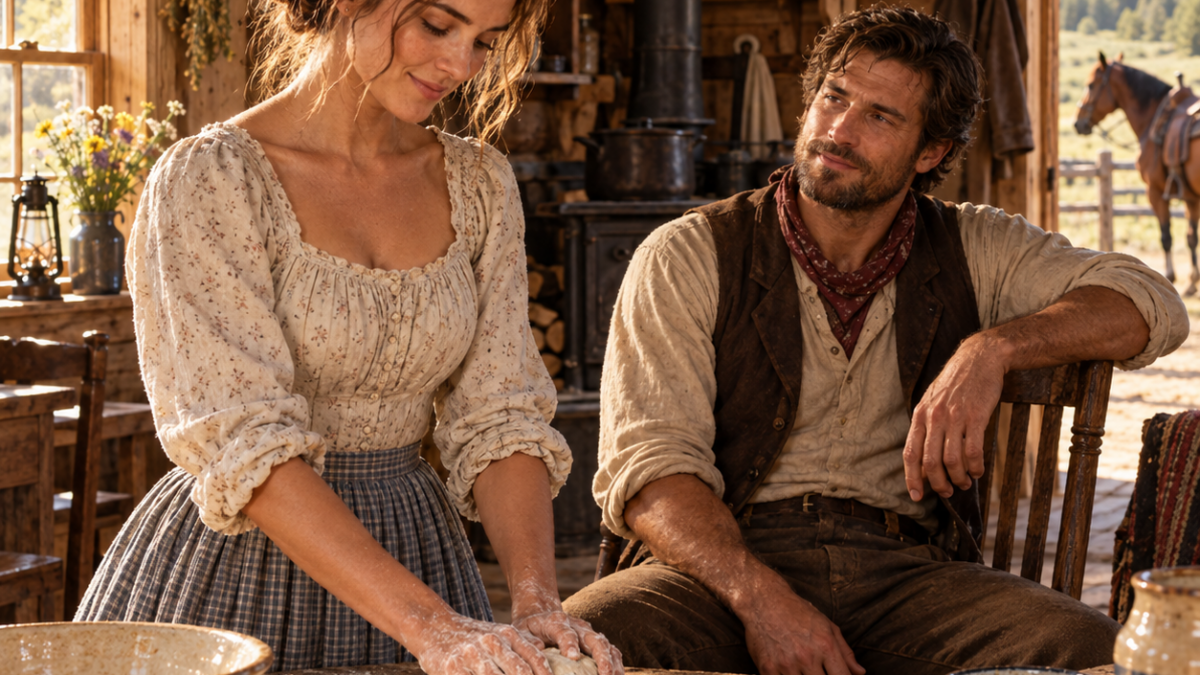
He Said He Could Get Used to Evenings Like This—Then She Told Him Not to Stop Coming
Jacob Rowan had sat in Sarah Kendall’s kitchen a hundred times before the evening he finally realized he was no longer coming for errands, news, or neighborly habit.
One simple sentence slipped out beside the stove, and Sarah’s answer made him understand she had heard the truth in it before he had found the courage to name it.
By winter, every small story he carried three miles to her door would force him to decide whether he wanted to keep visiting Sarah’s life—or finally ask to share it.
Jacob Rowan had known Sarah Kendall for years before one ordinary October evening made him see her.
Not meet her.
Not notice her in the foolish way men sometimes claimed, as if a woman came into being only when a man finally turned his head.
He had known Sarah since she was young enough to braid her hair in a long tail down her back and old enough to scold grown men for leaving gates unlatched. He had known her father, Ben Kendall, longer than that. Their farms lay three miles apart along a road that turned soft in spring, dusty by August, and hard as iron once winter decided to settle in. Jacob had traded tools with Ben, helped bring in hay once when weather turned fast, sat at Ruth Kendall’s table after church, and drunk enough coffee in their kitchen that he knew which chair by the stove held heat longest after sundown.
Sarah had simply been part of that house.
Not in any small way.
Never that.
She was not background, though Jacob would later feel ashamed for how long he had let habit make her seem like part of the familiar furniture of his days. Sarah was the one who knew whether the hens had begun hiding eggs in the old woodpile again. Sarah kept household accounts when Ruth’s eyes tired. Sarah could harness a team, argue down a merchant, turn biscuit dough with flour-dusted hands, and correct a man’s memory without making apology sound like mercy.
Jacob knew all that.
He had known it for years.
What he had not known was that most of the small pieces of his days had begun traveling toward her before he did.
It started with Henry Pritchard and a steer that had no business being that clever.
“Third time this month,” Henry said, standing across the fence line with his hat shoved back and irritation written all over his face. “Damn thing’s smarter than my dog.”
Jacob leaned on the saddle horn and laughed.
The steer in question was a red-and-white troublemaker with a broad forehead and calm eyes that made his crimes look accidental. He had learned how to shoulder against a weak place near Henry’s lower rail, ease through without breaking anything obvious, and wander precisely far enough to make Henry look foolish before allowing himself to be driven home.
Henry blamed the rail.
Then the wind.
Then his hired boy.
Sarah Kendall had blamed the steer back in spring.
“That animal has too much patience in the wrong places,” she had said when Henry first complained of him. “Watch the fence, not the field. Clever creatures don’t escape where men expect them to.”
Jacob had laughed then, because Sarah said things like that with the dry confidence of a person who expected the world to prove her right eventually.
And now it had.
As Henry cursed the steer and swore he’d mend the whole stretch before snowfall, Jacob found himself thinking, Sarah will want to know she was right.
The thought came easily.
Too easily to matter at first.
He kept riding.
He had a small matter to settle with Ben Kendall anyway: a borrowed drawknife that needed returning. Reason enough to turn up the Kendall lane in the low gold light of early October, with cottonwoods glowing along the road and cold already gathering in the shaded places.
Ruth Kendall met him at the door before he knocked.
“Take the chair by the stove,” she said. “You look half frozen.”
“I’m not half anything.”
“You will be by the time you admit it.”
Jacob took the chair without arguing because a man would have better luck disagreeing with weather than with Ruth Kendall in her own kitchen.
The drawknife changed hands.
Ben examined the edge and nodded.
“You sharpened it.”
“It was dull.”
“I lent it dull.”
“I know.”
“That your way of complaining?”
“That my way of returning it better than I borrowed it.”
Ben grinned.
Ruth poured coffee.
There was nothing left for Jacob to do.
He stayed anyway.
PART2:
That was not unusual. He had stayed before. The Kendall kitchen had a way of holding people without making it feel like capture. The stove warmed the room evenly. Ruth did not fuss over guests. Ben allowed silences to sit without shoving talk into them. There were always small sounds: fire settling, kettle ticking, hens making foolish complaints outside, footsteps from the next room.
Jacob started in on Henry Pritchard’s steer while Ben still held the drawknife up to the light.
“Henry’s red steer got out again.”
Ben snorted.
“That fence?”
“Same stretch.”
Ruth looked over.
“Third time?”
“Third.”
Jacob held back the best part until he heard Sarah’s step in the next room.
He did not decide to hold it back.
Not consciously.
He only noticed, in the pause before the punchline, that the story would land better if Sarah heard it.
She came in from seeing to the hens, hair coming loose at one temple, cheeks touched with cold, sleeves pushed up as if work had interrupted all concern for how she looked. She did not ask who had come. She saw Jacob, nodded as though he belonged in the chair he had taken, and went straight to the work table where a bowl of biscuit dough waited beneath a cloth.
Jacob told the rest then.
“How’d he get through?” Sarah asked, hands already dusted with flour.
Jacob smiled.
“Not through. Under.”
Sarah looked up.
Ben barked a laugh.
Jacob continued, “Henry mended the middle rail twice, nailed the upper rail tighter, cursed the hired boy, and that steer waited until he was gone, pushed his nose under the lower board, lifted just enough, and slid through like he’d been practicing with a church deacon watching.”
Sarah laughed.
Not politely.
For real.
Her flour-dusted hands went still above the bowl, and she threw her head back just enough for the loose strand of hair to fall farther against her cheek.
“I told you that steer had more sense than half the men who work for Henry.”
“Mhm,” Jacob said. “You did tell me that.”
“And?”
He looked at her.
“And you were right.”
“Again.”
Ben grinned into his coffee.
The room went on being exactly the room it always was.
Jacob’s attention did not.
He watched Sarah’s hands return to the dough. Watched the particular way she tucked the stray hair back with her wrist because her fingers were floured. Watched the ease of her, the ordinariness of her, the way she did not perform anything for him and somehow held his attention more completely because of it.
He had seen Sarah in church dresses.
Seen her carrying eggs.
Seen her riding with her father.
Seen her irritated at merchants, amused by children, patient with Ruth, impatient with badly tied knots, and entirely unmoved by men who mistook volume for sense.
He had known all those facts.
PART3:
That evening, they arranged themselves differently.
The silence in him lasted a beat longer than conversation required.
The line came out of that pause, not from any plan.
“I could get used to evenings like this.”
He meant the ease.
The talk.
The particular unremarkable comfort of a room he had sat in a hundred times and somehow only just begun wanting differently.
He did not mean the biscuits, though he would not have known how to explain that distinction if anyone had asked.
Sarah did not duck her eyes to the dough.
She looked at him and held the look a beat longer than an ordinary answer required.
Something in her face told him she had heard more than the sentence he had actually said.
“Then don’t stop coming,” she said.
Warm.
Small.
Not shy.
Jacob felt the floor of the evening shift half an inch beneath him.
Sarah turned back to the dough because she had said what she meant and had no further use for the silence.
Ben and Ruth carried on as though nothing had happened.
As far as the room was concerned, maybe nothing had.
Jacob did not answer with anything grand.
He could not have found the words if he had gone looking.
He left at his ordinary hour, said his ordinary good nights, and rode the three miles home turning over one look he had no neighborly explanation for.
The steer got loose again the following week.
This time, Henry caught him halfway through the gap and came close enough to admiring the animal that his anger lost some authority. Jacob helped reset the lower board. Henry promised to sell the steer before it learned arithmetic.
Jacob laughed and thought, Sarah will want the ending.
There it was again.
A small thing set aside for her without permission.
That became the shape of his days.
News collected itself for Sarah.
A horse trade gone sideways in town.
A child at church asking whether heaven had mud.
A barn cat at Jacob’s place choosing the hayloft over a perfectly good box near the stove.
A hawk working the same fence posts all week.
None of those things mattered much by themselves. But each one seemed unfinished until he imagined telling Sarah. A piece of news became something like a coin in his pocket, turned over and over until he had somewhere proper to spend it.
Sarah gave him no more than she had already given.
She kept to her garden, her accounts, errands into town when the pantry ran thin, and the thousand ordinary tasks that made the Kendall place run without anyone needing to praise her for it. If the quiet between them now carried a different weight, she did not rush to name it.
Jacob was grateful for that.
And not grateful.
A man could want a door opened wider and still be relieved no one had shoved him through it.
The frost had not come yet, but the cottonwoods along the Walla Walla Road had already turned. Under that gold light, Jacob found Sarah in town one afternoon, standing at a merchant’s counter with a list in her hand, deciding aloud whether the household needed two sacks of flour or three.
Ben was outside loading the wagon wrong side first.
Sarah kept half an eye on him while the clerk attempted unnecessary conversation about the weather, prices, and the supposed superiority of a cheaper trace fitting he had just received.
Sarah was not glamorous.
That was the thought that came to Jacob, and he liked her better for it.
She was brisk, a little impatient with the clerk’s chatter, entirely herself, entirely unhurried about becoming any easier to admire. A woman did not need softness around the edges to be worth looking at. Sometimes the edge was the point.
Jacob approached the wagon and noticed a crate sitting askew against the rail.
He shifted it without asking.
“I had that where I wanted it,” Sarah said behind him.
He turned.
She moved the crate back.
“The load balances that way.”
“Does it?”
“It does.”
She said it without heat, matter-of-fact as weather, and set the crate exactly where it had been.
Jacob was amused more than corrected.
Or perhaps he was corrected and discovered he liked it.
He waited after that, watched what she actually wanted done before he touched anything else, and found he liked the correction better than he would have liked simply being useful.
Inside, the merchant tried again with the trace fitting.
“It’ll do through winter,” the man said.
“No, it won’t,” Sarah answered.
The clerk blinked.
“The price is better.”
“Only today.”
She held the cheaper fitting in one hand and the sturdier one in the other, named in three sentences why the cheaper one would fail before spring thaw, and placed it back on the counter without insulting anyone’s intelligence more than necessary.
Jacob watched her settle the matter and thought, not for the first time that week, that he liked her better disagreeing with a man than agreeing with one.
When the wagon was finally loaded, he had an opening to keep her a while longer.
He could have asked if she needed help driving back.
He could have mentioned the horse trade story.
He could have stretched one small errand into half an hour.
He let it pass.
He asked one plain question about the road home, then let her go on her way.
Some old caution in him was not ready to claim more of her afternoon than he had been offered.
That same evening, he went to the Kendall place at his usual hour.
He told himself he was bringing Ben a note about a harness repair. The note was real. That made the excuse respectable enough to survive Ruth’s knowing look, had she chosen to give one.
She did not.
Sarah was in the yard wringing out a dish towel when he arrived, speaking quietly to Ruth.
“Ellen needs help bringing in the last of her garden before the cold sets in. I may go tomorrow. Stay through supper, maybe the night if we run late.”
Jacob was close enough to hear.
He said nothing about it.
Asked nothing.
Treated it exactly as what it was: her family, her plans, her road, no claim of his anywhere in it.
Still, when he rode home later, Sarah’s words from the kitchen rode with him.
Then don’t stop coming.
They remained true.
But she was not going to build the rest of it for him.
Sarah left the next day on an ordinary trip down an ordinary road, a basket of preserves tied behind her saddle. She sent no word to Jacob.
She had no reason to.
He arrived at the Kendall place at his usual hour, his horse falling into the easy pace it always took up that lane, expecting the usual room.
Ruth opened the door.
“Sarah’s at Ellen’s. Might stay the night if the garden work ran past dark.”
No look passed between anyone that suggested the news meant more than it said.
Ben sat by the stove sharpening a hoe, entirely unbothered.
Supper went on as it always had. Ruth and Ben were, as ever, perfectly good company. The conversation was easy and familiar in all the usual ways.
Jacob had a small piece of news he had meant to bring. Something about a horse trade gone sideways in town, a story with a decent punchline if told right.
He started to tell it.
Then let it die halfway.
Because the particular pleasure of telling it to Sarah was not there to be had from anyone else.
Ruth asked him to finish.
He said it wasn’t much of a story after all.
He did not announce what he had noticed.
He simply ate, thanked Ruth, and left earlier than his ordinary lingering habit allowed.
Nobody remarked on it.
Ben did not tease.
Ruth did not smile the smile of someone who had guessed something.
The three miles home felt longer than three miles usually did, the same road under the same moon somehow not worth the riding.
He carried the horse trade story home instead of leaving it behind.
It sat there unfinished for two days, useless to anyone but her.
On the second day, while mending a fence that had held fine all autumn, Jacob found he had one more small thing now: a hawk working the same posts all week, dropping down into the grass and rising empty-clawed, offended each time by the world’s failure to cooperate.
Nothing important.
Nothing a man needed to saddle a horse over.
Still, something in Jacob refused to wait for the old rhythm of an evening call.
He finished what needed finishing.
Not everything.
He was learning the difference.
He washed up faster than the work required and rode out earlier than he had any reason to.
Sarah was in the Kendall yard, not the kitchen, working a stiff harness buckle with both hands, sleeves pushed up despite the cold. A smear of black grease marked one wrist. Another touched her cheek where she had rubbed an itch without thinking.
She looked up.
Then looked again, clearly measuring the hour against where the sun sat.
“Did something happen?” she asked. “Did Ben send for you?”
“No.”
She waited, the buckle forgotten in her hands.
Jacob let the silence sit longer than was comfortable because he had not planned what came next and did not trust himself to dress it up properly.
“I wanted to see you,” he said at last, plain as he could make it. “That’s the whole of it.”
Sarah looked down at the buckle.
For one terrible second, he wondered if he had said too much.
Or worse, not enough.
Then she looked back at him.
Something crossed her face too quickly to name, gone before he could be sure he had seen it.
“Well,” she said, “you’re here now.”
It was not quite forgiveness.
Not quite triumph.
And if her voice caught slightly on the last word, neither of them mentioned it.
She did not drop the harness.
She asked if he wanted to walk with her to the tack shed while she finished.
He did.
He matched her pace without being asked.
That was the whole of the beginning.
Before Jacob left that evening, he asked for a particular afternoon.
Not a vague someday.
Not another borrowed errand.
The Sunday after next, after service, when families scattered toward their own roads and no one would think twice about two neighbors walking a stretch of the same one.
Sarah did not answer at once.
She looked at him a moment, then named the hour that actually suited her.
Not the earliest.
Not whatever he preferred.
An hour that belonged to her real day.
Jacob liked that too.
The Sunday walk carried none of the strain of two strangers working out who the other person was.
They already knew each other’s family names, each other’s habits, years of ordinary history lying between them like a road they had both traveled separately. There were no grand discoveries. No false brightness. No desperate effort to become more charming than nature allowed.
Instead, they disagreed lightly about whether the coming winter would be hard or merely long.
Sarah insisted the geese knew better than any almanac.
Jacob teased her for trusting a bird’s opinion over his own eyes.
“Your eyes have been wrong before,” she said.
“Name once.”
“The crate in the wagon.”
“That was balance, not prophecy.”
“It was both. You were equally wrong in two directions.”
He laughed.
She did not try to make him laugh.
That was why she so often succeeded.
A silence between them, walking past the last of the season’s turned fields with breath showing faintly in the cold air, felt comfortable rather than empty.
Once, without quite meaning to, Sarah reached out and straightened his collar where the wind had turned it up.
Her hand lingered half a second too long.
Then she seemed almost surprised by her own fingers and drew back.
Neither said anything about that either.
Jacob went home that day with less news than he had brought and more life than he had carried in a long while.
The poultry yard gate caused their first real correction.
It had begun catching on its post, the latch dragging a groove into the dirt each time it swung. Sarah was occupied elsewhere, checking on a broody hen with the kind of patience she gave animals more readily than men.
The fix seemed plain enough to Jacob.
He rehung the gate.
Set it clean.
Tested the swing.
Pleased with the improvement, he thought no more about it.
He had not accounted for the way it now swung closer to the feed shed, cutting straight across the path Sarah walked every morning with scraps, giving the hens a clean run at the yard before she could close it behind her.
Undoing in one gesture the very order she kept without thinking.
Sarah discovered this at first light, chasing two hens halfway to the fence line before she got the gate shut, feed scattered across the yard behind her.
She found Jacob later and did not soften the complaint.
“You could have asked me before you changed it.”
He looked up from checking a cinch near Ben’s barn.
“What?”
“The poultry gate. I use that gate every morning. You don’t.”
“I was only trying to help.”
“I know you were.”
She said it plainly.
Not unkindly.
But she did not let him off the fact either.
“That’s not the same thing as helping.”
Jacob opened his mouth.
Closed it.
His intentions stood ready, polished and eager, waiting to be defended.
He did not defend them.
Sarah watched him.
He asked instead, “Which way do you need it to swing?”
She told him.
He fixed it accordingly without another word of defense.
Sarah let the matter close once the gate did.
That was new for both of them.
Three days later, on an errand that had nothing to do with gates, Jacob found Sarah wrestling a wagon wheel into place alone, hands slipping on the greased axle, the black smear on her cheek returning like an old argument.
He did not step in and take over.
He stopped two paces away.
“Want another pair of hands?”
Sarah looked at the wheel.
Then at him.
“Yes.”
They set it together, Sarah directing where to brace, Jacob following without needing to be told twice.
Nothing more needed saying about gates or asking.
It had simply become the way things were done between them now.
Frost came to stay.
The valley changed under it.
Morning grass silvered. Water buckets skinned with ice. Smoke from chimneys rose straight when the air was still and tore sideways when winter wind came fast across the fields. The days shortened quickly once December got a real hold, and evenings arrived with the flat blue-gray light that made warm windows look like promises.
Sarah stood on the Walla Walla boardwalk one afternoon and watched Henry Pritchard’s mule back squarely into a stack of empty apple crates.
The crates scattered across the walk one by one.
Henry blamed the wind.
Then the crates.
Then a passing dog.
In that order.
He refused to blame the mule at all, though the animal stood there with an expression of such calm guilt that a jury would have convicted it in under a minute.
A passerby stopped just to watch the spectacle complete itself.
Henry’s hat nearly came off in the commotion.
Sarah laughed outright, hand pressed briefly to her mouth.
Then she looked around for Jacob before the laugh had even finished.
Because he was the one she wanted to tell.
She found him near the hitching rail down the street, deep in conversation with another stockman. She crossed to him without waiting for a formal pause in the talk, already speaking before she had fully arrived.
“You need to hear what Henry Pritchard just blamed on a dog.”
Jacob turned at once.
Not with politeness.
With readiness.
Sarah told him the whole absurd shape of it.
Henry’s face.
The mule’s indifference.
The crates rolling into the gutter one by one.
Jacob laughed harder at her telling of it than he would have laughed at seeing it himself, drawing a curious glance from the man he had been speaking with.
No gift passed between them.
No favor.
Only the plain fact that she had come looking for him first, the same way he had once waited to tell her about a steer and a gate latch.
That fact warmed him for the rest of the day.
Before they parted, he asked about another day.
She did not say whenever suited him.
She checked what she actually had ahead of her and named a time that worked for both.
This, too, became part of them.
Jacob asked for time now instead of appearing out of old habit. Twice, Sarah sought him out first. Once at the mill. Once on the road itself, riding half a mile out of her own way to catch him before he turned toward home.
They disagreed over small things.
A dry spell of temper one evening over nothing at all—whether a storm cloud meant snow by morning or only cold rain—ended with both of them laughing at how little the argument had actually been about and continuing the walk instead of letting it sit between them.
The old familiar household life continued exactly as it always had, except that now the courtship inside it had a name, spoken or not.
Ben knew.
Ruth knew.
Ellen probably knew before Jacob did and had been waiting only because she enjoyed watching men arrive late to their own hearts.
Nobody made a speech.
Nobody teased too much.
That restraint was kindness.
Jacob valued it.
He had never been a young man careless with feeling. By thirty-four, he had learned how many kinds of loneliness could be made respectable if a man kept busy enough. His own place was sound. His animals were cared for. His accounts were fair. His neighbors trusted him. He had coffee, a bed, tools where he left them, and evenings that asked nothing of him except that he endure them.
Before Sarah, he had considered that enough.
Now, sitting alone one evening mending tack at his own place, something small happened.
Nothing worth remembering on its own.
A barn cat that had taken to sleeping in the hayloft refused fresh milk with the offended dignity of a banker and stole bacon from Jacob’s plate five minutes later.
Jacob laughed aloud.
Then he started toward the familiar motions before he had finished thinking.
Set down the tools.
Saddle the horse.
Carry the story three miles to where Sarah would hear it properly.
He stopped with his hand on the saddle strap.
The barn went quiet around him.
He counted without meaning to how many evenings had now gone this way. How many small, worthless things he had carried across the same road because keeping them to himself had started to feel like keeping half his life in a drawer nobody opened.
He was tired of it.
Not tired of the road.
Not tired of Sarah.
Tired of dividing his life into what happened and who made it matter.
He did not have a word yet for what to do with that.
But it rode with him the whole way over anyway.
He came to the Kendall farm on a quiet late afternoon in the second week of December. Ruth and Ben were elsewhere on the property, near enough for propriety, far enough to leave the front room to the two of them. Jacob suspected Ruth had arranged that distance with the same calm skill she used on bread dough and family tension.
The fire had burned down to embers.
Neither Jacob nor Sarah moved to build it back up.
Outside, the light was already going, the blue-gray of early winter dusk pressing gently against the windows.
Jacob started as he often did, with the ordinary thing he had meant to tell her.
“The barn cat stole bacon after refusing milk like a judge refusing a bribe.”
Sarah smiled.
“Did you deserve it?”
“Probably.”
“That cat has excellent judgment.”
“It was my bacon.”
“Still.”
He laughed, but the story faded almost as soon as he spoke it because it was not really why he had come.
They both seemed to know it.
Sarah waited, hands folded in her lap, not filling the silence for him the way she never had.
Jacob set his hat on the table between them, turning it once before he let it go.
“I’ve been thinking,” he said.
“That sounds dangerous.”
“It may be.”
She did not smile this time.
He looked at his hat because looking at her made the truth too large.
“I’ve been thinking about how many times now I’ve ridden over here just to tell you something that happened without you. And how it never once felt like enough.”
Sarah was very still.
“Saving things up,” he said, “carrying them three miles, telling you pieces of a day after it’s already gone, then riding home again as though that ought to satisfy me.”
He stopped.
Started again, plainer.
“I don’t want to keep splitting my life in two, Sarah. What happens here and what happens over there. My day and your day. My fire and your fire. My stories and your listening. I’d rather it was just one life.”
His hand stilled on the hat.
“Marry me.”
He had not planned the words that way.
They came out rougher than he would have liked.
No mention of land.
No poetic promise.
No polished explanation of affection built through years of acquaintance and two months of seeing differently.
Just the truth.
Sitting there with his hat under his hand and the fire low.
Sarah did not answer right away.
The silence stretched so long he had time to feel every mistake he might have made.
Too sudden.
Too plain.
Too late.
Not enough tenderness.
Too much assumption.
Then she drew one breath.
Her voice, when she spoke, was not quite steady, though she plainly meant it to be.
“I’ve been waiting for you to say something like that since October, and I wasn’t going to pretend otherwise.”
Something in her face gave way, something she usually kept guarded.
“Yes,” she said. “And I don’t want you riding three miles just to tell me things anymore.”
Jacob looked at her.
The room did not transform.
No music rose.
No winter sun broke through the clouds.
The fire still needed tending.
His hat was still old.
Sarah’s hands were still practical hands, folded in her lap.
But the space between them changed completely.
He reached across it.
She met him halfway.
They agreed, without much ceremony, on a small wedding before winter fully closed in. Not rushed, exactly. They had known each other too long for rushing. But once the decision stood plain, neither saw virtue in delaying until weather made every road an argument.
They married in the last week of December in a modest church ceremony in Walla Walla.
Ruth and Ben were there.
Ellen was there, looking unbearably satisfied and pretending to adjust her gloves whenever anyone looked her way.
Henry Pritchard attended and claimed his steer would have come if invited, which Sarah said was unlikely because the steer preferred unchaperoned appearances.
A handful of neighbors filled the pews.
Not many.
Only those who had earned their place.
Sarah wore her own best dress, dark blue wool, no borrowed finery, no veil that tried to make her look younger or softer than she was. Jacob stood beside her with his hair brushed stubbornly into order and his expression so serious that Ben leaned over to Ruth and whispered, “Man looks like he’s facing a judge.”
Ruth whispered back, “He is.”
The minister kept the words short.
That suited everyone.
Sarah stood through the whole of it with steady composure that faltered only at the very end, when Jacob’s hand found hers and she let out a breath she seemed to have been holding since October.
Nobody gave a speech about how right it all was.
It simply was.
Afterward, at the Rowan place, on an evening not so different from any other, Jacob came in from ordinary stock work with a small story already forming on his tongue.
Nothing worth much.
A fence post gone soft at the base.
A stubborn calf refusing the bottle until the barn cat tried to inspect the milk and offended it into eating.
He did not have to decide whether to save it for a three-mile ride.
Sarah was already looking up from her own work at the table.
Already asking, “What happened?” before he had gotten past the doorway.
Her hands were still busy with whatever task she had been doing.
He told her.
She listened the way she always had, asking the one question that mattered before he had even finished.
And the distance between what happened to him and what happened to her—the old space between my day and your day—simply was not there anymore.
Had not been for weeks, though neither had bothered to remark exactly when it went.
Marriage, of course, did not make every evening perfect.
Perfect evenings belonged mostly to stories told by people who stopped before dishes, weather, fatigue, and real tempers entered the room.
Jacob and Sarah had ordinary ones.
Some were warm.
Some were strained.
Some ended with laughter.
Some ended with one of them saying less than they meant because the day had been long and kindness did not always arrive on time.
The first month, Jacob tried too hard not to interfere and became useless in irritating ways.
Sarah stood in the kitchen one morning with a full water bucket in each hand while he stepped aside as though giving her sovereignty over exhaustion.
She stared at him.
“Jacob.”
“What?”
“You may carry a bucket without conquering my independence.”
He took both buckets.
“I was trying not to assume.”
“That is admirable. It is also wet.”
He learned.
Sarah learned too.
At first, she kept parts of her day folded away out of habit. Not because she meant to hide them. Because for years she had belonged to a house where her thoughts, though valued, often served the needs of parents, chores, weather, and timing. She knew how to be necessary. She was less practiced at being simply known.
One evening, Jacob noticed she had gone quiet over supper.
He tried to wait.
Waiting had served him well in courtship.
After ten minutes, Sarah set down her fork.
“You may ask.”
“I was waiting for you to say.”
“I know. It has become irritating.”
He blinked.
“What happened?”
She told him then about a letter from Ellen, about worry over Ruth’s cough, about wondering whether she should ride over the next day and whether going too often would make Ruth feel watched.
Jacob listened.
Not solving.
Not at first.
Then he asked, “Do you want advice or a horse saddled early?”
Sarah looked at him for a long moment.
Then smiled.
“Horse saddled early.”
He nodded.
“That I can do.”
They learned the shape of one life slowly.
Jacob discovered Sarah hummed when she was thinking through a problem but stopped humming if someone listened too obviously.
Sarah discovered Jacob talked more to animals than he admitted and that most of his sternness vanished if a calf looked particularly stupid.
He learned she disliked being called patient because most of what people called patience in women was often endurance with a nicer dress on it.
She learned he carried loneliness poorly, not with complaint, but by making every tool hang straight and every chore last long enough to fill the evening.
He learned to ask before fixing things she used.
She learned to let him help before work became proof she needed no one.
Sometimes they failed.
The poultry gate became family legend because Jacob never again touched a hinge on Sarah’s route without asking, and Sarah never again saw a crooked gate without saying, “Do you feel moved by helpfulness?”
Jacob would answer, “I am suppressing it.”
That usually earned him a kiss.
Spring came.
Then summer.
The road between the Rowan and Kendall places remained, but it no longer divided their days the way it had. Jacob still rode it often to visit Ben, help with hay, or bring Ruth whatever Sarah had made too much of. Sarah rode it too, sometimes alone, sometimes with Jacob, sometimes simply because she wanted to arrive at her parents’ house as a daughter and not as someone who had disappeared into marriage.
Jacob understood that.
Or he tried to.
The first time she said she wanted to stay overnight at the Kendall place because Ruth was tired and Ben had strained his shoulder, Jacob felt the old emptiness rise in him sharper than expected.
It was unreasonable.
He knew that.
She had stayed there all her life before him.
One night did not undo marriage.
Still, when evening came and the house held only his own footsteps, he stood by the stove with a small story about the barn cat and no one to tell.
For a moment, he nearly saddled up and rode over.
Then he stopped.
Sarah did not need him arriving because he could not manage one evening alone.
So he wrote the story down instead, badly.
The barn cat has taken insult because I moved the feed scoop. It may never forgive me.
When Sarah came home the next afternoon and found the note on the table, she laughed until she had to sit down.
“You wrote me a report on the cat.”
“I had to tell someone.”
“You chose paper?”
“I am growing.”
She held the note against her chest, teasing gone soft.
“Keep doing that when I’m away.”
He did.
Years passed, and their life filled with the kind of ordinary evenings Jacob had once said he could get used to.
The first child came in a rainstorm, a daughter with Sarah’s steady eyes and Jacob’s offended expression. They named her Ruth Ellen, and Ben declared she had the grip of a future tyrant. Two years later came Thomas, who loved mud so completely that Sarah once said he must have been built from creek banks and appetite. A third child, Mary, came quieter than the first two, watchful from the start, the kind of baby who seemed to study faces before trusting them.
Children changed the evenings.
Of course they did.
There were fewer quiet conversations beside low fires and more interruptions involving spills, fevers, broken toys, missing socks, and urgent questions about whether chickens had opinions.
But even then, Jacob and Sarah kept looking for each other first.
A small thing happened.
A child said something strange.
A cow behaved foolishly.
A neighbor made a claim too absurd to hold alone.
One of them would turn, searching for the other before laughter even finished forming.
That was the marriage.
Not grand declarations repeated daily.
Not perfect harmony.
Recognition.
The ongoing miracle of having one person in the room who made the day feel complete enough to put down.
Sometimes, in hard seasons, they forgot.
Not fully.
But enough to frighten them.
The winter Thomas turned six was cruel. Snow came heavy. Feed ran low. Jacob began working past dark again, the old habit returning through necessity’s door. Sarah understood at first. Then watched worry turn into distance.
One evening, he came in late, exhausted and cold, and began telling her what needed doing next.
Not what had happened.
What needed doing.
Hay.
Fence.
A sick calf.
A neighbor’s shortage.
The words stacked between them like boards.
Sarah listened.
Then said quietly, “Jacob.”
He stopped.
She stood at the table, sleeves rolled, flour on one wrist, older now but still herself in the lamplight.
“I know what the ranch needs,” she said. “Tell me what you saw today.”
He stared at her.
Outside, wind struck the house.
Inside, the question opened the room.
What had he seen?
Not what required repair.
Not what threatened them.
Not what tomorrow demanded.
He sat slowly.
“There was a fox near the creek,” he said after a long moment. “Bold thing. Sat right in the snow and looked at me like I was on his land.”
Sarah smiled.
“Was he right?”
“Probably.”
“Then what?”
Jacob breathed out.
The evening returned by inches.
Years on, when the children had grown tall and then gone into lives of their own, the house quieted again.
Not as it had been before Sarah.
Never that.
This quiet carried memory in every board.
Ruth Ellen married a schoolteacher and moved east of town. Thomas took work with horses and came home only when he needed food, advice, or money he pretended was neither. Mary remained longest, then left fastest once she decided, taking a position in a household where she was valued more for her mind than her ability to sit prettily. Sarah had raised her too well to be surprised and not well enough to avoid tears after the wagon left.
Jacob found her in the kitchen that evening, standing with one hand on the back of a chair.
He did not ask if she was all right.
They were old enough now to know when a question deserved better words.
He said, “I saw a hawk on the west post this morning.”
Sarah turned.
“The same kind as that year?”
“Maybe.”
“Did it catch anything?”
“No.”
“Offended?”
“Deeply.”
Her mouth trembled, then softened into a smile.
“Tell me.”
He did.
The years kept moving.
The ranch changed hands of work more than once. The furniture grayed. The porch settled despite Jacob’s repeated accusations against it. Ben and Ruth passed within two winters of each other, leaving the Kendall place to relatives who kept the kitchen warm and the road familiar. Henry Pritchard’s infamous steer became a story told so often the animal grew cleverer with every retelling until, by the end, children believed it could open latches and possibly read.
Jacob’s hair went white at the temples first.
Sarah said it made him look thoughtful.
He said he had always been thoughtful.
She said appearance and fact were different matters.
Her own hair silvered in a thick streak near the front, and Jacob loved it with an intensity that embarrassed him, though not enough to keep from touching it when she sat beside him in the evenings.
They never got one perfect evening.
That was what Sarah said once when Mary asked whether marriage became peaceful after enough years.
“No,” Sarah told her. “Perfect evenings are too fragile. We got ordinary ones. Those hold better.”
Jacob, listening from the porch, smiled to himself.
He knew exactly what she meant.
An ordinary evening was weathered enough to survive real life.
It allowed for burnt biscuits, tired tempers, aching joints, bad news, laughter, silence, a story interrupted twice before it reached the point, and still someone waiting to hear the rest.
One October evening, many years after the first, Jacob came in from the barn slower than he once would have. His knee troubled him in cold weather now, though he complained only when Sarah was close enough to hear and accuse him of wanting sympathy.
She sat near the stove with mending in her lap.
The light outside had the same low gold quality as the evening he returned Ben’s drawknife. The same kind of cold in the corners. The same smell of woodsmoke and dough.
Jacob stopped just inside the door.
Sarah looked up.
“What?”
“I was remembering.”
“That is a dangerous occupation at your age.”
“I could get used to evenings like this,” he said.
The old words entered the room gently.
Sarah’s hands stilled over the mending.
For a moment, they were young enough again to feel the floor of the evening shift beneath them.
Then she smiled.
“You did.”
He crossed to the chair by the stove—the one he had taken in her parents’ kitchen long ago because Ruth told him to—and sat carefully.
“I suppose I did.”
Sarah set the mending aside.
“And you didn’t stop coming.”
“No.”
“Though I made it easier by marrying you.”
“That was helpful.”
“I have always been practical.”
He laughed.
The sound was softer now, but still his.
Outside, the last of the sun left the fields. Somewhere in the barn, a cat descended from some ancient line of thieves knocked something over and pretended innocence. Jacob heard it and lifted one finger.
“Story.”
Sarah leaned back, waiting.
He looked toward the door, then back at her.
For most of his life, small things had not felt complete until Sarah heard them.
That had not changed.
Only the distance had.
No three-mile ride.
No saved-up tale carried beneath moonlight.
No old space between what happened to him and what happened to her.
Just the turn of his head.
Her eyes already on him.
The evening ready.
Jacob smiled.
“You’ll never believe what that cat has done now.”
Sarah’s mouth curved.
“Tell me anyway.”
So he did.
And outside, the road between the Rowan place and the Kendall farm lay quiet under the deepening October sky, no longer a distance to be crossed for love, but the old path that had taught him where home had been waiting all along.








