He Had Never Known Love—Then the Paralyzed Ocelot Kitten Purred Beneath His First Warm Blanket
He Had Never Known Love—Then the Paralyzed Ocelot Kitten Purred Beneath His First Warm Blanket
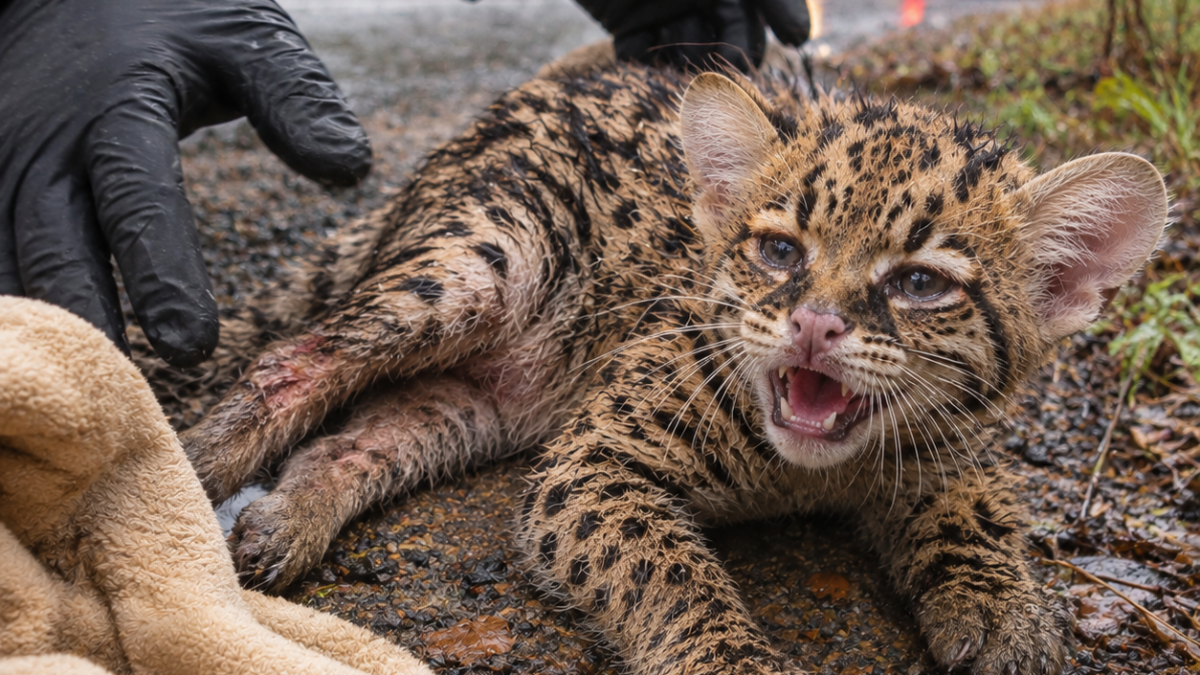
Olaf was found beside the road unable to move his back legs, his tiny body dangerously cold and too weak to understand why strangers were reaching for him.
The young ocelot had suffered a severe spinal injury, and the people trying to save him could not promise that he would ever walk normally again.
But one night, beneath a warm blanket, the terrified kitten made a sound nobody in the clinic had heard from him before.
The rescue call came with almost no information.
Small wild cat.
Roadside.
Alive.
Not moving properly.
Possibly hit by a vehicle.
The person who spotted him had stopped only because something near the edge of the road looked wrong.
At first, the little body could easily have been mistaken for leaves or debris lying against the dusty shoulder.
Then the head moved.
Barely.
That was enough.
Someone called for help.
By the time rescuers arrived, the kitten was still conscious, but every movement looked exhausting.
He was tiny.
Much smaller than the adult animal he would someday have become.
His coat carried the beautiful spotted markings that immediately identified him as something other than an ordinary house kitten.
Dark rosettes crossed his golden-brown fur.
White surrounded his mouth and eyes.
His ears were rounded.
His face still had the oversized, unfinished look of youth.
He was a little ocelot.
A wildcat kitten.
Built by nature to move quietly through brush, climb, stalk, leap and explore.
But when rescuers found him, half of that body would not move at all.
His front paws tried.
That was the first thing they noticed.
He pulled.
Stopped.
Pulled again.
The hind legs remained behind him.
Limp.
Unresponsive to his attempts.
There was no time to stand beside the road debating what might have happened.
The kitten needed veterinary care.
Now.
A rescuer wrapped him carefully before lifting him.
Even that simple action triggered fear.
His ears flattened.
His mouth opened.
A warning sound came out.
Not powerful.
Not convincing.
But very clear.
Stay away.
The rescuer paused.
“Okay, little one.”
The kitten stared.
His pupils were wide.
His breathing quick.
PART2:
He did not understand that the hands touching him were trying to help.
Why would he?
Humans always know the story before the animal does.
We know the blanket is meant to provide warmth.
We know the box or carrier is supposed to keep the injured animal from hurting himself.
We know the strange car is taking him toward doctors.
The animal knows only this:
I am hurt.
I cannot run.
Something larger than me is touching me.
That difference mattered throughout Olaf’s recovery.
The rescue team could not ask him to understand kindness.
They would have to prove it.
One careful moment at a time.
The kitten was placed into a carrier lined with towels.
He tried using his front legs to push himself backward.
There was nowhere to go.
He hissed.
His body stiffened.
Then the effort drained what little energy he had left.
He lowered his head.
The rescuer closed the carrier door.
“Stay with me.”
The vehicle pulled away.
The clinic was notified before they arrived.
Possible spinal injury.
Juvenile wild feline.
Hypothermic.
Weak breathing.
Rear-limb paralysis.
The veterinary staff prepared before the door opened.
When the carrier came inside, everyone moved quickly but deliberately.
Too much noise could increase panic.
Too much restraint could worsen a spinal injury.
The first priority was basic survival.
Temperature.
Breathing.
Circulation.
Pain.
The thermometer confirmed one of their biggest concerns.
Olaf was dangerously cold.
A young animal that cannot move normally loses heat quickly.
Shock makes it worse.
Exposure makes it worse.
Pain makes everything worse.
He needed controlled warming.
Not too fast.
Not careless.
Warm blankets were prepared.
Heating support.
Monitoring.
Fluids.
The little ocelot remained defensive.
Every time someone came near his face, he hissed.
When a hand moved toward his side, he tried to twist away using only the front half of his body.
One veterinarian whispered:
“He’s scared.”
Another answered:
“Good.”
The first looked at her.
“Good?”
“He still has enough energy to tell us he’s scared.”
That mattered.
A completely unresponsive animal would have frightened them more.
Olaf still had opinions.
Still had reactions.
Still had fight.
They stabilized him enough to begin imaging.
X-rays confirmed what the team had feared.
There was significant trauma near the lower spine.
The injury explained the motionless hind legs.
The exact location made immediate surgery unsuitable.
That was difficult news because surgery is often what people imagine when they hear the word spinal injury.
Fix the damage.
Repair the body.
Problem solved.
Olaf’s situation was not that simple.
The affected area was delicate.
The risk of surgical intervention was high.
The team believed conservative treatment and rehabilitation offered the best immediate path.
No one could promise the outcome.
Would he regain function?
Maybe.
Would he always remain partially paralyzed?
Possible.
Could complications appear?
Absolutely.
Could he survive?
They were going to try.
Neurological testing brought the first small piece of hope.
His rear legs did not move normally.
But some neurological responses were present.
Tiny responses.
Not enough to make predictions.
Enough to make everyone pay attention.
His body had not gone completely silent below the injury.
There was still communication somewhere.
A spark.
That became the word people around him used.
Not miracle.
Not certainty.
Spark.
The nervous system can be frustratingly slow.
Healing, when it happens, does not follow the timeline humans want.
A person can stare at a paw for ten minutes hoping to see movement and see nothing.
Then days later a toe twitches.
Was it reflex?
Intentional?
Progress?
You test again.
Wait again.
Olaf’s treatment plan grew around patience.
Pain medication.
Anti-inflammatory support.
Nutrition.
Careful rehabilitation.
Laser therapy.
Magnetotherapy as part of the supportive plan being used by his team.
Acupuncture sessions.
Physical therapy.
Gentle manipulation of joints that Olaf could not move himself.
Massage.
Position changes.
Skin checks.
Bladder assistance.
Bowel assistance.
Cleaning.
More cleaning.
And then cleaning again.
Paralysis creates problems far beyond the obvious inability to walk.
A kitten who cannot use the lower body normally may not empty the bladder without help.
Urine remaining too long can create infection risk.
Moisture against the skin can cause irritation.
Pressure develops when an animal remains in one position.
Muscles weaken.
Joints stiffen.
Circulation suffers.
The animal must be moved even when the animal does not want to be moved.
For Olaf, every part of that care involved another complication.
He was wild.
Not wild in the romantic sense people sometimes imagine when they see an ocelot in a photograph.
Not some miniature jungle prince calmly accepting admiration.
Wild meant his instincts told him restraint was dangerous.
Human hands were dangerous.
Being unable to escape was terrifying.
When a veterinary technician approached with medication, Olaf hissed.
When someone needed to clean him, he growled.
When hands supported his hips during therapy, he stiffened so hard that his front claws gripped the towel.
Nobody blamed him.
One technician, Sofia, began talking to him during every procedure.
Not baby talk.
Just conversation.
“I know.”
Hiss.
“I know you hate me.”
Growl.
“I’d hate me too right now.”
Olaf watched her.
“But we’re doing this anyway.”
She worked slowly.
“If you want to complain, complain.”
Olaf complained.
A lot.
The first several days followed a rhythm that had little romance in it.
Medication.
Nutrition.
Temperature check.
Cleaning.
Bladder care.
Rest.
Physical therapy.
Rest.
Food.
Cleaning again.
The glamorous image of wildlife rescue disappeared quickly when you were washing bedding at two in the morning because a paralyzed kitten could not control his body.
And yet, those ordinary tasks were what kept him alive.
The team paid attention to calories.
Olaf was thin.
His body needed energy not only for growth but for repair.
Protein.
Hydration.
Appropriate nutrients.
At first, appetite was inconsistent.
Pain can suppress hunger.
Fear can too.
So could unfamiliar surroundings.
Staff gave him privacy when possible.
Food was placed close enough that he did not have to drag himself far.
Sometimes he ate only after everyone left.
Sofia discovered this by accident.
She placed food inside the enclosure.
Olaf stared at her.
She waited.
Nothing.
“You’re not going to eat while I’m here, are you?”
Olaf continued staring.
“Fine.”
She left.
Ten minutes later the bowl was almost empty.
Sofia laughed when she returned.
“So that’s how this relationship works.”
Olaf flattened his ears.
“Understood.”
They began using predictability.
Same feeding location.
Same type of bedding arrangement.
Same voices.
Slow movements.
Whenever possible, the same small group handled him.
Wild animals do not need to become human-dependent emotionally to benefit from reduced stress.
But Olaf’s long rehabilitation meant human contact could not be avoided.
If every encounter remained terrifying, treatment itself would become another source of constant suffering.
So the caregivers worked on tolerance without demanding affection.
They did not reach toward him merely because he looked cute.
They did not pass him from person to person.
They did not make him perform for visitors.
He was a patient.
A frightened one.
His boundaries mattered.
The first warm blanket became part of that routine.
Olaf’s temperature had stabilized, but he still seemed to relax more when wrapped loosely in warmth after treatment.
Not trapped.
Never tightly swaddled.
Just soft fabric around the parts of his body that struggled to regulate comfort after long therapy sessions.
The blanket was pale blue.
Nothing special.
It came from a pile of donated veterinary linens.
One corner had been repaired where stitching had come loose.
Sofia placed it beneath Olaf after physical therapy one evening.
His hind legs had been gently flexed and extended.
His hips supported.
Muscles massaged.
Olaf had hissed through half of it.
By the end, he looked exhausted.
Sofia lowered him onto the blanket.
Then sat beside the enclosure.
“Bad day?”
Olaf’s ears flicked.
“I know.”
She adjusted one fold of the blanket near his side.
Olaf tensed.
Sofia stopped.
“Your decision.”
She moved her hand away.
For several minutes, she simply sat.
The clinic had become quieter.
Phones no longer rang constantly.
Someone cleaned instruments in the next room.
Rain tapped lightly against a window.
Olaf’s breathing slowed.
His head lowered onto the blanket.
Sofia looked down at her notes.
Then heard something.
Very faint.
She stopped writing.
There it was again.
A vibration.
She looked at Olaf.
The kitten’s eyes were partly closed.
His chin rested against the fabric.
The sound continued.
A purr.
Sofia remained completely still.
Another technician passed the doorway.
Sofia lifted a finger.
Do not speak.
The technician leaned in.
Olaf purred again.
It was not loud.
It did not mean he suddenly trusted every human.
Cats can purr for several reasons, including stress and self-soothing, and no responsible caregiver would turn one sound into a fairy tale.
But something about that moment felt different from the defensive noises they had heard since he arrived.
His body was not rigid.
His ears were not pinned.
He was not pulling away.
He looked warm.
Tired.
Comfortable enough, for that minute, to let his guard drop.
Sofia whispered:
“There you are.”
Olaf opened one eye.
The purring stopped.
Sofia smiled.
“Okay. I ruined it.”
The next morning, everyone knew.
Not because Sofia had announced some miracle.
Because clinics become families around difficult patients.
“How’s Olaf?”
“Purred last night.”
“No way.”
“Three times.”
“While you touched him?”
“Mostly while I left him alone.”
“That sounds like Olaf.”
The emotional change remained slow.
One purr did not transform him.
The next afternoon he hissed at Sofia again.
She laughed.
“Back to normal.”
But the defensive reactions began becoming less automatic.
At first, every approaching hand triggered tension.
Then some did not.
A hand resting outside the enclosure became acceptable.
Then inside.
Then near his shoulder.
Touch still required caution.
Olaf preferred knowing where the hand was.
Sudden contact from behind frightened him.
Sofia began letting him smell her fingers before therapy.
He would sniff.
Sometimes hiss anyway.
But he stopped trying to bite.
Days became weeks.
His weight increased.
The coat changed first.
When Olaf arrived, his fur had looked dull, flattened by stress and poor condition.
With nutrition and grooming, the natural patterns became more vivid.
Golden brown.
Black rosettes.
White markings.
His face looked fuller.
The kitten beneath the injury was emerging.
And physically, small signs began appearing too.
A twitch in one rear paw during therapy.
Then a stronger response.
One veterinarian tested again.
“Do that.”
Olaf did not.
Everyone waited.
Nothing.
The following day the movement returned.
Neurological rehabilitation can be cruel to hopeful people because progress rarely performs on command.
A toe moves Monday.
Nothing Tuesday.
Muscle contracts Wednesday.
No visible response Thursday.
Then Friday something stronger appears.
The team documented everything.
They did not celebrate too loudly.
But they celebrated.
Olaf learned to move efficiently using his front legs.
At first, he dragged the lower half of his body awkwardly.
A protective surface prevented skin abrasions.
The staff rearranged his area so food, water and resting spaces remained accessible.
Then Olaf began figuring out leverage.
Front paws forward.
Pull.
Pause.
Again.
He could cross the enclosure.
One morning Sofia placed a small soft toy several feet away.
Not as therapy.
Just curiosity.
Olaf watched it.
A stuffed fabric animal with a tail.
Sofia nudged it.
Olaf’s pupils changed.
Wildcat focus.
For the first time, his expression was not dominated by fear or pain.
It was hunting interest.
He pulled himself forward.
The toy moved again.
Olaf lunged with his front body and grabbed it.
Sofia laughed.
“There you are.”
Olaf bit the toy fiercely.
Then looked at her as though she had insulted him.
The team began incorporating play carefully.
A feather moving along the floor.
A small ball.
Fabric strips.
Nothing that forced movement beyond his safe capacity.
Play did something therapy alone could not.
It gave Olaf a reason to move.
Animals rarely care about rehabilitation goals.
No kitten thinks:
I should perform three sets of assisted hip flexion because it may support future mobility.
But a moving toy?
That mattered.
His front-body strength increased quickly.
The shoulders became more muscular.
He learned how to pivot.
How to reposition himself.
How to climb partly onto a cushion.
He was still paralyzed enough to require extensive assistance.
But helpless was no longer the right word.
Olaf was adapting.
The team continued acupuncture.
The first session had been difficult.
He did not like restraint.
But the clinician who performed the treatment, Dr. Elena Márquez, became one of the people Olaf gradually tolerated best.
Elena did not rush.
She spent several minutes simply being near him before each session.
No immediate grabbing.
No sudden movement.
She spoke quietly.
Sometimes Olaf hissed.
Sometimes he did not.
Eventually, he began watching her without panic.
Elena became interested in more than his neurological responses.
She noticed his personality.
Olaf was opinionated.
If food arrived late, he stared.
If bedding was changed, he investigated every corner before settling.
He liked one particular cushion and rejected another nearly identical one.
He preferred scratches along the side of his head but disliked hands moving over the lower spine.
He liked warm blankets.
He loved feather toys.
And he developed a strange fascination with Elena’s shoelaces.
During one session, while she prepared supplies, Olaf dragged himself closer and grabbed one lace.
Elena looked down.
“That is expensive medical equipment.”
Olaf pulled.
“Release it.”
He pulled harder.
Sofia laughed from across the room.
“He’s rehabilitating.”
“My shoe?”
“Motivation is motivation.”
Olaf eventually released the lace.
Only because another toy appeared.
There were setbacks too.
Recovery stories become dishonest when every day is framed as improvement.
Some days Olaf ate less.
Some days pain seemed worse after therapy and the plan had to be adjusted.
One week his urine showed signs of infection.
That frightened everyone.
Animals with bladder dysfunction can develop urinary infections because normal emptying is disrupted.
Treatment started quickly.
For several days, Olaf became irritable again.
He hissed more.
Stopped playing.
Slept.
Sofia worried.
“Feels like we went backward.”
Elena corrected her gently.
“We didn’t go backward.”
“He was doing so well.”
“He has an infection. He feels terrible.”
“So?”
“So recovery isn’t a staircase.”
Sofia looked at Olaf.
Elena continued.
“You don’t lose every good day because today is bad.”
That became another rule around him.
Do not measure the whole story by one difficult morning.
The infection cleared.
Olaf began eating better.
Then one afternoon he attacked Elena’s shoelace again.
Sofia pointed.
“Medical recovery confirmed.”
The next challenge was mobility equipment.
Because Olaf’s rear limbs remained significantly impaired, the team explored a small supportive cart.
Creating one for a young wildcat required care.
Size.
Weight.
Growth.
Balance.
The device could not simply be a miniature version of a large dog wheelchair.
It had to support the pelvis without creating pressure.
Allow front movement.
Avoid rubbing skin.
And be used only during supervised sessions.
The first fitting was a disaster.
Olaf hated it.
Completely.
The moment support was positioned around him, he twisted.
Hissed.
Grabbed at the straps.
Tried to climb out using his front legs.
Sofia looked at Elena.
“Well.”
Elena watched Olaf.
“He has an opinion.”
“That opinion is murder.”
They removed the equipment.
No forcing.
Later they introduced components separately.
Let him smell them.
Placed one near his bedding.
Rewarded calm behavior.
Tried again another day.
Short duration.
Seconds.
Then off.
Next session, slightly longer.
The first time Olaf managed forward movement inside the cart, nobody cheered.
They had learned loud celebration startled him.
But every person in the room exchanged the same look.
Olaf pulled forward.
The wheels moved.
He stopped.
Looked behind him.
Moved again.
This time farther.
His front legs worked.
The cart followed.
He was not walking in the normal sense.
The device was supporting what his body could not.
But for Olaf, the experience changed his relationship with space.
Until then, every movement depended on dragging.
Now effort could translate into smoother distance.
He crossed the therapy mat.
Reached Elena.
Grabbed the shoelace.
Elena looked down.
“Of course.”
Sofia covered her mouth to keep from laughing too loudly.
The little cart became part of carefully controlled therapy.
Not all day.
Not unsupervised.
Olaf still needed rest outside it.
Still needed skin checks.
Still needed help with bladder and bowel functions.
Still needed massage.
Still needed all the difficult, unglamorous care paralysis creates.
But the cart allowed movement that looked almost joyful.
The first time they took him into a protected outdoor rehabilitation courtyard, Olaf stopped.
Everything changed.
Air.
Sunlight.
Bird sounds.
Leaves.
Smells carried by wind.
This was not a sterile treatment room.
Olaf lifted his head.
His nose moved rapidly.
The wild part of him came alive.
He pulled forward.
The wheels followed.
Pause.
Sniff.
Forward again.
A butterfly crossed several feet away.
Olaf’s entire body focused.
He tried to chase it.
The staff laughed softly.
He was not fast.
The butterfly was never in danger.
Olaf apparently believed otherwise.
For several minutes, his disability seemed less important than his curiosity.
That became the goal.
Not to pretend paralysis was gone.
To build a life where paralysis was not the only thing happening.
Olaf learned the courtyard.
A patch of sun.
A small log placed low enough for enrichment without requiring climbing.
A cluster of safe plants.
A shaded corner.
Each day outside seemed to change his mood.
Elena noticed something Sofia had seen weeks earlier.
He looked better after being outdoors.
Not medically measurable in some dramatic way.
Just brighter.
More engaged.
The team adjusted his routine.
When weather allowed, outdoor enrichment became part of rehabilitation.
And trust deepened.
Olaf began accepting head scratches.
First briefly.
One finger near the cheek.
Then behind the ear.
If a hand stayed too long, he turned away.
The humans learned to listen.
One evening Sofia scratched under his jaw.
Olaf leaned forward.
Her eyes widened.
“Are you doing that on purpose?”
Olaf pushed his head into her fingers.
Sofia froze.
He rubbed again.
Then began purring.
Louder this time.
Sofia whispered:
“Okay.”
She did not move farther.
Did not grab him.
Did not turn the moment into restraint.
She let Olaf control it.
The purring continued.
The wild kitten who once stiffened at approaching hands was asking for contact.
That emotional shift meant more to the staff than many of the physical milestones.
His body was adapting because treatment worked with what function remained.
His trust was changing because the humans had stopped demanding it.
They simply kept being safe.
The same people.
The same voices.
The same routines.
Morning medication.
Food.
Therapy.
Rest.
Play.
Cleaning.
Outdoor time.
Warm blanket.
Night.
Again.
Again.
Again.
Trust is often built through boredom.
Nothing bad happens.
Then nothing bad happens again.
Eventually the nervous system stops predicting disaster every second.
Olaf started sleeping more deeply.
At first, any nearby noise woke him.
Later, Sofia could enter the room and find him upside down against a cushion, front paws curled, completely asleep.
The first time she saw it, she took a photograph for the medical team.
The caption:
DANGEROUS JUNGLE CAT.
Olaf looked ridiculous.
Elena saved the photo.
Months passed.
He grew.
Not into a normal-bodied ocelot.
Into Olaf.
His lower limbs gained some improvement in tone and response.
He could push more than before.
During supported therapy, there were moments when the legs participated.
Small.
Inconsistent.
But real.
The team adjusted expectations carefully.
No one told themselves he would someday walk normally.
That was not promised.
The spinal injury remained severe.
But function existed on a spectrum.
And any increase in independence mattered.
Physical therapy sessions began including supported standing.
A sling beneath the pelvis.
Front paws planted.
Rear paws positioned.
At first Olaf collapsed immediately without support.
Then he held weight for a moment.
One second.
Two.
Elena watched closely.
“Again.”
They rested.
Tried later.
Three seconds.
Sofia whispered:
“Did you see that?”
“Yes.”
“Three.”
“I know.”
“Three!”
Elena smiled.
“I know.”
They did not confuse standing with recovery complete.
But three seconds mattered because once there had been zero.
That became Olaf’s story.
Zero becoming one.
One becoming three.
A hiss becoming tolerance.
Tolerance becoming touch.
Touch becoming purring.
A motionless hind leg becoming a twitch.
A twitch becoming a small push.
Not every change led where people hoped.
Some functions remained limited.
Some never returned fully.
But the question slowly changed.
At the beginning:
Can he survive?
Then:
Can we keep him comfortable?
Then:
Can he move independently at all?
Later:
What kind of life can we build around the abilities he has?
That was the better question.
Olaf did not know he was supposed to compare himself with able-bodied ocelots.
He knew he liked toys.
Warmth.
Food.
Outdoor smells.
Certain people.
Shoelaces.
The corner near the window.
The blue blanket.
His cart during short sessions.
He knew what made his life interesting.
That mattered.
The staff also had to consider his long-term future.
This was not a domestic kitten they could simply list for ordinary adoption.
Olaf was a wild feline with specialized behavioral, environmental and legal needs depending on jurisdiction.
Whatever permanent placement he received would need people qualified and prepared to care for him appropriately.
The rescue team began discussing options.
Specialized sanctuary.
Long-term rehabilitation facility.
Professional wildlife care.
Each possibility had advantages.
Each involved change.
And by then, change was something everyone worried about.
Olaf had finally developed trust with a small group.
Moving him would mean unfamiliar smells.
Unfamiliar hands.
Unfamiliar routines.
That did not mean change was impossible.
It meant it had to be thoughtful.
Elena found herself thinking about him outside work.
At dinner.
Driving home.
Buying groceries.
She would see a soft blanket and think:
Olaf would like that.
Then catch herself.
One evening, Sofia noticed Elena standing beside Olaf after everyone else had finished.
“You going home?”
“In a minute.”
“You said that twenty minutes ago.”
Elena looked at the kitten.
Olaf was chewing a toy.
“He’ll be fine.”
“I know.”
Sofia smiled.
“That’s the problem.”
Elena looked at her.
“What?”
“You’re attached.”
“I’m his doctor.”
“You are extremely attached for his doctor.”
Elena said nothing.
Sofia leaned against the doorway.
“He likes you too.”
“That is not a clinical observation.”
“He steals your shoelaces specifically.”
“He attacks everyone’s clothing.”
“No. Mine he attacks. Yours he collects.”
Elena laughed despite herself.
The question of placement became more urgent as Olaf stabilized.
He no longer required hospital-level monitoring every hour.
That was good.
It also meant the temporary phase was ending.
A meeting was scheduled.
Veterinary staff.
Rescue coordinators.
Wildlife specialists.
They reviewed his condition.
Permanent mobility impairment.
Need for bladder monitoring and possibly assistance.
Regular veterinary follow-up.
Specialized enclosure and enrichment.
Therapy.
Safety.
Behavioral needs.
The list was long.
Olaf was adoptable only in the broadest sense of the word.
He needed someone whose life could accommodate him.
Not someone moved by a viral video.
Not someone fascinated by owning an exotic animal.
He needed experienced care.
Commitment.
Facilities.
Knowledge.
Time.
The rescue director said:
“We have a sanctuary option.”
Elena felt something drop inside her.
She kept her face neutral.
“Where?”
“Several hours away.”
“Good facility?”
“Very.”
“Experience with small wild felids?”
“Yes.”
“That sounds appropriate.”
Sofia glanced at her.
The director continued.
“They can take him next month.”
Elena nodded.
Good.
That was the professional answer.
Good.
That evening, she performed Olaf’s acupuncture session.
He was unusually calm.
No hiss.
No protest.
When she finished, she sat beside him longer than necessary.
Olaf crawled toward her shoe.
Elena expected the lace attack.
Instead, he placed one front paw on the shoe and rested.
She looked down.
“Don’t do that.”
Olaf blinked.
“You’re making this complicated.”
He purred.
Elena looked away.
A week later, she asked the rescue director for a private conversation.
“I want to discuss Olaf’s placement.”
The director looked unsurprised.
“What about it?”
“I may be able to provide his long-term care.”
The director said nothing for several seconds.
Elena continued quickly.
“I know what he needs. I know this is not a normal pet placement. I have the professional background. I can create an appropriate secure space. I can continue his rehabilitation. I can manage his medical needs.”
“You’ve thought about this.”
“Yes.”
“For how long?”
Elena looked embarrassed.
“Long enough.”
The director leaned back.
“This cannot be emotional.”
“I know.”
“You cannot take him because you feel responsible.”
“I know.”
“He may never walk normally.”
“I know.”
“He may need bladder care for life.”
“I know.”
“He is a wild animal.”
“I know.”
“He could become more difficult as he matures.”
“I know.”
“His housing and handling requirements will change.”
“I know.”
The director studied her.
“Then why?”
Elena did not answer immediately.
She thought about the first acupuncture session.
The first hiss.
The shoelaces.
The purring.
The little cart crossing the courtyard.
Then she said:
“Because I am already building my life around what he needs.”
The director’s face softened slightly.
“That still sounds emotional.”
“It is.”
Elena smiled.
“But it is also practical.”
The process took time.
Approvals.
Planning.
Facilities.
Evaluations.
This would not be somebody putting an ocelot into a house and calling it adoption.
Elena had to prepare an appropriate secure environment.
Safe indoor medical-care space.
Outdoor enrichment area.
Surfaces Olaf could navigate.
Low platforms rather than dangerous climbing heights.
Protected zones.
Warm resting areas.
Easy-clean surfaces because of bladder and bowel care.
Room for his mobility equipment.
A routine for continued therapy.
Emergency planning.
Everything needed to reflect both parts of Olaf:
Wild animal.
Disabled patient.
By the time the placement was approved, the clinic knew.
Sofia walked into Olaf’s room carrying the blue blanket.
“You are not going to believe what your doctor did.”
Olaf attacked a toy.
“She adopted your entire medical chart.”
Olaf looked at her.
“And apparently you.”
Sofia laid the blanket down.
Olaf crawled onto it.
“You got lucky.”
Then she stopped.
“No.”
She corrected herself.
“You got prepared people.”
Luck had played a role in his survival.
Being found.
Getting transported quickly.
Having neurological response.
But what followed was work.
The move happened quietly.
No crowd.
No dramatic goodbye line.
Olaf traveled in a secure carrier with Elena nearby.
The blue blanket went with him.
So did several familiar toys.
His feeding bowls.
A cushion carrying familiar scent.
Anything that made the new environment less completely new.
When the carrier arrived, Olaf did not come out immediately.
Elena opened the door.
Then sat several feet away.
No reaching inside.
No pulling.
The new room was quiet.
Olaf watched.
Minutes passed.
He sniffed.
Eventually one front paw appeared.
Then his head.
He looked at Elena.
She did nothing.
Olaf dragged himself forward.
Another few inches.
Then stopped.
The floor had been designed with traction so his front legs could grip without his lower body sliding uncontrollably.
He moved again.
Reached the blue blanket.
Stopped.
Smelled it.
Then settled.
Elena exhaled.
“Home.”
She did not know whether Olaf understood the word.
It did not matter yet.
Home would have to be demonstrated.
The first night was difficult.
New noises.
Different light.
Different smell.
Olaf remained awake longer than usual.
Elena slept on a couch nearby.
Not because he needed constant observation medically.
Because she knew he might.
Around two in the morning, she heard him moving.
She turned on a dim light.
Olaf had pulled himself away from the bed area.
She sat up.
“You okay?”
He stared.
Elena waited.
Olaf moved toward the couch.
Slowly.
Front paws.
Pull.
Pause.
Again.
He reached the edge.
Elena put one hand on the floor but did not touch him.
Olaf sniffed her fingers.
Then placed his head against them.
The purring started.
Elena closed her eyes.
“Okay.”
That was the beginning of their life together.
Not dramatic.
Routine.
Breakfast.
Cleaning.
Medication.
Therapy.
Rest.
Outdoor enrichment.
Play.
More cleaning.
Some days Olaf used the mobility cart.
Some days he wanted nothing to do with it.
Elena respected that when medically appropriate.
The cart was a tool.
Not his identity.
He learned the outdoor space quickly.
A secure enclosure allowed sun and fresh air.
Low logs.
Plants.
Platforms he could access using front-body strength.
He watched birds.
Tracked insects.
Smelled rain before Elena did.
His wild instincts remained vivid.
One afternoon, a lizard appeared outside the protected enclosure.
Olaf froze.
Every muscle above the injury focused.
Elena watched from inside.
The lizard moved.
Olaf launched forward with such determination that his cart bumped a low branch.
He recovered.
Kept chasing.
The lizard escaped easily.
Olaf remained convinced he had almost caught it.
“Terrifying predator,” Elena said.
Olaf ignored her.
His physical therapy continued.
There were days with progress.
Days with no visible change.
His hind legs never became what everyone once hoped they might.
But supported movement improved.
He could reposition more effectively.
Sometimes he bore limited weight with assistance.
The front half of his body became powerful.
He learned to climb onto low surfaces using shoulders and claws.
Elena constantly adapted the environment.
A normal cat tree would be dangerous.
So she created ramps.
Wide platforms.
Low heights.
Nothing requiring Olaf to pretend his body functioned differently than it did.
He still had choices.
That was important.
Disability did not mean every aspect of his life should become therapy.
Sometimes he was allowed to be obnoxious.
He stole cloths.
Knocked bowls.
Attacked shoelaces.
Refused the expensive bed Elena bought while sleeping on the old repaired blue blanket.
One evening Elena brought home a new orthopedic cushion.
“This cost more than my groceries.”
Olaf sniffed it.
Walked past.
Settled on cardboard.
Elena stared.
“You’re a cat after all.”
Olaf purred.
He learned play in a way that delighted everyone who had known him at the clinic.
Feather toys were favorites.
But Elena had to move them in ways that matched his abilities.
Not high jumps.
Not teasing him with impossible movement.
Across the ground.
Around corners.
Behind low obstacles.
Olaf stalked.
Pulled forward.
Pounced with the front half of his body.
Captured the toy.
Bit it.
Looked deeply satisfied.
His confidence increased.
Visitors were limited.
Olaf was not an attraction.
People did not come over to hold him.
Those allowed into his space followed rules.
No chasing.
No cornering.
No lifting unless necessary.
No trying to force affection.
Let Olaf approach.
Most of the time he did not.
That was fine.
With Elena, things were different.
The bond became unmistakable.
When she entered, his posture changed.
He watched.
Sometimes moved toward her.
He accepted head scratches.
Cheek rubs.
Occasionally he pushed his forehead against her hand.
Purring became common.
Still meaningful.
But no longer rare.
One night Elena sat on the floor doing paperwork.
Olaf was on his blanket.
She looked over.
“You know, the first time you purred, Sofia acted like somebody won the lottery.”
Olaf’s eyes closed.
“You were terrifying then.”
One eye opened.
“You are still terrifying.”
The eye closed again.
Elena smiled.
“I’m glad you stayed.”
Olaf purred.
Months turned into more than a year.
The kitten grew.
His face became less babyish.
The body broader.
The wildcat markings more striking.
Visitors seeing photographs sometimes focused on how beautiful he was.
Elena focused on something else.
He was alive.
Beauty had nothing to do with why his life deserved care.
If his fur had been plain gray, the work would have mattered equally.
If he never learned to purr, the work would still have mattered.
If he remained defensive forever, he would still have deserved humane treatment.
That became something Elena emphasized whenever people romanticized his story.
Olaf did not recover because love magically repaired a severed nervous system.
Medical care mattered.
Rehabilitation mattered.
His own neurological condition mattered.
Nutrition mattered.
Time mattered.
And love mattered because it kept people doing all the difficult things consistently.
Love was the reason someone cleaned him again at midnight.
The reason therapy continued after progress slowed.
The reason a home was modified.
The reason nobody decided his disability made him inconvenient.
Love did not replace medicine.
It made the commitment to medicine sustainable.
People who heard Olaf’s story often asked the same question.
“Is he normal now?”
Elena never liked that question.
“Normal how?”
“Can he walk?”
“Not normally.”
“Does he use the cart?”
“For some supervised movement.”
“Is he happy?”
That question she answered differently.
“He has a life he seems engaged in.”
That was more honest than pretending anyone could read an animal’s mind.
Olaf played.
Ate.
Explored.
Sought certain kinds of contact.
Rested comfortably.
Showed curiosity.
Displayed preferences.
Participated in his environment.
Those things mattered more than whether his gait resembled another cat’s.
His world was built around capability rather than comparison.
That idea changed how many people saw disabled animals.
A paralyzed cat does not spend all day mourning the imaginary body humans wish it had.
The animal lives in the body it has.
The question is whether pain is controlled.
Whether needs are met.
Whether movement is possible in some form.
Whether enrichment exists.
Whether there is interest.
Comfort.
Safety.
Olaf had those things.
He also had opinions.
Very strong opinions.
Bathing his lower body when needed remained unpopular.
Bladder assistance sometimes earned Elena a glare so severe she joked it could damage furniture.
One morning he hissed during cleaning.
Elena laughed.
“You literally sleep against me.”
Hiss.
“And now this?”
Another hiss.
“Fine. Boundaries.”
Afterward, when the procedure ended, Olaf pushed his head into her wrist.
Elena looked at him.
“You are emotionally confusing.”
Purr.
The clinic team continued visiting.
Sofia came often.
The first time she saw Olaf in the completed outdoor space, she stood quietly.
He moved across the ground using his front legs with confidence.
Then entered the cart during a therapy session.
Pulled forward.
Turned.
Approached her.
Sofia crouched.
“Remember me?”
Olaf sniffed.
Then grabbed her shoelace.
She laughed.
“You absolutely remember.”
Later, Sofia sat with Elena.
“You know what I remember most?”
“The hypothermia?”
“No.”
“The spinal films?”
“No.”
“What?”
“That first blanket.”
Elena looked toward Olaf.
“He still has it.”
“I know.”
The blue blanket was faded now.
Washed hundreds of times.
A corner patched twice.
Olaf still preferred it.
Sofia smiled.
“He looked so angry at the world.”
“He was.”
“He had reason.”
They sat quietly.
Olaf fell asleep in a patch of sun.
Sofia whispered:
“I thought the purr meant we saved him.”
Elena considered that.
“And now?”
“Now I think it meant he felt okay for thirty seconds.”
Elena smiled.
“That’s enough.”
It was.
Humans want every emotional moment to symbolize the entire future.
Sometimes a purr is simply a purr.
A brief moment of comfort.
But lives are made of brief moments.
Enough safe minutes become safe hours.
Enough safe hours become routine.
Routine becomes expectation.
Eventually Olaf no longer expected every hand to hurt.
That change was enormous even if no single moment caused it.
There were still health scares.
One year, another urinary infection appeared.
Treatment started quickly.
Olaf became lethargic.
Elena barely slept for two nights.
She knew intellectually that infection was treatable.
Emotionally, every setback returned her to the first clinic day.
Tiny cold body.
Motionless rear legs.
Uncertainty.
She caught herself hovering.
Sofia called.
“How is he?”
“Stable.”
“Eating?”
“Some.”
“Temperature?”
“Normal.”
“Then stop staring at him.”
“I am not staring.”
“You’re absolutely staring.”
“I’m monitoring.”
“You’re his mom now, not only his doctor.”
Elena rolled her eyes.
But Sofia was right.
That distinction made difficult moments harder.
Professional knowledge does not protect anyone from fear when the patient becomes family.
Olaf recovered.
His appetite returned.
Two days later he destroyed a toy.
Elena found stuffing everywhere.
“You were dying forty-eight hours ago.”
Olaf stared at her.
“Apparently not.”
He attacked the remaining fabric.
Life continued.
That ordinary continuation became the real success.
The dramatic rescue was only one morning.
The clinic crisis lasted weeks.
Rehabilitation lasted months.
But Olaf’s life stretched beyond all of them.
Birthday estimates.
Season changes.
New toys.
Replaced blankets.
Therapy schedules.
Warm afternoons.
Rainy days.
Routine examinations.
Moments when Elena had to cancel dinner because bladder care took longer.
Moments when Olaf woke her at five because he wanted food.
No inspirational music.
Just life.
People online sometimes wrote:
He never gave up.
Elena understood the sentiment but felt uneasy with it.
Animals do not survive because they demonstrate moral strength.
Olaf had not failed on bad days when he slept.
He was not more deserving because he fought.
A weaker animal would have deserved the same help.
The phrase that mattered more to Elena was:
They did not give up on him.
That was something humans could control.
Olaf had no choice about the spinal injury.
The people around him had choices every day.
Continue therapy.
Adjust the plan.
Treat complications.
Provide enrichment.
Respect boundaries.
Make a home accessible.
Stay.
They chose those things.
Again and again.
That was where the human part of the story belonged.
Olaf did not owe anyone inspiration in exchange for care.
He simply got to live.
And over time, living produced its own moments worth celebrating.
One of them came on an ordinary morning.
Elena was preparing food.
Olaf waited near the kitchen area.
He had learned where breakfast came from.
She turned.
“Hold on.”
Olaf made an impatient sound.
“You have no concept of gratitude.”
Another sound.
“Exactly.”
She placed the bowl down.
Olaf ate.
A few minutes later he moved toward the window.
Sunlight crossed the floor.
He settled into it.
The blue blanket was nearby but not beneath him.
Elena watched.
There had been a time when warmth had to be brought to Olaf because he could not seek it himself.
Now he had moved into the sun because he wanted to.
That small fact stopped her.
Choice.
So much of early Olaf’s life had been defined by things happening to him.
Vehicle trauma.
Pain.
Paralysis.
Rescue.
Examinations.
Treatment.
Handling.
Later, his world contained more choices.
Sun or shade.
Blanket or cushion.
Toy or rest.
Approach Elena or stay alone.
Cart session or another form of therapy depending on the day.
Indoor enrichment or outdoor observation.
His body still had limits.
But his life contained agency.
That was what Elena wanted most for him.
Not a performance of normality.
Choice within safety.
Years later, people who met Olaf’s story through photographs often saw the cart first.
A little wildcat in wheels.
Easy image to share.
Easy to call miraculous.
Elena always redirected attention.
“The cart is one tool.”
She showed them Olaf sleeping.
Eating.
Playing.
Receiving therapy.
Being cleaned.
Getting a health check.
Resting outside the cart.
That was the full reality.
Disability care is not one inspiring device.
It is a system.
Medical.
Environmental.
Emotional.
Daily.
Sometimes exhausting.
Always individual.
Olaf’s wheelchair did not save his life.
It expanded one part of it.
The people around him saved his life first by treating shock and injury.
Then prolonged the quality of that life through careful long-term care.
Olaf contributed by adapting in the ways his body allowed.
No single hero.
No single miracle.
A chain.
The passerby who noticed him.
The rescuer who stopped.
The clinic that stabilized him.
The team that worked through the early nights.
Sofia talking while she cleaned him.
Elena offering acupuncture and later a home.
Physical therapists.
People maintaining equipment.
Everyone who treated the wild kitten as a patient rather than a burden.
That chain mattered.
Olaf’s story was sometimes described as being rewritten by love.
Elena eventually decided she liked the phrase only with one correction.
Love did not erase the first pages.
The injury remained real.
The paralysis remained part of him.
The terror was not imaginary.
The difficult treatments happened.
But love wrote more pages after them.
Enough pages that the roadside was no longer the whole book.
That was the difference.
Olaf grew into a young adult with the same spotted coat, the same wild eyes, and a personality that had become impossible to mistake.
Curious.
Stubborn.
Selective.
Affectionate on his own terms.
Obsessed with warm fabric.
Suspicious of new objects for approximately thirty seconds before attempting to destroy them.
Still fascinated by shoelaces.
He tolerated therapy better.
Not because he loved therapy.
Because he trusted Elena.
There is a distinction.
One evening after a particularly long session, Elena placed him on the blue blanket.
Almost exactly as Sofia had years earlier.
Olaf rested his head.
Elena sat beside him.
“You know what they said when you arrived?”
Olaf blinked.
“They said we couldn’t know how much you’d recover.”
He closed his eyes.
“They were right.”
Her fingers touched the fur behind his ear.
“No one knew.”
Purring started.
Elena smiled.
“I think that was the hardest part.”
Uncertainty.
Humans hate it.
We want prognosis.
Percentages.
Timelines.
A promise that effort leads to reward.
Olaf had offered none of that.
The team had to care for him before knowing the ending.
That was the lesson Elena carried into every difficult case afterward.
Do not require certainty before offering compassion.
Some animals improve dramatically.
Some improve a little.
Some do not recover function.
Some die despite everything.
The value of care cannot depend entirely on whether the ending becomes inspirational.
Olaf mattered before anyone knew he would eat normally.
Before the first purr.
Before the first toy.
Before the cart.
Before Elena considered taking him home.
He mattered while he was cold and terrified beside the road.
That is where the story began.
Not because he proved he was a fighter.
Because he was alive.
And suffering.
That should have been enough.
Years later, the old blue blanket finally began falling apart beyond repair.
Elena washed it one last time.
The fabric had thinned.
Several seams opened.
She considered replacing it quietly.
Then laughed at herself.
“It’s a blanket.”
Olaf was asleep nearby.
She folded it and put it beneath his favorite cushion.
A new blanket went on top.
Olaf woke.
Sniffed.
Climbed onto the new fabric.
Turned twice.
Stopped.
Looked at Elena.
Then moved off it.
He pulled at the edge until the old blue corner appeared.
Elena stared.
“You have got to be kidding me.”
Olaf settled partly on the old blanket.
Purred.
Elena sat on the floor laughing.
Some memories live in bodies.
Maybe Olaf recognized scent.
Texture.
Familiarity.
Maybe it meant nothing more than preference.
But to Elena, the blanket represented the distance between two versions of the same animal.
The kitten who once lay on it because he was too weak and frightened to do much else.
And the young wildcat now deliberately choosing it.
That choice felt like the whole story in miniature.
Olaf had never become the animal he might have been without the accident.
There was no way to know that version.
Perhaps he would have grown in the wild.
Hunted.
Climbed.
Avoided people entirely.
That future disappeared when the vehicle struck him.
It was reasonable to grieve that.
But Elena refused to describe his existing life as merely second best.
It was different.
Complicated.
Human-dependent in ways no healthy wild ocelot should be.
But it contained comfort.
Curiosity.
Movement.
Relationship.
Enrichment.
Preference.
Safety.
The question was not:
Is this the life he would have chosen before injury?
No one could answer that.
The question was:
Can we provide a life worth continuing now?
Day after day, Olaf answered through behavior.
He ate.
Played.
Explored.
Sought warmth.
Engaged with his environment.
Approached Elena.
Purred.
And occasionally tried to destroy furniture.
Good enough.
The rescue organization continued using Olaf’s case to educate people about special-needs animals and injured wildlife.
Not as a promise.
As an example.
A disabled animal’s future should be evaluated individually.
Some injuries produce pain that cannot be controlled.
Some neurological damage creates complications that overwhelm quality of life.
Others can be managed with intensive support.
Olaf’s story belonged to the second category because his team had resources, knowledge, and a patient whose condition remained compatible with meaningful daily life.
That nuance mattered.
“Never give up” sounds beautiful.
Sometimes compassionate care means letting go.
Olaf’s team had simply never reached that conclusion during his critical period because neurological signs, comfort response and gradual progress gave them reasons to continue.
They watched the animal in front of them.
Not the slogan.
That was how responsible rescue should work.
The public preferred simpler language.
Tiny fighter.
Miracle cat.
Wheelchair warrior.
Elena tolerated most of it.
Then went home and cleaned Olaf because real life was waiting.
One evening Sofia visited with a small gift.
A new blanket.
Same pale blue shade as the original.
Elena laughed when she opened it.
“You’re encouraging him.”
“I’m honoring tradition.”
They placed it beside Olaf.
He sniffed.
Walked onto it.
Turned twice.
Lay down.
Sofia stared.
“He accepts it?”
Elena looked offended.
“He rejected the last three.”
“Clearly I have superior taste.”
Olaf began purring.
Sofia sat on the floor.
For several minutes, the two women said nothing.
Then Sofia whispered:
“Remember when we thought the first purr was huge?”
Elena nodded.
“It was.”
“Still is.”
They watched Olaf.
A warm blanket beneath him.
Rear legs still affected.
Front paws strong.
Spotted coat bright.
Eyes relaxed.
No dramatic finish line.
No moment where the disability disappeared.
Just a living animal comfortable in a body that required help.
Maybe that was enough of a happy ending.
People often believe happy endings must undo tragedy.
Olaf’s did not.
The spinal injury remained.
The accident could not be reversed.
The life he might have had was gone.
His caregivers could not return him to that imagined future.
What they could do was build another one.
A future where his inability to walk normally did not become a reason to stop.
A future where needing bladder assistance did not make him disposable.
Where therapy became routine.
Where movement came with wheels when necessary.
Where curiosity still had room.
Where wildness was respected rather than treated like misbehavior.
Where fear slowly gave way to recognition.
Where the first hand he once hissed at eventually became a hand he leaned toward.
Where a blanket stopped being only medical warmth and became something he chose to sleep on.
Where one doctor who had monitored his nerves, placed acupuncture needles, celebrated tiny movements and worried through every setback eventually became the person he expected to find every morning.
Olaf did not know the word adoption.
He knew routine.
Elena entering.
Food.
Therapy.
Sunlight.
The outdoor enclosure.
The old blanket.
The new blanket.
A familiar voice.
Those were the parts of family he could understand.
And perhaps family is mostly repetition anyway.
Someone comes back.
Again.
Again.
Again.
One morning Elena entered carrying breakfast.
Olaf was already waiting.
He pulled himself toward her.
Front paws moving confidently.
She placed the bowl down.
“You know, you used to hide when I came near you.”
Olaf ignored her.
“You hissed at me.”
Eat.
“You tried to murder my shoelaces.”
Still eating.
“You still do that.”
Olaf finished.
Then moved toward Elena.
She sat.
He pressed his head into the side of her hand.
Purring began.
Elena smiled.
“Yeah.”
She scratched behind his ear.
“I remember too.”
The little ocelot who once could not walk had not been repaired into the animal he was before.
He had been supported into becoming the animal he could still be.
That difference is important.
Healing does not always mean restoration.
Sometimes it means adaptation.
Sometimes it means medicine.
Sometimes wheels.
Sometimes hands helping with things another animal can do alone.
Sometimes a warm blanket.
Sometimes learning that dependence does not have to mean danger.
That last lesson may have been the biggest one Olaf learned.
On the roadside, dependence was terrifying.
He could not run.
Could not use half his body.
When people approached, his only defenses were hissing, growling and whatever strength remained in his front paws.
At the clinic, every necessary touch required him to surrender control he desperately wanted.
But patient care slowly taught him something different.
A person could hold him without hurting him.
Lift him because he needed support.
Clean him because his body could not manage it.
Move his legs gently because they needed circulation.
Bring food.
Bring warmth.
Then leave enough space for him to choose closeness later.
That was how a terrified wild kitten eventually began purring beneath human hands.
Not because his instincts disappeared.
Because experience changed what those specific hands meant.
Safety.
Routine.
Relief.
Home.
Years after the accident, Elena still kept one photograph from Olaf’s first night at the clinic.
She almost never showed it publicly.
He looked tiny beneath the blanket.
Eyes huge.
Ears low.
Body thin.
Rear legs motionless.
The image made her uncomfortable because she knew what happened after the camera stopped.
The temperature checks.
The cleaning.
The uncertainty.
The way he hissed when they moved him.
People looking at the photograph saw fragility.
Elena saw work.
Then beside it, she kept another photograph.
Olaf older.
In the protected courtyard.
Front paws planted.
Small mobility cart supporting his rear body.
Head turned toward something beyond the frame.
Alert.
Curious.
Not posing.
Living.
The two photographs looked like a before-and-after story.
Elena never described them that way.
Before and after suggests one version is finished.
Olaf was never finished.
Neither is any living thing.
The first photograph was Olaf.
The second photograph was also Olaf.
One hurting.
One adapted.
Both worthy.
When people asked Elena which moment made her decide to bring him home, she could never answer.
Was it the first acupuncture session?
No.
The first purr?
Maybe.
The shoelace theft?
Ridiculous.
The first movement in the cart?
Powerful.
The moment he rested a paw on her shoe before the placement meeting?
Possibly.
Eventually she realized there had not been one moment.
Love sometimes happens the same way neurological recovery does.
So slowly that you notice it only after enough small changes accumulate.
A little less distance.
A little more concern.
A routine.
A thought about the animal while buying groceries.
A blanket you purchase without admitting why.
Then one day someone says the patient is leaving for another facility and your chest hurts.
By then, the answer has already happened.
Olaf did not get adopted by chance.
The person who took responsibility for his long-term life already knew the hard parts.
The bladder care.
The therapy.
The expense.
The uncertainty.
The behavior.
The physical limitations.
She chose him with all of those things included.
That was what made the choice meaningful.
She did not choose a fantasy in which Olaf would someday wake up perfectly able-bodied.
She chose Olaf.
The cat in front of her.
The wildcat who purred.
Hissed.
Played.
Needed help.
Used wheels sometimes.
Needed medical monitoring.
Might never move normally.
Could be affectionate and difficult within the same hour.
That is what acceptance actually looks like.
Not pretending limitations do not exist.
Knowing them clearly and saying:
You still belong.
Today, Olaf’s life is measured less by medical milestones than by ordinary things.
Meals.
Play.
Sunlight.
Therapy sessions.
Rest.
Enrichment.
Veterinary checks.
Warm blankets.
Familiar people.
Some days he moves eagerly.
Some days he rests more.
Some days he tolerates therapy beautifully.
Other days he reminds everyone that he is still perfectly capable of expressing disagreement.
His body remains different.
His life remains worthwhile.
The tiny roadside animal who once could not understand why humans were reaching toward him learned something those first hours could never have promised.
Not every hand takes.
Some support.
Not every restraint means danger.
Sometimes it prevents pain.
Not every strange room becomes a prison.
Some become clinics.
Some become homes.
Not every person disappears.
Some come back the next morning.
Then the next.
Then years later they are still there.
If there is a miracle in Olaf’s story, perhaps it is not the cart.
Not the neurological response.
Not even the first purr.
Maybe the miracle is that a life can change direction without becoming perfect.
That a broken body can still contain curiosity.
That dependence can exist without humiliation.
That an animal can require extraordinary care and still give ordinary joy.
That fear can become familiarity.
That familiarity can become trust.
And that trust can eventually sound like a tiny rumble beneath a warm blue blanket.
Olaf began his story beside a road.
Cold.
Injured.
Unable to use his back legs.
Hissing at the people who lifted him because he had no reason to understand that they were carrying him toward safety.
No one knew exactly what his future would look like.
No one knew how much function would return.
No one knew whether he would tolerate the months of care his injury demanded.
They only knew he was alive.
So they tried.
One treatment.
One meal.
One cleaning.
One therapy session.
One gentle touch.
One night at a time.
Then one day the frightened kitten stopped hissing long enough to rest.
Later, he allowed a hand near him.
Later still, he leaned toward it.
He ate.
Gained weight.
Played.
Moved.
Used a small cart.
Explored sunlight.
Stole shoelaces.
Purred.
And somewhere inside all those ordinary repetitions, Olaf stopped living like every moment was something he needed to survive.
He started living like there might be another safe morning after this one.
That may be what a home means to an animal.
Not an address.
Expectation.
Food will come.
Pain will be noticed.
The blanket will still be there.
The person who leaves will return.
Olaf learned that expectation.
And the doctor who once knelt beside a terrified patient became part of it.
At night, when the work was done and the room became quiet, Olaf often returned to the blanket.
Sometimes the old blue one.
Sometimes its replacement.
He would turn himself into the position he preferred.
Settle.
Close his eyes.
And if Elena sat near enough without asking anything from him, the sound would begin.
Soft.
Steady.
A purr from the little wildcat who once had no reason to believe human hands could mean warmth.
His spine never forgot what happened beside that road.
But his heart learned something afterward.
And that was enough to change the rest of his life.








