He Expected His Bride to Sew Curtains—Then Her Sailmaker’s Needle Exposed the Lie in His Wool Yard
He Expected His Bride to Sew Curtains—Then Her Sailmaker’s Needle Exposed the Lie in His Wool Yard
Malcolm Keating thought his future bride had come west with a woman’s ordinary sewing box, the kind meant for curtains, shirts, and quiet domestic work.
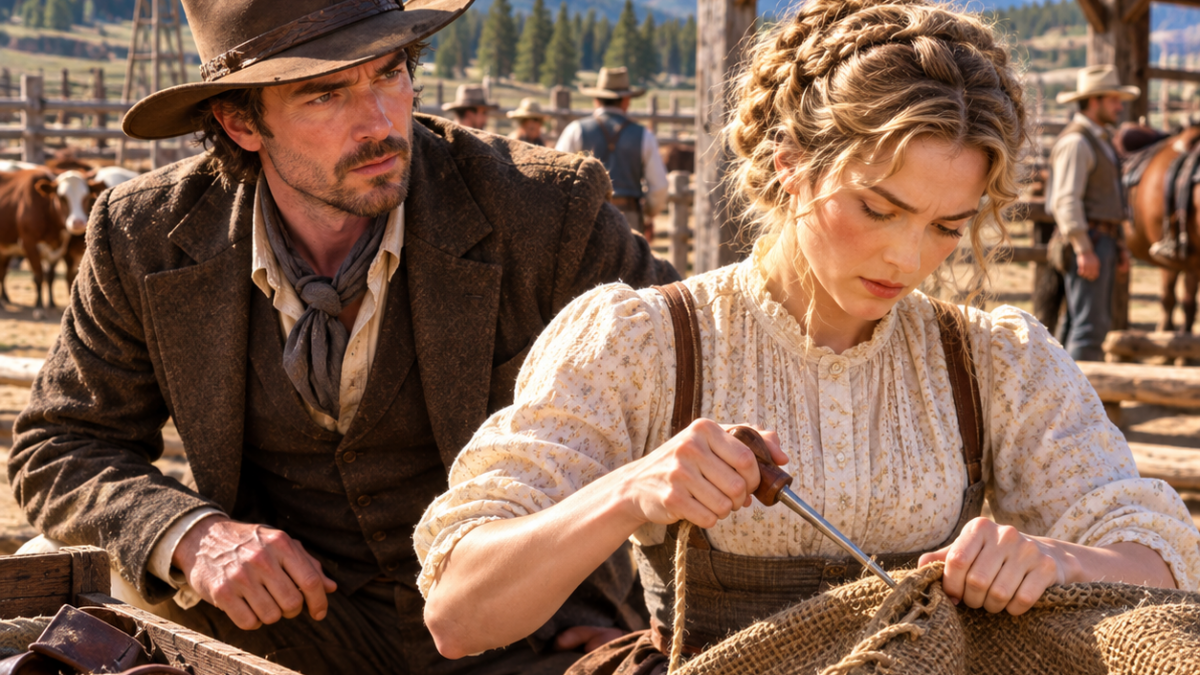
Then Beatrice Loring opened the long wooden case she refused to let him carry, pulled out a sailmaker’s palm and a heavy curved needle, and repaired a torn wool sack like a woman who had been reading strain and failure long before she ever met him.
By the time one of her approval tags appeared on a sack she had rejected, Malcolm would have to decide whether he trusted the woman beside him—or the lie someone had planted to destroy her name.
The train came into Billings gray and on time, trailing steam across the platform like a tired animal breathing hard after a long pull across Montana Territory.
Malcolm Keating stood near the freight office with his hat already in his hand.
He had been there too early.
He knew that.
A man could pretend he was early because trains were uncertain, because schedules mattered, because the freight office had business he might need to see to while waiting. But none of those excuses survived the truth standing plainly inside him.
He wanted to see Beatrice Loring before she saw him.
Seven months of letters had made her familiar in ways that unsettled him. He knew the slant of her handwriting, the patience in her phrasing, the clean way she separated an honest doubt from a complaint. He knew she had worked in a sewing room near St. Louis, then in a repair shop where canvas, sacks, and working cloth came through by the bundle. He knew she had once written, without any self-pity, that a woman who could make worn things useful again was often mistaken for someone content to be used.
That line had stayed with him.
He had read it three times by lamplight, then folded the letter and set it aside as though it were too sharp to hold carelessly.
He did not know her voice.
He did not know whether she smiled often.
He did not know if she would look at Billings and see opportunity or dust.
He did not know if the careful talk of marriage they had allowed onto paper would survive the first plain hour in daylight.
The train doors opened.
Passengers stepped down.
A merchant with two trunks.
A mother with a sleeping child.
A soldier.
A thin man carrying a birdcage covered in cloth.
Then a woman in a dark traveling dress appeared at the car steps with a leather travel bag in one hand and a long wooden box in the other.
Malcolm knew her at once.
Not because she looked exactly as he had imagined.
She did not.
Imagination had made her softer, perhaps because he had been foolish enough to associate sewing with softness. The woman stepping down from the train looked tired from travel, yes, but not fragile. Her posture was straight. Her mouth was composed. Her eyes moved across the platform once, taking in exits, strangers, luggage, sky, and then him.
Her gaze stopped.
He came forward.
“Miss Loring.”
“Mr. Keating.”
Her voice was lower than he expected.
Not cold.
Not warm enough to be careless.
He reached for her travel bag.
She let him take it.
Then he reached for the wooden box.
She did not.
He noticed.
He did not ask.
That was his first wise act of the day.
“Your journey was difficult?” he asked.
“Long,” she said. “Not impossible.”
“Montana has a way of making those feel alike.”
One corner of her mouth shifted.
It was not quite a smile, but it suggested one might exist under better circumstances.
He took her first to Ellen Harker’s boarding house, not to his own home.
That had been decided in letters and mattered to them both. Beatrice had written plainly that she would not arrive in Billings as a woman already absorbed into a man’s household before she knew whether she intended to marry him. Malcolm had answered that a woman considering marriage should have her own key and her own door until she chose otherwise.
He had meant it.
Ellen Harker’s place stood two streets from the depot, square and clean, with lace curtains that had been mended more than replaced. Ellen herself opened the door before Malcolm could knock, looked Beatrice over with the frankness of a woman who had seen enough boarders to know that politeness was less useful than accuracy, and said, “You’ll want hot water before conversation.”
Beatrice looked at her.
“Yes.”
Ellen nodded as if that settled her opinion favorably.
Malcolm left Beatrice there with her own key, her own room, and no request for an answer.
He walked back toward the wool yard feeling both relieved and more nervous than before.
She was real now.
That complicated everything.
Keating Wool & Commission occupied a broad, dusty yard near the rail line, where the smell of fleece, dirt, raw lanolin, horse sweat, burlap, and weather seemed to settle permanently into the boards. Malcolm had inherited nothing fine. His father had left debts, a sour reputation with two growers, and one narrow office with a roof that leaked directly over the account shelves. Malcolm had built the yard into something steadier through caution, long hours, and an intolerance for sloppy handling that made men complain until their wool sold properly and then return the next season.
He was thirty-five.
Not rich.
Not poor.
Respected by men who did not use the word generously.
He had thought a wife might make the small house near the yard less bare.
That thought embarrassed him now.
Not because he wanted curtains.
He did.
The house had stood with naked windows for three years, and every time afternoon light struck the empty frames, the rooms looked temporary, as though waiting for someone to decide whether they deserved softness.
But Beatrice had written once, I can sew nearly anything put before me.
Malcolm, without asking properly, had pictured curtains.
Shirts.
Table linen.
Domestic mending.
The neat, quiet kind of sewing a man expected without examining the expectation too closely.
He had never asked what kind of sewing she meant.
The next morning, when he asked if she would like to see the wool yard for herself, Beatrice said yes before he finished the question.
She arrived in the same dark dress, though the travel dust had been brushed from it. Her hair was pinned plainly beneath a hat. She carried the long wooden box again.
PART2:
Malcolm glanced at it once.
This time, she noticed him noticing.
“You are wondering.”
“I am.”
“But not asking.”
“I was raised with some restraint.”
“That must be inconvenient in business.”
“Frequently.”
That earned a real smile.
Small, but real.
The yard met her all at once.
Wool sacks stacked in uneven rows.
Men moving bundles toward the press.
A wagon backing too sharply near the east gate while Peter Niles shouted directions nobody followed quickly enough.
A grower waiting beside the receiving table with the offended patience of a man certain his wool deserved better weather, better prices, and more immediate attention.
Beatrice stood just inside the gate and looked.
Not like a woman admiring a new place.
Like a woman reading it.
Malcolm had seen men look that way at the yard. Growers did it when judging whether they trusted a commission agent. Freight men did it when measuring labor. Buyers did it when deciding whether dust, weight, and reputation matched the papers in their hands.
He had never seen a woman look at the yard and read the cloth itself before she understood the business around it.
A yard hand set aside an empty burlap sack with a torn seam, meaning to get to it later.
Beatrice stopped beside it.
She laid her hand flat against the coarse cloth.
“Would anyone mind if I looked at this?”
Nobody minded.
Mostly because no one understood what she was asking permission to do.
She set down the wooden box at last and opened it.
Inside was not lace.
Not colored thread.
Not little scissors in a velvet fold.
There was a heavy curved needle, a sailmaker’s palm worn smooth at the heel and darkened by hands before hers, strong waxed thread coiled tight, an awl, a small knife, folded patches of working canvas, and a beeswax lump wrapped in cloth.
Malcolm stared.
Beatrice braced the sack across her knee, fitted the palm against her hand, and began to sew.
The repair was large, confident, and unhurried.
The curved needle drove through the coarse fabric with a strength that did not look like effort. Her hand did not flutter or fuss. She set each stitch where strain would pull and gave the seam room to survive rough handling. This was not decorative work. This was judgment made visible in thread.
Malcolm had already turned toward another task when he noticed the motion of her hands.
Then he stopped walking.
“I thought you meant curtains,” he said.
“I can sew curtains.”
She did not slow down.
“They just don’t need this much needle.”
Peter Niles, standing nearby with a tally board, let out a laugh before disguising it badly as a cough.
Beatrice glanced up.
“Did I say something funny?”
PART3:
“No, ma’am,” Peter said. “Just truthful.”
She returned to the sack.
“Truth often arrives poorly dressed.”
Malcolm found himself smiling despite the wool dust in the cold morning air.
Smiling at exactly how wrong he had been.
Smiling, too, at how little that seemed to matter now if he was willing to be corrected.
Isaac Doran, a grower waiting on his own business, watched the repair finish. He was a square-built man with weathered skin, forty years of suspicion in his face, and wool enough each season that men spoke to him carefully.
When Beatrice tied off the thread and tested the seam with both hands, Doran stepped closer.
“You take work?”
Beatrice did not look to Malcolm first.
That pleased Malcolm more than it should have.
“If the cloth is worth mending,” she said.
Doran nodded toward two sacks on his wagon.
“Got a few that might be.”
Malcolm saw the moment forming and understood, with sudden clarity, that he had a choice.
He could treat Beatrice’s skill as an ornament attached to his business.
Convenient.
Charming.
A service he had somehow acquired through courtship.
Or he could keep the terms clean before anyone had time to muddy them.
He turned to Peter.
“Clear the corner of the receiving table when it doesn’t interfere with yard business.”
Then to Doran.
“Any repair agreement is with Miss Loring. Payment straight to her hand. No percentage to Keating’s. No claim through my books unless she asks for the account space.”
Beatrice’s needle paused only half a breath.
Then continued.
Doran shrugged.
“Plain enough.”
It was plain.
That mattered.
That evening, at Ellen Harker’s boarding house, Beatrice opened a small ledger of her own and wrote the first line in it herself.
Doran — two sacks examined, one repaired, one held for inspection.
Malcolm watched from across the parlor where he had been invited for supper, not quite hiding his interest.
Not a useful bride, he thought.
A woman with a trade.
That was different.
It should have been obvious from the letters.
He was ashamed that it had not been.
Four days later, a sack of Doran’s tested that respect for the first time.
It came in folded under two better ones, old but not hopeless at first glance. A diamond-shaped patch sat low on one side, stitching around it gone soft with age. The burlap near the patch had thinned, but the main seam still looked serviceable.
Beatrice turned it over.
Felt the weave.
Checked the patch.
“Mend,” she said.
Malcolm looked at the sack.
Then at what the sack still had to survive.
Filling.
Weighing.
Dragging.
Loading.
Miles of rough wagon travel.
The hard handling of shearing country, where men tired by noon and sacks suffered every impatience hands could give them.
“Replace it,” he said.
Beatrice looked up.
“The seam will take another line.”
“The seam might. The sack won’t.”
Her expression stilled.
Men had corrected her before.
Malcolm saw the memory of it pass across her face, though not the detail. Some past supervisor perhaps. Some customer who believed a woman’s work was either invisible or suspect. Some man who treated disagreement as proof she had forgotten her place.
Malcolm did not argue the cloth.
He did not pretend to know it better than she did.
He told her straight out what the sack would be asked to do once it left Billings. The miles. The weight. The handling it could not avoid on a wagon bound for shearing country.
Beatrice turned the old patch back.
She checked the burlap around it again, closer this time, fingers reading the fabric the way another person might read a page.
She found the weakened area she had missed the first pass.
“Replace,” she said.
No embarrassment.
No muttering.
No little defense of her first answer.
Malcolm gave no sign of victory either.
She drew a broad charcoal X inside the upper fold and wrote in her ledger:
Doran — diamond patch — reject.
The sack went to the reject pile.
Neither mentioned it again that day.
After Doran had gone, Beatrice asked Malcolm how far a sack like that might travel once it left the yard.
He told her.
She listened with the same attention she gave thread under tension.
“I was judging the cloth,” she said.
“You were judging what it still had to survive.”
“Yes.”
“I should have said that first.”
“You did say it.”
“Not first.”
“No,” she agreed.
He liked that she did not make mercy decorative.
She asked one more question about the route Doran’s sacks would take and listened while Malcolm described the handling they would meet after leaving Billings. He noticed she was not asking to prove herself right after the fact. She was adding a piece of his knowledge to her own. The next time she touched a sack, she would be judging more than cloth alone.
That evening, Beatrice counted a few repair dollars in her room at Ellen’s and checked that her return fare still lay untouched in the lining of her travel bag.
Ellen Harker stood in the doorway with a folded towel over one arm.
“Billings what you expected?”
“No.”
“Mr. Keating?”
Beatrice ran her thumb over the edge of the coin.
“No.”
“That good or bad?”
“I haven’t sorted it yet.”
Ellen smiled.
“Best answers take sorting.”
Across town, Malcolm looked once toward the empty repair table before closing the yard and found himself wondering what kind of life he might have with a woman who would tell him when she thought he was wrong and then change her own answer when the evidence required it.
A week later, a heavy protective cover showed them the pattern from the other side.
The cover stretched over a load near the east side of the yard, canvas worn at a stress point where rope pull met corner strain. A small tear had started near the fold. Malcolm saw it during evening check and decided it could wait until morning.
Beatrice had followed him out because Ellen needed a receipt for a delivery sent through the yard and Malcolm had forgotten to sign it.
“The wind won’t wait,” she said.
He looked at her.
“What?”
She stepped closer to the cover and traced where the pull would travel once the gusts caught it.
“Here to here. If the wind gets under this edge tonight, the tear will double before breakfast.”
Malcolm looked again.
At first, he saw only the tear.
Then he saw what she meant.
The direction of force.
The loosened rope.
The way night wind would worry that weak point like a dog at a bone.
“You’re right,” he said. “Mend it.”
No ceremony.
No embarrassment.
He had corrected her once.
Now she corrected him.
Neither needed more made of it.
There was no reason left for Malcolm to stay once the cover was settled. Peter could have held the lantern. Beatrice could have mended alone. The yard was cold and dinner waited.
He stayed anyway.
They talked while she worked.
Not about romance.
Not yet.
They talked about work other people called tedious.
She liked knowing where strain would travel before it showed.
He liked knowing what could wait and what could not.
Different skills.
The same pleasure in sound judgment.
Over the next few days, growers brought Beatrice worn sacks and torn covers. Not many at first. A handful. Enough to see whether the arrangement had weight. She refused cloth that was not worth saving, charged plainly, and kept every entry in her own ledger. Malcolm stopped by her table for reasons that were not always necessary.
Sometimes he brought a question about material wear.
Sometimes she asked how long a repaired piece would be expected to serve before replacement.
The conversations were brief and practical, but both had started choosing the other person’s judgment even when they could have managed without it.
That kind of choosing frightened Beatrice more than kisses might have.
Kisses could be explained by weather, loneliness, novelty, hope.
Judgment was harder.
A woman did not easily risk trusting a man with the way she knew things.
Henry Bains noticed before either of them named it.
Bains was forty-six, a competing wool commission agent with a clean collar, a narrow face, and the patient resentment of a man who believed another man’s success must contain some unfair advantage. His yard was smaller than Keating’s but older in certain relationships. He survived by habit, pricing, favors, and the fact that some growers preferred the devil whose tricks they already knew.
He had never liked Malcolm Keating.
He liked him less each season.
Keating’s yard had become harder to dislodge. Too orderly. Too trusted. Too quick to admit small errors before they grew large enough to exploit.
Now there was Miss Loring.
Bains first noticed her when a grower who might have stopped at his office carried two mended sacks from Keating’s yard instead.
“Keating added a repair service?” Bains asked, pausing near the receiving gate with a polite smile.
“My account is my own,” Beatrice said.
Malcolm, standing nearby, confirmed it.
“Convenient,” Bains said.
Then he moved on.
But he took note.
Men like Bains rarely struck where a person was strong in public.
They looked for the seam beneath the patch.
One afternoon, Malcolm held out the strap from his yard ledger without comment. The leather had gone thin and frayed at the buckle, though he had been ignoring it for weeks.
Beatrice took it, looked at the strap, then at the ledger itself, thick with pages he kept meaning to sort.
“The strap,” she said, “or your habits?”
Peter Niles, passing behind Malcolm, coughed into his shoulder.
Malcolm laughed once, short and real.
He did not answer either question.
A mixed batch of returned sacks gave them a harder test.
Beatrice sorted first by condition of cloth.
Malcolm sorted by what each sack still had to endure.
Their lists did not match.
The first disagreement took place over a sack that looked sound near the base but had weakened along the side seam.
“Cloth will hold,” Beatrice said.
“Storage only,” Malcolm replied.
“For how long?”
“Maybe two months. No wagon travel.”
“Then repair.”
The next was the opposite.
“This one?” Malcolm asked.
“Mendable, but not worth charging for if he needs it through full season.”
“Replace?”
“Replace.”
By then, neither treated a first judgment like a position to defend. They simply kept asking what the other might have seen.
The change showed most clearly when Malcolm handed her a sack and waited for her answer before offering his own.
Beatrice noticed.
Then did the same with the next one.
It was not deference.
It was curiosity made habitual.
And it followed them out of the yard more often than either admitted.
Malcolm showed her the small house that would be theirs if they married.
It stood two streets from the yard, whitewashed, square, and plain, with a narrow porch and windows still bare. The rooms were sound but unfinished in feeling. A stove. A table. A bedchamber with light from the east. Another small room that might become storage, sewing, or something neither of them had named.
Beatrice stood in the front room and looked at the empty windows.
Malcolm looked too.
“I’d imagined curtains appearing rather sooner than this,” he said.
“They can wait.”
“For what?”
She walked to the window and rested her fingertips on the sill.
“For me to know whether they’re mine to make.”
He understood.
Not perfectly, perhaps.
But enough.
She would not furnish the shape of a marriage before knowing whether the life inside it was hers.
They stood a while in the bare room with no work between them. Beatrice could hear wagons on the street outside and, farther off, the muted activity of the yard. Malcolm did not tell her where a table ought to go or which room should be hers to manage.
He only asked, “Does it feel too small?”
“No.”
Small was not what troubled her.
Choosing wrong was.
A few days later, near the depot where their meeting had begun, Malcolm stopped walking and turned toward her.
“Your travel doesn’t obligate you to anything,” he said. “I’ll walk you to the train myself if you want to go. Your letters don’t obligate you either.”
Beatrice studied him.
“I came to see whether I could marry you.”
“And?”
“I can.”
The words settled between them.
No music.
No witness.
No grand gesture.
Just an answer that had taken weeks of cloth, work, correction, restraint, and watching to earn.
Malcolm breathed out.
“Good. I’d reached the same conclusion.”
For the first time since she arrived, neither of them had another practical matter waiting to be decided.
Beatrice could still leave.
Malcolm could still step back.
The fact that neither wanted to made the silence feel different from every silence before it.
The amusement between them softened.
He kissed her there, unhurried.
She let him.
Then she said, “I still keep my ledger.”
“Yes.”
“And my money.”
“Yes.”
“And my work.”
“Yes.”
“And you will not call my tools household goods.”
That made him smile.
“I would not dare.”
“See that you don’t.”
They married quietly on the twenty-fourth of June with Ellen Harker and Peter Niles as witnesses.
Afterward, Beatrice carried her wooden toolbox into Malcolm’s house herself, her ledger tucked under one arm, and set both on the table.
They had chosen marriage after seeing each other be right, wrong, and honest about both.
What remained was to learn what that honesty would cost when the stakes were no longer small.
The first days of marriage were ordinary in a way neither made a show of.
Her tools found a real place in the house.
Her ledger stayed hers.
His business papers and her repair accounts could share a table without becoming one book.
She kept taking paid work.
The windows stayed bare.
Bains noticed that too.
Marriage had not absorbed Beatrice’s repair table or made it disappear. Her work remained unmistakably hers. A grower who might have gone to Bains chose Keating’s instead, not from loyalty, only because his sack work was already sitting at Beatrice’s table and it was simpler to keep errands together.
What had been ordinary commercial irritation began hardening into something closer to resentment.
Bains began to see Beatrice as part of why Keating’s yard was harder to dislodge than it should have been.
That was when resentment started looking for a tool.
Ned Mallory was twenty-four, a temporary hand with ordinary access to the back sack storage. Young, eager, careless in the way some young men are when they have not yet suffered a consequence that outlived a day. He had no particular hatred for Malcolm and no reason to dislike Beatrice. That made him useful to Bains.
A man acting from hatred might talk.
A man acting from easy money might tell himself nothing serious had happened.
Bains approached Ned under a plain commercial excuse near the freight office. Nothing that would raise a question if anyone watched. A word about work. A coin folded into a palm. A short instruction.
The old diamond-patch sack Beatrice had rejected was still sitting in the reject pile, marked with her charcoal X. A sound replacement sack sat folded in storage.
Make certain the rejected sack went out in Doran’s batch marked as though she had passed it herself.
Simple enough.
Harmless enough, if a man did not think hard about what it might cost the woman whose name would ride out on that tag.
Bains wanted three things damaged at once.
Beatrice’s reliability.
Malcolm’s standards.
The confidence growers placed in both.
All three struck by the same quiet blow.
It was no longer competition, whatever it had begun as.
Somewhere between the money and the instruction, it had become fraud.
Bains knew the difference even as he told himself otherwise.
The yard was busy the day Doran’s batch left.
Wagons loaded in the ordinary rush of a season already underway. Peter was at the far end arguing over count. Malcolm was speaking with a grower about delayed rail space. Beatrice was at her repair corner finishing a cover seam. Dust moved through the yard. Men called numbers. Sacks shifted from table to wagon.
Nothing about the morning suggested anything was wrong.
Ned handled the switch as he had been asked.
No hesitation anyone noticed.
No dramatic glance over his shoulder.
He moved through routine the same way he moved through every other task that week.
The diamond-patch sack went out among usable sacks carrying the appearance of Beatrice’s approval stitched into its very presence there.
The sound replacement stayed folded unnoticed in back storage, where no one had reason to look.
The count came out even.
Nobody looked twice.
Somewhere out past Billings, on a wagon with a dozen sacks exactly like it, the rejected sack was already riding toward a season’s worth of hard use it had never been built to survive.
It would come back full.
It would come back changed.
And when it did, the name attached to it would not be Bains’s.
That evening, Malcolm and Beatrice had a small disagreement about whether he should finish an entry that night or leave it for morning.
“You are tired,” she said.
“The figures are here.”
“They will be here tomorrow.”
“So will more figures.”
“That is not a moral argument.”
“It is a practical one.”
“It is a tired one.”
He looked at her across the table.
“You are direct when you’re married.”
“I was direct before. You are simply closer to hear it.”
He laughed.
No one won.
It did not need to be won.
She went to bed.
He stayed with the ledger a while longer, then closed it when he realized she had been right.
Disagreement between them had stopped being a threat.
Neither remarked on that because it no longer needed remarking on.
Doran’s filled sacks began returning toward Billings for weighing the following week.
The diamond-patch sack came back closed and under real strain now, indistinguishable from the rest at a glance. Beatrice was occupied with another repair. Malcolm oversaw receiving. Bains had legitimate reason to be nearby and gave no sign of satisfaction, only the patience of a man waiting for something he already knew was coming.
The sack failed during ordinary handling.
No warning.
Only the weakened cloth near the old patch giving way under the strain of weighing.
Wool spilled across the receiving floor and stopped the work around it.
No one was hurt.
That was the mercy.
But the mess meant repacking, cleaning what could be saved, and losing time while Doran’s temper rose with every minute.
Someone found the tag before Doran did.
Beatrice Keating’s approval tag.
On a sack she had never approved.
Bains did not shout.
He did not need to.
He only let the fact sit where everyone could see it and let the silence around it do the rest of the work for him.
Doran looked to Beatrice, his voice hard but not unfair.
“Your tag’s on it. How did this go out?”
The yard grew still in the way working places do when labor pauses but judgment continues.
Bains offered one restrained line into the silence.
“If her tag’s on it, whose judgment was it?”
Beatrice did not answer with a speech.
She looked at the sack.
Malcolm looked at her first.
Then the sack.
Then the tag.
Something in his face worked through the plain shape of the question rather than reaching for an easy answer.
He asked her directly, in front of only the people who needed to hear it.
“Did you pass this sack?”
“No.”
“You’re certain?”
“Yes.”
The question hurt.
He saw that.
She did not turn it into an accusation of her own.
Malcolm took the answer seriously, the way a man takes a fact rather than a plea.
“Then we’ll look again,” he said.
He did not say his wife could never be wrong.
He already knew she could.
He had seen it with the diamond patch the first time.
What he said was simpler and stronger.
Her denial had earned an investigation, not a dismissal.
Doran’s anger did not disappear, but it changed shape. He stepped back from the sack and let them work.
Malcolm kept receiving stopped long enough to prevent spilled wool from being trampled farther into dirt. Peter set men to repacking what could be saved.
Beatrice knelt beside the failed sack with no one touching it before she did.
She turned it over, hands moving across the cloth with the same careful attention she gave every piece at her table.
The old diamond patch.
The weakened cloth gone soft in exactly the place she remembered marking.
She did not need long.
She turned back the upper inside fold.
There, rubbed but still visible against the coarse weave, was the charcoal X she had drawn herself weeks earlier in this same yard with Malcolm standing not three feet away.
“I turned this one out,” she said.
Her ledger opened to the page.
Doran — diamond patch — reject.
Plain ink.
No flourish.
Matching the sack in front of them exactly.
Doran saw it land.
The first question was answered.
She had not passed it.
But a second question rose immediately behind it.
If she had rejected it, how had it left the yard carrying her tag at all?
Now Malcolm’s part of the work began.
He went back through Doran’s incoming count.
How many sacks had come in?
How many passed?
How many rejected?
Whether a sound replacement had been supplied.
Where it should have gone.
The numbers did not show an extra sack anywhere.
The count had stayed correct the whole time.
“If this one went,” Malcolm said, “another one stayed.”
A substitution.
Peter checked the back storage and found it.
The sound replacement sack still folded exactly where it should never have been left.
The rejected sack had gone out.
The good one had stayed behind.
The count matched because someone had traded one for the other.
Malcolm set the sound sack beside the failed one before saying anything further.
One had the strength Doran’s lot required.
The other carried Beatrice’s charcoal refusal under a tag that said the opposite.
The error was no longer a question of bad sewing, and the even count could no longer be explained by an extra sack slipping into the load.
A swap had occurred.
Whether by carelessness or deliberate interference remained open.
Peter worked back through who had handled that part of the yard on loading day and landed on Ned Mallory, the seasonal hand with ordinary access to storage.
Then he remembered something else.
Bains had spoken with Ned privately that same afternoon.
Several eyes moved to Bains.
Malcolm spoke before anyone could leap farther than the facts allowed.
“That is not proof.”
Beatrice looked at him.
Then nodded.
“It’s a thread,” she said. “Not a rope.”
They needed more than access and a private conversation to call it what it looked like.
So they laid what they had side by side.
Her evidence: the diamond patch, weakened cloth, charcoal X, ledger line.
His evidence: Doran’s count, the sound replacement still in storage, Ned’s position that day.
Each said outright what their half proved and what it did not.
Objects on a table.
Two people reading them the way they had learned to read everything else together.
For the first time since this began, the thing that had made them enjoy each other was not flirtation anymore.
It was protecting the truth.
They gathered Doran, Peter, Bains, and Ned after immediate yard work had settled, keeping the matter to the people who had actually touched it.
Beatrice set the failed sack where everyone could see it.
“That patch is the one I turned out,” she said.
She showed the charcoal X.
Then the ledger line beside it.
Her voice remained steady and without theater.
Bains answered in a controlled, reasonable voice, the voice of a man who had rehearsed the fence he would hide behind.
“A mark in a book shows what you meant to do. It doesn’t show what went out.”
A fair point on its face.
The kind of point that might have ended the matter if it were all there was.
Malcolm set the sound replacement sack down beside the failed one.
“No,” he said. “This shows what went out.”
He laid out Doran’s count without ceremony, slowly enough for Doran to follow every figure himself.
Correct on paper.
Yet one sound sack still sat untouched in storage, where it never should have been if the loading had gone properly.
Something had been exchanged.
The numbers proved it without needing anyone’s word at all.
Ned understood, watching the evidence laid out, that there was no bad-stitching story left to hide behind.
He was young enough to have believed a small wrong would stay small.
Now it stood in the yard with every man looking at it.
His face went pale.
“Mr. Bains paid me,” he said.
Bains turned sharply.
“Ned.”
“Told me to put the old sack with Doran’s lot and hang one of Mrs. Keating’s tags on it.”
The yard went silent.
Bains tried to question Ned Mallory’s word.
Doran did not let it stand.
“Mallory’s word came last,” he said. “The sack, the mark, and Keating’s count came first.”
That sentence finished what accusation alone could not.
Doran kept his business where the evidence had earned it.
Bains lost standing with a grower he would not easily get back.
Malcolm sent a plain factual notice to the Eastern house Bains represented.
No ornament.
No revenge language.
Just facts.
A customer’s wool had been spilled.
A young hand had sold his judgment cheaply.
A competing agent’s resentment had turned ordinary competition into fraud.
Beatrice gathered her ledger and the failed tag herself.
Malcolm did not take either from her.
The practical question had been answered.
The harder one had not.
That evening, the house was quiet.
Not peaceful.
Quiet.
Beatrice closed her ledger on the table where her repair accounts and Malcolm’s business papers sat near each other without touching.
The windows were still bare.
Outside, wagons passed now and then. Somewhere in town, a dog barked twice. Malcolm stood near the stove, tired enough that dust still lined one sleeve where he had brushed against the receiving table.
Beatrice did not look at him immediately when she spoke.
“When you asked me,” she said, “did you think I might truly have passed it?”
Malcolm did not answer quickly.
That was wise.
A quick no would have sounded merciful and false.
“Yes,” he said.
The word landed small and hard.
Beatrice felt the hurt of it.
She sat with that hurt a moment before he went on.
“I know you can be mistaken. I’ve seen it. You saw it too. What I have never seen is you hide a mistake once it was plain.”
She looked up.
“When you told me you hadn’t passed that sack,” he said, “I knew we had to look again.”
“That is not the same as believing me without question.”
“No.”
The honesty cost him.
She could see it.
He continued anyway.
“I don’t think blind belief would have served you today. If I had said, ‘My wife could never be wrong,’ Doran would have heard a husband protecting a wife. Bains would have used it. The yard would have doubted more quietly later. Your work did not need romance standing in front of it. It needed facts standing beside it.”
Beatrice looked down at her hands.
The right answer did not remove the sting.
But it gave the sting somewhere honest to settle.
“Next time,” she said, “ask me once.”
Malcolm nodded.
“Fair.”
“And do not make the second question sound like the first.”
He considered.
Then nodded again.
“Fair.”
Something warm came back into the room.
Not all at once.
But enough.
A few days later, Malcolm had a shipment timing choice to make. He asked Beatrice only about the material condition of what needed moving—her half, not his. She gave him what she knew and did not try to decide the rest for him.
He decided his part alone.
No contest in it.
They knew now, without needing to say so, where one judgment ended and another began.
Early August came hot and bright.
The yard smelled stronger in the sun. Wool dust clung to everything. Men moved slower by noon and complained more by three. Beatrice’s repair work continued, but now growers approached her table differently. Not because she had been proven never wrong. Better than that. Because when something false had touched her name, she and Malcolm had followed the truth carefully enough for everyone to see where it led.
That kind of trust lasted longer than admiration.
One late afternoon, Malcolm came home and found lighter cloth spread across the table.
Not burlap.
Not canvas.
Curtain cloth.
Plain, but good.
The late sun fell across it in a way that made the fabric look almost fine.
Beatrice measured carefully, her heavy work box sitting nearby, unhidden.
No sailmaker’s palm needed for this kind of sewing.
Malcolm stopped just inside the doorway.
“I’d begun to think those windows meant to stay bare forever.”
“They had to wait their turn.”
He looked at the cloth.
Then at her.
“And now?”
She did not look up right away.
Her needle moved through the lighter fabric with a different rhythm than it used on sacks. Smaller. Quieter. Not weaker.
“Now they’re ours,” she said.
He stood there for a while, letting the words settle into the room.
Not his house made softer by her labor.
Not her proof that she had become properly domestic.
Ours.
Chosen.
Named.
Timed by her hand.
He crossed to the table and sat across from her.
“Need help?”
She gave him a look.
“With curtains?”
“I can hold something.”
“You may hold your silence.”
“I am poor at that.”
“I have noticed.”
He smiled.
She cut the next length of fabric.
After a moment, he said, “I am glad you brought the wooden box.”
“So am I.”
“I was afraid of it at first.”
She paused.
“Were you?”
“I thought it meant there were pieces of you I had failed to understand.”
“It did.”
He accepted that.
Then she said, “You learned.”
“I am still learning.”
“That is better.”
The curtains were finished over three evenings.
On the fourth, Malcolm hung them badly enough that Beatrice had to stand with one hand over her mouth to keep from laughing.
“I run a wool yard,” he said from the chair he had climbed onto. “Not a drapery establishment.”
“You are proving that.”
“This nail is crooked.”
“The nail is innocent.”
He looked down.
She smiled.
The room held both of them easily by the end of it.
Curtains moved slightly at the open window.
Her wooden toolbox sat by the wall, not tucked away in storage.
Her ledger and his shared the same table without ever becoming one book.
Malcolm noticed a loose tie on the new curtain and touched it once.
“Mend?”
Beatrice glanced over.
“Tomorrow.”
He left it alone.
The evening settled quietly around them.
Months later, people in Billings still told the story incorrectly.
They said Malcolm Keating’s bride saved his wool yard.
They said Beatrice Keating was clever with sacks.
They said Henry Bains had been a fool to challenge a woman who kept such careful records.
Those things were partly true.
But they were not the whole truth.
The real story had begun before sabotage.
Before the spilled wool.
Before Ned Mallory’s confession.
Before Doran saw the charcoal X.
It began on a gray platform when Malcolm reached for a wooden box and Beatrice did not let him take it.
It began when he noticed and did not insist.
It began when she opened that box in the yard and showed him that the skill he had imagined as curtains was, in fact, a trade strong enough to hold against weather, weight, and fraud.
It began when she was wrong about a sack and admitted it.
When he was wrong about a cover and admitted it.
When disagreement stopped being a threat.
When curiosity became habit.
That was why, on the day her tag appeared on a lie, Malcolm did not reach for the easiest answer.
Not blind defense.
Not public doubt.
Investigation.
The kind of trust built not from pretending someone could never fail, but from knowing what they did when failure, accusation, or uncertainty entered the room.
Beatrice understood that now.
So did Malcolm.
Years later, the wooden box remained in the house, darker with handling, its hinges repaired twice, its contents used so often that the sailmaker’s palm bore the shape of Beatrice’s hand more than anyone else’s.
The curtains wore out eventually.
She replaced them when she chose.
The wool yard changed too.
Peter Niles became partner in a small way, then larger.
Ned Mallory left Billings after paying back what little he could and writing a letter Beatrice kept but did not answer.
Henry Bains lost more than one customer after the notice reached the Eastern house, though not enough to ruin him at once. Men like Bains often survived longer than justice preferred. But his name began to carry a pause after it, and in business a pause could cost almost as much as proof.
Doran stayed with Keating’s.
Not out of sentiment.
Because the numbers had been shown plainly.
Because the truth had been protected before pride.
Because a man’s wool had spilled and the people responsible did not try to hide behind marriage, reputation, or noise.
Beatrice’s repair table became a regular sight in the yard. It remained hers. Payment straight to her hand. Her ledger separate. Her standards known.
Some sacks she mended.
Some she rejected.
Some she marked for limited use.
And when new hands came through, Malcolm told them one rule before they touched the storage piles.
“If Mrs. Keating marks a sack, the mark stands unless she changes it herself.”
One young man once asked, “Because she’s your wife?”
Malcolm looked at him.
“Because she knows the cloth.”
That answer traveled farther than he knew.
In winter, when work slowed and cold settled into the boards, Beatrice sometimes took lighter sewing at the house. Shirts. Linens. Curtains for Ellen Harker when hers finally gave up after years of sun. But no one who knew her well ever again mistook light sewing for small sewing.
She had taught them better.
Malcolm still made mistakes.
So did Beatrice.
Marriage did not cure either of them of judgment, pride, fatigue, impatience, or the occasional desire to be right before being accurate.
But they had learned how to return.
To the sack.
To the count.
To the mark inside the fold.
To the question beneath the argument.
What did you see that I missed?
That question became the strongest seam in their marriage.
Stronger than waxed thread.
Stronger than a curtain tie.
Stronger than the public version of love people admired because it looked smooth from the outside.
One evening, long after the scandal with Bains had become an old story, Malcolm came home to find Beatrice repairing the leather strap on his thickest ledger.
He set his hat down.
“I thought we agreed that strap was my habit, not yours.”
“It is.”
“Then why mend it?”
She pulled the thread through and tested the leather.
“Because the habit has improved enough to deserve another season.”
He laughed.
“High praise.”
“For you, extravagant.”
He sat beside her.
The window curtains moved slightly in the breeze.
On the table lay his ledger, her tools, and a small plate of biscuits Ellen had sent over with no explanation except that she had made too many, which nobody believed.
Malcolm watched Beatrice’s hands.
The same hands he had once imagined hemming curtains before he knew better.
The same hands that had held a sailmaker’s needle steady through burlap and canvas.
The same hands that opened a ledger to prove a lie false.
The same hands now mending his strap because she chose to.
He reached across the table, palm up.
She looked at his hand.
Then set the needle down and placed her fingers in his.
For once, neither hand held anything useful.
For once, nothing needed mending.
That, Malcolm thought, might be the finest repair of all.








