He Drove Two Hours With an Injured Stray Cat Wrapped in His Shirt—Then Paid $1,800 to Save Her Without Hesitating
PART3:
The man shook his head.
“I think she got hit.”
“Did you see it?”
“No.”
“I saw her after.”
He pointed vaguely toward the highway beyond our building.
“She was trying to get off the pavement.”
“Dragging herself.”
His jaw tightened.
“I thought she was dead at first.”
The cat made a small sound.
Not a full meow.
Something between a cry and an exhale.
The man looked at her immediately.
“I know.”
He whispered.
“You’re okay.”
He had known this animal less than two hours.
He was already talking to her like she needed to recognize his voice.
Rachel started an IV catheter.
We administered pain medication.
I palpated carefully.
The cat tensed, but did not fight.
Good neurological response in the front half.
Rear limb movement limited by injury and pain.
I checked her abdomen.
No obvious internal bleeding.
Still, trauma cases can hide things.
We moved to radiographs.
The man followed until we stopped him at the treatment-room door.
“You’ll need to wait up front.”
He looked at the cat.
“I can’t stay?”
“Not during X-rays.”
He nodded.
“Okay.”
Then:
“She’s hurting?”
“We’re giving her pain medication.”
“That’ll work?”
“Yes.”
He exhaled.
“Okay.”
That was the first time I noticed he was shaking.
Not dramatically.
His hands.
Tiny tremor.
I assumed adrenaline.
He had probably picked an injured cat off a highway shoulder with traffic passing a few feet away.
Anyone would shake.
The X-rays confirmed what I suspected.
Both rear legs were fractured.
One femur.
One tibia.
Complicated enough to require surgical stabilization.
But fixable.
That word matters.
There is an enormous emotional difference between bad and fixable.
I checked chest films.
No obvious lung damage.
Pelvis intact.
Spine looked good.
That was fortunate.
Very fortunate.
When I returned to the waiting room, the man was sitting on the edge of a chair.
The red flannel shirt was folded across his knees.
There were dark stains near one sleeve.
Blood.
He was staring at the floor.
I sat opposite him.
“She has two significant fractures.”
He looked up.
“But?”
I appreciated that he heard the structure of the sentence.
“But I think we can repair them.”
His shoulders dropped slightly.
“What does that mean?”
“Surgery.”
“Pins.”
“Several weeks of strict rest.”
“Pain control.”
“Follow-up X-rays.”
“Probably six to eight weeks before we’re comfortable letting her move normally.”
He nodded as if memorizing every word.
“What are the chances?”
“Good, assuming we don’t find anything unexpected.”
“Can she walk again?”
“I believe so.”
He exhaled slowly.
Then came the part every veterinarian hates.
Money.
I explained the estimate.
Diagnostics.
Anesthesia.
Surgical repair.
Hospitalization.
Medication.
Follow-ups.
A little under two thousand dollars.
About eighteen hundred based on what we knew now.
He did not react.
So I repeated it.
“Approximately eighteen hundred.”
“I heard you.”
I waited.
Most people need time.
Even loving owners need time.
Eighteen hundred dollars is real money.
For some families, impossible money.
For others, painful money.
I expected the questions.
Payment plans?
Alternative treatment?
Could one leg heal without surgery?
What if we surrendered her?
What if a rescue took over?
Instead he said:
“Do it.”
I thought I misunderstood.
“The surgery?”
“Yes.”
“You understand the estimate?”
“Eighteen hundred.”
“Approximately.”
“Fine.”
I looked at him.
“Is this your cat?”
“No.”
There it was.
The detail I had not expected.
“You’re not the owner?”
“I never saw her before today.”
Rachel, standing nearby, looked at me.
I looked back at him.
“You found her?”
“On County Road 18.”
“That’s almost two hours away.”
“I know.”
“You drove here from there?”
He nodded.
“Nearest clinic I found that was open.”
I leaned back.
“Do you have cats?”
“No.”
“Ever?”
“No.”
“Dogs?”
“Always had dogs growing up.”
I stared at him.
“You understand if you sign as financially responsible, you’re agreeing to the bill?”
“Yes.”
“You could surrender her to us and we could contact a rescue.”
He looked confused.
“Why would I do that?”
“So you don’t personally have to cover the full cost.”
He shook his head immediately.
“No.”
“We work with groups that sometimes—”
“I’ll pay it.”
“Sir, you don’t have to decide this second.”
“I already did.”
I stopped.
There are moments when pushing becomes disrespectful.
He had decided.
“Okay.”
He pulled out his wallet.
“What do you need?”
We processed the deposit.
He paid without arguing.
No dramatic gesture.
No pause.
Just a card.
A signature.
Done.
Then he asked:
“When do you start?”
“As soon as we stabilize her and prepare.”
“How long?”
“A few hours.”
He nodded.
“I’ll wait.”
“You don’t have to.”
“I’ll wait.”
“You live almost two hours away.”
“I know.”
“We’ll call you as soon as she’s out.”
He looked toward the treatment-room doors.
“I said I’ll wait.”
Not rude.
Not angry.
Final.
So we let him.
His name was Mason Reed.
I learned that from the paperwork.
Forty-one years old.
Worked heavy-equipment maintenance for a quarry operation outside a small rural town.
Single.
No children.
One old Labrador at home named Duke.
That raised another problem.
“You have a dog?”
“Yeah.”
“How is he with cats?”
Mason looked at me.
“I have no idea.”
“You said she’s coming home with you?”
He blinked.
“I haven’t said that yet.”
Fair.
I had jumped ahead.
“We’ll discuss placement later.”
He nodded.
But something in his expression suggested he had already begun thinking.
We took the cat into surgery.
Mason stayed in the waiting room.
For three hours.
I know because every time I stepped into the front hallway, he was in the same chair.
He did not scroll through his phone.
Did not watch the television.
Did not read.
Did not leave for food.
He simply sat.
Red flannel shirt folded across his lap.
Hands resting on it.
Once Rachel brought him coffee.
He thanked her.
Forgot to drink it.
At one point, she gave him a brief update.
“She’s stable.”
Mason immediately asked:
“Is she hurting?”
“No.”
“She’s fully anesthetized.”
“We’re controlling pain.”
He nodded.
“Okay.”
That was all.
Not:
How long?
How much more?
Can I go?
Only:
Is she hurting?
The surgery went well.
Better than I feared.
The femoral fracture aligned nicely.
The tibia required more work.
Pins held.
No major soft-tissue complications.
No pelvic damage.
No spinal injury.
When we finished, the cat was stable.
I removed my gloves.
Washed.
Went to find Mason.
He stood before I spoke.
“She did very well.”
His eyes closed.
Just for a second.
“Both legs?”
“Repaired.”
“She’ll need strict confinement.”
“Medication.”
“Follow-up.”
“But if healing continues normally, I expect her to walk.”
He nodded.
“Good.”
That was it.
Good.
Like a man who had been holding something heavy and finally found permission to put it down.
I sat.
“Now we need to discuss what happens next.”
“Okay.”
“She doesn’t have a microchip.”
“No collar.”
“We’ll still post her as found and check local reports.”
“Of course.”
“If an owner appears and can prove she’s theirs, legally that may affect placement.”
He nodded.
“Fine.”
“Until then, we need somewhere for her to recover.”
I explained rescue options.
Medical foster.
Clinic boarding for a short period.
Then I asked:
“Do you want to take responsibility for her after discharge?”
He looked at me like the question was stranger than the surgery bill.
“She’s coming with me.”
I smiled despite myself.
“You’ve never owned a cat.”
“No.”
“You have a Labrador.”
“I have doors.”
“That is technically true.”
“He’s old.”
“He mostly sleeps.”
“You’re talking about eight weeks of limited movement.”
“I heard you.”
“Medication twice daily.”
“Okay.”
“Litter box management.”
“Okay.”
“She may need help getting in and out.”
“Then I’ll help.”
“You need a small recovery area.”
“I have a spare bedroom.”
“Dog stays out.”
“Easy.”
I studied him.
“You sure?”
Mason looked toward the doors where she was recovering.
“Yes.”
That was when I finally asked.
“Why?”
He frowned.
“Why what?”
“Why all of this?”
He waited.
I continued.
“You drove almost two hours.”
“You paid eighteen hundred dollars.”
“You’ve been sitting here for three hours.”
“You’re taking home a cat you met today.”
“You don’t even know if she likes you.”
Mason looked at the flannel shirt in his hands.
Then at me.
“Because I saw her.”
I thought he was not finished.
He was not.
“I was the one who saw her.”
He spoke slowly.
“Cars were going past.”
“I almost went past too.”
He rubbed one thumb against the fabric.
“Then I looked in the mirror.”
“She was trying to drag herself into the grass.”
He swallowed.
“I stopped.”
He looked at me directly.
“And once I stopped…”
He shrugged.
“…she was my responsibility.”
I did not speak.
Mason continued:
“That’s how it works.”
“Once you’re the person who sees something…”
“You don’t get to pretend you didn’t.”
I stared at him.
Then reached for a scrap of paper on my desk.
Wrote the words down.
He noticed.
“What are you doing?”
“Nothing.”
“You’re writing.”
“I don’t want to forget that.”
He looked embarrassed.
“It’s not profound.”
I folded the paper.
“It is in this building.”
He did not understand.
I did.
I have watched people love animals with extraordinary devotion.
I have also watched people walk away because helping would complicate their day.
Most human beings do not lack compassion.
We lack willingness to accept responsibility for suffering we did not create.
Mason had decided differently.
He had not injured this cat.
Had not abandoned her.
Had never seen her before.
Still, the moment he became aware of her suffering, he treated awareness as obligation.
That stayed with me.
The cat remained hospitalized overnight.
Mason refused to leave until he could see her.
We finally allowed him into recovery.
She was still sleepy.
Wrapped in blankets.
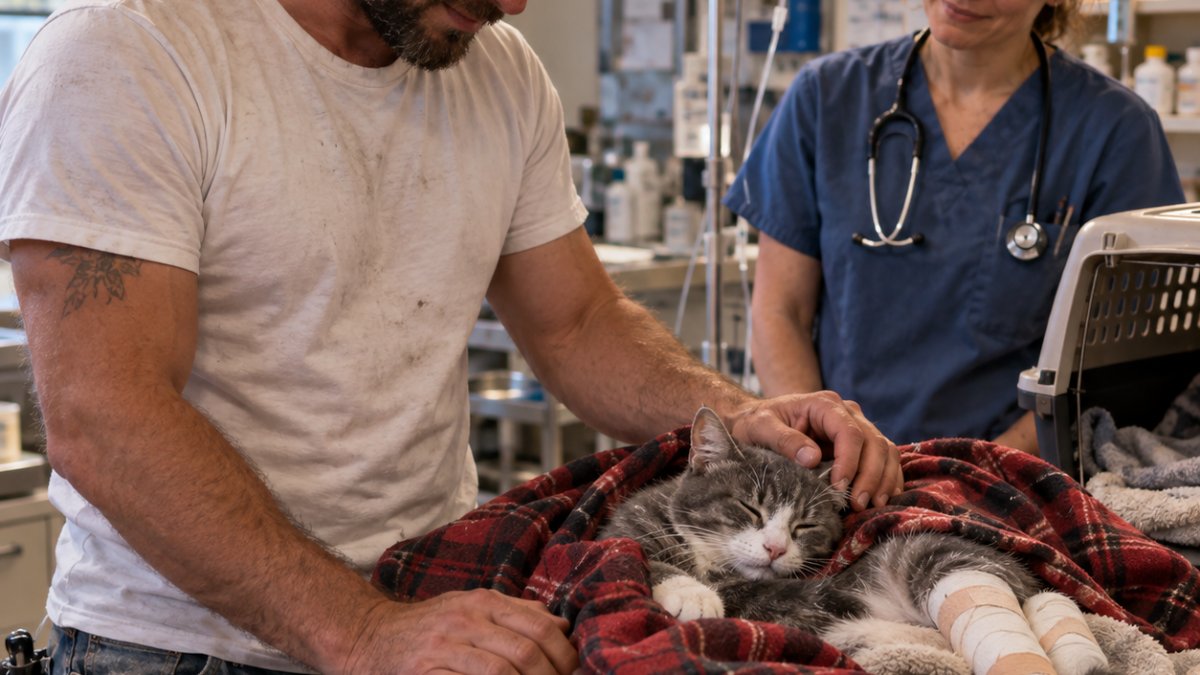
Both hind legs bandaged.
IV running.
Mason stood near the cage.
Did not touch immediately.
“Hey.”
Her ear moved.
He smiled.
“Still here.”
Rachel handed him the flannel shirt.
“We put this with her earlier.”
The cat had been noticeably calmer against it than against our regular blankets.
Mason looked at the bloodstains.
“You can throw it away.”
Rachel shook her head.
“I don’t think she wants us to.”
He opened the cage slightly.
Placed the shirt near her.
The cat moved her head.
Pressed her face into it.
Mason’s expression changed.
He looked away.
I pretended not to notice.
He finally left around seven.
Drove home.
Came back at opening the next morning.
Two-hour drive.
Again.
He had apparently stopped at a store.
His truck bed contained:
Cat litter.
Litter pan.
Cat bed.
Food.
Water bowls.
A scratching post.
Three toys.
A carrier.
And, for reasons I will never understand, a seven-foot cat tree.
I looked at the tree.
“She cannot climb that for two months.”
“I know.”
“So why did you buy it?”
“For later.”
Mason said it as though obvious.
For later.
That told me something.
He was not planning a temporary rescue.
We discharged her that afternoon.
He needed a name for the paperwork.
“Do you want to name her?”
Mason looked uncomfortable.
“I’m bad at names.”
“Your dog is named Duke.”
“Exactly.”
He stared at the cat.
She was awake now.
Green eyes.
Gray cap over her head.
White nose.
One gray patch shaped vaguely like a road bend across her side.
Rachel suggested:
“Lucky?”
Mason shook his head.
“Too obvious.”
“Hope?”
“No.”
I said:
“Flannel.”
He looked at me.
“No.”
Rachel laughed.
The cat reached one paw through the carrier door.
Touched Mason’s finger.
He thought.
“Roadie?”
The cat blinked.
“No.”
Then he noticed the red flannel shirt folded beneath her.
“Ruby.”
Rachel looked at him.
“She’s gray.”
“I know.”
“Why Ruby?”
Mason shrugged.
“Red shirt.”
I wrote:
Ruby Reed.
He stared.
“My last name?”
“You’re taking responsibility.”
He smiled.
“Yeah.”
“I guess I am.”
Before he left, we reviewed everything.
Medication schedule.
Strict confinement.
No jumping.
No running.
No stairs.
Monitor swelling.
Monitor appetite.
Monitor litter use.
Emergency signs.
Follow-up in two weeks.
Mason took notes.
Actual notes.
On paper.
He asked questions.
“What if she won’t use the litter?”
“What if Duke barks at the door?”
“What if she tries to stand?”
“What if she chews the bandage?”
“What if she doesn’t eat tonight?”
The man who claimed he had never owned a cat became the most attentive cat owner in our waiting room within forty-eight hours.
Then he drove home.
I expected trouble.
Almost all orthopedic recovery involves some complication.
Not necessarily medical.
Behavioral.
Animals do not understand why they must stay still.
Cats especially.
Ruby disagreed with confinement by day three.
Mason called.
“She’s trying to climb the crate.”
“Stop her.”
“I know.”
“How?”
“Smaller recovery pen.”
“She’s going to hate me.”
“Probably.”
“Okay.”
Next day:
“She hasn’t pooped.”
“How long?”
“Thirty-six hours.”
“Still eating?”
“Yes.”
“Drinking?”
“Yes.”
“Medication?”
“Exactly on schedule.”
“Give it another day.”
That night he sent a message.
She pooped. Never thought I’d be happy enough to text a doctor about that.
I replied:
Welcome to pet ownership.
At the two-week follow-up, Ruby arrived in a proper carrier.
The flannel shirt was still inside.
Mason carried a notebook.
Of course he did.
Dates.
Food.
Medication.
Litter box.
Behavior.
He had recorded everything.
Rachel whispered:
“He’s doing better records than we are.”
I examined Ruby.
Incisions looked good.
Swelling down.
Pins stable.
She was brighter.
Angrier.
That was excellent.
A cat trying to bite my stethoscope is often a healthier cat than one too weak to care.
Mason apologized.
“She doesn’t like strangers touching her legs.”
“Reasonable.”
“She likes me.”
“I noticed.”
Ruby reached toward him.
He put his hand near her face.
She rubbed against it.
“How’s Duke?”
I asked.
Mason sighed.
“Obsessed.”
“Bad?”
“No.”
“He sleeps outside her door.”
“Barks?”
“Not anymore.”
“Ruby?”
“Hisses under the door.”
I laughed.
“That sounds promising.”
Week three, Duke and Ruby saw each other through a baby gate.
Mason recorded video.
Old yellow Labrador.
Twelve years old.
Gray face.
Sitting politely.
Ruby inside the recovery room.
She stared.
Duke stared.
Ruby hissed.
Duke lay down.
Ruby stared another thirty seconds.
Then lay down too.
Mason texted:
I think they’re negotiating.
By week four, Ruby was putting more weight on both rear legs.
Short controlled movement only.
She hated restrictions.
Mason called me after she escaped the recovery pen.
“What happened?”
“I don’t know.”
“You built it.”
“Yes.”
“She’s a cat.”
“I’m learning what that means.”
He found her under the bed.
No damage.
We adjusted the setup.
At six weeks, X-rays looked excellent.
Bone healing.
Alignment maintained.
I showed Mason.
“So?”
“Another couple weeks of limited activity.”
His face fell.
“You told me six to eight.”
“This is eight.”
“She heard six.”
Ruby meowed loudly from the carrier.
Mason pointed.
“See?”
I laughed.
At eight weeks, we cleared her for gradual normal activity.
Mason went home and assembled the seven-foot cat tree.
Ruby ignored it for four days.
Then climbed to the top.
Sent Mason into cardiac arrest.
Not literally.
Close.
He sent a photograph.
Ruby sitting proudly on the highest platform.
Duke asleep below.
Caption:
Apparently we spent $1,800 repairing her so she could immediately find the highest object in my house.
I replied:
Also welcome to cat ownership.
Months passed.
Ruby recovered completely.
A slight stiffness in the left hind leg after long activity.
Otherwise normal.
She ran.
Jumped.
Played.
Slept with Duke.
That last part surprised everyone.
The cat who initially hissed at him eventually began sleeping against his stomach.
Duke tolerated it with the exhausted patience of an elderly dog who had survived enough life to know some battles were not worth fighting.
Mason sent pictures occasionally.
Ruby in a tractor seat.
Ruby watching birds through a kitchen window.
Ruby asleep inside a cardboard box despite having an expensive bed.
Ruby sitting on Mason’s chest while he tried to watch television.
One photo stayed with me.
Mason had placed the original red flannel shirt on an old chair in his bedroom.
Ruby slept on it.
Months after the accident.
The stains had been washed away.
The shirt was frayed.
She still chose it.
I asked Mason once:
“Why do you think she likes that shirt?”
He shrugged.
“Smells like me.”
Then:
“Or maybe it smells like the day she didn’t die.”
He said it casually.
I did not.
I thought about that for a long time.
One year after the accident, Mason brought Ruby in for vaccines.
She had gained two pounds.
Healthy.
Confident.
Furious about the thermometer.
Mason looked different too.
Not dramatically.
Softer somehow.
I asked:
“How’s life with a cat?”
He sighed.
“She knocks tools off my workbench.”
“Why is she in the workshop?”
“She opens the mudroom door.”
“She cannot open doors.”
“She can.”
“She steals my chair.”
“She wakes me up at four.”
“She hates the vacuum.”
“She loves Duke’s food.”
“So terrible?”
He looked at Ruby.
“No.”
“Best thing that happened to me in a while.”
Ruby head-butted his hand.
Mason smiled.
Then told me something I had not known.
The day he found Ruby had already been a bad day.
His father had died six months earlier.
Cancer.
Mason had been driving back from clearing out the last of his father’s workshop.
Tools in the truck.
Old boxes.
Things he did not want but could not throw away.
He had spent the entire drive angry.
At his father.
At himself.
At death.
At the fact that grief turned ordinary objects into impossible decisions.
Then he saw something gray move near the highway shoulder.
“At first I thought it was trash.”
He said.
“Plastic bag.”
“Then she lifted her head.”
He drove past.
Maybe fifty yards.
Then looked in the rearview mirror.
Ruby dragged herself another foot.
Mason stopped.
Traffic moved around her.
Nobody else did.
“I sat in the truck for maybe five seconds.”
He admitted.
“Thought about calling animal control.”
“Thought maybe someone else would stop.”
“Then I realized everybody else probably thought the same thing.”
He backed up.
Turned around.
Pulled safely off the road.
When Ruby saw him approaching, she tried to drag herself away.
Even with two broken rear legs.
“She thought I was going to hurt her.”
Mason said.
“That’s the part I keep thinking about.”
He crouched.
Did not grab immediately.
Spoke.
Waited.
Traffic passed.
Ruby hissed.
He removed the red flannel shirt he wore over his T-shirt.
Tossed it gently over her.
Wrapped her.
Lifted.
“She weighed nothing.”
He said.
“Felt like nothing.”
“But she screamed.”
His eyes changed.
“That sound…”
He shook his head.
“I knew I couldn’t put her back down.”
The nearest local veterinary office was closed.
Another clinic could not perform orthopedic surgery.
They directed him to us.
One hour and fifty minutes.
He drove.
Ruby wrapped against him on the passenger seat.
One hand occasionally resting on the bundle at red lights.
“She calmed down when I talked.”
“What did you say?”
“Nothing useful.”
“Like?”
Mason smiled.
“Mostly telling her she’d better not die after ruining my shirt.”
I laughed.
“So you lied to me that first day.”
“How?”
“You said the shirt didn’t matter.”
“It didn’t.”
“Apparently you were emotionally attached enough to mention it to an injured cat.”
“That doesn’t count.”
We sat quietly.
Then Mason looked at Ruby.
“My dad would’ve stopped too.”
There it was.
The deeper story.
“I think that’s why I couldn’t drive away.”
Mason’s father had been the kind of man who picked turtles off roads.
Moved fallen branches.
Helped neighbors tow vehicles from snow.
Not sentimental.
Useful.
His rule was simple:
If you’re there, help.
Mason had grown up hearing it.
He had not understood how thoroughly it lived inside him until County Road 18.
He looked at me.
“When you asked why I paid…”
“I remember.”
“I gave you that answer.”
“Because you saw her.”
“Yeah.”
“But I think it was really my dad.”
He paused.
“Maybe that was the last thing he taught me.”
Ruby climbed onto his lap.
Mason scratched behind her ears.
“Don’t tell anybody I said that.”
“Medical confidentiality.”
“I’m not the patient.”
“Close enough.”
Duke died the following winter.
Fourteen years old.
Old age.
Mason called not because he needed veterinary advice.
Because Ruby stopped sleeping in the bedroom.
She stayed beside Duke’s empty bed.
“Is that normal?”
“Yes.”
“She’s eating?”
“Yes.”
“Drinking?”
“Yes.”
“Then give her time.”
Mason knew grief now in a different form.
He sat beside Ruby.
Left Duke’s bed where it was.
Did not force her away.
After a week, Ruby returned to Mason’s bed.
The old dog bed remained in the corner another month.
Then Mason finally moved it.
He donated Duke’s unopened food to our clinic.
When he came in, he stood near reception holding the bag.
“Hard?”
I asked.
He nodded.
Then looked toward our adoption board.
There was an old shepherd mix listed.
Nine years old.
Gray muzzle.
Returned after his owner entered assisted living.
Mason stared at the photo.
“No.”
I had not said anything.
He pointed at me.
“Don’t.”
“I’m literally silent.”
“I know that face.”
“What face?”
“The veterinarian face.”
“I have no idea what you’re talking about.”
He took the food donation into the back.
Twenty minutes later, he asked:
“What’s that dog’s name?”
“Walter.”
Mason froze.
I froze.
His father’s name had been Walter.
“No.”
He said.
I tried not to smile.
“That is actually his name.”
“You’re making that up.”
I turned the adoption sheet around.
WALTER
Mason stared.
“This is manipulative.”
“I did not name the dog.”
He went home.
Came back Saturday.
Met Walter.
Ruby had to approve any adoption, so we arranged careful introductions.
Walter was calm around cats.
Ruby took three minutes to hiss.
Ten to inspect.
Twenty to sit six feet away.
By the second meeting, she rubbed against his front leg.
Mason closed his eyes.
“This house is becoming a zoo.”
Walter went home with him that afternoon.
I thought about County Road 18.
One injured cat.
One man stopping.
Then Ruby.
Duke.
Walter.
Connections spreading outward from one decision nobody else witnessed.
Mason became the person our clinic called when a certain kind of emergency arrived.
Not every emergency.
We did not exploit him.
But if an injured stray needed transport from his area, he sometimes helped.
He bought a proper animal carrier.
Kept blankets in his truck.
A first-aid kit.
Gloves.
A collapsible water bowl.
The red flannel shirt stayed home with Ruby.
Over the next three years, Mason transported six injured animals.
Two cats.
Three dogs.
One very angry raccoon that he wisely did not touch and instead waited beside until wildlife rescue arrived.
He never became a rescuer in the formal sense.
No organization.
No social media page.
No fundraising.
He simply stopped when stopping was useful.
One afternoon, one of my younger technicians asked:
“Does he save everything he sees?”
I said:
“No.”
“How do you know?”
“Because nobody can.”
That distinction mattered.
Compassion without limits can destroy the person trying to practice it.
Mason did not take every animal home.
He did not pay thousands for every stray.
Sometimes he called the right service.
Sometimes he transported.
Sometimes he moved an animal safely off a roadway and waited.
Responsibility did not always mean personally solving everything.
It meant refusing to pretend the problem did not exist once you had seen it.
That was more sustainable.
And maybe more important.
Four years after Ruby’s surgery, Mason brought her in because she was limping.
I felt immediate fear.
Old injury?
Hardware?
New fracture?
X-rays showed mild arthritis near one repaired joint.
Nothing catastrophic.
Medication.
Weight management.
Activity adjustments.
Mason looked relieved.
“She’s getting old?”
“She’s six.”
“That’s not old.”
“Tell her that.”
Ruby bit the edge of the exam mat.
He smiled.
“She still sleeps on the shirt.”
“The same shirt?”
“Yeah.”
“You know fabric stores exist.”
“It’s hers now.”
The shirt was nearly destroyed.
Ruby had kneaded it.
Slept on it.
Dragged it.
Mason had stitched one sleeve.
Eventually he cut the usable center section and placed it inside a cat bed.
Ruby approved.
Years passed.
Ruby turned eight.
Then nine.
Mason aged too.
Walter the dog died peacefully at twelve.
This time Ruby grieved, but not as deeply.
Maybe because Mason was there.
Maybe because loss no longer meant being alone.
I thought about that often.
The cat once lying broken beside a highway had become the constant thing in somebody else’s life.
One day Mason came into the clinic without Ruby.
He placed something on my desk.
A framed piece of paper.
The sentence I had written years earlier.
I stared.
“Where did you get this?”
“You gave me a copy.”
I had forgotten.
Apparently after one of Ruby’s early follow-ups, I had told him I had saved the quote.
He asked what I wrote.
I copied it for him.
Now it was framed.
“Because I’m the one who saw her. From that moment on, she was my responsibility.”
At the bottom, someone had added:
County Road 18
I looked at him.
“What is this?”
“Our quarry office is doing safety training.”
“That sentence has nothing to do with workplace safety.”
“Yes, it does.”
“How?”
“If you see something unsafe and walk past it, you own the consequence too.”
I laughed.
“You turned cat rescue into occupational safety.”
“My dad would appreciate efficiency.”
He hung another copy at the quarry.
Months later, one of his coworkers noticed a cracked hydraulic line on heavy equipment.
Small.
Easy to ignore.
He shut the machine down.
Repair crew discovered a larger failure developing.
Could have injured someone.
The coworker later told Mason:
“Your stupid cat sign cost us half a shift.”
Mason said:
“You’re welcome.”
Ruby became locally famous in a very small way.
Not internet famous.
Quarry famous.
Men who worked with excavators, crushers, dump trucks, and stone equipment knew the story of the gray-and-white cat who cost their coworker eighteen hundred dollars.
They called her:
“The most expensive thing Mason ever found on the shoulder.”
He pretended to be annoyed.
Then showed pictures.
At Christmas, someone gave him a tiny safety vest for Ruby.
He sent me the photo.
She looked furious.
I printed it.
It remained on our clinic refrigerator for years.
When Ruby turned ten, we discovered early kidney disease.
Manageable.
Diet.
Monitoring.
Medication later.
Mason handled it like he handled everything else.
Notebook.
Questions.
Compliance.
The man who once knew nothing about cats could now discuss renal values with alarming fluency.
At twelve, Ruby slowed.
Her repaired legs developed more arthritis.
Mason built ramps.
One to the bed.
One to the couch.
One to the window.
I visited his house once for a home euthanasia appointment for another animal he had temporarily fostered.
That was the first time I saw Ruby’s world.
Cat tree.
Still there.
Lower platforms added.
Window bed.
Water fountain.
Three scratching posts.
An embarrassing quantity of toys.
And beside Mason’s bed, the remains of a red flannel shirt inside a soft basket.
Ruby was asleep on it.
I pointed.
“You kept that thing twelve years?”
Mason looked offended.
“It’s structurally fine.”
“It has three holes.”
“Ventilation.”
I laughed.
Ruby opened her eyes.
Meowed.
Mason crouched.
“Doc’s insulting your blanket.”
Ruby stared at me.
“She agrees.”
At thirteen, Ruby’s kidneys worsened.
We adjusted treatment.
She still ate.
Still moved.
Still demanded morning attention.
Still slept on the flannel.
At fourteen, her decline accelerated.
Mason knew before I said it.
People who live closely with animals usually do.
He sat in the exam room with Ruby in his lap.
Her body had become small.
Too light.
I reviewed the blood results.
Mason stared at the floor.
“How long?”
“Could be days.”
“Maybe weeks.”
“She comfortable?”
“For now.”
“What do I watch?”
I told him.
He wrote nothing this time.
He knew.
Then he asked:
“When it’s time…”
“Yes?”
“Can you come to the house?”
“Yes.”
Ruby lived another nineteen days.
Mason called early on a Sunday.
“She didn’t eat last night.”
His voice was steady.
“Didn’t get out of bed this morning.”
“I’m coming.”
When I arrived, Ruby was on the red flannel.
Sunlight through the window.
Mason beside her.
He had moved the bed onto the floor.
One hand rested on her side.
She purred faintly when I touched her.
Mason asked:
“She hurting?”
“No obvious severe pain.”
“Tired?”
“Yes.”
He nodded.
We talked.
No rush.
He knew what he wanted.
Ruby died peacefully with Mason’s hand on her chest.
Fourteen years after the highway.
Almost exactly.
I packed my equipment slowly.
Mason remained sitting.
Finally he said:
“You know what’s weird?”
“What?”
“I still think of her as something I found yesterday.”
I understood.
He looked at the flannel.
“I had her longer than Duke.”
“Longer than Walter.”
“Longer than some jobs.”
“Longer than any relationship I ever managed.”
He laughed softly.
Then:
“She was supposed to be a cat on the road.”
I said nothing.
He looked at me.
“What do I do with that?”
“The shirt?”
“Yeah.”
I smiled.
“Keep it.”
He nodded.
“I was going to.”
Of course.
Months later, Mason came into the clinic carrying a small box.
Inside was a piece of red flannel.
Neatly cut.
Clean.
He had placed it behind a photograph of Ruby taken shortly after her surgery.
Gray-and-white face.
Bright eyes.
Front paws tucked.
Rear legs bandaged.
Under it, a small engraved plate:
BECAUSE I SAW HER.
He gave it to us.
“It belongs here.”
I hung it in the treatment hallway.
Not reception.
Not for publicity.
For us.
Veterinary medicine can make people cynical.
Not because people in it stop loving animals.
Because they see what happens when caring becomes expensive.
They see delayed treatment.
Abandonment.
Neglect.
Impossible choices.
Angry owners.
Financial arguments.
Deaths that might have been preventable.
You begin protecting yourself.
Then sometimes somebody walks through the door carrying a stranger’s cat in a bloody flannel shirt.
And you remember the other side of people.
The side that stops.
The side that says:
I did not cause this.
But I am here now.
So I will do something.
I have told Mason’s story to younger veterinarians.
Technicians.
Students.
Not as a standard.
Most people cannot spend eighteen hundred dollars on an animal they found.
That is reality.
I never want someone hearing this story to think kindness is measured by the size of a credit-card charge.
It is not.
Mason’s kindness began before the clinic bill.
It began when he pressed the brake pedal.
When he turned around.
When he stepped onto the shoulder while other vehicles passed.
When he took off his shirt.
When he picked up an injured animal who was frightened enough to fight him.
When he drove.
Money was one part.
The decision came first.
If he had only transported Ruby and transferred her to a rescue, he still would have helped.
If he could afford only the first examination, he still would have helped.
If he had called animal control and waited until someone arrived, he still would have helped.
The important part was that he stopped pretending her suffering belonged exclusively to somebody else.
That is what I wrote beneath the photograph eventually.
A second card.
Not Mason’s quote.
Mine.
You are not responsible for every suffering thing you encounter.
But when you can help, noticing is sometimes where responsibility begins.
Every once in a while, someone asks about Ruby.
A new employee.
A student.
A client who spots the photograph while walking through treatment.
I tell them:
Young cat.
Hit by car.
Two broken rear legs.
No chip.
No collar.
Stranger found her.
Drove two hours.
Paid for surgery.
Took her home.
Loved her fourteen years.
Usually people say:
“That’s incredible.”
Maybe.
But the longer I have practiced medicine, the less I think extraordinary compassion comes from extraordinary people.
Mason never described himself as special.
He fixed heavy machinery.
Complained about taxes.
Drank gas-station coffee.
Forgot appointments unless we called.
Used paper notebooks long after everyone else switched to apps.
He was impatient in traffic.
Terrible at naming animals.
He was ordinary.
That is exactly why the story matters.
Because kindness is more useful when we stop treating it like a personality trait possessed by saints.
Sometimes kindness is simply the decision made by the person who happens to be there.
A cat is dragging herself off a highway.
You stop.
Someone falls.
You help.
An animal is lost.
You call the number.
A neighbor is struggling.
You knock.
You see something wrong.
You do not pretend you missed it.
Mason once told me his father used to say:
“If you’re there, help.”
Ruby turned that sentence into fourteen years.
Fourteen birthdays.
Fourteen winters.
Thousands of mornings.
Cat hair on work clothes.
Vet appointments.
Scratched furniture.
Dog friendships.
Kidney medication.
Ramps.
An old red shirt worn down to threads.
All because one man looked in his rearview mirror and decided the gray shape moving beside the road was no longer somebody else’s problem.
I still have the scrap of paper from the first day.
The original one.
Folded inside my desk drawer.
The ink has faded.
It says:
Because I’m the one who saw her.
From that moment on, she was my responsibility.
That’s how it works.
Fourteen years of veterinary medicine had taught me how to repair fractures.
That afternoon, a man who had never owned a cat reminded me of something medicine cannot teach.
Sometimes saving a life begins long before the operating room.
It begins with noticing.
And choosing to stop.








