Green Beret Doubted the Quiet Nurse—Until Her Military K9 Skills Exposed a Buried Secret
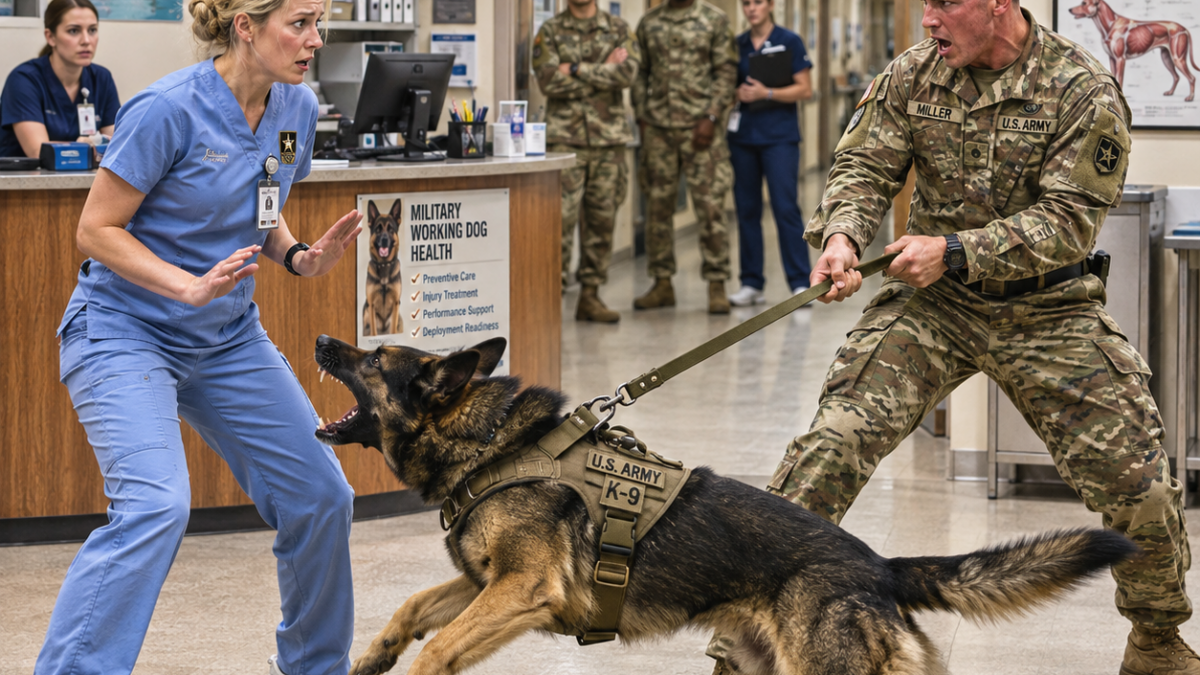
Green Beret Doubted the Quiet Nurse—Until Her Military K9 Skills Exposed a Buried Secret.
The retired Green Beret thought the quiet nurse walking toward his out-of-control Belgian Malinois had no idea what she was doing—until Titan stopped fighting the instant she changed her stance and looked at his injured hip.
Hours later, an X-ray proved the military K9 had been living with a fracture that someone at Fort Dunlap had already examined and somehow declared “clear,” turning Caleb Mercer’s confusion into a question nobody at Ridgeline Animal Trauma Hospital wanted to answer.
Then two federal agents walked through the door, called the nurse by a rank she had not used in fourteen years, and placed a buried military complaint on the table with her own handwriting still visible across the first page.
At 11:47 on a Tuesday morning, Titan hit the floor of Ridgeline Animal Trauma Hospital like something had exploded.
One hundred pounds of Belgian Malinois.
Muscle.
Teeth.
Scar tissue.
Pain.
The front doors slammed backward against their stops as Sergeant First Class Caleb Mercer came through behind him, both hands wrapped around a leather leash that had stopped functioning as a restraint several seconds earlier.
“Clear the lobby!”
The receptionist froze.
A technician carrying a cat carrier jumped backward.
Another employee moved behind the front counter.
Titan lunged sideways.
His claws scraped across the linoleum.
His body twisted.
His teeth flashed.
A low, terrible sound came from somewhere deep in his chest.
Caleb leaned his entire weight into the leash.
“Titan!”
The dog barely seemed to hear him.
Caleb had handled dangerous situations before.
Real ones.
Four combat deployments.
Afghanistan.
Two countries he still did not discuss casually.
Years spent as a Green Beret learning how quickly a manageable situation could turn lethal.
He knew violence.
He knew fear.
PART2:
He knew the difference between panic and intent.
What he was seeing in Titan frightened him more than either.
Because this was not his dog.
Not the dog he had known for six years.
Titan had served beside him.
Slept beside him.
Tracked men through terrain Caleb would never voluntarily cross alone.
Sat quietly beneath helicopter blades.
Ignored gunfire.
Worked injured once without giving away the pain until they were back behind the wire.
Titan did not lose control.
He did not attack without reason.
He did not break commands.
Yet now Caleb could barely hold him.
“Someone get a veterinarian!”
A voice answered from the hallway.
“Everybody stay back.”
Dr. Harlon Voss.
Chief of veterinary surgery.
Mid-fifties.
Expensive watch.
White coat always clean enough to suggest he spent more time directing work than performing it.
He appeared at the end of the corridor.
“Do not approach that dog.”
Most of the staff obeyed instantly.
One woman did not.
Elena Marsh stepped around the intake desk.
Caleb saw her and almost swore.
PART3:
She was not wearing protective gear.
No bite sleeve.
No catch pole.
No muzzle.
Gray scrubs.
Dark hair pinned back.
Maybe thirty-eight.
Medium height.
Quiet face.
The kind of person Caleb would have assumed worked paperwork if he had passed her in the hallway.
“Ma’am.”
She continued forward.
“Stop.”
Elena did not even look at him.
Caleb tightened the leash.
“I said stop.”
Dr. Voss called:
“Marsh.”
She lifted one hand.
Not toward Voss.
Toward Titan.
Caleb could not believe it.
“You’re going to get hurt.”
“No.”
It was the first word she had spoken.
Calm.
Almost flat.
Titan snapped his head toward her.
Elena stopped eight feet away.
She did not crouch.
Did not hold out a hand.
Did not use the ridiculous high-pitched voice strangers sometimes used with military dogs.
She simply stood.
Feet balanced.
Shoulders loose.
Hands visible.
Breathing slow.
Her eyes met Titan’s for perhaps two seconds.
Then moved away.
Caleb noticed that.
Most civilians either stared because they were afraid or avoided eye contact completely.
Elena did neither.
She acknowledged the dog.
Then released the pressure.
Titan’s growl changed.
Barely.
But Caleb knew every sound that animal made.
He heard it.
Elena took one step.
Stopped.
Titan watched.
Another.
Caleb whispered:
“What are you doing?”
“Nothing yet.”
She stood four feet from Titan.
Then looked at his body.
Not his teeth.
Not his eyes.
His body.
Caleb saw her gaze move down the spine.
Shoulders.
Front legs.
Pelvis.
Rear quarter.
Left side.
Her expression shifted.
Small.
Almost invisible.
She reached into her scrub pocket and produced a piece of dried chicken.
Dr. Voss said sharply:
“Marsh, don’t.”
Elena dropped the chicken onto the floor.
Pushed it gently forward with her shoe.
Titan stared at it.
Then at Elena.
Then down again.
He took one step.
His left hind leg landed strangely.
Elena noticed.
Caleb saw her notice.
Titan reached the food.
Ate.
Then stood still.
The lobby exhaled.
Caleb did not.
Elena moved closer.
Titan’s ears rotated.
She stopped again.
Waited.
Then placed the back of her fingers near his shoulder.
He allowed it.
Her hand moved down.
Slow.
Deliberate.
Titan’s breathing changed.
Caleb loosened the leash by half an inch.
Elena looked at him.
“Don’t pull.”
“He can break away.”
“He won’t.”
“You don’t know that.”
Elena returned her attention to Titan.
“No.”
She touched the dog’s neck.
Shoulder.
Thoracic spine.
Then lower.
Titan’s body tightened when her hand approached the left hindquarter.
Elena stopped.
Waited for the tension to release.
Then continued.
Caleb stared.
She was not petting the dog.
She was reading him.
Every pause had a purpose.
Every shift in pressure caused another adjustment.
Titan raised his lip once.
Elena immediately removed her hand.
No fear.
No challenge.
Just information.
Two seconds later, Titan lowered the lip.
Elena touched the hip.
Titan braced.
Not pulled away.
Braced.
Elena’s eyes hardened.
“How long has he been doing that?”
Caleb swallowed.
“Doing what?”
“Protecting the left hip.”
“I don’t know.”
“You do.”
The answer irritated him.
Three days without real sleep made irritation easier.
“I brought him here because I don’t know what’s wrong.”
Elena looked directly at him for the first time.
“How long?”
Caleb thought.
“He started getting short-tempered maybe three months ago.”
“With handling?”
“Mostly.”
“Stairs?”
He hesitated.
“Yes.”
“Jumping into your truck?”
Another pause.
“Yes.”
“Lying on that side?”
Caleb said nothing.
Elena nodded once.
“You’ve been helping him into the truck.”
“How did you know that?”
“Because he stopped loading the hip normally before he stopped obeying you.”
Caleb looked down at Titan.
“What does that mean?”
“It means this isn’t aggression.”
Dr. Voss approached from behind.
“That’s enough, Marsh.”
Elena ignored him.
Caleb said:
“What is it?”
“Pain.”
“I know he’s hurting.”
“No.”
Elena touched the area again.
Titan’s body stiffened.
She withdrew.
“He’s been hurting for months.”
Caleb felt something cold in his stomach.
“Fort Dunlap examined him.”
“When?”
“Two months ago.”
“Imaging?”
“X-ray.”
“Result?”
“Clear.”
Elena’s jaw tightened.
Very slightly.
“What?”
“Nothing.”
“What did you feel?”
She stood.
“I need our own imaging.”
“What did you feel?”
“Crepitus.”
Caleb stared.
“English.”
“Joint movement that shouldn’t be there.”
Her voice remained steady.
“Possible fracture involving the femoral head or acetabular margin.”
Caleb looked from her to Titan.
“You got all that with your hand?”
“I got enough to want imaging.”
Dr. Voss stepped closer.
“She’s an intake nurse.”
Caleb looked at him.
Then Elena.
Something about the phrase bothered him.
Not because it was false.
Because it had clearly been chosen to reduce the weight of everything she had just done.
Another veterinarian arrived.
Dr. Prentice.
Early forties.
He looked at Titan and immediately said:
“Let’s sedate.”
Elena answered:
“No.”
Prentice blinked.
“Excuse me?”
“We don’t have a current weight.”
“We have his file weight.”
“From when?”
Prentice glanced at the chart.
“Seven months.”
“He’s redistributed muscle because he’s been protecting the left rear quarter.”
Prentice stared.
Elena continued.
“If you dose off old weight before we know current condition, you’re making assumptions.”
“We can weigh him sedated.”
“And if he comes out disoriented with uncontrolled orthopedic pain, you may have a harder dog than the one standing here now.”
Prentice’s face tightened.
Dr. Voss said:
“Marsh.”
Elena finally looked toward him.
“I’m the only person he’s allowing to palpate the joint.”
“That does not make you the attending veterinarian.”
“I know exactly what I am.”
The lobby went still again.
Elena looked at Prentice.
“Let me finish the manual assessment.”
Prentice hesitated.
“If he escalates?”
“We stop.”
Dr. Voss folded his arms.
Prentice nodded.
“Fine.”
The assessment took eighteen minutes.
Caleb watched every second.
Twice Titan’s lips pulled back.
Twice Elena stopped before he had to warn her further.
She never punished the warning.
Never called him difficult.
Never called him dangerous.
She waited until he was ready and continued.
When she finished, she stood.
“Imaging.”
Prentice asked:
“How certain?”
“Enough.”
“Soft tissue?”
“No.”
“Why?”
“Response localizes to the joint. He’s bracing against acetabular pressure.”
Prentice stared at her.
Dr. Voss said:
“The military imaging was clean.”
Elena turned.
“The military imaging was read as clean.”
Silence.
Caleb felt the sentence hit him.
Not the same thing.
He pulled out his phone.
“I’ll request the films.”
“Good.”
Elena reached for a transport lead.
Titan stepped next to her without being told.
Caleb watched.
“You’ve handled Malinois before.”
Elena clipped the lead.
“Yes.”
“Military dogs?”
She began walking.
“Come on, Titan.”
The dog followed.
Caleb walked beside them.
“Where did you train?”
“I didn’t.”
“That’s not true.”
Elena looked ahead.
“You asked where I trained.”
“Yes.”
“I didn’t answer.”
Two hours later, Ridgeline’s imaging appeared beside the Fort Dunlap films.
Dr. Prentice stood at the display.
Dr. Voss behind him.
Caleb near the door.
Elena to one side.
Prentice adjusted the image.
Then again.
His face changed.
“There.”
A fracture line.
Left femoral head.
Compression along the joint margin.
Evidence of chronic loading.
Caleb felt his hands curl.
“How long?”
Prentice leaned closer.
“Eight weeks minimum.”
Elena said:
“Longer.”
Everyone looked at her.
She pointed.
“Callus formation.”
Prentice studied it.
She continued:
“Inferior margin.”
He leaned closer.
The room remained quiet.
Then:
“Four months.”
“Four to six.”
Prentice nodded reluctantly.
Caleb’s eyes moved to the older Fort Dunlap image.
“Can you see it there?”
Prentice opened the comparison.
Zoomed.
Adjusted contrast.
Elena moved closer.
There.
Subtle.
But present.
Caleb felt heat climb his neck.
“That image was declared normal.”
Nobody answered.
He looked at Voss.
“Was the fracture there?”
Voss chose his words carefully.
“It appears there may have been an early injury.”
“Was it there?”
“Yes.”
Caleb turned toward Elena.
She was staring at the screen.
No satisfaction.
No triumph.
Only recognition.
“You knew.”
“I suspected.”
“Before you touched him.”
“I saw compensation.”
“How?”
Elena did not answer.
Dr. Voss stepped in.
“Medical imaging is imperfect. Findings are missed.”
Elena looked at him.
“Sometimes.”
The word was dangerous.
Voss heard it.
Caleb did too.
Prentice said:
“We should focus on Titan.”
Good.
That was something Caleb could do.
Surgery was scheduled for the next morning.
Possible repair.
Possible full hip replacement depending on what the orthopedic surgeon found.
Titan went into pre-operative care.
He allowed Elena to place the IV.
Allowed her to check vitals.
Allowed her to lead him away from Caleb.
That last part hurt more than Caleb expected.
He had spent six years being the person Titan trusted most.
Now the dog followed this nurse as though he knew something Caleb didn’t.
At five that afternoon, Elena sat alone in the break room eating leftover soup and crackers.
The receptionist appeared.
“Elena?”
“Yeah?”
“There’s someone asking for you.”
“Client?”
“No.”
Elena kept reading the Fort Dunlap imaging transfer on her phone.
“Give me a minute.”
The receptionist did.
Then returned.
“He asked for you by name.”
Elena looked up.
“Who?”
“He has a federal badge.”
Everything inside Elena became still.
Not frightened.
Still.
The man waiting was Agent Raymond Doyle, Department of Defense Office of Inspector General.
His partner, Agent Nina Rusk, remained near the conference-room door.
Doyle sat across from Elena.
No small talk.
“Elena Marsh.”
“Yes.”
“Former Sergeant Elena Marsh.”
She said nothing.
“Combat Veterinary Support Unit.”
Nothing.
“Operational Detachment Fourteen.”
The air left the room differently.
Doyle finished:
“Classified deployments, 2007 through 2010.”
Elena looked at him.
She had not heard the unit designation spoken aloud in fourteen years.
“You reopened something.”
Doyle placed a folder on the table.
“We’ve been investigating military working dog medical clearances for eight months.”
Elena looked down.
Her own handwriting.
2010.
A complaint.
Three names.
Kira.
Bolt.
Ranger.
She had written every line by hand.
She had filed it in triplicate because she did not trust the computer network.
The commanding officer reviewed it.
Then classified it.
Then closed it.
No action.
Three weeks later Elena was reassigned.
Six months later she was separated.
Official reason:
medical administrative concerns.
There had been nothing medically wrong with her.
Doyle said:
“We know.”
Elena’s eyes stayed on the paper.
“You know now.”
“Yes.”
“Fourteen years later.”
“Yes.”
She looked up.
“Why?”
Doyle slid another sheet forward.
“Titan.”
She stared.
“His case matches a pattern.”
“How many?”
“Seven recent cases confirmed.”
“Dead?”
“Two.”
Elena’s jaw set.
“Another dog was euthanized for behavioral deterioration.”
She already knew what he would say.
Doyle continued.
“Postmortem review indicated chronic orthopedic pain.”
Elena looked back at her old complaint.
“What do you need from me?”
Doyle opened another section.
“The contractor running the clearance system.”
A company.
Vantage Contract Services.
CEO:
Marcus Vale.
Elena’s expression finally changed.
Not much.
Enough.
Doyle saw it.
“You know him.”
“Yes.”
“How?”
“Procurement.”
“Operational Detachment Fourteen?”
“Yes.”
“What was your relationship?”
“He told me to stop.”
Doyle waited.
“Three days before I filed the complaint.”
Elena’s voice was calm.
“He came to me privately.”
“What did he say?”
“That I was misreading the records.”
“Anything else?”
“That filing would end my career.”
Doyle stared.
“Did he threaten you directly?”
Elena thought.
“He smiled.”
Rusk looked up from her tablet.
Doyle asked:
“Why does that matter?”
“Because men delivering friendly advice don’t usually smile while telling you your career is over.”
Silence.
Doyle leaned forward.
“Did you keep anything from 2010?”
Elena looked at him for a long time.
Then:
“I need to think about how I answer that.”
Doyle nodded.
No pressure.
No threat.
He gave her a card.
“We’ll be in Dunore through Friday.”
After they left, Elena sat alone eleven minutes.
Then went back to work.
At home that evening she stood in front of a closet.
Behind a fireproof lockbox.
Behind lease papers.
Behind a car title.
An older case.
Combination lock.
Fourteen years.
She made coffee first.
Not because she wanted coffee.
Because some decisions deserved something ordinary beside them.
She sat in her kitchen thinking about Titan.
A dog in pain.
A military X-ray read as clean.
Two dead working dogs.
One euthanized after chronic pain was called behavioral failure.
Marcus Vale.
His smile.
Nobody is going to listen to you, Marsh.
He had been right.
Then.
Elena finished the coffee.
Returned to the bedroom.
Opened the box.
Inside:
Field logs.
Veterinary assessments.
Forms showing her original findings.
Correction marks entered by someone else.
Emails.
Three photographs.
USB drive.
Her complaint.
Closed in red ink.
And a small digital recorder.
She had carried all of it through four duty stations, two civilian jobs, and one move across the country.
She had never destroyed it.
Destroying it would have meant accepting that it had never mattered.
Elena was many things.
But she had never been built for that.
Her phone buzzed.
Unknown number.
**Titan’s surgery got moved to 7:00. Thought you should know. — Mercer**
Elena frowned.
She had not given Caleb her number.
She typed:
**He’ll be ready.**
Then looked at the box.
Fourteen years was a long time to carry something.
It was also a long time for guilty people to assume you had finally put it down.
Titan’s surgery lasted three hours and twenty minutes.
The orthopedic surgeon, Dr. Euan, opened the joint and discovered the damage was worse than imaging suggested.
The fracture had compressed under continued weight bearing.
Normal repair would not hold.
Total hip replacement.
Elena scrubbed in.
Dr. Voss had not chosen her.
Dr. Euan had.
“You’ve assisted orthopedic?”
“Yes.”
“Where?”
“Field setting.”
Dr. Euan looked at her.
“Military?”
Elena did not answer.
Euan did not ask again.
Two hours into surgery, Titan’s blood pressure began dropping.
Elena saw the trend before the monitor alarmed.
“Pressure falling.”
Euan moved instantly.
Adjustment.
Fluids.
Anesthesia modification.
Seconds later the alarm sounded.
The correction was already underway.
Dr. Euan looked at Elena over her mask.
One nod.
Nothing more.
After surgery, Titan began cycling up during emergence.
A technician tried soothing him.
The dog became more agitated.
Elena sat on the floor beside the recovery mat.
No touch.
Just presence.
“Easy.”
Titan’s breathing changed.
Slowed.
He slept.
Caleb had been waiting since 6:30.
When Elena entered the waiting room at 11:20, he stood before she said anything.
“He’s out.”
Caleb released a breath.
“Surgery?”
“Successful.”
“The fracture?”
“Too damaged for standard repair. Full replacement.”
Caleb sat.
Elena sat opposite because her back hurt.
“Twelve to sixteen weeks rehabilitation.”
“I can do it.”
“First four are strict.”
“I can do it.”
“He cannot decide he feels better and start acting normal.”
Caleb almost smiled.
“You’ve met him.”
“Yes.”
“He did four deployments.”
“So?”
“Twelve weeks is nothing.”
Elena believed him.
Then Caleb’s expression changed.
“The agents found you.”
Not a question.
“Yes.”
“I’ve been talking to Doyle.”
Elena’s eyes narrowed.
“For how long?”
“Six weeks.”
“You knew about the investigation.”
“Parts.”
“Did you bring Titan here because of me?”
“No.”
He shook his head.
“They flagged the Fort Dunlap images. Somebody recommended Ridgeline because of orthopedic capacity.”
“You didn’t know I worked here?”
“No.”
Elena watched him.
Caleb was a good liar when necessary.
She suspected he was not lying now.
He said:
“They showed me the old complaint.”
Her face hardened.
“Not the whole thing.”
“Enough.”
Silence.
“They told me what happened.”
“That version will change every time somebody tells it.”
“They said you filed evidence of falsified K9 clearances and they buried it.”
“That part won’t change.”
Caleb looked through the recovery-room window toward Titan.
“Are you going to help them?”
Elena remained silent.
Then:
“Did Fort Dunlap ever recommend behavioral euthanasia?”
Caleb’s head turned sharply.
“How did you know?”
“Answer.”
“One handler suggested it.”
“When?”
“Last month.”
Elena’s face went cold.
“Reason?”
“Unpredictable aggression.”
“Did the veterinarian agree?”
“Dr. Trell gave us thirty days.”
“To do what?”
“See if Titan settled.”
Elena looked at the floor.
Then at Caleb.
“I’ll help them.”
At noon, she called Doyle.
“I kept records.”
Silence.
“What kind?”
“Everything I could.”
Doyle said nothing.
Elena continued.
“Assessment forms. Field logs. authorization chain. Emails.”
Pause.
“And I recorded Marcus Vale.”
Doyle’s breathing changed.
“When?”
“Three days before I filed.”
“What does he say?”
“He tells me the complaint will end my career.”
Another pause.
“He says nobody will listen.”
Doyle finally exhaled.
“Elena.”
“What?”
“That recording may be what connects intent.”
“I know.”
They met at a diner on Route Nine.
Elena brought no documents.
First meeting was for information.
That was how she worked.
“You show me your case.”
Doyle nodded.
They had financial records.
Systematic contract overbilling.
Clearance incentives.
Three cooperating veterinarians.
Current medical evidence.
Titan.
What they lacked was history.
Proof the scheme had existed from the beginning.
Proof complaints had been deliberately suppressed.
Proof Marcus Vale knew animals were being cleared despite documented injuries.
Elena said:
“I can give you all three.”
Rusk stopped typing.
Doyle looked at her.
“What do you want?”
“My 2010 complaint officially reopened.”
“Done.”
“In writing.”
“Yes.”
“I make copies before anything leaves my possession.”
“Yes.”
“And every item is logged for chain of custody.”
Rusk said:
“We’d insist on that anyway.”
Elena nodded.
“Good.”
That night she laid the records across her kitchen table.
Phone recording.
Date.
Description.
Condition.
Source.
Each item documented before transfer.
Halfway through, her phone buzzed.
Unknown number.
**You should think carefully about what you’re doing, Elena. Some things are better left in boxes. A friend.**
She read it twice.
Screenshot.
Forward to Doyle.
Then continued logging evidence.
The phone rang thirty seconds later.
Same prefix.
Voicemail.
Elena listened.
Fourteen years disappeared.
Marcus Vale’s voice.
Older.
Same cadence.
“This is a courtesy call.”
Her stomach tightened.
“Whatever you think you have, it won’t be enough.”
He continued.
“The people you’re talking to have a limited window before this investigation gets buried the way the last one did.”
Elena closed her eyes.
“So before you do something you can’t undo, think about what you’re protecting.”
Pause.
“Because it isn’t going to protect you back.”
End.
Elena saved the recording.
Forwarded it to Doyle.
Then pulled the 2010 audio from the USB drive.
Marcus Vale.
Same voice.
Same rhythm.
Fourteen years earlier:
**Nobody’s going to listen to you, Marsh.**
Elena sat back.
Vale had made a mistake.
Not the fraud.
Not even the call.
His mistake was believing time had transformed evidence into memory.
It hadn’t.
Agent Rusk arrived at 10:47 with another federal agent.
They worked until one in the morning.
Forensic copies.
Hash verification.
Photographs.
Chain-of-custody logs.
The original recorder was still in Elena’s box.
Batteries removed.
Receipt preserved.
Rusk looked at her.
“You kept the receipt?”
“Yes.”
“Why?”
“Because evidence without provenance becomes an argument.”
Rusk stared.
“You really did this before.”
Elena looked back.
“Yes.”
At 9:47 the following morning, Dr. Voss called her into his office.
A lawyer representing Vantage had requested Titan’s records.
Immediately.
“Independent review.”
Elena read the request.
“Don’t send them.”
Voss frowned.
“I’m hospital director.”
“Yes.”
“I decide record release.”
“Then decide after your attorney tells you whether this is legally compulsory.”
Voss leaned back.
“You’re an intake nurse.”
Elena held his gaze.
“And I’m the only person in this room who knows why that lawyer wants the records before the federal subpoena arrives.”
Silence.
“What are you saying?”
“They are trying to get ahead of evidence preservation.”
Voss’s expression shifted.
“You know that?”
“I know the company.”
“Why?”
“You don’t need that answer yet.”
The old Voss might have pushed.
This version hesitated.
Elena continued:
“If I’m wrong, you lose a day.”
She placed the request on his desk.
“If I’m right and you release raw evidence to the target of an active federal investigation before preservation is secured, this hospital becomes part of the problem.”
Voss stared at the letter.
“Get out.”
Elena left.
At noon, the federal subpoena arrived.
Voss did not release anything to Vantage.
At 11:40, another visitor came asking for Elena.
Garrett Soul.
Attorney for Marcus Vale.
Business card.
Handwritten on the back:
**This doesn’t have to be difficult for you. Call me.**
Elena photographed it.
Sent it to Doyle.
No response to Soul.
By noon, federal investigators were preparing arrest warrants.
Marcus Vale.
Former military official Damen Puit.
Contract administrator Sylvia Bard.
Elena sat in a temporary federal field office above a real-estate agency listening as Doyle explained.
“We need one more commitment.”
“What?”
“Testimony.”
She knew.
“Grand jury?”
“Yes.”
“Trial?”
“Potentially.”
Elena looked at the photographs of the suspects.
Vale.
Older now.
Softer.
The smile gone.
“Yes.”
Doyle nodded once.
Nothing emotional.
Exactly what she needed.
Back at Ridgeline, Titan was standing.
Not well.
Not fully.
But standing.
Caleb sat beside the kennel.
Doyle had briefed him about the warrants.
He looked at Elena.
“What happens to them?”
“Who?”
“Vale.”
“The others.”
“Real consequences?”
Elena thought about fourteen years.
“It depends on evidence.”
“Meaning?”
“It means I stopped trusting promises a long time ago.”
Caleb looked toward Titan.
“So this could happen again.”
“This time I kept better records.”
At 3:22, Doyle texted.
**WARRANTS ISSUED.**
Elena put the phone down.
Continued writing a discharge summary for a cat in Bay Two.
Ten minutes later, the front door opened.
Nobody reacted at first.
Clients came in all day.
Then the receptionist made a strange sound.
Elena looked up.
Marcus Vale stood in the lobby.
For fourteen years, he had lived in Elena’s memory exactly as he had looked in 2010.
Now reality replaced it.
Fifty-four.
Gray at the temples.
Expensive suit.
He looked directly at her.
“Elena.”
She set down the pen.
“Mr. Vale.”
“I’d like five minutes.”
“No.”
His jaw tightened.
“We need to speak.”
“No.”
He stepped closer.
She reached beneath the desk and pressed the silent staff alert.
Not dramatic.
A safety system she had personally helped install for violent clients.
Vale continued.
“Whatever these agents have told you—”
“Stop.”
“Elena.”
“You called me last night.”
He went quiet.
“You texted.”
Nothing.
“You sent your lawyer.”
His eyes shifted.
“And now you walked into a building with cameras.”
She looked toward the entrance.
“You always were too confident about documentation.”
That landed.
For the first time, something honest appeared in his face.
Annoyance.
Fear.
Maybe both.
Vale said quietly:
“You’re making the same mistake you made fourteen years ago.”
Elena looked at him.
“No.”
“What changed?”
“I kept the original.”
The front doors opened behind him.
Agent Rusk entered.
Another agent behind her.
Vale heard the footsteps.
Turned.
Rusk removed her badge.
“Marcus Vale?”
He became perfectly still.
“Yes.”
“I have a federal warrant for your arrest.”
Silence consumed the lobby.
Vale looked toward the exit.
Toward the hallway.
Then at Elena.
Only briefly.
Rusk said:
“Hands where I can see them.”
He complied.
Caleb had emerged from Titan’s recovery wing.
He stood thirty feet away.
Green Beret posture.
Arms at his sides.
No satisfaction in his face.
Only something harder.
Vale was cuffed.
As he passed Elena, he did not look at her again.
That was deliberate.
Elena understood why.
Looking would have meant acknowledging who had been standing in front of him all along.
After the agents left, the receptionist whispered:
“Did that really just happen?”
“Yes.”
Elena picked up her pen.
“I need to finish this chart.”
Four hours later, Doyle confirmed the coordinated arrests.
Puit in Henderson.
Bard in Virginia.
Vale in Nevada.
The first news reports broke the next morning.
Federal contractor.
Military working dog fraud.
Medical clearances.
Contract incentives.
Two animal deaths.
Suppressed complaint.
Titan named as the trigger case.
Elena was not named.
Not yet.
Caleb found her near the supply station.
“They’re calling Titan a trigger.”
“He is.”
“That sounds too small.”
Elena stopped working.
“No.”
She looked at him.
“Trigger doesn’t mean small.”
“What does it mean?”
“It means investigators had pieces.”
She paused.
“Titan connected them.”
Caleb looked away.
“Two dogs died.”
“Yes.”
“What happened to the animals from your complaint?”
Elena knew every answer.
“Kira died during deployment.”
Caleb became still.
“Bolt retired with severe joint deterioration. Died young.”
“And Ranger?”
“Made it to eight.”
“You remember all of them.”
“I wrote their files.”
Caleb looked at her differently.
Not admiration.
Not pity.
Something closer to understanding.
Then the case exploded.
Vale’s own former attorney began cooperating.
Investigators obtained a secondary record system.
Shadow files.
Thirteen years.
Every overridden injury.
Every veterinarian.
Every clearance.
Every contract payment.
Forty-seven dogs.
Forty-seven.
Elena sat down when Doyle told her.
Not because she was weak.
Because standing suddenly felt unnecessary.
“Forty-seven?”
“Yes.”
“Confirmed?”
“Documented.”
“Why did Vale keep records?”
“Leverage.”
Of course.
People running conspiracies often feared each other more than they feared justice.
Vale had preserved his own guilt as insurance against his partners.
Doyle continued:
“Your 2010 material becomes the origin point.”
Elena stared at the wall.
“Meaning?”
“Meaning the case is no longer nine years.”
Pause.
“It’s thirteen.”
“Who else?”
“We’re finding out.”
Then came a phone call that broke through the part of Elena nothing else had reached.
Barbara Wall.
Older woman.
Mother of Corporal Daniel Wall.
Kira’s handler.
“My son didn’t come home.”
Elena pulled her car onto the shoulder of Route Nine.
Barbara continued.
“We were told enemy contact.”
Elena closed her eyes.
“I believe that.”
“The news said a complaint was filed.”
“Yes.”
“About Kira?”
“Yes.”
Silence.
“Did you know her?”
Elena’s voice softened for the first time that day.
“Yes.”
“What was she like?”
The question nearly destroyed her.
Not:
Was she injured?
Not:
Who did this?
What was she like?
Elena stared at the desert.
“She was focused.”
Barbara sniffed.
“She loved Daniel.”
“I know.”
“She wouldn’t leave him.”
“I know.”
Then the question Elena had feared.
“Was she hurt when they sent her?”
Elena pressed her lips together.
“I believe she was.”
The sound on the other end was small.
Controlled.
Grief changing shape after more than a decade.
Barbara eventually whispered:
“Thank you for trying.”
Elena’s eyes filled.
“They didn’t listen.”
“You still tried.”
“I couldn’t stop it.”
“You wrote it down.”
Elena looked toward the black horizon.
“Yes.”
Barbara said:
“Then it existed somewhere.”
That sentence stayed.
The next morning Doyle called.
The shadow files contained forty-seven cases.
Eight veterinarians.
Contract payments tied directly to clearance throughput.
Healthy clearance:
payment.
Treatment delay:
reduced numbers.
Reduced numbers:
contract risk.
The system rewarded clean certifications.
Even when the animals were not clean.
Titan’s own internal note existed.
**Possible joint irregularity. Monitor.**
The phrase was removed from the official certification.
Dr. Nathaniel Trell signed Titan fit.
Eight months later, when Titan’s pain became behavior, Trell’s program called it adjustment failure.
Caleb had trusted them.
That was what hurt him most.
Not that he missed the fracture.
That he believed the people who told him there wasn’t one.
Elena told him:
“You took him back.”
“Too late.”
“You took him back twice.”
“I believed them in between.”
“So would most people.”
“I’m supposed to know my dog.”
“You did.”
Caleb looked at her.
“You said that the first day.”
“Because you knew the diagnosis was wrong before you knew what the right one was.”
He sat with that.
Sometimes truth begins as discomfort.
This answer does not fit what I see.
That had been Caleb’s instinct.
It had been Elena’s in 2010 too.
The federal government formally reopened her complaint.
Then went further.
The U.S. Attorney’s Office filed recognition that Elena’s 2010 whistleblower report had been substantiated and improperly suppressed.
Doyle told her over the phone.
“You were right.”
Elena finished writing Titan’s vitals.
“Fourteen years late.”
“Yes.”
“Still counts.”
“Yes.”
She put away the pen.
That afternoon Titan took his first assisted steps outside.
Caleb held the rehabilitation harness.
Darra, the rehab technician, guided from the left.
Elena stood several feet away.
Four steps.
Five.
Titan stopped.
His repaired hip moved awkwardly.
Then he turned.
Saw Caleb.
Took two more.
Caleb crouched.
Titan pressed his head into his chest.
Caleb closed both hands around the dog’s face.
Elena looked away.
Not because she did not want to see.
Because some moments belonged to the people inside them.
Her phone vibrated.
**Trell taken into custody.**
Then:
**DoD/DOJ press conference 1600. Your name will be identified as the 2010 whistleblower.**
Elena read the message twice.
Fourteen years ago, her name had been attached to a complaint marked classified and closed.
Now the same name would be spoken publicly by the institutions that buried it.
She felt no triumph.
Just weight shifting.
At four, she did not watch.
She was checking a postoperative patient.
The receptionist found her afterward.
“They said your name.”
Elena nodded.
“They said you were a military veterinary specialist.”
“Yes.”
“They said your complaint started the whole case.”
“Not exactly.”
“That’s what they said.”
Elena closed the chart.
The receptionist stared.
“You’ve been here three years.”
“Yes.”
“Working intake.”
“Yes.”
“You never told anyone.”
“No.”
“Why?”
Elena thought.
“It wasn’t relevant until it was.”
Dr. Prentice approached her later.
He had twenty-two years in veterinary medicine.
He looked uncomfortable.
“The hip.”
“Yes?”
“I wouldn’t have caught the clinical signs before imaging.”
“You might have.”
“No.”
He shook his head.
“I didn’t.”
Elena waited.
“You did.”
“Yes.”
He nodded.
Walked away.
That was enough.
Dr. Voss waited until evening.
The lobby was empty.
He approached without summoning her.
That alone was different.
“There’s a position.”
Elena looked at him.
“Clinical specialist.”
Silence.
“Trauma and orthopedic support.”
He continued.
“Consultation. Surgical assist. Protocol development.”
“You’ve had it open seven months.”
Voss looked surprised.
“I read the internal postings.”
“Of course you did.”
He almost smiled.
“I want you to apply.”
Elena stared.
“Why now?”
He did not insult her with a false answer.
“Because I understand your background now.”
“That’s part of it.”
“Yes.”
“What’s the other part?”
Voss took a breath.
“Because I finally started looking at the work you were already doing.”
That answer mattered more.
“I’ll consider it.”
She walked outside.
Nevada evening.
Cold.
Stars beginning.
Her phone rang.
Deputy Inspector General Harmon.
The shadow files contained something else.
A personnel file.
Elena Marsh.
Vale had tracked her for eleven years.
Addresses.
Employment.
Licenses.
Moves.
Jobs.
He had not forgotten her.
He had been afraid of what she kept.
Eight months before Titan appeared at Ridgeline, internal memos discussed a “legacy documentation risk” in Nevada.
Then another memo.
**Create conditions that would draw the asset into the open.**
Elena stood beneath the desert sky.
“The asset is me.”
“We believe so.”
“How did Mercer get referred here?”
“We’re tracing it.”
Elena’s pulse slowed instead of speeding.
That frightened her more.
Titan’s arrival may not have been coincidence.
Vale may have manipulated the referral chain.
Send a compromised dog.
Create a crisis.
Draw Elena out.
See what she knew.
See whether she still held evidence.
Then control the response.
Harmon said:
“He expected you to surface.”
“He was right.”
“Yes.”
“He expected me to panic.”
“Apparently.”
“He forgot something.”
“What?”
“I had fourteen years to get better at this.”
Within thirty-one hours, investigators reversed additional redactions.
Two more names.
Retired General Wallace Sutter.
Pentagon logistics official Roy Abrams.
Sutter helped protect contract renewals.
Abrams participated in suppressing a second whistleblower complaint from 2018.
Another veterinarian.
Dr. Priya Sandoval.
Same concerns.
Same pattern.
Different year.
Same response.
Reassigned.
Marginalized.
Separated.
Elena asked:
“Can I speak with her?”
Harmon paused.
“I’ll ask.”
Five defendants became part of the expanding conspiracy case.
The superseding indictment ran forty-three pages.
Conspiracy.
Wire fraud.
Obstruction.
Witness intimidation.
Forty-seven dogs listed individually.
Elena read all forty-three pages.
Kira.
Case number four.
March 2010.
She stopped at the entry.
Hands flat on the table.
Then kept reading.
That was the only way she knew to do it.
The staff at Ridgeline eventually learned most of the story.
Some became overly respectful.
Elena disliked that.
Some stopped joking around her.
She disliked that more.
Prentice returned to normal first.
She appreciated him for it.
Dr. Voss placed the clinical specialist job description on her desk.
Salary written in pen.
Elena took it home.
At three weeks post-arrest, Darra asked:
“When you walked toward Titan, did you know all this was going to happen?”
Elena laughed once.
“No.”
“You didn’t recognize the conspiracy immediately?”
“I recognized a dog in pain.”
“That’s it?”
“That’s enough.”
Darra thought.
“Most people backed away.”
Elena looked toward Titan’s recovery room.
“That’s how you end up with forty-seven.”
Four weeks later, Elena called Barbara Wall.
“Kira is officially in the indictment.”
Silence.
“By name?”
“Yes.”
“Her injury?”
“Yes.”
“The override?”
“Yes.”
Barbara breathed.
“So they can’t erase her again.”
“No.”
“Are they going to prison?”
“The prosecutors are asking for significant time.”
“How much for Vale?”
“Potentially twenty years.”
Barbara’s answer was quiet.
“Good.”
They talked about Daniel after that.
Not the case.
The man.
What music he liked.
What he wanted to do after service.
How Kira slept outside his bedroom whenever he visited home.
How grief changes a house.
Before hanging up, Barbara said:
“Thank you for keeping the records.”
Elena answered truthfully.
“I couldn’t put them down.”
“That doesn’t make it less important.”
“It wasn’t noble.”
“Maybe it doesn’t have to be.”
Barbara paused.
“Sometimes not being able to put something down is enough.”
Titan’s twelve-week rehabilitation assessment arrived in June.
Nevada heat.
Late-afternoon sun.
Darra worked him through mobility exercises.
Range of motion:
roughly ninety percent.
Walking gait:
even.
Cold stiffness:
expected.
Then Caleb picked up a training bumper.
“You ready?”
Titan’s ears lifted.
Caleb threw it.
The dog went after it.
Controlled trot.
Not perfect.
Not fast.
Not pain.
Elena watched from the wall.
Titan reached the bumper.
Grabbed it.
Returned.
Caleb accepted it.
Then looked at Elena.
“He’s good.”
Not a question.
Elena nodded.
“He’s good.”
Caleb stared at Titan.
Then:
“What about you?”
“What about me?”
“Grand jury is finished.”
“Yes.”
“You’ve testified four times.”
“Yes.”
“Your name is all over the case.”
“Yes.”
“What happens now?”
Elena thought.
“I’m taking the specialist job.”
Caleb smiled slightly.
“I knew it.”
“No, you didn’t.”
“You should.”
“That’s different.”
“And the military?”
She looked at him.
“DoD asked me to join a working group.”
“For what?”
“Rebuilding medical oversight.”
Caleb’s expression sharpened.
“You’re going back?”
“No.”
“Sounds like going back.”
“It’s not.”
Elena looked toward Titan.
“I’m not returning to the person I was in 2010.”
“What are you doing?”
“Using what happened after.”
He waited.
“Civilian practice taught me different failure points.”
Elena continued.
“Military systems taught me others.”
“So you combine them.”
“Yes.”
Caleb nodded.
Titan lay down with the bumper.
Comfortable.
Caleb said:
“He trusted you on day one.”
Elena looked at the dog.
“I think he knew I wasn’t going to pretend he was fine.”
Caleb’s eyes moved to her.
“That’s rarer than it should be.”
“Yes.”
The prosecution took eight months.
Slow.
Motions.
Hearings.
Grand jury.
Defense attacks.
Marcus Vale’s lawyers argued Elena had held a grievance for fourteen years.
She did.
That did not make the documents false.
They argued memory degraded.
Metadata did not.
They argued record discrepancies were administrative errors.
The shadow database destroyed that argument.
They argued the current program had evolved independently from 2010.
Emails connected it directly.
Vale eventually pleaded guilty.
The courtroom was full on sentencing day.
Elena attended.
Not for revenge.
Not entirely.
She wanted to hear the number.
Nineteen years.
The judge cited:
systematic fraud,
forty-seven affected working dogs,
suppression of two whistleblower complaints,
financial motives,
harm to handlers,
and Vale’s direct attempts to intimidate Elena during the active investigation.
Nineteen years.
Vale did not look at her.
Puit received sixteen.
Sutter fourteen.
Abrams nine.
Bard seven after cooperation.
Dr. Trell lost his veterinary license and received four years after cooperating with prosecutors.
Elena thought four years was too little.
She also understood justice had never been designed to match grief exactly.
Outside the courthouse, Doyle found her on the steps.
“How do you feel?”
Elena looked at Las Vegas traffic.
“Done.”
Pause.
“And not done.”
Doyle nodded.
“That’s usually how it feels.”
“Barbara doesn’t get Daniel back.”
“No.”
“Kira doesn’t come back.”
“No.”
“Forty-seven files being corrected doesn’t change what happened to forty-seven dogs.”
“No.”
Elena looked at him.
“But it still matters that the record is right.”
“Yes.”
That was enough for the afternoon.
Ridgeline changed gradually.
Elena became Clinical Trauma Specialist.
Not because she had suddenly become more capable.
Because the title finally caught up to work she had already been doing.
She continued nursing shifts too.
She insisted.
Voss argued.
She won.
Her office was small.
She rarely used it.
The new DoD K9 medical oversight group met monthly.
Elena pushed for independent review.
Separated financial incentives from clearance decisions.
Mandatory secondary assessment when behavior changed suddenly.
Protected reporting outside contractor command chains.
Preservation of raw imaging.
No silent amendment of clinical findings.
No single person able to change a readiness decision without traceable justification.
One day another committee member asked:
“Why are you so obsessive about raw records?”
Elena answered:
“Because summaries can lie.”
Silence.
“Raw data has to be altered deliberately.”
That line went into the protocol.
Dr. Priya Sandoval joined later.
The second whistleblower.
They met quietly.
Neither knew what to say at first.
Priya finally laughed.
“So you too?”
Elena smiled.
“Apparently.”
“They told me I was difficult.”
“They told me I was unstable.”
“Administrative reassignment?”
“Yes.”
“Same.”
They looked at each other.
Eight years apart.
Same machinery.
Priya said:
“I thought I was the only one.”
Elena shook her head.
“That was probably the point.”
The new oversight framework eventually expanded beyond Nevada.
Fort Dunlap adopted revised review requirements.
Contract structures changed.
Civil claims followed.
Families obtained records they had never seen.
Some learned painful things.
Others received confirmation of things they had suspected for years.
Nothing became neat.
That was real life.
Months later, Caleb brought Titan back to Ridgeline.
Not because anything was wrong.
Annual evaluation.
Titan entered through the same front doors.
Bria looked up.
“Oh no.”
Caleb laughed.
“Relax.”
Titan walked calmly at his left side.
No pulling.
No growling.
No teeth.
His gait retained a slight stiffness when he first started moving.
Then loosened.
Elena came around the desk.
Titan saw her.
Stopped.
Ears forward.
Caleb loosened the lead.
Titan crossed the lobby.
Pressed his head into Elena’s hand.
Exactly like the first day.
Only this time the room did not scatter.
Elena scratched behind his ear.
“Still dramatic?”
Caleb said:
“You’re talking about the dog?”
She looked at him.
“Mostly.”
Dr. Voss passed.
Stopped.
“Titan.”
Caleb nodded.
“He’s doing well.”
Voss watched the dog lean into Elena.
Then said:
“Of course he is.”
That was all.
Later Caleb found Elena outside during lunch.
They sat on the low concrete wall behind the hospital.
Titan lay at his feet.
“You know what I thought the first day?”
Elena looked at him.
“I assume something insulting.”
“I thought you were going to get bitten.”
“Reasonable.”
“I thought Voss should stop you.”
“Less reasonable.”
“I thought you were some quiet intake nurse trying to prove something.”
Elena smiled faintly.
“And?”
Caleb looked at Titan.
“I was wrong about the proving part.”
She waited.
“You weren’t trying to prove anything.”
“No.”
“You just knew.”
“I observed.”
“There you go again.”
“What?”
“Making it sound smaller.”
“It isn’t smaller.”
Elena looked at him.
“Knowing what you’re looking at is not magic.”
Caleb nodded.
“No.”
“It’s years.”
“Yes.”
“Training.”
“Yes.”
“Mistakes.”
“Yes.”
“Attention.”
He smiled.
“Yes.”
Elena looked toward the hospital.
“People like dramatic explanations because they excuse them from learning.”
Caleb considered that.
“So the secret is competence.”
“Very disappointing, isn’t it?”
He laughed.
Titan raised his head.
For the first time, Elena laughed too.
Years passed.
The story became one of those cases used in federal training.
Not the sensational version.
The procedural one.
Titan’s case.
Medical compensation.
Behavioral misclassification.
Contract incentive failure.
Whistleblower suppression.
Evidence integrity.
Elena occasionally saw slides with her own name.
She disliked it.
She tolerated it.
One presentation opened with:
**CASE STUDY: MWD TITAN**
That she liked.
Because Titan had never asked to expose anything.
He had simply hurt badly enough that the lie stopped working.
That was what buried systems always feared most.
Not heroic investigators.
Not dramatic whistleblowers.
A fact too physical to explain away.
Titan’s hip was broken.
The image showed it.
The body showed it.
The dog showed it.
Fourteen years earlier, Kira’s body had shown it too.
Bolt’s.
Ranger’s.
Elena had written what she saw.
Someone changed the paperwork.
Then they changed her career.
What they could not change was what had actually happened.
For fourteen years, the truth waited in a locked box.
Then a retired Green Beret walked through a hospital door behind a dog who had finally become too hurt to keep cooperating with the story written about him.
Caleb had doubted Elena because everyone around him had taught him what authority looked like.
White coats.
Titles.
Military clinics.
Official clearances.
Signatures.
Elena had learned a different lesson.
Authority can be wrong.
Records can be altered.
Institutions can protect themselves.
And sometimes the person who sees the truth first is the one everyone has decided is not important enough to listen to.
One winter morning years later, Elena arrived at Ridgeline before sunrise.
New nurse at the desk.
Young.
Nervous.
A difficult German Shepherd had been admitted overnight.
The nurse was standing three feet away reading the chart.
Elena watched her.
“What do you think?”
The young nurse looked startled.
“Me?”
“Yes.”
“Dr. Prentice hasn’t examined him yet.”
“I know.”
The nurse looked toward the dog.
“He keeps turning his head when he sits.”
“What else?”
“Weight’s shifted.”
“Where?”
“Right front.”
Elena nodded.
“Why?”
The nurse hesitated.
“Maybe protecting the left shoulder.”
“Good.”
The nurse stared.
“You think I’m right?”
“I think you observed something.”
Elena handed her the chart.
“Write it down.”
The nurse did.
Not because a quiet nurse should secretly be treated like a decorated specialist.
Not because every junior employee is always right.
But because someone should listen long enough to find out.
That was the lesson Elena chose to keep.
Not that she had eventually been vindicated.
Not that Marcus Vale went to prison.
Not that a federal agency restored the complaint.
Not even that Titan recovered.
It was simpler.
Pain deserves to be believed when the evidence is there.
So does truth.
The afternoon Titan first entered Ridgeline, everyone saw teeth.
Elena saw the leg he was trying not to use.
Caleb saw a dangerous dog.
Elena saw a working animal whose body had finally stopped hiding what the paperwork insisted was not there.
Dr. Voss saw an intake nurse.
The federal records eventually revealed a former sergeant from a classified combat veterinary unit.
But even that description was incomplete.
Elena Marsh was not important because of the title she had once carried.
She was important because fourteen years after being told that what she saw did not matter, she had never trained herself to stop seeing.
And somewhere on a quiet Nevada morning, Titan ran again.
Not fast.
Not like the dog he had been at three years old.
But free of the pain people had once mistaken for aggression.
Caleb watched him cross an open stretch of desert ground, turn, and come back.
No hesitation.
No guarded hip.
No warning growl.
Just the easy confidence of an animal trusting his own body again.
When Titan reached him, Caleb knelt.
Buried both hands in the dog’s neck.
Then looked across the field toward Elena.
She stood with her arms folded.
Same posture.
Same quiet face.
No medals.
No uniform.
No need to explain herself.
Caleb smiled.
“You knew.”
Elena shook her head.
“No.”
Titan leaned against her leg.
She rested one hand on his shoulder.
“I just listened when he told us something was wrong.”
And fourteen years of buried truth had finally started talking with him.








