Girl Pointed at the Van Following 500 Hells Angels—Seconds Later, Every Rider Turned Around, and What They Found Left the Entire Highway in Heartbreaking Silence
PART3:
That was the thing nobody on the roadside understood.
Every July and every November, we did it. We raised money, collected toys, packed trucks and saddlebags, and rode to the children’s hospital in San Luis Obispo. The nurses knew us. Security knew us. The kids knew us, or at least the ones who were well enough to come to the windows.
The year before, we raised forty-three thousand dollars for the pediatric oncology unit.
The year before that, thirty-eight thousand for burn victims under sixteen.
I had personally loaded stuffed animals onto a gurney for a seven-year-old girl from Paso Robles who had lost three fingers in a lawn mower accident. Her name was Emily. She liked purple dinosaurs and hated being called brave because, in her words, “brave is when you choose it.”
I still sent her a Christmas card every year.
None of that fit the picture.
Leather and chrome fit the picture.
Engines fit.
Beards fit.
Patches fit.
A line of bikers heading toward a children’s hospital with toys, checks, stuffed animals, and quiet tenderness?
That confused people.
So they ignored it.
Sandra was in Fresno that weekend visiting her sister, and Lily had begged to come on the run. She had ridden with me before, always with Sandra’s permission and more safety gear than some adults wore. Passenger half helmet. Long jeans. Boots when I could force the issue. That day, she won the argument over the sneakers.
“They’re lucky,” she said when I pointed out the holes.
“They’re falling apart.”
“That’s how you know they’ve been through things.”
I looked at Sandra’s daughter standing in my driveway at 5:10 in the morning with a backpack full of snacks, a dented water bottle, and the calm certainty of someone twice her age.
“You been through things, Lilybug?”
She shrugged.
“I fell off my bike Thursday.”
That was Lily.
No drama.
Just evidence.
By sunrise, we were rolling west.
The convoy settled into rhythm after Atascadero. Engines merged into one continuous thunder that moved through your ribs. The hills along Highway 41 were dry gold under the July sun, oaks scattered like dark punctuation across the slopes. The sky was hard blue, empty except for a few high white streaks and a red-tailed hawk circling over Vineyard Drive.
Lily sat behind me on my Harley-Davidson Fat Boy with the confidence of a child who trusted both the machine and the man in front of her. Her arms were around my middle, her helmet occasionally bumping my back when the formation slowed.
She did not chatter on rides.
Some kids fill the air because silence makes them nervous.
Lily saved words.
That was why, when she spoke, I listened.
The rear tire had been pulling slightly to the right since Templeton. Not enough to worry most people. Enough to bother me before the downhill stretch toward the coast. Near mile marker 22, close to the Vineyard Drive junction, I signaled out and pulled to the shoulder.
The convoy rolled past us in waves.
Six hundred riders became five hundred.
Then a long braid of chrome and leather stretching west.
Then a handful of stragglers.
Then four bikes in the distance.
Then the road quieted enough that I could hear dry grass moving in the ditch.
Lily climbed off the passenger seat without being told and stood on the gravel shoulder. I crouched behind the bike with the pressure gauge.
“Stay close,” I said.
She did not answer.
That made me look up.
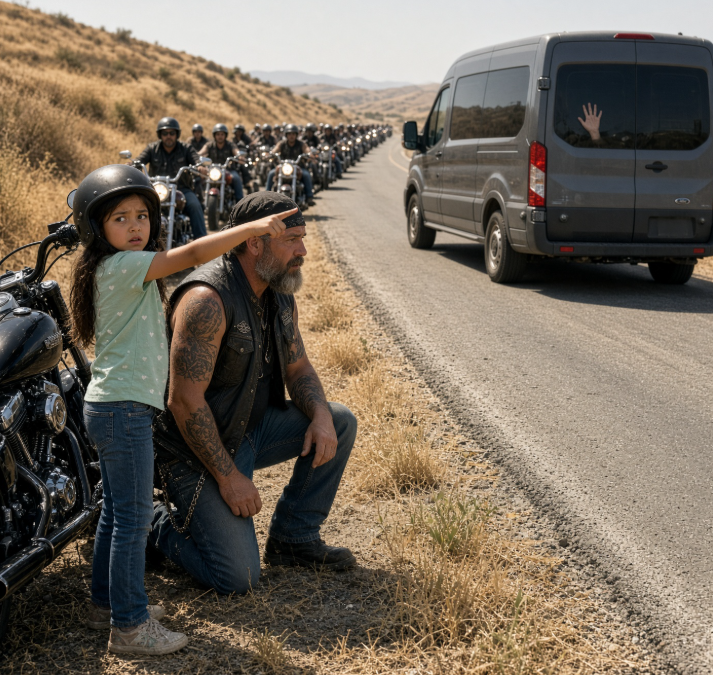
She was staring down the highway, body perfectly still, one arm hanging at her side, the other slowly lifting.
Not pointing in the loose, wandering way children point at clouds or cows.
This was different.
Small hand.
Arm straight.
Finger fixed.
“Rex,” she said.
“Hang on, Lilybug.”
“Rex.”
I turned.
About four hundred yards ahead on the right shoulder sat a gray Ford Transit van, pulled partially off the pavement. No markings. California plates. Tinted rear windows. Engine running.
I had clocked it when I stopped.
Of course I had.
A man like me clocks vehicles without meaning to.
Gray Transit. No company logo. Shoulder. No hazard lights.
I filed it in the background.
Lily had not.
“The van has been following the bikes,” she said.
No fear in her voice.
No excitement.
Just fact.
I stood slowly.
“Since when?”
“Before Atascadero.”
I looked at her.
“What do you mean before Atascadero?”
“When we went under the Viejo Road overpass. It was three cars back. Same one. Then it moved up. Then it slowed down. Then when you pulled over, it pulled over too.”
I put the pressure gauge in my vest pocket.
“How do you know it’s the same one?”
“No writing. Gray. Back window has a sticker in the corner.”
I had not noticed the sticker.
That landed.
I walked four deliberate steps toward the edge of the shoulder and studied the van.
From that distance, I could make out the plate format but not the number. The van sat still. Driver’s door closed. No one outside. No hazard blink. No visible flat tire. No reason to be stopped except the reason Lily had named.
It had stopped because we had.
“Stay by the bike,” I said.
She did not move.
“Rex.”
Her voice had changed.
Quiet.
Thin.
But controlled.
I turned.
She was staring at the rear window of the van.
“There’s a hand.”
I saw it three seconds after she did.
Small.
Pressed flat against the inside of the tinted rear glass.
Fingers spread.
Pale against dark.
Not waving.
Not tapping.
Just there.
Two seconds.
Then gone.
Not lowered.
Pulled.
My body went cold in the July heat.
There are things a man sees once and never needs explained again.
I had spent eight years with children who did not know how to ask for rescue in adult language. That hand was not random. It was not a joke. It was not a shadow.
It was a child using the only surface available.
Lily whispered, “It was a kid.”
I took out my phone.
Two bars.
Sometimes one on that stretch.
I pulled up Frank Aldridge’s number and called.
The phone rang four times.
Five.
On the sixth, he picked up. Road noise roared behind him.
“Callaway, where are you? Targo Flat?”
“No. Frank, I need you to listen.”
Something in my voice cut through the engine noise.
The background changed slightly, like he had turned his head away from the wind.
“I’m listening.”
“Mile marker 22. Gray Ford Transit on the right shoulder. California plate, can’t read it yet. Lily says it followed us from Viejo. I just saw a child’s hand in the rear window.”
No immediate response.
That was why Frank was Frank.
He never filled silence just because it opened.
“How sure?”
“Sure.”
“Driver?”
“Inside. Engine running. Windows up.”
“Police?”
“Not yet. I’m calling you first because the convoy just rolled past and the van hasn’t moved.”
“What do you need?”
“Pull the last five riders if they’re close. Come back quiet. No full thunder until you’re around the bend. Bring Drexler if he’s still in rear formation.”
Another half beat.
“Copy.”
He ended the call.
I crouched beside Lily.
She had not moved from the shoulder. Her jaw was set in that particular way Sandra’s used to be when she had decided fear could wait until work was done.
“Did you see it too?” she asked.
“I saw it.”
“Are you going to help them?”
“Yes.”
Her eyes held mine.
“You promise?”
Some promises should not be made lightly to children.
This one could not be avoided.
“Yes.”
I put my hand on her shoulder.
“I need you to get back on the bike. Sit on the far side, facing the hills. Keep low. Keep quiet. If I tell you to get down, you get down. If Frank tells you to move, you move. If a deputy comes and asks you what you saw, you tell the truth exactly once and don’t let anybody make you think you imagined it.”
She blinked.
That was a lot for eight.
But Lily did not ask me to repeat it.
She walked to the Fat Boy and climbed onto the passenger perch, facing away from the road.
Not crying.
Not asking what trafficking was.
Not asking what would happen.
Just doing what needed doing.
Sandra had raised something extraordinary.
I called 911 next.
The signal dropped once before dispatch picked up.
I gave location first.
Highway 41.
Mile marker 22 near Vineyard Drive.
Gray Ford Transit, no markings, idling on shoulder, possible child in distress inside, visible hand against rear window, caller on scene.
The dispatcher asked whether I had approached the vehicle.
“No.”
She asked if anyone was armed.
“I can’t see.”
She asked if the driver knew we had seen the hand.
“I don’t know.”
She asked me to stay back.
I said I would.
Then I watched the van.
Seconds change when a child might be trapped inside a metal box in July.
They become physical.
You feel each one pass.
At three minutes and forty-two seconds, a sedan came around the bend from the Atascadero direction. It slowed as it passed me, the driver staring at my bike, my vest, my beard, and Lily sitting behind the saddle. He looked at the van too, but not long enough to see anything. Then he accelerated away.
The van did not move.
At six minutes, I could read the plate through the shimmer of heat.
7TRK891.
I repeated it in my head once.
That was all it took. Old habits took care of the rest.
At seven minutes, I heard motorcycles coming from the Morro Bay direction.
Not the full roar.
Five bikes.
Engines low.
Controlled.
Frank came first, full-face helmet on, white beard compressed beneath it. Behind him came Frank Drexler, Tommy Hess, Wayne Bricker, and Cole Simmons, a twenty-six-year-old prospect still learning when to talk and, more importantly, when not to.
They pulled behind my bike and killed their engines.
Frank did not remove his helmet.
His eyes went straight to the van.
“How long has it been sitting there?”
“Since before we stopped.”
“Lily clocked it from Viejo?”
“Yes.”
Frank looked at Lily.
She gave him a single nod.
He returned it with complete seriousness.
That was one thing I loved about Frank Aldridge: if a child gave him information, he did not treat it like decoration.
“What did you see?” he asked me.
“Child’s hand on the rear window. Two seconds. Pulled back.”
Drexler moved up beside us.
He was wide, quiet, fifty-eight, with hands that still looked like they belonged near emergency equipment. He had spent twelve years as a licensed EMT in Bakersfield before moving to the coast. He looked at the van. Then the road. Then the sun.
“Ventilation,” he said.
That word tightened everything.
I studied the vehicle again.
Windows up.
Engine running.
“You can see exhaust,” I said.
“Cab might be cooling,” Drexler said. “Doesn’t mean the back is.”
The temperature was eighty-seven degrees and climbing. Dry Central California summer heat. An enclosed cargo area could turn cruel fast.
Frank already had his phone out.
He called dispatch too, gave his name, location, vehicle description, plate, number of possible witnesses, and the fact that a child’s hand had been observed through the rear window.
Then he listened.
His face hardened.
He hung up.
“Sheriff’s unit is on the way.”
“How long?” Wayne asked.
“Seven to twelve minutes.”
Nobody spoke.
Seven to twelve minutes is reasonable on a map.
It is not reasonable if you are small, trapped, dehydrated, and hot in the back of a van.
Frank looked at me.
“We wait for the unit.”
“I know.”
And I did know.
I knew procedure.
I knew risk.
I knew what could happen if five bikers approached a suspicious vehicle on a state highway with an unknown driver and unknown occupants.
I knew what would happen in the report if it went wrong.
I knew that an adult man can make a rescue worse by needing to feel like the hero.
So I stood still.
And counted.
One.
Two.
Three.
Lily sat silently on the bike.
Drexler watched the van like he was trying to assess vital signs through steel.
Cole shifted from one foot to the other.
Frank noticed.
“What?”
Cole swallowed.
“Shouldn’t the rest of them know?”
Frank looked at him.
Cole’s eyes flicked down the road where the convoy had disappeared.
“Five hundred riders just went down the hill.”
The road behind them lay empty and bright.
Frank took a long breath.
This was the sort of moment men remember because a group becomes exactly what it is in the space between options.
Frank lifted his radio.
No speech. No explanation. No drama.
At 11:23 a.m., he sent four words over the chapter frequency.
“Mile 22. Van. Now.”
That was all.
In our world, that was enough.
For the first two minutes after the radio call, nothing changed.
The van sat.
The engine idled.
The driver’s head remained down.
I watched the rear window until my eyes hurt.
No hand appeared again.
That scared me.
A deputy arrived before the convoy returned.
His cruiser came from the Atascadero direction, lights on, no siren. He pulled twenty yards behind us and stepped out with the careful posture of a man already balancing information against expectation.
He was mid-thirties, broad shoulders, close-cropped hair, professional face. His badge read Watts.
Deputy Derek Watts.
I had seen that expression before.
A lawman responding to a call involving bikers on a highway shoulder.
He expected one kind of problem.
He found another.
“You the one who called in a possible child in distress?” he asked.
Frank spoke first.
“I called it in.”
Watts looked at Frank’s cut, then at me, then at Lily, then the van.
“What’s the nature of your concern with the vehicle?”
His voice was flat and controlled.
Trained not to show the assumptions pulling on him.
I answered before Frank could.
“Child’s hand on the rear window approximately fourteen minutes ago. Small, pressed flat, fingers spread, visible for two seconds, then retracted. Van has been idling with windows up in eighty-seven-degree heat for roughly twenty minutes. Engine running the entire time. No visible mechanical issue. Lily saw the vehicle follow the formation from before Atascadero.”
Watts looked at me more closely.
“You’re certain about the hand?”
“I’m certain.”
“Witness?”
“My goddaughter.”
He looked at Lily.
She sat up straighter on the bike.
“I saw it before Rex did,” she said.
That changed him.
Not dramatically.
But enough.
The preconception lost some of its grip.
Watts looked back toward the van.
“Stay here.”
He moved toward it.
Twenty yards.
Fifteen.
Ten.
He raised one hand in standard traffic-stop posture and approached the driver’s window.
That was when the sound began behind us.
Not sudden.
Not loud at first.
A low vibration under the road.
A pressure moving through the air.
I turned slowly.
The convoy came around the bend from the Morro Bay direction in a formation that had reorganized itself in the eleven minutes since Frank’s radio call.
Not chaotic.
Not angry.
Not a swarm.
A disciplined single file unspooling around the curve like a river reversing course.
Fifty riders.
Then one hundred.
Two hundred.
Three.
Four.
The sound built into something physical, pressing against the chest, rolling through dry hills and grass, chrome flashing in the sun. Then, one by one, two by two, they pulled onto the shoulder behind us.
And killed their engines.
Silence arrived in waves.
The last motor died.
Five hundred motorcycles lined the shoulder of Highway 41, stretching behind us nearly a quarter mile.
Not a word.
No shouting.
No revving.
No posturing.
Just five hundred riders sitting quiet in the heat because a child had pointed and one of ours had said now.
Deputy Watts had frozen at the van’s driver window.
So had the driver.
Watts turned and looked back at the line of riders. His hand moved toward his radio, then stopped. He turned back to the van.
I watched his posture shift.
Inquiry became authority.
The driver’s door opened.
A woman stepped out.
Mid-thirties.
Dark hair.
Jeans.
Yellow windbreaker wrong for the July heat.
Hands half raised, not quite surrender, not quite cooperation.
That jacket bothered me immediately.
Too much cover for the weather.
Too much concealment for a woman who wanted to look casual.
Watts spoke to her.
She shook her head.
He spoke again.
The rear doors opened.
Drexler was moving before anyone asked him to.
So was I.
Then I stopped.
Not because I did not want to go.
Because Lily was behind me.
And sometimes your first duty is not the most dramatic one.
I went to my goddaughter.
She had been watching everything.
Her face was eight years old and far too composed.
When children become still like that, adults should be careful. Stillness can be courage. It can also be a child trying not to make the room worse.
“Are they okay?” she asked.
“Drexler’s with them. He knows what to do.”
“But are they okay?”
I crouched to her eye level.
Behind me, voices sharpened. Watts’s radio came alive. Drexler’s low EMT voice cut through the heat with instructions. The woman in the windbreaker was being secured near the cruiser.
“They’re going to be,” I said, “because you saw what you saw.”
Lily looked at me for a long moment.
Then she said something that I have carried ever since.
“Somebody had to look.”
Inside the van were three girls.
Approximately seven, nine, and eleven.
All conscious.
All dehydrated.
All frightened in that flat, distant way children become frightened when panic has already used up the first layer of them. The youngest sat in the corner with her knees drawn to her chest. One had marks on her wrists where restraints had recently been removed. They blinked in the sudden flood of California sunlight as if the world had become too bright too fast.
I did not learn their names.
I did not ask.
Names belong first to the people who need to be safe before they become part of anyone else’s story.
By 12:17 p.m., Highway 41 between mile markers 21 and 24 had become a coordinated emergency scene.
Three San Luis Obispo County sheriff’s cruisers.
One CHP unit.
Two paramedic rigs from the Atascadero mutual-aid agreement.
Yellow tape tied between road signs.
Traffic slowed and diverted.
The woman in the yellow windbreaker, whose name emerged as Cheryl Boone, age thirty-six, last known address in Stockton, sat in the back of a cruiser with zip-tied hands and a face that had moved from calculation to acceptance.
Drexler met the paramedics at the van with pulse rates, approximate ages, hydration status, visible findings, and a summary so precise that one paramedic stopped mid-step.
Her badge said Torres.
She looked at Drexler.
“You a medic?”
“Was. Bakersfield. Kern County. Twelve years.”
“Do you need me to step back?”
Torres looked at the girls.
Then at Drexler.
“No,” she said. “I need you right here.”
That was how scenes should work.
Not ego.
Need.
Skill.
Use whoever can help.
The riders stayed back without being asked.
Five hundred and fourteen motorcycles by the final count, lined along the shoulder, quiet in the heat. No one crossed the tape. No one interfered. No one shouted at deputies. No one demanded credit. They stood, sat, waited, watched the road, and became exactly what the moment required.
A wall.
Not around themselves.
Around three children they did not know.
That is what most people did not understand when they saw us coming.
They never wondered what we were riding toward.
Only what they assumed we were riding away from.
Frank came to stand beside me around 12:22 p.m.
For three minutes, neither of us spoke.
We watched Torres wrap a mylar blanket around the youngest girl, who held a bottle of water in both hands like it might vanish if she loosened her grip.
Frank finally said, “How did you know?”
“I didn’t.”
He glanced at me.
“Lily knew.”
He accepted that.
Then said, “You knew what to do with what Lily saw.”
I looked down the highway toward the place where the van had been sitting.
Old rooms rose in my mind.
Johnson Avenue.
White walls.
Plastic chairs.
Interview tables.
A four-year-old who only answered questions while hiding under a desk.
A twelve-year-old who drew houses with no doors.
A teenage boy who would not say his foster father hit him but described the exact sound of the belt buckle on tile.
The work had not left.
It had only stopped having an office.
“I used to work child welfare,” I said.
Frank did not turn.
“County?”
“Eight years.”
“I didn’t know that.”
“I don’t tell it.”
“Why not?”
I watched the youngest girl accept another sip of water.
“Because it doesn’t fit the picture people already have. So I stopped trying to fit it.”
Frank made a sound too low to be agreement and too thoughtful to be dismissal.
After a while, he said, “You ever think about going back?”
“To social services?”
“To the work.”
That was a different question.
I did not answer quickly.
The truth was complicated.
I did not miss the system.
I did not miss the paperwork, the court deadlines, the impossible caseloads, the phone calls from supervisors who wanted risk reduced without resources increased. I did not miss the feeling of leaving a house knowing a child was not safe enough and not yet unsafe enough for a judge.
But I missed the moment attention mattered.
The moment one adult believed one child quickly enough for the world to change.
“Some of it,” I said.
Frank nodded as if that was the answer he expected.
Deputy Watts walked toward us a little after 12:31.
He stopped at the yellow tape.
Professional neutrality was still on his face, but it had cracked around the edges.
“I need your full account,” he said. “Yours and the child’s.”
“My goddaughter.”
“Yes. Your goddaughter’s.”
He wrote something in his notepad.
“The investigator from the task force wants to speak with both of you.”
“What task force?” Frank asked.
Watts looked at him briefly.
“Multi-county. Human trafficking. That van was flagged eight days ago in Sacramento. They lost it south of Stockton.”
He looked back at me.
“Your call is what found it.”
“My goddaughter’s observation is what found it.”
Watts met my eyes.
Then wrote that down.
Good.
He hesitated after that.
Something human moved under the uniform.
“I need to ask you something.”
I waited.
“When you called in—when your chapter called in—what made you think we’d respond to a call from…”
He stopped himself.
Frank’s eyes shifted toward him, but he said nothing.
I knew what Watts had almost said.
A call from bikers.
A call from men like you.
A call from the picture I had before I arrived.
“What made us think you’d respond?” I asked.
His jaw tightened.
He knew I was not letting him hide from his own unfinished sentence.
“I’m asking because—”
“There were children in that van,” I said. “You call, you act, and you account for everything else later.”
I held his gaze.
“That’s not a biker thing. That’s a human thing.”
Watts stared at me for three seconds.
Then he looked down at his notepad.
“I’m going to write in my report that your group’s response was decisive in the recovery of three minor children from an active trafficking situation.”
He chose every word like he had to lift it from somewhere heavy.
Frank said nothing.
I said nothing.
Some statements deserve space.
Watts nodded once and walked back toward the command vehicle.
Frank placed one hand briefly on my shoulder.
That was all.
In my world, that was enough.
When I turned, Lily stood four feet behind me.
She had materialized from the bike with the silent competence she seemed to develop entirely on her own.
I almost told her to go back.
I didn’t.
She was part of this story whether I liked it or not.
“The little one,” she said. “The one with the blanket.”
“Yeah?”
“She’s the same size as me.”
I looked toward the paramedic rig.
The youngest girl sat on the step with the blanket around her shoulders and water in both hands. She did look about Lily’s size.
“Yeah,” I said. “She is.”
Lily watched her for a long time.
“Will she go home?”
“I don’t know.”
That answer hurt.
But I would not lie to her.
“Will someone nice take care of her?”
“Yes.”
“How do you know?”
“Because a lot of people are watching now.”
Lily looked up at me.
“People should’ve been watching before.”
There are moments when children say something so true adults have to decide whether to defend the world or admit it.
I admitted it.
“You’re right.”
Special Agent Carla Donovan arrived later in a gray Tahoe with state plates.
She was fifty-four, though I only learned that later, and had been working child exploitation cases since 1998, the same year I started child welfare. That meant we had been moving through adjacent rooms of the same broken system for years without ever meeting.
She wore plain clothes, carried a legal pad, and had the tired focus of someone who had learned to put fury in a locked box until the work was done.
She introduced herself to me with a firm handshake.
Then she crouched to Lily’s level.
That told me plenty.
Not everyone knows to get down when speaking to a child. The ones who don’t know usually haven’t spent enough time listening to them.
“Your name is Lily?” she asked.
“Lily Marsh.”
“I’m Carla. I need to ask you some questions about what you saw today. Is that okay?”
“Yes,” Lily said. “I already told Rex. I can tell you the same things.”
Donovan’s mouth softened at one corner.
“That would help.”
She took Lily’s account in eleven minutes.
Viejo Road overpass.
Gray van.
Three cars back.
Forward movement.
Shoulder stop.
No markings.
Sticker in rear window.
Hand against glass.
Pulled back.
Donovan wrote it down without asking Lily to repeat herself unnecessarily.
That mattered too.
Children notice when adults make them say frightening things more times than needed.
When Lily finished, Donovan said, “You did exactly the right thing.”
Not to me.
Not to all of us.
To Lily.
The recognition landed where it belonged.
Lily nodded solemnly.
“I told Rex because he listens.”
I had to look away.
Donovan took my account next.
Then Frank’s.
Then Drexler’s medical observations.
She confirmed only what she could: the three girls were part of an active case that had begun in Sacramento eight days earlier and crossed multiple county lines. All three had been reported missing. All three were conscious and communicating. Cheryl Boone was connected to a network already under investigation.
I did not ask for details beyond that.
The older I get, the less I believe curiosity is always a virtue.
Some details belong to investigators.
Some to courts.
Some to therapists.
Some to children years later if and when they choose to tell their own stories.
By 2:30 p.m., the scene began clearing.
CHP managed traffic.
Sheriff’s vehicles left in sequence.
The paramedic rigs departed toward Sierra Vista Regional Medical Center on Johnson Avenue in San Luis Obispo.
Johnson Avenue.
The same street where I had spent eight years across a desk from children whose lives had become files.
I stood on the shoulder and watched the ambulances leave.
Four miles.
That was the distance between the highway and the hospital.
Four miles between a tinted van and a trauma team.
Four miles between being unseen and being received.
I thought about the staff who would meet them.
The case workers called on a Saturday.
The emergency placement calls.
The forensic interviews.
The blankets.
The juice boxes.
The paperwork.
The careful questions.
The mistakes they would try not to make.
The ways the system would help and fail and help again.
I had left that world.
But for one morning on Highway 41, it had reached up through the asphalt and put me back to work.
Deputy Watts was the last official to leave.
He walked over while Lily sat sideways on the Fat Boy again, facing the hills instead of the road.
Most of the riders were mounted now, engines off, waiting.
Watts checked his notepad.
“Rex Callaway?”
“That’s right.”
He looked at the line of bikes.
Then back at me.
“I’ve been working this highway six years,” he said. “I want to tell you something.”
I waited.
“Most of what I think I know when I pull up to a scene…”
He stopped.
Organized something in himself.
“I’m going to be thinking about this one for a while.”
“Most things worth thinking about take a while.”
He absorbed that.
Then extended his hand.
I shook it.
His grip was firm, but not performative.
He walked back to his cruiser and drove east toward Atascadero.
Frank rode up alongside me, visor lifted.
He looked down the highway toward Morro Bay, where the afternoon light had turned the hills the color of old brass.
“You know what the strangest thing is?” he said.
“What?”
“All these years. All these runs. All the times people saw us coming and moved to the shoulder.”
He paused.
“They never wondered what we were riding toward.”
I looked at him.
“Always what they thought we were riding away from.”
Frank repeated it quietly, as if placing the words somewhere permanent.
“Always what they thought we were riding away from.”
Then he pulled his visor down and gave the old road signal.
Two fingers forward.
Engines started in sequence.
Low.
Controlled.
Deliberate.
Not a roar meant to announce ourselves.
A formation returning to motion.
Five hundred motorcycles pulled onto Highway 41, heading west toward the coast. The sound filled the valley between the hills and then stretched ahead of us, long and steady.
Lily wrapped her arms around my middle.
We rode eleven miles without speaking.
She understood silence better than some adults. She knew which silences were empty and which ones were full, and she left the full ones alone.
On the downhill toward Morro Bay, where the Pacific first appeared as a thin bright line between the hills, she leaned closer.
“Rex?”
“Yeah.”
“Did you know what was going to happen when you stopped to check the tire?”
“No.”
“You just stopped because it was pulling?”
“That’s right.”
“But then I saw.”
“Then you saw.”
“And you knew what to do with it.”
The words hit harder than she meant them to.
I kept my eyes on the road.
“I knew some of what to do.”
“My mom says you used to help kids for your job.”
I had not known Sandra had told her.
For a moment, I did not know how to hold that.
“A long time ago.”
“Do you miss it?”
The Pacific widened ahead.
Blue.
Bright.
Indifferent.
I thought about Donovan’s legal pad. Deputy Watts’s report. Drexler kneeling in the van. The youngest girl with the mylar blanket. The way Lily had said somebody had to look.
“Some of it,” I said.
She accepted that.
Children are better than adults at letting partial truths stand.
At Morro Bay, we stopped for fuel and water at the Chevron on Main Street. The great black dome of Morro Rock stood against the Pacific in the July light. Riders spread through the parking lot and sidewalks in groups of five, eight, twelve. Locals went about their afternoon without alarm. They knew the July run. They knew we came through every year. Familiarity softens fear better than explanation ever does.
An elderly man sat on a bench outside the bait shop across the street.
I learned later his name was Howard Quinland.
Seventy-nine.
Korean War veteran.
Daily coffee at the Hofbrau on Harbor Street for eleven years.
He had watched the July run for a decade.
When the lead riders passed, he lifted one hand in a slow wave.
A few riders waved back.
He did not know what had happened on Highway 41.
He did not know a child had noticed a van.
He did not know three girls were alive because Lily had refused to dismiss what she saw.
He only knew the formation had arrived later than usual and quieter than usual.
At the end of the line, as I rolled past on the Fat Boy, Lily lifted her arm and waved.
Not a quick flap.
A full, unhurried wave.
The way children wave when they mean it.
Howard raised his coffee cup in response.
That should have been the end of it.
It wasn’t.
Stories like that do not end where the event ends.
They follow everyone home.
The first news report aired that evening.
“Biker convoy helps recover missing children from trafficking suspect on Highway 41.”
That was better than I expected and still too simple.
By the next morning, other outlets had found the story.
Some leaned hard into surprise.
Hells Angels Toy Run Turns Rescue Mission.
Girl Spots Van, Hundreds of Riders Respond.
Bikers Help Save Three Missing Children.
I hated some of the wording.
Not because it was inaccurate exactly.
Because the surprise was doing too much work.
As if people in leather caring about children violated a law of nature.
As if a child seeing clearly were adorable rather than essential.
As if the story were about redemption for men who had not asked anyone to misunderstand them in the first place.
Sandra called me Sunday morning from Fresno before driving back.
She had seen the news.
At first she could not speak.
Then she said, “Put Lily on.”
I handed the phone to Lily, who sat at my kitchen table eating cereal from a mixing bowl because she said normal bowls were too small for stressful weekends.
She listened.
“I’m okay,” she said.
Pause.
“Yes.”
Pause.
“I told Rex.”
Pause.
“Because he listens.”
She looked at me while Sandra spoke.
Then her face changed.
“Mama, I wasn’t scared until after.”
That one got me.
I turned toward the sink and pretended to rinse a mug that was already clean.
Fear often waits until the job is done.
Adults forget that about children.
They can hold themselves together through the impossible and fall apart over breakfast because the body finally gets permission.
When Sandra got back, she came straight to my house.
Lily ran to her across the driveway, and Sandra dropped to her knees and wrapped both arms around her like she meant to fold the child back into her own body.
I stood near the garage and let them have that.
After a while, Sandra looked over Lily’s shoulder at me.
Her eyes were wet.
“Thank you.”
I shook my head.
“She did it.”
“You listened.”
“That’s not special.”
“It should not be,” Sandra said. “But it is.”
I had no answer.
The county asked for formal statements later that week.
Lily gave hers with Sandra present, me sitting outside the room because that was cleaner. I did not want any defense attorney someday suggesting she shaped her account to please me. Donovan handled it with care.
Afterward, Lily came out holding a granola bar someone had given her.
“She asked the same questions but not in a dumb way,” Lily said.
High praise.
“What’s a dumb way?” I asked.
“When adults ask you something and already decided the answer.”
I looked at Sandra.
Sandra closed her eyes briefly.
Our children know us too well.
A week later, Frank Aldridge called a chapter meeting.
Not unusual.
But the room felt different before he spoke.
Men leaned against walls, sat at tables, stood near the back with arms folded. Some had been on Highway 41. Some had only heard the story from the news, from brothers, from the thousand private retellings that happen after something large.
Frank stood at the front and waited until the room settled.
“We’re not here to celebrate,” he said.
That was Frank.
No warm-up.
“No child’s rescue is a celebration. It’s a relief. There’s a difference.”
The room stayed quiet.
“We’re proud of how the club responded. We’re proud of Lily Marsh. We’re proud of Callaway, Drexler, everyone who held position and didn’t turn the scene into something about us.”
His eyes moved around the room.
“But I want everyone to understand what happened. A kid saw what adults didn’t. Not because she was magic. Because she was looking.”
He paused.
“And because Rex believed her fast.”
I looked down.
I did not enjoy being named in rooms.
Frank continued.
“So here’s what changes. On runs with children or charity loads, we tighten rear observation. We log suspicious vehicles earlier. We keep one medically trained rider near the rear, not just front. We coordinate with local law before and after the run when routes involve long rural stretches. We do not become police. We do not play hero. But we do not ride past something wrong because we assume someone else will see it.”
That became policy.
Not official in some corporate handbook sense.
Better.
Lived policy.
The kind men follow because they remember why it exists.
Drexler built a basic emergency-response kit list for long runs.
Torres from the paramedic crew helped him refine it later, though she complained about half his terminology and he complained about her handwriting.
Deputy Watts attended one meeting two months later at Frank’s invitation. He arrived in plain clothes. Some men did not like that at first. Old histories run deep between clubs and law enforcement, and trust does not appear because one deputy shook one hand after one good day.
But Watts did not pretend otherwise.
“I’m not here because we’re friends,” he said. “I’m here because the highway doesn’t care who finds the emergency first.”
That earned him more respect than friendliness would have.
He and Frank built a basic communication protocol for major charity rides: route notices, emergency contact numbers, rear vehicle reporting, and specific language for suspicious child welfare concerns that would not get buried under “biker incident” assumptions in dispatch.
It was practical.
Raymond, my old supervisor from child welfare, would have called it “useful enough to survive contact with humans.”
I thought about that phrase often.
The girls from the van remained unnamed publicly.
Good.
Sometimes the best outcome is a story where the rescued get privacy and the rescuers do not try to fill the empty space with themselves.
All I heard through Donovan, months later, was that they were safe, medically stable, and placed through proper channels while the case moved forward. All three had family situations more complicated than headlines could hold. All three were alive.
Alive was enough for me.
Lily asked about them sometimes.
Not obsessively.
Just honestly.
“Do you think they have bikes?”
“No idea.”
“Do you think the little one likes dogs?”
“Probably.”
“Everybody likes dogs.”
“Not everybody.”
“People who don’t like dogs need help.”
Hard to argue.
One Sunday in September, Lily came with me on a shorter ride near Templeton. Sandra followed in her car because motherhood had limits even if trust existed.
We stopped at a roadside fruit stand.
Lily picked peaches with serious concentration, rejecting several for “bad vibes,” which the old woman running the stand accepted without question.
On the way back to the bike, Lily paused.
“Rex?”
“Yeah?”
“Sometimes I feel bad.”
“For what?”
“That I saw.”
I crouched beside her in the dust.
“What do you mean?”
“If I saw, that means it was real.”
Children will break your heart with accuracy.
I took off my sunglasses.
“It was real whether you saw or not.”
She looked at the peach in her hand.
“But if I didn’t see, maybe I wouldn’t think about it.”
“No. But those girls might still be in the van.”
She nodded slowly.
“I know.”
“That’s a heavy thing.”
“Yeah.”
“You don’t have to carry it by yourself.”
She looked up.
“Do you carry stuff by yourself?”
I almost answered too fast.
That would have been dishonest.
“I used to.”
“Does it work?”
“No.”
“What happens?”
“You get mean or tired.”
“You’re not mean.”
“I was getting there.”
She studied me.
“Then don’t.”
Children.
No nuance.
No exit ramp.
Just the plain order hidden inside love.
“Okay,” I said.
“Promise?”
Another promise not to make lightly.
“I’ll try.”
She accepted that because, unlike adults, children sometimes understand try is the strongest honest word available.
After Highway 41, I started volunteering twice a month with a child advocacy center in San Luis Obispo.
Not full-time.
Not case management.
I was not ready to return to the system that had burned me down.
But Donovan connected me with a program that needed trained adults to help with transportation logistics, court waiting-room support, and fundraising. Simple things. Useful things. Things with boundaries.
The first day I walked into the center, the smell of crayons and coffee almost knocked me backward.
Not because it was bad.
Because memory is faster than armor.
A young coordinator named Elena greeted me at the desk. She was maybe thirty, bright-eyed but not naive, wearing a cardigan covered in tiny embroidered strawberries.
“You must be Rex.”
“That obvious?”
“We don’t get many volunteers who arrive on motorcycles and list ‘former child welfare case manager, current biker’ under relevant experience.”
“Fair.”
She handed me a visitor badge.
“We’re glad you’re here.”
I almost left.
Not because I did not want to help.
Because wanting to help again felt dangerous.
The last time I cared inside a building like that, I had not known how to stop caring at the door. I had taken files home in my head, into sleep, into relationships, into the kind of silence that makes friends stop asking if you’re okay because the answer becomes inconvenient.
Elena seemed to read some of that.
She said, “We use shifts here. You sign in. You sign out. You are allowed to be useful and then leave.”
I looked at her.
She smiled.
“We practice saying that because most people who come here need to hear it.”
I stayed.
Two hours.
Then I left.
And nothing collapsed.
That became my own kind of therapy.
Not the dramatic kind.
The ordinary kind.
Show up.
Do one thing.
Leave.
Return.
Highway 41 became part of our chapter history, but not in the way outsiders expected.
Nobody painted murals of the van.
Nobody wore shirts about it.
No one used the girls as symbols.
But sometimes, when a child at a toy run pointed at something, adults looked.
Immediately.
When a quiet girl tugged a sleeve, men bent down.
When a suspicious vehicle stayed too long behind a convoy, someone logged it.
Lily had changed our road culture more than any speech could have.
She grew an inch that year.
Lost another tooth.
Replaced the lucky sneakers finally, though she kept them in a box because she said “historic footwear should be preserved.” Sandra blamed me for that phrase.
At Christmas, Emily—the girl from Paso Robles I had been sending cards to for years—sent me one back. Purple dinosaur sticker on the envelope. Inside, in careful handwriting, she wrote:
My mom said you helped some girls. I hope they get good toys.
I sat at my kitchen table holding that card for a long time.
Then I called Frank.
“We should expand the November run.”
He sighed like a man who had been expecting trouble and found it on schedule.
“Define expand.”
“Children’s hospital plus advocacy center donations. Comfort bags. Clothes. New stuffed animals. Gift cards for emergency placements.”
A pause.
“You already made a list.”
“Yes.”
“Drexler involved?”
“Not yet.”
“He’ll complain.”
“Yes.”
“Good. Keeps him young.”
That November, we raised more than we ever had.
Not because of the news, though that helped.
Because when people understood where the money went, some of them looked again. Local businesses that had kept distance before wrote checks. A church women’s group donated handmade blankets. A retired CHP officer brought boxes of coloring books. Howard Quinland from Morro Bay sent twenty dollars in an envelope with shaky handwriting and a note that said, Saw the girl wave. Figured you boys were doing something right.
I kept that note.
The November run ended at the hospital and then at the advocacy center. We delivered comfort bags packed with toiletries, stuffed animals, notebooks, soft socks, snacks, and small flashlights because Lily said kids like having light they control.
She was right.
We put flashlights in every bag.
At the advocacy center, Elena watched fifty bikers unload supplies in the parking lot with military efficiency and said, “You all are surprisingly organized.”
Drexler looked offended.
“We’re not raccoons.”
“No one said raccoons.”
“Tone did.”
Lily carried in a box of stuffed dogs nearly as big as she was. Sandra followed behind her with two more.
Donovan came by near the end, plain clothes, legal pad tucked under one arm out of habit.
She stood beside me as riders moved boxes inside.
“You look better here than on the shoulder,” she said.
“So do you.”
“I was working on the shoulder.”
“You’re always working.”
She accepted that.
After a while, she said, “The girls are still safe.”
I did not ask questions.
But I closed my eyes briefly.
“Thank you.”
“Lily should know that much.”
“She will.”
Donovan looked toward the doorway where Lily was arguing with Elena about whether dinosaur stickers should be included in comfort bags for all ages.
“She sees clearly.”
“Yes.”
“That can be hard on a child.”
“I know.”
“Make sure she also gets to be eight.”
That stayed with me.
So after the delivery, I took Lily for ice cream.
No lesson.
No processing.
No serious talk.
Just mint chip in a waffle cone and the kind of sticky hands children should have.
On the anniversary of Highway 41, we did not mark it publicly.
No posts.
No ride.
No speeches.
But I woke early and rode alone to mile marker 22.
The shoulder looked smaller than memory.
Places always do.
The hills were still gold. The road still stretched toward the coast. Cars passed without slowing. A hawk rode the thermals above Vineyard Drive.
I parked the Fat Boy near the spot where Lily had stood.
For a while, I did nothing.
Then I took off my gloves and stood in the heat, looking at the place where the gray van had been.
The mind is strange.
It can keep a whole scene alive on empty asphalt.
The van.
Watts at the window.
The line of bikes returning.
Lily’s finger pointed toward the road.
The hand against dark glass.
Somebody had to look.
A cruiser pulled up behind me after fifteen minutes.
For one second, I thought the past had folded.
Then Deputy Watts stepped out.
He was off duty, judging by the jeans and plain shirt, but cops carry themselves like cops even when they try not to.
“I wondered if I’d find you here,” he said.
“You stalking bikers on your day off?”
“Only sentimental ones.”
I almost smiled.
He stood beside me.
Neither of us looked at the other.
After a while, he said, “I read the final report.”
“What can you say?”
“Not much.”
“Then don’t.”
He nodded.
A truck passed.
Dust lifted and settled.
Watts said, “They took plea deals.”
I kept my eyes on the road.
“The network took a hit. Not gone. But hit.”
“Good.”
“Donovan said to tell Lily her statement held clean.”
“She’ll like that wording.”
“She’s a precise kid.”
“Yes.”
Watts shifted.
“I teach the Highway 41 stop now.”
I looked at him.
“In training?”
“Informally. New deputies. I tell them what I thought I was responding to. Then what it was. Then what I missed before getting out of the car.”
“That sounds uncomfortable.”
“It should be.”
I respected that.
“Does the story include the bikers?”
“It includes the child first.”
“Good.”
“And the bikers.”
“Fine.”
“And the deputy who arrived with his head halfway up his own assumptions.”
I did smile then.
“Strong module.”
He shrugged.
“Most things worth thinking about take a while.”
I recognized my words.
He had kept them.
That mattered.
We stood until the heat became unpleasant.
Then Watts returned to his cruiser.
Before he left, he said, “Tell Lily I still look at gray vans.”
“I will.”
He drove away.
I rode west after that.
Not fast.
There was no need.
When I reached Morro Bay, I stopped near the water. Morro Rock stood black against the Pacific, unchanged by every human story that had ever unfolded on the roads leading to it. Tourists took photos. Kids dropped fries. Gulls screamed like unpaid actors. Life continued, ordinary and rude and beautiful.
I bought coffee and sat on the bench outside the bait shop.
Howard Quinland was not there that day.
His bench was empty.
I lifted my cup toward it anyway.
A month later, Sandra told me Lily had written an essay for school about “a time you helped someone.”
She did not show it to me at first.
Said it was private.
Then, one afternoon, she walked into my garage while I was changing oil and handed me three stapled pages.
“I got an A,” she said.
“Congratulations.”
“You can read it but don’t be weird.”
“I’ll control myself.”
She watched while I read.
The essay was titled: The Day I Looked at the Van.
She wrote about the ride, the heat, the hand, Rex listening, the motorcycles coming back, and the girls getting water. She did not make herself sound like a hero. She did not make me sound like one either.
The last paragraph said:
Some people think scary-looking people are always the problem. But sometimes they are the people who stop. Sometimes the problem looks normal, like a van with no words on it. I learned you should say what you see, even if grown-ups are busy looking at something else.
I read the paragraph twice.
Then a third time.
Lily crossed her arms.
“You’re being weird.”
“I’m proud.”
“That’s okay. Just don’t cry on it.”
“I won’t.”
I absolutely would have if she had left the room.
Instead, I handed it back.
“Keep this.”
“Why?”
“Because someday you might forget how clear you were.”
She frowned.
“Do grown-ups forget that?”
“All the time.”
She folded the essay carefully.
“Then I’ll keep it.”
Good.
There are things children should carry forward.
Not trauma.
Not fear.
But evidence of their own voice.
Years have passed since Highway 41.
Lily is taller now. The mint green T-shirt is long gone, though Sandra saved it in a box with the school essay and, unfortunately, the historic sneakers. Lily still watches things other people ignore. She still asks questions that make adults rearrange their faces.
She does not ride with me as often.
That is right.
Kids grow toward their own roads.
But once in a while, she climbs onto the back of the Fat Boy, taps my shoulder twice, and we take a short ride through Templeton or out toward the coast.
She still points.
At hawks.
At old cars.
At dogs in truck beds.
At weird cloud shapes.
At things worth noticing.
And every time she does, I look.
Immediately.
The chapter still does the July run.
Still raises money.
Still rides west in formation.
People still pull to the shoulder when they see us coming. Some stare with fear. Some with curiosity. Some with irritation because five hundred motorcycles are inconvenient no matter how noble the destination.
That part has not changed.
Maybe it never will.
People still read patches before faces.
Still see leather before charity.
Still hear engines before purpose.
But I have changed.
I no longer believe explanation is the only way to correct a false story.
Sometimes the correction is lived.
Every year.
Every ride.
Every box of toys.
Every comfort bag.
Every time a man the world has already judged listens when a child says something is wrong.
Sometimes the truth is not a speech.
It is a formation of five hundred riders turning around without needing the whole story because four words came over the radio and trust did the rest.
Mile 22. Van. Now.
Sometimes the truth is a deputy writing decisive in a report where another word might have been easier.
Sometimes it is a paramedic looking at a biker’s patches, hearing his medical summary, and saying, “I need you right here.”
Sometimes it is an eight-year-old saying, “Somebody had to look.”
She was right.
Somebody did.
Not the adults in cars who slowed to stare at us.
Not the drivers who saw leather and decided the danger had already been identified.
Not me, at first, even though I should have known better.
Lily looked.
Then she spoke.
The rest of us only became useful after that.
That is the humbling part.
And the hopeful part.
Because the world does not always need everyone to see at once.
Sometimes it needs one person to see clearly.
One person to point.
One adult to believe them fast enough.
One phone call.
One radio message.
One line of motorcycles reversing course through the California hills.
People ask me what I remember most.
They expect me to say the hand in the window.
Or the van doors opening.
Or the sight of five hundred riders lined along Highway 41 in absolute silence.
I remember all of that.
But what I remember most is smaller.
Lily standing on the gravel shoulder in torn sneakers, arm outstretched, trusting that what she saw mattered.
She did not know task forces.
She did not know trafficking networks.
She did not know dispatch response times or probable cause or how heat builds in the back of a cargo van.
She only knew the van had followed too long.
She only knew a hand appeared where no child should have been.
She only knew adults were looking at the wrong thing.
And because she said so, three girls lived to become more than what had been done to them.
That is enough.
More than enough.
So if there is a lesson, it is not that bikers are secretly good or cops can learn or children are pure or danger looks like vans.
Those are too easy.
The lesson is harder.
Look again.
Look past the picture you expected.
Look where the child is pointing.
And when someone small says they saw a hand in the dark glass, do not ask first whether it fits the story you already believe.
Believe fast.
Move carefully.
Call help.
Turn around.
Because sometimes the difference between a tragedy and a rescue is not strength, or numbers, or engines, or badges, or patches.
Sometimes it is one little girl on the side of a California highway saying:
“Rex, there’s a hand.”
And one grown man finally listening.








