Four SEALs Couldn’t Hold Our Combat K9—Then an Old Farmer Stepped Forward and Said, “Enough, Ghost”
PART3:
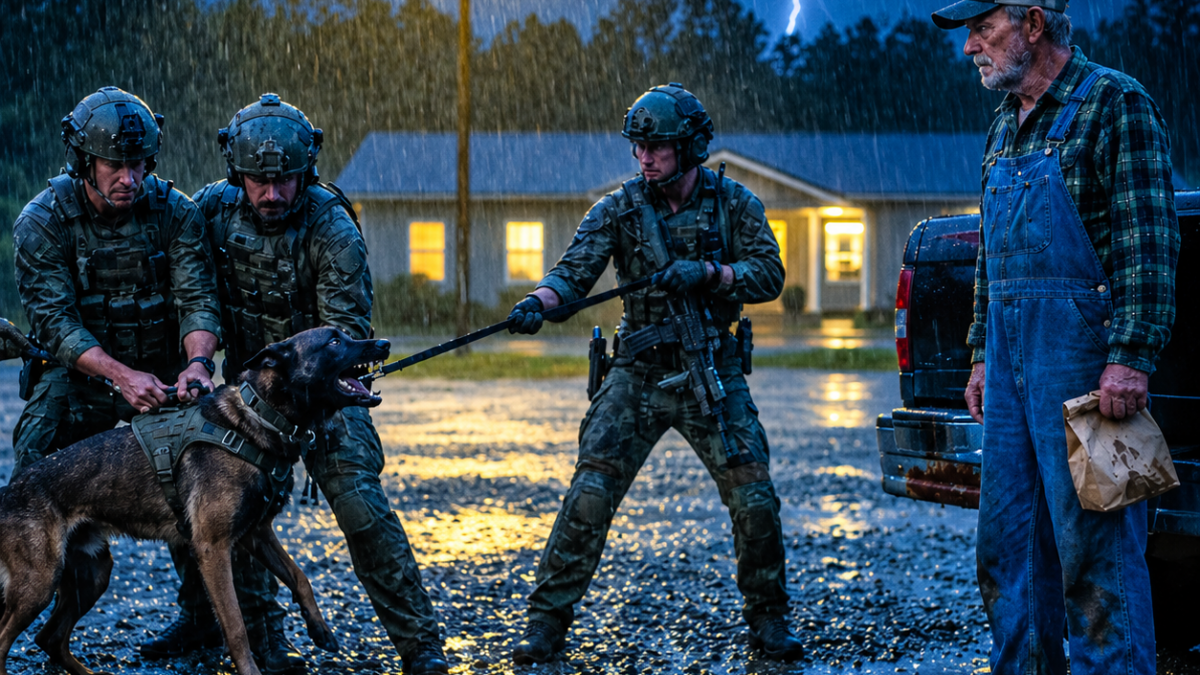
“This is a restricted military animal,” I said. “He is injured and unstable. Move back now.”
The old man took one step forward.
Slow.
Deliberate.
No wasted motion.
Cerberus lowered his head.
His hackles, raised seconds earlier like blades along his spine, began to settle.
I felt anger rise in me then, hot and immediate.
Not because the old man had done anything wrong.
Because he was doing something I could not explain.
And men like me do not enjoy variables we cannot explain.
“That’s a direct order,” I snapped. “Stand down.”
The old man ignored that too.
He moved closer, eyes scanning Cerberus in pieces: ears, shoulders, breathing, injured paw, tension through the back legs, tail angle, mouth, eyes.
Not staring.
Reading.
I had seen doctors assess trauma patients with less precision.
“Easy now, son,” he murmured. “Let’s see the trouble.”
Cerberus whimpered.
Not at me.
At him.
That sound cut deeper than I expected.
Because I knew Cerberus’s sounds.
His alert growl.
His low search whine.
His frustration bark.
His satisfied huff when he found a target odor.
This sound was none of those.
This was recognition without understanding.
Pain meeting memory.
The old man knelt in the mud.
His knees cracked softly, but the movement itself was smooth. Too smooth. His balance was perfect. His weight shifted exactly where it needed to. He did not lean over Cerberus. Did not crowd him. Did not reach for his head like an idiot trying to make friends with a loaded weapon.
He held out one empty hand, palm up.
“Give.”
One word.
Cerberus took a shaky step forward.
I tightened my grip on the lead.
The old man’s eyes flicked to me for the first time.
Not angry.
Not afraid.
Disappointed.
That somehow hit harder than anger.
“Loose,” he said.
I almost told him to go to hell.
Instead, for reasons I still cannot fully explain, I loosened the lead by two inches.
Cerberus moved forward and laid his massive head in the old man’s hand.
The parking lot went silent.
Or maybe I stopped hearing the storm.
The dog that had just fought four SEALs to a standstill stood trembling in the rain with his jaw resting in a farmer’s palm.
The old man brought his other hand up slowly and touched the base of Cerberus’s skull. His fingers found a place behind the ears, precise and practiced. Cerberus’s eyes softened. His breathing changed. A long shudder moved through his body.
Then he leaned into the man’s flannel shirt like a lost puppy.
I lowered my hand from the pistol grip I had not realized I was hovering near.
Nothing about this made sense.
“His paw,” the old man said.
He still did not look up.
“He’s favoring the left foreleg.”
“We know that,” I said, sharper than I should have.
“No,” he replied calmly. “You know he’s hurt. You don’t know where.”
He ran his hand down the leg. Cerberus flinched but did not pull away. A small, pained yelp came from him—communication, not aggression.
The old man’s fingers moved over the pad with impossible gentleness.
“Something’s lodged deep,” he said. “Metal, I think. Not just a sprain. Maybe not a clean fracture either.”
The clinic door opened behind us.
Dr. Benedict stood in green scrubs, rain blowing around him from the lighted doorway.
“What in God’s name is going on out here?”
I looked at him.
Then at Cerberus.
Then at the old man kneeling in the mud with our combat K9 half-melted against his chest.
“We had some trouble getting him inside,” I said.
Dr. Benedict stepped closer, then stopped.
His face changed as he watched the old man’s hands.
Not surprise exactly.
Recognition trying to climb out of memory.
The old man looked up.
“He’s got metal in the interdigital space. Deep. You’ll need to sedate him before digging for it.”
Dr. Benedict blinked.
“You examined him?”
“Enough.”
The old man turned those pale eyes on me.
“You can’t push a dog like this when he’s hurt,” he said. “He doesn’t know you’re helping. He knows pain, thunder, hands, restraint. That’s all. If you bring more pressure into that storm, you become part of it.”
I swallowed.
He said it simply.
That made it worse.
Because he was right.
“Then what are we supposed to become?” Kai muttered.
The old man’s gaze stayed on Cerberus.
“The calm.”
Inside the clinic, the unreality deepened.
Dr. Benedict had prepared the examination room in haste. Stainless steel table. Emergency tray. Sedative. Bandages. Portable imaging equipment warming up in the corner. The room smelled of antiseptic, wet dog, and ozone from the storm.
Silas—that was the only name the old man gave us—walked beside Cerberus with one hand resting lightly against the dog’s shoulder.
No force.
No leash tension.
Cerberus limped at his side.
The same dog who had nearly taken Rico’s hand off five minutes earlier now followed an old farmer through a clinic hallway like a child led out of a nightmare.
We followed behind them, four heavily armed operators rendered useless by a man in muddy boots.
Dr. Benedict approached with the syringe.
Kai and Rico instinctively moved to restrain.
Silas lifted one hand.
They stopped.
“No need,” he said. “Let me talk to him.”
He knelt again. Cerberus lowered himself carefully, injured paw held awkwardly. Silas began speaking in a low murmur, sounds I could not place. Not quite English. Not Russian, though I knew enough Russian to know. Not Pashto, not Arabic, not any operational phrase set I had heard.
It had rhythm.
Clicks.
Soft guttural tones.
Intent more than language.
Cerberus laid his head across Silas’s knee and exposed his neck.
A combat dog exposing his neck.
Trust does not get clearer than that.
The sedative went in without incident.
As it took effect, Silas kept one hand on Cerberus’s head, murmuring until the dog’s breathing deepened and his muscles relaxed.
Only then did Silas stand and move to the corner.
Out of the way.
Quiet.
As if nothing remarkable had happened.
Dr. Benedict began working on the paw. Ben moved closer to assist. The rest of us stood near the wall with our hands empty, feeling like men who had brought rifles to a language lesson.
I watched Silas.
Really watched.
The absence of fear was the first thing.
Plenty of men can look brave when they know people are watching. Plenty can bluff calm. Silas was not bluffing. He simply did not carry fear in places where most men did.
His posture was relaxed, but never careless.
His eyes moved without seeming to.
Door.
Window.
Our hands.
The dog’s breathing.
The veterinarian’s tools.
The storm outside.
Everything seen.
Everything weighed.
His hands were farmer’s hands, yes: scarred, thick-fingered, dirt ground into the creases. But across his knuckles ran pale lines that did not come from fence wire. On his left wrist, half-hidden beneath his sleeve, was a circular rope-burn scar, old and deep.
A leash burn, maybe.
From something much stronger than any farm dog.
The word came back to me.
Ghost.
It was not in Cerberus’s file.
Not a call sign.
Not a command.
Not a nickname.
I knew his entire documented history. Training pipeline. Health records. Handler transitions. Diet. Drive profile. Reward hierarchy. Operational suitability. Behavioral notes.
Nothing about Ghost.
Nothing about an old man named Silas.
“Got it,” Dr. Benedict said.
He held up forceps.
Caught in the metal teeth was a jagged shard of copper-jacketed metal.
“Ricochet fragment,” he said. “Buried deep next to the tendon. Another few hours, more swelling, more pressure, and he could have done serious permanent damage.”
The fragment hit the tray with a sharp clink.
I stared at it.
Then at Silas.
He had known by touch in the rain.
Dr. Benedict looked at him too.
“I feel like I should know you,” the vet said slowly.
Silas shrugged.
“Been a long time, Doc.”
“You’ve brought animals here before?”
“Not often.”
Dr. Benedict’s eyes narrowed.
“No. Not here.”
His voice lowered.
“Fort Bragg. Early 2000s. I did a rotation with special operations K9 units. They used to talk about men who handled dogs before the modern doctrine was cleaned up for manuals.”
Silas’s expression did not change.
But something moved behind his eyes.
A warning.
A request.
Let it go.
Dr. Benedict saw it.
For a second, I thought he would stop.
Then he whispered, almost to himself, “The Shepherds.”
The room changed.
Kai’s head lifted.
Ben went very still.
Rico looked at me.
The Shepherds were not part of official conversation.
They were rumor.
Black-budget myth.
A name buried in old after-action whispers and training folklore. Men selected not simply to command dogs, but to bond with them so deeply the line between handler and animal became something operationally useful and personally dangerous.
Project Ghost.
Officially dismantled.
Unofficially denied.
Historically inconvenient.
I had read fragments.
Enough to dismiss most of it as legend built around classified work and bored operators trying to scare younger ones.
But standing there, looking at Silas, I felt the fragments connect.
Ghost was not Cerberus’s name.
It was not even a dog command.
It was a key.
A transfer phrase.
A way for one shepherd to tell a dog that another shepherd had authority now.
Silas had not calmed Cerberus.
He had claimed responsibility for him in a language older than my training.
My face burned.
I had ordered him to stand down.
A man whose work may have shaped the very program that produced the dog on that table.
Silas walked to Cerberus and placed one hand on his flank. Even sedated, the dog’s tail gave a slow thump against the metal.
“He’s got the old blood,” Silas said softly. “Feels too much. That’s the burden with the good ones.”
He looked at me then.
Not superior.
Not cruel.
Worse.
Kind.
“You’re his anchor, Lieutenant. When the storm comes, he looks to you. If you meet his panic with more pressure, you both drown.”
I said nothing.
There was nothing defensive left in me.
“You have to be the rock,” Silas said. “The calm he can tether to.”
The calm.
The phrase settled somewhere deeper than instruction.
It sounded like responsibility.
Like rebuke.
Like mercy.
I finally found my voice.
“Who are you?”
Silas smiled faintly.
“Just a farmer, son. That’s all I am now.”
He gave Cerberus one last touch and turned toward the door.
“Wait,” I said.
He stopped.
“I was out of line.”
“Yes.”
The answer came so quickly that Rico coughed to hide something dangerously close to a laugh.
I deserved it.
“I apologize,” I said.
Silas turned slightly.
“We can give you a ride home,” I added. “Pay you for your time. Something.”
“You want to pay me?”
“Yes.”
“Take care of the dog.”
His eyes moved to Cerberus.
“Listen to him. He’ll tell you what he needs if you’re quiet enough to hear it.”
Then he walked out.
The bell above the clinic door jingled cheerfully, absurdly, as he stepped back into the rain.
I followed him outside.
His old Ford started with a protesting groan. He did not look back as he pulled out of the lot and disappeared into the storm.
I stood in the doorway until the taillights vanished.
Dr. Benedict came beside me.
The rain blew cold against my face.
“You know who he is,” I said.
The vet exhaled.
“I know stories.”
“Tell me.”
“Most of the records are sealed or destroyed. But the stories leaked. They always do. The first Shepherd could walk into a kennel full of dogs everyone else called unstable and have them settled in minutes. No domination. No tricks. Just presence.”
“Silas?”
Dr. Benedict looked down the road.
“They said he retired after something went wrong. Bought land out past Ridge Road. Stopped answering to any name that mattered.”
I thought of the pale scars on his hands.
The leash burn.
The way Cerberus folded under his touch.
“He called the dog Ghost.”
“No,” Dr. Benedict said quietly. “I think Ghost called him.”
Back in the exam room, Cerberus was beginning to stir.
The shard was out. The paw was cleaned, stitched, and bandaged. He would need rest, antibiotics, pain control, and no field work until cleared.
For the first time that night, the problem in front of me seemed simple.
Medical.
Manageable.
The harder injury stood beside the table wearing my face.
I had failed him before we ever reached the clinic.
Not because I did not care.
Because I cared through control.
I thought if I held tighter, commanded sharper, moved faster, forced him through the pain, I could get him to help.
But Cerberus had not needed more force.
He had needed me to become steady enough for him to borrow my nervous system.
The calm he could tether to.
I stepped to the table.
Cerberus’s eyes opened halfway, hazy from sedation. His ears twitched at my voice.
“Hey, Cerb.”
I placed my hand on his head the way Silas had.
Not exactly.
I was a student copying a master’s first stroke.
But I tried.
Base of the skull.
No pressure.
Slow breath.
Not fear.
Not apology.
Presence.
Cerberus blinked.
Then sighed.
His body settled beneath my hand.
I closed my eyes for one second.
“I hear you,” I whispered.
After that night, I changed.
Not all at once.
Men like me do not transform cleanly because one old farmer embarrasses us in the rain. Pride has roots. Training has grooves. Stress brings old habits back fast.
But I began noticing.
When Cerberus stiffened, I asked why before correcting.
When thunder rolled, I grounded myself before touching him.
When he hesitated, I checked his body, his environment, my tone.
When he looked at me, I understood the question better.
Are you steady?
At first, I was not.
Not always.
During his recovery, Cerberus was restless and irritable. A working dog on forced rest is a storm in a crate. He hated the bandage. Hated inactivity. Hated the fact that the rest of the team moved without him.
I nearly lost patience more than once.
Each time, I heard Silas.
If you meet his panic with more pressure, you both drown.
So I learned to lower my voice.
Loosen the lead.
Slow my breathing.
Become the rock.
The team noticed.
Kai, who had never allowed emotional sincerity to pass unmocked, watched me sit beside Cerberus during a thunderstorm two weeks later and said, “You doing meditation now, boss?”
“Yes,” I said.
He waited for the joke.
There wasn’t one.
So he sat down on the other side of the kennel.
After a while, Rico joined.
Then Ben.
Four SEALs sitting quietly around one injured dog while thunder rolled over the compound.
Cerberus slept.
That became the first lesson.
Not from a manual.
From a farmer.
The second lesson came when I drove out to Ridge Road.
I told myself it was to return Silas’s grease-stained paper bag, which he had left in the clinic. Inside were two biscuits wrapped in wax paper and a receipt for livestock feed.
That was the excuse.
The truth was I needed to see him again.
Ridge Road climbed through wet hills into country that felt forgotten on purpose. Fences sagged. Pines leaned over the road. Mailboxes appeared long before houses. Silas’s place sat at the end of a gravel drive, a small farmhouse with peeling white paint, a barn patched in three kinds of wood, and fields rolling back toward the tree line.
He was mending a fence when I arrived.
He did not look surprised.
Men like Silas rarely do.
“You lost, Lieutenant?”
“No.”
“Then you’re here on purpose. That’s worse.”
I held up the paper bag.
“You left this.”
He looked at it.
“Could’ve eaten them.”
“I wasn’t sure they were for humans.”
“Smart.”
A massive gray dog appeared near the barn.
Old.
Scarred.
Not military, but not soft either.
He watched me from a distance.
Silas noticed my gaze.
“That’s June.”
“She friendly?”
“To me.”
“Good to know.”
He went back to wiring the fence.
I stood there like an idiot for maybe ten seconds before asking, “Were you really one of the Shepherds?”
His hands stopped.
Only briefly.
Then continued.
“People name things after they stop understanding them.”
“That’s not an answer.”
“It’s the only one you’re getting.”
Fair.
I stepped closer.
“I came to ask you to teach me.”
That made him look up.
The pale blue eyes narrowed slightly.
“You’ve got trainers.”
“I have trainers. Manuals. Command structures. Medical support. Behavioral protocols.”
“Sounds expensive.”
“It is.”
“And still four of you couldn’t hold one hurting dog.”
There it was.
Clean.
Brutal.
True.
“No,” I said. “We couldn’t.”
Silas studied me for a long moment.
The wind moved through the grass.
June remained near the barn, still watching.
Finally, he said, “Bring him when his paw heals.”
“That’s it?”
“You were expecting a ceremony?”
“No.”
“Yes, you were.”
Maybe I was.
Silas bent back to the fence.
“First thing you need to learn is that the dog already knows most of what matters. You’re the slow one.”
He was not wrong.
Cerberus returned to work eventually, but not the same way.
His paw healed clean. The fragment had missed the tendon by less than a prayer. He moved cautiously at first, then stronger, then with his old precision. Still, I requested adjusted training time, more recovery checks, better sensory monitoring during storms.
Nobody questioned it.
Not after what had happened.
Our command heard a sanitized version first.
Then a less sanitized one.
Then the kind of version that travels through special operations circles without anyone officially repeating it.
The old farmer had stepped in.
The dog had listened.
Mace got humbled.
That last part traveled fastest.
I let it.
It was useful.
The first time I brought Cerberus to Silas’s farm, the dog stepped out of the vehicle and went perfectly still.
Not tense.
Aware.
He smelled the air.
Hay.
Wet earth.
Machine oil.
Old dogs.
Horses.
Wood smoke.
Silas stood near the barn with June beside him.
He looked at Cerberus.
Then at me.
“Lead’s too tight.”
I looked down.
He was right.
I loosened it.
Cerberus exhaled.
Silas nodded.
“Better.”
That was how training began.
No welcome speech.
No explanation of Project Ghost.
No dramatic reveal.
Just an old man pointing out the tension in my hand before I noticed it myself.
For months, whenever operations allowed, I drove out there.
Sometimes with Cerberus.
Sometimes alone.
Silas taught in fragments.
Never lectures.
Never stories unless the story had teeth.
“You want him to trust you? Stop lying through the leash.”
“What does that mean?”
“Your mouth says easy. Your hand says hurry. Which one you think he believes?”
Or:
“Don’t reward obedience when he’s shut down. That’s not calm. That’s absence.”
Or:
“He doesn’t need you to be fearless. He needs you to stop making your fear his problem.”
That one stayed with me.
Because I had been making my fear his problem for longer than I wanted to admit.
Not fear of combat.
Fear of failing him.
Fear of losing him.
Fear of being the man responsible when a dog trusted by everyone became uncontrollable because I missed the sign.
Silas saw that without me saying it.
“Your dog can smell guilt,” he said one afternoon.
I laughed.
He did not.
“Oh,” I said. “You’re serious.”
“He can smell the chemistry. He can read the posture. But more than that, he can feel when you’re not where your body is.”
I frowned.
“What does that mean?”
“You’re standing beside him thinking about every way you might fail him tomorrow. So he starts looking for the danger you see.”
I looked at Cerberus across the field. He sat under an oak tree, watching us.
“How do I stop?”
“You come back to the ground under your boots.”
“That sounds simple.”
“It is.”
“Easy?”
“No.”
Silas showed me how to stand.
That sounds absurd.
I had trained for years. I knew how to move through rooms, climb, swim, fall, fight, shoot, carry weight, disappear, endure.
But Silas taught me how to stand so a dog could rest.
Balanced.
Breathing low.
Shoulders not stiff.
Hand quiet.
Eyes soft but awake.
Presence without pressure.
“You become a place he can return to,” Silas said.
I thought of the clinic.
Cerberus’s head in his hand.
Enough, Ghost.
“What did Ghost mean?” I asked.
Silas looked toward the barn.
“You keep asking old questions.”
“They matter.”
“Not as much as what you do with the answer.”
“Was it Project Ghost?”
He did not move.
That was answer enough.
“You built the fail-safe.”
His jaw tightened.
“I helped build many things. Not all should’ve been built.”
That was the first time I heard regret in his voice.
Cerberus rose and came toward us, as if summoned by something quieter than sound.
Silas placed a hand on his head.
“The dogs were never the mistake,” he said.
“No?”
“No. Thinking we could ask that much of them without owing them everything afterward. That was the mistake.”
I carried that sentence back into every mission after.
We owe them everything afterward.
Cerberus and I changed together.
He became more responsive because I became less noisy inside myself.
He looked to me faster during stress.
I listened sooner.
On a later deployment, when thunder rolled over a temporary compound and Cerberus began to spiral, I did not clamp down. I did not bark corrections. I took him into a quieter corner, lowered my breathing, placed two fingers at the base of his skull, and said, “I’m here.”
He shook for three minutes.
Then leaned against my leg.
Kai watched from the doorway.
When I looked at him, he said, “Becoming the rock, huh?”
I nodded.
He said, “Good. Because the rest of us are idiots.”
That was Kai’s way of saying he was glad.
Years passed faster than I expected.
Cerberus got older.
Not old, exactly.
But older in the way working dogs become older: small stiffness after hard days, deeper sleep, less patience for young dogs, more gray around the muzzle that I pretended not to notice.
Silas got older too.
He never admitted it.
His fence repairs slowed. June died one winter, and for three days, Silas did not answer the phone. I drove out and found him sitting in the barn beside an empty blanket.
He looked at me and said, “Don’t make a thing of it.”
So I sat beside him and did not.
Cerberus lay at Silas’s feet.
Silence did more than words would have.
That was another lesson.
Not every pain needs commentary.
Sometimes witness is enough.
When Cerberus retired, there was no debate about where he would go.
He came home with me.
But the first stop was Silas’s farm.
I opened the truck door, and Cerberus stepped down slowly. He was eleven by then, still strong, but no longer pretending time had not found his joints. Silas stood on the porch in the same feed store cap, older, thinner, eyes still sharp.
Cerberus walked to him.
Sat.
Laid his head in the old man’s hand.
Silas smiled.
A real one.
“Enough, Ghost,” he whispered.
This time, the words did not stop panic.
They honored history.
Cerberus sighed and leaned into him.
I stayed for dinner that night.
Beans, cornbread, coffee too strong to legally qualify as a beverage. Silas talked more than usual, which meant he spoke six full paragraphs across three hours.
He told me about his first dog.
Not the classified parts.
The real parts.
How the dog hated helicopters until Silas learned to put his hand against his ribs before takeoff. How he once found Silas after a blast knocked him unconscious. How he died years later under a mesquite tree, old and half-blind, after a life no record would ever properly honor.
“His name?” I asked.
Silas looked at the dark window.
“Ghost.”
I did not speak.
Outside, Cerberus lifted his head from the porch.
Silas stared into his coffee.
“After him, they named the project. Like men do. Take something sacred and turn it into paperwork.”
I understood then.
Enough, Ghost was not just a command.
It was grief.
A private language.
A bridge built from one old dog to another.
“You called Cerberus by your dog’s name,” I said.
“No.”
Silas’s eyes met mine.
“I called the part of him that was trapped.”
The room went quiet.
“Every warrior dog has one,” he said. “So does every man.”
I looked down at my hands.
“Enough,” Silas said softly, “means you don’t have to keep fighting what’s already over.”
I thought of every mission that had followed me home.
Every night I woke before I knew why.
Every time Cerberus looked at me because he felt the storm in me before I did.
Maybe Silas had not only spoken to the dog that night.
Maybe he had spoken to all of us.
Enough, Ghost.
Stand down.
Come back.
A year later, Silas died.
Not in battle.
Not dramatically.
He fell asleep in his chair with the radio on, a half-finished cup of coffee beside him, and Cerberus at his feet because we had been visiting that weekend.
I found him in the morning.
For a long moment, I stood in the doorway and became every young man who had ever failed to arrive in time.
Then Cerberus whined.
I went to him first.
He was standing beside Silas’s chair, nose pressed to the old man’s hand.
I crouched and placed my palm at the base of his skull.
“He’s gone,” I whispered.
Cerberus trembled.
I said the words Silas had given us.
“Enough, Ghost.”
Cerberus turned into me.
Not collapsing.
Not breaking.
Leaning.
Trusting me to be the rock this time.
So I was.
Silas left no family that anyone could find.
He left the farm to a veterans’ working dog foundation he had quietly funded for years under a name no one had connected to him. He left a box of notebooks to Dr. Benedict. He left me one envelope.
Inside was a single page.
Mace,
You were slower than the dog but faster than most men.
Keep listening.
The leash tells the truth.
Take care of Cerberus.
He took care of you first.
—S.
I read it once.
Then again.
Then folded it carefully and put it in the same case where I kept Cerberus’s retirement papers.
Cerberus lived three more years.
Good years.
Farm visits.
Slow hikes.
Sun patches.
Too many unauthorized pieces of steak from Kai, who denied everything with grease on his fingers.
He slept beside my bed, then later on an orthopedic mat because age made the floor harder. Thunder still bothered him, but not like before. When storms came, he found me. I sat with him. Sometimes I spoke. Sometimes I simply breathed.
On his last night, rain tapped the windows.
Not a violent storm.
Just rain.
Cerberus lay with his head on my knee, gray muzzle soft beneath my hand. His breathing was slow. His body had done everything I had asked of it and more.
Too much, maybe.
We always ask too much of the brave.
I touched the spot at the base of his skull.
“You’re a good dog,” I said.
His tail moved once.
“You took care of us.”
Another breath.
“You can rest.”
His eyes opened.
Clouded now, but still Cerberus.
Still my teammate.
Still the dog four SEALs could not hold because we had forgotten that strength without understanding is only pressure.
I leaned close.
“Enough, Ghost.”
He exhaled.
And this time, he stood down for good.
I buried him on Silas’s farm beneath the oak where they had trained together.
Dr. Benedict came.
Kai, Ben, and Rico came.
Even Ronan, the command master chief, came in civilian clothes and pretended the wind was making his eyes water.
We placed no military marker.
Silas would have hated spectacle.
Instead, we set a flat stone beneath the tree.
Two words carved into it.
The Calm.
Years later, I still think about that night outside the clinic.
The rain.
The mud.
The thunder.
The four of us straining against a dog we loved but did not understand.
The old farmer stepping forward with a paper bag in one hand and history in the other.
Enough, Ghost.
It is easy to remember the impossible part.
The way Cerberus stopped.
The way he laid his head in Silas’s palm.
The way the room shifted when we realized the farmer was not just a farmer.
But the more important part came after.
The lesson.
You have to become the calm.
That sentence changed the way I led men.
Not just dogs.
Men panic too.
They hide it under anger, jokes, discipline, silence, aggression, perfection, and control. Teams can drown in a leader’s fear if he mistakes volume for steadiness. Pain does not become less painful because someone orders it to behave.
You become the rock.
You listen before correcting.
You ask where it hurts.
You do not call panic disobedience just because it frightens you.
That old farmer taught me more in one storm than some courses taught me in months.
He reminded me that command is not force.
Trust is not control.
And the strongest man in the room is often the one quiet enough for everyone else to stop fighting.
I was there that night.
I was the lieutenant who told him to stand down.
I was the fool holding a leash too tight.
I was the man watching a legend kneel in the mud and speak a language deeper than rank.
And I was the student who finally understood that some ghosts do not need to be chased away.
They need someone brave enough to say:
Enough.
You made it back.
Rest now.








