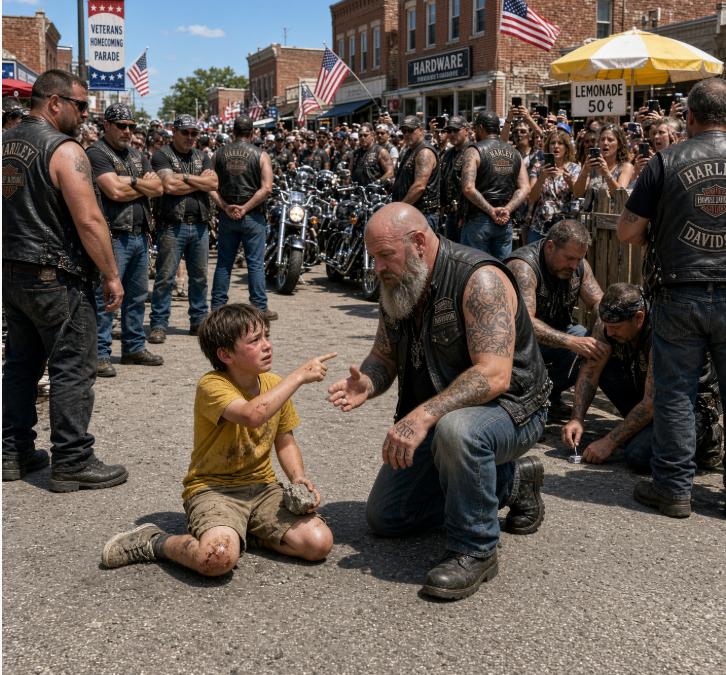
Forty Harleys went silent when a bleeding little boy attacked their parade with rocks—but the terrifying circle the riders formed around him concealed a desperate plea no one else could hear.
PART3:
His carotid pulse was weak and rapid. The beam restricted his chest, and each breath came shallower than the one before it.
“We need to lift this now,” I said.
Gravel examined the frame.
“On your count.”
Two bikers crawled under the broken gate to help us. Together, they raised the crossbeam just enough for me to pull the old man free.
The child gripped his grandfather’s shirt.
Gravel checked the man’s mouth, repositioned his jaw, and opened his airway with the practiced movements of someone who had done it many times before.
“You a medic?” I asked.
“A long time ago.”
The old man dragged in a thin breath.
His eyelids fluttered.
Gravel fitted the new battery into the recovered hearing aid and gently placed it in the man’s ear.
The old man’s eyes opened.
He looked at the boy first.
Then his gaze moved to Gravel.
He studied the scar along Gravel’s neck, the gray beard, and the small tattoo near his left wrist—two open hands beneath a thin crescent moon.
Recognition transformed his face.
His trembling fingers rose.
He signed one word.
Coyote.
Gravel went completely still.
The color left his face so quickly that I thought he might collapse beside the patient.
The old man signed again.
You came back.
Behind us, forty bikers stood in complete silence while their road captain looked at a dying stranger as if a locked door from his own past had just opened.
“Elias?” Gravel whispered.
The old man’s mouth moved.
No sound came out, but Gravel understood.
“Yes,” he said. “It’s me.”
The boy looked between them, confused and terrified.
Sirens approached from the far end of Main Street.
I checked the old man’s abdomen and found it rigid beneath my hands. There was bruising along his left side, and his pulse was becoming harder to locate.
“Possible internal bleeding,” I told Gravel. “We need him transported immediately.”
The bikers created a human corridor from the broken gate to the street. When the paramedics arrived, they expected chaos. Instead, they found forty men and women holding the crowd back while Gravel helped me stabilize Elias Vega’s neck.
Colonel Danner reached us as the stretcher came through the gate.
He was no longer smiling.
For a fraction of a second, his polished public expression disappeared. He looked at Elias, then at Gravel, and something cold passed between them.
“You know this man?” I asked.
Danner recovered quickly.
“I know many veterans.”
Elias saw him.
The heart monitor attached by the paramedics began beeping faster.
He lifted one shaking hand and signed directly at Danner.
Liar.
Danner’s mouth tightened.
“He’s confused,” he said.
Gravel stepped between him and the stretcher.
“He knows exactly who you are.”
Police officers moved closer.
Brick and three other riders did the same, but Gravel raised one hand without looking back. The riders stopped immediately.
Danner lowered his voice.
“Cole Mercer. I wondered how long it would take you to crawl back into respectable company.”
Gravel’s face remained calm, but a muscle jumped near his jaw.
“I came back a long time ago, Colonel. You just never bothered looking at the men you left behind.”
Danner glanced at the phones surrounding us.
“This is neither the place nor the time.”
“You picked the place thirty-four years ago.”
Before Danner could answer, Elias’s blood pressure crashed.
The paramedics rushed him toward the ambulance. The boy tried to climb inside, but one of the officers caught his shoulders.
“Family only.”
“He is family,” I snapped.
The boy was shaking so hard he could barely stand. His hand had bled through Ellis’s leather vest.
“I’ll go with them,” I said.
“You’re assigned to the parade,” Danner replied.
“I’m an ER nurse, and that man is unstable.”
“You are also an employee of Cedar Ridge Regional.”
I looked directly at him.
“Then you should be relieved that I’m doing my job.”
I climbed into the ambulance with Elias and the boy.
Gravel stood in the road as the doors closed. The crowd surrounded him, still filming, but his eyes remained fixed on Elias.
The boy sat beside me during the entire ride. He would not release his grandfather’s hand.
His name was Mateo Vega. He was nine years old and had childhood apraxia of speech, which made spoken language difficult under stress. He could talk slowly in familiar settings, but when frightened, his voice often disappeared completely.
Elias had taught him sign language before he taught him to ride a bicycle.
Mateo’s parents had died in a highway accident three years earlier. Since then, Elias had been his entire world.
At the hospital, a trauma team took Elias directly into surgery.
A social worker cleaned Mateo’s injured palm and found a deep cut beneath the blood. It required seven stitches. He never cried while the doctor worked.
He only watched the surgery doors.
I remained beside him until a woman from child services arrived, then stepped into the corridor to call Gravel.
Before I could dial, I saw Colonel Danner speaking to the hospital administrator near the elevators.
Danner noticed me and ended the conversation.
“Ms. Ortiz,” he said. “A word.”
He led me into an empty consultation room and closed the door.
There was no gratitude in his face. No concern for Elias. No question about Mateo.
Instead, he folded his hands and said, “I need you to prepare an incident statement.”
“Of course.”
“The statement should make clear that the motorcyclists obstructed emergency access and escalated the child’s behavior.”
I stared at him.
“They saved his grandfather.”
“They damaged private property, surrounded a minor, and interfered with an official parade route.”
“They shut down their engines so they could hear the distress signal.”
“According to whom?”
“According to everyone who was close enough to stop recording and pay attention.”
His eyes hardened.
“You work for a hospital that depends heavily on the Danner Foundation.”
“I work for patients.”
“That kind of self-righteous answer sounds admirable until it costs other people their jobs.”
The room suddenly felt smaller.
“Are you threatening me?”
“I’m reminding you that public panic can be dangerous. A video is already spreading online. It appears to show forty gang members surrounding a bleeding child.”
“They are veterans, not gang members.”
“Some of them are veterans. Others have criminal records.”
“So do some hospital donors.”
He did not smile.
“I knew your father.”
The words struck harder than I expected.
“My father never mentioned knowing you.”
“I’m not surprised. Gabriel understood the cost of clinging to certain versions of the past.”
I felt my pulse begin to pound.
“What is that supposed to mean?”
Danner opened the door.
“It means you should be careful whose story you choose to believe.”
By sunset, the video had been viewed more than two million times.
It began after the rocks were thrown.
Someone had cropped out Mateo running toward the motorcycles and the riders shutting off their engines. The clip showed Gravel rising to his full height while eight bikers closed around the child.
The person recording screamed, “They’re going to hurt him!”
Then the video ended.
The caption read:
FORTY BIKERS ATTACK NINE-YEAR-OLD AT VETERANS PARADE.
News vans arrived outside the hospital before Elias left surgery.
Reporters found Gravel standing near the emergency entrance and surrounded him with microphones.
“Why did your club threaten a child?”
“Were you armed?”
“Is it true you were discharged from the Army for abandoning your post?”
That last question changed him.
Gravel looked toward the reporter who had asked it.
“Who told you that?”
The reporter glanced over his shoulder.
Colonel Danner stood near the hospital doors.
He did not need to say anything.
Gravel understood.
“So that’s how he wants to do this,” he murmured.
Brick pushed through the reporters.
“Back off.”
The cameras swung toward him.
Police officers moved in, and for one dangerous second, Brick looked ready to give the entire country the violent image it expected.
Gravel caught his arm.
“No.”
“He’s using the kid against us,” Brick said.
“I know.”
“He’s doing it again.”
“I know.”
Brick’s eyes shone with helpless rage.
“Then let me do something.”
Gravel tightened his grip.
“You are doing something. You’re going to stand here, keep your hands open, and make him lie without our help.”
Brick slowly unclenched his fists.
That moment never appeared on the evening news.
The surgery lasted nearly four hours.
Elias had three fractured ribs, a punctured lung, a ruptured spleen, and internal bleeding severe enough that the surgeon told me he might not survive the night.
Mateo sat in a plastic chair outside intensive care with his bandaged hand tucked against his chest.
Gravel approached slowly.
The boy looked at his leather vest and then at his face.
Gravel signed, May I sit?
Mateo nodded.
For several minutes, neither of them spoke.
Finally, Mateo signed, Grandpa knew you.
“Yes.”
Who is Coyote?
Gravel looked toward the ICU doors.
“Someone I stopped being a long time ago.”
Mateo frowned.
Grandpa said Coyote saved people.
Gravel’s hands remained motionless.
Then why did you stop?
The question seemed to hurt him more than any accusation from the reporters.
“Because sometimes people tell a lie about you so many times that you start building your life around it.”
Mateo considered this.
Grandpa says a lie is still scared of the truth even when it gets old.
Gravel gave a sad, breathless laugh.
“That sounds like Elias.”
Mateo looked down at his bandage.
I hurt your motorcycle.
“You saved your grandfather.”
I threw rocks.
“You used what you had.”
The child’s lower lip trembled.
People were angry.
“People get angry when they’re frightened and don’t understand what they’re seeing.”
Were you angry?
Gravel held up two fingers close together.
“About this much.”
For the first time all day, Mateo smiled.
Gravel took the white battery case from his pocket.
“Your grandfather dropped one hearing aid. Does he have another?”
Mateo shook his head.
Gravel turned the little case over in his hands.
“My daughter used these.”
Mateo waited.
“She lost most of her hearing after meningitis when she was five. For years, I kept spare batteries everywhere. Jacket pockets. Truck console. Toolboxes. Even after she switched to implants, I kept carrying them.”
Where is she?
The answer took too long.
“Virginia.”
Do you see her?
“Not enough.”
Why?
Gravel looked at me, perhaps hoping I would interrupt.
I did not.
“Because I thought disappearing from her life would protect her from my mistakes.”
Did it?
“No.”
Mateo leaned back in his chair.
Grandpa says leaving someone alone does not protect them from being lonely.
Gravel closed his eyes.
The ICU doors opened before he had to answer.
A doctor allowed Mateo two minutes at Elias’s bedside. Gravel stayed in the hallway, but as the boy went inside, Elias saw him through the glass.
The old man lifted two fingers and pointed toward his own eyes.
Watch.
Then he pointed at Gravel.
Me.
Gravel nodded.
Elias made one final sign before exhaustion pulled his hand back to the bed.
Drawer.
Gravel stared at him.
“What drawer?” I asked.
“The workshop,” he said. “He wants me to look inside a drawer.”
The next morning, my supervisor called me into her office.
Marjorie Keene had managed the emergency department for eleven years. She was strict, fair, and rarely uncomfortable.
That morning she could not meet my eyes.
“The board received a complaint regarding your conduct at the parade.”
“From Warren Danner.”
She folded her hands.
“You left your assigned volunteer station.”
“To treat a critical patient.”
“You entered an ambulance without authorization.”
“I was asked to assist.”
“You publicly contradicted the chairman of our board.”
“That isn’t a medical violation.”
“No, but this might be.”
She pushed a printed form across her desk.
It was an incident statement bearing my name.
The final paragraph claimed the Mercy Chain Riders had delayed paramedics, intimidated spectators, and aggravated Mateo’s distress.
“I didn’t write this.”
“It was prepared using multiple witness accounts.”
“Then why is my name on it?”
“The board would like you to sign.”
I slid it back.
“No.”
“Lena, please understand the position I’m in.”
“I understand it perfectly. Danner wants a nurse’s signature beneath his lie.”
“Lower your voice.”
“Why? Is he hiding under your desk?”
Her face tightened.
“The hospital is placing you on paid administrative leave pending review.”
I sat very still.
“In fourteen years, I have never had a patient complaint upheld against me.”
“I know.”
“I worked through the influenza overflow. I stayed here for thirty-one hours during the ice storm. I held pressure on your husband’s artery when he came in after his accident.”
“I know.”
“Then look at me.”
She finally did.
There were tears in her eyes.
“I have three hundred and twelve employees whose paychecks depend on a board Danner controls,” she whispered. “I’m sorry.”
I removed my identification badge and placed it on her desk.
“So am I.”
By noon, my name had leaked to the news.
The headline called me “the biker nurse.”
A photograph from the parade showed me crawling beneath the broken gate while Gravel followed. Commenters accused me of helping a motorcycle gang stage a publicity stunt. Others claimed Mateo had been paid to throw rocks.
My address appeared online that evening.
Someone left a smashed toy motorcycle on my porch.
I stood over it in the dark and finally understood why decent people stayed silent when powerful men lied.
Silence was not always cowardice.
Sometimes it was exhaustion. Sometimes it was fear. Sometimes it was the knowledge that the truth could cost a mortgage payment, health insurance, or the fragile safety of someone you loved.
But knowing that did not make silence right.
My mother called after seeing the news.
“Come to the house,” she said.
“I’m fine.”
“No, you’re doing that thing your father used to do.”
“What thing?”
“Lying with one word.”
She lived twelve miles outside Cedar Ridge in the same ranch house where I had grown up. When I arrived, she was waiting in the garage beside Dad’s old green footlocker.
I had seen it hundreds of times.
He kept military photographs, medals, uniforms, and letters inside. After his funeral, Mom had locked it and refused to open it.
Now the key trembled in her hand.
“Your father made me promise,” she said.
“Promise what?”
“That if Warren Danner ever came after you, I would give you this.”
The garage seemed to tilt around me.
“He knew this could happen?”
“He knew what Danner was capable of.”
She opened the lock.
The smell of canvas, metal, and old paper rose from the trunk.
Inside were Dad’s dress uniform, a stack of photographs bound with a rubber band, and a weathered notebook.
Mom handed me the notebook.
On the first page, in my father’s handwriting, were six words:
COYOTE BROUGHT EVERY ONE OF US HOME.
I sat on the concrete floor and began to read.
In February 1991, my father had been a twenty-four-year-old Army radio operator attached to a medical logistics unit near the Kuwait-Iraq border.
Warren Danner had been their captain.
Cole Mercer was a nineteen-year-old mechanic and driver whose ability to cross broken terrain had earned him the nickname Coyote. Elias Vega was a staff sergeant and combat medic.
During a night evacuation, their convoy received word that an aid station near a dry riverbed had been hit. Seventeen American personnel remained there, along with several local civilians who had helped the unit.
Danner ordered the convoy to continue south.
The official reason was incoming fire.
According to Dad’s journal, the real reason was that Danner had redirected two trucks carrying medical supplies to a private staging site controlled by a defense contractor. If the convoy returned to the aid station, the missing trucks would be discovered.
Elias challenged him.
Danner threatened to arrest him.
Cole turned his vehicle around anyway.
Dad went with him, along with Elias and five others.
They reached the aid station after midnight. Cole drove through smoke and burning fuel while Elias treated the wounded. Dad maintained radio contact and repeatedly requested support.
Danner denied every request.
Still, they evacuated all seventeen Americans and six civilians.
One of the rescued soldiers died two days later, but the others survived.
During the final trip, an explosion destroyed Cole’s truck and tore the hearing from Elias’s ears. Shrapnel cut Cole from his jaw to his collarbone, leaving the scar I had seen at the parade.
When they returned, Danner confiscated Dad’s radio logs.
Then he rewrote the story.
He claimed he had personally organized the rescue while Cole had abandoned the convoy, stolen a military vehicle, and endangered the unit through reckless disobedience.
Danner received a Silver Star.
Cole received an other-than-honorable discharge after a rushed administrative proceeding.
Elias tried to testify, but his traumatic brain injury and hearing loss were used to question his reliability. My father was threatened with charges for falsifying communications records.
He stayed silent.
The final pages of the notebook were filled with shame.
I told myself I was protecting Lena and Rosa.
I told myself the Army would discover the truth without me.
I told myself Mercer was strong enough to survive what they did to him.
Every excuse sounded smaller as the years passed.
On the final page, Dad had written:
If Cole Mercer is still alive, tell him Gabriel Ortiz was a coward when it mattered, but he never forgot who came back for him.
I closed the notebook against my chest.
Mom sat beside me.
“Why didn’t Dad tell me?”
“Because shame is a room with no windows,” she said. “Your father spent thirty years inside it.”
A photograph slipped from between the pages.
Seven young men stood beside a damaged military truck. One was my father.
Another was unmistakably Gravel, though his beard had not yet grown and his face looked impossibly young.
Elias stood beside him with one arm over his shoulder.
On the back, Dad had written:
Coyote, Lighthouse, and the men who chose not to leave us.
“Lighthouse?” I asked.
“Elias,” Mom said. “Your father said he could guide frightened men through anything.”
Beneath the photograph was a sealed envelope addressed to Cole Mercer.
I drove directly to the Mercy Chain clubhouse.
It occupied an old fire station on the edge of town. By the time I arrived, someone had spray-painted CHILD BEATERS across the garage door.
Several motorcycles had slashed tires. A brick had shattered one window.
Inside, the riders were sorting donated medical equipment as though nothing had happened.
Brick saw me first.
“If you’re press, the answer is no.”
“I’m Lena Ortiz.”
“We know who you are.”
Gravel emerged from the back room.
He looked exhausted.
I handed him the photograph.
He studied it for a long time.
“Gabriel,” he said.
“He was my father.”
“I know.”
“You knew?”
“He kept your picture inside his helmet liner. You were four years old, wearing a red raincoat and holding a frog.”
I had forgotten that photograph existed.
My throat tightened.
“He wrote about what happened.”
Gravel’s expression changed.
“How much?”
“Everything.”
“No one writes everything.”
“He wrote enough.”
I gave him the letter.
Gravel stared at my father’s handwriting but did not open the envelope.
“He apologized,” I said.
“He doesn’t owe me an apology.”
“Yes, he does.”
Gravel looked up sharply.
“My father loved me,” I continued. “He was a good man in many ways, but he failed you. Pretending otherwise would only protect him from a truth he already understood.”
The riders had gone quiet.
Gravel turned the envelope over.
“Your father was twenty-four. Danner threatened to put all of us in prison.”
“And you were nineteen.”
“I had less to lose.”
“You had a daughter.”
“Not then.”
“You had your future.”
He looked toward the vandalized window.
“Not for long.”
I told him what Danner had done at the hospital and showed him the false statement.
Brick swore.
Gravel remained calm.
“What did Elias mean by the drawer?” I asked.
His eyes moved toward the others.
“We were about to find out.”
The police had sealed Vega’s workshop after the trellis collapse, but Elias owned the property, and Mateo had permission from child services to retrieve clothing and medication.
A social worker accompanied us.
The rear garden looked different without an emergency unfolding inside it.
The trellis had not simply fallen.
Two steel support bolts had been cut almost completely through. Fresh scrape marks surrounded the lock on the gate.
Someone had wanted the structure to collapse.
Someone had also locked Elias and Mateo inside afterward.
Mateo led us through the workshop.
The room smelled of cedar and machine oil. Every shelf held evidence of Elias’s work—canes with carved handles, wheelchair trays, small ramps, wooden flag cases, and devices designed to make ordinary tools easier for injured hands to hold.
On one wall hung photographs of veterans Elias had helped.
Near the back stood an old rolltop desk.
Mateo pointed toward its lowest drawer.
Gravel pulled it open.
It was empty.
Not simply unused.
Empty.
A clean rectangular outline marked the dust where something had recently been removed.
Mateo began signing rapidly.
“What is he saying?” I asked.
Gravel crouched beside him.
“You saw someone?”
Mateo nodded.
He described a man entering the workshop before the parade. Elias had confronted him. The man had shoved Elias against the desk and demanded a metal box.
Mateo had hidden beneath the workbench.
The stranger searched the drawers but could not find what he wanted.
After he left, Elias told Mateo they needed to go to Colonel Danner at the reviewing platform. He said it was time to tell the truth publicly.
They had gone through the garden because reporters were waiting outside the front entrance.
As Elias crossed beneath the trellis, it collapsed.
Mateo ran for help, but the gate swung shut behind him. Someone on the alley side pulled a chain through the latch and locked it.
Mateo screamed.
No one heard him.
He climbed the fence, cutting his palm on an exposed nail, and ran toward the loudest thing he could find.
The motorcycles.
“Can he identify the man?” I asked.
Mateo’s hands slowed.
He touched two fingers to his shirt collar, imitating a pin.
Then he drew the shape of a bird in the air.
Brick pulled out his phone and searched photographs from the parade committee.
Mateo stopped him on an image of Danner’s chief of security, Travis Rusk.
Rusk wore a gold eagle pin on his lapel.
The social worker immediately called the police.
They took Mateo’s statement seriously until Colonel Danner arrived at the station with an attorney.
By evening, police described the identification as “uncertain.” Rusk claimed he had spent the entire morning supervising security near the courthouse.
Three parade officials confirmed his alibi.
The hardware store’s alley camera should have shown who locked the gate.
Its memory card was missing.
The metal box from Elias’s drawer was gone.
Danner’s public-relations team released a statement expressing concern about “dangerous conspiracy theories promoted by a discredited former soldier and his associates.”
They named Gravel.
They named me.
They did not name Mateo, but everyone knew who they meant.
Elias regained consciousness two days later.
I was still suspended, but Marjorie quietly arranged for me to visit after hours.
Gravel came with me.
Elias looked smaller beneath the hospital blankets. Tubes ran from his chest and arm. His face was gray with pain.
Mateo sat beside him, reading a comic book.
When Gravel entered, Elias raised one hand.
Coyote.
“Lighthouse,” Gravel replied.
Elias smiled.
They spoke in sign language for several minutes. I caught only fragments, but emotion needed no translation.
Gravel finally turned to me.
“He says the metal box contained copies of the original radio recordings, Dad’s field notes, and a list of the medical supplies Danner diverted.”
“My dad’s notes?”
“Your father helped Elias make copies before the inquiry.”
“Then Danner has everything.”
Elias shook his head.
His fingers moved.
Gravel watched, then laughed softly.
“What?”
“He says Danner has a box full of blank tapes and old hardware receipts.”
Mateo smiled proudly.
Elias had expected someone to search the workshop. Months earlier, after Danner learned Elias had contacted a military records attorney, Elias created a decoy box.
The real evidence was hidden elsewhere.
“Where?” I asked.
Elias looked toward Mateo.
The boy did not know.
That had been deliberate.
Elias signed, safer.
Gravel asked another question.
Elias answered by forming a roof with his hands, then pointing toward me.
“My house?” I asked.
He shook his head.
He repeated the sign, then touched his chest and pointed toward Gravel.
Gravel’s expression softened.
“Home,” he said. “He says the evidence is with someone who still needs to come home.”
No one understood what he meant.
The next morning, Danner held a press conference on the courthouse steps.
He stood beneath an enormous American flag and spoke solemnly about public safety, respect for veterans, and the danger of extremism.
Then he invited Gravel to the microphone.
We had not expected that.
Gravel had received no warning, but he walked through the crowd and climbed the steps anyway.
Danner smiled for the cameras.
“Mr. Mercer, I believe our community deserves reassurance that your organization will cooperate with law enforcement.”
Gravel looked at the microphones.
“We have cooperated from the beginning.”
“Then perhaps you would explain why forty armed riders encircled a child.”
“We formed a privacy barrier while he led us to his injured grandfather.”
“Witnesses felt threatened.”
“Witnesses were filming a bleeding kid instead of helping him.”
Murmurs moved through the crowd.
Danner’s smile thinned.
“Isn’t it true that you were separated from the Army for misconduct?”
“Yes.”
“And isn’t it true you disobeyed a direct order in a combat zone?”
“Yes.”
The crowd shifted uneasily.
Danner had expected denial. Gravel gave him none.
“Would you describe yourself as a man who respects authority?”
Gravel studied him.
“I respect authority that accepts responsibility.”
Danner leaned closer.
“You stole an Army vehicle.”
“To rescue seventeen Americans you abandoned.”
The courthouse steps erupted with voices.
Reporters shouted questions.
Danner’s face hardened.
“That allegation was investigated and rejected.”
“By a report you wrote.”
“You were an unstable nineteen-year-old seeking attention.”
“I was nineteen. You’re right about that.”
Gravel’s voice remained calm.
“I was also scared. My hands shook so badly that Elias had to help me start the truck. I wanted to obey you. I wanted to believe an officer knew more than I did.”
He looked directly at Danner.
“Then I heard wounded men asking over the radio if anyone was coming.”
Danner’s jaw tightened.
“You endangered everyone in that convoy.”
“I brought everyone in that aid station home.”
“You got Private Miller killed.”
Gravel flinched.
For the first time, Danner had found the wound he wanted.
“Daniel Miller died because you delayed medical support,” Gravel said.
“He died in your vehicle.”
“He died holding my hand after asking why his captain never answered the radio.”
Danner stepped away from the microphone.
“This event is over.”
I pushed through the reporters.
“No, it isn’t.”
Danner saw the notebook in my hand.
His expression changed.
“My father was Gabriel Ortiz,” I said into the nearest microphone. “He was the radio operator that night.”
The crowd went quiet.
“He documented every request Cole Mercer made and every request Warren Danner denied.”
Danner’s attorney moved toward me.
I opened the notebook.
“Captain ordered us south at 2210. Coyote refused after hearing Staff Sergeant Vega call from the aid station. Captain disabled support channel. Coyote returned anyway.”
Danner grabbed the microphone.
“Ms. Ortiz is a suspended nurse under investigation for professional misconduct.”
There it was.
The public humiliation he had prepared.
Cameras swung toward me.
He continued, “She has aligned herself with a violent organization and removed confidential information from hospital property.”
“That is false.”
“Your judgment is not reliable.”
“My judgment saved Elias Vega’s life.”
“Your recklessness endangered a child.”
“Mateo threw those rocks because your security chief locked him behind a gate.”
A roar swept through the crowd.
Danner’s attorney pulled him away from the microphone, but the damage had been done.
For the first time, the country heard the accusation in public.
That evening, the full parade video appeared online.
It came from an unexpected source.
A twelve-year-old girl named Olivia Chen had been recording the motorcycles for her grandfather. Her video began before Mateo entered the street and continued after the bikers reached the garden.
It showed the rocks striking Gravel’s motorcycle.
It showed him ordering every engine off.
It captured the tapping behind the fence.
It showed the riders turning outward to protect Mateo from the crowd.
Most importantly, it showed Travis Rusk emerging from the alley beside the hardware store less than three minutes before Mateo appeared.
He was carrying a metal box.
The edited video had received two million views in twenty-four hours.
Olivia’s full video received eighteen million.
Public opinion changed with frightening speed.
The same people who had called the riders monsters now called them heroes. News anchors praised Gravel’s restraint. Commenters apologized to Mateo. Donations poured into the Mercy Chain Riders’ website.
Gravel hated it.
“They learned nothing,” he said as we watched a reporter describe him as a “gentle giant.”
“What do you mean?”
“Yesterday, I was a monster because of thirty seconds of video. Today, I’m a hero because of three minutes. Nobody waited to know me either time.”
He switched off the television.
“A person shouldn’t have to be caught doing something heroic before people decide he deserves dignity.”
The police arrested Rusk the following morning for evidence tampering, unlawful imprisonment, and assault.
He denied everything until investigators searched his garage.
They found Elias’s metal box beneath a tarp.
Inside were blank tapes and old receipts, exactly as Elias had promised.
But they also found something Rusk had not expected.
A tiny audio transmitter powered by a hearing-aid battery.
Gravel stared at Elias when detectives told us.
The old man smiled weakly.
He had built it himself.
The transmitter had sent eighteen minutes of audio to a receiver hidden inside Mateo’s backpack.
On the recording, Rusk could be heard demanding the location of “the original Ash Creek tapes.”
Elias refused.
Then Rusk said, “Colonel Danner gave you thirty years to die quietly.”
That sentence changed the investigation.
Rusk still tried to protect Danner.
He claimed he had acted alone because he was overly loyal.
No one believed him, but belief was not evidence.
Danner had not personally appeared on the recording. There were no text messages, emails, or bank transfers linking him to the workshop.
He had spent his life surviving through distance.
Someone else always carried the order.
Someone else always signed the form.
Someone else always absorbed the blame.
Three days later, Danner came to my house.
He arrived after dark without his driver.
I saw him through the front window and activated the voice recorder on my phone before opening the door.
“You have thirty seconds,” I said.
He looked past me.
“May I come in?”
“No.”
“This concerns your father.”
“You used my father’s fear to protect yourself.”
“Gabriel made his own choices.”
“You threatened him.”
“I reminded him of his obligations.”
“To you?”
“To his unit. To his country.”
“You stole medical supplies during a war.”
His face did not change.
“Your father wrote things when he was troubled.”
“He wrote dates, coordinates, and radio frequencies.”
“None of which proves what you think.”
“What did you do with the supplies?”
For the first time, impatience cracked his composure.
“You have no understanding of what that night was like.”
“Then help me understand.”
“We had incomplete intelligence, incoming fire, damaged vehicles, and seventeen men trapped in a position that could not be defended. A commander makes decisions other people are spared from making.”
“You left them.”
“I preserved the larger unit.”
“Cole went back.”
“Cole was a reckless boy who got lucky.”
“He got wounded.”
“So did many of us.”
“You received a medal for what he did.”
Danner looked toward the dark street.
“When institutions make heroes, Ms. Ortiz, they are not rewarding a single act. They are creating symbols. Symbols hold frightened communities together.”
“You built a foundation around that symbol.”
“And that foundation has helped thousands.”
“Has it?”
His gaze snapped back to mine.
That was when I knew there was more.
“You should consider what happens if you keep pulling at this,” he said. “The hospital expansion could disappear. Two hundred jobs could vanish. The veterans’ clinic could close. Your mother’s pension fund has substantial holdings tied to our development project.”
“You investigated my mother?”
“I prepare for consequences.”
“No. You make other people pay for yours.”
He lowered his voice.
“Sign the hospital statement. Publicly acknowledge that stress affected your memory. I will ensure you are reinstated with a promotion and full back pay.”
“And Gravel?”
“The city will decline charges if his group leaves Cedar Ridge.”
“There are no charges.”
“There can always be charges.”
“And Elias?”
“He is an old man with limited time. He can spend it peacefully with his grandson.”
The threat was soft enough to sound like concern.
I stepped closer.
“My father stayed quiet because he was afraid you would destroy our family.”
“He stayed quiet because he understood what mattered.”
“What mattered?”
Danner’s expression turned almost pitying.
“That men like Cole Mercer are useful in a crisis but dangerous afterward. They cannot distinguish courage from disobedience. Someone has to shape the story they leave behind.”
I held his gaze.
“Thank you.”
“For what?”
“For shaping yours.”
I lifted my phone.
The red recording light glowed between us.
Danner’s face emptied.
He reached for it.
I stepped backward and slammed the door.
He struck the wood once with the flat of his hand.
Then he walked away.
The recording was morally powerful, but Danner had phrased his words carefully. Abby Mercer told us it might support intimidation charges, though it did not directly prove he ordered Rusk into the workshop.
Abby arrived in Cedar Ridge the following afternoon.
She was thirty-two, tall like her father, with dark hair cut at her jaw and a cochlear implant visible behind one ear. She worked as a civil-rights attorney in Richmond.
Gravel waited outside the clubhouse while her car pulled into the lot.
Neither of them moved at first.
Then Abby got out.
She looked at the broken window, the spray paint, and the line of motorcycles.
Finally, she looked at her father.
“You still carry size 312 batteries,” she signed.
Gravel touched the white case in his vest.
“Habit.”
“You always did confuse guilt with loyalty.”
He absorbed the words without defending himself.
“I should have called.”
“Yes.”
“I thought you were better without this.”
She gestured toward the clubhouse.
“Without people who build ramps for disabled veterans?”
“Without me.”
“That was never your decision to make.”
“I know.”
“No, you know it now because a nine-year-old explained it to you.”
Mateo, watching from the doorway, looked alarmed.
Abby glanced at him and smiled.
“Good work,” she signed.
Mateo smiled back.
Gravel’s eyes filled.
“I read every article about you,” Abby continued. “Every escort. Every veteran you helped. Every house you repaired. Do you know what hurt the most?”
He shook his head.
“You became a father to every lost person you met because it was easier than asking your own daughter to forgive you.”
“I didn’t think I deserved it.”
“That was selfish.”
He flinched.
“You made your shame bigger than my love.”
For several seconds, neither moved.
Then Gravel signed, May I hug you?
Abby stepped into his arms before he finished.
He folded around her as though holding something returned from the dead.
The riders turned away to give them privacy.
So did I.
Abby took control of the legal fight with an efficiency her father clearly found terrifying.
She requested military records, hospital board minutes, foundation tax filings, and the complete police file. She contacted the Army Board for Correction of Military Records and a former inspector general who specialized in historic service cases.
She also examined the Danner Foundation’s finances.
Within forty-eight hours, she found irregularities.
Millions of dollars raised for veterans’ housing had been paid to consulting companies sharing the same post-office box. One company belonged to Danner’s brother-in-law. Another traced back to Travis Rusk.
The foundation had collected donations for twenty-four accessible homes.
Only nine had been built.
My hospital’s proposed expansion included a rehabilitation wing funded by the same missing money.
Danner had not threatened to cancel the project because the scandal might frighten donors.
He had threatened it because the money was already gone.
Brick proved unexpectedly useful.
Before joining the Mercy Chain Riders, he had spent twenty-two years as a union electrician. He examined photographs from Elias’s workshop and noticed a thin wire leading from the fallen trellis into the brick wall.
We returned with a detective.
Behind a loose brick, we found a second receiver.
It contained video from a pinhole camera Elias had installed above the garden.
Rusk appeared clearly.
So did another figure.
Colonel Danner never entered the yard, but his black sedan stopped at the alley entrance. Rusk leaned into its passenger window and spoke to someone inside.
The footage had no audio.
Then Mateo noticed something.
He pointed toward the sedan’s reflective door.
For two seconds, the window captured the image of the person sitting inside.
A white shirt.
A row of medals.
Danner had come directly from the parade platform.
The image was not perfect, but combined with Rusk’s recording and my conversation, it was enough for a warrant.
Investigators searched Danner’s office.
They found the original hardware-store memory card locked inside his desk.
They also found foundation ledgers, private bank records, and a folder bearing Cole Mercer’s name.
The folder contained thirty-four years of surveillance.
Danner had followed Gravel’s jobs, arrests, divorce, counseling records, and veterans’ advocacy work. Every time Gravel petitioned to correct his discharge, someone submitted an anonymous statement describing him as unstable.
The language in those statements matched Danner’s private correspondence.
He had not merely destroyed Gravel once.
He had returned every few years to make sure the damage remained.
When Gravel saw the folder, he sat down and covered his face.
Brick paced the clubhouse like a caged animal.
“Give me ten minutes alone with him.”
“No,” Gravel said.
“Five.”
“No.”
“He stole your whole life.”
Gravel looked up.
“He already took thirty-four years. I’m not giving him another ten minutes of yours.”
Brick stopped pacing.
His anger collapsed into grief.
“My brother died waiting for a place in one of those housing programs,” he said. “The foundation told us the units were full.”
Abby opened the financial ledger.
“They weren’t full.”
“They said there was a two-year waiting list. Danny spent that winter in his truck. They found him after a freeze.”
Brick lowered himself into a chair.
“He died in a parking lot while Danner put his name on buildings.”
Gravel sat beside him.
For a long time, neither man spoke.
Then Brick whispered, “I want him to hurt.”
“He will.”
“Not enough.”
“No,” Gravel said. “It’s never enough. That’s why revenge keeps eating after justice is full.”
Brick looked at him.
“What am I supposed to do with that?”
“Carry your brother’s name somewhere Danner can’t touch it.”
The federal investigation became public the following week.
Danner resigned from the hospital board but insisted he was innocent. His attorney described the allegations as a politically motivated attack led by “a disgruntled nurse, a convicted biker, and a cognitively impaired veteran.”
The phrase cognitively impaired enraged Elias.
He was still weak, but he demanded to testify before the city council.
The council scheduled an emergency public hearing at the high-school auditorium because the courthouse could not hold the expected crowd.
More than eight hundred people attended.
The same spectators who had filmed Mateo now filled the seats. Some carried signs supporting the Mercy Chain Riders. Others came to defend Danner, unwilling to believe that Cedar Ridge’s most honored citizen could be a fraud.
Danner entered through a side door wearing his Silver Star.
Gravel arrived with all forty riders.
They did not wear leather.
At Elias’s request, each wore a plain white shirt.
“No armor,” he had signed. “Let them see your faces.”
Mateo sat between Elias and Abby in the front row. His injured hand was healing, though a pale red line crossed his palm.
I sat beside my mother and held Dad’s notebook.
Danner spoke first.
He described his years of service, his charitable work, and the toll the accusations had taken on his family.
“I do not claim to be perfect,” he said. “But I will not apologize for making difficult decisions in war, nor will I allow extremists to rewrite history through stolen recordings and the confused memories of traumatized men.”
Then Elias rose.
The auditorium fell silent.
He walked slowly to the microphone with a cane he had carved himself. Mateo stayed beside him to interpret his signs aloud.
Elias looked at Danner.
His hands began to move.
Mateo’s voice shook at first.
“My grandfather says he remembers the night clearly.”
Elias continued.
“He remembers Captain Danner ordering the convoy south. He remembers hearing wounded soldiers on the radio. He remembers Cole Mercer turning his truck around.”
Danner’s attorney objected.
The council chair told him this was not a courtroom.
Elias signed again.
“He says Colonel Danner is correct about one thing. Cole was afraid.”
Gravel lowered his eyes.
“He was nineteen years old,” Mateo said. “His hands were shaking. He asked my grandfather if disobeying an officer made him a traitor.”
Elias paused.
“My grandfather told him a uniform does not excuse a man from knowing when another human being has been abandoned.”
The auditorium remained completely still.
“Cole asked, ‘What if we don’t make it back?’”
Elias looked toward Gravel.
“My grandfather said, ‘Then no one will ever say we left them alone.’”
Gravel pressed his fist against his mouth.
Mateo continued interpreting.
“They made three trips into the aid station. On the last trip, an explosion destroyed the truck. My grandfather lost his hearing. Cole carried him almost half a mile.”
Elias’s hands slowed.
“He says Coyote was not his nickname because he was dangerous. It was because he always found a road home when everyone else saw only desert.”
A quiet sob moved through the audience.
Danner stood.
“This is sentimental fiction.”
Elias turned toward him.
Then he removed his hearing aid.
He placed it on the table.
The small click echoed through the microphone.
Without it, Elias could not hear Danner’s voice, the crowd, or Mateo’s breathing.
He signed one final statement.
Mateo translated.
“My grandfather says you used his deafness for thirty-four years because you believed a man who could not hear would never be heard.”
Elias looked around the auditorium.
“You were wrong.”
Abby approached the audio system.
She played the recovered radio recording.
Static filled the room.
Then my father’s twenty-four-year-old voice emerged from the speakers.
“Lantern Actual, this is Ortiz. Aid station reports seventeen personnel alive. Requesting authorization to return.”
Danner’s younger voice answered.
“Negative. Continue south.”
Another voice broke through.
It was Elias.
“They will not survive until morning.”
“Continue south, Sergeant.”
Then Cole spoke.
“We have room.”
“Mercer, stay in formation.”
“We have room, sir.”
“That is a direct order.”
The recording went silent for several seconds.
Then Cole said, “Respectfully, Captain, you can arrest me when I bring them back.”
Someone in the auditorium laughed through tears.
The tape continued.
We heard engines, gunfire, shouted coordinates, and my father repeatedly requesting medical support.
Danner denied each request.
Finally came Cole’s voice, strained and breathless.
“Seventeen American, six local, one critical. We are moving south.”
My father asked, “What about Vega?”
Cole answered, “Lighthouse rides with me.”
There was an explosion.
The recording dissolved into static.
Then my father’s voice returned, shouting, “Coyote, respond.”
For nine unbearable seconds, there was nothing.
At last, Cole whispered, “Still here.”
The auditorium erupted.
People stood, applauding, crying, and calling Gravel’s name.
He did not rise.
He sat with his head bowed while Abby held one hand and Brick held the other.
Danner moved toward the exit.
Two federal agents met him at the door.
They arrested him on charges related to wire fraud, obstruction, witness intimidation, conspiracy, and theft of charitable funds.
Travis Rusk had accepted a plea agreement that morning.
In exchange for reduced charges, he admitted Danner had ordered him to steal Elias’s evidence and stage the trellis collapse as an accident.
Danner turned back toward the auditorium as the agents placed him in handcuffs.
For the first time, he looked small.
Not defeated.
Exposed.
There is a difference.
Defeat can make a cruel man seem tragic. Exposure simply removes the shadow that made him appear larger than everyone else.
His gaze found Gravel.
“You think this changes what you are?” he called.
Gravel stood slowly.
“No.”
The room quieted.
“I knew what I was when I turned that truck around.”
Danner’s face twisted.
Gravel continued, “You were the one who needed a medal to tell you.”
The agents led Danner away.
Justice did not arrive all at once after that.
Real justice rarely does.
It came in paperwork, hearings, audits, interviews, and long months of waiting.
The hospital reinstated me with full back pay and a public apology. Marjorie offered me the position of assistant nursing director.
I declined.
Instead, I helped create an emergency-access and disability-response program for local public events. Every parade volunteer now learned basic sign language. Every fenced event route required an unlocked medical exit. Children with communication disabilities could register for a wristband explaining how they communicated under stress.
The program was named the Mateo Protocol.
Mateo pretended to hate that.
He secretly kept every newspaper article mentioning it.
The Danner Foundation was dissolved. Recovered assets funded the veterans’ housing projects that had existed only on paper.
The first completed home was named for Daniel Harlan, Brick’s brother.
Brick stood on the front porch during the dedication and cried without trying to hide it.
Elias recovered slowly.
He never regained all his strength, but he returned to the workshop six months later. The Mercy Chain Riders rebuilt the garden, replaced the gate, and constructed a steel trellis strong enough to survive a truck.
Gravel welded the final support himself.
Abby opened a small legal office in Cedar Ridge, though she insisted the move had nothing to do with her father.
No one believed her.
She and Gravel did not repair thirty years of pain in a single embrace. They argued. They misunderstood each other. Some weeks, she refused his calls. Other weeks, they ate breakfast together every morning.
Healing was not a straight road.
But neither of them disappeared.
The Army corrected Gravel’s discharge record eleven months after the parade.
The official decision acknowledged that Cole Mercer had acted to preserve life after command failures placed American personnel in immediate danger.
His benefits were restored.
So was his honor.
The Army offered him a formal ceremony in Washington.
He refused.
Then Mateo asked if there would be motorcycles.
Gravel changed his mind.
Elias, Abby, Brick, my mother, and I attended. My father’s name was read alongside the men whose testimony had finally corrected the record.
Gravel received no Silver Star.
He had not asked for one.
Instead, the surviving soldiers from the aid station presented him with a dented military compass recovered from the truck he had driven that night.
Its glass was cracked, and its needle no longer pointed north.
A small engraving on the back read:
FOR THE MAN WHO FOUND A ROAD WHEN THE COMPASS COULD NOT.
Gravel held it against his chest.
Then he turned to my mother.
“Rosa,” he said, “Gabriel wasn’t a coward.”
She began to cry.
“He believed he was.”
“Most brave men can name the moment they failed. Cowards usually can’t.”
He gave her my father’s unopened letter.
“You never read it?” I asked.
Gravel shook his head.
“Why?”
“Because I don’t need his worst day to be the last conversation I have with him.”
Mom pressed the envelope to her heart.
The following summer, Cedar Ridge held its Veterans Homecoming Parade again.
This time, there was no portrait of Warren Danner on the courthouse wall. His name had been removed from the veterans’ clinic, and his Silver Star was under military review.
The Mercy Chain Riders led the parade.
All forty motorcycles rolled down Main Street in two perfect columns.
Gravel rode in front.
A small sidecar had been attached to his Harley.
Mateo sat inside wearing a yellow T-shirt and a child-sized helmet. Elias rode behind them in a convertible with Abby and my mother.
When they reached the hardware store, Gravel raised his fist.
Forty motorcycles stopped.
Forty engines went silent.
The crowd waited.
Mateo climbed from the sidecar and walked to the flower bed where he had found the first rock.
He picked up a small piece of limestone.
A few people inhaled sharply.
Mateo grinned.
Then he handed the stone to Gravel.
A metal plate had been fixed to its surface.
Gravel read the engraved words aloud.
THE DAY SILENCE SAVED A LIFE.
Mateo signed something to him.
Gravel laughed and translated for the crowd.
“He says I still owe him for the stitches.”
Brick shouted from the second motorcycle, “Make him pay for the headlamp first.”
The entire street erupted in laughter.
Then Elias tapped his cane against the side of the convertible.
Tap.
Pause.
Tap.
The sound traveled through the silence.
This time, everyone heard it.
Gravel started his engine.
The other thirty-nine followed, one after another, until Main Street trembled beneath them.
But the sound no longer frightened Mateo.
He knew exactly what it meant.
It meant someone had heard him.
It meant the men the crowd had feared were the men who had stopped.
It meant an old lie had finally grown weaker than the people who carried the truth.
And as forty riders moved down Main Street beneath a summer sky, I understood what my father had spent the rest of his life trying to say.
Courage is not always the loudest voice in the crowd.
Sometimes it is a frightened boy throwing the only thing he can lift.
Sometimes it is a nineteen-year-old soldier turning a truck around.
Sometimes it is a disgraced man refusing to become cruel after the world has been cruel to him.
And sometimes courage is simply the moment one person chooses to go silent long enough to hear someone else asking to be saved.








