Forty Harleys Rolled Into My Nephew’s 9th Birthday Uninvited—Then We Learned He’d Secretly Written the Bikers a Letter at 1 A.M.
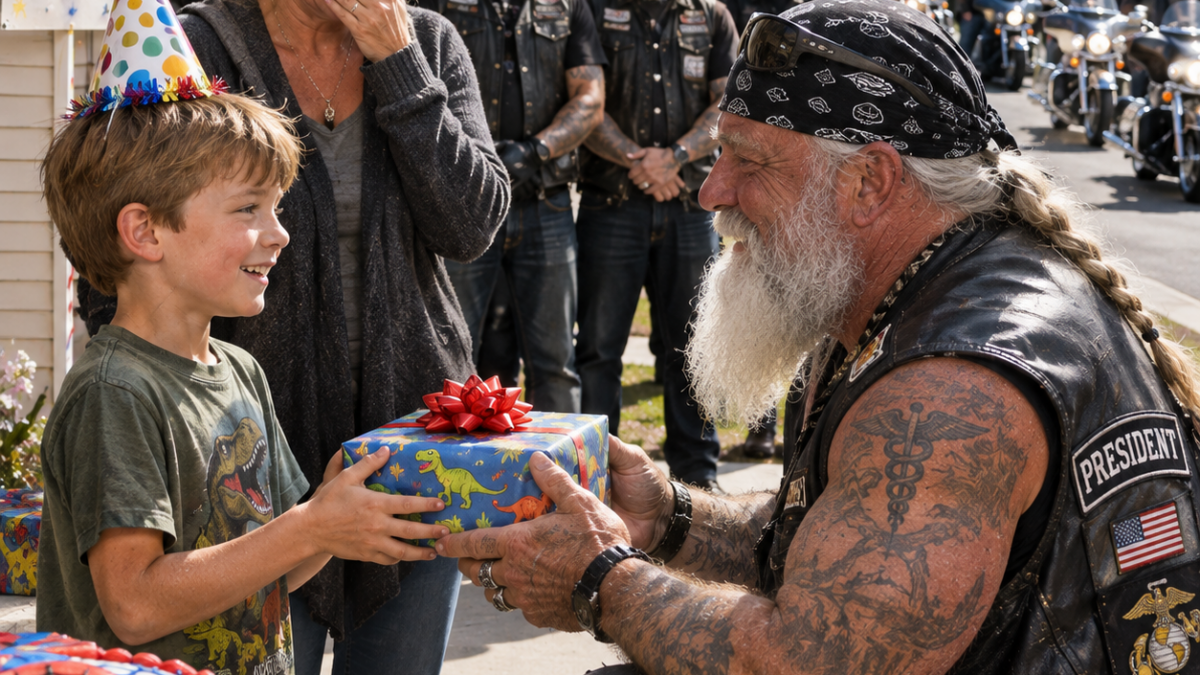
Forty Harleys Rolled Into My Nephew’s 9th Birthday Uninvited—Then We Learned He’d Secretly Written the Bikers a Letter at 1 A.M.
My sister had spent two years blocking every number, returning every card, and keeping our dead brother’s motorcycle club away from the nine-year-old son he left behind—until forty Harleys rolled into her quiet Tennessee cul-de-sac carrying birthday presents nobody had invited them to bring.
She thought the bikers had ignored her wishes, but the truth was worse: Tucker himself had secretly opened the duffel bag she had hidden on the top shelf of a closet, found four years of unopened letters from his father’s brothers, and mailed them an invitation at one in the morning because he believed his aunt was too sad to admit she missed them too.
Then the club president walked into Karen’s kitchen, placed a leather envelope on the table, and showed her the final instructions our brother had written one month before he died—words that proved the men she had spent two years protecting Tucker from had actually been protecting both of them.
Forty Harleys rolled into my sister’s quiet suburban cul-de-sac at exactly 1:43 p.m. on a Saturday in March.
I know the exact time because I happened to be looking at the microwave when the first engine reached Cherrywood Lane.
1:43.
The Spider-Man cake still needed candles.
Eight third-grade boys were in the backyard firing squirt guns at one another despite the temperature barely touching sixty degrees.
Someone had knocked over a bowl of cheese puffs.
The birthday boy was supposed to be outside with his friends but was instead standing beside me in the kitchen, dragging one finger through the red frosting along the cake’s edge.
“Tucker.”
He froze.
I turned.
He had frosting on the corner of his mouth.
“No idea what happened.”
“You’re a terrible criminal.”
“I didn’t do anything.”
“You have evidence on your face.”
He wiped his mouth with the sleeve of his good blue shirt.
“That makes it worse.”
He looked at the cake.
“Can I have one more?”
“No.”
“Please?”
“Your aunt will kill both of us.”
“She likes you.”
“Not enough.”
He smiled.
Tucker was nine years old that afternoon.
Slim.
Sandy blond hair.
Blue eyes.
Long legs he hadn’t grown into yet.
His father’s ears.
His father’s half-smile.
PART2:
His father’s habit of tilting his head whenever he thought an adult was giving him an answer that didn’t make sense.
If you had known my younger brother Daniel Mason at nine, you could have picked Tucker out of a crowd.
That fact made looking at him both beautiful and difficult.
Especially for Karen.
Karen was our older sister.
Fifty-one then.
A payroll administrator for a regional construction company.
Organized.
Responsible.
Practical to the point of irritation.
The kind of woman who labeled storage bins.
The kind who brought printed hotel confirmations even though everything was already on her phone.
The kind who believed grief could be managed if you filed the death certificate, closed the bank accounts, transferred the school records, canceled the subscriptions, arranged therapy, washed the sheets, and kept moving.
Grief disagreed.
It had been two years, five months, and twelve days since our brother Danny died on a wet stretch of state highway in Knox County.
Karen never stopped counting.
She pretended she had.
She hadn’t.
I knew because sometimes, when she was tired, she’d say things like:
“It’s been twenty-eight months.”
People who aren’t counting don’t say that.
Danny died October 4, 2022.
Forty-one years old.
Single father.
Marine veteran.
Transmission mechanic.
PART3:
Patched member of the Wild Mountain Riders Motorcycle Club.
And father of Tucker Mason, then six years old.
The accident report said Danny entered a curve too fast on wet pavement.
His motorcycle lost traction.
He crossed the center line.
A delivery truck hit him.
He died before the helicopter arrived.
That is the clinical version.
The version Karen lived with was simpler.
Motorcycle killed my brother.
The club encouraged motorcycles.
Therefore, the club was part of what killed my brother.
Grief does not care whether the math is fair.
It only wants somewhere to put the blame.
Karen chose the Wild Mountain Riders.
Especially their president.
A man called Doc.
That was why, when the low thunder reached Cherrywood Lane that Saturday afternoon, Karen reacted before the rest of us understood what we were hearing.
She had been standing beside the counter with a cake knife.
Her hand stopped in midair.
At first I thought she had cut herself.
Then I saw her face.
White.
Not pale.
White.
Exactly the same color I remembered from the night Sheriff Paul McCrae called her house and asked whether she was Daniel Mason’s sister.
I looked toward the front of the house.
The engines grew louder.
One.
Then several.
Then many.
Tucker’s eyes widened.
He knew before I did.
I saw it.
Excitement.
Fear.
Recognition.
Karen placed the knife down.
Very carefully.
“Tucker.”
He looked at her.
“What did you do?”
Nothing in her voice was loud.
That made it worse.
He didn’t answer.
The engines reached the entrance of the cul-de-sac.
Karen walked out of the kitchen.
Across the living room.
Through the foyer.
She opened the front door.
I followed.
So did Tucker.
Forty motorcycles were rolling into Cherrywood Lane.
Harleys mostly.
A couple Indians.
One old Victory.
Black leather.
Chrome.
White beards.
Gray beards.
Military patches.
Memorial patches.
Engines idling low.
Not roaring.
Not revving.
Not trying to frighten anyone.
They came around the circle at walking speed.
Neighbors appeared behind blinds.
A man two houses down stepped onto his porch holding a leaf blower.
A woman across the street pulled her toddler inside.
The boys in the backyard abandoned the squirt guns and ran toward the side gate.
And at the front of the formation rode Doc.
Six bike lengths ahead.
Alone.
He was on a black 2008 Harley-Davidson Road Glide.
I recognized the motorcycle before I recognized the rider.
Danny’s motorcycle.
My breath stopped.
I hadn’t seen it since the funeral.
Doc had purchased it from the impound lot after the accident.
Karen knew.
She hated him for that too.
Said he was collecting a trophy.
I later learned he had bought it because the storage fees were increasing, Danny had left no estate money to deal with the bike, and Doc couldn’t stand the idea of it being auctioned to a stranger.
For two years, he had kept it in the clubhouse garage.
Started it once a week.
Changed the oil.
Turned the tires.
Never taken it on a real ride.
Until that morning.
Now Danny’s Road Glide was carrying a sixty-four-year-old retired Army medic into my sister’s neighborhood.
Doc looked the way legends usually don’t.
Older than the stories.
Six-foot-one.
Maybe two hundred ten pounds.
Long white braid down his back.
Full white beard.
Black bandana.
Thick forearms covered in black-and-gray ink.
A medical caduceus.
Names.
Dates.
A faded blue USMC tattoo on his neck from the years before he joined the Army medical corps.
His black leather cut said:
WILD MOUNTAIN RIDERS MC.
TENNESSEE.
PRESIDENT.
He had served eight years in Iraq as a battlefield medic.
Twenty-two years as chapter president.
The kind of man who could walk into a rural gas station and lower the volume without saying a word.
Across his gas tank was a birthday present.
Small.
Rectangular.
Wrapped in bright green dinosaur paper.
Blue ribbon.
Bungeed down with absurd care.
The contrast was almost funny.
Almost.
Except Doc rode like he was carrying something sacred.
He stopped in front of Karen’s house.
The other riders formed a line along both curbs.
Engines shut down.
One after another.
The sudden silence landed harder than the noise.
Doc swung one boot down.
Turned off Danny’s bike.
Removed his gloves.
Untied the present.
Then walked toward the driveway.
Nobody followed.
Karen stood in the doorway.
Her hands were shaking.
Doc stopped at the bottom of the porch steps.
He removed his sunglasses.
“Ma’am.”
Karen said nothing.
He held the birthday present in both hands.
“The boy invited us.”
Karen’s face changed.
Behind her, Tucker stopped breathing.
Doc continued quietly.
“We came.”
Karen turned.
Slowly.
“Tucker.”
He looked at the floor.
“What did you do?”
His chin trembled.
“I wrote them.”
Karen stared.
“You what?”
“I invited them.”
“How?”
Nobody spoke.
“How did you know where to send anything?”
Tucker’s eyes filled.
“The cards.”
Karen’s expression went blank.
“What cards?”
He looked toward the hallway.
And in that instant, I knew.
The duffel bag.
I didn’t know everything inside it yet.
But I knew enough to understand that Tucker had touched the one thing Karen had spent two years refusing to touch.
She stepped backward.
“No.”
Tucker whispered:
“I’m sorry.”
“When?”
He looked up.
“A while.”
“What does that mean?”
“I read them when you’re at work.”
Karen grabbed the doorframe.
“You opened the bag?”
Silence.
“Tucker.”
“Yes.”
For a second, anger won.
“You had no right.”
The boy flinched.
Doc looked down.
I stepped closer.
“Karen.”
She raised one hand.
“No.”
She looked at Tucker.
“That was your father’s property.”
Tucker’s face tightened.
“He was my dad.”
The sentence hit everyone.
Karen’s mouth opened.
Closed.
Tucker continued.
“You wouldn’t talk about him.”
“I talk about him.”
“No.”
“I do.”
“You talk about before the motorcycles.”
Karen stared.
Tucker’s voice began shaking.
“You talk about when he was little. You talk about Christmas. You talk about school.”
Tears filled his eyes.
“But you don’t talk about the people he loved when he died.”
Karen whispered:
“Tucker.”
He wiped his face angrily.
“You hid his stuff.”
“I was protecting you.”
“From Dad?”
“From this.”
She gestured toward the street.
Forty riders stood silently.
Tucker looked at them.
“That’s not Dad.”
“No.”
“They knew Dad.”
Karen swallowed.
“They were there.”
“At what?”
“At the clubhouse. Before.”
Her voice cracked.
“Before he got on that bike.”
There it was.
The thing she hadn’t said.
The accusation beneath everything.
Doc looked toward Danny’s Road Glide.
Then back at Karen.
“Ma’am.”
“Don’t.”
Her voice hardened.
“You don’t get to explain.”
Doc nodded.
“Yes, ma’am.”
“You don’t get to come here with forty motorcycles and make him think this is some kind of—”
“I invited them!”
Tucker shouted it.
Everyone froze.
Not because he was loud.
Because Tucker almost never shouted.
Karen looked at him.
He was crying now.
Fully.
“I invited them because they’re Dad’s family.”
Karen looked like he’d slapped her.
Then Tucker said something that broke whatever remained.
“And they’re mine too.”
Karen made a sound.
Not quite a sob.
Not quite a gasp.
Then she walked inside.
Closed the front door.
Tucker stood there.
Terrified.
Doc didn’t move.
He looked at me.
I said, “Give me a minute.”
I found Karen in the kitchen.
Sitting on the linoleum floor.
Her blue party dress spread around her.
Hands over her face.
The Spider-Man cake sat three feet away.
Nine candles in a plastic package beside it.
“Tuck wrote them,” she said.
“I know.”
“He wrote them himself.”
I sat beside her.
“He’s nine.”
“I know.”
“I’ve been hiding the bag.”
“Yes.”
“I thought he didn’t remember them.”
I didn’t say anything.
She lowered her hands.
“I thought if enough time passed, he would stop asking.”
“Kids don’t work that way.”
“I know that now.”
The tears came.
“I thought I was protecting him.”
I put my arm around her.
“Maybe you were protecting yourself too.”
She looked at me sharply.
I expected anger.
Instead, her face folded.
“Yes.”
She whispered it.
“Yes.”
Then the doorbell rang.
Karen looked toward the hallway.
Neither of us moved.
It rang once.
No knocking.
No second ring.
I stood.
“Want me to—”
“No.”
She got up.
Wiped her face.
Straightened her dress.
Walked to the door.
Doc stood alone on the porch.
No cut.
He had removed it.
Folded over one forearm.
I learned later that among Wild Mountain Riders, entering someone’s home in club colors without being invited was considered disrespectful.
He held the dinosaur-wrapped present.
And something else.
A flat leather pouch.
Brown.
Hand-sewn.
About the size of a sheet of paper.
Karen looked at him.
Doc said:
“Ma’am, I won’t come inside unless you tell me.”
She stared.
Then stepped aside.
He entered.
I closed the door.
Tucker remained outside with the bikers.
That mattered.
Doc had apparently told them to stay put and keep Tucker occupied.
He did not want the boy watching whatever happened next.
Doc placed the birthday gift on the dining table.
Then held out the leather pouch.
“I should’ve gotten this to you two years ago.”
Karen stared.
“You gave me a bag.”
“Yes.”
“You said everything was in there.”
“Yes.”
“This wasn’t?”
“No.”
“Why?”
Doc looked down.
“Danny gave me two instructions.”
Karen’s jaw tightened at the name.
“What instructions?”
“Give you the duffel.”
“And?”
“If you wouldn’t read what was inside, wait.”
Karen looked confused.
“For what?”
“The boy.”
I felt the room change.
Doc continued.
“He told me Tucker would come looking.”
Karen laughed bitterly.
“You’re telling me my brother predicted this?”
“Pretty much.”
“What is that?”
Doc held out the pouch.
“Something Daniel wrote.”
Karen did not take it.
Her hands had begun shaking again.
“Is this another club thing?”
“No.”
“Did you write it?”
“No.”
“Did one of your people?”
“No.”
“It better not be some—”
“Karen.”
I rarely interrupted her.
She turned.
“Take it.”
She stared at me.
Then at Doc.
She accepted the leather pouch.
It had been stitched shut with thick brown thread.
Doc handed her a small pocketknife.
She cut the stitches.
Inside was a yellow sheet of legal paper.
Folded in thirds.
I recognized Danny’s handwriting before she opened it.
Our brother wrote like he was always annoyed at the pen.
Heavy pressure.
Big capital letters.
Dates underlined twice.
Karen unfolded the page.
Her eyes stopped on the first line.
September 14, 2022.
Three weeks before the accident.
She sat down.
Doc remained standing.
I stood beside the counter.
Karen began reading.
Not aloud at first.
Then she reached the part that changed everything.
Her lips moved.
Finally her voice came.
“In the event of my death…”
She stopped.
I stepped closer.
“What?”
She looked up at Doc.
“This is a will.”
“Yes.”
“Why wasn’t this filed?”
“It wasn’t his full legal will.”
Doc spoke carefully.
“He had a formal one through an attorney dealing with the house account, insurance, and some other things. This was supplemental. Personal wishes.”
“Witnessed?”
“Yes.”
“Notarized?”
“Yes.”
“Who?”
“Two brothers witnessed. My wife notarized.”
Karen stared at him.
“You knew he wanted Tucker with me?”
“Yes.”
“And you never told me?”
Doc’s expression changed.
“We did.”
“No.”
“The lawyer did.”
Karen went still.
“Danny’s attorney called you the night after the accident.”
She looked at me.
I remembered.
A lawyer had called.
Karen had taken guardianship immediately.
There had been no custody fight.
No paternal grandparents.
Tucker’s mother had been absent for years.
“Danny named you as first-choice guardian in the formal documents,” Doc said.
Karen looked at the paper.
“Then what is this?”
“His words.”
She started reading aloud.
“If something happens to me, I want Tucker with Karen.”
Her voice broke.
She continued.
“She will hate that I’m asking her because she thinks I ride too much and because she thinks the club is half the reason I’m still stupid.”
A laugh escaped me.
Karen covered her mouth.
That was Danny.
Exactly.
She kept going.
“But she’s the best person I know.”
Karen stopped.
Doc looked toward the floor.
“She doesn’t quit on people even when she’s mad at them.”
Karen’s face crumpled.
“She will raise him right.”
She could barely breathe.
“Tell her I know that.”
Then:
“To my brothers in Wild Mountain—I’m sorry I’m putting my sister in the position of telling you no.”
Karen stopped.
She looked at Doc.
He said nothing.
“She probably will.”
Her voice became smaller.
“Don’t hold it against her.”
A tear fell onto the page.
“She has been losing me for a long time and she’s tired.”
That was the line.
Karen bent over the table.
I had known she was angry.
I had known she blamed the club.
I had known she blamed the motorcycle.
I had not understood the deeper truth.
She had been losing Danny before the crash.
Not physically.
Emotionally.
For years.
First to the Marines.
Then Afghanistan.
Then drinking.
Then sleepless nights.
Then motorcycles.
Then the club.
Every time Danny found another world that Karen couldn’t enter, she had experienced it as another version of losing him.
And when he finally died on a motorcycle, all those old losses became one enormous accusation.
The letter continued.
“Give her space.”
Karen wiped her face.
“Give her a year.”
She breathed.
“Give her two if she needs it.”
Doc closed his eyes.
“Keep an eye on Tucker without her knowing.”
Karen looked sharply at him.
“You did?”
Doc hesitated.
“From a distance.”
“How?”
“Christmas cards.”
“You sent those.”
“Yes.”
“You knew I returned them.”
“Yes.”
“You kept sending.”
“Yes.”
“Why?”
“Danny asked us to keep a door unlocked.”
Karen stared.
Doc continued.
“We didn’t follow him. We didn’t show up at school. We didn’t contact him online. We respected what you said.”
He pointed to the paper.
“But Danny told us the boy would find us when he was ready.”
Karen looked back at the letter.
She read:
“He’ll come find you.”
Her voice broke.
“He’s a smart kid.”
She looked toward the front window.
Outside, Tucker was standing beside one of the motorcycles talking to a gray-haired rider.
“He’ll figure it out.”
Then the next line.
“And when he does, you treat my sister like family.”
Karen whispered:
“What?”
She read again.
“If he chose to come find you, then she did right by him.”
Her face collapsed.
“That means she earned it.”
Karen pressed the paper against her mouth.
For two years she had believed Danny would’ve been angry.
Believed he would’ve resented her for removing the club from Tucker’s life.
Believed some part of him would accuse her of erasing his identity.
Instead, he had anticipated everything.
Her fear.
Her anger.
Her refusal.
Her need for time.
And he had defended her to the men she was shutting out.
Doc had stood in front of his own chapter and told forty men to leave Karen alone because Danny had asked them to respect the way his sister grieved.
Karen read the last lines.
“My cut goes to Tucker.”
“To wear when he’s old enough.”
“My bike goes to Doc.”
She looked through the window at the Road Glide.
“To ride when he’s missing me.”
Doc’s chin lowered.
Then:
“Tell my boy I loved him.”
Karen’s voice disappeared.
I read the final line over her shoulder.
EVERY DAY. WITH EVERYTHING.
—DANNY.
Karen put her forehead on the letter.
And sobbed.
Not cried.
Sobbed.
I had not seen her grieve like that at the funeral.
At the funeral, she managed.
She chose flowers.
Spoke to the pastor.
Handled Tucker.
Signed papers.
Thanked Marines.
Made sure everyone ate.
Even when the honor guard folded the flag, Karen held herself together because Tucker’s hand was inside hers.
She had become his guardian before she’d had time to become Danny’s sister again.
For two years, anger had performed the job grief refused to do.
Now anger had lost its purpose.
Doc stayed near the door.
Didn’t approach.
Didn’t touch her.
Didn’t say he was sorry.
After several minutes, Karen looked up.
“Why didn’t you force me to read this?”
Doc’s answer came immediately.
“Because Danny told me not to.”
“You could’ve told me what it said.”
“He told me you’d hear it when you were ready.”
“What if I never was?”
Doc looked toward the front window.
“Then Tucker would be.”
Karen looked down.
The wisdom of that hurt.
Outside, laughter erupted.
One of Tucker’s school friends had apparently tried to sit on a motorcycle and nearly fallen over.
A biker caught him.
The sound came through the glass.
Children.
Bikers.
Birthday.
Life continuing while Karen’s world cracked open again.
Doc cleared his throat.
“Ma’am.”
She looked up.
“The chapter would be honored to stay.”
He paused.
“We’d also leave right now if that’s what you want.”
Karen’s face trembled.
“After you brought forty bikes?”
“They’re trained.”
I laughed unexpectedly.
Doc almost smiled.
He continued.
“Your house.”
“Your rules.”
“Your boy.”
Karen looked at the letter.
Then out the window.
Tucker was now standing beside Danny’s Road Glide.
One small hand resting on the gas tank.
The dinosaur present remained on our dining table.
She whispered:
“Bring them in.”
Doc didn’t move.
“What?”
“Bring them in.”
She wiped her face.
“All of them?”
Karen laughed through tears.
“You already destroyed my neighbors’ property values.”
Doc smiled for the first time.
“Probably.”
She stood.
“Bring the cake outside.”
Then the sentence I will remember until I die.
“Tell them the boy gets his daddy’s club.”
Doc’s eyes filled.
He nodded once.
Then walked outside.
Forty bikers came up the driveway.
Not at once.
Not like an invasion.
Five or six at a time.
Many removed their cuts before entering the house.
Some didn’t enter at all.
They stayed in the yard.
Introduced themselves to nine-year-olds.
Let children sit on motorcycles with the engines off.
Passed out birthday presents.
And Tucker—
God.
Tucker changed.
That’s the only way I can explain it.
He had always been a good kid.
Quiet after Danny died.
Too quiet.
Counselors called it “adaptive.”
Adults use words like that because saying “this little boy learned not to ask for what he misses” sounds unbearable.
That afternoon, he became loud.
He laughed.
He shouted names.
He remembered people Karen didn’t think he remembered.
“Bear!”
A giant man with a red beard dropped to one knee.
“You remember me?”
“You taught me to make motorcycle noises.”
Bear laughed.
“That sounds irresponsible.”
Another rider.
“Uncle Goose!”
“Good Lord, he remembers that name.”
One by one.
Connections Karen had tried to erase because she thought grief would be easier if Tucker didn’t have reminders.
But children aren’t blank pages.
They remember through their bodies.
Smells.
Sounds.
Nicknames.
The way somebody lifts them.
The sound of forty engines.
At 2:29, we brought out the Spider-Man cake.
Forty bikers plus eight children plus family cannot fit around one suburban patio table.
We improvised.
Some stood.
Some sat on folding chairs.
One enormous man named Moose sat on a child’s plastic lawn chair and somehow survived.
Tucker stood behind the cake.
Karen placed nine candles.
She looked at Doc.
“Would you?”
He shook his head.
“You.”
“I’m his aunt.”
Doc looked at her.
“You’re his mom.”
Karen stopped.
That word.
Mom.
She had never asked Tucker to call her that.
He still called her Aunt Karen.
But legally, emotionally, practically, she was raising him.
Doc wasn’t replacing Danny.
He was recognizing what she had become.
Karen lit the candles.
Everyone sang.
Forty biker voices singing “Happy Birthday” is one of the ugliest sounds I have ever heard.
Tucker loved it.
He closed his eyes.
Made a wish.
Blew out every candle.
Then Doc carried out the dinosaur present.
Tucker tore the paper.
Inside was a wooden box.
Handmade.
Dark walnut.
Brass hinges.
His name burned into the lid.
TUCKER DANIEL MASON.
He opened it.
Inside was a motorcycle key.
Karen saw it.
Her entire body stiffened.
Doc immediately said:
“Not yet.”
Tucker looked confused.
“What is it?”
Doc crouched beside him.
“Key to your dad’s bike.”
Karen stared.
Tucker looked toward the Road Glide.
“That’s Dad’s?”
“Yes.”
“You rode Dad’s bike here?”
“First long ride it’s taken since the accident.”
Tucker touched the key.
“Is it mine?”
Doc looked at Karen.
“No.”
Good answer.
“Your daddy left the bike to me.”
Tucker nodded.
Doc continued.
“But I don’t plan on keeping it forever.”
Tucker’s eyes widened.
Doc pointed at the wooden box.
“That key doesn’t start anything yet.”
“What?”
“I changed the ignition cylinder.”
Several bikers laughed.
Doc smiled.
“That’s the old key.”
Tucker looked disappointed.
Then Doc said:
“It’s a promise.”
Tucker looked up.
“When you’re old enough, if your aunt agrees, I’ll teach you.”
Everyone became very still.
Doc continued.
“If she says no, the answer is no.”
That mattered.
Karen heard it.
He was putting her authority above club tradition.
Above Danny.
Above the symbolism of the bike.
Tucker looked at Karen.
“Can I?”
She stared at the old key.
I saw the fight inside her.
Motorcycle.
Accident.
Danny.
Fear.
Then she looked at Tucker.
“We’ll talk when you’re older.”
For Karen, that was practically yes.
Tucker smiled.
“Okay.”
Doc nodded.
“Good.”
Then Tucker pulled something from beneath his shirt.
A small black vest.
Child-sized.
I recognized it.
His old prospect cut.
The one the club made him when he was five.
Karen froze.
“You’ve been wearing that?”
“Sometimes.”
“Where was it?”
“Under my mattress.”
The bikers laughed.
Karen did not.
Not immediately.
Then Doc said:
“Boy.”
Tucker looked at him.
“Take it off.”
The yard went silent.
Tucker’s face fell.
“But—”
“Take it off.”
He obeyed.
Doc took the little vest.
Held it carefully.
“That ain’t yours anymore.”
Tucker looked devastated.
Karen watched.
Doc smiled.
“You outgrew it.”
Laughter.
He handed it back.
“Your daddy’s cut is yours someday.”
Tucker’s eyes widened.
“You have it?”
Karen said quietly:
“I do.”
Everybody looked at her.
She swallowed.
“It’s in the closet.”
Tucker’s eyes dropped.
“I know.”
“Yes.”
For the first time, she smiled at the secret.
“I suppose you do.”
That evening, after the school friends went home and most of the club started leaving, Doc sat with Karen on the back porch.
I wasn’t invited into the conversation.
I listened anyway because older sisters have privileges.
Karen asked:
“Were you with him that day?”
Doc nodded.
“At the clubhouse?”
“Yes.”
“What happened?”
Doc stared at the yard.
“Danny brought Tucker by around eleven.”
“What for?”
“Saturday breakfast.”
“Tucker remembers?”
“Probably pieces.”
Karen waited.
Doc continued.
“Danny seemed good.”
“Drinking?”
“No.”
“You’re sure?”
“Seven years sober.”
“Drugs?”
“No.”
“He was tired?”
“Maybe.”
Karen’s voice sharpened.
“Why didn’t somebody stop him from riding?”
There it was.
The question she had been carrying for two years.
Doc did not defend himself.
“We didn’t know he needed stopping.”
“It was raining.”
“Barely when he left.”
“The road was wet.”
“Yes.”
“He rode too fast.”
“According to the report.”
“You were president.”
“Yes.”
“You could’ve told him to stay.”
“I could’ve.”
Karen’s face twisted.
“Then why didn’t you?”
Doc looked at her.
“Because he was a grown man.”
She looked away.
“That doesn’t feel good enough.”
“I know.”
“Did you tell him to slow down?”
“No.”
“Did anyone?”
“No.”
She began crying again.
“I keep thinking somebody should’ve.”
Doc’s voice softened.
“So do I.”
That surprised her.
“You blame yourself?”
“Every day.”
Karen stared.
Doc continued.
“I was a medic.”
He looked at his hands.
“I spent eight years keeping men alive.”
His voice became quieter.
“Then one of my brothers died forty miles away because I wasn’t there.”
“You couldn’t have—”
He looked at her.
Now it was his turn.
She stopped.
“Exactly.”
He said it gently.
“We both know the answer when the other person says it.”
Karen lowered her head.
Doc continued.
“Danny made a bad decision in a curve.”
“We loved him.”
“Yeah.”
“We didn’t cause it.”
“No.”
Neither sounded fully convinced.
But maybe saying it together was the beginning.
“What happened after he left?”
Doc described it.
Danny put Tucker into a pickup driven by another brother’s wife, who was taking several kids to an afternoon movie.
Danny planned to meet them afterward.
He left alone on the Road Glide.
Forty-seven minutes later, sheriff’s deputies called the emergency contact listed in his wallet.
Doc reached the crash scene before Karen did.
That was why Karen hated him most.
He had seen Danny.
She hadn’t.
The casket was closed.
“What did he look like?”
I almost stopped listening.
Doc didn’t answer immediately.
“Karen.”
“I need to know.”
“No.”
“Don’t decide for me.”
He turned.
“I was a battlefield medic.”
His voice changed.
“I know the difference between truth that heals and detail that becomes a nightmare.”
Karen stared at him.
“He wasn’t alone.”
She stopped.
Doc continued.
“A woman had stopped before EMS arrived.”
“Who?”
“I don’t know.”
“She held an umbrella over him.”
Karen’s eyes filled.
“Was he conscious?”
“For a little while.”
“What did he say?”
Doc closed his eyes.
“I don’t know whether this helps.”
“Tell me.”
“He asked about Tucker.”
Of course.
Karen covered her mouth.
“What did you tell him?”
“That Tucker was safe.”
“Anything else?”
Doc looked directly at her.
“He said, ‘Tell Karen I’m sorry I made it hard.’”
Karen broke.
I stepped back from the kitchen window.
That sentence belonged to her.
Later she told me the rest.
Doc had held Danny’s hand until the paramedics told him there was nothing left to do.
The biker Karen had spent two years imagining as the symbol of everything that killed her brother had, in fact, been the last familiar face beside him.
Doc hadn’t told her because she never asked.
And because Danny’s final words weren’t a weapon he wanted to use to force his way back into Tucker’s life.
That was the thing I came to understand about the Wild Mountain Riders.
They waited.
Not perfectly.
Not painlessly.
But they waited.
They had cards.
Photographs.
Stories.
Danny’s bike.
A little boy they loved.
And yet, for two years, they obeyed a grieving woman’s demand to stay away.
Not because they agreed.
Because Danny asked them to respect her.
Tucker changed that.
Not them.
At some point during the party, Doc handed me the invitation.
It was folded into quarters.
Pencil.
Spelling mistakes.
Nine-year-old handwriting.
Dear Wild Mountin Riders,
My name is Tucker Mason.
I am Daniels son.
I am turning 9 on March 16.
I want you to come to my birthday because my dad would have wanted you there.
I know my Aunt Karen says no but I think she will say yes if you come because she misses my dad too she just doesnt say it.
I have been reading the cards you sent me.
Thank you.
I read all of them.
The address is 412 Cherrywood Lane Bristol TN.
Please come at 1:30.
The party is in the back yard.
Please dont make Aunt Karen mad.
Please be quiet when you come up the street.
Love,
Tucker Mason
Then the P.S.
My dads cut is in the closet.
I want to wear it when im 18.
Doc will you keep it safe untill then?
Aunt Karen doesnt know I know its there.
I read it twice.
Then asked Doc:
“What did you do when you got this?”
He smiled.
“Cried.”
“Seriously?”
“No.”
I waited.
He sighed.
“Yes.”
“What then?”
“Called a chapter meeting.”
“All forty?”
“Forty local. Six Knoxville wanted in. Four Asheville heard.”
“So fifty came?”
“Forty bikes on the street. Some doubled.”
I looked around.
“You voted?”
“Unanimous.”
“Did anyone say maybe you shouldn’t?”
“Me.”
That surprised me.
“Why?”
“Because Karen said no.”
“So why come?”
He looked toward Tucker.
“Because Danny said the boy would tell us when.”
I glanced at the letter.
“You really waited for that?”
“Two years.”
“That’s a long time.”
“Not when a brother asks.”
One of the riders called for Doc.
He stood.
Before walking away, he said:
“Worst thing about losing a brother isn’t the funeral.”
“What is?”
“Figuring out what parts of him you’re allowed to keep.”
I understood what he meant.
Karen thought keeping the club meant keeping the danger.
The club thought keeping Tucker without Karen’s permission would dishonor Danny.
So everyone gave something up.
Until a nine-year-old got tired of adults deciding which parts of his father he was allowed to love.
That night, after everyone left, the house looked destroyed.
Paper plates.
Wrapping paper.
Empty soda cans.
Motorcycle magazines somebody had given Tucker.
A model Harley kit.
Two Spider-Man masks.
Forty adults can do remarkable damage to a kitchen.
Karen stood at the sink.
I dried dishes.
Tucker had fallen asleep on the couch wearing his father’s old club T-shirt.
Not the cut.
Karen wouldn’t let him wear that yet.
But the shirt.
She had taken it from the duffel bag herself.
“You okay?” I asked.
“No.”
“Useful answer.”
She stared into the sink.
“I was wrong.”
“About what?”
“Everything.”
“That’s dramatic.”
She looked at me.
“Let me have it.”
“Fine.”
She washed a plate.
“I thought if I kept him away from the club, he wouldn’t become Danny.”
I stopped drying.
Karen continued.
“I thought if he didn’t hear the engines, didn’t see the leather, didn’t grow up around those men, he wouldn’t want a motorcycle.”
“That might still be true.”
“No.”
She smiled faintly.
“He has posters hidden behind his bookshelf.”
I laughed.
“You knew?”
“I found them last month.”
“And said nothing?”
“I was planning my denial.”
She rinsed the plate.
“I thought I could remove the dangerous parts of Danny and leave Tucker with the good parts.”
Her eyes filled.
“But they were all mixed together.”
Yes.
Danny’s recklessness.
His loyalty.
Motorcycles.
Sobriety.
The Marines.
Nightmares.
The club.
Fatherhood.
You couldn’t cut him into safe pieces.
Karen whispered:
“I erased his family.”
“No.”
“I tried.”
“You were grieving.”
“Tucker was too.”
“Yes.”
“I made my grief the rule.”
I didn’t have an answer.
She looked toward the couch.
“He read those cards every night.”
“How do you know?”
“He told me.”
She started crying.
“Four years of birthday cards.”
There had been cards from the chapter for ages seven, eight, nine, and one batch written before Danny died.
Forty-one men signed some of them.
One read:
Your dad once tried to cook chili without opening the cans first. Ask Doc.
Another:
Your daddy stayed with me all night after my wife died. He didn’t talk. Good man.
Another:
Your dad taught me how to change a clutch and then made me redo it because I did it wrong.
Another:
When you’re older, I’ll tell you about the time your dad tried to ride a wheelie and fell into a hedge. Don’t do that.
Tucker had been collecting fragments of his father while Karen thought he was forgetting.
The next morning, Karen took the duffel bag down.
For the first time.
We emptied it onto the living room rug.
Danny’s cut.
Heavy black leather.
D. MASON.
WILD MOUNTAIN RIDERS.
TENNESSEE.
A Marine pin.
A sobriety anniversary patch.
Memorial strip for another brother.
Tucker touched it like church silver.
Karen held it against her chest.
There were photographs.
Hundreds.
Danny with Tucker on the gas tank.
Danny holding baby Tucker inside the clubhouse.
Doc asleep in a chair with Tucker on his chest.
A Christmas party.
A veterans’ ride.
Tucker in the tiny prospect vest.
Danny laughing.
Danny cooking.
Danny being alive in ways Karen had denied herself for two years.
There was also the toy cut.
Birthday cards.
A brass keychain.
A recovery coin marking seven years sober.
And one small voice recorder.
Tucker found it.
“What’s this?”
Karen stared.
“I don’t know.”
We charged it.
There were eleven recordings.
Most were nonsense.
Danny testing it.
Club noises.
Tucker laughing when he was four.
Then recording number nine.
Danny’s voice.
“If you’re hearing this, I forgot I recorded it.”
We all laughed.
Then he continued.
“Or I’m dead.”
Nobody laughed.
Karen reached for stop.
Tucker grabbed her wrist.
“No.”
She looked at him.
He whispered:
“Please.”
So we listened.
Danny’s voice filled the room.
“Okay. Serious.”
Pause.
“If Tucker is hearing this someday—boy, I love you.”
Tucker’s lip trembled.
“More than motorcycles.”
“More than the Marines.”
“More than the club.”
“More than anything I’ve ever been good at or bad at.”
Karen closed her eyes.
“I know people are gonna tell you stories about me.”
“Some will make me sound better than I was.”
“Some worse.”
“Believe your aunt Karen.”
She looked up.
“She knows when I’m full of it.”
I laughed through tears.
Danny continued.
“And listen to Doc sometimes.”
“Not always.”
“Old man likes hearing himself talk.”
Somewhere across town, Doc probably sneezed.
Then:
“You do not owe me my life.”
Tucker became very still.
“You don’t have to ride.”
“You don’t have to join the club.”
“You don’t have to be a Marine.”
“You don’t have to fix transmissions.”
“You don’t have to be anything because I was.”
Karen covered her mouth.
“You owe me one thing.”
“Be decent.”
“That’s it.”
“If somebody is smaller, help.”
“If somebody is hungry, feed them.”
“If somebody’s alone, sit with them.”
“If you’re mad, don’t drive.”
That sentence nearly stopped my heart.
“If you’re scared, say it.”
“If you screw up, own it.”
“And if you ever wonder whether your dad loved you—don’t.”
A pause.
“I did.”
“Every day.”
“With everything.”
Same words as the letter.
The recording clicked off.
Tucker sat motionless.
Karen reached for him.
He crawled into her lap like he was six again.
She held him.
“I didn’t know,” she whispered.
“I know.”
“I should’ve opened it.”
“I opened it.”
“I know.”
“Are you mad?”
Karen pulled back.
“No.”
“Even though I stole a stamp?”
A laugh escaped her.
“We’ll address the federal crime later.”
He smiled.
Then became serious.
“Can Doc come back?”
Karen looked at me.
Then at Tucker.
“Yes.”
“Every week?”
“Let’s not lose our minds.”
“Once a month?”
She sighed.
“Yes.”
Tucker hugged her again.
That became dinner.
First Sunday of each month.
At first, only Doc.
Then Bear.
Goose.
Moose.
A few others.
Karen imposed a rotating limit because she refused to feed forty bikers monthly.
Eventually she started making chili in industrial quantities anyway.
The riders did dishes.
That was mandatory.
Doc repaired her porch railing.
Bear replaced a broken water heater.
Goose taught Tucker fishing knots.
One rider named Finch, an accountant—which Tucker found deeply disappointing—helped Karen sort Danny’s remaining veterans-benefit paperwork.
The club never tried to become Tucker’s father.
That mattered.
They spoke about Danny.
They did not replace him.
When Tucker asked difficult questions, they answered.
“Did Dad ever get arrested?”
Doc:
“Yes.”
Karen:
“Doc.”
Tucker:
“For what?”
Doc:
“Bar fight.”
Karen:
“Doc.”
Doc:
“He was twenty-three.”
Tucker:
“Did he win?”
Karen:
“Conversation over.”
They told him Danny had struggled with alcohol.
They told him why he got sober.
They told him motorcycles were dangerous.
They did not romanticize the accident.
Doc was especially firm.
“Your father loved riding.”
He would point at Tucker.
“That does not mean every choice he made on a bike was smart.”
When Tucker turned ten, Karen asked the chapter to come again.
This time she invited them herself.
Twenty-seven bikes.
Neighbors were prepared.
One even brought lawn chairs.
When Tucker turned eleven, Karen handed Doc a document.
“What is this?”
“Rules.”
He looked.
No motorcycle riding without certified training.
No public roads until legally licensed.
Full protective equipment.
No riding in rain.
No riding after dark until eighteen.
No club prospecting until twenty-one.
School performance requirements.
Doc stared.
“You wrote a motorcycle treaty.”
“Yes.”
“You know he’s eleven?”
“I plan ahead.”
Doc smiled.
“Danny was right.”
“What?”
“You are terrifying.”
She hugged him.
That was the first time.
Doc froze.
This enormous battle-tested medic didn’t know what to do with a suburban woman hugging him beside a grill.
Eventually he put one arm around her.
She whispered:
“Thank you for waiting.”
Doc’s face changed.
“Wasn’t easy.”
“I know.”
“No, ma’am.”
He looked toward Tucker.
“You don’t.”
That was true.
The club had lost Danny too.
One of their own.
And then immediately lost his son.
No funeral visits afterward.
No birthdays.
No holidays.
No stories.
They had obeyed Karen.
But obedience had cost them.
Doc kept Danny’s Road Glide in perfect condition.
Every Sunday morning, he started it.
Let it idle.
Once a month, rode it around the clubhouse parking lot.
Never farther.
“Why didn’t you ride it?” I asked.
“Didn’t feel like mine.”
“Danny gave it to you.”
“Still.”
Then March came.
Tucker’s letter.
Doc said he knew immediately what motorcycle had to lead the formation.
“The boy needed to hear his dad coming home.”
That line wrecked me.
Karen heard it later.
She cried again.
By Tucker’s twelfth birthday, Danny’s bike had moved to Karen’s garage.
Her idea.
Doc tried to refuse.
“The bike belongs with the chapter until he’s older.”
Karen shook her head.
“It belongs near his son.”
So the Road Glide sat beside Karen’s Honda.
Black.
Chrome.
Polished.
Silent most days.
Once a month, Doc came to start it.
Tucker helped.
Check oil.
Battery.
Tires.
Brakes.
Doc taught him maintenance before riding.
“Machines don’t care how excited you are,” Doc told him. “You respect them before you enjoy them.”
Karen liked that lesson.
At thirteen, Tucker started asking about the accident in detail.
Karen wanted to avoid it.
Doc didn’t.
He brought the official report.
Sat at the dining table.
“Your dad entered this curve here.”
He pointed.
“Too fast?”
“Probably.”
“Why?”
“We don’t know.”
“Was he showing off?”
“No witnesses.”
“Was he angry?”
“Maybe.”
“Tired?”
“Possible.”
Tucker looked at the diagram.
“Could it happen to you?”
“Yes.”
Doc did not soften it.
“Could it happen to me?”
“Yes.”
Karen looked terrified.
Doc continued.
“That is why we train.”
He pointed at Tucker.
“And why fear isn’t weakness.”
Tucker looked at the crash report.
“Dad made a mistake.”
“Yes.”
“Does that mean motorcycles are bad?”
“No.”
“Does it mean motorcycles are safe?”
“No.”
Tucker looked at Karen.
She looked back.
For the first time, both sides of Danny could exist in the same room.
Loved biker.
Dead father.
Good man.
Imperfect man.
Those truths no longer had to fight.
That was healing.
Not making Danny safer in memory.
Making him whole.
When Tucker turned fourteen, Karen finally attended a Wild Mountain Riders family picnic.
First time at the clubhouse since Danny’s memorial.
She almost didn’t go inside.
I stood beside her.
“You okay?”
“No.”
“Popular answer.”
She smiled weakly.
Doc came out.
No cut.
“Want to leave?”
Karen looked at him.
“You’d let me?”
“Of course.”
“I drove forty minutes.”
“Can drive forty back.”
She stared at the door.
“I hate this place.”
“I know.”
“My brother drank here.”
“Sometimes.”
“He got sober here too.”
“Yes.”
“He met bad influences here.”
“Yes.”
“Good ones too?”
Doc smiled.
“Couple.”
Karen took a breath.
Then entered.
Danny’s photograph hung on the memorial wall.
Not a biker picture.
A father picture.
Danny holding Tucker at age two.
Below:
DANIEL “MASON” MASON
BROTHER. MARINE. FATHER.
1979–2022.
Karen touched the frame.
Then noticed something underneath.
A small plaque.
HE TOLD US TO WAIT FOR THE BOY.
Karen cried.
Clubhouse men suddenly became fascinated with walls, ceiling tiles, beer refrigerators, anything except her face.
Tucker walked up.
Put one arm around her.
“I found them.”
Karen nodded.
“You did.”
“I told you you’d say yes.”
She laughed through tears.
“You were annoyingly correct.”
“Dad said I was smart.”
“He also said don’t get arrogant.”
“That wasn’t in the recording.”
“Lost section.”
At fifteen, Tucker had his first serious fight at school.
A boy told him his father had died because bikers were idiots.
Tucker punched him.
Karen was furious.
Doc was worse.
“You hit him?”
“He insulted Dad.”
“So?”
Tucker stared.
“So?”
Doc leaned forward.
“You think your daddy needed a fifteen-year-old defending him with fists?”
“He said—”
“I don’t care what he said.”
Tucker’s face hardened.
“He disrespected him.”
Doc’s voice dropped.
“Then you walk away.”
“Is that what Dad would’ve done?”
Silence.
Doc looked at him.
“No.”
Tucker seemed triumphant.
“Exactly.”
Doc continued:
“That’s part of why your dad wanted you to be better.”
Tucker lost the smile.
“Your father spent years learning that every insult does not require an answer.”
Doc pointed toward the memorial wall.
“If you turn every weakness he had into a tradition, you ain’t honoring him.”
Tucker looked down.
That became another lesson.
Karen later told me that was the moment she finally trusted the club completely.
Not because they loved Danny.
Because they refused to make him a myth.
At sixteen, the Road Glide promise became real.
Karen didn’t sleep the night before.
Doc arrived at seven in the morning.
Trailer.
Training bike.
Not Danny’s Harley.
Tucker came outside wearing jeans.
Doc shook his head.
“Wrong.”
“What?”
“Where’s the gear?”
Tucker pointed at his helmet.
“That’s one piece.”
Doc opened the truck.
Armored jacket.
Gloves.
Boots.
Riding pants.
Tucker looked disappointed.
“I look ridiculous.”
“Good.”
“What?”
“Ridiculous is alive.”
Karen smiled.
Doc looked at her.
“Don’t encourage me.”
They spent four hours in an empty community-college parking lot.
Clutch.
Throttle.
Braking.
Turning.
Stopping.
Again.
Again.
Again.
Danny’s Road Glide stayed in the garage.
Tucker asked when he could ride it.
Doc said:
“When the machine stops being the reason you’re learning.”
Tucker didn’t understand.
A year later he did.
At seventeen, after months of training, Doc asked:
“Why do you ride?”
Tucker thought.
“Because Dad did.”
Doc shook his head.
“Not ready.”
Six months later, asked again.
“Because I like it.”
Doc nodded.
“Closer.”
On Tucker’s eighteenth birthday, Doc asked one last time.
“Why do you ride?”
Tucker looked at Karen.
Then at Danny’s bike.
“Because I choose to.”
Doc smiled.
“Now you’re ready.”
Karen cried before the motorcycle even started.
Tucker wore Danny’s cut only for photographs.
It was too large in the shoulders.
Still smelled faintly of leather conditioner and an old life.
He touched his father’s name patch.
Then removed it.
Hung it back carefully.
“Not yet.”
Karen looked surprised.
“I thought you’ve waited years.”
“I have.”
“Then?”
Tucker smiled.
“Dad said I don’t owe him his life.”
Karen closed her eyes.
The recording.
All those years later.
Still working.
Doc gave Tucker the current ignition key.
They rolled the Road Glide into the driveway.
Same black bike.
Same chrome.
Same machine that had led forty riders into the cul-de-sac nine years earlier.
Tucker sat.
Feet down.
Hands on grips.
Doc stood beside him.
Karen stood on the porch.
I stood next to her.
“You okay?”
“No.”
“Want me to stop asking?”
“Yes.”
The engine started.
Deep.
Familiar.
Karen gasped.
For one second, I think she heard October 2022.
Then Tucker looked toward her.
Didn’t move.
Waited.
She walked down the porch steps.
Put one hand on his helmet.
“Your dad was not invincible.”
“I know.”
“Neither are you.”
“I know.”
“You do not ride in rain.”
“I know.”
“You do not ride angry.”
“I know.”
“You call me.”
“I know.”
“Every time.”
“Yes.”
She looked at Doc.
“You bring him back.”
Doc’s face softened.
“Yes, ma’am.”
Karen stepped away.
Tucker eased forward.
No dramatic roar.
No speeding.
Just a young man learning a machine his father once loved.
Doc followed.
Two motorcycles.
Around the cul-de-sac.
Then back.
That was all Karen could tolerate.
Enough.
More than enough.
Later that evening, Tucker returned the key to the wooden birthday box.
The one wrapped in dinosaur paper nine years earlier.
He still had it.
Inside were three things now.
The original dead key.
The current key.
And his handwritten invitation.
Doc had given it back.
Tucker asked Karen:
“Do you remember being mad?”
She laughed.
“I remember everything.”
“Were you really going to make them leave?”
“Yes.”
“What changed your mind?”
Karen thought.
“Your father.”
“But he was gone.”
She looked at him.
“No.”
Tucker understood.
There are ways people remain that have nothing to do with ghosts.
Instructions.
Stories.
Habits.
Warnings.
Values.
A voice recording.
A letter.
Forty men who know when to wait.
A boy who drags a kitchen chair to a closet because adults haven’t given him enough truth.
Today, Tucker is older.
Karen is still the person he calls when something goes wrong.
Doc is still Grandpa Doc.
I remain Aunt Lauren, apparently useful mostly for inappropriate gifts and emergency money.
The Wild Mountain Riders still come for dinner.
Not forty at once.
Usually.
Karen still makes chili.
She still labels leftovers.
She still complains about motorcycles.
She always will.
Healing did not turn her into someone else.
That matters.
She didn’t suddenly decide motorcycles were harmless.
She didn’t rewrite Danny’s accident.
She didn’t apologize for every boundary she set.
Some of those boundaries protected Tucker.
Others protected her.
Some went too far.
She owns that now.
Doc owns things too.
He wishes he’d told Danny not to ride that afternoon.
He knows that might not have changed anything.
He still wishes it.
That is the kind of regret adults carry.
Not because the alternative was guaranteed.
Because imagination gives us perfect authority over moments where real life gave us none.
If only I had called.
If only I had stopped him.
If only I’d opened the bag.
If only I’d answered differently.
If only.
Karen and Doc eventually learned to stop using those words against themselves.
Not completely.
Enough.
There is one object from Tucker’s ninth birthday that Karen keeps framed in the hallway now.
Not Danny’s will.
That stays in a fireproof safe.
Not the club invitation.
Tucker owns that.
It is a photograph.
Someone took it with a phone.
Doc kneeling in the driveway.
Tucker wrapped around him.
Forty bikers behind them.
Karen visible in the doorway.
Her face shattered.
If you didn’t know the story, you might think the photograph shows the moment a motorcycle club invaded a birthday party.
Karen says it shows the opposite.
It shows the moment she stopped running from the part of her brother’s life she couldn’t control.
Underneath, she placed a copy of one line from Danny’s letter.
IF HE CHOSE TO COME FIND YOU, THEN SHE DID RIGHT BY HIM.
THAT MEANS SHE EARNED IT.
I asked her once why she chose that line.
She said:
“Because I thought Danny would be angry with me.”
She looked at the photograph.
“For two years, I thought every time I said no to Doc, I was betraying Danny.”
Her eyes filled.
“Turns out my brother knew me better than I knew him.”
She smiled.
“He knew I’d say no.”
“And?”
“He trusted me anyway.”
That is the part that changed her.
Not the motorcycles.
Not the party.
Not the cut.
Trust.
Danny trusted Karen with his child even though he knew she didn’t understand every part of him.
He trusted the club to leave her alone even though it hurt.
He trusted Tucker to grow curious.
He trusted time.
And eventually, everybody did what he believed they would.
Karen raised his son.
The club waited.
Tucker found the door.
Doc opened it.
That Saturday in March, the neighbors talked about forty Harleys for weeks.
One woman complained to the homeowners association.
The HOA discovered motorcycles are legal.
She remained disappointed.
Another neighbor brought cupcakes to the next club dinner.
The man with the leaf blower eventually asked Doc what year the Road Glide was.
Life returned to normal.
Except it didn’t.
Karen started saying Danny’s name more.
That was the biggest change.
Before the birthday, she said “your father” to Tucker.
Afterward, she said:
“Danny used to do that.”
“Danny hated peas.”
“Danny would have laughed.”
“Danny once got kicked out of a bowling alley.”
“Danny was terrified of snakes.”
“Danny couldn’t cook eggs.”
She stopped protecting Tucker from his father by reducing him to a tragedy.
Tucker stopped protecting Karen by pretending he didn’t miss the club.
And the Wild Mountain Riders stopped being an enemy at the edge of the family.
They became what they had always believed themselves to be.
Uncles.
Friends.
Brothers.
Imperfect men who had loved another imperfect man.
The last time I visited Karen, Doc’s Harley was in the driveway.
Not Danny’s.
His own.
Doc and Tucker were in the front yard rebuilding a small dirt bike somebody had bought cheap.
Tucker was greasy to the elbows.
Doc was complaining about carburetors.
Karen stood on the porch with two cups of coffee.
She walked down.
Handed one to Doc.
He nodded.
“Thank you, ma’am.”
After all these years.
Still ma’am.
She looked at Tucker.
“Homework?”
“Done.”
“Actual done?”
“Actual.”
“Show me later.”
“Yes, ma’am.”
Doc laughed.
Tucker looked at him.
“Don’t.”
Karen returned to the porch.
I stood beside her.
For a while we watched them work.
Wrench.
Metal.
Sunlight.
No dramatic music.
No forty-bike formation.
No crying.
Just life.
I asked:
“Do you ever think about what would’ve happened if Tucker hadn’t mailed that invitation?”
Karen took a sip.
“Yes.”
“What?”
She looked at the driveway.
“I think Doc would’ve kept waiting.”
“Forever?”
“Probably.”
“And Tucker?”
“He would’ve found another way.”
I laughed.
“Definitely Danny’s kid.”
She smiled.
Then became quiet.
“I hate that he had to.”
“What?”
“Go around me.”
She looked down.
“He was nine years old. He shouldn’t have had to manage my grief.”
“No.”
“I thought I was protecting him.”
“You were doing the best you could.”
“I know.”
That answer was progress.
A few years earlier she would’ve punished herself.
Now she continued:
“And sometimes the best you can do is still wrong.”
“Yes.”
“So you fix it.”
She looked toward Doc.
“That’s what we’re doing.”
Maybe that is the whole story.
Not that bikers are secretly wonderful.
Some are.
Some aren’t.
Not that Karen was wrong to fear motorcycles after her brother died on one.
Fear doesn’t need permission.
Not that Tucker somehow knew better than every adult.
He didn’t.
He was a child trying to reconnect with his father through the people who remembered him.
The story is about what happens when grief turns love into possession.
Karen believed protecting Tucker meant deciding which memories he was allowed to keep.
The club believed honoring Danny meant respecting the sister he trusted.
Tucker believed loving his aunt and loving his father’s club could happen at the same time.
He was the only one who was completely right.
For two years, the adults had treated the family as two sides.
Karen.
The club.
Safe.
Dangerous.
Before.
After.
Tucker refused the division.
He wanted all of it.
The aunt who became his mother.
The bikers who remembered his father.
The cut.
The birthday cake.
The suburban cul-de-sac.
The Harley in the garage.
Rules.
Stories.
Fear.
Love.
All of it.
That’s what family usually is.
Not a clean story.
A crowded one.
People holding contradictory things and staying anyway.
I still have a copy of Tucker’s invitation.
The spelling mistakes are preserved.
So is the stolen Forever stamp.
Karen paid the Postal Service back by buying an entire sheet and giving it to Tucker for Christmas.
He did not find that funny.
On the back of my copy, Doc wrote something years later.
I didn’t notice until I got home.
Four words.
THE BOY CAME LOOKING.
That’s what Danny predicted.
That’s what happened.
A nine-year-old boy climbed onto a kitchen chair while his aunt was at work.
Reached the top shelf.
Opened a duffel bag full of a dead man’s life.
Read every card.
Touched his father’s leather.
Found an address.
Stole a stamp.
Wrote forty bikers a letter.
And asked them, very politely, to come quietly because he didn’t want to make Aunt Karen mad.
They came.
Forty motorcycles at 1:43 on a Saturday afternoon.
At the front rode an old medic on Danny’s Road Glide.
Across his tank sat a dinosaur-wrapped birthday gift.
Inside Karen’s house waited a Spider-Man cake.
Inside Doc’s hands waited a letter.
Inside that letter waited a dead brother’s faith in the people he loved.
And inside Karen waited two years of grief she had never given herself permission to feel.
Forty engines did not heal her.
Danny’s letter did not erase the accident.
Tucker’s birthday did not make everything easy.
What happened was smaller.
And harder.
A door opened.
Karen let Doc inside.
Then she let the club inside.
Then, slowly, she let Danny back inside too.
Not the safe version.
Not the brother from childhood.
Not the father frozen inside a funeral photograph.
The whole man.
Marine.
Recovering alcoholic.
Biker.
Mechanic.
Brother.
Father.
Funny.
Reckless.
Loyal.
Flawed.
Loved.
Dead.
Still present.
And when Tucker became old enough to understand that his father had made a mistake on the highway, nobody lied to him.
That may be the greatest gift they gave him.
They did not tell him Danny died doing what he loved as if love made the risk noble.
They did not tell him motorcycles were evil as if a machine had chosen the curve.
They told him:
Your father was human.
He loved you.
He made mistakes.
You may make different ones.
You are allowed to become somebody else.
That is inheritance at its best.
Not repeating a life.
Receiving it honestly enough to choose your own.
Every year on Tucker’s birthday, Doc still brings one present wrapped badly.
He says he refuses dinosaur paper now because Tucker is “too old for dinosaurs.”
Tucker says nobody is too old for dinosaurs.
Karen sides with Tucker.
The first dinosaur gift box still sits on a shelf in his room.
Inside is the old motorcycle key.
The invitation.
A copy of Danny’s letter.
And the seven-year sobriety coin.
Four objects.
A machine.
A child’s courage.
A father’s words.
A man’s recovery.
Tucker says those are the four things he wants to remember.
I asked why.
He said:
“The key reminds me Dad loved riding.”
“The coin reminds me he had problems.”
“The letter reminds me he loved me.”
“And the invitation?”
He smiled.
“That reminds me Aunt Karen doesn’t always know everything.”
Karen heard.
She threw a dish towel at him.
Doc nearly fell out of his chair laughing.
That is where the story ended for me.
Not with forty Harleys.
Not with Karen crying on the kitchen floor.
Not even with the will.
It ended years later, at a crowded dinner table.
Karen’s chili.
Doc complaining there wasn’t enough salt.
Tucker arguing about school.
Danny’s photograph on the bookshelf.
His cut upstairs.
His bike in the garage.
Nobody pretending the accident hadn’t happened.
Nobody pretending the club hadn’t hurt to lose.
Nobody pretending Karen hadn’t made mistakes.
Nobody asking Tucker to choose.
Just family.
Messy.
Loud.
Reassembled.
There are people who will look at the photograph of those forty motorcycles and see danger.
Karen once did.
There are people who will look at suburban Karen and see a controlling woman who kept a child from his father’s family.
The bikers could have.
Danny made sure they didn’t.
Because he knew something all of us had to learn later.
Grief makes people build walls around what they are terrified of losing next.
Sometimes those walls protect.
Sometimes they imprison.
And sometimes a nine-year-old has to climb onto a chair, reach above them, find an address, and mail a letter through.
When forty Harleys rolled around Cherrywood Lane that afternoon, I thought they had come to Tucker’s birthday.
They had.
But that wasn’t all.
They had come to keep a promise to a dead brother.
They had come because his son asked.
They had come after waiting exactly as long as Danny told them to wait.
And Doc, riding the motorcycle that had outlived the man who owned it, carried more than a dinosaur-wrapped present across that gas tank.
He carried the part of Danny that Karen had been too angry to touch.
He carried the proof that Danny had understood her anger before she ever felt it.
He carried a dead brother’s permission to stop blaming herself.
And when Karen finally opened the door, Doc did not tell her she had been wrong for two years.
He did not demand an apology.
He did not remind her about unanswered calls, returned cards, or birthdays missed.
He removed his cut.
Waited to be invited inside.
Placed the truth on her kitchen table.
And let Danny speak for himself.
That is why I still think about 1:43 p.m.
The exact minute the first engine reached our street.
Because for two years, Karen believed that sound represented the moment she lost her brother.
On Tucker’s ninth birthday, forty motorcycles gave the sound back to her.
And this time, instead of carrying Danny away—
they brought him home.








