Forty Adults Watched an 8-Year-Old Girl Pull 9 Hairs From a Terrifying Biker’s Beard—Then She Saw His BIOPSY Wristband and Realized He Was Using Her Dead Father’s Panic Ritual Too
PART3:
Terrified.
Ambulance sirens.
Antiseptic.
Steel carts.
Fluorescent lights.
Oxygen cylinders.
Any sharp metallic noise in a hallway.
All of them could send her back.
Fourteen months earlier, Aaron Harper had been driving home through a January storm when he came upon a pileup on Route 89.
Aaron was an off-duty paramedic.
He stopped.
Of course he stopped.
That was who he was.
A woman was trapped in a minivan.
Aaron climbed inside to stabilize her while other drivers moved away from the damaged vehicles.
Then another truck lost traction.
The minivan shifted.
A roof support collapsed.
Aaron never came home.
Maggie and I reached the hospital while doctors were still trying to save him.
She was seven.
We were standing outside the trauma area when an oxygen cylinder fell from a cart.
CLANG.
A few seconds later, the doctor walked toward us.
That sound became welded to the worst moment of Maggie’s life.
Now, fourteen months later, she needed an MRI after fainting twice at school.
Her pediatrician believed the episodes might be related to dehydration, skipped meals, or anxiety.
But first they needed imaging.
Maggie had promised she could manage it.
“If you stay with me.”
“I’m staying.”
“Even when they put me in?”
“As far as they let me.”
She nodded.
She had her father’s handkerchief in her pocket.
We had practiced breathing.
Grounding.
Counting.
Everything her counselor taught her.
Then somebody behind the radiology doors dropped a steel tank.
The crash echoed down the hallway.
Maggie went white.
“No.”
I reached for her.
“No, no, no.”
She backed into the chairs.
Then beneath them.
“Maggie.”
Hands over ears.
Eyes shut.
Her breathing became rapid.
“Look at me.”
She couldn’t.
“Name five blue things.”
Nothing.
“Baby, feel the floor.”
She screamed.
Not words.
Just sound.
People turned.
A nurse came toward us.
I told her:
“Please give her space.”
Maggie’s knees pulled to her chest.
I tried counting ceiling tiles.
Tried the handkerchief.
Tried asking where her feet were.
Nothing reached her.
Then the Harley stopped outside.
Three bikers entered.
Then Ray.
Maggie saw him.
She stopped screaming.
Not gradually.
Abruptly.
Her hands came away from her ears.
She stared.
I followed her eyes.
At first I thought it was the vest.
Then I saw the strip of blue cloth sewn just inside the leather near Ray’s chest.
A strip cut from one of Aaron’s old paramedic shirts.
I had made it months earlier.
I had mailed it to Ray.
Twice.
Both times the envelope came back unopened.
I hadn’t known Preacher eventually forced it into his hands.
Maggie crawled out from beneath the chairs.
“Maggie?”
She ignored me.
Walked straight across the waiting room.
Ray saw her coming.
His whole body changed.
Not relaxed.
Frozen.
He knew her.
Or recognized her.
Maggie stopped in front of him.
Ray’s voice came out almost soundless.
“Magpie?”
Only Aaron called her that.
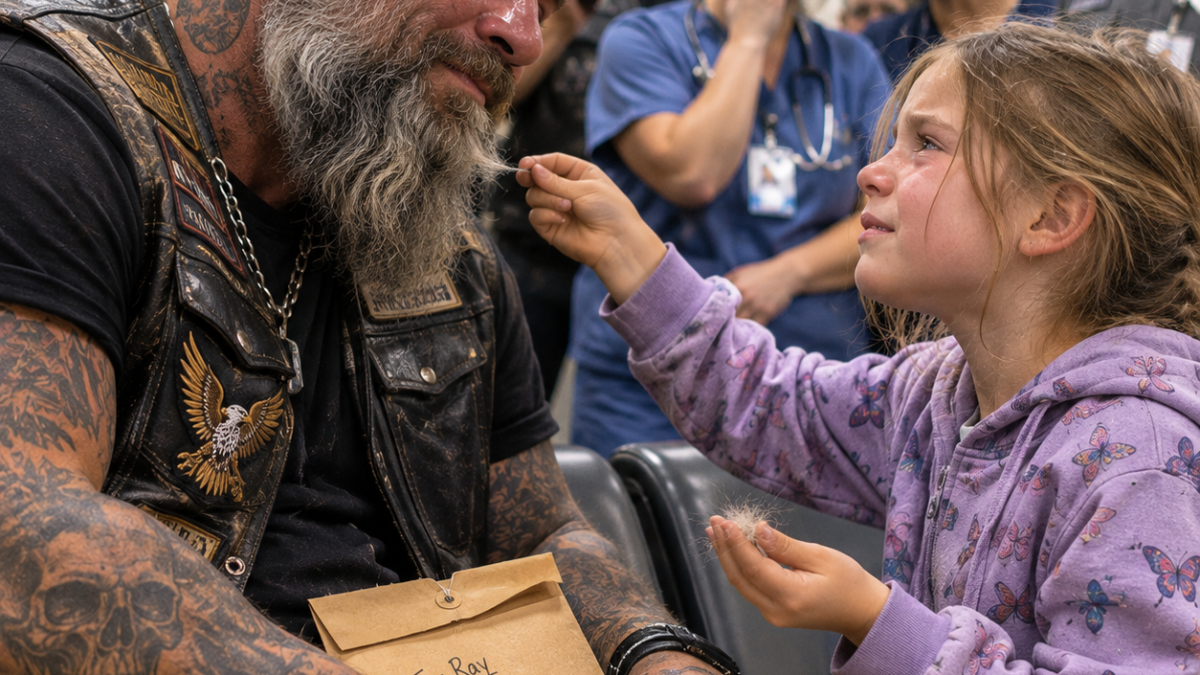
She stared at his beard.
Then reached up.
And pulled.
The first hair came free.
Ray sucked in air.
“One.”
Second.
“Two.”
The waiting room went silent.
A woman near the vending machines whispered:
“What is she doing?”
I knew by then.
Or almost knew.
Aaron had invented the nine-count when Maggie was tiny.
It had begun as nonsense.
She had been three months old when Ray first came to our apartment.
Aaron was bathing her in the kitchen sink because our water heater was broken.
Ray leaned too close.
Maggie grabbed his beard with both fists.
At the time it was shorter.
Mostly black.
Ray panicked.
“What do I do?”
Aaron laughed so hard he had to sit down.
“Count.”
“To what?”
“Until she lets go.”
Maggie released him at nine.
From then on, nine belonged to them.
When thunderstorms frightened her, Aaron counted nine breaths.
When she needed vaccinations, he sometimes offered nine loose beard hairs from his own shorter beard and told her each one carried away a worry.
Most of the time she never actually pulled them.
Touching was enough.
But she remembered.
Ray remembered too.
The third hair came free.
“Three.”
A patient stood.
“Hey.”
Ray didn’t look at him.
The man pointed.
“She’s hurting you.”
Ray said:
“She’s fine.”
Maggie pulled number four.
The nurse approached.
“Sir?”
Ray’s club brothers rose.
Preacher held one hand toward them without looking.
Stay.
Maggie’s breathing was already changing.
Slower.
Ray began giving her words between numbers.
“One for what you hear.”
She stared at him.
“Two for what you touch.”
Her fingers tightened around the hairs.
“Three for where your feet are.”
She looked down.
“Four because the door is open.”
That line made Ray glance toward the exit.
I noticed.
Then I understood something I hadn’t understood before.
Ray was panicking too.
He had always hated hospitals.
Aaron told me years earlier.
Ray had spent time in county jail before I knew him.
Something happened to him there.
He never explained details.
Aaron never asked me to.
Locked doors.
Steel noises.
Fluorescent lights.
Narrow rooms.
Hospitals carried all of it.
I watched Ray’s right knee bounce once.
Stop.
Bounce again.
The nurse spoke into her radio.
Security arrived.
Officer James Bell.
Middle-aged.
Calm.
Not aggressive.
He assessed what he saw.
Large biker.
Child pulling hair.
Several bikers standing.
Phones filming.
Distraught mother.
He stepped toward Maggie.
“Sweetheart?”
She didn’t respond.
He reached toward her shoulder.
Ray raised one hand.
“Don’t.”
Bell stopped.
“Sir, I need to move her away from you.”
“No.”
“She’s pulling out your beard.”
“I noticed.”
“You cannot restrain a child.”
“I’m not touching her.”
That was true.
Both Ray’s hands remained visible.
Open.
On his knees.
Bell looked at me.
“Ma’am?”
I found my voice.
“She knows him.”
“Is this appropriate?”
I looked at Maggie.
Her shoulders had begun lowering.
“Yes.”
Someone behind me said:
“This is insane.”
Maybe it looked that way.
Bell moved closer.
Ray’s brothers shifted.
For one dangerous second, the room became exactly what every camera would later make it appear to be.
Uniformed security facing tattooed bikers.
A crying child between them.
Adults preparing for confrontation.
Then Preacher spoke.
“Everybody breathe.”
He didn’t raise his voice.
He didn’t need to.
“James, he’s not touching her.”
Bell looked at him.
Preacher continued:
“Mother says she knows him.”
Then to the riders:
“And nobody moves.”
They sat.
All three.
Immediately.
Maggie pulled hair number five.
Ray’s face tightened.
“Five.”
Number six hurt more.
I saw his eyes water.
“Six.”
Maggie’s trembling stopped.
Number seven.
“Seven.”
Her breathing slowed.
Eight.
“Eight.”
Then she paused.
Ray had been holding something inside his vest.
A white envelope.
Old.
Edges softened from months of being carried.
Maggie saw the handwriting.
Her whole face changed.
“That’s Daddy’s.”
Ray looked down.
Aaron’s handwriting covered the front.
HAMMER.
Ray’s club name.
Maggie touched the envelope.
“Daddy wrote that.”
Ray nodded.
“Why didn’t you open it?”
No answer.
She looked at the hospital wristband around his wrist.
RAYMOND DAWSON.
Below it:
BIOPSY.
Maggie read slowly.
“What’s biopsy?”
Ray didn’t answer that either.
I did.
“The doctors need to check something.”
She looked at him.
“You’re sick?”
“Maybe.”
“Are you scared?”
Ray stared toward the exit.
“No.”
Maggie frowned.
“Daddy said you lie about that.”
Preacher covered his mouth.
Ray glared at him.
Maggie lifted her hand to the beard.
“Your turn.”
Ray bent down.
She pulled the ninth hair.
Hard.
Ray’s eye shut.
“Nine,” Maggie whispered.
Then she placed all nine hairs on top of Aaron’s envelope.
“Open it.”
Ray shook his head.
She waited.
Aaron had been good at that.
Maggie inherited it.
The ability to become completely still while another person tried to avoid the truth.
Ray looked at the envelope.
Fourteen months.
He had carried it unopened.
I knew why later.
At the time, I only knew that I had mailed it after finding it in Aaron’s motorcycle toolbox.
The first time, Ray returned it.
No note.
Second time, same.
Eventually Preacher took it directly to Ray’s shop.
Ray threw it into a drawer.
He believed Aaron had written something forgiving him.
He did not want forgiveness.
Because Ray blamed himself for Aaron’s death.
They had both been at the pileup.
Ray and Preacher were returning from collecting motorcycle parts when they came across the wreck.
Aaron took control.
Ray helped move people uphill.
When Aaron entered the minivan, Ray remained outside.
After the second impact, Ray tried to rush the vehicle.
Preacher stopped him until firefighters stabilized it.
Twenty-three minutes later, they brought Aaron out.
Alive.
Barely.
Ray believed those minutes belonged to him.
If he had gone in.
If he had ignored Preacher.
If he had moved faster.
Grief loves the word if.
At the hospital, Ray panicked.
Aaron wasn’t there to count him down.
Preacher tried.
Ray shoved him.
Then left.
Rode for hours in freezing rain.
He attended Aaron’s funeral from behind the last row.
Helmet on.
He left before Maggie saw him.
He didn’t help carry the casket even though the Cinder Ridge Riders did.
Several club members called him a coward.
One said he had abandoned Aaron twice.
Ray heard.
He returned his vest voluntarily.
Stopped seeing us.
Stopped answering.
Fourteen months.
Then his voice became hoarse.
He began coughing.
Difficulty swallowing.
Preacher arranged an appointment.
Ray skipped it.
Another.
Skipped.
Eventually imaging found a small mass near his larynx.
Biopsy required.
Hospital required.
Preacher gave Ray his leather vest back under one condition.
“You go.”
Inside the vest, Preacher had sewn Aaron’s blue strip.
Then he put the unopened letter into the pocket.
That was how Ray came through those doors on the same afternoon Maggie’s MRI was scheduled.
Neither had planned to see the other.
Now an eight-year-old child stood in front of him holding nine pieces of his beard.
“Open it.”
Ray finally tore the envelope.
Inside were two pages.
And a photograph.
Ray saw the photograph first.
Five years earlier.
Roadside lemonade stand.
Maggie maybe three.
Sitting on Ray’s Harley wearing a helmet nearly as large as her torso.
Aaron behind her.
Grinning.
Holding up nine fingers.
Ray looked away.
Maggie reached for the first page.
He moved it out of reach.
“Mine.”
“Then read.”
His voice was already rough from the laryngeal mass.
He began.
“Hammer, if you’re reading this, somebody finally ignored your first three no’s.”
Preacher sat down.
That was Aaron.
Exactly.
Ray stopped.
Maggie tapped the paper.
“More.”
He continued.
Aaron had written the letter months before his death.
Not because he expected to die.
His paramedic unit had encouraged staff to update emergency information and personal letters.
Aaron wrote one for me.
One for Maggie.
One for Ray.
He knew Ray.
Knew exactly what grief would make him do.
The letter said:
You’ll decide disappearing protects Laura and Maggie from the man who happened to be standing near me when I died.
That is garbage.
You know it.
I know it.
Ray’s hand began shaking.
The waiting room had become completely silent.
Even security stopped moving.
Ray read more.
Aaron reminded him of Maggie’s nine-count.
If she ever approached him frightened, Ray was supposed to let her finish.
Even if it hurt.
Even if it looked strange.
Even if some well-meaning adult tried to interfere.
Then came the part Ray had not expected.
The count isn’t only hers.
I taught it to you first.
Ray stopped breathing for a second.
Because that was true.
Nineteen years earlier, Aaron Harper had met Ray Dawson beneath an overpass on Interstate 40 at two in the morning.
Ray’s Harley had thrown a drive belt.
Aaron was returning from a patient transfer.
He pulled over.
Ray told him to leave.
Aaron asked:
“You planning to intimidate the motorcycle into repairing itself?”
Ray disliked him instantly.
That was frequently the beginning of Aaron’s best friendships.
Ray had punched a road sign.
Split two knuckles.
Dislocated a finger.
Aaron cleaned him up.
Then noticed Ray’s breathing.
Too fast.
Eyes tracking headlights.
Neck locking every time a truck used air brakes.
“You afraid of traffic?”
“No.”
“Good. Then you’re having a completely unrelated panic attack under a highway.”
Ray nearly hit him.
Instead Aaron sat on the guardrail.
Started counting.
One ambulance.
Two boots.
Three lanes.
Four open doors.
Ray’s breathing gradually slowed.
Later Aaron gave him the number of a counselor.
Ray said:
“I’m not military.”
Aaron answered:
“Panic doesn’t check résumés.”
Ray kept the card seven months.
Then called.
That was the beginning.
Aaron had taught Ray the count before Maggie was born.
Then turned it into a silly childhood ritual years later.
Now his letter continued:
If she reaches nine and you’re still planning to run, let her count you back too.
Ray lowered the page.
His eyes were wet.
Maggie said:
“Keep going.”
He did.
One sound.
One touch.
One thing still here.
Stay long enough to learn what happens next.
That was the ending.
No:
I forgive you.
No:
It wasn’t your fault.
Aaron knew Ray would argue with those sentences forever.
Instead he left him instructions.
Maggie took Ray’s hand.
“One sound.”
Ray looked at her.
“What?”
“One sound.”
He listened.
“The air vent.”
“One thing you feel.”
Ray looked down at her fingers around his scarred knuckle.
“Your hand.”
“One thing still here.”
That answer took longer.
Ray looked toward the exit.
Then Preacher.
Then me.
Then Maggie.
“Me.”
Maggie nodded.
“Now we stay.”
Nobody in that room moved.
The radiology nurse appeared.
“Maggie Harper?”
At almost the same moment, a technician opened another door.
“Mr. Dawson?”
Both Ray and Maggie tensed.
Maggie looked at him.
Ray looked at her.
She held up the nine beard hairs.
“I’ll go if you go.”
Ray swallowed.
“Deal.”
The hospital allowed him to walk with us as far as MRI preparation.
He did not enter restricted areas.
Didn’t interfere with staff.
Didn’t pretend to understand medicine.
He simply stayed where Maggie could see him.
Nine ceiling lights.
Eight floor seams.
Seven blue tiles.
Six slow breaths.
The count wasn’t always exactly nine anymore.
That wasn’t the point.
When the MRI door closed, Ray stood outside the lower glass panel.
Maggie could see his boots.
She completed the scan.
No sedation.
No screaming.
No crawling beneath furniture.
When she came out, Ray was gone.
For one second she panicked.
Then Preacher appeared.
“He went upstairs.”
“The biopsy?”
“Yes.”
Maggie looked at the nine hairs.
“Good.”
Ray’s biopsy lasted nearly two hours.
We waited.
By then, the waiting-room video had already begun spreading online.
Someone had filmed from the moment security approached.
The first video ended before Aaron’s letter.
It showed exactly enough truth to create a lie.
A little girl pulling hair from a frightening biker.
Security intervening.
Other bikers standing.
Ray saying:
“Don’t.”
Comments multiplied.
Why is that child near him?
Where is the mother?
Those bikers threatened security.
The hospital should ban them.
Obviously staged.
Bad parenting.
Assault.
Cult.
Kidnapping.
People can build entire lives around twenty seconds of context.
Crow Ramirez, one of the club members, wanted to post Aaron’s letter.
“No,” I said.
“They’re destroying Hammer.”
“No.”
“They need context.”
“The letter is private.”
Crow looked at Preacher.
“President?”
Preacher stared toward the biopsy doors.
“Name grows back.”
He pointed toward Maggie’s pocket.
“Some things don’t.”
Nobody posted it.
For once, the Cinder Ridge Riders protected one of their brothers by refusing to defend him publicly.
Ray came down later.
Preacher was beside him.
I knew before either spoke that something had been found.
Ray sat.
Looked at Maggie.
Then me.
“Cancer.”
One word.
Early-stage laryngeal cancer.
Small.
Localized.
Treatable.
The oncologist believed there was a strong chance of cure.
Ray asked:
“How soon can I weld again?”
The doctor apparently told him:
“That should not be your first question.”
Ray answered:
“It was mine.”
Treatment meant radiation.
Imaging.
Follow-up appointments.
Voice rest.
Seven weeks.
And repeated hospital visits.
The one place Ray had avoided for almost two decades.
He didn’t miss one.
Not because he became fearless.
Maggie didn’t let him.
Before each appointment, she called Preacher.
“Is Hammer staying?”
If Ray considered canceling, Preacher put her on speaker.
“One appointment.”
Ray would grunt.
“Two boots.”
“Kid.”
“Three brothers.”
“I’m going.”
“Four open doors.”
Ray usually hung up.
But he went.
Every time.
Maggie’s MRI came back clear.
No tumor.
No structural abnormality.
The fainting episodes were eventually linked to missed meals, dehydration, and anxiety intensified by grief.
That did not mean nothing was wrong.
Her fear was real.
Her body was real.
She began working with her counselor more consistently.
Nutrition.
Hydration.
Gradual exposure to medical environments.
Learning that hearing metal strike metal did not mean somebody she loved was dying.
Ray joined only when invited.
That mattered.
He never became:
The biker who cured a traumatized child.
He would have hated that.
He was not her therapist.
Not a doctor.
Not a replacement father.
He was a familiar beard.
A steady chair.
A person who understood what it felt like when your body refused to believe the room was safe.
Eventually I released a short statement about the viral video.
Nothing dramatic.
Ray was a close family friend.
Maggie initiated a grounding ritual taught by her late father.
Ray stayed still because interrupting that ritual while she was panicking could make things worse.
Hospital security video confirmed he never restrained her.
Never grabbed anyone.
Never threatened security.
Never encouraged violence.
The correction received a fraction of the attention.
Of course.
A week later, the woman who recorded the original video came to Ray’s motorcycle shop.
Patricia Lane.
Fifty-two.
She had been waiting for her husband’s cardiology appointment.
Ray’s radiation made speaking painful.
So he wrote on a pad.
She apologized.
“I should’ve waited before posting.”
Ray wrote:
YOU FILMED WHAT YOU SAW.
Patricia shook her head.
“I saw part.”
Ray wrote:
EVERYBODY DOES.
Patricia asked:
“Do you want me to delete it?”
He thought.
Then shook his head.
He wrote:
ADD THE NINTH HAIR.
With my permission, she posted a longer version.
Not Aaron’s letter.
That remained private.
Only the grounding line:
One sound.
One touch.
One thing still here.
The second video showed Maggie pulling the ninth hair.
Ray opening the envelope.
Both of them breathing differently afterward.
Then Maggie saying:
“Now we stay.”
That version never became as viral.
Good.
I liked that.
Because the truth wasn’t:
Terrifying biker secretly a saint.
And it wasn’t:
Brave little girl heals broken man.
The truth was less tidy.
Two frightened people happened to recognize fear in each other.
And neither one left.
During radiation, Ray’s beard began thinning.
The skin near his neck became irritated.
Doctors told him to trim it.
He refused.
Of course.
The beard meant too much now.
Years of identity.
Scars hidden underneath.
The nine-count.
Maggie solved it.
She showed up at his shop carrying child-safe scissors and a small wooden box.
“You’re losing it anyway.”
Ray looked offended.
I corrected:
“Some of it.”
Maggie asked:
“Can I?”
That mattered too.
Permission.
Always.
Ray nodded.
Preacher counted.
Maggie cut nine small locks from the bottom of Ray’s beard.
No pulling this time.
One.
Two.
Three.
Ray watched.
Four.
Five.
Six.
Seven.
Eight.
Nine.
She placed them beside the original hairs.
Then made two envelopes.
HERS.
HIS.
She tried dividing nine evenly.
Couldn’t.
Ray got five.
“Why do I get five?”
Maggie said:
“Because you’re harder to calm.”
Preacher laughed so loudly someone in the garage shouted from the back room.
Ray’s treatment lasted seven weeks.
On the final day, twenty-three Harleys waited outside St. Joseph’s.
Engines off.
The riders knew some hospital patients were sensitive to noise.
No banners.
No blocked entrances.
No performance.
They just stood beside their motorcycles.
Ray walked out wearing a hospital wristband.
Aaron’s blue strip visible inside his vest.
His beard shorter.
Patchy beneath the jaw.
Face thinner.
Maggie waited near the curb.
She raised nine fingers.
Ray reached into his pocket.
Held up five beard hairs inside a tiny plastic sleeve.
Neither counted aloud.
They didn’t need to.
That should have been the end.
It wasn’t.
Ray kept returning to St. Joseph’s.
At first for scans.
Then follow-ups.
Then because he noticed something.
Waiting rooms were full of people trying not to leave.
Children.
Parents.
Veterans.
People with trauma histories.
People terrified of medical procedures.
People ashamed of being terrified.
Ray spoke with a hospital counselor.
Then administrators.
Then nursing leadership.
He did not propose bikers wandering around doing therapy.
Even he knew better.
Instead they created a supervised volunteer program.
Training required.
Background checks.
Boundaries.
Staff direction.
No pretending to be clinicians.
No replacing professional mental-health treatment.
Just trained people who understood how to remain calm in a room where someone else could not.
The Cinder Ridge Riders paid for the first round of training.
Nine members completed it.
Administrators initially wanted plain polo shirts.
One pediatric nurse disagreed.
“Why?”
“Professional appearance.”
She looked through the glass toward Ray.
“Children should learn safe people don’t all look the same.”
The leather stayed.
Inside certain clinical areas, identifying patches were covered.
But tattoos stayed visible.
Boots stayed.
Beards stayed.
Preacher learned card tricks.
Crow carried noise-reducing headphones.
Another rider became good at building tiny block structures with children while asking almost no questions.
Ray always chose the chair nearest the exit.
Always.
Someone asked why once.
His voice was still rough from treatment.
“A person thinking about running shouldn’t have to cross the whole room before deciding to stay.”
Beside his chair stood a little wooden box.
Blank paper slips.
The instructions:
ONE SOUND.
ONE THING YOU FEEL.
ONE THING STILL HERE.
Nobody had to sign.
Children wrote:
Mom’s breathing.
Warm blanket.
My shoes.
A dog barking outside.
Dad’s hand.
Vent noise.
The blue chair.
I am here.
Parents wrote too.
So did adults waiting alone.
Every few months, Maggie and Ray reviewed the anonymous slips with a counselor.
They turned some into small laminated grounding cards.
Nine cards went into every volunteer’s pocket.
Ray’s voice recovered.
Not fully.
It remained rough.
Maggie liked it.
“You sound more like a Harley.”
Ray considered that a compliment.
His beard grew back.
Mostly.
One thin patch beneath the jaw never filled in.
Maggie never pulled another hair.
She asked first now.
Sometimes she held the end between two fingers while counting.
The game changed because she did.
Aaron’s letter stayed inside Ray’s vest.
Behind the strip from his old paramedic shirt.
The fold lines softened.
Ink faded slightly.
Ray read one sentence before every follow-up scan.
Stay long enough to learn what happens next.
So he stayed.
Four years passed.
Maggie is twelve now.
She still hates the sound of metal carts hitting doors.
She still notices sirens before I do.
Fear did not disappear.
That matters.
Stories sometimes pretend one powerful moment cures trauma.
It doesn’t.
What changed was simpler.
Fear stopped making every decision.
She can enter St. Joseph’s now.
Some days easily.
Some days not.
Ray remains cancer-free.
Second Tuesday of every month, he rides the same black Harley to the hospital.
He shuts the engine off early and rolls the final distance near the patient entrance.
His beard is mostly gray.
The patch beneath his jaw remains thin.
New security officers sometimes ask why a massive tattooed biker is sitting in pediatrics.
James Bell—the same officer who once nearly separated Ray from Maggie—usually answers.
“He counts.”
That’s enough.
Ray still sits nearest the exit.
Sometimes a frightened child approaches.
Sometimes nobody does.
Sometimes he spends three hours there while parents walk past without speaking.
He stays anyway.
Maggie visits after school when she can.
She helps refill the grounding cards.
She keeps her envelope of hairs in her room.
Ray keeps his.
Every January, on the anniversary of Aaron’s death, the Cinder Ridge Riders return to mile marker 418.
They park beyond the curve.
Far enough from traffic.
They attach one ambulance-blue ribbon to the guardrail.
No speeches.
Ray hates speeches.
Preacher sometimes counts motorcycles.
Nine.
I count nine slow breaths.
Maggie counts the people around her.
One year, she reached ten.
Ray looked at her.
“The game stops at nine.”
“It used to.”
“What’s ten?”
Maggie touched the blue strip inside his vest.
“Someone who stayed.”
Ray didn’t answer.
Cold wind moved through the rock cut.
A truck sounded its horn somewhere behind us.
Ray’s right hand tightened around his Harley grip.
I saw it.
Maggie saw it first.
She always does.
“One sound.”
Ray breathed.
“The horn.”
“One thing you feel.”
“The handlebar.”
“One thing still here.”
Ray looked around.
Preacher.
Crow.
The club.
Me.
Aaron’s daughter.
The motorcycles.
The road that had taken one man and left the rest of us with the work of remembering him.
His answer came in that rough voice.
“Us.”
Maggie nodded.
The engines started one by one.
Ray waited.
For years, he had been the first person to leave anything that frightened him.
The hospital.
The funeral.
Our family.
His club.
His own treatment.
He had once believed leaving was punishment.
Then protection.
Then survival.
Aaron had understood him better.
Stay long enough to learn what happens next.
Ray looked down the highway.
Preacher pulled out first.
Then Crow.
Then the others.
I drove behind them.
Maggie waved from my passenger seat.
Ray started his Harley.
But he didn’t race ahead.
He waited until everyone else had entered the road.
Then he joined us.
For years, people who saw the hospital video remembered a giant biker allowing an eight-year-old girl to tear nine hairs from his beard.
They thought that was the strange part.
It wasn’t.
The strange part was how many lives had to intersect for those nine hairs to matter.
A broken motorcycle under an Arizona overpass nineteen years earlier.
A young paramedic who stopped when a stranger told him not to.
A panic attack treated like fear instead of weakness.
A baby who grabbed the wrong beard.
A ridiculous counting game.
A winter pileup.
A father who wrote a letter he never expected would become his final instructions.
A man who refused to open it.
A little girl who refused to let him leave.
A hospital security officer willing to pause before acting.
A club president who told everyone to breathe.
Forty adults who initially saw only what was visible.
Leather.
Tattoos.
A frightened child.
A frightening man.
Nine hairs.
But the truth was never really about the beard.
It was about the count.
One sound.
One touch.
One thing still here.
Aaron had taught it to Ray first.
Then to Maggie.
And years after Aaron was gone, his daughter returned it to the man who needed it.
Nine wasn’t magic.
Neither was Ray.
Neither was Maggie.
Nine was simply long enough for fear to lose a little momentum.
Long enough to notice the door was open.
Long enough to notice somebody’s hand.
Long enough to remember:
I am still here.
That afternoon in St. Joseph’s, Ray thought he was letting Maggie finish her father’s old game.
He didn’t understand until the ninth hair that Aaron had built the game for him too.
Maggie placed those hairs inside the unopened envelope.
Took the hand of one of the most intimidating men I had ever known.
And said the sentence Ray had spent fourteen months refusing to hear.
“Now we stay.”
So he did.








