For Three Years, He Waited at the Same Train Station Every Friday—Then a New Clerk Asked One Question That Finally Revealed Why He Never Missed the 4:12 Train
PART3;
Kansas rain in autumn can be meaner than winter snow, especially when wind drives it sideways across an open platform. It began before I reached town. By the time I tied my horse outside the station, my hat brim dripped steadily, and my best shirt clung cold against my back beneath my coat.
I did not have flowers. The rain had flattened what grew along the south fence.
At the window, Mara looked past me toward the weather.
“Platform ticket?” she asked, though she already knew.
“Yes, ma’am.”
Her fingers hovered over the stack. “You could wait inside today.”
I placed the nickel down.
“The bench is outside.”
She looked at me, then tore the ticket and handed it through.
I sat in the rain.
The eastbound came at 4:12, steam hissing hard in the wet air. Passengers hurried down, heads ducked, hems lifted, bags clutched tight. The platform smelled of coal smoke and soaked wood. The conductor shouted over the rain. Somewhere, a child cried because puddles had found the inside of his boot.
I watched every passenger.
None was her.
The train pulled away.
I sat.
Rain ran from the brim of my hat onto my coat.
I had just begun to feel the chill settle into my bones when the station door opened behind me.
Mara Ellison stepped onto the platform with no umbrella.
She closed the door, crossed the wet boards, and sat down beside me on the second bench from the east end.
Neither of us spoke for a moment.
Then she asked, quietly, “Who are you waiting for?”
There it was.
The question everyone had carried in their mouths for three years and never dared set down between us.
I did not answer right away.
Not because I was offended.
Because words are not neutral. Once spoken, they move things. They take a private room and open its windows. They make shape out of what a man has survived by keeping foggy.
I reached into the inside pocket of my coat and took out an old platform ticket.
Not the one I had bought that day.
This one had been folded and unfolded so many times the paper felt almost like cloth. The ink had softened. The edges had worn round. It was not evidence. It was not useful.
It was a talisman.
I held it between my fingers but did not give it to her.
“My wife,” I said.
Mara did not move.
“Her name was Evelyn.”
The rain ticked against the roof.
“When we first married, she went to Salina to care for her mother. Her mother had lung trouble. Bad. Doctors said the old woman wouldn’t last two months. She lasted fourteen.”
Mara looked at the tracks rather than at my face, which made it easier to keep speaking.
“Every Friday, Evelyn took the eastbound home to me for the weekend. Train was always late back then. I sat here anyway. This bench. She said she could see me from the window before the train stopped. Said she always knew which bench because I always chose the same one.”
A memory came so sharply then that I nearly stopped.
Evelyn jumping down from the car steps before the conductor could properly help her. Her traveling coat crooked. Hatpin loose. Cheeks pink from the heat inside the train. Laughing because she had two bags and only two hands and still tried to run.
“Walking is too slow,” she used to say, breathless, when she reached me. “When a person has been waiting all week, walking is an insult.”
Mara folded her hands in her lap.
“When her mother died,” she said softly, “she came home for good?”
“Yes.”
“But you kept coming.”
I nodded.
“Why?”
The rain blurred the tracks ahead of us.
“Because she loved this place,” I said. “She said it was the first place she understood someone was waiting for her. Not expecting her to be useful. Not needing anything. Just waiting because she mattered.”
My throat tightened.
“She died three years ago. Fever. Twelve days.”
Mara closed her eyes briefly.
I slipped the old ticket back into my coat.
“I kept coming.”
She did not tell me I should stop.
That was the first mercy she gave me.
“You know she won’t be on the train,” Mara said after a while.
“I know.”
“Then why?”
I looked down the tracks until they vanished at the bend beyond the hill.
“Because this is the last place I can still see her running.”
Mara said nothing.
“At the ranch, it’s harder now,” I admitted. “At first, I could see her everywhere. Kitchen. Garden. By the south window where the morning light came in. In the chair by the stove. Then time did what time does. It smoothed the edges. Took pieces without asking. I walk into rooms now and remember what happened there, but not always how she looked standing in them.”
The rain beat harder.
“Here,” I said, “I can still see her in motion.”
Mara’s voice was very soft. “I’m sorry.”
People say those words often.
Most of the time, they are bandages too small for the wound.
But she meant them entirely. I heard that.
We sat in the rain until the cold made my fingers ache.
Then I rose, placed my hat properly, and walked to my horse.
When I looked back once, Mara was still sitting on the bench, soaked through, staring at the tracks as if something had been left there for her too.
The following Friday, there was coffee on the bench when I arrived.
A tin cup, steaming faintly in the cold afternoon.
I stopped when I saw it.
Then I looked at the ticket window.
Mara was helping a woman buy passage to Topeka. She did not look at me directly. Her face gave away nothing.
I bought my platform ticket from her as usual.
“Eastbound’s on time,” she said.
“Thank you.”
I went outside, sat on the bench, and picked up the coffee.
No sugar.
Exactly how I took it.
The heat sank into my hands before I drank. It was not exceptional coffee. Station coffee rarely is. But it was hot, and it had been made for me without my asking, and after three years of arranging my life around an absence, that small fact struck me with such force that I had to look away from the window.
The train came.
The passengers stepped down.
Evelyn did not.
The train left.
I sat.
The coffee cooled.
When I finally brought the cup back to the window, Mara took it without looking surprised.
“Thank you,” I said.
“It gets cold waiting,” she replied, eyes on the schedule board.
“How did you know how I take it?”
“I guessed.”
“You guessed right.”
A faint almost-smile touched her mouth. “Then I won’t ruin it next time.”
Next time.
She said it like a simple thing.
It was not simple to me.
The coffee appeared every Friday after that.
For a while, that was all.
She did not sit beside me. She did not ask more than I offered. She gave me the bench, the train, the cup, and the dignity of not turning kindness into a debt.
But slowly, something changed.
Not all at once. Grief rarely moves like a door swinging open. It shifts like weather. One morning the air is different, and you realize the season has turned while you were still calling it by the old name.
By late October, I found myself noticing whether the coffee was already on the bench before I arrived. I noticed if Mara’s hair was pinned differently. I noticed when Pruitt barked at her and she answered calmly enough to make him look smaller. I noticed when she carried freight slips from the back office and frowned at numbers that did not satisfy her.
And I noticed, to my shame and confusion, that after the train left, the tracks no longer felt like only emptiness.
They felt like a place where someone knew I would be.
That winter came hard.
The first warning was the lung sickness moving through county herds. It took cattle from three ranches north of town before it reached my south pasture. By the time my foreman, Amos Reed, rode in at dawn to tell me forty head were coughing blood-flecked foam and standing wrong in the frost, I already knew from his face that the day would be bad.
Amos had worked for me six years.
He was a thin, sharp-chinned man with pale eyes and a gift for looking loyal while keeping his thoughts elsewhere. Evelyn had never liked him. She never said he was dishonest, only that he watched too closely when accounts were discussed and listened too carefully when he pretended not to.
I had trusted him anyway.
Men do foolish things when they are tired and grieving. They keep what is familiar because the effort of replacing anything feels like another loss.
We lost eleven head before the cold killed the sickness.
Eleven head from a three-hundred-head operation does not ruin a man by itself. But ranching is arithmetic sharpened by weather. Fencing costs. Feed costs. Wages cost. Winter costs. A bad year does not need to destroy you; it only needs to lean on the weak place until the crack spreads.
I rode into town the first Friday of December carrying that arithmetic in my bones.
Mara had left coffee on the bench.
I sat, drank, watched the eastbound arrive and leave, and when she came out afterward, she sat beside me without ceremony.
“Bad week,” she said.
“Lost eleven to lung sickness.”
She did not say, I’m sorry, in the quick way people do when they do not understand money. She looked toward the tracks, thinking.
“Will you make it through winter?”
“Yes.”
“At what cost?”
That made me turn to her.
She met my eyes.
Mara was not being nosy. She was asking the kind of question Evelyn would have asked after supper with the ledger open and one pencil tucked behind her ear.
“It will cost,” I said. “But yes. I’ll make it.”
She nodded once.
Down the platform, Pruitt shouted at a freight handler over a misrouted crate. Steam hissed from the locomotive. The cold had turned the platform boards pale.
“What do you do the rest of the week?” Mara asked.
“Work.”
“I meant evenings.”
I watched the smoke thin above the cars.
“I eat supper. Read what I can. Sleep.”
“Accounts?”
“Sometimes.”
“Alone?”
The word landed harder than it should have.
“Evelyn had a better head for numbers than I did,” I said. “We used to go through the books after supper. She could find a mistaken sum by looking at a page the way some men find a brand through dust.”
“And now?”
“Now I do them.”
Mara looked down at her own hands. Ink had darkened the side of one finger. She rubbed at it absently and failed to remove it.
“My father kept ledgers,” she said. “He owned a dry goods shop in Wichita before his lungs got bad. When I was twelve, I started helping him count receipts because he said my eyes were better than his. By the time I was twenty-four, I was doing most of the books.”
I said nothing.
Mara rarely spoke about herself. When she did, I knew enough not to crowd the opening.
“My mother became ill after him,” she continued. “Not the same sickness. Different one. Slower. I spent years arranging my life around medicine times, bills, linens, accounts, doctor visits, what they could eat, what they couldn’t, which neighbors meant well and which ones came to count how much longer we had.”
Her voice remained even, but her hands had gone still.
“They died in the same winter. Father in January. Mother in March. I sold the house because every room had become a sickroom in my mind. Took this job because it was available, and because being somewhere nobody knew me seemed easier than staying somewhere everyone did.”
A gust of wind dragged coal smoke across the platform.
“I’m sorry,” I said.
She gave me a small, tired smile. “There it is.”
“What?”
“The thing everyone says because it is true and useless.”
I almost smiled. “I said it because I meant it.”
“I know.”
We sat quietly.
Then she said something that stayed with me longer than she likely intended.
“Capability is not the same as sufficiency.”
I turned the sentence over in my mind.
“You think about that often?”
“More than I’d like.”
The eastbound gave a final groan down the line. Pruitt slammed the station door behind him, still scolding someone. The town carried on beyond us: wagon wheels in mud, voices outside the feed store, a dog barking somewhere near the hotel.
Mara rose first.
“I should go back.”
“Thank you for the coffee.”
She looked at me. “Thank you for answering the question.”
“What question?”
“The one about evenings.”
After she went inside, I sat a few minutes longer.
Not waiting for Evelyn.
Not exactly.
Thinking of a woman in Wichita who had spent her life at windows watching other people leave, and a woman in Salina who had once run down this platform because walking was too slow, and how two sorrows could sit beside each other without one needing to be larger.
I rode home in the cold and found Amos waiting near the barn.
He looked nervous.
That should have warned me.
“Mr. Kincaid,” he said, “Silas Vane came by.”
Of all the men in Larkspur County, Silas Vane was the one I least wanted visiting my ranch when I was not there.
He owned the largest cattle-brokerage office in town, held private notes for half the smaller ranchers between Larkspur and Abilene, and had a way of making every conversation feel like a contract you had signed before hearing the terms. He was fifty or near it, heavy through the middle, with smooth white hands and a voice that never rose because he preferred other men to do his shouting.
Evelyn had distrusted him on sight.
That was enough reason for me to do the same.
“What did Vane want?” I asked.
Amos shifted.
“Said he’d like to discuss purchase terms.”
“For what?”
Amos looked at the house, then back at me.
“For the ranch.”
I removed my gloves slowly.
“He say why he thinks it’s for sale?”
“Said circumstances may make it wise to consider before spring.”
“Did he?”
Amos swallowed. “He mentioned the sickness. Said losses spread fast in winter. Said a man alone might not see trouble until trouble was past helping.”
I stepped close enough that Amos stopped shifting.
“If Silas Vane comes to this ranch again when I’m not here,” I said, “you tell him to wait on the road or turn around.”
“Yes, sir.”
“And Amos?”
“Yes?”
“Do not discuss my cattle, my accounts, my pastures, my debt, my health, my grief, or my weather with him.”
His face tightened.
“My grief?” he repeated.
“You heard me.”
He nodded.
But he did not look me in the eye.
The next week, trouble came into town wearing a fine coat.
I knew something was wrong the moment I stepped into the station. Conversations changed shape. Men who had been speaking near the stove lowered their voices. Mrs. Albright from the hotel looked at me and then quickly away. Pruitt stood near the freight door with a smugness he did not bother to hide.
Mara sat behind the window.
Her face went still when she saw me.
That frightened me more than the whispers.
“Platform ticket,” I said.
She did not reach for the stack immediately.
“Wilson,” she said softly.
Pruitt appeared beside her before she could continue.
“Five cents,” he said, too loudly. “Unless you’re here on other business, Mr. Kincaid.”
I looked at him.
“What business would that be?”
Silas Vane’s voice answered from behind me.
“Business best handled before a man loses the dignity to manage it himself.”
I turned.
Vane stood near the stove with three men beside him: one lawyer, one deputy too young to know he was being used, and one cattleman named Reese Dodd who smiled at other people’s discomfort like it was a warm meal.
Silas held a folded paper.
“I came as a courtesy,” he said. “Though after today, courtesy may no longer be required.”
The station had gone silent.
Mara stood behind the ticket window.
I felt her attention like a hand on my shoulder.
“What do you want, Vane?”
“To save you embarrassment, if possible.”
A few men looked down.
Silas sighed, performing regret.
“There are concerns, Wilson. Serious ones. Your losses this winter. Your refusal to engage in reasonable sale discussions. Your habit of spending every Friday waiting at a railway bench for a dead woman. A man’s grief is his own affair until it endangers property, employees, and creditors.”
The words struck the room like a slap.
For three years, no one had said it that way.
Not to my face.
Not in public.
I heard a small sound behind the window. Mara’s hand had tightened around the edge of the counter.
I kept my voice level. “Say what you came to say.”
Silas unfolded the paper.
“I hold notes connected to your late wife’s medical care and household debts. Notes that have gone unpaid. I also have testimony that your ranch accounts are in disarray and that cattle have gone missing under your management.”
“My accounts are not your concern.”
“They become my concern when your debt touches them.”
“I have no debt to you.”
“You may be mistaken.”
He said it gently, which made it worse.
Pruitt cleared his throat with satisfaction.
Mara spoke then.
“Mr. Vane, if you intend legal notice, this is not a courthouse.”
Every head turned toward her.
Pruitt hissed, “Miss Ellison.”
But Mara did not step back.
Silas smiled at her the way men like him smile at women they plan to punish later.
“You’re new to town, Miss Ellison. You may not understand our local arrangements.”
“I understand a railway station is not a place to humiliate a grieving man for sport.”
The room changed.
A freight handler coughed to hide a laugh. Someone near the stove muttered, “Well, now.”
Pruitt’s face reddened.
Silas’s smile remained, but the eyes behind it cooled.
“No sport,” he said. “Only facts.”
“Then take them to a judge.”
He looked from her to me.
“With pleasure.”
He handed the folded notice to me.
“Temporary injunction hearing in two weeks,” he said. “If the court finds you unable to maintain the ranch or satisfy outstanding obligations, a receiver may be appointed. I have generously offered to purchase the property before matters reach that humiliating conclusion.”
He stepped closer and lowered his voice enough that only those nearest heard.
“Your wife was a practical woman, Wilson. She would have sold before letting sentiment bury you.”
I hit him then.
Not hard enough to kill.
Hard enough to end the conversation.
Silas fell backward against the stove pipe, knocked his hat off, and sat down badly on the floor.
The station exploded.
Pruitt shouted. The young deputy grabbed my arm. Reese Dodd cursed. Mara came around the ticket window faster than I expected and placed herself between me and the deputy as if she could stop anything with the force of her indignation.
“That is enough,” she said.
I looked past her at Silas rising slowly, one hand pressed to his mouth. Blood marked his lower lip.
He smiled.
That was when I understood.
He had wanted that.
By sundown, half the town had heard that Wilson Kincaid had assaulted Silas Vane in the station after being questioned about his mental fitness. By morning, the other half had heard a version in which I had raved about ghosts, threatened a deputy, and needed restraining by two men.
The truth traveled slower because it lacked ambition.
Mara sent word to the ranch that evening through a boy from the livery.
Do not come to the station tomorrow. Pruitt is angry. Vane planned more than we saw. I am looking at the freight ledgers. M.E.
I read the note three times.
Then I placed it beside my account book and opened Evelyn’s old ledger for the first time in months.
It was foolish, maybe, how long I had avoided those pages. Evelyn’s handwriting lived in them. Neat, slanted, certain. She had kept accounts the way she kept everything: honestly and with no patience for sloppy thinking.
Feed.
Wages.
Medical supplies.
Rail fees.
Cattle sales.
Household purchases.
Garden seed.
The last entries before her illness were routine. Then my handwriting took over, uglier and less precise.
I read until midnight.
Then longer.
By dawn, I knew two things.
First, I had no record of the notes Silas claimed.
Second, cattle I believed lost, sick, or unaccounted for had disappeared from my books in patterns too neat to be chance.
Not enough at once to alarm a distracted grieving man.
Six here.
Nine there.
Twelve entered as winter loss by Amos.
A line scratched through.
A freight payment I did not remember authorizing.
And beside one shipment from the year before, in Evelyn’s earlier hand, a small note I had never noticed.
Ask station for waybill copy if S.V. repeats offer. Numbers do not match.
S.V.
Silas Vane.
I sat back so sharply the chair scraped the floor.
Evelyn had seen something before she died.
And I had missed it for three years.
The next Friday, I went to town early.
Not at 3:52.
Not in my best shirt.
I wore work clothes, my heavy coat, and a face that made two men step off the boardwalk before I reached the station.
Mara saw me through the ticket window. Relief crossed her features before she hid it.
Pruitt stood behind her, arms folded.
“Mr. Kincaid,” he said, “after last week’s disturbance, I am within my rights to refuse you platform access.”
“I’m not here for the platform.”
That startled him.
Mara’s eyes narrowed slightly, attentive.
“I need copies of freight waybills for shipments under my brand over the last three years,” I said.
Pruitt laughed. “Railway records are not public entertainment.”
“They are available to shippers.”
“You’ll need formal request papers.”
“I’ll wait.”
“Could take weeks.”
“Mara,” I said, looking past him. “Is that true?”
Pruitt snapped, “Miss Ellison is not authorized to answer.”
Mara’s chin lifted.
“A shipper may request copies of waybills tied to his own brand or account,” she said evenly. “There is a small copying fee. If records are on site, they may be produced during regular business hours.”
The silence afterward was worth the fee by itself.
Pruitt turned purple.
“You are overstepping,” he said.
“No,” Mara replied. “I am reading the policy posted in the back office.”
I placed money on the counter. “Copies. Three years. Kincaid brand.”
Pruitt stepped close to her. “You will not touch those ledgers.”
Mara met his eyes.
“Then you touch them, Mr. Pruitt. But if you deny a shipper access to his own freight records after notice, you may explain that to the district office.”
Something passed between them then. Something ugly and familiar.
Pruitt was afraid.
Not of me.
Of what those ledgers might show.
He vanished into the back office and slammed a drawer so hard the wall shook.
Mara leaned closer to the window.
“Evelyn left a note,” I murmured.
Her eyes widened.
“What did it say?”
“Numbers do not match.”
Mara inhaled quietly.
“I found the same thing,” she said. “Two shipments last spring billed under your brand, but payment routed through Vane’s brokerage. Another in August. The signatures on the release slips are not yours.”
“Amos?”
“Some look like A.R.”
My hand tightened on the counter.
Amos Reed.
Mara glanced toward the back room.
“Wilson, there’s more.”
Before she could continue, Pruitt returned with a stack of ledgers and a face hard with resentment.
“You can wait,” he said.
“I will.”
For the first Friday in three years, I did not sit on the second bench from the east end when the eastbound arrived.
I stood inside the station with Mara Ellison as she copied freight records that began to reveal how a ranch could be stolen without a fence ever being cut.
The method was simple because theft usually is when men count on grief doing most of the work.
Amos marked cattle as lost, sick, or dead.
Small numbers. Believable numbers. A few after storms. Several during illness. Others during drives when confusion was expected.
Then those cattle appeared in rail records under altered release slips, shipped through Vane’s brokerage to buyers east of Topeka. Payments never touched my books. Vane used false deductions, manufactured freight fees, and private notes to make his own paper trail look legitimate.
The missing animals had not wandered.
They had been sold.
By the man I paid to help run my ranch.
Through the man now claiming I was unfit to keep it.
Mara copied until her fingers cramped.
Pruitt hovered, making objections no one answered.
When the eastbound whistle sounded, my chest tightened out of old habit.
Mara noticed.
“You can go,” she said softly.
I looked through the window.
The train rolled in, black smoke trailing. Passengers gathered near the steps. The second bench waited in the cold light.
For a moment, I saw Evelyn running.
Then I looked back at the ledgers.
“No,” I said. “Not today.”
Mara said nothing, but something in her face changed.
Respect, maybe.
Or sorrow.
Or the beginning of a feeling neither of us wanted to name yet.
That night, I confronted Amos in the barn.
He denied everything.
Poorly.
He swore signatures could be mistaken. Said cattle records were always imperfect. Said Vane’s men handled shipments sometimes for convenience. Said Evelyn herself might have approved things I didn’t know about.
That was the mistake.
“Do not put my wife’s name in your mouth to cover theft,” I said.
His face hardened.
“You think she was a saint because she’s dead.”
“No,” I said. “I think she was honest because I knew her.”
He spat near the stall door.
“You don’t know what it’s like working for a man who spends every Friday chasing a ghost while the ranch falls behind him.”
I stepped closer.
He flinched.
That told me enough.
“You’re done here.”
“You can’t prove—”
“I said you’re done.”
He left before dawn.
I expected him to run.
Instead, he rode straight to Vane.
Two days later, I received notice that Silas Vane had amended his petition. He now claimed not only debt, but evidence of mismanagement, physical instability, and violent temperament. He included my assault at the station. He included Amos’s statement. He included Pruitt’s statement claiming I had attempted to intimidate railroad staff into altering records.
Mara’s name appeared too.
Miss Mara Ellison, recently employed clerk of uncertain judgment, has exhibited improper personal involvement with Mr. Kincaid and may have participated in irregular handling of railway documents.
I rode into town with the notice in my coat and anger so controlled it felt like ice.
Mara was not at the window.
Pruitt was.
He smiled.
“Miss Ellison is no longer handling ticket sales today.”
“Where is she?”
“Back office. Pending review.”
“For doing her job?”
“For compromising the integrity of this station.”
I leaned toward the opening.
“If you harm her reputation to protect Vane, you’ll regret it.”
Pruitt’s smile twitched.
“Threatening another railway official, Mr. Kincaid?”
I looked at his ink-stained fingers.
“You’re not an official. You’re a man with keys.”
I found Mara outside behind the station, standing near a stack of freight crates with no coat despite the cold. Her face was pale with anger.
“He suspended me from the window,” she said before I could ask. “Not officially. He says until district review.”
“I’m sorry.”
“There it is again.”
“This time it is useful. I brought a lawyer’s name.”
That surprised her.
I handed her the slip of paper.
“Evelyn’s cousin in Topeka. He practices law. I sent him a wire. He says if we can bring him waybill copies, brand records, and proof of forged signatures, he’ll file a counterclaim and request a railway district auditor.”
Mara looked at the paper, then at me.
“We?”
“You started this when you asked who I was waiting for.”
“No,” she said. “I started this when I made coffee.”
I almost smiled.
Then she looked away, and the moment passed.
“Pruitt destroyed one carbon copy this morning,” she said. “I saw the ash in the stove.”
My anger sharpened.
“Can we get the originals?”
“Some are here. Some are in the monthly packet to Newton division. If Pruitt hasn’t altered the index.”
“Can you prove he did?”
“Not yet.”
“Then we get proof.”
She looked at me for a long moment.
“You say that like proof is cattle standing in daylight.”
“Isn’t it?”
“No. Proof is more stubborn. It hides in drawers and margins. It requires patience.”
“I have some experience waiting.”
At that, she smiled despite herself.
Over the next two weeks, Mara and I became the sort of people gossip loves because gossip does not understand work.
We met in public when possible and in daylight when not. She reviewed copies of freight ledgers at Mrs. Patterson’s dining table while the boardinghouse owner pretended not to listen from the next room. I brought Evelyn’s account books, brand papers, sale receipts, and old correspondence tied in brown string.
Mara read everything.
Everything.
She had the kind of mind that did not merely see numbers, but listened to them. She found repetitions. A freight fee rounded the same wrong way on six separate shipments. A release signature that leaned left when mine leaned right. Amos’s initials appearing on dates he had claimed to be in the north pasture. Pruitt’s verification stamp on documents he later claimed never passed through his hands.
“This is not one theft,” she said late one evening at Mrs. Patterson’s. “It is a system.”
Mrs. Patterson, who had been refilling the stove though it needed no refilling, muttered, “Men do love a system when stealing.”
Mara looked at her.
Mrs. Patterson lifted her chin. “I said what I said.”
She was sixty years old, owned the boardinghouse outright, and had no fear left for men like Silas Vane. I came to appreciate her deeply.
The harder question was Evelyn.
Vane’s alleged notes bore her signature.
At first glance, they looked real.
That fact kept me awake.
Not because I doubted her, but because forgery of someone you loved feels like a second death. It takes their hand, their name, the shape of their letters, and turns them against you.
Mara placed the notes beside Evelyn’s account ledger and studied them under lamplight.
“These are good,” she admitted.
I stared at the signature.
“She never made the lower loop on the K that way.”
Mara glanced up.
“You noticed?”
“I watched her write my name on envelopes for seven years.”
Her face softened.
Then she looked back down.
“The loop is wrong, yes. But not enough for court unless we find more.”
“There is more.”
“Where?”
I pointed to the date.
Mara read it.
March 19.
I felt my throat close.
“She was unconscious that day,” I said. “Fever broke her mind by then. Doctor Bell came twice. Reverend Mills prayed in the kitchen because I would not let him pray at her bed while she was still breathing.”
Mara’s hand stilled.
“She could not have signed this?”
“No.”
“Can the doctor attest to it?”
“He moved to Emporia.”
“Then we wire him.”
We did.
The answer came three days before the hearing.
Dr. Samuel Bell confirmed in writing that on March 19, Evelyn Kincaid was incapacitated by fever, unable to sit upright, speak coherently, or sign any legal document.
Mara read the telegram twice.
Then she sat down hard at Mrs. Patterson’s table.
“We have him,” she whispered.
But men like Silas Vane are never most dangerous when exposed.
They are most dangerous in the narrow space between exposure and consequence.
The hearing was set for a Thursday morning at the courthouse, but Larkspur Junction decided the trial began the day before.
By noon Wednesday, everyone knew I had accused Silas Vane of theft.
By two, everyone knew Mara had been helping me.
By four, Pruitt posted a notice at the station stating that Miss Ellison had been relieved of duties pending investigation into misconduct, tampering with freight records, and inappropriate association with a rancher involved in litigation.
He posted it where passengers could read it.
Where freight men could read it.
Where I had once waited for Evelyn.
Mara arrived at the station just as a cluster of people stood reading.
I saw her from across the street.
She stopped.
The town stopped with her.
Pruitt stood near the door, pretending to adjust his cuffs. Silas Vane stood beside him. Amos Reed leaned against a post, arms folded, wearing the smug look of a small man protected by larger cruelty.
Mara walked to the notice.
Read it.
Her face went white.
Then red.
Then still.
Silas removed his hat with false courtesy.
“Miss Ellison,” he said. “I advised Mr. Pruitt to handle this discreetly, but railroad integrity requires transparency.”
Mara turned.
“You advised him.”
“A woman in your position must be careful,” Silas said. “Loneliness can cloud judgment. I do not blame you entirely. Men like Kincaid prey on sympathy.”
I started forward.
Mrs. Patterson caught my sleeve.
“Don’t,” she hissed. “He wants your temper again.”
She was right.
God help me, she was right.
Silas continued, voice smooth enough for everyone nearby to hear.
“A widower obsessed with his dead wife. A clerk new to town, eager to matter. It is unfortunate, but not uncommon.”
Mara’s chin lifted.
“You forged Evelyn Kincaid’s name.”
The crowd stirred.
Silas’s smile thinned.
“You should be careful with accusations.”
“And you should be careful with dates.”
That landed.
I saw it.
For the first time since I had known him, Silas Vane looked uncertain in public.
Mara stepped closer, her voice carrying.
“You chose March 19 because you had access to household records showing Evelyn Kincaid was still alive. But you did not know Dr. Bell’s notes would show she was unconscious and unable to sign anything.”
Pruitt snapped, “Enough.”
“No,” Mara said.
One word.
Clear as a bell.
“I have stood behind that window for months while men like you decided what I could understand. I have listened to you explain policy incorrectly, misstate freight rules, misplace blame, and mistake obedience for honesty. I am done being quiet so dishonest men can feel orderly.”
The platform went dead silent.
Then Silas made his mistake.
He laughed.
Not loudly.
Just enough.
“You poor thing,” he said. “You think numbers make you brave.”
Mara stepped close enough that he had to look down at her.
“No,” she said. “Numbers make me accurate.”
Someone in the crowd laughed once before swallowing it.
Silas’s eyes turned flat.
“Enjoy accuracy from the unemployment line.”
Then he walked away.
Pruitt followed.
Amos spat near the platform boards and went after them.
Mara stood very still.
Only when the three men disappeared into Vane’s office across the street did her shoulders drop.
I went to her then.
“I’m sorry,” I said.
She closed her eyes. “Stop saying that.”
“What do you want me to say?”
She turned toward me, and the pain in her face struck harder than anger would have.
“I want you to say this will be worth it.”
I did not answer too quickly.
She deserved better than comfort dressed as certainty.
So I said the truest thing I had.
“It already is.”
Her eyes filled, but she did not let the tears fall.
That night, she received a letter from Salina Junction.
A permanent position.
Better salary.
Full staff.
No Harlan Pruitt.
Three weeks to respond.
She did not tell me.
I learned that later.
At the hearing the next morning, the courthouse overflowed.
Larkspur County had few pleasures greater than watching powerful men challenged, especially if the powerful men had spent years making themselves unpleasant. Ranchers came. Shopkeepers came. Railroad workers came. Women came with baskets as if attending church. Mrs. Patterson sat in the front row like she had paid for the building.
Silas arrived in a black coat with his lawyer and the confidence of a man accustomed to paper obeying him.
Pruitt came carrying station records.
Amos came wearing his best vest and the face of a witness who had rehearsed lies until he believed he invented truth.
Mara came in the same dark blue dress she wore at the ticket window.
I sat beside her.
People noticed.
Let them.
The judge was named Calvin Briggs, a narrow man with spectacles and no patience for performance. He listened first to Vane’s lawyer, who presented me as unstable, indebted, violent, and incapable of managing the Kincaid Ranch. The assault at the station was described in rich detail. My Friday visits were described as “morbid fixation.” Mara’s assistance was described as “compromised clerical interference.”
When my lawyer, Thomas Avery from Topeka, rose, he did not object to all of it.
That worried me.
Then he began.
“Mr. Vane claims my client is a poor manager. We will discuss management. He claims debt. We will discuss debt. He claims irregular records. We will discuss records. But first, Your Honor, we should establish whose irregularity we are actually here to examine.”
He called Mara.
A murmur moved through the room.
Mara walked to the witness chair with her hands steady.
Vane’s lawyer tried to make her look foolish.
He asked if she had formal legal training.
“No.”
Accounting training?
“Practical.”
Railway seniority?
“Eight months in Larkspur Junction, preceded by bookkeeping experience in Wichita.”
Was she emotionally involved with me?
Mara paused.
The room leaned forward.
“I am involved with the truth of the records,” she said.
The lawyer smiled. “Not my question.”
“No,” Mara replied. “It was the answer your question deserved.”
Judge Briggs coughed into his hand, and I suspected it hid amusement.
Then Mara explained the freight records.
Not dramatically. Not angrily. That was her strength. She laid each piece down until the pattern could no longer be denied. Shipments under my brand. Release signatures inconsistent with mine. Amos’s initials. Pruitt’s verification stamps. Payments routed through Vane’s brokerage. Missing cattle recorded as losses in ranch logs but appearing as freight in railway logs.
Silas’s face changed slowly.
Not fear.
Calculation.
Pruitt began sweating.
Then came the forged notes.
Vane’s lawyer argued Evelyn had signed them before her death, making me liable.
Thomas Avery asked for the date to be read aloud.
“March 19,” the clerk said.
He handed up Dr. Bell’s telegram and sworn statement.
Judge Briggs read silently.
The courtroom held its breath.
“Mr. Vane,” the judge said, “you allege Mrs. Kincaid signed a financial note on a date when her physician states she was incapacitated by fever and unable to speak coherently.”
Silas stood.
“Your Honor, physicians can be mistaken.”
Thomas Avery lifted Evelyn’s account ledger.
“Then perhaps Mrs. Kincaid’s own handwriting will help.”
He placed her ledger beside the alleged note.
My chest tightened.
I hated seeing her name there.
Hated seeing strangers study it.
Hated the fact that justice required grief to become evidence.
A handwriting comparison was made. Not formal by Eastern standards, but enough for Judge Briggs to see the wrong loop, the wrong angle, the wrong pressure in the hand.
Then Thomas called the witness I did not expect.
Reese Dodd.
The cattleman who had smiled at my humiliation weeks before.
He shuffled to the front looking like a man who had slept badly.
Silas went very still.
Reese had been promised immunity by the county prosecutor for truthful testimony involving illegal cattle shipments. I learned that only as he began speaking.
He testified that Silas Vane had arranged purchases of Kincaid cattle through Amos Reed. He testified that Pruitt helped alter freight indexes in exchange for payments disguised as “expediting fees.” He testified that Silas intended to use the forged notes and my public grief to force a receivership, buy the ranch below value, and control the grazing corridor needed for a new stock route south of town.
The courtroom erupted.
Judge Briggs slammed his gavel.
Amos bolted.
Truly bolted.
He made it three steps before the deputy caught him by the collar and drove him into a bench so hard his hat flew off.
Mrs. Patterson said, loud enough for half the room to hear, “Should’ve run sooner.”
I nearly laughed.
Nearly.
Silas did not run.
Men like him rarely do. Running admits the body knows what pride denies.
He stood straight, face pale, and said, “This is slander.”
Judge Briggs removed his spectacles.
“No, Mr. Vane. It appears to be testimony.”
By afternoon, the injunction was dismissed.
By evening, Silas Vane, Harlan Pruitt, and Amos Reed were under formal investigation for fraud, forgery, theft, and conspiracy.
By the next week, the district railway auditor arrived from Newton. Pruitt was removed from his post before noon. He carried his personal effects in a crate across the same platform where he had tried to ruin Mara.
No one helped him.
That was not justice exactly.
But it was a satisfying cousin.
Silas’s fall took longer because money builds walls even around guilty men. But the walls cracked. Ranchers came forward with stories. Freight discrepancies surfaced. Notes were challenged. Bribes found names. By spring, his brokerage had collapsed, and the county discovered that half the authority he carried had been borrowed from other people’s fear.
Fear, once withdrawn, is a terrible thing for a tyrant to lose.
My stolen cattle could not all be recovered, but restitution was ordered from Vane’s seized accounts. Amos took a deal and left the county in disgrace after testifying fully. Pruitt lost his railroad pension and his standing, which hurt him more than money ever could.
Mara was reinstated before the district auditor left town.
The railroad sent a formal letter praising her “attention to procedural irregularities.”
She read it aloud at Mrs. Patterson’s table, then folded it once and said, “They mean numbers.”
Mrs. Patterson snorted. “Men do love making courage sound clerical.”
For a while after the hearing, I thought things would become easier between Mara and me.
I was wrong.
Justice can clear the ground, but it does not tell a person what to build there.
Mara returned to the ticket window. I returned to the ranch. Fridays continued.
I still came at 3:52.
I still bought my platform ticket.
I still sat on the second bench.
But now everyone watched with a different hunger.
Before, they had watched my grief.
Now they watched possibility.
That was worse.
Possibility attracts opinions.
Mrs. Albright smiled too knowingly. The feed store owner asked whether I had business at the station “or personal improvements.” One old ranch hand told me Evelyn would want me to remarry, then looked terrified when he realized what he had said.
Mara felt it too.
I could see it in the way she kept her voice professional at the window, the way she gave me coffee with a careful distance, the way she stopped sitting beside me every Friday and chose only some Fridays instead.
I did not blame her.
She had been publicly humiliated because of me. She had risked her position, her reputation, and her peace. Now the town wanted to reward her bravery by turning her into the next chapter of my grief.
No woman deserves to become an answer to another woman’s absence.
So I waited.
Waiting was the only skill I had never failed at.
February brought the letter from Salina.
I did not know it then.
All I knew was that Mara became quieter.
Not cold.
Never unkind.
But a door inside her had closed enough for me to hear the latch.
On the first Friday of March, she sat beside me after the train left and watched the tracks until dusk began to purple the sky.
“Mara,” I said.
“Yes?”
“Are you leaving?”
She did not answer.
That was answer enough.
I looked down at my hands.
“When?”
“I have not decided.”
“Is it Salina?”
Her head turned sharply.
“How did you know?”
“It is where people go when they want a better station and fewer people discussing their life.”
A faint smile came and went.
“Yes. Salina Junction. Permanent position. Better pay.”
“You should take it if you want it.”
“That is exactly the sort of decent thing I hoped you would not say.”
I looked at her then.
Her eyes were wet, though her voice remained steady.
“What do you want me to say?”
“I don’t know.”
That was honest.
The wind dragged smoke down the tracks.
I thought of Evelyn, because I still did every Friday. I thought of her running toward me. I thought of what she had loved in me, and what grief had turned into habit, and whether love for the dead could become an excuse to fail the living.
“I spent three years waiting for a woman who could not come back,” I said quietly. “I do not want to spend the rest of my life missing one who could have stayed.”
Mara’s mouth trembled.
Then she stood.
Not because she was leaving town.
Because she was trying not to cry in front of me.
“I need time,” she said.
I nodded.
“I know.”
“You always say that.”
“Because I usually do.”
She laughed once, broken and soft, then walked back inside.
The following Thursday, she packed her bag.
The following Friday, she carried it to the station.
Her plan, as she later told me, was practical. Finish her shift. Buy a ticket east. Connect west to Salina. Leave before I arrived. Avoid the bench. Avoid the question. Avoid the possibility that love might ask more courage of her than loneliness did.
But a fence had broken on my south pasture that day.
Two heifers had found the gap and tested the whole arrangement. By the time I fixed it and rode hard to town, I was late.
3:58.
Six minutes.
Six minutes saved my life.
I entered the station and stopped.
Mara stood on the platform with her bag.
The eastbound was pulling in behind her, black smoke rolling, brakes screaming, steam hissing white around the wheels.
She turned when she heard my boots.
Her face changed.
Not guilt.
Not surprise.
Pain.
The kind that comes when the thing you tried to escape arrives before you do.
I walked toward her.
The conductor called for passengers to stand clear until the train stopped.
Mara held the bag in both hands.
“I took the position in Salina,” she said before I could speak. “I should have told you.”
“Yes.”
“I was going to.”
“No.”
She flinched because it was true.
I stood ten feet from her, close enough to stop her if I were the kind of man who stopped women, far enough to let her choose if she needed distance.
The train doors opened.
Passengers began stepping down.
For one mad second, habit made me look at their faces.
Then I looked back at Mara.
“I won’t ask you to stay because the town expects it,” I said.
Her grip tightened around the bag.
“I won’t ask you to stay because you helped save my ranch. I won’t ask because I’m lonely. I won’t ask because Evelyn is gone.”
The conductor called, “Boarding eastbound!”
Mara closed her eyes.
“Then why would you ask?” she whispered.
“Because when something happens now, good or bad, you are the person I want to tell.”
Her eyes opened.
“Because the ranch is quiet when I ride home from seeing you, not peaceful. Quiet. There’s a difference. Because you look at numbers and people the same way—with attention. Because you asked the question no one else would ask, and you stayed long enough to hear the answer.”
My voice nearly failed.
“And because I am not done grieving Evelyn. I never will be. But I am done pretending grief is the only faithful thing left in me.”
The conductor shouted, “Final boarding!”
Mara looked at the train.
Then at me.
Then at the bench.
The second bench from the east end.
Empty.
Waiting.
“I am afraid,” she said.
“I know.”
“If I stay, people will say I waited for your wife’s shadow to make room.”
“People say many things when they have empty hands.”
“What if they’re right?”
“They are not.”
“How can you know?”
“Because Evelyn was never a shadow.”
That made her still.
“She was my wife,” I said. “She is part of me. So is the ranch. So is every hard winter. So is every Friday I sat on that bench thinking absence was the only way to honor presence. If you stay, you do not take her place. You take your own.”
The train hissed.
Mara looked down at her bag.
Then she set it on the platform boards.
The conductor looked at it.
Then at her.
Then at me.
He shrugged the ancient shrug of railroad men who have seen every form of human complication delay or not delay a train.
“All aboard!”
The eastbound left without her.
Mara did not cry until the last car disappeared around the hill.
When she did, I did not touch her immediately.
I waited.
Then she stepped toward me, and I put my arms around her on the platform where, for years, I had only held flowers.
Spring came bluntly to the Kansas plain.
One week mud.
Next week green.
The cattle recovered better than expected after the restitution money allowed me to replace what winter and theft had taken. I hired a new foreman, a widower named Paul Mercer with two daughters and a reputation for honesty so plain some men mistook it for dullness. Dull honesty was a blessing I no longer undervalued.
Mara stayed at the station.
But she also came to the ranch in April.
I asked if she would like to see it, and she said yes before I had finished the sentence.
On the ride out, she was quieter than usual.
Nervous, I realized.
That moved me.
Mara had faced Silas Vane in front of the town without trembling, but the idea of walking into Evelyn’s kitchen frightened her.
The house stood solid and sun-warmed when we arrived. The porch needed painting. The garden had begun its first green work. The cottonwoods along the creek moved silver in the wind.
Mara stepped down from the wagon and looked around without speaking.
I showed her the barn first. Then the south pasture. Then the sitting room.
I showed her the kitchen last.
Evelyn’s kitchen.
There was no avoiding that.
The jars were arranged by her logic. Flour near the worktable. Coffee on the second shelf because she said first shelves made people lazy. Dried herbs hanging where the morning sun touched but did not scorch. Cast iron where it could be reached quickly. Nothing wasted. Nothing placed without thought.
“I haven’t changed much,” I said.
Mara stood in the doorway.
“Because you couldn’t?”
The question was gentle.
“No. Because she was usually right.”
Mara smiled faintly. “That sounds inconvenient.”
“It was, at times.”
She walked in slowly.
Not like a woman claiming territory.
Like a woman entering a church where someone else had prayed first.
She touched nothing without looking at me, which made my throat ache.
“You don’t need permission,” I said.
“I think I do,” she replied.
“No.”
She glanced at me. “Wilson, yes. Not from you only. From myself too.”
I understood that.
She stepped to the window above the sink. Outside, the garden waited in uneven rows.
“She planted that?” Mara asked.
“Our first spring.”
“What comes up on its own?”
“Some herbs. Something purple near the north wall. She called it by name. I forgot.”
“You forgot?”
“Not on purpose.”
Mara looked back at me.
“I didn’t mean it as accusation.”
“I know.”
We went outside.
The garden was messy with returning life. Evelyn had planted things that came back without asking, which felt like both kindness and cruelty. Every April, the earth reminded me she had expected more springs.
Mara knelt near the north wall and touched a small emerging leaf.
“I’d need to learn what she planted before I could help,” she said.
“I can tell you what I know.”
“Which is not all of it?”
“No.”
“That’s all right,” she said. “We’ll figure out the rest.”
She did not mean only the garden.
We both knew it.
In May, I went to the station alone on a Friday.
Mara knew I was going.
I had told her the night before while we sat on the ranch porch drinking coffee, watching dusk settle over the pasture. She had placed her hand over mine and said, “I’ll see you after.”
Not Are you sure.
Not Don’t go.
Not Haven’t you done this enough.
Just, I’ll see you after.
That is what trust sounds like sometimes.
At 3:52, I bought a platform ticket from the temporary clerk because Mara had taken the afternoon to visit Mrs. Patterson.
Five cents.
Exact change.
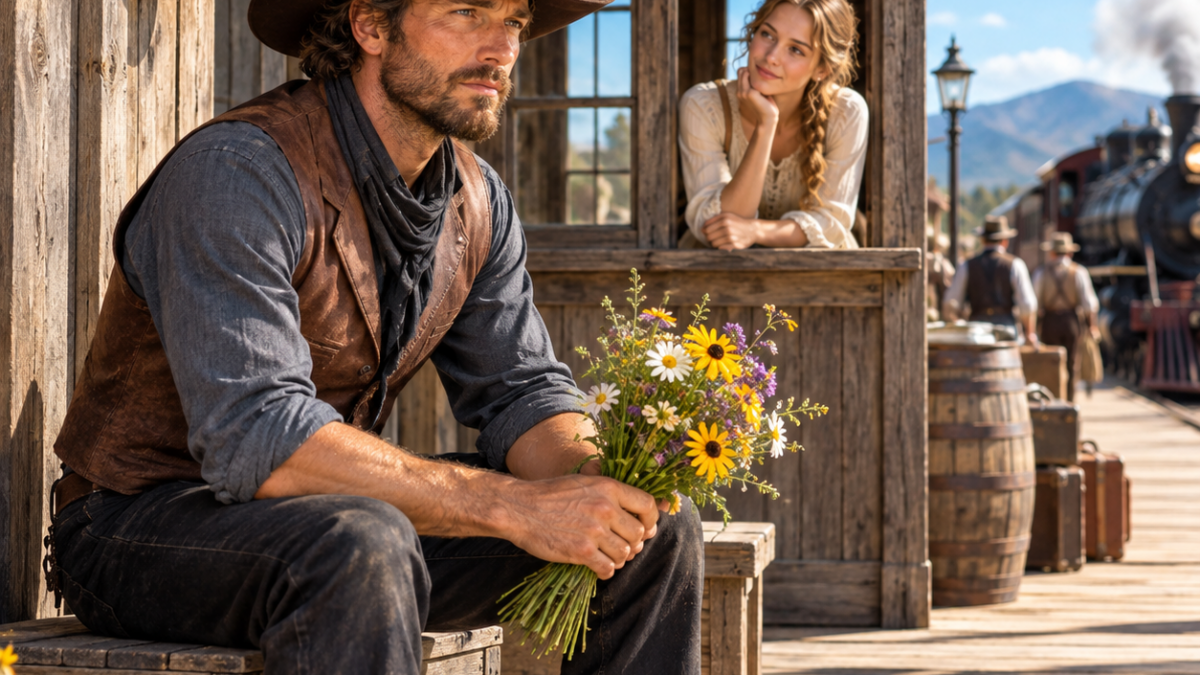
I walked outside and sat on the second bench from the east end.
I had brought wildflowers.
The eastbound arrived at 4:12.
I watched the passengers step down.
A man with a case.
Two women in traveling clothes.
A family with a little boy who ran ahead on the platform because children understand better than adults that sitting still too long is an insult to the body.
The train left.
I looked at the tracks going east until they bent around the hill and disappeared.
Then I took the old platform ticket from my coat.
Three years of carrying had softened it almost to cloth. I unfolded it carefully.
The date was barely legible now.
I thought about Evelyn.
Not the fever.
Not the bed.
Not the last breath that had left me listening for another that did not come.
I thought about her running.
I thought about her laughing because walking was too slow. I thought about her sitting across from me with the ledger open, hair coming loose, scolding me for adding a column wrong. I thought about her telling me, one Friday before we were married, that the most frightening thing about me was that I showed up before I had any guarantee.
“You make a woman believe she matters,” she had said.
“You do,” I had answered.
She had looked away, smiling.
For three years, I had come to the station because I thought it was the last place I could find her.
But that day, sitting with flowers in my hand, I understood Mara had been right before either of us knew she was saying it.
Evelyn was not only in the absence.
She was in the kitchen logic. The garden rows. The account books that saved me when a dishonest man tried to use her name. She was in the habit of showing up. In the way I treated promises as things with weight. In the part of me still capable of loving carefully because she had once loved me well.
I placed the wildflowers on the bench beside me.
Not like leaving them behind.
Like leaving them in good hands.
Then I folded the old ticket one last time and tucked it into the crack between the bench slats where weather would eventually take it apart.
I did not need it in my coat anymore.
When I walked to the ticket window, Mara was there.
She had come back early.
Her eyes moved to the bench.
Then to me.
She said nothing about the flowers.
I said nothing about the ticket.
She closed the window, came outside, and stood beside me.
“Ready?” she asked.
“Yes.”
We walked together through Larkspur Junction in the long gold light of evening, past the hotel, past the feed store, past men who tipped hats and women who pretended not to stare.
The town had watched me wait for three years.
Now it watched me walk.
We married in September.
On a Saturday.
Friday still belonged to the station, and neither of us wanted to change what Friday was.
Mara wore a dress the color of the Kansas sky after summer heat breaks. Mrs. Patterson cried openly and denied it when confronted. Paul Mercer’s daughters threw wildflowers badly, which was to say perfectly. The new stationmaster came, a serious man from Newton who treated Mara with respect and Pruitt’s old office with suspicion.
Silas Vane did not come.
He was awaiting trial in Topeka by then.
Amos Reed had already left the state after testifying, which was wise. Harlan Pruitt was rumored to be working in a warehouse in Missouri where no one trusted him with keys.
I wore my best shirt.
The blue one.
Faded, mended, no longer fine by any reasonable measure.
Mara noticed.
At the altar, her eyes flicked to the cuff Evelyn had once repaired, then back to my face. She understood without needing explanation. Some things are not worn because they are new. Some things are worn because they survived.
Our vows were simple.
I promised honesty.
She promised truth.
I promised to show up.
She smiled when I said it.
After the ceremony, we walked to the station.
No train was due for another hour. No passenger expected us. No reason existed except the reason that mattered: it was where everything had begun.
The platform was empty in the September afternoon. The second bench from the east end held no flowers now, no old ticket, only gray boards worn smooth by years of waiting.
Mara sat first.
I sat beside her.
The coal smell from the afternoon train still hung in the air. The rails caught the late light. The tracks ran east until they bent around the hill and disappeared.
For a while, we said nothing.
Then Mara placed her hand over mine.
“She knew,” she said.
I looked at her.
“Evelyn.”
“What did she know?”
“That you would show up even without guarantee.”
I looked down the tracks.
“Yes,” I said. “She did.”
Mara leaned her shoulder lightly against mine.
“And now I know it too.”
The words entered me quietly.
No thunder.
No dramatic swell.
Just truth finding a place to sit.
Years later, people in Larkspur Junction would still talk about the man who waited every Friday. Some told it like a love story. Some told it like a ghost story. Some told it like a scandal because people who missed the point often decorate the wrong parts.
They would say I waited for my dead wife until a clerk asked who I was waiting for.
That was true, but incomplete.
I waited because grief had given me one place where memory still moved.
I waited because I did not know how to carry love after death except by returning to the last place joy had run toward me.
I waited because men are sometimes praised for strength when what they are really doing is standing very still inside a life that has collapsed.
And Mara Ellison did not save me by replacing Evelyn.
She saved me by asking the question no one else would ask and staying long enough to hear the answer.
She saw the bench.
She saw the coffee.
She saw the ledgers.
She saw the lie men had built around my sorrow.
Then she helped me tear it down, number by number, truth by truth, until the people who mistook kindness for weakness discovered that quiet women and grieving men can still be dangerous when they stop protecting everyone else’s comfort.
The ranch healed.
Not all at once.
No real thing does.
Mara learned the garden. She found the name of the purple flowers near the north wall in an old seed catalog tucked inside Evelyn’s cookbook. Larkspur, of all things. She laughed when she discovered it, then cried a little because life can be mercilessly tender in its arrangements.
She did not move Evelyn’s jars immediately.
Then one winter morning, she moved the coffee to the lower shelf because she said reaching that high before dawn was foolish. I objected on Evelyn’s behalf. Mara said Evelyn had likely only placed it there because I was tall and she was considerate, but consideration did not require permanent inconvenience.
She was probably right.
Evelyn often was.
So was Mara.
Our life made room for both facts.
On Fridays, I still went to the station when I could.
Not always. Ranches do not respect rituals without occasional protest. Calving happens. Storms happen. Fences fall. Life interrupts grief and joy alike.
But when I came, I no longer bought a platform ticket unless I needed one.
Sometimes Mara and I sat on the second bench after her shift. Sometimes we drank coffee. Sometimes we watched passengers step down and imagined who was waiting for them elsewhere. Sometimes we said nothing at all.
Once, years later, a young woman came through Larkspur Junction with too many bags and not enough hands. Her fiancé stood on the platform looking terrified and hopeful. She stepped down, saw him, dropped one bag, and ran the last twenty yards.
Walking, apparently, was still too slow for some people.
Mara looked at me.
I looked at her.
Neither of us spoke.
We did not need to.
The people we love do not leave when they die.
They change form.
They become the courage we use without knowing where it came from. They become the habits that save us. The gardens that return. The ledgers that tell the truth. The bench where we finally understand that remembering and living are not enemies.
For three years, I thought I was waiting for Evelyn.
Maybe I was.
But I was also waiting for the day someone brave enough, lonely enough, and kind enough would sit beside me in the rain and ask the question that opened the rest of my life.
Who are you waiting for?
For a long time, I thought the answer was a woman who would never come back.
Now I know better.
I was waiting for the truth.
I was waiting for justice.
I was waiting for the courage to stand up from that bench.
And, though I could not have known it then, I was waiting for Mara.








