For Six Months, the Fallen SEAL’s K9 Shut Out the World—Then an Old Farmer Whispered Something No One Expected
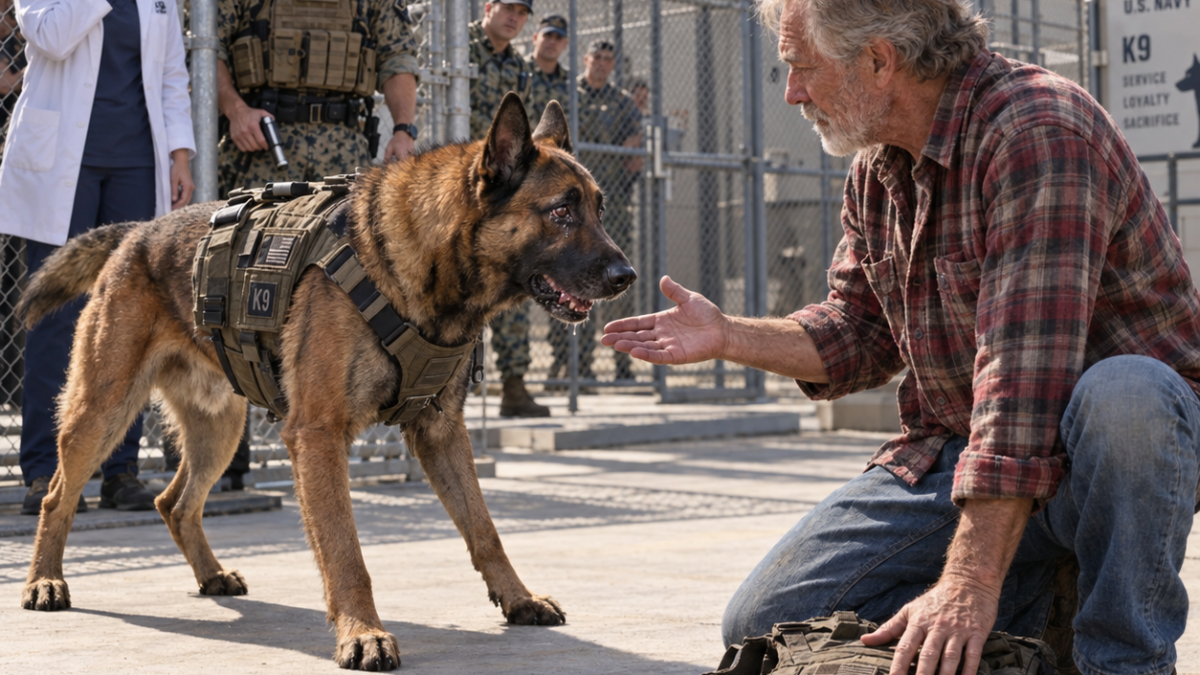
PART3:
Elena folded her arms.
“You said that.”
“How many layers?”
“Two.”
“Inner kennel gate. Outer safety perimeter.”
“Yes.”
“Tranq gun?”
Petty Officer First Class Mark Davis, standing several feet behind them, shifted involuntarily.
Jacob’s eyes went to the movement.
Then to the holster at Davis’s side.
Not a firearm.
Chemical immobilization launcher.
Jacob looked back at Phalanx.
“Long pole for feeding?”
Davis stared.
Elena did not like how quickly the old man was identifying the system.
“For safety.”
“Of course.”
Elena’s patience thinned.
“Mr. Brandt, Phalanx is suffering from severe post-deployment behavioral destabilization compounded by attachment loss. Hypervigilance. Resource guarding. Sleep disruption. Aggression toward unfamiliar handlers. Persistent sympathetic arousal—”
“He’s holding a perimeter.”
Elena stopped.
Jacob still watched the dog.
“He’s what?”
“Holding a perimeter.”
“He’s pacing.”
“No.”
Jacob pointed with two fingers.
“Watch his eyes.”
Elena did.
Phalanx moved left.
His body faced forward.
His eyes checked the gate.
Then the service corridor.
Then the corner behind the water station.
Then back to the gate.
Turn.
Repeat.
Jacob said, “He’s checking sectors.”
Davis’s face changed.
Elena looked at him.
“Davis?”
The young handler swallowed.
“I’ve noticed the gate fixation, ma’am.”
“You never described it as perimeter behavior.”
“No, ma’am.”
“Why?”
“I thought it was kennel guarding.”
Jacob spoke.
“Same behavior. Wrong reason.”
Elena turned toward him.
“You’ve known him for three minutes.”
“I’ve known dogs like him longer than you’ve been alive.”
The comment landed harder than either intended.
Davis glanced away.
Elena’s spine stiffened.
“I hold a doctorate in clinical psychology and specialized in military trauma before being assigned to this program.”
Jacob finally turned toward her fully.
“And I expect you’re very good at it.”
That disarmed her.
He continued.
“But you’re treating what he’s doing like symptoms.”
“They are symptoms.”
“To you.”
“What are they to him?”
Jacob looked at Phalanx.
“Orders.”
The word hung there.
Elena frowned.
“He hasn’t received an order in six months.”
“Exactly.”
A metallic clang sounded from a kennel farther down the facility.
Phalanx spun toward it instantly.
Body low.
Eyes locked.
Three seconds.
Then he returned to pacing.
Jacob watched.
“He doesn’t think the mission ended.”
Elena said nothing.
“He thinks his boy is missing.”
“Liam is dead.”
“You know that.”
Jacob pointed through the fence.
“He doesn’t.”
Davis stared at Phalanx.
Something about the explanation fit too easily.
Elena looked down at her chart.
They had tried systematic desensitization.
Counterconditioning.
Environmental changes.
Temporary foster-handler exposure.
Medication.
Sleep intervention.
Controlled reintroduction to former team members.
Nothing.
Former teammates upset Phalanx more.
One of Liam’s friends had approached the kennel wearing a familiar uniform.
Phalanx had thrown himself at the fence so violently he chipped a canine tooth.
They assumed the uniform triggered combat memory.
Jacob seemed to read something in Elena’s face.
“What happened when his team came?”
She looked up.
“How did you know they came?”
“Would’ve been the first thing I tried.”
Elena hesitated.
“He became more aggressive.”
Jacob’s face tightened.
“Course he did.”
“Why?”
“He saw men who came home without Liam.”
The simplicity of it bothered her.
“You are anthropomorphizing.”
“No.”
“Dogs do not construct grief narratives in the same way humans—”
“I didn’t say he wrote himself a poem about it.”
Davis coughed.
Possibly hiding a laugh.
Elena looked at him.
He became extremely interested in the fence.
Jacob continued.
“He knows his handler left with a team. He knows some of that team came back. He knows Liam didn’t. He knows nobody brought Liam through that gate.”
Elena’s expression changed.
Jacob said, “So he waits.”
“For six months?”
“My wife waited sixteen years for our son to come home from things nobody could tell her about.”
The anger left Elena’s face.
Jacob looked older suddenly.
“He came home,” Jacob added. “Just not the same.”
“Your son served?”
Jacob ignored the question.
He moved toward the outer perimeter.
Phalanx stopped again.
The growl began.
Davis stepped forward.
“Sir, please stay behind the yellow line.”
Jacob looked down.
A bright strip had been painted across the concrete.
“Why?”
“That’s the minimum reaction distance.”
“For you?”
Davis blinked.
“Yes, sir.”
Jacob stepped until the toes of his boots touched it.
Phalanx’s head lowered.
Elena said, “Mr. Brandt.”
Jacob studied the dog.
Phalanx’s growl deepened.
“He know my scent?”
“Possibly through Liam’s belongings.”
“That isn’t what I asked.”
Elena exhaled.
“We don’t know.”
Jacob nodded.
Then said, “Open the gate.”
Davis stared.
Elena thought she had misheard.
“No.”
Jacob did not look at her.
“I need to go inside.”
“Absolutely not.”
“Doctor.”
“No.”
Jacob turned.
“My grandson trusted that dog with his life.”
“That dog is no longer in a stable operational state.”
“And whose fault is that?”
Elena’s eyes flashed.
“Excuse me?”
“You’ve locked a working dog in concrete for half a year, surrounded him with unfamiliar people, tried to drug him into sleeping, and every few weeks somebody new walks up and tests whether he still wants to fight.”
“We have been trying to prevent him from injuring himself.”
“I know.”
“Do you?”
“Yes.”
Jacob’s voice softened.
“That’s what makes this hard.”
Elena stared.
There was no contempt in him.
Only exhaustion.
She looked back at Phalanx.
Her preliminary final report sat on her desk.
Recommendation:
Nonrecoverable operational instability.
Continued significant risk to personnel.
Quality of life declining despite comprehensive intervention.
Humane euthanasia should be considered.
She had not signed it.
For five days she had told herself the delay was administrative.
It was not.
“I cannot let a civilian walk into that enclosure.”
Jacob’s eyes stayed on her.
“He has a week.”
Elena’s stomach tightened.
“Who told you?”
“Nobody needed to.”
He nodded toward the folder tucked under her arm.
“I know what a last chance looks like.”
Elena glanced at Davis.
The handler looked miserable.
Jacob continued.
“You called me from Montana because everything else failed.”
“We called because Liam’s next of kin indicated you had significant involvement in his upbringing.”
“That’s a long sentence for last chance.”
Elena’s voice hardened.
“I will not allow you to get mauled so that we can say we exhausted one more option.”
“And I didn’t drive eighteen hours to watch you kill Liam’s partner through chain link.”
Davis looked down.
Elena felt the words hit a place she had carefully avoided.
Jacob moved closer.
“You want to know why your treatment isn’t reaching him?”
She did not answer.
“You’re trying to make him forget the job.”
“We’re trying to reduce pathological hyperarousal.”
“He doesn’t need to forget.”
“What does he need?”
Jacob looked through the fence.
“To be released from it.”
Silence.
Phalanx paced.
Seven steps.
Turn.
Seven.
Turn.
Elena heard herself say, “Davis.”
The young handler looked up.
“Ma’am?”
“Prepare the secondary barrier.”
His eyes widened.
“You’re allowing this?”
“I’m allowing controlled contact.”
Jacob almost smiled.
“No leash.”
Elena turned sharply.
“Don’t push it.”
“No leash on him.”
“He will not tolerate one anyway.”
“Good.”
“Mr. Brandt, if he charges, Davis will sedate him.”
“No.”
“That is not negotiable.”
Jacob looked at the young handler.
Davis felt something strange pass between them.
Not friendship.
Recognition.
Jacob said, “If he commits, chemical sedation won’t stop him before he reaches me.”
Davis knew that was true.
“You know dogs?” Davis asked.
Jacob looked at him.
“Some.”
“What kind?”
“The kind that bite.”
Elena rubbed her forehead.
“This is insane.”
Jacob nodded.
“Probably.”
That was somehow worse.
Davis secured the outer compound.
Two veterinary personnel moved behind a secondary gate.
Elena took position beside the emergency control panel.
Davis unlocked the inner enclosure.
The metal gate opened six inches.
Phalanx stopped pacing.
Every muscle in his body changed.
Davis opened it fully.
Jacob entered.
The gate closed behind him.
Phalanx’s growl became a roar.
Elena’s heart climbed into her throat.
Jacob took one step.
Then another.
His hands remained loose at his sides.
He did not extend one.
He did not crouch.
He did not turn sideways submissively.
He simply entered as if crossing into a field he understood.
Phalanx’s lips curled back.
His entire body trembled with contained force.
Jacob stopped fifteen feet away.
Davis watched the old man.
Feet shoulder-width.
Left foot slightly behind.
Knees soft.
Weight centered.
Hands relaxed but not dead.
Elena saw an old farmer.
Davis saw something else.
“Ma’am,” he whispered.
“What?”
“Look at his stance.”
She did.
“What about it?”
“That man has been trained.”
Jacob’s eyes never left Phalanx.
Not the teeth.
The eyes.
Phalanx barked.
The sound hit the kennel walls like a gunshot.
Elena flinched.
Jacob did not.
Phalanx lunged.
Davis’s hand closed around the tranquilizer launcher.
“Wait,” Jacob said.
He did not shout.
Davis froze.
Phalanx stopped five feet away.
No barrier.
No tether.
Nothing physically prevented him from continuing.
He barked again.
Saliva flew.
Jacob’s breathing stayed slow.
“In.”
The old man whispered it to himself.
“Hold.”
Phalanx barked.
“Out.”
Davis stared.
Box breathing.
Military stress control.
Elena heard it too.
Her eyes shifted toward Davis.
Davis barely nodded.
Jacob spoke to the dog.
“Go ahead.”
Phalanx growled.
“You got plenty to say.”
Another bark.
“I imagine you do.”
Phalanx paced two steps sideways.
Jacob moved nothing but his eyes.
“You’ve been yelling six months and nobody’s answered the question.”
Elena’s fingers tightened around the emergency switch.
Jacob’s voice dropped.
“Where is he?”
Phalanx stopped.
Jacob swallowed.
“Yeah.”
Something changed in the dog’s face.
Small.
Almost invisible.
“You keep asking.”
Jacob’s voice roughened.
“Where’s Liam?”
Phalanx barked once.
Then again.
Not aggressive now.
Sharp.
Demanding.
Jacob’s eyes glistened.
“He isn’t coming through that gate, son.”
The dog stiffened.
Elena whispered, “Don’t.”
Jacob heard her.
He continued.
“You can stand there another six months.”
His own voice nearly failed.
“Six years.”
Phalanx’s ears moved.
“He’s not coming.”
The dog began pacing again.
Faster.
Jacob did not chase him.
“My boy died.”
The growl returned.
“My grandson.”
Phalanx barked violently.
“I know.”
Another bark.
“I know.”
Phalanx lunged again.
Jacob stayed.
“I’m mad too.”
Phalanx’s entire body shook.
“You think I don’t want somebody to bring him back?”
Jacob’s voice rose for the first time.
“You think I don’t wake up and forget for half a second?”
The dog stopped.
Jacob’s face broke.
Elena watched the farmer disappear.
What remained was a grandfather.
“I raised that boy half his life.”
Jacob swallowed hard.
“His daddy couldn’t stay sober. His mama did what she could. So Liam spent summers in my barn and winters calling me every Sunday.”
Phalanx’s mouth closed.
“He learned to ride on my place.”
Jacob breathed.
“He broke his wrist at twelve and lied to the doctor because he thought I’d sell the horse.”
A broken laugh escaped him.
“He ate everything but tomatoes.”
Phalanx took one step backward.
“And he wrote me about you.”
The dog’s ears lifted.
Jacob lowered himself.
Smoothly.
Too smoothly for an old farmer.
One knee touched concrete.
Davis’s suspicions became certainty.
Jacob reached no hand toward Phalanx.
“He said you were smarter than half the men in his platoon.”
Davis murmured, “Team.”
Elena glanced at him.
Jacob smiled faintly.
“He probably said team. I’m old. My memory gets selective.”
Phalanx stared.
“He said you stole his socks.”
The dog’s head tilted.
Jacob’s eyes filled.
“There you are.”
Phalanx whined.
Everyone outside the fence froze.
Elena’s mouth opened.
Six months.
They had heard barking.
Growling.
Snarling.
The relentless clicking of claws.
Never that.
Never a whine.
Jacob looked toward Elena.
“I need Liam’s vest.”
She hesitated.
“What?”
“Plate carrier. Shirt. Something he wore in the field.”
“We have his returned equipment.”
“Bring it.”
Elena remained still.
“Doctor.”
The old authority returned.
“Please.”
That word moved her.
She ran.
The evidence storage room was two buildings over.
Liam Olsen’s returned personal kit had been cataloged but never released because parts of his final mission remained under review.
Elena found the sealed carrier bag.
Plate carrier.
Sand still buried in seams.
One damaged buckle.
Faded marker initials:
OLSEN, L.
Her hands shook as she carried it back.
Davis took the bag.
He removed the vest carefully.
Even after six months, it smelled faintly of sweat, dust, lubricant, canvas, and something impossible to describe but unmistakably human.
Davis opened the outer gate.
He set the vest inside and backed away.
Jacob reached behind him without taking his eyes off Phalanx.
His fingers hooked the webbing.
He dragged the vest across the concrete.
The reaction was instantaneous.
Phalanx recoiled.
Not aggressively.
As though struck.
A sound came from his throat.
High.
Broken.
He moved backward until his hindquarters touched the fence.
Then forward.
Then back.
He could not decide whether to flee the smell or climb inside it.
Jacob placed his palm on the plate carrier.
“He’s here.”
Phalanx whined.
“Not the way you want.”
The dog shook.
“Me either.”
Jacob touched a frayed strap.
“His last watch is over.”
Phalanx moved one step forward.
Jacob breathed.
“He stood it.”
Another step.
“He did his job.”
Another.
“You did yours.”
Phalanx was eight feet away.
Jacob’s voice became almost a whisper.
“You don’t have to keep the whole war alive just because you’re the one who came home.”
Elena looked down.
The sentence reached beyond the fence.
Beyond the dog.
Davis swallowed.
Jacob stared at Phalanx.
Then he spoke one word.
“Stāshay.”
The dog froze.
Davis’s eyes widened.
Jacob repeated it.
Low.
Precise.
Not the exaggerated syllables of someone copying a foreign phrase.
Fluent muscle memory.
“Stāshay.”
Phalanx’s body changed.
His shoulders lowered.
His ears lifted.
His mouth opened slightly.
He stared at Jacob in complete confusion.
Davis whispered, “What the hell?”
Elena looked at him.
“You know it?”
“Not exactly.”
Jacob spoke again.
“At ease.”
Phalanx whimpered.
Then moved.
One step.
Two.
Three.
He stopped in front of Jacob.
Close enough to bite his face.
Elena reached toward the sedation control.
Davis caught her wrist.
She looked at him furiously.
He shook his head.
“Wait.”
Phalanx leaned forward.
Sniffed Jacob’s shirt.
Boots.
Hands.
Then the dog pressed his nose into Jacob’s palm.
Jacob did not touch him.
Phalanx nudged again.
Harder.
“Permission?” Jacob whispered.
The dog pushed his head beneath the hand.
Jacob’s fingers settled behind his ears.
Phalanx collapsed.
Not fell.
Collapsed.
His front legs folded.
His chest hit concrete.
His head landed across Jacob’s thigh.
Then the dog began to cry.
Elena had never heard anything like it.
Long, low, shuddering sounds.
His entire body convulsed.
Jacob bent over him.
The old man’s face disappeared into the Malinois’s neck.
And Jacob cried too.
No one outside the kennel spoke.
No one looked away.
For six months Phalanx had been a weapon pointed outward.
Now the weapon was gone.
There was only an animal mourning a man.
Jacob stroked him slowly.
“That’s right.”
Phalanx cried.
“I know.”
Jacob’s tears darkened the dog’s fur.
“Let him go.”
The dog pressed harder against him.
“You hear me?”
Jacob closed his eyes.
“We have to let him go.”
Minutes passed.
Maybe ten.
Maybe twenty.
Nobody checked.
Eventually Phalanx stopped shaking.
Jacob’s hands moved over him.
Ears.
Jaw.
Neck.
Shoulders.
Ribs.
Paws.
Abdomen.
Davis recognized the sequence.
Field assessment.
Systematic.
Professional.
Jacob’s fingers reached the left flank.
Stopped.
He separated thick fur.
“What the hell?”
Elena leaned toward the fence.
“What?”
Jacob worked at something.
A small knot came free.
A dry thorny burr.
Brown.
Embedded near the undercoat.
He held it up.
“Where was his last deployment?”
Elena shook her head.
“I can’t tell you.”
Jacob looked at the burr.
“You don’t need to.”
Davis stared.
“Afghan high desert?”
Jacob’s eyes lifted.
Davis continued.
“I’ve seen those.”
Jacob flicked it away.
“Probably been scratching him six months.”
Elena looked embarrassed.
“We performed complete examinations.”
“I know.”
“He had imaging.”
“I know.”
“How could we miss—”
“Because you were afraid of his mouth.”
The answer carried no cruelty.
That made it worse.
Jacob scratched the dog’s neck.
“You saw the dangerous parts first.”
Elena looked at Phalanx.
For the first time since Liam’s death, his eyes were closed while someone touched him.
“How did you know that word?”
Jacob did not answer immediately.
“Liam wrote it.”
Davis said, “No, sir.”
Jacob looked up.
The young handler stood straighter.
“With respect.”
Jacob’s mouth twitched.
“You’re about to disrespect me politely?”
“Yes, sir.”
“That sounds Navy.”
Davis stepped closer to the fence.
“That pronunciation didn’t come from a letter.”
Jacob said nothing.
“And the way you entered the kennel.”
Nothing.
“The breathing.”
Jacob watched him.
“The stance.”
Silence.
“The field check.”
Elena looked between them.
Davis continued.
“What were you?”
Jacob lowered his eyes toward Phalanx.
“A farmer.”
“Before.”
“A younger farmer.”
Davis almost smiled.
“Sir.”
Jacob sighed.
“A long time ago.”
“Where?”
“In places that don’t exist anymore.”
Elena recognized a closed door when she heard one.
Davis did too.
But before either could speak, Phalanx rose.
Jacob stood with him.
The dog moved immediately to his left side.
Perfect position.
No leash.
Head level with Jacob’s hip.
Davis stared.
Jacob walked toward the gate.
Phalanx followed.
Elena moved backward involuntarily.
The dog noticed.
Jacob stopped.
“Doctor.”
“Yes?”
“You want him to heal?”
She nodded.
“Stop expecting the dog he used to be.”
Elena looked at Phalanx.
“What should I expect?”
Jacob touched the animal’s shoulder.
“The dog who came home.”
He reached the gate.
Davis unlocked it.
Jacob stepped through.
Phalanx followed without hesitation.
Davis froze.
“Sir.”
Jacob looked back.
“You planning to tell him he can’t?”
“No, sir.”
“Good.”
Elena stared.
“We cannot simply remove a military working dog from secure housing.”
Jacob nodded.
“Then secure wherever I’m standing.”
And for the first time in six months, Petty Officer Davis laughed near Phalanx without the dog showing his teeth.
That afternoon, Elena submitted an emergency amendment to her report.
Euthanasia recommendation suspended.
Transfer evaluation pending.
Behavioral response following controlled family exposure: dramatic.
She deleted dramatic.
Too emotional.
She replaced it with significant.
Then stared at the word.
Significant was absurd.
It did not describe a dog collapsing in grief.
It did not describe the way Phalanx had followed Jacob across the compound.
It did not explain the command.
It certainly did not explain Jacob.
At 1600, Davis requested a meeting with Captain Robert Wallace, commanding officer overseeing several base support programs.
Wallace read Elena’s preliminary report while Davis stood at parade rest.
“Dr. Reed says the dog is no longer displaying active aggression.”
“Yes, sir.”
“After six months.”
“Yes, sir.”
“Because Liam Olsen’s seventy-something-year-old grandfather walked into the kennel.”
“Yes, sir.”
Wallace lowered the report.
“You understand why I’m having difficulty with this.”
“Yes, sir.”
“What did he do?”
Davis explained.
Every detail.
Wallace interrupted only once.
“What was the word?”
“Sounded like ‘stah-shay,’ sir.”
Wallace frowned.
“Language?”
“Pashto, I think.”
“You think?”
“I checked afterward. Regional usage. Something close to stand easy, settle, remain at rest.”
Wallace leaned back.
“And Olsen’s grandfather knew this?”
“Yes, sir.”
“From a letter.”
“That’s what he claimed.”
“You don’t believe him.”
“No, sir.”
“Why?”
Davis hesitated.
“Because I’m a handler.”
Wallace waited.
“And?”
“A civilian kneeling near an unstable Malinois puts his hands where he thinks the dog wants them.”
Davis demonstrated.
“Mr. Brandt checked ears, jaw, lymph area, shoulders, ribs, paws, flank. Same sequence I was taught for rapid field injury assessment.”
Wallace’s expression changed slightly.
“He positioned himself before the dog charged. Balanced. Bladed. Protected his throat without looking defensive.”
Davis continued.
“He controlled breathing under threat.”
“Military?”
“More than military.”
Wallace studied him.
Davis said, “Handler.”
The captain turned toward his computer.
“Name.”
“Jacob Brandt. Montana.”
Wallace typed.
Nothing obvious.
Farm property.
Agricultural registration.
Veterans benefit entry.
No visible details.
Wallace accessed another system.
Then another.
“Middle initial?”
“T, sir.”
Wallace typed.
A warning appeared.
He entered credentials.
Another warning.
His expression changed.
Davis saw it.
“Sir?”
Wallace said nothing.
A record opened.
Most of the screen was black bars.
BRANDT, JACOB THOMAS.
UNIT HISTORY: RESTRICTED.
ASSIGNMENTS: RESTRICTED.
Then scattered years.
Navy.
Special operations support.
Reconnaissance.
Advisory.
Several unit designations Davis did not recognize.
Wallace leaned closer.
“My God.”
“What?”
Wallace scrolled.
A citation appeared.
NAVY CROSS.
The summary was brief.
Extraordinary heroism.
Clandestine reconnaissance operation.
Enemy numerical superiority.
K9 warning and tracking support.
Extraction of wounded personnel.
Davis read one line twice.
“Lead scout and canine handler.”
Wallace sat back.
“You know your program history?”
“Post-nine-eleven, mostly.”
“Go back.”
“To when?”
“Vietnam.”
Davis knew the broad outline.
Scout dogs.
Tracker teams.
Sentry dogs.
The animals saved thousands of lives.
Many never came home.
Wallace said, “Before the current Naval Special Warfare canine system had facilities, dedicated procurement, standardized handler pipelines, and budgets, men were improvising.”
He tapped the file.
“Some attached to units history barely admits were there.”
“MACV-SOG?”
Wallace looked at him.
“That name is enough for this room.”
Davis stared at Jacob’s record.
“He was SOG?”
“Parts of this file suggest attachments to operations connected with it.”
“And the dog?”
Wallace scrolled.
A photograph appeared.
Grainy.
Black and white.
A much younger Jacob Brandt kneeling in jungle mud.
Lean.
Hard-faced.
Rifle across his chest.
Beside him sat a dark shepherd-type dog.
The caption:
CPO BRANDT / K9 MAJOR.
Davis felt gooseflesh.
Wallace said quietly, “Jacob Brandt isn’t a farmer who learned one command from his grandson.”
“No, sir.”
“He helped build the language your people inherited.”
Davis stared at the photograph.
“How did Liam know?”
“Family.”
“No, sir. I mean why didn’t anybody else?”
Wallace closed part of the file.
“Because Brandt retired and asked to disappear.”
“Why?”
Wallace looked at the black bars.
“If these redactions could talk, I suspect we’d both lose sleep.”
Davis thought of Jacob kneeling on concrete.
The calm.
The grief.
The way Phalanx moved to his heel.
“Can we tell Dr. Reed?”
Wallace considered.
“Only what Brandt authorizes.”
Davis nodded.
Wallace glanced at him.
“One more thing.”
“Sir?”
“Don’t turn that man into a museum exhibit.”
Davis frowned.
“He buried this life for a reason.”
Wallace closed the file.
“If he wants to be a farmer, he’s a farmer.”
The next morning Elena found Jacob on a grassy field near the edge of the canine facility.
Phalanx was off leash.
Elena stopped.
The dog trotted twenty yards away.
Jacob threw a knotted rope.
Phalanx chased it.
Actually chased it.
Not tactical pursuit.
Not attack.
Play.
He grabbed the rope and ran back.
Jacob held out his hand.
“Out.”
Phalanx released immediately.
Jacob tossed again.
The dog bounded after it.
Elena’s throat tightened.
She had forgotten what Phalanx looked like when his body was not preparing to fight.
Jacob noticed her.
“Morning, Doctor.”
“Mr. Brandt.”
“You always this formal?”
“When I don’t know what else to call someone.”
“Jacob works.”
Phalanx returned.
He looked at Elena.
Her body stiffened automatically.
The dog noticed.
Jacob noticed him noticing.
“Phalanx.”
The Malinois looked at Jacob.
“Easy.”
Then that other word.
“Stāshay.”
Phalanx’s shoulders loosened.
Elena stared.
“You lied.”
Jacob picked up the rope.
“About?”
“The command.”
He said nothing.
“Liam didn’t teach you that.”
Jacob looked across the field.
“Davis talks too much?”
“He told me nothing.”
Jacob glanced at her.
“But he looks at you differently today.”
“That boy needs to work on his face.”
Elena almost smiled.
She moved several feet closer.
Phalanx watched but did not growl.
“I owe you an apology.”
Jacob threw the rope again.
“For?”
“I thought you were a grieving relative who would make the situation worse.”
“Reasonable assumption.”
“No, it wasn’t.”
Jacob looked at her.
Elena took a breath.
“I saw an old farmer.”
“I am an old farmer.”
“I saw only that.”
Jacob remained silent.
“I thought education meant I understood more than you.”
“Usually does.”
“Not this time.”
“No.”
She accepted it.
“I treated Phalanx like a pathology.”
Jacob’s eyes went toward the dog.
“You treated what you could measure.”
“That sounds like an excuse.”
“It isn’t.”
Phalanx returned.
This time he carried the rope toward Elena.
He stopped ten feet away.
Her pulse quickened.
Jacob said nothing.
Phalanx dropped the rope.
Elena stared.
Jacob said, “Pick it up.”
“Are you sure?”
“No.”
She looked at him.
He smiled faintly.
“That’s the point.”
Elena slowly bent.
Phalanx watched.
She lifted the rope.
“What now?”
“Toss it.”
She did.
Phalanx chased.
A laugh escaped her.
Unplanned.
She covered her mouth.
Jacob watched the dog.
“He’s still in there.”
Elena nodded.
“I thought we’d lost him.”
“You kept trying.”
“We almost killed him.”
Jacob looked at her.
“You didn’t.”
“I signed most of the report.”
“But not the last line.”
Elena stared.
“How do you know?”
“You wouldn’t have called me otherwise.”
That silenced her.
Phalanx returned again.
Elena tossed.
After several minutes she asked, “What were you?”
Jacob did not look at her.
“Davis asked the same.”
“And?”
“I told him farmer.”
“I’m asking before.”
Jacob sighed.
“You people are persistent.”
“Occupational hazard.”
He rubbed Phalanx’s shoulder.
“I handled a dog once.”
Elena waited.
“His name was Major.”
“What happened?”
Jacob’s face changed.
The transformation was subtle but complete.
“He died.”
“I’m sorry.”
“So am I.”
“How?”
Jacob looked toward the Pacific beyond the buildings.
“Saving me.”
Elena said nothing.
After a long silence, Jacob continued.
“We were somewhere we weren’t supposed to be doing something nobody would admit we were doing.”
His hand remained on Phalanx.
“Major alerted before I heard movement. Bought us maybe eight seconds.”
“That saved your team?”
“Most of us.”
“And him?”
Jacob swallowed.
“Not him.”
Phalanx leaned into his leg.
“For a long time, I was angry at that dog.”
Elena looked shocked.
“Why?”
“Because he died doing what I asked.”
Jacob’s eyes remained far away.
“I thought that meant I killed him.”
Elena recognized the statement instantly.
Survivor guilt.
Moral injury.
Attachment grief.
All the terms she had used in papers.
They sounded small now.
“What changed?”
“My team leader.”
“What did he say?”
“He said Major did not die because I failed him.”
Jacob looked down.
“He died because the bond worked exactly the way we built it.”
Elena frowned slightly.
“That doesn’t remove responsibility.”
“No.”
Jacob nodded.
“That’s why I believed it.”
He scratched behind Phalanx’s ear.
“We don’t heal by pretending nothing is ours.”
His eyes met Elena’s.
“We heal by figuring out what actually is.”
Phalanx sat beside him.
“Liam chose this work.”
Jacob’s voice roughened.
“So did Phalanx, as much as a dog can choose anything we shape him for.”
He looked down.
“Now Liam’s dead. Phalanx isn’t.”
Elena nodded.
“And you think giving him another mission will help.”
“Not a mission.”
“What?”
“A life.”
Over the next four days Jacob remained on base.
Not because the Navy ordered him.
Because Phalanx would not let him leave.
The first night, Jacob stayed in base lodging.
Phalanx was returned to the kennel after midnight.
He began pacing again.
Not aggressively.
Searching.
At 2:00 a.m., Davis called Elena.
At 2:10, Elena called Jacob.
At 2:28, Jacob entered the compound wearing boots without socks and the same flannel shirt he had apparently slept in.
Phalanx stopped pacing the instant he heard his voice.
Jacob slept that night on a cot beside the enclosure.
The following night, command approved temporary co-location in an unused handler room.
Phalanx slept six uninterrupted hours.
The first time in half a year.
Elena reviewed the camera footage twice.
At 1:13 a.m., Phalanx woke abruptly.
Head up.
Breathing fast.
Jacob did not wake.
Phalanx stood.
Turned in a circle.
Then pushed his body against the side of Jacob’s cot.
Jacob’s hand dropped unconsciously.
Rested on the dog’s back.
Phalanx lay down.
Elena stared at the monitor.
Treat the bond.
She wrote the phrase in her notebook.
Not the animal.
Not simply symptoms.
The bond.
On the third afternoon, Liam’s former team members requested another visit.
Elena worried.
Jacob approved it.
Four men came.
None wore dress uniforms.
They entered the field one at a time.
Phalanx stiffened when he saw the first.
Jacob placed a hand on his neck.
“Easy.”
The man stopped twenty feet away.
His name was Chief Ryan Mercer.
He looked at the dog.
Then at Jacob.
“Sir.”
Jacob said, “Don’t call me that.”
Mercer’s mouth tightened.
“Liam talked about you.”
“I know.”
Mercer looked at Phalanx.
The dog’s stare hardened.
Mercer’s eyes filled.
“I’m sorry, buddy.”
Phalanx growled.
Jacob said nothing.
Mercer lowered himself slowly.
“We tried.”
The dog’s ears moved.
“We tried to bring him.”
Mercer’s voice failed.
Jacob looked sharply at him.
Elena stopped writing.
Mercer wiped his face.
“The helicopter couldn’t hold.”
Jacob went still.
“Tell me.”
Mercer looked at him.
“Sir—”
“Tell me.”
The other SEALs exchanged looks.
Mercer swallowed.
“Liam was hit during exfil.”
Jacob’s hand tightened in Phalanx’s fur.
“Phalanx wouldn’t leave him.”
Elena looked at the dog.
Mercer continued.
“He kept pulling us back.”
His voice cracked.
“Every time we tried moving Phalanx, he went back to Liam.”
Jacob closed his eyes.
“We had incoming. Aircraft took damage.”
Mercer breathed.
“Liam made us take the dog.”
Jacob opened his eyes.
“What?”
“He was conscious.”
Silence.
“Liam ordered me.”
Mercer’s tears came now.
“He said, ‘Get Phalanx home.’”
The Malinois whined.
Mercer stared.
“He heard me.”
Jacob could barely speak.
“Probably.”
Mercer looked at Phalanx.
“He heard Liam.”
Elena’s hand covered her mouth.
Suddenly everything made sense.
Not merely absence.
Phalanx had been physically removed from his dying handler.
He had not failed to understand death.
He believed he had abandoned his post.
Jacob sank to one knee beside him.
“Oh, son.”
Phalanx pressed against him.
“That’s what you’ve been carrying.”
Mercer moved closer.
Phalanx growled.
Jacob raised one hand.
Mercer stopped.
Jacob looked at Phalanx.
“You didn’t leave him.”
The dog’s ears moved.
“He sent you.”
Phalanx shook.
Jacob’s voice strengthened.
“You hear me?”
He touched the animal’s chest.
“He sent you home.”
Mercer began crying openly.
“So did he.”
Jacob looked at him.
Mercer nodded.
“His exact words.”
He struggled for breath.
“Tell Grandpa I finally beat him at staying stubborn.”
Jacob laughed through tears.
“That idiot.”
Mercer smiled.
“He was proud of it.”
Phalanx looked between the two men.
Jacob touched Liam’s old vest, which he had begun carrying during difficult sessions.
“He gave you an order.”
Phalanx whined.
“Come home.”
Jacob placed his forehead against the dog’s.
“Mission accomplished.”
Something in the men around them broke.
No one tried to hide it.
The SEALs cried.
Davis looked away.
Elena stopped pretending she was observing clinically.
Phalanx moved toward Mercer.
Slowly.
One step.
Another.
Mercer froze.
The dog sniffed him.
His chest.
Hands.
Boots.
Then Phalanx pushed his head into Mercer’s shoulder.
Mercer wrapped both arms around him.
“I’m sorry.”
Phalanx leaned.
“I’m sorry, buddy.”
Jacob closed his eyes.
He understood then that he had been wrong about one thing.
Phalanx did not need only a new commander.
He needed the truth.
So did everyone else.
Two days later, Captain Wallace approved transfer of Phalanx into Jacob Brandt’s custody.
The paperwork described it as medical retirement with family placement.
Jacob read the phrase twice.
“Family placement.”
Elena smiled.
“Problem?”
“No.”
He looked at Phalanx.
“First accurate thing in the file.”
But Jacob did not immediately leave.
Instead, he asked Elena to show him the full canine reintegration protocol.
She brought three binders.
He stared at them.
“You trying to punish me?”
“You asked.”
He opened the first.
Read.
Made no comments for twelve pages.
Then took a pencil.
“Problem?”
Elena sat across from him.
“Tell me.”
“Too much emphasis on exposure.”
“Exposure therapy is evidence-based.”
“I’m not arguing that.”
He circled a paragraph.
“You expose before you establish trust.”
“In many cases, trust develops through structured exposure.”
“With who?”
“The assigned clinician or handler.”
“What if that handler is the trigger?”
Elena paused.
Jacob continued.
“You keep assuming the dog lost tolerance for environments.”
“What if the dog lost the person who made the environment survivable?”
Elena wrote.
Jacob turned pages.
“This.”
“What?”
“Rotating staff.”
“For generalized socialization.”
“For a grieving working dog, might look like nobody stays.”
Elena wrote again.
He flipped.
“Sleep.”
“We track it.”
“You medicate it.”
“When appropriate.”
“What happens when the dog wakes?”
She frowned.
“What do you mean?”
“Who is there?”
Silence.
Jacob tapped the page.
“Night is where grief gets loud.”
Elena stared at him.
That sentence applied to humans too.
Jacob noticed her expression.
“Doctor.”
“Yes?”
“You ever lose somebody?”
She looked down.
“My brother.”
Jacob waited.
“Car accident. I was twenty-six.”
“You sleep well after?”
“No.”
“Would rotating strangers through your bedroom have helped?”
Despite herself, Elena laughed.
“No.”
“Then write that down in scientific language.”
She did.
Jacob stayed three weeks.
The Navy expected two days.
During those weeks, he and Elena argued constantly.
She defended evidence.
He defended experience.
Davis translated between them.
Phalanx supervised.
Slowly, something emerged.
Not rejection of science.
Integration.
Medication when appropriate.
Veterinary treatment.
Behavioral assessment.
But also handler-loss rituals.
Controlled exposure to belongings.
Team debriefs designed specifically around the dog’s last known experiences.
Stable personnel rather than excessive rotation.
Sleep observation.
Scent continuity.
And one requirement Jacob fought hardest for:
No surviving K9 would be treated without interviewing the people who last saw the handler and dog together.
“Why?” a Navy administrator asked during a review meeting.
Jacob looked at him.
“Because the dog was there.”
The administrator frowned.
“So were the service members.”
“Exactly.”
Jacob leaned forward.
“You have witnesses who speak English, and you ignore them while trying to guess what the animal experienced.”
Elena sat beside him.
Months earlier, she would have challenged the simplification.
Now she said, “He’s right.”
The administrator looked surprised.
Elena continued.
“We cannot clinically reconstruct attachment trauma while excluding the attachment context.”
Jacob leaned toward Davis.
“She made it scientific.”
Davis whispered, “I think that means she agreed with you.”
“I know. I’m enjoying it.”
Elena heard them.
“Both of you can leave.”
Phalanx yawned.
The program pilot was approved.
Unofficially, people began calling it the Olsen Protocol.
Jacob hated that.
Elena loved it.
“It honors Liam.”
“It sounds like something that requires laminated badges.”
“It does.”
“I withdraw my support.”
“You already signed.”
Jacob glared.
She smiled.
It was one of the first times Davis saw Elena win an argument with him.
The day Jacob finally prepared to return to Montana, Captain Wallace requested a private meeting.
Jacob entered wearing flannel.
Wallace stood.
“Chief Brandt.”
Jacob stopped.
His face cooled.
“Haven’t heard that in a while.”
Wallace extended his hand.
Jacob looked at it.
Then shook.
“I accessed part of your record.”
“I’m sorry to hear that.”
Wallace almost smiled.
“I wanted you to know nothing leaves my office without your approval.”
Jacob studied him.
“Good.”
“Davis knows enough.”
“He guessed enough.”
“He knows about Major.”
Jacob’s expression changed.
“File?”
“Photograph.”
Silence.
Wallace opened a drawer.
He removed a printed copy.
Black and white.
Young Jacob.
Young Major.
Jungle.
Forty-some years disappeared from the old man’s face.
He touched the photograph.
“I thought this was gone.”
“Most copies probably are.”
Jacob picked it up carefully.
Major looked directly at the camera.
Jacob stared for a long time.
Wallace said, “Keep it.”
Jacob’s eyes lifted.
“Why?”
“Because sometimes the archive shouldn’t be the only place remembering.”
Jacob swallowed.
He folded the photograph once.
Very carefully.
Placed it in his shirt pocket.
Wallace said, “Your grandson knew?”
“Some.”
“How much?”
“Enough.”
“Did he join because of you?”
Jacob looked toward the window.
“No.”
“You’re certain?”
“He joined because of himself.”
Wallace nodded.
Jacob added, “But maybe he learned what service looked like at my table.”
They stood quietly.
Then Wallace asked, “Why did you disappear?”
Jacob’s face became still.
“Because I came home.”
Wallace waited.
Jacob continued.
“And too many men I loved didn’t.”
A familiar answer.
A familiar wound.
“I thought if I could become ordinary enough, the dead would stop following me.”
“Did they?”
Jacob almost laughed.
“No.”
“What did?”
“Nothing.”
He touched the photograph in his pocket.
“You just learn they’re not chasing you.”
He looked at Wallace.
“They’re walking with you.”
Phalanx left Coronado beside Jacob on an overcast morning.
No ceremony.
Jacob refused.
Davis stood by the truck.
Elena carried the transfer folder.
Mercer and two other members of Liam’s team waited near the kennel building.
Phalanx wore no tactical harness.
Only a simple leather collar Jacob had bought off base.
The Malinois jumped into the passenger side of Jacob’s old truck.
Elena laughed.
“You’re letting him ride in front?”
“It’s his truck now.”
“You’ve owned it twenty years.”
“He outranks me.”
Davis leaned through the window.
“Take care of him.”
Jacob looked offended.
“Who?”
“The dog.”
“I thought you meant the truck.”
Davis scratched Phalanx behind the ears.
The dog leaned into him.
Six weeks earlier, Davis could not approach within ten feet.
His eyes filled.
“Good boy.”
Phalanx licked his wrist.
Jacob started the engine.
Elena stepped near the driver’s window.
“You’re coming back.”
“That a question?”
“No.”
“I have a farm.”
“We have a program.”
“You have a doctorate.”
“We need experience.”
“You have Davis.”
“He’s twenty-six.”
“I was useful at twenty-six.”
“You were probably unbearable.”
Jacob thought.
“Fair.”
Elena smiled.
“Three months.”
“For what?”
“Consulting.”
“No.”
“Two.”
“No.”
“One week.”
“No.”
“Four days.”
Jacob looked at Phalanx.
The dog looked at him.
Jacob sighed.
“He says three.”
Elena laughed.
The truck drove north.
Montana was nearly twenty hours away.
Jacob stopped frequently.
Phalanx disliked hotel rooms.
So they slept one night in the truck beneath a wide Nevada sky.
Jacob woke at two in the morning.
Phalanx sat awake in the passenger seat.
Watching him.
Jacob rubbed his face.
“Bad dreams?”
The dog looked out the windshield.
“Me too.”
Jacob reached behind the seat.
Took out Liam’s vest.
He had been allowed to keep it after the investigation cleared the item.
Phalanx sniffed it.
Then rested his head on Jacob’s thigh.
Jacob stared through the windshield.
“I lied to you back there.”
Phalanx breathed.
“I said his watch was over.”
Jacob stroked one ear.
“Mine isn’t either.”
He looked at the stars.
“Apparently your doctor has paperwork for us.”
Phalanx closed his eyes.
Jacob smiled.
“Coward.”
The farm sat in a broad Montana valley beneath mountains that wore snow even in summer.
Phalanx stepped from the truck cautiously.
Wind moved through grass.
No concrete.
No metal gates.
No shouting.
Cattle moved in the distance.
An old red barn stood behind the house.
Jacob unclipped the leash.
Phalanx looked at him.
“Go.”
The dog remained.
Jacob pointed.
“Go be a dog.”
Phalanx took three steps.
Stopped.
Looked back.
Jacob folded his arms.
“You’re embarrassing both of us.”
Phalanx trotted farther.
Then faster.
Then ran.
Not toward a target.
Not after a suspect.
Across grass.
For no reason.
Jacob stood beside the truck watching Liam’s dog become weightless.
Phalanx ran a wide circle.
Then another.
He found a shallow irrigation ditch and leaped it.
Missed.
Landed chest-deep in muddy water.
Jacob laughed so hard he had to hold the truck.
Phalanx emerged covered in mud.
Shook.
Then ran directly at him.
“No.”
The dog accelerated.
“Absolutely not.”
Phalanx hit him.
Mud everywhere.
Jacob cursed.
The dog barked.
One joyful bark.
Jacob stopped.
Phalanx barked again.
Jacob’s anger disappeared.
“Do it.”
The dog barked.
Jacob’s eyes filled.
“Again.”
Phalanx barked.
And somewhere in the Montana valley, a sound nobody at Coronado had heard in six months rolled across the fields.
Not warning.
Not grief.
Life.
Three months later Jacob returned to Coronado.
Phalanx came with him.
The dog walked through the canine compound without pacing.
He recognized Kennel Seven.
Stopped.
Jacob let him.
Phalanx stared through the fence.
Then looked at Jacob.
“Yeah.”
Jacob touched his shoulder.
“You lived there.”
Phalanx moved on.
Elena saw them from across the yard.
The dog looked transformed.
Weight restored.
Coat healthy.
Eyes clear.
But scars remained.
A slammed metal gate still made him tense.
Certain helicopter sounds caused him to scan.
Once, when a handler wore the same brand of glove Liam used, Phalanx searched the man’s face for several seconds.
Healing had not erased Liam.
Jacob never wanted it to.
The Olsen Protocol received its first serious case that week.
A Labrador retriever named Archer whose handler had died in a training accident.
Archer had stopped eating and refused to enter vehicles.
Elena introduced Jacob to the clinical team.
“This is Jacob Brandt.”
A younger veterinarian smiled.
“The farmer?”
Jacob looked at Elena.
She managed innocence.
“Yes.”
The veterinarian extended a hand.
“We’ve heard a lot about you.”
“All lies.”
Phalanx sat beside him.
Elena handed Jacob a folder.
“Where do we start?”
He did not open it.
“Who saw Archer last with his handler?”
A lieutenant raised his hand.
Jacob pointed.
“You.”
The lieutenant blinked.
“Sir?”
“Sit.”
The officer sat.
“Tell me everything.”
“From the accident?”
“Before.”
“How far?”
“Morning.”
“Earlier.”
The lieutenant hesitated.
“Breakfast?”
“Good.”
Jacob pulled out a chair.
“What did the handler eat?”
Elena smiled.
Class was in session.
Months became a year.
The protocol expanded.
Not every dog recovered as dramatically as Phalanx.
Some never worked again.
That was okay.
Jacob fought the language whenever administrators called those dogs failures.
“They already worked.”
He said it repeatedly.
“They don’t owe you a second career to prove they deserved the first.”
Some dogs went to former teammates.
Some to families.
Some into quieter service roles.
A few returned to duty.
The measure of success changed.
Not operational usefulness.
Quality of life.
Trust.
Rest.
Connection.
Elena published research.
Jacob refused authorship.
She added him anyway.
He demanded removal.
She refused.
They argued by telephone for forty minutes.
The article appeared with:
Consulting contribution: Jacob T. Brandt.
He called her.
“You’re impossible.”
“You taught me.”
“That’s defamation.”
“You’ll recover.”
Two years after Liam’s death, the Navy held a memorial for several fallen operators whose mission details had finally been cleared enough for public acknowledgment.
Jacob almost did not attend.
Mercer called.
“You should come.”
“I already buried him.”
“This isn’t for Liam.”
Jacob understood.
It was for them.
The living.
He wore a dark suit.
No medals.
No insignia.
Phalanx wore a simple collar.
At the memorial, Liam’s photograph stood among others.
Young.
Grinning.
Alive forever in that frame.
Phalanx stopped.
His whole body became still.
Jacob held the leash loosely.
The dog approached the photograph.
Sniffed the base.
Then sat.
People watched.
Jacob whispered, “Take your time.”
Phalanx remained for almost a minute.
Then he stood.
Turned.
Returned to Jacob’s left side.
No collapse.
No rage.
No frantic searching.
Just grief.
Carried differently.
Mercer stood nearby crying.
Jacob put a hand on his shoulder.
“You brought him home.”
Mercer shook his head.
“Not Liam.”
“No.”
Jacob looked at Phalanx.
“But you carried what he asked you to carry.”
Mercer nodded.
For the first time, Jacob believed he did too.
Years later, new handlers at Coronado heard a story.
They heard about a Malinois nobody could approach.
A fallen SEAL.
A seven-day euthanasia deadline.
An old Montana farmer.
A mysterious Pashto command.
Some versions exaggerated.
In one, Phalanx broke through a kennel gate.
He did not.
In another, Jacob stared down a full attack and caught the dog midair.
Definitely not.
Some said Jacob was a secret SEAL.
That irritated him most.
“I was Navy before half those titles meant what they mean now.”
Elena would laugh.
The true story was quieter.
A dog had been waiting for a dead man.
An old man recognized the waiting because he had spent decades doing a version of the same thing.
He did not defeat Phalanx’s aggression.
He understood it.
He did not erase the dog’s grief.
He gave it somewhere to go.
And Phalanx did something for Jacob in return.
The farmer had spent more than forty years pretending his own war ended the day he took off a uniform.
Then Liam died.
The old perimeter reopened.
Major returned in dreams.
Names he had not spoken in decades came back.
Faces.
Voices.
A jungle.
Rain.
A dog launching into darkness before gunfire began.
Jacob had gone to California believing he was there to save Liam’s dog.
Only later did he understand why Phalanx recognized him so quickly.
Not scent.
Not command.
Not blood relation.
The dog recognized someone else still standing watch over the dead.
Eventually Phalanx grew old.
His muzzle whitened.
Arthritis settled into his hips.
The dog who had once cleared walls and ridden aircraft began needing Jacob to lift him into the truck.
Jacob never complained.
“About time you let me contribute.”
Phalanx would glare.
“You carried enough.”
One cold Montana morning, Jacob sat on the farmhouse porch while snow moved softly across the valley.
Phalanx lay under a blanket beside him.
His breathing had become slower in recent weeks.
Elena had visited a month earlier.
She knew.
Jacob knew.
The veterinarian knew.
Nobody said much.
Jacob held Liam’s old vest across his knees.
The fabric had faded.
Phalanx lifted his head.
Sniffed.
Then rested again.
Jacob stroked the gray fur behind his ears.
“You remember him?”
Phalanx’s eyes moved toward Jacob.
“Stupid question.”
The old man smiled.
“I do too.”
Wind crossed the field.
Jacob looked toward the barn where Liam had once learned to saddle a horse.
For a moment he could almost see the boy at twelve.
Then twenty.
Then in uniform.
Then gone.
“I told you something wrong once.”
Phalanx breathed.
“I said Liam was waiting on us.”
Jacob’s voice trembled.
“I don’t know if that’s true.”
He rubbed the dog’s ear.
“I hope it is.”
Phalanx shifted closer.
“But I know this.”
Jacob looked down.
“You didn’t fail him.”
His own eyes filled.
“And neither did I.”
The sentence took seventy years to say.
Phalanx exhaled.
Jacob leaned back.
“His watch ended.”
He placed his hand over the dog’s shoulder.
“Major’s too.”
Snow gathered along the porch rail.
“And yours can whenever you’re ready.”
Phalanx slept.
Jacob remained beside him.
No gate.
No kennel.
No perimeter except mountains.
The dog lived another three months.
Long enough for spring.
Long enough to lie in warm grass.
Long enough for Elena to visit one final time and sit beside him without fear.
When Phalanx died, Jacob buried him on the hill above the farm.
Beside the grave he placed no military plaque.
No list of operations.
No titles.
Only a stone.
PHALANX
LIAM’S PARTNER
MY FRIEND
HE CAME HOME
Elena stood beside Jacob after the burial.
Neither spoke for a long time.
Then she said, “The program has seventeen dogs now.”
Jacob nodded.
“Seven permanent placements.”
“Good.”
“Three returned to modified duty.”
“Good.”
“Two are living with families of fallen handlers.”
Jacob looked at her.
“Good.”
She smiled through tears.
“We’re naming the new training building.”
“No.”
“You don’t know what I was going to say.”
“Yes, I do.”
“Brandt-Olsen Canine Reintegration Center.”
“Absolutely not.”
“It’s already approved.”
Jacob stared.
“You waited until the dog died because you knew I’d object.”
“I learned strategy.”
“From who?”
Elena smiled.
“An old farmer.”
Jacob shook his head.
They began walking toward the farmhouse.
Elena glanced back at the grave.
“You know what I got wrong when we met?”
“Only one thing?”
She ignored him.
“I thought I needed to fix Phalanx.”
Jacob waited.
“But he wasn’t broken.”
“No.”
“He was loyal beyond what his nervous system could survive.”
Jacob nodded.
“And we treated the loyalty like pathology.”
“Sometimes the thing hurting you started as the thing keeping you alive.”
Elena looked at him.
“You should let me quote that.”
“No.”
“I already wrote it down.”
He sighed.
“Should’ve never told you to get a notebook.”
They reached the porch.
Jacob stopped.
Across the valley, evening light touched the mountains.
For most of his life, he had believed trust was something forged under pressure.
War.
Danger.
Shared risk.
Phalanx taught him another version.
Trust could also be built afterward.
In quiet.
By staying.
By telling the truth.
By allowing grief to exist without demanding that it become useful.
The Navy had once classified Phalanx as an unstable asset.
Jacob had hated that phrase.
Asset.
As though loyalty could be inventoried.
As though courage belonged to the government because someone issued a serial number.
As though a dog who had spent years trusting a man could be expected to reorganize his entire world because paperwork said the man was gone.
Jacob looked toward the hill.
Liam had known better.
He had called Phalanx family.
That was the word that mattered.
And in the end, that was why the dog survived.
Not because an old man knew a secret command.
Not because Jacob possessed some magical ability that doctors did not.
Not because science failed and instinct won.
Phalanx survived because someone finally understood that his aggression was not hatred.
It was duty with nowhere left to go.
His pacing was not madness.
It was waiting.
His refusal to accept another handler was not defiance.
It was loyalty trapped inside grief.
Jacob never asked him to forget Liam.
He gave him permission to remember Liam without continuing the war.
That difference saved him.
Years after both Liam and Phalanx were gone, handlers at the Brandt-Olsen center were still taught one sentence on the first day of reintegration training.
It had come from Jacob despite his objections.
It was painted on a plain wall near the entrance.
YOU CANNOT ORDER GRIEF TO END.
YOU CAN ONLY GIVE IT SOMEWHERE SAFE TO STAND DOWN.
Below those words hung two photographs.
One showed Liam Olsen crouched beside a younger Phalanx, both dusty from training, Liam grinning while the dog looked impatiently toward something outside the frame.
The second was older.
Jacob Brandt on his Montana farm.
White hair.
Flannel shirt.
One hand resting on Phalanx’s gray head.
No uniforms.
No weapons.
No fences.
Visitors sometimes asked Elena which photograph best represented Phalanx.
She always gave the same answer.
“Both.”
Because the first showed what he had fought for.
The second showed what he had survived for.
And whenever a new grieving military dog came through those doors, snarling, pacing, refusing food, searching every hallway for footsteps that would never return, the staff no longer began by asking:
What is wrong with this dog?
They asked:
Who is he waiting for?
What happened the last time he saw them?
What does he believe his job still is?
And most importantly:
Who has earned enough trust to tell him he can finally stand down?
That was Jacob Brandt’s legacy.
Not the secret missions.
Not the Navy Cross he never displayed.
Not the record buried beneath black ink.
Not even the pioneering work he had done with Major decades before anyone had formalized the job.
His legacy was simpler.
He taught a generation of handlers, doctors, and commanders that the most powerful working dogs were not machines that malfunctioned when grief entered the system.
They loved.
They remembered.
They mourned.
And sometimes the last command a warrior needed was not attack.
Not search.
Not hold.
Not guard.
Sometimes the hardest command was the quietest one.
Enough.
You did your job.
Come home.
And that was what the old farmer had truly said to Phalanx on the concrete floor of Kennel Seven.
Not merely a forgotten word from another war.
Not merely at ease.
He had told the dog what nobody else had known how to say.
Liam was gone.
His love was not.
The mission was over.
His life was not.
And after 182 days of standing guard for a man who could never walk back through the gate, Phalanx finally believed him.








