For Six Months, the Fallen SEAL’s K9 Shut Out the World—Then an Old Farmer Whispered Something No One Expected
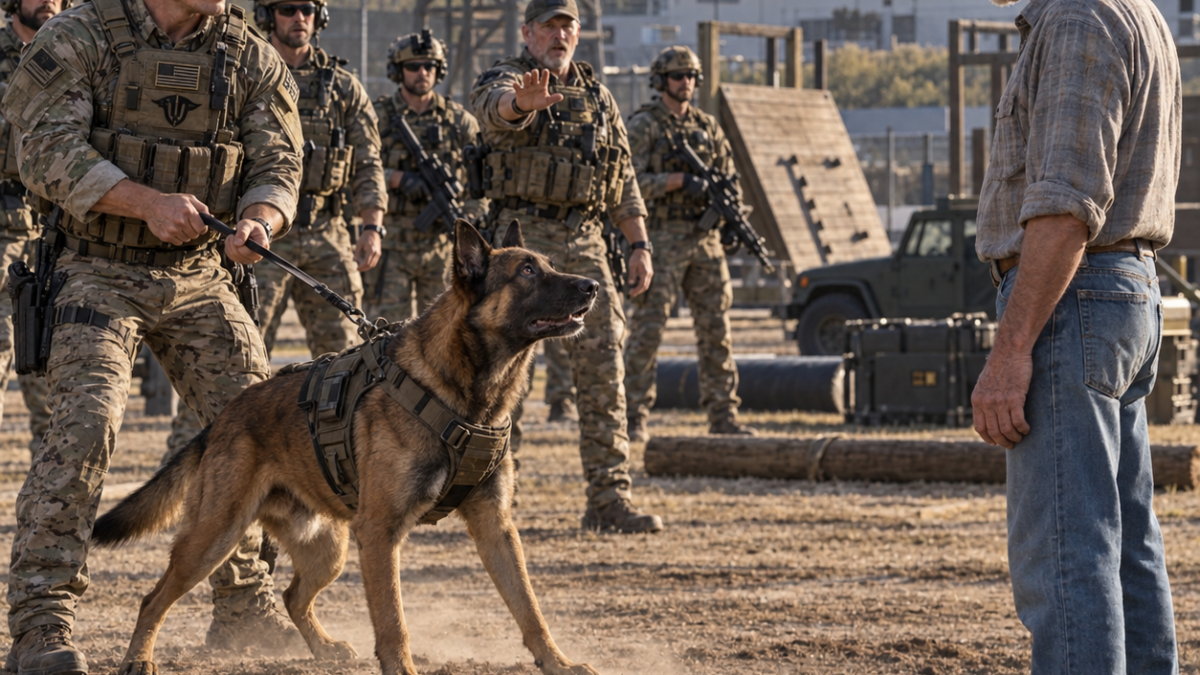
PART3:
Two operators moved forward instinctively.
Samuel sighed.
Very quietly.
He removed the hammer from his hand.
Placed it carefully on the canvas beside his tools.
Then began walking toward the training area.
One of the SEALs saw him first.
“Sir.”
Samuel continued.
“Sir, hold up.”
No response.
A second man stepped into his path.
“This is a live training lane.”
Samuel angled around him.
The operator’s eyebrows rose.
“Hey.”
Mason turned.
He saw the old contractor approaching and immediately became irritated.
“Stop right there.”
Samuel finally halted.
Twenty-five feet from Havoc.
The dog was still fighting the lead.
But not as violently.
His head had turned.
Samuel watched.
Havoc stared at him.
Not recognition.
Not yet.
Something closer to confusion.
Cole felt the change through the leash.
“Sir?”
Mason moved between the old man and the dog.
“You need to go back to the fence.”
Samuel ignored him.
His gaze remained fixed on Havoc.
Mason stepped closer.
“I’m not asking.”
Samuel lifted his eyes.
For the first time, Mason looked closely at the contractor.
Pale blue eyes.
Still.
Far too still.
No nervousness.
No attempt to appease an irritated commanding officer.
Mason had spent enough years evaluating men under pressure to recognize when someone’s heart rate was probably not matching the danger around him.
Something about Samuel’s calm bothered him.
“This animal is unstable,” Mason said.
Samuel glanced around Mason toward the Malinois.
“No.”
Mason blinked.
“Excuse me?”
“He’s scared.”
Cole looked down at Havoc.
Mason’s jaw tightened.
“Thank you for the diagnosis.”
Samuel nodded once.
“You’re welcome.”
A few of the men behind Mason looked away to hide reactions.
Mason folded his arms.
“Go back to your work.”
Samuel watched Havoc.
The dog’s panting had changed.
The frantic rhythm slowed by perhaps ten percent.
Barely enough to notice.
Samuel noticed.
“He got another name?”
Cole looked at Mason.
Mason said, “His designation is K9-7. Call sign Havoc.”
Samuel’s eyes remained on the dog.
“That’s not what I asked.”
Mason’s patience snapped.
“That is his name.”
Samuel’s face changed.
For one second.
Pain.
Then gone.
“No.”
The word was almost a whisper.
Havoc froze.
The change was so sudden Cole nearly stepped backward.
The Malinois stopped pulling.
His head rose.
His nose worked.
Samuel took one slow step.
Mason lifted a hand.
“That’s enough.”
Samuel stopped.
Havoc’s entire body began trembling.
Not like before.
Different.
His tail shifted.
Mason noticed.
So did Cole.
Samuel’s voice dropped.
“Ranger.”
The dog went completely still.
No panting.
No growling.
No movement.
Cole stared.
“What did you say?”
Samuel swallowed.
“Ranger.”
The Malinois made a sound no one on the field had heard from him before.
A low, broken whine.
His tail moved once.
Then again.
Cole slowly loosened his grip.
Ranger sat.
The lead went slack.
Every SEAL on the field became silent.
Samuel stepped closer.
Mason should have stopped him.
He knew that.
Later, he would ask himself why he did not.
Maybe because the dog was no longer looking at anyone else.
Maybe because something in Samuel’s face had changed too.
The old farmer did not seem old anymore.
He moved carefully.
Economically.
Balanced.
No wasted motion.
Davis—one of the senior handlers—noticed it before Mason did.
Samuel stopped six feet away.
He knelt.
Not with the stiff awkwardness of a man approaching seventy.
Smooth.
One knee down.
Hands visible.
No reaching.
No baby talk.
No exaggerated soothing sounds.
He simply waited.
Ranger stared.
Samuel whispered, “Hey, buddy.”
The dog’s ears pushed forward.
“You remember me?”
Ranger’s chest trembled.
Samuel’s eyes filled.
“Yeah.”
The dog surged forward.
Cole dropped the lead instinctively.
Mason tensed.
Three SEALs stepped forward.
Then stopped.
Ranger did not attack.
He crashed into Samuel’s chest.
The old man fell backward onto one hand.
The Malinois climbed over him.
Licking.
Whining.
Pressing his entire body into Samuel as though trying to erase every inch of separation between them.
Samuel wrapped both arms around the dog.
His shoulders shook.
“Easy.”
Ranger whined louder.
“I know.”
Samuel buried his face in the animal’s neck.
“I know.”
The training yard changed.
Minutes earlier, it had been a place of frustration.
Now grown men stood without speaking.
Cole slowly released the empty lead.
Mason approached.
Ranger lifted his head.
His body instantly shifted between Samuel and the commander.
A growl started.
Samuel placed one hand behind Ranger’s ear.
“Easy.”
The growl disappeared.
Mason stared.
No repeated command.
No correction.
No leash.
One word.
Trust.
Mason looked at Samuel.
“How?”
Samuel ran his fingers down Ranger’s shoulder.
Not petting.
Examining.
His thumb stopped over a scar buried beneath the coat.
Then another along the ribs.
He knew where they were.
Mason saw it.
“How do you know this dog?”
Samuel did not answer.
Cole said, “His file says Havoc.”
Samuel shook his head.
“Files say all kinds of things.”
“What is he?”
Samuel looked at Ranger.
“Ranger.”
Cole took a step nearer.
The dog watched but did not react.
“You said that was his name.”
“It is.”
“How would you know?”
Samuel’s hand rested on the dog’s shoulder.
“Because I named him.”
Silence.
Mason stared.
“You named him?”
Samuel stood.
Ranger rose with him and moved immediately to his left side.
Perfect heel position.
No cue.
Mason’s unease sharpened.
The old man had been repairing fence posts forty minutes earlier.
Now an unstable Tier One working dog was glued to him like a shadow.
“What is your full name?”
Samuel’s expression closed.
“Samuel.”
“Last name.”
“Folks around here don’t usually need it.”
“I do.”
Samuel looked toward the gate.
“I think Ranger’s had enough.”
Mason stepped into his path.
“You are not walking off this range with a government working dog.”
Samuel met his eyes.
“He’s not going back to that kennel.”
“He belongs to the United States Navy.”
Samuel’s jaw moved.
“No.”
Mason’s voice hardened.
“He is military property.”
Samuel stared at him for several seconds.
Then looked down at Ranger.
When he spoke again, his voice was softer.
“That right there is why you couldn’t reach him.”
Mason felt the insult.
“What?”
“You keep calling him property.”
Samuel looked back.
“He isn’t a rifle.”
“He is a trained operational asset.”
“He’s a soldier.”
“Dogs are not soldiers.”
Samuel’s eyes became cold.
“Tell him.”
Mason glanced down.
Ranger watched him.
Samuel continued.
“Tell him all the times he went through doors first don’t count.”
No one moved.
“Tell him all the nights he slept beside men carrying rifles were just inventory hours.”
Mason’s expression changed.
Samuel touched Ranger’s neck.
“Tell him the blood he left somewhere you won’t put on a map belonged to property.”
Cole lowered his eyes.
Mason said quietly, “You served.”
Samuel smiled without humor.
“I fix fences.”
“Bullshit.”
Ranger’s ears lifted at Mason’s tone.
Samuel calmed him with one touch.
Mason noticed.
He called over his shoulder.
“Chief Carter.”
Senior Chief Noah Carter stepped forward.
“Sir.”
“I want the full file on K9-7.”
“Yes, sir.”
“Every transfer.”
“Yes, sir.”
“Veterinary history.”
“Yes, sir.”
“Previous handlers.”
Carter hesitated.
“There’s nothing listed before current acquisition.”
“Then find what isn’t listed.”
Mason looked at Samuel.
“And find out who he is.”
Samuel’s expression changed slightly.
Not fear.
Resignation.
Mason saw it.
That confirmed everything.
Samuel turned.
“Come on, Ranger.”
The dog followed.
Mason stepped forward.
“Where are you going?”
“Home.”
“You can’t—”
Samuel stopped.
He looked tired suddenly.
Not old.
Tired.
“Commander.”
Mason waited.
“If you put him back in that kennel today, he will tear himself apart trying to get out.”
Mason looked at Ranger.
The dog leaned against Samuel’s knee.
“I’ll stay on base property until you figure out what paperwork makes you comfortable.”
Mason crossed his arms.
“That sounds reasonable.”
“I wasn’t finished.”
Mason almost smiled despite himself.
Samuel pointed beyond the fence.
“My house is three minutes from your south gate.”
“You live there?”
“Have for two years.”
“You’re taking him?”
“I’m asking you whether you want him sleeping tonight or chewing through another steel door.”
Mason turned to Cole.
“How bad are nights?”
Cole hesitated.
“He paces.”
“How long?”
“Most of it.”
“Sleep?”
“Two hours. Maybe three.”
Samuel stared at Mason.
The commander sighed.
“This is temporary.”
“Everything is.”
Ranger left the training yard beside Samuel.
Mason watched them walk.
One old man.
One dog.
No leash.
Perfect synchronization.
Carter appeared beside him.
“Sir.”
“Tell me that makes sense.”
“It doesn’t.”
“Good.”
Mason looked toward the command building.
“Find the sense.”
The official file contained almost none.
K9-7.
Belgian Malinois.
Male.
Acquisition program details.
Exceptional evaluation metrics.
Explosive detection.
Tracking.
Apprehension.
A long string of excellent physical scores.
Then behavioral problems.
Failed pairing with four Navy handlers.
Increasing anxiety.
Resistance.
Sleep disturbances.
Aggression under restraint.
Mason flipped pages.
“This is garbage.”
Carter stood beside him.
“It’s what we have.”
“This dog reacted to a name that isn’t written anywhere.”
“Yes, sir.”
“He followed a maintenance contractor off the field without a leash.”
“Yes, sir.”
“Find before.”
Carter pointed to a transfer number near the bottom.
“Here.”
“What?”
“Source organization.”
“Army?”
“Looks like it.”
Mason frowned.
“Why Army?”
“Working dogs move between programs.”
“Keep going.”
Carter enlarged the scanned form.
A section had been blacked out.
Not ordinary privacy redaction.
Classification.
Mason leaned forward.
“Medical transfer?”
Carter nodded.
“Originated Landstuhl.”
Mason looked up.
“Germany.”
“Yes.”
Landstuhl Regional Medical Center.
The place where America’s badly wounded often passed on their way home.
Mason’s stomach tightened.
“This dog didn’t come from another training pipeline.”
“No, sir.”
“He came out of a combat evacuation chain.”
Carter said nothing.
Mason continued reading.
Scar tissue.
Healed left-side rib fractures.
Previous penetrating injuries.
No accompanying operational incident summary.
One notation:
FORMER HANDLER STATUS — RESTRICTED.
Mason leaned back.
“Find Samuel.”
Carter had already started.
At first, he found exactly what anyone would expect.
Samuel Keen.
Sixty-eight.
Property records.
Small agricultural parcel adjacent to the base.
Contract work.
Feed supplier account.
Truck registration.
Taxes.
Nothing military.
“That’s too clean,” Mason said.
Carter nodded.
“No high school?”
“Not digital.”
“Birth?”
“West Virginia.”
“Social Security?”
“Valid.”
“Veteran status?”
Carter’s fingers stopped.
“Blank.”
Mason leaned forward.
“Blank?”
“Not no.”
“Blank.”
“Yes.”
“That’s not normal.”
“No, sir.”
Carter tried another database.
Access denied.
Another.
No result.
Another.
Then a warning appeared.
The computer required credentials above Carter’s level.
Mason tried his.
Denied.
He stared at the screen.
“A handyman has a personnel firewall higher than mine?”
Carter said quietly, “Apparently.”
Mason stood.
“Request access.”
“Through?”
“Flag.”
Carter grimaced.
“That’ll make noise.”
“Good.”
It did.
At 11:38 that night Mason’s secure phone rang.
He answered from his office.
“Commander Mason.”
A male voice responded.
Older.
“Stop.”
Mason frowned.
“Identify yourself.”
“No.”
“That’s not how this works.”
The man chuckled.
“Son, the fact that I’m calling this phone without identifying myself should tell you exactly how this works.”
Mason’s jaw tightened.
“Who are you?”
“Someone asking you to leave Samuel Keen alone.”
“So that is his name.”
Silence.
Mason smiled slightly.
“Thank you.”
The voice sighed.
“You’re persistent.”
“I’m a SEAL.”
“So was he.”
Mason stopped.
The room seemed to change temperature.
“Samuel Keen was a SEAL?”
The caller paused.
“I did not say that.”
“You said so was he.”
“I said too much.”
Mason moved toward the desk.
“What unit?”
“No.”
“Why does K9-7 recognize him?”
“You already know.”
“Was Keen his handler?”
Silence.
Mason’s pulse accelerated.
“He was.”
The voice became firmer.
“Commander, listen carefully. You stumbled into history that has been intentionally buried.”
“Why?”
“For survival.”
“Whose?”
“Keen’s.”
Mason looked at the redacted dog file.
“And the dog?”
A longer silence.
“The dog was supposed to be dead.”
Mason’s grip tightened on the phone.
“What?”
“You didn’t hear that from me.”
“Someone told Keen the dog died?”
“Yes.”
“Who?”
“People trying to protect what was left.”
Mason stood motionless.
“Protect him from what?”
“That is the question you are not cleared to ask.”
“What happened to his team?”
“Stop.”
“I need to know whether there is a security threat on my installation.”
“No current threat.”
“How do I know?”
“Because if there were, you wouldn’t be having this conversation.”
Mason hated answers like that.
The caller continued.
“The dog belongs with Keen.”
“Legally?”
“Make it legal.”
Mason almost laughed.
“You’re telling me to retire a multi-million-dollar canine based on an anonymous phone call.”
“No.”
The man’s voice softened.
“I’m telling you that dog already retired himself eighteen months ago.”
Mason looked through his dark office window.
“What was his name?”
The caller understood.
“Ranger.”
Then the line went dead.
At dawn, Mason drove toward the southern property boundary.
Samuel’s farmhouse sat at the end of a gravel lane bordered by Virginia pine and old pasture.
A red barn leaned slightly behind it.
The green Ford was parked outside.
Mason got out.
Ranger appeared in the barn doorway.
No barking.
He stood.
Watched.
A growl began.
Samuel’s voice came from inside.
“Enough.”
The growl stopped.
Mason entered slowly.
Samuel sat on a stool repairing an old leather harness.
Ranger moved beside him.
“Commander.”
“Keen.”
Samuel’s hands stopped for half a second.
Then resumed stitching.
“So they found that.”
“Someone found me.”
“Different thing.”
“I was ordered to stop digging.”
Samuel nodded.
“Good advice.”
“I’m ignoring it.”
“Bad habit.”
“I have several.”
Samuel cut the thread.
Mason looked around the barn.
Old tools.
Saddles.
Feed bins.
Nothing unusual.
Then he saw an open footlocker.
Photograph inside.
Mason stepped toward it.
Samuel closed the lid with his boot.
“That’s private.”
Mason stopped.
“Ranger was your dog.”
Samuel looked down.
“Yes.”
“How long?”
“Three years.”
“What unit?”
“No.”
“Where?”
“No.”
“Why was his identity erased?”
Samuel looked at Mason.
“You came here to understand the dog?”
“Yes.”
“Then stop asking about the unit.”
Mason exhaled.
“Fine.”
Samuel set the harness aside.
“What happened?”
His eyes went distant.
Not theatrically.
Genuinely.
Mason knew the look.
He had seen men disappear behind their own faces.
“Bad intelligence.”
Samuel’s voice lowered.
“Ridgeline.”
Ranger moved closer.
“Supposed to be empty.”
He rubbed the dog’s neck.
“Wasn’t.”
Mason remained silent.
Samuel continued.
“We walked into an ambush.”
“How many?”
“Enough.”
“Your team?”
A muscle moved near Samuel’s jaw.
“Gone.”
“All?”
Samuel looked at Ranger.
“Almost.”
Mason understood.
“You two survived.”
“Barely.”
Samuel lifted his shirt slightly.
Scars crossed his left side.
Old.
Deep.
“Rounds?”
“Some.”
“Shrapnel?”
“Some.”
He lowered the shirt.
“Ranger took worse.”
Mason looked at the scars beneath the dog’s fur.
“You were evacuated together?”
“No.”
Samuel’s eyes closed briefly.
“That’s where it went wrong.”
“What happened?”
“I was unconscious.”
Ranger rested his head against Samuel’s thigh.
“When I woke at Landstuhl, I asked for him.”
Samuel swallowed.
“They told me Ranger died during extraction.”
Mason stared.
Samuel looked down at the dog.
“I believed them.”
“Why?”
“Because sometimes people die.”
The simple answer carried enormous weight.
“They told me my team was dead.”
Samuel’s hand shook once.
“My dog was dead.”
He looked toward the open barn door.
“They gave me choices.”
“Retire?”
“Disappear.”
Mason said nothing.
Samuel smiled bitterly.
“Some of what we were doing had created enemies with long memories.”
“So Samuel Keen is not your birth name.”
The old man looked at him.
“Don’t ask.”
Mason nodded.
Samuel continued.
“I came here because this farm was quiet. Did contract work because sitting still makes a man crazy.”
He looked at Ranger.
“For eighteen months I grieved him.”
Mason whispered, “And he grieved you.”
Samuel’s face cracked.
“Yeah.”
For several seconds the barn was silent.
Then Mason said, “Why did they tell you he was dead?”
Samuel’s eyes sharpened.
“Protection, probably.”
“From whom?”
“Maybe themselves.”
Mason waited.
Samuel exhaled.
“Ranger was wounded. Bad.”
He stroked the dog.
“He would’ve gone through rehab while I was unconscious.”
“Then someone decided he was still operationally valuable.”
“Likely.”
“They renamed him.”
“Easier to move hardware if the serial number changes.”
Mason winced.
Samuel noticed.
“Now you understand why I don’t like asset.”
Mason nodded.
“They tried pairing him.”
“With strangers.”
“He failed every time.”
Samuel looked toward Ranger.
“No.”
Mason frowned.
Samuel said, “They failed every time.”
“Explain.”
“Ranger was trained to bond with one handler at a depth you can’t put on your little evaluation form.”
Mason almost objected.
Samuel raised a hand.
“I’m not insulting your program.”
“You sound like you are.”
“I’m insulting whoever thought they could erase three years from his head and start over because a folder changed.”
Mason looked at Ranger.
“So when we called him Havoc…”
“He had no idea who you meant.”
“We trained recall.”
“You trained a new sound.”
“We gave commands.”
“To a dog who woke up injured, lost the scent of his entire team, lost me, got moved across an ocean, and then had strangers putting pressure on him.”
Samuel shook his head.
“He wasn’t refusing the mission.”
“He was waiting for the old one.”
“Yes.”
Mason breathed slowly.
“What happened yesterday when you said Ranger?”
Samuel looked down.
“He came home.”
The commander had no response.
A door creaked from the house.
Ranger’s ears moved.
No panic.
Samuel noticed Mason watching.
“First night he slept six hours.”
Mason frowned.
“He hasn’t slept six hours straight since he arrived.”
“I know.”
“How?”
Samuel’s eyes held his.
“Because I didn’t either.”
Mason looked away.
That answer reached somewhere uncomfortable.
A few minutes later, Samuel opened the footlocker himself.
He removed the photograph.
Handed it over.
Mason looked.
Samuel.
Younger.
Maybe fifty.
Hard-bodied.
Beard.
Camouflage without visible insignia.
Rifle.
Mountain terrain behind him.
Ranger beside him.
Unscarred.
Alert.
The photograph had no date.
No location.
Mason turned it over.
One sentence was written on the back.
WE GO TOGETHER.
Mason looked up.
“Your motto?”
Samuel shook his head.
“Promise.”
“To him?”
“To all of them.”
The commander handed it back.
Samuel placed it carefully inside the trunk.
Mason said, “The Navy will retire him.”
Samuel stared.
“I got authorization.”
“How?”
“I was told to make it legal.”
Samuel almost laughed.
“Sounds like somebody.”
“Who?”
“Don’t ask.”
Mason smiled faintly.
“He comes to you.”
Samuel looked at Ranger.
For the first time that morning, the old man’s eyes shone.
“He already did.”
Mason hesitated.
“There’s another issue.”
“What?”
“My men.”
Samuel’s expression hardened.
“What about them?”
“They spent eighteen months thinking they were failing that dog.”
Samuel understood.
Especially Cole.
Young.
Driven.
Given one of the most prestigious canine assignments available.
Then humiliated repeatedly.
Dragged through dust.
Bitten once.
Unable to bond.
Samuel looked down.
“Bring him.”
“Cole?”
“Yes.”
That afternoon Cole arrived at the farm.
He looked uncomfortable without the training yard around him.
Ranger watched from the porch.
Cole stopped twenty feet away.
Samuel sat in a wooden chair.
“Come closer.”
Cole hesitated.
“He doesn’t like me.”
“He doesn’t know you.”
“He’s spent eight months with me.”
“Not the same.”
Cole approached.
Ranger stood.
Samuel placed two fingers against the dog’s shoulder.
“Easy.”
Cole stopped ten feet away.
Samuel looked at him.
“You angry?”
Cole stared.
“At the dog?”
“Yes.”
“No.”
Samuel waited.
Cole’s jaw tightened.
“Yes.”
“Good.”
The young handler looked surprised.
Samuel continued.
“Why?”
“I gave him everything.”
Ranger watched.
“I stayed nights when everyone else left.”
Cole swallowed.
“I got bit trying to keep him from hurting himself.”
Samuel nodded.
“I changed every technique they told me.”
His voice broke.
“And nothing mattered.”
Samuel looked at Ranger.
“Everything mattered.”
Cole laughed bitterly.
“He hated me.”
“No.”
“He attacked me twice.”
“He was terrified.”
“Same result when teeth are in your arm.”
Samuel almost smiled.
“Fair.”
Cole rubbed an old scar.
“I thought I wasn’t good enough.”
Samuel’s expression softened.
“There it is.”
Cole frowned.
“What?”
“The part you made about you.”
The words stung.
Samuel continued gently.
“Dog wasn’t grading you.”
Cole looked at Ranger.
“He was surviving.”
“Yeah.”
Samuel stood.
“Come here.”
Ranger stiffened.
Samuel spoke the name.
“Ranger.”
The dog looked up.
“This is Cole.”
Samuel touched his chest.
“Friend.”
Cole swallowed.
Ranger watched.
Samuel gestured.
“Turn around.”
“What?”
“Turn your back.”
“That seems like a bad idea.”
“It would be if he wanted to bite you.”
Cole looked at Mason, who stood near the barn.
Mason shrugged.
“You came for the lesson.”
Cole muttered something and turned.
Samuel crouched beside Ranger.
“Go.”
The dog approached.
Slowly.
Sniffed Cole’s boots.
Calves.
Hands hanging at his sides.
Cole remained rigid.
Ranger moved away.
Samuel said, “Again tomorrow.”
Cole turned.
“That’s it?”
“That’s plenty.”
Three days later Ranger took food from Cole.
One week later Cole touched his shoulder.
Two weeks later Ranger allowed him to clip on a leash.
Not because Cole became Ranger’s new handler.
He never did.
Because Ranger learned Cole was safe.
Cole learned that mattered more.
Official retirement paperwork came through twelve days later.
The ceremony was supposed to be administrative.
Mason changed it.
No press.
No public affairs.
No decorations.
Just the team.
The training yard looked different in the late-afternoon sun.
Ranger wore the original scarred leather harness Samuel had taken from his footlocker.
The younger handlers stared at it.
Old style.
Hand-modified.
Repairs stitched in three different thread colors.
Samuel stood beside him.
Mason stepped forward.
“K9-7, call sign Havoc, is formally retired from United States Navy service effective today.”
Samuel raised an eyebrow.
Mason sighed.
He looked at the paperwork.
“Correction.”
The team smiled.
“Military working dog Ranger is formally retired from United States service.”
Ranger’s ears lifted at his name.
Mason continued.
“Custody transferred to Samuel Keen.”
He lowered the papers.
Then looked at Samuel.
“Though I think everyone understands the custody question was settled before we caught up.”
A few men laughed.
Samuel smiled.
Cole stepped forward.
He knelt.
Not as a handler.
Just a man.
“Ranger.”
The dog looked at him.
Cole extended his hand.
Ranger sniffed.
Then licked his fingers once.
Cole’s eyes filled.
“Yeah.”
He stood quickly.
Mason approached Samuel.
“There’s something else.”
Samuel’s expression became suspicious.
“No.”
“You don’t know what I’m asking.”
“I’ve survived long enough to know when officers say there’s something else.”
The men laughed.
Mason smiled.
“We want you to consult.”
“No.”
“I knew you’d say that.”
“Then why ask?”
“Because you’re going to think about it.”
“No.”
“Canine integration.”
“No.”
“Handler education.”
“No.”
“Trauma recovery.”
Samuel paused.
Mason saw it.
So did Cole.
The commander continued.
“We almost destroyed that dog because nobody recognized what we were looking at.”
Samuel glanced down.
“You recognized it.”
“After you walked onto the field.”
Mason took one step closer.
“How many Rangers are we going to meet when the one person they trust doesn’t come home?”
Samuel said nothing.
“How many handlers are going to think they failed because the dog is grieving someone else?”
The old man’s face changed.
Mason pressed.
“I don’t need your classified history.”
“Good.”
“I don’t need war stories.”
“Better.”
“I need what you know about the bond.”
Samuel looked at the young men around him.
Some were twenty-five.
Twenty-eight.
Thirty.
Men with shoulders like athletes and eyes older than their faces.
He had once been one of them.
He looked at Ranger.
Then at Cole.
“What are you calling this?”
Mason smiled.
“Nothing yet.”
“Good.”
“Why?”
“Names create paperwork.”
Laughter.
Samuel sighed.
“One day.”
Mason nodded.
“Fine.”
“One.”
“Absolutely.”
Samuel pointed.
“You sound dishonest.”
“I’m an officer.”
“Same thing.”
The next morning Samuel returned.
With Ranger.
He found six handlers waiting.
And Captain Ava Rostova, the base veterinarian.
Samuel frowned.
“You multiplying?”
Mason smiled.
“One day.”
Samuel looked at a whiteboard.
Someone had written:
K9 TRAUMA / HANDLER BOND WORKSHOP
He shook his head.
“Erase trauma.”
Rostova frowned.
“Why?”
“Because you decide the diagnosis before meeting the dog.”
She crossed her arms.
“What would you write?”
Samuel picked up the marker.
He erased everything.
Then wrote:
WHAT HAPPENED?
He capped the marker.
“Start there.”
Rostova stared.
“That’s clinically vague.”
“Yes.”
“I need something measurable.”
“You’ll get there.”
She did not look convinced.
Samuel pointed toward a young Labrador in a side kennel.
“What’s his problem?”
Rostova answered immediately.
“Noise sensitivity, avoidance, refusal to load into vehicles after deployment.”
Samuel looked at her.
“What happened?”
“Deployment stress.”
“What happened?”
She frowned.
“He was exposed to an explosion.”
“With who?”
“Handler.”
“Handler alive?”
Rostova hesitated.
“Medically retired.”
“Dog see him afterward?”
“I don’t know.”
Samuel looked toward Mason.
“Find out.”
That became the first lesson.
Not obedience.
History.
They contacted the handler.
He had lost his lower leg in the explosion.
The dog had been removed during emergency treatment and never saw him again.
Three weeks later, with medical approval, the handler visited.
The Labrador crossed the room and nearly knocked him from his prosthetic.
Rostova cried.
Samuel pretended not to notice.
The workshop became another.
Then another.
Samuel argued with veterinarians.
Handlers.
Psychologists.
Commanders.
He rejected the idea that experience replaced science.
That surprised everyone.
“Medicine works,” he told them.
“Behavioral science works.”
Then he tapped the table.
“But science gets stupid when pride makes it stop asking questions.”
Captain Rostova leaned back.
“And experience gets stupid when old men think anecdotes are data.”
Samuel stared.
Then smiled.
“Now we’re learning.”
They became unlikely friends.
Rostova brought current research.
Samuel brought forty years of observations.
The handlers brought field experience.
The program evolved.
One principle became central.
The bond itself could be injured.
Not metaphorically.
Functionally.
A dog trained to regulate its entire nervous system around one human could destabilize when that human vanished.
Repeated reassignment without resolving that loss could make the instability worse.
Ranger had been the extreme example.
He had not forgotten commands.
He had lost context.
Every stranger telling “Havoc” what to do simply reinforced the fact that his actual world had disappeared.
Six months passed.
Ranger changed too.
At Samuel’s farm, he learned useless things.
Good things.
He chased rabbits unsuccessfully.
Barked at the mail truck.
Slept on a porch in sunlight.
Rolled in something dead once and was banned from the house for forty-five minutes.
Samuel surrendered after twenty.
Ranger became obsessed with an old tennis ball.
A dog trained to detect explosives through concrete apparently could not understand why a ball rolled under a couch.
Samuel watched him paw furiously beneath it.
“You’ve found weapons on three continents.”
Ranger whined.
“The ball is six inches from your nose.”
The dog looked offended.
Samuel got it for him.
At night, things remained harder.
Sometimes Ranger woke snarling.
Sometimes Samuel did.
One winter night, Samuel came awake reaching toward a nightstand.
No weapon sat there.
He had stopped keeping one beside the bed.
Ranger stood beside him.
Samuel breathed.
“Ridge.”
The memory came.
Rocks.
Dust.
Radio call.
Men down.
Ranger bleeding.
Samuel pressed his hands over his face.
The dog climbed halfway onto the bed despite being specifically forbidden from doing so.
Samuel felt the weight against his chest.
“You remember too.”
Ranger rested his head there.
For years Samuel believed he had failed him.
He could still hear himself calling Ranger after the blast.
Could remember trying to crawl.
Could remember hands pulling him onto the evacuation aircraft.
“Dog!”
He had screamed.
“My dog!”
Then darkness.
At Landstuhl, a colonel told him Ranger died.
Samuel had not asked to see the body.
That haunted him.
Why had he not demanded proof?
Because he was broken.
Drugged.
Grieving seven other people.
Because authority had told him the truth.
Because even warriors sometimes trusted the wrong sentence when they no longer had strength to question it.
Now the dog lay beside him.
Alive.
Older.
Scarred.
Samuel touched his shoulder.
“They stole eighteen months.”
Ranger breathed.
Samuel closed his eyes.
“But they didn’t get the rest.”
The classified truth emerged slowly.
Not publicly.
Not officially.
Samuel never asked.
Mason learned enough.
The same unnamed official eventually met him in person during a Washington visit.
Rear Admiral Thomas Vale.
Retired, though not nearly as disconnected as retirement suggested.
“You’re the voice,” Mason said.
Vale smiled.
“I have several.”
They sat in a secure office.
Mason placed Ranger’s old file on the table.
“Who changed his identity?”
Vale’s smile disappeared.
“We did.”
“Why?”
“Because Keen’s unit was compromised.”
“Enemies?”
“Yes.”
“They knew the dog?”
“Possibly.”
“So you hid both.”
“That was the intention.”
“You told Keen Ranger died.”
Vale looked tired.
“I didn’t.”
“Who?”
“Medical chain made a decision.”
“Bad one.”
“Yes.”
Mason was surprised by the answer.
Vale continued.
“Ranger’s condition deteriorated during rehabilitation.”
“So someone transferred him.”
“The thought was he might recover with another program.”
“Without telling Keen.”
“Keen was under protective relocation.”
“Still.”
Vale looked at him.
“We made mistakes.”
Mason leaned back.
“Men like you rarely say that.”
“Men like me get old.”
Silence.
Vale continued.
“Sometimes age is useful.”
“Ranger almost got destroyed.”
“I know.”
“Keen almost spent the rest of his life believing his partner died.”
“I know.”
Mason’s jaw tightened.
Vale said quietly, “Protection without humanity can become another kind of damage.”
Mason looked at him.
“Tell him.”
Vale shook his head.
“No.”
“Why?”
“Because he doesn’t need my apology.”
“That should be his decision.”
Vale became still.
Mason realized he had repeated Samuel’s own philosophy back at the admiral.
The older man noticed too.
Vale sighed.
“Give me the address.”
Three weeks later, a black government sedan arrived at Samuel’s farm.
Ranger barked once.
Samuel stepped onto the porch.
Vale emerged.
Samuel stared.
“Thomas.”
Vale stopped.
“Sam.”
For several seconds, neither moved.
Then Samuel walked down the stairs.
Ranger followed.
Vale looked at the dog.
His eyes filled.
“My God.”
Samuel’s voice was flat.
“You knew.”
Vale looked at him.
“Not until later.”
“You knew he survived.”
“Months afterward.”
“And you didn’t tell me.”
“You were buried.”
“I was alive.”
“We thought contact could compromise you.”
Samuel laughed once.
“You thought.”
Vale lowered his head.
“Yes.”
Ranger moved between them.
Samuel placed his hand on the dog.
“You know what he thought for eighteen months?”
Vale swallowed.
“No.”
“Neither did anybody else.”
Samuel’s anger sharpened.
“You people looked at him and saw a reusable resource.”
“That wasn’t my decision.”
“But you knew.”
“Yes.”
“Then it became yours.”
Vale absorbed that.
“I’m sorry.”
Samuel stared.
No immediate forgiveness.
No dramatic reconciliation.
“I believe you.”
Vale looked up.
Samuel continued.
“That doesn’t make it okay.”
“I know.”
“Good.”
They stood in winter sunlight.
Then Samuel said, “Coffee?”
Vale almost smiled.
“I’d like that.”
It was not forgiveness.
It was a beginning.
Years passed.
The small canine trauma workshop became a permanent reintegration program.
Official documents gave it an impressive name nobody used.
Handlers called it Ranger House.
Samuel objected.
Nobody cared.
He taught less as age slowed him.
Cole eventually became one of the senior instructors.
On his first day teaching new handlers, he wrote two words on the board.
WHAT HAPPENED?
Samuel sat in the rear pretending not to be proud.
Ranger slept beside his boots.
After class Cole approached.
“Well?”
Samuel frowned.
“Too much talking.”
Cole laughed.
“You talked for six hours my first day.”
“Exactly. Learn from my mistakes.”
Captain Rostova published studies influenced by the program.
One paper described attachment-centered rehabilitation strategies for military working dogs following handler loss.
Samuel read two pages.
Closed it.
“What language is this?”
“Science.”
“Looks like a hostage note.”
She smiled.
“You’re acknowledged.”
“Remove me.”
“No.”
“Everybody around here violates consent.”
Rostova laughed.
Ranger lifted his head.
Samuel scratched behind his ear.
“You see what I deal with?”
The dog yawned.
At seventy-four, Samuel finally stopped contract work on the base.
His knees made ladders unwise.
Mason—now a captain—came to the farm on Samuel’s last official day.
Ranger’s muzzle had turned gray.
The once-explosive Malinois walked more slowly.
Mason sat on the porch.
“You know, the first time I saw you, I thought you were an old fool walking toward a dangerous dog.”
Samuel drank coffee.
“You were half right.”
“Which half?”
“Old.”
Mason smiled.
They watched Ranger sleep.
“Do you miss it?” Mason asked.
“What?”
“The work.”
Samuel understood.
The classified work.
The operations.
The identity before Samuel Keen.
“No.”
Mason seemed surprised.
Samuel looked toward the valley.
“I miss people.”
He took another drink.
“Different thing.”
Mason nodded.
“I understand.”
Samuel looked at him.
“You will more when you’re old.”
“Thanks.”
“You’re welcome.”
Ranger’s breathing had become heavier that year.
Arthritis.
Old shrapnel scars.
Age.
Nothing dramatic.
Nothing unfair.
Simply time.
Samuel hated it anyway.
The veterinarian told him Ranger might have another year.
He got eight months.
The final week was quiet.
Ranger stopped chasing the tennis ball.
Then stopped climbing the porch steps without help.
Samuel built a short ramp.
The dog looked at it suspiciously.
“You’ve jumped from helicopters.”
Ranger stared.
“It’s a plank.”
Still staring.
Samuel sighed and walked up it himself.
“See?”
Ranger followed.
“Ridiculous animal.”
On the last morning, Samuel carried a blanket into the pasture.
Spring grass had begun appearing.
He sat beneath an oak.
Ranger lowered himself beside him.
Samuel had brought the old photograph.
The one from the mountains.
He held it.
Young man.
Young dog.
Neither knowing what waited.
“You remember that?”
Ranger’s eyes stayed half closed.
Samuel smiled.
“I hated that place.”
Wind moved through the grass.
“Loved you.”
He rested a hand on Ranger’s chest.
“You saved me.”
The dog breathed slowly.
“Twice.”
Samuel’s voice cracked.
“First time on that ridge.”
He swallowed.
“Second time on that training field.”
Ranger opened his eyes.
Samuel smiled through tears.
“I was alive before you found me.”
He looked toward the mountains.
“But that isn’t the same as living.”
The dog shifted his head onto Samuel’s leg.
They stayed like that for hours.
When Ranger died, he did not die in a military kennel.
He did not die beneath fluorescent lights.
No unfamiliar hands held him.
No one called him K9-7.
No one called him Havoc.
Samuel held his head.
Whispered the name that had brought him back eighteen months earlier.
“Ranger.”
The dog breathed once.
Then again.
Samuel bent over him.
“You can go.”
One last breath.
“You found me.”
Silence.
“I won’t lose you again.”
Ranger died beneath the old oak.
Samuel buried him beside the barn.
Cole came.
Rostova.
Mason.
Several handlers.
Even Admiral Vale.
No uniforms were required.
Samuel placed the old leather harness in the grave.
Then changed his mind.
He pulled it back out.
Mason looked at him.
Samuel said, “Program needs it.”
Months later, Ranger’s harness was mounted inside the entrance of Ranger House.
Beneath it was no list of classified missions.
No kill count.
No financial value.
No description of operational capabilities.
Only a small plaque.
RANGER
PARTNER
SURVIVOR
HE REMEMBERED WHO HE WAS
New handlers often asked why that last line mattered.
Cole told them the story.
Not all of it.
Some parts still belonged to Samuel.
He told them about a dog everybody called Havoc.
About failed pairings.
About panic mistaken for disobedience.
About an old contractor who stepped away from a broken fence.
And about one word.
Ranger.
“The lesson,” Cole would say, “isn’t that you need some magical command.”
He would look at the young handlers.
“The lesson is that behavior has a history.”
He tapped the board.
WHAT HAPPENED?
“If you don’t understand that history, you can spend months punishing an animal for surviving something you never bothered to learn about.”
Then he pointed toward the harness.
“And sometimes loyalty looks exactly like dysfunction when the person looking at it only understands obedience.”
Samuel occasionally attended classes.
He always sat in the back.
Farm clothes.
Old boots.
Feed-store cap.
New handlers rarely knew who he was.
Once, a young SEAL whispered to another, “Who’s the farmer?”
Cole heard.
He smiled.
“Ask him.”
The young SEAL approached during break.
“Sir, were you Ranger’s owner?”
Samuel looked up.
“No.”
The young man seemed confused.
“Handler?”
Samuel considered.
“Once.”
“What was he like?”
Samuel looked toward the old harness.
He could have told him Ranger was fast.
Brave.
Precise.
He could have described firefights.
Tracking.
The ridgeline.
Blood.
He could have talked about sacrifice.
Instead he smiled.
“Terrible with tennis balls.”
The SEAL laughed.
Samuel did too.
That was how he preferred to remember him.
Not as a weapon.
Not as a classified asset.
Not as the dog who saved his life.
As Ranger.
The animal who snored near the fireplace.
Stole bacon.
Hated ramps.
Loved an orange tennis ball.
And somehow remembered one old man after the entire military bureaucracy had tried to convince both of them that the other was gone.
People later told the story as though the miracle happened when Samuel stepped onto the training field and spoke a name.
Samuel never agreed.
The miracle happened before that.
It happened during eighteen months of confusion when Ranger kept searching.
It happened when the dog refused to surrender the memory of the person he trusted, even while strangers renamed him, relocated him, restrained him, evaluated him, and called his grief instability.
It happened when Samuel survived long enough to repair a fence on exactly the wrong—or right—training field.
And it happened afterward, when a group of elite warriors had enough humility to admit that all their strength, technology, money, and training had missed something an old farmer saw almost immediately.
Ranger was not asking for stronger commands.
He was asking one question.
Where is my partner?
For eighteen months, nobody understood the question.
Then Samuel answered it simply by walking forward.
The dog heard his real name.
Saw the man he had never stopped waiting for.
And for the first time since a bloody ridgeline half a world away, Ranger finally understood that he had completed the only mission that mattered.
He had found his way home.








