For Six Months, a Retired K9 Snarled at Every Officer Who Came Near—Then One Morning He Suddenly Went Silent and Stared Toward a Plane Carrying Someone No One Expected
PART3:
Brutus almost tore the helicopter door off its hinges trying to get back to him.
When the bird landed at the forward operating base, Wyatt was not on it.
The official status became missing in action.
But everyone knew the valley.
Everyone knew the odds.
Being left behind in those mountains meant only one thing.
Something broke inside Brutus that night.
He refused to leave the tarmac.
For two days, he sat on the concrete facing the sky, eyes fixed on the direction of incoming aircraft. He did not eat. He barely drank. Every time rotors sounded in the distance, he rose. Every time the aircraft was not Wyatt’s, he sat down again.
When they finally forced him into transport back to Little Creek, the grief changed shape.
By the time he reached the kennels, sorrow had become war.
He bit through a padded glove and sent one handler to the ER with tendon damage. He snapped a titanium choke chain. He pinned a heavily armored training officer to the floor and held him there, growling but not biting, until three men dragged the officer out by his boots. He stopped responding to commands in English. Then German. Then Dutch. Then even the low whistle Wyatt had used when Brutus was young.
He trusted no one in uniform.
Not because he had forgotten training.
Because the last people in uniform had taken him away while Wyatt stayed behind.
Miller understood that.
Understanding did not open Kennel Four.
That afternoon, Captain Alan Henderson came into the kennel office with a manila folder in one hand and exhaustion pulled tight around his mouth.
Henderson was a pragmatist. A base, to him, was a living machine. Personnel, schedules, fuel, weapons, animals, transport, discipline. Everything had to function. Anything that could not function became a problem. Anything dangerous became a liability.
Miller stood when he entered.
“Status report on the O’Connor dog.”
Miller hated that phrase.
The O’Connor dog.
As if Brutus had stopped being himself the moment Wyatt vanished.
“No change, sir,” Miller said. “He’s still refusing handlers. Extreme defensive aggression within six feet. Won’t submit to leash. Won’t allow muzzle. Won’t respond to recall.”
Henderson dropped the folder on the desk.
“We’re out of time.”
“Sir, he’s grieving.”
“He bit Specialist Hayes yesterday through the fence.”
“She reached too fast.”
“She is a veterinary technician.”
“She made a mistake.”
Henderson’s jaw tightened. “That dog has put two men in medical care and nearly killed a training officer.”
“He didn’t kill him.”
“Do not split hairs with me, Sergeant.”
Miller shut his mouth.
Henderson rubbed the bridge of his nose. For one moment, he looked less like a cold commander and more like a tired man who hated the next words but intended to say them anyway.
“The veterinary board reviewed his file.”
Miller looked down at the folder.
He already knew.
Something in his body had known before Henderson came in.
“No,” Miller said.
“Forty-eight hours.”
“Sir—”
“If Brutus cannot complete a basic obedience walk and submit to a new handler by Friday morning, he will be euthanized.”
Miller felt the room narrow.
The hum of the lights got louder.
“He served this country.”
“I know.”
“He saved twelve Marines in Helmand. He found the IED under that culvert before the convoy hit it. He pulled Reed out when the east wall came down in Mosul.”
“I know.”
“He lost Wyatt.”
Henderson’s face hardened, but his eyes did not.
“We all lost Wyatt.”
“No, sir,” Miller said quietly. “Not like Brutus did.”
For a second, Henderson looked as if he might answer with anger.
Instead, he picked up the folder.
“This is a formal notice. Forty-eight hours. If you can give me proof he can be safely handled, I will take it back to the board. If not, this ends Friday morning.”
He turned for the door.
Miller spoke before he could stop himself.
“And if Wyatt comes back?”
Henderson stopped.
The office went painfully still.
After a moment, he said, “Wyatt O’Connor has been missing for six months.”
“That’s not what I asked.”
Henderson did not turn around.
“If Wyatt comes back, Sergeant, I will personally apologize to the dog.”
Then he left.
The next forty-eight hours felt like a death watch.
The kennel staff moved quietly. Even the younger handlers who usually joked too much stood back from Kennel Four with their hands in their pockets and grief in their faces. Everyone knew Brutus’s record. Everyone had heard the stories. Everyone had seen the old footage of him and Wyatt moving through training courses like one organism split into two bodies.
Nobody wanted to be present Friday morning.
Nobody wanted to be absent either.
Specialist Lena Hayes lasted longer than most before desperation made her reckless.
She was twenty-six, a veterinary technician with a bruised arm from the day before and a soft spot for dogs no amount of military structure had beaten out of her. She found Miller in the sterile hallway outside the kennel block Thursday afternoon.
“What if we give him something of Wyatt’s?”
Miller looked at her.
“No.”
“You don’t even know what I’m going to say.”
“I know exactly what you’re going to say.”
“He needs scent.”
“He needs Wyatt.”
“We don’t have Wyatt.”
The words struck them both silent.
Hayes swallowed. “Maybe if he smells him, it grounds him. Breaks the defensive loop.”
“Or it makes it worse.”
“He’s being euthanized tomorrow.”
Miller closed his eyes.
That was the cruelty of desperation.
It made bad ideas look like doors.
“Wyatt’s locker was cleared months ago,” he said. “Everything went to his family.”
“Not everything.”
Miller opened his eyes.
Hayes looked down the corridor toward the gear storage room. “His secondary Kevlar vest. The one he used stateside. It got left in tactical gear. I saw it last week.”
“Washed?”
“No.”
Miller said nothing.
“It still smells like him,” Hayes whispered.
Twenty minutes later, they stood outside Kennel Four with Wyatt O’Connor’s old multicam vest folded in Miller’s arms.
It smelled faintly of gun oil, pine, sweat, dust, and something Miller could not identify but Brutus would know instantly.
Brutus lay in the far corner, head on his paws, eyes fixed on them.
Miller crouched.
“Brutus,” he said softly.
The dog’s ears flattened.
Miller slid the vest under the steel partition.
For one second, nothing happened.
Then Brutus froze.
His nostrils flared.
His whole body changed.
He stood slowly, trembling before he moved. One step. Then another. His head lowered toward the vest. His nose touched the fabric.
Miller held his breath.
Hayes pressed one hand to her mouth.
Brutus buried his muzzle into the Kevlar.
His eyes closed.
For three seconds, Miller saw the dog he remembered.
Not safe.
Not healed.
But there.
Then Brutus realized Wyatt was not inside the scent.
Only absence was.
The dog threw his head back and released a sound Miller would never forget.
It was not a bark.
It was not a howl in the ordinary sense.
It was mourning pulled through a throat built for war.
High, broken, and terrible.
The sound echoed off the concrete walls and silenced every other dog in the block.
Then grief twisted.
Brutus seized the vest in his teeth and shook it violently, tearing fabric, ripping at straps, snarling as if the Kevlar itself had betrayed him. He spun toward the gate and slammed into it with such force the hinges screamed. Foam gathered at the corners of his mouth. His eyes burned through the mesh.
“Pull it back!” Hayes shouted. “Pull it back!”
Miller yanked the vest through the slot, heart hammering.
Brutus hit the gate again.
And again.
And again.
The whole facility erupted into barking.
Miller stumbled back, clutching the torn vest against his chest.
Hayes was crying.
He did not blame her.
“It’s over,” Miller whispered.
Brutus snarled so hard his whole body shook.
Miller looked at the Kevlar in his hands.
“We made it worse.”
Friday morning arrived wrapped in thick gray fog that rolled off the Atlantic and swallowed the edges of the base.
At 0800, Miller sat in his office staring at the syringe and vials on his desk.
Phenobarbital.
He knew the procedure. Every kennel master did, even if they prayed never to use it on a dog like Brutus.
Captain Henderson was due at 0900.
Miller had pulled Wyatt’s file that morning, though he could not explain why. Maybe he needed to look at the human cost before carrying out the military one. The photograph lay beside the vials now.
Wyatt O’Connor kneeling beside a younger Brutus.
Wyatt smiling.
Brutus alert, proud, leaning slightly into the handler’s knee.
Miller touched the edge of the photo with one finger.
“I’m sorry,” he said.
He did not know whether he meant it for Wyatt, Brutus, or himself.
Then the base alert klaxon shattered the silence.
Miller jolted to his feet.
The radio on his desk crackled.
“All available medical personnel report to the flight line. Code Red transport inbound. Prepare for immediate triage. Code Red transport inbound.”
Miller grabbed the radio.
Code Red transports were rare.
Usually they meant someone critical was coming in from a hot zone.
But there were no major operations taking place. Not that Miller knew of.
He stepped into the foggy morning.
The base had erupted into motion. Humvees and ambulances tore toward the airfield. Security vehicles cut across access roads. Medics ran with trauma bags bouncing against their hips.
“What’s going on?” Miller shouted to a passing logistics officer.
“Unscheduled C-17 from Ramstein,” the officer yelled back. “JOC pushed it through. Rumor says they recovered someone.”
Miller’s chest tightened.
No.
He killed the thought immediately.
Hope could be crueler than despair if it had no evidence behind it.
Wyatt had been gone six months.
No one survived six months in hostile mountains without supply lines, without support, hunted, wounded, alone.
No one.
Miller turned back toward the kennels.
He had a grim duty to perform.
As he approached Kennel Four, he expected to hear the familiar pacing. The claws on concrete. The low growl that started whenever boots entered the corridor.
Instead, the kennel block was silent.
Miller slowed.
A cold feeling moved through him.
He drew his sidearm slightly from habit, wondering if Brutus had escaped or injured himself.
He reached the gate and looked inside.
Brutus was not pacing.
He was standing in the exact center of the enclosure, rigid as stone.
His ears, usually pinned back in anger, stood straight up, swiveling like radar dishes. His body was tense, but not with aggression.
With anticipation.
He was staring past Miller.
Past the corridor.
Past the concrete wall that faced the eastern side of the base.
Toward the airfield.
“Brutus?” Miller whispered.
The dog did not even flick an ear toward him.
He took a deep, shuddering breath. His nostrils flared, testing air currents through the upper ventilation grates.
Then he began to whine.
Miller’s skin prickled.
He had not heard that sound in six months.
It was not territorial. Not warning. Not rage.
It was desperate.
Brutus moved to the far wall and scratched at the concrete, claws scraping until blood streaked beneath them. He wanted out.
Not to attack.
To run.
“He knows something,” Miller whispered.
The heavy roar of a massive aircraft engine shook the ground.
Through the fog, somewhere beyond the kennels, a C-17 Globemaster was dropping toward the runway like a steel leviathan.
Brutus backed away from the wall and threw himself against the gate.
Not snapping.
Not biting.
Pushing.
Crying.
Trying to open the world by force.
Captain Henderson entered the kennel block in a pristine uniform and a somber expression.
He saw Brutus at the gate and frowned.
“Sergeant Miller, I see the animal is still agitated. Do you have the necessary—”
“Sir,” Miller interrupted.
It was a breach of protocol.
He did not care.
“Look at him.”
Henderson stopped.
Brutus pressed his entire body into the gate, eyes fixed toward the airfield. His tail was tucked, not in fear, but quivering with electric energy. His ears tracked the distant engine. His nose worked frantically.
“He’s not looking at us,” Miller said.
Henderson’s radio beeped.
He unclipped it.
“Command, this is Tower. Flight Four Alpha is wheels down. Triage teams moving to intercept VIP.”
Miller stepped closer to Henderson.
“Who’s on that plane?”
Henderson did not answer.
“Captain. Who is on that plane?”
Henderson slowly lowered the radio.
His face had gone pale.
“The manifest is classified.”
Brutus barked.
Once.
A deep, deafening, echoing command bark that tore through the kennel block.
Miller knew that bark.
Every handler on the base knew that bark.
Brutus used to give it when a mission objective was complete.
The monster of Kennel Four was gone.
The soldier was back.
And he was demanding to be let out.
Miller did not wait for Captain Henderson to issue an order.
He grabbed the heavy leather lead from the wall hook and opened the steel gate.
For the first time in six months, he did not brace himself.
Brutus did not lunge at him.
Did not snarl.
Did not bite.
The massive German Shepherd pushed past him, trembling so violently his collar shook, and shoved his own head toward the tactical lead.
Miller clipped the carabiner with shaking hands.
“Sergeant, what the hell are you doing?” Henderson demanded.
“With respect, sir,” Miller said, barely able to hold the leash as Brutus dragged him down the corridor, “he is not a threat right now.”
“That animal is a certified lethal risk.”
“No, sir. He’s a soldier who just realized his commanding officer is home.”
Miller reached the door.
“Court-martial me tomorrow if you have to. I’m taking him to the flight line.”
Henderson stared at the dog.
At the animal that had terrorized his base for half a year.
At the creature now whining like a lost puppy.
Something shifted in his face.
“Get in my transport,” Henderson snapped. “We drive. If he loses control on that tarmac, Miller, I will shoot him myself. Understood?”
Miller met his eyes.
“Understood, sir.”
The drive took less than three minutes.
It felt endless.
Brutus was practically climbing over the seats, nose pressed flat against the reinforced windshield, breath fogging the glass. His eyes were locked on the gray silhouette of the C-17 taxiing through the fog.
Outside, the airfield was controlled chaos.
Ambulances from Naval Medical Center Portsmouth waited with lights flashing, red and white strobes cutting through the morning mist. Armed military police held a wide security perimeter. Trauma surgeons stood near the rear of the aircraft with a mobile stretcher.
Word had already spread through command channels.
A ghost had been recovered.
Henderson slammed the SUV into park near the security cordon.
Before the vehicle had fully settled, Miller opened the rear door.
Brutus launched out.
He hit the wet concrete hard and struck the end of the leash with so much force that Miller nearly lost his footing.
“Hold him back!” Henderson shouted over the aircraft turbines. “Do not let him interfere with the medical team.”
The rear ramp began to lower, hydraulic motors groaning under the weight.
Fog curled around the aircraft.
The bright cargo bay lights cut through the gray.
Brutus dropped to his belly.
Miller almost fell forward.
The dog dragged himself across the tarmac, body low, ears flattened now, claws scraping the concrete.
He began to whimper.
Not growl.
Not bark.
Whimper.
The sound broke something in every hardened military police officer within earshot.
The K9 who had hospitalized two men, shattered a titanium chain, and terrified an entire kennel block was crying.
For one terrible minute, nothing came down the ramp.
Rain misted against Miller’s face.
Jet fuel burned in the air.
Ambulance lights flashed across the wet runway.
Then the medics emerged.
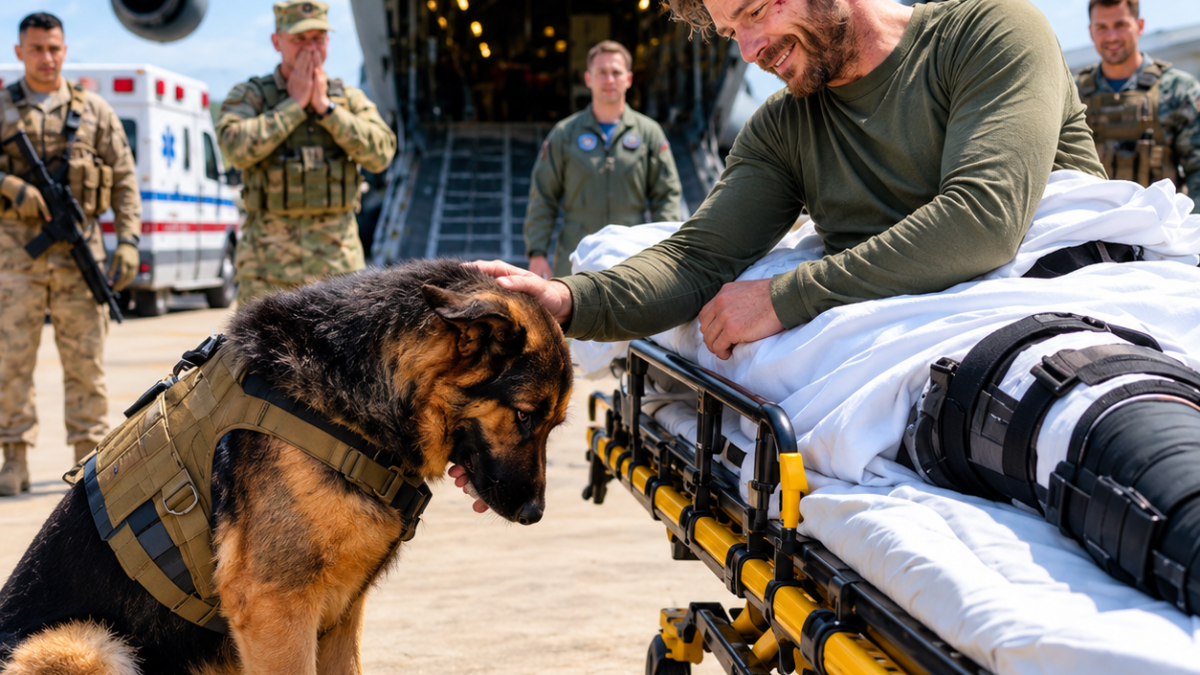
Six of them maneuvered a tactical gurney down the ramp.
The figure on it was surrounded by IV bags, oxygen lines, monitors, trauma blankets. He was shockingly thin. His face was pale, bruised, and hollowed by suffering. His beard had grown uneven across his jaw. One leg was wrapped in heavy bloodstained bandages and stabilized in a metal halo brace.
For a moment, Miller’s mind refused to connect the body to the photograph in his office.
Then he saw the eyes.
Petty Officer First Class Wyatt O’Connor.
Alive.
Broken, battered, starved, and barely conscious.
But alive.
The wind shifted.
Brutus caught the scent.
The dog’s whole body convulsed.
He released a roar so powerful it echoed across the flight line.
It was not anger.
It was triumph.
Then he surged forward.
The leather leash, already strained, snapped in Miller’s hands with a crack like a gunshot.
“Brutus!” Miller screamed.
Military police raised rifles by instinct.
“Stand down!” Henderson bellowed, stepping in front of them and shoving one barrel toward the ground. “Do not fire! Hold your fire!”
Brutus sprinted across the wet tarmac, black and tan body cutting through fog and flashing lights. He closed the distance in seconds.
The medics froze.
They had heard enough rumors by then to know what was coming toward them.
An eighty-pound apex predator with a combat record and a history of uncontrolled aggression.
Brutus slid to a stop at the base of the stretcher.
Then the beast vanished.
He did not jump.
Did not climb.
Did not tackle the gurney.
He dropped his hindquarters to the freezing concrete.
Then he crawled.
Inch by inch.
Belly low.
Tail tucked beneath him.
Ears flat.
His entire body spoke one ancient language.
Submission.
Reverence.
Love.
Wyatt O’Connor, barely conscious beneath morphine and agony, turned his head.
His sunken eyes fluttered open.
For a moment, disbelief moved through them.
Then recognition.
His cracked lips parted.
Slowly, painfully, Wyatt reached one trembling arm over the metal rail of the stretcher. His fingers were thin, bruised, covered in dirt and healing cuts.
Brutus let out a long, shuddering sigh.
He lifted his massive head and pressed his nose directly into Wyatt’s palm.
Not hard.
Not wild.
Careful.
So careful.
He rested his chin on the edge of the mattress, not putting weight on Wyatt’s broken body. His tail thumped weakly against the stretcher wheel.
Wyatt smiled.
A tear slid down his bruised cheek, cutting a clean path through the grime.
“Hey, buddy,” he rasped.
The flight line had gone silent except for idling engines.
Wyatt’s voice was barely there.
“I told you I’d come back.”
Miller stood fifty feet away with both hands over his mouth, tears streaming down his face.
Captain Henderson turned away and wiped roughly at his eyes.
The ticking time bomb in Kennel Four had not been broken.
He had been waiting for the only hands that knew how to disarm him.
Wyatt was transported to Walter Reed under critical care.
Brutus rode in the medical convoy.
Technically, that violated four different protocols.
Nobody mentioned them.
Inside the ambulance, Brutus lay on the floor beside the stretcher, his body pressed as close as the medics allowed. Every time Wyatt’s breathing changed, Brutus lifted his head. Every time a monitor beeped, his ears shifted. When a corpsman adjusted an IV line too quickly, Brutus rumbled deep in his chest.
“Easy,” Wyatt whispered without opening his eyes.
The rumble stopped.
The corpsman looked at the dog, then at Wyatt.
“Thank you,” he muttered.
Wyatt’s fingers moved weakly until they found Brutus’s fur.
Brutus did not move again.
At Walter Reed, doctors discovered just how close Wyatt had come to never leaving those mountains.
Shattered femur.
Three broken ribs.
Severe malnutrition.
Internal injuries.
Infected lacerations.
Nerve damage in the left leg.
Signs of captivity no one spoke about in front of him unless necessary.
He had survived an ambush, capture, interrogation, an escape through mountain terrain, and nearly three weeks moving alone after a recon team found signs of life near a border route.
When the rescue team finally reached him, Wyatt had been hiding under a rock overhang with a stolen radio, a field dressing wrapped around his leg, and the hard drive from Operation Sandfall still taped beneath his shirt.
He had not only survived.
He had completed the mission.
That fact made admirals use words like extraordinary.
It made doctors use words like impossible.
It made Brutus ignore everyone because Wyatt was breathing and that was the only report he needed.
The military bureaucracy, famously rigid, bent with surprising speed.
Captain Henderson made one call to Naval Special Warfare Command, then another, then another. By the end of the first day, the euthanasia order vanished from the administrative file so thoroughly that Miller later joked it had been killed in action.
Brutus was reclassified under a specialized medical support protocol.
No longer active-duty tactical asset.
No longer kennel-contained behavioral risk.
Permanent recovery companion.
For the first four weeks in intensive care, Brutus did not leave Wyatt’s room.
The hospital staff feared him at first.
They had read the file.
Two hospitalized handlers.
Broken chain.
Severe aggression.
Unmanageable.
But the monster of Little Creek did not enter Walter Reed.
In his place was a silent guardian with soft eyes and iron rules.
He learned the pattern of the ICU faster than some new nurses. He knew how to move around IV lines. He knew which side of Wyatt’s bed gave access without blocking monitors. He knew the difference between routine pain and panic before Wyatt did.
The first night terror came on day six.
Wyatt had been sleeping badly, pulled under by medication and memory. At 0300, his heart rate spiked. His hands clenched. He thrashed once, hard enough to pull against the lines.
“No,” he gasped. “No, get him on the bird. Get Brutus on the bird.”
A nurse rushed in.
Brutus was already moving.
He jumped onto the bed with impossible care, placing his weight where it would not touch the leg brace or chest injuries. He pressed his broad chest against Wyatt’s torso, deep and steady, grounding him with warmth and pressure.
Wyatt fought the nightmare for several more seconds.
Then his hands found fur.
His breathing hitched.
“Brute?”
The dog pressed closer.
Wyatt’s heart rate began to slow.
The nurse stood frozen, one hand on the call button.
Brutus did not look at her.
His entire world was the man beneath him.
Wyatt opened his eyes.
For a moment, he looked afraid to believe what he saw.
Then he buried his hand in Brutus’s coat and whispered, “You waited.”
Brutus gave one soft snort.
As if the answer were obvious.
Recovery did not happen cleanly.
Stories liked to turn reunions into endings.
Real life turned them into beginnings.
Wyatt woke angry some days. Not loud, not cruel, but furious at pain, at weakness, at the six months stolen from his body and the men lost in the valley. He hated the brace. Hated the walker. Hated the tremor in his hand when fatigue got bad. Hated needing help to cross a room when he had once fast-roped into compounds at night.
Brutus struggled too.
The first time Wyatt was taken for surgery and Brutus had to remain outside the sterile area, the dog planted himself at the door and would not move for four hours. He did not snarl at staff. That was progress. But he did not eat, drink, or lie down until Wyatt returned.
Miller visited whenever command allowed.
The first time he entered the hospital room, Brutus lifted his head from beside Wyatt’s bed.
Miller stopped in the doorway.
“Hey,” he said softly.
Brutus watched him.
No growl.
No lunge.
No welcome either.
Miller accepted that as more than he deserved.
Wyatt looked between them.
“You’re Miller?”
“Yes.”
Wyatt’s voice was still rough. “You kept him alive.”
Miller looked down.
“We almost didn’t.”
“I heard.”
Shame moved through the room.
Miller forced himself not to look away.
“Captain Henderson signed the notice. The board approved it. I didn’t stop it.”
“But you opened the gate.”
Miller swallowed.
“That was almost too late.”
Wyatt studied him.
Then, slowly, he said, “Most things that save a life happen almost too late.”
Miller did not know what to do with that.
Brutus stood and crossed the room.
Miller’s body stiffened before he could stop it.
The dog stopped two feet away.
He sniffed Miller’s boots.
Then his hand.
Then he turned and went back to Wyatt’s bed.
Miller let out a breath he had not realized he was holding.
Wyatt’s mouth twitched.
“That’s Brutus for ‘you may continue existing.’”
Miller laughed once.
It came out broken.
“I’ll take it.”
Captain Henderson visited two weeks later.
He arrived in dress uniform, which was either respect or armor. Possibly both.
Wyatt was in a wheelchair by then, pale but upright, a blanket over his legs. Brutus lay beside him with his head on the footrest, eyes half-closed.
Henderson stood just inside the room.
“Petty Officer O’Connor.”
Wyatt looked up.
“Captain.”
For a moment, neither spoke.
Then Henderson removed his cap.
That got Wyatt’s attention.
“I owe you an apology.”
Wyatt’s expression did not change.
Henderson continued.
“Not for the board’s concern. Brutus was dangerous without you. Men were hurt. That part is true. But I reduced him to a liability because I did not know what else to do with grief I could not command.”
Brutus opened one eye.
Henderson looked at him.
“I also owe him an apology.”
Wyatt’s hand rested on Brutus’s head.
“He understands tone.”
“I assumed as much.”
“Say it like you mean it.”
Henderson’s jaw worked once.
Then he crouched.
Not close.
Not foolish.
At a respectful distance from the dog who had once haunted Kennel Four.
“Brutus,” he said, voice lower now. “I was wrong about you. I thought loyalty had become danger. I forgot they can look the same when the person you love is gone.”
Brutus watched him.
Then closed his eye again.
Wyatt nodded.
“That’s him accepting your paperwork.”
Henderson almost smiled.
Almost.
Months passed in pieces.
Surgery.
Pain management.
Physical therapy.
Psychological evaluations.
Classified debriefs.
More surgery.
Bad nights.
Better mornings.
Wyatt learned to stand again with parallel bars and a therapist who did not care that he had a Navy Cross pending. Brutus learned to walk beside a wheelchair without tangling IV lines. Wyatt learned to sleep more than two hours. Brutus learned that nurses could enter without meaning harm.
One day, Wyatt took three steps with a cane.
Brutus stood in front of him, blocking the fourth.
The therapist frowned. “Is he stopping you?”
Wyatt looked at Brutus.
Brutus stared back.
“No,” Wyatt said. “He’s telling me my leg is about to quit.”
The therapist looked skeptical.
Wyatt took half a step.
His left knee buckled.
Brutus moved instantly, bracing against him just enough for Wyatt to catch himself.
The therapist stared.
Wyatt patted Brutus’s shoulder.
“He’s annoying when he’s right.”
Brutus looked satisfied.
Eight months after the rescue flight, a ceremony was held on the green lawn at Little Creek.
The sky was brilliant blue, almost offensively clear compared to the fog of Wyatt’s return. Rows of decorated officers, kennel masters, handlers, and operators stood at attention. Cameras waited at a respectful distance. The American flag moved in a clean wind off the water.
At the center stood Wyatt O’Connor.
He leaned heavily on a custom black carbon-fiber cane. His dress uniform was immaculate, though the body inside it was still thinner than before. A Purple Heart and Navy Cross had been pinned to his chest. His face carried scars that had not been there before Sandfall. His left leg would never move the way it used to.
At his left side sat Brutus.
The dog’s coat gleamed in the sunlight. His tactical harness had been cleaned, repaired, and fitted with his own commendation medals. His posture was proud and alert, but his eyes remained soft, locked on Wyatt’s face.
Captain Henderson stepped to the podium.
For once, he did not look like a man trying to reduce life into assets and liabilities.
He looked like a man who had been corrected by something larger than rank.
“We demand absolute performance from our military working dogs,” he began. “We ask them to run into darkness, to face gunfire and explosives, to trust commands they cannot question, and to protect our lives with their own.”
His voice carried across the lawn.
“We train them to be fearless warriors. But sometimes we forget that loyalty this deep cannot simply be reassigned. Sometimes we mistake grief for failure. Sometimes we call love a liability because we do not know how to measure it.”
Miller stood in the front row.
His eyes were already wet.
Henderson looked toward him briefly, then back to Wyatt and Brutus.
“Brutus did not just serve his country. He reminded us that some bonds survive beyond evidence, beyond official status, beyond probability. For six months, he was told his handler was gone. He refused to believe it. And on the day everyone else accepted the impossible, Brutus heard hope land on a runway.”
A murmur moved through the crowd.
Henderson lifted a polished wooden plaque.
“Effective today, by order of the Commander of Naval Special Warfare, Military Working Dog Brutus is honorably discharged from active duty service. He has completed his tour. He is permanently remanded to the care and custody of Petty Officer First Class Wyatt O’Connor.”
The applause began before Henderson finished.
It rolled across the lawn like weather.
Wyatt smiled and reached down to unclip the heavy tactical lead from Brutus’s collar for the last time.
He tossed it toward Miller.
Miller caught it with both hands and laughed through tears.
Wyatt scratched Brutus behind the ears.
“You’re a civilian now, buddy,” he whispered. “Your watch is over.”
Brutus leaned his weight carefully against Wyatt’s good leg and sighed.
He did not care about the applause.
Not the medals.
Not the orders.
Not the title.
His ghost was real.
His pack was whole.
That was enough.
After the ceremony, when the crowd loosened and officers began speaking in small clusters, Wyatt and Brutus moved away from the lawn toward the edge of the training field.
Miller followed at a respectful distance.
Wyatt noticed.
“You can come over, Sergeant.”
Miller approached, still holding the old lead.
“I don’t know what to do with this.”
Wyatt looked at the leash.
“Keep it.”
“I can’t.”
“You opened the gate.”
Miller’s face tightened.
“I almost didn’t.”
“But you did.”
Brutus sniffed the leash once, then looked away as if it belonged to another life.
Miller ran his thumb over the worn leather.
“I thought he was gone,” he said. “Not dead. I mean… gone inside himself.”
Wyatt looked toward the kennels in the distance.
“He was guarding something.”
“What?”
Wyatt rested his hand on Brutus’s head.
“The place where I still existed.”
Miller had no answer.
The wind moved through the grass.
A group of young handlers across the field laughed at something, and for once the sound did not feel out of place.
Wyatt shifted his weight on the cane.
Brutus immediately adjusted beside him.
Miller noticed.
Of course he did.
“You ever think about what happens now?” Miller asked.
Wyatt looked down at Brutus.
“Every day.”
“Does that scare you?”
Wyatt smiled faintly.
“More than combat ever did.”
Miller understood that better than he expected.
In combat, terror had direction. Survival had tasks. Move. Cover. Fire. Extract. Treat. Breathe.
Peace was less clear.
Peace asked what remained after the mission.
Wyatt said, “But he came back to me after six months of hell.”
Brutus pressed closer.
“So I figure I can learn to come back too.”
They went home two weeks later.
Not to the barracks. Not to the hospital. Not to the kennels.
Home.
A small one-story house near the Chesapeake, purchased years earlier by Wyatt and barely lived in because deployments had a way of turning homes into storage units for people who were always leaving.
The first night, Wyatt stood in the doorway longer than necessary.
The house smelled closed-up despite the cleaning crew. Dust, wood, old fabric, faint salt from the air outside.
Brutus stepped in first.
He moved room to room, checking corners, windows, exits. Not frantic. Professional. When he finished, he returned to Wyatt and sat.
Wyatt laughed softly.
“Clear?”
Brutus blinked.
Wyatt stepped inside.
The first weeks were harder than he admitted to anyone.
There were no applause lines in the middle of the night when pain woke him. No ceremony when he dropped a mug because his grip failed. No medal when he sat on the bathroom floor unable to stand and Brutus pressed against him until the shaking stopped.
But there was Brutus.
Always Brutus.
Brutus learned the rhythm of the house. He knew when Wyatt’s leg was bad before Wyatt said so. He knew the difference between a nightmare and a memory. He knew when Wyatt needed weight across his lap and when he needed space. He learned to bring the cane when Wyatt forgot it, though he occasionally looked insulted by the task.
Wyatt learned too.
He learned to let neighbors help carry groceries. Learned to say “bad day” instead of “I’m fine” when Miller called. Learned that healing did not mean becoming the man he was before Sandfall. That man had died in the valley in some ways.
Not all deaths stopped the heart.
One afternoon, months into civilian life, Wyatt took Brutus to the beach.
Not a crowded beach. A quiet stretch beyond the houses, where the sand was cold and the water gray-green beneath winter light.
Wyatt walked slowly with his cane.
Brutus moved beside him without leash.
At the edge of the water, Wyatt stopped.
Waves folded over themselves.
Wind moved through Brutus’s coat.
Wyatt looked down at him.
“You knew,” he said.
Brutus looked up.
“When everyone else thought I was dead, you knew.”
The dog leaned against his leg.
Wyatt closed his eyes.
For six months, he had survived by reducing life to the next necessary thing.
Find water.
Stop bleeding.
Stay hidden.
Move at night.
Remember the route.
Do not think about home too long or it will become unbearable.
Do not think about Brutus.
That rule had failed often.
In captivity, when pain stripped everything else away, he had imagined the dog’s weight against his side in transport aircraft. The smell of fur and dust. The way Brutus always huffed when Wyatt took too long packing gear. The exact pressure of the dog’s head against his palm.
More than once, Wyatt had stayed alive for the absurd promise he had shouted over helicopter noise.
I’ll come back.
He had said it to a dog.
He had meant it like a vow.
On the beach, Wyatt lowered himself carefully onto a driftwood log.
Brutus sat in front of him.
“You waited for me,” Wyatt said.
The dog’s ears shifted.
“I’m going to try to stop making you.”
Brutus stepped forward and pressed his head into Wyatt’s chest.
Wyatt wrapped one arm around him and breathed through the ache until it loosened.
Years later, when young handlers asked Miller about Brutus, he never started with the aggression.
He started with the waiting.
He told them about the dog who sat on a tarmac for two days staring at the sky.
The dog who refused commands because obedience had once taken him away from the man he loved.
The dog who became a monster because no one knew what to do with a soldier grieving in a language humans kept misreading.
Then he told them about the foggy morning, the C-17, the broken leash, and the way Brutus dropped to his belly before Wyatt’s stretcher.
“That,” Miller would say, “is what loyalty looks like when it survives being misunderstood.”
He kept the old leather lead in his office.
Not displayed like a trophy.
Folded on a shelf beside training manuals and medical forms.
When a young handler got impatient, Miller would take it down and place it on the desk.
“This leash belonged to the most dangerous dog I ever opened a gate for,” he would say. “And opening that gate was the smartest thing I ever did.”
If they asked what happened to Brutus, Miller would smile.
“He went home.”
And that was true.
Brutus lived the rest of his life with Wyatt.
He never returned to active duty. Never cleared another compound. Never jumped from another aircraft. Never had to prove again that he was useful enough to deserve life.
He became, officially, a retired military working dog.
Unofficially, he remained what he had always been.
Wyatt’s partner.
On good days, they walked slowly near the water.
On bad days, Brutus stayed pressed beside Wyatt’s chair while the world narrowed to pain and memory.
When Wyatt woke from nightmares, Brutus climbed onto the bed and anchored him there.
When Brutus aged and his hips stiffened, Wyatt modified the porch steps into a ramp with help from Miller and a civilian carpenter who knew better than to comment on the tears in two grown men’s eyes while they measured wood.
Their roles blurred.
Some mornings Brutus steadied Wyatt.
Some mornings Wyatt steadied Brutus.
Neither kept count.
On the last day of Brutus’s life, the sky over Virginia was clear.
Wyatt sat on the living room floor because the old dog could no longer climb onto the couch and Wyatt refused to let him lie alone. Brutus’s muzzle was white by then. His eyes cloudy but peaceful. His breathing slow.
Miller came and sat on the other side.
Captain Henderson, retired by then, stood quietly near the doorway for a few minutes, then placed one hand over his heart and left before grief overcame his dignity.
Wyatt held Brutus’s head in his lap.
“You found me,” he whispered.
Brutus’s tail moved once.
Barely.
Enough.
Wyatt stroked the soft fur between his ears.
“I told you I’d come back,” he said, voice breaking. “You made sure I had somewhere to come back to.”
Brutus exhaled.
One long sigh.
The same kind he had given on the tarmac when his nose touched Wyatt’s palm.
Then he was still.
For a long time, nobody moved.
Outside, gulls cried faintly beyond the windows.
Inside, Wyatt bowed over the dog who had guarded his ghost, survived his grief, and brought him home to life after the mission ended.
When Brutus’s ashes were returned, Wyatt placed them beside the framed photo from the ceremony.
In the photo, he stood with his cane, thin but smiling. Brutus sat at his left leg, harness bright with medals, eyes fixed upward at Wyatt instead of the crowd.
Below the frame, Wyatt placed the old lead Miller had kept for years.
He had asked for it back only once.
Miller had handed it over without a word.
On the shelf beneath the photo, Wyatt engraved a small brass plate.
BRUTUS
Military Working Dog
Brother. Guardian. Friend.
He never stopped believing I was coming home.
People later told the story in many ways.
Some called it a miracle.
Some called it proof of the bond between handler and K9.
Some focused on the military bureaucracy, the euthanasia order, the dramatic landing, the fog, the broken leash, the ceremony.
Wyatt let them.
Stories belonged partly to the people who needed them.
But the truth, the private truth, was simpler.
A dog lost the only person who made the world make sense.
Everyone told him that person was gone.
The dog refused.
He snarled at officers, shattered chains, rejected commands, and turned a kennel into a battlefield, not because he was evil, not because he was beyond saving, but because somewhere in a part of him no human board could evaluate, Wyatt O’Connor was still alive.
And on a foggy morning at Little Creek, the air changed.
The scent came first.
Then the aircraft.
Then the stretcher.
Then the hand.
And the beast everyone feared lowered his head, crawled through rain and jet fuel and flashing lights, and placed his nose in the palm of the man he had waited six months to find.
No command could have made him do it.
No training manual could explain it fully.
No medal could equal it.
Brutus had simply known what love sometimes knows before evidence arrives.
His handler was not a memory.
Not a ghost.
Not a name in a file.
He was home.
And the war inside Kennel Four ended the moment Wyatt whispered, “I told you I’d come back.”








