For Nearly a Year, a Gray-and-White Cat Returned to the Same Grave Every Day—Until the Heartbreaking Truth About the Woman She Was Waiting For Moved the World
PART3:
Each time, the result was the same.
He could bring her to a safer place. He could give her food, water, and shelter. He could offer what any reasonable person would call a better life.
But she would not stay.
She always returned.
At first, Keli felt helpless.
Then he became curious.
No animal returns to the same place without reason.
So he began asking questions.
At the cemetery, he spoke to caretakers and visitors. Along the road, he asked shopkeepers. Near the homes beyond the cemetery wall, he asked older residents who knew almost everyone’s history.
Slowly, the story came together.
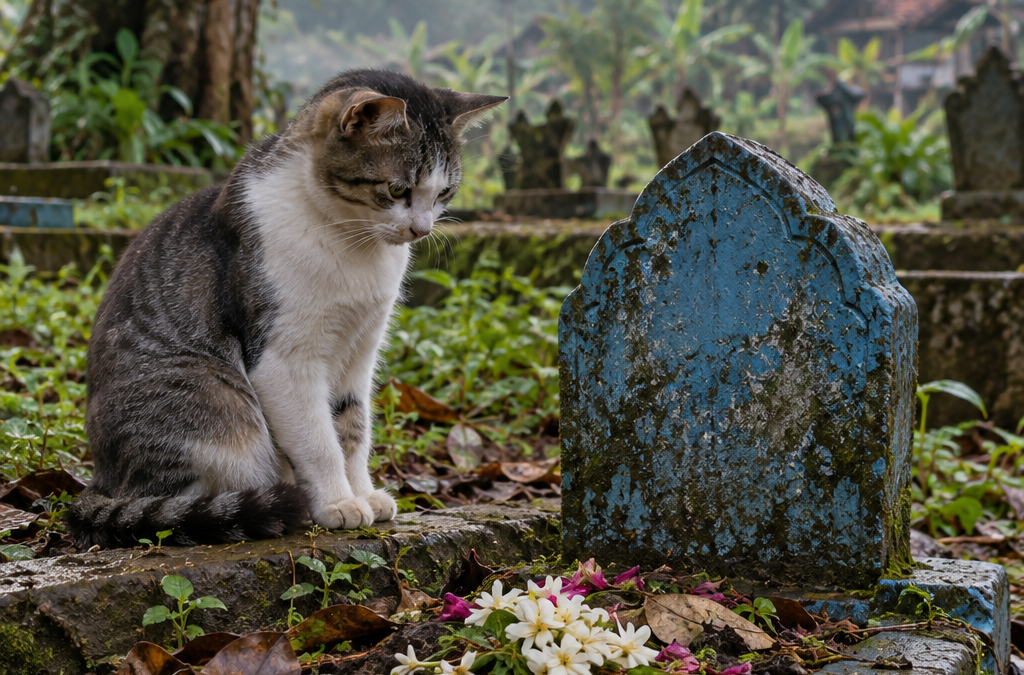
The blue grave belonged to an elderly woman named Ibu Kundari.
People spoke her name gently.
She had lived nearby. A quiet woman, they said. Kind. The sort of woman who did not have much but still found a way to share food with hungry animals. She had cared for the gray-and-white cat while she was alive.
“That cat was always around her house,” one neighbor told Keli. “Always near her feet.”
Another said, “When Ibu Kundari sat outside, the cat sat beside her.”
Another remembered seeing the cat follow the old woman along the path, not too close, but close enough.
Keli listened.
Then he understood.
The cat was not lost.
She knew exactly where she was.
The grave was not random.
It was the last place in the world connected to the person she loved.
After that, Keli watched differently.
He noticed the routine.
In the morning, the cat would sit beside the grave, her body close to the blue headstone. Later, she would leave the cemetery and walk toward the house where Ibu Kundari had once lived. The woman’s children still lived nearby, and they fed her when she came.
She would eat there.
Sometimes she would rest.
But she did not remain.
After a while, she would rise, leave the house, and return to the cemetery.
Back to the blue headstone.
Back to the place where her person had been laid to rest.
People began to come just to see her.
Some came quietly, moved by the story. Others came with phones, wanting pictures. Children pointed. Adults whispered. A few tried to touch her, but the cat usually moved away from strangers and returned to her chosen place.
Keli worried the attention might disturb her.
“She is not a performance,” he told one man who stepped too close with a camera.
The man lowered his phone, embarrassed.
“She is grieving,” Keli said.
He did not know if that word was scientifically correct.
He did not care.
Whatever people wanted to call it, the cat’s loyalty was real enough to make everyone lower their voices.
The story spread beyond the village.
At first, it moved through conversation. Then through photographs. Then online. People from other places saw the gray-and-white cat beside the blue grave and felt something in their chests they could not easily explain.
Some called it love.
Some called it habit.
Some said cats did not understand death.
Others said animals understand more than humans admit.
Keli did not argue.
He had seen enough to know that certainty was not necessary.
Maybe the cat did not understand death the way people did.
Maybe she did not know that Ibu Kundari would not rise from beneath the earth, call her name, and walk home again.
Maybe she returned because the scent remained.
Maybe the routine remained.
Maybe the cemetery, the stone, the soil, and the path had become pieces of a world that once made sense to her.
Or maybe, in the quiet language of animals, she understood the most important thing of all:
This was where love had last been.
And so she stayed close.
There was one afternoon Keli never forgot.
The rain had come earlier than usual that day, warm and heavy, turning the cemetery paths dark and soft. Most people had gone home. The flowers near the graves bent under the weight of water. The sky was gray, and the air smelled of wet earth.
Keli thought the cat would have found shelter.
Instead, he saw her at the grave.
She was sitting close to the headstone, her fur damp, her body small against the rain. Not hiding. Not running. Just there.
He hurried over with an umbrella.
“You stubborn little heart,” he murmured.
He held the umbrella above her.
The cat looked up.
For a moment, her eyes met his. They were not wild eyes. Not empty eyes. They were tired, patient, and full of something he could not name.
He crouched beside her.
“I know,” he said softly. “You miss her.”
The cat blinked.
Rain tapped against the umbrella.
Keli stayed there until the worst of the rain passed.
He did not try to take her away that time.
Some kindness means sheltering someone where they choose to stand.
After that day, he changed his approach.
He stopped trying to make her forget the grave.
Instead, he tried to make the place safer for her.
He brought food and water when he could. Others did the same. The family continued feeding her at Ibu Kundari’s old home. People checked on her. Some kept dogs away. Some brought shade when the sun was too harsh.
The cat still lived between two places.
The home where she was fed.
And the grave where she waited.
Weeks turned into months.
The blue headstone faded a little more under the weather.
Flowers came and went.
People visited, prayed, left, returned.
The cat remained.
Not every minute of every day, but always enough that people understood the grave was hers in some way too. A place of return. A place of memory. A place where the world still held the shape of someone she had loved.
One evening, an elderly man stood near Keli and watched the cat resting beside the grave.
“My wife used to feed a cat,” he said.
Keli turned to him.
The man’s eyes were on the gray-and-white cat.
“After my wife died, the cat waited near our kitchen for weeks. Every morning. Same place.” He swallowed. “I got angry at first. Not at the cat. At life. At seeing that waiting.”
Keli said nothing.
The man continued, “Then one day, I realized I was waiting too.”
The cat shifted beside the headstone, curling her tail tighter around herself.
The old man wiped his eyes.
“Animals make grief visible,” he said.
Keli never forgot that.
Animals make grief visible.
Perhaps that was why the story touched so many people.
Humans often hide grief.
They fold it into routines. They answer “I’m fine.” They keep working, cooking, cleaning, raising children, paying bills, smiling when necessary. They learn to carry absence in public without letting it spill everywhere.
But the cat did not know how to pretend.
She missed someone, and so she returned to the place where that someone had gone.
Again.
And again.
And again.
Her little body became a message people could understand without translation.
Love was here.
Love is still here.
I will stay near it.
As the months passed, Keli noticed small changes in how people treated the cemetery.
They became gentler around the blue grave.
Children who once ran noisily along the paths slowed when they saw the cat. Visitors who came with curiosity often left quietly. Some brought flowers not only for their own relatives but for Ibu Kundari too. Some placed food nearby, though the family asked that people not overwhelm the cat.
One young woman came one day with tears in her eyes.
She told Keli that her mother had died the year before.
“I saw the cat online,” she said. “I thought I was foolish because I still talk to my mother’s photograph.”
Keli shook his head.
“Not foolish.”
The woman looked at the cat.
“She keeps going back,” she whispered.
“Yes.”
“I think I understand that.”
Many people did.
That was the power of the cat’s devotion.
It gave people permission to admit they also returned to invisible graves.
A chair.
A song.
A saved voicemail.
A kitchen recipe.
A folded shirt.
A road they avoided because it led past a hospital.
A room they had not changed because changing it felt too much like closing a door.
Not all graves are in cemeteries.
Some are hidden inside ordinary life.
The cat beside the blue headstone reminded people that returning is not always weakness.
Sometimes it is how love continues when the body cannot follow.
Keli eventually learned more about Ibu Kundari from her children.
They said their mother had not considered the cat a possession. She had not spoken of her that way. The cat had come and gone, as village cats often do, but Kundari always made room for her.
A little rice.
A little fish.
A shaded place.
A soft voice.
Perhaps the cat had never needed a collar or a bed to know she was loved.
Animals measure love differently from humans.
Not by documents.
Not by ownership.
Not by the words people use.
They know who feeds them gently.
Who waits while they approach.
Who speaks without shouting.
Who shares the same path often enough that the world begins to feel safe.
Ibu Kundari had been that person.
And when she was gone, the cat kept returning to the place where that safety had disappeared.
One afternoon, Kundari’s daughter came to the grave with flowers.
The cat was already there.
The daughter knelt, placed the flowers carefully, and began to cry. Not loudly. Just a quiet shaking of the shoulders.
The cat rose and walked to her.
For a moment, the woman froze.
Then the cat pressed her head against the woman’s knee.
The daughter covered her mouth with one hand.
“Oh,” she whispered. “You miss her too.”
Keli was standing several graves away and saw the whole thing.
He turned his face aside.
Some moments are too private even when witnessed.
From then on, Kundari’s family seemed to accept the cat not as a stray to be managed, but as another mourner.
They fed her.
They checked on her.
They did not force her to stay.
That was important.
Love cannot be honored by turning it into a cage.
The cat had chosen her rhythm.
Home for food.
Grave for memory.
The living house and the resting place.
The past and the present.
Her body moved between them the way a heart moves between grief and survival.
People often ask what happened to her later.
Some say she continued returning for a long time.
Some say she eventually spent more nights near the family home as she grew older.
Some versions of the story differ, as all widely shared stories do. Details shift. Names are misremembered. Timelines stretch or shrink. People add what they think the heart of the story needs.
But the heart does not need much.
A cat.
A grave.
A woman who once loved her.
A village that learned to look more carefully.
That is enough.
Keli never claimed to know exactly what the cat understood.
When reporters or visitors asked, he answered carefully.
“She keeps coming back,” he would say. “That is what we can see.”
And perhaps that humility made the story more beautiful.
Because no one needed to pretend to read the cat’s mind.
The devotion was visible.
The meaning could remain partly mysterious.
Love is often like that.
Even between people, we rarely understand it completely. We only see what it makes someone do.
Stay at a hospital bedside.
Cook for someone who has no appetite.
Save a message just to hear a voice again.
Visit a grave.
Return to a blue headstone day after day because something in the heart refuses to abandon the place where love still feels present.
One morning, Keli arrived at the cemetery earlier than usual.
The sun had just begun to rise over the village, touching the stones with pale gold. The air was cool. Birds moved in the trees. The world was quiet in that brief way mornings are quiet before work, traffic, and voices begin.
The cat was already there.
She sat beside the blue grave with her back straight, facing the path.
For a moment, in the soft light, she looked as though she were waiting for someone to walk toward her.
An old woman, perhaps.
Slow steps.
Gentle hands.
A familiar voice.
Keli stopped at the gate and did not move closer.
The cat turned her head slightly, then looked back at the grave.
He understood then that he did not need to rescue her from this place.
Not completely.
He could feed her.
He could protect her.
He could make sure she was not forgotten.
But he could not take from her the last connection she had chosen to keep.
Sometimes love stays where logic says it should leave.
Sometimes the heart makes a home out of memory because memory is all that remains.
And sometimes mercy means allowing that.
So Keli stood quietly at the cemetery gate while the morning light grew warmer.
A few minutes later, the cat rose.
She stretched.
She walked slowly toward the path that led to Ibu Kundari’s former home, where food and living hands waited.
She would eat.
She would rest.
Then, later, she would return.
To the blue headstone.
To the quiet.
To the place where love had not ended for her simply because the world said goodbye.
Years from now, many people who read her story may forget the exact names.
They may forget the village.
They may forget the color of the headstone.
But they will remember the image.
A gray-and-white cat curled beside a grave.
Waiting.
Returning.
Keeping watch in the only way she knew how.
And maybe that is why the story continues to move people across countries and languages.
Because everyone knows what it means to miss someone.
Everyone knows what it means to return, in memory or in body, to the last place where love felt close.
Everyone knows that some bonds are not loud.
Some do not need grand gestures.
Some do not need words at all.
Some goodbyes are silent.
Some grief has four paws.
Some loyalty sits quietly beside a blue headstone in the heat and rain, refusing to let the world forget that someone was loved.
And some little hearts keep returning, not because they do not understand loss, but because they understand love in the only way they can.
By staying near it.








