For Four Years, No One Could Touch the Stray Cat Everyone Feared—Then They Found Him Curled Around a Dying Newborn Kitten, and Nothing About Him Made Sense Anymore
PART3:
He followed it to a piece of torn cardboard pressed against the concrete near the loading dock, half wedged under a wooden pallet.
Under it were four newborn kittens.
Their eyes were sealed shut. Their ears were folded. Their umbilical cords were still attached. They were less than two days old—maybe less than one. Their bodies were no bigger than plums, their mouths opening silently because they were too weak to make much noise.
Luis called Harbor Strays before he called his supervisor.
I was brushing snow off my windshield when my phone rang.
“Mara,” Carla said, and I could hear panic under her voice. “Kittens. Newborns. Behind Marlow. Mother’s dead.”
“I’m coming.”
By the time I arrived, the wind cut through my coat like glass. Carla was already there with a heated carrier, towels, syringes, and formula, her face red from cold. Luis stood nearby looking helpless in the way good men look when something small is dying and strength is useless.
We got three of the kittens into the carrier.
One was barely breathing. One felt like ice in my palm. The third made one tiny sound and then went still.
The fourth was missing.
“There were four,” Luis kept saying. “I saw four. I swear to God, there were four.”
We searched under pallets, behind dumpsters, along the edge of the loading dock. We crawled on frozen concrete with flashlights between our teeth. My fingers went numb. Carla cried from frustration and cold.
Nothing.
Then, from beneath the far end of the loading dock, something growled.
Every person froze.
Not a dog growl.
Lower. Rougher. The sound of a creature who had already decided the answer was no.
Luis whispered, “That’s him.”
Ghost.
I crouched slowly and aimed my flashlight under the dock.
At first, I saw only darkness, pipes, rusted beams, and windblown trash. Then two yellow eyes caught the light.
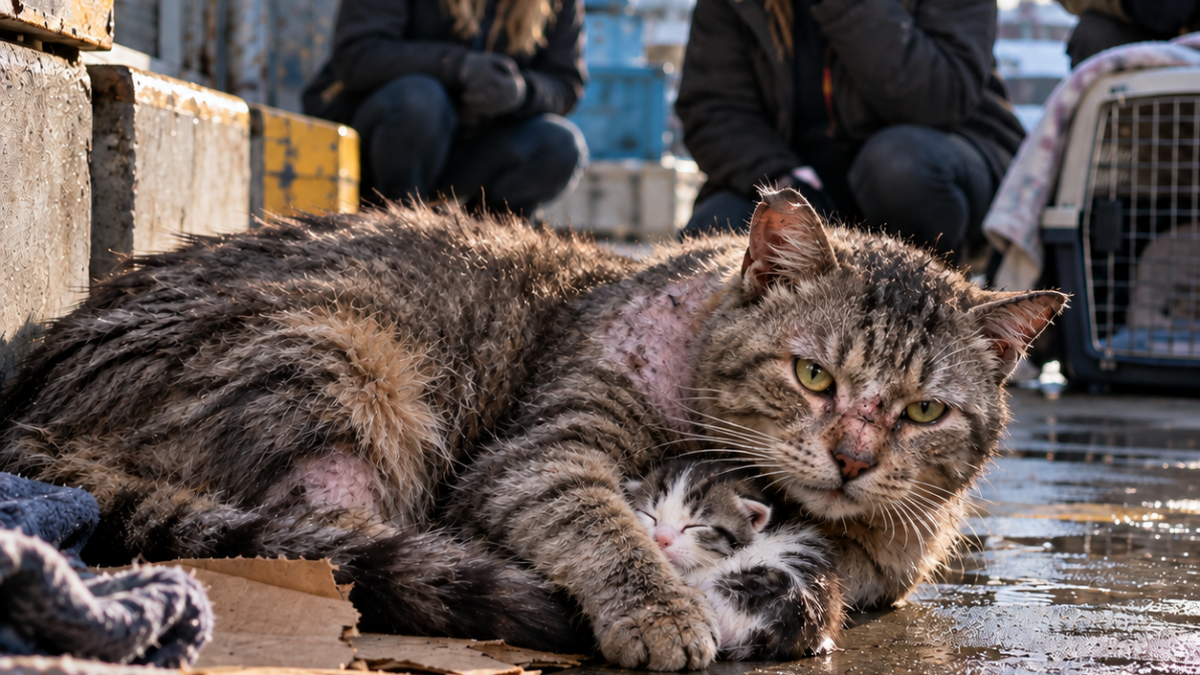
Ghost lay on his side in a hollow scraped between the concrete supports. His scarred head was lifted. His enormous body curved around something so small I did not understand what I was seeing right away.
Then the thing moved.
A newborn kitten, pressed against his chest.
My breath stopped.
Ghost’s front leg was wrapped around it.
Not pinning it. Protecting it.
His chin hovered over the kitten’s body, shielding it from the wind. The baby’s face was pushed into the sparse fur near his belly, kneading with weak little paws, searching for milk that did not exist.
Ghost stared at me.
He did not hiss.
That scared me more.
I had seen Ghost furious. I had seen him vanish. I had seen him explode out of shadows like a thrown blade. But I had never seen him still.
Carla knelt beside me, one hand over her mouth.
“Oh my God,” she whispered.
I should have moved faster. That is what part of me still says when I remember it. I should have grabbed the kitten. I should have taken the bite. I should have shoved a towel between us and done whatever had to be done.
But Ghost’s eyes held me in place.
They did not say, Come closer.
They did not say, I trust you.
They said, Not this one.
So I backed away.
“Leave food,” I said.
Carla turned to me, shocked. “Mara, that baby needs heat. It needs formula.”
“I know.”
“It’ll die.”
I looked under the dock again. Ghost lowered his head closer to the kitten until his scarred nose nearly touched its back.
“If we rush him, he’ll move it,” I said. “And we may never find it again.”
Carla cried openly then. She hated me in that moment. I understood. I hated myself too.
We left a bowl of warm kitten formula mixed with high-calorie paste as close as we dared. We left fish for Ghost. We left a heating pad wrapped in towels near the opening, though he refused to move toward it while we watched.
The three kittens we took died before noon.
All three.
We tried everything. Warming slowly, feeding drop by drop, rubbing their backs with warm cloths, oxygen at the clinic, prayers none of us admitted to saying.
Their bodies had been too cold for too long.
By late afternoon, I was sitting in the supply room of the vet clinic with three tiny bodies wrapped in a blue towel, feeling like failure had weight and I was holding all of it.
Dr. Helen Park came in quietly and sat beside me on the floor.
Helen was my boss, my friend, and one of the few people who could tell me the truth without sounding cruel.
“You did what you could,” she said.
“I left one there.”
“You made a judgment call.”
“I left a newborn kitten on concrete with a feral tomcat who has bitten three people badly enough to need stitches.”
Helen was quiet.
Then she said, “And if that tomcat is keeping it warm?”
I looked at her.
She shrugged gently. “Mara, animals surprise us when they stop trying to survive alone.”
I wanted to believe that.
But that night, I did not sleep.
At 4:30 a.m., I went back to the warehouse alone.
The world was blue-black and silent except for the harbor bells clanging in the wind. My breath fogged in front of my face. I carried formula, fish, a thermal blanket, and a trap I already knew Ghost would not enter.
He was still there.
The kitten was alive.
I heard it before I saw it—a stronger little squeak, angry and thin.
Ghost lay curled around it again, his back to the wind, his thick tail wrapped near its body. He watched me with those yellow eyes as I placed the food down and retreated.
“Okay,” I whispered. “Okay, big guy. I see you.”
His eyes narrowed.
“I’m not taking him today.”
Ghost did not understand my words.
But maybe he understood my distance.
For six weeks, that became our ritual.
Every morning before work and every evening after, I went to the loading dock. Sometimes Carla came. Sometimes Luis. Sometimes Officer Ray, who pretended he was there only because animal control needed updates, though I once saw him crouched behind a stack of crates whispering, “Hang in there, little man.”
We never got closer than eight feet at first.
Ghost allowed food. That was all.
He dragged fish to the kitten, chewed it, spat it near the baby when it grew old enough to mouth at solids. He carried the kitten by the scruff when rain blew under the dock, moving him to higher ground beneath a rusted metal staircase. He slept curled around him every night, body shielding him from the cold.
We put out insulated shelters.
Ghost ignored the first two.
The third one, built by Luis from an old foam cooler and lined with straw, he inspected for forty minutes before dragging the kitten inside as if the whole thing had been his idea.
We named the kitten Minnow.
That was Carla’s fault.
“He looks like a little fish skeleton,” she said on day three, while we watched from behind the dumpsters through binoculars like lunatics.
Minnow was gray and white, with a dark patch over one eye and a white tail tip that twitched when he nursed uselessly against Ghost’s belly. He should not have lived. Every textbook, every protocol, every rescue instinct said he should not have survived without bottle feeding, without constant heat, without a mother’s milk.
But he did.
Because Ghost kept him warm.
Because Ghost guarded him.
Because somehow, a battle-scarred tomcat who had trusted nothing in this town for four years decided that one freezing newborn belonged to him.
And the town began to notice.
At first, it was just the workers.
Luis told his wife, who told her sister, who worked at the diner. Someone saw Ghost carrying Minnow across the loading dock in his mouth and posted about it on Facebook. A blurry photo appeared: Ghost beneath the metal stairs, scarred face turned toward the camera, one huge paw resting near the kitten.
By the next day, half of Briarport seemed to have an opinion.
Some people melted.
Others mocked it.
A few got angry.
“Now everyone thinks that vicious cat is cute,” wrote one man online. “Wait until it bites a kid.”
Another commented, “That thing should’ve been put down years ago.”
Then there were the softer messages.
Is the kitten okay?
Can I donate formula?
Please don’t separate them.
My daughter wants to draw them.
That was when Marlow Fish Processing’s owner, Grant Marlow, decided he cared.
Grant was the third generation of Marlows to own the warehouse, though everyone knew his grandfather had built the business and Grant had mostly inherited walls, contracts, and a talent for blaming other people. He was in his late forties, always in a pressed jacket even when walking through fish water, with hair that looked expensive and hands that looked like they had never lifted anything heavier than a pen.
He had tolerated the cats for years because they kept rodents away and because removing them would have cost money. But he did not like attention unless he controlled it.
The story of Ghost and Minnow brought attention he did not control.
He called Harbor Strays on a Tuesday afternoon.
Carla put him on speaker because she already looked ready to throw the phone.
“This situation behind my building has become disruptive,” Grant said.
I was in the rescue office labeling medication. I stopped.
“What situation?” Carla asked, though we all knew.
“The cat situation. People are trespassing. Employees are distracted. Someone left a bag of cat food blocking a service entrance.”
“That was donated food,” Carla said.
“It was in the way.”
“I’ll move it.”
“I want the animals removed immediately.”
My pulse quickened.
“We’re working on a safe trapping plan.”
“I don’t need a plan. I need them gone.”
“The kitten is only a few weeks old. Ghost is highly trap-savvy and dangerous when panicked. If we rush—”
Grant cut me off. “Is this Mara Ellison?”
“Yes.”
“I’ve heard about you. You’re the one encouraging this circus.”
I leaned closer to the phone. “I’m the one trying to keep both animals alive.”
“That cat has attacked people on my property.”
“That cat was cornered by people trying to trap him.”
“That is not my problem.”
Something in his voice made me cold.
I had heard that tone before from men who thought ownership of land meant ownership of every living thing unlucky enough to stand on it.
Grant continued, “If the rescue doesn’t remove them by Friday, I’ll hire pest control.”
Carla’s face went white.
“You cannot poison cats,” she said.
“I didn’t say poison.”
“You implied disposal.”
“I implied I want my property managed.”
I said, “Mr. Marlow, if you harm those cats, especially now that the public is aware—”
He laughed once. “Careful, Ms. Ellison. People might enjoy a sad cat story online, but when liability gets involved, they usually remember animals are animals.”
He hung up.
For a moment, none of us spoke.
Then Carla said, “I hate him.”
Officer Ray, who had been standing in the doorway with a coffee he had forgotten to drink, said, “We need to move faster.”
“We can’t force Ghost,” I said.
“If Marlow brings someone in, force won’t be the word they use.”
I knew he was right.
That night, I stayed behind the warehouse for three hours.
Snow fell in hard little grains that stung my face. Ghost sat at the entrance of the foam shelter, Minnow tucked beneath his chest. The kitten was bigger now, eyes open, wobbling around on unsteady legs when Ghost allowed it.
“Listen,” I said softly from eight feet away, feeling ridiculous and desperate. “You don’t know me. You don’t trust me. That’s fair. Humans have probably earned every bit of that. But he can’t stay here.”
Ghost stared.
Behind him, Minnow sneezed.
Ghost immediately turned, bent his scarred head, and began licking the kitten’s face with slow, rough strokes.
My throat tightened.
“You love him,” I whispered.
The word hung in the frozen air.
Love.
It seemed too soft for Ghost.
And yet there it was, in the way he curled around the kitten, in the way he gave him food first, in the way he watched every gull, every truck, every boot that came too close.
Not gentleness. Not exactly.
Something older.
A vow made without language.
On Thursday, Grant Marlow put up NO TRESPASSING signs.
On Friday morning, he had one of his supervisors throw away the insulated shelters.
Luis called me before sunrise, furious and shaking.
“They took the shelters, Mara. Tossed them in the dumpster.”
“Where are the cats?”
“Under the dock. Ghost moved Minnow behind the crates, but the wind’s bad.”
I arrived twenty minutes later with Carla and Ray.
Grant came out wearing a wool coat and irritation.
“I told you people this ends today.”
Ray stepped forward. “Mr. Marlow, we need access to safely remove the animals.”
“You had weeks.”
“And you interfered with an active humane trapping effort.”
Grant smiled. “Humane. That cat has injured three people.”
I moved past him toward the dock.
He grabbed my arm.
Not hard enough to bruise.
Hard enough to remind me he thought he could.
Ray’s voice changed. “Take your hand off her.”
Grant released me with a performative little lift of both palms. “Everyone is emotional. I understand.”
I looked at him and, for one strange second, thought of Ghost.
How many times had hands like that reached for him? Not hard enough to leave evidence at first. Just hard enough to teach him the shape of threat.
We rebuilt the shelter that morning.
Grant called the police.
Ray, already standing there in uniform, took the complaint himself with obvious pleasure.
By noon, half the town knew Grant had thrown away the shelter of the famous warehouse kitten.
By evening, the Facebook comments had turned.
Not all of them. Cruel people rarely disappear just because the facts improve. But now Grant was being watched.
And men like Grant hate being watched.
The next week, someone shot Ghost.
We did not know that at first.
All we knew was that he vanished.
Minnow was six weeks old by then, round-bellied and bright-eyed, beginning to stagger after Ghost on tiny legs. We arrived one morning and found the kitten alone inside the foam shelter, crying so hard his little mouth opened in a silent square between squeaks.
Ghost was gone.
Panic moved through me so fast I nearly dropped the carrier.
“He wouldn’t leave him,” Carla said.
Her face had gone gray.
“No,” I said. “He wouldn’t.”
We searched for six hours.
Under pallets. Behind dumpsters. Along the seawall. Behind the bait shop. Beneath parked trucks. In the alley by the diner. We found paw prints in dirty snow near the chain-link fence. We found a smear of blood on a broken board.
Not much.
Enough.
Luis left work mid-shift to help. Ray called off two routine appointments. Helen closed the clinic early and came with a medical kit. By afternoon, volunteers from three towns over had joined.
Grant Marlow stood at his office window and watched us.
I saw him.
He did not come out.
At 4:17 p.m., we found Ghost in an abandoned net shed near the old pier.
I was the one who heard him.
Not a meow.
A breath.
A wet, painful, stubborn breath.
He was wedged behind a stack of crab traps, eyes half closed, body shaking. There was blood on his left hip and along his belly. When my flashlight touched him, he lifted his head and tried to growl, but the sound collapsed in his throat.
“Oh, Ghost,” I whispered.
Carla came up behind me and started crying.
He could not stand.
That was the only reason we were able to get him.
Even then, he tried to fight.
The moment Ray moved the crab trap, Ghost struck with one paw, claws scraping Ray’s glove. Not a true attack. Reflex. Terror. Pride. Whatever remained when a creature had nothing left but the habit of not surrendering.
“It’s okay,” Ray murmured. “I know, buddy. I know.”
We used thick blankets and a transfer board. Ghost bit the towel, bit the edge of the carrier, bit nothing but air when pain overtook him. I kept talking to him the whole time, nonsense mostly.
“You’re okay. You’re furious, and that’s okay. Stay mad if you need to. Just stay alive.”
At the clinic, Helen sedated him.
Only when he went limp did we see the full truth of his body.
The new wound was from a pellet or small-caliber projectile lodged near his left hip. It had torn through muscle but missed the artery by less than an inch.
But the X-ray showed more.
An old pellet already embedded deep in that same hip, surrounded by bone changes from years of irritation.
Three old fractures: one rib, one toe, one healed break along the tail.
Teeth worn down almost to stubs.
A chronic eye infection that had scarred one tear duct.
Arthritis in his spine.
Old abscess pockets along the neck and shoulders.
Ghost had not been born a monster behind that warehouse.
He had been made there, wound by wound.
Helen stood staring at the X-ray with her jaw tight.
“Someone has been hurting him for years,” she said.
Carla covered her mouth.
Ray turned and walked outside. Through the window, I saw him bend over with his hands on his knees.
I stood beside the exam table where Ghost lay under sedation, his scarred face finally soft, his huge paws limp.
Without the rage, he looked exhausted.
Not fierce.
Not dangerous.
Just tired beyond words.
Minnow was in a carrier on the counter, mewing frantically. We had taken him in as soon as Ghost vanished, bottle-fed him, warmed him, checked him. He was healthy, but inconsolable.
When Ghost began waking from sedation hours later, Minnow cried again.
Ghost’s ears twitched.
His eyes opened, unfocused.
He tried to lift his head and failed.
Minnow cried louder.
Ghost made a sound I had never heard from him before.
Not a growl.
Not a hiss.
A broken, searching chirp.
Helen looked at me.
“Bring the kitten closer.”
“We can’t put them together. He’s coming out of sedation.”
“Closer, not together.”
I placed Minnow’s carrier against the side of Ghost’s recovery cage.
Ghost saw him.
Everything in him changed.
The tension went out of his body so suddenly I thought something was wrong. He dragged himself, stitches and all, toward the cage wall closest to Minnow. Then he collapsed on his side, pressed his scarred face against the bars, and closed his eyes.
Minnow pushed against his own carrier wall until his tiny nose touched Ghost’s through the gap.
Ghost purred.
A rough, uneven, impossible sound.
Carla, the woman he had bitten two years before, sank onto the floor and wept.
That moment should have ended the argument over Ghost.
It did not.
By morning, the town was divided again.
Someone leaked that Ghost had been shot. People demanded to know who had done it. Others insisted it was probably an accident. Grant Marlow posted a statement on the warehouse page saying he was “saddened by the animal’s injury” but “concerned by increasing harassment of local businesses over an aggressive stray.”
Aggressive stray.
I read those words while sitting beside Ghost’s recovery cage, watching Minnow sleep pressed against the mesh carrier wall beside him.
My hands shook.
Helen took my phone away.
“No more comments,” she said.
“I need to know what people are saying.”
“No, you don’t. You need to help me change this bandage.”
The investigation began because Ray refused to let it go.
Technically, a wounded stray cat did not always trigger much official action. But Ray was stubborn, and the public pressure helped. He requested security footage from nearby businesses. Grant claimed the warehouse cameras facing the loading dock had been “malfunctioning” the night Ghost disappeared.
That might have ended it.
Except Luis remembered the bait shop across the service road had installed a new camera after a break-in.
The footage was grainy.
But it was enough.
At 2:13 a.m., a figure walked behind the warehouse carrying what looked like an air rifle. Ten minutes later, cats scattered from the loading area. One large dark shape—Ghost—lurched toward the fence.
The person turned toward him.
A small flash.
Ghost collapsed, then dragged himself out of frame.
The figure stepped closer, stood over the place where he had fallen, then walked away.
The face was not clear.
But the jacket was.
Marlow Fish Processing supervisor jacket. Reflective stripe across the back. Company patch on the sleeve.
Grant said several employees had access to those jackets.
Then Luis gave Ray something else.
For months, he had been documenting things quietly. Photos of thrown-away shelters. Text messages from supervisors telling workers not to feed cats. A photo of a broken pellet gun he had found in a maintenance closet the year before. A message from Grant in the employee group chat that said: “If animal control won’t solve the problem, we’ll solve it ourselves.”
It still might not have proven everything.
But then a young worker named Ben Lasky came forward.
Ben was nineteen, skinny, anxious, and terrified of losing his job. He arrived at the police station with his mother and cried before he finished the first sentence.
He said Grant had offered two workers cash to “scare off” the cats. He said no one was supposed to shoot Ghost directly. He said Grant had laughed and called Ghost “that scarred devil.” He said when word spread that Ghost was protecting a kitten, Grant got angrier because people were bringing food, reporters were calling, and employees were “acting like the cat owned the place.”
Ben had not fired the shot.
Another worker had.
But Grant had created the situation, encouraged it, paid for it, and then lied.
By the time charges were filed, Ghost was strong enough to sit up.
He still tried to bite us during medication.
He still hated bandage changes with a passion that felt almost admirable.
But every time Minnow cried, Ghost went still.
That was how we learned to treat him.
Minnow became our peace offering.
If Minnow was visible, Ghost endured.
Not happily. Never happily.
But he endured.
People came by the clinic with donations. Some left notes. Children drew pictures of Ghost as a superhero. One little girl drew him with angel wings and a speech bubble that said, “NO TOUCH BABY.”
We taped that one to the recovery room wall.
Ghost ignored it.
Minnow tried to chew it.
As Ghost healed, a new problem emerged.
What happens to a cat no one can touch who has become the town’s most famous father?
Some people wanted him released back to the warehouse.
Absolutely not, I said.
Some suggested a barn home.
Maybe, Helen said, but only with Minnow, and only somewhere safe.
Some thought he should go to a sanctuary.
Carla called three. All were full. Two said a cat with Ghost’s bite history would be difficult to place.
Then came the email from Ruth and Daniel Whitcomb.
They owned a small sheep farm an hour inland, outside a town called Bellweather. They had adopted two semi-feral cats from Harbor Strays years earlier, both of whom now lived lazy lives in a heated tack room and occasionally pretended to hunt mice for self-esteem.
Ruth wrote:
We have followed Ghost and Minnow’s story. We understand Ghost may never be friendly. We understand he may never allow handling. We have a secure heated barn room with outdoor catio access, no children in the home, livestock guardian dogs trained around cats, and experience with ferals. We would take both together if you think it’s best for them.
I read the email three times.
Then I cried.
Not because it solved everything.
Because it offered Ghost something nobody had ever offered him before.
A choice that did not end at the loading dock.
The first time Ruth and Daniel came to meet him, Ghost lunged at the cage door so hard Daniel took a step back.
Ruth did not.
She was in her sixties, with silver hair in a braid, weathered hands, and the calm presence of someone who had helped lambs into the world at three in the morning and no longer startled easily.
“Well,” she said, looking at Ghost. “You’re honest.”
Ghost growled.
Daniel cleared his throat. “That means he hates us?”
“That means he has boundaries,” Ruth said.
I liked her immediately.
Minnow, meanwhile, tumbled over his own paws inside the playpen and attacked Daniel’s shoelace.
Daniel looked down, helplessly charmed. “And this one?”
“That one has no boundaries,” I said.
Over the next two weeks, Ruth visited four times. She never tried to touch Ghost. She sat beside his enclosure and read paperback mysteries aloud in a low voice while Minnow climbed her pant leg. Ghost watched her with suspicion, then boredom, then something close to tolerance.
On the day of adoption, I thought my heart would break from the pressure of wanting to keep what was never mine.
Ghost was loaded into a reinforced crate. Minnow rode in a smaller carrier beside him. The moment Ghost realized Minnow was near, he stopped thrashing.
He pressed against the crate wall closest to the kitten.
Just like the first day at the clinic.
I stood beside Ruth’s truck, wind whipping my hair into my face.
“Call me when you get there,” I said.
“We will,” Ruth promised.
“And if it doesn’t work—”
“We’ll call.”
“And if he won’t eat—”
“Mara.”
I stopped.
Ruth put a hand on my shoulder. “We are not taking him away from love. We are taking him toward safety.”
I nodded, but tears blurred everything.
As they drove away, Minnow cried once from inside the truck.
Ghost answered.
A low sound. Not angry. Not afraid.
A father calling back.
The first week at the farm, Ghost stayed inside the heated barn room and refused to come out of his crate unless no human was visible. Ruth sent daily updates with no sugarcoating.
He ate at night.
He used the litter box.
He growled when I changed water.
Minnow thinks the scratching post is a mortal enemy.
Ghost allowed Minnow to sleep against him.
Progress.
The photos were always from a respectful distance.
Ghost under a wooden shelf, eyes glowing.
Minnow sprawled across his paws.
Ghost sitting near the small window, watching snow fall over the pasture.
Minnow climbing onto his back like a mountain goat.
After three weeks, Ruth wrote:
He came out while I was in the room today.
After five weeks:
He took chicken from tongs.
After eight:
He slept while Daniel repaired the latch.
After three months:
Mara, you need to see this.
Attached was a video.
I opened it in the clinic supply room, bracing myself.
The video showed Ruth and Daniel’s bedroom.
A handmade quilt. Morning light. A mug on the nightstand. A small gray-and-white cat—Minnow, bigger now, sleek and bright—kneading happily beside a pillow.
And there, stretched on his side across the foot of the bed, was Ghost.
On a bed.
Inside a house.
His torn ear lay flat. His scarred nose pointed toward Minnow. His eyes were half closed. Ruth’s hand entered the frame slowly and stopped six inches from his back, not touching, just resting there.
Ghost looked at the hand.
For a long moment, nothing happened.
Then he closed his eyes again.
I sat down on the floor and cried so hard Helen found me there ten minutes later.
She watched the video over my shoulder.
“Well,” she said softly. “Looks like the monster found a mattress.”
Justice came in pieces after that.
Grant Marlow pled to charges connected to animal cruelty and unlawful discharge of an air gun within town limits. He paid fines that were not enough. He lost contracts after local restaurants stopped buying from his warehouse. Luis quit and got hired by a competing seafood company two towns over, where the owner gave him permission to build proper shelters for the dock cats.
The worker who fired the shot received probation, community service, and mandatory restitution to Harbor Strays. He wrote a letter of apology. I read it once. It sounded young and ashamed. I did not forgive him easily, but I believed he might become better than the worst thing he had done.
Grant never apologized.
Men like that often don’t. They wait for the world to get tired.
But Briarport did not forget.
The warehouse changed ownership within a year. The new owner signed an agreement with Harbor Strays allowing managed colony care on the property. Feeding stations were built away from truck lanes. Shelters were secured. Cameras worked. Cats were trapped, neutered, vaccinated, and returned safely.
Ghost never came back to see it.
I’m glad.
Some places do not deserve to witness your healing.
The first time I visited Ghost at the Whitcomb farm, it was late spring. The drive inland took me past marshes, pine woods, fields waking green, and roadside stands selling strawberries. I rehearsed the whole way what I would feel if Ghost hated seeing me.
Maybe he would growl.
Maybe he would hide.
Maybe I would be just another human attached to pain.
Ruth met me in the driveway wearing mud boots and a smile.
“He’s in the sunroom,” she said.
“The house?”
She grinned. “He has opinions now.”
The farmhouse smelled like bread, coffee, and old wood. Ruth led me through the kitchen to a sunroom overlooking the pasture.
Minnow saw me first.
He was nearly full-grown by then, long-legged and ridiculous, with a glossy coat and the same dark patch over one eye. He launched himself off a chair and ran toward me with no survival instinct whatsoever.
I scooped him up, laughing as he rubbed his face against my chin.
Then I saw Ghost.
He was lying on a wide cushion beneath the window.
Sunlight touched every scar.
His torn ear. His pale nose. The hairless patches along his shoulders. The thick line where the surgery had saved his hip.
He lifted his head.
My body remembered caution before my heart did.
I stopped six feet away.
“Hi, Ghost,” I whispered.
He stared at me.
Minnow wriggled in my arms, offended by stillness. I lowered him to the floor, and he ran straight to Ghost, flopping dramatically against his chest.
Ghost looked down at him, then back at me.
And then, slowly, he blinked.
Once.
It was not forgiveness.
I would never insult him by calling it that.
It was recognition.
You were there.
You did not take him.
You brought him here.
I sank onto the nearest chair because my knees had gone weak.
Ruth pretended not to notice.
“He still doesn’t let us pick him up,” she said. “He may never.”
“That’s okay.”
“He sleeps on the bed. Only if Minnow gets up first, of course. He acts like it’s a security assignment.”
I laughed through tears.
“Of course he does.”
Minnow began kneading Ghost’s scarred belly.
Ghost endured it with the expression of a retired soldier being climbed by a toddler.
That was when Daniel came in with coffee and said, “You should see him at night. If Minnow moves, Ghost opens one eye. If Minnow jumps down, Ghost follows. If Minnow gets into the laundry, Ghost sits there watching like he’s not responsible, even though he absolutely is.”
I looked at Ghost, who avoided my eyes.
“He’s a father,” I said.
Ruth nodded. “Yes. He is.”
The word still felt like a miracle.
Not because male cats cannot be nurturing. Animals are more complicated than the simple stories people tell about them. But Ghost had been written off by everyone, including sometimes me, as too damaged, too violent, too far gone.
Yet beneath all those scars had been something waiting.
Not softness.
Not exactly.
Purpose.
Some creatures do not become gentle because life has been gentle to them. They become protective because they know exactly what danger feels like. They do not love lightly. They love like a barricade.
Ghost loved like that.
He did not become harmless. He did not turn into a lap cat who greeted strangers and posed for happy endings. He remained Ghost.
He hissed at the farrier. He refused to let Daniel touch his left hip. He once slapped a visiting cousin who leaned too close to Minnow after being warned twice. He distrusted carriers, hated closed doors, and treated the vacuum cleaner as a personal enemy.
Some wounds leave habits behind.
But every night, he slept on his side with Minnow tucked against his chest.
Always the same way.
The way we found them on the concrete.
Only now there was a quilt beneath them instead of frozen cement.
Now there was heat in the walls.
Now there was no truck backing toward them in the dark.
No pellet gun.
No warehouse owner deciding their lives were inconvenient.
Only a room, a window, a farm, and a smaller cat who had never known that his first father was supposed to be impossible.
Months later, Harbor Strays held our annual fundraiser at the community hall. We almost canceled it that year because everyone was exhausted from the Ghost case, but Carla insisted.
“People need to see what their donations did,” she said.
She was right.
We printed before-and-after photos, though carefully. We did not use the worst images. Trauma is not entertainment. We showed Ghost behind the warehouse, watchful and scarred. We showed Minnow as a tiny newborn pressed to his chest. We showed the clinic recovery cage. Then we showed the farm: Ghost in sunlight, Minnow draped over him, both of them alive.
The photo board drew a crowd all night.
People stood in front of it quietly.
Some cried.
Some read every caption.
Some just stared at the final picture: Ghost asleep on the Whitcombs’ bed, scarred body relaxed, Minnow curled against him with one paw across his face.
Under it, Carla had written:
He was never impossible.
He was waiting for something worth trusting.
I thought that was too sentimental at first.
Then I watched Ray stand in front of the board with his wife, looking at the cat who had once bitten him badly enough to send him to the hospital. His wife touched his arm.
Ray cleared his throat and said, “I should’ve understood sooner.”
I stepped beside him.
“You didn’t hurt him.”
“No,” he said. “But I thought I knew what he was.”
I looked at the photo.
“We all did.”
That is the truth I carry from Ghost.
Not that love fixes everything.
It doesn’t.
Love did not erase the pellet in his hip. It did not regrow the missing fur, unbreak the bones, or give back the years he spent under a loading dock learning which footsteps meant pain. It did not make him easy.
Real love rarely makes anyone easy.
What love did was give Ghost a reason to show the part of himself no one had survived long enough to see.
A protector.
A father.
A creature who had been called vicious because he fought every hand that reached for him, until one tiny life reached without judgment, without history, without fear, and simply needed warmth.
Ghost answered that need with everything he had.
Not because he had been taught.
Not because it made sense.
Because sometimes the most wounded souls recognize helplessness faster than anyone else. Sometimes the ones who have survived the worst become the fiercest shelter for someone smaller. Sometimes a heart that looks ruined is only waiting for the one life it was meant to guard.
I still visit the Whitcomb farm twice a year.
Ghost is old now.
Older than we thought he would ever get to be.
His walk is stiff. His scarred face has gone silver around the muzzle. He sleeps more. He complains often. He has accepted Ruth’s hand on his head exactly three times, each occasion treated by the household with the reverence of a lunar eclipse.
Minnow is grown, sleek, spoiled, and completely convinced Ghost exists for his comfort.
Maybe he’s right.
The last time I visited, rain moved softly across the pasture, tapping the sunroom windows. Ruth and I drank coffee at the kitchen table while Daniel fixed a gate outside. In the next room, Ghost lay on the couch with Minnow pressed into the curve of his body.
Same position.
Always the same.
I stood in the doorway for a long time watching them.
Minnow slept deeply, one white-tipped paw resting against Ghost’s scarred chest. Ghost’s eyes were half open. He saw me, of course. Ghost always saw everything.
“Hi, big guy,” I whispered.
He did not move.
But his tail tapped once against the cushion.
For Ghost, that was practically a love letter.
I smiled.
Then Minnow shifted in his sleep and made a tiny sound.
Ghost immediately lowered his head and touched his nose to Minnow’s back.
Checking.
Always checking.
Years had passed since the loading dock. The kitten was no longer helpless. The freezing concrete was gone. The trucks were gone. The danger was gone.
Ghost still checked.
Some instincts are born from fear.
Some are born from love.
Some are both.
I used to think saving animals meant taking them away from suffering and delivering them into safety. Ghost taught me it is more complicated than that. Sometimes rescue means standing back when every part of you wants to rush in. Sometimes it means respecting the boundary of a creature who has lost everything except the right to say no. Sometimes it means admitting that the one you thought needed saving has already become the savior for someone else.
And sometimes, the miracle is not that a feral cat became tame.
Ghost never truly did.
The miracle is that after everything humans had done to him, he still chose to protect something helpless with the same body the world had spent years wounding.
That is why people still talk about him in Briarport.
Not because he attacked three people.
Not because he escaped every trap.
Not because he survived winters, trucks, fights, hunger, and a pellet meant to remove him from a place where he had every right to exist.
They talk about him because one January morning, when a newborn kitten had lost its mother, its siblings, its warmth, and almost its life, the most feared cat in town lay down on frozen concrete and became the only home that baby had left.
He wrapped one enormous paw around a life smaller than his scarred head.
He lowered his torn face against the cold.
He told the world, without words, Not this one.
And for once, the world listened.
The kitten lived.
The truth came out.
The warehouse lost its power over him.
The monster became a father.
And the ghost everyone feared finally found a place where he did not have to disappear anymore.








