For Four Days, a Tiny Puppy Cried Beneath Tons of Concrete—When We Finally Reached Him, I Thought the Miracle Was Finding Him, Until the Real Fight Began
PART3:
Then Luis raised one hand, and everyone went quiet.
For a few seconds, there was only the low vibration of the site.
Then it came.
A sound so faint I almost missed it.
A low moan.
Then another.
Not a bark.
Not even a whimper.
A breath shaped into pain.
I dropped to my knees.
“Oh my God.”
Luis pointed toward a narrow opening between two concrete sections. It was barely wider than my forearm and half-hidden by mud and broken rock.
“He’s down there.”
I turned on my flashlight, lowered myself as close as possible, and angled the beam into the darkness.
At first, I saw only wet concrete.
Packed earth.
Dark water.
Then two eyes reflected back.
About six feet below us, wedged between broken concrete and the earth beneath the slabs, was a puppy.
He was tiny.
Brown and white.
His body was trapped so tightly that he could not turn around. Mud covered most of him. Water pooled around his paws and belly. His fur lay flat against his skin. Flies moved around his ears, back legs, and tail area.
Only his head could move.
When the flashlight touched his face, he tried to lift it.
His eyes were open.
Barely.
“Hey, baby,” I whispered.
His ears twitched.
That was all.
Something inside my chest cracked.
“How did he get down there?”
Nobody answered.
A worker behind me said, “The slabs shifted earlier this week. We didn’t know there was a cavity underneath.”
“He may have crawled in,” another said. “Maybe chasing shade.”
“Or fell,” Luis added quietly.
I looked again at the opening. The puppy had no way back out. The concrete around him formed a hidden pocket, too narrow for a person, too unstable to simply reach into and start pulling.
“How long have you heard him?” I asked.
Luis looked down.
“I heard something Monday morning.”
Today was Thursday.
My anger rose so quickly I felt heat behind my eyes.
“Monday?”
“We didn’t know where it was coming from.”
“And yesterday?”
“We knew it was somewhere around the slabs.”
“Then why is he still here?”
The workers exchanged glances.
Luis looked toward the machinery.
“We tried reaching him. We couldn’t. The slabs are too heavy.”
Another worker said, “If we move the wrong one, the whole section could collapse.”
That stopped me.
I looked down again.
The puppy gave another exhausted cry.
Not loud.
Not demanding.
Just enough to remind us he was still there.
And still losing the fight.
I lowered my flashlight farther and studied the space around him. His body was pinned between a broken piece of concrete and mud-packed earth. If the slab above shifted down even an inch, it could crush him. If we tried to drag him blindly, we could break ribs, damage his spine, or tear skin from wounds we could not yet see.
Finding him had not been the hardest part.
The hardest part was going to be moving thousands of pounds without killing the thing we were trying to save.
“Does anyone have a small bowl?” I asked.
A worker ran to a truck and came back with a plastic container.
I tied it to a cord from my rescue bag and filled it with water.
“I’m going to lower this,” I said. “Nobody move.”
The container descended slowly through the gap.
The puppy’s nose moved toward it.
He could smell it.
But his head could not reach far enough.
“Can you guide it?” I asked.
Luis lay flat beside me and stretched his arm into the opening. His fingers could barely reach the cord, but he managed to angle the container closer.
“Easy,” I whispered. “Easy.”
The puppy’s tongue touched the water.
Once.
Twice.
Then he drank.
Three desperate laps.
Then five.
Then his head dropped.
“He’s fading,” I said.
Luis’s face went pale.
“Can we get him out?”
“We need lifting equipment. Now.”
A crane operator was called. A veterinarian was placed on standby. Workers cleared the area while I marked every slab that looked like it could shift. A site engineer came over and knelt beside me, studying the stack with a grim expression.
“This is unstable,” he said.
“I can see that.”
“If we lift the wrong section, the load could settle inward.”
“I understand.”
“I’m telling you because if that happens—”
“I understand.”
He looked at me then.
He was not trying to discourage me.
He was trying to make sure I knew the truth.
I looked into the hole.
The puppy’s eyes were half closed again.
“We’re not leaving him there,” I said.
The engineer exhaled.
“No. We’re not.”
When the crane arrived, everything changed.
The site became quieter.
More focused.
Men who had been standing around helplessly started moving with purpose. Chains were dragged across mud. Hard hats were adjusted. The crane operator climbed down and studied the slabs for a long time before speaking.
“This has to be slow.”
“How slow?” Luis asked.
The operator looked at the opening.
“As slow as it needs to be.”
Chains were secured around the first slab.
Everyone backed away.
Everyone except me.
I stayed beside the gap.
The operator looked at me.
“You can’t be there if it shifts.”
“I need to see him.”
“If that falls, you won’t help him by dying beside him.”
He was right.
I hated him for it.
Luis touched my shoulder.
“We’ll watch from here.”
I backed up only as far as I had to.
The crane tightened.
The chains strained.
Concrete groaned.
Dust fell into the opening.
The puppy cried.
My heart stopped.
“Hold it!” I screamed.
Everything froze.
For several seconds, no one moved.
Dust drifted through sunlight.
The slab hung less than an inch above where it had rested.
I dropped back down beside the gap and shined the flashlight.
The puppy’s head was up.
Still alive.
“He’s okay,” I said, though okay was an absurd word.
The crane operator lowered the slab back half an inch.
The engineer crouched and shook his head.
“Angle’s wrong. It’s putting pressure inward.”
They repositioned the chains.
Tried again.
This time, the slab lifted cleanly.
One inch.
Two.
Three.
A gap widened.
Workers moved in with wedges and supports.
No one celebrated.
There was no room for celebration yet.
One slab came away.
Then another.
The darkness around the puppy began to change shape.
Workers dug by hand because shovels were too dangerous near his body. Mud came away in handfuls. Broken stones were passed back. Every movement was slow, careful, deliberate.
Hours seemed to pass inside minutes.
The puppy cried less.
That scared me more.
A crying puppy is alive enough to complain.
A silent puppy may be conserving strength—or losing it.
“Talk to him,” I told Luis.
His hands were covered in mud.
“What?”
“Talk to him.”
Luis leaned near the gap.
“Hey, little guy. We’re coming. I know. I know, buddy. We’re coming.”
The puppy’s ear twitched.
Luis swallowed hard.
The crane moved again.
Concrete lifted.
The opening widened.
Then Luis shouted.
“I can reach him!”
I dropped beside the gap.
“Careful.”
He lowered himself as far as he safely could, one worker gripping his belt, another holding his leg.
“Don’t pull if he’s stuck,” I said.
“I know.”
“Support his body.”
“I know.”
His muddy hands disappeared beneath the concrete.
For one breath, the whole site stopped.
Then Luis said, “I’ve got him.”
A second later, he lifted out something so small and limp that the entire construction site went silent.
The puppy did not stand.
He did not try to run.
He did not even cry.
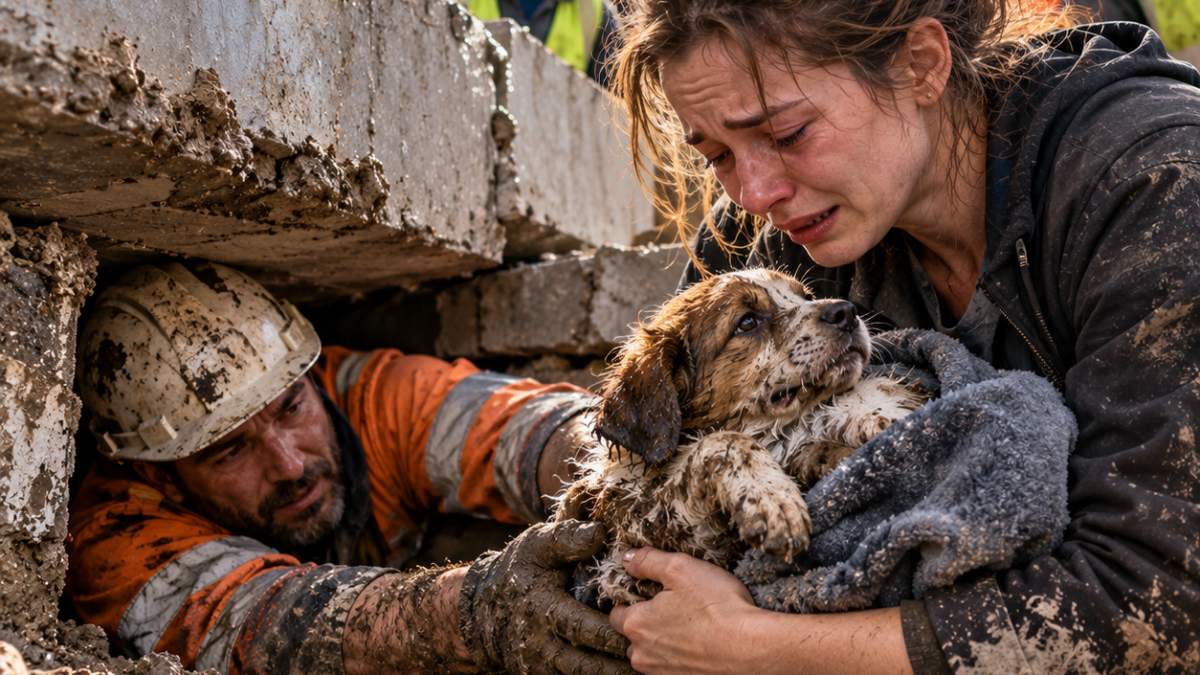
Luis placed him into the blanket in my arms, and the moment his body touched fabric, he collapsed completely.
His trembling ran through the blanket into my chest.
Not the normal shaking of a frightened dog.
Deep spasms.
Exhaustion moving through every bone.
I wrapped him close.
“Car,” I said. “Now.”
I do not remember shouting the words, but suddenly everyone around me was moving.
Luis cleared a path.
Someone grabbed my medical bag.
Another worker opened the passenger door of our rescue van.
I climbed inside with the puppy wrapped against my chest.
His entire body shook beneath the blanket. Mud clung to his face. Flies had left raw patches around his ears and hindquarters. The smell of stagnant water rose from him. When I touched his ribs, I could count every one.
Luis appeared at the door.
“Is he going to make it?”
I wanted to say yes.
Rescuers learn quickly not to make promises a wounded body may not be able to keep.
“I don’t know,” I said.
His face fell.
“But he’s alive. That matters.”
Luis nodded.
Then he reached slowly toward the puppy.
“Hey, little man.”
The puppy’s ear moved.
Luis swallowed hard.
“I’m sorry it took us so long.”
I saw tears in his eyes.
Before I could answer, our driver pulled away.
I kept one hand beneath the puppy’s head throughout the entire ride. Every few seconds, I checked his breathing.
Too shallow.
Too fast.
Then slower.
Each change terrified me.
“Come on,” I whispered.
His nose rested against my wrist.
“You fought for four days. Give me twenty more minutes.”
He could not understand the words.
But I kept talking anyway.
Sometimes a voice is all you can offer.
The veterinary clinic was waiting when we arrived.
Dr. Rebecca Lawson met us at the door with two technicians and a rolling table.
“How long submerged?”
“Not fully submerged,” I said. “Standing or lying in water. Possibly four days.”
“Eating?”
“Unknown.”
“Drinking?”
“We got a little water into him before extraction.”
She pulled back the blanket.
Her expression changed.
Not dramatically.
Dr. Lawson had seen terrible things.
But the tightening around her mouth told me enough.
“Treatment room,” she said.
They carried him away.
I followed until a technician stopped me.
“Let us work.”
The doors closed.
I stood in the hallway covered in mud.
My hands were shaking now.
For hours, I had focused on one problem.
Find him.
Reach him.
Lift the concrete.
Get him out.
Now there was nothing to lift.
Nothing to dig.
Nothing for my hands to do.
That helplessness was worse.
I sat against the wall.
Ten minutes later, Luis called.
“Anything?”
“Not yet.”
“He cried after you left.”
“What?”
Luis hesitated.
“Everybody went quiet. Nobody wanted to go back to work.”
I closed my eyes.
“What happened at that site, Luis?”
Another silence.
“I don’t know what you mean.”
“You said people had heard him for days.”
“We did.”
“Why didn’t somebody call sooner?”
“I thought somebody had.”
That sentence stayed with me.
You hear it in rescue work more often than you would believe.
I thought somebody had called.
I thought somebody else was helping.
I thought it wasn’t serious.
I thought the owner knew.
I thought animal control had been told.
Four days can grow out of thoughts like that.
“Who runs the site?” I asked.
“Our foreman.”
“Name?”
Luis did not answer immediately.
“Why?”
“Because a puppy nearly died under his concrete.”
“Sarah…”
“Just give me the name.”
“Colin Burke.”
“Did Colin know?”
The line became quiet again.
That was answer enough.
“Luis.”
“Yes.”
“Did he know?”
Finally, he whispered, “He knew we were hearing something.”
“For how long?”
“At least three days.”
My stomach hardened.
“And nobody called?”
“I told him we needed to stop moving slabs.”
“What did he say?”
Luis exhaled.
“He said there were stray dogs all over the industrial lots and that if we stopped every time somebody heard barking, nothing would get finished.”
I stood.
“He said that?”
“Sarah, please. I’m telling you because I feel terrible.”
“You should.”
I regretted the words immediately.
Luis had climbed into that hole.
He had risked himself reaching between unstable concrete to pull the puppy free. And from the way his voice shook, he had been carrying his own guilt long before I arrived.
“I’m sorry,” I said. “That wasn’t fair.”
“No. It was.”
“Did you see the puppy before today?”
“No. We couldn’t locate the opening until this morning.”
“But Colin knew something was trapped?”
“He knew we kept hearing it.”
“Did he ever look?”
“Not that I saw.”
I stared at the treatment-room doors.
Four days.
The words became heavier every time I repeated them.
A technician stepped into the hallway.
“Sarah?”
I hung up.
“How is he?”
“Alive.”
My knees almost gave out.
She continued before I could celebrate.
“But he’s in bad shape.”
Dr. Lawson came out a few minutes later. Mud stained one sleeve of her coat.
“He’s severely dehydrated,” she said. “Hypothermic. Weak. We’ve got fly-strike wounds around the rear legs and tail area, abrasions along the chest, and signs of prolonged stress.”
“Any fractures?”
“Nothing obvious on initial exam. We’ll image him when he’s stable enough.”
“Can he stand?”
“No.”
The word hit me harder than expected.
“Neurological?”
“Too soon to tell. Could be weakness, electrolyte imbalance, exhaustion, pain. We need bloodwork.”
“What are his chances?”
Dr. Lawson leaned against the counter.
“Better than they were in that hole.”
“That’s not an answer.”
“It’s the only honest one I have right now.”
I nodded.
She softened.
“He’s young.”
“How young?”
“Maybe ten to twelve weeks.”
Ten weeks.
A puppy still young enough to be learning what grass smelled like had spent four days pressed against concrete in filthy water.
“Has he eaten?”
“We’re going slowly.”
“Like refeeding?”
“Exactly. Tiny amounts. Controlled fluids. Warm him gradually.”
“Tests?”
“We’ve started the basic panel and infectious disease screening.”
I rubbed mud from my wrist.
“Can I see him?”
“For a minute.”
He looked even smaller on the treatment table.
A heating pad rested beneath him. Warm towels covered most of his body. An IV catheter had been taped to one front leg. Someone had carefully cleaned the mud from his face.
Without it, he looked younger.
His ears were too large for his head.
His paws were tiny.
His eyes followed the sound of the door.
I walked closer.
“Hey.”
He lifted his head perhaps half an inch.
Then dropped it.
“That’s okay.”
I sat beside the table.
“You don’t have to do anything.”
His nose moved.
I placed one finger near it.
He sniffed.
Then his tongue touched my skin.
Once.
Barely.
I laughed, and tears came at the same time.
Dr. Lawson stood behind me.
“Well.”
“What?”
“That’s more engagement than he gave us ten minutes ago.”
“He likes me.”
“He thinks you taste like construction mud.”
“I’m choosing my interpretation.”
She smiled.
“What are we calling him?”
I looked down.
He needed a name.
Not “the puppy.”
Not “the dog from the hole.”
Something that belonged to the life ahead of him instead of the place behind him.
“Milo,” I said.
Dr. Lawson repeated it.
“Milo.”
His ear twitched.
I smiled.
“See? He approves.”
“That or his ear itches.”
“Doctor, let me have this.”
Milo stayed overnight.
Then another.
His bloodwork was ugly but not catastrophic.
Severe dehydration.
Anemia.
Low blood sugar.
Abnormal electrolytes.
Evidence of infection around several skin lesions.
But the infectious disease tests we feared most came back negative.
No parvovirus.
No distemper.
No immediate sign of the devastating illnesses that often attack unvaccinated puppies.
When Dr. Lawson called with the results, I closed my eyes.
“Negative?”
“Negative.”
I sat down at my kitchen table.
“That’s the first good thing anyone has said to me in two days.”
“I can give you another.”
“What?”
“He stood.”
I was already reaching for my keys.
“For how long?”
“About three seconds.”
“That counts.”
“Apparently it counts enough that one of my technicians cried.”
“I’m coming.”
“Sarah.”
“Yes?”
“Drive like a sane person.”
Twenty minutes later, I walked into the clinic.
Milo was asleep.
“Where’s my standing dog?”
Technician Emma pointed at him.
“That dramatic fraud.”
I laughed.
“You said he stood.”
“He did. Then he looked at us like we’d demanded manual labor and collapsed back into his blankets.”
I crouched beside him.
“Milo.”
His tail moved.
I froze.
“Did you see that?”
Emma grinned.
“He’s been doing it.”
One small tap against the blanket.
Then another.
I put my hand over my mouth.
Two days earlier, the only movement I cared about was breathing.
Now a tail wag felt like fireworks.
Milo ate four teaspoons of soft food that afternoon.
Slowly.
Painfully slowly.
He wanted more.
Dr. Lawson refused.
“He has to rebuild safely.”
Milo licked the bowl until it squeaked across the floor.
“He disagrees,” I said.
“Patients often do.”
He looked toward the smell of the food container.
I scratched beneath his chin.
“More later.”
That became a phrase he learned very quickly.
More later.
More food later.
More water later.
More walking later.
More strength later.
His body had survived four days by shrinking its needs down to the smallest possible things.
A sip.
A breath.
A position where his nose stayed above water.
Now we could finally expand his world again.
But while Milo was learning to eat, something else was beginning outside the clinic.
The rescue video spread through town.
Someone had filmed the crane lifting the concrete.
Another person recorded Luis carrying Milo from the hole.
By the next morning, people were asking the same question I had asked.
How could a puppy cry for four days while dozens of people worked nearby?
I did not answer publicly.
I wanted facts first.
Luis called again.
“I think Colin knows I talked to you.”
“What happened?”
“He asked everybody who contacted rescue.”
“What did you say?”
“Nothing.”
“Are you worried about your job?”
A humorless laugh.
“You mean the job where we left a puppy under concrete for four days?”
“Luis.”
“I know. I know.”
He lowered his voice.
“There’s more.”
I stood.
“What?”
“Tuesday afternoon, I asked him to let us bring in the small excavator and search the drainage channel.”
“What did he say?”
“He told me we were behind schedule.”
“Did anybody else hear that?”
“Three guys.”
“Would they say so?”
“I don’t know.”
“Would you?”
Silence.
Then: “Yes.”
That mattered.
Not because I wanted revenge in the cinematic sense.
I did not want Colin trapped somewhere.
I did not want him hurt.
I wanted the opposite.
I wanted somebody to look at exactly what had happened and decide that a small life could not be ignored simply because saving it was inconvenient.
The next day, I contacted county animal control.
Officer Denise Walker met me at the clinic.
She photographed Milo’s wounds.
She took copies of his medical records.
Then she interviewed me for nearly an hour.
“How certain are you about the four days?”
“I wasn’t there.”
“Who reported it?”
“Multiple workers.”
“Names?”
I gave her Luis’s.
“He says the foreman knew?”
“Yes.”
“That’s different from knowing exactly where the animal was.”
“I understand.”
“Did anyone see Milo before the rescue day?”
“Not that I know.”
Denise closed her notebook.
“I’ll talk to them.”
“Will anything happen?”
“Maybe.”
“That doesn’t sound promising.”
“It sounds realistic.”
She looked through the clinic window at Milo.
“Cruelty cases require evidence. Bad judgment and criminal neglect aren’t automatically the same thing.”
“So somebody can hear an animal suffering for days and just ignore it?”
“I didn’t say that.”
“What did you say?”
“I said I need to prove what he knew and when he knew it.”
I nodded.
Anger can begin a case.
Evidence has to finish it.
Milo knew nothing about any investigation.
His biggest conflict was with the clinic scale.
On day four after rescue, Emma carried him into the exam room.
“Ready?”
“No,” I said.
“I was asking Milo.”
“He says no too.”
She set him down.
He stood.
Four legs.
No support.
His back end trembled.
I held my hands out but did not touch him.
“Come on.”
One second.
Two.
Three.
Four.
His front paws shifted.
His back legs almost folded.
Then he corrected himself.
“Good boy.”
He took one step.
Emma gasped.
Another.
Then he collapsed onto his belly.
I dropped beside him.
“That counts.”
Emma was crying.
“I hate this dog.”
“You’ve known him four days.”
“He’s emotionally manipulative.”
Milo licked the floor.
“He’s licking disinfectant residue.”
“He has poor judgment.”
“He spent four days in a hole.”
“Fair.”
He weighed just under eight pounds.
Small even for his age.
Dr. Lawson expected that with nutrition, he would probably become a medium-sized dog.
“He has a lot of growing left.”
That sentence made me happy.
Growing meant future.
The first week was mostly sleep.
Milo would eat.
Drink.
Walk five or six steps.
Then sleep as if those movements had required a marathon.
His wounds had to be cleaned daily.
The fly-strike damage was painful.
He cried during the first treatment.
Not the same cry from beneath the concrete.
This one was sharper.
Angry.
Alive.
I held him while Emma cleaned around his tail.
“I know, baby.”
He tried to climb into my shirt.
“I know.”
Emma worked quickly.
“This is the worst area.”
“Are there maggots?”
“We removed everything we found.”
I swallowed.
“How bad would another day have been?”
She stopped.
“You don’t want that answer.”
“Yes, I do.”
Emma looked at me.
“Another day in water with open wounds, dehydration, and fly strike?”
She shook her head.
“Maybe he wouldn’t have had another day.”
I looked down at Milo.
He had stopped struggling.
His head rested against my chest.
That was when the anger returned.
Not loud.
Focused.
Someone had known.
Maybe not exactly how deep the hole was.
Maybe not exactly how small the puppy was.
But people had known an animal was crying.
And one man with the authority to stop the work had apparently decided production mattered more.
Denise called that evening.
“I interviewed six workers.”
“And?”
“Four confirm hearing the puppy or an unidentified animal for at least two days before rescue.”
“Only two?”
“Two personally heard it longer.”
“What about Colin?”
“He says he believed the sounds were coming from stray animals outside the site.”
“Luis told him to search.”
“He acknowledges Luis raised a concern.”
“And?”
“He says he checked the visible perimeter and found nothing.”
I laughed once.
“Did he?”
“I’m investigating.”
“What does that mean?”
“It means there are cameras on the site.”
I became still.
“Cameras?”
“Security cameras.”
“Did you get the footage?”
“The company says their system overwrites after seventy-two hours.”
My heart sank.
“So the first days are gone.”
“Maybe.”
“What does maybe mean?”
“It means one worker says the project manager sometimes downloads clips when there are equipment incidents.”
I understood.
“There was an equipment incident.”
“Tuesday morning. Forklift damage.”
“And a clip might exist.”
“Correct.”
“Denise…”
“I’m working on it.”
I wanted to push.
I did not.
She was doing exactly what I needed her to do.
Milo came home with me nine days after the rescue.
Technically, I was fostering him.
Emotionally, that distinction had already become ridiculous.
I prepared my spare bathroom first because it was easy to clean and warm.
Soft bed.
Shallow water bowl.
Food dish.
Puppy pads.
A small pen.
Three blankets.
Six toys, though he had never shown interest in any toy.
Emma inspected the photograph I sent.
“You know he’s one puppy, right?”
“He deserves options.”
“He can barely walk across the room.”
“Then all six options need to be nearby.”
Milo entered my house wrapped in the same type of blanket we had used at the construction site.
The difference was that now his head stayed up.
His eyes moved.
His nose worked constantly.
I placed him gently on the floor.
“Welcome home.”
He took three steps.
Stopped at the edge of a bath mat.
Sniffed it.
Then urinated directly beside the puppy pad.
I stared.
He stared back.
“Excellent beginning.”
His tail wagged.
“You’re not sorry.”
That night, I put his bed beside my sofa because I did not want him alone.
At eleven, he slept.
At midnight, he slept.
At 1:17 a.m., he screamed.
I bolted upright.
“Milo!”
He was trying to stand. His paws scrambled against the blanket. His eyes were wide.
I reached him.
“Hey. Hey. You’re okay.”
He fought my hands for a second.
Then recognized my voice.
His body went limp.
I held him against my chest.
His heart pounded.
Nightmare.
Maybe.
Nobody can know exactly what a dog dreams.
But I knew what his body remembered.
Darkness.
Water.
No space to move.
I turned on a lamp.
“Look.”
He buried his nose beneath my chin.
“No concrete.”
I walked around the room with him.
“See?”
He did not see the meaning.
But he heard calm.
I touched his paws to the dry floor.
“Dry.”
Then his bed.
“Warm.”
Then I put him down.
He immediately climbed onto my foot.
I sighed.
“So I’m the bed now.”
He curled against my ankle.
I slept sitting on the floor that night.
The nightmares came for weeks.
Less often each time.
A sound would trigger him.
Concrete scraping from roadwork outside.
A metal trash can dropping.
Thunder.
Water splashing unexpectedly.
He would freeze.
Sometimes tremble.
Then look for me.
I developed a ritual.
“Milo.”
Eye contact.
“You’re here.”
Hand to chest.
“Safe.”
I do not know when those words began meaning something to him.
But eventually, he stopped panicking as soon as he heard them.
You’re here.
Safe.
His appetite became outrageous.
At first, every meal was controlled according to veterinary instructions. Milo considered this a violation of constitutional law.
He would finish his portion and sit beside the bowl.
Then stare.
“Milo.”
Stare.
“You ate.”
Stare.
“Your doctor said no more.”
Stare.
“You don’t pay the vet bills.”
Tail wag.
“You have no money.”
Faster wag.
“You’re trying emotional blackmail.”
He put one paw on my foot.
“Unbelievable.”
I gave him nothing extra.
Mostly.
His body changed quickly.
The bones along his spine became less visible.
His belly filled out.
His coat, once rough and stained, began to soften.
The wounds healed beneath clean pink skin.
And those trembling legs became steadier.
Two weeks after coming home, he ran for the first time.
It was an accident.
I opened the refrigerator.
A piece of cooked chicken slipped from my fingers and landed three feet away.
Milo saw it.
The puppy who had needed both hands supporting his belly ten days earlier launched himself across the kitchen.
“Hey!”
He skidded.
Grabbed the chicken.
Spun.
Then sprinted behind a chair.
I froze.
He froze.
Chicken hanging from his mouth.
“Milo.”
His tail wagged.
“That was mine.”
He swallowed.
I laughed so hard I had to lean against the counter.
“You ran.”
Milo looked around for additional chicken.
“You actually ran.”
I dropped to my knees.
“Come here.”
He ran again.
Straight into my arms.
I buried my face against his neck.
“You did it.”
For perhaps ten seconds, the concrete hole disappeared from my mind completely.
There was only a puppy.
Running.
Stealing food.
Acting ridiculous.
Exactly what a puppy should be doing.
Then my phone rang.
Denise.
I answered.
“We found the video,” she said.
My smile vanished.
“What video?”
“The construction site.”
“How much?”
“Enough.”
She asked me to meet her at the animal control office the next morning.
When I arrived, Luis was already there.
He looked exhausted.
“You okay?” I asked.
He nodded.
“Colin fired me.”
“What?”
“Yesterday.”
“Why?”
“Officially? Safety violations.”
“You?”
He gave a bitter laugh.
“I’m the safety violation.”
Denise came into the room.
“Sit.”
She opened a laptop.
The footage had no audio.
The timestamp showed Tuesday, three days before Milo’s rescue.
A wide security camera captured the concrete storage area.
Workers moved through the frame.
Forklift.
Truck.
Luis appeared.
He stopped.
Turned his head.
Then walked toward the slabs.
He crouched.
Another worker joined him.
They looked around.
Then Colin entered.
I recognized him from a company website photograph Denise had shown me.
Tall.
Heavyset.
Bright safety vest.
Luis pointed toward the concrete.
They spoke.
Colin looked down once.
Then waved his hand.
Luis shook his head.
Colin pointed toward the active construction area.
A minute later, everyone returned to work.
“That proves he knew we heard something,” Luis said.
Denise nodded.
“Keep watching.”
Twenty minutes later, Luis returned alone.
He crouched beside the slabs with a flashlight.
Then Colin appeared again.
This time, the body language was clearer.
Colin pointed away from the area.
Luis argued.
Colin stepped close.
Pointed toward the job trailer.
Luis finally left.
I looked at him.
“What did he say?”
Luis rubbed both hands across his face.
“He told me if I stopped work again over a stray dog, I could clock out and not come back.”
My jaw tightened.
Denise played another clip.
Wednesday.
Two days before rescue.
A worker approached Colin.
Pointed toward the same slabs.
Colin shook his head.
Then did something that made my stomach drop.
He directed a forklift operator to move another concrete section beside the area.
Not over the opening.
But closer.
“You’ve got to be kidding me,” I whispered.
Denise paused the video.
“The movement did not appear to trap Milo further, according to the rescue layout.”
“That’s not the point.”
“I know.”
“He heard something trapped and kept stacking concrete.”
“We still need to establish exactly what he believed.”
Luis leaned forward.
“I told him it sounded like a puppy.”
Denise looked at him.
“Those exact words?”
“Yes.”
“When?”
“Tuesday afternoon.”
“You’ll testify to that?”
“Yes.”
“Even after being fired?”
“Especially after being fired.”
I looked at him.
“Luis.”
He turned.
“You tried.”
“Not enough.”
“You challenged your supervisor.”
“I went home Tuesday night.”
His eyes filled.
“I went home and ate dinner while that puppy was still under there.”
“You didn’t know where he was.”
“I knew he was crying.”
His voice cracked.
“My daughter asked me why I looked upset. I told her there was probably an animal stuck at work.”
He swallowed.
“She said, ‘Then why don’t you help it, Dad?’”
Nobody spoke.
Luis looked toward the floor.
“I didn’t have an answer.”
The county opened a formal investigation into the site.
Construction temporarily paused around the drainage area while inspectors examined how the cavity had been created.
They found something else.
The opening Milo had fallen into should not have been accessible.
A temporary barrier required under the site safety plan had been removed two weeks earlier.
Not by Colin personally.
But under his supervision.
Why?
Workers needed quicker forklift access.
Replacing the barrier had been listed as “pending.”
That single word made me furious.
Pending.
Milo had almost died inside a hole created by somebody’s pending task.
The company reacted exactly as companies often do when a small problem becomes publicly visible.
They released a statement.
They were “deeply concerned.”
They “valued animal welfare.”
They were “cooperating fully.”
They emphasized that employees had ultimately participated in Milo’s rescue.
All of that was technically true.
None of it mentioned four days.
None of it mentioned workers being told to keep working.
None mentioned Luis losing his job.
I did not want to become the public face of a fight.
I wanted to take care of Milo.
But sometimes the two become connected.
A local reporter called.
“Can you describe the rescue?”
“Yes.”
“Do you blame the company?”
“I blame every decision that allowed suffering to continue after people knew something was wrong.”
“Do you blame Colin Burke personally?”
“I’m not the investigator.”
“Do you think he should be charged?”
“I think the evidence should decide that.”
“What do you want people to learn?”
I looked across my living room.
Milo was attacking a sock.
“That a life doesn’t become worthless because helping is inconvenient.”
That sentence made the evening news.
Colin saw it.
I know because he called me.
I did not recognize the number.
“Sarah Mitchell?”
“Yes?”
“This is Colin Burke.”
Every muscle in my body tightened.
“How did you get my number?”
“Your rescue office gave me the public contact line. They transferred me.”
“What do you want?”
“To tell you you’ve got this wrong.”
I sat down.
“Which part?”
“You’re making it sound like I knew a dog was down there.”
“Did Luis tell you he heard a puppy?”
“He said he heard something.”
“That’s not what he says.”
“Luis is angry because he got fired.”
“Did you fire him?”
“He violated procedures.”
“After the rescue?”
“He had prior issues.”
“Did you tell him to stop looking?”
Silence.
“Colin?”
“We were operating a job site.”
“That isn’t an answer.”
“You don’t understand construction.”
“No,” I said. “I understand puppies.”
He exhaled sharply.
“There are stray dogs around there constantly.”
“And this one was crying from under your concrete.”
“We didn’t know that.”
“Did you check?”
“We looked.”
“Who?”
“I did.”
“When?”
Another pause.
I knew Denise had told me not to turn myself into an investigator.
So I stopped.
“You should speak to animal control.”
“I already have.”
“Then why are you calling me?”
His voice lowered.
“Because you’ve got people treating me like I put that dog in the hole.”
“I never said you did.”
“That’s what everybody thinks.”
“Then tell the truth and let the facts speak for you.”
“You think you’re some hero because you carried him out?”
I became very calm.
“No.”
“Everybody online thinks so.”
“I didn’t pull him from the hole. Luis did.”
He went quiet.
That name bothered him.
I continued.
“And you know what the strange thing is, Colin?”
“What?”
“If you had stopped the work Tuesday, brought in equipment, and helped rescue him, nobody would be angry with you now.”
He said nothing.
“You could have been the man who saved him.”
Still nothing.
“Instead, you chose a deadline.”
He hung up.
I stared at the phone.
Milo dropped the sock and walked toward me.
I picked him up.
“You have terrible timing.”
He licked my chin.
“Also terrible breath.”
His life kept expanding while the case moved slowly.
Week three after rescue, he discovered stairs.
I nearly had a heart attack.
I had installed a gate.
Milo discovered that the gate was not properly latched.
I heard a noise behind me.
Turned.
He was halfway up.
“Milo!”
He froze.
One paw lifted.
“Do not move.”
Tail wag.
“Seriously.”
He climbed another step.
I ran over.
“You have had functioning legs for approximately nine days.”
He tried climbing past me.
“Absolutely not.”
I carried him down.
He immediately walked back toward the stairs.
I corrected the gate.
He sat in front of it.
Thinking.
That worried me.
Week four, he discovered the yard.
Dr. Lawson finally cleared him for short outdoor sessions.
The first time I placed him on grass, he stood completely still.
Wind touched his ears.
His nose lifted.
Birds.
Soil.
Leaves.
Sunlight.
A world that did not smell like stagnant water or concrete.
“Go ahead.”
Milo took one step.
Then another.
He lowered his face and sniffed the grass intensely.
Then sneezed.
I laughed.
He looked offended.
“Sorry.”
He sneezed again.
Then suddenly began running.
Not gracefully.
Not in a straight line.
He bounced.
A ridiculous puppy sprint where the back legs seemed slightly faster than the front.
He ran toward me.
Past me.
Around a lawn chair.
Back across the yard.
I started laughing before the tears came.
“Slow down!”
Milo did not slow down.
For almost two minutes, he ran until exhaustion caught up with him.
Then he collapsed in the grass.
For one terrible fraction of a second, my old fear returned.
I rushed toward him.
He rolled onto his back.
Tail wagging.
Tongue out.
Happy.
I sat beside him.
“You scared me.”
He bit gently at my sleeve.
“Four weeks ago, you couldn’t stand.”
He kicked his legs.
“You’re showing off now.”
I lay down in the grass next to him.
For the first time since meeting him, I allowed myself to imagine years instead of days.
Birthdays.
Training classes.
Chewed shoes.
Vet appointments.
Gray fur.
An old dog sleeping beside my bed.
I wanted all of it.
That frightened me.
Fostering animals teaches you that love and permanence are not always the same thing.
I had fostered twenty-seven dogs.
I had cried every time one left.
Then I watched them go into wonderful homes and remembered that letting go allowed me to save the next one.
Milo was supposed to be number twenty-eight.
I knew that.
My rescue director, Karen, knew that.
Apparently Milo did not.
He followed me everywhere.
Bathroom.
Kitchen.
Laundry room.
If I closed a door, he sat outside it.
If I sat down, he touched me.
One paw.
One shoulder.
His chin on my foot.
Physical confirmation that I was still there.
Karen visited one afternoon.
Milo climbed into my lap.
She watched him.
“You’re in trouble.”
“I know.”
“He’s adoptable soon.”
“I know.”
“We already have applications.”
I looked at her.
“You do?”
“Eighteen.”
My stomach twisted.
“That’s good.”
“You said that like someone informed you of a dental procedure.”
“I’m happy.”
“Sure.”
Milo fell asleep against me.
Karen folded her arms.
“You want him?”
“I foster.”
“That was not my question.”
“I’m useful as a foster.”
“You can foster another dog eventually.”
“He needs a good family.”
“He seems to think he has one.”
I looked down.
“Karen.”
“Sarah.”
“I can’t keep every dog.”
“No.”
“What happens when the next special one comes?”
“You make a decision then.”
I stroked Milo’s ear.
“He’s young. Somebody with kids might be perfect.”
“Maybe.”
“Or another dog.”
“Maybe.”
“A yard.”
“You have a yard.”
“You’re not helping.”
“I’m not trying to.”
I did not fill out an adoption application.
Not yet.
I told myself I was being responsible.
Then the first meet-and-greet was scheduled.
A young couple named Amanda and Jake came on Saturday.
They were kind.
Patient.
They sat on the floor and let Milo approach.
He sniffed Amanda.
Accepted treats from Jake.
Played with a rope toy.
They asked excellent questions.
“What scares him?”
“Loud scraping noises. Sudden splashing sometimes.”
“Does he sleep in a crate?”
“We’re working on it.”
“House-trained?”
I laughed.
“He is passionately opposed to consistency.”
They smiled.
Everything about them was right.
I hated them.
Not really.
But emotionally, absolutely.
At the end, Amanda said, “He’s incredible.”
“He is.”
“We’d love to adopt him.”
My chest tightened.
Karen answered before I had to.
“We’re reviewing applications this week.”
After they left, Milo walked to the front door.
Sniffed.
Then turned toward me.
I sat on the floor.
“You liked them.”
He climbed into my lap.
“They’re good people.”
His nose pushed beneath my arm.
“You could have a great life.”
He curled against me.
“You are making this very difficult.”
That evening, he had another nightmare.
He woke whining.
I touched him.
“You’re here.”
He opened his eyes.
“Safe.”
His breathing slowed.
Then he fell asleep with his nose against my palm.
I stayed awake.
At 2:13 a.m., I emailed Karen.
Subject: Milo.
Message:
I’m adopting him.
Karen replied at 6:02.
I know.
I stared at the screen.
Then typed:
I hate you.
She responded:
Fill out the paperwork.
I did.
Milo officially became mine forty-three days after we pulled him from the hole.
The rescue charged me the standard adoption fee.
I complained.
“I have spent more on this dog’s chicken than the adoption fee.”
Karen handed me the receipt.
“Policy.”
“I paid for his orthopedic bed.”
“Policy.”
“He sleeps in my bed.”
“Your poor choices are not a rescue expense.”
I signed.
Then she gave me his tag.
MILO MITCHELL.
I stared at it.
A name.
A home.
A family.
Six weeks earlier, the only thing attached to him had been mud and flies.
Now he had an address.
I clipped the tag to his collar.
It jingled.
He tried to bite it.
“Very meaningful moment ruined immediately.”
Karen laughed.
“Congratulations.”
I crouched.
“Milo.”
He looked at me.
“You’re stuck with me.”
His tail exploded.
The investigation was still unresolved.
Luis found another job.
Lower pay at first, but with a smaller contractor.
His new supervisor had seen the rescue story. During the interview, he told Luis, “If you ever stop one of my sites because an animal or a person is in danger, I’ll buy the coffee while we wait.”
Luis called me afterward.
“I think I’m okay.”
“You are.”
“My wife disagrees. She says I’m unbearable now.”
“Why?”
“I check every drain opening twice.”
“Good.”
His daughter, Sofia, met Milo a month later.
She was nine.
When Luis told her this was the puppy from his work site, she knelt.
Milo walked toward her immediately.
Sofia hugged him.
Then she started crying.
“Dad said he was dying.”
“He almost did.”
She looked at Milo.
“Does he remember?”
“I don’t know.”
“Does he hate Dad because Dad didn’t save him sooner?”
Luis looked away.
My heart broke for him.
I crouched beside Sofia.
“No.”
“How do you know?”
“Because your dad is the person who reached into the hole and lifted Milo out.”
She looked at her father.
“You did?”
Luis nodded.
Sofia stood and hugged him.
That moment mattered more than any punishment I could imagine.
Luis had carried guilt like a stone.
Milo gave him something else to carry.
A second chance.
Colin’s situation went in the opposite direction.
County inspectors cited the construction company for several site-safety violations connected to the unsecured cavity and missing barrier.
The company initially defended Colin.
Then additional internal messages surfaced.
One worker had saved screenshots from the site group chat.
Tuesday, 10:18 a.m.
Luis: Still hearing animal crying near east concrete storage. Need permission to stop and inspect.
Another worker: Sounds under slabs.
Colin: Keep production moving. We checked yesterday.
Luis: I don’t think anyone checked underneath.
Colin: We are not renting equipment for a stray.
I read that line three times.
We are not renting equipment for a stray.
The crane used for Milo’s rescue had cost less than one hour of the site’s full crew and equipment operations.
That was what his life had been reduced to.
An expense line.
Another message appeared Wednesday morning.
Worker: Still hearing it.
Colin: If it can get in, it can get out.
But Milo could not.
That sentence became important because it contradicted Colin’s later claim that he had not believed an animal was trapped.
The company fired him.
He blamed Luis.
Then he blamed me.
Then he blamed social media.
But evidence has a way of becoming inconvenient when you have spent weeks blaming everyone except yourself.
Animal control forwarded the case to prosecutors.
I was warned the legal outcome might disappoint people.
“This isn’t going to be prison,” Denise told me.
“I know.”
“The strongest case is neglect by omission, and statutes vary.”
“I understand.”
“He didn’t put Milo into the hole.”
“We don’t know that.”
“We have no evidence he did.”
“Then we shouldn’t claim it.”
Denise nodded.
“Exactly.”
“What do you want?”
I looked at Milo sleeping beneath my chair.
“I want him never to be able to look at a suffering animal again and tell people production matters more.”
“That I understand.”
Months passed.
Milo grew.
His ears grew first.
Then his legs.
Then apparently the rest of him tried to catch up.
At five months old, he was twenty-eight pounds.
At seven months, thirty-nine.
Dr. Lawson laughed during one appointment.
“Remember when we could hold him with one hand?”
“Unfortunately.”
Milo put both paws on the exam table.
“He’s going to be around forty-five pounds.”
“You told me medium.”
“That is medium.”
“He occupies an entire sofa.”
“Emotional size is not medically recognized.”
His wounds healed so completely that only small areas of thin fur remained.
His fear of water took longer.
Baths were impossible.
The first time I tried, he heard the tub filling and ran.
I found him behind my bed.
Shaking.
I turned the water off.
Immediately.
I sat on the floor several feet away.
“Milo.”
He would not look at me.
“Okay.”
I did not pull him out.
I did not force him.
For the next week, I gave him treats in the dry bathroom.
Then beside the empty tub.
Then inside the empty tub.
No water.
Week by week.
Eventually, I put a damp towel under his paws.
He froze.
Treat.
The next day, slightly wetter.
Treat.
It took nearly three months before he tolerated shallow warm water touching his feet.
When he did, I nearly cried.
“Good boy.”
Milo looked offended but stayed.
“No hole.”
His ears moved.
“No cold water.”
I washed one paw.
“Safe.”
By his first birthday, he would step into the tub willingly.
He never loved baths.
Some traumas do not need to turn into favorite activities.
Tolerating them safely was enough.
The court hearing finally happened almost eight months after the rescue.
I attended because I had been subpoenaed as a witness regarding Milo’s condition and extraction.
Colin sat beside his attorney.
He looked different from the construction site photograph.
Smaller somehow.
Not physically.
The certainty was gone.
Luis testified first.
He described hearing the cries.
Reporting them.
Being told not to stop work.
Colin’s attorney attacked his credibility.
“You were fired by Mr. Burke.”
“Yes.”
“You resent him.”
“I resent what happened.”
“That wasn’t my question.”
Luis looked at Colin.
“Then yes.”
The attorney smiled slightly, as if he had scored a point.
Luis continued before he could stop him.
“But I was afraid of him before I was angry with him. That’s why I didn’t do enough.”
The courtroom became silent.
The attorney frowned.
Luis’s voice shook.
“I should have called rescue myself Tuesday. I should have called animal control. I should have walked off that job. I didn’t.”
He looked toward me.
“And that puppy suffered two more days because I thought my boss got the final say.”
There was no defense against a man who admitted his own failure.
Luis did not make himself a hero.
That made him believable.
Denise testified about the video.
The group messages.
The missing barrier.
The timeline.
Then I testified.
The prosecutor showed a photograph of Milo taken seconds after rescue.
Mud covering his body.
Eyes half closed.
Limbs trembling.
I hated that photograph.
“What happened when the puppy was removed?”
“He collapsed.”
“Could he walk?”
“No.”
“Could he stand?”
“No.”
“Describe his condition.”
I took a breath.
“His body was cold. He was severely weak. There were flies around open wounds. His coat was soaked with muddy water. He had been crying before extraction, but once we got him out, he barely had the energy to make noise.”
The prosecutor displayed another photograph.
Milo in the clinic.
IV line.
Blankets.
“Did you believe he might die?”
“Yes.”
“What did the veterinarian tell you?”
“That another day could have killed him.”
Colin looked down.
His attorney stood.
“Ms. Mitchell, you are not a veterinarian.”
“No.”
“You cannot medically determine exactly how long the puppy had been trapped.”
“No.”
“You did not personally hear him four days earlier.”
“No.”
“You did not personally inform my client.”
“No.”
“You did not see my client harm this puppy.”
“No.”
He paused.
“So much of what you know about events before Friday came from other people.”
“Yes.”
He nodded as if finished.
Then I added, “Which is why I’m not here to testify about what happened Tuesday.”
He stopped.
The prosecutor looked at me.
I continued.
“I’m here to tell you what was waiting at the end of those decisions Friday.”
The defense objected.
The judge sustained part of it.
But the words had already landed.
Colin eventually testified.
His lawyer asked him whether he intended for Milo to suffer.
“No.”
“Did you know there was definitely a puppy under the concrete Tuesday?”
“No.”
“What did you believe?”
“That there were stray animals around the property.”
“Did you believe an animal was trapped?”
“Not at first.”
“At what point did you realize that was possible?”
Colin shifted.
“Thursday.”
I stared at him.
Thursday.
A full day before we arrived.
His attorney paused.
“What did you do Thursday?”
“I had workers look around.”
“Did they find the puppy?”
“No.”
“Did you know how to safely move the concrete?”
“No.”
“Were you concerned that moving it could cause a collapse?”
“Yes.”
Reasonable answers.
For a moment, I understood the defense.
Then the prosecutor stood.
“You realized Thursday an animal might be trapped.”
“Yes.”
“You had access to cranes through multiple vendors?”
“I would have had to arrange one.”
“But access existed.”
“Yes.”
“You had the telephone number for animal control?”
“I assume so.”
“You had emergency services?”
“Yes.”
“Local rescue organizations?”
“I guess.”
“Did you call any of them?”
“No.”
“Why?”
Colin’s jaw tightened.
“I didn’t think it was necessary.”
The prosecutor lifted a printed message.
“Thursday, 2:41 p.m. A worker writes: ‘Crying is weaker now.’ Correct?”
“Yes.”
“You responded: ‘Finish the pour. We’ll deal with it tomorrow.’ Correct?”
Colin stared at the paper.
“Yes.”
I felt all the air leave my lungs.
I had never seen that message.
Finish the pour.
We’ll deal with it tomorrow.
Milo had been dying beneath the concrete while someone scheduled his suffering for tomorrow.
The prosecutor let the silence remain.
Then asked one final question.
“If rescue had not arrived Friday morning, when exactly were you planning to deal with it?”
Colin did not answer.
“Mr. Burke?”
“I don’t know.”
That was the entire case in three words.
I don’t know.
The court did not sentence Colin to some dramatic decade in prison.
Real justice rarely looks like the stories people imagine online.
He received probation, fines, community service requirements, and restrictions connected to animal care under the negotiated disposition. The company separately faced regulatory penalties and civil costs related to the site violations. The judge also ordered restitution toward Milo’s emergency veterinary treatment.
Before sentencing, Colin was allowed to speak.
He stood.
For the first time, he looked directly at me.
Then at Luis.
“I made the wrong call.”
Nobody moved.
“I thought we were dealing with a stray animal that would move on.”
The prosecutor started to object to minimizing language.
The judge allowed him to continue.
Colin swallowed.
“When it became clear something might actually be trapped, I still kept thinking about the schedule.”
His voice grew quieter.
“I told myself we would handle it after the work was done.”
He looked toward the photograph of Milo on the evidence screen.
“I didn’t understand what four days meant to something that small.”
My hands clenched.
Part of me wanted to hate him.
Another part wanted to understand how ordinary thinking becomes cruelty.
Not because he woke up wanting to torture a puppy.
Because he kept postponing compassion.
Later.
Tomorrow.
After the pour.
After the deadline.
After someone else handles it.
A life can die while people are saying later.
The judge addressed him directly.
“You had multiple opportunities to make a different decision.”
“Yes, Your Honor.”
“And each time?”
Colin looked down.
“I chose work.”
“That is the conduct before this court.”
When it ended, Luis and I walked outside together.
Reporters waited near the steps.
I wanted nothing to do with them.
Luis stopped.
“It’s over?”
“Mostly.”
He nodded.
“I thought I’d feel better.”
“Me too.”
He looked at me.
“Do you?”
I considered it.
“A little.”
“Not enough?”
“No punishment gives Milo those four days back.”
Luis rubbed his hands together.
“What does?”
“Nothing.”
He looked disappointed.
I continued.
“But he got every day after them.”
That was the part I cared about.
Colin lost his job.
The company lost money.
The court entered a judgment.
Those were consequences.
But they were not the revenge people expected when they heard Milo’s story.
The real revenge happened every morning at 6:15.
Milo jumped onto my bed.
Forty-five pounds of recovered puppy landed directly on my ribs.
I would gasp.
“Milo!”
Tail wag.
“You were almost dead once. Why are you trying to kill me now?”
He would lick my face.
The real revenge happened when he discovered sprinklers.
For months, water had terrified him.
Then one summer afternoon, Luis and Sofia visited. Sofia turned on the backyard sprinkler.
Milo froze.
Water hissed through the grass.
I watched his body become rigid.
“Milo.”
His eyes went to me.
“You’re here.”
He took one step.
“Safe.”
Sofia stood completely still.
The sprinkler rotated.
Water touched Milo’s front paws.
He jumped backward.
Then stared at it.
The sprinkler moved away.
Came back.
This time he did not retreat.
Water hit his chest.
He shook.
Then something changed.
He opened his mouth.
Tried to bite the water.
Sofia laughed.
Milo lunged.
The sprinkler rotated.
He chased it.
Within thirty seconds, the dog who once trembled at the sound of bathwater was racing through the yard trying to attack a stream of water.
Luis covered his face.
I looked at him.
“You okay?”
He nodded.
No.
He was crying.
So was I.
Sofia shouted, “Dad, look!”
“I’m looking.”
Milo ran directly through the spray.
Water covered his body.
He shook it off.
Then ran back for more.
That was revenge.
Cold water had once trapped him.
Now he chased water because it was fun.
Darkness had once meant nobody was coming.
Now he slept with the lights off because he knew exactly where he was.
Human voices had once drifted above him while he cried.
Now voices meant dinner, walks, toys, and people fighting over who got to pet him first.
He had not simply survived the hole.
He had taken everything the hole represented and turned it into something else.
Milo became surprisingly gentle with frightened dogs.
I resumed fostering after almost a year.
The first foster was a small black puppy named Daisy who had been found under an abandoned porch.
She was terrified of people.
For two days, Daisy stayed inside a crate with the door open and refused to approach me.
Milo lay outside.
Not touching her.
Not demanding anything.
Just there.
On the third morning, I found Daisy asleep with her nose pressed through the crate bars against Milo’s paw.
I stared.
“Milo.”
He opened one eye.
“You’re doing my job.”
Tail thump.
The following evening, Daisy followed him into the kitchen.
Then into the yard.
Then onto the sofa.
She learned safety through him before she learned it through me.
Over the next four years, Milo helped me foster thirty-two dogs.
Puppies.
Old dogs.
Injured dogs.
Dogs afraid of men.
Dogs afraid of doors.
Dogs who had never lived indoors.
He greeted each one differently.
Some needed play.
Some needed space.
Some needed another body sleeping nearby.
Milo seemed to understand.
Maybe I was projecting.
Maybe not.
I stopped worrying about which.
Good happened either way.
Luis became part of our lives.
Every year on Milo’s rescue anniversary, he came over with Sofia.
The first year, Sofia brought a dog-safe cake. Milo ate his portion in three seconds and tried stealing hers.
The second year, they brought a blue rubber toy shaped like a crane.
I stared at Luis.
“That is deeply inappropriate.”
He laughed.
“Sofia picked it.”
Milo loved it.
For months, he carried the crane around the house.
Life has a strange sense of humor.
On the third anniversary, Luis handed me an envelope.
“What’s this?”
“Open it.”
Inside was a photograph.
The construction site.
But completely different.
The drainage area had been rebuilt.
Proper covers.
Steel barriers.
Warning signs.
A small plaque had been installed on one fence.
It did not mention Milo by name.
It simply read:
CHECK FIRST. A LIFE MAY DEPEND ON IT.
I looked at Luis.
“Who did that?”
“The crew.”
“Your old company?”
“New management.”
“You’re serious?”
He nodded.
“After everything, they changed procedure. Any report of an animal trapped in a work area requires immediate shutdown and inspection.”
I stared at the photograph.
“That came from Milo?”
“Partly.”
“Partly?”
Luis smiled.
“I wouldn’t give him all the credit. Unions and safety officers enjoy paperwork.”
I looked down at Milo.
He was asleep beside Sofia’s shoes.
A puppy nobody wanted to stop production for had changed a company policy.
That mattered.
Years later, I saw Colin again.
It happened at a hardware store.
I was buying fencing material for foster dogs.
Milo was with me.
Older now.
Gray beginning around his muzzle.
Still strong.
Still convinced every stranger existed solely to admire him.
I heard a man say, “Sarah.”
I turned.
Colin stood several feet away.
He looked older too.
For a moment, neither of us moved.
Milo noticed him.
Tail wag.
Of course.
Milo had no concept of grudges.
Colin looked down.
“That’s him?”
“Yes.”
He stared.
“He got big.”
“Forty-seven pounds.”
“I thought he was going to stay tiny.”
“So did my furniture.”
Colin almost smiled.
Then the expression disappeared.
“Can I…”
He stopped.
“Can you what?”
“Pet him?”
I looked at Milo.
Then back at Colin.
Years earlier, the question would have made me furious.
Now I felt something quieter.
Milo did not belong to my anger.
“He decides.”
Colin crouched several feet away.
Held out one hand.
Milo sniffed.
Walked closer.
Then put his head beneath Colin’s palm.
Colin froze.
His fingers touched Milo’s fur.
I watched his face.
He was crying before he realized it.
“I’m sorry,” he whispered.
Milo leaned harder into his hand.
Because dogs do not understand courtroom records.
They do not understand deadlines.
They do not understand the moral weight of somebody’s failure.
Milo understood only that a human hand was touching him gently now.
Colin looked at me.
“He doesn’t know.”
“No.”
“He should hate me.”
“That isn’t how he works.”
Colin wiped his face.
“I think about that week all the time.”
I said nothing.
“My brother owned a dog when we were kids. Got hit by a car. I carried him three miles.”
The confession surprised me.
“I loved that dog.”
“Then why, Colin?”
He looked at Milo.
“I don’t know.”
“No. You do.”
His face tightened.
I waited.
Finally, he said, “Because work had become the thing I used to measure everything.”
I said nothing.
“If it slowed the project, it was a problem. If it cost money, it was a problem. If somebody questioned me, they were a problem.”
He looked at me.
“And a crying animal became another problem.”
“That almost killed him.”
“I know.”
“I need you to understand that forgiveness from me doesn’t matter.”
“I’m not asking.”
“Good.”
He nodded.
“I volunteer now.”
That caught me off guard.
“Where?”
“County shelter. Kennel cleaning mostly.”
I stared.
“Denise knows?”
“She’s the one who suggested it after my court hours ended.”
Of course she had.
“How long?”
“Two years.”
Milo sat on Colin’s shoe.
Colin laughed softly.
“Apparently I can’t leave.”
“No.”
Milo leaned against his leg.
Colin scratched his neck.
“I don’t deserve this.”
I answered without thinking.
“He isn’t doing it because you deserve it.”
Colin looked up.
“He’s doing it because that’s who he is.”
That was the last thing I ever needed Colin to understand.
Milo’s kindness was not absolution.
It belonged to Milo.
Nobody who had failed him could claim it as proof that the failure did not matter.
We walked away a few minutes later.
In the parking lot, Milo looked back once.
Then continued beside me.
I did not feel triumphant.
I felt finished.
There is a difference.
Milo is eight years old now.
His face is gray.
He still has a faint scar near one hind leg where the fly-strike wounds were deepest.
Most people never notice.
I do.
Every once in a while, my fingers touch that spot while I am petting him.
For a second, I see the hole again.
The narrow opening.
Dark water.
A pair of exhausted eyes looking up through concrete.
Then Milo rolls onto his back because he expects belly scratches.
The memory disappears.
That is how healing works sometimes.
Not by erasing what happened.
By surrounding it with so many better moments that the terrible ones no longer occupy the whole story.
Milo still hates being confined in tight spaces.
I never force him into small crates. He travels with a large open kennel where he can stand and turn easily.
He still notices scraping concrete.
Road construction makes his ears flatten.
If we pass heavy machinery during walks, he moves closer to my leg.
I touch his shoulder.
“You’re here.”
His tail moves.
“Safe.”
Then we continue.
But he loves water now.
Not baths.
Never baths.
He loves lakes.
Streams.
Sprinklers.
Puddles.
At six years old, he learned to swim.
I almost did not let him.
A friend invited us to a shallow dog-friendly lake. Milo watched other dogs jump in. He paced along the edge.
Water touched his paws.
I stood beside him.
“You don’t have to.”
A Labrador named Rosie splashed near the shore.
Milo barked.
Rosie splashed again.
Milo stepped deeper.
Water reached his knees.
I held my breath.
He looked at me.
“You’re here.”
Another step.
“Safe.”
Then Rosie swam past.
Milo launched himself after her.
For one horrible second, every rescue instinct inside me screamed.
Then his legs began paddling.
Naturally.
Strongly.
He swam.
I stood waist-deep in the lake laughing and crying like an idiot.
Milo turned back toward me.
Swam in a crooked circle.
Then came closer.
I put one hand beneath his chest.
“You okay?”
He splashed me directly in the face.
Apparently yes.
That afternoon, he swam until I forced him to rest.
Watching his body move through clean water did something to me I still cannot explain.
For years, the defining image in my head had been Milo trapped with dirty water around his belly, unable to move.
Now the same element held him gently.
He could enter.
He could leave.
He had choice.
Maybe freedom is nothing more complicated than that.
The ability to leave what once trapped you.
Luis still sends a message every rescue anniversary.
Four words.
“He got another year.”
The first time he sent it, I corrected him.
“Milo got another year.”
Luis replied:
“No. We did.”
I understood.
One tiny puppy changed all of us.
Luis stopped assuming authority meant morality.
I stopped believing every rescue ended when the animal left the hospital.
The construction company changed its procedures.
Colin changed the way he measured responsibility.
Sofia grew up wanting to work with animals.
She is studying veterinary medicine now.
And Milo?
Milo remained wonderfully uninterested in any of that.
His priorities are straightforward.
Breakfast.
Walk.
Nap.
Dinner.
Steal something.
Pretend innocence.
Repeat.
One Sunday morning, I woke to silence.
Milo usually scratched at my bedroom door around six.
That morning, nothing.
I got up.
“Milo?”
No response.
My heart began pounding.
I found him in the living room.
Lying on his bed.
He tried to stand.
His back legs failed.
For one terrible second, I was back at the construction site.
Tiny body.
Trembling limbs.
Unable to stand.
“Milo.”
He looked at me.
I dropped beside him.
“Hey.”
His tail moved once.
I called Dr. Lawson.
She had treated him since he was a ten-week-old puppy. By then she knew my voice well enough to skip introductions.
“What happened?”
“He can’t stand.”
“Any injury?”
“No.”
“Breathing?”
“Normal.”
“Gums?”
“Pink.”
“Bring him.”
The drive to the clinic felt longer than the first one eight years earlier.
Milo lay across the back seat on a thick blanket.
I kept talking.
“You’re here.”
His eyes stayed on me through the rearview mirror.
“Safe.”
At the clinic, imaging showed a spinal problem associated with age and wear.
Not catastrophic.
Treatable with medication, rest, and rehabilitation.
I sat in the same exam room where he had first taken shaky steps years earlier.
Dr. Lawson leaned against the counter.
“He’s getting older.”
“I reject that diagnosis.”
“It isn’t a diagnosis.”
“I want another opinion.”
“He is eight.”
“That sounds young.”
“For you?”
“For him.”
She smiled.
“He can have good years ahead.”
That phrase.
Good years.
Years were once more than we dared ask for.
Now I was greedy.
I wanted all of them.
Milo recovered enough to walk again.
Slower.
His back legs sometimes wobble.
We use a support harness on difficult days.
The first time I slipped it beneath his belly, I remembered holding his tiny body in a sling during recovery.
“Full circle,” Dr. Lawson said.
“I hate circles.”
Milo looked up.
“Don’t listen to her.”
He leaned against my leg.
Now our walks are shorter.
We stop more.
Milo sniffs everything.
Every mailbox.
Every tree.
Every patch of grass.
I used to hurry him.
Now I do not.
An old dog has earned the right to read every smell in the neighborhood.
Sometimes children ask about the scar on his leg.
I tell them a simple version.
“He got trapped when he was a puppy, and people worked very hard to rescue him.”
One little boy asked, “Was he scared?”
“Yes.”
“Did he cry?”
“Yes.”
“Did you hear him?”
“I did.”
The boy knelt and hugged Milo.
Milo accepted it with the solemn dignity of a retired statesman.
Then the child asked the question adults rarely do.
“Why didn’t somebody help him right away?”
I opened my mouth.
No easy answer came.
Finally, I said, “Sometimes people think someone else will do the right thing.”
The boy frowned.
“That’s dumb.”
I laughed.
“Yes.”
He scratched Milo’s ears.
“If I heard him, I’d call somebody.”
“That’s exactly what you should do.”
The lesson is simple enough for a child.
If something is suffering, do not assume somebody else has called.
Do not assume somebody else noticed.
Do not assume tomorrow is soon enough.
Check.
Call.
Act.
Milo survived because eventually people did.
The crane operator came.
Workers lifted concrete.
Luis reached down.
A veterinarian stayed ready.
Technicians cleaned wounds.
Fosters cared.
Investigators asked uncomfortable questions.
A judge listened.
No single person owns Milo’s rescue.
It took a chain of people deciding that one small life mattered.
But the chain started too late.
That part should never be forgotten.
A few months ago, Luis and I returned to the old construction site.
Milo came with us.
The project had been finished for years. Landscaping covered much of the area. Cars moved through a nearby parking lot. The slabs were gone. The hole was gone. Only the rebuilt drainage system remained.
Luis stood beside me.
“This was about here.”
I nodded.
Milo sniffed the grass.
No fear.
No recognition I could detect.
I had wondered whether bringing him back was wrong.
But we were not forcing him toward anything.
He walked wherever he wanted.
At one point, he wandered toward the fence containing that small plaque.
CHECK FIRST. A LIFE MAY DEPEND ON IT.
Milo sniffed the post.
Then lifted his leg and peed on it.
Luis stared.
I stared.
Then we both burst out laughing.
“Eight years of meaning,” Luis said, wiping tears from his eyes. “And he pees on it.”
“That might be his review.”
Milo trotted back toward us.
Gray muzzle.
Older legs.
Tail still moving.
Luis knelt.
“Hey, buddy.”
Milo pressed against him.
For several seconds, neither of us spoke.
Then Luis whispered, “I’m glad you kept crying.”
My throat tightened.
Because that was the part people forget.
Milo saved himself too.
For four days, when every cry used energy his body desperately needed, he kept making noise.
Again.
Again.
Again.
The sound became weaker.
Almost nothing.
But he kept calling.
If he had gone quiet a few hours sooner, Luis might never have located the opening.
We might never have known exactly where to bring the crane.
Milo did not know rescue was coming.
He had no evidence anyone was listening.
Still he cried.
That is courage in its rawest form.
Not believing you will be saved.
Just refusing to disappear silently.
We walked away from the site.
Milo moved slowly between us.
Luis kept one hand near his harness when we crossed uneven ground.
At the car, Milo stopped.
Turned toward the breeze.
His nose lifted.
Sunlight touched the gray around his face.
I remembered the first time I saw him.
Mud.
Flies.
Water.
Concrete.
A body too weak to stand.
I had thought we were pulling a dying puppy from a grave.
I was wrong.
We were pulling an entire life into the open.
Eight birthdays.
Thousands of meals.
Thirty-two foster dogs.
A girl inspired toward veterinary school.
A worker who learned to speak up.
A foreman forced to face what postponing compassion can cost.
A company procedure changed.
A home filled with chewed toys.
Sprinklers.
Lakes.
Stolen chicken.
Nightmares that became rare.
Fear that became trust.
Milo leaned against my leg.
I touched his shoulder.
“You ready?”
His tail wagged.
I opened the car door.
He looked at the seat.
Then at me.
Old age had made jumping difficult.
“Yeah, yeah.”
I lifted him.
He settled onto his blanket.
Luis smiled.
“Remember when he fit in your hands?”
“I remember when he fit in a towel.”
Milo yawned.
Then rested his head against the window.
On the drive home, rain began tapping against the windshield.
Years ago, water had surrounded him while he cried beneath concrete.
Now he fell asleep listening to it.
No panic.
No trembling.
Just sleep.
At home, I opened the door.
Milo walked inside.
Straight to his bed.
Turned three slow circles.
Lay down.
I covered him with a blanket.
His eyes closed.
For a while, I sat beside him.
I thought about people who wanted the ending of Milo’s story to be punishment.
They wanted Colin destroyed.
They wanted somebody to pay.
I understood that feeling.
For months, I had felt it too.
But punishment was never the ending.
It was one chapter.
If Milo’s story ended with what happened to the man who ignored him, then that man would still own too much of the story.
Milo’s ending belongs to Milo.
It belongs to the trembling legs that learned to run.
The terrified puppy who learned to swim.
The starving body that became strong enough to help frightened foster dogs.
The little cries beneath the concrete that became joyful barking every time somebody rings my doorbell.
And the dog sleeping beside me now, older and slower but completely certain that when he wakes, someone will be there.
Sometimes I still hear that first cry in my head.
So faint.
So exhausted.
Almost human.
I remember lowering the flashlight into the darkness and seeing two frightened eyes.
I remember whispering, “Hey, baby.”
I remember wondering whether we had arrived too late.
We had not.
Barely.
Milo had four days taken from him.
Four days of cold water.
Four days of darkness.
Four days of hunger.
Four days of waiting while human beings debated schedules, costs, and responsibility.
But after those four days, he received something nobody standing over that hole could have imagined.
Years.
Years of warmth.
Years of safety.
Years of being wanted.
Years of never having to cry for hours before someone answered.
And if there is any revenge worth celebrating in Milo’s story, it is this:
The people who treated his suffering like an inconvenience expected the problem to disappear.
Instead, Milo survived long enough to become impossible to forget.
The little stray nobody wanted to stop work for changed the people around him.
He changed procedures.
He changed choices.
He changed a child’s future.
He changed mine.
And every morning when those older paws cross my floor and that gray face appears beside my bed, I am reminded that the tiny puppy beneath the concrete won the only fight that truly mattered.
He lived.








