For Five Years, Moka Gave His Only Blue Toy to Every Scared Kitten—Then One Tiny Kitten Made Him Break Every Rule
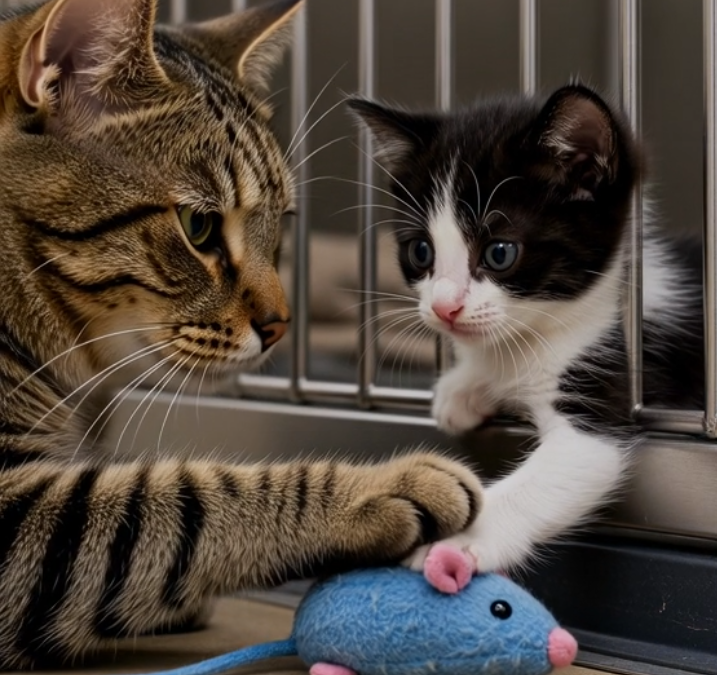
For Five Years, Moka Gave His Only Blue Toy to Every Scared Kitten—Then One Tiny Kitten Made Him Break Every Rule
For five years, an old shelter cat named Moka gave frightened kittens the only thing he had left from the home he lost.
Every time a terrified baby arrived, his little blue mouse appeared outside their cage before dawn, as if he had been quietly telling them they were not alone.
But when a half-starved kitten named Popper came in already giving up, Moka did something he had never done before—and it changed the way every person in that rescue understood love.
I still remember the first time I saw the blue mouse outside another cat’s cage.
It was early, the kind of early that makes even kind places feel abandoned for a moment. The sun had barely come up behind the parking lot, and the glass front door of the rescue was still fogged at the corners from the cold. I had just come in for my volunteer shift carrying a paper cup of coffee that had already gone cold in my car. My keys were still in my hand. My jacket was damp at the shoulders. I was tired before the day had even started.
The cat room smelled the way it always did in the mornings.
Clean litter.
Old towels.
Warm canned food.
Bleach beneath everything.
And something softer I could never quite name, something like hope that had been folded and unfolded too many times but somehow still held its shape.
I walked past the kitten cages first, because they were always the loudest.
Little paws reached through bars.
Tiny voices demanded breakfast.
A tortoiseshell baby flung herself at her door as if she had been imprisoned unjustly instead of rescued from behind a laundromat three days earlier. A pair of orange brothers wrestled inside a blanket cave, all teeth and elbows and dramatic squeaks.
Most mornings, that sound helped me.
It reminded me why I kept coming back.
But that morning, I stopped halfway down the row.
Because the blue mouse was not where it was supposed to be.
It was sitting outside cage 9.
Right in front of the door.
Cage 9 belonged to a tiny orange kitten who had arrived the night before. She had been found under a parked car outside a grocery store, soaked in motor oil and shaking so badly the cardboard carrier trembled when the animal control officer handed her over.
She had hissed at every person who looked at her.
She refused food.
Refused water.
Refused a towel fresh from the dryer.
She wedged herself into the back corner of the cage and made herself as small as possible, as if the world had taught her that being seen was dangerous.
Now Moka’s blue mouse was at her door.
Not near her door.
Not somewhere in the aisle where it might have been kicked by accident.
Directly in front of her cage.
Placed there.
I looked across the room.
Cage 14.
Moka was sitting the way Moka always sat.
Quiet.
Still.
Trying not to take up too much space in the world.
PART2:
He was an old brown tabby with a gray face, one torn ear, cloudy green eyes, and the tired dignity of a cat who had learned not to expect much but had not become mean because of it. His paws were folded beneath his chest. His faded fleece blanket was bunched behind him. His food dish sat untouched near the door.
He watched me.
I looked from him to the blue mouse.
“Moka,” I said softly, “what did you do?”
He blinked once.
Slowly.
That was all.
At first, I thought one of the night volunteers had moved it. Maybe someone had taken the mouse out while cleaning and forgotten to put it back. Maybe a staff member had tried to comfort the new kitten and grabbed the nearest toy without realizing it was Moka’s.
So I asked.
Nobody had moved it.
Nobody had touched it.
Nobody had even noticed it was gone.
By noon, the tiny orange kitten had pulled the mouse through the bars and tucked it under her chin.
By evening, she had eaten two bites of food.
The next morning, the blue mouse was back in cage 14, under Moka’s paws.
I never saw him retrieve it.
The camera in that room had one blind spot near the older cages, and Moka seemed to know exactly where it was.
Maybe he waited until the rescue was quiet.
Maybe he carried it back after the lights went out.
Maybe he did not want us making a fuss.
That was Moka’s way.
He gave comfort quietly.
And he never asked for any in return.
A few weeks later, it happened again.
A little gray kitten came in after being pulled from a storm drain. He was so frightened that the towel beneath him trembled. He would not blink. He would not eat. He stared through us like the world had already proved itself cruel and he was simply waiting for the next terrible thing.
The next morning, Moka’s blue mouse was in front of his cage.
After that, I started paying attention.
PART3:
Every time a scared kitten arrived, Moka waited.
Not when the room was busy.
Not when visitors were there.
Not when volunteers were watching.
He waited until the bowls had been washed, the floors had been mopped, the dryers hummed in the back room, and the rescue settled into that quiet hour between afternoon chaos and closing time.
Then he would stand.
Slowly.
His hips were stiff even then. He never complained, never cried, never made the little old-cat sound some of our seniors made when their joints bothered them. He simply gathered himself, one paw at a time, lifted the blue mouse in his mouth, and walked down the row.
Sometimes he passed cages full of kittens bouncing at their doors.
Sometimes he passed young cats who meowed for attention.
He never stopped for the loud ones.
He stopped for the silent ones.
The ones pressed into corners.
The ones too afraid to ask for touch.
The ones who looked like they had already decided not to expect rescue from anyone.
Moka would place the mouse by their cage door.
Then he would turn around and walk back to cage 14.
No performance.
No demand.
No meow.
No pride.
Just an old cat giving away the only comfort he owned.
Like he was saying, in the only language he had:
You’re safe now.
I told people about it sometimes.
Not everyone understood.
Some visitors smiled politely, the way people smile when they think shelter volunteers have become too emotional from spending too much time around animals.
Some laughed and said, “That’s cute.”
Some said, “Cats don’t think like that.”
Some said, “He probably just drops it wherever.”
I stopped arguing after a while.
People who need love to look human before they respect it are hard to convince.
But the staff knew.
Marisol knew.
Diane, our medical coordinator, knew.
Even Tom, the retired mechanic who volunteered on Wednesdays and claimed he only cleaned cages because his wife had “voluntold” him, knew. He used to stand in the doorway with his arms folded, watching Moka watch the kittens.
“That old man’s got a system,” Tom said one afternoon.
I looked up from folding towels.
“What system?”
“He knows who needs it.”
I followed his gaze.
Across the room, a black-and-white kitten sat frozen in cage 6 after being trapped behind an apartment dumpster. She had not moved since intake. Her eyes were huge. Her body was tucked so tightly against the back wall that she looked like a shadow with whiskers.
Moka was watching her.
Not staring the way cats stare at prey.
Watching the way a person watches a hospital room door.
That evening, after everyone left, the blue mouse appeared outside cage 6.
By morning, the kitten was sleeping with one paw over it.
That was when I stopped calling it coincidence.
Moka had arrived at Little Lantern Rescue five years earlier on a wet November day.
I was not working intake then, but I had heard the story so many times it felt like memory.
His owner had died.
That was all the form said at first.
Owner deceased.
No known family able to care for animal.
Senior male tabby.
Approximate age: ten.
Name: Moka.
Belongings: one fleece blanket, one small blue toy mouse.
That was the inventory.
A life reduced to four lines.
Later, we learned more.
His owner had been a woman named Ruth Devlin, a retired school librarian who lived alone in a small apartment above a bakery. She had adopted Moka as a kitten after finding him in a return bin behind the library during a rainstorm. For ten years, he slept in the front window while she read novels in a green chair. She gave him little pieces of turkey on Sundays. She talked to him as if he were a coworker who had strong opinions about mysteries and weak opinions about romance novels.
The blue mouse had been his first toy.
Ruth had bought it for him the same week she brought him home.
Over the years, it became worn nearly flat. Its felt ears disappeared. One side was patched with gray thread. The little tail had been replaced twice with blue yarn that did not match. It smelled, even after washing, faintly like old fabric, dust, and catnip ghosts.
When Ruth died suddenly in her sleep, Moka stayed beside her body until the neighbor found them two days later.
The neighbor told us he would not leave the bed.
Not when paramedics came.
Not when the coroner arrived.
Not when the neighbor tried to pick him up.
Moka crouched near Ruth’s shoulder with the blue mouse between his paws, growling softly at anyone who came too close.
Not aggressive.
Protective.
Confused.
Faithful.
Eventually, the neighbor wrapped the mouse in Ruth’s fleece blanket and placed both inside the carrier. Only then did Moka go in.
He arrived at the rescue silent.
He ate the first night.
Used the litter box.
Allowed examination.
Accepted medication for a mild respiratory infection.
But he did not ask for anything.
That was what made him hard to place.
Kittens threw themselves at adopters.
Young cats performed.
Confident cats rubbed against bars.
Even cranky cats had personality people could describe.
Moka simply sat.
Visitors passed him without seeing him.
If someone opened his cage, he allowed a gentle hand. Sometimes he purred. Sometimes he leaned in slightly. But he never pushed himself forward.
He did not sell his love.
He had given it once, completely, and lost the person who understood its language.
For the first year, we told ourselves his person would come.
There is always someone, we said.
A kind senior.
A quiet home.
A librarian.
A widow.
A person who loved old cats.
For the second year, we updated his photos.
Moka sitting in sunlight.
Moka with the blue mouse.
Moka wearing a tiny bow tie he tolerated with the resigned dignity of a retired judge.
For the third year, we moved him to the front room for better visibility.
He hated it.
Too much noise.
Too many hands.
Too many people saying, “Oh, he’s old,” before moving on.
After two weeks, we moved him back to cage 14.
For the fourth year, we stopped saying he would be adopted soon.
Not because we gave up.
Because hope can become cruel when repeated too brightly in front of someone still waiting.
By the fifth year, Moka belonged to the rescue in that painful way long-term shelter animals do.
Not officially.
No one wanted that.
But he had become part of the building.
Part of the morning routine.
Part of the emotional structure of the place.
Volunteers greeted him first.
Staff saved his favorite food.
New people were told, “That’s Moka. Go slow. He’s been here a long time.”
He had his blanket.
His blue mouse.
His quiet dignity.
And, eventually, his work.
That was how I came to think of it.
Moka had a job.
Not one anyone assigned him.
Not one written on a chart.
But a job all the same.
He welcomed the ones too afraid to believe they were safe.
He did not cuddle them.
He did not groom them.
He could not even touch most of them through cage bars.
So he gave them what he had.
The blue mouse.
The last piece of home.
By the time Popper arrived, forty-three kittens had slept with that mouse.
I knew because I counted.
Forty-three.
A motor-oil kitten.
A storm-drain kitten.
Three babies found in a shed after their mother vanished.
A calico pulled from a hoarding house.
A black kitten whose tail had been injured in a garage door.
Two bottle babies old enough to be terrified but young enough to still search for a mother’s heartbeat.
Every time, Moka gave away the mouse.
Every time, he got it back.
Sometimes the kittens carried it into their blankets.
Sometimes they drooled on it.
Once, a bold little tabby tried to keep it for three days and slapped the bars when Moka came near. Moka simply waited until she fell asleep, then somehow retrieved it anyway.
We joked that he had a talent for gentle theft.
The truth was, none of us knew how he did half the things he did.
Then Popper came.
It was January.
The worst kind of January, when the cold seems personal and the parking lot outside the rescue turns into a sheet of dirty ice by noon. We were already full. Every rescue is always full, but this was worse than usual. Flu had gone through one foster home. A pipe burst in another. We had three medical cases, two emergency intakes, and a waiting list so long Marisol had started making phone calls from the supply closet just so no one would see her cry.
Popper arrived in a shoebox.
That is the part I still cannot say without feeling sick.
A man found her beside a dumpster behind an abandoned restaurant, tucked inside a shoebox with a wet dish towel. He almost did not notice the box because it had been pushed behind two broken plastic crates. He heard one sound—one tiny pop of a cry, he said—and thought it might be a bird.
That was why he named her Popper before we could stop him.
“She made a little popping sound,” he told us, standing in the lobby with red hands and panic in his eyes. “Like she was trying to meow but couldn’t.”
The box smelled like cold, mildew, and fear.
Inside was a kitten no bigger than my two hands.
She was gray, maybe, though dirt made the color uncertain. Her fur stuck out in brittle clumps. Her eyes were crusted. Her ears looked too large for her skull. She was so thin that her hip bones rose like little knots under her skin.
She did not hiss.
Did not fight.
Did not curl away.
That was what frightened Diane most.
A terrified kitten still has some belief left that resisting might matter.
Popper lay on the towel and breathed.
Barely.
Diane took her straight to medical.
We followed without speaking.
Her temperature was low.
Her blood sugar was low.
She was dehydrated.
Full of fleas.
Severely malnourished.
Too weak to eat.
Too weak to cry.
Too weak, almost, to be afraid.
“She’s maybe seven weeks,” Diane said, though she looked four.
Marisol crossed herself.
She did that only when she was scared.
We warmed Popper slowly.
Fluids.
Syringe feeding.
Flea treatment.
Eye ointment.
Tiny amounts of food.
Tiny amounts of time.
She survived the first night.
That should have felt like victory.
Instead, the next morning, she looked even farther away.
Some animals, once they are warm and fed, come back to themselves quickly. Fear returns, appetite returns, anger returns, and everyone celebrates because anger means life is still in there.
Popper did not come back.
She lay in the warmed cage with her eyes half open, staring at nothing.
Not sleeping.
Not watching.
Just gone somewhere inside herself.
We placed soft toys around her.
No response.
We warmed food.
No response.
We played kitten purr sounds.
Her ears twitched once, then nothing.
We brought in a calm foster cat blanket that smelled like mothering.
Nothing.
By the third day, Diane stood outside Popper’s cage with her arms folded tight across her chest.
“She has no fight,” she said.
I hated those words.
Not because Diane was wrong.
Because she was afraid she was right.
Popper was medically fragile, but that was not the part that scared us most.
Her body had survived long enough to reach warmth.
Her spirit had not decided whether to follow.
That evening, after closing, the rescue felt heavier than usual.
The kitten room was quiet.
Too quiet.
I cleaned bowls in the sink while Marisol updated medical notes. Diane was in the back checking medication charts. Tom had gone home after repairing a loose kennel latch and pretending he was not worried about Popper.
Moka sat in cage 14.
Watching.
He had watched Popper since the moment we carried the shoebox through the cat room.
Not with curiosity.
With attention.
His blue mouse was beneath his paws.
I paused beside him.
“She’s very sick,” I whispered.
Moka looked at me.
“I know you know.”
His cloudy eyes did not blink.
“She might not make it.”
I do not know why I said that to him.
Maybe because rescue makes you strange.
Maybe because after years of watching Moka comfort kittens, I had stopped pretending he was just another cat in a cage.
Maybe because I needed someone else in that room to understand that Popper was standing at the edge of something we could not reach.
Moka lowered his head and touched the blue mouse with his nose.
I opened his cage and sat on the floor.
He stepped out carefully.
That surprised me.
Moka rarely came out when people were nearby. He preferred his routine after hours, unseen. But that evening, he climbed down from cage 14 and stood beside my knee.
His hips trembled.
He was older now.
Fifteen, maybe sixteen.
His kidneys needed monitoring. His arthritis had worsened. His appetite came and went. Some mornings, he looked so tired that I had to count his breaths before saying hello.
Still, he picked up the blue mouse.
Then he walked toward Popper’s cage.
I did not move.
I barely breathed.
This time, he did not use the camera blind spot.
He did not wait until we were gone.
He carried the mouse down the row while I watched openly.
When he reached Popper’s cage, he lowered the toy gently in front of her door.
Then he did something he had never done before.
He did not turn back.
He sat down.
Right there.
Outside her cage.
His body was stiff, his back legs tucked awkwardly beneath him, but he stayed facing her.
Popper did not move.
Moka leaned forward and made a sound.
Not a meow.
Not a chirp.
A low, rough, vibrating sound from deep in his chest.
Almost a purr, but directed outward.
Calling.
Popper’s ear twitched.
I pressed both hands over my mouth.
Moka made the sound again.
This time, Popper’s eyes shifted.
Only slightly.
But toward him.
Marisol came to the doorway.
She saw me sitting frozen on the floor, then followed my gaze.
“Oh,” she whispered.
Moka lowered himself onto his side outside the cage, facing Popper through the bars.
The blue mouse lay between them.
Popper stared.
For nearly five minutes, nothing happened.
Then, inch by inch, Popper moved her head.
Not her body.
Just her head.
Toward the mouse.
Toward Moka.
Moka’s purr deepened.
It was not loud.
But in that room, it felt like thunder.
That night, Popper ate three drops of food from a syringe without turning away.
We celebrated as if she had stood up and danced.
The next morning, Moka was still outside her cage.
He had not returned to cage 14.
His blanket sat empty.
His food untouched.
His old body curled stiffly against the tile near Popper’s door.
The blue mouse was no longer outside the cage.
Popper had one paw through the bars, touching it.
Marisol cried before she even turned on the lights.
“Moka,” she said softly. “Old man, you can’t sleep on the floor.”
He ignored her.
We lifted him back to cage 14 so he could eat and rest.
He allowed it.
But the moment we opened the cage later, he climbed down again and returned to Popper.
That became the new routine.
Moka no longer gave the mouse and left.
He stayed.
All day, if we let him.
All evening.
As long as his body allowed.
He sat outside Popper’s cage like a tired guard at a hospital bedside. He purred when she stirred. He touched the bars when she cried in her tiny broken way. He pushed the blue mouse back toward her whenever it rolled out of reach.
On the second day of this, Diane made the decision.
“We need to try them together.”
Marisol looked startled.
“Is it safe?”
“For Popper? Maybe. For Moka? I don’t know. She’s medically fragile, but not contagious based on tests. He’s vaccinated. We supervise. We can’t leave him on the floor all day.”
“And if he stresses her?”
Diane watched Moka through the glass.
“He won’t.”
So we prepared the large recovery pen in the quiet room.
Soft blankets.
A low heated pad.
Water.
Food.
Space for Moka to leave if he wanted.
Popper was placed first, wrapped loosely in a towel. She looked even smaller in the large pen.
Then we brought Moka.
The old tabby stood at the entrance for a moment, blue mouse in his mouth.
He looked at Popper.
Popper looked at him.
No one spoke.
Moka stepped inside.
He walked slowly to the kitten, lowered the blue mouse beside her front paws, and lay down near her.
Not touching yet.
Just near.
Popper stared at the toy.
Then at him.
Then, with a strength so small it barely counted, she moved one paw and touched Moka’s fur.
Moka closed his eyes.
His purr began.
Popper pressed her face into his side.
I had seen kittens seek warmth before.
I had seen scared babies curl into stuffed animals, blankets, heating pads, human hands, and each other.
But this was different.
Popper did not simply seek heat.
She sought him.
She buried her tiny face into the old tabby’s thin fur as if she had found the one sound in the world that made sense.
Moka lowered his head and began to groom her.
One careful lick.
Then another.
His tongue moved slowly over her dirty forehead, between her ears, down the back of her neck. Popper’s eyes fluttered closed.
Diane turned away.
Marisol sobbed openly.
Tom, who had come in early with a toolbox and claimed he was fixing a shelf, stood in the doorway and said, “Well, damn,” in a voice that did not sound like his.
That day, Popper ate.
Not much.
But enough.
The next day, more.
By the end of the week, she had gained four ounces.
Four ounces can be an entire universe when a life has been that close to leaving.
Moka changed too.
For years, he had given comfort from a distance.
Now he became something we did not know he still had the strength to be.
A father.
Or a grandfather.
Or a memory of a mother.
Whatever word humans needed, Moka did not care.
He cleaned Popper’s face.
He let her knead his side with sharp little paws.
He curled around her during naps, careful not to put weight on her body.
He tolerated her climbing over his back once she grew stronger, though he looked deeply offended by the indignity.
He let her chew his torn ear.
That one made Tom say, “Kid’s got no respect for veterans.”
Moka merely blinked.
Popper blossomed under him.
There is no other word.
Her eyes cleared.
Her fur softened.
Her belly rounded.
Her voice, once only a popping little cry, became a squeak, then a chirp, then a surprisingly loud demand for food at exactly 6:12 every morning.
She followed Moka around the recovery pen with absolute devotion.
If he stood, she stood.
If he ate, she sniffed his bowl.
If he slept, she wedged herself against his chest.
And always, the blue mouse stayed nearby.
At first, we thought Popper would keep it.
But one afternoon, I saw something that made me sit down hard in the hallway.
A new kitten had arrived that morning.
A tiny black male found inside a cardboard box near a bus stop, frightened but healthy. He was in cage 3, pressed into the back corner, refusing to look at anyone.
Moka was asleep in the recovery pen.
Popper was not.
She stood beside the blue mouse, looking toward the cat room.
She was still weak, still small, still too young for independence. The recovery pen door was secure, and she could not leave.
But she picked up the mouse.
It was nearly half her size.
She dragged it to the pen door, dropped it, and made a tiny frustrated sound.
Moka opened one eye.
He looked at Popper.
Then at the mouse.
Then toward the cat room.
For a moment, I imagined him sighing.
Slowly, painfully, he stood.
Popper stepped back.
Moka picked up the mouse, carried it out after I opened the pen, and walked to cage 3.
Popper pressed herself against the recovery pen door, watching.
Moka placed the mouse outside the frightened kitten’s cage.
Then he returned.
But this time, when he came back, Popper climbed on him as if greeting a hero returning from war.
Moka tolerated it with the expression of a man who had accepted retirement was no longer available.
That was when we realized he was teaching her.
Not intentionally, perhaps.
Not in the way humans teach.
But Popper was learning that comfort was something passed along.
The blue mouse had become more than a toy.
It was a message.
I had been loved.
Now you are loved too.
Moka and Popper became the soul of Little Lantern Rescue.
We did not plan for that.
In rescue work, you try not to turn animals into symbols. It is unfair to them. They do not exist to heal humans, teach lessons, or make social media cry. They exist to live, to eat, to be safe, to sleep in sunbeams, to be loved without needing to become inspirational first.
Still, sometimes an animal does something so honest that humans cannot help but become better witnesses.
Moka’s story spread after Marisol posted one photo.
It showed Popper asleep against Moka’s chest, her tiny paw resting on the blue mouse between them. Moka’s head was bent over her, his torn ear visible, his cloudy eyes half closed.
The caption said:
For five years, Moka has given his blue mouse to frightened kittens. This week, he gave it to Popper—and then refused to leave her side.
That was all.
By morning, the post had been shared thousands of times.
Comments poured in.
Some from people who had adopted seniors.
Some from people who had lost old cats.
Some from foster parents who knew the strange power of one animal helping another heal.
Many simply wrote, “Thank you, Moka.”
A woman from Oregon mailed a box of blue toy mice.
A child sent a crayon drawing of Moka wearing a crown while kittens lined up to receive mouse toys.
A retired man donated heated beds for every senior cat in the rescue.
A teacher asked if her class could write letters to Moka as part of a kindness project.
Tom said fame would go to Moka’s head.
Moka slept through this accusation.
But attention also brought the question we had avoided for years.
Could Moka be adopted?
People began asking.
Not just people passing through.
Serious people.
Kind people.
People who saw the viral post and wanted to give the old cat a home.
For five years, that had been the dream.
A home.
A couch.
A person.
No more cage 14.
No more fluorescent lights.
No more shelter noise.
No more waiting.
But now, when the applications arrived, none of us knew what to do.
Because Moka had a home, in one sense.
A strange one.
An imperfect one.
A rescue cage was not a home.
We knew that.
We believed that.
We said it constantly.
No animal belongs in a cage forever.
But Moka had built something inside those walls none of us knew how to measure.
He had work.
He had kittens.
He had Popper.
And Popper had him.
The first adoption applicant was a woman named Heather, who lived alone and had experience with senior cats. She seemed wonderful. Soft-spoken. Patient. She brought records from her vet. She cried when she met Moka.
Moka allowed her to pet his head.
Popper watched from the recovery pen.
When Heather left the room to speak with Marisol, Popper began to cry.
Not a normal kitten complaint.
Not hunger.
Not boredom.
The old sound.
The pop-cry from the shoebox.
Moka lifted his head immediately.
Popper pressed herself against the pen door, eyes wide, calling for him.
Moka stood, slow and stiff, and walked to her.
He did not look at Heather again.
Heather saw.
To her credit, she understood before we said anything.
“He can’t leave her,” she said.
Marisol’s eyes filled.
“We don’t know.”
Heather shook her head.
“I do.”
She withdrew her application for Moka and adopted the black kitten from cage 3 instead.
She named him Echo.
She sent us photos for years.
The second applicant wanted both Moka and Popper.
That seemed, for one bright moment, like the answer.
Then during the home visit, we discovered three large dogs with high prey drive and an owner who said, “They’ll adjust,” in a tone that meant she expected the cats to do most of the adjusting.
Marisol declined.
The woman left angry.
We did not regret it.
The third applicant loved Moka’s story more than Moka.
That happens more often than people think.
They wanted photos.
They wanted to talk about followers.
They wanted to know if he would “perform the mouse thing” on video.
Tom showed them the door before Marisol had to.
After that, we stopped accepting applications for a while.
Not because Moka was not adoptable.
Because we needed to understand what adoption would mean for him now.
Popper grew.
Slowly, then all at once.
Her legs got longer.
Her eyes brightened.
Her fur turned a smoky gray with pale stripes near her tail.
She remained small, probably always would, but she developed the fierce confidence of a kitten raised by an old shelter cat with no patience for nonsense.
She learned to eat from a dish by watching Moka.
She learned to use the litter box by following him and then looking surprised when everyone applauded.
She learned that hands could bring medicine and also warmth.
She learned that blankets were for sleeping and attacking.
She learned that Tom’s shoelaces were prey.
She learned that Marisol cried easily and could be manipulated with head bumps.
She learned that the blue mouse belonged to everyone who needed it.
But at night, she slept with one paw touching Moka.
Always.
Moka aged faster that spring.
Maybe he had been aging all along and we only noticed because Popper was becoming more alive beside him. His body grew thinner. His back legs stiffened. His appetite became particular in the way old cats become particular, as if they have decided late in life to become restaurant critics.
Diane adjusted his arthritis medication.
We added steps to the recovery pen.
He got fluids twice a week for kidney support.
He accepted all of it with the weary patience of a cat who had spent years putting up with humans.
One night in April, I found him awake while Popper slept curled against him.
The blue mouse lay beneath his front paw.
The rescue was closed. The lights were dim. Rain tapped against the back windows. The dryers hummed softly in the laundry room.
I sat outside the pen.
“You’re tired,” I said.
Moka looked at me.
I had never said those words to him before.
Not like that.
We had called him old.
Senior.
Gentle.
Special.
Long-term.
But tired was different.
Tired was not a category.
It was a truth.
Moka lowered his head and rested his chin on Popper’s back.
She shifted in her sleep and pressed closer.
“I don’t know what to do,” I whispered.
His eyes half closed.
“If someone takes you home, you leave this place. If you stay, you keep giving pieces of yourself away.”
He blinked slowly.
Of course, he did not answer.
Or maybe he did.
Maybe every choice he had made for five years had been his answer.
Some beings do not measure life by how much comfort they keep.
Some measure it by who is less afraid because they were there.
Two weeks later, Ruth Devlin’s niece came to the rescue.
Her name was Clara.
She was in her fifties, with short dark hair, a tired face, and a canvas bag full of old photographs.
When Marisol told me who she was, I felt my stomach drop.
Family.
After five years.
Those stories rarely end simply.
Clara stood in the lobby twisting the strap of her bag.
“I don’t know if I should have come,” she said. “I only found out recently he was still here.”
Marisol’s voice stayed kind, but I could hear the tension beneath it.
“Moka?”
Clara nodded.
“My aunt’s cat. I live in Michigan. When Aunt Ruth died, my cousin handled everything. He told me the cat had been placed with a rescue and adopted.” Her eyes filled. “I believed him.”
I felt anger rise in me toward a man I had never met.
Marisol glanced at me.
I said nothing.
Clara continued.
“I was going through Aunt Ruth’s old letters. She wrote about Moka constantly. I searched the rescue name I found on one form, and then I saw your post.”
She pulled out her phone.
The photo of Moka and Popper filled the screen.
“I knew it was him.”
We brought her to the quiet room.
I warned her before she went in.
“He’s older now. And he’s very bonded to a kitten.”
Clara nodded.
“I’m not here to take him away.”
That sentence made me like her immediately.
Moka was lying beside Popper when Clara entered.
He lifted his head.
Clara stopped.
Her hand went to her mouth.
“Oh, Moka,” she whispered.
Moka looked at her.
For a moment, nothing happened.
Then Clara reached into her bag and took out a small paperback book.
The cover was worn.
A mystery novel.
She opened it with shaking hands and began to read.
Not to us.
To him.
“Chapter One,” she said, voice trembling. “The rain had not stopped for three days, and Miss Eleanor Finch was beginning to suspect the umbrella in the hallway had moved by itself.”
Moka’s ears moved.
I looked at Marisol.
She looked at me.
Clara kept reading.
Her voice steadied.
Moka stood.
Popper woke immediately, blinking.
Moka took one step toward Clara.
Then another.
Clara began to cry but did not stop reading.
Moka reached the side of the pen.
He pressed his face against the mesh.
Clara lowered herself to the floor.
“My aunt read to him every night,” she whispered. “Every night. Even when he fell asleep.”
Moka made a sound.
Small.
Old.
Almost lost under the rain.
Clara pressed her fingers to the mesh.
He rubbed his cheek against them.
That was the first time I truly understood that Moka had not forgotten home.
He had kept giving it away.
Clara visited three times that week.
Each time, she read from Ruth’s old books.
Each time, Moka came to the mesh.
Popper did too, suspicious at first, then curious, then deeply interested in attacking Clara’s shoelaces.
On the fourth visit, Clara said, “I want to ask something, and you can say no.”
Marisol looked wary.
“I’d like to foster them both.”
The room became very quiet.
Clara hurried on.
“Not adopt immediately. Not if that’s too fast. I know Moka has medical needs. I know Popper is attached to him. I have a quiet house. No other pets. I work from home. I can do medications. I can bring them back for checkups. And if he hates it, if either of them hates it, I’ll bring them back. But…” She looked at Moka. “He belonged to my aunt. I should have known. I should have asked. Maybe I can’t undo five years, but I can give him a home now.”
Marisol cried.
I cried.
Tom, who was pretending to inspect a door hinge nearby, said, “This place is getting ridiculous,” and walked away suspiciously fast.
We approved the foster after a home visit.
Clara’s house was small, quiet, and full of books.
There was a green chair by a window.
Not the same chair Ruth had owned.
But close enough that when I saw it, I had to step outside for a moment.
Clara had prepared a room with low beds, heated pads, steps, food bowls, litter boxes, and a little basket full of toys.
In the center, on a folded fleece blanket, she placed Moka’s blue mouse.
Moving day came on a Thursday.
We all tried to be cheerful.
We failed.
Long-term shelter animals do not leave quietly in the hearts of the people who loved them.
They take pieces with them.
Moka went into his carrier without protest. Popper went into hers with great protest, three dramatic screams, and one attempt to climb Diane’s sleeve.
The blue mouse went with Moka.
At the last second, he pushed it toward the front of the carrier.
Popper saw it.
Stopped yelling.
And reached one paw through her carrier door toward him.
Clara looked at us.
“I’ll send updates tonight.”
Marisol nodded, unable to speak.
The rescue felt wrong after they left.
Cage 14 was empty.
The recovery pen was empty.
The cat room kept making the same sounds, but they arranged themselves differently without Moka’s silence at the center.
That night, Clara sent a photo.
Moka was in the green chair.
Popper was pressed against him.
The blue mouse was beneath both their paws.
Caption: He found the chair.
I cried over my phone in the grocery store parking lot.
The foster became adoption three weeks later.
Not because everything was perfect.
Because it was right.
Moka adjusted slowly, but deeply.
He slept more.
Ate better.
Sat in the window while Clara read aloud from Ruth’s old mysteries.
Popper explored the house with reckless joy, then ran back to Moka every time she discovered something suspicious, such as the dishwasher, a broom, or her own reflection in the oven door.
Moka still worried when Popper left his sight.
Popper still slept touching him.
And the blue mouse?
It stayed mostly with them.
But Clara sent one video that I watched more times than I can count.
A neighborhood kitten had appeared outside her back door, cold and crying after slipping through a fence. Clara brought the kitten inside while locating the owner.
The baby was frightened, sitting in a towel-lined box near the kitchen.
Moka, old and slow, stood in the doorway.
Popper beside him.
For a moment, both cats watched the kitten.
Then Popper picked up the blue mouse.
She carried it halfway across the kitchen, dropped it beside the box, and stepped back.
Moka sat behind her.
Watching.
The kitten sniffed the mouse.
Popper looked at Moka.
Moka blinked slowly.
Clara’s voice whispered behind the camera, “Oh, sweetheart.”
The lesson had passed on.
Moka lived eleven more months.
I wish I could say years.
He deserved years.
But senior cats do not negotiate with time, no matter how loved they are.
Those eleven months were full.
That is what I hold on to.
Full of sunlight.
Soft chairs.
Books read aloud.
Popper’s ridiculous energy.
Medication hidden in treats.
Vet visits where he behaved better than everyone.
Rainy afternoons.
Warm blankets.
Clara’s hand resting gently on his back while he slept.
Photos arrived every week.
Moka in the window.
Moka with Popper on his head.
Moka glaring at a pumpkin.
Moka asleep on Ruth’s old paperback, as if he had finally decided the mystery could wait.
His last photo before things changed showed him in the green chair with the blue mouse tucked under his chin.
He looked old.
Very old.
But peaceful.
In late February, Clara called.
I knew from the sound of her breathing.
“Is it time?” I asked.
She cried quietly.
“I think he’s tired.”
Diane and I went with Marisol to Clara’s house that afternoon.
Not because we had to.
Because some goodbyes need witnesses.
Moka was in the green chair.
Popper was curled against him, her body pressed along his side.
The blue mouse lay beneath his front paw.
Clara sat on the floor beside them with Ruth’s mystery novel in her lap.
“I’ve been reading,” she said, wiping her face. “He listens.”
Moka opened his cloudy eyes when we entered.
His gaze moved over us slowly.
Marisol.
Diane.
Me.
For five years, that old cat had given comfort in a building full of fear, loss, noise, bleach, hope, and waiting.
Now he was home.
The veterinarian arrived an hour later.
Popper did not want to move.
We did not force her until we had to.
Clara read softly while Moka rested his head on the blanket.
His breathing was shallow.
His body had done all it could.
Before the final injection, he moved one paw.
Just barely.
The blue mouse shifted.
Popper leaned forward and pressed her nose to his forehead.
Moka’s eyes closed.
His purr started.
Faint.
Rusty.
Still there.
Clara read through tears.
“The rain had not stopped for three days…”
Moka left the world hearing a story.
With Popper beside him.
With the blue mouse under his paw.
With the last piece of home no longer the only proof he had been loved.
Because now there was so much proof.
Cage cards.
Medical notes.
Photographs.
Children’s drawings.
Volunteer memories.
Forty-three kittens who had slept one night a little less afraid because of him.
Popper, alive and whole, because he refused to leave her side.
The rescue was never the same after Moka.
How could it be?
We created a senior comfort program in his name.
Not because every senior cat would be like Moka.
They would not.
Animals are not symbols first.
They are themselves first.
But because Moka had taught us that older shelter animals were not only waiting to be saved. Some of them were quietly saving others while we were too busy to notice.
We changed the way we wrote kennel cards.
We stopped saying “just a senior.”
We stopped letting people walk past old cats without telling their stories.
We created a shelf in the kitten room filled with soft toys donated in Moka’s memory.
Blue mice, mostly.
Every frightened kitten got one.
Not as a replacement.
Nothing could replace Moka’s mouse.
But as a continuation.
Popper stayed with Clara.
Of course she did.
No one even pretended otherwise.
For weeks after Moka died, she carried the blue mouse from room to room.
She slept with it.
Dragged it to Clara’s chair.
Dropped it outside the bathroom door.
Once, Clara woke to find it on her pillow.
“I think she’s worried about me,” Clara told me.
“She learned from the best,” I said.
Months passed.
Popper grew into a small, fierce, beautiful gray cat with bright eyes and a habit of mothering anything weaker than herself. Clara began fostering again, quietly, one kitten at a time.
The first foster after Moka was a trembling black kitten with a white chin.
Popper watched from across the room.
Clara placed one of the donated blue mice near the kitten.
Popper looked at it.
Then left the room.
Clara thought maybe it was too soon.
A few minutes later, Popper returned with Moka’s original blue mouse.
The old one.
The worn one.
The patched one.
The one Ruth had bought.
The one Moka had carried for five years.
She placed it beside the kitten.
Then sat down nearby.
Not too close.
Just near enough.
Clara sent me the photo.
I opened it during my morning shift, standing between cage 9 and cage 14.
Cage 14 had another senior in it by then, a cranky calico named Agnes who bit anyone who disrespected her boundaries and had already become Tom’s favorite.
Life had continued.
It always does, even when your heart wants it to pause in respect.
I looked at the photo of Popper and the mouse and the frightened kitten.
Then I cried so hard Marisol came running with paper towels.
“What happened?”
I showed her the phone.
She read Clara’s message beneath the picture.
He taught her.
Marisol sat down on the floor.
Agnes watched us from cage 14 with disgust.
We laughed through tears.
That is rescue.
Crying on the floor while a senior calico judges you.
Years later, people still ask about Moka.
His story spread farther than we ever expected. Not in one giant burst, but steadily, quietly, the way he lived. People sent letters. Donations. Photos of adopted senior cats with blue mouse toys. Teachers wrote about using his story in classrooms to talk about kindness. Grieving people wrote to say they had kept one object from someone they lost and no longer felt foolish for needing it.
One letter came from a woman whose mother had died.
She wrote:
I thought I was weak for sleeping with her old scarf. Then I read about Moka giving away the only thing he had left from home. I realized comfort is not childish. It is how love keeps helping us survive.
I kept that letter in my desk.
I still read it on hard days.
Because Moka’s story was never only about a cat and a toy.
It was about what we do with the last piece of love we have.
Some beings guard it.
Some hide it.
Some cling to it so tightly that no one can come near.
And some, somehow, after losing everything, learn to place it gently in front of someone more frightened than themselves.
That was Moka.
He had one blue mouse.
One object from the home where he had been loved for ten years.
One small, worn, ridiculous toy that smelled like memory.
And for five years, he gave it away again and again.
Not because he had too much.
Because he knew what it meant to have nothing familiar in a strange cage.
He knew what it meant to wake up in a place where kind hands still did not feel like home.
He knew what it meant to wait for someone who would not come back.
So when terrified kittens arrived, he did the only thing he could.
He gave them proof.
Proof that the room was not all danger.
Proof that something soft could exist near fear.
Proof that even in a cage, love could still cross the aisle.
And when Popper came, too weak to believe in warmth, too tired to choose life, Moka gave more than the mouse.
He gave himself.
His old body.
His purr.
His patience.
His last year.
And because he did, Popper lived.
She did more than live.
She learned.
She carries the mouse now.
Not always.
Not to every kitten.
Only to the silent ones.
The ones pressed into corners.
The ones who look like the world has already disappointed them beyond repair.
Clara says Popper waits until the house is quiet.
Then she picks up Moka’s blue mouse, walks slowly to the foster pen, and places it by the door.
No performance.
No demand.
No meow.
No pride.
Just a small gray cat giving away the comfort that once saved her.
Like she is saying, in the language Moka taught her:
You’re safe now.
I sometimes visit Clara just to see it.
Popper has grown older herself, though not old yet. She still has that fierce little face, still small from the hunger that almost took her, still serious in a way that makes visitors lower their voices without knowing why.
The blue mouse is almost more thread than toy now.
Clara keeps saying she should retire it.
She never does.
None of us could.
Some objects become sacred not because of what they are, but because of what love has done through them.
A scrap of fabric.
A collar.
A blanket.
A letter.
A toy mouse.
Moka’s mouse sits now in the green chair most days, unless Popper decides someone needs it more.
Beside the chair, Clara keeps a framed photo.
Moka in the rescue recovery pen, curled around tiny Popper, blue mouse between them.
Under the photo is a small brass plate.
MOKA
WHO GAVE AWAY HOME
SO OTHERS COULD FIND IT
Every time I read that, I think of cage 14.
The old tabby sitting quietly with cloudy eyes and folded paws.
The blue mouse beneath him.
The kittens he watched.
The way we almost mistook his stillness for sadness only, when really it was also listening.
Waiting.
Choosing.
Moka never had the kind of life we wanted for him.
That truth still hurts.
He spent five years in a shelter.
Five years of cage doors, cleaning schedules, adoption events, strangers passing by, and nights when the building settled into darkness around him.
I wish someone had taken him home sooner.
I wish Ruth had lived longer.
I wish the world had more room for old cats with quiet hearts.
But I also know this:
Those five years were not empty.
Moka filled them with meaning no one assigned to him.
He became a welcome.
A comfort.
A bridge.
A keeper of frightened things.
He turned his own loss into shelter.
And that is a kind of life too.
Not the one he deserved.
But one he made beautiful anyway.
Sometimes I think about the morning I first saw the blue mouse outside cage 9.
How close I came to assuming someone had dropped it.
How easily I might have missed what Moka was telling us.
That fright can recognize fright.
That loneliness can answer loneliness.
That the quietest creature in the room may be doing the most important work.
And that love does not always announce itself.
Sometimes it moves after closing.
Past the clean bowls.
Past the folded towels.
Past the cages of loud kittens demanding breakfast.
It stops at the door of the one who has not made a sound.
It leaves a small blue mouse there.
Then it returns to its own cage before anyone can say thank you.
Moka did that for five years.
Then Popper arrived.
And for her, he stayed.
That is the part I will carry forever.
Not only that he gave comfort.
But that, when comfort was not enough, he gave presence.
He understood what so many people forget:
Sometimes the broken do not need advice.
They do not need cheering.
They do not need someone to toss hope at their door and walk away.
Sometimes they need someone to lie down beside the bars and say, without words:
I am here.
I will not leave first.
You can rest now.
Moka gave that to Popper.
And Popper lived long enough to give it to others.
So if you ever visit a rescue and see an old cat sitting quietly in the back of a cage, do not assume there is no story there.
Do not pass by too quickly because the kittens are louder.
Do not mistake stillness for emptiness.
Some hearts have already loved so much that they no longer perform for attention.
Some have lost everything and still found a way to give.
And some old shelter cats, with cloudy eyes and aching hips, may be holding beneath their paws the one small thing that proves they were once loved—waiting for the next frightened soul who needs it more.








