For 58 Days, Nobody Chose the Black Shelter Cat Who Offered Every Visitor Her Toys—Then a Little Girl Sat Beside Her and Roxy Did Something That Made the Entire Room Go Silent
PART3:
She likes sleeping under blankets and carries her toys around.
I am sorry.
That was all.
No phone number.
No explanation.
No signature.
Just I am sorry.
I had read hundreds of surrender notes.
Some angry.
Some defensive.
Some twelve pages long.
Some one sentence.
That one bothered me.
Maybe because whoever wrote it clearly knew her.
They knew her age.
Her habits.
Her name.
They packed her blanket and toys.
They made sure she had food.
Then they left her in an apartment hallway in February.
Cruelty is easier to understand when it looks like hatred.
Love mixed with abandonment is harder.
I opened the basket.
Roxy did not bolt.
She stayed pressed against the bottom.
Black fur.
Small frame.
White whiskers beginning to show age.
No obvious injury.
She stared at me.
“Hi, Roxy.”
Her ears turned toward my voice.
I held out two fingers.
She sniffed them.
Then gently touched her forehead to my hand.
That was it.
No scratching.
No panic.
No hissing.
Just a tiny head bump.
The animal control officer sighed.
“See?”
“What?”
“She did that to me too.”
I smiled.
“She likes people.”
“Apparently more than people like her.”
I looked at him.
He immediately regretted saying it.
“Sorry.”
“No.”
I looked at the note again.
“You’re probably not wrong.”
We ran the usual intake process.
Microchip scan.
Nothing.
Photographs.
Weight.
Temperature.
Bloodwork scheduled.
Flea check.
Teeth.
Claws.
Coat.
Roxy weighed barely eight pounds.
Dr. Patel estimated her age at seven or eight.
She had mild dental disease.
A small healed scar near her left shoulder.
Otherwise healthy.
“No medical reason she shouldn’t be adoptable,” he said.
That sentence sounds hopeful.
Shelter workers know better.
Adoptable and adopted are very different words.
Age matters.
Color matters.
Personality matters.
The number of kittens available matters.
The weather matters.
A photograph matters.
Where a kennel sits matters.
Whether the animal reaches a paw through the bars or hides in the back matters.
Black cats had always been harder for us.
Not impossible.
But harder.
Some people still carried ridiculous superstition.
Others said dark cats did not photograph as well.
Some wanted kittens.
Some simply walked past because Roxy disappeared visually into the dark bedding at the back of her enclosure.
So we gave her a bright yellow blanket.
I remember thinking that would help.
It did not.
Her first week, thirty-seven visitors came through the cat room.
Roxy was adopted by none of them.
She watched every one.
That became her habit almost immediately.
Most shelter cats develop a strategy.
Some rush forward.
Some hide.
Some meow constantly.
Some sleep.
Some reach through the door.
Roxy watched.
The second the outer cat-room door opened, she stood.
Her entire body became alert.
Not frightened.
Hopeful.
She moved to the front of the kennel and sat.
If the visitor stopped, she waited.
If the visitor looked at her, she leaned toward the glass.
If they walked on, she followed them with her eyes until they disappeared.
The first toy incident happened on day eleven.
A couple in their twenties came in looking for a kitten.
They were laughing.
Holding hands.
The woman wore a white sweater.
The man kept saying he wanted “one that acts like a dog.”
They stopped in front of Roxy for perhaps six seconds.
Roxy looked at them.
Then turned.
She walked to the back of the kennel.
I assumed she had given up.
Instead she returned carrying the little green frog.
She placed it directly against the glass.
The woman laughed.
“Oh my God.”
Roxy sat behind the toy.
Watching.
The man crouched.
“Did she bring that to us?”
I was cleaning a kennel across the aisle.
“Looks like it.”
Roxy picked up the frog again.
Pressed it against the glass.
The couple stayed another minute.
Then the man said, “She’s cute, but we really want a kitten.”
They moved on.
Roxy remained at the front.
The frog sat between her paws.
That evening, when I was locking the cat room, I found the toy still there.
I picked it up.
“You tried.”
Roxy rubbed against the door.
I put the frog beside her.
She carried it to her bed.
The next day she did it again.
Different visitor.
Different toy.
This time the purple ball.
Then one of the mice.
Soon we noticed a pattern.
Every time someone showed interest, Roxy brought something.
Never aggressively.
Never dropping it through the bars.
She simply selected one of the few possessions that had arrived with her and carried it to the front.
A toy.
An offering.
At least that was what it looked like.
My coworker Jess posted a video.
“Look at Roxy,” she said quietly behind the camera.
In the video, a middle-aged man approached.
Roxy watched.
Turned around.
Picked up her green frog.
Returned.
Set it down.
Then looked up at him.
The clip got several hundred views locally.
Comments came in.
Sweet baby.
Someone adopt her.
Black cats are the best.
I wish I could.
Poor girl.
Everyone loved her online.
Nobody came for her.
By day nineteen, the behavior became painful to watch.
A woman with two teenagers entered.
Roxy brought the frog.
They walked away.
An older couple stopped.
Roxy brought a mouse.
They wanted a declawed cat.
A young man crouched.
Roxy brought the ball.
He lived in an apartment that did not allow pets.
A mother and daughter stopped.
Roxy brought two toys, one after another.
They adopted the orange kitten two kennels down.
Every evening, I gathered Roxy’s toys from the front and returned them to her bed.
“Tomorrow.”
I hated myself for saying it.
Animals do not understand promises.
Maybe people say them for themselves.
Tomorrow.
Someone will notice tomorrow.
Tomorrow became day twenty-five.
Then thirty.
Then thirty-seven.
Roxy remained affectionate.
That was remarkable.
Long shelter stays can change cats.
Noise.
Strangers.
Doors.
Dogs barking in distant rooms.
Disinfectant.
Lack of privacy.
Constant interruption.
Some cats become withdrawn.
Others become restless.
Roxy somehow stayed gentle.
But small things changed.
She slept more.
She stopped eating breakfast immediately.
Sometimes she remained curled in her blanket while visitors entered.
Then she would hear voices.
Lift her head.
Stand.
And bring the toy.
Every time.
Jess stopped filming.
“It feels sad now,” she told me.
I knew what she meant.
The sweetness had become desperation.
One afternoon, a little boy stood in front of Roxy’s kennel.
He was maybe five.
Roxy carried the frog.
The boy put both hands against the glass.
“Kitty!”
Roxy pressed her forehead against the other side.
The boy’s father said, “Come on, buddy. Mommy said no black cats.”
I looked up.
The father saw me.
He seemed embarrassed.
“She thinks they’re creepy.”
I said nothing.
He led the boy away.
Roxy remained against the glass.
That night, I sat on the floor in front of her enclosure after closing.
“You’re not creepy.”
She blinked slowly.
“You’re extremely normal.”
She meowed.
“And possibly manipulative.”
Another slow blink.
I opened the door.
She stepped immediately into my lap.
That was when I noticed the second pattern.
The toys stopped mattering the moment someone stayed.
I sat cross-legged.
The green frog lay beside her.
Roxy did not look at it.
She pushed her head beneath my arm.
Climbed halfway up my chest.
Then curled against me.
I scratched behind her ears.
She purred.
Ten minutes later, Jess walked in.
“There you are.”
“Shh.”
She leaned against the doorway.
Roxy stretched one paw across my wrist.
Jess smiled.
“Look at her.”
“She does this every time.”
“Does what?”
“The toys.”
“What about them?”
I looked down.
“She brings them when people are outside.”
“Yeah.”
“But when somebody comes in, she forgets they exist.”
Jess frowned.
We tested it over the next week.
Not scientifically.
But enough.
A volunteer named Chloe sat in Roxy’s enclosure.
Roxy abandoned the mouse.
Climbed into Chloe’s lap.
A retired teacher came for a meet-and-greet.
Same thing.
A teenage volunteer sat beside her.
Roxy pushed the frog away to get closer.
The toys were never the goal.
People had misunderstood.
Roxy was not saying, Play with me.
She was saying, Please stop.
Please come closer.
Here is the only thing I have.
Will this make you stay?
Once someone stayed, she did not need the toy anymore.
That realization broke something in me.
I took her note from the intake file and read it again.
She likes sleeping under blankets and carries her toys around.
Maybe she had always done it.
Maybe in her old home she carried toys to someone she loved.
Maybe that was how she greeted them after work.
Maybe the person who abandoned her had once laughed and said, Look what Roxy brought me.
Maybe every visitor looked enough like possibility that she repeated the ritual.
We did not know.
Animals arrive with histories but no language to explain them.
We fill the silence with guesses.
Sometimes those guesses are all we have.
On day forty-three, we put Roxy in the front adoption room.
Better light.
More traffic.
Bright blanket.
New photographs.
We wrote a profile:
ROXY, 7
Professional lap warmer.
Expert toy delivery specialist.
Loves quiet conversation, soft blankets, and sitting close enough to supervise everything you do.
She would prefer a calm home where she can finally unpack her toys for good.
The last sentence was mine.
I almost deleted it because it felt too sentimental.
Jess told me to leave it.
So I did.
Day forty-seven.
No adopter.
Day fifty.
No adopter.
Then came Emma.
I did not know her name the first time she entered the shelter.
I noticed the coat.
Red.
Too thin for the March weather.
She walked beside a woman who looked exhausted.
The woman was maybe thirty-eight.
Dark blond hair pulled into a messy knot.
No makeup.
Scrubs visible beneath her winter coat.
The girl beside her was small for nine.
Pale.
Brown hair cut unevenly around her shoulders.
No conversation between them.
Most children enter our shelter loudly.
They want to see everything.
Dogs.
Cats.
Rabbits.
Sometimes animals we do not have.
Do you have snakes?
Can I pet a puppy?
Which one bites?
Emma said nothing.
She walked slowly through the cat room.
The woman followed.
I was replacing water bowls.
“Hi.”
The woman smiled politely.
“Hi.”
“Looking to adopt?”
The woman hesitated.
“We’re just visiting.”
That phrase usually means no.
I nodded.
“Take your time.”
Emma stopped at Roxy’s enclosure.
Roxy stood.
I watched automatically.
The ritual began.
Roxy looked at Emma.
Turned.
Walked to her bed.
Picked up the green frog.
Returned.
Emma did not laugh.
She crouched.
Roxy placed the frog against the glass.
Emma whispered, “Is that yours?”
Roxy meowed.
Emma looked back at the woman.
“Mom.”
The woman stepped closer.
“What?”
“She gave me something.”
Her mother smiled faintly.
“I see.”
Roxy picked up the frog.
Pressed it against the glass again.
Emma sat directly on the floor.
The woman looked embarrassed.
“Emma, honey, get up. Your jeans.”
“I’m okay.”
Roxy sat.
Emma sat.
Neither moved.
Five minutes passed.
Then ten.
I cleaned three cages while pretending not to watch.
Roxy did not leave.
Emma did not either.
Eventually the girl asked, “Can I touch her?”
Her mother looked toward me.
I said, “We can do a meet-and-greet if you’d like.”
The woman’s expression immediately changed.
“Oh, we’re not—”
She stopped.
Emma looked up.
Something passed between them.
The woman closed her eyes briefly.
Then said, “Okay.”
I opened the kennel.
Emma entered first.
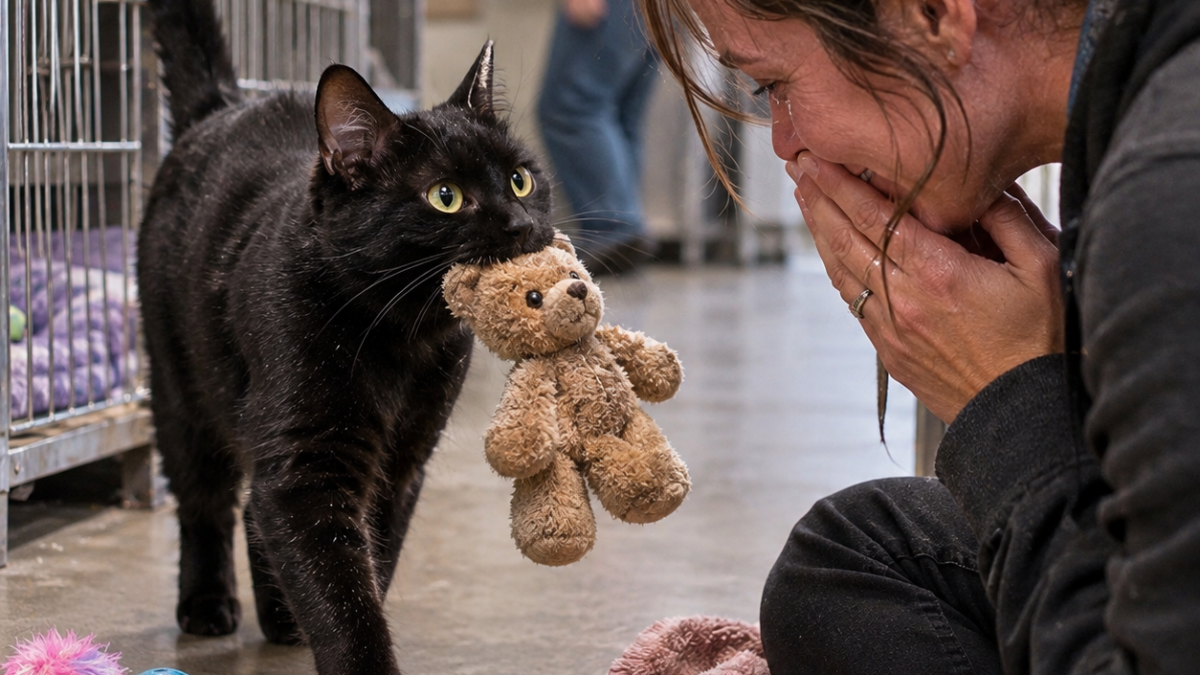
Roxy had the green frog in her mouth.
The second Emma sat down, something extraordinary happened.
Roxy dropped it.
Not carefully.
Just let it fall.
Then walked straight past the toy.
She climbed into Emma’s lap.
Emma froze.
Roxy pushed her forehead beneath the child’s chin.
The girl’s hands remained suspended in the air.
“Can I pet her?”
“Yes.”
Emma touched Roxy’s back with two fingers.
Roxy began purring.
Loudly.
Then she curled against Emma’s stomach.
The green frog remained three feet away.
Forgotten.
Emma looked at her mother.
Her expression changed so quickly I felt embarrassed for witnessing it.
Not happiness.
Pain.
“Mom.”
Her mother pressed her lips together.
“Yeah.”
“She likes me.”
“She does.”
Emma lowered her face into Roxy’s fur.
And began crying.
Not loudly.
Silent tears.
Roxy lifted her head.
Touched her nose to Emma’s chin.
The woman turned away.
I saw her wipe her face.
I stepped toward the door.
“I can give you a few minutes.”
“Thank you.”
I left.
Jess was in the hallway.
She looked at my face.
“What?”
I pointed through the window.
She watched.
Her hand went to her mouth.
“Oh.”
“Yeah.”
“Is that—”
“Roxy.”
“No toys?”
I shook my head.
Roxy had completely abandoned them.
She was wrapped around Emma.
The girl held her as carefully as though she had been entrusted with something breakable.
Twenty minutes later, Emma’s mother came outside alone.
She closed the door behind her.
“I should explain.”
“You don’t have to.”
“No.”
She looked through the glass.
“I do.”
Her name was Rachel Martin.
She worked nights as a respiratory therapist at St. Agnes Medical Center.
Emma was her daughter.
Six months earlier, Rachel’s husband, David, had died unexpectedly after a brain aneurysm.
Forty-one years old.
Healthy.
At work on Monday.
Gone by Wednesday.
Emma had been at school when it happened.
Rachel picked her up early.
Told her in the car.
The girl had barely spoken for three days.
After that, grief changed her quietly.
She still went to school.
Still did homework.
Still brushed her teeth when reminded.
But she stopped inviting friends over.
Stopped drawing.
Stopped sleeping in her own room.
She had begun sitting in her father’s old recliner after school without watching television.
Rachel told me this while staring through the glass at her daughter.
“She used to talk constantly.”
Her voice broke.
“I used to wish for five minutes of silence.”
She laughed once.
Then wiped her eyes.
“God, I’d give anything to have that problem again.”
I looked at Emma.
Her lips were moving.
Talking to Roxy.
I could not hear the words.
Rachel saw it too.
“That’s more than she’s said to me all week.”
“Animals are easier sometimes.”
Rachel nodded.
Then her expression tightened.
“But we can’t adopt.”
I knew.
I had heard it before.
Rent.
Allergies.
Finances.
Schedule.
“She asked you?”
“No.”
“Then why are you telling me?”
Rachel looked down.
“Because I want to.”
That surprised me.
“So what’s stopping you?”
She hesitated.
“David was allergic.”
I waited.
She laughed sadly.
“I know. He’s gone.”
The sentence felt terrible in the air.
“I haven’t changed anything.”
She continued.
“His shoes are still in the closet. His coffee mug is still beside the machine. There’s half a bottle of shampoo in the shower I can’t throw away.”
I understood.
More than she probably realized.
“Bringing home an animal feels like admitting the house belongs to a different life now.”
Rachel nodded.
Tears filled her eyes.
“Yes.”
We stood quietly.
Inside the room, Roxy had stretched one paw across Emma’s chest.
Emma was smiling.
Barely.
But unmistakably.
Rachel whispered, “That’s the first time I’ve seen that expression since the funeral.”
I did not tell her to adopt Roxy.
Shelter workers learn not to push.
Adoption made from guilt can become another surrender.
Instead I said, “You don’t have to decide today.”
Rachel nodded.
“Can we stay a while?”
“As long as you want.”
They stayed almost an hour.
When they left, Emma knelt beside Roxy.
“I’ll come back.”
Roxy watched her go.
Then picked up the green frog.
Carried it to the door.
My throat closed.
Emma came back two days later.
This time Rachel brought coffee for herself and hot chocolate for Emma.
Roxy saw them through the glass.
Grabbed the frog.
Emma smiled.
“Hi, Roxy.”
Meet-and-greet room.
Toy dropped.
Lap occupied.
Same ritual.
They came again Sunday.
Then Tuesday.
By then, Roxy had started recognizing the sound of Emma’s voice from the hallway.
She stood before the girl entered.
Tail straight.
Meowing.
Other staff noticed.
“What’s going on with Roxy?”
“Boyfriend?”
“Girlfriend,” Jess corrected.
Emma brought a small toy on the fourth visit.
A soft yellow star.
She held it through the bars.
“This is for you.”
Roxy sniffed it.
Then went for the green frog instead.
Emma laughed.
Rachel stopped walking.
The sound was small.
A child laughing.
But Rachel closed her eyes.
I knew exactly why.
Some sounds become sacred after you think they are gone.
Emma eventually left the star inside the kennel.
Roxy slept with it that night.
The following morning, I found the green frog pushed beside it.
On Friday, Rachel asked for the adoption application.
She held the clipboard like it weighed twenty pounds.
“Are you sure?”
I asked.
“No.”
That was probably the best answer.
She smiled nervously.
“I think being sure is impossible now.”
“Sometimes.”
She looked through the window.
Emma was sitting beside Roxy.
“I keep waiting until I feel ready for our life to change.”
“And?”
“It already changed.”
I nodded.
Rachel continued.
“Maybe I’m just deciding whether all the changes have to be losses.”
That sentence stayed with me.
She completed the application.
Landlord approval.
Veterinary history from a childhood dog.
Household information.
Work schedule.
Emergency contact.
Everything checked out.
We scheduled adoption for Saturday.
Emma did not know.
Rachel wanted to surprise her.
Saturday morning, I arrived early.
I cleaned Roxy’s enclosure.
Packed the old toys.
Green frog.
Purple ball.
Two mice.
Yellow star.
Her original pink blanket.
The abandoned-cat note remained in our records.
I photocopied it.
I do not know why.
Maybe because I wanted evidence of the distance she had traveled.
Rachel arrived at ten.
Alone.
She signed everything.
Paid the adoption fee.
Bought a carrier from us.
Then left.
I stared at Jess.
“What?”
“She left.”
Jess smiled.
“She’s getting Emma.”
Twenty minutes later, they returned.
Emma entered the cat room.
Stopped.
Roxy’s enclosure was empty.
Her face changed instantly.
She looked at me.
“Where’s Roxy?”
I said nothing.
Emma turned to Rachel.
“Mom?”
Rachel held out the carrier.
Inside was the pink blanket.
The green frog.
The toys.
Emma looked confused.
Then hope entered slowly.
“No.”
Rachel began crying.
“Yes.”
Emma stared.
“No.”
“You told me you wanted her.”
“You said we couldn’t.”
“I changed my mind.”
Emma looked at the empty kennel.
“Where is she?”
I opened the staff-room door.
Jess carried Roxy out.
The cat immediately saw Emma.
She wriggled.
Jess lowered her.
Roxy ran.
Not sprinted like a dog.
Not dramatically.
Just a quick little black blur across the floor.
Straight to Emma.
Emma dropped to her knees.
Roxy climbed against her.
The girl made a sound between laughter and sobbing.
“You’re coming home?”
Roxy purred.
Emma looked at Rachel.
“She’s really coming?”
“Yes.”
“For forever?”
Rachel knelt beside them.
“For as long as she’ll have us.”
Emma wrapped one arm around Roxy.
Then the other around her mother.
Rachel held both.
Every person in that room stopped working.
Not because adoptions were unusual.
We saw them constantly.
But some endings carry the weight of everything before them.
Fifty-eight days.
Hundreds of footsteps past glass.
Toy after toy.
An abandoned cat trying to give strangers the only things she owned.
A little girl learning how empty a house could sound after losing her father.
A mother terrified that moving forward meant leaving someone behind.
And somehow all three had ended up on the same shelter floor.
Jess cried openly.
I pretended my eyes were irritated by cleaning chemicals.
Nobody believed me.
Before they left, Emma gathered Roxy’s toys.
The green frog last.
She held it up.
“Does this have to come?”
I laughed.
“Absolutely.”
“Why?”
“That’s her favorite.”
Emma looked at Roxy.
“I thought I was her favorite.”
Rachel smiled.
“You can both be.”
Emma placed the frog in the carrier.
Roxy ignored it.
She wanted to sit against Emma.
Of course she did.
The first update arrived that evening.
A photograph.
Roxy stretched across Emma’s bed.
Green frog beside her.
The caption from Rachel read:
She has inspected every room and apparently approves.
The next photograph came at 11:42 p.m.
Roxy asleep beneath Emma’s blanket.
Only two yellow eyes and one black ear visible.
She refuses to leave Emma.
I showed Jess.
She cried again.
“Stop.”
“You stop.”
Sunday morning, another update.
Roxy sitting on David’s old recliner.
That one was complicated.
Rachel wrote:
I almost moved her.
Then Emma said, “Dad liked warm things too.”
So I left her.
I stared at the photograph for a long time.
Healing can look disrespectful when you first see it.
Someone else in his chair.
A new bowl in the kitchen.
Cat hair on a blanket that belonged to him.
Laughter in a room where people had cried.
But Rachel was learning something I had watched many families learn through animals.
Love does not preserve a home by freezing it.
Love survives being rearranged.
Two weeks later, Rachel brought Roxy back for a routine vaccination.
Emma came too.
Roxy entered in a carrier.
Healthy.
Bright-eyed.
Half a pound heavier.
Her coat looked shinier.
When I opened the carrier, she walked directly onto my lap.
“You remember me?”
Purr.
Emma looked offended.
“She likes you.”
“I knew her first.”
Emma narrowed her eyes.
“She’s mine.”
I laughed.
“Yes, ma’am.”
Dr. Patel examined Roxy.
“Looks good.”
Emma stood beside him.
“Her teeth?”
“Still need dental cleaning eventually.”
“I’m saving.”
Dr. Patel looked at Rachel.
Rachel smiled.
“She has a jar.”
Emma explained.
“I put allowance in it.”
“For Roxy?”
“Yes.”
“How much?”
“Twenty-three dollars.”
Dr. Patel nodded solemnly.
“Excellent start.”
Emma looked proud.
After the exam, Rachel asked if she could speak privately.
We stepped into the hallway.
“She sleeps in Emma’s room every night.”
“Sounds normal.”
“No.”
Rachel smiled.
“I mean Emma sleeps in her own room again.”
I understood.
“She hadn’t since David?”
“Not once.”
Rachel’s eyes filled.
“The first night Roxy came home, Emma said she wanted to try.”
“How did it go?”
“She woke up twice.”
Rachel laughed softly.
“Roxy woke me up both times.”
“What?”
“She came into my room. Meowed. Walked back toward Emma’s room until I followed.”
I smiled.
“She trained you quickly.”
“Apparently.”
The second time Emma woke from a nightmare, Roxy stayed against her chest until she fell asleep.
After that, the nightmares came less often.
Not gone.
Grief does not leave because a cat arrives.
But the nights stopped feeling empty.
Emma started drawing again.
Mostly Roxy.
Black cat with yellow eyes.
Black cat in a castle.
Black cat flying through space.
Black cat wearing a crown.
My favorite showed Roxy sitting beside a stick figure with long brown hair.
Across the top, in purple marker, Emma had written:
ROXY PICKED ME.
Rachel framed that one.
Three months later, Emma came to the shelter for her tenth birthday.
She did not want a party.
She wanted to volunteer.
Technically she was too young to volunteer officially, so Rachel brought cupcakes and they spent two hours making adoption cards for cats.
Emma sat at a table.
Roxy was not there, obviously.
But her influence was.
Emma drew toy frogs on every card.
For older cats, she wrote:
PLEASE STOP AND SAY HI.
For black cats:
THEY ARE EASIER TO LOVE THAN TO PHOTOGRAPH.
I laughed so hard when I saw that.
“Who told you this?”
“Mom.”
“Your mom is smart.”
“I know.”
There were four black cats in the room that month.
Two were adopted that weekend.
The third went home the following Tuesday.
The fourth, an eleven-year-old named Marvin, took three weeks.
Emma visited him twice.
Brought him a toy frog.
Coincidence, probably.
Still.
I began thinking about how stories travel.
Roxy’s first video had reached a few hundred people.
After her adoption, Jess posted an updated version.
It showed Roxy offering toys.
Then a short clip, with Rachel’s permission, of Roxy dropping the frog and climbing into Emma’s lap.
No dramatic music.
No narration.
Just text explaining that for nearly two months people thought Roxy wanted visitors to play.
What she really wanted was someone to stay.
The video spread.
First locally.
Then beyond Pennsylvania.
Ten thousand views.
Fifty thousand.
Then hundreds of thousands.
Messages arrived from shelters in Ohio.
Texas.
California.
Canada.
People shared photographs of black cats they adopted.
Older cats.
Shy cats.
Animals nobody noticed until the right person stopped.
One woman wrote:
I went to my shelter because of Roxy and adopted a 12-year-old black cat named Tessa. She had been there four months.
Another:
My son lost his dad last year too. We adopted an adult cat yesterday. Thank you, Emma.
Rachel read those messages.
She cried.
Emma reacted differently.
“How many cats?”
“What?”
“How many got adopted?”
We did not know.
She found that frustrating.
“Some.”
“How many is some?”
“A lot, maybe.”
She frowned.
“That’s not a number.”
I liked her more every visit.
The attention eventually brought one message we did not expect.
It came through the shelter email.
Subject:
I think Roxy was my mother’s cat.
My stomach tightened.
I opened it.
The writer was named Jonathan Vale.
He lived in Ohio.
His mother, Susan, had lived in Pennsylvania until several months earlier.
She was sixty-eight.
Diagnosed with early-onset Alzheimer’s several years before.
Her condition declined quickly.
Jonathan moved her into assisted living near him.
She owned a black cat named Roxy.
Seven years old.
Carried toys.
Slept under blankets.
Yellow eyes.
My chest went cold.
There were photographs attached.
It was her.
No question.
Roxy sitting beside an older woman.
Roxy with the green frog.
Roxy asleep beneath the pink blanket.
The exact blanket from intake.
I called our shelter director.
Then Rachel.
That call was one of the hardest I have ever made.
“Rachel.”
“What happened?”
She heard it immediately.
“Is Roxy okay?”
“Roxy’s fine.”
Pause.
“Then what?”
“We may have found her previous family.”
Silence.
Not owner.
Family.
I deliberately used the word.
Rachel’s voice changed.
“Are they asking for her back?”
“I don’t know.”
Another silence.
Then quietly:
“I need to tell Emma.”
“We don’t know anything yet.”
“She deserves to hear it from me.”
I agreed.
Jonathan called later that day.
His voice was exhausted.
“I’m not trying to take anybody’s cat.”
Those were his first words.
I relaxed slightly.
“What happened?”
He explained.
When his mother’s dementia worsened, he moved her into assisted living.
Roxy could not go.
Jonathan was severely allergic.
His sister lived overseas.
He arranged for a longtime family friend named Paula to foster Roxy temporarily while he searched for permanent placement.
Paula agreed.
Three weeks later, Paula told him Roxy had been placed with a “wonderful retired couple.”
Jonathan believed her.
He had too much else happening.
His mother’s move.
Selling her home.
Medical decisions.
Power of attorney.
Her repeated confusion.
He did not ask enough questions.
Months later, he saw our viral post.
Roxy.
Green frog.
Pink blanket.
He knew immediately.
“I think Paula abandoned her.”
“Why?”
“Because she stopped answering me after I asked for the couple’s contact information.”
“Why would she do that?”
Jonathan’s voice cracked.
“I don’t know.”
There was shame in it.
“I gave her money.”
“How much?”
“Eight hundred dollars.”
“For?”
“Food, veterinary expenses, and helping with placement.”
I closed my eyes.
Maybe Paula kept the money.
Maybe caring for Roxy became inconvenient.
Maybe the story was uglier.
It did not matter to Roxy anymore.
What mattered was Jonathan’s mother.
“Does Susan remember her?”
Long silence.
“Sometimes.”
That answer hurt.
Jonathan continued.
“She asks about Roxy on good days.”
My throat tightened.
“What do you tell her?”
“That she’s safe.”
“Before you knew?”
“Yes.”
His voice broke.
“I was lying.”
“No.”
I said it quickly.
“You believed she had a home.”
“I should have checked.”
“Probably.”
He went quiet.
I continued.
“But you were caring for your mother during a medical crisis. Someone you trusted lied to you.”
“I still should’ve checked.”
There was no useful argument against grief mixed with guilt.
I knew that.
So I said, “She is safe now.”
Jonathan cried.
Very quietly.
“Can I see her?”
That became complicated.
Legally, Roxy had been processed as an abandoned animal.
Required holding periods had passed.
No microchip.
No missing report local enough to match.
Adoption completed lawfully.
Jonathan had no interest in challenging it.
Rachel still worried.
Not about law.
About Emma.
I visited their house before Jonathan came.
Roxy met me at the door.
She had gained another pound.
Her collar was purple now.
Tag:
ROXY MARTIN.
Emma sat on the couch.
Serious.
“You found her old mom.”
“Yes.”
“Is she taking Roxy?”
“No.”
“You promise?”
“I can’t promise things other people control.”
Rachel looked at me.
I continued.
“But Jonathan has told us clearly that he does not want to remove her from you.”
Emma’s eyes filled.
“Why did they leave her?”
I told her carefully.
Susan was sick.
Jonathan trusted someone.
That person apparently failed Roxy.
Emma became angry.
“She put her in a hallway?”
“We think so.”
“That’s horrible.”
“Yes.”
Adults sometimes dilute cruelty for children.
I did not.
Abandoning Roxy was horrible.
Emma deserved truth.
“But Jonathan tried to help her,” I added.
“He messed up.”
“Yes.”
Emma looked down.
“People mess up when they’re sad.”
Rachel closed her eyes.
That sentence came from somewhere deep.
“Yes,” she said.
Jonathan arrived Saturday.
He brought his mother.
We had not expected that.
Susan used a walker.
Small woman.
White hair.
Blue coat.
Jonathan stayed beside her.
Rachel met them outside.
I stood near the living room.
Emma held Roxy.
Susan entered.
At first nothing happened.
Her eyes moved around the room.
Confused.
Jonathan said softly, “Mom, look.”
Roxy heard his voice.
Then saw Susan.
The cat went completely still.
Emma felt it.
She loosened her arms.
Roxy jumped down.
Walked toward Susan.
Stopped.
Sniffed her shoe.
Susan looked down.
For several seconds there was no recognition.
My heart sank.
Then Roxy meowed.
Susan’s face changed.
Not all at once.
Like a light behind a curtain.
“Roxy?”
Jonathan covered his mouth.
Roxy stood on her hind legs against Susan’s knee.
The older woman began crying.
“My baby.”
Roxy climbed into her lap when we helped Susan sit.
She pushed beneath the woman’s hand.
Purrrrr.
Susan stroked her automatically.
“Where were you?”
Nobody answered.
She looked around.
“Jonathan?”
He knelt.
“I’m here.”
“Why is Roxy here?”
He started crying.
“She has a family now, Mom.”
Susan looked at Emma.
The child stood five feet away.
Terrified.
Susan looked at Roxy again.
Then at Emma.
“Yours?”
Emma nodded.
Susan smiled.
“Good.”
That one word changed the entire room.
Emma stepped closer.
“She sleeps with me.”
Susan nodded.
“She likes blankets.”
“I know.”
“She carries frog.”
Emma ran to Roxy’s toy basket.
Brought the green frog.
Susan laughed.
A thin, surprised sound.
“Still.”
Jonathan turned away.
Rachel was openly crying.
Susan touched the toy.
Then looked at Emma.
“She gives things.”
Emma nodded.
“She gave it to me at the shelter.”
Susan’s smile became sad.
“No.”
Emma frowned.
“What?”
Susan stroked Roxy.
“She gives when scared.”
The room went quiet.
I leaned closer.
“What do you mean?”
Susan’s eyes were clearer than they had been since arriving.
“When thunder.”
She spoke slowly.
“She brings toy.”
Jonathan stared.
“I didn’t know that.”
Susan nodded.
“When lonely.”
She looked down at Roxy.
“Bring something.”
My throat closed.
All those days.
All those visitors.
Roxy had not merely learned a cute way to attract people.
It was a coping behavior.
When frightened.
When lonely.
When she needed comfort.
She carried something she loved to someone she hoped would stay.
Emma understood before any of us said it.
“She was scared at the shelter.”
“Yes,” I whispered.
Emma started crying.
She knelt beside Susan.
Roxy moved from one lap to the other, then seemed unable to decide.
Finally she lay across both their legs.
Susan stroked her head.
Emma stroked her back.
Two people.
Past and present.
Roxy between them.
Jonathan cried so hard he had to leave the room for a moment.
When he returned, Emma asked him something.
“Did your mom love her?”
Jonathan looked shocked.
“Very much.”
“Then why doesn’t Roxy live with her?”
Rachel started to speak.
Jonathan answered first.
“Because sometimes loving somebody doesn’t mean you’re able to take care of them the way they need.”
Emma thought.
Then looked toward the framed photograph of her father on the bookshelf.
“I know.”
No child should understand that sentence at nine.
But she did.
Susan visited Roxy three more times before her health declined.
Each visit followed the same pattern.
Confusion.
Then Roxy’s voice.
Then recognition.
Sometimes only minutes.
Once nearly an hour.
Susan would stroke her.
Tell stories no one could completely follow.
Call her “little shadow.”
Emma always sat nearby.
Not jealous anymore.
She understood something beautiful.
She had not replaced Susan.
Roxy had room for both.
The last visit happened in August.
Susan was weaker.
She barely spoke.
Roxy climbed onto her lap.
Susan rested one hand on her back.
Then looked at Emma.
“Take care.”
Emma nodded.
“I will.”
Susan looked at Roxy.
“Family.”
That was one of the last clear words Jonathan remembered her saying.
She died six weeks later.
Jonathan called Rachel first.
Then me.
At Susan’s memorial, Emma placed a photograph beside the flowers.
Susan holding Roxy.
Roxy holding the green frog.
Jonathan kept it.
He later told me his mother’s final months had been easier because he could honestly tell her Roxy was safe.
No more comforting lie.
No uncertainty.
Roxy had a home.
That mattered.
The shelter’s investigation into Paula ended with charges related to abandonment and misuse of funds.
It was not dramatic.
No courtroom revelation.
No media swarm.
She admitted she had become overwhelmed caring for Roxy after Susan moved.
She spent much of Jonathan’s money on personal expenses.
Then, after Roxy scratched furniture in her apartment, she panicked.
She left the cat in the hallway of a building where she knew the property manager had previously contacted animal control for strays.
The note was hers.
Please take care of Roxy.
She is 7.
She is indoor only.
She is sweet.
She likes sleeping under blankets and carries her toys around.
I am sorry.
She had known Roxy was loved.
She had known someone would have taken her if she simply made a phone call.
That was the part I found hardest to forgive.
She had options.
She chose abandonment because embarrassment was easier than admitting failure.
Jonathan blamed himself.
For months.
Emma eventually wrote him a letter.
Rachel showed me only because Emma gave permission.
It said:
Mr. Jonathan,
You didn’t leave Roxy.
You thought she was safe.
She got lost but now she is not.
Your mom loved her first and I love her now.
I think Roxy got two families instead of one.
Please don’t be sad every day because she isn’t.
Love,
Emma
Jonathan framed it.
Years passed.
Roxy stopped bringing toys to the door every time someone visited.
That detail meant more to us than almost anything.
At first she still did it.
Doorbell.
Footsteps.
Green frog.
Then, gradually, less.
Maybe because she learned visitors could leave without taking her world with them.
Maybe because she no longer feared that every arrival was an audition.
She still carried toys.
Especially the green frog.
But now she brought them to Emma’s bed.
Dropped them beside Rachel on the couch.
Sometimes left one in David’s old recliner.
Rachel found the purple ball there once.
She sat staring at it.
Then laughed.
“David would have complained about cat hair.”
Emma asked, “Really?”
“He complained about everything furry.”
“Would he like Roxy?”
Rachel looked at the chair.
“Yes.”
Then smiled.
“He’d pretend not to.”
Emma grew.
At eleven, she began volunteering officially with a parent.
At thirteen, she learned basic cat handling.
At fourteen, she became the person nervous cats seemed to trust.
I teased her.
“You know why?”
“Why?”
“You don’t stare.”
She shrugged.
“People stared at me when Dad died.”
That answer silenced me.
She continued cleaning a litter box.
“I hated it.”
“So you don’t do it to them?”
“No.”
Simple.
Compassion often is.
Rachel changed too.
The recliner remained.
David’s coffee mug eventually moved into a cabinet.
His shoes left the closet.
Not thrown away.
Donated.
The first time Rachel did that, she cried in the parking lot of Goodwill for thirty minutes.
Then went home.
Roxy climbed into her lap.
No toy.
She did not need one anymore.
Rachel eventually started dating again.
Four years after David died.
The man’s name was Aaron.
He was a high school history teacher.
Divorced.
Kind.
Terrified of Roxy.
Not because she was black.
Because he had never owned a cat and believed she could “sense weakness.”
She could.
On his first visit, Roxy stared at him from across the room.
Aaron whispered to Rachel, “What does that mean?”
“Nothing.”
“She hasn’t blinked.”
“She’s evaluating you.”
“That is not nothing.”
Emma laughed.
Roxy walked away.
Returned with the green frog.
Every adult in the room stopped.
Aaron did not know why.
“What?”
Emma covered her mouth.
Rachel’s eyes filled.
Roxy placed the frog near Aaron’s shoe.
He crouched.
“Is this for me?”
Roxy rubbed against his hand.
Emma whispered, “She likes you.”
Aaron smiled.
“I feel like I passed something.”
“You did.”
He later married Rachel.
Roxy slept through most of the small backyard wedding.
At the reception, she stole a piece of turkey from an unattended plate.
I considered that her formal blessing.
By then, Roxy was twelve.
Her black fur had begun developing silver hairs around the face.
Her jumping became less graceful.
She took longer to climb stairs.
Emma, fifteen, placed little ramps beside the couch and bed.
Roxy initially refused to use them.
Pride apparently crosses species.
Then arthritis worsened.
She accepted the ramps.
At fourteen, kidney disease appeared.
Early.
Manageable.
Rachel learned to give fluids.
Emma learned medication schedules better than many adult pet owners.
Aaron became responsible for prescription food ordering.
Roxy remained herself.
Still yellow-eyed.
Still opinionated.
Still slept under blankets.
Still carried the green frog, though less often because her teeth hurt.
One snowy January evening, seven years after Roxy first entered our shelter, Emma called me.
She was sixteen.
Her voice sounded like the nine-year-old I remembered.
“Hannah?”
“What happened?”
“Roxy won’t eat.”
My chest tightened.
“I’m coming.”
Technically I no longer needed to.
They had a veterinarian.
A car.
Competent adults.
But I went.
Roxy was on Emma’s bed.
Very thin.
The green frog beside her.
Rachel sat on one side.
Emma on the other.
Aaron stood near the door.
Dr. Patel had already seen her earlier that afternoon.
Advanced renal failure.
Options limited.
They could hospitalize.
Maybe buy days.
Maybe weeks.
Roxy hated the clinic now.
Stress.
Needles.
Noise.
Emma knew.
“I don’t want her scared.”
Rachel cried quietly.
Neither did I.
The decision was made for the following morning.
Home euthanasia.
I stayed.
At midnight, Emma was still awake.
She stroked Roxy.
Then said, “I don’t remember Dad’s voice very well anymore.”
Rachel looked up.
Emma continued.
“I remember things he said. But not exactly the sound.”
Rachel reached for her.
Emma cried.
“What if I forget Roxy too?”
That is one of those questions adults want to answer with certainty.
You won’t.
But memory does change.
Faces blur.
Voices fade.
Details rearrange.
I sat beside her.
“You’ll forget some things.”
Rachel looked at me.
I continued.
“You may forget exactly how her meow sounds.”
Emma cried harder.
“You may forget which side of the bed she slept on when you were ten.”
I touched the green frog.
“But you won’t forget what she changed.”
Emma looked at me.
“There are things we remember with facts.”
I put a hand over my chest.
“And things we remember by who we become afterward.”
She looked at Roxy.
The cat’s eyes were closed.
I said, “You became someone who notices the animal everybody else walks past.”
Emma lowered her forehead against Roxy.
“That doesn’t disappear.”
Morning came softly.
Snow outside.
Quiet house.
Dr. Patel arrived at nine.
Roxy lay on Emma’s blanket.
Rachel.
Aaron.
Emma.
Me.
No clinic table.
No steel.
No cage.
The green frog beneath her front paw.
Dr. Patel explained every step.
Emma listened.
Then she asked for one minute.
Everyone waited.
She picked up the frog.
Held it near Roxy.
“Remember this?”
Roxy opened her eyes.
Weak.
Emma smiled through tears.
“You brought this to me.”
Roxy’s paw moved.
Barely.
Emma placed the toy against her chest.
“But you didn’t have to.”
Her voice broke.
“You never had to give me anything.”
Rachel began crying.
Emma leaned closer.
“I would’ve stayed anyway.”
Roxy purred.
Very faintly.
But we heard it.
Every one of us.
Emma held her.
Dr. Patel gave the first medication.
Roxy relaxed.
Her breathing slowed.
Emma whispered, “I choose you.”
The exact words we had once joked every shelter animal wanted to hear.
“I still choose you.”
Roxy died in her lap.
Loved.
Warm.
Home.
Not behind shelter glass.
Not beside toys she was trying to trade for attention.
In the arms of the little girl she had chosen seven years earlier.
We buried the green frog with her.
Emma kept the yellow star.
That surprised me.
“Why that one?”
She held it.
“Because I gave it to her.”
I understood.
The frog represented what Roxy offered.
The star represented what Emma did.
Love had moved both directions.
After Roxy died, Emma stopped volunteering for two months.
Nobody pushed.
Then one Saturday in March, she walked through the shelter doors.
Seventeen now.
Taller.
Hair longer.
Yellow star clipped to her backpack.
I was behind the desk.
She looked at me.
“Any black cats?”
I smiled.
“Three.”
“Old ones?”
“Two.”
She nodded.
“Show me.”
We walked into the cat room.
A nine-year-old black male named Jasper sat at the back of his kennel.
Did not approach.
Emma sat on the floor.
Waited.
Five minutes.
Ten.
Jasper eventually moved forward.
Emma did not reach.
He sniffed through the bars.
Then sat.
“That one,” Emma said.
“You adopting?”
She laughed.
“Mom would kill me.”
“So?”
“I want to make his profile.”
She took photographs.
Not easy with black fur.
She adjusted background.
Waited for light.
Sat for forty minutes until Jasper relaxed.
Then she wrote:
Jasper isn’t going to perform for you.
He won’t carry toys to the glass.
He may not climb into your lap the first day.
But if you are patient, he will sit beside you.
And one day you may realize that sitting beside someone is his version of saying everything.
Jasper was adopted four days later by a retired widower.
Emma cried when he left.
Then smiled.
She went on to study veterinary social work, a field I had barely known existed.
She wanted to help families dealing with pet loss, surrender crises, and the complicated grief that comes when animals and humans depend on each other.
Years later, she returned to Maple Grove for a lecture.
Not as the silent nine-year-old in the red coat.
As Emma Martin, MSW, speaking to shelter staff about grief-informed adoption counseling.
I sat in the back.
She showed one photograph at the end.
Roxy.
Black cat.
Yellow eyes.
Green frog in her mouth.
The room laughed softly.
Emma smiled.
“She spent fifty-eight days trying to give this toy to strangers.”
Then another photograph appeared.
Roxy curled in Emma’s lap.
Toy abandoned on the floor.
Emma looked at us.
“For years I thought Roxy brought toys because she was trying to get adopted.”
She paused.
“My grandmother—Roxy’s first owner—later helped us understand that she carried toys when she was frightened or lonely.”
The room became quiet.
Emma continued.
“So every time a visitor came, Roxy was doing the only thing she knew how to do with hope and fear at the same time.”
She looked toward the photograph.
“She brought something precious.”
Then she smiled.
“But the second someone stayed, she let it go.”
I felt tears start before I could stop them.
Emma saw me.
Of course she did.
She continued.
“I think people do that too.”
No one moved.
“We bring accomplishments.”
“Jokes.”
“Gifts.”
“Perfect behavior.”
“Anything we think might make somebody choose us.”
Her voice softened.
“But sometimes what we actually need is a person who sits down long enough for us to understand we don’t have to perform anymore.”
That was Roxy’s story.
Not simply a black shelter cat waiting fifty-eight days.
Not simply a child grieving her father.
Not simply an abandoned animal going viral online.
It was a story about what happens when two lonely creatures recognize something familiar in each other.
Roxy had lost Susan.
Emma had lost David.
Neither could understand where the person went.
Neither could undo what happened.
Neither needed replacement.
They needed somewhere safe to put the love that remained.
They found each other.
For years afterward, people would remember the toys.
The little green frog.
The purple ball.
The fuzzy mice.
The sweet black cat carrying offerings to visitors.
I remembered something else.
I remembered the moment she dropped the frog.
Emma sat down.
Roxy looked at her.
And suddenly the thing she had been carrying did not matter.
Because someone had stopped.
Someone had stayed.
Someone had finally looked through the shelter glass and seen not a seven-year-old black cat, not bad luck, not an older animal when kittens were available, not another adoption fee or veterinary expense.
Emma saw Roxy.
And Roxy, in whatever way animals understand such things, seemed to see Emma too.
That was all either of them had been asking for.
Not perfection.
Not rescue from every painful thing that had happened before.
Just the chance to belong after losing the place they once belonged.
Roxy never knew that thousands of people eventually watched her videos.
She never knew strangers cried over her story.
She never knew other black cats were adopted because people saw her photograph.
She never knew her little ritual changed the way our shelter described older animals.
She certainly never knew Emma eventually built a career partly around what she learned from loving her.
Roxy knew simpler things.
The sound of Emma coming home.
The warm spot in David’s old chair.
Rachel opening a can in the kitchen.
Aaron pretending not to share turkey.
A blanket lifting so she could crawl underneath.
A hand resting on her back at night.
The green frog.
The yellow star.
Her family.
Maybe that is enough.
Maybe, for any of us, it is more than enough.
Because for fifty-eight days, Roxy stood behind shelter glass offering strangers everything she owned.
One toy at a time.
Again.
Again.
Again.
And the heartbreaking truth was that she never really wanted them to take the toy.
She wanted them to take her home.
Then one little girl finally sat down.
Roxy dropped everything she was carrying.
And she never had to ask to be chosen again.








