For 500 Days, Reach Has Stretched His Paw Through the Bars at Every Person Who Walks Past—And Not One of Them Has Reached Back
PART3:
He let veterinary staff examine his mouth.
He tolerated nail trims with the weary dignity of a man enduring airport security.
And he had the paw.
People loved the paw.
Staff filmed it.
Volunteers showed visitors.
“Watch this.”
Someone would walk up.
Reach would extend his paw.
“Oh my God.”
People laughed.
They took pictures.
They told him he was adorable.
Then they adopted a kitten.
That happened the first week.
And the second.
Then July came.
Kitten season.
Cedar Ridge received forty-three kittens in eleven days.
Reach was moved from kennel 6 to kennel 10 to make room for a nursing mother.
Then from kennel 10 to kennel 14 when an injured cat needed the larger lower kennel.
Kennel 14 sat at the very end of the row.
Bottom level.
Near the utility closet.
Just before the hallway turned toward laundry.
It was technically visible.
But barely.
The cat room was arranged so that visitors entered beside kennels 1 and 2.
The kittens were near the front.
Bright blankets.
Toy mice.
Little adoption cards with colorful handwriting.
By the time families reached kennel 14, most had already emotionally chosen someone.
Pam saw it every Saturday.
A mother and daughter would kneel in front of two kittens.
A young couple would laugh at an orange cat climbing their sleeves.
Someone would say, “I think this is the one.”
Then they would continue down the row because a volunteer encouraged them to “meet everybody.”
But they were no longer looking.
They were confirming.
When they passed Reach on their way back toward the lobby, he would stand.
Sit near the door.
Extend his paw.
The people kept walking.
Sometimes they literally stepped around it.
Not intentionally.
They simply never looked down.
Pam began noticing that part.
The not looking.
Human beings, she decided, were very good at walking past things once they believed they had already found what they wanted.
At first she took one photograph for the shelter’s social media page.
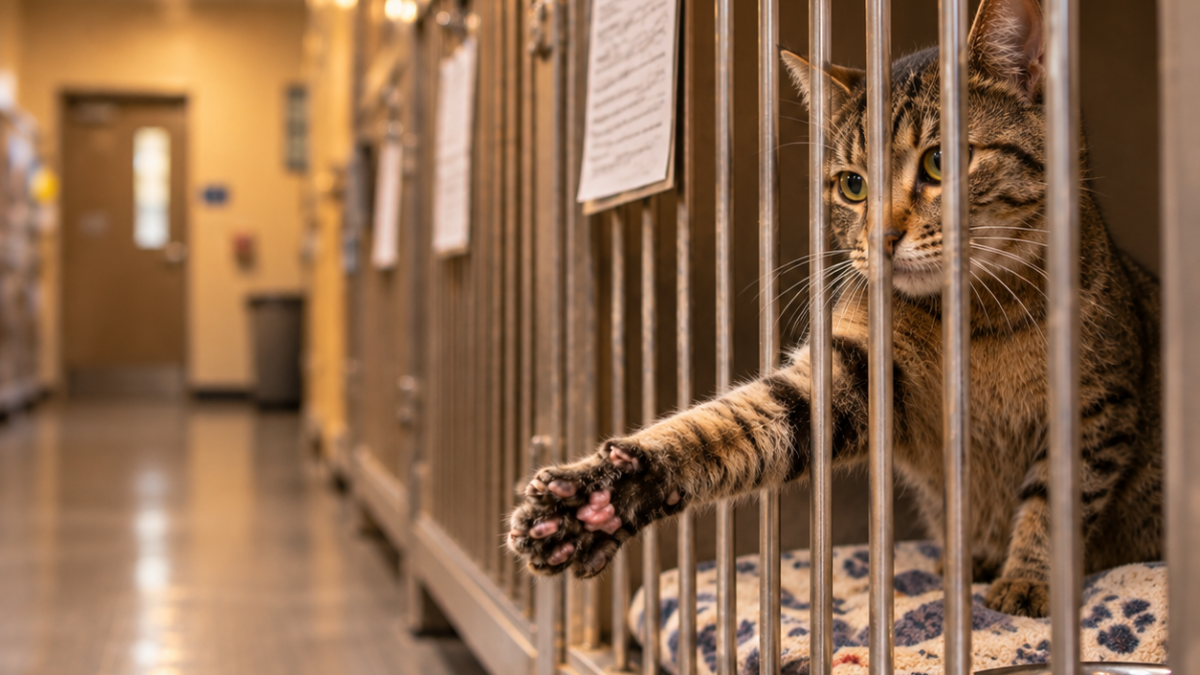
Reach was sitting at the bars.
Paw extended.
A teenage boy was visible behind him, blurred by the camera because he was walking away.
Pam wrote:
This gentleman would like to shake your hand.
Meet Reach, six years old and still searching for his forever home.
The post received seventy-eight likes.
Two comments.
One person wrote, “So cute!”
No applications.
The following Tuesday, Pam took another photograph.
Almost the same.
Different person in the background.
Reach’s paw extended.
The week after that, she took another.
Then another.
She did not initially plan a series.
She simply kept thinking, Surely this one will be the last.
Every Tuesday.
Photo.
Paw.
Bars.
Someone walking past.
By week ten, it had become a ritual.
By week twenty, a record.
By week fifty, an accusation Pam had not yet admitted she was making.
Seventy-one photographs.
Same cat.
Same position.
Different human beings leaving.
Pam saved them in a folder on her phone titled REACH TUESDAYS.
She never told him what she was doing.
“Smile,” she sometimes whispered.
Reach would extend his paw.
Click.
“Good boy.”
Then she would reach back.
Pam Fletcher was sixty-one years old and had spent thirty-four years teaching eighth-grade English at Millbrook Middle School.
She was widowed.
Her husband Ray had died four years earlier after a stroke.
They had never had children.
Not because they did not want them.
Because life had made other choices.
Pam had learned there were certain questions people eventually stopped asking you.
When are you having kids?
Are you seeing anyone?
How are you holding up?
People asked until your answer made them uncomfortable.
Then they stopped.
Animals did not stop.
That was one reason Pam volunteered.
At Cedar Ridge, nobody asked her to be less lonely.
They simply needed litter boxes cleaned.
The shelter director was a man named Brett Caldwell.
Forty-six.
Tall.
Former county code enforcement officer.
Always clean-shaven.
Always carrying a stainless-steel travel mug.
Brett was not an animal person in the sentimental sense.
He had told Pam that himself.
“My job is operations.”
Pam had raised an eyebrow.
“At an animal shelter.”
“Yes.”
“So the animals are part of the operations.”
“Of course.”
“But you don’t consider yourself an animal person.”
“I consider myself a taxpayer person.”
Pam had decided immediately that she did not like him.
Brett did not care.
He had been hired eighteen months earlier after the county commission criticized Cedar Ridge for high operating costs and long animal stays.
He brought charts.
Performance reports.
New volunteer rules.
New intake procedures.
New adoption targets.
His favorite phrase was “flow through.”
“We cannot become a warehouse,” he would say.
Pam agreed with the sentence.
She disagreed with what he sometimes meant by it.
Long-stay animals bothered Brett.
Not personally.
Numerically.
The county’s monthly dashboard included AVERAGE LENGTH OF STAY.
Every day Reach remained at Cedar Ridge, he increased that number.
By month six, Brett had begun referring to him during meetings as “the tabby in fourteen.”
Pam corrected him every time.
“Reach.”
“I know his name, Pam.”
“Then use it.”
By month nine, Reach stopped appearing on the shelter’s featured adoption posts.
Pam noticed.
She approached Kayla Benton, the twenty-four-year-old employee who managed social media.
“Why hasn’t Reach been posted?”
Kayla looked uncomfortable.
“I posted him.”
“When?”
“A while ago.”
“Four months.”
Kayla stared at her computer.
“Brett wants variety.”
“Reach is variety.”
“He says repeating long-stay animals makes the page look unsuccessful.”
Pam folded her arms.
“Unsuccessful at what?”
Kayla lowered her voice.
“Pam.”
“No, tell me.”
“I’m just telling you what he said.”
“So we hide the cat because nobody adopted him?”
“We’re not hiding him.”
“He is in the last kennel on the bottom row and you won’t put him online.”
Kayla looked toward the office.
“Can you not do this here?”
Pam softened.
Kayla was not the problem.
“Sorry.”
“I like Reach.”
“I know.”
“I share him on my personal page.”
“I know.”
“Brett told us official posts should focus on animals with high engagement potential.”
Pam stared.
“What does that mean?”
“Kittens.”
“Of course it does.”
“Cute dogs.”
“Reach is cute.”
“Pam.”
“He is.”
Kayla finally smiled.
“I know.”
A month later, Cedar Ridge held its annual spring adoption event.
Banners.
Food truck.
Discounted fees.
Local radio station.
Twenty-seven animals were adopted that Saturday.
Reach never entered the event room.
Pam discovered him in kennel 14 at 10:15.
She had assumed someone else would bring him forward.
The front adoption room contained eight cats.
Reach was not one of them.
Pam found Brett near the lobby.
“Why is Reach still in fourteen?”
“He’s available.”
“That wasn’t my question.”
“The feature room is full.”
“With who?”
“Cats we selected for the event.”
“On what basis?”
“Adoptability.”
Pam stared at him.
“He has spent ten months here.”
“Exactly.”
She felt something cold move through her.
“What does that mean?”
Brett sighed.
“Pam, I don’t have time for one of these conversations today.”
“Make time.”
People moved around them.
A family filled out paperwork.
Someone carried a kitten past.
The radio host was speaking into a microphone near the front doors.
Brett lowered his voice.
“Long-stay adult cats do not perform well at high-traffic events.”
“Perform.”
“Get adopted.”
“Then put him where people can see him.”
“The event is designed around probable outcomes.”
“Not second chances.”
“Don’t do that.”
“Do what?”
“Turn management into morality.”
Pam laughed without humor.
“You’re doing a good job of that yourself.”
Brett’s face hardened.
“You are a volunteer.”
“I’m aware.”
“Act like one.”
Pam stood there for another second.
Then walked away.
She went straight to kennel 14.
Reach was sitting at the front.
He pushed his paw through.
Pam knelt.
The radio station was playing music fifty feet away.
Children laughed.
Kennel doors opened.
Adoption announcements echoed through the hall.
Pam slipped her fingers beneath Reach’s paw.
“They didn’t even give you a chance today.”
Reach curled his toes around her.
Pam looked down.
“I’m sorry.”
For the first time, she wondered whether sorry was becoming another word humans used when they did not intend to change anything.
After the event, Brett announced twenty-seven adoptions to the county commission.
He did not mention Reach.
Summer returned.
Reach passed one year.
Three hundred sixty-five days.
Pam baked cupcakes for the volunteers.
Brett told her birthday celebrations for shelter animals were not permitted in public areas because they “anthropomorphized the adoption process.”
Pam stared at him.
“His birthday is not his actual birthday.”
“Exactly.”
“I’m celebrating a year he has survived here.”
“That is not necessarily a positive message.”
That sentence stayed with Pam.
Not necessarily positive.
She went home that night and opened the folder.
Fifty-two Tuesday photographs.
She arranged them on her laptop.
A year.
Paw.
Bars.
Footsteps.
Paw.
Bars.
Footsteps.
Once, a woman’s red purse.
Once, a man’s work boots.
Once, a little boy’s sneakers.
Once, an empty hallway because nobody came that day.
Reach’s paw was always there.
Pam began thinking about repetition.
She had taught literature for three decades.
Students sometimes asked why writers repeated things.
Because repetition changed meaning.
Say a word once, it was information.
Say it again, emphasis.
Again, rhythm.
Again and again and again, and eventually it became something else.
A plea.
A warning.
A prayer.
By day 487, Pam had seventy photographs.
That Tuesday, Reach reached as usual.
Photo seventy-one.
A woman in a yellow cardigan was visible in the background.
Walking away.
Pam looked at the photograph.
Something in her broke.
Not dramatically.
Quietly.
The way fatigue breaks into anger.
She sat on the shelter break room steps after her shift and opened every image.
Seventy-one.
She created a grid.
Rows and rows.
Same bars.
Same brown face.
Same paw.
Different people.
It looked almost absurd at first.
Then devastating.
Because time became visible.
The viewer did not have to imagine five hundred days.
They could see failure repeat.
Pam typed:
This is Reach.
Deleted it.
She started again.
This is Reach. He has been in kennel 14 for almost 500 days.
She continued.
Every time someone walks past, he puts his paw through the bars.
Nobody has stopped.
This is the same photo taken 71 different times.
It looks the same because nothing has changed.
Pam stared at the screen.
Too harsh?
Maybe.
She added:
He is six years old.
His owner entered hospice.
The note that came with him said, “He likes to hold hands. Please find him someone.”
He still reaches for every person.
I hope I never have to take photo number 100.
Pam posted it to her personal Facebook page at 8:41 p.m.
She went to bed.
At 6:15 the next morning, her phone contained 227 notifications.
At 7:30, the post had been shared 4,000 times.
At noon, 19,000.
By dinner, 86,000.
The comments came faster than Pam could read.
Where is this shelter?
I will adopt him.
Please tell me he is safe.
That poor baby.
I cried at picture number eight and couldn’t keep going.
How can people walk past him?
Somebody go hold his paw.
One woman wrote:
The fact that he still reaches after 500 days is what breaks me.
Another wrote:
He is not begging. He is still offering love.
Pam read that sentence three times.
He is still offering love.
At 8:12 the next morning, Brett Caldwell called her.
She was eating cereal.
“Take it down.”
Pam set down her spoon.
“Good morning to you too.”
“I’m serious.”
“So am I.”
“You posted interior shelter images without authorization.”
“I have posted shelter photographs for four years.”
“Not like this.”
“Like what?”
“Misleading.”
“What is misleading?”
“The implication that nobody has cared about this animal.”
Pam stood.
“Has someone adopted him?”
“No.”
“Has someone fostered him?”
“No.”
“Has he been there five hundred days?”
“Four hundred ninety-eight.”
Pam almost laughed.
“Is that your defense?”
“The post makes Cedar Ridge look negligent.”
Pam walked to her kitchen window.
“That’s interesting.”
“What?”
“I thought it made Reach look lonely.”
“Pam.”
“Brett.”
“You need to understand the damage viral outrage can cause.”
“To who?”
“The shelter.”
“Then use the attention.”
“We are getting threatening calls.”
“That’s wrong.”
“Exactly.”
“I’ll post asking people to be respectful.”
“No. Delete the entire thing.”
“No.”
Silence.
Then Brett said, “If you refuse, I may have to suspend your volunteer access.”
Pam felt her stomach drop.
For four years, Cedar Ridge had been her routine.
Her purpose.
Reach.
“You would ban me from the shelter because people saw a cat?”
“Because you violated communication policy.”
“What policy?”
“I will send it.”
“Send the version dated before yesterday.”
Another silence.
Pam had taught teenagers.
She knew the sound of someone caught constructing a rule after the fact.
Brett said, “You are making this adversarial.”
“No. Reach has been sitting there five hundred days. That part happened before Facebook.”
He hung up.
The policy Brett emailed had been updated at 9:17 that morning.
Pam looked at the file metadata.
Then took a screenshot.
Old English teachers knew things too.
By noon, television vans were outside Cedar Ridge.
The county released a statement:
Reach remains healthy, loved, and available for adoption. Cedar Ridge County Animal Shelter provides high-quality care to all animals and regrets that recent social media content has created an inaccurate impression of shelter operations.
Pam read it in the grocery store parking lot.
“Inaccurate.”
A woman loading groceries beside her looked over.
“Excuse me?”
Pam realized she had spoken aloud.
“Nothing.”
Her phone rang.
Kayla.
Pam answered.
“Hey.”
Kayla whispered, “Don’t say my name.”
Pam stopped.
“What happened?”
“Brett is losing it.”
“Why are you whispering?”
“I’m in the laundry room.”
“Are you twelve?”
“I’m serious.”
Pam heard machines running.
Kayla said, “He wants Reach moved.”
Pam’s body went cold.
“Where?”
“I don’t know.”
“What do you mean?”
“He said long-term overflow transfer.”
“To another shelter?”
“I think so.”
“Which one?”
“He didn’t say.”
“Kayla, Reach has adoption offers coming in from everywhere.”
“I know.”
“Why transfer him now?”
“Because he wants him gone before reporters come inside.”
Pam gripped the phone.
“Do not let them move him.”
“I can’t stop Brett.”
“Who can?”
“I don’t know.”
“County administrator?”
“Maybe.”
“Board?”
“Pam—”
“Take a picture of anything you can legally photograph.”
“I could lose my job.”
Pam closed her eyes.
“You’re right. Don’t.”
Silence.
Then Kayla said, “There’s something else.”
“What?”
“Someone called about him yesterday.”
“Hundreds of people called.”
“No. Before the post.”
Pam went still.
“Who?”
“A hospice nurse.”
Pam stopped breathing.
“What did she want?”
“She asked whether we still had the brown tabby surrendered last year.”
“Reach?”
“Yes.”
“What was her name?”
“I don’t remember. Shannon something.”
“Why did she call?”
“She asked whether his owner could see him.”
Pam leaned against her car.
“What?”
“Brett took the call.”
“Why?”
“She asked for a supervisor.”
“What happened?”
“I heard him say animals cannot be removed for private visits once legally surrendered.”
Pam’s mouth went dry.
“His owner is alive?”
“I guess.”
Pam looked across the parking lot without seeing anything.
For five hundred days, everybody had spoken of Reach’s owner as though hospice meant death.
Not technically.
But emotionally.
“She wants to see him?”
“Apparently.”
“Did Brett tell her he’s still here?”
“I don’t know.”
“Find the nurse’s name.”
“I can’t access surrender records for you.”
“I didn’t ask you to break a rule.”
“You were about to.”
Pam took a breath.
“Fine.”
She lowered her voice.
“Tell me this. Does the original surrender form have the owner’s direct signature?”
Kayla did not answer.
“Kayla?”
“I need to go.”
The call ended.
Pam drove straight to the county administration building.
She had no appointment.
That did not bother retired teachers.
The receptionist told her Deputy County Administrator Elaine Porter was unavailable.
Pam sat down.
“I’ll wait.”
“Ms. Porter may not be available today.”
“I have nowhere else to be.”
That was not entirely true.
She had laundry.
But laundry had never saved a cat.
After forty minutes, Elaine Porter emerged.
Fifty-seven.
Gray suit.
Short blond hair.
Reading glasses hanging from a chain.
“Ms. Fletcher?”
Pam stood.
“Thank you.”
“I have five minutes.”
“I need three.”
They went into a conference room.
Pam placed her phone on the table.
The grid appeared.
Elaine looked at it.
“I’ve seen this.”
“Good.”
Pam slid another screenshot forward.
Volunteer policy modified that morning.
Elaine’s eyebrows moved slightly.
“I have not seen this.”
“Better.”
“Ms. Fletcher—”
“A hospice nurse called the shelter yesterday asking about Reach.”
Elaine’s face changed.
“Who told you that?”
“I am not identifying an employee.”
“Then I cannot verify—”
“Verify it yourself.”
Elaine leaned back.
“What exactly are you alleging?”
“I don’t know yet.”
“Then we should be careful.”
“I agree.”
Pam took out a copy of Reach’s public adoption record.
“Who surrendered him?”
“According to this, Calvin Boone.”
“Relationship?”
“Nephew.”
“Owner signature?”
Elaine looked.
There was a line.
OWNER OR AUTHORIZED AGENT.
Calvin Boone had signed it.
Not the owner.
Pam said, “The note says, ‘He likes to hold hands. Please find him someone.’”
“Yes.”
“Everyone assumed the owner wrote it.”
“Did she?”
“I don’t know.”
“Then what do you want from me?”
Pam looked directly at her.
“I want you to find out why a hospice nurse called asking to bring his owner to see him five hundred days after we were told she gave him up.”
Elaine’s eyes stayed on hers.
Pam continued.
“And I want you to stop Brett Caldwell from transferring that cat anywhere until you do.”
Elaine did not promise.
Administrators rarely did.
But ten minutes after Pam left, Cedar Ridge received an email directing staff that Reach was not to be transferred, relocated, or dispositioned without county approval.
Pam learned that from Kayla.
She exhaled for what felt like the first time all day.
The hospice nurse found Pam that evening.
Her name was Shannon Pike.
Forty-two.
Registered nurse.
She sent Pam a Facebook message.
Are you the woman who posted Reach?
Pam replied immediately.
Yes.
Three dots appeared.
Stopped.
Appeared again.
Finally:
I know who wrote the note.
Pam called her.
Shannon answered crying.
“I’m sorry,” she said.
“Why are you apologizing?”
“I should have done this sooner.”
“Done what?”
“Tried harder.”
Pam sat at her dining table.
“Start at the beginning.”
Shannon took a breath.
Reach’s owner was Evelyn Boone.
Eighty-three years old.
Retired librarian.
Widowed for twenty-one years.
No children.
Reach had been hers since he was eight weeks old.
“He slept with her,” Shannon said.
Pam looked at the seventy-one-photo grid on her laptop.
“She really taught him to hold hands?”
“Yes.”
“How?”
“She said when he was a kitten, he would reach out from under the blanket and grab her fingers.”
Pam closed her eyes.
“Lord.”
“He did it every night.”
Shannon continued.
Evelyn had congestive heart failure.
She entered hospice after three hospital admissions in four months.
Hospice did not mean she was unconscious or days from death.
She had elected comfort-focused care.
At the time Reach was taken to Cedar Ridge, Evelyn was still living at home.
“Wait,” Pam said.
“He was surrendered before she left her house?”
“Yes.”
“Why?”
Shannon hesitated.
“Her nephew.”
Calvin Boone.
He had power of attorney for financial matters.
He lived in Atlanta.
Rarely visited before Evelyn became sick.
Then suddenly he became involved.
“He said the cat was a fall risk,” Shannon explained.
“Was he?”
“No.”
“All cats are technically a fall risk if you trip over them.”
“Evelyn refused to give him up.”
Pam gripped the edge of the table.
“Then how did Reach end up at the shelter?”
Shannon’s voice became quiet.
“One Tuesday, Evelyn was admitted overnight for fluid overload. Calvin came to the house.”
Pam already knew.
“He took Reach.”
“Yes.”
“Without telling her.”
“Yes.”
“Did Evelyn know where?”
“No.”
Shannon paused.
“When she came home and asked where Reach was, Calvin told her the cat had gone to a private rescue in Macon.”
Pam stood so quickly her chair scraped the floor.
“He lied.”
“Yes.”
“Why?”
“He said knowing the cat was safe would make transition easier.”
“Transition to what?”
“Selling the house.”
Pam stopped.
“What?”
“Calvin had started arranging sale paperwork.”
“While she was in hospice.”
“Yes.”
“Was Evelyn mentally competent?”
“Completely.”
“Then how—”
“I’m a nurse, Pam. I can tell you what I saw. Legal questions are beyond me.”
“Tell me what you saw.”
“Evelyn crying every night because Reach was gone.”
Pam pressed a hand over her mouth.
Shannon continued.
“She asked me to call the rescue. Calvin would never tell us the name.”
“Because there was no rescue.”
“Right.”
“So how did you find Cedar Ridge?”
“I saw your post.”
Pam stared at the wall.
“Yesterday?”
“Yes.”
“The picture grid came up because one of our aides shared it.”
Shannon’s voice broke.
“I knew him immediately.”
Pam looked down at the screen.
Reach.
Paw.
Bars.
Seventy-one Tuesdays.
“I showed Evelyn.”
Pam could barely ask.
“What happened?”
“She put her hand over the phone.”
Pam shut her eyes.
“She said, ‘That’s my boy.’”
Silence filled the line.
Pam pressed her forehead against her palm.
Shannon said, “Then she asked why he was in a cage.”
Pam began crying.
Not dramatically.
Just tears falling onto her table.
“What did you tell her?”
“The truth.”
“All of it?”
“As much as we knew.”
“What did she say?”
“She asked me to bring him home.”
Pam opened her eyes.
“Home?”
“Evelyn moved into Willow Creek Hospice House three months ago. They allow pets.”
Pam stood again.
“Then bring her.”
“I tried.”
“To the shelter?”
“Yes.”
“Brett said no.”
“He said the surrender was legally final and there was no evidence Evelyn retained ownership rights.”
“Did you ask to adopt Reach for her?”
“Yes.”
Pam froze.
“What?”
“I said if ownership was the problem, I would adopt him myself and bring him to her.”
“What did he say?”
“That due to viral attention, all applications were temporarily frozen while the shelter evaluated suitable placement.”
Pam felt her anger turn frighteningly calm.
“When was this?”
“Yesterday afternoon.”
“Before or after my post became big?”
“After.”
“Did you submit an application?”
“Yes.”
“In writing?”
“Yes.”
“Good.”
“Why?”
“Because paper remembers.”
The next morning, Elaine Porter called Pam.
“Do you know an Evelyn Boone?”
“Yes.”
“How?”
“Her nurse contacted me.”
Elaine exhaled.
“Of course she did.”
“What did you find?”
“I cannot disclose details of an active review.”
“Is Reach safe?”
“Yes.”
“Can Evelyn have him back?”
“That is complicated.”
“No.”
“Pam.”
“No. Do not use that word on me. Is she competent?”
“According to documentation, yes.”
“Did she sign the surrender?”
“No.”
“Did she authorize it?”
“We’re determining that.”
“Does Calvin have legal authority to surrender her personal property?”
“That depends on the scope of his power of attorney and Georgia law.”
“Then determine it quickly.”
Elaine sounded exhausted.
“We are.”
“Evelyn is dying.”
Silence.
Pam hated saying it.
But it was true.
Hospice did not always mean tomorrow.
It did mean time mattered.
“Reach has already lost five hundred days with her.”
Elaine said quietly, “I know.”
Pam softened a little.
“No. You know a number.”
Elaine did not respond.
Pam looked at the photo grid.
“Five hundred days means she went to sleep five hundred nights without him.”
Silence.
“Fix it.”
The investigation moved faster once a local reporter learned the owner was alive.
Her name was Dana Whitmore.
She worked for Channel 8 in Macon.
Pam refused an interview at first.
“I don’t want this turned into some old-lady-loses-cat circus.”
Dana said, “Then help me get it right.”
“What do you know?”
“That Evelyn Boone owned Reach.”
“Correct.”
“That her nephew surrendered him.”
“Yes.”
“That she did not sign the surrender form.”
“Yes.”
“That the shelter has refused to release him.”
“Temporarily.”
“That distinction sounds important to them.”
“It is important legally.”
“Do you believe the nephew had authority?”
“I believe Evelyn wants her cat.”
Dana paused.
“Can I ask you something unrelated?”
“Depends.”
“Why hasn’t anyone adopted him in five hundred days?”
Pam looked toward kennel 14 through the glass wall.
Reach had his paw out for a maintenance worker.
The man did not see.
“Because visibility isn’t the same thing as being seen.”
Dana was quiet.
“Can I quote that?”
“No.”
“Why?”
“Because then I’ll hear it in a promo twelve times tonight.”
Dana laughed.
Pam liked her slightly more.
The story aired that evening anyway.
Not sensational.
Dana used the seventy-one-photo grid.
Then a photograph Shannon provided of Evelyn at home eighteen months earlier.
Reach was stretched across her lap.
His paw rested in her hand.
The image changed everything.
The viral photographs had made people sad.
The old photograph made them angry.
Because the paw was no longer a trick.
It was not a cute shelter behavior.
It was memory.
Reach was doing in kennel 14 what he had done every night with Evelyn.
Reaching.
Holding.
Waiting.
People had imagined he was asking strangers to choose him.
Maybe he was.
But now there was another possibility.
Maybe he had simply continued the last language of affection he knew.
The calls became overwhelming.
People offered money.
Transportation.
Legal help.
One Atlanta attorney volunteered to review Evelyn’s documents.
The county attorney did the same.
Calvin Boone finally responded publicly through a written statement.
“My aunt’s cat was surrendered in good faith after consultation with medical caregivers who expressed concerns regarding her ability to safely care for an animal. At all times I acted in her best interests.”
Shannon read the statement at Willow Creek and nearly threw her phone.
“No medical caregiver said that.”
Evelyn was sitting propped against pillows.
She was thin.
Very thin.
But her eyes were sharp.
“Give me that.”
Shannon hesitated.
Evelyn held out her hand.
“Phone.”
Shannon handed it over.
Evelyn read Calvin’s statement.
Then she said one word.
“Liar.”
It was the strongest her voice had sounded all week.
“Evelyn.”
“He told me Reach went to Macon.”
“I know.”
“He told me a family had him.”
“I know.”
“He said there were children.”
Shannon sat beside her.
Evelyn stared at the photograph of kennel 14.
“My baby sat there.”
Shannon took her hand.
Evelyn’s fingers trembled.
“Five hundred days?”
“Yes.”
“And he still does that?”
“The paw?”
“Yes.”
“Every person.”
Evelyn closed her eyes.
“He’s looking for my hand.”
Shannon did not correct her.
Maybe Reach was.
Maybe he was not.
Love did not always require scientific certainty.
Evelyn whispered, “Bring me to him.”
The county scheduled a supervised meeting two days later.
Not ownership transfer.
Not yet.
A visit.
Pam arrived before the hospice van.
Brett Caldwell was standing in the lobby.
She had not spoken to him since the viral post.
He looked furious and tired.
“You should not be here.”
“I volunteer Wednesdays.”
“You are suspended pending review.”
“Elaine reinstated my access yesterday.”
His face changed.
Pam enjoyed that more than she should have.
Brett lowered his voice.
“You have created a nightmare.”
“No.”
“Reporters outside. Threats. County attorneys. Donors calling.”
Pam stepped closer.
“Reach sat in that cage five hundred days before I created a Facebook post.”
“You think a shelter can operate based on individual emotional stories?”
“I think a shelter should know whether an animal was legally surrendered.”
“His paperwork was accepted in good faith.”
“By who?”
“Intake staff.”
“Who reports to you.”
“I wasn’t director when he arrived.”
That was true.
Brett had started three months after Reach’s arrival.
Pam nodded.
“Fine.”
He continued.
“And since then, we have cared for him.”
“That is also true.”
“Food. Veterinary care. Housing. Medication.”
“Yes.”
“We did not harm that cat.”
Pam looked at him carefully.
This was the first time she understood Brett’s anger.
It was not only arrogance.
It was fear of being blamed for something larger than his own decisions.
That did not excuse him.
But it made him human.
“You didn’t surrender him,” Pam said.
“No.”
“You didn’t lie to Evelyn about where he was.”
“No.”
“But when her nurse called, you stopped her adoption.”
“Because there were hundreds of applications.”
“She had a reason.”
“So did everybody else.”
“She was trying to reunite him with his owner.”
“An owner who no longer had legal title.”
Pam stared at him.
“Do you hear yourself?”
“I am doing my job.”
“No. You are protecting process after process failed.”
He looked away.
Pam continued.
“You want to know the difference?”
“I’m sure you’ll tell me.”
“You keep acting like rules prove you did the right thing.”
Brett looked back at her.
“Rules matter.”
“Yes.”
“So does judgment.”
“That’s easy to say when you are not responsible.”
Pam’s expression changed.
“That is where you’re wrong.”
He waited.
“I am responsible.”
“For what?”
“For taking seventy-one pictures instead of asking seventy-one times why nothing changed.”
Brett said nothing.
Pam’s voice softened.
“I should have asked more.”
Before he could answer, the front doors opened.
A hospice transport aide entered.
Then Shannon.
Then Evelyn Boone.
She was in a wheelchair.
Small.
White hair.
Blue cardigan.
Oxygen tubing beneath her nose.
A folded patchwork blanket covered her legs.
She looked fragile enough that everyone instinctively lowered their voices.
Her eyes moved around the lobby.
Searching.
Pam approached.
“Mrs. Boone?”
Evelyn looked at her.
“Pam?”
“Yes.”
“You took the pictures.”
Pam nodded.
“Too many of them.”
Evelyn reached for her hand.
“Thank you.”
Pam swallowed.
“I’m sorry it took so long.”
Evelyn squeezed her fingers.
“Where is he?”
They wheeled her into the cat wing.
Staff had cleared visitors for privacy.
The hallway was silent.
Kennel 14 was at the far end.
Pam watched Evelyn’s face as they approached.
Kennel 14.
Bottom row.
Reach was asleep on his blanket.
Shannon stopped the wheelchair six feet away.
Evelyn whispered, “Reach.”
His head lifted.
He froze.
Nobody moved.
“Reach.”
The cat stood.
His eyes widened.
His body changed.
Not dramatically.
But unmistakably.
His tail rose.
He came to the bars.
Evelyn began crying before he made a sound.
“Oh, baby.”
Reach vocalized.
Not his normal chirp.
A long, rough cry.
He shoved his paw through the bars.
Evelyn reached down.
Her fingers were too far away.
Shannon pushed the wheelchair closer.
Reach reached farther.
His shoulder pressed against metal.
Evelyn extended her hand.
Their fingers touched.
Reach curled his paw around two of them.
The room broke.
Kayla turned away.
Shannon covered her mouth.
Pam cried openly.
Even Brett stared at the floor.
Evelyn leaned forward.
“There you are.”
Reach pressed his forehead against the bars.
“There you are, sweetheart.”
His paw never released her fingers.
Pam had photographed Reach seventy-one times.
She had her phone in her pocket.
She did not take it out.
Not yet.
This moment belonged to Evelyn.
A staff veterinarian opened the kennel.
Reach did not hesitate.
He stepped directly onto Evelyn’s lap.
He smelled her cardigan.
Her hands.
Her face.
Then he climbed higher, placing both front paws against her chest.
Evelyn laughed and cried at once.
“You got fat.”
Reach head-butted her chin.
“You did.”
He began purring.
Loud.
A deep vibrating sound.
Evelyn buried her face in his fur.
Five hundred days disappeared and did not disappear.
Time did not reverse.
It accumulated.
Every missed night was still gone.
But Reach was no longer behind bars.
For thirty minutes, nobody discussed ownership.
No attorneys.
No surrender forms.
No procedures.
Just an old woman and her cat.
At one point Evelyn held out her palm.
Reach placed his paw in it.
Exactly as he had in the old photograph.
Shannon whispered, “Pam.”
Pam looked.
“Take this one.”
Pam hesitated.
Evelyn heard.
“Yes.”
Pam pulled out her phone.
She took photograph seventy-two.
Evelyn in the wheelchair.
Reach on her lap.
His paw resting in her hand.
No bars between them.
The county attorney called an emergency meeting that afternoon.
By evening, preliminary legal review concluded Calvin Boone’s power of attorney did not authorize gifting or surrendering Evelyn’s companion animal for his own convenience unless necessary for her care and consistent with her wishes.
More importantly, Evelyn had been mentally competent and had explicitly objected.
The original surrender was disputed.
The county decided not to fight her.
Reach was released to Evelyn the next morning.
Calvin objected.
His attorney threatened litigation.
Then Dana Whitmore obtained something worse.
A voicemail.
Shannon had saved it.
Sixteen months earlier, after Reach disappeared, Shannon had called Calvin.
The recording lasted forty-three seconds.
“Calvin, Evelyn is asking about Reach again. She is extremely distressed. Please call me and tell me where the cat is so we can arrange contact if possible.”
Calvin’s reply had come later by voicemail.
“Shannon, the cat issue is handled. He has been placed permanently, and it would be better if you stopped reinforcing her fixation. We need her focused on accepting the next stage.”
Dana aired the audio.
People heard the word fixation.
They heard handled.
They heard next stage.
And then the investigation shifted.
Not because surrendering a cat was criminal by itself.
Because Evelyn’s property and finances had also been changing.
A bank employee had already filed a suspicious activity report months earlier after unusual withdrawals.
The viral cat story brought new attention.
County adult protective services opened a case.
Then the probate court reviewed Calvin’s financial power of attorney.
Pam knew almost none of the details at first.
She only knew Reach went to Willow Creek Hospice House.
The staff placed a bed beside Evelyn’s.
Reach ignored it.
He slept on Evelyn’s pillow.
The first night, Shannon checked the room at 11:40.
Evelyn was asleep.
Reach lay under the blanket beside her.
One paw rested on top of her hand.
Shannon took a photograph.
She sent it to Pam.
No caption.
Pam stared at it for a long time.
Then she opened the seventy-one-photo grid.
She added the new image beneath it.
Seventy-two.
This one different.
She did not post it immediately.
She asked Evelyn first.
“Put it up,” Evelyn said.
“You sure?”
“Yes.”
“What do you want me to write?”
Evelyn thought.
Then smiled.
“He finally found the right hand.”
Pam posted photograph seventy-two.
The internet erupted.
But this time, people were not crying because nobody stopped.
They were crying because someone did.
The post was shared more than one million times.
Pam disabled comments for three days after strangers began attacking Calvin’s family members who had nothing to do with the case.
She also posted:
Do not harass anyone.
This story is about Reach and Evelyn.
Let the authorities handle the rest.
Brett called that “surprisingly responsible.”
Pam replied, “I’ll try to disappoint you tomorrow.”
They were not friends.
Not yet.
The investigation continued for months.
It found that Calvin Boone had sold Evelyn’s car without informing her.
Transferred money from one account into another account he controlled jointly.
Placed her house on the market.
Used $18,000 from her funds to repair the property before sale.
Some expenses were arguably related to her care.
Others were not.
A judge suspended his power of attorney.
An independent conservator was appointed for financial matters.
The house sale was canceled.
Calvin was later ordered to repay money determined to have been improperly used.
He was not marched away in handcuffs.
There was no dramatic criminal conviction.
Real justice was messier.
Bank records.
Hearings.
Repayment orders.
Restrictions.
A judge telling him he had treated authority as ownership.
That sentence made the newspaper.
Pam cut it out.
Authority is not ownership.
She thought it applied to more than bank accounts.
Calvin came to see Evelyn once after the hearing.
She agreed on one condition.
Reach stayed in the room.
Calvin sat in a chair near the door.
Evelyn was weaker by then.
Reach curled against her hip.
Calvin looked older.
Not villainous.
Just diminished.
“I thought I was helping,” he said.
Evelyn stared at him.
“You sold my car.”
“You weren’t driving.”
“You put my house up.”
“You weren’t going back.”
“You took my cat.”
He looked at Reach.
“I thought he was making it harder for you to accept—”
“My dying?”
Calvin stopped.
Evelyn’s voice was thin but sharp.
“You thought dying meant nothing belonged to me anymore.”
“That’s not what I thought.”
“It is what you did.”
Calvin wiped his forehead.
“You were falling.”
“I fell once.”
“Because of the cat.”
“Because I was eighty-two.”
He looked down.
Evelyn stroked Reach.
“You wanted everything tidy.”
Calvin did not answer.
“The house empty.”
Silence.
“Accounts simple.”
Silence.
“No cat.”
Evelyn’s eyes filled.
“You were preparing for me to be gone before I was gone.”
Calvin’s face changed.
For the first time, shame appeared.
Not the public shame of cameras.
Private.
Worse.
“I’m sorry.”
Evelyn nodded.
“I believe you.”
He looked up hopefully.
She continued.
“That doesn’t make it undone.”
Calvin began crying.
Reach lifted his head.
He watched him.
Then, to everyone’s surprise, Reach jumped from Evelyn’s bed.
He walked toward Calvin.
Pam heard about this part from Shannon.
Reach sat near Calvin’s shoe.
Calvin looked at Evelyn.
She shrugged.
“He always liked people better than I did.”
Calvin laughed through tears.
Reach sniffed his hand.
Then walked away.
Not forgiveness.
Not rejection.
Just a cat checking a smell.
Sometimes that was all life offered.
Evelyn lived another four months.
Long enough for Christmas.
Willow Creek allowed a small tree in her room.
Reach attacked the lowest ornament twice and then lost interest.
Long enough for one January snow flurry that melted before touching the ground.
Long enough to turn eighty-four.
Pam brought a small cake.
Reach tried to lick the frosting.
Long enough to tell Pam stories about him.
How he had once locked himself in a pantry.
How he stole a pork chop.
How he slept in a laundry basket for three weeks after Evelyn’s husband died.
“He knew,” Evelyn said.
“Knew what?”
“That I needed something warm near me.”
Pam looked at Reach.
He was asleep with one paw extended.
Evelyn smiled.
“People think holding hands is about comfort.”
“Isn’t it?”
“Yes.”
“But?”
“It is also proof.”
“Proof of what?”
“That someone is still there.”
Pam swallowed.
Evelyn looked toward the window.
“When my husband died, people stayed around for two weeks. Food. Flowers. Calls.”
Her voice softened.
“Then everyone went back to their lives.”
Reach woke and climbed onto her blanket.
“But he stayed.”
Evelyn held out her hand.
He placed his paw on it.
“Every night.”
Pam looked down.
“So that’s why he reaches.”
Evelyn smiled.
“That’s why I taught him.”
“You taught him?”
“Not exactly.”
“You said he did it as a kitten.”
“He started.”
Her fingers curled around his paw.
“I answered.”
Pam felt the sentence travel through her.
He started.
I answered.
Maybe that was all love was.
Someone reached.
Someone answered.
Repeated enough times, it became home.
Evelyn died on a Sunday morning in March.
Shannon was there.
Reach was there.
The room was quiet.
No dramatic final speech.
No last-minute revelation.
Evelyn had been sleeping most of the previous day.
At 6:20 a.m., she woke briefly.
She looked at Reach.
He was beside her hand.
She whispered, “Good boy.”
Then she closed her eyes.
She died twenty-seven minutes later.
Reach did not move for almost an hour.
Shannon called Pam.
Pam arrived at 8:10.
She stood at the doorway.
Reach was still on the bed.
Evelyn’s hand lay beside him.
He had one paw resting on two fingers.
Pam turned away and cried in the hallway.
Later, hospice staff asked what should happen to Reach.
Evelyn had already answered.
Her revised will contained a page titled CARE OF REACH.
Not property distribution.
Care.
She left $15,000 in trust for his veterinary expenses.
And named Pam Fletcher as the person she wanted to have him.
Pam stared at Shannon.
“No.”
Shannon smiled through tears.
“Yes.”
“I can’t.”
“Why?”
Pam looked into the room.
Reach was sitting near the window.
“Because he belongs with her.”
Shannon touched Pam’s shoulder.
“She knew he couldn’t.”
Pam cried harder.
“I don’t know if I can do this again.”
“Do what?”
“Love something that leaves.”
Shannon waited.
Pam laughed bitterly through tears.
“That sounded ridiculous.”
“No.”
“It did.”
“It sounded human.”
Pam looked at Reach.
He turned.
Saw her.
And walked over.
He sat.
Then extended one paw.
Not through bars.
Just toward her.
Pam stared at it.
Five hundred days.
Seventy-one photographs.
One old woman.
One broken promise.
One reunion.
Now this.
Pam held out her hand.
Reach placed his paw on her fingers.
She closed her eyes.
“Okay.”
Reach moved into Pam’s house two days later.
He was seven years old.
He spent the first evening beneath her dining room table.
Pam did not force him out.
At midnight, she woke to a strange pressure on the mattress.
Reach had climbed into bed.
He sat beside her.
Pam lay still.
He looked at her.
Then extended his paw.
She put her fingers beneath it.
Reach curled his toes.
Pam began to cry in the dark.
“Your mama told me.”
He purred.
“She said this is proof someone is still there.”
Reach closed his eyes.
Pam whispered, “I’m here.”
He slept beside her hand.
Cedar Ridge changed too.
The public outrage had forced county commissioners to examine more than Reach’s surrender paperwork.
Why had he remained there five hundred days?
Why had he been placed in the least visible kennel?
Why had long-stay animals been excluded from feature events?
Why were adoption decisions being driven partly by social media engagement?
The review did not find deliberate cruelty.
It found something quieter.
Habits.
Assumptions.
Metrics.
Long-stay animals were less likely to be promoted because previous promotion had produced fewer applications.
Because they received less promotion, they got fewer applications.
Because they got fewer applications, staff interpreted that as lower public interest.
The circle reinforced itself.
No conspiracy.
Just neglect dressed like data.
The county required every adoptable animal to receive equal rotation on public adoption pages.
Long-stay animals received priority for foster placements.
Kennels were rotated monthly so the same cats did not remain at the back.
Every visitor was encouraged to walk the full room before choosing.
And Brett Caldwell lost his position as shelter director.
Not because he had ordered harm to Reach.
He had not.
The county found he had acted improperly in freezing Shannon’s adoption application without documented cause and had attempted to transfer Reach during active media scrutiny primarily to avoid reputational damage.
The report called it “decision-making influenced by institutional embarrassment rather than animal welfare.”
Pam thought the sentence was perfect.
Brett did not.
He appealed.
Lost.
Then resigned rather than accept reassignment.
Six months later, Pam saw him at a feed store.
She almost avoided him.
He saw her first.
“Pam.”
“Brett.”
They stood beside shelves of dog food.
He looked thinner.
“You got your cat.”
“Reach is not an object I won.”
“You know what I mean.”
“I do.”
Brett looked down.
“I read about Evelyn.”
Pam softened.
“She died in March.”
“I’m sorry.”
“Thank you.”
They stood awkwardly.
Then Brett said, “You were right about something.”
Pam waited.
“I cared too much about making the shelter look functional.”
“That’s not the same as being functional.”
“I know.”
She studied him.
“Do you?”
“Yes.”
He looked toward the front windows.
“I was afraid if the numbers looked bad, commissioners would cut funding.”
“That fear wasn’t stupid.”
“No.”
“But?”
“I started making decisions for the report.”
Pam said nothing.
Brett continued.
“Reach annoyed me.”
Pam nearly smiled.
“He annoys everyone eventually.”
“I mean the case.”
“I know.”
“He was proof we had failed to move an animal.”
“Maybe.”
“I saw five hundred days.”
“And I saw five hundred chances.”
Brett looked at her.
“That’s exactly it.”
Pam waited.
“I saw him as a bad number.”
He swallowed.
“You saw him as the same cat every day.”
Pam nodded.
“That was your job.”
He gave a short laugh.
“Apparently.”
Before leaving, Brett said, “For what it’s worth, I’m glad you didn’t delete the post.”
Pam looked at him.
“That must have hurt.”
“A little.”
She smiled.
“Good.”
He laughed.
It was the first time she had liked him.
Not enough to have coffee.
Enough to let him leave without hating him.
The seventy-one-photo grid became famous.
Pam received requests from magazines, nonprofits, television shows, advertising agencies, even a greeting card company.
She rejected most of them.
One animal welfare conference asked permission to use the grid in a presentation about long-stay shelter animals.
Pam agreed.
Only if photograph seventy-two appeared at the end.
They asked what caption she wanted.
Pam chose:
The picture changes when someone stops.
Later, Cedar Ridge printed the grid inside the adoption hallway.
Not as decoration.
As a reminder.
Seventy-one small photographs.
Then one large image beneath them.
Evelyn.
Reach.
Hand.
Paw.
No bars.
Visitors stopped in front of it.
They read the story.
Then staff directed them down the full kennel row.
All the way to the end.
Kennel 14 no longer stayed occupied by one cat for long.
Not because every animal was adopted immediately.
Because the shelter stopped allowing location to become destiny.
Pam continued volunteering.
Every Tuesday.
She no longer photographed Reach.
He had retired from modeling.
At home, he developed very strong opinions about breakfast.
He wanted food at 5:40 a.m.
Not 5:42.
He scratched one specific corner of Pam’s sofa despite owning three scratching posts.
He slept in Ray’s old chair.
The first time Pam found him there, she froze.
Ray used to sit in that chair after dinner.
For years after his death, Pam had avoided moving it.
Reach climbed into it without ceremony.
Turned three circles.
Slept.
At first Pam wanted to move him.
Then she laughed.
“Fine.”
The chair became his.
Two years passed.
Then three.
Reach’s face grew rounder.
He gained weight.
His coat became glossy.
He stopped looking toward doors whenever someone left.
That change took Pam months to notice.
At the shelter, Reach had watched every person go.
At home, eventually, he learned Pam came back.
The realization devastated her when she finally understood it.
She had gone to the grocery store.
Returned.
Reach was sleeping.
Did not run to the door.
Did not search the hallway.
Did not reach toward her urgently.
He simply opened one eye.
Pam stood with grocery bags in both hands.
“You knew.”
Reach yawned.
“You knew I was coming back.”
She sat on the floor and cried.
Reach walked over reluctantly, apparently offended by emotional displays before dinner.
He put a paw on her knee.
Pam laughed.
“Yes, yes.”
There were people online who continued asking whether Reach still reached.
Pam answered:
Sometimes.
But now he usually doesn’t need to.
That became more popular than the original post for a while.
Years later, school groups visited Cedar Ridge.
Pam occasionally told Reach’s story.
She never made it magical.
She did not say he waited five hundred days because he knew Evelyn would return.
She did not claim cats understand betrayal exactly as humans do.
She did not say every paw extension meant, Please save me.
She told the facts.
A woman loved a cat.
Her nephew removed him.
The cat ended up in kennel 14.
He had a habit of offering his paw.
People passed.
A volunteer noticed.
Then kept noticing.
The repetition became evidence.
The evidence became attention.
Attention led to questions.
Questions found the truth.
And truth opened a door.
One student once asked, “What would have happened if you never took the pictures?”
Pam did not answer quickly.
“I don’t know.”
“Would he still be there?”
“Maybe.”
“Would Evelyn have died without seeing him?”
Pam swallowed.
“Maybe.”
The child frowned.
“That’s sad.”
“Yes.”
“Then the pictures saved him.”
Pam shook her head.
“No.”
“But—”
“The pictures didn’t save Reach.”
“What did?”
Pam looked around the shelter.
“People deciding to stop accepting what they were seeing.”
The student considered that.
Pam continued.
“A picture is only proof something happened.”
“So what matters?”
“What people do after they know.”
Years later, Reach developed diabetes.
Pam learned insulin injections.
Reach hated them.
He would see the syringe and move to the opposite side of the couch.
“You survived kennel 14,” Pam told him. “You can survive me poking you.”
Reach disagreed.
He complained loudly.
He lived another four years.
By thirteen, he walked more slowly.
His jumping became careful.
White hairs appeared around his eyes.
He still held hands.
Mostly at night.
Pam would read in bed.
Reach would lie beside her.
One paw resting against her fingers.
Sometimes Pam thought of Evelyn.
Sometimes Ray.
Sometimes nobody.
Silence could be enough.
At fifteen, Reach was diagnosed with kidney failure.
Pam knew where the road was going.
She had volunteered too long not to.
She promised herself she would not wait until he suffered.
It was easier to make that promise when he was still eating.
Harder when the day came.
One Tuesday morning, Reach refused breakfast.
Pam sat beside him.
He looked tired.
Not hurting exactly.
Finished.
She called the veterinarian.
Then she called Shannon.
Shannon still worked at Willow Creek.
“I think it’s time.”
Shannon went quiet.
“I’m coming.”
“You don’t have to.”
“I know.”
She arrived with the old photograph.
The one of Evelyn.
Reach.
Paw.
Hand.
Pam had forgotten Shannon still had a printed copy.
They placed it beside Reach’s blanket.
“Think he remembers her?” Shannon asked.
Pam stroked his head.
“I don’t know.”
“You always say that.”
“Because I don’t.”
Shannon smiled.
“I think he does.”
Pam looked down.
“Maybe.”
The veterinarian arrived at four.
Reach lay in Ray’s old chair.
Pam sat on the floor.
Shannon sat nearby.
The vet explained each step.
Pam knew every step already.
Still, she listened.
When the time came, Pam slipped her fingers beneath Reach’s paw.
He did not squeeze very hard.
He was tired.
She leaned close.
“You reached long enough.”
His eyes were half closed.
“You don’t have to anymore.”
Pam kissed his forehead.
“You found us.”
His paw rested in her hand.
“You found her again.”
A breath.
“You found me.”
Another.
“And we reached back.”
Reach died with his paw in Pam’s hand.
No bars.
No footsteps walking away.
No kennel door.
Just home.
Afterward, Pam sat beside the empty chair.
Shannon stayed until dark.
Before leaving, she asked, “What are you going to do with the seventy-one pictures?”
Pam looked toward the framed grid on her wall.
“I don’t know.”
“You should keep them.”
“I will.”
“Not because they’re sad.”
Pam looked at her.
“Why?”
“Because they’re not really the story anymore.”
Pam understood.
A week later, she went to Cedar Ridge.
Kennel 14 held a two-year-old calico named Pearl.
Pearl did not reach.
She hissed.
Pam liked her immediately.
A young couple entered the cat wing.
They stopped at the kittens.
Of course.
Pam watched them.
Then one of the shelter’s new volunteers said, “Make sure you walk all the way down. Some of our best cats are at the end.”
The couple continued.
Kennel 14.
Pearl flattened her ears.
The woman crouched.
Pearl hissed.
The man laughed.
“She’s got opinions.”
The woman sat on the floor.
“I like her.”
Pam stood twenty feet away.
The man asked, “Can we meet her?”
A volunteer opened the kennel.
Pearl stepped out suspiciously.
Ten minutes later, the couple filled out an application.
Pam smiled.
No photograph.
No viral post.
No tragedy required.
Just someone making it to the end of the row.
That mattered to her more than she expected.
On the fifth anniversary of Reach’s original post, Cedar Ridge held a small remembrance gathering.
Pam hated the idea of calling it an anniversary.
But she agreed to speak.
The seventy-one photographs hung behind her.
The crowd was smaller than the viral numbers suggested.
Maybe fifty people.
Staff.
Volunteers.
Former adopters.
Shannon.
Elaine Porter.
Even Brett came, standing quietly in the back.
Pam looked at the wall.
Seventy-one nearly identical frames.
Same paw.
Same bars.
Different strangers.
Then photograph seventy-two.
Evelyn holding Reach.
Pam said:
“When I first posted these, I thought the saddest part was that he kept reaching.”
She paused.
“I was wrong.”
The room stayed quiet.
“The saddest part was that we had gotten used to seeing him do it.”
Pam looked toward kennel row.
“He was not invisible.”
Her voice softened.
“We all saw him.”
“That’s different.”
“We fed him. Cleaned his kennel. Gave him medicine. Pet him. Loved him.”
She took a breath.
“But seeing someone is not the same as changing what is happening to them.”
Nobody moved.
“I took seventy-one pictures before I realized I was documenting a problem instead of solving one.”
Pam looked at the grid.
“I used to hate those pictures.”
She smiled faintly.
“Now I think they taught me something.”
She lifted one hand.
“Hope is beautiful when people romanticize it.”
Then she looked at photograph seventy-two.
“But hope is exhausting when you are the one doing all the reaching.”
A few people wiped their eyes.
“So if someone reaches for you—an animal, a person, a neighbor, a stranger—do not admire their hope from a distance.”
Pam swallowed.
“Reach back.”
That was all.
No applause at first.
Then Shannon stood.
Others followed.
Pam hated standing ovations.
She tolerated this one.
Years passed.
The shelter expanded.
The original kennel row was renovated.
Kennel 14 was removed.
The bars were scheduled for disposal.
A staff member called Pam.
“Do you want the door?”
Pam thought about it.
Five hundred days.
Reach’s paw between those bars.
She said no.
“Are you sure?”
“Yes.”
“What should we do with it?”
“Recycle it.”
The employee laughed.
“You sound like Elena.”
“Who?”
“Never mind.”
Pam hung up.
She did not need the bars.
She already had what mattered.
The photographs.
Evelyn’s note.
A single piece of yellow legal paper preserved behind glass.
He likes to hold hands.
Please find him someone.
For years, people had read that sentence as a plea for adoption.
Pam eventually understood it differently.
Please find him someone.
Not necessarily someone new.
Just someone.
Someone who would answer.
Evelyn had been that someone first.
Pam became that someone later.
And in between, Reach had spent five hundred days offering the same quiet question to anyone passing kennel 14.
Not with words.
With one paw.
Pads up.
Patient.
Again.
Again.
Again.
Seventy-one photographs.
Five hundred days.
Thousands of footsteps.
And still he reached.
People called that hope.
Pam was never sure.
Maybe it was habit.
Maybe memory.
Maybe the body remembers tenderness even when life stops providing it.
Maybe Reach simply knew that once, long ago, when he extended his paw in the dark, a hand had always appeared beneath it.
And perhaps that was why he never stopped believing one would appear again.
Eventually, one did.
Then another.
And another.
Until the cat who spent five hundred days reaching toward people who were leaving finally spent the rest of his life beside people who stayed.








