For 389 Days, Everyone Thought This Shelter Cat Was Unfriendly—Then a Retired Teacher Tapped the Floor Three Times and Finally Understood What He’d Been Trying to Say
PART3:
Jenna turned toward me.
“He had a basic exam when he came in. The vet noted possible hearing impairment, but we never had definitive testing. He startles if touched unexpectedly, but sometimes he seems to respond to vibration or movement. Honestly, we weren’t sure how much he could hear.”
“Do people call him from behind often?”
Her face flushed.
“I guess they do.”
“Has anyone tried getting his attention another way?”
“We wave sometimes if he’s facing us. He responds better then. But when adopters come in, they usually call his name first.”
“And when he doesn’t turn around?”
“They assume he doesn’t care.”
I looked at Ripley.
389 days.
More than a year of people standing behind him, calling into a world that might not reach him.
“May I meet him?”
“Of course.”
Jenna unlocked the enclosure and opened the door. Ripley remained facing the wall.
She started to say his name again, then stopped herself.
I smiled faintly.
Old habits are strong.
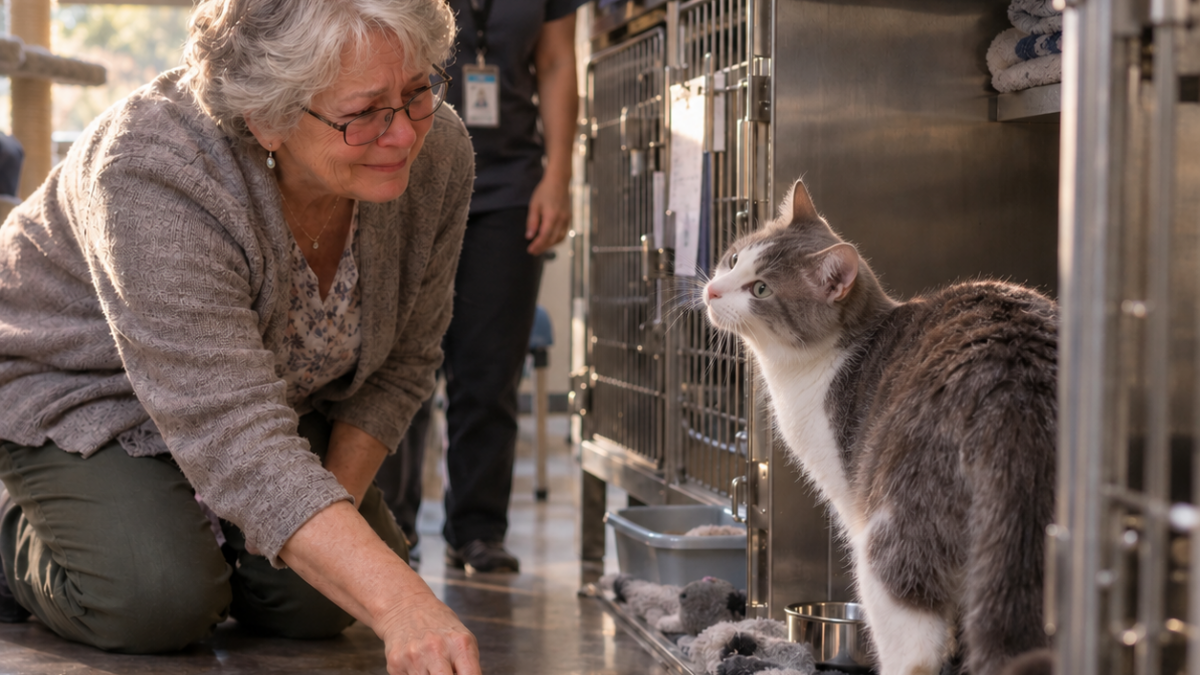
I knelt down slowly, not too close. I placed two fingers against the floor of the enclosure.
Tap.
Tap.
Tap.
Ripley turned around immediately.
Jenna froze.
So did I.
His ears did not swivel toward the sound.
They did not move at all.
But his eyes went straight to my hand.
I tapped again.
Tap.
Tap.
Tap.
He stepped forward.
Not cautiously.
Not with fear.
With recognition.
As if someone had finally knocked on the right door.
My throat tightened.
“Oh,” Jenna whispered.
I held my hand where Ripley could see it and slowly extended my fingers. He leaned forward, sniffed once, then pressed his forehead into my palm.
Jenna covered her mouth.
“I’ve never seen him do that with someone he just met.”
I did not answer right away.
I was too busy trying not to cry in front of a stranger and a cat.
Ripley pushed harder into my hand, then turned his cheek so I could scratch beneath it. His eyes narrowed. His shoulders softened. The wall he had been sitting in front of for who knew how long no longer mattered.
I sat down fully on the floor.
Ripley stepped out of the enclosure.
He looked at Jenna.
Then at me.
Then, with no hesitation at all, climbed into my lap.
He turned once, tucked his body against my stomach, and began to purr.
I felt it before I heard anything.
A vibration through my legs, my hands, the quiet shelter floor.
Deep.
Steady.
Certain.
Jenna turned away.
Her shoulders shook.
I rested one hand gently on Ripley’s back.
He looked up at me, and I swear his expression said, There you are.
Not because I had been destined for him in some magical way.
Because he had been waiting for someone to try something else.
Jenna wiped her eyes and sat beside me on the floor.
“I feel awful,” she said.
“Don’t.”
“How did we miss it?”
“You didn’t miss everything. You knew something was different.”
“But we still let people think he was unfriendly.”
I looked down at Ripley.
His eyes were half closed now.
“I spent thirty years watching good people make that mistake with children,” I said.
Jenna looked at me.
“I taught deaf and hard-of-hearing students.”
Her face changed.
“Oh.”
“Yes.”
She glanced back at Ripley’s enclosure.
“For 389 days, families would stand there and call him. Sometimes kids would clap or snap their fingers. He wouldn’t turn around. Then someone would say, ‘He doesn’t seem affectionate,’ or ‘I want a cat that actually likes people.’”
Her voice broke.
“Sometimes people reached in from behind, and he’d jump because he didn’t know they were there. Then they’d pull back and say he was skittish.”
Ripley’s purr continued beneath my hand.
Jenna hugged her knees.
“I kept telling people he was sweet once he warmed up. But they wanted a cat who responded right away.”
“They wanted him to understand their language.”
“And nobody learned his.”
The words sat between us.
I thought of children in my classroom across three decades.
A boy named Anthony who had been called defiant because he did not respond when teachers spoke while facing the chalkboard.
A girl named Priya whose parents cried when they saw her sign an entire story because they had been told she was “delayed” when really no one had given her full access to language.
A teenager named Mateo who stared out windows, not because he did not care, but because lipreading all day had exhausted him down to the bone.
So many children labeled inattentive, rude, stubborn, slow, aloof, difficult, when the truth was that the adults around them were using the wrong tools and blaming the child for not becoming easier.
Ripley had lived inside that same misunderstanding.
Not in a classroom.
In a shelter enclosure.
Behind glass.
Facing a wall.
“Do you want some time to think about adopting him?” Jenna asked softly.
I looked down.
Ripley was asleep in my lap.
Completely asleep.
Trusting the lap of someone he had known for less than ten minutes because that person had tapped the floor instead of calling into a silence he could not use.
I laughed, and it came out wet.
“He’s already sitting on me.”
Jenna laughed too, wiping her face.
“I think he decided.”
“I think he did.”
That afternoon, I signed the adoption papers.
The form asked whether I understood that Ripley might have special needs.
I wrote yes.
It asked whether I was prepared to accommodate a disabled pet.
I wrote yes.
It asked why I wanted to adopt him.
I paused there for a long time.
Then I wrote:
Because he has been misunderstood long enough.
When I brought Ripley home, he stayed inside the carrier for twenty-three minutes.
I did not rush him.
I set the carrier in the living room, opened the door, and sat on the floor several feet away with a cup of tea cooling beside me. The house was quiet around us. Too quiet, as usual. Sunlight fell through the front windows onto the rug. The grandfather clock in the hall ticked loudly enough that I wondered if Ripley felt the vibration through the floorboards.
He watched me from inside the carrier.
I did not call his name.
Instead, I tapped the floor.
Tap.
Tap.
Tap.
His eyes followed my hand.
I smiled.
“That’s right,” I said, though he could not hear me. “No rush.”
He came out one paw at a time.
First, he sniffed the edge of the rug.
Then the leg of the coffee table.
Then my slipper.
Then he startled at his own reflection in the dark television screen and retreated halfway into the carrier before deciding the flat black cat was not an immediate threat.
I stayed still.
For more than thirty years, I had told parents the same thing.
Patience is not doing nothing.
Patience is making room for trust to arrive safely.
Ripley explored the living room, the hallway, the kitchen doorway, then returned to my slipper and sat beside it.
Not on my lap yet.
Just beside me.
That was enough.
The first few days took some getting used to.
I learned not to approach him from behind.
I learned that if he was asleep on the rug, touching him suddenly sent him straight into the air, claws out, eyes wide, heart pounding beneath his fur. The first time it happened, he hid under the couch for an hour, and I sat on the floor apologizing to a cat who could not hear my words but could see my face.
“I’m sorry,” I signed anyway.
It was habit.
He watched from under the couch.
I placed my palm flat on the floor and tapped once.
Tap.
He blinked.
I tapped twice.
Tap.
Tap.
He came halfway out.
By the end of the week, we had the beginning of a language.
One tap meant look at me.
Two taps meant come here.
Three taps meant I am inviting you close.
A gentle pat on the couch meant up here.
A slow wave meant I was leaving the room.
Two quick flicks of the hallway light meant I was home.
Opening and closing my hand near his food bowl meant dinner.
Pointing to my chest, then to the chair, meant I was sitting down and he was welcome.
He learned quickly.
So quickly it made my heart ache.
Because every time he understood, I imagined how many times people had mistaken him for unresponsive when he was simply waiting for a signal he could receive.
I bought a small lamp with a remote switch and placed it near the front door. Whenever I came home, I flicked it twice before stepping into the room. At first, Ripley only lifted his head from the sofa. Then he began standing. Then trotting toward me. Eventually, by the third week, two flicks of light brought him running from wherever he had been sleeping.
No sound needed.
No voice.
Just light.
Movement.
Consistency.
Trust.
My neighbor, Mrs. Callahan, came over with banana bread the Saturday after Ripley arrived. She was eighty-one, sharp as a needle, and had been pretending not to worry about me since my retirement.
“I hear you adopted a cat,” she said.
“News travels fast.”
“I saw you carrying a pet carrier. I’m old, not blind.”
Ripley sat in the hallway, watching her.
“He’s handsome,” she said.
“He’s deaf.”
“Fully?”
“Enough that sound is not reliable.”
Mrs. Callahan looked at him with interest, not pity.
“Well, Mr. Ripley, I’m useless without my glasses, so we all adapt.”
He continued watching.
I tapped the floor twice.
Ripley came to me, then sat beside my chair.
Mrs. Callahan raised her eyebrows.
“Look at that.”
“He responds to vibration and visual signals.”
“Smart boy.”
“Yes,” I said. “Very.”
She glanced at me.
“You sound like your teacher self.”
I looked down at Ripley.
“I think she’s still in here somewhere.”
Mrs. Callahan stayed for tea. Ripley did not sit on her lap, but he did sniff her purse and gently steal a tissue. She declared him charming and told me my house already felt less like a museum.
I pretended to be offended.
I was grateful.
That first month changed my house in small, steady ways.
There was now a cat bed in the window, though Ripley preferred the folded blanket beside it. A bowl in the kitchen. A brush on the side table. A notebook where I wrote down our signals, partly out of habit and partly because after years of lesson plans, apparently I could not communicate with any living creature without documentation.
Morning routine became our first fluent conversation.
I would walk into the kitchen.
Ripley would usually be nearby, still half asleep, loafed beside the heat vent or draped across the rug.
I would tap the floor three times.
Tap.
Tap.
Tap.
His head would lift.
His eyes would find me.
Then he would come running.
Every time, my chest warmed.
Not because he was obeying.
Because he was answering.
There is a difference.
People who rely on speech sometimes forget that communication is not the sound leaving your mouth. It is the connection made when the message arrives.
Ripley and I connected in taps, light, gestures, touch, rhythm, and routine.
He learned that if I held up two fingers and pointed to the couch, I wanted him beside me while I read.
He learned that if I touched my heart and then extended my hand, it meant good boy, though technically that was not standard sign language. It was ours.
I learned that when he sat in the kitchen doorway and blinked slowly, he wanted me to follow him to the food bowl and witness its alleged emptiness, even when three pieces of kibble remained.
I learned that if he pawed once at my slipper and then looked toward the hallway, he wanted the bedroom door open.
I learned that when he pressed his forehead against my wrist, he was not asking for anything.
He was saying, I am here.
About a month after I brought him home, something happened that I will never forget.
It was raining.
Not a dramatic storm, just a steady evening rain that streaked the windows and turned the streetlights soft. I was sitting in the living room reading a novel I had already checked out from the library twice and failed to finish both times. Ripley was asleep on the rug, curled into a gray-and-white comma.
The house was quiet.
But it was not the same quiet that had frightened me before.
This quiet breathed.
I looked over at Ripley and thought about those 389 days.
All those people calling his name.
All those voices he never turned toward.
All those moments when someone probably shook their head and walked away.
He doesn’t seem affectionate.
He doesn’t like people.
He’s boring.
He’s weird.
He’s not the right cat.
I put my book down.
Then I tapped the floor.
Three times.
Tap.
Tap.
Tap.
Ripley’s eyes opened.
He lifted his head.
He saw me.
Then he came running.
Not walking.
Running.
A slightly clumsy, enthusiastic trot across the rug, around the coffee table, straight to me. He jumped onto the couch, climbed into my lap, and tucked his face beneath my hand as if he had been waiting all day for the question.
I cried so hard I had to take off my glasses.
Ripley pushed his head into my palm.
He did not understand tears, perhaps.
Or perhaps he understood enough.
People sometimes tell me I rescued Ripley.
I know what they mean.
I signed the papers. I brought him home. I learned his signals. I gave him safety after more than a year of being overlooked.
But I do not see it as rescue in the way people usually mean.
Ripley was not broken.
He was not cold.
He was not incapable of love.
He was not waiting to be transformed into a better cat.
He was simply living in a world that kept speaking to him in a language he could not hear, then blaming him for the silence that followed.
And the strangest part was how deeply I understood that after retirement.
For decades, I knew exactly where I belonged.
Room 114.
First hallway on the left.
Visual schedule on the board.
Flashing doorbell near the entrance.
Round table for small-group reading.
Blue rug for story time.
Name signs taped to cubbies.
Children who needed me to show up with patience, humor, structure, and sometimes snacks hidden in my desk drawer because middle schoolers are always hungry even when they insist they are not.
Then one day, the classroom door closed behind me.
People said, Enjoy your freedom.
Freedom felt like a hallway after everyone else had gone home.
No bells.
No students.
No lesson plans.
No urgent emails.
No one needing me to interpret, advocate, explain, push back, or remind the hearing world that access is not a luxury.
I did not know who I was when nobody was waiting for me at 7:30 in the morning.
Ripley changed that.
Not because he needed me in the same way students had.
He did not need to be taught how to be deaf.
He already knew how to live inside his own body.
What he needed was a home willing to stop insisting on sound.
And what I needed, though I had not known it, was someone who reminded me that my hands still had a language, my patience still had somewhere to go, and my life had not become useless simply because I no longer stood in front of a classroom.
Two months after Ripley came home, Jenna called.
“Mrs. Walker?”
“Please, call me Eleanor.”
“I wanted to check in. How is Ripley doing?”
I looked across the room.
Ripley was lying on his back in a sunbeam, all four paws loose in the air, looking deeply unemployed.
“He’s adjusting terribly,” I said. “As you can imagine, life is very hard for him.”
Jenna laughed.
“Send photos?”
“I’ll do better. Would you like to visit?”
She came the next Saturday.
The moment she stepped inside, Ripley looked up from the couch. Jenna froze, as if afraid to ruin whatever peace he had found.
I flicked the hallway light twice.
Ripley stood.
I tapped the floor twice.
He jumped down and walked toward us.
Jenna knelt, tears already in her eyes.
“Hi, Ripley.”
He could not hear her.
But he saw her face.
He sniffed her fingers, then rubbed his cheek against them.
Jenna cried instantly.
“I am so sorry,” she whispered.
I put a hand on her shoulder.
“He doesn’t need your guilt.”
She nodded, wiping her face.
“What does he need?”
“Scratch under his chin. Slowly. Let him see your hand first.”
She did.
Ripley leaned into her touch.
Jenna laughed through tears.
“He looks so different.”
“He looks understood.”
We sat at the kitchen table while Ripley supervised from the windowsill.
Jenna told me the shelter had changed procedures because of him. Every cat who seemed unresponsive now received additional screening. Staff had made laminated signs for the kennels of animals with known hearing or vision differences. Volunteers were being trained to approach visually, avoid startling, use floor taps, light signals, and vibrations.
“Ripley did that,” she said.
“He had help.”
“You did that.”
I shook my head.
“I recognized what he was already telling everyone.”
Jenna looked toward him.
“I wonder how many others we misunderstood.”
“That question is painful,” I said. “It is also useful.”
She nodded slowly.
Before she left, I showed her our signals.
One tap.
Two taps.
Three taps.
Ripley performed beautifully until he realized no treats were involved, at which point he sat down and began washing one paw with theatrical disinterest.
“He has boundaries,” I said.
Jenna laughed.
“I’m glad.”
A few weeks later, the shelter posted an update about Ripley.
Not a pity post.
Not a tragic story.
A teaching one.
They wrote about how some animals communicate differently. How unresponsiveness does not always mean indifference. How people should watch body language, approach gently, and consider hearing loss, especially in animals who do not respond to sound.
They included a video of me tapping the floor three times.
Ripley looked up from the rug and came running.
The post spread farther than anyone expected.
Messages came in from people who had deaf dogs, blind cats, senior pets, autistic children, elderly parents with hearing loss, spouses who needed captions on everything, students who communicated through devices, and adults who had spent entire childhoods being called rude when they simply had not heard.
One mother wrote to me through the shelter.
My son is hard of hearing and cried when he saw Ripley come when you tapped. He said, “The cat just needed a teacher.”
I printed that message.
I keep it in my desk drawer.
Not because I think I am Ripley’s teacher in the traditional sense.
Because it reminded me that representation can arrive on four paws in a gray-and-white coat and still matter.
Another message came from a man who had adopted an older dog two years earlier.
We thought he was stubborn. Turns out he was deaf. We started using lights after seeing Ripley. He comes to dinner now.
I read that one aloud to Ripley.
He was asleep and unimpressed.
Still, I believe he deserved to know.
Winter came.
Ripley discovered the radiator.
He also discovered that my lap was warmer when I wore the blue fleece robe, so he began herding me toward it in the evenings by standing in the hallway and staring until I obeyed.
Yes, herding.
A deaf cat herding a retired teacher through guilt and eye contact.
He grew rounder.
Not overweight, the vet assured me, though “comfortable” was mentioned. His fur became shinier. His eyes brighter. He stopped sleeping with his back to walls. He still startled if touched from behind, but less often because I learned and he trusted.
On cold mornings, he followed me into the kitchen and waited for our three taps.
The ritual never got old.
Tap.
Tap.
Tap.
Head up.
Eyes on me.
Run.
Sometimes I tapped even when he was already looking.
Just because I loved watching him answer.
One afternoon in January, my former school invited me back for Deaf Awareness Week.
At first, I said no.
Not because I did not care, but because I was afraid. Afraid of walking back into the building and feeling replaced. Afraid of seeing another teacher in room 114. Afraid of realizing the school had moved on just fine without me, which of course it had and should have.
Then the new teacher, Ms. Alvarez, emailed.
The students saw Ripley’s video. They want to meet you. And, if possible, they would love to meet him too.
I looked over at Ripley, who was sitting inside a cardboard box that had once held printer paper and now apparently held royalty.
“You have been invited to school,” I told him.
He blinked.
I took that as consent.
The visit required planning.
A carrier. A quiet room. No crowding. Visual signals. Clear rules. No sudden touches. No tapping on the carrier like he was an exhibit. I sent a list two pages long and apologized for none of it.
On the day of the visit, I carried Ripley into my old school.
The smell hit me first.
Waxed floors.
Dry erase markers.
Cafeteria pizza.
Paper.
Childhood.
My chest tightened so suddenly I had to stop near the office.
“You okay?” Ms. Alvarez asked.
She was younger than I expected. Warm eyes. Hair in a braid. Hands that moved fluently when she signed, Welcome back.
I signed, Thank you.
Ripley’s carrier shifted slightly against my side.
I breathed.
Room 114 looked different.
Of course it did.
New posters. Different rug. Updated smartboard. But the flashing light by the door was still there. The semicircle table still sat near the windows. A few old bookshelves remained, including one Daniel had helped me assemble badly one summer while complaining about Allen wrenches.
The students were waiting.
Ten of them, ages eight to eleven, sitting in a wide circle on the floor.
Some wore hearing aids. Some had cochlear implants. Some signed rapidly to one another. Some watched me with open curiosity. One little boy leaned toward another and signed, Cat?
I smiled.
Yes. Cat.
I set Ripley’s carrier down and let him watch the room.
I told the students his story.
Not the sentimental version.
The true one.
“He lived at the shelter for 389 days. People called his name, but he did not turn around. They thought he was ignoring them. They thought he was unfriendly. But Ripley could not hear them. When I tapped the floor, he understood the vibration and came to me.”
A girl with purple hearing aids raised her hand.
“Why didn’t they know?”
Her question was direct.
Children’s questions usually are.
“Because sometimes people assume instead of investigating,” I signed and spoke. “And sometimes people blame the listener when the message does not arrive.”
Several students nodded.
They knew.
Of course they knew.
I opened the carrier.
Ripley stepped out cautiously. He looked around at the circle of children, the moving hands, the attentive faces, the room full of people who did not expect sound to be the only bridge.
Then I tapped the floor three times.
He came to me.
The students lit up.
Not with noise.
With hands waving in silent applause.
Ripley stared at the fluttering hands.
Then, after a moment, he walked to the nearest child, a boy named Sam, and sniffed his shoe.
Sam looked like he had been blessed by royalty.
“Can I tap?” he signed.
“Gently,” I said.
Sam placed two fingers on the floor.
Tap.
Tap.
Ripley turned.
Sam’s face transformed.
“He saw me,” he signed.
I had to look away.
“Yes,” I signed back. “He did.”
After that visit, something in me shifted.
I had been afraid returning to the school would prove my life there was finished.
Instead, it reminded me that belonging can change shape.
I was no longer the teacher in room 114.
But I was still Eleanor Walker.
I still had something to offer.
So did Ripley.
We began visiting once a month.
Not as therapy officially, though I suspect therapy happened anyway. We visited the deaf and hard-of-hearing classroom, the special education wing, sometimes the library. Ripley became an ambassador for different communication. The children made him a sign name: the sign for cat, followed by three tapping fingers.
He tolerated visits with great dignity, especially once he learned students might offer treats with permission.
One day, a hearing student from another class asked, “Why doesn’t the cat just learn to come when people call?”
Before I could answer, Purple Hearing Aid Girl, whose name was Maya, turned to him and signed while speaking aloud, “Why don’t you learn to tap?”
The room went silent.
Then Ms. Alvarez coughed into her hand to hide a smile.
I thought, Excellent question, Maya.
Spring arrived.
Ripley began sitting in the open window, watching birds with intense moral disapproval. I started gardening badly in the backyard. Mrs. Callahan came over most Saturdays. My former students sent emails. The shelter asked if Ripley could be featured in a training workshop for volunteers. I said yes, provided he could leave whenever he wanted, because cats and retired teachers share a low tolerance for unnecessary meetings.
One evening, after a long day, I sat in Daniel’s chair.
I had avoided that chair for years.
Not deliberately, or so I told myself. I simply chose the sofa, the kitchen chair, the porch rocker, anywhere else. Daniel’s chair remained in the corner with a folded blanket over the back, waiting for a man who would not return.
That evening, I was tired enough to forget my avoidance.
I sat.
The chair creaked beneath me in the familiar way.
Grief rose immediately.
Not sharp.
Deep.
I touched the armrest where Daniel’s hand had worn the wood smooth.
Ripley was across the room.
I did not tap.
I did not call.
I simply sat there, feeling the old quiet gather.
A moment later, Ripley lifted his head.
Maybe he felt the change in the room. Maybe he saw my face. Maybe, like many animals, he understood sorrow without needing an explanation.
He crossed the floor, jumped into my lap, and pressed his forehead against my chest.
I placed one hand on his back.
“I miss him,” I whispered.
Ripley purred.
Vibration, not sound.
A language grief could understand.
For the first time since Daniel died, his chair did not feel empty.
It felt shared.
By summer, Ripley had become fully himself.
Not a different cat.
Not “fixed.”
Himself, safe.
He demanded breakfast by sitting in the kitchen doorway and staring until I acknowledged the crisis. He preferred one brand of wet food and treated others as moral failures. He enjoyed sunbeams, cardboard boxes, the blue fleece robe, Mrs. Callahan’s purse, and lying directly on whatever book I was reading.
He disliked vacuum cleaners, sudden touches, closed bedroom doors, and the orange cat who walked along the back fence as if he owned the block.
He did not care about my voice.
He cared about my presence.
He did not hear his name.
He knew my hand.
My light.
My steps through the floorboards.
My habits.
My attention.
That was enough.
On the anniversary of his adoption, Jenna came over with a small toy shaped like a fish and a card from the shelter staff. The front had a photo of Ripley in his old kennel, back turned, facing the wall. Inside was a new photo I had sent them: Ripley sprawled on my lap, belly up, one paw over his face.
Jenna had written:
389 days misunderstood. One year understood. Thank you for hearing him differently.
I cried.
Jenna cried.
Ripley ignored the emotional moment and climbed into the gift bag.
“Still dignified,” Jenna said.
“Always.”
That evening, I made tea and sat on the living room floor beside Ripley.
“I want you to know something,” I said, signing as I spoke because it felt right even if he did not know formal signs. “People say I rescued you.”
Ripley washed one paw.
“But I think you gave me back a part of myself I thought had no place to go.”
He paused, as if considering whether this affected dinner.
“I missed being needed,” I said. “I missed being understood too.”
Ripley blinked slowly.
I tapped the floor three times.
He stood, walked into my lap, and curled there.
Some answers do not require sound.
Years have passed now.
Ripley is older. So am I. He has arthritis in one shoulder, and I have arthritis in both hands. Our taps are softer these days. Sometimes I tap with my knuckles if my fingers ache. Sometimes I flick the light and he takes his time coming, not because he does not understand, but because old cats believe urgency is for the young.
Every morning still begins the same way.
I walk into the kitchen.
Ripley is usually nearby, half asleep.
I tap the floor.
Three times.
Tap.
Tap.
Tap.
His head lifts.
His eyes find mine.
And he comes.
Maybe not running as fast as he once did.
But he comes.
Every single time.
And every single time, I think about those 389 days.
All those people calling his name.
All those voices rising louder and louder.
All those hands reaching from behind.
All those misunderstandings stacking into loneliness.
I think about how easy it is to mistake difference for rejection.
How quick the world can be to label someone difficult when it has not tried very hard to be accessible.
How often people decide love is absent simply because it does not answer in the expected way.
Ripley never needed someone to call his name louder.
He needed someone willing to stop, observe, learn, and communicate differently.
That is true for cats.
It is true for children.
It is true for the elderly, the grieving, the disabled, the lonely, the retired, the people who do not respond the way others expect because the message is not reaching them in a form they can use.
We spend so much of life shouting from behind glass.
Then, when nobody turns around, we call them cold.
But love is not always a louder voice.
Sometimes love is a flicker of light in the hallway.
A hand held where it can be seen.
Two fingers tapping gently against the floor.
A patient pause.
A willingness to ask, What am I missing?
Ripley taught me that after I thought my teaching years were over.
Or maybe he reminded me.
Because sometimes the one who needs understanding most is not broken.
Sometimes he is simply facing the wall, waiting for the first person wise enough to stop calling from behind him.
And sometimes, when that person finally taps the floor three times, he comes running.
Not because he has changed.
Because at last, someone has.








