For 214 Days, Nobody Wanted the Scarred Shelter Cat—Then a Tiny Kitten Needed the One Thing Only He Could Give
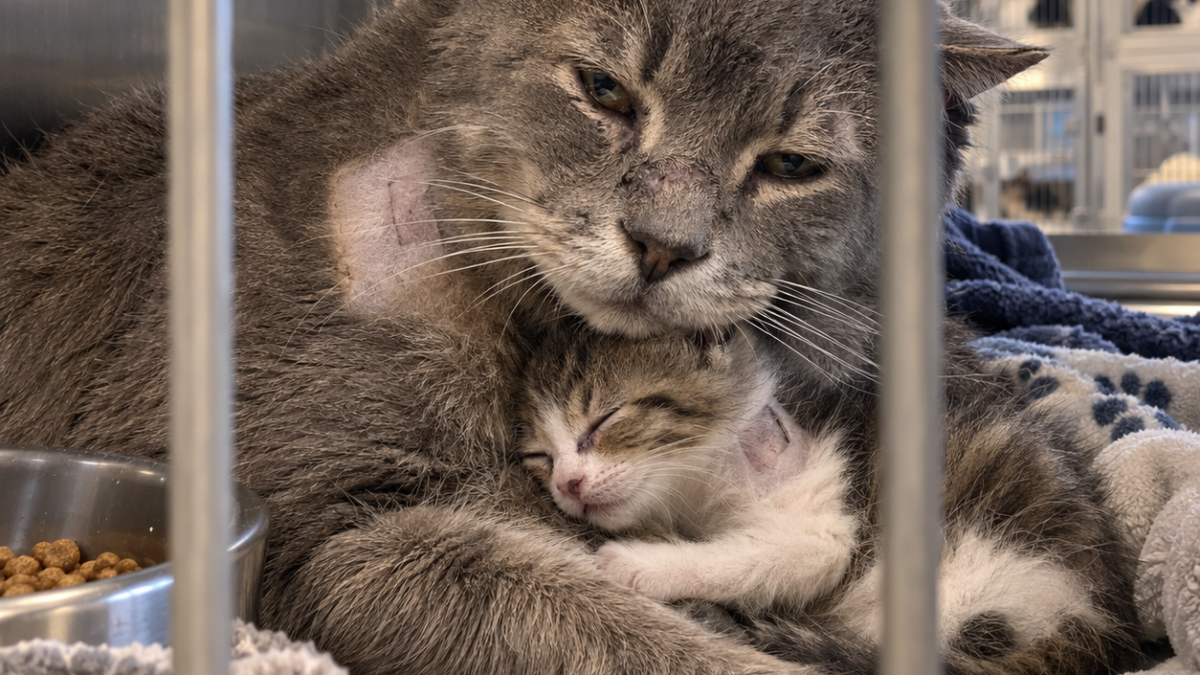
For 214 Days, Nobody Wanted the Scarred Shelter Cat—Then a Tiny Kitten Needed the One Thing Only He Could Give.
Everyone noticed the same strange thing in the photo: the old gray tomcat and the tiny kitten beside him had matching shaved rectangles on their necks.
At first, people thought it was a mistake, or maybe some odd medical coincidence the shelter forgot to explain.
Then one woman asked why the marks matched—and the answer turned a forgotten shelter cat into the reason a dying kitten was still breathing.
My name is Claire Donnelly, and I have worked at Willow Creek County Animal Shelter long enough to know that people rarely see what matters first.
They see age.
They see scars.
They see missing fur, cloudy eyes, crooked tails, shy bodies pressed against the backs of cages.
They see the kitten reaching through the bars before they see the old cat sitting quietly beside the litter box.
They see the clean photo before they see the story behind it.
They see the animals who ask to be loved loudly, and they walk past the ones who have forgotten how to ask at all.
That was Moss.
For 214 days, people walked past Moss.
Some paused for a second, but not long enough for it to mean anything.
They would glance at the card clipped to his kennel door, read his name, his age, maybe the word “friendly,” and then move on toward the kitten room, where tiny paws reached out like little hooks for the heart.
Moss never reached.
He never pressed himself against the kennel door.
He never performed.
He sat on his folded towel with the dignity of a retired boxer who had taken too many hits but refused to complain about any of them.
He was seven years old, though he looked older when he first came in.
He was a big gray tomcat, just over eleven pounds when he arrived, broad-headed and thick-necked, with one torn ear and a face marked by the kind of small scars that told us he had spent years surviving outdoors.
There was a pale line across the bridge of his nose, a nick in his left eyelid, and an old healed bite mark near his shoulder that made the fur grow in a different direction.
He had been trapped behind a closed-down feed store on County Road 14 after several people reported seeing him limping near the dumpsters.
PART2:
One of our volunteers, a retired school bus driver named Betty, set a humane trap with sardines and waited in her truck for four hours, knitting a scarf and calling him “that poor old gentleman” every time he circled the trap without going in.
Eventually, hunger beat suspicion.
When Betty brought him to us, Moss stared from the back of the trap with yellow eyes so tired they looked almost human.
“He’s had a rough life,” she said.
Most people said that about cats like Moss.
But then they adopted kittens.
At intake, we named him Moss because his coat was a smoky gray with faint greenish undertones in sunlight, and because he was quiet in the way forest floors are quiet.
Not empty.
Not lifeless.
Just holding things no one sees unless they stop and kneel down.
He tested negative for the major contagious diseases.
His teeth needed cleaning.
He had fleas, ear mites, and a respiratory infection that made him sneeze so hard his whole body shook.
He accepted medication with the resigned patience of a cat who had endured worse from the world than a pill.
After two weeks, he began to recover.
After a month, his limp improved.
After six weeks, his coat looked better.
But his kennel card did not change the one thing most visitors noticed.
Adult male.
PART3:
Seven years old.
Gray.
Scarred.
People said things like, “He looks tough,” or “Aw, he’s been through it,” or “I wish I could take them all.”
Then they did not take him.
Moss did not seem surprised.
That broke my heart more than if he had cried.
Cats who beg at the kennel door still believe someone might choose them.
Cats who hide are afraid but not always hopeless.
Moss simply watched people come and go with the calm of an animal who had learned that wanting too much was dangerous.
I loved him early.
Shelter workers try not to say we have favorites.
That is a lie.
Of course we do.
We love them all, but some animals find the places in us that are already cracked and settle there.
Moss was mine.
Every morning, when I unlocked the cat room, he would lift his head but not stand.
He waited while I cleaned the younger cats first, the louder ones, the ones who knocked their bowls over or climbed my pant leg or screamed for breakfast like they had been fasting for religious reasons.
Moss waited.
When I reached his kennel, he would rise slowly, stretch his front legs, and touch his nose to my wrist.
Not dramatic.
Not needy.
Just hello.
Then he would step aside so I could change his towel.
The first time he climbed into my lap, it was an accident.
Or so he wanted me to believe.
I was sitting on the floor after closing, updating medical notes, when he walked out of his open kennel during exercise time.
He circled me once, sniffed my clipboard, considered my shoe, then climbed onto my thigh as if testing a bridge.
He settled there heavily and began to purr.
Moss did not purr like a kitten.
He purred like an old machine starting in winter.
Low.
Uneven.
Stubborn.
I sat there for forty minutes because moving felt disrespectful.
After that, every evening, if time allowed, I sat with Moss.
I told him about the shelter drama.
About the rabbit who kept escaping from intake.
About the beagle who learned how to open the treat cabinet.
About my mother asking when I would get a “real job,” though she had been asking for eleven years and I had stopped answering.
Moss listened with half-closed eyes.
He was good at listening.
Maybe because no one had listened to him for most of his life.
The blood test happened during his first week.
All cats who came through our shelter got standard intake bloodwork when we could afford it, but that month, a grant had covered expanded screening.
So our veterinarian, Dr. Hannah Pike, ran a few extra panels, including blood typing for certain cats who might one day be eligible donors in emergencies.
Most shelters do not have the luxury of thinking ahead like that.
We barely had enough litter sometimes.
But Dr. Pike had worked emergency medicine before coming to us, and she had lost animals because compatible blood could not be found in time.
So when she had the chance to build a donor list, she took it seriously.
Moss was calm for his blood draw.
He sat on the exam table with Betty holding his shoulders and me scratching under his chin.
When the results came back, Dr. Pike called from the clinic.
“Well,” she said, “your old gray gentleman is special.”
“I know that.”
“No, medically special.”
My stomach tightened.
Shelter workers fear the word medically.
“What’s wrong?”
“Nothing’s wrong. Moss is blood type B.”
I frowned.
“Is that good?”
“It’s rare. Not unheard of, but rare. Around here, most cats we see are type A. Type B is much less common.”
“So what does that mean?”
“It means if a type B cat needs a transfusion, compatible donors can be hard to find fast.”
I looked through the cat room window toward Moss’s kennel.
He was sleeping with one paw over his face.
“So he could donate?”
“Potentially, if he stays healthy. He’s large enough. Stable. Calm. We’d need to monitor him carefully, but yes.”
I remember laughing softly.
“Moss? A blood donor?”
“Don’t sound so surprised.”
“It’s just… nobody even stops at his kennel.”
Dr. Pike was quiet for a moment.
“Well,” she said, “maybe someday someone will need him very badly.”
I wrote TYPE B — POTENTIAL DONOR in his medical record and did not think much about it afterward.
Not because it did not matter.
Because shelters run on immediate fires.
A litter of bottle babies arrived.
A pit bull came in with an embedded collar.
The washing machine broke again.
A family surrendered three cats after an eviction.
A volunteer got bitten by a terrified terrier.
A grant report was due.
Moss stayed in kennel C-12, watching the days pass through the glass.
Then March came.
Cold rain fell for three days straight, the kind of rain that turns gravel lots into soup and makes every dog in the building smell like wet carpet. We were understaffed, behind on laundry, and running low on canned kitten food when the phone rang at 7:18 on a Thursday night.
I was mopping near the intake desk.
Dr. Pike was on the line.
Her voice was different.
Fast.
Controlled.
Emergency fast.
“Claire, is Moss still there?”
I straightened.
“Yes. Why?”
“I need him.”
“What happened?”
“A kitten was hit by a car out on Miller Farm Road. Good Samaritan brought her in wrapped in a car mat. Female, maybe eight weeks old, eight hundred and fifty grams. Internal bleeding. Severe anemia. She’s type B.”
My hand tightened around the mop handle.
“She needs blood.”
“She needs it now.”
I looked toward the cat room.
Moss.
Quiet Moss.
Unwanted Moss.
Sleeping on his towel after 214 days of being passed by.
“How soon?”
“As soon as you can get him here.”
“The roads are awful.”
“I know.”
“How bad is the kitten?”
Dr. Pike did not answer immediately.
That told me enough.
“She won’t last the night without a transfusion,” she said.
I dropped the mop.
Not dramatically.
It clattered against the bucket and splashed dirty water onto my shoes.
“Betty!” I shouted.
Betty appeared from the laundry room holding towels.
“What?”
“We need to take Moss to Hannah’s clinic. Now.”
She looked at my face and did not ask the first ten questions.
She grabbed her coat.
Moss did not want the carrier.
That was the first time I ever saw him resist anything.
He braced all four paws against the kennel door, not violently, just with the firm dignity of a cat who had survived many traps and did not plan to enter another container without objection.
“I know,” I whispered. “I know, sweetheart. I’m sorry.”
Betty lined the carrier with his favorite towel.
I placed one hand on his head.
“Moss, there’s a baby who needs you.”
Of course he did not understand the words.
Or maybe he understood enough from my voice.
His body softened slightly.
Betty guided his back end.
I guided his shoulders.
He entered the carrier.
The drive took forty minutes.
It should have taken twenty-five.
Rain sheeted across the windshield so hard the wipers seemed mostly decorative. Betty drove because she had driven school buses through Tennessee storms for thirty years and claimed fear was for people without good tires. I sat in the passenger seat with Moss’s carrier on my lap, one hand through the bars, fingers resting against his paw.
He did not make a sound.
Not once.
Most cats complain in cars.
Some panic.
Some howl like ghosts.
Moss sat in silence, his yellow eyes reflecting passing headlights, his paw pressed lightly against my fingertips.
“You’re doing good,” I kept saying.
He blinked slowly.
At the clinic, Dr. Pike met us at the back door.
Her hair was pulled into a messy knot. Her scrub top had blood on one sleeve. Her face was pale from concentration.
“How is he?” she asked.
“Quiet.”
“Good.”
She led us to the treatment room.
That was where I first saw Juniper.
She did not have a name yet.
Not then.
She was just the kitten.
A tiny calico-gray scrap of life lying on a warming pad with an oxygen tube near her face. She was so small that the car mat someone had wrapped her in looked enormous beside her. One front leg was bandaged. Her gums were almost white. Her breathing came too fast, then too shallow, then too fast again.
There are moments in animal rescue when hope looks unreasonably small.
Juniper looked smaller than hope.
A young vet tech named Mara was gently monitoring her.
“She’s crashing,” Mara said.
Dr. Pike nodded once.
“Let’s move.”
Everything became precise.
Moss was weighed.
Examined.
Heart checked.
Hydration assessed.
Dr. Pike explained each step even though she had no time to spare, because that was who she was.
“He’s large enough for a full donation,” she said. “Forty milliliters. We’ll monitor him closely. Warm fluids after. Food. Rest.”
“Will it hurt him?” I asked.
“Not if all goes well. But it’s still a real donation. He’ll need recovery.”
I looked at Moss on the table.
He sat calmly while they shaved a small rectangle of fur on the side of his neck.
The buzz of the clippers sounded too loud.
Gray fur fell away.
Underneath, his skin looked pale and vulnerable.
I had seen shaved patches a thousand times in shelter medicine.
For IVs.
For blood draws.
For surgery.
But this one felt different.
This small bare rectangle was not evidence of injury.
It was the door through which life would leave one body and enter another.
Moss turned his head slightly.
I placed my hand beneath his chin.
“You are such a good boy,” I whispered.
His purr started.
Quiet at first.
Then stronger.
Mara looked up.
“He’s purring?”
“Yes.”
“During a blood donation?”
“That’s Moss.”
Dr. Pike inserted the needle with practiced care. Dark blood flowed through the line into the collection bag.
Moss stayed still.
Forty milliliters does not sound like much to people.
A few tablespoons.
Less than a small cup.
But in a cat, especially a shelter cat who had already survived too much, it mattered.
It was a full donation.
It was not nothing.
It was part of him.
When the draw finished, they bandaged him, gave him fluids, and wrapped him in a warm towel. Betty fed him a small amount of recovery food from her fingers. He ate slowly, then leaned against her wrist.
Across the room, Juniper received his blood.
We all watched the line.
Drop by drop.
Moss into Juniper.
Old street cat into broken kitten.
A life no one had chosen helping a life no one had expected to survive.
At first, nothing changed.
Then Mara said, “Heart rate’s improving.”
Dr. Pike leaned over the monitor.
“Blood pressure’s coming up.”
Juniper’s tiny chest rose.
Fell.
Rose again.
Color slowly returned to her gums.
Not pink exactly.
But less white.
Less ghostlike.
Dr. Pike let out a breath she had been holding for too long.
“She’s responding.”
Betty cried openly.
I turned away and pretended to check Moss’s towel.
Moss closed his eyes.
As if his work was done.
We kept him at the clinic for two hours, then took him back to the shelter with strict instructions.
Quiet.
Food.
Fluids if needed.
Monitor gums.
Monitor energy.
No stress.
No adoption meet-and-greets for at least a day.
That last one almost made me laugh.
Nobody had asked to meet him in weeks.
The next morning, Moss ate breakfast.
Not all of it.
Enough.
He accepted my apology for the carrier by head-butting my hand.
In his kennel record, I added:
3/14 — Emergency blood donor for juvenile female kitten, type B. Donated 40 ml. Tolerated well. Saved kitten’s life.
I wrote saved kitten’s life, then stared at the words.
It felt too large for a form.
Over the next days, we received updates.
The kitten was alive.
Critical, but alive.
The woman who had found her on Miller Farm Road had pulled over in a storm after seeing something move near the shoulder. She had thought it was a piece of trash at first. Then it lifted its head.
She wrapped the kitten in the only thing she had: a rubber-backed floor mat from her car.
She drove twenty-two minutes with one hand on the wheel and one hand touching the mat, whispering, “Stay with me, baby.”
At the clinic, someone named the kitten Juniper because she was found near a row of juniper bushes and because everyone needed to call her something other than “the hit-by-car kitten.”
Juniper had internal bleeding, severe bruising, a cracked pelvis that would require strict rest, and a front paw injury. But after Moss’s transfusion, she stabilized.
We celebrated carefully.
Shelter people are superstitious about early good news.
We said things like, “So far, so good,” and “She’s hanging in,” and “One day at a time.”
Never “She made it.”
Not yet.
Eleven days later, the phone rang again.
It was 6:04 in the morning.
I was at home, brushing my teeth, when Dr. Pike called my cell.
“Claire.”
I knew from her voice.
“What happened?”
“Juniper’s numbers dropped overnight.”
My hand tightened around the sink.
“No.”
“She’s still fighting, but she needs another transfusion.”
“Moss?”
“He’s the only compatible donor we have access to fast enough.”
I looked at myself in the bathroom mirror.
Toothpaste foam at the corner of my mouth.
Hair half pinned.
Eyes already afraid.
“It’s only been eleven days.”
“I know.”
“Can he donate again that soon?”
A pause.
“Normally, no. We would never choose it under normal circumstances. Cats need weeks to recover properly between full donations.”
“But this isn’t normal.”
“No.”
“What are the risks?”
“We will reduce every risk we can. Check his red cell levels first. Fluids. Monitoring. Stop if he’s not stable enough. But Claire, if Juniper doesn’t get blood, I don’t think she’ll survive.”
I spat toothpaste into the sink with shaking hands.
“I’ll get him.”
When I arrived at the shelter, Moss was awake.
He sat at the front of his kennel, as if expecting me.
I stood there for a moment.
“You already gave once,” I whispered.
He blinked.
“You don’t owe anybody anything.”
His tail curled around his paws.
That was the part people forget about rescue.
Animals do not consent in the way humans do.
We make decisions for them because we must. We weigh one life, one risk, one urgent need against another. We tell ourselves we are doing good, and often we are, but there is a heaviness in deciding what an animal’s body will give.
I called Dr. Pike again from the cat room.
“If his numbers aren’t good, we stop,” I said.
“Yes.”
“If he shows stress, we stop.”
“Yes.”
“If you think this is too much—”
“I will not take blood from him if I believe it will seriously harm him.”
I looked at Moss.
He lifted one paw and touched the kennel bars.
I opened the door.
This time, he entered the carrier without bracing.
Betty drove again.
The rain had stopped, but the roads still shone wet beneath gray morning light. Moss sat quietly in the carrier. I kept my hand near him, but he did not press his paw to mine this time. He simply watched the road through the slats.
At the clinic, they ran his bloodwork first.
We waited in a small exam room with pale blue walls and a poster about dental health curling at one corner.
Betty whispered, “If he can’t, he can’t.”
“I know.”
“You sure?”
“No.”
She reached over and squeezed my hand.
Dr. Pike came in with the results.
“He’s stable,” she said. “Lower than before, as expected, but still within a range where I’m comfortable proceeding carefully.”
Comfortable.
That word had limits.
We all knew it.
Moss was shaved again, a second small patch near the first. Matching rectangles on the side of his neck.
A map of what he had given.
This time, he did not purr during the draw.
He stayed still, but tired.
So tired.
I kept my forehead close to his.
“Almost done,” I whispered. “Almost done, sweetheart.”
Forty milliliters again.
A second full donation in eleven days.
The absolute edge of what the team could justify because the alternative was watching Juniper slip away.
When it was over, Moss sagged into the towel.
My heart lurched.
Dr. Pike immediately checked him.
“He’s okay. Tired, but okay.”
“Are you sure?”
“I’m watching him.”
They gave him warmed fluids and food.
He took two bites, then rested.
Across the room, Juniper received his blood again.
This time, I sat beside Moss and did not watch the line.
I could not.
I watched him instead.
Old gray head.
Torn ear.
Shaved neck.
Eyes half closed.
The cat nobody wanted had just given part of himself twice to a kitten he had never met.
No one online was praising him.
No family was waiting to adopt him.
No visitor had asked about him.
He had no idea he was heroic.
Maybe that made him more so.
Juniper recovered.
Slowly.
Not magically.
There were bad hours.
A fever scare.
A day she refused food.
Several nights when Dr. Pike slept on the clinic couch and claimed she was “just resting her eyes.”
But Juniper lived.
Her gums pinked.
Her appetite returned.
Her paw began healing.
Her cracked pelvis required weeks of crate rest, which she found deeply offensive once she felt better. She was tiny but furious, a creature made of bones, fluff, and dramatic opinions.
The first time she hissed at Dr. Pike, we all cheered.
“That,” Hannah said, “is the sound of a patient who plans to cause trouble.”
Moss recovered too.
We spoiled him shamelessly.
Warm food.
Extra blankets.
Quiet time in the office.
Betty brought him a knitted bed, which he used exactly once before choosing a cardboard box instead, because cats are committed to humbling human effort.
His shaved patches began to grow in slowly, but for weeks they remained visible.
Two neat rectangles on his neck.
The marks of a donor.
When Juniper was stable enough to leave the clinic, she needed a place to finish recovery.
She was too fragile for the general kitten room. Too energetic for the clinic once she began feeling better. Too medically complicated for an ordinary foster without experience.
We considered options.
Then Dr. Pike said, “What about Moss?”
I looked up.
“What about him?”
“He’s calm. Gentle. Good with other cats?”
“We don’t know. He came in alone.”
“Has he ever shown aggression?”
“No.”
“Juniper needs warmth, supervision, and maybe a calm companion. He needs company too.”
I hesitated.
“She’s a tiny injured kitten.”
“He saved her life twice,” Dr. Pike said. “Maybe let them meet before deciding he doesn’t get to know her.”
So we tried.
Carefully.
In the quiet room, with a baby gate, towels, carriers open, everyone ready to intervene.
Moss came out first.
He walked slowly around the room, sniffed the corners, then sat on the rug with the composed patience of a retired judge.
Juniper came next in a small carrier.
The moment the door opened, she stepped out, wobbled, overestimated herself, and nearly tipped sideways.
Moss looked alarmed.
Juniper righted herself and marched toward him as well as a recovering kitten with a healing pelvis could march.
She reached his front paws.
Sniffed.
Then shoved her whole tiny head beneath his chin.
Moss froze.
Everyone froze.
Juniper began purring.
A tiny purr.
Barely there.
Moss looked at me.
I swear his expression said, What is this?
Then he lowered his head and sniffed the top of her skull.
Juniper pressed closer.
Moss sighed.
And curled his body around her.
That was it.
No drama.
No formal introduction period.
No lengthy negotiation.
Juniper had decided Moss was hers.
Moss, being Moss, accepted.
We moved them into a larger recovery kennel together, one with soft blankets, low sides, and room for Moss to stretch without crowding Juniper. At first, we supervised constantly. But Moss was careful with her. So careful it made my chest ache.
If she slept, he did not move.
If she squeaked, he lifted his head.
If staff reached in to check her bandages, he watched closely but did not interfere.
Sometimes Juniper crawled onto his front legs and fell asleep there. Sometimes she tucked herself against his shaved neck, her own little shaved patch visible from clinic treatments.
That was when Betty took the photograph.
Moss lying on his side, big gray body curved around the tiny kitten, Juniper asleep beneath his chin.
Both of them had the same bare rectangle on the side of the neck.
Same size.
Same place.
One donor.
One survivor.
At first, we printed the photo and taped it to their kennel because staff loved it.
Then someone posted it on the shelter page.
The caption was simple:
Moss and Juniper, resting together after recovery.
People noticed immediately.
Why do they have matching shaved spots?
What happened to their necks?
Are they related?
Did they have surgery?
Is this bonded pair available?
That last question made me stop.
Bonded pair.
Moss had been available for 214 days.
No one had asked if he was bonded to anything except maybe disappointment.
Now, because of Juniper, people were looking.
But they still did not know the story.
So I wrote it.
Not the short version.
Not the polished version.
The true one.
I wrote about Moss arriving scarred and unwanted. About his rare blood type. About the kitten struck by a car. About the forty-minute drive through freezing rain. About the first donation. The second call eleven days later. The risk. The second donation. The recovery. The way Juniper had crawled under his chin like she already knew.
I wrote:
The matching shaved marks are not from matching injuries. They are from matching moments of survival.
One mark is where Moss gave blood.
The other is where Juniper received the care that blood made possible.
Moss has waited 214 days for a family.
During that time, he carried something rare inside him.
And when someone finally needed it, he gave it.
Twice.
The post spread.
Not like some viral internet explosion with jokes and memes.
Slower.
Deeper.
People shared it with captions like I’m crying at work and This old cat deserves everything and Please someone adopt them together.
Applications came in for Juniper.
Of course they did.
She was tiny, tragic, adorable, and newly famous.
Applications also came in for Moss.
That was new.
Some were not right.
A few wanted only Juniper and said they “might consider” Moss if required. Those went nowhere. Moss was not a bonus item. He was not the emotional backstory included with the kitten.
Others wanted Moss because he was a hero but had not considered that he was also a seven-year-old cat with scars, a torn ear, and a need for patience.
Then the Parkers came.
Angela and Tom Parker lived forty minutes away in a farmhouse with screened porches, warm windows, no young children, and two elderly cats who had passed within the last year. They were supposed to be Juniper’s medical foster at first. They had experience with injured kittens, medication schedules, and cats who needed quiet recovery.
When Angela first met Juniper, she cried.
Most people did.
Juniper climbed into her lap, stepped on the adoption paperwork, and tried to chew the corner of the medical instructions.
“She’s perfect,” Angela whispered.
Tom smiled.
Then he looked at the photo taped to the kennel.
The one of Moss curled around Juniper.
He stared for a long time.
“Is the gray cat still here?” he asked.
I was standing beside them.
My throat tightened.
“Yes.”
“Is he available?”
“Yes.”
Angela looked up.
“The donor?”
“Moss,” I said. “Yes.”
Tom looked through the kennel glass.
Moss sat in the back, Juniper curled against his side.
“Can we meet him?”
I had to blink fast.
“Of course.”
We brought them into the visiting room together.
Juniper explored immediately, climbing into Angela’s purse and emerging with a tissue like a trophy.
Moss stepped out more slowly.
Tom sat on the floor.
Not in a chair.
On the floor, cross-legged, hands resting loosely on his knees.
He did not reach.
That told me something.
Moss approached after a minute.
Sniffed Tom’s boot.
Then his hand.
Then, with the tired confidence of an old cat who had made one good decision and was considering another, he climbed into Tom’s lap.
Tom did not move.
Moss settled heavily, purring his uneven old-engine purr.
Angela covered her mouth.
Juniper noticed, squeaked indignantly, and scrambled over to wedge herself between Moss and Tom’s stomach.
Tom laughed.
“Well,” he said softly, “I guess they come as a set.”
Angela looked at me.
“Do they?”
I tried to sound professional.
“We would strongly prefer they stay together.”
Angela looked down at Moss’s shaved neck, then Juniper’s.
“They already are.”
The adoption became official in April.
Moss had waited 214 days.
Juniper had fought for her life for weeks.
They left together in two carriers placed side by side, though Juniper spent the entire paperwork process trying to break out of hers and Moss simply watched her with tired resignation.
Before they left, I knelt beside Moss’s carrier.
His shaved patches were starting to fuzz over.
Soon, the marks would disappear.
People would not see what he had given.
But I would know.
Betty would know.
Dr. Pike would know.
Juniper would know in whatever way animals know the body that kept them warm after saving them.
I slipped one finger through the carrier bars.
Moss pressed his nose to it.
“You were always needed,” I whispered. “We just didn’t know by whom.”
He blinked slowly.
Then the Parkers took them home.
The first update came three days later.
A photo of Moss stretched across a sunbeam on a screened porch, Juniper asleep between his front paws.
Caption:
Moss has claimed the porch. Juniper has claimed Moss.
The second update came a week later.
Juniper, wearing a tiny recovery harness, trying to climb Tom’s pant leg while Moss watched with visible concern.
Caption:
Her doctor says restricted activity. Juniper says define restricted.
The third update came after a month.
Moss sleeping in Angela’s lap.
Juniper perched on his back like a tiny queen.
Caption:
We adopted a hero and his shadow.
People kept asking about them.
For months, visitors came to the shelter and mentioned Moss.
“Is that the blood donor cat?”
“Did the little kitten make it?”
“Were they adopted together?”
Each time, I got to say yes.
Yes, he was adopted.
Yes, she survived.
Yes, together.
The cat room changed after Moss.
Not physically.
The kennels still needed scrubbing. The laundry still multiplied overnight. Cats still arrived faster than homes appeared. Kittens still got adopted quicker than seniors. Scarred old tomcats still waited too long.
But we changed.
Or maybe we remembered something we should never have forgotten.
Every animal carries something unseen.
Not always rare blood.
Sometimes patience.
Sometimes trust that survived mistreatment.
Sometimes a ridiculous purr.
Sometimes the ability to comfort another animal.
Sometimes the exact kind of quiet presence a grieving person needs.
But if no one stops long enough, those gifts remain hidden behind kennel bars.
Moss had sat in front of visitors for 214 days.
He had been overlooked because his face was scarred, his age was inconvenient, and his beauty was not obvious.
All that time, his body carried something almost no one else in our area had.
The blood that saved Juniper.
Twice.
But I think his real gift was not only in his veins.
It was in what he did afterward.
He let a frightened kitten press against him.
He let her heal beside him.
He became proof that being needed can arrive late and still matter.
One afternoon, months after the adoption, I visited the Parkers.
Officially, it was a follow-up.
Unofficially, I missed Moss.
Their farmhouse sat beyond a line of cedar trees, with wind chimes on the porch and flower beds Angela apologized for even though they looked beautiful. Inside, the house smelled like coffee, wood polish, and cat food.
Moss was on the screened porch.
Of course he was.
Sunlight warmed his gray coat. The torn ear looked almost noble now. His scars had softened under healthier fur. The shaved patches on his neck had grown back completely, leaving no visible sign of what happened.
Juniper was nearly twice the size she had been, still small but strong, with bright eyes and a habit of attacking shadows. She launched herself from a wicker chair onto Moss’s tail.
Moss opened one eye.
Juniper froze.
He closed the eye again.
She attacked the tail.
He sighed.
Tom said, “That’s their whole relationship.”
I sat on the porch floor.
Moss lifted his head.
For a second, I wondered if he remembered me.
Then he stood, stretched slowly, walked over, and pressed his forehead against my knee.
I cried immediately.
Angela pretended not to notice and handed me a tissue without comment.
Juniper climbed into my lap next, all elbows and curiosity.
“She’s doing well,” Angela said.
“She looks amazing.”
“She still follows him everywhere.”
Tom smiled.
“He lets her.”
Moss settled beside me, Juniper half on top of him, half on my leg.
I touched the side of his neck where the shaved rectangles had been.
No mark.
No evidence.
Just fur.
That is how many acts of love are.
Invisible later.
A meal given quietly.
A ride in the rain.
A body held still during a needle.
A second chance offered without applause.
The mark disappears.
The life remains.
Before I left, Angela showed me a framed print on their hallway wall.
It was the shelter photo.
Moss and Juniper in the kennel.
Two shaved patches.
One gray cat.
One tiny kitten.
Under the frame, Angela had placed a small engraved plate.
He gave what she needed.
She gave him a home.
I stood there reading it for a long time.
Then I said, “It should say they gave each other.”
Angela smiled.
“You’re right.”
The plate was changed the next week.
They gave each other what they needed.
Years in shelter work teach you not every story ends the way you want.
Some animals never get chosen.
Some arrive too late.
Some people fail them in ways we cannot undo.
Some miracles are partial, temporary, messy, or invisible to anyone outside the room.
But Moss and Juniper gave us one clean, shining thing to hold.
A reminder.
That the overlooked may be carrying something rare.
That survival is sometimes shared from one body to another.
That a scarred old cat can be exactly what a broken kitten needs.
That a tiny survivor can become the reason someone finally sees the hero sleeping beside her.
And that sometimes, when you spend months believing nobody needs you, life is simply waiting for the right soul to arrive.
Moss waited 214 days.
Juniper waited on a wet roadside, wrapped in a stranger’s car mat, her little body fading.
Neither of them knew the other existed.
Neither knew that one was carrying blood the other would need.
Neither knew that two shaved patches would one day make people stop, look closer, and ask the question that changed both their lives.
Why do they have the same mark?
Because one gave.
Because one survived.
Because someone drove through freezing rain.
Because doctors refused to give up.
Because a shelter cat nobody chose still had something priceless inside him.
Because love, in its quietest form, sometimes looks like a small bare rectangle on the side of a neck.
And because Moss, old scarred Moss, was never unwanted.
He was only waiting to be seen.








