Five German Shepherd Puppies Found Homes—But Everyone Rejected the Sixth Until a Navy SEAL Knelt Down and Called Him “Love”
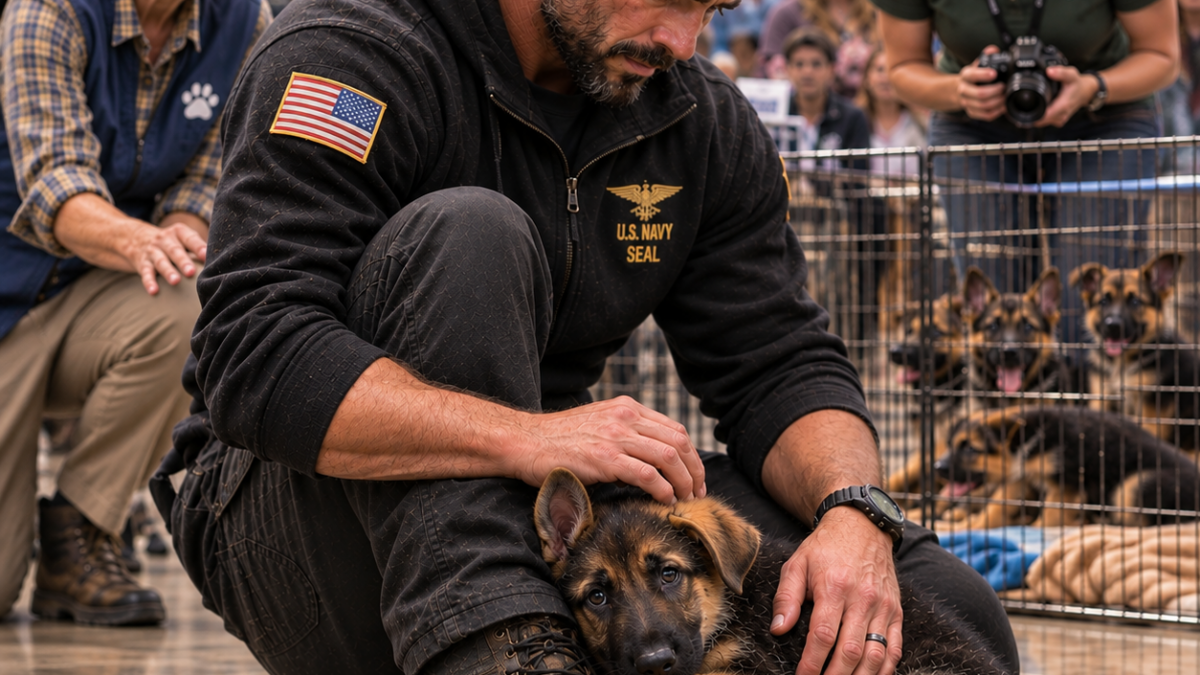
Five German Shepherd Puppies Found Homes—But Everyone Rejected the Sixth Until a Navy SEAL Knelt Down and Called Him “Love”
Five German Shepherd puppies from the same litter found families before lunchtime, while the sixth sat trembling in the corner because strangers called his crooked ear ugly, his fearfulness defective, and his future somebody else’s problem.
Forty-five-year-old Navy SEAL Adam Sullivan had only stopped at the Bloomington adoption center to donate fifty dollars, but when the frightened puppy escaped after a metal cart screeched across the floor, he ignored every reaching hand and ran straight to Adam’s military boots.
Adam walked away anyway—because four years after burying his wife, the man who had survived more than two decades of dangerous assignments was terrified of making one simple promise to a tiny dog who had already learned what it felt like to be returned.
“Please don’t take him away.”
The words came from a man who had spent more than twenty years training himself to remain calm when other people panicked.
Forty-five-year-old Adam Sullivan was kneeling on the concrete floor of a crowded adoption center in Bloomington, Indiana.
One hand rested beside his knee.
The other hovered protectively above a trembling German Shepherd puppy.
Adam did not touch him.
That was deliberate.
The puppy had already endured enough hands that morning.
People reaching.
Children grabbing.
Volunteers moving him.
Families lifting his ears.
Someone turning his face toward the light.
Someone else saying:
“What’s wrong with this one?”
Nothing was wrong with him.
At least nothing anyone had actually diagnosed.
He was eight weeks old.
Black-and-tan coat.
One ear straight.
The other folded awkwardly sideways.
His fur grew slightly uneven around his cheeks.
His paws were enormous compared with the rest of him.
Sixth puppy in a litter of six.
His five littermates had spent the morning charming families.
One went home with a young couple from Indianapolis.
Another with a retired teacher.
Two were adopted together by siblings whose families lived on neighboring farms.
The fifth left with a father and teenage daughter who had driven nearly two hours to meet him.
Then there was number six.
People stopped.
Looked.
Moved on.
One woman leaned toward her husband.
“That’s the ugliest German Shepherd I’ve ever seen.”
Her husband glanced at the folded ear.
“Probably something wrong with him.”
Adam looked up.
No shouting.
No intimidation.
He did not stand.
He simply asked:
“Is that how you decide whether a living creature deserves a home?”
The couple froze.
The woman looked embarrassed.
Her husband took her elbow.
They walked away.
Adam immediately regretted speaking.
Not because he thought the question was wrong.
PART2:
Because he had not come there to argue with anyone.
Actually, he had not come there for a dog at all.
He had been driving home when he saw a banner outside the Bloomington community center.
WEEKEND ADOPTION EVENT
SUPPLIES & DONATIONS NEEDED
Adam had fifty dollars in his wallet.
His original plan:
Park.
Donate.
Thank someone.
Leave.
Five minutes.
Maybe seven.
Instead, a metal supply cart screeched across the polished floor.
The puppy panicked.
Slipped between two volunteers.
Ran through the adoption hall.
People tried to help.
That made it worse.
Hands came down from every direction.
Children squealed.
PART3:
Someone laughed when the puppy skidded.
The little shepherd dodged them all.
Then saw Adam.
Adam stood near the wall wearing jeans, a dark jacket, and the black boots he had worn to work that morning.
The puppy ran directly to him.
Stopped.
Pressed himself against Adam’s boots.
And shook.
Adam crouched instinctively.
A volunteer approached.
“Sir, we need to put him back.”
The puppy flattened.
Adam raised his hand slightly.
“Give him a minute.”
The volunteer stopped.
An older woman came over.
Short silver hair.
Pale blue eyes.
Name tag:
GRACE HARPER.
She studied Adam.
Then the puppy.
“You have experience with frightened dogs?”
“Not much.”
“Then why aren’t you picking him up?”
Adam looked down.
“Because he looks like he’s had enough people deciding things for him today.”
Grace’s face softened.
The puppy peeked from beneath Adam’s hand.
Adam lowered his voice.
“It’s all right.”
He did not know whether the puppy understood words.
Probably not.
“Nobody’s rushing you.”
The little shepherd sniffed his fingers.
Moved closer.
Something tightened behind Adam’s ribs.
It had been years since anything small had depended on him.
Years since somebody had reached for him because they simply assumed he would stay.
Grace crouched.
“He’s had a rough start.”
Adam looked at her.
“What happened?”
“He was adopted briefly.”
Adam frowned.
“He’s eight weeks old.”
“Yes.”
“How briefly?”
“A few hours.”
He stared.
Grace explained.
Family wanted a German Shepherd.
Two children.
Busy house.
Visitors coming and going.
The puppy hid.
Startled at ordinary noises.
Would not play when expected.
Cried when cornered.
They became worried.
Then frustrated.
They brought him back.
Adam’s jaw tightened.
“Same day?”
Grace nodded.
“They weren’t prepared.”
He looked at the puppy.
He understood intellectually that returning an unsuitable animal could sometimes be responsible.
Better than neglect.
Better than keeping a dog and resenting him.
Still, the casual judgments bothered him.
Too ugly.
Too nervous.
Too difficult.
Probably something wrong.
Grace adjusted the nearby blanket.
“He needs patience.”
“And quieter surroundings.”
“Probably.”
“Health issues?”
“Nothing obvious.”
“Vet checked?”
“Yes.”
“Any hearing problem?”
“No indication.”
“Vision?”
“Normal.”
“Then?”
“Temperament.”
Adam frowned.
Grace clarified.
“Not bad temperament.”
“Sensitive.”
“Easily overwhelmed.”
“He wants contact, but sometimes contact scares him once it arrives.”
Adam looked down.
“That sounds complicated.”
“It is.”
The puppy’s folded ear slipped even farther sideways.
Adam smiled despite himself.
“Does he have a name?”
Grace hesitated.
“Number six.”
Adam looked at her.
“That’s his name?”
“That’s the paperwork identifier.”
“That’s worse.”
Grace laughed.
Adam looked at the puppy.
Something about the little dog was painfully earnest.
He had no idea why the word came out.
“Hey, Love.”
Grace looked at him.
“What?”
Adam shrugged.
“Nothing.”
“You called him Love.”
The puppy tilted his head.
Straight ear up.
Crooked ear sideways.
Adam laughed.
The sound surprised him.
Grace smiled.
“You think that’s his name?”
Adam looked at the puppy again.
“Better than number six.”
Grace took the adoption folder.
Beside the identification number, in pencil, she wrote:
LOVE.
Adam stared at it longer than necessary.
It looked strange.
Too soft.
Too hopeful.
Love.
He had not come to adopt.
He repeated that silently.
He was retiring soon.
His schedule was uncertain.
A private security company had offered him a consulting contract involving frequent travel.
He had never raised a German Shepherd puppy.
He had lived alone for four years.
He was absolutely not adopting a dog because it leaned against his boots for ten minutes.
Grace eventually guided Love toward the quiet enclosure.
Adam thanked her.
Stood.
Walked toward the exit.
Three steps.
Scrape.
Adam stopped.
Turned.
Love had slipped through the partially open enclosure door.
He was standing several feet behind him.
Head low.
One paw raised.
Watching.
Grace remained beside the pen.
“He doesn’t usually follow people.”
Adam swallowed.
Love took one small step.
Then stopped as if frightened by his own decision.
Adam looked at the exit.
Then at the puppy.
Crouched again.
“I’m not ready for this.”
Love crept closer.
“I don’t know anything about puppies.”
One paw landed on Adam’s boot.
His chest tightened.
And Sarah appeared in his mind.
Yellow dress beside a Michigan lake.
Laughing.
Alive.
Then:
Hospital bed.
Thin hand.
Quiet voice.
Her final months had taught Adam there were things strength could not defeat.
Sarah had understood him better than anyone.
Physical danger never frightened him the way helplessness did.
Adam liked tasks.
Objectives.
Problems with answers.
Cancer had given him none.
Near the end, Sarah once told him:
“Don’t spend the rest of your life alone because you’re angry I had to leave.”
He had promised nothing.
Four years later, he had built a life that looked suspiciously like exactly what she warned him against.
Adam opened his eyes.
Love was still touching his boot.
He looked toward Grace.
“Can I come back tomorrow?”
“Of course.”
“I need to think.”
Grace looked from Adam to Love.
“I think both of you probably do.”
Adam walked outside.
He expected relief.
Instead, getting into his truck felt like leaving something unfinished.
His house stood on the quieter side of Bloomington.
Two bedrooms.
Clean furniture.
Polished floors.
Shoes aligned precisely.
Glasses evenly spaced inside kitchen cabinets.
Nothing broken.
Nothing misplaced.
Nothing suggesting the man living there particularly enjoyed coming home.
One photograph hung on the refrigerator.
Adam and Sarah beside Lake Michigan.
Eleven years earlier.
Yellow dress.
His arm around her.
Both laughing.
Sarah had died four years ago.
Adam worked after that.
Then worked more.
Colleagues called him dedicated.
Friends called him reliable.
He volunteered for things nobody else wanted.
Extra assignments.
Administrative work.
Transition planning.
Anything that made coming home optional.
Now retirement was approaching.
A security contractor wanted him.
Excellent salary.
Frequent travel.
Familiar structure.
Hotels.
Airports.
Briefings.
Objectives.
Exactly the sort of life Adam understood.
He had not signed.
That Saturday night, he sat at his kitchen table with his phone.
Search:
German Shepherd puppy feeding schedule.
Then:
fearful puppy socialization.
Then:
German Shepherd veterinary costs.
Then:
crate training.
Then:
how much exercise for eight-week-old German Shepherd.
Two hours disappeared.
Adam looked at Sarah’s photograph.
“You’d laugh at me.”
Silence.
“Forty-five years old.”
He leaned back.
“Twenty-plus years doing ridiculous things for the government.”
Pause.
“And I can’t stop thinking about a puppy with one crooked ear.”
He imagined Sarah.
Then go back.
His smile disappeared.
Because he could almost hear her.
Nine o’clock Sunday morning.
Adam entered the adoption center.
Grace was folding towels.
She looked up.
Raised one eyebrow.
“Back already?”
“I’m checking on the dog.”
“Obviously.”
“I brought treats.”
“Very casual.”
He looked mildly embarrassed.
Grace smiled.
“Come on.”
Love had been moved into a quieter room.
He lifted his head when Adam entered.
No frantic reaction.
No barking.
No immediate approach.
Just watching.
Adam crouched several feet away.
“Hey.”
Love’s ears moved.
Grace handed Adam a treat.
“Put it down.”
Adam obeyed.
“Now?”
“Wait.”
One minute.
Then another.
Love approached.
Sniffed.
Ate.
Retreated.
Adam smiled.
“Progress.”
“Maybe.”
He looked at Grace.
“What do you mean maybe?”
“Taking food isn’t the same as being comfortable.”
Adam considered that.
“What do I do?”
“Wait.”
“That’s becoming your answer to everything.”
“It’s useful.”
Over the next hour, Adam learned Love disliked fast hands.
Especially above his head.
He wanted to approach people.
Then sometimes backed away when they responded.
At one point, Love came near Adam’s hand.
Adam instinctively reached to pet him.
Love retreated immediately.
Adam sighed.
“I thought we were doing well.”
Grace watched.
“You were.”
“He ran away.”
“He needed space.”
“That doesn’t feel like progress.”
“Why?”
“Because he backed away.”
Grace crouched.
“Adam.”
He looked at her.
“Stop deciding what his behavior means before watching what happens next.”
Adam glanced at Love.
The puppy had settled near the blanket.
Breathing slower.
No trembling.
Grace said:
“He approached you.”
“You moved faster than he expected.”
“He stepped away.”
“And?”
“He learned you didn’t chase him.”
Adam stared.
Grace smiled.
“That matters.”
For someone trained his entire adult life to make rapid decisions, waiting without forcing an outcome felt absurdly difficult.
But he stayed.
Near the end of the visit, Love approached again.
Adam did not reach.
He placed his hand flat on the floor.
Love sniffed it.
Touched it with his nose.
Then sat beside Adam.
Something warm moved through Adam’s chest.
Grace noticed.
“You’re smiling.”
“No.”
“You absolutely are.”
“Lighting.”
She laughed.
Adam returned three more times that week.
Then five.
He brought appropriate food instead of random treats.
Asked about vaccines.
Training.
Sleep.
Stress.
Socialization.
He learned Love was not something to fix.
He was an animal deciding whether people could be predictable.
That distinction changed Adam more than he expected.
Emma Parker, the rescue’s twenty-nine-year-old communications coordinator, noticed too.
She approached one afternoon holding a camera.
“Would you mind if I filmed you?”
Adam’s answer was immediate.
“No.”
Emma blinked.
“Wow.”
“No cameras.”
“It’s not about you.”
“Then don’t film me.”
Grace, folding laundry nearby, said:
“He’s stubborn.”
Adam nodded.
“Correct.”
Emma sighed.
“We have several shy animals.”
“So?”
“People keep assuming shy means unfriendly.”
Adam looked toward Love.
The puppy was lying beside his boots.
Emma continued.
“If people saw somebody letting a scared dog approach on his own terms, it might help.”
Adam remembered:
Ugliest German Shepherd.
Probably something wrong.
He looked at Emma.
“If he becomes uncomfortable, you stop.”
“Immediately.”
“No dramatic music.”
Emma grinned.
“No promises.”
Adam raised an eyebrow.
“Fine.”
The video was remarkably boring.
Adam sat on the floor.
Love stayed several feet away.
Then approached.
Retreated.
Approached again.
Adam did almost nothing.
That was the entire point.
Emma posted it with information about patient introductions and shy animals.
Within days, the rescue received messages.
Some about Love.
Many about other overlooked animals.
Then Grace called Adam.
“A family applied.”
“For what?”
“For Love.”
Adam said nothing.
Grace waited.
“Large home.”
“Two kids.”
“Dog experience.”
“Fenced backyard.”
“They look good on paper.”
Adam looked down.
Love was asleep beside his chair.
“Oh.”
Grace hesitated.
“Are you planning to apply?”
“I don’t know.”
“You’ve visited almost every day.”
“That isn’t the same thing.”
“No.”
He looked around his house.
Spotless kitchen.
Quiet hallway.
Empty second bedroom.
“I don’t know if I’m what he needs.”
Grace answered:
“Then that is the question.”
After the call, Adam sat beside Love.
The puppy stretched.
Placed a paw on his boot.
Adam looked at him.
“Somebody wants you.”
Love yawned.
“Probably good people.”
The puppy moved closer.
Adam felt his throat tighten.
Four years insisting solitude was easier.
Now imagining those tiny paws disappearing from the house frightened him.
He looked toward Sarah’s photograph.
“What am I supposed to do?”
No answer.
The rescue approved a temporary foster arrangement.
Adam told himself that solved everything.
Temporary.
He could help Love experience a quiet home.
The rescue could evaluate behavior away from the adoption center.
No permanent promise.
Excellent.
Love moved in.
Within twenty-four hours, Adam discovered his definition of “quiet” differed sharply from a puppy’s.
Love stole one sock.
Then another.
Attempted to chew a kitchen chair.
Barked at his reflection in the dark patio door.
Refused to walk past the vacuum cleaner.
Woke Adam at 3:06 a.m.
Then 4:12.
Then 5:01.
At 5:04, Adam stood in the backyard wearing sweatpants and a jacket over a T-shirt while Love investigated one blade of grass for approximately seven minutes.
Adam stared at the sky.
“Sarah.”
Love sniffed.
“This is your fault.”
The puppy looked up.
Adam sighed.
“Not you.”
He quickly learned something else.
Love improved faster when Adam stopped trying to make every problem disappear.
The vacuum?
Adam placed it across the room.
No movement.
No pressure.
Treats nearby.
Day after day.
Eventually Love sniffed it.
The front porch?
He was frightened by delivery trucks.
Adam did not carry him away every time.
They sat far enough back that Love could observe without panicking.
A truck arrived.
Love stiffened.
Adam stayed calm.
Truck left.
Nothing terrible happened.
Little experiences accumulated.
Still, Adam wondered whether he was making a mistake.
Then Grace called.
“Decision Friday.”
Adam tightened his grip on the phone.
“Friday?”
“Three days.”
Love was underneath the kitchen table dragging a cardboard box.
Adam watched.
“I thought foster was longer.”
“It can be.”
“But another approved family is waiting.”
He closed his eyes.
Grace continued:
“You do not owe Love a permanent commitment because you feel guilty.”
He went still.
“What?”
“You heard me.”
Grace’s voice remained gentle.
“You are treating this like a character test.”
Adam looked down.
Love had gotten his head inside the box.
Now backed up.
Box remained attached.
Adam nearly laughed.
Grace continued.
“If you adopt because returning him makes you feel like a bad person, that is not fair to either of you.”
Adam swallowed.
“I know.”
“Do you?”
Silence.
“You’ve spent your life believing responsible people push through difficult things.”
“That’s not entirely wrong.”
“No.”
“But sometimes saying no is responsible too.”
Adam hated the sentence.
Because it was true.
He had been afraid returning Love would make him another person who abandoned him.
But adopting an animal while unprepared could be another form of selfishness.
Grace said:
“If you cannot keep him, we find another home.”
“You haven’t failed him.”
Adam looked down.
Love finally escaped the cardboard box.
Sat beside it.
Stared at it as though deeply betrayed.
Adam said:
“I want him to stay.”
Silence on the line.
The words surprised him.
“I want him here.”
Grace’s voice softened.
“Then we talk about whether that can work.”
That afternoon Adam met Dr. Lauren Price.
Fifty-four.
Practical.
The sort of veterinarian who seemed constitutionally incapable of comforting someone with a lie.
Adam explained everything.
Retirement coming.
Security consulting offer.
Frequent travel.
No puppy experience.
Love’s sensitivity.
His own uncertainty.
Lauren listened.
Then:
“Why do you want to adopt him?”
“Because nobody else wanted him.”
She shook her head immediately.
“That is not enough.”
Adam frowned.
“Why?”
“Pity starts things.”
She leaned back.
“It doesn’t reliably sustain twelve years of veterinary care, training, exercise and changed plans.”
Adam nodded.
Lauren asked again.
“Why?”
He looked toward the window.
Then:
“When I come home now, I’m happy to be there.”
Lauren waited.
Adam’s voice became rougher.
“My house used to be where I slept between assignments.”
He looked down.
“Now someone is waiting.”
Pause.
“I didn’t realize how much I missed that.”
Lauren nodded.
“That is a better beginning.”
“But?”
“Still need a plan.”
Training.
Veterinary costs.
Exercise.
Mental stimulation.
Fear management.
Reliable care whenever Adam could not be home.
Lauren explained that Love might always be cautious.
Progress could regress.
He might dislike crowds permanently.
Might never enjoy strangers reaching over his head.
Adam asked:
“What if he never becomes confident?”
Lauren replied:
“Confident enough for what?”
“Normal.”
“Who defines normal?”
Adam did not answer.
“He doesn’t need to become a dog who loves dog parks.”
She continued:
“He doesn’t need to greet everybody.”
“He doesn’t need to be fearless.”
“He needs to function safely and have a life he can enjoy.”
Then:
“Your job is not to replace him with the dog you think he should have been.”
Adam looked toward Love.
“It’s to understand the dog who is already here.”
That evening Adam put the security consulting contract on his kitchen table.
Salary:
excellent.
Travel:
constant.
Assignments outside Indiana:
frequent.
He had spent months telling himself that was his future.
Why?
Because it resembled his past.
Hotels.
Objectives.
High-level clients.
Schedules.
Work so structured he would never have to ask what he wanted next.
Love did not magically answer that question.
The puppy simply made it impossible to avoid.
Adam called the company.
Declined.
Then contacted a veterans organization in Bloomington.
They had previously approached him about helping service members transition into civilian employment.
Lower salary.
Predictable schedule.
Local.
Adam had dismissed it because it sounded less important than security consulting.
Now he reconsidered.
Helping someone figure out what came after service suddenly seemed like work he understood.
Maybe even needed.
He arranged an interview.
Then called Grace.
“I’d like to apply.”
“For?”
Adam looked at Love sleeping beside his old military boots.
“Permanent adoption.”
Grace paused.
“You’re sure?”
“Yes.”
“Schedule?”
“Handled.”
“Backup care?”
“Yes.”
“Veterinary budget?”
“Yes.”
“Training?”
“Plan attached.”
Grace laughed.
“You sound like you’re briefing an admiral.”
“Occupational hazard.”
Then she became serious.
“This isn’t a rescue operation.”
Adam waited.
“There’s no extraction.”
“No finish line.”
“No point where someone hands you an award because the difficult part is complete.”
“I know.”
“You might spend months working on something and have a bad week.”
“I know.”
“Love doesn’t solve every problem.”
Adam looked at the puppy.
“That’s okay.”
“Why?”
“Because I don’t need him to be perfect.”
Pause.
“I need to be someone he can count on.”
Grace closed her eyes at the other end of the call.
“Then I think you’re ready.”
The rescue completed its normal review.
Home evaluation.
References.
Veterinary planning.
Training plan.
Nothing was waived because Adam had served in the military.
Adam liked that.
When adoption day arrived, Grace handed him the certificate.
ADOPTER:
ADAM SULLIVAN.
ANIMAL:
GERMAN SHEPHERD.
NAME:
LOVE.
Adam stared.
His hands trembled.
He had received medals.
Commendations.
Certificates with government seals.
Documents signed by people whose names opened doors.
This page felt strangely heavier.
Grace asked:
“You okay?”
Adam nodded.
“Yeah.”
His voice broke.
“Yeah.”
Grace smiled.
“Take your boy home.”
Adam crouched beside Love.
One ear upright.
Other folded.
Still cautious.
Still very much himself.
“Ready?”
Love tilted his head.
Adam laughed.
“Me neither.”
They walked out.
No applause.
No dramatic crowd.
Just a man.
A puppy.
A leash.
Home.
Three weeks later, Adam took Love to Bryan Park early on a Tuesday morning.
Early was deliberate.
Fewer people.
More space.
Love had improved.
Not transformed.
That distinction mattered.
He could now pass parked vehicles without freezing.
He tolerated cyclists at a distance.
He knew:
sit.
touch.
come.
leave it.
He slept through most normal household noises.
Still disliked metal carts.
Still retreated when strangers reached too quickly.
Adam was learning to accept progress without demanding completion.
They followed a walking path along the grass.
Love sniffed.
Tail neutral.
Body loose.
Adam relaxed.
Then a child screamed.
Love froze.
Adam felt the leash tighten.
Ahead, maybe forty yards away, a small boy had fallen from a low playground structure.
Nothing catastrophic.
His mother hurried toward him.
But children nearby began shouting.
A maintenance worker pushed a metal equipment cart around the corner.
One wheel squealed.
Same kind of sound as the adoption center.
Love panicked.
He lunged backward.
Adam reacted instantly.
Shortened the leash.
Stepped between Love and the approaching cart.
His first impulse:
Get him out.
Pick him up.
Leave immediately.
Protect.
Then Lauren’s words surfaced.
He does not need you to turn him into a different dog.
Grace’s too.
Watch what he is telling you.
Love was frightened.
But not unreachable.
Adam moved farther off the path.
Distance.
The cart passed.
Love trembled.
Adam crouched sideways.
Did not pull him closer.
Did not say:
It’s okay.
Over and over.
He simply waited.
Love looked toward him.
Adam gave the hand cue they had practiced.
Touch.
Love hesitated.
Then pressed his nose against Adam’s palm.
Reward.
Another scream from the playground.
Love flinched.
But remained.
Adam could have left.
Part of him wanted to.
Instead they moved another twenty feet away.
Enough distance that Love could observe.
The boy who had fallen was already standing.
His mother dusted off his knees.
Other children resumed playing.
Nothing terrible followed the noise.
Love watched.
Breathing slowed.
Then a woman approached.
“Is he friendly?”
Adam saw Love stiffen.
“He’s learning.”
She smiled.
Reached toward his head.
Adam moved one hand gently between them.
“Please don’t reach over him.”
Her hand stopped.
“Oh.”
“He gets nervous.”
“I’m sorry.”
“No problem.”
The woman crouched slightly.
Adam said:
“Better if you ignore him.”
She laughed.
“I can do that.”
She turned sideways.
Love watched.
After thirty seconds, he took one step toward her.
Then another.
Sniffed the bottom of her jacket.
Retreated.
The woman never touched him.
“Good enough?” she asked.
Adam smiled.
“Perfect.”
She continued walking.
Love watched her leave.
Then looked at Adam.
Something clicked.
Adam had spent his career believing protection meant controlling threats.
Remove danger.
Create distance.
Secure the area.
Love required something different.
Some threats were not threats.
They were experiences he had not yet learned how to process.
If Adam removed every uncomfortable thing before Love had the chance to recover, the puppy might learn only one lesson:
The world really is too dangerous.
Protection could become a cage.
Adam stood.
“Come on.”
Love followed.
Not toward the playground.
Not yet.
They made one slow loop farther away.
Five minutes.
Then ten.
By the time they reached the parking lot, Love’s tail was moving normally.
Adam opened the truck.
Love put his front paws inside.
Then stopped.
Turned.
Looked back toward the park.
Adam waited.
Love stared at the distant playground.
Then climbed into the truck.
Adam smiled.
“Okay.”
Not victory.
Just one ordinary frightening morning that did not end in disaster.
The following week, they returned.
Same early hour.
Love noticed the maintenance cart.
Stayed farther away.
Watched.
No panic.
Week after:
closer.
A month later, the metal cart squealed.
Love looked toward Adam.
Adam offered his hand.
Touch.
Then Love continued sniffing the grass.
That was the moment Adam finally understood what Lauren meant by confidence.
It was not the absence of fear.
It was the ability to experience fear without believing fear controlled everything that happened next.
Adam knew something about that.
He just had never applied it to his own life.
Retirement came officially that summer.
The ceremony was small.
Adam requested it that way.
A few colleagues.
Command staff.
Friends.
Grace came.
So did Emma.
Lauren declined because she was working but sent a card.
Love stayed at home with an experienced dog sitter.
Six months earlier, Adam might have considered leaving him home evidence of failure.
Now he knew better.
A crowded military ceremony was not where Love needed to prove anything.
Adam accepted a folded flag.
Handshakes.
A few words about service.
Someone asked what he planned next.
Adam answered:
“Helping veterans transition.”
One old teammate grinned.
“You?”
“What?”
“You hate paperwork.”
“I hate unnecessary paperwork.”
“That organization is ninety percent paperwork.”
Adam sighed.
“I’ve made a terrible mistake.”
People laughed.
For once, Adam did not rush away afterward.
He stayed.
Talked.
Accepted congratulations.
Then went home.
Love waited inside.
Not at the window.
Not dramatically.
He was asleep.
Adam opened the door.
Love woke.
Stretched.
Trotted toward him.
That was enough.
The veterans organization eventually hired Adam.
His first months surprised him.
Some former service members wanted jobs.
Others wanted direction.
Some had families.
Some lived alone.
Some wanted structured careers.
Others were exhausted by structure.
Adam resisted giving everyone the same answer.
That had become familiar.
Watch what they are telling you.
Do not assume.
Do not force.
Grace would have enjoyed the irony.
One afternoon, a twenty-eight-year-old former Marine sat across from Adam.
“I should take the contracting job.”
“Why?”
“Money.”
“Only reason?”
“Everybody says I’d be good at it.”
“That wasn’t what I asked.”
The young man stared.
Adam waited.
Silence no longer bothered him the way it once had.
Finally:
“I actually want to study physical therapy.”
“Then why aren’t you?”
“Feels like wasting everything I learned.”
Adam thought of the security contract.
Then Love.
“What if what you learned helps you make a different decision instead of repeating the same one?”
The Marine looked at him.
Adam leaned back.
“Just a thought.”
That evening he told Grace about the conversation.
She laughed.
“You’re becoming patient.”
“Don’t insult me.”
“You waited for him to answer.”
“I’ve always done that.”
“No.”
Adam looked offended.
Grace continued:
“You used to wait for people to say what you already wanted them to say.”
“Different.”
“Very.”
Love grew.
The oversized paws became proportionate.
His face filled out.
Black-and-tan coat thickened.
One ear eventually stood almost straight.
The other remained slightly crooked.
Adam secretly hoped it always would.
The puppy who had been mocked as ugly became an objectively handsome German Shepherd.
People told Adam constantly.
“What a beautiful dog.”
He appreciated the compliment.
But it also irritated him.
Because Love had not become more deserving when he became prettier.
His value had not increased when his ears changed.
The eight-week-old trembling puppy had deserved patience too.
Emma invited Adam to participate in another adoption video.
This time he agreed without arguing quite as much.
The video did not focus on Love’s appearance.
It showed:
a quiet room.
A nervous rescue dog.
A volunteer sitting sideways.
No reaching.
No crowding.
No forcing.
Adam spoke briefly.
“People think trust begins when the dog comes to you.”
Pause.
“Sometimes trust begins when you prove you won’t follow when he needs to step away.”
The video spread farther than the original.
Not because Adam was a Navy SEAL.
Emma deliberately minimized that.
Because the lesson was simple.
Adopters began asking different questions.
Instead of:
Which dog is friendliest?
Some asked:
Which dog needs a quieter home?
Instead of:
Which puppy is easiest?
One family asked:
Which animal keeps getting overlooked?
Grace called Adam after that adoption.
“You’ve created a problem.”
“What?”
“People are requesting the difficult ones.”
Adam smiled.
“Terrible.”
“Awful.”
The family who had originally applied for Love adopted another shy young dog instead.
Adam met them months later.
Their daughter showed him photographs.
The dog asleep beside her bed.
First successful walk downtown.
First time accepting a visitor.
Adam felt no jealousy.
That mattered.
His decision had never been about beating another family to Love.
It had been about becoming prepared to say yes for the right reasons.
One autumn evening, Adam found Sarah’s photograph on the floor.
Love had knocked it from the refrigerator.
Adam’s heart stopped.
The frame had cracked.
Love stood nearby.
Tail low.
Adam picked up the photograph.
For one second, anger flashed.
Not at the dog exactly.
At the broken frame.
At the years.
At the strange cruelty of an ordinary accident damaging one of the few physical objects that still felt connected to Sarah.
Love backed away.
Adam saw it.
His anger changed immediately.
He sat on the kitchen floor.
Removed the photograph carefully.
The picture itself was fine.
Love remained six feet away.
Adam rested one hand on the floor.
Did not call.
Minutes passed.
Love approached.
Slowly.
Touched Adam’s fingers with his nose.
Exactly as he had at the shelter.
Adam swallowed.
“You didn’t know.”
Love sat.
Adam looked at Sarah in the photograph.
Yellow dress.
Laughing.
He laughed softly too.
“She would’ve blamed me for putting it where you could reach it.”
Love rested his chin on Adam’s knee.
That night Adam ordered a sturdier frame.
Then, for the first time in four years, he put another photograph beside Sarah’s.
Love at the park.
Crooked ear.
Muddy tongue.
No symbolism.
No replacement.
Two different lives.
Both belonged in the house.
The anniversary of Sarah’s death arrived in November.
Adam normally worked through it.
That year he took the day off.
Walked Love beside the lake.
Not Michigan.
Indiana.
Cold wind.
Gray water.
Love investigated everything.
Leaves.
Bench.
Trash can.
An apparently fascinating stick.
Adam sat.
He thought about Sarah’s final request.
Don’t spend the rest of your life alone.
For years, he had interpreted it too literally.
As though she were instructing him to find another wife.
He was not ready for that.
Maybe never.
That was not the point.
Sarah had known him.
She knew what grief would tempt him to do.
Work.
Structure.
Isolation disguised as independence.
Love had not fixed loneliness.
He had made Adam participate in life again.
Veterinarian.
Training class.
Park.
Neighbors.
Grace.
Emma.
People stopping to ask about the dog.
Someone depending on him to come home.
Adam looked toward Love.
The dog had found the stick.
He carried it over.
Dropped it near Adam’s boots.
Adam smiled.
“Too big.”
Love stared.
“It is objectively too big.”
Love picked it up again.
Adam laughed.
Years earlier, laughter in the empty house had felt almost disloyal.
Now it simply felt like laughter.
That winter, the adoption center held a holiday fundraiser.
Adam attended.
Love too.
The building was quieter than during his first visit.
Grace had arranged a low-stimulation corner.
Love was nearly full grown.
He walked through the entrance.
Paused.
Remembered something?
Adam could not know.
Then continued.
Near the same section where his litter had once been displayed sat another puppy.
Small.
Brown.
One cloudy eye.
Visitors had been passing him all afternoon.
A boy pointed.
“Why does he look like that?”
His mother answered:
“He probably had an injury.”
The boy crouched.
The puppy retreated.
Adam watched.
The mother said:
“Give him space.”
The boy sat down.
Did not reach.
Minutes later, the puppy approached.
Grace appeared beside Adam.
“You see that?”
“Yes.”
“Your fault.”
Adam glanced at her.
“I have never met those people.”
“Emma’s videos.”
“Then Emma’s fault.”
“She says yours.”
“Convenient.”
Grace looked at Love.
“Do you remember when he didn’t have a name?”
Adam’s expression changed.
“Number six.”
“Yep.”
Love leaned lightly against his leg.
Adam rested his hand on the dog’s shoulder.
“Terrible name.”
Grace smiled.
“You gave him a ridiculous one.”
“It worked.”
“Love?”
Adam nodded.
“At the time, I thought you named him because he needed some.”
Adam looked down.
“And now?”
Grace shrugged.
“Maybe because you did.”
He stared at her.
“That’s aggressively sentimental.”
“I’m old.”
“Not an excuse.”
She laughed.
Across the room, the one-eyed puppy touched his nose to the boy’s hand.
The boy did not grab him.
Adam watched.
Then said:
“You know what I got wrong?”
Grace waited.
“I thought protecting Love meant preventing bad things from reaching him.”
“And?”
“Sometimes.”
Adam watched his dog.
“Mostly it means being there while he learns he can handle more than he thinks.”
Grace nodded.
“Same for you?”
Adam looked at her.
“Don’t push it.”
Two years after adoption, Love still disliked metal carts.
Not severely.
Just enough that his ears shifted when one squealed.
He still preferred strangers to let him approach first.
Crowded indoor events tired him.
Adam planned accordingly.
Love also loved hiking.
Snow.
Tennis balls.
Cheese, unfortunately.
And sleeping across doorways in ways specifically designed to trip a forty-seven-year-old man carrying coffee.
His crooked ear remained slightly crooked.
Adam considered it perfect.
One morning Adam arrived at the veterans center and found a new employee staring at the framed photograph on his desk.
Love sitting beside Sarah’s old picture.
The employee asked:
“Your dog?”
“Yes.”
“Rescue?”
“Yes.”
“How’d you choose him?”
Adam thought about it.
Five siblings adopted.
Number six.
Ugly.
Probably something wrong.
Metal cart.
Black boots.
Tiny paw.
He smiled.
“I didn’t.”
The employee laughed.
“Dog chose you?”
Adam shook his head.
“Not exactly.”
“What then?”
Adam looked at the photograph.
“We both kept coming back.”
That was closer.
Love had not healed Adam.
Adam had not rescued Love in the simple way people liked to tell the story.
The shelter saved him first.
Grace gave him time.
Lauren gave Adam reality instead of reassurance.
Emma helped strangers understand fearful dogs.
Adam provided a home.
Love gave Adam responsibility he could not complete and file away.
Their relationship was not one act of rescue.
It was repetition.
Meals.
Walks.
Bad days.
Training.
Vet visits.
Waiting.
Returning.
Trust built in ordinary minutes.
Years later, people still occasionally recognized Adam from the adoption video.
They would say:
“You’re the Navy SEAL who saved that rejected German Shepherd.”
Adam always corrected them.
“No.”
Some looked confused.
“He wasn’t dying.”
“He wasn’t in danger.”
“He needed the right home.”
Then, if Love was beside him, Adam would scratch behind the crooked ear.
“And I needed to stop pretending I didn’t.”
On the fourth anniversary of Love’s adoption, Grace mailed Adam a photocopy of the original intake page.
Litter of six.
Numbers one through six.
Five names handwritten beside the first five entries.
Beside number six:
LOVE.
In pencil.
Adam placed it in a drawer.
Not framed.
Not displayed.
Some things did not need to become monuments.
That evening he returned home from work.
Love met him in the hallway.
Older now.
Still energetic.
Adam put down his keys.
Love picked up one of his gloves.
“Absolutely not.”
Love walked away.
“Give it back.”
Faster.
Adam followed.
Love looked over his shoulder.
Tail wagging.
Adam stopped.
Laughing.
The house was not spotless anymore.
There were scratches near the back door.
Dog hair on furniture.
A basket of toys beside the fireplace.
Leashes on hooks.
A water bowl where Adam once insisted nothing should clutter the kitchen.
Sarah’s photograph still hung on the refrigerator.
Beside it was one of Love.
The house looked lived in.
That was the difference.
Years before, five German Shepherd puppies found homes while one frightened puppy was rejected.
Adam had entered the shelter believing he was donating fifty dollars.
Instead he met an animal other people had already reduced to a list of inconveniences.
Crooked ear.
Too shy.
Too strange.
Returned.
Number six.
Adam’s first instinct had been to protect him from everyone.
His second was to run before the dog could become important.
Both instincts came from fear.
Love’s progress eventually taught him something harder.
Caring for something did not guarantee you could prevent loss.
It never had.
Sarah proved that.
Military service proved that.
Life proved it repeatedly.
The answer was not to stop caring.
It was to care while knowing that certainty would never come with it.
The little puppy who once trembled against Adam’s boots became a confident adult dog—not confident by somebody else’s definition, but confident enough to live the life that suited him.
And Adam became something different too.
Not less disciplined.
Not less capable.
Not magically healed.
Just willing to be needed again.
That was why, whenever somebody called Love lucky, Adam usually smiled.
Then he looked down at the crooked-eared German Shepherd beside him and said:
“Yeah.”
After a moment, he always added:
“So am I.”








