Five Foster Siblings Were About to Be Separated—Then 35 Bikers Pulled Up With a Plan No One at the County Office Expected
PART3:
The children had spent those eight months with a temporary foster couple named Ben and Marcy Lowell.
The Lowells had not planned to take five children.
Nobody sane plans for five children to arrive in forty-eight hours.
But when our emergency list failed, Marcy had said, “We’ll make it work for a week.”
One week became eight months.
They converted a den.
Borrowed bunk beds.
Bought enough cereal to feed a football team.
Ben learned that Grace would only fall asleep if someone walked clockwise around the kitchen island.
Marcy learned that Sophie needed the bedroom door cracked exactly four inches.
They were good people.
Then Ben’s mother suffered a severe stroke in Indiana.
Marcy came into my office with swollen eyes.
“We have to move.”
My stomach dropped.
“For how long?”
“I don’t know.”
She started crying.
“Maybe permanently.”
I already knew what she was going to say.
“We can’t take the kids.”
I hated myself for the tiny spark of anger I felt.
Then I hated myself more because Marcy saw it.
“I’m sorry.”
“No.”
I reached across the desk.
“You do not apologize.”
“But they’re going to think we sent them away.”
“I’ll explain.”
“Karen.”
Her voice broke.
“You know explaining doesn’t fix it.”
She was right.
Three days.
That was how much time we had.
Three days to place five siblings together.
I called every licensed foster home in our county.
Then the neighboring counties.
Then agencies.
Therapeutic homes.
Emergency homes.
Faith-based networks.
Regional contacts.
Everyone.
I heard variations of the same answers.
“We have room for two.”
“We can take the baby.”
“We could consider the older boy.”
“Not five.”
“We don’t have enough bedrooms.”
“Our license caps us at three.”
“Maybe if they were younger.”
“Maybe if they weren’t younger.”
“I’m sorry.”
“I wish we could.”
By the second day, I had options.
Options.
That word still bothers me.
Eli could go with a retired couple forty minutes north.
Maddie and Sophie could go near Dayton.
Noah had a placement with a teacher and her husband across town.
Grace could go immediately to a foster home specializing in infants.
Every child would have a bed.
Food.
Heat.
Clean clothes.
Safe adults.
On paper, it worked.
That is one of the ugliest lessons in this job.
Safety and belonging are not the same thing.
I called my supervisor, Tom.
“I want another day.”
“Karen.”
“Give me another day.”
“Placement ends tomorrow.”
“I know.”
“The Lowells have movers coming.”
“I know.”
“We can’t keep calling homes that already said no.”
“I know.”
Tom was quiet.
He was not cruel.
He had been doing this almost as long as I had.
“What are you hoping happens overnight?”
“I don’t know.”
“Then we need to prepare the kids.”
That afternoon I drove to the Lowells’ house.
The first moving boxes were already stacked by the garage.
Sophie saw one and started crying.
Maddie immediately pulled her into her lap.
“It’s okay.”
No.
It wasn’t.
Eli stood in the hallway watching me.
He knew.
I had not said a word.
He knew.
“Are we getting moved?”
“We’re still working on a few possibilities.”
His face changed.
Not dramatically.
He just became older.
“Are we getting split?”
I hesitated half a second.
That was enough.
Eli looked toward the living room.
Maddie was singing softly to Sophie.
Noah was making his dinosaur climb a couch cushion.
Grace slept against Marcy.
Eli whispered, “Don’t tell Sophie yet.”
Twelve years old.
That sentence followed me all the way home.
Don’t tell Sophie yet.
He was preparing to manage his sister’s heartbreak before anybody had even allowed him to have his own.
I sat in my car outside my house and cried.
Then my phone rang.
Unknown number.
I almost ignored it.
I wish I could tell you I answered because of intuition.
I answered because the ringtone annoyed me.
“Karen Whitfield.”
A deep male voice said, “Ms. Whitfield, my name is Caleb Hayes.”
“Yes?”
“I’m with the Iron Hollow Riders.”
I recognized the name.
Everyone in Madison County did.
Local motorcycle club.
Charity rides.
Toy drives.
Veterans’ fundraisers.
They had the kind of reputation that changed depending on who you asked.
Some people called them intimidating.
Some called them saints with engines.
I called them complicated paperwork whenever they volunteered at county events.
Caleb continued.
“I heard about the Carter kids.”
My professional alarm went off instantly.
“I can’t discuss an active case.”
“I know.”
“Then who told you?”
“I’m not asking you to tell me anything.”
“Mr. Hayes—”
“Can I come by your office tomorrow morning?”
“For what?”
“We might have a placement idea.”
I closed my eyes.
“If you’re suggesting an informal arrangement, I need you to understand—”
“No informal anything.”
His voice remained calm.
“Licensed homes. Background checks. Home studies. Legal placements.”
I sat up.
“How many homes?”
A pause.
“That depends.”
“On what?”
“How flexible your definition of keeping siblings together is.”
I did not like riddles that night.
“Mr. Hayes.”
“Five homes.”
My heart sank.
“We already have separate homes.”
“Not on the same street.”
I stopped.
He continued.
“Let me come explain.”
The next morning, Caleb Hayes walked into my office carrying a three-ring binder.
He was fifty-eight.
Tall.
Black.
Broad shoulders.
Gray beard.
Tattooed hands.
Heavy boots.
Black leather vest over a white shirt.
On the back was the Iron Hollow Riders emblem.
He removed his bandana before sitting.
That small gesture told me something about him.
He looked around at the children’s artwork on my walls.
Then slid the binder across my desk.
“Thirty-five of us met last night.”
I opened it.
Names.
Addresses.
Maps.
License statuses.
Background check histories.
Bedroom layouts.
School routes.
Emergency contacts.
My pulse started rising.
“What is this?”
“Five Iron Hollow families live on Oak Lantern Drive.”
“I know Oak Lantern.”
“Eight houses apart, end to end.”
I turned the page.
Ray and Angela Doyle.
Licensed respite providers previously.
Three grown sons.
Ray: retired shop teacher.
Angela: part-time bookkeeper.
Marcus and Tessa Bell.
Tessa: pediatric nurse.
Marcus: retired firefighter.
Prior foster experience.
Luis and Marlene Torres.
Licensed kinship support history.
No current foster license.
Applications initiated.
Denise Carter.
Former foster parent.
License lapsed two years earlier.
Renewal inquiry submitted.
Another couple listed as backup respite.
I looked at Caleb.
“You did all this overnight?”
“No.”
He gave me a tired smile.
“People like us get old. Kids move out. Houses get quiet. Several members had already talked about fostering.”
“Why these kids?”
“We met them at the Christmas drive.”
I remembered.
Iron Hollow had run a county holiday event two months earlier.
“Eli unloaded boxes,” Caleb said.
“He does that.”
“Maddie picked art supplies and said they were for everybody.”
“That sounds like Maddie.”
“Noah asked me if motorcycles could be blue.”
I smiled.
“They can?”
“Any color if you have enough money.”
I turned another page.
A hand-drawn map showed five houses on Oak Lantern Drive.
Lines connected backyards.
Proposed sleeping arrangements.
Shared transportation.
Emergency contacts.
“This is not one home.”
“No.”
I looked at him.
“Then how is this different from splitting them?”
Caleb leaned forward.
“Because separation is not only about roofs.”
I waited.
“Eli and Maddie can walk to each other.”
He pointed to the map.
“Noah can be at Grace’s backyard gate in ninety seconds.”
Another point.
“Same school district. Same bus stop. Same church if they want. Same neighborhood. Same birthday parties. Same dinners.”
He looked straight at me.
“You’re not trying to make five children live in one building.”
He tapped the map.
“You’re trying to preserve one childhood.”
I sat very still.
It sounded beautiful.
Beautiful is dangerous in child welfare.
Beautiful plans fail background checks.
Beautiful intentions collapse under licensing rules.
Beautiful people sometimes discover traumatized children are harder than charity events.
“You understand this cannot be a club project.”
Caleb nodded immediately.
“No publicity.”
“No motorcycles showing up whenever they want.”
“Agreed.”
“No one gets called Mom or Dad unless the child chooses it.”
“Of course.”
“No shared discipline.”
He frowned.
“What do you mean?”
“If Eli gets grounded at one house, twenty bikers do not get to enforce it.”
Caleb almost smiled.
“That seems reasonable.”
“This isn’t symbolic.”
“I know.”
“It could take months to approve permanency.”
“We know.”
“Some of these children will test them.”
“They should.”
I looked at him.
Caleb’s expression hardened in a way I liked.
“If a kid has been left enough times, testing whether you’ll leave too seems rational.”
That was the first moment I thought this might actually work.
Not because he cared.
Lots of people care.
Because he understood distrust was not disrespect.
It was survival.
“What made you think of this?”
Caleb looked down at his hands.
“My sister and I were foster kids.”
I had not known.
“Different homes?”
“Three years.”
His jaw tightened.
“She was eight. I was eleven.”
“Did you see each other?”
“Sometimes.”
He looked back at me.
“By the time we were placed near each other again, she had started calling another boy her brother.”
There was no bitterness in the way he said it.
That made it sadder.
“I understood why.”
He rubbed his thumb along the binder edge.
“But I decided a long time ago if I ever had the chance to stop that from happening to somebody else…”
He didn’t finish.
He did not need to.
I called Tom.
Then licensing.
Then legal.
Then everyone Caleb had already contacted.
For the next thirty hours, the impossible plan became less impossible.
Not easy.
Never easy.
Ray and Angela’s prior certification sped up parts of their home assessment.
Tessa’s pediatric nursing background helped.
Luis and Marlene submitted emergency foster applications.
Denise agreed to remain support instead of primary placement because her spare bedroom did not meet current requirements.
County attorneys reviewed whether sibling contact arrangements could be built directly into placement agreements.
We inspected houses.
Smoke detectors.
Medication locks.
Fire exits.
Sleeping spaces.
References.
Financial records.
Criminal checks.
Child abuse registries.
The entire ugly, necessary machinery.
Oak Lantern Drive surprised me.
It was an ordinary Ohio street.
Maple trees.
Chain-link fences.
Pickup trucks.
Small lawns.
Porches.
A basketball hoop leaning slightly sideways.
Motorcycle parts inside garages.
Nothing looked miraculous.
Maybe that was why I trusted it more.
The Doyles lived at number 14.
Ray Doyle was sixty, white, tattooed forearms, steel-gray hair, and a voice so quiet I kept asking him to repeat himself.
Angela was fifty-three, curly gray hair, soft sweater, firm eyes.
“You’re proposing Eli here?” she asked.
“Possibly.”
“Alone?”
I hesitated.
“Maddie may be placed with the Torres family.”
Angela’s face tightened.
“Will he think we took him from her?”
“That is what I need you to understand.”
She nodded.
“Then he gets a key to their gate.”
I looked at her.
“Excuse me?”
“Our back fences connect if Pete cuts through one section.”
Ray looked up.
“Already measured.”
“Please tell me you have not started construction.”
“No.”
A beat.
“Bought lumber.”
I stared.
Ray smiled.
“Not construction.”
Three houses down lived Luis and Marlene Torres.
Luis worked as a mechanic.
Forty-six.
Dark hair.
Tan skin.
Hands permanently marked by grease no matter how much he washed them.
Marlene was an electrician.
Forty-four.
Highly organized.
Her pantry had labels.
Her labels had labels.
They wanted Maddie and Noah.
“Why both?”
Marlene answered immediately.
“Because Maddie is going to worry herself sick if she cannot hear Noah breathing.”
I looked at her.
“How do you know?”
“Christmas drive.”
She smiled sadly.
“Noah wandered to another table for maybe thirty seconds. Maddie tracked him the entire time.”
Luis nodded.
“She wasn’t playing. She was counting.”
That detail mattered.
At number 19 lived Marcus and Tessa Bell.
Marcus was fifty-one, former firefighter, tall, deep brown skin, patient eyes.
Tessa was forty-nine.
Pediatric nurse.
Their daughters were grown.
The house smelled like soup and dryer sheets.
They wanted Sophie and Grace.
“Sophie may scream at bedtime,” I warned.
Marcus nodded.
“Kids scream.”
“She may ask for Eli.”
“We walk her over.”
“Every night?”
“If she needs it.”
“For weeks?”
“If she needs it.”
“For months?”
Marcus looked at me.
“Ms. Whitfield, I was a firefighter for twenty-two years.”
“So?”
“I’ve spent longer than months showing up to the same false alarms.”
Tessa laughed.
“He means yes.”
The others filled gaps.
One biker was a retired school secretary who knew transfer procedures.
Another owned a furniture store and offered beds.
An electrician checked outlets.
Someone built toddler gates.
A mechanic promised rides.
A nurse offered respite.
A lawyer volunteered to explain hearings.
A woman named Denise—Mama D to half the club—said, “Whatever child cries at two in the morning and wants a different house, call me.”
The plan became less like five foster placements.
More like a neighborhood treaty.
Still, I did not allow myself to believe until the final emergency approvals came through.
Even then, there was one problem.
The children.
Adults love plans children never asked for.
We had to tell them.
The afternoon they came to my office, rain had turned the parking lot silver.
Eli held Maddie’s hand.
Maddie held Sophie.
Noah had his dinosaur.
Grace slept against my coworker’s shoulder.
The first plan had already reached them somehow.
Separate placements.
They knew.
Not details.
Enough.
Noah kept asking:
“Are we all going to the same house?”
Nobody answered directly.
I hated every one of us for that.
Not because we wanted to lie.
Because adults use soft language when the truth feels too sharp.
“Different placements.”
“Keeping contact.”
“Temporary transition.”
Children hear what you avoid.
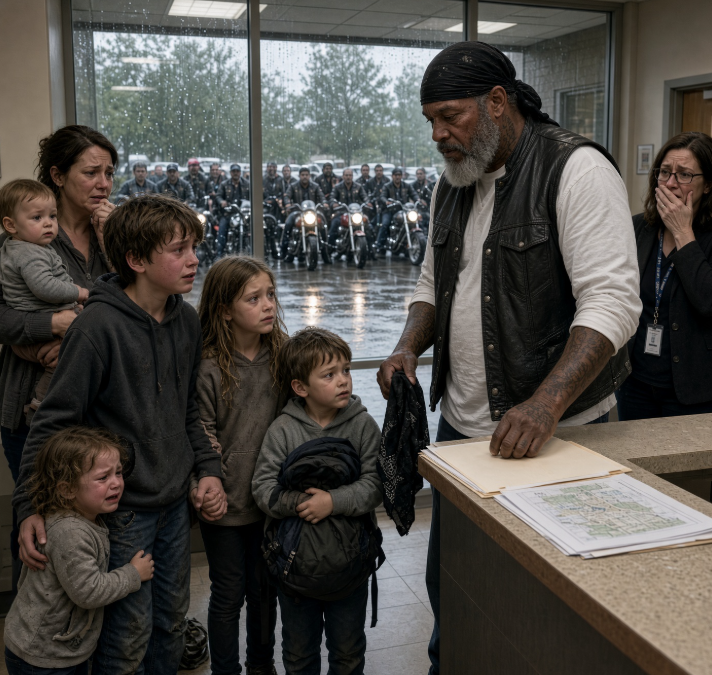
Eli stood by the hallway window.
That was when the motorcycles arrived.
One.
Then another.
Then five.
Ten.
Twenty.
Thirty-five.
They came slowly.
No revving.
No show.
Headlights cutting through rain.
Riders parked in rows.
Men.
Women.
Black.
White.
Latino.
Young.
Old.
Leather vests dark with rain.
Eli pressed closer to the window.
Noah joined him.
“Are they bad guys?”
Eli did not answer.
Sophie started crying.
Too many strangers.
Too much leather.
Too much uncertainty.
Then Caleb entered alone.
He removed his bandana.
Wiped his boots.
Took off his gloves.
Made himself smaller somehow without actually being smaller.
“Mr. Hayes,” I said.
He nodded.
Eli stepped forward before I could begin.
“Are you taking us?”
That question still hurts.
Not “Are you helping us?”
Not “Who are you?”
Are you taking us?
Caleb looked at him.
“No single house in our club can take all five of you.”
Maddie made a wounded sound.
Eli’s face shut down.
I opened my mouth.
Caleb lifted one hand.
“But five homes on the same street can keep you together.”
Eli blinked.
“What?”
Caleb placed the map on the table.
He did not address me.
He addressed the children.
“Eli, you’d sleep at Ray and Angela’s.”
He pointed.
“Maddie and Noah would be right here with Luis and Marlene.”
Another house.
“Sophie and Grace would be here with Marcus and Tessa.”
Sophie clung tighter to Maddie.
Eli stared at the spaces between the houses.
“How far?”
Caleb understood exactly what he meant.
“Three houses from you to Maddie.”
“What about Grace?”
“Five if you use the sidewalk. Faster through the backyards once we finish the gates.”
Noah looked confused.
“So we’re split?”
The room went quiet.
Caleb crouched.
Not too close.
“No.”
He paused.
Then corrected himself.
“You’ll sleep in different houses.”
Noah’s face fell.
“But you’ll wake up on the same street.”
He pointed.
“Same bus stop.”
Another point.
“Same school.”
Then:
“Same dinners whenever you want.”
Noah frowned.
“Every day?”
Caleb looked at me.
I said, “You can see each other every day.”
Maddie finally spoke.
“Can Grace come to our house?”
“Yes.”
“Can Sophie sleep over?”
“If the adults arrange it safely, yes.”
“Can Eli come if I need him?”
Ray, standing near the door now, answered.
“Kid, I’ll drive him three houses if necessary.”
That got the smallest smile from Maddie.
Eli still looked suspicious.
“Why?”
Caleb turned toward him.
“Why what?”
“Why are you doing this?”
The rain tapped against the windows.
Caleb rested his forearms on his knees.
“Because I had a little sister once.”
Everyone went quiet.
“We were put in foster care too.”
Eli’s expression changed.
“They split you?”
“Yes.”
“Did you get back together?”
“Eventually.”
“Was it the same?”
Caleb did not lie.
“No.”
Eli looked away.
Caleb continued.
“So when I heard five brothers and sisters were about to become visitors to each other, I asked whether adults could do something different.”
Eli’s jaw tightened.
“What if they get tired of us?”
That was the question underneath everything.
Not bedrooms.
Not distance.
Tired of us.
Angela took one step forward but stopped.
Caleb answered.
“Then thirty-four other people remind them why they started.”
Eli looked at the window.
Thirty-four riders stood in the rain.
Caleb said, “Nobody is promising you adults will never make mistakes.”
Good answer.
“We will.”
Better answer.
“Somebody will forget something. Somebody will get frustrated. Somebody will say the wrong thing.”
Eli looked at him again.
“But if one house is having a hard day, there are four more houses close enough to knock on.”
His voice softened.
“You kids have been carrying each other because adults kept falling short.”
Maddie started crying silently.
Caleb looked at all five.
“That part changes now.”
Noah raised his dinosaur.
“What if we’re loud?”
For the first time, Caleb smiled.
“Son, we ride motorcycles.”
Sophie giggled.
Tiny sound.
Almost nothing.
It changed the room.
Eli asked more questions.
Of course he did.
“Can I see Grace every day?”
“Yes.”
“Can Maddie call me after bedtime?”
“Yes.”
“Birthdays?”
“Together.”
“Christmas?”
“Together unless you kids someday choose otherwise.”
“What if one of us gets moved?”
I hated that question.
Caleb looked at me.
I answered this one.
“No placement is guaranteed forever until courts complete permanency.”
Eli’s face hardened.
“But this plan is built to keep you on Oak Lantern Drive. If a problem develops in one house, we look at the neighborhood first.”
“Before somewhere else?”
“Yes.”
He studied me.
“You promise?”
I had learned to hate promises.
So I said, “I promise I will not lie to you and say nothing can ever go wrong.”
His eyes stayed on mine.
“But I can promise that keeping you close is written into the plan. Not just something adults are saying today.”
That mattered to him.
Paper mattered when paper usually took things away.
This time, paper protected something.
Maddie took his hand.
Eli held on.
One tear rolled down his cheek.
He wiped it angrily.
Nobody pretended not to notice.
Caleb stood.
“You ready to meet some people?”
Eli looked outside.
“All of them?”
“No.”
Caleb laughed.
“That would be horrifying.”
Even Eli smiled.
We introduced the primary foster families first.
Angela crouched to Maddie’s eye level before realizing Maddie would not live with her.
“Sorry. Habit.”
Maddie almost smiled.
Ray showed Eli a photograph of his garage.
“You like building things?”
“No.”
“That’s okay.”
Eli looked suspicious.
“You’re supposed to convince me.”
“Why?”
“So I like you.”
Ray shrugged.
“You don’t have to like me today.”
Eli stared at him.
That might have been the smartest thing anyone said all afternoon.
Luis showed Noah a photograph of a blue motorcycle.
Noah gasped.
“You said motorcycles can be blue!”
Caleb nodded solemnly.
“I do not lie about motorcycles.”
Marlene asked Maddie if she wanted to see the bedroom before anyone decorated it.
“Why?”
“So you can pick things.”
Maddie immediately asked, “Can Noah pick too?”
Marlene smiled.
“That is exactly why there are two walls.”
Marcus knelt several feet from Sophie.
“I hear you like purple.”
She hid behind Maddie.
“Bad intelligence?”
No response.
He waited.
Finally Sophie whispered, “Yellow.”
Marcus nodded.
“I’ll fire my source.”
Tessa took Grace only after Grace reached for her.
Every adult moved slowly.
No grabbing.
No performing.
No “Come give me a hug.”
That mattered.
The children had had enough adults claiming closeness faster than trust could grow.
The placement transition happened the next afternoon.
The bikers did not line the road.
Caleb forbade it.
“This is their move, not our parade.”
The families kept things quiet.
Eli arrived at Ray and Angela’s house carrying one backpack.
That was all he had.
Ray showed him the bedroom.
Bed.
Desk.
Dresser.
Blank walls.
“I thought there’d be stuff.”
“You tell us what stuff.”
“What if I don’t want stuff?”
“Then the room stays boring.”
Eli dropped his bag.
He did not unpack.
Angela noticed.
She said nothing.
Three houses away, Maddie immediately inspected Noah’s bedroom.
“His night-light needs to be near the outlet.”
Marlene nodded.
“Okay.”
“He wakes up thirsty.”
“We have cups.”
“He hates doors closed.”
“We keep it open.”
Maddie stopped.
Marlene looked at her.
“You don’t have to give me the whole manual tonight.”
“Yes, I do.”
“No.”
Maddie’s eyes sharpened.
“You don’t know.”
“You’re right.”
Marlene pulled out a chair.
“So teach me.”
Maddie stood uncertainly.
“But you don’t have to teach me everything in one day.”
That was new.
At Marcus and Tessa’s, Sophie cried for Eli before they even got through dinner.
“I want Eli.”
Tessa sat beside her.
“I know.”
“I want him now.”
Marcus reached for his phone.
Tessa smiled.
“Shoes.”
Five minutes later, Marcus walked Sophie down Oak Lantern Drive in pink pajamas and rain boots.
They reached Ray’s porch.
Eli opened the door.
Sophie launched herself at him.
He hugged her so tightly Ray looked away.
“I thought they weren’t letting me come.”
Eli looked at Marcus.
“He brought you.”
Sophie nodded.
“Can I stay?”
Ray looked at Marcus.
Marcus looked at Angela.
Every placement schedule said no.
Every trauma instinct said yes.
Angela sighed.
“Twenty minutes.”
Sophie stayed forty-five.
At 9:47 that night, all five children were in Ray and Angela’s living room.
Nobody planned it.
Maddie brought Noah because Noah refused to sleep.
Tessa carried Grace because she was fussy.
Marcus brought Sophie.
Luis brought blankets.
Marlene brought popcorn.
Caleb arrived because someone called him and made the mistake of assuming he had better judgment.
He surveyed the scene.
Five children in pajamas.
Six exhausted foster parents.
One caseworker—me—who had stopped by “for ten minutes” and was still there.
“This is definitely not the schedule.”
I pointed at Caleb.
“You helped create the schedule.”
“First-night rules.”
“There are no first-night rules.”
“Exactly.”
We watched an animated movie.
Nobody remembers which one.
That is how little the movie mattered.
Sophie fell asleep against Eli.
Noah slept with his dinosaur on Maddie’s knee.
Grace slept on Tessa.
Eli stayed awake longest.
He watched every adult.
At almost midnight, we began carrying the children back.
Eli stiffened when Angela touched his shoulder.
“Where are they going?”
“To their beds.”
His eyes filled with panic.
“What if something happens?”
Ray sat beside him.
“Then you call.”
“What if nobody answers?”
“Then you walk three houses and bang on a door.”
“What if—”
Ray interrupted gently.
“Eli.”
He waited.
“You do not have to stay awake tonight to make sure everybody is still here tomorrow.”
Eli’s face collapsed.
He covered it.
Twelve-year-old boys sometimes cry like they are angry at their own bodies.
Ray stayed beside him.
Did not hug him.
Did not speak.
Eventually Eli lowered his hands.
“You promise?”
Ray said, “I’ll be downstairs when you wake up.”
Not forever.
Not impossible certainty.
Morning.
A promise small enough to keep.
The next morning, Eli walked onto Ray’s porch at 7:12.
He had slept in his clothes.
Maddie and Noah appeared from the Torres house.
Maddie saw Eli.
Stopped.
Then smiled.
Marcus came down the sidewalk pushing Grace’s stroller with Sophie beside him.
The five children gathered at the bus stop.
They stared at one another.
Noah grinned.
“We’re still here.”
Maddie laughed.
“We’re still here.”
Eli looked from one sibling to another.
Then toward the adults on the porches.
He did not smile.
Not yet.
But his shoulders dropped.
That phrase became theirs.
We’re still here.
After nightmares.
We’re still here.
After court dates.
We’re still here.
After their mother missed visitation.
We’re still here.
After Sophie panicked when Marcus packed a suitcase for a weekend conference.
We’re still here.
After Noah got suspended for hitting a boy who called Grace “not his real sister anymore.”
We’re still here.
The placement was not a fairy tale.
I need that said clearly.
People love stories like this because they want the motorcycles, the surprise, the rough-looking strangers with tender hearts.
But loving traumatized children is not a single dramatic afternoon.
It is Tuesday.
It is breakfast.
It is a child hiding food in a dresser because hunger happened once and his body refuses to believe full cupboards are permanent.
It is a ten-year-old girl washing bottles without being asked because she thinks usefulness is the price of staying.
It is a twelve-year-old boy refusing birthday gifts because possessions make leaving harder.
It is a four-year-old screaming when anyone pulls luggage from a closet.
It is an eighteen-month-old waking every two hours for reasons she cannot explain.
Oak Lantern Drive struggled.
Of course it did.
Three weeks in, Eli got into an argument with Ray.
Ray had told him to finish homework before going to see Maddie.
Eli exploded.
“You’re not my dad!”
Ray stood by the kitchen counter.
“No.”
“You don’t tell me what to do.”
“Sometimes I do.”
“No.”
“Eli.”
“You only took me because your club wanted to look good!”
That one hurt.
Ray later admitted it.
But he did not react.
Eli grabbed his backpack.
Angela appeared in the hallway.
“Where are you going?”
“To Maddie’s.”
Ray said, “You can go when you calm down.”
Eli laughed harshly.
“You said I could see her whenever I want.”
“You can.”
“You’re stopping me!”
“I’m asking you not to run out while angry.”
“You lied.”
He reached for the door.
Ray did not block him.
That mattered.
Eli froze with his hand on the knob.
Ray said quietly, “I won’t trap you in this house.”
Eli looked back.
“But if you leave angry, I’m walking behind you.”
“Why?”
“Because you are twelve.”
“I can walk three houses.”
“I know.”
“Then leave me alone.”
Ray nodded.
“Five steps behind.”
Eli stormed outside.
Ray followed five steps behind.
At the Torres house, Maddie opened the door.
She looked from Eli to Ray.
“What happened?”
“Nothing.”
Ray said, “Homework.”
“Traitor.”
Maddie folded her arms.
“Do your homework.”
Eli stared at her.
“You too?”
“You’re being dumb.”
He eventually did homework at the Torres kitchen table.
Ray sat on the porch with Luis.
Neither adult dragged him back.
At ten, Eli returned voluntarily.
His room was untouched.
Backpack still on the floor where he had dropped it.
Angela was reading.
Ray was watching television.
Nobody said, “We knew you’d come back.”
Nobody punished him for going.
Ray only asked, “Math done?”
Eli nodded.
“Good.”
That night, Eli unpacked two shirts.
Tiny thing.
Huge thing.
Maddie’s problem was harder to notice.
She was too helpful.
Adults love helpful children.
They praise them.
That can be dangerous.
Marlene noticed Maddie was waking at five thirty to make Noah breakfast.
“You know I do breakfast.”
“He likes the pancakes thinner.”
“Teach me.”
“I can do it.”
“I know.”
Maddie kept flipping pancakes.
Marlene turned off the burner.
Maddie stared at her.
“What?”
“Sit.”
“Why?”
“You’re ten.”
“So?”
“So I am forty-four, and I have been waiting my entire life to boss a ten-year-old around.”
Maddie almost smiled.
“I have to make Noah’s lunch.”
“No.”
“He doesn’t like mustard.”
“I know.”
“You don’t.”
“Maddie.”
Marlene touched her own chest.
“I can learn.”
Maddie’s face changed.
“If I don’t do it right, he gets upset.”
“Then I help him be upset.”
“You don’t understand.”
“You’re right.”
Marlene pulled out a chair.
“But I understand this: you are his sister, not his mother.”
Maddie started crying.
“I have to take care of them.”
“Who told you?”
“Nobody.”
“Then why?”
Her answer was devastating.
“Because nobody else stays.”
Marlene knelt.
“I’m going to stay for breakfast.”
Maddie cried harder.
“Tomorrow too?”
“Yes.”
“What about Monday?”
“Yes.”
“Next month?”
“If I’m alive.”
Maddie laughed through tears.
Marlene smiled.
“That’s the only kind of promise I make.”
Over months, Maddie slowly allowed adults to do things badly.
That was part of healing.
Marlene made Noah’s sandwich wrong once.
He survived.
Tessa forgot Sophie’s purple—actually yellow—hair ribbon.
She survived.
Ray missed a school pickup and Caleb covered it.
Everybody survived.
The children learned a family did not collapse because one adult made a mistake.
Noah adapted fastest.
Partly because he was six.
Partly because Luis had motorcycles.
He followed Luis into the garage constantly.
“What is that?”
“Socket wrench.”
“What’s that?”
“Torque wrench.”
“What’s torque?”
“Force.”
“What’s force?”
Luis eventually told him, “I am limiting you to twelve questions an hour.”
Noah nodded.
“Is that question one?”
Luis closed his eyes.
Motorcycle maintenance became Noah’s favorite thing.
He wore safety goggles to sweep the garage.
He wore safety goggles to hand Luis a rag.
He once wore safety goggles while eating grapes.
Marlene took them away.
“Hazard control,” Noah protested.
“The grape is not a hazard.”
“You don’t know.”
Sophie struggled longest with nighttime.
For months, she woke screaming Eli’s name.
Marcus would put on slippers.
No complaint.
Walk her to Ray’s porch.
Sometimes Eli was asleep.
Sometimes Ray woke him.
Eventually they created a ritual.
At bedtime, Sophie called Eli.
Every night.
The conversation rarely lasted more than thirty seconds.
“You there?”
“I’m here.”
“You sleeping?”
“Trying.”
“Okay.”
“Goodnight, Sophie.”
“Goodnight.”
Then she slept.
Grace grew.
Her first clear word on Oak Lantern Drive was not Mama.
Not Dada.
“Eli.”
It sounded more like “Ee-eye.”
He pretended not to care.
Then went into Ray’s garage and cried where he thought nobody could see.
Ray saw.
Said nothing.
That was their relationship.
Months became years.
Court hearings came and went.
Their mother entered treatment.
Left.
Returned.
Missed visits.
Completed programs.
Relapsed.
Loved her children.
Failed them.
Those two truths existed together.
I refuse to flatten her into a villain.
Addiction had taken more from her than responsibility.
But responsibility still mattered.
The hardest court hearing came fourteen months after the Oak Lantern placement.
The judge ruled reunification was no longer realistic within the children’s timeframe.
Parental rights proceedings began.
Eli took the news silently.
Maddie cried.
Noah asked whether that meant their mother was dead.
Sophie asked whether she had done something wrong.
Grace did not understand.
That weekend, Oak Lantern held no celebration.
Nobody said adoption.
Nobody acted relieved.
The children were grieving.
Even when a parent cannot safely raise you, losing the legal possibility of going home is still a death.
Caleb sat with Eli on Ray’s porch.
I happened to be there for a visit.
Eli stared at the street.
“Everybody thinks I should be happy.”
“Who?”
“People.”
“People are stupid.”
Eli looked at Caleb.
Caleb shrugged.
“I’m people. I’m allowed to say it.”
Eli picked at a loose thread on his jeans.
“She loved us.”
“I believe you.”
“She messed everything up.”
“I believe that too.”
“How can both be true?”
Caleb looked toward the road.
“Most painful things are true in pairs.”
Eli waited.
“My mother loved me.”
A pause.
“She also couldn’t take care of me.”
Eli looked at him.
“You mad at her?”
“Sometimes.”
“Still?”
“Sometimes.”
“Even though she’s dead?”
“Death doesn’t turn people into saints.”
Eli absorbed that.
“Do you forgive her?”
Caleb thought.
“Some days.”
That answer gave Eli permission no therapy phrase had managed.
The adoptions took another year.
Not because the families were hesitant.
Because five children, three primary adoptive households, sibling protections, subsidy agreements, court procedures, and interstate family searches do not move quickly.
During that year, Iron Hollow developed rules.
No club photographs of the children without permission.
No public storytelling about their case.
No treating the children as charity mascots.
No forcing affection.
No surprise rides.
No motorcycles transporting children without approved safety arrangements.
Caleb enforced everything ruthlessly.
One new club member posted a vague message online about “saving five kids.”
Caleb made him remove it.
“This is not our story.”
The member argued.
Caleb pointed toward Oak Lantern.
“They are people, not proof we’re good.”
I respected him more after that.
The community still noticed.
How could they not?
Five sibling foster placements on one street involving a motorcycle club eventually became local legend.
But Oak Lantern protected the children from spectacle.
They were allowed to become boring.
That is one of the greatest gifts traumatized children can receive.
Boring Tuesdays.
Ordinary homework.
Arguments about dishes.
Missing socks.
Bad report cards.
Birthday cake.
Stomach flu.
Someone using all the hot water.
Life without emergency music playing underneath it.
Eli started woodworking with Ray.
At first only because Ray never asked him to talk.
They built a birdhouse.
Then a shelf.
Then a bench.
Eli liked measuring.
Precision calmed him.
One afternoon he made a small wooden box with five compartments.
Ray asked what it was.
“Nothing.”
Years later, I learned he kept one item from each sibling inside.
Maddie painted murals on Marlene’s backyard fence.
Flowers.
Stars.
Motorcycles.
Handprints.
She painted five connected houses one summer.
Noah complained his was too small.
“It’s perspective.”
“What’s perspective?”
“Why do you ask questions?”
Sophie became fearless during the day.
Still hated suitcases.
Marcus solved that accidentally.
He took her shopping and bought a tiny yellow suitcase.
“For you.”
She recoiled.
“No.”
“It’s not for leaving.”
“Suitcases are leaving.”
Marcus sat on the store floor.
“This one can be for coming back.”
She looked at him.
“How?”
“You pack it when we go somewhere. Then you bring it home.”
Sophie considered.
“Always?”
“As often as I can control.”
She eventually touched it.
Their first trip was one night at a cabin twenty miles away.
Sophie packed six stuffed animals and no socks.
When they returned, she carried the yellow suitcase into the house herself.
The next time Marcus traveled for work, she helped him pack.
Healing is strange.
Sometimes it looks like luggage losing its power.
Grace grew up differently from all of them.
She barely remembered life before Oak Lantern.
That created guilt.
At age seven, she told Maddie, “I don’t remember Mom’s apartment.”
Maddie froze.
“You were a baby.”
“Eli remembers.”
“He was older.”
Grace started crying.
“Does that mean she wasn’t my mom?”
Maddie took her hand.
“No.”
“But I don’t remember.”
Maddie looked across the connected yards.
Then said something I wrote down later because it was wiser than anything in our agency manuals.
“You don’t have to remember someone the same way to belong to the same story.”
Grace accepted that.
Children often understand complicated truths when adults stop overexplaining them.
The final adoption hearing happened nearly three years after the motorcycles arrived at my office.
Judge Marian Ellis presided.
She was sixty-two.
Black.
Sharp glasses.
Sharper questions.
She had reviewed hundreds of permanency plans in her career.
She had never seen one like Oak Lantern.
The courtroom was crowded.
Ray and Angela.
Luis and Marlene.
Marcus and Tessa.
Caleb.
Denise.
Other riders.
Therapists.
Teachers.
Me.
Tom.
Children everywhere.
Technically, three separate adoption orders were finalized.
Emotionally, there was one.
Judge Ellis addressed Eli first.
He was fifteen now.
Taller.
Still thin.
Eyes less tired.
“Eli, do you understand what adoption means?”
“Yes.”
“Do you consent?”
He looked at Ray and Angela.
Then at his siblings.
“Yes.”
Maddie was thirteen.
The judge asked the same.
“Yes.”
Noah, nine, asked whether he had to say “I consent” or if “yeah” counted.
The courtroom laughed.
Judge Ellis said, “I prefer legal enthusiasm.”
Noah said, “Then extremely yes.”
Sophie was seven.
She whispered her answer.
Grace, four, waved at the judge.
Nobody required a legal opinion from Grace.
When the orders were signed, people cried.
Lots of people.
Ray covered his face.
Marlene ruined her mascara.
Marcus held Sophie.
Tessa kissed Grace’s head.
Luis hugged Noah until Noah complained.
Angela reached for Eli but stopped.
Always waiting.
Eli stepped into her arms himself.
That was when I lost control.
I had cried at work before.
Quietly.
In bathrooms.
Cars.
Empty offices.
That day I cried in public.
Caleb stood near the back.
He had tears in his beard.
Judge Ellis removed her glasses.
“Well.”
Her voice cracked.
“I’ve seen relatives become families.”
She looked around the courtroom.
“I’ve seen foster parents become families.”
Then toward the children.
“I don’t believe I have ever seen an entire street become one.”
Afterward we gathered on the courthouse steps.
No media.
Just photographs for the families.
Thirty-five Iron Hollow riders stood behind the children.
Caleb was asked to say something.
He resisted.
Eli insisted.
So Caleb stood in front of the steps.
Leather vest.
White shirt.
Gray beard.
Same man who had walked into my office with the binder.
“The system was going to separate five siblings,” he said.
I winced slightly at the phrasing.
He glanced at me.
Probably noticed.
“We didn’t let that be the end of their story.”
Better.
He looked at the children.
“They grew up together.”
Eli interrupted.
“We’re still growing.”
Laughter.
Caleb smiled.
“Fair.”
Then he said, “Many homes.”
Eli shook his head.
“One family.”
Caleb looked at him.
The boy he had first met holding everyone’s hands was almost a young man now.
Caleb nodded.
“One family.”
The years after adoption were ordinary and extraordinary.
Eli got his driver’s license.
Maddie became interested in art therapy.
Noah stayed obsessed with engines.
Sophie joined soccer.
Grace developed the dangerous confidence of a youngest child with approximately thirty-five unofficial grandparents.
Oak Lantern Sunday dinners became ridiculous.
Three yards.
Four grills.
Folding tables.
Children running everywhere.
Motorcycles lined along the curb.
Neighbors who were not club members joined eventually.
Mrs. Palmer from across the street brought pies.
Mr. Singh at the corner made samosas.
The mail carrier once ate two hamburgers and stayed an hour.
The neighborhood stopped belonging only to the Iron Hollow Riders.
That might have been the best part.
Good communities expand.
They do not hoard goodness.
When Eli was sixteen, he had his worst fight with Ray.
Real fight.
Not homework.
Eli’s biological mother had died from an overdose.
He had not seen her in more than a year.
The news came through my office.
I drove to Oak Lantern myself.
Ray answered.
His face told me he already knew something was wrong.
I asked for Eli.
We sat in the garage.
He knew before I said it.
Maybe children like Eli never lose that instinct.
“She’s dead?”
I nodded.
He stared at the workbench.
“How?”
I told him.
He punched a cabinet.
Hard.
Ray moved.
Eli spun.
“Don’t.”
Ray stopped.
Eli hit the cabinet again.
“You all wanted this.”
“No,” Ray said.
“You wanted to adopt me.”
“Yes.”
“You wanted her gone.”
“No.”
“You got what you wanted!”
Ray’s face changed.
“That is not true.”
“You get to be my dad now.”
“I was already—”
“Shut up!”
Ray did.
Eli screamed.
Cried.
Threw a small wooden stool he had built himself.
It broke against the garage wall.
Then he looked horrified.
Not at the wall.
At Ray.
There it was again.
Testing.
I did something terrible.
Will you leave?
Will you punish me?
Was your love only for the grateful version?
Ray looked at the broken stool.
Then Eli.
“You done?”
Eli sobbed.
“I hate you.”
Ray nodded.
“Okay.”
“I mean it.”
“Okay.”
“Say something!”
Ray walked closer.
Slowly.
“You want me to hate her because she hurt you.”
Eli froze.
“I don’t.”
Ray swallowed.
“You want me to be glad she’s dead because that makes adoption cleaner.”
Eli’s face crumpled.
“I’m not.”
Ray’s eyes filled.
“She was your mother.”
Eli made a sound like a wounded animal.
Ray opened his arms.
This time Eli fell into them.
Not because grief disappeared.
Because there was room for both mothers and fathers.
Biological.
Adoptive.
Love did not require simplifying the dead.
At eighteen, Eli graduated high school.
That day brought the motorcycles back in a way I had not seen since the county office.
Thirty-five riders.
Some older now.
Some had sold their bikes.
One came with a cane.
Two had passed away and were represented by patches on vests.
They sat behind Eli’s siblings.
Nobody revved an engine.
Nobody made a spectacle.
When the announcer called:
“Elijah Carter-Doyle.”
Every Iron Hollow Rider stood.
Thirty-five bodies rising together.
Eli saw them.
He stopped halfway across the stage.
The principal almost bumped into him.
Eli laughed.
Then he cried.
Maddie screamed.
Noah shouted, “LET’S GO, ELI!”
Sophie covered her face.
Grace waved both arms.
Ray was openly sobbing.
Angela did not bother pretending otherwise.
Caleb stood straight.
Gray beard almost white now.
I was several seats over.
For a second, I saw twelve-year-old Eli again.
Holding a backpack.
Holding Maddie’s hand.
Watching motorcycles arrive through county glass.
After the ceremony, people gathered on the football field.
Photos.
Flowers.
Arguments about dinner.
A local reporter who knew part of the history approached Eli.
He asked permission before recording.
“What do you remember most about the day you found out about Oak Lantern?”
Eli thought.
The reporter probably expected motorcycles.
Caleb.
The courthouse plan.
Eli surprised him.
“Nobody made me let go.”
The reporter frowned slightly.
“Of what?”
“My sister’s hand.”
He looked across the field.
Maddie was arguing with Noah.
Sophie was chasing Grace.
Ray was carrying folding chairs because apparently retired shop teachers cannot attend events without moving furniture.
Caleb stood with Marcus and Luis.
Eli smiled.
“Before Oak Lantern, whenever adults talked about placements, somebody was always separating us physically.”
His expression became serious.
“Different cars. Different rooms. Different appointments. Different plans.”
He looked at his siblings again.
“That day everybody built the plan around us instead.”
The reporter lowered the microphone.
“That’s what you remember?”
“Yeah.”
Eli shrugged.
“Nobody told me to loosen my grip.”
That was the whole story.
Not thirty-five bikers.
Not leather.
Not motorcycles.
Not a dramatic rescue.
Those things make a good headline.
They were never the miracle.
The miracle was that a group of adults looked at five children already holding on to one another and did not ask:
How do we make them fit the homes available?
They asked:
How do we build enough home around the family that already exists?
That difference changed everything.
I retired two years after Eli graduated.
On my final day, Caleb came to the office.
Older.
Slower.
Same vest.
He brought a box.
Inside was a wooden plaque.
Eli had made it.
Five small houses carved into oak.
A road ran between them.
Underneath, carved by hand:
WE’RE STILL HERE.
I cried immediately.
Caleb smiled.
“You social workers cry a lot.”
“We have paperwork feelings.”
He sat across from my desk.
The same desk where he had placed that binder years earlier.
“You know,” I said, “that plan should not have worked.”
“I know.”
“The licensing alone was insane.”
“I remember.”
“Three primary households.”
“Yes.”
“Thirty-five bikers trying to help.”
“Your biggest nightmare.”
“Absolutely.”
He laughed.
I ran my fingers over the wooden houses.
“You saved them.”
Caleb shook his head.
“No.”
“You did.”
“No.”
He leaned back.
“We built some fences.”
“Cut gates.”
“Made dinners.”
“You kept them together.”
He was quiet.
Then said, “They kept themselves together.”
I looked at him.
“That’s why it worked.”
He nodded toward the plaque.
“We just stopped adults from getting in the way.”
I thought about that long after he left.
Child welfare is full of people who want to rescue children.
I became suspicious of that word over the years.
Rescue.
It makes adults sound heroic.
Children do not need to become supporting characters in somebody else’s goodness.
They need safety.
Reliability.
Food.
Beds.
School.
Therapy.
Boundaries.
Patience.
Truth.
And whenever possible, they need the relationships that already kept them alive before professionals entered the room.
Eli had protected Maddie.
Maddie had raised Noah emotionally.
Noah made Sophie laugh.
Sophie could calm Grace with a song nobody else knew.
Grace reminded all of them there was still a baby in the family who expected joy.
They had built their own system.
Imperfect.
Unfair.
Too much responsibility on children.
But real.
The best thing Oak Lantern did was not replace it.
The adults surrounded it.
Years later, I was invited to Eli’s wedding.
Yes.
All thirty-five riders were not there.
Time takes people.
Some had died.
Some moved.
Some became too ill to travel.
But their chairs were represented.
Patches.
Photographs.
Names.
Caleb walked slowly with a cane.
Ray looked uncomfortable in a suit.
Maddie helped decorate.
Noah arrived on a motorcycle he had rebuilt with Luis.
Sophie cried before the bride even entered.
Grace, now a teenager, complained that everyone was embarrassing.
At the reception, Eli stood to give a speech.
His wife, Hannah, held his hand.
He thanked Ray and Angela.
Then Luis and Marlene.
Marcus and Tessa.
Caleb.
Denise.
The club.
Me.
I wanted to disappear under the table.
Then he called his siblings forward.
Maddie.
Noah.
Sophie.
Grace.
They stood beside him.
Eli looked at them for a long moment.
“When I was twelve,” he said, “I thought family meant everybody sleeping under one roof.”
He smiled.
“Then I learned roofs are overrated.”
Laughter.
He continued.
“We had three kitchens.”
“Four if you count Mama D,” Noah called.
Denise shouted, “You better count mine.”
More laughter.
“Fine,” Eli said. “Four kitchens.”
Then his voice softened.
“We had three main homes, five backyard gates, too many parents, thirty-five motorcycle aunts and uncles, and one bus stop.”
Caleb looked down.
Eli swallowed.
“And somehow nobody ever made us feel like visitors to each other.”
Maddie took his hand.
Just like she had all those years ago.
Eli looked at her.
“I spent a long time thinking I kept my siblings together.”
He shook his head.
“I was twelve. I shouldn’t have had to.”
Ray’s face crumpled.
Eli continued.
“What changed my life wasn’t adults praising me for being strong.”
He looked around the room.
“It was adults finally saying, ‘You can stop being strong for five minutes. We’ve got this.’”
Nobody spoke.
Then Grace whispered loudly, “I think he’s going to cry.”
Everyone laughed.
Eli did cry.
So did everybody else.
Caleb raised his glass.
“One family.”
The room answered.
“Many homes.”
Eli shook his head, smiling.
“No.”
He lifted Maddie’s hand.
“One family.”
Caleb laughed.
“One family.”
That night, after the reception, I found Caleb outside.
He was sitting on a bench near the parking lot.
No motorcycle anymore.
His knees had finally convinced him to stop riding.
I sat beside him.
“You okay?”
“Old.”
“That wasn’t the question.”
He smiled.
“Yeah.”
We watched Eli and Hannah through the reception hall windows.
Caleb said, “My sister would’ve liked this.”
“The one you were separated from?”
He nodded.
“What happened to her?”
“We found each other as adults.”
“I didn’t know.”
“We’re close now.”
He smiled.
“She still says I snore.”
“You probably do.”
“Violently.”
We sat quietly.
Then Caleb said, “You know why I brought thirty-five riders that first day?”
“To intimidate county government?”
“That was a bonus.”
I laughed.
“Why?”
“Because I wanted those kids to see people show up.”
I looked at him.
“Not one person.”
He gestured toward the hall.
“Not one hero.”
“A crowd.”
“A community.”
He nodded.
“When you’ve been left enough times, one adult promising forever sounds like marketing.”
I smiled.
“Marketing?”
“I own a repair shop. I know scams.”
I laughed.
Caleb continued.
“But thirty-five people standing outside?”
He shrugged.
“Harder to believe everybody disappears at once.”
That may have been the smartest explanation of the whole thing.
Trauma makes certainty expensive.
Oak Lantern bought it in installments.
Breakfast.
Bus stops.
Backyard gates.
Homework.
Night calls.
Sunday dinners.
Someone always answering.
That is how the children learned permanence.
Not in court.
Court made it legal.
Life made it believable.
The Carter siblings are adults now.
Eli works in carpentry and youth vocational training.
He teaches teenagers who hate classrooms how to build things with their hands.
Maddie became an art therapist.
Of course she did.
She works with children in foster care.
Her office has paint everywhere.
Noah became a motorcycle mechanic.
No surprise there.
He still wears safety glasses too often.
Sophie became a teacher.
Grace is in college and complains that she has four siblings, six parents, and “approximately a thousand relatives.”
Oak Lantern Drive changed too.
Some families moved.
Some passed away.
New people bought houses.
The gates remained.
That matters to me.
Those little backyard gates became part of the property.
People asked why they were there.
Neighbors told the story.
Not the dramatic version.
The useful version.
Once, five children needed more family than one house could hold.
So the street made room.
That is the version worth keeping.
I still have Eli’s wooden plaque.
Five houses.
One road.
WE’RE STILL HERE.
It hangs beside my front door.
Visitors ask about it.
Sometimes I tell them.
Sometimes I don’t.
Not every story needs to be performed.
But on hard days, I touch those carved letters.
I remember that rainy county office.
Sophie crying.
Grace sleeping.
Noah asking the question nobody wanted to answer.
Maddie trying not to fall apart.
Eli holding her hand like letting go might erase her.
Then headlights.
Motorcycles.
Caleb walking in soaked from the rain.
A binder landing on my desk.
Five addresses.
One street.
A plan that looked unreasonable until enough people decided unreasonable was better than unnecessary heartbreak.
Thirty-five bikers did not save five foster children that day.
That version is too simple.
They did something more important.
They refused to accept that the only available solution had to be the final one.
They asked another question.
Then another.
What if one home cannot hold all five?
What if five homes act like one neighborhood?
What if sibling contact means more than scheduled visits?
What if children can walk down the street instead of waiting for a caseworker’s transportation calendar?
What if Sunday dinner belongs to everybody?
What if the adults bend first?
Those questions built a childhood.
No miracle.
Just stubborn compassion organized well enough to survive background checks.
That is what I want people to understand.
Good intentions are not enough.
The Iron Hollow Riders succeeded because Caleb refused to let kindness become recklessness.
Licenses mattered.
Background checks mattered.
Home inspections mattered.
Trauma training mattered.
Legal permanence mattered.
Boundaries mattered.
The children mattered more than the adults’ desire to feel heroic.
That is why the plan lasted.
And underneath all the procedures was one simple principle.
Do not destroy a bond because your system lacks imagination.
Sometimes there really is no alternative.
I know that.
I spent seventeen years facing impossible decisions.
Some siblings cannot safely remain together.
Some children need specialized placements.
Some homes fail.
Some distances cannot be avoided.
Real life refuses easy slogans.
But “difficult” is not the same as “impossible.”
And “we have always done it this way” is not a child-centered reason.
The Carter children taught me that.
Caleb taught me that.
Oak Lantern taught everyone who worked that case.
The day they first came to the street, Eli still believed adults were about to take his siblings.
Years later, standing at his own wedding, he had more family around him than any ballroom could comfortably hold.
That is not because trauma disappeared.
It never did.
It became part of them.
But it stopped being the only thing organizing their lives.
Love took over some of the structure.
Routine took over some.
Trust.
Choice.
Time.
Those ordinary things.
The same things children are supposed to receive without having to earn them.
My last memory of all five together is from a summer picnic several years ago.
Caleb was alive then.
Ray grilled hamburgers.
Marlene yelled at Noah for putting tools on the food table.
Marcus slept in a lawn chair.
Tessa held someone’s baby.
Not sure whose.
Sophie argued with Grace about music.
Maddie painted children’s faces.
Eli stood at the old backyard gate Ray had built years earlier.
The wood was worn.
Hinges rusty.
He opened it.
Closed it.
Opened it again.
I walked over.
“You planning to fix that?”
“Probably.”
He ran his hand along the top.
“You remember when this went in?”
“Before you moved.”
He nodded.
“I hated it.”
“The gate?”
“The whole thing.”
That surprised me.
“Really?”
“I thought it was fake.”
“What changed?”
Eli looked through the opening toward the Torres yard.
“Nothing.”
I waited.
“That’s what changed.”
I smiled.
He explained.
“Monday happened.”
He pointed.
“Then Tuesday.”
Another direction.
“Then a month.”
He shrugged.
“You all kept doing the same boring stuff.”
“That convinced you?”
“Eventually.”
I laughed.
“You could’ve told us. We spent thousands on therapy.”
He smiled.
“Therapy helped too.”
Then his face softened.
“I just needed enough mornings.”
Enough mornings.
That is permanence.
Not a dramatic promise.
Enough mornings where the same people are still there.
Enough breakfasts.
Enough rides.
Enough arguments.
Enough apologies.
Enough nights where you go to a different bed but wake up close to the people you love.
Enough proof.
The five Carter children had stood in my county office expecting somebody to take their hands apart.
Instead, an entire neighborhood was built around the fact that they refused to let go.
And after everything I saw in seventeen years of child welfare, I still believe that may be one of the most beautiful things adults can ever do for children.
Not tell them to loosen their grip.
Not praise them for surviving alone.
Not demand they trust faster.
Just look at the hands they are already holding and say:
Keep holding on.
We’ll build around you.








