Fifty Bikers Waited Outside While Their Feared President Let His 5-Year-Old Daughter Give Him a Garage Spa—Then She Played the Last 11 Seconds of Her Mother’s Video
PART2:
Found whichever shoe had disappeared overnight.
Opened Kane Custom Motorworks by seven.
From outside, I probably looked functional.
Bills paid.
House clean enough.
Child delivered to kindergarten on time.
Groceries purchased.
Laundry folded incorrectly but consistently.
I learned which detergent made Ellie’s skin itch.
I learned that dinosaur chicken nuggets went on sale every third Thursday.
I learned that if I cut strawberries too thin she called them “sad strawberries.”
But inside our house, everything waited for Caroline.
Her yellow raincoat hung by the back door.
Her chipped blue coffee mug remained above the coffee maker.
A grocery list was still under a magnet shaped like Tennessee.
Milk.
Apples.
Paper towels.
Ellie yogurt.
Ask Gabe about gutters.
PART3:
I had replaced the gutters six months earlier.
I still couldn’t throw away the list.
Ellie noticed.
Children always notice what adults believe they are hiding.
She began asking permission for sounds.
“Daddy, can I watch cartoons?”
“Yes.”
“Can I use the blocks?”
“Yes.”
“They’re loud.”
“That’s fine.”
“Can I laugh?”
The first time she asked that one, I stopped what I was doing.
She was sitting on the living-room rug.
The neighbor’s dog was trying to attack a sprinkler.
Water kept hitting his face.
He kept coming back.
Ellie had covered her mouth.
“Why are you asking?”
She shrugged.
“Because you’re sad.”
I sat down beside her.
“You never need permission to laugh.”
She nodded.
Then watched the dog.
But she didn’t laugh.
Caroline had been the noise in our family.
She sang while washing dishes.
Invented songs about missing socks.
Narrated grocery shopping like we were special forces crossing dangerous territory.
“Cereal aisle clear.”
“Possible hostile near frozen peas.”
She could make Ellie laugh until milk came through her nose.
I loved Caroline because she was unafraid of silliness.
She loved me because I had spent most of my life afraid of it.
Before her, I had been good at motorcycles and anger.
At twenty-four, I broke a man’s jaw with a wheel wrench after he shoved my younger brother outside a roadside bar.
There were reasons.
Reasons are not excuses.
I served six years for aggravated assault.
When I came home, my brother had joined the Army.
My mother had sold the house.
Most of the men who once called themselves my brothers had learned that loyalty gets flexible around visiting hours.
Rook Mercer was the exception.
Every second Sunday, he rode a hundred seventy miles to sit across from me under fluorescent lights.
Sometimes we talked.
Sometimes we didn’t.
He kept coming.
When I got out, he found me a job.
Later we opened Kane Custom Motorworks.
I offered to put his name on the sign.
He refused.
“You do the talking.”
“I don’t talk.”
“Exactly. Customers like mystery.”
The Iron Harbor Riders grew around the shop.
We were not saints.
Never claimed to be.
Some riders were veterans.
Some welders.
Some mechanics.
Truck drivers.
Nurses.
Men and women with histories that made respectable people nervous.
We also delivered groceries after tornadoes.
Paid motel rooms after fires.
Sat outside operating rooms for people who had nobody.
Caroline met me during one of those nights.
She taught second grade.
A student’s father was hurt in a warehouse collapse.
Eight of us repaired the family’s roof before another storm arrived.
Caroline brought sandwiches.
She looked at the cracked compass tattoo on my forearm.
“Is that supposed to point somewhere?”
“It used to.”
She stared at me.
“That is the saddest answer I have ever heard from a man holding a turkey sandwich.”
Then she laughed.
I married her eighteen months later.
When Ellie was born, I stood beside the hospital bassinet afraid to pick her up.
My hands looked too large.
Caroline noticed.
“She isn’t made of glass.”
“I know.”
“No.”
She lifted Ellie.
Placed her against my chest.
“You don’t.”
For five years, Ellie kept teaching me the same lesson.
Painted my fingernails before rides.
Put stickers on my helmet.
Once clipped twelve plastic butterflies into my beard while I slept.
I removed one.
She cried.
So I rode to the shop with eleven butterflies in my beard.
Nobody laughed twice.
Then Caroline died.
Not after a long final illness.
That somehow made it worse.
She had survived breast cancer three years earlier.
Chemotherapy.
Surgery.
Months of fear.
Then she recovered.
We thought we had been given our warning.
We thought we knew what danger looked like.
One Tuesday morning, Caroline was making toast.
She said:
“Gabe?”
I turned.
She collapsed.
Cerebral aneurysm.
By the time the ambulance arrived, I knew.
Rook reached our kitchen before they finished working.
He took Ellie outside.
That was one more thing I would owe him forever.
After Caroline died, I became harder without intending to.
I called it routine.
Schedule.
Responsibility.
Protection.
But grief can wear work boots and pretend it has a job.
I opened the shop earlier.
Stayed later.
Took more club calls.
Fixed things that did not need fixing.
If I kept my hands moving, maybe the quiet could not catch me.
Ellie adapted.
That should have frightened me sooner.
She learned to close doors softly.
Learned to wait until phone calls ended.
Learned to watch my expression before asking for things.
Then came the spa.
That Saturday morning, Ellie carried Caroline’s old tablet into the kitchen.
She had found a tutorial.
A woman in a white robe mixed oats, cocoa, yogurt, and honey into a facial mask.
Her little girl painted her nails.
Cucumber slices over the eyes.
Soft music.
Ellie watched it four times.
Then announced:
“Daddy, I’m opening a business.”
I was tightening the chain on Caroline’s old bicycle.
“What kind?”
“A spa.”
“We don’t have a spa.”
“We have a garage.”
“Garages are for motorcycles.”
“And spas.”
She said it like she had checked zoning.
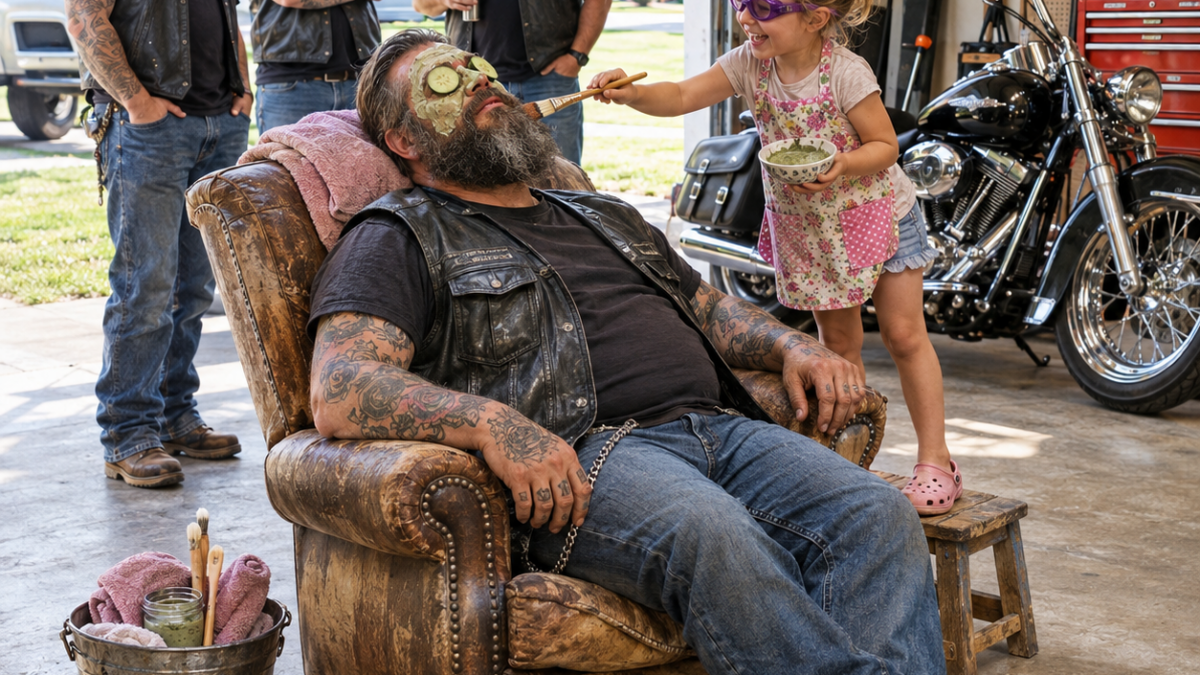
By ten, half my garage had changed jurisdictions.
A beach towel covered my old recliner.
Caroline’s portable speaker played whale sounds interrupted every seven minutes by a car-insurance advertisement.
A cereal bowl held brown facial paste.
Two cucumber slices floated in a plastic cup.
A hand-lettered sign outside read:
ELLY ROYAL ROD SPA
Below:
ONE CUSTMER. VERRY IMPORTANT.
“You spelled Ellie wrong.”
“It’s business spelling.”
“Understood.”
She pointed.
“Sit.”
My phone vibrated.
Rook.
City Hall.
The permit meeting had been moved.
I knew.
The Caroline Kane Memorial Ride was six weeks away.
Our permit was in trouble.
Two neighborhoods had complained.
A council member called seven hundred motorcycles moving through Clarksville “an intimidating occupation of public roads.”
The mayor wanted a meeting.
Police chief.
Council.
Club leadership.
My presence mattered.
Caroline had created that ride years earlier after one of her students’ fathers lost both legs in a factory accident.
She had convinced churches, businesses, bikers, and city officials to cooperate for one day.
After she died, the club renamed the ride for her.
I opposed it.
They outvoted me.
My phone vibrated again.
I placed it facedown.
Then sat.
I expected fifteen minutes.
Children’s businesses usually have short operating hours.
They open a restaurant.
Serve one plastic egg.
Charge you seventeen invisible dollars.
Then close because owner has discovered a cardboard box.
Ellie had a schedule.
Three sheets of printer paper taped together.
First drawing:
My face with cucumbers.
Second:
Purple lines in my beard.
Third:
Both of us drinking something beneath a crooked clock.
“What are purple lines?”
“Beard conditioner.”
“We don’t have beard conditioner.”
She produced Caroline’s apple detangling spray.
“No.”
“It smells nice.”
“Still no.”
She narrowed her eyes.
“Regular package or VIP?”
“What’s difference?”
“VIP doesn’t complain.”
I chose VIP.
At 11:03, pink towel.
11:07, mud mask.
11:12, cucumber slices.
Then she asked questions.
“Do motorcycles get tired?”
“Yes.”
“Where do they sleep?”
“Garages.”
“Does your motorcycle miss Mommy’s motorcycle?”
Caroline’s red Softail sat beneath a canvas cover at the rear of the shop.
She had stopped riding when she became pregnant with Ellie.
She refused to sell it.
“I think it does.”
Ellie was quiet.
“Do you?”
I swallowed.
“Yes.”
She dabbed more mask across my chin.
“Me too.”
That was the first time in eight months she said it without changing the subject.
At 11:26, someone knocked.
11:31, my phone vibrated.
11:39, a Road King entered the driveway.
I recognized Rook’s bike by its slightly uneven idle.
He refused to let me fix it because it reminded him of his father’s old Shovelhead.
The engine stopped.
Boots crossed concrete.
Garage door opened.
Rook.
Mateo “Saint” Alvarez, our road captain.
Jo Kessler, ER nurse and one of the few people in Iron Harbor who could tell fifty bikers to sit down and expect compliance.
They stopped.
I could not see through cucumbers.
But silence has weight.
That one weighed eight hundred pounds.
Rook finally said:
“Grinder.”
“Rook.”
“What happened to your face?”
“Premium treatment.”
Ellie corrected:
“VIP.”
“VIP treatment.”
Saint made a choking noise.
Jo told him:
“Grow up.”
I could hear her smiling.
Rook did not smile.
“Mayor moved meeting to twelve-thirty.”
“I know.”
“We leave now.”
“Can’t.”
The word landed wrong.
“This ride helps families.”
“I know.”
“Your wife built it.”
“I know.”
“Then get up.”
Ellie’s brush stopped.
I heard it touch the bowl.
Her breathing changed.
That was all.
But I knew.
She had heard this sound before.
Phone.
Boots.
Men.
Daddy leaves.
She climbed off the milk crate.
“I can close.”
Not angry.
Not crying.
Prepared.
That was worse.
At five years old, my daughter had already learned that her plans were the plans adults abandoned first.
I lifted one cucumber slice.
Rook stood there in his old black cut.
Gray ponytail damp from mist.
The man who rode a hundred seventy miles every second Sunday for six years to sit with me in prison.
The man who mortgaged his house when our first shop loan failed.
The man who carried Ellie outside while paramedics worked on Caroline.
He was asking me to show up.
I understood the weight.
Ellie began folding the towel.
I covered my eye again.
“No.”
Rook’s expression changed.
“The spa stays open.”
“You’re choosing this?”
“Yes.”
He stared.
“You’re choosing this over Caroline’s ride?”
I kept my voice level.
“I’m choosing this.”
Rook walked out.
Saint followed.
Jo stayed.
She crouched beside Ellie’s bowl.
“Oats?”
“Yes.”
“Yogurt?”
“Yes.”
“Cocoa?”
“Yes.”
“Honey?”
“Yes.”
“Soap?”
“No.”
“Anything from garage?”
Ellie looked offended.
“Garage things are dirty.”
Jo nodded.
“Approved.”
She stood.
Then spoke quietly near me.
“Rook thinks you stopped caring.”
“He’s wrong.”
“Then explain.”
“If I explain in front of Ellie, she’ll think she needs a tragic reason for me to stay.”
Jo was silent.
Then:
“Who has your presentation?”
“Blue folder.”
“Where?”
“Right saddlebag.”
“You planned someone else to lead?”
“Rook.”
“You tell him?”
“Thursday.”
“He thought you were testing him.”
“I was trusting him.”
“With you two, those look similar.”
She took the folder.
Left.
By 12:41, motorcycles began arriving.
Rumors improve with distance.
By the time twelve riders stood outside, the story was that Rook had demanded my resignation while Ellie held me captive with cosmetics.
One prospect raised his phone.
I lifted a cucumber.
“If that camera comes up, you clean every oil pan with a toothbrush.”
The phone vanished.
Unfortunately, a neighbor had already photographed us.
Me beneath pink towel.
Mud across face.
Cucumbers over eyes.
Ellie holding brush.
Tattooed bikers watching.
Caption:
I don’t know what’s happening at the biker house, but the tiny lady appears to be in charge.
It traveled across Clarksville.
People laughed.
People mocked.
People invented explanations.
I saw none of it.
At 1:04, Ellie began beard relaxation.
She used apple detangler despite our treaty.
At 1:22, she served lukewarm water in Caroline’s blue mug.
One cucumber floated inside.
At 1:37, bicycle bell rang.
I started standing.
“Not finished.”
“You rang bell.”
“Halfway bell.”
I looked at clock.
Two and a half hours.
My back hurt.
Mud had dried.
Cucumbers warm.
I needed bathroom.
Twenty riders stood outside.
“Thirty more minutes,” Ellie said.
“Why three hours?”
She looked toward tablet.
“Because that’s how long the lady stayed.”
I assumed the tutorial woman.
I was wrong.
At 1:49, Rook returned.
Alone.
The driveway quieted.
His boots stopped beside me.
“Well?”
“The permit passed.”
I lifted cucumbers.
Rook looked furious.
“You knew it would.”
“I knew you could do it.”
“They changed questions.”
“You had Jo.”
“Police chief challenged emergency plan.”
“You wrote emergency plan.”
“Mayor wanted president.”
“He got vice president.”
“This wasn’t trust.”
Rook’s jaw hardened.
“You didn’t want to go.”
“That too.”
His eyes went to Ellie.
She stirred the final mask, pretending not to listen.
Rook lowered his voice.
“Caroline built that ride.”
“I remember.”
“Then act like it matters.”
I stood too fast.
Pink towel fell.
Mud cracked across beard.
Twenty riders shifted outside.
Ellie stepped backward.
That stopped me.
Rook saw it.
His anger left first.
Mine followed.
We had both become our younger selves for ten seconds.
Two men who thought volume was argument.
I sat again.
“The appointment isn’t over.”
Rook looked at Ellie.
“How long?”
“Eleven minutes.”
He dragged a mechanic’s stool over.
Sat.
No apology.
No speech.
Men like us repair first inch that way.
At 2:00, Ellie rang bicycle bell three times.
“Spa closed!”
The riders applauded.
Saint revved a motorcycle.
Jo slapped his helmet.
Then Ellie laughed.
One sharp burst.
She covered her mouth.
Another laugh escaped.
Then another.
I had not heard that sound since Caroline’s funeral.
Everything inside me stopped.
Ellie laughed at dried mud falling from my beard.
At cucumber stuck to my neck.
At Rook putting pink towel over his head and announcing:
“I want angry old man discount.”
I lowered my head.
Not from shame.
Because fifty-four-year-old men with STAY HOME tattooed across their knuckles are allowed to need a minute.
Ellie brought damp washcloth.
Then picked up Caroline’s tablet.
“The lady says customers watch ending.”
She opened tutorial.
At fourteen minutes, tutorial ended.
Suggested videos appeared.
Ellie tapped twice.
The screen changed.
Caroline.
Sitting on red Softail inside our garage.
Thinner.
Blue scarf over hair.
Cancer treatment.
Smiling straight at camera.
My lungs forgot their job.
Caroline had beaten breast cancer three years before the aneurysm.
During chemotherapy she sometimes recorded little messages for Ellie.
After she died, Ellie and I watched them.
I thought I had found them all.
This one lasted eleven seconds.
Caroline lifted two cucumber slices.
“If Daddy gets his storm face, open the silly spa.”
She smiled.
“He’ll say no.”
“Charge him extra.”
Clip ended.
Nobody in garage spoke.
Ellie replayed it.
“If Daddy gets his storm face, open the silly spa. He’ll say no. Charge him extra.”
She looked at me.
“You didn’t say no.”
“No.”
“So you don’t pay extra.”
“Good business.”
Her smile faded slightly.
“Did it fix your storm face?”
That was question Caroline had left.
I could have explained grief.
Could have said mud masks do not change death.
Could have told her faces are easier than weather behind them.
Instead, I opened my arms.
Ellie climbed into my lap.
Mud soaked my shirt.
Her arms locked around my neck.
“It helped.”
She rested her cheek against me.
“I made the spa for you.”
There it was.
I had believed I was entertaining a child.
Ellie had been watching me.
The nights I sat alone in garage.
Meals I forgot.
Light under door after midnight.
The way I touched Caroline’s patch inside my vest before riding.
Ellie found the hidden clip weeks earlier.
Then waited.
Found tutorial.
Built spa.
The wrong spelling.
The washers.
The mud.
Three hours.
Especially three hours.
During Caroline’s chemotherapy, infusions lasted close to three hours.
Ellie had been two.
Too young for treatment room.
But Caroline called it:
“Mommy’s long spa where medicine teaches my body to fight.”
She came home exhausted.
I would sit with cold washcloth over her eyes until she slept.
Ellie had rebuilt that memory out of fragments.
She wasn’t asking me to play.
She was asking me to let someone stay beside me.
Rook stood.
“Where you going?”
“To get in line.”
He removed his cut.
Folded it on toolbox.
Sat in recliner.
Ellie looked at him.
“VIP?”
“No.”
“Why?”
“I complained.”
“That costs two dollars.”
Rook emptied pockets into coffee-can register.
Coins.
Bolts.
Pocketknife.
Road King key.
Ellie selected two quarters.
“Sit still.”
Twenty minutes later, vice president of Iron Harbor Riders had yogurt and oatmeal drying on his forehead.
Then Saint wanted a turn.
Then Jo.
By 3:30, fourteen motorcycles lined the street while riders waited for treatment from a five-year-old.
A second photograph spread across Clarksville.
Rook beneath pink towel.
Me holding cereal bowl.
Ellie working.
Tattooed bikers waiting.
Caption:
Apparently the tiny lady has expanded.
It traveled farther.
But no photograph showed Caroline’s tablet.
No one online knew what eleven seconds had done.
No one could see what three hours returned to our garage.
Sound.
Two days later, Rook came into office.
Closed door.
“You should have told me.”
“I did.”
“You said, ‘You lead Saturday.’”
“Yes.”
“I thought you meant presentation.”
“I did.”
“You didn’t tell me you wouldn’t be there.”
“I didn’t know spa existed.”
“That isn’t point.”
He was right.
Rook had spent years believing being second meant catching whatever weight I dropped.
I trusted his ability.
But I did not respect burden of surprise.
Caroline used to call it hidden control.
“You don’t ask people to lead,” she once told me.
“You drop weight and see who catches it.”
I told Rook.
He stared.
“She said that?”
“Many times.”
“Smart woman.”
“She married me.”
“Everybody makes one bad decision.”
I almost smiled.
Then he asked:
“If permit had been denied, would staying still be worth it?”
“Yes.”
His face hardened.
I did not soften answer.
“The ride matters.”
“You matter.”
“Those families matter.”
“But Ellie watched her mother disappear in one morning.”
“Since then, every time my phone rings, she watches to see if I disappear too.”
Rook looked through office window.
The crooked spa sign remained on wall.
“I didn’t see that.”
“Neither did I.”
Iron Harbor had always said:
Brotherhood first.
Funerals.
Breakdowns.
Hospital rooms.
Two-a.m. calls.
But sometimes brotherhood first meant families received whatever time remained.
Caroline called us out years earlier.
Ellie’s second birthday.
A prospect’s motorcycle broke down forty miles away.
He was safe in diner.
Tow truck coming.
Still twelve of us left party.
When we returned:
Cake dry.
Ellie asleep.
Caroline alone under paper decorations.
She looked at all of us.
“You men love rescuing one another from inconvenience.”
No one spoke.
“It lets you feel noble while somebody else cleans up empty chairs.”
We never forgot.
We just failed to change enough.
Rook called emergency club meeting.
I expected challenge to my leadership.
Instead he stood before Iron Harbor.
“We have become experts at showing up for strangers and amateurs at staying home.”
Nobody liked it.
Good conversations often begin there.
Saint argued families understood club life.
Jo asked:
“Why does understanding always travel one direction?”
Buck admitted his teenage son had stopped inviting him to school events.
He assumed father would cancel anyway.
Silence.
We changed three rules.
Safe breakdowns no longer required half club.
Family commitments could not be challenged unless someone faced immediate danger.
Every major event required two trained leaders.
No organization should depend on one man abandoning everything else.
Rook called it Ellie Rule.
Ellie rejected.
“Spa Rule.”
Then:
“Everybody pays.”
The Caroline Kane Memorial Ride happened six weeks later.
Seven hundred twelve motorcycles.
Controlled route.
Police escorts.
Volunteer medics.
Fairgrounds ending.
We raised enough to help nine families facing medical emergencies.
Before start, mayor approached me.
He had once called our club visually disruptive.
“I saw photograph.”
“Most people did.”
“My granddaughter wants to know if spa accepts children.”
“Owner decides.”
He handed Ellie five dollars.
She returned four.
“First visit is one dollar.”
That afternoon, mayor’s seven-year-old granddaughter sat beside Rook beneath plastic canopy while Ellie applied oatmeal masks.
Reporters came.
I refused interviews.
One asked:
“Why would a man with your reputation sit beneath cucumber slices for three hours?”
I gave only answer that mattered.
“My daughter opened a spa.”
“I was the VIP customer.”
“I lay still for three hours with cucumbers over my eyes.”
“Worth every minute to hear her laugh.”
That sentence spread farther than photographs.
People attached their own stories.
Fathers.
Daughters.
Missed afternoons.
Ridiculous games.
Some still mocked.
I had been mocked by better men.
What bothered me were strangers saying spa proved I was “secretly gentle.”
As though one sweet photograph canceled everything complicated.
It didn’t.
Spa did not erase prison.
It did not erase man whose jaw I broke.
It did not erase birthdays missed.
It did not erase every time Caroline asked me to come home and I answered:
“One more ride.”
Sitting still was not redemption.
It was one kept appointment.
Sometimes repair begins there.
Three months later, a letter came from Kentucky.
Father whose wife died after long illness.
His six-year-old son saw spa photograph and opened barbershop in laundry room.
Father sat two hours while boy sprayed water on his shirt and charged bottle caps.
Letter ended:
He talked about his mother the whole time.
I taped it inside garage cabinet where Caroline kept spare gloves.
More letters came.
Truck driver whose daughter decorated beard before weeklong route.
Firefighter who spent afternoon in blanket fort because son stopped asking him to play.
Grandfather who let grandchildren paint every fingernail before surgery.
None needed cucumbers.
They needed permission to stop treating presence as leftover time.
Ellie’s spa became monthly fundraiser booth.
Jo supervised products.
Everything skin-safe.
Nothing from service bays.
No children near chemicals or tools.
Five dollars bought:
Hand massage.
Beard combing.
Temporary star sticker.
Cucumber water.
Every dollar went to families with medical emergencies.
First month, spa booth raised more than custom-bike raffle.
Rook hated that.
Jo said:
“Healing costs more than chrome.”
Rook replied:
“Chrome doesn’t put yogurt in my eyebrows.”
Ellie pointed at him.
“You complained.”
“That’s two dollars.”
He paid.
First Sunday each month became spa day.
Noon.
Caroline’s blue mug beside chair.
Washers in coffee-can register.
Whale sounds.
Same insurance ad every seven minutes because none of us figured out how to block it.
I was always first customer.
Some appointments twenty minutes.
Some an hour.
Ellie brushed my beard while explaining kindergarten crises.
Caleb stole purple crayons.
Class hamster possibly female.
Clouds possibly dead dinosaurs.
I treated each report with seriousness deserved.
Club learned to wait.
When spa sign faced street, nobody interrupted.
Bike broke?
Another leader handled.
City Hall called?
Rook answered.
Customer arrived early?
Waited.
Some of most feared men in Clarksville learned to respect a five-year-old’s business hours.
Caroline’s tablet stayed on shelf.
I backed recordings up three times.
Ellie rarely played eleven-second clip.
Didn’t need to.
One rainy Sunday she asked:
“Why did Mommy call your face storm face?”
“Because I looked angry when I hurt.”
“Why?”
“Angry felt safer.”
“Is it?”
“No.”
She arranged cucumbers.
“Your face still does it.”
“I know.”
“I charge extra.”
“I know.”
She covered my eyes.
Outside, twenty-three motorcycles started.
The rumble traveled through concrete floor and chair.
Once, that sound would have made me stand.
That day I stayed.
When Ellie turned six, she renamed business:
ELLIE AND MOMMY’S ROYAL ROAD SPA.
She drew Caroline wearing blue scarf.
I asked:
“My name?”
“No.”
“Why?”
“You’re customer.”
Fair.
Rook built second chair.
Saint added shelves.
Jo stocked disposable brushes.
Mayor’s granddaughter became assistant manager.
Ellie fired her twice for eating cucumber inventory.
On first anniversary of Caroline’s death, I uncovered red Softail.
Rolled it into light.
Ellie wiped dust from tank.
Rook checked tires.
I drained old fuel.
Worked slowly.
Not pretending rider would return.
We did not sell bike.
We mounted it behind spa booth at clubhouse.
Blue scarf.
Small plaque.
CAROLINE KANE.
Dates.
Nothing else.
No speeches.
Every spa day, children placed one cucumber slice on Softail seat before opening.
By closing, it was always gone.
Rook blamed Saint.
Saint denied everything.
Two years after first spa day, I returned from three-day ride and found garage open.
Ellie was seven.
Louder.
Taller.
Suspicious of vegetables except cucumber slices used professionally.
Pink towel on recliner.
Coffee can.
Whale sounds.
But Ellie wasn’t behind chair.
Rook was.
Purple swimming goggles on forehead.
Wooden brush in hand.
“What is this?”
“Appointment.”
“With who?”
He pointed.
Ellie sat in recliner.
Child-sized blanket.
Cucumber slices.
Oatmeal mask.
“The owner had a difficult week,” Rook said.
Ellie lifted one cucumber.
“Caleb says spas are dumb.”
“He still steals crayons?”
“Only blue now.”
I hung my cut.
“Move over, Rook.”
“One brush.”
“I’ll manage.”
I sat on concrete beside Ellie.
Rook carefully painted another line across her forehead.
Outside, traffic moved along Route 41A.
Somewhere a Harley shifted gears and continued north.
Ellie reached blindly.
Found my hand.
Her fingers wrapped around scarred knuckles.
Covered pieces of STAY and HOME.
“Daddy?”
“Yeah?”
“Do spas fix everything?”
“No.”
“What do they fix?”
I thought about Caroline.
Blue scarf.
Eleven seconds.
Rook riding through six years of prison visits.
A garage full of bikers learning staying could be action.
“Nothing by themselves.”
“Then why do we do them?”
“They give people time.”
“For what?”
“To sit beside each other.”
Ellie considered that.
Accepted it.
Rook placed cucumber slices over my eyes even though I sat on floor.
Concrete hurt knees.
Back ached from ride.
I smelled road dust.
Oatmeal.
Apples.
Gasoline trapped inside Caroline’s old gloves.
No phone rang that required me.
Nobody asked me to leave.
Nobody needed rescuing.
And for next three hours, we stayed exactly where we were.








