Fifteen Bikers Broke Into My House During My Wife’s Funeral—Then I Saw Who Was Crying at My Kitchen Table
PART3:
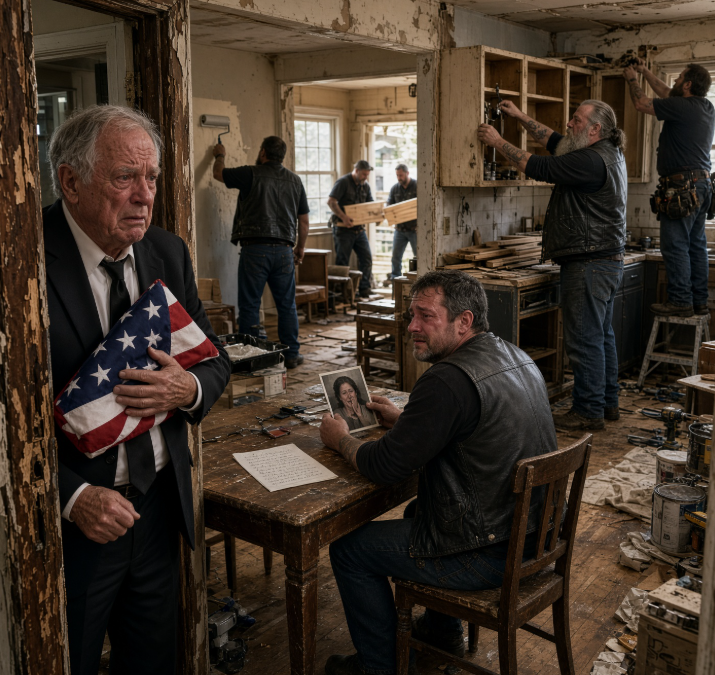
Then he removed a phone from his pocket, opened the screen, and placed it on the table.
The call history showed Sarah’s number.
There were seventeen calls.
I stared at them.
The first was dated three months earlier.
At that time, Sarah had already begun losing weight. We knew she was ill, but the doctor had not yet used the words stage four.
“She told me she had cancer,” Matthew said. “She asked me not to contact you yet.”
“Why?”
“Because she knew we’d make it about the old fight. She was trying to get me to understand what you would need after she was gone.”
“She was still alive. What I needed was my wife.”
“I know.”
“Did you see her?”
Matthew lowered his eyes.
“Three times.”
I took one step backward.
“You came to Springfield?”
“Yes.”
“And you didn’t come here?”
“She was in treatment. She met me at the clinic the first time. The other two times I went to hospice while you were home showering.”
Something inside me split.
For six days, I had been telling myself there were no more secrets between Sarah and me.
Now I discovered my wife had spent her final months rebuilding a relationship with our son while keeping me outside it.
“Get out.”
Matthew looked up.
“Dad—”
“Get out of my house.”
Gravel moved closer but did not touch me.
Matthew remained beside the table.
“If you want me gone after you read her letter, I’ll leave.”
“I don’t need another secret letter from my dead wife.”
“She wrote it to you.”
“I said get out.”
Matthew’s mouth tightened.
For a second, I saw the twenty-eight-year-old man who had stood in that kitchen and shouted that he no longer needed a father.
Then the anger left his face.
“I promised her I wouldn’t run this time.”
The sentence stopped me.
He reached inside his vest and removed a white envelope.
My name was written across the front in Sarah’s handwriting.
Robert.
No last name.
No decoration.
Just the name she used when she needed me to listen.
Gravel took the envelope from Matthew and offered it to me.
I did not reach for it.
“What did she tell you to do?” I asked.
Matthew looked around the damaged kitchen.
“This.”
I laughed once.
It was a terrible sound.
“She told you to break into my house?”
“She gave me the key.”
“The door was ripped off.”
“The key broke inside the lock. The frame was rotted, and the whole thing came apart when we tried to remove the cylinder.”
“So you decided to destroy the rest of the place?”
“We’re repairing it.”
“I didn’t ask you to.”
“Mom did.”
“She didn’t own this house alone.”
“No. But she knew you wouldn’t let anyone help after she died.”
That was true, which made it harder to hear.
Matthew pointed toward the envelope.
“Read it.”
I finally took it.
The paper smelled faintly like the lavender hand cream Sarah kept beside her bed.
My fingers would not open the flap.
Gravel gestured toward the living room.
“Give us five minutes outside.”
The bikers put down their tools. One by one, they left through the broken doorway. Even the men on the roof climbed down.
Matthew remained.
“You too,” I said.
He nodded and followed them.
I stood alone in the kitchen.
Not entirely alone.
Sarah’s coffee mug rested near the sink because I had not been able to move it. Her grocery list remained attached to the refrigerator. A cardigan hung across the back of her chair.
I sat where Matthew had been and opened the envelope.
Robert,
If you are reading this, then one of two things has happened. Either my plan worked, or you frightened fifteen grown bikers so badly they made Matthew deliver this from the sidewalk.
I almost laughed.
Almost.
The letter continued.
I know you are angry. You are probably angry with me, with Matthew, with the men in our house, with the doctors, with God, and with every fool who says I am “in a better place” when the place you want me is beside you.
Be angry.
But read to the end before you throw anyone out.
You spent thirty-two years fixing everything for us. You fixed furnaces, cars, leaking pipes, broken lamps, scraped knees, frightened nights, and every mistake I was too proud to admit making.
Now there are things you cannot fix by yourself.
The roof leaks.
The porch is unsafe.
The bathroom floor is soft near the tub.
Three kitchen cabinets are pulling away from the wall.
The back door frame is rotten.
The furnace needs inspection.
Most important, my husband’s heart is breaking, and stubbornness has never been a proper repair tool.
Matthew promised to come.
His brothers promised to help.
Let them.
I stopped reading.
The kitchen blurred.
I placed the letter on the table and covered my face.
For six months, Sarah had been dying in a house that was failing around her.
I had known about the roof.
I placed buckets beneath the leaks.
I knew the porch boards flexed.
I stepped around them.
I knew the bathroom floor felt soft.
I told myself I would repair it after Sarah’s next appointment, then after the next scan, then after the next round of medication.
There was always something more urgent.
Then Sarah became the only urgent thing.
I picked up the letter again.
You will tell them you do not need help.
That is a lie.
You will tell them the house is good enough.
That is another lie.
You will say Matthew chose to leave.
That is only half the truth, and half the truth has cost this family eleven years.
Our son was angry.
So were you.
You were frightened, and fear made you cruel.
He was hurt, and hurt made him leave.
Neither of you knew how to turn around without believing it meant the other man had won.
There is no victory in an empty chair.
There is only an empty chair.
I looked at Sarah’s place at the table.
Her cardigan still hung across it.
The final page contained a list.
Replace the kitchen cabinets, but preserve the narrow door beside the pantry because Matthew’s height marks are inside it.
Paint the living room blue, not gray. Robert will say gray. Ignore him.
Repair the porch.
Seal the roof.
Replace the bathroom floor.
Inspect the furnace.
Do not remove the blue tile behind the stove, even though it is ugly. We bought it on our first anniversary, and Robert pretends to hate it.
Leave the kitchen table exactly where it is.
At the bottom, Sarah’s handwriting became less steady.
Give him a reason to keep living in this house.
Make it feel like a home instead of a grave.
And make sure my husband understands how loved he is.
The paper slipped from my hand.
I tried to stand.
My knees failed.
The chair struck the wall, and I went toward the floor.
The back door opened.
Matthew reached me before I hit the tile.
His arms closed beneath mine, and he lowered both of us until we sat on the floor beside the table.
For the first time in eleven years, I held my son.
“I’m sorry,” I said.
The words came before pride could stop them.
“I’m sorry I failed you.”
Matthew held on tighter.
“No, Dad.”
“I told you that you weren’t my son.”
“We were both angry.”
“A father doesn’t say that.”
“A son doesn’t disappear for eleven years.”
“You came home and told me you were joining a motorcycle club. I looked at the leather and thought I knew what it meant.”
“I should’ve explained.”
“You tried.”
He leaned back enough to look at me.
“I called you a hypocrite.”
“You were right.”
Matthew shook his head.
“Not entirely.”
“I rode when I was your age. I trusted men on motorcycles with my life. Then you put on a vest, and I called you trash.”
“You were scared.”
“That isn’t an excuse.”
“No.”
His refusal to comfort me with a lie hurt, but it also made the moment honest.
The fight had happened on a cold November evening eleven years earlier.
Matthew arrived for dinner wearing a new leather vest with an Iron Lanterns prospect patch on the back. I knew nothing about the club.
I saw only the symbols.
The motorcycles.
The memory of my old friend Eddie Grant dying on a wet highway when we were twenty-three.
The bar fights from my own riding years.
The night Sarah made me promise I would stop racing.
Fear rushed into my mouth before love could slow it down.
“No son of mine is going to throw his future away with a gang,” I told Matthew.
He was already a mechanical engineer, engaged to Jessica, and more responsible at twenty-eight than I had been at forty.
He tried to explain that the Lanterns ran toy drives, helped veterans, and maintained vehicles for families who could not afford repairs.
I did not listen.
“The man I raised is better than this.”
Matthew went still.
“Better than men you haven’t met?”
“Better than pretending leather makes you a man.”
His face changed.
“I joined because of you.”
I laughed at him.
That was the part I remembered most clearly.
Matthew unfastened the prospect vest and dropped it on the kitchen table.
“You spent my whole childhood telling me about the men you rode with. How they stopped traffic when Grandma’s funeral procession crossed town. How they rebuilt Uncle Pete’s barn after the tornado. How one phone call brought six bikes when our car died in Arkansas.”
“That was different.”
“Why?”
“Because I knew those men.”
“You don’t know mine.”
“I know what clubs become.”
“And I know what fear has turned you into.”
Sarah stood between us, begging us to stop.
Matthew pointed at the vest.
“You taught me brotherhood mattered. I found it, and now you’re ashamed of me.”
“I’m ashamed you need strangers to make you feel important.”
The sentence landed.
Matthew’s eyes filled, but his voice became quiet.
“If that’s what you think of me, then you don’t have to call me your son.”
I answered with the worst thing I ever said.
“Maybe I won’t.”
Matthew walked out.
Sarah followed him to the driveway, but he did not return.
I expected an apology by Christmas.
Matthew expected one from me.
Christmas became Easter.
Easter became another birthday.
Pride transformed months into years.
Sarah sent cards.
Some came back unopened.
Matthew called twice during the first year, but I answered neither time. I told myself he could leave a message if it mattered.
He did not.
By the third year, silence had become part of the house.
By the fifth, discussing him hurt too much.
By the eleventh, I had convinced myself my son no longer cared whether I lived.
Sarah knew that was not true.
Matthew sat beside me on the kitchen floor.
“Mom told me things,” he said.
“What things?”
“About you.”
“You knew me for twenty-eight years.”
“Not all of it.”
He reached for the table and used it to pull himself upright. Then he helped me into a chair.
“She told me you worked two jobs while I was in college.”
I looked away.
“She wasn’t supposed to tell you.”
“Why?”
“You had enough pressure.”
“You sold the Ford.”
“It was an old truck.”
“It was Grandpa’s truck.”
“You needed tuition.”
“I had a scholarship.”
“For part of it.”
Matthew took a breath.
“She told me you passed up the plant supervisor promotion because they wanted us to move to Kansas City.”
“You had two years left at Central High.”
“You gave up twenty years of better pay so I wouldn’t have to change schools?”
“It wasn’t twenty years.”
“You never applied again.”
“I liked electrical work.”
“You complained about your knees every night.”
“That’s what knees are for.”
Matthew laughed through tears.
It was the first laugh we shared in eleven years.
He sat across from me.
“Mom told me you slept in the hospital parking lot when I had pneumonia because the family lounge was full and you didn’t want to leave the property.”
“You were seven.”
“I don’t remember.”
“You weren’t supposed to.”
“Why did you hide every good thing you did?”
“I didn’t do it for credit.”
“You could have told me when I started believing you didn’t care.”
I looked at him.
“You could have come home.”
“I know.”
Neither of us escaped responsibility.
That was Sarah’s final gift.
She had not built a story where one of us was the villain and the other was innocent. She gave us the entire ugly history and refused to let either man hide inside the half that felt safest.
The bikers waited outside for nearly twenty minutes.
When Gravel finally knocked on the open frame, Matthew and I were still sitting across from each other.
“Mr. Patterson?”
I wiped my face.
“Robert.”
He nodded.
“Robert. Do you want us to leave?”
I looked at the new cabinets waiting to be mounted.
“What happened to the old pantry door?”
Gravel pointed toward the living room.
A biker had placed it carefully against the wall.
Pencil marks climbed the inside panel.
Matthew—age six.
Matthew—eight years, four months.
Matt—eleven.
One final line marked his height at seventeen.
Beside it, Sarah had written, Taller than his father, but don’t tell Robert.
I touched the wood.
“Can you put this back?”
Gravel rubbed his beard.
“The frame is too warped.”
“Then the deal’s off.”
A thin biker with glasses stepped forward.
His patch read DOC, though I later learned he was a high-school shop teacher, not a physician.
“We can turn the panel into the inside face of the new door,” he said. “Same marks. Same place.”
“Sarah said preserve it.”
“We will.”
I looked around the room.
“You already painted half my wall blue.”
Gravel nodded gravely.
“Direct orders.”
“I would have chosen gray.”
“We were warned.”
I read Sarah’s letter again.
Then I stepped away from the doorway.
“Finish what she asked.”
The house erupted back into motion.
The circular saw started outside. Rollers moved across the walls. Someone on the roof shouted for more flashing.
The sound should have felt intrusive.
Instead, it pushed against the silence that had been suffocating the house for months.
Joan returned my folded flag.
“What is happening?” she whispered.
“My wife.”
Joan looked toward the bikers.
“Your wife hired them?”
“She recruited our son.”
“I didn’t know you had a son.”
That sentence cut deeper than she intended.
“I do.”
One of the officers approached. His name was Sergeant Lewis, and he had responded to Joan’s second call.
“We verified the letter and materials receipts,” he said. “Your son also has an email from your wife’s attorney explaining the project.”
“He had permission?”
“Your wife signed an authorization while she was alive. Whether that still grants legal access is complicated, but if you want them removed, we’ll remove them.”
I looked at Matthew carrying a cabinet through the kitchen.
“No.”
Sergeant Lewis nodded.
“Your neighbor thought they were burglarizing the place.”
“So did I.”
“I’ve seen worse burglaries.”
He returned to his cruiser.
For the rest of that afternoon, fifteen men transformed my house.
They did not work quietly.
They argued about measurements, insulted one another’s tool choices, and used language Sarah would have pretended to dislike.
Every hour, one of them placed food in front of me.
The first was a turkey sandwich.
“I’m not hungry,” I said.
The biker’s patch read TOMMY.
He sat across from me.
“That wasn’t a question.”
“You always order grieving widowers around?”
“When necessary.”
“I buried my wife this morning.”
“I know.”
His voice softened.
“I buried mine eight years ago.”
That changed the air between us.
Tommy was fifty-eight, with red in his beard and a wedding band hanging from a leather cord around his neck.
“Cancer?” I asked.
“Car accident.”
“I’m sorry.”
“So am I.”
He pushed the sandwich closer.
“The first week after Linda died, I ate crackers because opening a can felt like a decision. The second week, I stopped doing that much. Gravel came over, opened my refrigerator, and found nothing but mustard and beer.”
“What did he do?”
“Threw away the beer, filled the refrigerator, and slept on my couch for six nights.”
“You let him?”
“No. He ignored me.”
I looked toward Gravel, who was rebuilding the door frame.
Tommy lowered his voice.
“That hollow feeling in your chest? I know it. Difference is, you’ve got a crew now. Nobody here is going to watch you disappear.”
I ate half the sandwich.
Tommy waited until I finished the other half.
The club worked until nearly midnight.
Matthew stayed after everyone else left.
He slept on our couch beneath the quilt Sarah made during our first winter in the house.
I remained awake in the bedroom.
Her side of the bed was still smooth.
Her reading glasses rested on the nightstand. A water glass stood beside them, half full from the final morning before we took her to hospice.
I could not pour it out.
Around two, I heard Matthew moving in the kitchen.
I found him sitting at the table with Sarah’s cardigan in his hands.
“I should have come sooner,” he said.
I leaned against the doorway.
“So should I.”
“She asked me to visit you before she died.”
That surprised me.
“What stopped you?”
“Cowardice.”
“You drove across the state to see a dying woman. That isn’t cowardice.”
“I sat outside this house twice.”
I stared at him.
“The first time was after her second treatment. I parked around the corner for almost an hour.”
“Why didn’t you knock?”
“I saw you through the front window.”
“What was I doing?”
“Helping her into the chair. You wrapped a blanket around her, then knelt to put socks on her feet.”
His voice broke.
“I thought there wasn’t room for me inside that moment.”
“There was.”
“I know that now.”
“What about the second time?”
“The night before she went to hospice.”
I remembered that night.
Sarah could no longer climb the stairs. I moved a hospital bed into the living room. Rain struck the windows until morning.
“I was across the street,” Matthew said. “I saw you sitting beside her.”
“You should have come in.”
“You would have let me?”
I wanted to say yes.
The honest answer took longer.
“I don’t know.”
Matthew nodded.
“That’s why I stayed in the car.”
I sat across from him.
“Did your mother forgive you?”
“She said it wasn’t her forgiveness I was scared to ask for.”
“That sounds like Sarah.”
“She also called us two jackasses with the emotional range of fence posts.”
“That sounds even more like her.”
Matthew smiled.
Then silence returned.
Not the old hostile silence.
A tired one.
“What did you talk about?” I asked.
“Everything.”
He told me about his wife, Jessica.
They had married nine years earlier.
Sarah knew.
She had found wedding photographs online and saved them in a folder on her laptop.
Matthew told her about their son, Luke, who was seven, and their daughter, Grace, who was five.
Sarah had seen photographs of them too.
My grandchildren.
Children whose birthdays had occurred without me.
I felt grief fold over grief.
“Did she talk to them?”
“Once. Video call.”
I closed my eyes.
“She never told me.”
“She wanted to.”
“Why didn’t she?”
“Because she knew hearing their voices would destroy you before there was any guarantee I’d walk through the door.”
“That was not her decision to make.”
“No.”
His agreement startled me.
“You’re angry with her?” I asked.
“I love her. I’m also furious she waited until she was dying.”
Those feelings could live together.
I had not understood that before.
Matthew turned the cardigan over in his hands.
“She made me promise that if you threw me out, I’d come back the next day.”
“I almost did.”
“She said you would.”
“What else did she predict?”
“That you’d object to the blue paint.”
“She knew me.”
“She said to bring groceries because you’d live on coffee and toast.”
“I can cook.”
“She said you would claim that.”
“What did she say about the back door?”
“That you’d complain about the workmanship even while it was lying on the porch.”
I looked at the temporary plywood covering the opening.
“The framing cut is two degrees off.”
Matthew laughed.
This time, I joined him.
It felt wrong to laugh so soon after burying Sarah.
Then I remembered how much she hated people whispering around illness.
At hospice, when a volunteer spoke to her in a slow, solemn voice, Sarah waited until the woman left and said, “If she talks any softer, I’m going to die from boredom.”
Sarah would not have wanted our house to become a shrine to silence.
On the second morning, twelve motorcycles arrived at seven.
The others came by truck with lumber and tools.
Matthew introduced me properly.
Gravel owned a welding business.
Doc taught shop.
Tommy was a retired mail carrier.
A rider called Finch installed kitchen cabinets for a living. Another called Moose worked as a paramedic. Two were veterans. One managed a hardware store. The youngest, Coyote, was twenty-six and spent most of the morning terrified he would scratch Sarah’s blue tile.
They were not the men I imagined when I saw Matthew’s vest eleven years earlier.
They were also not saints.
They cursed.
They argued.
Gravel had served time for assault when he was young. Tommy had two divorces before Linda. Mack—whose real name was Arthur—had not spoken to his own brother in six years.
Brotherhood did not make them perfect.
It gave them people who demanded they keep showing up.
Near noon, Finch removed the cabinet above the refrigerator and found an envelope taped behind it.
ROBERT’S EMERGENCY MONEY, Sarah had written.
Inside were thirty-two hundred-dollar bills.
I stared at the cash.
Matthew read a note attached to it.
This pays three months of utilities, groceries, and whatever Robert insists is unnecessary.
He handed it to me.
“I didn’t know about this.”
“Neither did I.”
Sarah had quietly saved money from the household budget during her final year.
I felt a flash of anger.
We could have used that money during treatment.
Then I understood.
Sarah knew I would spend every dollar trying to keep her alive. She also knew there would be a morning after the funeral when I would not care whether the electric bill was paid.
She had planned for the version of me who no longer believed he had a future.
The club president put the money back inside the envelope.
“Your wife also prepaid the material deposit,” Gravel said.
“How?”
“She sold jewelry.”
My head snapped toward him.
“What jewelry?”
Matthew looked uncomfortable.
“Her mother’s bracelet and two rings.”
“She loved those.”
“She loved you more.”
I sat down.
Sarah had arranged the renovation with Matthew and Gravel through telephone calls from hospice. She mailed measurements, photographs, and a handwritten list of priorities.
When she became too weak to speak, she sent text messages one word at a time.
ROOF FIRST.
PRESERVE DOOR.
BLUE PAINT.
FEED ROBERT.
Her final message to Gravel arrived two days before she died.
DO NOT LET THEM QUIT ON EACH OTHER.
He showed me the screen.
I touched the words.
“I didn’t know she knew your number.”
Gravel put the phone away.
“She called the clubhouse first. Told whoever answered that she needed fifteen stubborn men and didn’t have time to explain twice.”
“Who answered?”
“Coyote.”
Across the kitchen, the young rider raised one hand.
“She scared me, sir.”
“That sounds right.”
“Your wife asked whether we were the kind of club that only talked about brotherhood or the kind that used it.”
“What did you say?”
Coyote smiled.
“I told her I’d find Gravel.”
Sarah had challenged fifteen bikers from a hospice bed.
They came.
That afternoon, the front porch revealed more damage than expected. Two support posts had rotted below the surface, and one joist had pulled from the house.
Gravel estimated another two days.
“You don’t have to finish everything,” I said.
Matthew looked at me.
“Mom’s list says complete rebuild.”
“I’m not letting these men spend an entire week here.”
Tommy emerged from beneath the porch.
“Good news. Nobody asked.”
I started to argue.
Then I heard children shouting in the driveway.
A silver minivan stopped behind the motorcycles.
The side door opened.
A boy with Matthew’s dark hair jumped out, followed by a smaller girl wearing purple rain boots despite the clear sky.
They ran toward the house.
“Grandpa!”
I froze.
They had never met me.
Still, they shouted the word as if they had used it every day.
The little girl reached me first and wrapped both arms around my legs.
The boy stopped with more caution.
“Are you really Grandpa Robert?”
I looked at Matthew.
He wiped his eyes.
“This is Luke. That’s Grace.”
I lowered myself until I was level with them.
“I’m really him.”
Grace studied my face.
“You look older than your picture.”
“Grace,” Matthew said.
“What? He does.”
I laughed.
Luke held out his hand with grave seven-year-old seriousness.
“Dad says you know how to fix anything.”
“Your father exaggerates.”
Matthew shook his head.
“He does not.”
A woman stepped from the minivan.
Jessica was tall, with warm brown eyes and nervous hands. She approached slowly, as if uncertain whether she had the right to enter.
“Mr. Patterson.”
“Robert.”
She hugged me.
The force of it nearly cracked a rib.
“We should have come years ago,” she whispered. “I’m sorry.”
“So am I.”
Grace pulled on my sleeve.
“Grandma Sarah said you make pancakes shaped like dinosaurs.”
My heart stopped.
“You spoke to her?”
Grace nodded.
“On the phone. She said you make the tails too big.”
“She complained about those tails for thirty years.”
“Can you make them tomorrow?”
I looked toward Sarah’s kitchen.
Half the cabinets were missing. Tools covered the counters. The stove had been disconnected.
“Maybe when the kitchen works.”
Finch called from the hallway.
“Stove will be back by six.”
“Then tomorrow,” I told Grace.
Her smile nearly broke me.
Matthew had shown his children my photograph.
He told them stories about me.
They knew I once built a treehouse that leaned but never fell. They knew I taught Matthew to ride a bicycle in an empty church parking lot. They knew I made dinosaur pancakes, hated mushrooms, and sang badly when fixing electrical panels.
For eleven years, my son had kept me alive inside the stories he told his children.
He had been angry.
He had not stopped loving me.
That evening, we ate pizza on the unfinished porch.
Fifteen bikers, my son, his wife, two grandchildren, and me sat on construction lumber beneath temporary work lights.
The house looked wounded.
The new blue walls glowed through the windows.
Grace sat beside me and picked pepperoni from her slice. Luke asked Gravel whether his scar came from a knife fight.
“No,” Gravel said.
Luke leaned closer.
“What happened?”
“Goose.”
“A goose did that?”
“Mean goose.”
Luke looked disappointed.
Gravel lowered his voice.
“Don’t underestimate geese.”
For the first time since Sarah’s diagnosis, the porch filled with ordinary conversation that had nothing to do with medication, pain, insurance, or death.
I watched Matthew with his children.
He cut Grace’s pizza into smaller pieces without being asked. He listened while Luke described a school project. He kept one hand on Jessica’s shoulder whenever he passed behind her chair.
My son had become a good man without me there to witness it.
Pride and regret rose together.
After the children left with Jessica, Matthew remained on the porch.
“You’re a better father than I was,” I said.
He looked toward the street.
“I learned from you.”
“You learned what not to do.”
“That too.”
“Did joining the Lanterns cost you your engineering job?”
“No.”
“I said it would.”
“I know.”
“Did you end up in jail?”
“Only once.”
I turned toward him.
He smiled.
“Parking ticket dispute. Three hours.”
“That isn’t funny.”
“It is now.”
I looked at the club members clearing pizza boxes.
“Why did you join?”
Matthew rested his forearms on his knees.
“Because of you.”
“You said that the night we fought.”
“You laughed.”
“I remember.”
“When I was a kid, your stories about riding were the only time you sounded young. You’d talk about waking before sunrise, crossing three states, sleeping beside the road, and trusting the man behind you with your life.”
“Things were different then.”
“No, Dad. You were different then.”
He pointed toward the motorcycles.
“I wanted a piece of the man you were before bills and shifts and responsibility wore him down.”
“You could have bought a bike without joining a club.”
“I did. It felt empty.”
“So you needed patches?”
“I needed people.”
That answer silenced me.
Matthew continued.
“The Lanterns helped one of my coworkers after his house burned. They showed up before the insurance adjuster. They found his family a rental, replaced his kids’ clothes, and rebuilt his work truck.”
“So you joined.”
“I spent a year around them first. They didn’t recruit me. They made sure I understood what the vest cost.”
“What does it cost?”
“Time. Accountability. Showing up when you’re tired. Letting other men see when you’re failing.”
I looked at Gravel.
“That sounds unpleasant.”
“It is.”
Matthew smiled.
“It also saved me.”
“From what?”
“From becoming you.”
The words could have started another eleven-year silence.
This time, I waited.
“What do you mean?”
“After our fight, I wanted to stay angry forever. Anger made me feel like I didn’t miss you. Gravel kept telling me pride was grief wearing work boots.”
“He said that?”
“Tommy did. Gravel said I was being an idiot.”
“That sounds more believable.”
“The club pushed me to send cards. I sent three.”
“I never saw them.”
“Mom returned the first two.”
That surprised me.
“She did?”
“She wrote that you weren’t ready.”
Anger flashed again.
“Sarah made too many decisions for both of us.”
“Yes.”
“Did she return the third?”
“No. It came back with your handwriting.”
I remembered.
A plain envelope arrived seven years earlier. The return address was Kansas City, but the name had been smudged by rain.
I recognized Matthew’s handwriting.
I marked it RETURN TO SENDER before opening it.
“I sent it back,” I whispered.
“I know.”
“I thought you wanted money.”
Matthew stared at me.
“Why?”
“Because that was easier than believing you might want me.”
He nodded slowly.
“At least we finally found something we agree on.”
I looked toward the unfinished porch.
“Your mother should have told me.”
“I should have knocked.”
“I should have opened the letter.”
We could have spent the night assigning percentages of blame.
Instead, Matthew held out his hand.
“Second chance?”
I gripped it.
“Second chance.”
The following morning, Grace and Luke arrived before seven.
I made dinosaur pancakes on the newly connected stove while Finch installed cabinet doors around me.
Grace was right.
The tails were too large.
Sarah always trimmed them before placing the pancakes on Matthew’s plate. I had forgotten that until my granddaughter reached for the knife and said, “Grandma told me the trick.”
She cut the tail.
For one impossible second, Sarah’s hand seemed to move through hers.
I turned toward the sink so the children would not see me cry.
Luke noticed anyway.
“Are you sad?”
“Yes.”
“Because Grandma died?”
“Yes.”
He considered that.
“Dad says being sad means you still have love with nowhere to put it.”
I looked at Matthew.
He stood in the doorway holding a box of cabinet hinges.
“That from the Lanterns?” I asked.
“Tommy.”
“Of course.”
Luke covered his pancake with too much syrup.
“You can put some love on us.”
Children can say things adults spend years trying to understand.
I sat between my grandchildren and ate breakfast.
By the third day, the house had changed.
The living-room walls were blue, but the club left one small patch of the original brown behind the bookcase because Sarah had marked it on her list.
The roof no longer leaked.
The porch stood level.
The bathroom floor was solid, and the cracked vanity had been replaced.
The pantry door returned with Matthew’s height marks fitted into the new frame.
Finch preserved the blue tile behind the stove.
The new back door closed without lifting it by the handle, something I had been doing for six years.
The men also repaired things Sarah had not listed.
A loose railing.
A broken attic vent.
Two dead outlets.
The garage light that flickered whenever the washing machine ran.
They found my old motorcycle beneath a tarp behind the workbench.
It was a 1981 Honda Gold Wing, dusty, rusted, and silent for fifteen years.
Matthew stood beside it.
“You still have it.”
“Never got around to selling.”
“That why the tires are blocked off the concrete and the cylinders are oiled?”
“I said I didn’t sell it.”
“You maintained it.”
“Some habits stay.”
He wiped dust from the tank.
“Think it’ll run?”
“No.”
“Want to find out?”
“Not today.”
Matthew nodded.
He did not push.
That restraint showed me how much he had changed.
The younger version of him would have turned the question into a challenge. The younger version of me would have heard refusal as rejection.
Now “not today” meant only that.
Not today.
On the fourth morning, the club completed the final porch rail.
Gravel walked me through every repair and handed me a binder containing warranties, receipts, paint codes, plumbing diagrams, and the contact information of every rider who worked on the project.
“No charge,” he said.
“I can’t accept that.”
“You already did.”
“I’ll repay the materials.”
“Sarah covered the deposit. The club covered the rest.”
“That could be thousands.”
“It was.”
“I’m not a charity case.”
Gravel’s expression hardened.
“Neither is Tommy when we change his roof. Neither is Doc when we rebuild his transmission. Neither is Matthew when we stand beside him at a funeral.”
“That is different.”
“Why?”
I did not have an answer.
Gravel placed the binder in my hands.
“Brotherhood isn’t a loan.”
“I’m not your brother.”
“No.”
He glanced toward Matthew.
“But he is.”
That was the price.
Accepting their work meant accepting that my son belonged to them too.
Eleven years earlier, that idea frightened me.
Now I understood they had protected the part of him I abandoned.
I offered Gravel my hand.
He ignored it and pulled me into an embrace.
The other riders waited beside their motorcycles.
Each stopped before leaving.
Doc gave me his number in case the pantry door shifted.
Finch told me not to overload the new cabinet shelves.
Coyote apologized three times for a nearly invisible scratch in the floor.
Tommy placed frozen meals inside the refrigerator and made me promise to eat one every evening.
Mack handed me a small black phone.
“One button calls Matthew,” he said. “Second calls Gravel. Third calls me.”
“I already have a phone.”
“Your phone was made during the Reagan administration.”
“It works.”
“Humor us.”
The final rider was a quiet man called Bear, who had spent three days repairing the roof.
He gripped my shoulder.
“Anything goes wrong, you call.”
“Roof problems?”
“Anything.”
They started the motorcycles.
The sound rolled through the neighborhood.
Joan stood across the street watching them leave.
“I’m sorry I called the police,” she said.
“You saw strangers breaking down my door.”
“They fixed my loose gutter while they were here.”
“That sounds like them.”
Once the engines faded, Matthew and I carried coffee onto the new porch.
Morning light came through the maple branches.
We sat in the same positions we had used when he was young—me near the rail, him on the steps.
For eleven years, I had remembered only our final fight.
Now earlier memories returned.
Matthew asleep against my shoulder during a thunderstorm.
Matthew running beside my motorcycle pretending to ride.
Matthew at sixteen, handing me a wrench before I asked.
“I patched in because of you,” he said.
“I know.”
“No. I need you to hear the whole thing.”
I waited.
“I didn’t join to spite you. I wanted to understand why riding mattered so much to you. The open road. The men who showed up without needing explanations. The feeling that someone behind you would stop if you went down.”
“And did you?”
“Yes.”
He looked toward the empty driveway.
“I also learned the road wasn’t the important part.”
“What was?”
“Stopping.”
The word stayed between us.
Sarah had understood it before either of us.
Brotherhood was not proven by how far men rode together.
It was proven by who stopped, turned around, and came back.
Matthew lifted his coffee.
“Mom said if we stayed at war after she died, she’d come back and haunt us.”
“She would have.”
“She said she’d start by moving your tools.”
“That woman knew how to make a threat.”
I laughed.
It was the first honest laugh since her death.
For the next several weeks, grief came in waves.
Some mornings I could eat breakfast, answer calls, and work in the yard.
Other mornings I remained in bed because reaching Sarah’s empty side still surprised me.
Matthew called every day.
He did not ask whether I was okay because we both knew the answer.
Instead, he asked specific questions.
“Did you eat?”
“Did you take your blood-pressure pill?”
“Did you open the curtains?”
“Did you walk to the mailbox?”
On Saturdays, Jessica brought the children.
Grace filled the blue living room with dolls and colored pencils. Luke followed me into the garage and asked the purpose of every tool.
The Lanterns stopped by without warning.
Tommy brought soup.
Doc inspected the furnace.
Coyote replaced the porch light with one bright enough to guide an airplane.
Gravel rarely entered. He would park at the curb, look toward the windows, and wait until I waved.
They did not allow me to vanish.
Two months after the funeral, I found a second letter inside Sarah’s sewing box.
This one was addressed to Matthew and me.
If the two of you are reading this together, I won.
Matthew laughed when I read that line aloud.
The letter asked us to do three things.
Visit her grave together.
Repair the old Gold Wing.
Organize a memorial ride benefiting the hospice that cared for her.
Matthew looked toward the garage.
“Mom planned past the kitchen.”
“She planned past the grave.”
We began working on the motorcycle the following weekend.
The engine was seized. The fuel lines had hardened. Mice had destroyed part of the wiring harness.
For the first time in decades, my hands shook when I touched the handlebars.
Sarah used to ride behind me before Matthew was born. She wore a red helmet and tapped my shoulder whenever I exceeded the speed limit.
After Eddie died, she asked me to stop racing but never demanded I give up motorcycles.
I did that gradually.
Work.
Bills.
Parenthood.
Fear.
The Gold Wing disappeared beneath a tarp while I told stories about the man I used to be.
Matthew listened to those stories closely enough to spend his life searching for him.
The Lanterns helped us rebuild the bike.
They never took over.
Matthew and I cleaned the carburetors, replaced the wiring, rebuilt the brakes, and argued about the fuel pump.
Our arguments changed.
We no longer treated disagreement as a threat to the relationship.
When Matthew insisted on modern brake lines, I told him original parts mattered.
He said, “I’d rather have a living father than an authentic motorcycle.”
I installed the new lines.
Three months after Sarah’s funeral, the Gold Wing started.
The engine coughed twice, blew dust from the exhaust, then settled into a rough idle.
Matthew stood beside me.
Neither of us spoke.
I touched the empty portion of the seat where Sarah used to sit.
“We did it, baby,” I whispered.
Matthew looked away to give me privacy.
That kindness mattered.
The memorial ride took place six months after her death.
Three hundred motorcycles gathered outside the Ozarks Family Center. Most riders had never met Sarah.
They knew the story.
A dying woman contacted her estranged son, recruited his motorcycle club, and refused to let grief finish destroying her family.
The ride raised more than forty thousand dollars for hospice care and home-repair assistance for widowed seniors.
The Iron Lanterns made me a leather vest.
It carried no member patch because I had not earned one.
Across the front was a small stitched name.
ROBERT.
Beneath it were two words.
SARAH’S RIDER.
I wore it.
Matthew rode beside me on his black Harley. Jessica followed in a support vehicle with Luke and Grace.
At the cemetery, the motorcycles shut down one at a time.
Silence spread across the grass.
Matthew and I walked to Sarah’s grave.
I sat beside the stone and placed my hand against her name.
“Thanks, Mom,” Matthew said. “For refusing to quit on us.”
The granite was cold beneath my palm.
I closed my eyes.
For a moment, I could feel Sarah’s iron will inside everything around me.
The repaired motorcycle.
My son’s shoulder beside mine.
The grandchildren waiting near the road.
The men standing quietly behind us.
“Thank you, baby,” I whispered. “For sending them through my door.”
Matthew lowered his head.
“For making us repair what we wrecked,” I added.
The wind moved through the cemetery trees.
I imagined Sarah answering the way she always did when I finally admitted she had been right.
Took you long enough.
A year has passed now.
Every Saturday, Luke and Grace run through the back door the bikers replaced. Grace’s purple boots leave mud on the kitchen floor. Luke’s height mark has joined his father’s on the preserved pantry panel.
Matthew calls every morning.
The Lanterns still stop by.
Tommy and I attend the same grief-support group, though we sit in the back and complain about the coffee.
Jessica brings more food than one widower could eat in a week.
Alone is something I sometimes feel.
It is no longer something I am.
The house still carries Sarah everywhere.
Her cardigan remains on the chair.
Her blue tile remains behind the stove.
Her mug sits near the sink, though I finally washed it.
The walls are the color she chose.
The roof no longer leaks.
The porch no longer bends beneath my weight.
The house did not become a grave.
It became a place where her love kept moving after she could not.
People still tell the story as though fifteen bikers broke into my home during my wife’s funeral.
That is technically true.
They forced open a rotten door.
They tore apart my kitchen.
They ripped boards from my porch and cut holes in my roof.
But the back door was not the real thing Sarah sent them to break.
She sent them for the wall my son and I had spent eleven years building between us.
Fifteen bikers entered my house that morning.
When they left, they handed my family back to me.








