FAKE HOA COPS DROVE ONTO MY HUNTING TRAIL—I May Be Gentle, but My Gun Is a Different Story
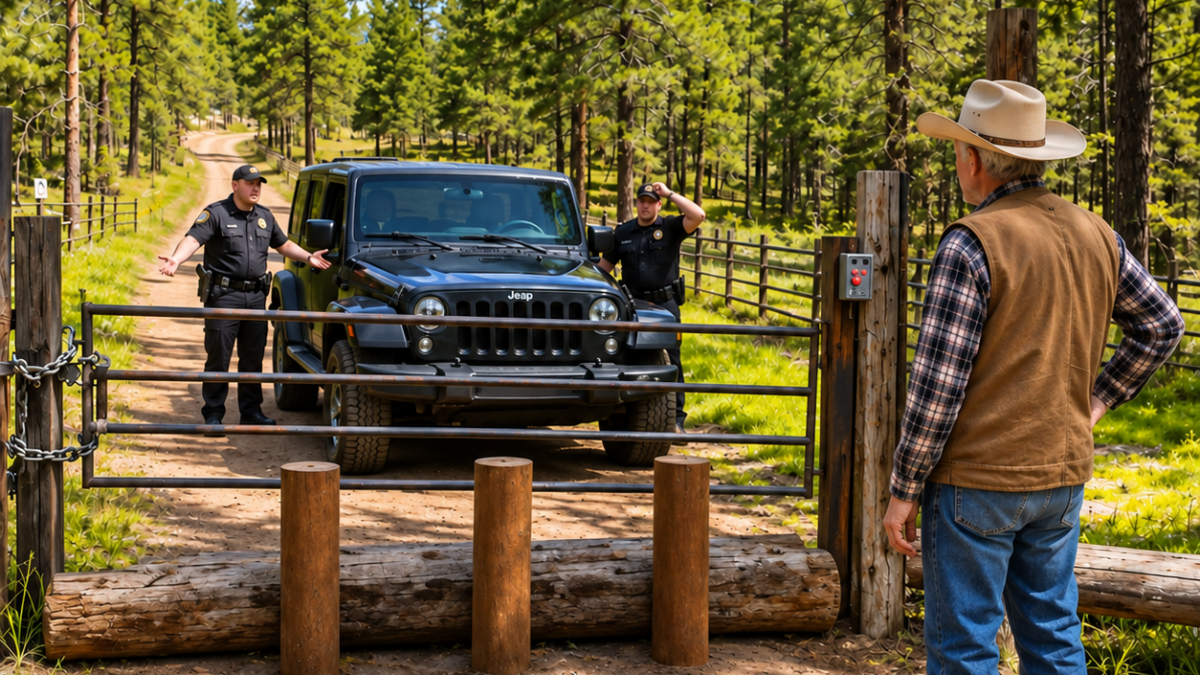
PART3:
“Can you show me a court order?”
Blake said the HOA did not need one.
“County authorization?”
No.
“Recorded easement?”
No answer.
“Written permission from me?”
Blake smiled.
“We will discuss that after the inspection.”
Grandpa nodded.
“Then inspect carefully.”
He turned and walked back toward the porch.
The men mistook his calm for surrender.
That was their first mistake.
Their second was assuming the trail had only one way out.
It didn’t.
The hunting trail formed a rough horseshoe through the north timber.
The entrance they had used came from the western boundary.
The eastern end rejoined our ranch road near an old cattle gate.
That gate had been chained shut for most of the summer because a spring washout had weakened the culvert beyond it.
Grandpa had noticed immediately which direction the Jeep was moving.
He also knew something Blake did not.
I was already coming in from the east.
Grandpa called me.
Not the sheriff.
Not yet.
Me.
I was hauling salt blocks in my pickup when the phone rang.
“Where are you?”
“East road.”
“How far?”
“Ten minutes.”
“Make it eight.”
I smiled.
“What happened?”
“We have company.”
“What kind?”
“HOA police.”
I stopped smiling.
“What?”
“Three men dressed like security guards are driving the north hunting trail.”
“Armed?”
“At least one.”
That changed everything.
“Grandpa, go inside.”
“No.”
“Grandpa.”
“I am standing on my porch.”
“Stay there.”
“I was planning to.”
“I’m calling the sheriff.”
“Already did.”
Of course he had.
Grandpa wasn’t reckless.
That was one of the things people misunderstood about him.
He owned guns.
Hunted most of his life.
Had carried a rifle in country where grizzly tracks appeared beside the creek.
But he never confused possessing a weapon with needing to display one.
His favorite phrase was:
“If a gun becomes the first argument you make, you probably ran out of good arguments.”
I came through the eastern ranch gate at 6:41.
My pickup bounced over the washboard road.
Deputy Lena Ortiz was right behind me.
She had been closer than the other units.
We stopped near the old cattle gate.
The white Jeep came around the bend thirty seconds later.
Blake was driving.
He hit the brakes when he saw us.
The Jeep stopped twenty yards away.
Nobody moved.
Lena stepped out.
Uniform.
Body camera.
Hand near—but not on—her duty weapon.
I stayed beside my truck.
Blake lowered his window.
“This is HOA enforcement activity.”
Lena looked at the Jeep.
Then at the black shirts.
“Which HOA?”
“Granite Crest.”
“You’re on Harper Ranch.”
“We have access rights.”
“Show me.”
Blake held up a laminated badge.
“I asked for access documentation.”
He lowered the badge.
Then produced a folded map.
Lena didn’t move closer.
“Place it on the hood.”
Blake stared.
“We’re authorized private enforcement.”
“Place the document on the hood.”
He finally stepped out.
The other two followed.
All three carried sidearms.
Lena immediately looked at them.
“Hands away from the weapons.”
Blake raised both hands slightly.
“We are licensed security.”
“Maybe.”
She pointed toward his holster.
“But right now you’re armed men on somebody else’s private property.”
His confidence changed.
Not vanished.
Adjusted.
He placed the map on the Jeep.
I recognized it immediately.
Granite Crest recreation plan.
Colored lines.
Proposed hiking trail.
Proposed Jeep route.
Proposed archery area.
Most of it on land they didn’t own.
Lena asked:
“Where’s the easement?”
Blake tapped a blue line.
“This is it.”
“That is a line on a drawing.”
“It reflects historical access.”
“Recording number?”
He looked at me.
Then back at her.
“I don’t have that information.”
Lena said:
“Then you’re leaving.”
Blake straightened.
“Mrs. Rowe instructed us to complete an inspection.”
“She doesn’t outrank the property owner.”
“We have a duty.”
“Not here.”
One of the younger men shifted nervously.
Lena noticed.
“So here’s what’s going to happen. Nobody reaches for anything. You get back in the Jeep. You follow Mr. Harper out. And if you have a legal claim, your attorney can address it through the county.”
Blake stared at me.
“You’re Daniel Harper?”
“Yes.”
“We’ve been instructed not to take direction from you.”
I laughed.
“Good. Take it from the deputy.”
He did.
The Jeep followed us to the eastern gate.
Grandpa waited beside the barn.
He hadn’t moved far from the house.
Good.
Blake rolled down his window when he passed.
“This isn’t finished.”
Grandpa looked toward the HOA PATROL patch.
“No.”
Then at the orange violation tags still hanging from their clipboard.
“Take your trash with you.”
They left.
Nobody fired a gun.
Nobody pointed one.
Nobody needed to.
That should have ended it.
Instead, it made Cynthia angry.
Very angry.
At 8:03 that morning, she sent an email accusing us of obstructing authorized community safety officers.
At 8:17, Granite Crest posted a notice to residents.
**HARPER RANCH TEMPORARILY BLOCKS HISTORIC COMMUNITY ACCESS ROUTE**
At 8:42, Cynthia called Grandpa.
He put her on speaker.
“You detained our patrol officers.”
“No.”
“You blocked their exit.”
“No.”
“They reported intimidation.”
“By the deputy?”
“By armed property owners.”
Grandpa looked at me.
Neither of us had been visibly armed.
There was a rifle locked in my truck rack because I had been checking cattle in bear country.
It never left the vehicle.
Grandpa said:
“Cynthia, they drove onto my ranch carrying pistols.”
“Our officers are authorized to carry for safety.”
“Good for them.”
“Your family escalated the situation.”
“They entered posted property.”
“We have an easement.”
“Send me the recording number.”
Silence.
Then:
“Our attorney will be in touch.”
“Tell him to bring the number.”
She hung up.
That afternoon, her attorney sent a six-page letter.
The tone suggested Granite Crest possessed rights from Moses.
The actual evidence was weaker.
It cited:
A 1968 county recreation map.
A 1974 Forest Service trail guide.
A 1982 hunting-club newsletter.
And a handwritten reference in an old road-maintenance log.
None created an easement.
Still, one item bothered me.
The 1968 map showed a dashed route through what later became Harper Ranch.
Grandpa stared at it.
“That trail never ran there.”
“You sure?”
He gave me a look.
“I was sixteen.”
Fair.
We hired a land attorney named Elise Warren.
Elise was forty-four, sharp, patient, and allergic to dramatic people.
She reviewed the HOA’s packet.
Then asked:
“Who made this modern map?”
“Granite Crest consultant.”
“That’s not what I mean.”
She pointed at the dashed historical route.
“Where did they get these coordinates?”
I didn’t know.
She called the county archive.
Then the state land office.
Then she found the original 1968 recreation map.
The dashed trail existed.
But it ran almost three-quarters of a mile east of our property.
Granite Crest’s version had moved it.
Not slightly.
Conveniently.
The old line followed a logging road that had disappeared when timber operations ended in the 1970s.
The HOA’s consultant had overlaid the route on modern GIS data.
Somehow the alignment had shifted directly onto our hunting trail.
Elise said:
“This is either terrible mapping or intentional.”
“Can we tell?”
“Metadata might.”
Granite Crest refused to provide the editable file.
That made Elise more interested.
Then something else happened.
A resident contacted me.
His name was Paul Garner.
Granite Crest homeowner.
Retired civil engineer.
He drove to the ranch in an old Subaru that looked completely out of place among the neighborhood’s luxury SUVs.
“I think Cynthia is lying to us.”
Grandpa said:
“Take a number.”
Paul almost laughed.
He brought a copy of the proposed recreation-expansion budget.
Granite Crest had approved:
$1.4 million.
Hiking infrastructure.
Archery facility.
Trail improvements.
Vehicle route.
Observation platform.
Emergency-response station.
The last two items were strange.
“Why does an HOA recreation project need an emergency-response station?” I asked.
Paul pointed at the budget.
“That’s what I asked.”
“And?”
“Cynthia said county emergency access was part of the project.”
“Through our ranch?”
“Yes.”
“County knows?”
“No idea.”
Elise asked:
“Anything else?”
Paul hesitated.
“There is a developer involved.”
Of course there was.
The company was North Peak Communities.
Large regional developer.
They owned 220 acres north of Harper Ranch.
Landlocked.
No practical access to the county highway.
I looked at the map.
Granite Crest sat south.
North Peak acreage sat north.
Harper Ranch between them.
Elise said:
“There it is.”
“What?”
“Your trail isn’t the recreation project.”
Grandpa leaned closer.
“The road is.”
North Peak wanted to build 143 luxury cabins and mountain homes.
One problem.
No usable route.
A western connection crossed steep federal land and required expensive environmental review.
An eastern route would require a bridge.
But if Granite Crest could establish an existing recreational corridor across Harper Ranch—
they could later argue for expansion or negotiate from a stronger position.
I asked:
“How much does access add to their land value?”
Paul answered before Elise.
“A lot.”
“How much is a lot?”
“Without access, maybe four million.”
“With approved development?”
“Twenty-five. Maybe more.”
Grandpa whistled.
“That explains the coffee station.”
Paul looked confused.
“Never mind.”
The HOA recreation plan suddenly looked very different.
A Jeep trail.
Archery range.
Hiking corridor.
Emergency station.
All built along a line connecting Granite Crest to North Peak’s land.
The community recreation story created a reason to establish regular traffic.
Then perhaps emergency access.
Then utility service.
Then a road.
Elise asked Paul:
“Does the board know?”
“Some.”
“Cynthia?”
“She negotiated directly with North Peak.”
“How do you know?”
Paul produced minutes from a closed executive session.
Cynthia had reported an “infrastructure partnership.”
Potential payment to Granite Crest:
$850,000.
For cooperation with future access planning.
My stomach tightened.
“What about her personally?”
Paul shook his head.
“I don’t know.”
We found out three days later.
Not because Cynthia confessed.
Because Blake Harlan did.
The fake “commander.”
His actual company was Harlan Protective Services.
Licensed private security.
Barely.
Granite Crest had hired them six weeks before the trespass.
Blake’s contract included a strange line.
**Trail access validation and enforcement documentation.**
Elise read it twice.
“They weren’t inspecting.”
Grandpa said:
“They were creating a record.”
Exactly.
Photographs.
Violation tags.
Uniformed patrol.
Inspection reports.
All designed to make it look as though Granite Crest already exercised authority over the route.
That was why they wanted the gate open.
Repeated access creates facts on the ground.
Facts on the ground can be turned into legal arguments later.
Not necessarily successful arguments.
But expensive ones.
Blake contacted the sheriff after Granite Crest refused to reimburse his company following the incident.
He was angry.
Angry people sometimes become excellent witnesses.
He turned over emails.
Cynthia had instructed:
**Do not ask Harper permission. Entry must be treated as existing HOA right, not negotiated access.**
Another:
**Photograph all private equipment within corridor and issue notices to establish enforcement history.**
Another:
**If challenged, reference historical easement review and county coordination.**
There had been no county coordination.
Then the most important message:
**North Peak needs documented use before December planning submission.**
There it was.
The men didn’t wander onto our ranch because Cynthia was eccentric.
The trespass had a deadline.
Elise sent preservation letters.
Granite Crest.
North Peak.
Harlan Protective.
Cynthia personally.
County planning office.
Then she filed for declaratory relief over the access claim.
We wanted one simple answer.
Did Granite Crest have any legal right to the trail?
Their attorney eventually produced what Cynthia called the “historic corridor instrument.”
Not an easement.
A license.
From 1971.
Signed by a prior ranch owner.
Grandpa read it.
Then laughed.
“What?”
I asked.
“This isn’t our ranch.”
I looked.
The surname:
Mallory.
Grandpa pointed east.
“Old Mallory timber parcel.”
The license granted members of a hunting club permission to cross the Mallory property during elk season.
Revocable.
Nontransferable.
Expired in 1975.
It had nothing to do with Harper Ranch.
Granite Crest’s lawyers had spent months building their claim on a document tied to land three-quarters of a mile away.
The same place the original 1968 trail actually ran.
That meant the shifted map wasn’t a harmless mistake anymore.
Everything aligned.
Old trail east.
Old license east.
Modern HOA map moved both west.
Onto us.
Elise said:
“Now I want the GIS source file.”
A court ordered production.
Metadata showed the route had been manually adjusted.
User initials:
CR.
Cynthia Rowe.
She wasn’t a GIS technician.
But the project history showed someone using her account had dragged the corridor line.
North Peak’s planning consultant then used the altered file in a preliminary access memo.
North Peak’s attorney claimed the company believed the HOA data was accurate.
Maybe.
Emails later showed they had doubts.
One North Peak engineer wrote:
**Harper deed review does not show corridor. Need title confirmation before reliance.**
Cynthia answered:
**Title issue being resolved through historical-use documentation. Proceed with concept alignment.**
Translation:
Keep drawing the road.
We’ll manufacture support later.
Granite Crest residents didn’t know any of this.
They thought they were getting hiking trails.
An archery range.
Maybe off-road recreation.
Then Paul shared the board documents at a special meeting.
The clubhouse was packed.
Cynthia stood at the front.
White jacket.
Of course.
A homeowner asked:
“Is North Peak paying the HOA for access?”
She said:
“There are partnership discussions.”
“How much?”
“Confidential.”
“Does the route cross Harper Ranch?”
“We believe community rights exist.”
“Recorded rights?”
“Our legal team—”
Someone shouted:
“Yes or no?”
Cynthia’s jaw tightened.
Then Paul stood.
“The historical trail map was altered.”
Noise filled the room.
Cynthia pointed at him.
“That is defamatory.”
Paul held up the original county map.
Then the HOA overlay.
“Which one is wrong?”
She didn’t answer.
Another resident asked:
“Why did HOA patrol enter the ranch with guns?”
Cynthia said:
“For safety.”
“Whose?”
No answer.
Then a woman named Marlene Price stood.
“My husband paid six thousand dollars in a special recreation assessment.”
Others murmured.
She continued.
“You told us construction would begin in spring.”
Cynthia said:
“It will.”
“On whose land?”
Silence.
That was when the room turned.
Not because people suddenly loved Grandpa.
Some probably still wanted the trail.
But they realized they had been charged for improvements that depended on land the HOA did not own.
Two hundred homes.
Average special assessment:
$6,000.
That was $1.2 million.
Almost the entire recreation budget.
Homeowners had already paid most of it.
Now they wanted to know where the money had gone.
Granite Crest hired an independent accountant.
Cynthia fought it.
Lost.
The numbers became the second half of the story.
$1.08 million collected.
$182,000 spent on legitimate design and planning.
$96,000 to Harlan Protective Services.
Far more than expected.
$74,000 to a company called Alpine Access Consulting.
Registered owner:
Cynthia’s brother-in-law.
$138,000 to Rowe Community Strategies.
Owner:
Cynthia Rowe.
“Project coordination.”
“Stakeholder engagement.”
“Historic access development.”
Grandpa read that last invoice.
“She billed them for inventing our easement?”
“Essentially.”
The largest unexplained category was:
**North Corridor Readiness — $260,000.**
Money moved through a separate capital account.
Some paid surveyors.
Some paid North Peak consultants.
Some paid legal fees.
Some went to Cynthia’s company.
Then investigators found a private agreement.
North Peak Communities had promised Cynthia a $300,000 consulting success fee if a usable access route was established through Harper Ranch or another equivalent southern corridor.
She had already received $40,000.
Now the fake HOA cops made perfect sense.
They weren’t supposed to seize the ranch in one day.
They were supposed to create proof that Granite Crest already exercised control.
Photographs.
Inspection.
Violation notices.
Security patrol.
Repeated entry.
Then, by the time North Peak filed for development approval, Cynthia could say:
Look.
We use this route.
We patrol it.
We regulate it.
We maintain it.
We enforce standards along it.
The problem was Grandpa.
He had lived there seventy-four years.
He knew exactly who used that trail.
Us.
Hunters we invited.
Ranch hands.
Wildlife officers with permission.
Occasional emergency crews.
Not Granite Crest.
The court hearing lasted less time than Cynthia expected.
Their attorney presented the 1971 license.
Elise presented the legal description.
Wrong parcel.
The original map.
Different route.
The manually altered GIS file.
Harper deed history.
Surveys.
Tax records.
Private-property signs.
Sheriff body-camera footage from the trespass.
Blake’s emails.
The judge asked Granite Crest’s attorney:
“Do you have any recorded instrument burdening Harper Ranch?”
Long silence.
“No, Your Honor.”
“Then what exactly are you asking this court to recognize?”
“Longstanding historical use.”
Elise said:
“By people who never used this property.”
The judge denied Granite Crest’s access claim.
Then made the sentence Cynthia had spent months trying to avoid.
“Nothing before this court establishes any right of the Granite Crest Homeowners Association to enter, regulate, patrol, inspect, traverse, or otherwise control the Harper property.”
Grandpa leaned toward me.
“Can I frame that?”
“Absolutely.”
We did.
The sheriff’s office separately investigated the patrol incident.
Blake and his men were licensed security, not police officers.
That distinction mattered.
Their uniforms and badges came under scrutiny because residents and members of the public could reasonably mistake them for law enforcement.
Blake cooperated.
The county did not treat them as men who had committed some cinematic armed invasion.
They had acted under a bad contract, entered posted property without legal authority, and carried weapons while doing it.
Serious enough.
But reality didn’t need exaggeration.
Granite Crest terminated Harlan Protective.
Blake lost the contract.
His company later changed its uniform design and removed the word “PATROL” from the large chest patches.
His “Commander” title disappeared too.
Grandpa considered that a public service.
Cynthia’s problems were larger.
The HOA board suspended her.
Then removed her.
North Peak terminated her consulting agreement.
The $260,000 remaining success payment vanished.
The $40,000 retainer became part of the accounting dispute.
Residents sued.
The HOA’s insurer became involved.
The state examined whether assessment funds had been misrepresented or improperly routed to related parties.
Cynthia insisted every expense benefited Granite Crest.
That argument weakened when invoices to her own company surfaced.
Then emails showed she had never disclosed the full North Peak success agreement to homeowners.
The most damaging message came from her own account.
Sent to North Peak’s vice president:
**Harper is old-school and passive. The grandson is polite. Neither will want a public confrontation. Once access begins, stopping it becomes harder than tolerating it.**
I read that three times.
Polite.
That was me.
She wasn’t wrong.
I am polite.
I open doors.
Say yes ma’am.
Help neighbors pull trailers from snowbanks.
Return shopping carts.
None of that means I surrender property because someone arrives in a uniform.
Grandpa read the email.
Then looked at me.
“She called you polite.”
“Devastating.”
“She called me passive.”
I laughed.
“That one’s worse.”
He nodded.
“Much worse.”
Cynthia eventually entered a settlement in the civil matters and faced separate consequences over HOA funds and undisclosed conflicts.
Not every accusation became a criminal charge.
Not every questionable expense was proven theft.
That distinction mattered.
But the financial record established enough for Granite Crest to recover substantial money from related-party payments and insurance claims.
Cynthia resigned permanently from any board role.
Her consulting company dissolved.
North Peak withdrew the proposed southern access route.
Without Harper Ranch, their development didn’t disappear.
They had to solve access honestly.
Two years later, they built the expensive eastern bridge they had originally hoped to avoid.
Cost them millions.
Not my problem.
Granite Crest still built hiking trails.
On Granite Crest land.
They still built an archery range.
On Granite Crest land.
They even created a legal off-road loop.
Also on Granite Crest land.
Amazing what can happen when people use property they actually own.
Paul Garner became HOA president.
The first time he visited the ranch after the lawsuit, he parked outside the gate and called.
“Daniel?”
“Yes.”
“Paul. I’m at the north entrance.”
“I can see you.”
“May I come in?”
Grandpa almost applauded.
I opened the gate.
Paul drove to the house.
He brought a folder.
I groaned.
“No more maps.”
“Different kind.”
Inside was a proposed agreement.
Granite Crest wanted emergency wildfire access across a tiny southern service path.
Not the hunting trail.
A different route.
Fire department recommended it.
Paul said:
“If the answer is no, the answer is no.”
Grandpa studied the map.
“Fire trucks only?”
“Yes.”
“Emergency use?”
“Yes.”
“No Jeeps?”
Paul smiled.
“No Jeeps.”
We reviewed it with Elise.
Recorded easement.
Narrow.
Specific.
Fire and rescue only.
No recreation.
No development access.
No expansion rights.
We signed.
That agreement probably saved three homes during a wildfire two summers later.
Cynthia would never have understood that.
She thought refusing her meant we opposed cooperation.
We didn’t.
We opposed taking.
There’s a difference.
Grandpa continued hunting until his knees made the steep part of the northern trail more argument than enjoyment.
He never gave it up entirely.
He moved slower.
Carried less.
Complained more.
The old cabin remained.
The creek kept moving through it all.
The HOA signs disappeared.
Granite Crest stopped sending notices.
Nobody in black uniforms ever returned.
Then came the event that gave the story its stupid internet title.
A year after the trespass, someone online posted:
**FAKE HOA COPS MESSED WITH OLD RANCHER—HIS GRANDSON SHOWED THEM HIS GUN**
That never happened.
I hadn’t shown anyone a gun.
I hadn’t drawn one.
Grandpa hadn’t either.
People prefer stories where the good guy produces a bigger weapon.
Reality was less cinematic and much safer.
My rifle remained locked in my truck that morning.
Deputy Ortiz never unholstered hers.
The HOA patrol men kept their hands away from theirs.
Everybody went home.
When a reporter later asked Grandpa whether he had been frightened by three armed men on the ranch, he said:
“Sure.”
The reporter looked surprised.
Grandpa continued:
“Anybody who isn’t a little concerned around armed strangers is too dumb to own a gun.”
Then:
“But my land records were better than theirs.”
That line should have been the headline.
Not as exciting.
More accurate.
The real weapon was paperwork.
Deed.
Survey.
Historical maps.
Court records.
Body camera.
Emails.
Invoices.
Metadata.
Financial statements.
A seventy-year fence line.
And three generations of people who knew exactly where the property ended.
The gun was simply part of living on a Montana ranch.
It protected livestock from predators.
It went hunting.
It stayed secured when it wasn’t needed.
It never decided who owned the trail.
The county clerk did a much better job of that.
Years later, I inherited Harper Ranch when Grandpa died at eighty-one.
Peacefully.
In his own bed.
Not during some dramatic confrontation.
The morning after the funeral, I walked the northern trail.
Same pines.
Same creek.
Same survey marker Blake had stood beside.
The orange violation tag he’d attached to our hunting blind had been hanging on a nail inside the barn for years.
Grandpa kept it.
On the back he’d written:
**$0.00 PAID**
Typical.
I brought it with me.
Near the old eastern gate, I stopped.
The cattle gate was newer.
Same location.
Beyond it, Granite Crest’s roofs were visible through the trees.
Closer than when Grandpa first bought the northern parcel.
Development always moves.
Land changes.
People sell.
Roads get built.
Nothing stays untouched forever.
But change still requires permission.
Or purchase.
Or a genuine legal right.
Not a white Jeep.
Not a fake badge.
Not a title like “Commander.”
Not a colored line on a map.
And certainly not somebody deciding that because my family was polite, we’d eventually stop saying no.
I hung the old orange violation tag on the gate for a minute.
Looked at it.
Then laughed.
Blake Harlan once stood on our trail with a holstered pistol and told my seventy-four-year-old grandfather the HOA had placed his property under “temporary review.”
Grandpa never raised his voice.
Never threatened him.
Never reached for a weapon.
He simply asked:
Court order?
No.
County authorization?
No.
Recorded easement?
No.
Permission?
No.
That was the entire case before anyone knew it was a case.
Every question had the same answer.
And all the uniforms in Montana couldn’t turn that answer into yes.
I took the tag down.
Put it back in my pocket.
Then locked the gate.
Not because Granite Crest frightened me.
Because a private gate on private land is allowed to be exactly what Cynthia had once pretended hers was.
A boundary.
And boundaries work best when everyone understands who has the right to cross them.








