Fake HOA Cops Beat Me on My Own Lawn—Then My FBI Team Walked Up With 10 Cameras Recording Everything
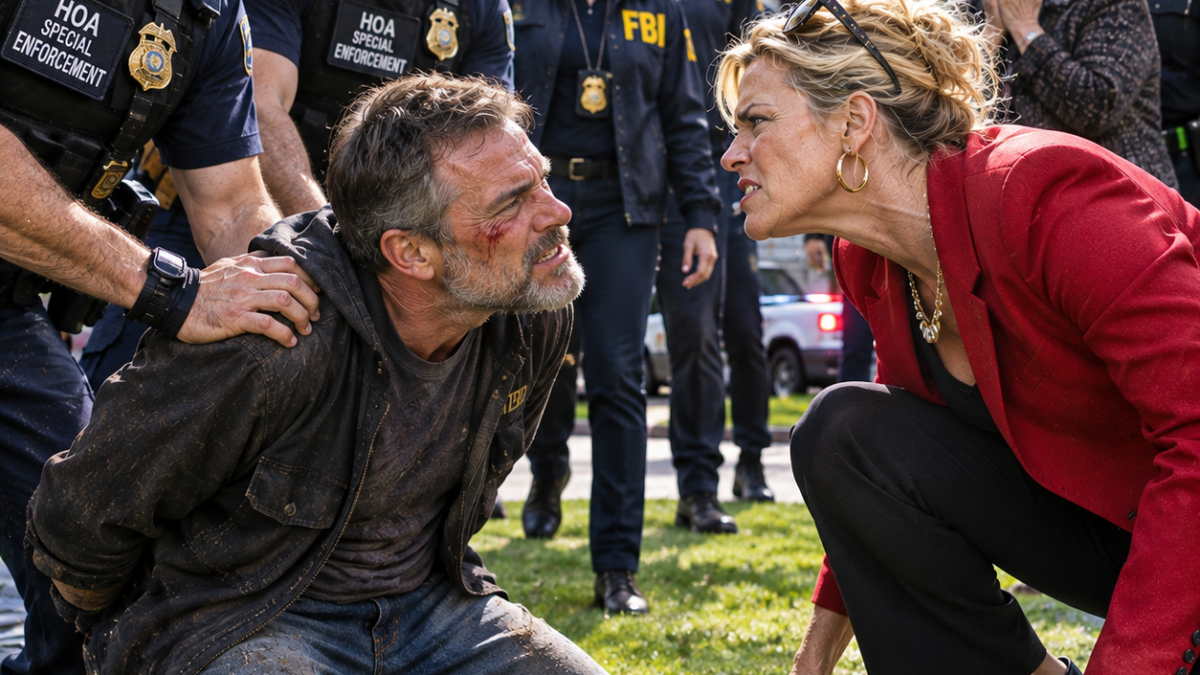
PART3:
Nothing yet tied Tabitha directly to the men doing the collections.
That was our problem.
Everybody around her seemed disposable.
Private security.
Management companies.
Collection contractors.
Law firms.
If investigators approached openly, the layer closest to the crime disappeared.
So we went quiet.
Willowbrook Estates had a house for sale.
Three-bedroom colonial.
Corner lot.
Overgrown hydrangeas.
Good visibility from two streets.
I bought it through an operational arrangement and moved in under my real name.
That part mattered.
Dennis Marlow was not invented.
The story around him was.
To Willowbrook, I was a semi-retired government contractor who had spent years traveling and now wanted somewhere quiet.
I fixed things around the house.
Mowed my own lawn.
Drove a ten-year-old pickup.
Waved.
Asked no unusual questions.
The only people who knew why I was really there were members of the investigation team.
Special Agent Rebecca Shaw.
Thirty-eight.
Former financial-crimes investigator.
The calmest person I had ever seen when everybody else was panicking.
Special Agent Tom Delgado.
Forty-five.
Surveillance.
Former local detective.
Could identify a vehicle from half a taillight.
And Kevin Park.
Thirty-one.
Technical specialist.
The reason half the ordinary-looking objects around my property had stopped being ordinary.
Three days after I moved in, Tabitha Crowley knocked on my door.
I opened it.
She stood there carrying a plate of cookies.
Red blazer.
Pearl earrings.
Perfectly arranged blond hair.
Warm smile.
Nothing about her looked threatening.
That was the point.
“Mr. Marlow?”
“Yes?”
“Tabitha Crowley.”
“HOA president.”
She held out the plate.
“Welcome to Willowbrook.”
“Thank you.”
I accepted it.
Chocolate chip.
Store-bought.
She glanced past me toward the foyer.
“We’re very proud of the community.”
“Looks nice.”
“We keep it that way.”
There was a shift in her voice.
Small.
“We take standards very seriously.”
I smiled.
“I’ll try not to ruin the place.”
She laughed.
But her eyes didn’t.
“I’m sure we won’t have any problems.”
I wondered how many people had heard that exact sentence before receiving a violation letter.
Two weeks later, mine arrived.
$750.
EXCESSIVE LAWN HEIGHT.
I stared at the notice.
Then went outside with a tape measure.
Two inches.
Willowbrook allowed three and a half.
Across the street, Leonard Marsh was watering flowers.
He was sixty-seven.
Gray cardigan even when it was warm.
HOA treasurer.
He saw me kneeling with the ruler.
“Lose something?”
“My criminal grass.”
He looked uncomfortable.
“You got a notice?”
“Seven-fifty.”
His hand stopped moving.
“That much?”
“You sound surprised.”
“I don’t set enforcement.”
“Who does?”
His eyes moved toward Tabitha’s house.
That was answer enough.
Then a white SUV crawled past.
Amber light bar on top.
Dark blue stripe.
Large lettering on the side:
SENTINEL SHIELD PATROL.
The design was deliberate.
From twenty yards away, it looked like a police vehicle.
No government seal.
No jurisdiction name.
No word POLICE.
But enough visual cues to make somebody nervous.
The driver looked directly at me.
Bearded.
Late thirties.
Black uniform.
Metal badge.
The SUV continued.
Leonard shut off the hose.
“I should go inside.”
“You expecting rain?”
He looked at me.
“No.”
Then left.
That afternoon I met Irene.
She lived two houses down.
I had seen her watching from her porch.
She waved me over.
“Dennis?”
“Yes, ma’am.”
“You received paper?”
I already knew she meant the violation.
“Grass.”
Her expression tightened.
“How much?”
“Seven-fifty.”
She looked toward the street.
“Do not pay cash.”
I waited.
Her eyes filled.
“A man came after Henry died.”
Henry was her husband.
Married fifty-one years.
He had passed that spring.
Irene had been saving for a granite headstone because she wanted one carved with a fishing boat.
“He wore a uniform?”
I asked.
She nodded.
“Dark blue.”
“Badge?”
“Yes.”
“Gun?”
“I think.”
“What did he say?”
“That I had ignored association orders.”
“What orders?”
“Fence.”
“Bushes.”
“Something about the roof.”
“Were any true?”
“I don’t know.”
Her voice broke.
“He said if I did not pay, they would get a warrant.”
“How much?”
“Four thousand two hundred dollars.”
My jaw tightened.
“How did you pay?”
“Cash.”
“Why cash?”
“He said court processing would cost more if I used a check.”
I sat beside her.
“Did he give you a receipt?”
She brought it from the house.
Cheap carbon form.
SENTINEL SHIELD COMPLIANCE UNIT.
Officer initials:
B.T.
I had seen that style before.
“Do you recognize him if you see him?”
“Yes.”
“Are you sure?”
Her voice sharpened.
“I remember the man who took Henry’s stone.”
That sentence hit me.
The money had not just been money.
It had been the last thing she planned to do for her husband.
I told her:
“Keep this receipt.”
“Don’t give the original to anyone.”
She looked at me.
“Why?”
“Because I think you’re going to need it.”
I wanted to tell her who I was.
Couldn’t.
Not yet.
Instead I promised something I had no right to promise.
“We’re going to figure out what happened.”
She put her hand over mine.
“Do not let them scare you too.”
I almost laughed.
“I’ll try.”
That night Rebecca sat in the surveillance van at the end of Willowbrook Lane.
From outside, it belonged to a landscaping company.
Inside:
Monitors.
Receivers.
Recording equipment.
Coffee bad enough to qualify as evidence.
Kevin had already installed cameras around my property under proper authorization for our operation.
Mailbox.
Porch fixture.
Garage.
One disguised in a sprinkler assembly aimed toward the driveway and front lawn.
Audio coverage was more controlled.
My own conversations.
Lawfully authorized monitoring.
Other evidence through warrants and cooperating witnesses as the case developed.
Nothing like television.
Real investigations are much more paperwork than gadgets.
Kevin handed me a small transmitter.
“If something goes wrong, say the phrase.”
“Which phrase?”
Rebecca answered:
“Take your hand off me.”
I looked at her.
“Subtle.”
“We’re not trying to win an Emmy.”
“What happens when I say it?”
“We move from observation to immediate intervention if there is physical escalation.”
“How fast?”
“Ninety seconds is the outside plan.”
Tom said:
“If somebody starts beating you, it’s going to be faster.”
“Comforting.”
Kevin looked unhappy.
“I still hate this.”
“So do I.”
We were not trying to get anyone to assault me.
That was important.
The operation was designed to document extortion.
Threat.
False authority.
Attempted collection.
If they delivered paperwork and left, fine.
If they demanded money while pretending to possess police authority, we had evidence.
If they crossed into violence, the team intervened.
Nobody needed me injured to prove the case.
The problem was criminals do not always cooperate with investigative plans.
Two nights later, I found a note under my front door.
No envelope.
Folded twice.
Four lines.
THEY KNOW SOMEONE IS WATCHING.
DON’T TRUST THE SHERIFF’S OFFICE.
SOMEONE IS TELLING THEM THINGS.
PLEASE BE CAREFUL.
No signature.
Handwriting shaky.
I called Rebecca.
She came through the garage entrance thirty minutes later.
Gloves.
Evidence sleeve.
She read it.
“Could be genuine.”
“Could be Tabitha trying to spook me.”
“Could be.”
“Could be internal leak.”
“Could be.”
I hated that answer.
Our sheriff’s-office liaison had limited knowledge of the operation.
Necessary for safety.
If the note was right, somebody might be passing information.
We tightened the circle.
The next morning I saw a man photographing my house from a parked sedan.
He left when I stepped outside.
Tom caught the plate.
Registered to Sentinel Shield Patrol.
Owner:
Victor Rinelli.
Vic Rinelli had a prior conviction for impersonating a police officer.
Traffic stop.
Fake badge.
Police-style lights.
Reduced sentence after cooperation.
He was prohibited from presenting himself as law enforcement.
Yet now he owned a company whose vehicles and uniforms seemed deliberately designed to suggest exactly that.
A second name appeared in Sentinel payroll records.
Brock Tanner.
Former corrections officer.
Terminated.
Third:
Cody Strong.
No law-enforcement background at all.
Twenty-nine.
Two assault arrests.
One conviction.
Suddenly Irene’s receipt mattered much more.
Initials B.T.
Brock Tanner.
Then Tabitha came back.
No cookies.
Red blazer.
Envelope.
She stood on my porch.
“Mr. Marlow.”
“Tabitha.”
“You have ignored association enforcement.”
“I measured my lawn.”
“This isn’t only about grass.”
She handed me the notice.
FINAL ENFORCEMENT DEMAND.
$6,000.
“What happened to seven-fifty?”
“Administrative penalties.”
“For?”
“Failure to cure.”
“Processing.”
“Security response.”
“Legal review.”
“Six thousand dollars in two weeks?”
“You were given an opportunity.”
I looked at her.
“And if I don’t pay?”
Her smile returned.
“Enforcement.”
“What kind?”
“You really don’t want to find out.”
“Police?”
She stepped closer.
“I have friends with badges, Dennis.”
The microphone under my shirt caught every word.
I smiled.
“I’d love to meet them.”
Her eyes narrowed.
“You will.”
Then she left.
In the van, Rebecca replayed the audio.
“I have friends with badges.”
Tom leaned back.
“She’s getting comfortable.”
Kevin asked:
“Enough?”
“For conspiracy?”
Rebecca shook her head.
“Not yet.”
“For attempted extortion?”
“Getting closer.”
We needed to show the system.
Who ordered the collections?
Who received money?
Who knew the “officers” were fake?
Who financed Sentinel?
Who controlled the proceeds?
Then our first real break came from inside.
Leonard Marsh.
HOA treasurer.
The man watering flowers.
He contacted a confidential reporting channel through an attorney.
He was terrified.
For nearly a year, he said, Tabitha had been pushing what she called “enhanced enforcement.”
Large penalties.
Fast collections.
Security assessments.
He noticed payments being routed through management accounts into Sentinel Shield.
When he questioned them, Tabitha told him the board had approved everything.
He checked minutes.
Some approvals did not exist.
Then an elderly resident named Walter Pike lost nearly all his savings.
Walter died weeks later.
Natural causes.
No evidence Tabitha caused his death.
Leonard knew that.
But guilt broke him.
“I signed checks.”
He told us.
“I kept telling myself it was procedural.”
Rebecca asked:
“Did you know residents were being threatened with arrest?”
“No.”
“Did you know Sentinel officers weren’t police?”
“I suspected.”
“When?”
“Months ago.”
“Why didn’t you report it?”
Leonard stared at the table.
“Cowardice.”
Nobody corrected him.
Sometimes comforting a witness too quickly is another way of refusing to let them tell the truth about themselves.
He agreed to cooperate.
That was the note.
He had slipped it beneath my door after learning Tabitha believed somebody in Willowbrook was talking to investigators.
And he agreed to something more important.
Wear a recorder during board discussions he lawfully attended.
Two weeks later we had Tabitha’s voice.
“Make the old ones pay.”
Leonard:
“They don’t have money.”
Tabitha:
“They have houses.”
Leonard:
“What if they fight the fines?”
Tabitha:
“Then Sentinel explains the alternative.”
“What alternative?”
“Liens.”
“Court.”
“Arrest if they interfere.”
Leonard:
“They can’t arrest anyone.”
Pause.
Then Tabitha:
“They don’t need to arrest them.”
“They need to believe they can.”
That was the sentence that changed the case.
Now we had knowledge.
Intent.
Deception.
We still needed financial corroboration.
Warrants were being built.
Bank records.
Sentinel contracts.
Management accounts.
But Tabitha accelerated before we were ready.
My forty-eight-hour deadline expired on Friday.
Saturday morning I mowed the lawn.
Two inches.
Again.
I did it partly because I enjoy mowing.
Partly because it made the scene ordinary.
Neighbors knew about my dispute with Tabitha.
Willowbrook gossip moved faster than federal subpoenas.
People came outside.
Porches.
Driveways.
Irene sat in a chair by her front walkway.
Leonard remained inside.
His role had to stay protected.
At 10:17 I heard the vehicle.
Low engine.
Then electronic siren chirp.
Red and blue lights.
That detail mattered.
Not amber anymore.
Red and blue.
The white Sentinel SUV turned onto my street.
Stopped at the curb.
Brock Tanner got out.
Navy uniform.
Badge.
Duty belt.
Cody Strong exited passenger side.
Same uniform.
Behind them came Tabitha.
Red blazer.
Phone already recording.
My pulse increased.
Rebecca’s voice came softly through the receiver.
“We see them.”
I shut off the mower.
Tanner walked onto my grass.
“Dennis Marlow?”
“Yes.”
“You’ve been served with a lawful enforcement order.”
“By who?”
“Willowbrook Special Enforcement.”
I looked at the badge.
It read:
WILLOWBROOK SPECIAL ENFORCEMENT.
No state.
No county.
No municipality.
No agency number.
“Whose department is that?”
Tanner’s expression changed.
“What?”
“Real police badges usually identify an actual department.”
Cody glanced at the ground.
Tabitha snapped:
“Stop playing games.”
I looked at Tanner.
“Are you a sworn law-enforcement officer?”
He stepped closer.
“You’ve been ordered to comply.”
“That wasn’t my question.”
“Turn around.”
“Why?”
“You’re being detained.”
“For an HOA fine?”
“Failure to comply.”
I could hear neighbors murmuring.
Irene stood.
Tabitha kept filming.
She said:
“Dennis, you had your chance.”
I looked at her.
“Six thousand dollars?”
“Now it will be more.”
Tanner reached for my arm.
I stepped back once.
“Don’t touch me.”
He grabbed.
Hard.
I said clearly:
“Take your hand off me.”
Trigger.
The plan changed instantly.
Rebecca:
“Team moving.”
Tanner twisted my arm.
“Stop resisting.”
“I’m not resisting.”
Cody shoved me from the side.
I lost balance.
Went down on one knee.
Then a boot hit my ribs.
Hard.
Air left my lungs.
That was not part of any plan.
Pain shot through my side.
I fell onto both hands.
Someone screamed.
Another kick caught my hip.
Tanner dragged me partly upright.
My jacket opened.
Wallet fell into the grass.
Not my credentials wallet.
Regular wallet.
My federal credentials were in a second leather case inside the jacket, which fell separately when Tanner yanked me.
I saw it land three feet away.
Closed.
Tabitha crouched.
Smiling.
Phone pointed at me.
“You should’ve paid.”
I coughed.
She leaned closer.
“No one will believe you.”
Her voice dropped.
“Everybody here works for me.”
The sprinkler camera was six feet behind her.
Porch camera above.
Shirt microphone still live.
Kevin had every word.
Then a real sheriff’s cruiser arrived.
Deputy Anita Cruz stepped out.
My stomach tightened.
We had not expected her that early.
And because of Leonard’s note, I did not know whether that was good news.
Tabitha stood immediately.
“Deputy!”
Perfect victim voice.
“He attacked my officers.”
Cruz looked at Tanner.
Cody.
Me on the ground.
Tabitha.
Neighbors.
“What officers?”
“Special enforcement.”
Tanner held up his badge.
Cruz did not react.
“Who touched who first?”
Tabitha said:
“He became violent.”
Cruz walked toward me.
Pulled out her cuffs.
For the first time that morning, I felt real uncertainty.
Had our sheriff liaison been compromised?
Was Cruz the leak?
I could hear Rebecca moving closer.
Then Irene Kowalski walked into the street.
Her hands were shaking.
Her voice wasn’t.
“That man stole four thousand two hundred dollars from me!”
She pointed directly at Tanner.
Everything stopped.
Tanner spun around.
“You need to go inside.”
Irene stepped forward.
“You came to my house.”
“I don’t know you.”
“You took Henry’s money!”
“Ma’am, back away.”
“You told me you were police.”
“I said back away!”
The anger in Tanner’s face told everybody more than a badge ever could.
Tabitha snapped:
“Cody.”
Then pointed at me.
“Take his phone.”
Cody reached into my pocket.
Pulled it free.
Held it up.
Tanner looked down at me.
“Nobody’s going to see anything now.”
I was still breathing carefully because my ribs felt wrong.
I looked past him.
Down the sidewalk.
Three people were coming toward us.
Dark blue tactical vests.
Yellow letters.
FBI.
Rebecca.
Tom.
Kevin.
No running.
No dramatic shouting yet.
Just controlled movement.
Tabitha saw them.
Her smile returned for half a second.
Nervous.
Then she laughed.
“FBI?”
She looked around.
“For a lawn?”
Rebecca walked past her.
Did not answer.
She came directly to me.
“You okay?”
“Ribs.”
“Stay down.”
Then she noticed the leather credentials wallet in the grass.
Picked it up.
Opened it.
Looked at Tanner.
Then at the gathered neighbors.
Her voice was clear.
“Supervisory Special Agent Dennis Marlow.”
“Federal Bureau of Investigation.”
Silence.
Complete.
I watched Tabitha’s face.
Confusion first.
Then comprehension.
Then fear.
Her phone slipped from her hand.
Cody stared at me.
“No.”
He whispered.
Tanner’s right hand moved.
Toward his waistband.
Tom Delgado saw it.
“Hands!”
Everything changed.
Weapons came up.
“Hands where I can see them!”
Tanner froze.
His fingers were inches from a concealed handgun.
Real handgun.
Fake uniform.
Very bad combination.
“Hands!”
He slowly lifted them.
Kevin moved in.
Secured him.
Removed the firearm.
Cody dropped my phone.
“I didn’t know!”
Nobody asked.
“It was her!”
Still nobody asked.
“She pays us two thousand a week!”
Tabitha turned on him.
“Shut your mouth!”
Rebecca looked at her.
“Ms. Crowley.”
Tabitha lifted her chin.
“I want my attorney.”
“That is absolutely your right.”
Rebecca said.
Then held up a tablet.
“But before anybody pretends this was a misunderstanding…”
She pressed play.
Tabitha’s own voice filled the street.
MAKE THE OLD ONES PAY.
OR THEY LOSE THEIR HOMES.
Another clip.
THEY DON’T NEED TO BE POLICE.
THEY NEED TO LOOK LIKE POLICE.
Another.
IF THEY THINK ARREST IS COMING, THEY PAY FASTER.
Tabitha’s face went gray.
People turned toward her.
Irene covered her mouth.
Then Leonard Marsh stepped from the crowd.
Gray cardigan.
Pale.
He looked at Irene first.
Not us.
“I’m sorry.”
His voice broke.
“I should’ve stopped it sooner.”
Irene stared.
Leonard continued.
“I signed checks.”
“I kept telling myself I didn’t know enough.”
“But I knew enough.”
Tabitha glared at him.
“You.”
Leonard nodded.
“I gave them the recordings.”
She took one step toward him.
Cruz moved between them.
That was when Rebecca finally looked at the deputy.
“Thank you for holding position.”
Cruz nodded.
My fear disappeared.
She had not been the leak.
She had been instructed by the sheriff to respond normally if called, preserve cover, and delay any premature escalation until the federal team had control.
The handcuffs she had taken out?
Not for me.
Prepared for whoever needed them once the scene clarified.
Tabitha had misread the deputy exactly the way she misread everybody else.
As someone she could command.
Then radios started going off.
Simultaneous teams.
One at Willowbrook’s clubhouse.
One at Sentinel Shield Patrol.
One at a management office across town.
Search warrants executed.
Vic Rinelli was arrested at the Sentinel office.
Agents found racks of uniforms.
Replica badges.
Emergency lights.
Blank violation forms.
Cash envelopes.
Resident information.
At the HOA clubhouse, investigators opened a locked cabinet in the president’s office.
Inside:
Collection ledgers.
Homeowner files.
Copies of IDs.
Bank records.
Thirty-eight victim names.
The documented amount associated with the extortion scheme eventually reached approximately $1.9 million.
Not all cash was recovered.
Some had been moved.
Some spent.
Some routed through accounts that took months to trace.
But the ledger gave investigators something victims had never had before.
Proof that they were not alone.
Tabitha heard the radio traffic.
Her confidence disappeared one piece at a time.
Clubhouse secured.
Sentinel office secured.
Rinelli detained.
Records recovered.
She looked at me.
“You planned this.”
I was still on the lawn.
A paramedic had arrived.
I said:
“No.”
“You came here to destroy me.”
“I came here because elderly people were being threatened.”
She laughed bitterly.
“You think a jury is going to believe this?”
Rebecca turned.
Tabitha continued.
“I’ll tell them he attacked me.”
She looked at the neighbors.
“I’ll cry if I have to.”
Nobody moved.
I stared at her.
Then pointed weakly toward the sprinkler head.
“One camera.”
Mailbox.
“Two.”
Porch light.
“Three.”
Across the street.
Tom nodded toward the surveillance van.
“And several more.”
I looked back at Tabitha.
“You had a federal wire.”
“Your own phone.”
“Neighbor witnesses.”
“A deputy.”
“And your own voice.”
I paused because breathing hurt.
“You’ve already told them everything.”
For once, Tabitha Crowley had nothing to say.
Paramedics cut open part of my shirt.
Two cracked ribs.
Bruising.
Nothing life-threatening.
I had been hurt worse in twenty-six years.
Still, I was furious.
Not because Tanner kicked me.
Because Irene was crying.
She walked over after the paramedics finished checking me.
Then hugged me.
Hard.
I nearly screamed.
“Ribs.”
She jumped back.
“Oh!”
Then started crying harder.
“You kept your promise.”
I shook my head.
“No.”
“We all did.”
I looked toward Leonard.
Rebecca.
The agents.
Cruz.
The neighbors who had finally started talking.
“One person doesn’t take something like this down.”
That was important.
People later told the story as though I had gone undercover, let myself get beaten, flashed an FBI badge, and personally destroyed a criminal HOA.
That version is entertaining.
It is also wrong.
The case worked because Irene kept a receipt.
Because Leonard finally spoke.
Because victims saved documents.
Because Rebecca followed the money.
Because Tom connected vehicles.
Because Kevin preserved recordings.
Because Cruz kept the scene from exploding before the arrests could happen safely.
Because prosecutors took elderly victims seriously.
My lawn was only where all those threads finally crossed.
The federal case lasted more than a year.
Real prosecutions do not wrap up before the next commercial break.
Attorneys filed motions.
Defendants negotiated.
Records were analyzed.
Victims interviewed again.
Financial experts traced transfers.
Defense lawyers challenged recordings.
Chain of custody.
Search warrants.
Witness credibility.
Everything.
Tabitha tried distancing herself from Sentinel.
Then the contracts appeared.
Monthly payments.
Special collection bonuses.
Emails.
One message from Tabitha to Vic Rinelli read:
OLDER ACCOUNTS RESPOND BETTER TO IN-PERSON PRESSURE.
Another:
UNIFORM PRESENCE INCREASES COMPLIANCE.
Brock Tanner’s testimony made things worse.
He initially denied everything.
Then learned how much evidence existed.
He eventually admitted that residents were intentionally led to believe he had arrest authority.
He described scripts.
“If they question the fine, mention court.”
“If they mention lawyers, mention warrant.”
“If they threaten police, say we coordinate with the sheriff.”
None of it was true.
The goal was fear.
Cody Strong cooperated almost immediately.
Some people called him a coward.
Maybe.
But cooperation exposed other victims.
Other accounts.
Other properties.
It also helped investigators understand how Sentinel recruited men willing to dress like police without technically printing the word POLICE anywhere.
Vic Rinelli had learned from his first conviction.
His new uniforms used:
SPECIAL ENFORCEMENT.
PUBLIC SAFETY.
COMPLIANCE UNIT.
OFFICER.
Words designed to approach the line without crossing it on fabric.
The conduct crossed it anyway.
Tabitha’s defense was more complicated.
She claimed she believed Sentinel was a legitimate civil-enforcement contractor.
That argument did not survive her own recordings.
Leonard had captured her laughing when somebody asked whether Sentinel officers could legally arrest residents.
“Of course not.”
She had said.
“They don’t know that.”
That recording was played in court.
I watched her face when she heard it.
No reaction.
By then she had learned not to react.
The final outcomes were serious.
Tabitha received a lengthy federal prison sentence.
Tanner received years for his role in the extortion scheme, impersonation conduct, assault, and related offenses.
Rinelli received substantial prison time because he had organized the fake-enforcement operation and had a prior history involving police impersonation.
Cody received less after cooperation.
Exact sentencing calculations involved more than the simple numbers neighbors repeated afterward, but none of them walked away untouched.
The court ordered restitution.
Recovery was imperfect.
It always is.
You can order someone to repay $1.9 million.
That does not magically recreate $1.9 million in an account.
Assets were sold.
Accounts seized.
Money recovered where possible.
Some victims received full restitution.
Some received distributions over time.
Irene got enough back to finish the thing she cared about.
Henry’s headstone.
She invited me when it was installed.
Gray granite.
Fishing boat engraved beneath his name.
HENRY KOWALSKI
1944–2025
HE ALWAYS KNEW WHERE THE FISH WERE
Irene stood beside it.
Touched the carved boat.
Then looked at me.
“He would complain it cost too much.”
“Probably.”
“He complained about everything.”
“Sounds efficient.”
She laughed.
Then cried.
I stood there and let her.
Willowbrook had to rebuild after the arrests.
The HOA’s reputation was destroyed.
Nobody trusted anyone.
That was understandable.
The first emergency meeting after Tabitha’s removal lasted almost four hours because residents questioned every line of every financial statement.
Good.
Painful.
Healthy.
Nobody wanted to be president.
Eventually Irene Kowalski agreed to serve temporarily.
I tried talking her out of it.
“Absolutely not.”
She crossed her arms.
“Why?”
“You’re seventy-six.”
“So?”
“You hate meetings.”
“Yes.”
“You swear when angry.”
“Good.”
“You threatened a fake officer with your umbrella.”
“He deserved it.”
I sighed.
“You’re going to do it anyway.”
“Yes.”
She became interim president.
Then the neighborhood elected her.
Her first proposed rule was simple.
No fine without:
Written notice.
Specific violation.
Evidence.
Reasonable cure period.
Right to hearing.
Board review for major penalties.
Residents applauded.
Irene banged the gavel.
“Stop clapping.”
“We have twenty-three more items.”
That was Irene.
The second reform required every private security provider to be clearly identified as private security.
No police-style badges.
No emergency-light impersonation.
No language implying arrest power.
The third required outside auditing.
The fourth created an anonymous reporting channel.
Leonard proposed that one.
He remained treasurer for three months.
Then resigned.
“I don’t deserve the position.”
He told me.
“Maybe.”
I said.
He looked surprised.
I continued.
“But resigning doesn’t erase what happened.”
“I know.”
“What are you going to do instead?”
“Help recover records.”
“Help victims.”
“Testify.”
“Good.”
He did.
People wanted to hate Leonard.
Some did.
He had signed checks.
Stayed silent.
Watched Tabitha consolidate power.
His eventual cooperation did not erase his earlier failure.
It mattered anyway.
Human beings like clean categories.
Hero.
Coward.
Victim.
Criminal.
Real life is less cooperative.
Leonard was frightened.
Complicit in some administrative failures.
Then brave.
All of those things could be true.
Deputy Anita Cruz visited my house after the case became public.
I opened the door.
“Here to arrest me finally?”
She smiled.
“You looked terrified when I pulled the cuffs.”
“I was evaluating variables.”
“You were terrified.”
“Professional uncertainty.”
“Terrified.”
I let her in.
She explained the sheriff’s side.
There had been complaints about Sentinel.
Not enough to prosecute.
The department suspected somebody inside the county system had been leaking basic complaint information to private security.
The eventual leak was not Cruz.
It turned out to be a civilian records employee who had a personal relationship with one of Rinelli’s associates.
That person had access to limited incident information and was feeding alerts back to Sentinel.
Not a dramatic corrupt sheriff conspiracy.
Still dangerous.
The note Leonard gave me had been partly right.
Information was leaking.
Just not from where we feared.
Cruz told me:
“When I saw Tanner standing over you, I almost blew the whole plan.”
“Why didn’t you?”
“Rebecca was ten seconds away.”
“That’s comforting now.”
“Wasn’t then.”
We drank coffee.
She looked toward my lawn.
“You still mowing that yourself?”
“Yes.”
“Two inches?”
“Two and a quarter.”
“Rebel.”
Months passed.
My house stopped feeling like a surveillance site.
Kevin removed equipment.
The landscaping van disappeared.
The sprinkler became a sprinkler again.
For the first few Saturdays after the takedown, neighbors watched me mow.
It became awkward.
Finally I shut off the mower and yelled:
“Do I have something on my face?”
A man across the street shouted:
“FBI!”
Everybody laughed.
That broke something.
Afterward Willowbrook slowly started becoming a neighborhood instead of a crime scene.
Kids rode bikes again.
People argued about trash cans instead of extortion.
Someone organized a block party.
Irene attempted to cook hamburgers.
That was worse than the lemon cookies in another life.
I took over the grill.
“I am president.”
She said.
“Not of meat.”
“Everything here falls under the HOA.”
I stared.
She smiled.
“That was a joke.”
“Too soon.”
We laughed.
I stayed in the house.
That surprised people.
The assignment was over.
I could have sold.
Moved.
Nobody expected me to remain after everyone learned who I was.
But I liked Willowbrook.
Maybe because I had first seen it at its worst.
There is something satisfying about watching a place become normal again.
I retired from the Bureau two years later.
Actually retired.
No cover story.
At my retirement dinner Rebecca gave me a framed photograph.
My lawn.
Morning of the takedown.
I was on one knee.
Tanner’s hand on my shoulder.
Tabitha pointing.
Behind them, barely visible down the sidewalk, the team approaching.
Underneath, Rebecca had engraved:
TAKE YOUR HAND OFF ME.
I stared.
“You’re terrible.”
“You’re welcome.”
Kevin said:
“We considered putting the sprinkler camera in the frame.”
Tom added:
“It was the real hero.”
Irene attended.
She brought cookies.
Store-bought this time.
Progress.
The hardest part of the case had never been my ribs.
Those healed.
The hardest part was victim interviews.
Thirty-eight names.
Thirty-eight different stories.
A retired carpenter who paid because Tanner threatened to arrest his disabled son.
A widow who borrowed money from her sister because she believed her home would be seized before Christmas.
A veteran who knew something was wrong but was too embarrassed to admit he had been frightened by a fake badge.
A woman who sold her wedding ring.
People assume scams work because victims are foolish.
That makes us feel safe.
If victims are stupid, then intelligent people are protected.
It isn’t true.
Fear compresses time.
Authority changes behavior.
A uniform changes behavior.
A badge changes behavior.
Someone standing on your porch saying:
“Pay now or I arrest you.”
does not give you the same mental environment as reading a contract at a kitchen table with an attorney.
Tabitha understood that.
That was the cruelty.
She targeted people likely to be alone.
Likely to panic.
Likely to pay before calling family.
The fake officers did not need actual arrest power.
They needed thirty seconds of believable fear.
That is why Irene mattered so much.
Not because she was the biggest victim.
Because on the morning everything came apart, she stopped being afraid.
Tanner ordered her back inside.
She stayed.
He denied knowing her.
She kept talking.
The neighborhood watched.
That changed the scene before my badge ever opened.
Authority based on fear is fragile once somebody publicly refuses to be afraid.
Irene did that.
Years later she still lived two houses down.
Eventually she stepped down as HOA president.
Her reason:
“These people complain too much.”
I reminded her:
“That’s democracy.”
“Democracy is exhausting.”
“Also democracy.”
Her successor was thirty-nine.
Accountant.
Quiet.
Every violation notice now included a phone number for appeals.
No cash accepted.
Ever.
A framed copy of the first reform resolution hangs in the clubhouse.
No fine without a hearing.
Irene insisted.
One evening she and I sat on her porch.
She asked:
“Did you know they would hit you?”
“No.”
“You knew maybe.”
“Yes.”
“Why do it?”
“I wasn’t trying to get hit.”
“But you knew risk.”
“Yes.”
She looked angry.
“You could have been killed.”
“I know.”
“Then why?”
I thought before answering.
“Because we needed to understand how far they were willing to go.”
She shook her head.
“You FBI people are not normal.”
“That is fair.”
Then she asked:
“Were you scared?”
“Yes.”
That surprised her.
“When?”
“When Cruz arrived.”
She laughed.
“The real police scared you?”
“I didn’t know she was clean.”
“And Tanner?”
“I was busy breathing.”
She reached over.
Patted my hand.
“You were brave.”
“No.”
I said.
“I had backup ninety seconds away.”
“You stood there.”
“So did you.”
She smiled.
“Fine.”
“We are both very brave.”
“Deal.”
Tabitha wrote me once from prison.
I almost threw the letter away.
Then read it.
Four pages.
Mostly excuses.
Bad childhood.
Financial pressure.
Residents impossible to satisfy.
Sentinel got out of control.
Vic manipulated her.
Leonard betrayed her.
Irene exaggerated.
I had entrapped her.
Every paragraph placed responsibility somewhere else.
Until the final three lines.
I thought if people were afraid of losing their homes, they would follow the rules.
I stopped seeing them as neighbors.
I saw accounts.
I am beginning to understand that was the crime before any law was broken.
I read those lines twice.
Did not write back.
Maybe she meant them.
Maybe she had learned what remorse should sound like.
It wasn’t my job to decide.
I put the letter in the case box.
Next to the grass violation.
The $6,000 demand.
Photos.
Court notices.
And a copy of Irene’s original receipt.
$4,200.
B.T.
That small slip of paper had outlived the entire operation built around it.
Vic Rinelli thought uniforms created authority.
Tabitha thought titles created authority.
Tanner thought physical force created authority.
Cody thought whoever paid him created authority.
They were all wrong.
Authority is limited.
Defined.
Reviewable.
Real authority does not need to lie about what it is.
That was the lesson Willowbrook learned.
The lesson I learned was different.
Truth does not automatically win because it is true.
Somebody has to preserve it.
Record it.
Report it.
Testify to it.
Stand beside it while somebody more confident tells everyone you are lying.
On the morning Tanner put me on the ground, Tabitha believed she controlled the story.
She had the HOA title.
She had two men dressed like officers.
She had a phone filming from her angle.
She had spent years teaching neighbors that challenging her had consequences.
Then Irene spoke.
Then Rebecca walked up.
Then my credentials opened.
Then Leonard stepped forward.
Then warrants hit.
The truth did not suddenly appear.
It had been accumulating for months.
Receipt by receipt.
Recording by recording.
Transfer by transfer.
Witness by witness.
The lawn was simply where it became impossible to hide.
I still mow every Saturday.
Habit.
Two and a quarter inches.
I measured once for fun.
A teenager from down the block saw me.
“Mr. Marlow, are you seriously measuring the grass?”
“Yes.”
“Why?”
“History.”
He had no idea what that meant.
Good.
Young people do not need to inherit every fear.
Just better systems.
Sometimes a white SUV turns onto Willowbrook Lane and I still look up automatically.
Then it passes.
Delivery vehicle.
Parent.
Contractor.
Normal.
That reflex has faded slowly.
So has everyone else’s.
Irene finally bought a new bench for her porch.
Henry’s old one rotted.
She made me assemble it.
Instructions were terrible.
At one point she said:
“You are FBI.”
“Retired.”
“You cannot build bench?”
“The Bureau did not train furniture assembly.”
“Waste of taxes.”
I laughed until my ribs hurt.
Not the old injury.
Just age.
One afternoon she pointed toward my lawn.
“Remember when they kicked you there?”
“Hard to forget.”
“Tabitha said nobody would believe you.”
“Yeah.”
Irene looked at the houses along the street.
“Everybody believes you now.”
I thought about it.
Then shook my head.
“That’s not what matters.”
“What matters?”
“That they believe themselves.”
She frowned.
I explained.
“When Tanner came to your house, you knew something was wrong.”
“You paid anyway because he made you doubt yourself.”
She looked down.
“Yes.”
“Now?”
“If someone tries that again?”
She lifted her chin.
“I call real police.”
“And me.”
“Maybe.”
“I charge hourly now.”
She slapped my arm.
The sun went down behind the roofs.
Willowbrook looked ordinary.
That was the victory.
Not federal sentences.
Not the FBI jackets.
Not Tabitha’s face when Rebecca opened my badge.
Ordinary.
Neighbors no longer afraid that a uniformed stranger could take their money because an HOA president said so.
An elderly widow no longer terrified of somebody knocking after dark.
A board that had to explain fines before collecting them.
Records anyone could review.
Real hearings.
Real appeal rights.
Real accountability.
Tabitha Crowley spent years convincing people that authority belonged to whoever sounded most certain.
Then one Saturday morning she stood on my lawn while two fake officers beat a man she thought was just another frightened homeowner.
She smiled.
Leaned down.
And whispered:
“No one will believe you.”
Maybe that sentence had worked before.
Maybe dozens of victims had heard some version of it.
Pay.
Obey.
Stay quiet.
Nobody will believe you.
But that morning, ten cameras were recording.
A federal wire was running.
A cooperating treasurer had already preserved her voice.
A widow was finally ready to point at the man who took her money.
A sheriff’s deputy was watching.
Three agents were walking up the sidewalk.
And my badge was lying in the grass directly between us.
Tabitha thought the most important thing on that lawn was the fake badge pinned to Tanner’s chest.
She was wrong.
The most important thing was not my real badge either.
It was the evidence.
Because badges can be copied.
Uniforms can be bought.
Titles can be abused.
People can lie.
But when the cameras, bank records, witness statements, recordings, receipts, and the criminals’ own words all tell the same story, eventually the costume stops mattering.
That was how Willowbrook got free.
Not because the FBI moved into the neighborhood.
Because thirty-eight frightened people finally had proof that what happened to them was real.
And the woman who had spent years telling them nobody would believe them finally had to sit in a courtroom and listen while everyone did.








