Everything at the Estate Sale Was Gone Except a 17-Year-Old Cat—Thirty People Walked Past Him, and I Was the 31st Who Finally Stopped
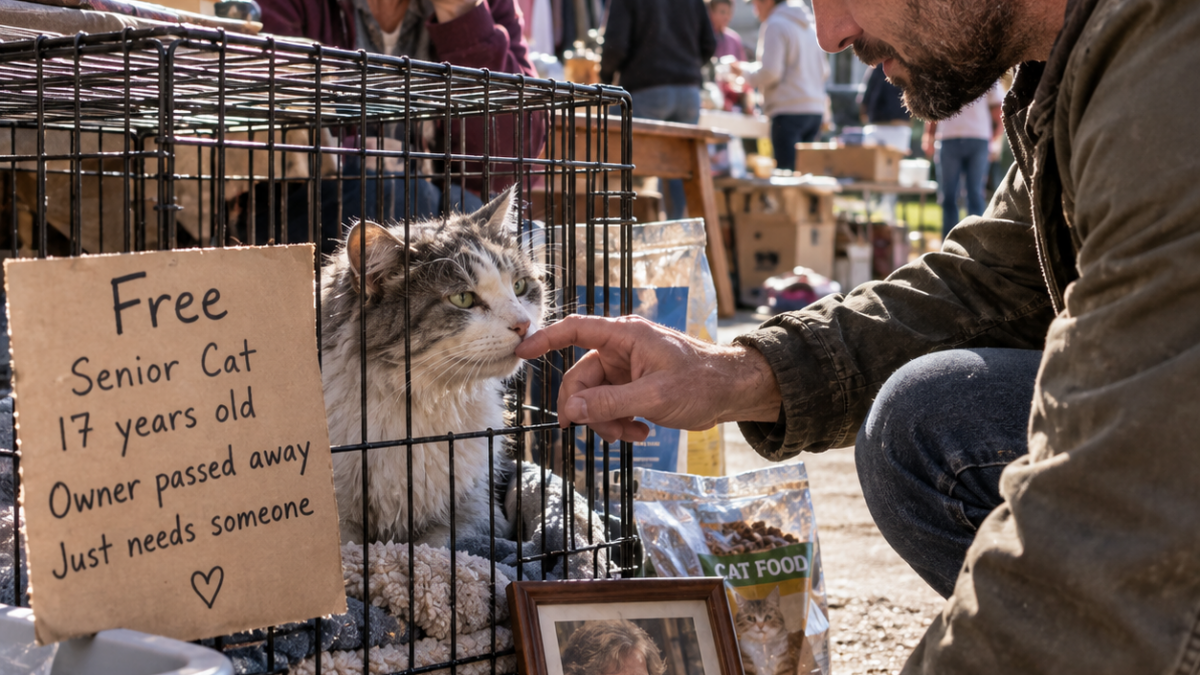
Everything at the Estate Sale Was Gone Except a 17-Year-Old Cat—Thirty People Walked Past Him, and I Was the 31st Who Finally Stopped.
Thirty people walked past the cage without stopping, even though the cardboard sign beside it said the seventeen-year-old cat’s owner had died and he simply needed someone willing to take him home.
I had already walked past him once too, bought the tools I came for, and made it all the way back to my truck before I realized I was standing there silently judging strangers for doing exactly what I had just done.
When I finally crouched in front of Arthur and asked the woman beside him to tell me his story, she handed me his old blanket, two bags of food, and a framed photograph of her mother holding him as a kitten—and by that night, the last living piece of one woman’s entire life was asleep on my couch.
My name is David Mercer.
I was fifty-eight years old the Saturday Arthur entered my life, and if you had asked me that morning whether I wanted a cat, I would have said no before you finished the question.
Not because I disliked cats.
I didn’t.
I had grown up with animals.
Dogs mostly.
A barn cat named Susie when I was a kid.
A beagle my children loved until old age took him when they were teenagers.
But by fifty-eight, my life had become deliberately uncomplicated.
I lived alone in a brick ranch house outside Columbus, Ohio.
My daughter Rachel was married and lived forty minutes away with two children.
My son lived in North Carolina.
My marriage had ended seven years earlier without explosions or lawyers screaming at one another.
We simply reached the uncomfortable conclusion that we had become better friends than spouses.
My ex-wife remarried.
I did not.
I worked maintenance for a manufacturing company.
Came home.
Cooked simple meals.
Watched baseball.
Worked on things in the garage.
Went to bed.
I was not miserable.
That distinction matters.
Loneliness does not always announce itself as suffering.
Sometimes it is simply a house that remains exactly the way you left it.
No shoes by the wrong door.
No television left on in another room.
No one using the last clean coffee mug.
Nothing inconvenient.
I had grown good at convenience.
That Saturday in July, I wanted a socket set.
That was the entire mission.
A coworker named Frank texted me around eight-thirty.
Big neighborhood sale on Briarwood. Guy near the middle has tools.
I had been rebuilding shelving in my garage and somehow lost a fourteen-millimeter socket I knew I owned.
Rather than admit the garage had eaten it, I drove to Briarwood.
The neighborhood was exactly what you would expect from a large community yard sale.
Cars parked half on lawns.
Kids dragging wagons.
Folding tables on driveways.
Clothes racks under trees.
Books.
Lamps.
Kitchen appliances.
Toys children had apparently loved deeply until that morning.
People bargaining over objects that had once cost hundreds of dollars and were now worth seven.
There is something strangely honest about yard sales.
You see how quickly possessions lose their mythology.
A wedding gift becomes five dollars.
A treadmill becomes twenty.
A china cabinet becomes free if you have a truck.
I wandered slowly.
Bought two extension cords I did not need.
A box of drill bits I probably already owned.
Then I saw the house near the end of the street.
It looked different.
Not because the tables were larger.
Because the objects had the unmistakable feeling of belonging to one person.
Older woman’s coats.
Porcelain dishes arranged carefully.
A walker.
A wooden jewelry box with nothing inside.
A stack of crossword puzzle books.
A sewing basket.
Old framed landscapes.
PART2:
Photographs turned face-down in a cardboard box as if someone had decided strangers should not browse the faces.
There was no sign saying ESTATE SALE.
It did not need one.
A whole life had been placed on folding tables.
Behind one table sat a woman in her early fifties.
Brown hair.
Jeans.
Pale blue shirt.
Garden chair.
She looked exhausted in a way that had nothing to do with carrying furniture.
People handed her dollar bills.
She thanked them politely.
Never negotiated much.
I looked briefly at the dishes.
Then noticed the cage.
It was sitting on the ground beside her chair.
Large wire crate.
Old brown blanket folded in one corner.
Small litter tray.
Water bowl.
And a cat.
White and gray.
Thin.
Very old.
There is something about senior cats that makes their age visible in the geometry of the face.
Cheeks narrow.
Eyes seem larger.
The bridge of the nose sharper.
Fur still beautiful but thinner, softer, almost fragile around the ears.
This cat had green eyes clouded slightly with age.
PART3:
He was lying on his blanket with his paws tucked beneath him.
Calm.
Silent.
Beside the cage leaned a piece of cardboard.
Black marker.
I read it.
FREE. SENIOR CAT. 17 YEARS OLD.
OWNER PASSED AWAY.
HE JUST NEEDS A HOME.
LITTER + FOOD INCLUDED.
I remember exactly what I thought.
Seventeen.
Then:
That’s old.
Then I kept walking.
That is important.
I did not immediately fall in love.
I did not hear music.
The cat did not reach through the bars and choose me.
I read the sign like everybody else and continued toward the tools two houses down.
The man selling them had a Craftsman socket set in a red case.
Nearly complete.
Twenty dollars.
I opened it.
Counted the sockets.
There was the fourteen.
“Twenty?”
“Twenty.”
I paid.
We talked about ratchets for several minutes.
Normal Saturday.
Normal transaction.
I carried the set back toward my truck.
That should have been the end.
Then I looked down the street.
The cage was still there.
Of course it was.
Only fifteen minutes had passed.
The woman still sat beside it.
The cat had not moved.
A family approached.
Little boy pointed.
“Kitty!”
Mother looked.
“We’re not getting a cat.”
They passed.
Nothing wrong with that.
Most families walking through yard sales do not need surprise pets.
I placed the socket set in my truck.
Closed the tailgate.
Put my hand on the driver’s door.
Then stood there.
I could not explain why.
Maybe the sign bothered me.
Maybe the combination of all the dead woman’s possessions being sold around a living animal felt wrong.
Maybe because I had watched the little boy notice him and the adults keep moving.
Whatever it was, I stayed.
At first, I was not counting.
A man in a red baseball cap passed.
Then a couple carrying a floor lamp.
Then two teenage girls.
Then an elderly man pushing a bicycle.
I began counting accidentally.
Five.
Six.
Seven.
A woman stopped.
Looked into the cage.
Arthur lifted his head.
She read the sign.
“Seventeen?”
The seated woman nodded.
The visitor made a sympathetic face.
“Oh, poor thing.”
Then walked away.
Eight.
I told myself I should leave.
I did not.
The woman beside the cat never called out to people.
That struck me.
No:
“Free cat!”
No:
“Anybody looking for a pet?”
No sales pitch.
She sat.
Waited.
Sometimes scratched the cat’s cheek through the bars.
People bought her mother’s things around them.
A porcelain tea set disappeared.
Two coats.
The walker.
A small side table.
Someone bought a box of Christmas ornaments for three dollars.
Every time something left, the driveway got emptier.
The cage did not.
I walked across the street and bought coffee from a teenager who had set up a folding lemonade stand but had apparently upgraded to iced coffee.
Then returned to my truck.
Still watching.
Ten.
Twelve.
Fifteen.
At number eighteen, a little girl knelt.
Finally.
She put both hands on her knees and said:
“Hi, kitty.”
Arthur raised his head.
I felt something inside me loosen.
Then her father said:
“Come on, Emily.”
She looked back.
“Can we—”
“No.”
One word.
She followed.
Nineteen.
Again, the father was not cruel.
Maybe allergic.
Maybe renting.
Maybe already owned animals.
I did not know.
But Arthur watched the child leave.
Then put his head back down.
That hurt more than it should have.
Around one, the crowd thinned.
People began packing unsold things.
A truck loaded a dresser.
Somebody carried away the last large box from the table beside Arthur.
Two women stopped.
Read the sign together.
One said:
“Seventeen is really old.”
The other:
“Vet bills.”
They looked at the woman.
“Is he healthy?”
She nodded.
“For his age.”
“Kidneys?”
“Early changes, but stable.”
“Any medications?”
“Joint supplement.”
One woman crouched halfway.
Arthur looked at her.
“He’s beautiful.”
“Yes.”
“But seventeen…”
The sentence did not need finishing.
They left.
Twenty-six and twenty-seven.
I realized I had been standing there almost two hours.
I felt ridiculous.
Why was I counting?
Maybe because numbers made the thing easier to observe than feel.
Twenty-eight.
Twenty-nine.
A man in work boots passed without looking.
Thirty.
That was the number.
Thirty people.
Then almost nobody remained.
It was around two.
The heat had settled over the street.
The woman stood.
Began folding one of the tables.
Another woman—maybe a neighbor—helped put unsold boxes into the garage.
Most were nearly empty.
Arthur remained in the shade.
I watched the woman glance down at him.
Then toward the street.
Her face changed.
There are expressions that belong to strangers.
You are not supposed to study them.
Grief.
Defeat.
Embarrassment.
Fear.
Whatever passed across her face contained some combination of those, and I looked away because I suddenly felt ashamed of watching.
Then another thought arrived.
You are waiting for somebody to do something.
It was not comfortable.
I had spent two hours hoping the next person would stop.
Some retired woman.
A family.
Someone with a farm.
A person who “needed a cat.”
Anybody except me.
Why?
Because I had not planned for a cat?
Neither had Arthur planned to lose his person.
Because he was old?
That seemed to be the exact reason nobody wanted him.
Because I could get attached and lose him quickly?
That was true.
And deeply selfish.
I had a house.
No landlord.
No dogs.
No allergies.
Stable income.
A veterinarian ten minutes away.
Furniture that was already too old to worry about.
I had spent years telling people I enjoyed living alone.
Maybe Arthur did not care whether I enjoyed it.
I crossed the street.
The woman looked up.
Recognized me.
I crouched in front of the cage.
Arthur opened his eyes.
“Hey, old man.”
One ear moved.
I placed my fingers near the bars.
Not through.
He slowly stood.
His back legs were stiff.
He stretched halfway.
Took three careful steps.
Then touched his nose to the wire where my hand rested.
Warm little breath against my knuckles.
He blinked.
Slow.
I looked at the woman.
“Tell me about him.”
Her eyes filled instantly.
She turned her face away.
Cleared her throat.
“His name is Arthur.”
“How long did your mother have him?”
“His whole life.”
“Seventeen years?”
She nodded.
“Mom adopted him right after she retired.”
“What was her name?”
The question surprised her.
“Evelyn.”
“What did she retire from?”
“Elementary school.”
Arthur rubbed one cheek lightly against the cage.
“She taught third grade for thirty-two years.”
I smiled.
“Brave woman.”
That got a small laugh.
“Yes.”
“She found Arthur?”
“A neighbor found kittens under a shed.”
“Mom said she absolutely didn’t want one.”
I looked at the cage.
“Obviously held firm.”
“About four hours.”
“What was he like as a kitten?”
“Awful.”
The answer came so fast I laughed.
Karen—that was the woman’s name—smiled through tears.
“He climbed curtains.”
“Knocked things over.”
“Bit toes.”
“Once slept inside her purse.”
“Sounds terrible.”
“She adored him.”
Arthur sat again.
I could already see him in the story.
Not seventeen.
Tiny.
Huge ears.
Running through a retired teacher’s house.
“What happened to Evelyn?”
Karen looked toward the garage.
“Cancer.”
“I’m sorry.”
“Thank you.”
“How long?”
“Diagnosed last year.”
“Got worse quickly.”
“Arthur stayed with her?”
Her mouth tightened.
“When she started spending most of the day in bed, he stopped leaving the bedroom.”
“Food?”
“We moved it upstairs.”
“Litter?”
“Hall.”
“He slept with her every night.”
She looked at the old brown blanket.
“Always had.”
“And after?”
Karen became quiet.
I waited.
“Mom died at home.”
“Hospice.”
“Arthur was on the bed.”
I did not speak.
“The funeral home came.”
“We moved him into another room.”
“When they left, he went straight back.”
“What did he do?”
“Nothing.”
That word carried everything.
“He just stayed on the bed.”
“For how long?”
“Two days.”
“He ate?”
“Almost nothing.”
“Used the litter box once.”
“Wouldn’t leave.”
“What finally changed?”
Karen looked at the blanket.
“We had to strip the bed.”
“He followed the blanket.”
That was when I understood the blanket in the cage.
“That one?”
“Yes.”
It had probably absorbed thousands of nights.
Evelyn.
Laundry soap.
House.
Arthur.
Everything familiar reduced to fabric.
“I tried keeping him.”
Karen said it defensively.
Like she expected judgment.
“I have two dogs.”
“What kind?”
“German Shepherd mix and a pit mix.”
“They aggressive?”
“No.”
“Good dogs.”
“Very.”
“But Arthur?”
“He hid under the guest bed.”
“How long?”
“Almost a week.”
“Wouldn’t come out unless the dogs were outside.”
“Did you separate them?”
“Yes.”
“Baby gates?”
“Yes.”
“Closed door.”
“Everything.”
“He still heard them.”
She wiped her eye.
“He stopped eating again.”
The phrase scared me.
Senior cats do not tolerate prolonged food refusal well.
“He was fading.”
“What did your vet say?”
“Stress.”
“Did you try rescues?”
“All of them.”
“Senior sanctuary?”
“Waitlist.”
“No-kill shelter?”
“Full.”
“What about the county?”
Karen looked horrified.
“I couldn’t.”
Not because county shelters are inherently cruel.
But she knew what an owner-surrendered seventeen-year-old cat meant in an overcrowded system.
Unknown stress.
Medical needs.
Poor adoption odds.
She shook her head.
“I kept hearing Mom.”
“What did she say?”
“Before she died.”
“She asked me to take care of Arthur.”
There it was.
Not a casual promise.
A final one.
“Did she know about your dogs?”
“Yes.”
“She thought we’d figure it out.”
Karen gave a broken laugh.
“She always thought I could figure everything out.”
“So the yard sale.”
“I thought…”
She looked down the nearly empty driveway.
“Mom knew everybody here.”
“Forty-two years in this house.”
“I thought someone would remember her.”
“Maybe somebody would take him.”
“Did anyone ask?”
“A few.”
“No one stopped long.”
“How long have you been out here?”
“Since ten.”
Four hours.
“How long are you staying?”
“Until everything’s gone.”
I looked at Arthur.
Everything else was gone.
Almost.
“What happens tonight?”
Karen’s jaw tightened.
“I don’t know.”
She did know.
That was the problem.
“You’d have to take him somewhere.”
“Yes.”
“Shelter?”
“If I can’t find anything else.”
Arthur looked at me.
I wish I could say he understood the conversation.
He did not.
He simply looked.
Green eyes.
Age.
No drama.
I asked practical questions because practical questions make emotional decisions feel manageable.
“Does he use the litter box reliably?”
“Yes.”
“Spray?”
“Never.”
“Scratch furniture?”
“Only when Mom bought something expensive.”
“Good instincts.”
Karen laughed again.
“Food?”
She pointed.
“Two bags.”
“Wet?”
“Morning and evening.”
“Dry food?”
“A little during the day.”
“Medications?”
“Joint supplement.”
“Last bloodwork?”
“Two months ago.”
“Kidneys?”
“Early stage.”
“Heart?”
“Good.”
“Teeth?”
“Old.”
“Aren’t we all.”
Arthur blinked.
“Does he like men?”
“Mom dated one man after Dad died.”
“Arthur tolerated him.”
“Strong endorsement.”
“He likes quiet people.”
That sentence followed me home later.
At the moment, I looked at the empty driveway.
Then the cage.
Then Karen.
I knew.
I still gave myself one final chance to escape.
“I work full time.”
“He sleeps about eighteen hours.”
That ruined that excuse.
“I don’t have supplies.”
“You’d have everything.”
“I’ve never had a cat on my own.”
“He’s seventeen.”
“He has experience.”
That made me laugh.
Then I said:
“I’ll take him.”
Karen stared.
I thought she did not hear.
“What?”
“I’ll take Arthur.”
Her face crumpled.
There was no graceful transition.
One second she was holding herself together.
Next she was crying in the middle of the driveway.
Hands over her face.
I stood awkwardly.
“I’m sorry.”
“No.”
She shook her head.
“I’m not—”
She tried again.
“Thank you.”
I looked at Arthur.
“Let’s see if he thanks me before we get emotional.”
Karen laughed through tears.
Then whispered:
“My mom would be so relieved.”
That word again.
Relieved.
Not thrilled.
Not proud.
Relieved.
As though somewhere inside Karen she had been failing Evelyn by every minute that passed.
“You didn’t fail her.”
I do not know why I said it.
Karen looked at me.
“I know.”
Then:
“I don’t know.”
That was more honest.
“You tried.”
“He doesn’t understand trying.”
“No.”
“He just knows she’s gone.”
We both looked at Arthur.
“And he knows his house is disappearing.”
Karen nodded.
We spent the next twenty minutes packing his life into my truck.
Litter box.
Litter.
Food.
Bowls.
Brush.
Joint supplement.
Vet records.
Two favorite toys he apparently had not touched in years.
Small scratching pad.
The blanket.
Then Karen disappeared inside.
Returned with a framed photograph.
Five by seven.
Wooden frame.
She handed it to me.
Evelyn sat on a floral couch.
Maybe sixty-five.
Gray hair beginning.
Smiling broadly.
In her arms was a tiny gray-and-white kitten.
Arthur.
His head looked mostly ears.
“That’s the day she got him.”
I stared.
“He was tiny.”
“He destroyed those curtains behind her two weeks later.”
I smiled.
Then noticed Karen watching the photograph differently.
Not as a cat picture.
As her mother.
She touched the edge.
“I think he should have it.”
Cats do not understand framed photographs.
I knew that.
She knew that.
Neither of us said it.
“I’ll keep it with him.”
“Thank you.”
Then came the transfer.
Karen had printed a simple letter authorizing ownership.
Good.
I signed.
She put the vet records in a folder.
Arthur watched all of it from the cage.
When I lifted the carrier, he gave one rusty meow.
Karen froze.
“Artie.”
Arthur looked at her.
Artie.
The private name.
She crouched.
Pressed her fingers through the bars.
He leaned his cheek against them.
“Be good.”
Her voice broke.
Then she smiled.
“You’ve never been good.”
Arthur blinked.
I put the carrier down.
“You can take a minute.”
Karen looked grateful.
She stayed crouched.
Whispered things I could not hear.
I walked several feet away.
Eventually she stood.
Wiped her face.
“You ready?”
Was she asking me?
Arthur?
Herself?
“Yes.”
I lifted the carrier.
Placed it carefully in the passenger seat.
Secured it with the seat belt.
Karen stood in the driveway until I pulled away.
At the stop sign, I checked the mirror.
She was still there.
Arthur made no sound.
“Okay.”
I looked at him.
“You and me.”
His eyes were open.
“I need you to understand I had a very different plan for today.”
Nothing.
“Socket set.”
Blink.
“This is significantly more complicated.”
Blink.
I laughed.
That was the first moment I felt less afraid of what I had just done.
My house was quiet when we arrived.
No dogs.
No children.
No unfamiliar voices.
I decided to start him in my office.
Smaller territory.
Litter in one corner.
Food away from it.
Water.
Old blanket.
Carrier left open.
Evelyn’s photograph on the bookshelf.
I opened the door.
Arthur stayed inside.
Five minutes.
Ten.
I sat on the floor against the wall.
“Take your time.”
At fifteen minutes he stood.
Sniffed the edge.
One paw outside.
Then another.
He stepped onto the carpet.
His rear legs were visibly stiff.
Arthritis.
He investigated the litter box first.
Then water.
Then walked to the blanket.
Sniffed deeply.
Circled twice.
Lay down.
I exhaled.
I had not realized I was holding my breath.
At six-thirty, I opened the wet food Karen packed.
Chicken pâté.
The smell nearly killed me.
Arthur appeared interested.
I set the dish near his blanket.
He ate.
Not cautiously.
All of it.
I took a picture of the empty bowl.
Texted Karen.
He ate everything.
Response came before I put the phone down.
Seriously?
Every bite.
Then:
Thank God.
A second message.
Mom used to panic if he left food.
I looked at Arthur.
“He has apparently spent seventeen years making women worry.”
He licked his paw.
The first night I planned to keep him in the office.
Then around eleven I opened the door because I felt guilty.
Arthur stepped into the hallway.
Stopped.
Listened.
Explored.
Living room.
Dining room.
Kitchen.
Back to living room.
He did not go upstairs.
That was fine.
I slept on the couch.
Not because of the cat.
That is what I told myself.
Around two-thirty, something touched my sock.
I opened my eyes.
Arthur.
Standing beside the couch.
“Hey.”
He looked up.
Then attempted to jump.
He got his front paws onto the cushion.
Rear legs failed to follow.
I reached beneath his hips.
Lifted gently.
He froze.
For a second, I thought he might scratch.
Then relaxed.
Arthur walked across my legs.
Turned.
Settled against my calf.
I stared at the ceiling.
“You do realize this is technically my couch.”
No response.
By morning, Arthur had moved higher.
His body pressed against my side.
His head near my elbow.
I took a photograph before getting up.
Sent it to Karen.
He found the couch.
She replied:
Mom would be happy.
I read that sentence three times.
The first veterinary appointment was Monday.
Dr. Melissa Collins had treated my daughter’s dog for years.
When I called and said I had adopted a seventeen-year-old cat at a yard sale, the receptionist was silent.
Then:
“A what?”
“Long story.”
Arthur hated the carrier.
Good sign in a way.
He still had opinions.
Dr. Collins examined him.
Weight.
Heart.
Eyes.
Joints.
Teeth.
Kidneys.
Blood pressure.
“Seventeen?”
“Yes.”
“He’s in surprisingly good condition.”
“How good?”
“For seventeen?”
“Yes.”
She smiled.
“Pretty good.”
Early chronic kidney disease.
Mild-to-moderate arthritis.
Some dental wear.
Slight muscle loss.
Nothing requiring emergency treatment.
“How long?”
I hated myself as soon as I asked.
Dr. Collins did not pretend.
“No way to know.”
“Months?”
“Could be.”
“Years?”
“Could be.”
“That helpful, huh?”
“Welcome to geriatric medicine.”
“What do I do?”
“Keep him hydrated.”
“Monitor appetite.”
“Regular bloodwork.”
“Manage pain.”
Then she looked at Arthur.
“And let him be old.”
I remembered that phrase.
Let him be old.
Not fix age.
Not chase youth.
Comfort.
Routine.
Respect.
I bought pet stairs for the couch.
Arthur ignored them.
Attempted the jump.
Failed.
I moved the stairs directly into the path he naturally used.
He stared at them.
Then climbed.
Cats do not reject solutions.
They reject solutions placed where humans think they should go.
I bought an orthopedic cat bed.
Expensive.
Memory foam.
Arthur slept in the shipping box.
I left the box.
Bought a heated mat.
That one he approved.
His routine developed quickly.
5:23 a.m.
Rusty meow.
I ignored.
5:26.
Second meow.
5:28.
Paw on bedroom door.
By week two, I surrendered.
Breakfast happened at 5:30.
Arthur ate.
Drank.
Sat by the front window.
Slept.
At four in the afternoon, he performed what I called inspection.
Living room.
Kitchen.
Office.
Hallway.
Then couch.
Dinner at six.
Couch again.
Bedtime eventually became complicated.
At first he slept downstairs.
Then one night I found him on the first stair.
He tried climbing.
Slow.
I followed behind in case he fell.
He reached the bedroom.
Investigated.
Jumped unsuccessfully toward the bed.
I lifted him.
Arthur walked in a circle.
Lay near my knees.
That was it.
Seventeen years sleeping on Evelyn’s bed.
Apparently beds came with people.
He slept with me from then on.
My daughter Rachel discovered Arthur the following Saturday.
She let herself in.
“Dad?”
“In here.”
She walked into the living room.
Stopped.
Arthur was asleep beside me.
“You have a cat.”
“So people keep telling me.”
“When did you get a cat?”
“Last Saturday.”
“You went to a yard sale.”
“Yes.”
“For tools.”
“Yes.”
“And came home with a cat.”
“Yes.”
She laughed.
Arthur opened one eye.
Rachel lowered her voice.
“How old?”
“Seventeen.”
Her face changed.
“Oh.”
“What?”
“That’s old.”
“He heard you.”
“He’s asleep.”
“He judges subconsciously.”
She sat on the other end of the couch.
Arthur stood.
Walked across my legs.
Approached her.
Sniffed.
Sat beside her.
Rachel scratched under his chin.
He allowed it.
“How did this happen?”
I told her.
Not all details.
Thirty people.
Karen.
Evelyn.
The sign.
The blanket.
When I finished, Rachel was quiet.
Then:
“You know what happened, right?”
“What?”
“You stood there waiting for somebody to take him.”
“I guess.”
“And then realized you were somebody.”
I hated when my daughter condensed emotional complexity into accurate sentences.
“Something like that.”
Rachel smiled.
“I like him.”
Arthur leaned against her.
“Traitor.”
The first month with Arthur taught me that senior animals create an odd relationship with time.
With a kitten, people imagine years.
Birthdays.
Future.
With a seventeen-year-old cat, every normal behavior can trigger fear.
Sleeps longer today?
Is this decline?
Leaves two bites?
Kidneys?
Stiff after waking?
Pain worse?
I watched too closely at first.
Dr. Collins noticed.
“You’re monitoring him like ICU.”
“He’s old.”
“Yes.”
“He has kidney disease.”
“Early.”
“What if—”
“David.”
I stopped.
“Arthur is going to die.”
There it was.
I stared.
“So are you.”
“Excellent bedside manner.”
“Thank you.”
She continued.
“If you spend every good day checking whether it’s the last one, you’ll waste the good day.”
That annoyed me because it was useful.
So I stopped measuring every nap.
Mostly.
Arthur became ordinary.
That was the goal.
His fur showed up on my black shirts.
He yelled if breakfast was late.
He found the one corner of my couch where the fabric had loosened and scratched it despite owning two scratching pads.
He hated salmon.
Loved chicken.
Ignored expensive treats.
Stole turkey once.
At night, he slept against my legs so heavily I woke numb.
I had spent years enjoying my quiet house.
Now I spoke to the cat constantly.
“Move.”
“You have your own chair.”
“No, you cannot have that.”
“Stop staring.”
“You ate.”
“I saw you eat.”
“What do you want?”
Arthur almost never answered.
But the house did not feel silent anymore.
Presence makes sound even when the living thing is quiet.
A water bowl.
Nails on hardwood.
A jump.
A sigh.
A body settling into the couch.
I had not realized how much I missed those sounds.
Karen and I texted occasionally.
She never overdid it.
That impressed me.
She did not use Arthur as an excuse to insert herself into my life.
But if I had questions, she answered.
Did he always shake one paw after drinking?
Yes. Mom called it his fancy-pants move.
Did he always wake people before sunrise?
Yes. Mom created that problem. Sorry.
Does he hate fish?
Only salmon. Loves tuna. Nobody understands why.
I started sending photographs.
Arthur in the window.
Arthur asleep.
Arthur glaring at the orthopedic bed.
Arthur sitting in the cardboard box beside it.
Karen usually replied with a heart.
Sometimes a story.
One photograph changed everything.
I sent Arthur sleeping on the old brown blanket.
Karen wrote:
That blanket was on Mom’s bed when Dad was still alive.
I looked at it differently afterward.
Objects collect time.
Arthur probably did not remember individual years the way we do.
But scent.
Texture.
Routine.
That blanket carried home.
I washed it rarely.
Carefully.
When it became too worn, I placed another soft blanket beneath it rather than replace it.
At Christmas, I invited Karen over.
I almost did not.
The invitation felt potentially cruel.
Would seeing Arthur reopen everything?
But I asked.
She came alone.
Stopped inside the doorway.
Arthur was asleep.
She did not call him immediately.
Good instinct.
He woke.
Saw her.
His head lifted.
Then he climbed down the pet stairs.
Walked across the living room.
Karen knelt.
“Hi, Artie.”
The nickname again.
Arthur pressed his head into her chest.
Not dramatic.
No running.
No screaming.
Cats rarely perform reunion for an audience.
He simply leaned.
Karen closed both arms around him.
I went to make coffee.
Not because coffee was needed.
Because that moment belonged partly to her.
When I returned, Arthur was in her lap.
She was showing him a photograph on her phone.
Evelyn.
“Mom used to sit in this exact position.”
Karen said.
“Couch?”
“Different couch.”
“Same cat.”
She smiled.
Then told me stories.
Arthur once climbed onto a bookshelf and knocked down only romance novels.
Arthur hated vacuum cleaners.
Arthur slept in the bathroom sink during summer until age twelve.
Arthur once stole an entire slice of ham from Evelyn’s sandwich and ran under the dining table.
The stories mattered.
They gave Arthur a past in my house.
Before that, I knew him mostly as old.
Karen gave me kitten Arthur.
Young Arthur.
Mischievous Arthur.
Arthur before stiff joints and cloudy eyes.
That changed the way I saw him.
He was not born seventeen.
Age can flatten identity.
People do it with elderly humans too.
We meet an eighty-five-year-old and subconsciously imagine they have always moved slowly.
We forget they ran.
Danced.
Fought.
Raised children.
Made stupid decisions.
Arthur had once climbed curtains.
That pleased me.
Later that evening, after Karen left, Arthur climbed beside me.
Pressed against my chest.
Then I felt something faint.
Vibration.
Purr.
He had barely purred since arriving.
I froze.
“Seriously?”
The purr continued.
Soft.
Almost inaudible.
Karen had told me:
“He only purrs when he really means it.”
Maybe that was family mythology.
I believed it anyway.
The yard-sale story became public accidentally.
Karen posted a photograph of Arthur sleeping on my couch.
Her caption explained her mother.
The sale.
People walking past.
The man who came back.
Someone shared it.
Then someone else.
Within days, friends I had not heard from in years messaged me.
You’re the cat guy now.
Wonderful.
A local rescue organization asked to share it.
I agreed if they also shared profiles of senior animals needing homes.
They did.
Senior-cat inquiries increased for a few weeks.
That was good.
But I disliked one word people used.
Hero.
I was not.
I told one interviewer:
“I walked past him too.”
She seemed surprised.
“You did?”
“Yes.”
“Then what changed?”
“I realized I was waiting for somebody else to solve a problem I was capable of solving.”
She wrote that down.
“That’s powerful.”
“It felt more embarrassing than powerful.”
She laughed.
I meant it.
The first thirty people became characters in the viral version.
Cold strangers.
People who ignored the old cat.
That was unfair.
I knew nothing about them.
Maybe one had allergies.
One had an elderly dog.
One was caring for a parent.
One rented from a landlord who prohibited pets.
One could not afford veterinary bills.
One simply did not want a cat, which is allowed.
Arthur did not need all thirty.
He needed one.
That changed how I told the story.
The meaningful number was not thirty people who said no.
It was one yes.
Arthur’s health remained stable through his eighteenth birthday.
Rachel brought tuna.
I bought a small candle.
No flame near the cat.
I am not completely stupid.
We sang anyway.
Arthur ate tuna.
Then vomited on my rug.
Perfect celebration.
I texted Karen.
He celebrated like royalty.
She asked:
Did he throw up?
Yes.
That means he had fun.
Apparently Evelyn had experienced similar birthdays.
The kidney disease progressed slowly.
Eventually Arthur needed subcutaneous fluids.
The first time Dr. Collins showed me how, I nearly refused.
Needle.
Bag.
Tube.
Under the skin.
“Absolutely not.”
“You can do it.”
“I repair machinery.”
“This is easier.”
“Machinery doesn’t bleed.”
“He barely will.”
Arthur stared at us.
“Also machinery doesn’t judge me.”
Dr. Collins smiled.
“Arthur definitely will.”
The first fluid session took twenty minutes.
I apologized to him six times.
Arthur tolerated it for chicken.
By the fifth session, we had a routine.
He sat on the old blanket.
I warmed the fluid bag slightly.
Needle.
Treat.
Done.
Caretaking became part of my week.
I did not resent it.
That surprised me.
Before Arthur, I valued freedom from obligation.
If I wanted to stay late at work, I stayed.
If I wanted dinner at nine, fine.
If I wanted to drive somewhere overnight, nobody cared.
Arthur created a schedule.
Food.
Medication.
Fluids.
Vet visits.
And somehow my life did not feel smaller.
It felt structured.
Evelyn had apparently understood that.
Karen told me one afternoon:
“When Mom adopted Arthur, friends told her she should enjoy retirement before taking on another responsibility.”
“What did she say?”
“She said, ‘I don’t need freedom from being needed.’”
I stopped.
That sentence found something.
I had spent years arranging my life so nobody needed me too much.
Children grown.
Marriage over.
Work predictable.
No pets.
No commitments I could not cancel.
I called it independence.
Sometimes independence and avoidance wear the same clothes.
Arthur needed me.
Not emotionally in some mystical way.
Practically.
Food bowl.
Litter.
Medication.
Warmth.
That requirement brought me back into the rhythm of another life.
Maybe that was what I needed too.
At eighteen and a half, Arthur had his first serious kidney crash.
No breakfast.
Vomiting.
Weakness.
I took him to Dr. Collins.
Bloodwork.
Dehydration.
Elevated kidney values.
Two nights hospitalized.
I went home without him.
The house was unbearable.
Not because Arthur normally filled it with noise.
Because absence is louder after attachment.
I walked past the couch.
Empty.
Heated pad.
Empty.
Food bowl.
Clean.
I sat.
Then laughed at myself.
I had known this cat less than two years.
Why did it feel like he had always been there?
Love does not check tenure.
That was the answer.
Arthur improved.
Came home.
More fluids.
Different diet.
Appetite medication.
For several months, he did well.
Not young.
Good.
There is a difference.
He spent spring in the window.
Sun on white-and-gray fur.
My grandson Ethan learned how to approach him.
Slow.
No grabbing.
Let Arthur choose.
The first visit Arthur hid.
Second, watched from a chair.
Third, walked over.
Ethan froze.
Arthur sniffed his hand.
Then climbed awkwardly beside him.
Ethan whispered:
“He likes me.”
“Don’t ruin it.”
Ethan remained almost completely still for fifteen minutes while Arthur slept against his thigh.
Afterward he said:
“My leg hurts.”
“Worth it?”
“Yes.”
Good answer.
Karen visited again on the second anniversary of Evelyn’s death.
We sat quietly.
Arthur between us.
She asked:
“Do you think he still waits for Mom?”
I thought about it.
Sometimes Arthur sat by the bedroom door after waking.
Sometimes he stared toward the front entrance after a car pulled up.
Could be normal cat behavior.
Could be memory.
“I don’t know.”
Karen stroked him.
“I wish I could tell him she didn’t leave him.”
That sentence broke something open.
“She didn’t.”
“I know.”
“He doesn’t.”
“No.”
We stayed quiet.
Then Arthur climbed into Karen’s lap.
She cried.
Animals do not solve grief.
Sometimes they give your hands somewhere to go while grief moves through you.
Arthur turned nineteen.
Nineteen.
I began joking he had lied about his age.
“You were actually seven at the yard sale.”
He ignored me.
His body was visibly older.
Back thinner.
Muscle loss.
Eyes more clouded.
Hearing reduced.
Arthritis worse despite medication.
Still knew the sound of the food can from any room.
Selective deafness is universal.
I installed carpet runners so he would not slip on hardwood.
Additional stairs.
Lower-sided litter box.
Warm pads.
Nightlight in the hallway.
The house quietly adapted around him.
There is a tenderness in making a place easier for an old body.
No one applauds.
You just notice what hurts and change the environment.
I wish humans did that for one another more often.
One December morning, Arthur did not come to breakfast.
The absence woke me more completely than any meow could have.
I found him on the couch.
Awake.
Head up.
But breathing differently.
Shallow.
Slow.
I knew before the veterinarian.
Still, I wanted someone else to say it.
Dr. Collins examined him.
Bloodwork.
Ultrasound.
Kidneys failing badly now.
Anemia.
Weakness.
Weight down.
She sat beside me.
“We can hospitalize.”
“How long?”
“Maybe stabilize him.”
“How long?”
“Days.”
“Weeks.”
“Could be longer.”
“But?”
She looked at Arthur.
“But his body is tired.”
I swallowed.
“Pain?”
“Nausea.”
“Weakness.”
“Probably discomfort.”
“Can we fix it?”
“Manage temporarily.”
The question every pet owner dreads came next.
“What would you do?”
Dr. Collins never answered directly.
Good veterinarians rarely make the decision for you.
She said:
“I would ask what treatment is buying him.”
That was the right question.
Not:
Can we keep the heart beating?
But:
What does another week contain?
Arthur hated hospitalization.
Needles.
Strangers.
Metal cages.
Eighteen months earlier I might have chased every possible day.
Now I understood.
The goal was not longest.
The goal was life worth living.
I called Karen.
She arrived.
Fast.
Arthur lay on a blanket in the clinic room.
Karen crouched.
“Hi, Artie.”
His eyes opened.
He pushed his nose weakly into her fingers.
She sobbed.
“I’m sorry Mom isn’t here.”
Then she looked at me.
“But David is.”
I had to turn away.
We decided no prolonged hospitalization.
Comfort medications.
Home.
One last night if he remained comfortable.
Dr. Collins supported it.
I carried Arthur home wrapped in Evelyn’s blanket.
The same blanket from the yard sale.
It had become thinner.
Frayed.
Still his.
He ate several bites of chicken.
Drank water.
Used the litter box.
Then climbed with help onto the couch.
I lay beside him.
Television off.
Nothing needed saying.
Arthur slept against my chest.
At some point after midnight, he purred.
Very faint.
I placed my hand along his ribs.
“Good boy.”
I had rarely called him that.
Cats are not dogs.
Still, the words came.
“You did good.”
Morning arrived.
Sun through the front window.
Arthur raised his head once.
Looked toward the light.
Then rested.
Dr. Collins came to the house that afternoon.
Karen came.
Rachel too.
Not a ceremony.
Just people connected to him.
I placed Evelyn’s photograph on the side table.
Karen smiled when she saw it.
“You kept it.”
“I said I would.”
Arthur lay on the blanket.
Dr. Collins explained everything.
Sedation first.
Then final medication.
We had time to change our minds.
We did not.
I stroked his head.
Karen scratched beneath his chin the way her mother used to.
Arthur began purring again.
Barely audible.
Karen froze.
“He did that with Mom.”
The purr continued.
I imagined Evelyn.
Not because I knew what happens after death.
I don’t.
But hope costs nothing in rooms like that.
Karen leaned near him.
“Mom’s waiting, Artie.”
Arthur’s eyes were closed.
I whispered:
“You’re okay.”
His breathing slowed.
One breath.
Pause.
Another.
Then no more.
He died at nineteen on my couch, wrapped in the blanket from the home where he had spent his first seventeen years.
Not in a shelter.
Not in the wire cage from the yard sale.
Not beneath a cardboard sign.
Wanted.
That became the word I cared about.
Wanted.
Karen sat with her hands on Arthur’s blanket.
After several minutes she looked at me.
“Thank you.”
“No.”
“Yes.”
“You don’t owe me.”
“You gave him two years.”
I shook my head.
“He gave them to me too.”
That was the truest answer.
Arthur was cremated.
Karen and I divided his ashes.
At first that sounded odd.
Then obvious.
Part went with Karen.
She placed them near Evelyn’s grave.
Part stayed with me.
Small wooden box.
The photograph above it.
Arthur’s collar beside it.
I had a small metal plate engraved.
ARTHUR
2005–2024
Then one line beneath.
HE WAS WANTED.
Not rescued.
Not free.
Not senior.
Wanted.
The house became quiet again.
For weeks, I woke before five-thirty waiting for the rusty meow.
Sometimes I thought I heard him walking in the hallway.
Of course I didn’t.
The brain dislikes missing routines.
The food bowls disappeared.
Litter box gone.
Heated mat stored.
The couch blanket stayed.
I could not move it.
One week.
Two.
A month.
Finally I folded it.
Placed it carefully in a drawer.
Not because I had “moved on.”
I hate that phrase.
Grief does not behave like traffic.
I moved the blanket because the couch needed to become a couch again.
Life needs ordinary objects returned to ordinary use eventually.
That is not betrayal.
Six months later, Karen invited me back to Briarwood.
Her mother’s house had finally sold.
The driveway was empty.
No tables.
No cage.
We sat in folding chairs drinking coffee.
She pointed toward a spot near the garage.
“That’s where he was.”
“I know.”
“I hated that day.”
“I know.”
“I kept thinking everybody walking past was proof nobody cared.”
I looked at her.
“I walked past.”
“You came back.”
“Eventually.”
“That’s what matters to me.”
We talked about Evelyn.
Arthur.
The tuna birthday.
His 5:30 dictatorship.
Then Karen said:
“I think Mom would’ve liked you.”
“Why?”
“You let the cat run your life.”
“Fair.”
She laughed.
Then became serious.
“You know, I always felt guilty about the yard sale.”
“Why?”
“Like I put him out there as another thing to get rid of.”
“You were trying to keep him out of a shelter.”
“I know.”
“Then what’s the guilt?”
She looked toward the street.
“The sign.”
“Free.”
I understood.
“You think it made him look worthless.”
“Yes.”
“He wasn’t.”
“I know.”
I thought about all Evelyn’s possessions.
China.
Furniture.
Walker.
Coats.
Everything with prices.
Arthur:
Free.
Yet he was the only thing there carrying seventeen years of living history.
He had heard Evelyn’s voice every day.
Slept beside her.
Known her healthy.
Known her sick.
He had witnessed thousands of ordinary evenings nobody photographed.
Objects survived her.
Arthur remembered her.
Or at least carried the sensory remains of those years in ways we could never fully know.
“The sign wasn’t his value.”
I said.
“It was just the adoption fee.”
Karen smiled.
“Mom would’ve liked that answer.”
The story continued circulating online after Arthur died.
People messaged me:
“You gave him the best ending.”
I appreciated it.
But something about “ending” bothered me.
Because the two years were not simply a conclusion to Evelyn’s story.
They were Arthur’s life.
Morning food.
Warm sunlight.
Annoying medication.
Rachel visiting.
Ethan learning to sit still.
Karen returning.
Me complaining about fur.
Those years did not exist only to create an emotional final scene.
Senior animals are often reduced to their endings.
“Give them a good final chapter.”
Beautiful phrase.
True.
But even a final chapter contains ordinary pages.
Arthur’s were mostly ordinary.
That is what made them good.
People also asked:
“Was it hard adopting an old cat knowing you would lose him soon?”
My answer became:
“The end was hard.”
Most of the rest was breakfast.
That is the thing people forget.
You see a seventeen-year-old animal and immediately imagine euthanasia day.
The animal does not.
Arthur never woke thinking:
I have limited time.
He woke thinking:
Food.
Window.
Warmth.
Couch.
Human.
Then sleep.
Humans are the ones who ruin Tuesday by grieving a future Friday.
Arthur taught me not to.
A year after he died, I went to the county shelter.
I told myself I was donating supplies.
Technically true.
I had unopened kidney food and an old carrier.
Then I walked through the cat room.
Young cats.
Kittens.
Adults.
Near the end sat a tortoiseshell female.
Eleven years old.
Name:
June.
Her card said:
Owner entered assisted living.
Quiet home preferred.
Early kidney disease.
I laughed.
The volunteer looked at me.
“What?”
“Nothing.”
June sat at the back.
Did not come forward.
I read the card.
Then continued walking.
Three cages.
Stopped.
Closed my eyes.
“Seriously?”
I turned around.
Crouched.
June looked at me.
I placed my hand near the bars.
No response.
“Your technique needs work.”
She blinked.
I asked the volunteer:
“Tell me about her.”
That sentence again.
The beginning.
Not replacement.
Never replacement.
June was June.
Arthur remained Arthur.
But Arthur had altered the type of person I was willing to be.
That may be the longest-lasting form of rescue.
Not saving one animal.
Becoming somebody more likely to stop for the next.
June came home with me that afternoon.
Rachel laughed so hard when I told her that I hung up.
“She’s eleven?”
“Yes.”
“Kidney issues?”
“Early.”
“Dad.”
“What?”
“You have a type.”
“Apparently.”
June hid for three days.
Then took over Arthur’s couch.
The first time she slept in his old spot, something inside me tightened.
Then loosened.
The couch did not belong to grief.
Arthur had never asked me to keep it empty.
I gave June a new blanket.
Arthur’s remained folded in the drawer.
Different cat.
Different story.
Sometimes I take Arthur’s photograph down.
The one Karen gave me.
Evelyn holding him as a kitten.
I look at her face.
She could not have known what would happen seventeen years later.
Could not know Arthur would outlive her.
Could not know her daughter would sit beside a cage for four hours trying to honor a promise.
Could not know a stranger looking for a socket set would walk past, turn around, and carry her cat away.
Life is full of unfinished responsibilities transferred between people who never meet.
Evelyn loved Arthur.
Karen protected him when Evelyn could not.
I carried him through the final two years.
Dr. Collins kept him comfortable.
Rachel helped.
Ethan sat still.
Then Arthur died.
No single person owned the whole story.
We each held part.
That is what family sometimes is.
Not blood.
Not one house.
A relay.
Somebody carries the living thing until another person can.
Arthur’s yard-sale sign originally said:
He just needs someone.
At the time, that meant someone to feed him.
House him.
Pay veterinary bills.
Let him sleep somewhere warm.
But eventually I understood the sentence differently.
Arthur needed someone.
I did too.
Not because I was broken.
Not because my life was tragic.
Because human beings become smaller when nothing depends on them.
I had structured my life around reducing inconvenience.
Arthur was inconvenient.
Beautifully.
He woke me.
Cost money.
Shed.
Vomited.
Needed medicine.
Changed travel plans.
Occupied my couch.
And every inconvenience was evidence that another life had become entangled with mine.
When he died, I missed even the annoying parts.
Especially the annoying parts.
That is something people do not warn you about.
You think you will miss affection.
Instead you miss washing the water bowl.
You miss stepping around the litter mat.
You miss the 5:30 complaint.
You miss buying chicken pâté.
Love hides inside chores until the chores disappear.
I sometimes think about those thirty people.
Not accusingly.
Wonderingly.
Number twelve.
Number twenty-seven.
The little girl.
The women who stopped.
Did any of them later hear about Arthur?
Did someone think:
That was the cat?
Maybe.
Doesn’t matter.
One person stopping is enough.
That became the message I shared whenever the story resurfaced.
A shelter animal does not need everyone.
A senior cat does not need the internet to agree he is worth loving.
He needs one person whose circumstances, timing, heart, home, finances, and willingness line up on one particular day.
One yes.
Thirty noes are not destiny.
Arthur proved that.
His whole final chapter existed because number thirty-one came back.
But I refuse to make myself special in that equation.
Because I had been number one too.
I walked past.
Maybe the difference between indifference and compassion is not that compassionate people never walk away.
Maybe it is that sometimes they notice themselves walking away and turn around.
That gives me more hope.
People can turn around.
Policies can change.
Families can reconsider.
A person can spend years saying:
“I don’t want another pet.”
Then stop at a cage.
A grieving daughter can believe she failed her mother and discover she did not.
An old cat can lose the only home he ever knew and still learn another couch.
Nothing erases the loss.
Evelyn remained gone.
Arthur knew something important was missing.
Karen did too.
But new safety did not disrespect old love.
Arthur could miss Evelyn and sleep beside me.
Both could be true.
That may be the deepest lesson he gave me.
We often treat love as exclusive.
New means replacement.
Healing means forgetting.
Another home means the first one matters less.
Nonsense.
Arthur brought Evelyn with him.
In the blanket.
The photograph.
His routines.
The way he expected breakfast before sunrise.
Even the habits that annoyed me came from seventeen years beside her.
I did not receive an empty animal.
I received a life already shaped by love.
My job was not to erase that.
Only to make room for what remained.
On the second anniversary of Arthur’s death, Karen and I met for coffee.
She brought something.
A small envelope.
Inside was a copy of Evelyn’s handwritten note from the year she adopted Arthur.
Apparently Karen found it inside an old recipe book after the house sold.
The note said:
Picked up kitten from Linda today. Gray and white male. Named him Arthur because he looks very serious. He has already knocked over a plant. I think retirement may have been a mistake.
I laughed until I cried.
“Can I keep this?”
Karen nodded.
“I made a copy.”
I framed it beneath the photograph.
Now when people visit, they see Arthur twice.
Tiny kitten.
Old ashes box.
Beginning and end.
Between them:
Seventeen years with Evelyn.
Two with me.
Nineteen years of one animal moving through human lives and rearranging them.
That is a good life.
Not perfect.
There was loss.
Fear.
A cage.
Four hours in a driveway.
But perfection is not required for a life to be worth celebrating.
Arthur was loved.
Lost.
Wanted again.
That is enough.
If I could go back to that July afternoon and speak to myself as I stood beside the truck watching people pass, I would not say:
“Go save that cat.”
I did not save Arthur from age.
Could not save him from kidney disease.
Could not give Evelyn back.
I would say something simpler.
“Go ask his name.”
Because that was the real beginning.
Not:
“I’ll take him.”
Before that.
“Tell me about him.”
When you ask for the story, an animal stops being an object beside a price tag.
He becomes Arthur.
Seventeen years.
Evelyn.
The bed.
The blanket.
The curtains he destroyed.
The food he liked.
The woman who promised her dying mother she would protect him.
Once I knew those things, walking away became harder.
Stories create responsibility.
Maybe that is why people share them.
Not because emotion itself changes the world.
Because emotion can make someone stop long enough to see an individual instead of a category.
Senior cat.
Old dog.
Disabled animal.
Medical case.
Unadoptable.
Free.
Those labels are shortcuts.
Arthur was never “a senior cat.”
Arthur was Arthur.
And Arthur needed one person.
Today, June sleeps on the same couch.
Different blanket.
Different personality.
She bites if I stop petting too early.
Arthur never did.
She hates chicken.
Loves salmon.
Arthur would be horrified.
Sometimes she stares at Evelyn’s photograph.
Probably at the frame reflection.
I pretend otherwise.
At five-thirty, June remains asleep.
Civilized animal.
But sometimes I wake anyway.
Old routine.
I lie there.
Remember Arthur’s rusty meow.
Then smile.
Grief becomes gentler with repetition.
The sharp edge wears down.
What remains is gratitude.
I got two years I had not planned for.
Arthur got two years nobody standing at that yard sale could promise him.
Maybe that is all adoption really is.
No guarantee.
Just:
Come with me.
I will do my best with whatever time we have.
Arthur’s ashes box still says:
HE WAS WANTED.
I chose those words because they correct the last impression the yard sale could have left.
Free.
Passed over.
Last thing remaining.
No.
That was one afternoon.
One bad afternoon does not define nineteen years.
For seventeen years, Evelyn wanted him.
Then Karen wanted safety for him badly enough to sit in a driveway while strangers walked past.
Then I wanted him.
And in the final moments, three people sat beside him because his life mattered.
Arthur was never unwanted.
He was between homes.
There is a difference.
A huge one.
So whenever someone tells his story as:
“The cat nobody wanted,”
I correct them.
“No.”
People look confused.
“Thirty people didn’t take him.”
“True.”
“But somebody had loved him for seventeen years.”
“Someone else loved him enough to fight for his next home.”
“And I loved him after that.”
Arthur was never worthless.
He was just waiting for the next person to understand his value.
I happened to be number thirty-one.
And the greatest thing I ever did for him was not rescuing him.
It was turning around.
Because that Saturday, everything else on Evelyn’s driveway had a price.
The china.
The walker.
The coats.
The furniture.
Arthur had none.
Free.
Yet he was the only thing there that contained seventeen years of somebody’s love.
The only thing that could miss her.
The only thing that had slept beside her as she died.
The only thing that still carried part of that home inside a living body.
He was the last thing left.
And somehow—
he was the most valuable thing there.
Thirty people walked past.
Then I did too.
But I came back.
And for the rest of Arthur’s life, he never had to sit in a cage waiting for someone to stop again.








