Everyone Wanted Her Only Kitten—But No One Saw the Mother Who Had Already Lost Almost Everything
PART3:
I’d known the cat twenty minutes.
Still, I stayed another half hour.
I sat on the floor outside her crate and talked.
“Nights are quiet here,” I told her. “No dogs in this room. Nobody’s going to grab you.”
Lucy didn’t blink.
“I know that doesn’t mean anything yet.”
Her sides rose and fell quickly.
I thought of my mother during one of her hospital stays.
A nurse had told her, “You’re safe.”
Mom had looked at me after the nurse left and whispered, “People keep saying that when they mean they don’t know what happens next.”
I understood Lucy’s eyes.
“Okay,” I whispered. “You don’t have to believe me.”
I left at seven-thirty.
The freezing rain had started.
I worried about that cat all the way home.
At 5:18 the next morning, Melissa called.
I answered before the second ring.
“What’s wrong?”
“Nothing wrong.”
Her voice sounded strange.
“Then why are you calling me before sunrise?”
“She had the babies.”
“Babies?”
Pause.
“Baby.”
“One?”
“One.”
I was dressed in eight minutes.
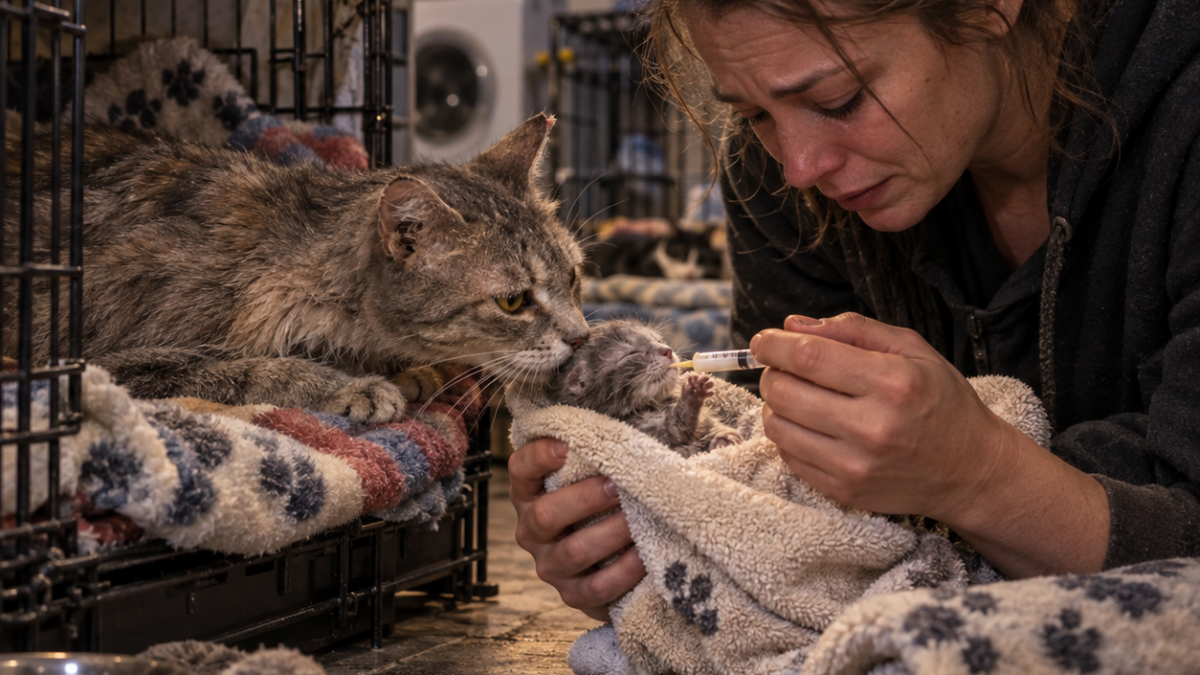
At the rescue, Lucy was in the cardboard nest.
One tiny gray kitten lay against her belly.
He was so small I could have held him in one hand.
Lucy had curled her body around him.
She cleaned him obsessively.
Head.
Back.
Legs.
Then started over.
“Any others?” I asked.
Melissa shook her head.
“We waited. Vet says sometimes single-kitten litters happen.”
I crouched near the crate.
Lucy immediately covered the kitten with her front leg.
“Okay.”
I backed up.
“I’m not taking him.”
She watched.
“What are we calling him?”
Melissa shrugged.
“You found her emotionally.”
“That’s not a thing.”
“It is at six in the morning.”
I looked at the kitten.
“Charlie.”
“Why?”
“I don’t know.”
“Very scientific.”
“Thank you.”
Charlie squeaked.
Lucy bent over him instantly.
That first week, she barely moved away from him.
We pushed her food almost underneath her nose because she refused to cross the crate to eat.
If Charlie made any sound, Lucy’s head snapped toward him.
If he slept too deeply, she nudged him.
If I opened the door, she wrapped herself over him.
On the third day, I tried to change the bedding.
That was the first time she hissed.
Not a theatrical hiss.
Not aggression.
Fear.
I froze with my hand inside the crate.
Lucy pulled Charlie against her chest.
Her eyes met mine.
And something about the expression stopped me.
There was no animal simplicity in it.
It was complicated.
Suspicion.
Exhaustion.
Warning.
And underneath all of it, desperation.
Please don’t.
That was what I heard.
Maybe I projected it.
People would later accuse me of doing exactly that.
But I was there.
I know what I saw.
I withdrew my hand.
“Okay.”
Lucy did not relax.
“I can wait.”
So I did.
I started sitting outside her crate every evening.
At first, I talked because silence felt awkward.
I told her about work.
“You would not believe the woman who yelled at me today because UPS delivered her package one day late.”
Lucy blinked.
“I know. Society is collapsing.”
Another night:
“My car is making a sound.”
No reaction.
“It’s a new sound.”
One ear moved.
“Exactly.”
I told her about my apartment.
The radiator that clanked.
The neighbor upstairs who vacuumed at midnight.
The grocery store changing the layout so I could no longer find anything.
Sometimes I told her about Mom.
I don’t know why.
Maybe because Lucy didn’t answer.
“She would’ve liked you,” I said one night.
Lucy had begun allowing me to sit closer.
“Actually, that’s a lie. She would’ve said you look judgmental.”
Lucy stared.
“See?”
Charlie grew slowly.
Too slowly.
We weighed him every morning.
The numbers went up.
Then stopped.
Then went up half an ounce.
Then down.
At ten days old, he was still frighteningly tiny.
Melissa said, “He’s nursing.”
“I know.”
“Maybe he’s just small.”
I wanted to believe that.
But once you’ve watched somebody die, you become suspicious of reassurance.
Small changes become alarms.
Long naps become threats.
The shape of a breath matters.
At night, I found myself waking at home wondering whether Charlie was warm.
I began stopping at the rescue before work.
Then after.
One morning, I opened the crate and Lucy did something new.
She didn’t cover him.
She watched me.
That was all.
But it felt enormous.
“Good morning.”
I changed the water.
Moved slowly.
Charlie crawled across the blanket.
I reached one finger toward him.
Lucy tensed.
I stopped.
Waited.
She looked at my hand.
Then my face.
Then Charlie.
I touched his back.
One finger.
Less than a second.
Lucy didn’t move.
My throat tightened.
“Thank you.”
Melissa walked in behind me.
“Did you just thank a cat for letting you touch her kitten?”
“No.”
“You absolutely did.”
“Mind your business.”
By two weeks, Lucy allowed me to change bedding.
By the third week, she ate from a dish while I sat nearby.
That sounds small.
Rescue teaches you a different scale.
A frightened animal eating with its back turned to you can feel like winning a war.
Then came the night Charlie nearly died.
It had been a brutal day at work.
One of our systems went down.
Calls backed up.
A supervisor who had never answered a customer call in her life sent three emails about “maintaining service excellence.”
I got to the rescue almost an hour later than usual.
The building was mostly dark.
Melissa had left.
Our evening volunteer had texted that everything was fine.
I entered the quiet room.
Lucy was awake.
Too awake.
Her body was stiff.
Charlie lay beside her.
Still.
I knew before touching him that something was wrong.
“Oh, no.”
I opened the crate.
Lucy didn’t hiss.
Didn’t block me.
Didn’t reach.
She looked directly at me.
That terrified me.
“Charlie?”
I touched him.
Cold.
Not freezing.
Wrong.
His body felt loose.
My knees nearly gave out.
“No, no, no.”
I scooped him into a towel.
Lucy followed my hands with her whole body.
I called the emergency vet.
The technician gave instructions while I warmed Charlie.
Heating pad under towels.
Slow.
Not too hot.
Stimulate.
Small amounts of formula.
I found the bottle.
My hands shook so badly I spilled half the powder.
Lucy came out of the crate.
That was unusual.
She pressed her nose against Charlie’s head.
“Come on.”
I placed one tiny drop at his mouth.
Nothing.
Another.
His tongue moved.
“That’s it.”
Lucy’s nose touched my fingers.
I don’t think she realized she was touching me.
“Come on, baby.”
Drop.
Swallow.
Drop.
Swallow.
Forty minutes.
Maybe fifty.
I lost track.
My legs went numb from sitting on the floor.
Lucy stayed beside the towel.
Every few seconds she nudged Charlie.
At one point, she looked up at me.
Her whole body trembled.
I had seen people cry without tears before.
My mother did it.
That night, I saw an animal do the same thing.
Then Charlie moved.
Barely.
One front paw opened.
Closed.
Lucy made a sound.
Soft.
Not a meow.
Something between a chirp and a sigh.
I burst into tears.
“Okay.”
I laughed while crying.
“Okay, okay.”
By sunrise, Charlie was warm enough to nurse.
Lucy curled around him.
She cleaned his face.
Then, for the first time since I had known her, she slept deeply.
Her head dropped beside Charlie.
Eyes closed.
Whole body loose.
I sat outside the crate watching her.
Ten minutes.
Maybe twelve.
Lucy trusted me enough to sleep.
That moment changed everything.
People later asked when I decided I would protect them as a pair.
I always lied a little and said it happened at the adoption event.
The truth?
It happened that morning.
I just didn’t know it yet.
Charlie recovered.
A month later, he was no longer a fragile little comma of a kitten.
He became ridiculous.
Round cheeks.
Huge ears.
Four legs that seemed to disagree about direction.
He attacked shoelaces.
Climbed fleece blankets.
Fell asleep face-first in the food dish.
He developed a squeaky meow that sounded like somebody stepping on a bath toy.
And Lucy adored him.
Not casually.
She monitored him.
If he went behind a box, she followed.
If he climbed too high, she sat beneath him.
If another cat cried in the next room, Lucy positioned herself between Charlie and the sound.
She washed him long past the point he wanted washing.
He would kick at her face.
She ignored him.
“You’re embarrassing him,” I told her.
Lucy cleaned harder.
At eight weeks, I began fostering them at home.
Officially temporary.
The rescue needed the quiet room.
Three new intakes were coming.
I had space.
Sort of.
My apartment was six hundred and forty square feet.
But I told myself two cats for a few weeks wouldn’t matter.
That was before Charlie discovered 3 a.m.
Lucy adjusted more slowly.
For the first several days, she lived behind my armchair.
Charlie treated the apartment like he’d inherited it.
He ran from bedroom to kitchen.
Skidded into walls.
Attacked his reflection in the oven.
Tried to climb my shower curtain.
Lucy followed three feet behind.
Not playing.
Watching.
I started seeing her differently.
At the rescue, Lucy had seemed like a frightened cat.
In my apartment, I saw how much of her fear was attached specifically to Charlie.
She wasn’t afraid only for herself.
She expected him to disappear.
Every time.
If I picked him up, Lucy watched.
If he entered another room, she listened.
If he slept too still, she touched him.
Trauma creates rituals.
Humans have them.
Animals too.
I checked locks three times after my mother’s death because the world suddenly felt capable of breaking into ordinary days.
Lucy counted Charlie’s breaths.
The rescue began receiving adoption inquiries.
At first, I was excited.
“Someone asked about them.”
Melissa corrected me.
“About Charlie.”
“Oh.”
“Another family too.”
“Lucy?”
“No.”
More inquiries came.
Charlie.
Charlie.
Charlie.
People loved his photos.
Gray fluff.
Round eyes.
Tiny paws.
Lucy stood behind him in some pictures.
People asked, “Is the adult included?”
Included.
Like packaging.
At ten weeks, Melissa called me on a Saturday morning.
I was making toast.
Charlie had both front paws inside my laundry basket.
Lucy was holding his tail with one paw.
“Anna.”
The tone.
I knew.
“What?”
“We need to talk.”
“I hate when people start with that.”
“We have three nursing mothers on the waiting list.”
My stomach tightened.
“Okay.”
“And people want Charlie.”
“Okay.”
Pause.
“Nobody wants Lucy.”
There it was.
I looked at her.
Lucy had started washing Charlie’s head.
He protested loudly.
Nobody wants Lucy.
“I want Lucy.”
“That’s not what I mean.”
“I know.”
Melissa exhaled.
“We’re drowning.”
I leaned against the counter.
The rescue wasn’t a villain.
That made everything harder.
Melissa had personally bottle-fed orphaned kittens at two in the morning.
She drove thirty miles once to collect an injured stray from a gas station.
She had taken out a personal credit card to pay an emergency surgery bill.
She cared.
But caring doesn’t create space.
“We may need to list Charlie separately.”
“No.”
The answer came so quickly even I heard it.
“Anna.”
“They’re bonded.”
“He’s a kitten.”
“So?”
“Mother cats wean kittens.”
“She’s not finished.”
“Emotionally?”
“Yes.”
Silence.
I knew how that sounded.
Melissa spoke carefully.
“Anna, I’m not saying she doesn’t care about him.”
“Good.”
“But animals adjust.”
I looked toward Lucy.
Her paw was over Charlie’s back.
“They adjust because they have no choice.”
“Sometimes.”
“That doesn’t mean we should create the loss.”
“We have other animals needing cages.”
“I know.”
“If Charlie gets adopted, that’s one placement.”
“I know.”
“Lucy might do better without constantly guarding him.”
That one stopped me.
Could she?
Was I protecting the bond or projecting onto it?
Rescue gives you no clean answers.
If love alone solved everything, shelters wouldn’t exist.
I asked, “What do you want?”
“Bring them to the adoption event next Saturday.”
“Together?”
“Yes.”
“And?”
“Let’s see what happens.”
I agreed.
For the next week, dread followed me.
I told myself I was being irrational.
No decision had been made.
An adoption event was just exposure.
But Lucy seemed restless too.
On Friday night, she slept on the floor beside Charlie rather than on the couch.
At two in the morning, I woke and found her licking his face.
“He’s fine.”
She looked at me.
“I promise.”
The problem with promises is they sound strongest right before you might break them.
The event was held in a community room next to a discount grocery store.
Folding tables.
Plastic chairs.
Metal coffee urn.
Handmade signs.
Volunteers with forced cheerful voices.
Crates lined the walls.
Kittens drew crowds immediately.
Children dragged parents by the hand.
Phones came out.
“Aww.”
“Look at this one.”
“So tiny.”
Adult cats sat behind wire doors watching people pass.
The imbalance bothered me more than usual.
Maybe because Lucy was now one of them.
I set her and Charlie in a larger crate with their blue blanket.
Charlie marched straight to the front.
Lucy stayed behind him.
Ten minutes later, a family approached.
Mother.
Father.
Little girl, maybe seven, wearing pink glasses.
The girl gasped when she saw Charlie.
“He looks like a stuffed animal.”
Charlie placed both paws on the crate door.
Traitor.
The father laughed.
“He’s cute.”
The mother pulled out her phone.
Lucy watched from the back.
The girl crouched.
“What’s his name?”
“Charlie.”
“And her?”
“Lucy.”
“Is that his mom?”
“Yes.”
The girl’s face brightened.
“That’s his mommy.”
Something about her saying it mattered.
Not “the adult.”
Not “the other cat.”
Mommy.
The mother asked, “Can she be handled?”
“She’s shy.”
“Does she bite?”
“No.”
“Scratch?”
“When terrified, any cat can scratch.”
That answer didn’t reassure her.
“Can we hold the kitten?”
I looked at Lucy.
Then Melissa across the room.
She gave a small nod.
I opened the crate.
Lucy moved forward immediately.
Not hissing.
Just placing herself between my hand and Charlie.
The little girl smiled.
“She’s protecting him.”
“Yes.”
I moved slowly.
“Lucy.”
Her ears went sideways.
“It’s okay.”
Charlie, having no sense of emotional complexity, climbed over his mother toward me.
I lifted him.
Lucy’s paw reached out.
Touched my sleeve.
No claws.
Just contact.
My heart hurt.
“I’m right here.”
The little girl stroked Charlie with one finger.
He purred.
That was apparently all it took.
The parents looked at each other.
The mother asked, “Is he available on his own?”
Everything inside me tightened.
“They’re very attached.”
The father glanced at Lucy.
“We really only planned on one.”
“I understand.”
“We have another cat.”
“Okay.”
“Would an adult female cause problems?”
“Not necessarily.”
The mother smiled politely.
“We wanted something our daughter could grow up with.”
I looked at Lucy.
She looked exhausted.
People always want something young enough to become part of their future.
Older things remind us they had lives before us.
Histories.
Habits.
Damage.
The little girl asked, “Can the mommy come too?”
Her parents exchanged a look.
“Honey,” the mother said, “two cats is a lot.”
The girl frowned.
“But she loves him.”
Nobody answered.
I returned Charlie.
Lucy grabbed him immediately.
Pulled him underneath her chest.
Washed his ear.
The family moved on.
The girl looked back twice.
By noon, three other people asked about Charlie.
No one asked about Lucy.
A woman in a red sweater crouched near the crate.
“The kitten is adorable.”
“His name’s Charlie.”
“What’s wrong with the mom?”
I stared.
“What do you mean?”
“She looks rough.”
“Hunger. Stress. She was found pregnant outside.”
“Is she friendly?”
“She’s learning.”
The woman stood.
“I don’t want baggage.”
Baggage.
I looked at Lucy.
Patchy fur.
Torn ear.
Yellow eyes.
Baggage.
Another man asked whether she was feral.
“No.”
“She hiding because she’s mean?”
“She’s hiding because this room has fifty strangers in it.”
He shrugged.
“Same difference.”
“No.”
He looked surprised.
“It isn’t.”
My voice had sharpened.
“Scared isn’t mean.”
“Okay.”
“Guarded isn’t aggressive.”
“I got it.”
“Quiet isn’t broken.”
He walked away.
Melissa came over.
“You okay?”
“No.”
“Anna.”
“I said no.”
She lowered her voice.
“You’re taking this personally.”
“I know them personally.”
“That’s exactly the problem.”
I looked at her.
She looked immediately regretful.
“I didn’t mean—”
“You did.”
“I mean you’re attached.”
“Yes.”
“Fosters get attached.”
“Why do people say that like attachment is a procedural error?”
She rubbed her forehead.
“We’ll talk later.”
By the end of the event, Charlie had six names on an interest list.
Lucy had zero.
Melissa showed me the clipboard.
I hated the paper.
That sounds irrational.
But there it was.
Evidence.
Charlie could have a home immediately.
Lucy could wait.
Maybe a week.
Maybe six months.
Maybe longer.
Adult cats wait.
Shy cats wait.
Mother cats wait after their kittens are gone.
Scarred cats wait.
Animals who don’t perform charm for strangers become invisible.
“You see the problem,” Melissa said.
“I see it.”
“Then you understand.”
“I didn’t say that.”
She sighed.
“We don’t have unlimited space.”
“I know.”
“One of the pregnant cats is literally in somebody’s garage right now.”
“I know.”
“Her finder says they can’t keep her past Monday.”
“I know.”
“Charlie has options.”
“And Lucy doesn’t, so she should lose him?”
“That’s not what I’m saying.”
“It’s what the system is saying.”
Melissa’s face tightened.
“What do you want me to do, Anna? Close intake?”
“No.”
“Tell people we can’t take the mother in the garage because these two need to stay together forever?”
“No.”
“Then help me.”
That silenced me.
Not because I agreed.
Because she was exhausted too.
We were two women trying to solve arithmetic with hearts.
There weren’t enough homes.
Not enough money.
Not enough cages.
Not enough people willing to adopt the difficult animal.
No villain.
Just scarcity.
Sometimes scarcity does cruel things without anybody intending cruelty.
I drove home with the carrier in the passenger seat.
Charlie slept.
Lucy didn’t.
At home, I opened the carrier.
Charlie exploded into the apartment like he’d spent the afternoon planning crimes.
Lucy followed.
Then stopped.
She sniffed him.
Head.
Back.
Legs.
Tail.
Each paw.
Counting.
When she finished, she gripped the loose skin behind his neck and dragged him behind my armchair.
Charlie protested.
Lucy curled around him.
She didn’t emerge for an hour.
I sat on the floor nearby.
“I’m sorry.”
Her eyes met mine.
No hiss.
No blink.
I had betrayed something anyway.
That night, I posted a photo.
Charlie upside down on the kitchen rug biting his foot.
Lucy behind him with one paw resting against his belly.
I wrote:
Charlie is thriving because Lucy never gave up on him. She’s shy, cautious, and still learning that people can be safe. We’re hoping to find them a home together.
At first, comments were kind.
“Keep them together!”
“What a mama.”
“She looks exhausted.”
Then the practical people arrived.
“You’re making adoption harder.”
“Most families can’t take two.”
“Rescues don’t have the luxury of being sentimental.”
“Animals separate naturally.”
“Stop humanizing them.”
Then one comment appeared.
A kitten’s chance at a good home matters more than a cat’s feelings.
I read it once.
Twice.
Three times.
The person hadn’t insulted me.
Hadn’t used profanity.
Hadn’t said anything obviously monstrous.
That made it worse.
It sounded reasonable.
Adult.
Efficient.
The kind of sentence that lets people close doors while believing nobody is crying on the other side.
I typed:
You weren’t there when she—
Deleted it.
Typed:
Maybe feelings should matter—
Deleted.
Typed:
I hope nobody ever decides your pain is inefficient.
Deleted.
I closed Facebook.
But the sentence stayed.
A kitten’s chance at a good home matters more than a cat’s feelings.
I washed dishes.
Took a shower.
Got into bed.
At 2:14 a.m., Charlie launched himself onto my mattress.
Lucy followed.
That was new.
She had never climbed onto my bed.
Too close.
Too exposed.
Charlie crawled behind my knees.
Lucy stood near my feet.
Watched.
Then slowly lowered herself.
She stretched out.
Fully.
Not curled to protect herself.
Not ready to run.
Her paw touched Charlie’s back.
She closed her eyes.
The apartment was silent.
No television.
No artificial voices.
Just the refrigerator humming and two cats breathing.
I thought about Mom.
During the last months of her illness, people used the word practical constantly.
Be practical about time.
Money.
Treatment.
Work.
Hospice.
Driving.
Sleep.
They weren’t wrong.
That was the painful part.
Practicality isn’t evil.
But sometimes we worship it because numbers don’t cry.
Mom once told me, “You can survive almost any decision if you can still recognize yourself afterward.”
I hadn’t understood her then.
Lying in bed with Lucy and Charlie, I did.
Maybe the decision wasn’t what was efficient.
Maybe it was what I could live with.
The next morning, Melissa called.
“I have an application.”
My stomach dropped.
“For?”
“Charlie.”
“Of course.”
“It’s strong.”
“Lucy?”
“They cannot take two.”
“Of course.”
“Anna.”
“What?”
“They have vet references. Indoor-only home. Another cat. Good income.”
“Great.”
“They met him Saturday.”
“Pink glasses?”
“No. Different family.”
Even worse somehow.
“They want to move quickly.”
“When?”
“Tomorrow, if approved.”
My throat closed.
“Tomorrow?”
“We need placement.”
“I know.”
“I’m emailing you the application because you’re the foster.”
“Why?”
“Because I don’t want you thinking we’re going behind your back.”
The application arrived.
I didn’t open it at work.
I waited until lunch.
Name.
Address.
House.
Veterinary reference.
Stable employment.
One existing cat.
No children under five.
They sounded perfect.
That made me cry in my car.
I hated myself for wanting them to be unsuitable.
I wanted one red flag.
Outdoor access.
Declawing.
Anything.
Nothing.
They wrote:
We fell in love with the gray kitten from Saturday’s event.
The gray kitten.
I knew it was unfair to resent that.
They didn’t know Charlie.
How could they?
But to me he wasn’t a gray kitten.
He was the tiny body that had gone cold in my hands.
The baby Lucy wouldn’t leave to eat.
The squeak she answered from across a room.
A life connected to another life.
I went back to work with swollen eyes.
At 5:30, I drove to the rescue.
Melissa was waiting.
The application lay printed on the desk.
“Did you read it?”
“Yes.”
“They’re good.”
“I know.”
She watched me.
“I’m not asking you to like this.”
“That’s generous.”
“Don’t.”
“I’m sorry.”
The washing machine thumped behind us.
Somewhere in the cat room, an animal yowled.
Melissa sat.
“We’re drowning.”
“I know.”
“No, Anna. We’re actually drowning.”
She pulled out a notebook.
“Four cats surrendered this week.”
I stared.
“Two seniors.”
She continued.
“One because the owner died. One because the family moved.”
“Stop.”
“Another pregnant stray coming tomorrow.”
“I said stop.”
“I need you to see the whole board.”
“And I need you to see Lucy.”
“I do.”
“No. You see space.”
Her face changed.
That hurt her.
I regretted it immediately.
“Melissa—”
“Do you think I don’t care?”
“I didn’t say that.”
“You think I haven’t held a mother cat after her kittens left?”
Silence.
“You think I don’t hear them calling?”
My anger drained.
Melissa’s eyes filled.
“Do you know how many times I’ve taken the ‘leftover mother’ home overnight because she wouldn’t stop crying?”
I didn’t.
“No.”
“I hate this too.”
That was when I finally understood.
She wasn’t asking me to become hard.
She was asking me to help her survive being soft in a system that punished softness.
“What am I supposed to do?”
“I don’t know.”
“That’s not helpful.”
“No.”
We both laughed once.
Tired.
Melissa tapped the application.
“You can say no as the foster.”
“Can I?”
“Technically the rescue has final authority.”
My stomach turned.
“But I won’t override you.”
I looked up.
“Why?”
“Because I’ve watched them too.”
There it was.
Hope.
“But I need a plan.”
“What kind?”
“If they stay together, we need either a committed adopter or—”
She stopped.
“Or?”
Melissa looked directly at me.
“Or you admit what everybody else already knows.”
I knew immediately.
“No.”
“Anna.”
“I can’t.”
“Why?”
“Money.”
Fair.
“Apartment?”
Pets allowed.
“Time?”
I looked away.
“Grief?”
That angered me.
“Don’t.”
“I’m not using it against you.”
“It sounded like it.”
She softened.
“I’m asking whether you’re afraid to keep something because you know you could lose it.”
That hit too close.
I grabbed the application.
“I need a night.”
Melissa nodded.
At home, I put the paper on my kitchen table.
Lucy jumped onto the chair.
I swear she did.
Placed one paw near the application.
Stared at me.
“This is manipulation.”
Lucy blinked.
Charlie was under the table attacking my sock.
“You raised an idiot.”
She looked down at him.
I made tea.
Didn’t drink it.
Read the application again.
These people weren’t bad.
That was what made the choice difficult.
Charlie could have been happy there.
I believed that.
Maybe Lucy would grieve.
Maybe she would adjust.
Maybe she would eventually become calmer without constantly watching him.
Maybe I was standing in the way of a good home because I needed their bond to mean something about my own grief.
Every accusation I had read online came back.
You’re projecting.
You’re emotional.
You can’t save them all.
Rescue isn’t about you.
I sat at the table.
Lucy stayed beside the paper.
“Tell me what to do.”
She began washing one paw.
“Useless.”
Charlie climbed onto the chair.
Lucy immediately stopped grooming herself and washed him instead.
“You’re both impossible.”
That night, they slept on my bed again.
Around three, I woke.
Charlie sprawled behind my knees.
Lucy at my feet.
Her body fully relaxed.
She was dreaming.
Little paw twitching.
I stared at her.
Because she finally sleeps.
The sentence appeared whole.
Because she finally sleeps.
That was it.
Not because separating them would definitely destroy her.
I couldn’t prove that.
Not because every mother and kitten should stay together forever.
That wasn’t realistic.
Not because I knew better than every rescue professional.
I didn’t.
Because this cat, this specific cat, after hunger, fear, birth, and nearly losing Charlie, had finally reached a place where she could close her eyes.
And I couldn’t be the one who taught her that safety was temporary.
At 8:12 the next morning, I called Melissa.
“I’m saying no.”
Silence.
“To the application?”
“Yes.”
“Okay.”
“And I’m adopting them.”
Longer silence.
“Both?”
“Don’t make me say it twice.”
“You can’t afford them.”
“Very supportive.”
“I’m serious.”
“So am I.”
“Anna.”
“I’ve done the numbers.”
I had not.
“Have you?”
“No.”
She laughed.
Then started crying.
That made me cry.
“I’m not proving anything,” I said.
“I know.”
“I’m not trying to be a hero.”
“I know.”
“I’m probably going to complain constantly.”
“I definitely know.”
“Why are you crying?”
“Because I was hoping you’d say it.”
That stopped me.
“What?”
“I’m not supposed to say that as coordinator.”
“You absolutely are not.”
“But I’ve seen Lucy with you.”
“You spent all weekend telling me practicality.”
“That’s my job.”
“And this?”
“That’s me.”
I drove to the rescue after work.
Melissa had paperwork ready.
Adoption agreement.
Medical history.
Microchip forms.
Fee schedule.
I stared at the total.
“Can I split this?”
“Already arranged.”
“You’re an enabler.”
“Sign.”
I signed.
Lucy Carlson—
“No last name,” Melissa said.
“She’s getting mine?”
“If you want.”
I laughed.
“Anna Whitaker, Lucy Whitaker, Charlie Whitaker. That’s embarrassing.”
“You’ve crossed worse lines.”
Permanent home.
Those words appeared near the bottom.
Permanent.
Beautiful word.
Terrifying word.
I signed again.
Then another form.
When we finished, Melissa came around the desk and hugged me.
“I smell like litter.”
“So do I.”
In the parking lot, I sat in my car and cried.
Not sad.
Not exactly happy.
Something larger.
I called my mother.
Of course, her number had been disconnected for two years.
I didn’t literally call.
I talked aloud.
“I adopted two cats.”
Rain tapped the windshield.
“You’d say I’m crazy.”
Pause.
“No.”
I smiled.
“You’d say Dad did worse.”
My father, who died when I was twenty-seven, used to bring home broken things.
Chairs.
Lamps.
Radios.
An entire dining table with one missing leg.
Mom complained.
Then made room.
Dad always said, “Somebody just has to see what it’s supposed to be.”
I had thought he meant furniture.
When I got home, Charlie ran into my shoe.
Lucy stood halfway down the hallway.
I knelt.
“You’re stuck with me.”
She didn’t move.
“Both of you.”
Charlie tried to chew my shoelace.
Lucy watched.
I extended my hand.
Slowly, she approached.
Touched her nose to my finger.
Tiny gesture.
Everything.
I posted one update that night.
Lucy and Charlie are home for good.
Then:
Some families are made by blood. Some by paperwork. Some begin when a frightened mother finally feels safe enough to close her eyes beside the only baby she has left.
Comments came.
Most kind.
Some not.
“You let emotions win.”
“You could’ve helped more cats by freeing the foster space.”
“This is why rescue becomes inefficient.”
“You can’t save every sad story.”
I read them.
For once, I didn’t collapse under them.
Some people weren’t cruel.
They were scared of scarcity too.
They were thinking about the cats still waiting.
I understood that.
So I wrote one reply.
I know we can’t save them all. But I also believe the ones we do save shouldn’t always have to lose everything twice.
That comment got shared.
I didn’t expect that.
A woman wrote:
This made me cry.
A man replied:
My wife and I adopted a bonded pair last year because a rescue asked us to reconsider taking only the younger one. Best decision we made.
Someone else:
You cannot apply this to every animal, but maybe we should stop pretending efficiency is the same thing as compassion.
Then came a message that changed the rescue itself.
Anonymous.
A money order arrived at Harbor Street.
Two hundred dollars.
Note:
For the next mother cat nobody wants.
Melissa sent me a picture.
I cried at my desk.
Then another donor brought senior-cat food.
A retired man came in and said, “Show me the ones everybody walks past.”
A teenager organized a blanket drive.
A couple paid the adoption fee for two bonded brothers.
One family that originally wanted a kitten asked to meet adult cats.
Nothing miraculous.
We were still full.
Still broke.
Still receiving calls faster than we could answer.
But people looked twice.
That matters.
The family with the pink-glasses girl contacted me a month later.
The mother’s message said:
You probably don’t remember us.
I did.
We met Lucy and Charlie at the adoption event. My daughter kept asking what happened to “the mommy cat.” We ended up adopting an eight-year-old orange tabby last week.
I stared.
She attached a photo.
The little girl sat on a couch.
Big orange cat on her lap.
The mother wrote:
She told us kittens aren’t the only ones who need someone to grow old with.
I put my phone down and cried.
Then picked it up.
Your daughter has a good heart.
The reply:
She learned something from Lucy.
That almost broke me.
Lucy never knew any of this.
Of course not.
She spent her days learning my apartment.
Window.
Chair.
Kitchen.
Bed.
She did not become affectionate overnight.
That’s not how trust works.
People love before-and-after stories because the middle is boring.
The middle is where healing happens.
Weeks of nothing dramatic.
Lucy stopped hiding when I vacuumed.
Then stopped running when I stood too quickly.
Then began sitting in the same room.
Then closer.
One evening, she jumped onto the couch.
I froze.
She sat beside my hip.
Not touching.
I stayed completely still.
Twenty minutes.
My leg went numb.
I didn’t care.
Charlie climbed onto my chest and fell asleep with his mouth open.
Lucy stared at him.
Then at me.
Then placed one paw on my thigh.
Light.
Barely weight.
I started crying.
Charlie woke and looked offended.
Lucy kept her paw there.
“Hi, mama.”
Slow blink.
That was the night my apartment stopped feeling empty.
Not because it became quiet in a better way.
It became loud.
Charlie knocked over plants.
Tracked litter.
Stole socks.
Dragged a dish towel into the litter box once.
I stood over it for a full minute questioning every choice that led me there.
Lucy stole toast.
Not from a plate left unattended.
From my hand.
Then ran.
“You have become a criminal.”
She disappeared behind the couch.
They scratched my chair.
Shed on everything.
Woke me at impossible hours.
Vet bills arrived.
Then my car finally died.
Of course it did.
January.
Parking lot at work.
Turned the key.
Click.
Nothing.
Repair estimate: $1,184.
I stared at the paper.
Then at my bank account.
Then cried.
Again.
I cried a lot that year.
Not always from sadness.
Sometimes numbers.
For two weeks, coworkers gave me rides.
I took the bus twice.
Walked from a stop in freezing wind.
I cut everything.
Takeout.
Streaming subscription.
New boots.
Coffee on workdays.
One evening, I stood in a grocery store pet aisle.
Cheap cat food in one hand.
The better food Lucy needed in the other.
My cart had ramen noodles, canned soup, eggs, bread.
I did the math.
Again.
Again.
I chose the better cat food.
Put back a package of chicken for myself.
A woman beside me laughed kindly.
“Spoiled cats?”
I almost said yes.
Instead:
“No. Just loved.”
She looked surprised.
So did I.
On hard nights, I wondered whether the critics had been right.
Maybe I’d let emotion win.
Maybe adoption had been financially stupid.
Maybe being able to love something wasn’t the same as being able to afford it.
Those were fair questions.
Love does not pay veterinary bills.
Romanticizing struggle helps nobody.
I started a small emergency savings envelope labeled CATS, which felt both responsible and depressing.
I picked up occasional overtime.
The rescue helped with discounted vaccines because I still volunteered.
I made it work.
Not heroically.
Not easily.
I learned something I wish people said more often:
Choosing love does not remove consequences.
Sometimes it simply makes the consequences worth carrying.
That winter, I came home after a twelve-hour shift.
Lucy was asleep in the middle of the living room floor.
Not under furniture.
Not near an escape route.
In the open.
Charlie sprawled against her.
Her belly exposed slightly.
I stood in the doorway.
Safety.
That was what I was looking at.
Not cuteness.
Not sentiment.
Safety made visible.
Whatever I gave up financially, I knew one thing.
I could live with this decision.
Months passed.
Charlie grew.
Then kept growing.
Long legs.
Gray tail.
Permanent expression of innocent stupidity.
He became larger than Lucy.
Lucy still washed him.
Charlie still protested.
Then leaned into her.
Their relationship changed.
That mattered too.
At first, Lucy’s love had been fear.
Hold him.
Count him.
Follow him.
Don’t lose him.
Slowly, love became trust.
Charlie entered rooms without her.
Lucy lifted her head.
Listened.
Stayed.
The first time that happened, I noticed.
He disappeared into the bedroom.
Lucy tensed.
Her ears followed the sound.
He returned thirty seconds later carrying my sock.
She relaxed.
“See?”
Lucy looked at me.
“He comes back.”
I don’t know whether she understood.
I did.
My mother’s death had taught me everything leaves.
Lucy had been teaching herself something more difficult.
Some things return.
Love isn’t always gripping hard enough to prevent movement.
Sometimes it’s believing footsteps will come back down the hall.
One year after Lucy arrived, Melissa called.
“I need you to come in.”
My stomach reacted automatically.
“What happened?”
“Nothing bad.”
“I don’t believe rescue people when they say that.”
“Come after work.”
At Harbor Street, she took me to the quiet room.
A brown tabby mother sat inside a crate with four kittens.
Thin.
Wide eyes.
Angry-looking.
I knew that anger.
Terror wearing armor.
“Someone already asked about two kittens,” Melissa said.
“Not her.”
She smiled tiredly.
“You know.”
One kitten squeaked.
The mother pulled it close.
“You’re not asking me to foster.”
“No.”
“Good.”
“You’d say yes and then hate me.”
“Correct.”
Melissa handed me papers.
New adoption application.
I skimmed.
Then saw a new line.
Would you consider adopting the mother with one or more kittens if they appear strongly bonded?
I looked up.
“We can’t always do it,” Melissa said.
“I know.”
“We can’t promise families stay together.”
“I know.”
“We still have to place animals.”
“I know.”
“But we can ask.”
I looked at the question again.
One line.
One extra question.
Not policy revolution.
Not morality solved.
Just:
Would you consider the mother too?
My eyes filled.
Melissa groaned.
“Don’t cry.”
“You did this.”
“Partly.”
“Why?”
“Because you were annoying.”
“Good.”
“And because you were right about one thing.”
“Only one?”
“Feelings belong in the decision.”
I hugged her.
“Still smell like litter.”
“So do you.”
The new form didn’t fix everything.
Some mothers were separated from kittens.
Sometimes that was appropriate.
Sometimes necessary.
Some bonds turned out to be weaker than foster humans assumed.
Some animals thrived apart.
Rescue remained complicated.
That’s important.
I don’t believe Lucy’s story proves one universal rule.
It proves something smaller.
Before convenience makes the choice for us, look.
Observe.
Ask.
Is there a bond here?
Is fear being mistaken for bad temperament?
Are we choosing the easy animal because we don’t want to understand the difficult one?
One extra question can change a life.
Maybe more than one.
That same day, I walked through the adult cat room.
A black cat sat in the back of a crate.
Nine years old.
Cloudy eyes.
Didn’t come forward.
Didn’t meow.
Before Lucy, I might have passed.
Not because I was cruel.
Because I didn’t know.
I crouched.
“Hi, old man.”
He looked at me.
Slow blink.
I sat there five minutes.
A month later, he was adopted by the retired man who had asked to see the cats everyone ignored.
His name became Winston.
I visited once.
Winston slept on a heated blanket beside a recliner while the man watched baseball.
“You know,” he told me, “I almost got a kitten.”
“What changed your mind?”
He scratched Winston’s head.
“I’m too old to be raising teenagers.”
Fair.
Online, the Lucy debate kept returning.
A local page ran the headline:
OHIO WOMAN REFUSED TO SEPARATE MOTHER CAT FROM HER ONLY KITTEN.
That did exactly what headlines are designed to do.
Created teams.
Hero.
Idiot.
Kind.
Selfish.
Emotional.
Compassionate.
People argued.
One wrote:
Nature separates animals all the time.
I looked at Lucy.
Charlie slept under her chin.
“It’s just nature,” I said.
Lucy opened one eye.
Maybe separation is nature.
So is attachment.
So is grief.
So is fear.
So is nurturing.
People invoke nature strangely.
Usually when it helps justify what they already want.
A year later, Harbor Street asked me to write an anniversary update.
I stared at the blank screen for an hour.
Finally:
One year ago, Lucy came to us frightened, hungry, and pregnant. She gave birth to one kitten, Charlie. She nearly lost him, then spent weeks keeping one paw on him as if love itself were something she had to physically hold in place.
When Charlie became old enough for adoption, people wanted him.
Almost nobody wanted her.
I was told separating them would be practical.
Maybe it would have been.
Instead, I adopted them both.
Lucy is still cautious. Charlie is still ridiculous. They sleep together every night.
I don’t believe every mother cat must stay with every kitten forever. Rescue is more complicated than slogans.
But I do believe this:
When we have the chance to protect a bond instead of automatically breaking it for convenience, we should at least ask ourselves why breaking it feels more normal.
I hesitated over the last sentence.
Then remembered the comment.
A kitten’s chance at a good home matters more than a cat’s feelings.
I posted.
It spread farther than expected.
Messages came.
Photos of bonded cats.
Old dogs with younger companions.
Mother cats adopted with kittens.
People admitted regrets.
I separated two cats years ago. I didn’t know they were bonded until afterward.
I adopted the kitten and left the mother. I still think about her.
I used to think older animals wouldn’t attach to me.
Those messages hurt.
But regret isn’t useless if it becomes different behavior.
I wanted to tell every person:
Not knowing yesterday does not require punishing yourself forever.
Know today.
Do better tomorrow.
That lesson applies far beyond animals.
How often do we choose the easy version of someone?
The cheerful one.
Young.
Healthy.
Uncomplicated.
The version without history.
Without fear.
Without needs that might inconvenience us.
How often do we avoid the person who flinches?
The one who doesn’t trust quickly.
The one who asks too many questions because experience taught them questions matter.
The tired parent.
The grieving friend.
The aging relative.
The difficult coworker.
The traumatized animal in the back of the crate.
We say some hearts are too much work.
Then wonder why the world feels lonely.
Lucy never tried to teach anyone anything.
She is a cat.
She wants food.
Warmth.
Cardboard boxes two sizes too small.
Charlie.
Occasionally my toast.
She doesn’t care about symbolic meaning.
That’s one reason animals humble us.
They don’t know when we’re turning them into lessons.
Years passed.
Charlie became a long-legged adult cat with no respect for personal property.
Lucy stayed smaller.
Her coat filled in.
The torn ear remained.
I grew to love it.
Every night, they had choices.
My bed.
Chair.
Window.
Heated mat.
Couch.
They chose the same corner.
Charlie curled first.
Lucy circled.
Lay beside him.
Sometimes his head rested on her side.
Sometimes her paw covered his back.
Not desperate anymore.
Just there.
Memory without panic.
Love after fear loosened its grip.
One night around three, I woke to a sound.
I walked into the living room.
Lucy sat alone by the window.
Charlie slept on the couch.
Moonlight reflected her face faintly in the glass.
She saw me.
Years earlier, she would’ve run.
She didn’t.
She looked at Charlie.
Then walked toward me.
Slow.
Silent.
She pressed her head against my ankle.
Not an accidental brush.
A full lean.
Her weight.
Trust.
I bent down.
Touched the torn edge of her ear.
She closed her eyes.
I thought about the first day I reached for Charlie.
How she covered him.
How she looked at me like I was about to steal her whole world.
Maybe every hand before mine had taken.
Food.
Shelter.
Safety.
Freedom.
Maybe people had chased her away.
Maybe she had lost kittens before.
Maybe not.
I’ll never know.
But in that moment, Charlie slept safely behind us.
Her food bowl was full.
The apartment was warm.
Nobody was coming for him.
Nobody was coming for her.
“You kept him alive,” I whispered.
Lucy opened her eyes.
“And you kept me alive too.”
That was the sentence I almost never said.
People accept stories about humans rescuing animals.
They become uncomfortable when you say an animal rescued something in you.
Because that can sound sentimental.
Unhealthy.
Overstated.
I agree animals should not be treated as emotional medicine.
They aren’t therapists.
They don’t exist to fix us.
Lucy owed me nothing.
Charlie owed me less.
But relationships change living creatures in both directions.
Before Lucy, I came home and turned on television so I wouldn’t hear how empty my apartment was.
After Lucy, I came home because someone needed medicine.
Food.
Clean water.
A litter box.
I got out of bed because Charlie was vomiting.
I laughed because he lost a fight with a sock.
I sat quietly because Lucy was brave enough to approach.
Responsibility pulled me outward.
Grief had made my life small.
Love made it inconvenient again.
Alive again.
The next morning, Charlie knocked my coffee spoon to the floor.
Then chased it under the stove.
Lucy watched him with the exhausted expression of a mother wondering where she went wrong.
I laughed until I had to sit down.
The kitchen was messy.
Loud.
Litter in the hallway.
Cat hair on my work pants.
A water dish I had nearly stepped in.
Alive.
Melissa came over for dinner a few weeks later.
Lucy sat on the sofa.
Charlie climbed into Melissa’s purse.
“He’s stealing something.”
“Probably.”
Melissa tried to remove him.
Charlie objected.
Lucy watched.
“Remember when we almost adopted him out?”
Melissa asked.
I looked at Lucy.
“Yes.”
“Do you hate me for pushing?”
“No.”
She seemed surprised.
“I did for about forty-eight hours.”
“Fair.”
“But you weren’t wrong about the rescue.”
“We really were drowning.”
“I know.”
She looked at Lucy.
“I still think about the other mother cats.”
“So do I.”
“That’s the thing people never understand.”
“What?”
“Sometimes there isn’t a choice where nobody loses.”
That sentence stayed with me.
Rescue stories online usually have clean endings.
Saved.
Adopted.
Home.
Real rescue contains losses.
Animals we couldn’t take.
Treatments we couldn’t fund.
People who waited too long.
Kittens separated because no joint home existed.
Fosters who burned out.
Volunteers who had to stop.
Compassion doesn’t guarantee success.
It guarantees only that somebody tried to see the whole cost.
A year later, Melissa became director of Harbor Street.
One of her first changes was a “family bond observation period” for mothers and older kittens.
Not mandatory lifetime pairing.
Not sentimental policy.
Observation.
Notes.
Behavior.
Does mother search frantically when kitten leaves?
Does appetite change?
Do they sleep together?
Does kitten rely unusually heavily on mother?
Do they appear independent?
Data.
Feelings translated into something a system could use.
“Look at you,” I told her.
“Science.”
“You’re unbearable.”
Applications still asked:
Would you consider the mother too?
Adoptions changed slightly.
Not dramatically.
But slightly mattered.
A mother named June went home with one of her kittens because a family originally seeking one cat reconsidered.
Two bonded sisters were placed together.
A senior cat named Elsie got adopted by a woman who came in for kittens but saw her sleeping in the back.
Somebody else still chose a kitten alone.
That was okay.
Compassion is not coercion.
It is attention.
It is allowing facts besides cuteness into the decision.
The little girl with pink glasses sent Harbor Street a Christmas card one year.
Her orange cat, Morris, wore a ridiculous sweater.
The card said:
Thank you for teaching us to ask about the cat nobody asks about.
Melissa framed it.
I cried.
Again.
I’m consistent.
The hardest year came later.
Not because of the cats.
Because I lost my job.
The medical supply company reorganized.
That’s corporate language for twenty-three people carrying boxes to their cars.
I got severance.
Small.
Unemployment.
Smaller.
For the first time since adopting Lucy and Charlie, I genuinely feared I had made a promise I couldn’t keep.
Rent.
Utilities.
Food.
Vet care.
I updated my résumé.
Applied everywhere.
Interviews.
Nothing.
My emergency fund shrank.
One afternoon, I sat at my kitchen table with bills arranged in rows.
Lucy jumped onto the chair beside me.
Charlie sat directly on a bill.
“Helpful.”
He lay down.
I laughed.
Then cried.
“I don’t know if I can do this.”
Lucy watched.
That night, I called Melissa.
“I need to ask something humiliating.”
“No.”
“What?”
“You don’t need to call it humiliating.”
I closed my eyes.
“Food.”
“Done.”
“Melissa—”
“The rescue has a pet pantry.”
“That’s for people in crisis.”
Silence.
“Oh.”
“Welcome to being people.”
I hated it.
Accepted it.
That taught me another lesson.
Sometimes love means receiving help.
I’d spent years believing responsible people handled their own commitments.
Then strangers and donors who would never know my name helped feed Lucy and Charlie for six weeks.
No questions.
No shame.
I got a new job.
Lower pay at first.
Better environment.
We recovered.
I later donated twice what I’d received to the pantry.
Not because I owed a debt.
Because somebody had protected my family when practical circumstances changed.
Everything loops.
Years passed.
Charlie stopped being kitten-shaped.
Lucy developed arthritis.
That scared me.
The first time I saw her hesitate before jumping onto the couch, my chest tightened.
Age.
The thing nobody can negotiate with.
I bought steps.
She refused them for three weeks.
Then began using them when she thought I wasn’t watching.
Charlie adapted too.
He slept closer.
Groomed her sometimes.
Badly.
She tolerated it.
The child had become the caretaker in small ways.
One winter evening, I found them on the couch.
Charlie washing Lucy’s torn ear.
She had her eyes closed.
I sat beside them.
“You did okay, mama.”
Lucy opened one yellow eye.
Charlie kept washing.
For years, Lucy had behaved as though Charlie’s survival depended entirely on vigilance.
Now she could let him take care of her.
That’s another shape love makes if you give it enough time.
The final lesson Lucy taught me had nothing to do with whether I was right to keep them together.
It was this:
Protecting someone does not always mean keeping them exactly where they began.
Lucy eventually let Charlie become his own animal.
She stopped following every step.
Stopped waking when he entered another room.
Stopped checking each nap.
She loved him enough to relax.
I learned something watching that.
My choice to keep them together had never been about freezing their bond in place.
It was about giving them enough safety that the bond could change naturally instead of being cut for convenience.
That’s the distinction I wish the internet arguments had understood.
Love isn’t always holding tight.
Sometimes it is creating enough security that nobody has to.
On the fifth anniversary of Lucy’s arrival, Harbor Street held a small open house.
Nothing fancy.
Coffee.
Cookies.
Adoption photos.
Donor board.
Melissa asked me to speak.
I refused.
She asked again.
“No.”
“You talk constantly.”
“Not into microphones.”
“Five minutes.”
“Absolutely not.”
Then she threatened to tell everyone about the time Charlie got stuck in my shower curtain.
I agreed under protest.
There were maybe forty people.
Volunteers.
Adopters.
Donors.
The pink-glasses girl was there.
Older now.
Morris’s picture on her mother’s phone.
The retired man who adopted Winston sat in the second row.
Winston had died peacefully the year before.
His adopter still donated black-cat food every month.
I stood in front.
Hands shaking.
“I don’t give speeches.”
Melissa coughed loudly.
“Apparently I do.”
People laughed.
I looked at a photograph behind me.
Lucy and Charlie.
The old adoption-event picture.
Charlie at the front.
Lucy behind him.
That image hurt differently now.
“I used to think this story was about whether I should separate a mother cat from her kitten.”
I paused.
“I don’t anymore.”
People watched.
“I think it’s about what we consider worth saving.”
The room quieted.
“Charlie was easy to see.”
I pointed to his photo.
“Small. Cute. Healthy enough to adopt. People stopped for him.”
Then Lucy.
“Lucy had patchy fur, a torn ear, fear, and history.”
I swallowed.
“People looked through her to reach him.”
Melissa lowered her eyes.
“I don’t think those people were bad.”
That mattered to say.
“Most were trying to make responsible choices. Some couldn’t afford two cats. Some genuinely weren’t equipped for a frightened adult animal.”
I looked around.
“The problem wasn’t that everyone should have taken Lucy.”
Pause.
“The problem was that almost nobody asked what losing Charlie might cost her.”
Silence.
“That question changed me.”
I looked at the audience.
“We cannot solve every need.”
“Harbor Street still says no sometimes.”
Melissa nodded.
“We still make hard placements.”
“We still separate animals when that’s appropriate.”
“But compassion doesn’t require that we always say yes.”
I took a breath.
“It requires that before we make something convenient for ourselves, we notice who pays for the convenience.”
That sentence was the only part people remembered.
It showed up later on the rescue page.
I was embarrassed.
But maybe it deserved to.
Afterward, the pink-glasses girl came over.
She was twelve now.
“My cat is fat.”
“Congratulations.”
“My mom says he’s supposed to lose two pounds.”
“Tragic.”
She looked at Lucy’s photo.
“Do you remember me?”
“Yes.”
“I wanted Charlie.”
“I remember.”
She smiled.
“Thanks for not giving him to me.”
I laughed.
“You’re welcome?”
“If you had, we wouldn’t have Morris.”
Her mother stood behind her.
“We also wouldn’t have learned what we learned.”
I looked at the girl.
“What did you learn?”
She answered immediately.
“That the one who doesn’t come to the front might still be waiting.”
I had to look away.
Years later, when Lucy became old, she slept more.
Charlie remained near her.
Not constantly.
But often.
The torn ear turned thinner.
Her yellow eyes clouded slightly.
The cat who once refused to sleep around humans began sleeping everywhere.
Couch.
Chair.
Bed.
Middle of the floor.
Once on my work sweater.
Safety had become so ordinary she could be careless with it.
That’s what I wanted for her.
Not gratitude.
Not affection.
Carelessness.
The belief that nothing terrible would happen simply because she closed her eyes.
One Saturday morning, I woke before sunrise.
Charlie was beside me.
Lucy wasn’t.
I found her in the living room.
On the same blue blanket I’d taken from the rescue years earlier.
The one she and Charlie had shared at the adoption event.
He had kneaded holes into it as a kitten.
I had kept it.
Lucy lay alone.
Awake.
I sat beside her.
“Hey, mama.”
She lifted her head.
Charlie came in.
Lay beside her.
She didn’t wash him.
Didn’t need to.
He placed his head against her side.
I touched her back.
She leaned into my hand.
For a long time, the three of us stayed there.
I thought about the first night.
Scared pregnant cat in a carrier.
I told her nobody would hurt her.
She didn’t believe me.
She was right not to.
Trust shouldn’t be demanded by strangers.
It should be earned by repetition.
Food.
Gentle hands.
Doors that open.
People who return.
Promises that survive inconvenience.
I had not been perfect.
I got frustrated.
Forgot medication once and drove home from work in panic.
Complained about vet bills.
Yelled when Charlie broke a lamp.
Cried over money.
Needed help.
Love didn’t make me saintly.
It made me responsible.
There’s a difference.
Lucy slept.
Charlie breathed beside her.
I whispered, “You were never the leftover.”
Her ear moved.
That phrase had haunted me.
The mother nobody wanted.
The difficult part.
The baggage.
The cat standing behind the cute kitten.
She was never extra.
Never packaging.
Never the obstacle between Charlie and a happy ending.
She was part of the ending.
Without Lucy, Charlie would not have survived his first weeks.
Without Charlie, Lucy might never have learned to trust me.
Without both of them, I don’t know who I would have become after my mother died.
Lives are connected.
That doesn’t mean every connection can remain forever.
Death guarantees otherwise.
But it means we should be careful when we decide one life matters more because it’s easier to love.
Lucy taught me that.
Not intentionally.
Cats rarely respect a lesson plan.
That evening, she ate dinner.
Charlie stole from her bowl.
She hit him on the head.
Normal.
I laughed.
Years earlier, I had been terrified to separate them because Lucy seemed unable to survive letting him go.
Now he was bigger.
Independent.
She trusted the world slightly more.
Their love no longer looked desperate.
That didn’t prove I had been wrong.
It proved we had gotten somewhere.
Sometimes the purpose of keeping something safe is not to keep it dependent.
It is to let it become free without fear.
I still volunteer at Harbor Street.
Less often now.
My knees complain about cleaning lower cages.
The washing machine was finally replaced.
Melissa held a mock funeral.
We still have mismatched blankets.
Still too many cats.
Still people asking for kittens.
But now, when families come in, volunteers ask:
“Would you like to meet the mother too?”
Sometimes the answer is no.
Sometimes yes.
Sometimes someone pauses.
Looks at the quiet cat in the back.
That pause matters.
There is a little sign near the adoption desk now.
Not mine.
Melissa wrote it.
It says:
LOOK TWICE.
That’s all.
Because sometimes mercy begins there.
Not with a grand sacrifice.
Not with taking home every animal.
Not with making yourself responsible for more than you can carry.
Just looking twice.
At the older cat.
The nervous dog.
The mother after the babies become cute enough to leave.
The person who seems difficult.
The friend who stopped answering.
The parent who moves slower now.
The version of somebody that isn’t polished enough to attract attention.
Look twice.
Maybe you’ll still walk away.
But at least you will know what you are walking away from.
People still occasionally ask me if I regret adopting both cats.
Especially when I tell them about the money.
The car repair.
The pet-food pantry.
The emergency vet visit after Charlie ate ribbon.
The furniture.
The sleep.
My answer surprises them.
“No.”
Then I usually add:
“But that doesn’t mean it was easy.”
We confuse those two things.
A correct choice does not always feel easy.
A loving choice does not guarantee comfort.
Sometimes you choose what is right for you and then spend years paying for it in money, time, worry, and cat hair.
I’d still choose it.
Not because everyone should.
Because I know myself.
My mother was right.
I can survive hard decisions.
What I couldn’t survive was no longer recognizing the person who made them.
The night before the anniversary of Lucy coming home for good, I woke around 2:30.
Charlie slept near my feet.
Lucy was beside my pillow.
That was new.
I turned my head.
Her face was inches from mine.
One cloudy yellow eye half-open.
“Personal space.”
Slow blink.
“Remember when you thought I was going to steal your baby?”
She closed her eye.
“I almost let them.”
I don’t know why I said it.
Maybe guilt never disappears completely.
“I almost did.”
Lucy breathed.
“I thought being practical might mean ignoring what I saw.”
Charlie shifted.
Lucy touched him with one paw.
Still.
After all those years.
Not gripping.
Just touching.
I smiled.
“But I saw you.”
That was the whole thing.
I saw her.
Not perfectly.
Not scientifically.
Not with certainty about every animal emotion.
But enough.
Enough to know fear mattered.
Enough to know attachment mattered.
Enough to know this particular relationship deserved consideration beyond whether Charlie could be adopted faster alone.
Enough to make one choice.
Then another.
Then a life.
In the morning, Charlie knocked my spoon onto the floor.
Some things never improve.
Lucy watched from the doorway.
I fed them.
Made coffee.
Sunlight crossed the kitchen.
My apartment was no longer quiet.
It hadn’t been quiet for years.
I used to think loneliness meant nobody else was in the room.
Now I know you can be surrounded and lonely.
You can also be alone and not lonely.
Loneliness is sometimes what happens when nothing in your life asks you to belong.
Lucy and Charlie asked.
Not with words.
Food bowl.
Vet appointment.
Warm bed.
Consistency.
Presence.
And I belonged.
That’s what they gave me.
So when people ask whether I chose emotion over practicality, I tell them the truth.
Yes.
And no.
I considered money.
Space.
Rescue capacity.
Adoption opportunities.
The other cats.
I listened to people who disagreed.
I lost sleep.
I didn’t make the decision because feelings were the only thing that mattered.
I made it because feelings were one of the things that mattered.
That’s the distinction.
Practicality without compassion becomes cruelty with clean paperwork.
Compassion without practicality can become chaos.
We need both.
But when the world insists only one of them counts, the vulnerable always pay first.
Lucy had already paid enough.
Tonight, as I write this, Charlie is asleep in the corner of the couch.
He’s bigger than his mother.
Much bigger.
Gray body curled like he still believes he’s ten weeks old.
Lucy lies beside him.
She circles first.
Settles.
He rests his head against her side.
She places one paw over him.
Not tight.
Not afraid.
Just there.
If you walked into my apartment without knowing the story, you wouldn’t see anything remarkable.
Two cats sleeping.
That’s all.
No dramatic rescue.
No bottle feeding.
No adoption fight.
No internet arguments.
No paperwork.
No moral.
Just sleep.
But I remember the first time I reached for Charlie.
Lucy’s body closing around him.
That look.
Don’t take him.
I remember the adoption event.
Families stopping for him.
Walking past her.
I remember the clipboard full of names.
Zero beside Lucy.
I remember the application on my table.
The perfect family.
The practical solution.
I remember the night she stretched out on my bed and finally closed her eyes.
I remember walking into Harbor Street and saying, “They stay together.”
I remember Melissa asking why.
Because she finally sleeps.
Years later, that is still my answer.
People want big reasons.
Numbers.
Arguments.
Universal principles.
Sometimes one sleeping animal is enough.
Maybe you would’ve chosen differently.
Maybe you run a rescue and know choices I never had to make.
Maybe two animals would have been impossible for you.
Maybe you think I got lucky.
Maybe I did.
I’m not asking everybody to become me.
I’m asking something smaller.
When there is a mother in the back of the crate and everyone is reaching past her for the kitten, look at her too.
When something appears difficult, ask whether it is difficult or frightened.
When something seems less desirable because life has marked it, remember that survival leaves evidence.
When the easy choice requires somebody else to absorb all the loss, notice that.
Then decide.
That’s all.
Just don’t pretend the cost disappeared because it wasn’t yours.
Lucy had one kitten.
One.
She loved him like he was every warm thing she had ever lost and every safe thing she had ever hoped to find.
For a while, she held him too tightly because fear told her love meant never letting go.
Then safety taught her something better.
Charlie could leave the room.
And return.
He could climb.
Fall.
Grow.
Become bigger than her.
He could sleep across the apartment.
She no longer had to count every breath.
That is Lucy’s victory.
Not that she kept her baby forever.
That she loved him long enough, and safely enough, to stop being terrified every time he moved away.
And maybe that is mine too.
I spent two years after my mother’s death believing loving anything deeply was just volunteering for another loss.
Lucy arrived already convinced of something similar.
Two frightened creatures.
One human.
One cat.
Both trying not to mistake peace for a trap.
Charlie, naturally, feared nothing.
Maybe that’s because Lucy did all the fearing for him.
Maybe that’s what parents do until they learn not to.
Maybe that’s what love does when it hasn’t healed yet.
Now Lucy sleeps.
Charlie wanders.
I go to work.
Come home.
Doors open.
Footsteps return.
Nobody has to hold on quite so hard anymore.
That is what safety looks like after years of fear.
Quiet.
Ordinary.
Almost boring.
And for me, that ordinary sight is worth every difficult decision that brought us here.
I did not save just the cute part.
I did not save just the easy part.
I saved the whole story.
And tonight, Lucy is asleep.
For some people, that will never be enough reason.
For me, it is everything.








