Everyone Thought the Sick cat had rabies—Until One Rescuer Followed His Morning Journey and Discovered He Had Been Returning for a Reason That Left the Entire Alley in Tears
PART3:
She was standing behind the front desk at Willowbend Veterinary Clinic, sorting appointment cards while a golden retriever in the waiting room tried to eat a magazine.
“Looking terrible isn’t the same as being rabid,” she said.
“I know that,” Mrs. Boyd replied, though her voice said she did not know it enough. “But parents are panicking. Mr. Kline from the hardware store said he’s calling animal control if no one does something.”
Elena glanced at the clock.
Her shift ended in twenty minutes.
“Tell everyone to stay away from him,” she said. “No one touches him. No one tries to trap him. No one throws anything at him.”
There was a pause.
“Elena.”
Her stomach tightened.
“What?”
“Someone already threw a broom yesterday.”
Elena stopped sorting the cards.
“At the cat?”
“He was near the back door of the dry cleaner. Mr. Kline said he was protecting himself.”
“Did the cat attack him?”
“No.”
“Then Mr. Kline was not protecting himself.”
Mrs. Boyd was quiet.
“I’ll be there in half an hour,” Elena said.
When Elena arrived behind the shops, the alley had that early morning grayness that made everything look more exhausted than it was. Rain from the night before had collected in shallow puddles. A truck idled behind the bakery. The smell of warm bread mixed with old garbage and wet concrete.
Mr. Kline stood outside the hardware store’s back entrance with a broom in one hand.
He was a broad man in his sixties with a red face, suspenders, and a habit of speaking as if volume were proof.
“You came about the cat?” he asked.
“I came to look.”
“Don’t get close.”
“I don’t plan to.”
“He’s got rabies.”
Elena looked at him.
“Did a veterinarian tell you that?”
“You can see it.”
“No,” she said. “You can see he’s sick. That’s not the same thing.”
Mr. Kline huffed.
“Drooling. Sores. Weird sounds. What else do you need?”
“A diagnosis.”
He muttered something about bleeding hearts and city nonsense, though they were standing behind a hardware store in a neighborhood where the closest thing to a city skyline was the cell tower behind the laundromat.
Elena ignored him.
She saw the cat near the storage wall.
He was worse than Mrs. Boyd had described.
That was the truth.
Elena had seen mange, infections, abscesses, broken jaws, poisoning, starvation, neurological damage, and the slow devastation of animals who had lived too long unseen. This cat looked like several miseries had found him at once.
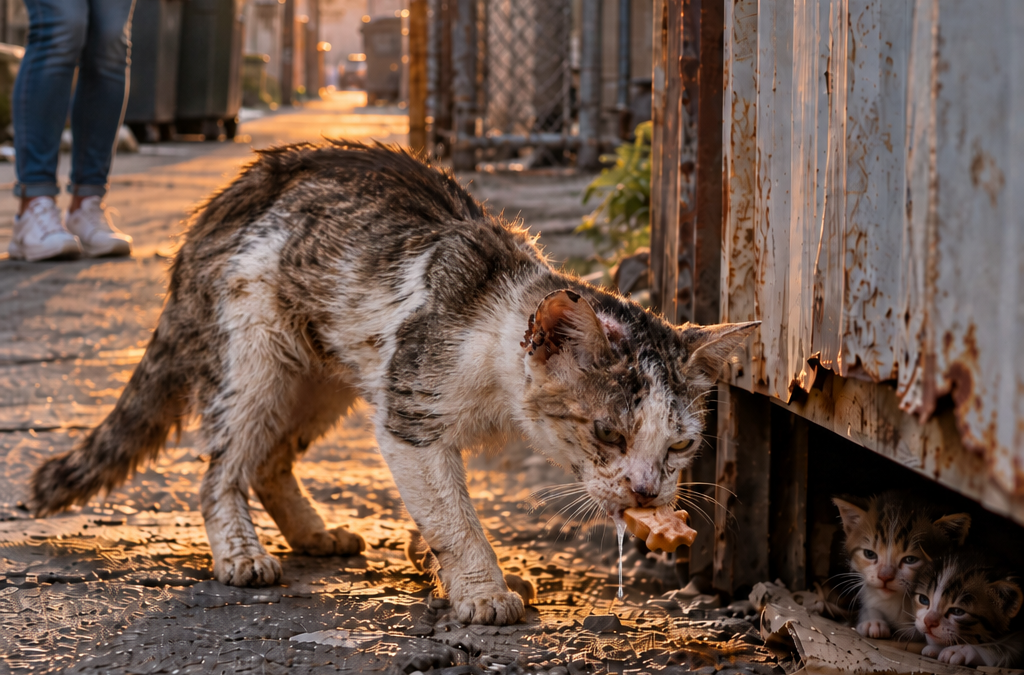
He stood near the bent metal panel with his head lowered, breathing hard.
His body trembled. His mouth hung slightly open, saliva darkening the fur beneath his chin. One eye was partly crusted. His front paw hovered briefly before he set it down, as if the pavement hurt.
Elena did not move toward him.
Fear does not become kindness just because it is wrapped in good intentions.
A sick, terrified animal can bite. A bite can be serious. A suspected rabies case must be handled professionally. Elena knew that better than most. She had the scars and vaccine records to prove she had learned some things the hard way.
So she stayed back.
She called the rescue team she trusted most: North County Animal Response.
Not the county shelter intake line.
Not a random officer with a catch pole and no patience.
North County had trained rescuers, protective equipment, quarantine protocols, and a veterinarian on call who understood that symptoms needed investigation, not gossip.
While waiting for them, Elena watched.
That was another thing rescue had taught her.
Before acting, watch.
Animals tell the truth in patterns.
The cat was not wandering randomly.
He kept returning to the same gap beneath the metal panel.
He would step away, look around, then come back.
Once, a delivery truck slammed its back door, and the cat flinched so hard he nearly fell. Still, after a moment, he dragged himself back to the wall.
“See?” Mr. Kline said from behind Elena. “Crazy.”
Elena did not answer.
A few minutes later, Mrs. Boyd came out of the diner holding a white paper bag.
“I brought a biscuit,” she said quietly. “In case.”
Mr. Kline frowned.
“Don’t feed it.”
Elena took the bag.
“Thank you.”
But before she could decide where to place it, the cat moved.
He turned away from the wall and limped toward the dumpster behind the diner. His gait was uneven and painfully slow. Every few steps, he stopped and lowered his head, swallowing hard as if his mouth hurt.
A small crowd had formed at a distance now.
Mrs. Boyd.
Mr. Kline.
Two employees from the dry cleaner.
A teenage boy with a skateboard.
A mother holding a little girl’s hand.
People always gather for suffering when they are not the ones suffering.
The cat reached the edge of the dumpster.
There, near the curb, lay a scrap of food.
Something pale.
Maybe chicken.
Maybe bread.
He sniffed it.
Elena held her breath.
Surely he would eat.
He was starving. Anyone could see that.
His ribs moved under his dirty coat. His sides had caved inward. His legs shook with weakness.
But he did not eat.
He picked up the scrap in his mouth.
The movement looked painful. His jaw trembled. Saliva stretched from his mouth to the pavement. He nearly dropped the food twice.
Then he turned and began limping back toward the wall.
The alley went quiet.
Even Mr. Kline stopped talking.
The cat crossed the cracked pavement with the scrap clenched weakly in his mouth. He reached the bent metal panel, lowered his head, and placed the food near the narrow gap.
Then, with the side of his nose, he nudged it underneath.
Elena’s whole body went still.
“What is he doing?” Mrs. Boyd whispered.
The cat stood there a moment, panting.
Then he pressed his face to the gap and made that weak, unsettling sound again.
Only now Elena heard it differently.
Not aggression.
Not madness.
Calling.
“He’s feeding something,” she said.
Mr. Kline scoffed, but it sounded uncertain.
“Feeding what?”
Elena was already moving, carefully, keeping her distance but changing her angle so she could see the wall better.
The panel was part of an old storage enclosure that had once covered electrical supplies or maintenance equipment. It had warped away from the brick at the bottom, leaving a narrow opening no wider than a man’s hand. Behind it, the space disappeared into darkness.
The cat turned toward her.
His head dropped.
A wet sound came from his throat.
Elena froze.
“I’m not taking it,” she said softly, though she did not know whether he heard the meaning or only the tone. “I’m trying to help.”
The cat stared.
His body shook.
Then, incredibly, he turned back toward the gap.
Not away from her.
Toward it.
Protecting.
Or begging.
Maybe both.
The rescue truck arrived seven minutes later.
To Elena, it felt like an hour.
Two responders stepped out, both wearing gloves and carrying equipment. One was a tall Black woman named Tasha Reed, who had been rescuing animals for nearly fifteen years and had the calm authority of someone who could walk into chaos and make it lower its voice. The other was a younger man named Ben, broad-shouldered and serious, with protective gear tucked under one arm.
Tasha greeted Elena with a quick nod.
“What do we know?”
“Sick adult cat. Drooling, sores, possible neurological signs. No reported bites. Avoiding people unless approached. But he keeps returning to that panel. I watched him carry food and push it underneath.”
Tasha’s expression changed.
“Under the panel?”
“Yes.”
“Could be kittens.”
“That’s what I’m thinking.”
Mr. Kline stepped forward.
“I’m telling you people, that cat is rabid. You need to put it down before it bites somebody.”
Tasha looked at him.
“Sir, please step back.”
“I own a business here.”
“And right now you’re standing too close to a potentially sick animal.”
He stepped back.
Not because he agreed.
Because Tasha’s tone left no room for debate.
The rescue was careful.
They did not rush the cat.
They did not corner him with panic.
They used protective gloves, a humane net, a secure carrier, and practiced movements. Even so, the cat fought with the last scraps of strength he had.
Not wildly.
Not viciously.
Desperately.
The moment Ben moved toward the wall, the cat twisted, trying to drag himself back to the gap. He made that awful wet sound again, louder now, and his front claws scraped against the pavement.
“He’s trying to get back,” Mrs. Boyd whispered, crying openly.
Elena stood with her hands clenched at her sides.
“I know, buddy,” Tasha murmured. “I know. We’re going to check.”
The cat was secured in the carrier, breathing hard, eyes fixed on the wall.
He did not look at the people.
Only the wall.
Over and over.
His body pressed against the carrier door, not toward escape, but toward the gap.
Tasha crouched several feet from the panel and listened.
At first, there was nothing.
Only distant traffic.
A compressor humming behind the dry cleaner.
Water dripping from a gutter.
Someone’s phone buzzing before they silenced it.
Then Elena heard it.
So faint she thought her own heart had invented it.
A tiny cry.
Everyone went still.
There it was again.
Thin.
Weak.
A kitten.
Mrs. Boyd covered her mouth.
The little girl near the alley whispered, “Mommy?”
Her mother pulled her close, eyes wide.
Tasha looked at Ben.
“Tools.”
They moved carefully.
The metal panel was rusted, bent, and partly screwed into rotting wood. Removing it too fast could collapse debris inward. Ben fetched a flashlight, a pry bar, and a small saw from the truck. Tasha kept her voice low, giving instructions.
Elena stayed near the cat’s carrier.
He was panting, eyes locked on the rescuers.
“They hear them,” she whispered to him. “They hear them now.”
His ears moved.
Maybe because of her voice.
Maybe because of the kitten crying again.
It took twelve minutes to remove the panel.
Twelve minutes can be an entire lifetime when something helpless is crying behind metal.
When the opening was finally wide enough, Tasha shone her flashlight inside.
Dust floated in the beam.
Old cardboard.
Strips of insulation.
A plastic bag.
A broken wooden crate.
Then she stopped.
“Oh,” she said softly.
No one breathed.
“What?” Elena asked.
Tasha reached in slowly.
Her gloved hand disappeared into the dark.
A moment later, she drew out a kitten.
Tiny.
Filthy.
Barely moving.
Its fur was dark gray, or maybe black beneath the dirt. Its eyes were crusted half shut. Its body fit into Tasha’s palm with room to spare.
A sound moved through the crowd.
Not words.
Something human and ashamed.
“There’s another,” Tasha said.
Ben held the flashlight steady while she reached in again.
The second kitten was orange and white.
Even weaker.
Its little head lolled against Tasha’s glove before it let out one thin cry.
The adult cat in the carrier struggled at the sound.
Not violently.
Urgently.
He pressed himself toward them, claws hooking through the carrier grate.
Elena knelt beside him, careful not to touch.
“They’re out,” she whispered. “They’re out. You did it.”
The cat stared through the carrier bars.
Tasha placed the kittens into a warmed transport box with soft towels and a heating pad wrapped safely beneath them.
“They’re cold,” she said. “Dehydrated. Critical.”
“But alive?” Mrs. Boyd asked.
Tasha looked at her.
“Alive.”
Mrs. Boyd sobbed.
Even Mr. Kline said nothing.
The rescuers searched the cavity again.
No more kittens.
No mother cat.
No bedding except scraps of cardboard and old insulation.
Nothing that explained how the kittens had ended up there.
But Elena had a terrible feeling she already knew part of the answer.
The gap beneath the panel was too small for most adult cats to enter.
A mother cat might have squeezed through before the metal bent further. Or the kittens might have crawled in and become trapped. Or someone might have dumped them in the alley, where they found the only shelter they could.
The adult cat had found them.
However it happened, he had been the only one who knew.
For three days, while humans called him diseased and dangerous, while food bowls vanished and people crossed the street, he had dragged his failing body through the alley to feed two starving kittens he could not reach.
Not his own, maybe.
Not by blood.
No one knew.
But love does not always wait for blood to begin its work.
The rescuers loaded the kittens into the truck.
The adult cat was placed separately, secured for transport under suspected infectious or neurologic precautions. Tasha explained to the gathered crowd that no one should touch sick stray animals, no one should assume rabies by sight, and the cat would need veterinary evaluation and proper quarantine protocols.
Mr. Kline folded his arms.
“So it still could be rabies.”
“It could be many things,” Tasha said. “That’s why trained people handle it.”
“But if it is—”
“If it is, we follow protocol. If it isn’t, he deserves treatment.”
Elena watched the cat.
Something had changed.
The moment the kittens were placed in the warm box, he stopped fighting.
He lay down inside the carrier, chest rising and falling hard.
His eyes remained open, but the panic had left them.
He could not know the future.
He could not know tests, treatment, quarantine, outcomes, or whether the world would finally be kind.
But somehow, in whatever way animals know what matters, he seemed to understand the kittens were no longer trapped behind the wall.
As the rescue truck prepared to leave, Mrs. Boyd stepped close to Elena.
“I thought he was a monster,” she whispered.
Elena looked at the carrier.
“No,” she said. “He was just sick where people could see it.”
The truck drove away.
The alley stayed silent long after it turned the corner.
That evening, Elena went to North County’s veterinary partner clinic even though no one asked her to.
She could not stay home.
Some stories grab hold of you by the conscience.
She sat in the clinic waiting room with cold coffee in her hands while rain started again outside.
Tasha came out first.
Her uniform was stained. Her eyes were tired.
“Kittens?” Elena asked.
“Critical but responding to warmth and fluids. Both female. Maybe four weeks old. Severe dehydration, fleas, upper respiratory infection. But they’re fighting.”
Elena closed her eyes.
“And him?”
Tasha sat beside her.
“The vet is still examining him. They’re calling him Atlas.”
Elena looked over.
“Atlas?”
“Ben named him. Said he looked like he’d been carrying the whole world.”
That nearly undid Elena.
“Does he have rabies?”
“They’re following quarantine procedures. But the first assessment does not point strongly that way.”
“What is it?”
Tasha’s face hardened in that way rescuers’ faces do when sadness becomes anger.
“Severe mange. Advanced mouth infection. Broken tooth, possible jaw injury. Dehydration. Malnutrition. Secondary skin infections. He may have been exposed to some kind of chemical irritant or dirty runoff that worsened the sores.”
Elena swallowed.
“So the drooling…”
“Pain. Infection. Maybe nausea. His mouth is a mess.”
“And the sound he made?”
“Could be pain. Could be respiratory. Could be both.”
Elena leaned forward, elbows on knees, and pressed both hands over her face.
For three days, people had called him rabid because suffering had made him ugly.
Because pain had made him frightening.
Because nobody wanted to get close enough to wonder whether there was a reason.
“Will he live?”
Tasha did not answer right away.
“He’s very sick.”
“But?”
“But he ate.”
Elena lowered her hands.
“He ate?”
“A little. Once the kittens were in the incubator nearby, he settled enough to lick some food from a syringe.”
Elena cried then.
Not loudly.
Just one hand over her mouth, tears slipping down her face in the fluorescent light of the clinic.
Tasha let her.
Rescue people understand strange tears.
They know you can cry because an animal ate one teaspoon of food after nearly dying.
They know small victories can carry unbearable weight.
The next morning, Mason Street changed.
Not completely.
No neighborhood changes in one day.
But the story did.
Mrs. Boyd put a handwritten sign in the diner window.
THE ALLEY CAT WAS PROTECTING KITTENS. DONATIONS FOR VET CARE ACCEPTED INSIDE.
By noon, there was a jar beside the cash register.
At first, people dropped in coins.
Then bills.
Then a man from the dry cleaner placed a folded twenty in the jar without saying a word.
The teenage boy with the skateboard brought a bag of kitten formula his mother had bought.
A little girl drew a picture of an orange cat wearing a cape and taped it to the counter.
At the bottom, she wrote: GET WELL SOON MR. ATLAS.
Mr. Kline did not donate.
But he stopped calling the cat rabid.
For him, that was almost a confession.
Elena visited the clinic after work each day.
She knew better than to romanticize recovery. Atlas did not transform overnight into a beautiful, grateful cat. Real suffering does not dissolve just because people finally understand it.
He remained isolated under veterinary precautions.
His skin treatment made him look even more fragile at first.
His sores had to be cleaned.
His mouth had to be treated.
He needed fluids, antibiotics, pain control, careful feeding, and time.
The first week, he barely lifted his head.
But when the kittens cried from their incubator nearby, he listened.
Every time.
The gray kitten turned out to be the stronger one.
She hissed at a cotton swab on day two, which made the veterinary technician laugh and say, “That one’s got opinions.”
They named her Cricket.
The orange-and-white kitten was smaller, weaker, and heartbreakingly quiet. She slept curled against a stuffed sock warmed in the dryer. Elena named her Penny because she had been found in a place everyone stepped over.
On the fifth day, Tasha sent Elena a video.
It was only eleven seconds long.
Atlas lay on a towel inside his kennel, still ragged, still sick, his fur shaved in patches for treatment. A technician held Penny carefully near the kennel door, not letting them touch because of medical precautions.
Penny made a tiny squeak.
Atlas lifted his head.
Slowly.
Painfully.
Then he made one soft answering sound.
Not the wet, frightening sound from the alley.
Something lower.
Gentler.
Alive.
Elena watched the video six times.
Then she sat at her kitchen table and cried into her cold dinner.
She had not realized until that week how angry she was.
Not only at the people who had feared him.
Fear was not the worst sin.
Rabies was real. Disease was real. Bites were dangerous. People should be cautious. Elena knew that.
What hurt was the certainty.
The eagerness to decide his life was worth less because his suffering made others uncomfortable.
The way people saw drool and sores and immediately stopped seeing a creature.
The way ugly pain became guilt.
The way weakness became danger.
She had seen humans treated that way too.
Her brother Mateo had lived on the streets for nearly two years after their mother died. Addiction, grief, untreated depression—people had many labels for him. Some were true. None were complete.
Elena remembered seeing strangers cross away from him outside a gas station because his clothes were dirty and his hands shook. She remembered the looks. The disgust dressed up as caution. The relief when someone like him moved along.
Mateo died in a motel room when he was thirty-six.
For years, Elena had wondered whether anyone had seen him as more than a problem near a doorway.
Maybe that was why Atlas broke something open in her.
He looked terrifying in the alley.
So had Mateo, near the end.
But both of them had been carrying something no one saw.
Pain.
Need.
Love.
A reason to keep moving.
On the tenth day, Atlas was officially declared unlikely to be rabid based on evaluation, history, and quarantine observation, though the clinic continued appropriate precautions until protocols were complete. His diagnosis list was long and ugly: severe sarcoptic mange, infected oral wounds, fractured tooth, malnutrition, dehydration, secondary bacterial infections, and possible exposure to harsh cleaning chemicals behind the shops.
The veterinarian, Dr. Hannah Cho, explained it carefully to Elena and Tasha in the treatment room.
“He was drooling because his mouth hurt,” Dr. Cho said. “He likely couldn’t chew properly. The skin lesions and itching made him look much worse. He may have sounded strange because of pain and inflammation.”
“And people thought rabies,” Tasha said.
Dr. Cho sighed.
“People often assume the scariest explanation when an animal looks frightening. The correct response is caution and professional help, not panic and cruelty.”
Elena looked through the observation window at Atlas.
He was sitting up now.
Barely.
But sitting.
His eyes were clearer.
His face, though still raw in places, looked less like a mask of suffering and more like a cat’s face again.
“He was starving,” Elena said. “And still feeding the kittens.”
Dr. Cho’s mouth tightened.
“I know.”
“Why would he do that?”
The veterinarian was quiet for a moment.
“Animals are more complicated than people give them credit for.”
It was not a scientific answer.
It was the truest one.
When the story spread online, it did what stories do now.
It became bigger than the alley.
Mrs. Boyd’s niece posted about Atlas and the kittens with photos from the rescue’s page. The post spread across town, then farther. People commented with crying emojis, prayers, anger, donations, and arguments.
Some praised Atlas as a hero.
Some said calling animals heroic was silly.
Some argued about rabies.
Some blamed the neighborhood.
Some blamed the rescue system.
Some blamed Elena for not catching him sooner, though she had learned about him only on the third day. The internet is talented at arriving late and declaring itself judge.
Elena tried not to read comments.
She failed.
One comment in particular lodged under her skin.
People are acting like he’s noble. It’s just instinct.
Just instinct.
As if instinct were small.
As if love became less meaningful when the body understood it before the mind explained it.
Elena wanted to reply.
She wanted to write: If instinct makes a starving animal carry food past his own mouth to keep another creature alive, maybe instinct deserves more respect than half the choices humans make.
She did not.
Instead, she went to the clinic and sat near Atlas’s kennel while he ate soft food from a shallow dish.
He was messy.
Terrible table manners.
Food on his chin, paw in the bowl, one ear angled strangely from old injury.
To Elena, he looked magnificent.
Three weeks after the rescue, Cricket and Penny were strong enough to leave the incubator.
Their eyes cleared.
Their bellies rounded.
Cricket became a tiny menace.
Penny remained delicate but steady, with a habit of placing one paw on Cricket’s back whenever startled.
They were placed in a foster room at the clinic, and once Atlas completed quarantine and his mange was no longer contagious, Dr. Cho allowed a carefully supervised reunion.
Elena was there.
So were Tasha and Ben.
Even Mrs. Boyd came, wiping her hands on her diner apron because she had run over between breakfast and lunch.
Atlas had gained weight, though he was still thin. His fur was patchy from treatment. His face would probably always carry scars. One tooth had been removed. His mouth no longer dripped saliva. He moved stiffly but with more strength.
When Dr. Cho opened the carrier, Atlas stepped out slowly.
Cricket and Penny were in a soft playpen with warm blankets.
At first, they did not recognize him.
They were kittens, after all. Their world had become warmth, bottles, hands, towels, medicine, and sleep.
Atlas approached the playpen.
Penny looked up.
She froze.
Then she let out a squeak.
Cricket, bolder, stumbled toward the mesh side.
Atlas lowered his head.
Penny pushed her tiny nose against the barrier.
Atlas closed his eyes.
No dramatic leap.
No music.
No miracle glow.
Just one scarred, exhausted cat standing with his head lowered while two kittens pressed themselves toward him as if some deep part of their bodies remembered the creature who had brought food to the dark.
Mrs. Boyd sobbed into a napkin.
Ben looked at the ceiling.
Tasha muttered, “I’m fine,” to absolutely no one.
Elena placed one hand over her chest.
She thought of the alley.
The bent panel.
The food scrap.
The way everyone had feared him when he was doing the most loving thing of his life.
“I’m sorry,” she whispered.
Atlas did not look at her.
He was watching the kittens.
That was enough.
The investigation into how the kittens ended up behind the wall began because of something small.
A blue rubber band.
When the metal panel had been removed, Ben had collected debris from the cavity in case there were hazards or evidence of dumping. Among the cardboard, insulation, and trash was a torn piece of a paper grocery bag from Mason Street Market and a blue rubber band of the kind used by the produce supplier.
That meant nothing by itself.
Trash travels.
Wind carries things.
Alleys collect the evidence of everyone’s carelessness.
But then the teenage boy with the skateboard, whose name was Dylan, came into the diner one afternoon and asked for Elena.
“I saw something,” he said.
Elena set down her coffee.
“When?”
“Before the cat got famous.”
He looked embarrassed by the word famous.
“What did you see?”
Dylan shifted his weight.
“My stepdad said not to get involved.”
Mrs. Boyd, who was behind the counter, narrowed her eyes.
“Your stepdad says a lot of things that are none of his business.”
Dylan almost smiled.
Then he looked at Elena again.
“Like a week before. Maybe more. I was skating behind the shops early because the parking lot is empty then. I saw a guy by the storage wall.”
“What guy?”
“I don’t know his name. Works at the market sometimes. Younger. Beard. Always wears that green jacket.”
Elena knew who he meant.
Travis Bell.
Nephew of the market owner.
Mid-twenties.
Careless in that ordinary way some people mistake for harmless until it harms something small.
“What was he doing?”
“He had a box. Like a produce box. It was making noise.”
Elena’s stomach tightened.
“What kind of noise?”
Dylan looked down.
“Like kittens.”
Mrs. Boyd said, “Lord have mercy.”
“I thought maybe he found them and was moving them,” Dylan rushed on. “I didn’t think… I mean, I saw him near the wall. Then Mr. Kline yelled at me for skating there, so I left.”
Elena’s hands went cold.
“Did you tell anyone?”
“My mom. She said maybe I misunderstood.”
“And now?”
Dylan’s face flushed.
“Now I think I didn’t.”
The truth came out in pieces.
It always does when people have been hiding behind convenience.
Travis had found the kittens in a produce delivery behind Mason Street Market. Their mother had been scared off or gone; no one knew. He did not want to deal with them. He later claimed he had intended to place the box “somewhere sheltered” until someone else found them.
But the panel space was not a shelter.
It was a trap.
Whether he slid the box behind the bent metal or the kittens crawled in after being dumped nearby, his failure was the same. He heard helpless cries and decided they belonged to someone else’s conscience.
Security footage from the dry cleaner showed Travis carrying a box toward the storage wall at 6:12 a.m.
It showed him leaving without it.
It showed Atlas appearing forty minutes later.
The footage had no sound.
No explanation.
Just movement.
Just proof.
When confronted, Travis cried.
Elena was told this by Mrs. Boyd, who heard it from Mr. Alvarez, who heard it from the market owner after a very loud argument in Spanish behind the bakery.
“He said he didn’t know they’d get stuck,” Mrs. Boyd reported, disgusted. “Said he figured stray cats would take care of them.”
Elena looked toward the alley.
“One did.”
The market owner fired Travis.
The rescue filed a report.
Whether anything serious would happen legally, Elena did not know. Animal neglect cases were hard. Proof had gaps. People excused what they did not want punished.
But the neighborhood knew.
Sometimes public shame is not justice.
Sometimes it is only noise.
But sometimes, in a place where quiet cruelty had been easy, being seen is a consequence too.
Mr. Kline surprised everyone.
It happened a week after the footage came out.
Elena was behind the shops helping Tasha set up new covered feeding stations for the community cats. Not random bowls scattered near dumpsters anymore, but monitored stations placed away from doors, with a plan for trapping, neutering, vaccinating, and returning healthy cats.
A real plan.
The kind Elena had wanted for years but could never get anyone to care about.
Mr. Kline walked out of the hardware store carrying a cardboard box.
Elena tensed.
He set it down on the pavement.
Inside were heavy work gloves, a flashlight, zip ties, two small tarps, and a new pry bar.
“For the rescue kit,” he said gruffly.
Elena stared at him.
He looked away.
“I was wrong about the cat.”
The words seemed to cause him physical pain.
Elena waited.
Mr. Kline cleared his throat.
“I shouldn’t have thrown the broom.”
“No,” Elena said. “You shouldn’t have.”
He flinched, probably expecting her to soften it.
She didn’t.
After a moment, he nodded.
“Right.”
Elena looked into the box.
“Thank you for the supplies.”
He turned to leave, then stopped.
“My wife used to feed the cats,” he said.
Elena looked up.
“She died four years ago. I got tired of seeing them around after. Reminded me of her.”
His voice had gone rough.
“So I told myself they were pests.”
There it was again.
Grief turning into cruelty because it had nowhere honest to go.
Elena thought of Mateo.
Of Atlas.
Of every frightened thing mistaken for a problem.
“She must have been kind,” Elena said.
Mr. Kline’s face changed.
For one second, he looked old in a way Elena had not noticed before.
“She was,” he said.
Then he went back inside.
That was not redemption.
Not fully.
But it was a crack in the wall.
Sometimes that is where mercy starts.
Atlas healed slowly.
The fur on his face grew back unevenly. Scars remained around one eye and along his ear. His mouth healed after dental surgery, though he would always prefer soft food. The mange cleared. His body filled out. Under the dirt and illness, he turned out to be pale orange with darker stripes along his tail.
He was not handsome in the polished way adoption photos like.
He was better than handsome.
He looked like survival had left its signature on him and he had refused to be ashamed.
Cricket and Penny grew too.
Cricket became bold enough to climb anything foolish enough to exist.
Penny followed more carefully, then complained if Cricket got too far ahead.
The rescue posted adoption profiles for the kittens first.
Applications flooded in.
Everyone wanted them.
Tiny miracle kittens rescued from the wall.
Cute sells easily once suffering becomes adorable.
Atlas received attention too, but of a different kind.
People admired him.
Praised him.
Donated in his name.
Called him a hero.
But adoption?
That was slower.
He was an adult cat with medical history, scars, a special diet, and uncertain trust. People loved his story as long as it remained safely on a screen. Bringing him home was another matter.
Elena knew how this went.
The world is full of people who will cry over a rescue story and still choose the kitten.
She tried not to judge them.
She failed a little.
One evening, after closing, Dr. Cho found Elena sitting beside Atlas’s kennel.
“You know,” the vet said, “you’ve visited him almost every day.”
Elena did not look up.
“I live nearby.”
“You drove twenty-five minutes yesterday.”
“Elena.”
She sighed.
Atlas was lying on his towel, eyes half closed. When Elena stopped petting him, he opened one eye and extended one paw through the kennel bars.
Not far.
Just enough.
She placed two fingers against it.
“I can’t take him,” she said.
Dr. Cho leaned against the counter.
“Why?”
“I already have two cats.”
“Senior cats who sleep twenty hours a day.”
“And a landlord who barely allows those.”
“You own your duplex.”
“My own inner landlord is very strict.”
Dr. Cho smiled.
Elena looked at Atlas.
The truth sat heavy in her throat.
“I can’t lose another broken thing.”
The room went quiet.
Dr. Cho did not rush to answer.
Good doctors know when a wound is not physical.
Finally, she said, “You’re going to lose every living thing eventually, Elena. That’s not a reason to leave them unloved while they’re here.”
Elena closed her eyes.
“That was rude.”
“That was medicine.”
Atlas’s paw pressed slightly against her fingers.
He was not the cat from the alley anymore.
But he was not fully trusting either.
He watched people carefully. He startled at loud noises. He ate better when someone sat nearby. When kittens cried from another room, he lifted his head.
Always.
He was a creature built from watchfulness.
Elena understood that too well.
Two days later, Cricket and Penny were adopted together by a family with a screened porch, two gentle children, and a mother who cried when she met Atlas.
“We wish we could take him too,” she told Elena.
Elena believed her.
But believing someone does not stop the ache.
Before the kittens left, Dr. Cho allowed one final supervised visit.
Cricket climbed onto Atlas’s back immediately, because gratitude had never been her strong point. Penny tucked herself beside his front legs.
Atlas did not groom them.
He did not play.
He simply lay still and let them press against him.
When the family carried the kittens out, Penny looked back once and squeaked.
Atlas lifted his head.
Then they were gone.
Elena stayed with him afterward.
He did not cry.
He did not panic.
He only rested his chin on his paws and stared at the door.
“They’re safe,” Elena whispered.
His ears moved.
“They have a home.”
He blinked slowly.
“And you need one too.”
He looked at her then.
That was the moment Elena lost the argument with herself.
Atlas came home with her the following Sunday.
Her two cats, Marbles and June Bug, reacted as if she had invited a damp ghost into the house. There was hissing. There was dramatic retreat. There was a slow introduction process involving baby gates, scent swapping, treats, patience, and one incident where June Bug slapped the gate and then ran away from her own courage.
Atlas spent his first week in Elena’s spare room.
He hid behind the laundry basket.
He ate only at night.
He flinched when trucks passed outside.
But he also did something that broke Elena’s heart.
Every morning, just after sunrise, he walked to the window.
The spare room window faced east, toward the old shop district a few blocks away.
Atlas would sit there, thin tail curled around his paws, and watch the light come up.
At first, Elena thought he wanted out.
Then she realized he was listening.
For kittens.
For cries.
For whatever duty had pulled him through pain in that alley.
“It’s done,” she told him one morning. “You saved them.”
Atlas did not turn.
Elena sat beside him.
“I know it’s hard to believe when the body is used to surviving.”
The sky brightened slowly.
“I’m still learning too.”
It took months.
That is the part people skip.
The after.
Rescue is not one shining moment when a dirty animal becomes clean and everyone claps.
Rescue is medication schedules.
Vet bills.
Trust measured in inches.
Bloodwork.
Setbacks.
Scratched hands.
Tiny victories no one else understands.
Atlas gained weight.
His coat grew in soft and pale.
He learned the sound of the can opener.
He learned that Marbles was queen and June Bug was foolish but mostly harmless.
He learned that Elena’s bed was allowed, then decided the pillow was preferable.
The first time he purred, Elena was not even touching him.
She was sitting on the floor of the spare room paying bills while he lay nearby. A truck passed outside, and he tensed. Elena began humming without thinking, some old song her mother used to sing while cooking.
Atlas relaxed.
Then a sound started.
Low.
Uneven.
Rusty.
Elena stopped writing.
Atlas opened one eye as if annoyed she had noticed.
She cried anyway.
A year later, the alley behind Mason Street looked different.
Not pretty.
It would never be pretty.
But cared for.
The feeding station stood near the edge of the bakery wall, clean and monitored. A laminated sign explained the community cat program and listed a rescue number for sick or injured animals. The storage panel had been replaced with solid, safe material. Mr. Kline installed motion lights. Mrs. Boyd kept donation envelopes near the diner register.
Every spring, the neighborhood held a small fundraiser called Atlas Day.
Elena hated the name at first.
Then she accepted that communities heal through rituals as awkwardly as individuals do.
The first Atlas Day raised enough to fund twenty-seven spay-neuter appointments, emergency treatment for three injured strays, and a reserve account for after-hours rescue calls.
Mr. Kline grilled hot dogs.
He overcooked them terribly.
No one complained.
Dylan, the skateboarder, volunteered with setup and later became part of the rescue’s transport network. He still apologized sometimes for not speaking up sooner until Tasha finally told him, “Guilt is only useful if you turn it into action. You did. Keep going.”
Cricket and Penny’s adoptive family sent updates every few months.
Cricket remained a menace.
Penny became round, glossy, and deeply attached to a blue blanket.
In every photo, they were together.
Elena printed one picture and placed it on her fridge.
In it, the two cats slept curled around each other in a sunbeam, so healthy and clean that no stranger would ever guess they had once been fading behind a metal wall.
Atlas would sometimes look at the photo when Elena held him near it.
He did not understand pictures.
Probably.
But Elena liked to show him anyway.
“Your girls,” she would say.
Atlas would blink.
Then ask for dinner.
Heroes, she learned, still cared deeply about dinner.
Two years after the rescue, Atlas became old in a sudden way.
No one knew exactly how old he had been in the alley. Dr. Cho guessed anywhere between seven and ten then, which meant now he was older than anyone could prove.
His kidneys began to struggle.
His appetite changed.
His back legs stiffened.
Elena adjusted.
Fluids.
Medication.
Soft beds.
Ramps.
Heating pads.
More vet visits.
More worry.
Atlas accepted care with grumpy reluctance. He bit one pill pocket in half, ate the treat, and spat the pill onto the floor while maintaining eye contact. Elena told him this was manipulative. He seemed proud.
On difficult mornings, he still went to the window at sunrise.
Not every day.
But often.
Elena would sit beside him with coffee and watch the light come up.
Sometimes she thought about the alley.
Sometimes Mateo.
Sometimes every creature, human or animal, who had been judged by their worst-looking moment.
She wished she could gather them all beneath one safe roof.
She knew she couldn’t.
So she did what rescue teaches you to do.
The next right thing.
One animal.
One phone call.
One bowl of food.
One person corrected when they said, “It’s probably dangerous,” and meant, “I don’t want to look closer.”
Atlas lived three and a half years after the alley.
Longer than anyone expected.
Not long enough.
Never long enough.
On his last morning, he did not go to the window.
He stayed on his heated bed with his head resting on Elena’s sweatshirt.
Marbles and June Bug, who had long ago accepted him as part of the household furniture and possibly the government, lay nearby.
Elena called Dr. Cho.
There are some calls animal people know by the silence before the words.
Dr. Cho came that afternoon.
Atlas was tired.
Not frightened.
Not fighting.
Elena sat on the floor beside him, one hand resting gently on his scarred head.
She told him about Cricket and Penny.
She told him they were safe.
She told him Mason Street still fed the cats properly now.
She told him people had learned his name.
She told him Mr. Kline still overcooked hot dogs in his honor.
She told him Mateo would have liked him.
Then she whispered the thing she had said to him in some form for years.
“You can rest. You don’t have to carry anyone now.”
Atlas looked at her.
His pale orange face was old, scarred, and beautiful.
He blinked slowly.
Once.
Then he was gone.
The silence afterward was immense.
But it was not empty.
That is what love does when it has been allowed to finish its work.
It leaves grief, yes.
But it also leaves proof.
Atlas left proof everywhere.
In the feeding stations behind Mason Street.
In the rescue policy that required sick strays be reported to trained responders instead of chased away.
In the kittens who grew up safe.
In Dylan’s volunteer badge.
In Mr. Kline’s box of rescue supplies.
In Mrs. Boyd’s donation jar.
In Elena’s home, where a framed photo of Atlas sat beside one of Mateo, both of them looking, in different ways, like they had survived worlds that had not been gentle.
On the next Atlas Day, Elena almost did not go.
Then she did.
Someone had painted a small mural on the storage wall.
Not sentimental.
Not cartoonish.
Just a pale orange cat walking across cracked pavement at sunrise, carrying a scrap of food in his mouth.
Beneath it were the words:
LOOK CLOSER.
Elena stood in front of it for a long time.
Mrs. Boyd came up beside her and slipped an arm through hers.
“He would’ve hated the attention,” she said.
“He would’ve demanded payment in soft food.”
Mrs. Boyd laughed.
Then cried.
Then laughed again, because grief often cannot decide what it wants to be.
A little girl approached the mural with her mother.
Not the same little girl from that first day, but another one. Children are always arriving into stories that began before them.
“Mom,” the girl said, looking at the painted cat. “Was he sick?”
“Yes,” her mother said.
“Was he scary?”
The mother hesitated.
Then she looked at Elena.
Elena answered.
“He looked scary because he was hurting.”
The girl thought about that.
“But he was helping?”
“Yes,” Elena said. “He was helping.”
The girl nodded with the serious wisdom children sometimes carry before adults teach it out of them.
“Then people should’ve helped him too.”
Elena swallowed hard.
“Yes,” she said. “They should have.”
The girl took her mother’s hand and walked toward the donation table.
Elena looked back at the mural.
For three mornings, everyone had seen Atlas and thought they understood him.
A rabid cat.
A dangerous cat.
A problem.
A thing to avoid.
A thing to remove.
But every sunrise, with his mouth infected and his skin burning and his body starving, he had dragged whatever food he could find across that alley. Not for himself. For two tiny creatures trapped behind metal, crying in the dark.
He had been ugly with pain.
He had been frightening with sickness.
He had been inconvenient, unsettling, and hard to look at.
And he had been good.
That was the part Elena never wanted people to forget.
Goodness does not always arrive clean.
Sometimes it limps.
Sometimes it drools.
Sometimes it looks like something the world has already decided to fear.
Sometimes it crawls out from beneath a rusted gate at sunrise, carrying food it desperately needs, and gives it away because someone smaller is waiting.
So when people asked Elena why she kept telling Atlas’s story, she gave them the simplest answer.
“Because someone has to remember what we almost missed.”
Then, if they stayed long enough, she told them the rest.
She told them about the alley.
The wall.
The kittens.
The first test results that proved fear had guessed wrong.
The scarred cat who finally stopped fighting when the kittens were safe.
The neighborhood that learned, too late but not too late for everyone, that caution should never become cruelty.
And the lesson Atlas left behind like paw prints in wet cement:
When something looks broken, do not decide too quickly that it is dangerous.
When something looks frightening, do not forget it may be afraid.
And when a suffering creature keeps returning to the same place, ask what love might be waiting there before you turn away.








