Everyone Thought the Biker’s Necklace Was Creepy—Until His 6-Year-Old Daughter Explained What Was Inside
PART2″
One night she watched Ruby cut macaroni into pieces too small to threaten anybody.
“She’s scared.”
I looked up.
“Of what?”
“The tooth.”
“She’s six.”
Mara stared.
“Excellent observation.”
“I mean it’s a tooth.”
“To you.”
Ruby sat at the other end of the table concentrating on dinner.
I lowered my voice.
“What do you want me to do?”
“Ask.”
So after dinner, I found Ruby sitting on her bedroom floor organizing toy horses by some system I wasn’t qualified to understand.
I sat beside her.
The floor complained under me.
“You worried about that tooth?”
“No.”
She moved a brown horse.
“Okay.”
I waited.
Mara had taught me that too.
Don’t ask a child a question and then rescue them from the silence.
Eventually Ruby said, “Maybe.”
“What part?”
She touched it with her tongue.
“I don’t want it gone.”
“It isn’t really going anywhere.”
“Yes, it is.”
“New tooth comes in.”
“I don’t care about the new one.”
That surprised me.
“Why?”
PART3:
She shrugged.
“That one’s mine.”
I almost said the replacement would be hers too.
Stopped.
“It’s been with me forever.”
Now I understood something.
Not everything.
Enough to stop joking.
“Since you were little.”
“I am little.”
“Fair.”
She looked at me.
“Can it stay?”
I hated the question because biology had already answered.
“No, bug.”
Her face changed.
“Why?”
“Because your body’s making room.”
“For what?”
“A grown-up tooth.”
“I don’t want a grown-up tooth.”
“Right now you don’t.”
“What if I never do?”
“Then you’re going to have an interesting time eating steak when you’re thirty.”
That got half a smile.
I thought I’d fixed it.
Parents love believing that.
We offer one decent sentence and assume childhood has been repaired.
Nine days after the tooth first started moving, it fell.
It happened after bath time.
Ruby was standing on her purple step stool.
I was leaning against the bathroom door with a towel over one shoulder.
She brushed very carefully.
Then—
Click.
The tooth landed in the sink.
I smiled automatically.
“There it is!”
Ruby froze.
I still remember how quickly joy left my face.
She stared at the tooth beside the drain.
One tiny white thing.
Barely bigger than a grain of corn.
Her right hand covered her mouth.
Her eyes filled.
“Daddy?”
I stepped forward.
“What?”
“It came out.”
“I know.”
Her breathing changed.
I turned the water off immediately and grabbed the tooth before it disappeared down the drain.
“It’s okay.”
“No.”
I placed it on a tissue.
“Ruby—”
“No.”
She backed against the vanity.
Tears spilled.
“I don’t want to lose me.”
That sentence stopped me.
Mara appeared in the hallway.
“What happened?”
Ruby turned.
“My tooth fell out.”
Mara started to smile, saw Ruby’s face, and didn’t.
Ruby pointed toward the tissue.
“It’s part of me.”
Mara crouched.
“Yes.”
“It came off.”
“Yes.”
“What if other parts come off?”
“They won’t.”
“But that did.”
Her voice rose.
“What if all my baby parts fall off and I get smaller inside?”
I stared at my daughter.
Nobody prepares you for the logic of a frightened six-year-old.
It can sound absurd for half a second.
Then you follow it.
And suddenly you understand the terror perfectly.
Ruby wasn’t afraid of dental development.
She was afraid of disappearance.
“What if I forget being me?” she asked.
Mara’s face broke.
Ruby began crying harder.
“What if I forget my baby self?”
I looked at the tooth in my hand.
I’d held motorcycle engines.
Hot metal.
Broken frames.
I’d picked up Ruby after scraped knees.
Carried her sleeping from the car.
Held Mara’s hand through labor while pretending I wasn’t terrified.
Nothing had ever felt more fragile than that tooth.
I knelt.
“Hey.”
Ruby looked at me.
“You’re not disappearing.”
“But it’s gone.”
“It’s outside you.”
“That’s gone.”
“No.”
“Where does it go?”
The obvious answer was under a pillow.
Tooth Fairy.
Money.
Cute note.
The whole cultural routine.
But I finally heard the real question.
Where does the part of me that used to be me go?
I looked at Mara.
Then Ruby.
“Nowhere bad.”
“What does that mean?”
“It means we don’t have to throw it away.”
Her crying slowed.
“You won’t?”
“No.”
“What do people do with them?”
Mara answered.
“Some parents save baby teeth.”
“Where?”
“Little boxes.”
Ruby looked worried again.
“What kind of box?”
“A keepsake box.”
“In a drawer?”
“Sometimes.”
Ruby shook her head.
“A drawer is far.”
To us, drawers were furniture.
To Ruby, drawers were where objects went when they stopped mattering.
Dead batteries.
Old instruction manuals.
Takeout menus.
Spare buttons.
She didn’t want part of herself in a dark place with things we forgot.
Mara asked, “What would feel safe?”
Ruby looked at her.
Then at me.
“With Daddy.”
I blinked.
“With me where?”
She came closer.
Pressed one finger against my chest.
Right over my heart.
“There.”
Mara looked at me.
I looked at Ruby.
“What, you want me to tape it to my shirt?”
A tiny laugh escaped.
“No.”
“Because that would be weird.”
“Daddy.”
“Okay.”
She wiped her face.
“You keep everything.”
“Do I?”
“You keep screws in your pockets.”
“That’s true.”
“And rocks I give you.”
Also true.
My dresser contained seventeen rocks that were apparently special for reasons nobody remembered.
“You won’t lose it.”
“I won’t.”
She pressed her hand against my chest again.
“Keep it here.”
I covered her fingers with mine.
“All right.”
I didn’t know how yet.
But when your little girl gives you that look, engineering becomes a secondary problem.
The next afternoon, I drove to a craft store.
That might have been the most uncomfortable fifteen minutes of my adult life.
I was still wearing work clothes.
Black shirt.
Jeans.
Boots.
Leather vest.
My hands had grease around the nails no matter how much I washed them.
I stood in an aisle surrounded by beads, miniature glass bottles, ribbons, chains, clasps, glitter, charms, fake flowers, and several thousand objects whose purpose was beyond me.
A woman with silver braids watched me from the end of the aisle.
She had reading glasses and a floral blouse.
After several minutes she said, “You look lost.”
“I am.”
“Can I help?”
“I need a tiny jar.”
“What size?”
I held my fingers apart.
“About that.”
“For?”
“My daughter’s tooth.”
The woman’s expression changed.
“Excuse me?”
I closed my eyes.
“That sounded worse than intended.”
She folded her arms.
“Try it again.”
So I told her.
Her name was Nora Bell.
I learned that later.
At first, she was just the woman standing in a craft store while a 285-pound mechanic tried to explain that his six-year-old believed losing baby teeth meant losing pieces of herself.
“She wants me to keep it near my heart.”
Nora’s expression softened.
“Oh, honey.”
I shifted.
“Please don’t do that.”
“Do what?”
“Look like you’re going to cry.”
“I am not.”
“Good.”
She absolutely was.
Nora took the assignment seriously.
She rejected two tiny bottles because the glass seemed too thin.
Another because the cork could work loose.
Then she found a small clear vial with a screw cap and metal loop.
She handed it to me.
“This.”
I examined it.
“Strong?”
“For crafts.”
“Not what I asked.”
She smiled.
“If you’re going to wear it working on motorcycles, I’d add cord around the neck and use a backup seal.”
She handed me black cord.
Then a small cloth pouch.
“What’s this?”
“For storage if you ever take the necklace off.”
I started to say I didn’t need it.
She pointed at me.
“If we’re holding a child’s fear, we’re not doing bargain-bin work.”
I bought everything she suggested.
That night, Ruby sat on my lap at the kitchen table.
Mara leaned against the sink.
I had cleaned the tooth.
Probably too carefully.
I put it inside the vial.
Screwed the silver cap down.
Wrapped the black cord.
Then threaded a heavy chain through the loop.
Ruby watched like I was doing surgery.
“You ready?”
She nodded.
I lifted the necklace.
The little tooth slid to the bottom.
Ruby leaned closer.
“It’s tiny.”
“It came from a tiny person.”
“I’m not tiny.”
“You’re extremely tiny.”
“Daddy.”
I put the chain over my head.
The vial settled against my chest.
Exactly where she’d pointed.
Ruby touched the glass.
“It’s there.”
“Yeah.”
“It won’t get thrown away?”
“No.”
“You won’t lose it?”
“No.”
“What if the chain breaks?”
“I bought a backup.”
She looked impressed.
“Miss Nora made me.”
“Who’s Miss Nora?”
“A woman who apparently runs the craft store and my life.”
Mara laughed.
Ruby became serious again.
She pressed her hand over the vial.
I covered it with mine.
“Listen to me, bug.”
She looked up.
“Growing doesn’t erase anything.”
Her eyes stayed on mine.
“You didn’t lose that version of you.”
“But the tooth—”
“The tooth came out.”
I tapped her chest.
“You stayed.”
She thought.
“I don’t feel different.”
“Exactly.”
“But you’ll keep it?”
“As long as you need me to.”
“By your heart?”
“Right here.”
Her shoulders relaxed.
That was the first night she slept normally in more than a week.
The next morning, she checked the necklace before school.
“You wearing it?”
I pulled it out.
“Reporting for duty.”
She smiled.
That should have been the end of the story.
It wasn’t.
Because what comforts a child can look very strange to adults who don’t know the child.
The first stranger who saw it was a gas station cashier.
I leaned forward to get my wallet.
The vial slipped from under my shirt.
He squinted.
“Dude.”
I tucked it back.
“What?”
“Is that a tooth?”
“Yes.”
He stared.
“Like… a human tooth?”
I took my coffee.
“Have a good morning.”
At the parts store, somebody asked if it was a biker thing.
At a grocery store, a woman saw the vial and moved her daughter to the other side of the aisle.
I didn’t explain.
The necklace wasn’t public property.
It belonged to Ruby’s fear.
Then Ray Brooks noticed.
Ray had worked with me at Mercer Ironworks for eleven years.
Fifty-one.
Black.
Shaved head.
Gray beard.
Built like a refrigerator.
He could rebuild a carburetor blindfolded and destroy a compliment in under three words.
I bent over an engine.
The necklace fell forward.
Ray stared.
“Gravel.”
“What?”
“Tell me I’m looking at something else.”
I looked down.
“It’s a tooth.”
He blinked.
“Whose?”
“Ruby.”
“Singular?”
“For now.”
He stared longer.
“You understand ‘for now’ did not improve this conversation.”
I went back to work.
“You wearing your daughter’s tooth around your neck?”
“Yeah.”
“Why?”
“She asked me to.”
Ray opened his mouth.
Closed it.
Then sat on the workbench.
“Okay.”
That answer rearranged him.
He still thought it was weird.
He told me so a week later.
But weird and wrong aren’t the same thing.
More teeth loosened.
The second time, Ruby panicked less.
It happened while she ate a banana.
She came running into the garage holding the tooth.
“Daddy!”
I nearly dropped a wrench.
“What happened?”
“Look.”
She opened her palm.
Second tooth.
Her eyes were wet.
But she wasn’t sobbing.
“You okay?”
She nodded.
“There’s room?”
I knew immediately.
I pulled the vial out.
“Plenty.”
She watched me put the second tooth beside the first.
The tiny click against glass.
She touched the jar.
“Now they’re together.”
“Yep.”
“And you’re wearing both.”
“That’s getting heavy.”
She smiled.
I could carry a thousand of those teeth.
The third came out at school.
Her teacher put it in a little plastic envelope.
Ruby refused to put it under her pillow.
She waited until I picked her up.
“Daddy.”
She handed it to me.
I understood.
That night the third joined the others.
Mara began worrying.
Not about the teeth.
About the fear.
We talked after Ruby went to bed.
“Do you think we’re helping?”
I was holding the vial.
“What do you mean?”
“I love that you listened to her.”
“But?”
Mara sat.
“I don’t want the ritual to accidentally teach her that parts of herself have to be physically preserved for her to stay whole.”
That irritated me for half a second.
Then I heard it.
She wasn’t attacking the necklace.
She was asking what came after.
“So what do we do?”
“I don’t know.”
“Helpful.”
“I’m serious.”
She looked at the jar.
“Maybe keep telling her the jar is a reminder. Not where she actually lives.”
I nodded.
“That’s what I’ve been telling her.”
“I know.”
Pause.
“I just think one day she should choose when she doesn’t need it.”
That part hit unexpectedly.
“Of course.”
Mara looked at me.
“You said that fast.”
“What?”
“Nothing.”
“Mara.”
She smiled.
“She’s not the only one getting attached to it.”
I scoffed.
“These are baby teeth.”
“Exactly.”
“What does that mean?”
“It means our daughter is growing.”
“That’s generally the goal.”
She waited.
I hated when she waited.
“What?”
“You okay with that?”
“Obviously.”
Another wait.
“She’s six.”
“She won’t always be.”
“I know.”
“Do you?”
I looked at the jar.
Three tiny teeth.
For a second, I saw Ruby at eighteen months.
Sleeping against my chest.
Then three years old saying “motorsickle.”
Four, sitting on the garage floor sorting washers by color even though washers have no colors.
Five, asking whether the moon followed my truck because it liked us.
Parents lose versions of children without funerals.
Nobody warns you.
A baby disappears.
A toddler replaces her.
Then a preschooler.
Then a kid with a backpack.
Each version vanishes while the next one is still standing in front of you, so you’re not supposed to grieve.
But you do.
Quietly.
“I’ll deal with it,” I said.
Mara smiled.
“Good.”
Then came Maggie’s Diner.
Saturday morning.
Ruby loved Maggie’s pancakes.
Especially because Maggie cut strawberries into little fans.
We sat in our regular booth.
Ruby wore a yellow sweater.
Pink sneakers.
Fresh gap in her front teeth.
I wore my vest because I’d ridden over on the bike while Mara met us by car after running errands.
Maggie Whitcomb poured coffee.
Sixty-four years old.
Short gray curls.
Reading glasses on a chain.
Knew everybody’s business and considered confidentiality an optional social experiment.
She’d seen the vial before.
Never asked.
That morning, Ruby wanted to add tooth number four.
It had fallen out the night before.
I had put it in a folded tissue inside my vest pocket because we’d been too tired to do the whole ritual.
After pancakes arrived, Ruby remembered.
“My tooth.”
“We’ll do it at home.”
“You said breakfast.”
I had.
“Fine.”
I pulled the vial from under my vest.
The teeth tapped against the glass.
Three seconds.
That’s how long it took the diner to notice.
A fork stopped.
Maggie’s coffee pot lowered.
A teenage boy in a corner booth leaned forward.
“Dude.”
His mother immediately said, “Tyler.”
He whispered, not quietly enough, “Are those teeth?”
I looked over.
“Yes.”
The diner became quieter.
Ruby stopped eating.
That’s what I noticed.
Not the stares.
Her.
She looked around.
Then at me.
A woman in the booth beside ours had a son around Ruby’s age.
Blond ponytail.
Green sweater.
She frowned.
“Excuse me.”
I waited.
“Those are human teeth?”
“Yes.”
Her hand rested on her son’s shoulder.
“Why would you wear something like that around a child?”
Ruby’s body shrank.
That’s the only reason I answered.
I took the vial in my hand.
My hands were enormous around it.
Scarred fingers.
Tiny glass.
Ruby touched the gap in her smile with her tongue.
“I told Daddy I was scared.”
The woman’s expression shifted slightly.
I looked at Ruby.
“Tell it your way, bug.”
She swallowed.
“When my tooth fell out, I thought I was losing me.”
Nobody laughed.
The teenage boy’s grin disappeared.
Ruby looked at the vial.
“I asked where the parts of me go when they fall off.”
Maggie put down the coffee pot.
Ruby continued.
“Mommy said we could keep it in a box.”
She looked at me.
“But a drawer was too far.”
The woman beside us lowered her hand from her son’s shoulder.
Ruby reached across.
Touched the glass.
“So Daddy keeps them by his heart.”
My throat tightened even though I’d heard the explanation before.
I put the vial against the center of my chest.
“You’re not losing anything,” I told her.
“I’ve got every little piece right here.”
Ruby smiled.
Gap and all.
The diner hurt.
That’s the only way I know how to describe the silence.
Not sad.
Not happy.
Everybody suddenly carrying more emotion than they expected with breakfast.
The blond woman looked down.
“I’m sorry.”
I nodded.
“Okay.”
She looked at Ruby.
“I shouldn’t have said that.”
Ruby shrugged the way children do when adults make situations too large.
“It’s okay.”
Then Maggie cleared her throat.
“Anybody whose pancakes are getting cold because they’re staring at Wyatt owes me an extra dollar.”
People laughed.
The room restarted.
Forks moved.
Coffee poured.
The teenage boy wouldn’t look at me.
But when his family left, he stopped at our booth.
“Sorry.”
I nodded.
He looked at Ruby.
“Your gap looks cool.”
Ruby smiled.
“Thanks.”
He walked out.
That should’ve been the worst public misunderstanding.
It wasn’t.
Two weeks later, school got involved.
Ruby had lost another tooth.
By then she was doing better.
The ritual worked because it was becoming less necessary.
That’s what healthy rituals should do.
Not trap fear.
Help you outgrow it.
One Thursday, I dropped Ruby at Blue Ridge Elementary.
Cold morning.
She wore a purple coat and a knitted hat with cat ears.
A boy near the entrance pointed at her.
“You look like a jack-o’-lantern.”
Not monstrous cruelty.
Children rarely need that much effort.
Ruby closed her mouth.
I saw her shoulders change.
I crouched.
“Hey.”
“I look weird.”
“No.”
“He said—”
“I heard.”
She looked toward the boy.
“I don’t like growing if people laugh.”
I wanted to confront him.
I’m ashamed of how quickly that instinct appeared.
Not violence.
But intimidation.
I was six-four.
Leather.
Beard.
Tattooed.
I could have looked at an eight-year-old in a way he’d remember through college.
Instead, I pulled the vial out.
“You want to check?”
Ruby nodded.
I placed it in my palm.
She touched the glass.
“Still there.”
“Still there.”
Her shoulders dropped.
Then a woman nearby gasped.
“What is that?”
I looked up.
Dana Miller.
I’d seen her at pickup.
Mother of another student.
Beige coat.
Ponytail.
Alarm on her face.
“That is not appropriate.”
Other parents turned.
Wonderful.
Ruby moved closer to me.
“They’re hers.”
That answer did not improve anything.
Dana frowned harder.
“Why would you have a child’s teeth around your neck?”
A phone appeared.
Of course.
Somebody always needs evidence.
A teacher looked over.
My jaw tightened.
Ruby pulled my sleeve.
“Daddy.”
I looked down.
“Tell them.”
I didn’t want to.
The diner had taught me how quickly private tenderness becomes public entertainment.
But this was Ruby’s ritual.
She was asking.
So I held the jar up.
“My daughter was scared that losing her teeth meant losing parts of herself.”
Dana’s expression changed.
“I keep them here until she doesn’t need me to.”
The phone slowly lowered.
Someone whispered.
I continued because anger had entered my voice.
Not explosive.
Controlled.
“People can think it’s weird.”
I looked around.
“Fine.”
Then at Ruby.
“My kid isn’t afraid of growing up anymore.”
Ruby touched the vial.
Then walked through the school gate.
Head higher.
I thought that was over.
I was wrong.
By afternoon, somebody had posted a blurry photo.
GIANT BIKER DAD WEARS DAUGHTER’S BABY TEETH TO ELEMENTARY SCHOOL.
No names at first.
Didn’t matter.
People identified me.
Town isn’t that big.
The comments were a carnival.
Sweetest thing ever.
Disturbing.
Creepy.
Protective father.
Serial killer energy.
This is unhealthy.
Mind your business.
Therapy.
Father of the year.
Call the school.
Mara stopped reading after five minutes.
I kept reading longer than I should have.
That’s the stupid thing humans do with pain.
Touch the bruise.
Again.
Again.
See if it still hurts.
One comment said:
Imagine being the other kids and seeing a huge biker carrying children’s body parts.
I threw my phone onto the couch.
Mara sat beside me.
“Don’t.”
“I’m not doing anything.”
“Your face says otherwise.”
“People are idiots.”
“Some.”
“They don’t know Ruby.”
“No.”
“They don’t know why.”
“No.”
“They act like—”
“I know.”
I stood.
Walked into the kitchen.
The vial rested against my chest.
For the first time, I considered taking it off.
Not because I thought we’d done something wrong.
Because I hated the idea of Ruby becoming the weird girl whose dad wore teeth.
Mara followed.
“What are you thinking?”
“Maybe I stop wearing it outside.”
She leaned against the counter.
“Why?”
“Because she doesn’t need this.”
“Doesn’t need what?”
“People talking.”
“True.”
I gripped the vial.
“Maybe I made it too visible.”
Mara was quiet.
“What did Ruby ask you to do?”
“Wear it.”
“Why?”
“Because she wanted it close.”
“Has she asked you to stop?”
“No.”
“Then maybe don’t make a decision about her fear based on strangers’ discomfort.”
I looked at her.
“You were worried about this ritual.”
“I am.”
“That’s convenient.”
“I was worried about whether Ruby would learn she couldn’t grow without it.”
Mara stepped closer.
“I’m not worried about grown adults thinking a father listening to his child is strange.”
That helped.
Not enough.
The next morning, I asked Ruby.
We were eating cereal.
“Bug.”
“Yeah?”
“You know people saw the necklace yesterday.”
She nodded.
“You want me to stop wearing it?”
Her spoon paused.
“Do you?”
“No.”
“Then why?”
“Because I don’t want kids bothering you.”
She thought.
“Will you still keep them?”
“Always.”
“By your heart?”
“If that’s what you want.”
“Then wear it.”
Simple.
I nodded.
“Okay.”
She ate cereal.
Then added, “But you can put it under your shirt if you don’t want people looking.”
A six-year-old had solved my problem.
“Good plan.”
That day, the school principal called.
My stomach tightened.
“Mr. Mercer, I’d like to discuss yesterday.”
“If this is about the necklace—”
“It’s partly about the photograph.”
I waited.
“We’ve reminded parents that photographing other families on school grounds and posting children-related situations online can create privacy concerns.”
That wasn’t what I expected.
“Okay.”
“And I wanted you to know Dana Miller asked to speak with you.”
“Why?”
“She’d like to apologize.”
I didn’t want one.
Then I thought about Ruby.
“Fine.”
Dana met me at school pickup.
No crowd.
No phone.
She looked embarrassed.
“I reacted badly.”
“Yeah.”
“My son has anxiety.”
I hadn’t known.
“He gets scared about losing things too.”
She rubbed her hands.
“Haircuts. Old toys. Clothes that don’t fit.”
I listened.
“Yesterday I saw the jar and reacted to what it looked like instead of asking what it meant.”
“People do that.”
“I did that.”
That distinction mattered.
No hiding behind humanity.
She looked toward the doors.
“I told Ruby I was sorry too.”
I nodded.
“Thank you.”
She hesitated.
“My son asked me last night where his old shoes go when we donate them.”
That almost made me smile.
“What’d you tell him?”
“I asked where he wanted them to go.”
“Good.”
She smiled weakly.
“I’m learning.”
“Me too.”
The internet story didn’t disappear immediately.
A customer at my garage canceled work after seeing it.
He walked in, spotted the vial when it slipped out, and frowned.
“You’re that guy.”
“Depends.”
“The teeth guy.”
Ray looked up from across the shop.
I said, “Apparently.”
The customer shook his head.
“I don’t know, man. That’s messed up.”
I wiped my hands.
“Your bike’s estimate is on the counter.”
“You don’t think it’s weird?”
“Yes.”
That confused him.
“You do?”
“Sure.”
“But—”
“Lots of things are weird.”
Ray grinned.
The customer said, “I just don’t want somebody like that working on my bike.”
My chest went cold.
“Somebody like what?”
He realized he’d stepped somewhere dangerous.
“Nothing. I just—”
I picked up his deposit envelope.
Held it out.
“Take it.”
“Seriously?”
“Yeah.”
“I’ve waited three weeks.”
“There are other mechanics.”
Ray stepped closer.
“Good ones too.”
The man took the envelope.
“You won’t even explain?”
I looked at him.
“No.”
“Why?”
“Because if you need my six-year-old daughter’s private fear explained before you decide I’m human enough to change your brake pads, find another shop.”
Silence.
He left.
Ray watched the door.
Then said, “I was about six seconds from charging him a stupidity fee.”
I laughed.
“That isn’t legal.”
“Neither is half what we do.”
A week later, I returned to Nora’s craft store.
The vial was getting crowded.
Four teeth.
One fifth coming.
I wanted a backup.
Nora spotted me.
“Tooth man.”
I stopped.
“Please don’t call me that.”
She laughed.
“How’s Ruby?”
“Better.”
“Good.”
“Lost another last week.”
“Cried?”
“About thirty seconds.”
“Progress.”
“Yeah.”
She helped me choose a slightly larger vial.
Stronger loop.
Soft padding inside so the teeth wouldn’t rattle as much.
At checkout, she became quiet.
“My granddaughter lost her first tooth.”
“She okay?”
“Excited until bedtime.”
I waited.
“Then she cried because her smile had a hole.”
I nodded.
“Kids see things straight.”
Nora looked at the little bag.
“My daughter threw the tooth away after the Tooth Fairy thing.”
I said nothing.
“Not wrong.”
“No.”
“But I wish we’d asked.”
That sentence stayed with me.
Adults love scripts.
First tooth.
First day of school.
First haircut.
First sleepover.
We know what the event is supposed to mean.
Children don’t.
Sometimes a haircut feels like losing part of yourself.
Sometimes donating old shoes feels like erasing the places you wore them.
Sometimes a baby tooth in a sink feels like physical proof that time is taking you apart.
The ritual doesn’t need to make sense to us.
The fear does.
The story spread enough that messages reached the garage.
Not thousands.
Dozens.
Then hundreds over time.
A father wrote:
My seven-year-old loses it every time we cut his hair. I thought he was being dramatic. Tonight I asked why. He said he thinks he’ll forget what he looked like before. We saved one little curl.
A mother:
My daughter cried when we gave away her crib. We took a piece of one broken slat and made a picture frame.
A grandfather:
I still keep my wife’s grocery lists. She died eight years ago. They’re nothing important, which is exactly why they’re important.
That one sat with me.
Nothing important.
I had a drawer in my garage filled with Ruby things.
A broken plastic bracelet.
A drawing of me that made my arms come directly out of my head.
Her first tiny work gloves.
A rock shaped vaguely like a potato.
I had mocked her fear of the drawer.
Meanwhile, I had been building my own.
Maybe parents are just children with better storage.
Ruby lost her sixth tooth without tears.
She brought it to me after school.
Held it out.
“Number six.”
I smiled.
“You counting?”
“Of course.”
“Want the jar?”
“Yes.”
She watched me open it.
Then said, “Daddy?”
“Yeah?”
“My old self isn’t actually in there.”
I stopped.
“No.”
“It’s just teeth.”
“Yep.”
She touched the glass.
“But they remind me.”
“Of what?”
“That I was littler.”
I smiled.
“You’re still pretty little.”
She rolled her eyes.
“I’m six and three quarters.”
“Ancient.”
She laughed.
That night, I told Mara.
She leaned against me on the couch.
“She’s getting there.”
“Yeah.”
“How do you feel?”
“Fine.”
She looked up.
“Mmm-hmm.”
“What?”
“You’ve started touching the vial when she’s not around.”
I looked down.
My hand was literally on it.
I removed it.
“Coincidence.”
“Wyatt.”
I sighed.
“I know.”
“Know what?”
I stared at the hallway leading to Ruby’s bedroom.
“She’s getting older.”
“That happens.”
“Bad design.”
Mara smiled.
“Terrible.”
I held the vial.
“You know when she was a baby, she’d sleep on my chest?”
“Yes.”
“I used to get mad because I couldn’t move.”
“I remember.”
“I would lie there thinking, God, put this kid in the crib.”
Mara laughed softly.
“And now?”
“I’d give a month’s pay to have one night of that back.”
Her eyes filled.
“Yeah.”
That’s parenting.
You beg a phase to end.
Then spend the rest of your life missing it.
By the eighth tooth, Ruby celebrated.
She ran into the garage carrying a napkin.
“Daddy!”
I slid from under a motorcycle so fast I hit my shoulder.
“What happened?”
She opened the napkin.
Tiny tooth.
“You okay?”
She grinned.
“It didn’t scare me.”
Mara appeared behind her.
Her face changed immediately.
Pride.
Grief.
All of it.
I wiped my hands.
“Want to put it in?”
Ruby nodded.
I opened the second vial.
She watched me place the tooth inside.
No trembling.
No tears.
Ceremony instead of emergency.
When I screwed the cap back on, she touched it.
“Can I wear them someday?”
That hit harder than expected.
“You want to?”
“When I’m big.”
“Sure.”
She thought.
“Maybe not every day.”
“Okay.”
“Maybe just when I forget I used to be little.”
I couldn’t answer.
Mara turned toward a shelf and pretended to inspect something.
Coward.
Ruby looked at me.
“Daddy?”
“Yeah.”
“You okay?”
“Allergies.”
“In the garage?”
“Very aggressive metal allergies.”
She hugged me.
That night, after she slept, I sat at the kitchen table holding the vials.
Mara joined me.
Eight teeth.
Tiny.
Ordinary.
Each one had once been panic.
Now they looked like a record.
Not of dental milestones.
Of conversations.
Nights.
Fear.
Trust.
Mara said, “She won’t need you to wear them forever.”
“I know.”
“You okay?”
“No.”
She laughed.
“I’m serious.”
“So am I.”
I looked toward Ruby’s room.
“Nobody tells you this part.”
“What part?”
“That they leave without going anywhere.”
Mara’s eyes softened.
“The kid who needed me to carry her into preschool is gone.”
“Yeah.”
“The one who couldn’t pronounce motorcycle is gone.”
“Yeah.”
“The one who thought thunder was clouds moving furniture.”
Mara smiled.
“I miss her.”
“So do I.”
“And Ruby’s right there.”
“Yeah.”
That’s the strange cruelty and beauty of it.
Your child is never gone.
But versions are.
Time takes them without asking.
Maybe the necklace had been for both of us.
Ruby needed proof that growing didn’t mean losing herself.
I needed proof that the little versions weren’t meaningless just because they couldn’t stay.
At Maggie’s Diner, the story became local legend.
That sounds grander than it was.
Mostly it meant Maggie told everyone before I could stop her.
A new customer would notice the chain.
Maggie would shout from the coffee station, “They’re his kid’s teeth, and if you’re going to be weird about it, tip first.”
“Maggie.”
“What?”
“Please stop introducing me that way.”
“You want me to say ‘beloved childhood keepsake’?”
“No.”
“Then eat your eggs.”
Ray was worse.
At the garage, if someone asked, he would say:
“Ruby was scared she was losing parts of herself, so Gravel keeps them close.”
Then he’d add:
“Got a problem, your labor rate just doubled.”
I would yell, “Ray.”
He’d say, “What? Inflation.”
The teenage boy from Maggie’s came in one Saturday with his father.
His name really was Tyler.
His father needed a tire mounted.
Tyler stood near the counter awkwardly.
Finally:
“Hey.”
I looked at him.
“You probably don’t remember me.”
“Diner.”
He went red.
“Yeah.”
“You apologized.”
“Yeah.”
“Then we’re good.”
He shoved his hands into his pockets.
“My sister lost a tooth.”
“Congratulations?”
“She freaked out.”
I waited.
“So my mom bought her this little box.”
“Good.”
“She puts notes in it too.”
“What kind?”
“Stuff she doesn’t want to forget.”
That made me smile.
“Sounds smart.”
Tyler nodded.
Then glanced at the necklace.
“I still think the teeth are kind of gross.”
“That’s fine.”
“But not, like, bad gross.”
“Deep insight.”
He laughed.
People don’t have to find our rituals beautiful.
They only need enough humility not to assume strange means harmful.
Ruby’s story changed at school too.
The boy who had called her a jack-o’-lantern eventually lost his own front tooth during lunch.
He cried.
Ruby sat beside him.
Her teacher later told us what happened.
The boy said, “It feels weird.”
Ruby said, “Yeah.”
“What if the hole stays?”
“It won’t.”
“How do you know?”
“Because your body changes rooms.”
The teacher apparently stopped writing for a second.
The boy frowned.
“What?”
Ruby said, “Daddy says growing doesn’t mean you disappear. Your body just makes room for the next you.”
That wasn’t exactly what I’d said.
It was better.
Children edit us into wisdom.
Her teacher wrote the sentence down.
A year passed.
Ruby became seven.
Then eight.
Her adult teeth came in too large for her face at first.
I loved them.
She stopped checking the vial before school.
That’s how I knew the ritual was working.
No announcement.
No ceremony.
One morning she simply ran out to the car without touching my necklace.
I noticed.
Of course I noticed.
I said nothing.
Three days later, same.
A week.
Then one Saturday at the garage, she was sitting on her red stool doing homework.
I leaned over an engine.
The vial slipped out.
Ruby looked at it.
“You still wear that?”
“Sometimes.”
“You know I’m not scared anymore.”
“I know.”
“You don’t have to.”
“I know.”
She narrowed her eyes.
“Then why?”
“Habit.”
Ruby climbed down.
Walked over.
Touched the jar.
“No.”
“No what?”
“It’s not habit.”
I waited.
“Love.”
Then she returned to her math.
I looked away quickly.
Ray saw.
“If you cry into that carburetor—”
“Shut up.”
“Just saying, moisture is bad.”
When Ruby turned ten, I gave the teeth back.
Not because she asked.
Because I realized the promise had always contained an ending.
I had told her:
As long as you need me to.
Not:
Until I need them.
I commissioned a small wooden box from a carpenter I knew.
Walnut.
Simple.
Blue velvet inside because blue had been Ruby’s favorite color the year the first tooth fell.
Both vials fit inside.
I polished the caps.
Replaced the cords.
On her birthday, after dinner, I set the box in front of her.
“What is it?”
“Open.”
She did.
Stopped.
The vials lay inside.
All those little teeth.
Her baby mouth archived.
Ruby looked at me.
“You’re giving them to me?”
“They’re yours.”
“But you keep them.”
“I’ve been borrowing them.”
She touched the first vial.
The original.
“I’m big enough now?”
I hated the phrase.
“You’re bigger.”
She smiled.
“Do you want to keep wearing one?”
The selfish answer?
Yes.
I wanted the weight.
I had become used to it.
Sometimes, on the motorcycle, the vial tapped my chest.
Tiny reminder.
Father.
Home.
Ruby at six.
But that wasn’t the promise.
“It’s up to you.”
She closed the box.
“Not every day.”
I nodded.
She came around the table.
Pressed her palm against the center of my chest where the jar had rested for years.
“You already kept them.”
My throat closed.
“Yeah.”
“Every little piece.”
I covered her hand.
“Every one.”
Ruby looked at me.
“I didn’t lose me.”
“No, bug.”
Then she hugged me.
Not the desperate hug of a six-year-old frightened by change.
A ten-year-old’s hug.
Different arms.
Different height.
Same child.
Not same child.
Both.
I held her.
Afterward, I went into the garage alone.
Sat on a work stool.
Reached automatically for the necklace.
Nothing there.
My chest felt strangely light.
I almost hated it.
Then Ruby came into the doorway.
“You sad?”
“No.”
She stared.
“Maybe.”
She walked over.
“Growing is weird.”
I laughed.
“Yeah.”
“For dads too?”
“Mostly dads.”
She thought.
“You didn’t lose me either.”
I looked at her.
There it was.
The answer coming back.
“No.”
“I’m just in a different room.”
That broke me.
I pulled her into another hug.
“Daddy.”
“What?”
“Too tight.”
“Sorry.”
The teeth lived in Ruby’s room after that.
Not hidden in a drawer.
On her shelf.
The box stayed closed most of the time.
Sometimes she opened it.
Sometimes friends asked.
Sometimes she didn’t care.
The ritual had changed shape.
Which is what rituals are supposed to do when the fear passes.
I still wore the chain occasionally.
Empty.
At first, Mara teased me.
“Sentimental biker.”
“Careful.”
“What are you going to do?”
“Write you a poem.”
“Please don’t.”
On certain days, Ruby would hand me the first vial.
School play.
Birthday.
The day she started middle school.
“Carry this?”
I always did.
Not because she believed parts of her would vanish.
Because meaning had replaced fear.
When Ruby was twelve, a student at her school lost her mother.
I didn’t know the family well.
One afternoon Ruby came home quiet.
“Her mom died.”
“I’m sorry.”
“She keeps wearing her mom’s old sweater.”
“Okay.”
“Some kids said it’s weird because it’s too big.”
I looked at Ruby.
“What do you think?”
She shrugged.
“Maybe she needs to wear it until she doesn’t.”
I smiled.
“Sounds familiar.”
Ruby looked toward the shelf with the box.
“People are mean when they don’t understand why somebody keeps something.”
Sometimes.
Not always mean on purpose.
Just impatient with symbols they don’t share.
A tooth is trash to one person.
To another, memory.
A grocery list is paper.
Until the handwriting belongs to someone dead.
A child’s old shoe is clutter.
Until you remember the first steps inside it.
An empty necklace is meaningless.
Until you remember what it used to carry.
Years later, Nora from the craft store became a customer at my garage.
Her grandson bought a used motorcycle.
She came with him.
When she recognized me, she laughed.
“Tooth daddy.”
“Everybody needs to stop naming me.”
“How’s Ruby?”
“Teenager.”
Nora made a sympathetic noise.
“That bad?”
“Depends on the hour.”
I showed her a picture.
Ruby taller now.
Brown curls longer.
Adult teeth.
Big green eyes.
Nora smiled.
“Beautiful girl.”
“Yeah.”
“Still have the jar?”
“She does.”
Nora’s face softened.
“My granddaughter keeps her first tooth now.”
I looked at her.
“Yeah?”
“In a little wooden box.”
“Drawer?”
“No.”
She smiled.
“Bookshelf.”
We stood there.
Two adults talking about teeth like sacred objects.
Maybe that’s what love does.
Turns ordinary material into evidence.
By the time Ruby was fifteen, I rarely wore the vial.
But Maggie’s Diner still remembered.
One Saturday morning, Ruby and I stopped for breakfast.
Just us.
Mara was visiting her sister.
Ruby slid into the booth across from me.
She was taller.
Almost looked like Mara from certain angles.
Maggie brought coffee for me and hot chocolate for Ruby out of habit.
Ruby said, “Maggie, I’m fifteen.”
Maggie said, “And?”
Fair.
A little girl at the neighboring table stared at my vest.
Then whispered something to her father.
The father looked at me.
“Sorry. She thinks all bikers have treasure.”
I smiled.
“Some do.”
Ruby looked up.
I had the old empty chain on.
No vial.
She grinned.
“Want to show her?”
I raised an eyebrow.
“Your call.”
Ruby opened her backpack.
She carried the little wooden box.
I hadn’t known.
“Why do you have that?”
“School project.”
She opened it.
The little girl’s eyes widened.
“Teeth!”
Her father looked horrified.
Ruby laughed.
“They’re mine.”
The girl’s mouth formed an O.
Ruby picked up the first vial.
“My dad used to wear these.”
“Why?”
Ruby looked at me.
Then gave the explanation herself.
“When I was little, I thought losing baby teeth meant pieces of me were disappearing.”
The girl’s father softened.
“So my dad kept them by his heart until I understood growing didn’t mean going away.”
The little girl considered this.
Then asked the question children always ask better than adults.
“Did it work?”
Ruby smiled.
“Yeah.”
“How?”
Ruby pointed at herself.
“I’m still here.”
Maggie stood nearby pretending not to listen.
She was terrible at pretending.
The father smiled.
“That’s quite a story.”
I looked at Ruby.
“It is.”
After breakfast, we walked outside.
Ruby handed me the vial.
“You want it?”
“Why?”
She shrugged.
“For the ride home.”
I slipped it onto the chain.
The familiar tiny weight returned.
“You know I don’t need this.”
“I know.”
“Then why?”
She smiled.
“Maybe you do.”
Smart kid.
We rode home slowly.
The jar tapped against my chest.
Not a burden.
Not a promise anymore.
Memory.
There is a difference.
I used to think fatherhood meant protecting Ruby from things.
Falling.
Pain.
Bad people.
Bad decisions.
Then I learned half the job is standing beside things you cannot prevent.
Teeth fall.
Children grow.
Friends move.
Pets die.
Grandparents age.
Hearts break.
You cannot weld childhood in place.
Trust me.
I know welding.
What you can do is give change somewhere safe to land.
That’s what the jar became.
A place for fear to land until Ruby could carry it herself.
And when people ask now why I once wore my daughter’s baby teeth around my neck, I don’t get angry.
Usually.
I say:
“She thought she was losing pieces of herself.”
Sometimes people laugh nervously.
Sometimes they understand immediately.
Then I tell them:
“I kept them near my heart until she learned she was still whole.”
That’s the entire explanation.
The teeth themselves were never magic.
The glass wasn’t.
The chain wasn’t.
I wasn’t.
I was a father who got lucky enough to hear the real question before answering the easy one.
Not:
Where does my tooth go?
But:
Where does the old me go when I change?
That question doesn’t belong only to children.
Adults ask it constantly.
After divorce.
Illness.
Aging.
Moving.
Death.
Parenthood.
We just disguise it better.
Who am I if I don’t look the way I used to?
If my children don’t need me the same way?
If the house changes?
If I leave the job?
If somebody I love dies?
Where do the old pieces go?
I don’t have a tiny jar big enough for those.
I wish I did.
But Ruby gave me an answer.
They don’t go anywhere.
Not really.
They become part of whatever comes next.
The baby becomes the child.
The child becomes the teenager.
The scared girl becomes the girl comforting somebody else.
The father who carries the pieces eventually learns how to hand them back.
Nothing stays.
Nothing important has to be thrown away either.
Those aren’t opposites.
It took my six-year-old to teach me.
One evening recently, I was closing the garage.
Ruby was sixteen.
She had her learner’s permit.
God help us.
She was helping me sweep.
By helping, I mean she moved dust from one side of the floor to another while complaining about music.
I looked at her.
Longer legs.
Adult smile.
Brown curls tied back.
No gaps.
I remembered yellow sweater.
Pink sneakers.
Bathroom step stool.
“I can feel you staring.”
“I’m your father.”
“That’s not an excuse.”
“You used to be nicer.”
“You used to carry my teeth around your neck.”
“Fair.”
She leaned on the broom.
“Do you miss it?”
“What?”
“When I was little.”
There was no point lying.
“Sometimes.”
“Do you like me now?”
The question startled me.
“Are you kidding?”
“No.”
I put down the rag in my hand.
“Ruby.”
She watched.
“I don’t want the six-year-old back instead of you.”
Her shoulders relaxed almost invisibly.
“I miss her because I loved her.”
I stepped closer.
“I love you because you’re here.”
She looked down.
“Okay.”
“You can miss an old version without wanting to erase the new one.”
She smiled.
“That’s pretty good.”
“I have moments.”
“Write it down.”
I pointed toward the office.
“Put it on an invoice.”
She laughed.
Then she said:
“That’s what the jar meant, right?”
I thought.
“Yeah.”
“Every version matters.”
“Every one.”
She resumed sweeping.
I watched her.
Then stopped myself.
You can’t spend all of parenthood mourning the person your child used to be.
Eventually nostalgia becomes another way of failing to see who is standing in front of you.
That was the final lesson of the teeth.
At first, I carried them so Ruby would know her past wasn’t discarded.
Eventually, I had to put them down so I wouldn’t cling to mine.
Love preserves.
Good love also releases.
Both.
The wooden box remains on Ruby’s shelf.
The two vials inside.
Eight little baby teeth.
People still find that creepy sometimes.
That’s okay.
Not every symbol needs universal approval.
Ruby doesn’t open the box much anymore.
Neither do I.
Nothing important has to be constantly touched to remain important.
Sometimes knowing where it is is enough.
The original chain hangs from a hook in my bedroom.
Occasionally I wear it.
Usually empty.
On Ruby’s birthday sometimes.
Or when I’m feeling sentimental and hoping nobody notices.
Mara always notices.
Of course.
“Missing your baby?”
She’ll ask.
“No.”
“Liar.”
“Mind your business.”
Then she’ll kiss my cheek.
Life moves.
That’s what it does.
The first tooth came out.
Then another.
Then another.
Ruby grew.
I grew too, though mostly around the waist.
The garage expanded.
Maggie’s hair got whiter.
Ray’s beard did too.
Nora retired from the craft store.
The teenage boy from the diner eventually brought his first motorcycle to my shop.
He still remembered.
Everybody changes rooms.
But sometimes, when I close my hand around that old chain, I can feel the tiny glass vial the way it used to rest against my heart.
I can hear Ruby’s six-year-old voice.
A drawer is far away.
I can see her pointing at my chest.
There.
I can remember placing that first tiny tooth inside glass and making a promise I did not yet understand.
You’re not losing anything.
I’ve got every little piece right here.
I thought I was promising to protect parts of her.
Really, I was promising something harder.
That I would honor who she had been without making her afraid of who she was becoming.
That I would keep the memories safe without asking her to remain small.
That when time carried one version away, I would not call the next version a loss.
Parenthood is full of missing pieces.
First baby tooth.
Last bottle.
Shoes too small.
Toys donated.
Bedroom door closed more often.
First drive without you.
College application.
Apartment key.
Maybe someday a wedding.
Maybe someday a child of her own.
You don’t get to keep everything.
You aren’t supposed to.
But loving something does not require freezing it.
Sometimes love means making a safe place for the old piece.
Then opening the door for the new one.
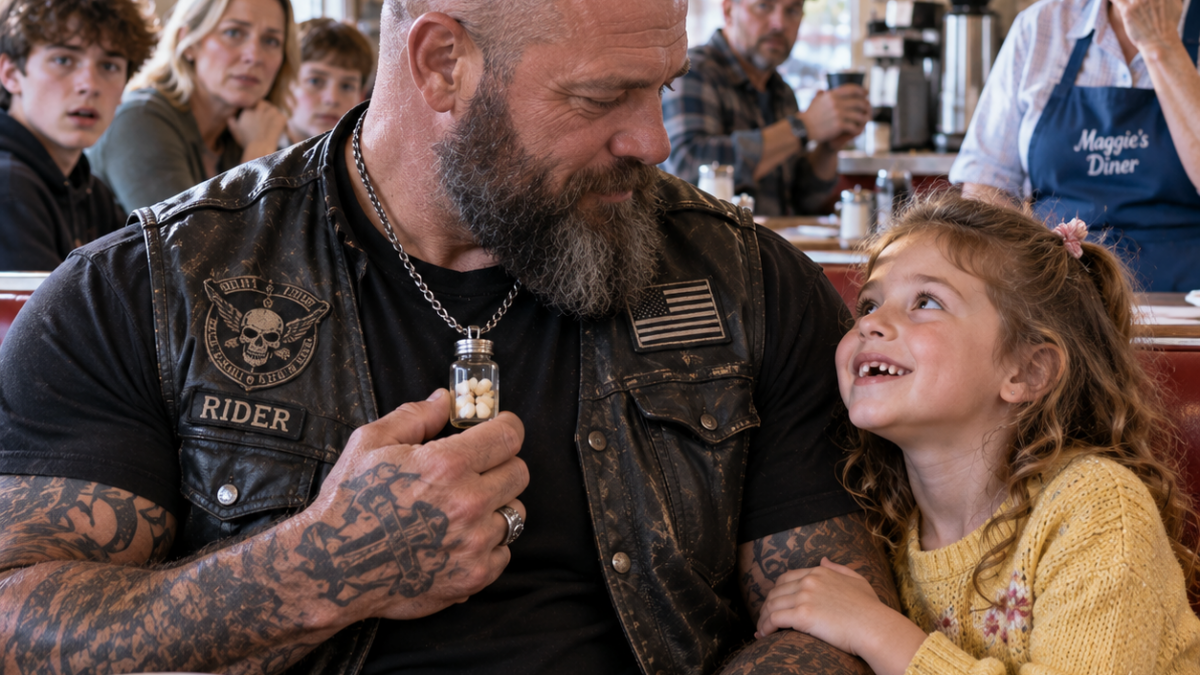
At Maggie’s Diner all those years ago, everybody stared at a giant tattooed biker wearing a tiny jar of baby teeth.
They saw something strange.
Maybe it was.
Ruby saw something else.
Proof.
Proof that her father had heard her when she said she was scared.
Proof that nothing she loved about being little was going into the trash just because her body was growing.
Proof that change and abandonment were not the same thing.
And I saw something too.
Though it took me years to understand it.
I saw the beginning of the day my daughter would no longer need me to carry those pieces.
At six, that idea frightened me almost as much as it frightened her.
At forty-three, I believed my job was to hold everything.
At fifty-something now, I know better.
A father’s job is not to keep every piece forever.
It is to hold what a child cannot carry yet.
Then, when she’s ready, place it gently back in her hands.
Ruby has the box now.
She has the memories.
She has her grown-up smile.
And me?
I have an empty place against my chest where a tiny glass vial used to rest.
It doesn’t feel empty anymore.
It feels exactly like what it was meant to become.
Room for her to grow.








