Everyone Thought the Biker Had Attacked a Grieving Little Girl—Until Her Backpack Began Moving on Its Own
PART3:
She turned.
I pointed.
“Don’t move.”
Wrong tone.
I sounded like command.
She froze.
Good.
Then she did what frightened children do when they don’t understand why an adult is yelling.
Her right hand rose toward her shoulder strap.
“No!”
I crossed the sidewalk.
Fast.
People turned.
She pulled at the strap.
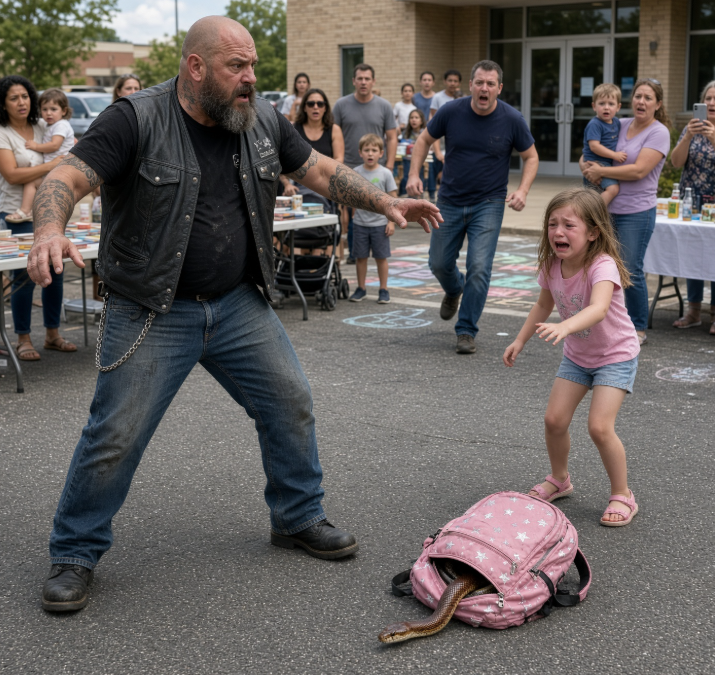
I grabbed the top handle.
Molly screamed.
I ripped the backpack backward off both shoulders.
The zipper snagged for half a second.
I felt something move inside.
I threw the bag.
Hard.
It crossed the road.
Hit pavement.
Rolled once.
Molly screamed louder.
“What are you doing?!”
A man charged from behind the refreshment tables.
Later I learned he was her uncle, David.
At that moment, all he saw was a giant tattooed biker ripping a precious bag off his niece and throwing it into traffic.
He shoved me.
I took one step back.
“What the hell is wrong with you?”
“Look at the bag.”
“You touched her!”
He swung.
I turned.
His fist clipped my shoulder.
I could have hit him.
Easily.
I’m not saying that because I’m proud.
I’m saying my body reacted before my mind.
Hands up.
Weight shifted.
Old reflex.
Then I saw Molly.
Crying.
Terrified.
David wasn’t attacking me because he wanted a fight.
He thought he was protecting her.
I lowered my fists.
“Look at the bag.”
“What?”
The pink backpack twitched.
Everybody stopped.
Once.
Then again.
A woman screamed.
The zipper opened another inch from inside.
Something narrow pushed through.
Brown head.
Copper-colored bands.
Juvenile copperhead.
The crowd broke apart.
Parents grabbed children.
Tables scraped.
Someone knocked over lemonade.
Molly lunged toward the backpack.
I stepped in front of her.
“No.”
“My bag!”
“You stay here.”
“That’s my dad’s!”
She kicked my boot.
Hard enough that I felt it.
“Move!”
“No.”
“You ruined it!”
“I know.”
“You don’t know anything!”
That was true.
At that moment, I knew only one thing.
There had been a venomous snake pressed against her back.
I knew nothing about James Turner.
Nothing about the aneurysm.
Nothing about the backpack being his final birthday gift.
Nothing about the note she carried inside.
Animal control arrived twelve minutes later.
It felt like forty.
Officer Priya Shah recognized me from my old county work.
She didn’t waste time.
“Anybody bitten?”
“No.”
“Child touched?”
“No.”
“Snake location?”
I pointed.
It had moved beneath a parked car.
Priya and another officer cleared everybody farther back.
Nobody tried to catch it themselves.
Good.
Copperheads generally don’t hunt human beings.
But a frightened juvenile snake in a crowded public event is a problem nobody improves by becoming brave.
They secured it.
Juvenile.
Healthy.
Probably looking for shelter.
That should have been the end of the event.
It wasn’t.
Paramedics examined Molly.
No punctures.
No swelling.
No signs of envenomation.
Her mother arrived.
Sarah Turner.
She knelt beside Molly and held her so tightly the girl nearly disappeared.
David stood several feet away.
His face had changed.
Anger replaced by shock.
My shoulder hurt where he’d hit me.
Didn’t matter.
A police officer interviewed me.
“What did you see?”
“Tail.”
“You’re certain?”
“Certain enough.”
“Why didn’t you warn her?”
“She reached behind herself.”
He looked at me.
“I had seconds.”
He nodded.
Across the lawn, people were watching.
Phones everywhere.
That’s when I realized some had filmed it.
Of course they had.
Something strange happens in public now and half the witnesses reach for cameras before they reach for understanding.
David found me by my truck after police released us.
He looked awful.
“I’m sorry.”
I leaned against the door.
“You saw a stranger grab your niece.”
“I hit you.”
“Wrong target.”
He looked down.
“Right reason.”
His face twisted.
“You could’ve hit me back.”
“Yeah.”
“Why didn’t you?”
“Because you were protecting her.”
He laughed once without humor.
“Badly.”
“You didn’t know what I knew.”
Silence.
Then he looked toward the sealed evidence bag containing Molly’s backpack.
“She loves that thing.”
I nodded.
“She made that clear.”
He took a breath.
“Her dad gave it to her.”
That was the first moment the morning got heavier.
“Birthday?”
“Eighth.”
“Where’s he?”
David looked at me.
“Dead.”
I stopped.
“Aneurysm. Four months after her birthday.”
I looked at the pink backpack.
Silver stars.
Road rash across one side.
One strap partially torn.
“She keeps his last lunch note in there.”
My stomach turned.
“The bag was evidence.”
“I know.”
“Police had to take it.”
“I know.”
David rubbed his face.
“She’s had a rough year.”
I stared at the bag.
I had made the same correct choice I would make again.
That didn’t mean nothing had been lost.
That distinction mattered.
“I’m sorry about the backpack.”
David shook his head.
“You saved her.”
“Both things can be true.”
He looked at me.
That sentence seemed to surprise him.
It surprised me too.
By the time I reached home Saturday evening, the six-second clip was already everywhere.
Rico called first.
“You seen this?”
“No.”
“Don’t.”
That guaranteed I would.
The video began exactly where context became dangerous.
Me crossing toward Molly.
My hand grabbing the bag.
Her scream.
Backpack flying.
David shoving me.
Video ended.
Six seconds.
The snake emerged two seconds later.
Two missing seconds.
That’s all it took.
The first caption:
BIKER ATTACKS LITTLE GIRL AT LIBRARY EVENT.
Another:
MAN RIPS DEAD FATHER’S BACKPACK OFF GRIEVING CHILD.
How did they already know about her father?
Small town.
Internet.
People hunt detail when outrage needs decoration.
Comments multiplied.
“Arrest him.”
“Why was a motorcycle gang around children?”
“Find this guy.”
“Someone check the child.”
I wasn’t named in the original post.
Didn’t matter.
Within an hour, somebody recognized the Iron Lantern vest.
Then me.
Raymond Alvarez.
Rook.
Mercer? No, different story. My shop was Alvarez Cycle Works, though everybody just called it Rook’s.
The reviews began Saturday night.
One star.
Dangerous man.
Avoid this business.
Child abuser.
Psychopath.
People who had never stepped inside my shop reviewed the quality of my work based on six seconds of video.
My phone rang continuously.
Threats.
Voice mails.
One man said he hoped somebody did to me what I’d done to that girl.
Another said he knew where the shop was.
Mack called a club meeting Sunday morning.
Forty-three members.
Nobody happy.
Rico slammed his phone onto the table.
“We release a statement.”
“No.”
He looked at me.
“Rook, your shop is getting killed.”
“I know.”
“They’re calling the club predators.”
“I know.”
“The library board is meeting tonight.”
“I know.”
“Then what the hell are we doing?”
I put my phone facedown.
“We ask Sarah.”
Mack nodded.
Rico didn’t.
“Why?”
“Because Molly is eight.”
“So?”
“So I’m not using footage of a scared child to clear my name unless her mother agrees.”
“Your business could close.”
“Then it closes.”
That sounded brave.
It wasn’t.
My stomach was on fire saying it.
I had five employees.
Rent.
Insurance.
Loans.
Families depending on paychecks.
Still.
I wasn’t making Molly evidence.
Mack folded his arms.
“We also have the winter book drive.”
“I know.”
“The library may cancel.”
“Then it cancels.”
Rico stood.
“You’re willing to let all of us take the hit?”
I looked at him.
“No.”
“Then—”
“But I’m not turning her worst morning into our defense strategy.”
The room went quiet.
Mack spoke.
“No child becomes our evidence.”
Final.
That’s how he ran things.
We waited.
Waiting was miserable.
Sunday afternoon, the library charity board issued a temporary suspension of our partnership while they “reviewed the incident.”
I understood.
Still hurt.
A reporter came to the shop.
I declined.
Another called.
No.
A national social media account reposted the clip.
Views passed two million.
People debated whether I should be arrested.
Some bikers online wanted to ride to my defense.
I told Mack absolutely not.
The last thing anyone needed was fifty angry motorcycles outside a children’s library.
Then the library director called Sarah.
Cynthia Park had found another recording.
A volunteer had been filming her daughter at the chalk table.
The video started earlier.
It showed Molly returning to the backpack.
It showed the small tail.
It showed me noticing.
It showed her reaching backward.
It showed the throw.
And it kept recording.
Snake emerging.
Me spreading both arms between Molly and the road.
David stopping mid-argument.
The crowd scattering.
Everything.
Cynthia asked Sarah before releasing it.
Sarah asked Molly.
I wasn’t there, but Sarah told me later.
Molly watched the short video first.
Then the long one.
She asked:
“Do people think he hurt me?”
Sarah said yes.
“Will this make them stop?”
“Some of them.”
Molly looked at her damaged bag.
“Show it.”
The full video went online Sunday evening.
Public opinion did what public opinion does.
It didn’t correct.
It reversed.
Same people.
Same intensity.
Different direction.
Suddenly:
HERO BIKER SAVES CHILD FROM VENOMOUS SNAKE.
“Give this man a medal.”
“I knew there had to be more.”
No, you didn’t.
“Faith in humanity restored.”
My shop phone changed overnight.
Threats became interview requests.
A backpack company offered to send Molly twenty replacements.
A morning show wanted both of us in New York.
Someone offered me sponsorship money.
Rico joked we should sell shirts.
I told him I’d bury him behind the shop.
Then comments turned on David.
“Idiot uncle.”
“Violent thug.”
“Arrest him for assault.”
“Imagine attacking the man saving your niece.”
That made me angrier than the attacks on me.
Sarah gave permission for one statement.
I wrote:
David saw a stranger seize his niece. Stop turning a frightened family into villains because you finally found the missing six seconds.
That was it.
No interview.
No hero speech.
David came to my shop the next afternoon.
“You didn’t have to do that.”
I was working on a touring bike.
“Yes, I did.”
“He punched you.”
Ray, my mechanic, said from across the room.
I looked at him.
“Nobody asked.”
Ray held up both hands.
David stood awkwardly.
“I really am sorry.”
“I know.”
“Still.”
I tightened a bolt.
“You see a tattooed stranger grab Molly again, what do you do?”
His face tightened.
“Depends.”
“On?”
“Whether there’s a snake.”
I almost smiled.
“Fair.”
My phone rang.
Officer Priya.
I expected some update about returning property.
Instead she said, “We found something.”
“What?”
“The backpack.”
I stopped.
“What about it?”
“There is a cut inside one side pocket.”
“From the snake?”
“No.”
She paused.
“Snakes don’t stitch fabric either.”
I put the wrench down.
“What are you saying?”
“Someone modified the bag.”
My stomach dropped.
Investigators had found a clean slit hidden beneath a decorative flap.
Part of the lining had been re-stitched.
The zipper was open enough that a snake could theoretically have crawled inside naturally.
But the cut had been made with a blade.
Fresh thread.
Fresh manipulation.
Police requested all library surveillance.
That’s when they found the gray-uniformed man.
Seven seconds.
Crouched beside Molly’s backpack.
He had looked around first.
That mattered.
Police identified him as Calvin Reed.
Not library maintenance.
His gray shirt belonged to a cleaning company that had stopped using that uniform two years earlier.
He’d bought it from a thrift store.
When police showed me his photograph, I knew him.
“He’s been in my shop.”
“When?”
“Week before the event.”
“Why?”
“Said he was organizing a charity ride.”
“What did he ask?”
I thought.
“How many of us went to library events.”
“Anything else?”
“What time we arrived.”
Another memory.
“He asked whether the library had exterior security cameras.”
The detective looked up.
“Why would he ask that?”
“He said he wanted to know how events handled theft.”
It had sounded odd then.
Not criminal.
Just odd.
Now?
Different.
They pulled my shop surveillance.
Calvin on camera.
Gray T-shirt.
Cap.
Standing near the service counter.
But he wasn’t studying motorcycles.
He looked repeatedly at the security monitor above my office.
Investigators dug deeper.
Calvin ran several online accounts.
“Social experiments.”
That’s what he called them.
He staged public scares.
Left fake packages.
Recorded arguments.
Created situations where strangers reacted badly, then uploaded edited versions for views.
Most were stupid.
Some dangerous.
One showed him leaving a realistic fake weapon near a park bench.
Another involved an abandoned dog carrier with recorded crying sounds inside.
The police suspected he wanted a confrontation involving the bikers.
What nobody could initially prove was whether he intentionally placed the snake.
Finding a copperhead isn’t impossible in Tennessee.
Capturing one and putting it into a child’s backpack is something else.
Police eventually found more evidence.
Messages.
Search history.
A container in his vehicle with residue and shed scales consistent with local pit viper habitat.
Enough for arrest.
Not conviction yet.
But enough.
When Sarah learned, she went pale.
Molly asked the question nobody wanted.
“Did he know it could kill me?”
Sarah told her the truth.
“We don’t know what he believed would happen.”
Molly looked at me.
“You knew.”
“I knew enough.”
“What does that mean?”
“I didn’t know for certain it was a copperhead.”
“But you threw it.”
“Yes.”
“Why?”
“Because I didn’t need certainty.”
She frowned.
I crouched so I wasn’t towering over her.
“If I saw smoke coming from your bedroom, I wouldn’t wait to see flames before telling you to get out.”
She considered that.
“I saw something dangerous beside your neck.”
“Tail.”
“Yeah.”
“So you knew enough.”
“Exactly.”
That phrase stayed with her.
It stayed with me too.
People spend a lot of time pretending good decisions require perfect information.
They don’t.
Sometimes all you get is credible danger and seconds.
Then you act.
The investigation uncovered something else.
Something nobody expected.
Molly’s father had known me.
The detective asked, “Did you know James Turner?”
I stared at him.
“James Turner?”
“Her father.”
The name unlocked an old memory.
Warehouse near the Tennessee River.
Nine years earlier.
Animal services.
A stray German shepherd had become trapped behind a loading dock.
Injured paw.
Dehydrated.
Workers cornered it accidentally.
Dog snapped.
Everybody called it aggressive.
James was warehouse manager.
He’d ended up boxed between pallets with the frightened animal ten feet away.
I responded.
I remember James because he listened.
Most people in that situation shout questions while you’re trying to keep everybody alive.
James stood still.
I told workers to clear an exit.
Lower voices.
Stop staring.
Dog wasn’t hunting anyone.
It was panicked.
Pain turns animals defensive.
Once the corridor opened, trained capture staff secured it.
No bite.
Afterward, James bought me coffee.
“You knew it wasn’t trying to attack.”
“I knew it was scared.”
“Everybody else saw teeth.”
“Teeth are what scared dogs have.”
He laughed.
That became an occasional friendship.
Not close.
Coffee twice a year.
A call when he saw an injured animal.
Christmas text.
When Molly was born, James sent me a photograph.
Newborn wrapped in pink.
Caption:
MY HARDEST JOB YET.
I attended his funeral.
Quietly.
Back row.
There were hundreds of people.
I saw a little girl near the front holding her mother’s hand.
Never realized that was Molly.
I never connected the name because Turner isn’t exactly rare.
Then came the note.
Police had photographed everything inside Molly’s backpack during evidence processing.
Sarah told investigators about James’s lunch note.
A folded piece of paper.
Worn at the creases.
Written in blue ink.
Apparently Molly carried it everywhere.
James had written it on a school morning months before he died.
Most of it was ordinary father stuff.
Eat the apple too, not just the cookies.
Be kind.
Don’t let Uncle David convince you dinosaurs can still live in Kentucky.
But near the bottom was something strange.
Molly had apparently asked what she should do if something frightening happened and Mom or Dad wasn’t there.
James wrote:
Find Rook. He notices what the rest of us miss.
I stared at the photograph of the note.
Could not breathe for a moment.
“Why would he write that?”
Sarah stood beside me in the police station.
“He told Molly stories.”
“What stories?”
“The dog at the warehouse.”
I closed my eyes.
James.
Coffee.
That day by the loading dock.
A throwaway moment from my perspective.
Not from his.
Sarah continued.
“He said there was a scary-looking biker who noticed the dog was frightened when everyone else thought it was vicious.”
My throat tightened.
“Molly never met me.”
“No.”
“Didn’t know what I looked like?”
“Not really.”
“Then the note was basically useless.”
Sarah laughed through tears.
“It was partly a joke.”
I looked at the final line again.
Find Rook.
He notices what the rest of us miss.
Nine years after James watched me notice fear in an injured dog, his daughter walked past me carrying a snake.
And I noticed a tail.
I don’t believe the universe arranges everything beautifully.
I’ve seen too much tragedy for that.
James still died.
Molly still lost him.
A dangerous man still tampered with her bag.
But some coincidences are heavy enough that you stop trying to explain them.
The backpack came back from evidence three weeks later.
It was in bad shape.
Side seam split.
Silver star scraped.
One interior pocket cut open by investigators.
The note had gotten damp when the backpack hit the road near a gutter.
The lower ink blurred.
Molly refused to see me.
I understood.
Saving her didn’t obligate her to like me.
That is another thing hero stories get wrong.
You can make the right decision and still become part of somebody’s bad memory.
Sarah brought the backpack to my shop alone.
She placed it on a clean workbench.
“Can you fix it?”
I examined the fabric.
“I repair leather saddlebags.”
“You sew.”
“Different material.”
“Can you?”
I touched the torn seam.
“Stabilize it.”
“Make it new?”
“No.”
“Good.”
I looked up.
“Good?”
“I don’t want it made new.”
She ran a finger over the scratched silver star.
“James touched this one.”
I understood.
Replacing everything could destroy the thing we were trying to preserve.
So I called Helen Wu.
Helen volunteered with the library’s historical collection and did textile conservation.
She came to the shop the next afternoon.
Looked at the bag like it belonged in a museum.
“Rule one,” she said.
“What?”
“We preserve what remains.”
“Okay.”
“We do not make damage disappear.”
“Why?”
“Because repair and erasure are not the same thing.”
That sentence turned out to matter far beyond fabric.
We worked four evenings.
Helen reinforced the inside using archival backing.
I built a thin protective structure for the damaged side pocket.
We kept every silver star.
Even the scraped one.
Especially the scraped one.
The zipper worked.
The bag could carry light objects.
Not heavy textbooks anymore.
Then we examined James’s note.
Lower line blurred.
Molly believed part of her father’s last message had been destroyed when I threw the backpack.
I stared at that damaged ink for a long time.
Right choice.
Real cost.
Again.
Helen said, “Wait.”
She walked out.
Returned with her laptop.
“A school exhibit last year.”
“What?”
“Family handwriting.”
She searched files.
“Molly’s class participated.”
My heart started beating faster.
“Tell me you photographed the note.”
Helen looked up.
“I photograph everything.”
She found it.
Clear image.
Before the water.
Every word.
Including:
Find Rook. He notices what the rest of us miss.
I had to walk away from the bench.
Sarah cried.
Helen pretended to adjust the printer.
We printed a conservation copy on acid-free paper.
Placed James’s original inside a protective sleeve.
Original would stay at home.
Copy could travel with Molly.
Sarah called her daughter.
Molly came the next afternoon.
I took off my vest before she arrived.
Not because I was ashamed.
Because I didn’t want the thing everybody had judged to fill the room.
She walked in holding Sarah’s hand.
Stopped six feet from the workbench.
Saw the pink backpack.
“You made it different.”
“Yes.”
“You couldn’t make it like before?”
“No.”
Her eyes moved over the repaired seam.
The scratched star.
Reinforced pocket.
“Why not?”
I thought of Helen.
“Because pretending nothing happened would’ve meant replacing too much.”
Molly approached.
Touched the seam.
“Does it still count as Dad’s?”
My first instinct was yes.
I stopped.
“That’s not mine to decide.”
She looked at her mother.
Sarah didn’t answer.
Good mother.
Molly opened the interior pocket.
Removed the copied note.
Read.
Her lips moved silently.
Then she reached the final line.
Out loud:
“Find Rook. He notices what the rest of us miss.”
She looked at me.
My eyes burned.
“Did Dad know you would throw my backpack?”
I shook my head.
“No.”
“Would he be mad?”
“About the backpack?”
She nodded.
“Probably.”
Molly almost smiled.
“He liked that backpack.”
“He had good taste.”
Her smile disappeared.
“Would he be mad that you saved me?”
“No.”
“How do you know?”
I swallowed.
“Because he loved you.”
Simple.
She stared at me.
“I still hate what you did.”
“I know.”
“I really hate it.”
“I know.”
“You threw it hard.”
“Very.”
She looked down.
“But I don’t hate you.”
That was more forgiveness than I had earned or requested.
“Okay.”
She put on the backpack.
I immediately said, “Don’t put heavy books—”
Her eyebrows lowered.
“You don’t get to give me rules.”
I stopped.
“Fair.”
She took it off.
Transferred two library books into a canvas tote.
Then put the backpack on again.
Only the note inside.
Some things could not be restored.
They could still be carried differently.
Winter came.
The library reinstated our charity partnership after reviewing everything.
The Iron Lantern Riders returned for the winter book drive.
No parade.
No cameras.
We brought trucks.
Parked motorcycles away from the children’s entrance.
The club paid for secure indoor bag storage.
Not because snakes normally crawl into backpacks.
Because unattended bags were part of what made the crime possible.
We consulted parents.
Library staff.
Accessibility people.
Molly rejected our first plaque idea.
Mack had suggested:
THE MOLLY TURNER SAFETY STATION.
She said, “Absolutely not.”
Rico laughed.
“She’s got you.”
Molly crossed her arms.
“I don’t want every time I come here to be snake day.”
Correct.
No plaque.
No snake graphic.
Just shelves.
Simple sign:
PLEASE STORE PERSONAL BAGS INSIDE DURING OUTDOOR EVENTS.
Officer Priya held a wildlife-awareness session.
Keep distance.
Don’t attempt capture.
Supervise children.
Call trained responders.
Molly attended the first half.
Then got bored and went to read.
Perfect.
David worked the refreshment table.
A few people recognized him from the original clip.
Nobody bothered him.
Our club had made our position clear.
He reacted to what he believed was danger.
The crowd had too.
The question wasn’t whether people misjudged incomplete information.
Everybody does.
The question is what you do after new information arrives.
One afternoon Molly asked me:
“Why didn’t you hit Uncle David?”
We were sorting donated books.
“He was protecting you.”
“He punched you.”
“Yeah.”
“He was wrong.”
“About me.”
She waited.
“Not about protecting you.”
She frowned.
“You both thought you were saving me.”
“Yes.”
“You were better at it.”
“No.”
She looked confused.
“I saw more.”
“What?”
“The tail.”
She became quiet.
“If I hadn’t seen it, maybe I would’ve thought I was attacking you too.”
That mattered.
Hero stories like to divide people into the wise and the foolish.
Good guys.
Bad guys.
Brave people.
Cowards.
Reality isn’t that neat.
I had one piece of information David didn’t have.
The tail.
My training helped me recognize it.
Without that detail, David’s reaction made sense.
Without the missing two seconds, millions of viewers made the same mistake.
The internet never learned moderation.
First I was a monster.
Then a hero.
Neither was true.
I was a man who noticed something dangerous and acted.
That’s all.
Calvin’s case proceeded without Molly becoming public evidence.
Sarah fought hard for that.
No television interview.
No courtroom spectacle if avoidable.
Written statements.
Attorneys.
The criminal process handled the rest.
I won’t turn what happened to Molly into entertainment by describing every charge or every ugly thing investigators uncovered.
That’s exactly what Calvin wanted.
Attention.
Reaction.
People sharing danger because danger performs well online.
He didn’t get Molly.
Not that way.
She went back to school.
Lost another tooth.
Had a birthday.
Fought with her mother about bedtime.
Joined a soccer team for half a season and quit because she hated shin guards.
Ordinary life is underrated after trauma.
The pink backpack stopped being her everyday school bag.
Too delicate.
But she carried it on James’s birthday.
Sometimes to the library.
The damaged silver star remained.
I once offered to cover the scrape with matching material.
“No.”
“Why?”
She touched it.
“That’s where the road happened.”
I understood.
Preserve what remains.
Don’t pretend nothing happened.
Years passed.
Molly grew.
Nine.
Ten.
Eleven.
At twelve, she started volunteering at the summer reading fair.
The first year, I watched her walk toward the maple tree.
My entire body tightened even though rationally I knew the danger was gone.
She set a box of books on a table.
Not a backpack.
Still.
Memory lives in muscles too.
She caught me watching.
“Rook.”
“What?”
“Stop.”
“I’m not doing anything.”
“You’re doing the face.”
“What face?”
“The snake face.”
Rico nearly fell off a chair laughing.
Apparently I had a snake face.
Molly sorted books.
Wildlife guides on one table.
Mysteries on another.
She pointed children toward indoor storage if they tried leaving bags under trees.
She never told the story unless asked.
Good.
Her life belonged to her.
At closing one Saturday, a new volunteer recognized me.
“Wait.”
I looked up.
“You’re that biker.”
Dangerous beginning to any conversation.
“Which one?”
“The backpack guy.”
Molly was standing beside me.
Before I could answer, she said:
“He’s the biker who saw the zipper.”
I looked at her.
Technically, the tail.
But I didn’t correct her.
The volunteer smiled.
“That’s incredible.”
Molly rolled her eyes.
“Can we not?”
“Sorry.”
He walked away.
She looked at me.
“People still tell it wrong.”
“They always will.”
She lifted the pink backpack.
The strap slipped loose.
My hand moved automatically.
Stopped.
“May I?”
She smiled.
“Nervous?”
“Respectful.”
“Sure.”
I adjusted the buckle.
Slow.
No sudden grab.
No screaming.
No snake.
Her father’s note was inside the reinforced pocket.
Copy, not original.
The original stayed protected at home.
Outside, late sunlight crossed the library steps.
Sarah waited by the car.
My Harley was parked near the curb.
Molly touched the pocket.
“Dad was right about you.”
I shook my head.
“Your dad exaggerated.”
“He said you notice things.”
“Sometimes.”
She looked toward the maple tree.
Same tree.
Different girl.
Then at me.
“Notice me leaving.”
I did.
She walked toward her mother.
Pink backpack against her shoulders.
Safe.
Nobody filming.
Nothing hidden.
I stood there until the car disappeared.
That night, I found myself thinking about James.
Nine years before the library fair, he’d stood near a loading dock watching everybody call an injured dog vicious.
I’d seen fear.
He remembered.
Long enough to write my name in a note to his daughter.
Then died before he could ever know whether the words mattered.
That’s the part that stays with me.
We never know which small thing somebody keeps.
A conversation you forgot.
A kindness you barely noticed performing.
A sentence you said because it seemed obvious.
James remembered that I saw fear instead of aggression.
Molly remembered that I threw the thing she loved to save the life her father had loved more.
Both truths mattered.
For years, people asked me whether I regretted throwing the backpack.
No.
Not for one second.
Would I do the same again?
Yes.
Harder if necessary.
That answer does not mean I dismiss what Molly lost.
There is a childish version of morality where doing the right thing means nobody gets hurt.
Adults know better.
Sometimes every available choice has a cost.
The question becomes which cost you can justify.
A damaged backpack.
Or a possible venomous bite against a child’s back.
I made the choice.
Then I lived with everything it broke.
That’s responsibility.
Not insisting your correct decision caused no pain.
Not demanding gratitude.
Repairing what can be repaired.
Admitting what cannot.
Molly taught me that too.
She never said:
It’s okay you ruined Dad’s backpack because you saved me.
She said:
I still hate what you did.
And:
I don’t hate you.
Those two statements were honest enough to hold the whole story.
The internet wanted cleaner.
Hero.
Villain.
Forgiveness.
Transformation.
No.
She loved the backpack.
I damaged it.
I saved her.
All true.
David punched me.
He was wrong about me.
He was right to protect his niece.
All true.
The crowd misjudged me.
They also saw something frightening with incomplete information.
True.
I had training they didn’t.
True.
Calvin engineered danger.
True.
James’s note linked us in a way neither Molly nor I understood that morning.
True.
Reality survives contradiction better than the internet does.
Years after the incident, David and I became friends.
Not close at first.
He brought his truck to the shop.
Needed brake work.
I looked at the estimate.
“Punching customers doesn’t get you a discount.”
He stared.
Then laughed.
“Worth trying.”
He helped our club at book drives.
Eventually joined some charity rides, though he never became a member.
One evening we were sitting outside my shop.
He said, “I still dream about it.”
“What?”
“You grabbing her.”
I nodded.
“Before I see the snake.”
“I understand.”
“In the dream I hit you harder.”
“Rude.”
He laughed.
Then became serious.
“I hate that I was wrong.”
“You weren’t completely.”
“You keep saying that.”
“Because it’s true.”
He looked toward the road.
“I judged you by how you looked.”
“Yeah.”
“That’s wrong.”
“Yeah.”
“And?”
“And you were protecting Molly.”
He shook his head.
“You always do that.”
“What?”
“Refuse to let me hate myself cleanly.”
I smiled.
“Self-hatred is lazy.”
He looked over.
“That’s a biker fortune cookie.”
“Put it on a shirt.”
“Snake shirt?”
“Get out.”
We laughed.
The shop recovered.
Some one-star reviews stayed.
I never bothered contesting all of them.
Ray framed one.
It said:
DANGEROUS BIKER. SHOULD NOT BE AROUND CHILDREN.
Underneath he added:
SAVED ONE ANYWAY.
I threatened to fire him.
He knew I wouldn’t.
The Iron Lantern Riders kept donating books.
No logos.
No media.
The library partnership actually became stronger afterward, partly because everybody learned something uncomfortable about assumptions.
The board apologized for suspending us before speaking to all parties.
Mack said they had made a reasonable temporary safety decision.
That surprised them.
People expected anger.
But institutions should pause when children’s safety is involved.
The problem would have been refusing to reconsider once evidence changed.
They reconsidered.
Good.
Molly’s secure-storage idea expanded to community events.
Simple shelves.
Bag-check system.
Nothing dramatic.
Officer Priya continued wildlife education.
The library created a policy against unattended belongings in outdoor activity zones.
Specific changes.
Useful changes.
Not a giant plaque about a miracle.
That was what I liked.
Trauma should not become branding.
Molly is fourteen now.
The backpack is mostly retired.
She keeps the original note in a protective sleeve at home.
The copied note sometimes travels.
On James’s birthday, she still takes the pink bag out.
Silver stars faded.
One scratched.
Repaired seam visible.
It doesn’t look new.
Helen would approve.
Last year, Molly came by my shop after school.
Her mother was running late.
She sat on the office stool doing homework.
At some point she asked:
“Did Dad know you well?”
“Not very.”
“Then why you?”
I knew what she meant.
The note.
Find Rook.
“He trusted something he saw me do.”
“What?”
“Notice an animal was scared.”
She looked down at her notebook.
“That’s not much.”
“No.”
“Enough for him?”
“Apparently.”
She became quiet.
Then asked:
“Do you remember everything he said?”
“No.”
That disappointed her.
“I wish you did.”
“So do I.”
We sat.
Then I remembered something.
“He hated hazelnut coffee.”
She looked up.
“What?”
“First time we got coffee after the dog call, he ordered hazelnut because the waitress recommended it.”
Molly smiled.
“What happened?”
“He drank two sips and said it tasted like somebody dissolved a candle.”
She laughed.
Big.
Real.
“Mom loves hazelnut.”
“Your father was right.”
She wrote something down.
“What are you doing?”
“Keeping it.”
That hit me.
People grieving someone hunt fragments.
The ordinary details become gold.
Not final words.
Not dramatic wisdom.
Coffee preferences.
Bad jokes.
Songs skipped in the car.
The way they folded a newspaper.
A father calling flavored coffee a candle.
Molly looked at me.
“Anything else?”
I searched memory.
“He tipped too much.”
“Mom says that.”
“He talked about you before you were born.”
Her pencil stopped.
“What?”
“When your mother was pregnant.”
I remembered a call.
James asking whether installing a baby gate near stairs required drilling into oak trim.
I had said yes.
He complained twenty minutes.
“He was scared he’d damage the house.”
Molly smiled.
“He did?”
“Then you arrived and I don’t think he cared about the trim anymore.”
Her eyes filled.
“Anything else?”
I stayed with memory.
“He sent me your newborn picture.”
“You still have it?”
Probably buried in an old phone backup.
Maybe.
That night, I searched.
Hours.
Old cloud account.
Emails.
Finally.
There.
Newborn Molly.
Pink blanket.
James’s message:
MY HARDEST JOB YET.
I printed it.
The next day, I handed it to her.
She stared for so long I worried I’d done something wrong.
Then she whispered:
“I’ve never seen this one.”
Sarah hadn’t either.
James had taken it himself in the hospital and sent it to only a few people.
Molly touched the corner.
Another piece returned.
Not because I was a hero.
Because I’d kept an old email without remembering I kept it.
Sometimes noticing happens years late.
She framed that photograph.
It sits beside the protected note now.
One afternoon recently, Molly asked something that surprised me.
“Do you think Dad sent you?”
I knew what she meant.
The day of the snake.
I could’ve given the comforting answer.
Maybe.
Instead:
“I don’t know.”
She nodded.
“I think maybe.”
“You’re allowed.”
“You don’t?”
I leaned against the workbench.
“I think your dad knew me.”
“Yeah.”
“I think Calvin chose your backpack.”
Her face tightened.
“I think I happened to be there.”
“That’s boring.”
“Reality often is.”
She smiled.
“But.”
I continued.
“But your father wrote my name years before, and the day you needed someone to notice something, I noticed.”
She looked at me.
“What do you call that?”
“I don’t know.”
“Coincidence?”
“Maybe.”
“Luck?”
“Maybe.”
“God?”
“Maybe.”
She frowned.
“You’re not helpful.”
“I repair motorcycles.”
That got the smile I wanted.
We don’t have to explain every meaningful coincidence.
Some things can remain strange.
The backpack incident changed me too.
Before it, I assumed being misjudged didn’t bother me.
Big biker.
Scars.
People cross streets.
Whatever.
Then two million strangers decided I was capable of hurting a child.
That did bother me.
Deeply.
For a while, I became defensive everywhere.
Somebody looked twice at the vest?
I assumed judgment.
A mother moved her child closer?
I took it personally.
Then I realized I was doing exactly what I hated.
Building stories from incomplete evidence.
Maybe the mother was protecting a shy child.
Maybe she wanted him out of a bike’s path.
Maybe she hadn’t noticed me at all.
I started catching myself.
A human brain hates unfinished scenes.
It wants to fill gaps.
That’s why the six-second clip worked.
Grab.
Scream.
Throw.
Shove.
The brain supplies motive.
Violence.
Aggression.
Threat.
Then the longer clip appeared.
New information.
Same actions.
Different meaning.
That’s frightening if you think about it.
How many people have I judged at second six without waiting for second eight?
Not viral videos.
Life.
Coworkers.
Parents.
Teenagers.
Police.
Strangers.
Animals.
I learned the lesson first from frightened dogs.
Then forgot it with humans.
Context changes behavior.
It doesn’t excuse everything.
But it explains enough that you should hesitate before turning assumptions into verdicts.
Molly understands that better than most adults now.
At fourteen, she’s not sentimental about the story.
If someone calls me her hero, she says:
“He threw my dad’s backpack into traffic.”
If someone says I ruined it, she says:
“There was a copperhead inside.”
Then:
“Both happened.”
That’s James’s daughter.
Sharp.
One Saturday at the library, I watched her talking to a younger boy who had knocked over a display and started crying.
His mother was embarrassed.
The librarian looked frustrated.
Molly crouched.
“Hey.”
The boy hid his face.
“You scared?”
He nodded.
“Everybody’s looking.”
Another nod.
Molly said:
“They don’t know your whole story yet.”
I stopped moving.
She had no idea I’d heard.
The boy looked at her.
“What story?”
“The part where it was an accident.”
She helped him pick up books.
No speech.
No big lesson.
Just context offered before judgment.
I thought of James.
Find Rook. He notices what the rest of us miss.
Maybe noticing passes forward.
Maybe that’s the only immortality ordinary people get.
Not statues.
Not names on buildings.
A habit.
A sentence.
A way of looking at someone.
James noticed something in me.
I noticed a tail.
Molly learned to notice unfinished stories.
That is enough.
The maple tree still stands beside the library.
Every summer reading fair, somebody puts chalk supplies beneath it.
Children race around.
Parents sweat.
Motorcycles come and go.
I sometimes stand near the refreshment table now.
Denise Carter—the retired teacher who witnessed the original incident—still volunteers.
She jokes that the safest place at the event is wherever I’m staring.
I tell her that’s exactly how paranoia starts.
The first year after the incident, I caught myself watching every unattended backpack.
Second year, less.
Third year, I could sit down.
Healing isn’t forgetting danger.
It’s allowing probabilities to return to normal.
Molly never became afraid of snakes in the way everyone expected.
Respectful, yes.
She learned identification.
Keeps distance.
Calls trained responders.
But she doesn’t panic.
What she feared afterward was losing things.
Her father’s objects.
The backpack.
The note.
Anything connected to James.
Sarah worked with a grief counselor.
So did Molly.
Gradually she learned memory isn’t stored entirely in objects.
Still, nobody made her throw them away.
That’s important.
People sometimes rush grieving children toward detachment because adults become uncomfortable around relics.
A backpack can remain a backpack and mean more.
No contradiction.
The bag is not James.
The bag matters because James touched it.
Both true.
When Molly eventually stops carrying it, that won’t mean she’s leaving her father.
It will mean the object finished one job.
Maybe it gets another.
Last year she told Sarah she might eventually frame part of the backpack fabric beside the note.
“I don’t want it sitting in a closet forever.”
Sarah asked, “Why not keep it whole?”
Molly shrugged.
“Because things can change and still count.”
I heard that later and smiled.
Repair and erasure are not the same.
Helen had taught us.
Molly learned.
Everyone did.
A month ago, she visited my shop wearing no backpack.
Just a small crossbody bag.
I pretended not to notice.
She immediately said:
“You noticed.”
“Occupational hazard.”
“You didn’t ask about the pink one.”
“Didn’t need to.”
She sat at the counter.
“It’s at home.”
“Okay.”
“I think I’m done taking it everywhere.”
“Okay.”
She studied my face.
“That’s all?”
“What do you want, a ceremony?”
“No.”
“Then okay.”
She smiled.
“Dad’s note stays home too.”
“Safer.”
“I made a copy for my wallet.”
“Smart.”
Silence.
Then:
“I used to think if I didn’t carry the bag, I was leaving him.”
I stopped working.
“And now?”
“I think he already left.”
Hard sentence.
True sentence.
She continued.
“But I didn’t.”
I looked at her.
She tapped her chest.
“He’s here because I remember.”
I nodded.
“Sounds right.”
“Still hate that scratch though.”
I laughed.
“Good.”
People expect grief to become gratitude in stories.
It doesn’t.
Some damage can remain irritating forever.
That’s fine.
If I could redo that morning with everything I know now, I would still throw the backpack.
I’d probably throw it farther.
I would also wish I could catch it on something soft.
Life rarely gives both.
That’s why I stopped calling the outcome perfect.
Molly lived.
That’s the part that matters most.
The backpack survived.
Different.
The note survived.
Copied.
James’s final line survived because a librarian happened to photograph it earlier.
Calvin was stopped.
The club stayed with the library.
David and I became friends.
Useful changes came from something terrible.
None of that makes the danger good.
Good things growing afterward do not retroactively bless what caused them.
Another lesson people struggle with.
Trauma does not have to be worth it.
We are allowed to build meaning without thanking the harm.
Molly never thanked the snake.
Never thanked Calvin.
She thanked Helen.
Officer Priya.
The librarian.
Her mother.
Sometimes me.
That’s enough.
At the last reading fair, near sunset, Molly put the pink backpack over one shoulder.
She brings it only occasionally now.
The reinforced seam caught the light.
The scratch across the silver star remained.
She started toward Sarah’s car.
Then turned.
“Rook.”
“Yeah?”
“You watching?”
“Always.”
She smiled.
“That’s creepy.”
“You asked.”
She laughed.
Then walked away.
I watched.
Not because James had ordered me.
Not because I’m her guardian.
I’m neither.
I watched because years ago a friend I barely knew had trusted one thing about me.
That I noticed.
I don’t always.
I’ve missed people.
Misread people.
Judged fast.
We all do.
But that morning, I saw a tail.
Two seconds.
That’s the difference between the story everybody filmed and the story that actually happened.
Two seconds.
A bag flew.
A child screamed.
A man threw a punch.
A snake crawled out.
Then the meaning changed.
Maybe that’s why, when somebody shows me a short clip now and asks what I think, I usually say:
“What happened next?”
People hate that question.
It slows outrage.
Complicates certainty.
Leaves room for explanations we might not enjoy.
But I’ve lived inside the missing seconds.
I know what they can contain.
Sometimes a monster.
Sometimes a mistake.
Sometimes a man trying to save a child.
Sometimes a frightened uncle.
Sometimes a dangerous snake hidden by somebody nobody noticed.
Sometimes a dead father’s promise waiting in a pocket.
And sometimes the difference between ruining a child’s most precious possession and saving her life is simply whether you saw the tail before everybody else did.
James once wrote that I noticed what others missed.
I’ve spent years thinking that was too generous.
I still do.
But I kept his sentence anyway.
Molly gave me a copy on my birthday.
It’s taped inside the cabinet above my workbench.
Not framed.
That would be too sentimental.
Ray says taping it up counts.
I tell him to mind his business.
The note reads:
Find Rook. He notices what the rest of us miss.
Below it, in Molly’s handwriting, there’s another line.
She added it when she was twelve.
And sometimes he throws it across the road.
That kid is definitely James’s daughter.
I laugh every time I see it.
Then I go back to work.
Because that’s what life became after the incident.
Not a permanent hero story.
Work.
Books.
Motorcycles.
Summer fairs.
Grief.
Growing up.
Repairs.
Ordinary days.
The kind James never got enough of.
The kind Molly eventually learned were worth carrying even without the backpack.
And whenever I see her walk away safely now, I notice.
Every single time.








