Everyone Knew Him as the Saddest Man in Town—Then a Young Seamstress Looked Him in the Eye and Said, “I Only Wanted to Mend Yours.”
PART3:
A man can look away from many things.
That does not mean he has not seen them.
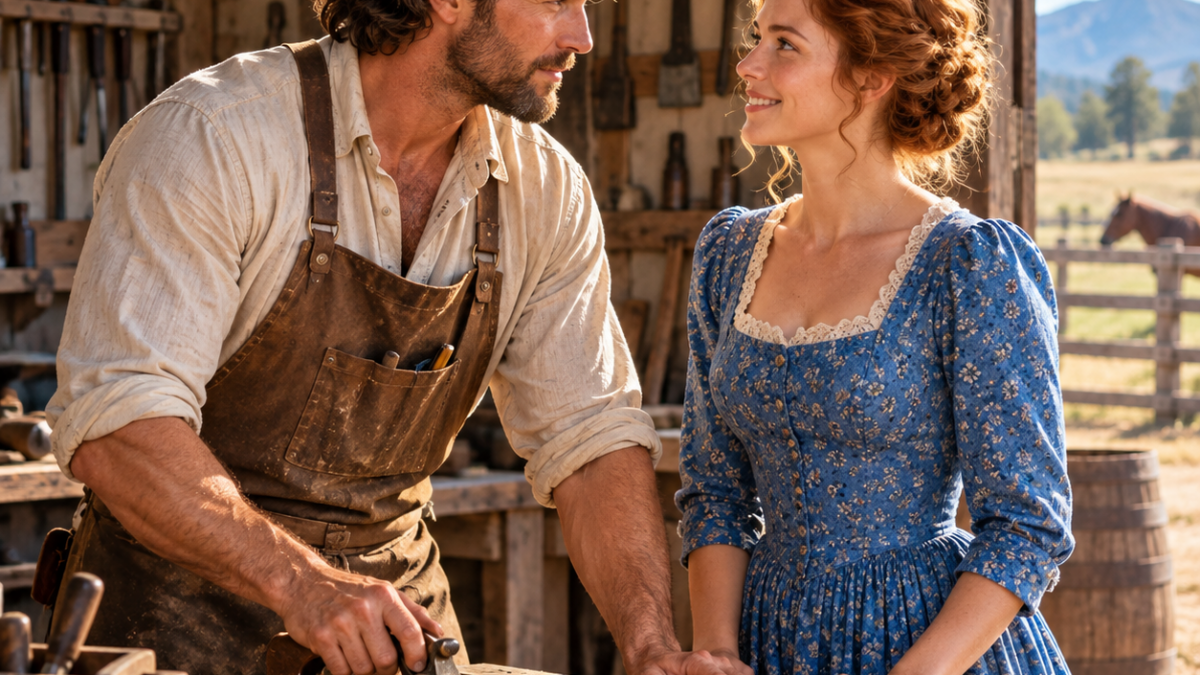
Her name was Grace Harper.
Nineteen years old. Seamstress by trade. Or by declaration first, trade second, depending on who you asked. She had learned from her mother and grandmother, took commissions from the time she was fourteen, and had decided Willow Creek needed a proper seamstress whether Willow Creek knew it or not.
Within three days, she needed me.
That was how she said it when she came to my workshop.
Not with helplessness.
With irritation at the inconvenience.
I was planing oak for a door panel when she appeared in the doorway. I knew it was her before I looked up. That bothered me.
“Miss,” I said.
“Grace Harper,” she replied. “I opened the seamstress shop next to the general store.”
“I heard.”
“I have a shelf bracket that was installed by a criminal.”
My hand paused on the plane.
“A criminal?”
“Only a criminal would put a bracket into plaster and hope optimism held it up.”
That was the first time in years a laugh rose in me without warning.
I did not let it out.
“I can come by Thursday,” I said.
“Thursday works.”
She stepped inside without asking, though not rudely. She looked at my tools arranged on the wall, the workbench, the racks of lumber, the clean floor. Most people saw a carpenter’s shop and noticed sawdust. Grace noticed order.
“You built this yourself?”
“Yes.”
“It’s very well made.”
No flattery. No simpering. Just an observation.
I looked down at the oak panel.
“Thursday,” I said again, because repeating a work arrangement felt safer than whatever had shifted when she looked around my shop and understood something about me.
She nodded and left.
I thought about her comment for the rest of the afternoon.
Then I told myself I had not.
The bracket took twenty minutes.
Grace had coffee ready when I arrived. That annoyed me because it was thoughtful, and thoughtful things create obligations even when no one names them.
Her shop was small but already becoming hers. Bolts of fabric leaned against the wall. Spools of thread sat sorted by color. The sewing machine stood near the window where light fell strongest. A cracked mirror hung behind a privacy screen. The bad shelf tilted with a foolish confidence that deserved condemnation.
I fixed the bracket.
Then checked the others.
Two more were poorly set. I fixed those too.
Grace watched with quiet attention.
“You fixed the others?”
“They needed it.”
“I didn’t ask you to.”
“They would have come down eventually.”
“How much more do I owe you?”
“Nothing.”
She frowned.
“I pay for work.”
“You paid for the shelf. The others were part of the same bad idea.”
“A bad idea with three brackets is still three brackets.”
I looked at her.
She looked back.
I learned something then. Grace Harper could hold a gaze without turning it into flirtation or challenge. She simply looked directly because she had no interest in pretending not to see.
“Fine,” I said. “Ten cents.”
“That is less than the work is worth.”
“Yes.”
“Are you always difficult?”
“Only when underpaid.”
She laughed then.
Not Clara’s laugh.
That matters.
I need it understood that I did not hear Grace laugh and mistake one woman for another. Clara’s laugh had been sudden and bright, like a window thrown open. Grace’s was lower, warmer, a little surprised by itself, as if joy had slipped past her planning.
It did something dangerous inside me anyway.
I took my tools and left before danger found language.
The following Tuesday, she came to the workshop again.
“The shop door won’t latch.”
I came Wednesday.
The latch took ten minutes. The frame was slightly out of plumb, which would cause trouble by winter. I fixed that too.
The week after, a window would not close properly.
Then a floorboard creaked.
Then a shelf in the back room needed adjusting.
Then the curtain rod leaned.
By the fifth repair, I knew.
Grace Harper was finding reasons.
Not inventing them exactly. Every problem existed. But they did not all require immediate attention, and certainly not from the best carpenter in Willow Creek on a weekly schedule.
I should have said something.
Instead, I came when she asked.
I fixed what needed fixing.
I drank the coffee that was always ready.
We talked.
Not about grief. Not then. We talked about the town. About customers. About how Mrs. Bell insisted on dresses cut for a waist she had not possessed in fifteen years. About the way Montana light changed in autumn.
I had never discussed autumn light with anyone.
Grace had opinions about it.
“September light has honesty in it,” she said once while I repaired her east window. “Summer light flatters. September light tells the truth and somehow makes it kinder.”
I kept my eyes on the frame.
“That so?”
“You disagree?”
“I build things. Light does what it likes.”
“You work by it. You must notice.”
I tightened a screw.
“I notice when there isn’t enough.”
“You’re avoiding the question.”
“I’m repairing a window.”
“Men do love hiding inside useful tasks.”
That struck too close.
I looked at her.
She looked back calmly, but I saw a flicker beneath it. She had meant the words lightly and then realized they had landed somewhere serious.
“I’m sorry,” she said.
“It’s true enough.”
The room went quiet.
Outside, wagon wheels passed. Someone called to Martha Greer next door. A horse stamped in the street.
Grace touched the edge of a fabric bolt, smoothing it with two fingers.
“You don’t have to answer questions I haven’t earned the right to ask.”
I returned to the window.
“No.”
“No, you won’t answer?”
“No. I mean, you’re right.”
“About what?”
“Rights are earned.”
She considered that.
“Then I’ll keep earning.”
I should have stopped coming after that.
Instead, I reinforced the window frame better than necessary and went home angry at her for noticing me and angrier at myself for wanting her to continue.
That night, I looked at the hope chest under the cloth.
“This is not what it looks like,” I said aloud to the empty cabin.
The cabin, being honest wood and silence, did not bother lying back.
October brought the first dream of Clara I had had in nearly two years.
At first, after she died, I dreamed of her almost every night. Not the fever. Never that, thank God. I dreamed of porch evenings, her hand in mine, the house we had planned but never built. Those dreams were a cruelty because they returned me to happiness and then tore me out at dawn.
Over time, they faded.
That is another cruelty, though people do not warn you of it. At first, grief is unbearable because the lost person is everywhere. Later, it becomes unbearable in a new way because you have to work harder to see them.
But that October night, Clara came easily.
I was standing on the porch of the house we had planned. South-facing kitchen behind us. Wide view ahead. The porch had two chairs. The garden beyond it was full of flowers with no practical use.
Clara sat in one chair, twenty years old forever, light brown hair pinned badly, laughter just behind her eyes.
“Nathan,” she said.
“Clara.”
“You’re being very careful.”
“I’m always careful.”
“With wood, yes.”
“With everything.”
“No,” she said gently. “With yourself, you are careful the way a man is careful when he is afraid the whole structure won’t hold.”
I looked at the garden.
“You always did like metaphors too much.”
“You always pretended not to understand them when they were inconvenient.”
That was so Clara I almost smiled in my sleep.
“She looks at you,” Clara said.
I did not ask who.
I knew.
“The way I used to look at you.”
Pain moved through me, but not as sharply as I expected.
“She’s young,” I said.
“So were we.”
“She doesn’t know what she’s looking at.”
Clara smiled. “Grace Harper knows exactly what she is looking at.”
Hearing her name in Clara’s mouth startled me.
“The garden,” Clara said.
“What about it?”
“I always wanted you to have that.”
“The flowers?”
“Not flowers exactly. Something with no practical use. Something just because it is good.”
I tried to look away.
“I don’t know how anymore.”
“Yes, you do.”
“I don’t.”
“Nathan.”
Her voice softened, and the whole dream seemed to breathe around us.
“You have always known how to build. You just stopped believing you were allowed.”
I woke before dawn.
The cabin was dark. The hope chest stood in the corner beneath its cloth. The stove had gone low.
I lay still until my breathing settled.
Then I rose, lit the lamp, and sat at the kitchen table until the Montana sky turned gray, thinking about flowers with no practical use.
For the first time in five years, the thought did not cut me open.
It felt like permission.
I did not know what to do with that.
The Willow Creek Harvest Fair came two weeks later.
Every small town believes its harvest fair is about produce, livestock, pies, and commerce. It is not. It is about survival. It is a community standing up after a hard season and declaring itself still here. There were booths and fiddles, children running with sticky hands, men pretending not to compare horses, women comparing stitching while pretending not to judge each other, and enough pies to make the church ladies territorial.
Grace had a booth.
Of course she did.
She had prepared for two weeks. Samples of her work hung from a wooden rack I had built without being asked. I saw her struggling with a flimsy display one morning and brought the rack the next day.
She looked at it.
Then at me.
She said nothing.
That was its own kind of sentence.
By noon, her booth had become one of the busiest spots at the fair. Partly because her work was excellent. Partly because women knew good stitching when they saw it. Partly because men who had never cared about sleeve alterations suddenly discovered reasons to stand nearby.
I came for practical reasons.
Livestock pens needed repair before animals came in. I fixed three gates, reinforced a rail, and replaced a hinge that should have been condemned before last year’s fair. By noon, my work was done.
I should have gone home.
Instead, I stood at the edge of the fairground and saw Grace surrounded by four young men competing for her attention with all the subtlety of roosters in a yard.
One was Caleb Miller’s nephew, handsome in a polished-boots way. One was a schoolteacher’s brother visiting from Helena. One was a ranch hand with shoulders wider than his conversation. The fourth, Peter Vale, I knew too well. Son of the freight agent. Smiled with too many teeth. Spoke to women as if every sentence was an offer they ought to appreciate.
Grace handled them easily.
Warm. Direct. Completely in control.
She laughed at something the Helena boy said.
Peter Vale leaned closer and said, loud enough for others to hear, “There it is. The real laugh. I knew Miss Harper was saving it for a man with charm.”
Something ugly stirred in me.
Not jealousy.
I told myself that quickly.
Too quickly.
I started toward the booth before deciding to move.
Grace saw me immediately.
Her eyes found mine through the crowd, and the fairground noise seemed to fall back.
Peter noticed where she was looking.
“Well,” he said, “here comes Willow Creek’s favorite funeral plank maker.”
The young men laughed.
Grace did not.
I stopped at the edge of the booth.
Peter turned toward me with a lazy smile.
“No offense, Reed. A man who builds as many coffins as you do must learn to appreciate a joke.”
“I prefer well-built things,” I said. “That includes jokes.”
The ranch hand coughed.
Peter’s smile thinned.
Grace stepped around her table.
“Nathan built my display rack,” she said. “So if you’re done insulting the only reason my work isn’t lying in the dust, I have customers to attend to.”
Peter flushed.
“I was only teasing.”
“No,” Grace said. “You were testing whether cruelty sounds better with laughter around it. It doesn’t.”
That should have been enough.
It was more than enough.
But I looked at those four young men, all their youth and ease and unbroken expectation standing around her booth, and felt something I had not felt in five years.
Fear, yes.
But also the old, impossible pull of wanting to be chosen.
I looked at Grace and gave the half smile I used when I was feeling something I did not intend to say.
“You’re going to break a lot of hearts,” I said.
I meant it as a shield. A way to say something close to the truth without touching it.
Grace looked at me.
The fair noise continued around us. Peter shifted awkwardly. A child cried near the pie table. Someone shouted about a loose goat.
Grace’s face changed.
Not into embarrassment.
Into decision.
“I only wanted to mend yours,” she said.
Quietly.
Clearly.
Directly at me.
The words struck so hard I could not answer.
The young men heard them. Martha Greer, standing near the general store table, heard them. Half of Willow Creek probably heard them, though later they would pretend not to have been listening because eavesdropping sounds better when renamed community awareness.
Grace did not wait for me to recover.
She turned back to her booth and helped Mrs. Bell examine lace as if she had not just placed her heart in the open air between us.
I stood there like a fool.
Peter Vale muttered something under his breath.
I did not hear it.
Or maybe I did and did not care.
I went home before dusk.
I did not sleep.
I sat at my kitchen table while the cabin darkened around me and stared at the hope chest under its cloth.
I only wanted to mend yours.
The words would not leave.
They followed me to the stove. To the washbasin. To the doorway. To bed when I tried lying down. They waited in the rafters and moved through the walls.
She had not said she loved me.
That might have been easier to dismiss.
People use love carelessly sometimes. Young people especially. They mistake longing for permanence, loneliness for fate, admiration for devotion.
But Grace had said mend.
That meant she had seen the break.
Not guessed at it.
Seen it.
For five years, I had maintained a clean and functional grief. I caused no scenes. Asked no comfort. Did not drink myself into ditches or rage at God in public. I built useful things and went home alone. People called that dignity.
Grace Harper saw the wound beneath the craftsmanship.
That was intolerable.
Because if she saw it, then perhaps it could be touched.
If it could be touched, it could hurt again.
And if it could hurt again, then I was not as safely dead inside as I had convinced myself.
Around midnight, I made the worst decision of my life.
I began to pack.
Not wildly. Not in panic. That would have been easier to forgive.
I packed carefully. Shirts folded. Tools selected. Papers sorted. Money counted. Blade wrapped. Coat brushed. Everything methodical, because a man can commit cowardice neatly and still call it reason.
There had been an offer in Billings since August. A hotel commission. Large job. Good money. Six months of work at least. I had declined without answering because I had not wanted to leave Willow Creek, though until that night I had refused to ask why.
Now I would accept.
I would leave before winter.
I told myself it was noble.
Grace was nineteen. She deserved someone without a covered hope chest in the corner. Someone who did not still dream of another woman. Someone who could walk into her shop without fighting the impulse to run from kindness. Someone whole.
I told myself I was sparing her.
That is how fear dresses when it wants to be praised.
Before dawn, I carved a flower.
I do not know why.
No, that is not true.
I know exactly why.
I had a small piece of maple on the bench, pale and fine-grained. I sat at my worktable with a lamp burning low and shaped it into something delicate. Petals layered. Stem curved. No practical use whatsoever.
Just beautiful.
The sort of thing Clara had once wanted in a garden.
The sort of thing Grace understood without explanation.
When it was finished, I placed it inside a small wooden box joined at the corners with the same care I put into cabinets and hope chests and every other object I used to avoid saying what mattered.
I left no note.
That was the cowardice inside the cowardice.
At sunrise, I took the box to my workshop and placed it on the bench where Grace would see it if she came.
Then I went to Martha Greer for supplies.
Martha was behind the counter, wrapping coffee beans for Mrs. Bell. She looked at my packed horse through the window and knew everything important before I spoke.
“Billings?” she asked.
“Work.”
“Mmm.”
Martha’s “mmm” could mean many things. That one meant coward.
I placed coins on the counter.
“I need salt, coffee, and cartridges.”
“You need sense, but I’m out.”
Mrs. Bell gasped softly.
I kept my face still.
Martha packed the goods with sharp movements.
“She is young,” I said.
Martha tied the coffee packet.
“So were you when Clara loved you.”
The words hit like a hammer to the ribs.
“That is different.”
“Everything is different when a man needs it to excuse him.”
I looked toward the window.
Martha softened then, but only slightly.
“Nathan, grief is not a grave you climb into to prove you loved the dead.”
My jaw tightened.
“You don’t know what I’m proving.”
“No,” she said. “But I know what you’re losing.”
I took the supplies.
“Thank you.”
“I hope Billings pays well.”
I turned at the door.
“It does.”
“Good. Maybe you can buy courage there.”
I left Willow Creek before the town fully woke.
I told myself the road ahead was practical.
Behind me, I left the hope chest in the cabin, the carved flower in the workshop, and Grace Harper’s words in the dust.
Billings was bigger than Willow Creek and loud in ways that made silence hard to find.
The hotel commission was real. Three stories, ambitious owner, too much decorative nonsense planned by an architect who thought Montana weather cared about elegance. The work was good. Complicated enough to require attention. Demanding enough to punish distraction.
I threw myself into it.
Twelve hours a day.
Then fourteen.
I corrected bad measurements, reinforced weak framing, rebuilt a staircase landing that would have sagged within a year, and argued with the owner about using cheaper lumber until he called me stubborn and I told him gravity was more stubborn.
Men respected me there quickly.
That helped less than expected.
At night, in a rented room above a livery that smelled of hay, sweat, and old leather, I lay awake and thought about the carved flower.
Had Grace found it?
Had she understood it?
Had she hated me?
I deserved that.
Anger would have been easier to bear than disappointment. Anger has heat. It proves something still matters enough to burn. Disappointment sits cold and level-eyed. It says, I expected more, and it is usually right.
On the second week, I woke at three in the morning with Clara’s dream clear in my mind though I had not dreamed it again.
You just stopped believing you were allowed.
I lit the lamp.
Sat at the little desk.
Took out paper.
The words came slowly because truth often does when it has been avoided too long.
Mr. Alden,
A matter requires my return to Willow Creek. I cannot in good conscience continue the hotel commission under the time required. I recommend Jonah Bell’s nephew Samuel Reed from Helena, trained in finish work and frame correction. I will leave measurements and notes on all completed sections.
Nathan Reed.
I read it.
Honest.
Incomplete, but honest enough for a hotel owner.
Then I packed.
At dawn, I rode for Willow Creek.
For two days, I rehearsed what I would say.
Every version sounded insufficient.
Grace, I was afraid.
Grace, I am sorry.
Grace, the flower was not goodbye.
Grace, I have spent five years mistaking a locked door for loyalty.
Grace, I do not know how to do this without trembling, but I would like to learn.
By the time Willow Creek appeared in the valley, my horse was tired, my face was windburned, and all rehearsed words had abandoned me.
Martha Greer saw me first.
I tied my horse outside the general store and stepped in.
She looked up from weighing flour.
For a long moment, she said nothing.
“You came back,” she said finally.
“Yes.”
“Mmm.”
This “mmm” meant about time.
“She’s at the shop,” Martha said before I could ask.
I nodded.
“Nathan.”
I turned.
Martha’s expression was softer than usual.
“Don’t make a speech at the door and leave again. Go inside.”
“I intend to.”
“Men intend many things at thresholds.”
That was fair.
I walked to Grace’s seamstress shop.
The latch I had fixed worked smoothly. The bell above the door rang.
Grace sat at her worktable with her back to me, bent over a piece of dark fabric, stitching with the kind of precision people use when they are trying not to think about anything else.
“Just a moment,” she said.
Then she heard the silence.
Not all silences sound alike.
She turned.
For a long moment, we only looked at each other.
The Montana afternoon light came through the windows I had fixed. Dust moved in it. The shop smelled of cloth, thread, coffee, and faintly of oak from the display rack I had built.
Grace stood.
She was composed.
Actually composed, not pretending. That hurt in its own way. She had spent the weeks I was gone deciding what she would do if I returned, and she had arrived at herself before I arrived at the door.
“Nathan,” she said.
“I left a flower,” I said.
It was not what I had planned.
But it was true.
“I found it.”
“I should have left a note.”
“Yes.”
That answer steadied me because she did not rescue me from what I deserved.
“I was afraid.”
“I know.”
“Not of you.”
“I know that too.”
“Of what it meant. Of what happens when you let something matter and then lose it.”
Her face softened, but she did not move toward me.
“I lost someone five years ago,” I said. “Her name was Clara. I loved her. She died. After that, I built a door inside myself and closed it. I told everyone, including myself, that I was simply continuing. Working. Being useful. But I think I was hiding in plain sight.”
Grace’s eyes shone.
“Martha told me some,” she said quietly. “The rest I figured out.”
“I carved you a flower with no practical use because you made me think of something I had buried. Then I left it without a note because I got scared at the last moment and ran.”
She folded her hands together.
“Why did you come back?”
That was the question.
Not because it was hard to answer.
Because it required me to stop sounding like a man explaining himself and become a man offering himself.
“I’m still afraid,” I said. “But I am done letting fear make my decisions and calling it kindness.”
Grace’s composure trembled then.
Only a little.
“I’m not trying to replace her,” she said.
“I know.”
“No, Nathan. I need you to hear me. I am not trying to make you forget Clara. She was real. She mattered. She always will.”
Her voice stayed steady, but tears filled her eyes.
“I only wanted to be here if you let me.”
Something inside me opened.
Not all the way.
Not suddenly fixed.
Opened enough.
I crossed the room slowly, giving her every chance to step back.
She did not.
I reached for her hand.
She looked down at our joined hands, then up at me.
And she cried.
Quietly.
Completely.
The way a person cries when something they had given up on turns out to still be standing in front of them, hat in hand, foolish and late but real.
I held her hand and said nothing because there was nothing better to say than what was already happening.
The next Sunday, I took Grace to see the hope chest.
The cabin felt different with her inside it.
Not easier.
More honest.
She did not look around with the curiosity of a woman measuring a future claim. She looked the way she looked at fabric before cutting, carefully, respectfully, understanding that some things could not be rushed without ruining the shape.
The hope chest stood in the corner beneath the cloth.
I had not opened it in five years.
Grace sat beside me on the floor.
“You don’t have to do this today,” she said.
“Yes,” I replied. “I do.”
My hands shook when I lifted the cloth.
The oak beneath was exactly as I remembered because I had built it to remain. Tight corners. Smooth lid. Iron hinges Jonah had helped me choose. A hope chest made by a young man who believed the future would arrive because he had prepared a place for it.
I opened it.
Inside lay the quilt Clara’s mother had started for the wedding. A small Bible with Clara’s name written on the first page in her own hand. A pressed wildflower, dry and fragile, tucked into wax paper. A ribbon. A folded handkerchief.
At the bottom was a piece of paper.
I knew it was there.
I had seen it the week she died and been unable to unfold it.
Grace placed her hand over mine.
Not pushing.
Present.
I opened the paper.
Clara’s handwriting looked up at me across five years.
It was a list.
House things, written in her practical, hopeful way.
South-facing kitchen.
Wide porch.
Two chairs.
Pantry shelves low enough that I do not need Nathan every time I want flour.
That line broke a laugh out of me so unexpectedly it hurt.
Grace smiled through tears.
I read on.
Room for cradle someday. No hurry. But room.
Garden on east side.
Not practical.
Just flowers.
Just beautiful things.
Underlined twice.
I pressed the heel of my hand to my eyes.
Grace said nothing.
That silence was one of the kindest gifts anyone had ever given me.
After a while, I folded the paper carefully.
“She would have liked you,” I said.
Grace looked at me.
“I think I would have liked her.”
I nodded.
I believed that completely.
I put the list back in the chest.
Not to hide it.
To keep it.
There is a difference.
“I’m going to build a garden,” I said.
Grace’s eyes moved to me.
“Not practical. Just flowers.”
The corner of her mouth trembled.
“If you’ll help me decide which ones.”
“Yes,” she said.
Simply.
Completely.
The way she said everything that mattered.
We married the following spring.
Not a large wedding, though Willow Creek made it large by caring too much to stay home. Martha Greer cried openly in the front row with the satisfaction of a woman whose conclusions had been correct all along. Peter Vale attended and looked miserable, which Martha later called “a decorative blessing.” Grace wore a dress she had sewn herself, cream-colored with small green stitching at the cuffs. I wore a black suit that felt too formal until Grace took my arm.
The vows were simple.
I preferred simple things by then.
Not because simple means small.
Because true things do not require much trimming.
That summer, I built the house.
Not the house Clara and I had planned.
That mattered.
I did not take an old dream and place Grace inside it like a replacement figure. I built something new with echoes of what had been true before. A south-facing kitchen because light is still light and good sense does not belong to only one love. A wide porch with two chairs and a long view because some dreams deserve to be carried forward. A sewing room for Grace with windows on two sides. Shelves low enough that no woman in the house would need to fetch a man for flour unless she wanted him nearby.
Along the east side, we planted the garden.
Larkspur. Columbine. Prairie rose. Lupine. Sweet peas climbing a trellis I built too carefully, according to Grace, for plants that would cover it anyway.
“Beauty deserves sound construction,” I said.
“Beauty also deserves you not hovering over it with a ruler.”
That was our first argument in the garden.
Not our last.
The hope chest stood in our bedroom, uncovered.
Present.
Not a shrine. Not a wound displayed for admiration. A record. Proof that love had existed before and that a new love did not need the old one erased in order to live honestly.
Our first child came the next spring.
A girl.
Grace suggested the name.
Clara Rose.
I could not speak for a full minute when she said it.
Grace held our daughter in the bed, exhausted and pale and smiling with a softness I had never seen in her before.
“Only if you want,” she whispered.
I sat beside them and touched the baby’s tiny hand.
“Clara Rose,” I said.
The name entered the room gently.
Like a blessing accepted.
Our son came two years later. William, after my father. He inherited Grace’s direct stare and my tendency to fix things that were not yet broken. By six, he was taking apart hinges to understand them. By nine, he had learned that his mother’s sewing scissors were not to be touched under threat of consequences worse than weather.
Years went by the way good years do.
Not without pain.
Never without pain.
We lost crops to hail, money to bad seasons, sleep to sick children, friends to accidents, and once nearly lost the house roof to a windstorm that came down the valley like judgment. Grace and I fought sometimes. Real fights. About money, work, pride, how much help to accept, whether I was overcommitting to town projects, whether she was taking too many commissions, whether grief made me too quiet when anniversaries came.
But even our fights had doors in them.
We learned to open them.
Every spring, the flower garden returned stronger. What began as a strip along the east side became a riot of color that made passing wagons slow. People joked that Nathan Reed, the practical carpenter, had built the least practical garden in Willow Creek.
I took pride in that.
Clara Rose grew up knowing who Clara Whitfield had been.
Not as a ghost. Not as competition. As part of the story that made her father possible. Grace made sure of that. She would sit with Clara Rose by the hope chest and show her the pressed flower, the Bible, the list.
“This was someone your father loved,” she said once when our daughter was old enough to ask why she carried the name. “Love does not run out because more people arrive.”
I heard from the doorway and had to step outside.
Not because I was ashamed of tears.
Because some moments are too holy to interrupt.
On an evening in our twenty-third year together, Grace and I sat on the porch in the two chairs facing the long view.
Clara Rose was grown and living in Helena. William was apprenticed to a carpenter I trusted because I had trained him myself and because Grace said if I inspected the poor man’s work one more time, William would change his name and become a banker out of spite.
The Montana evening spread gold across the valley. The garden moved lightly in the wind, flowers with no practical use doing exactly what they had been planted to do.
Grace sat beside me, auburn hair silvering at the temples, hands folded in her lap. Those hands had sewn dresses, mended shirts, held babies, gripped mine through fever, pulled weeds, measured cloth, wiped tears, and once thrown a spool of thread at my head when I suggested a crooked seam might still function.
She felt me looking.
“What?” she asked.
“Nothing.”
“You have never once looked at me like that for nothing.”
“I’m just looking.”
“At what?”
“At the thing I almost lost because I was afraid.”
Her face softened.
“Nathan.”
I took her hand.
“I left a flower without a note.”
“You came back.”
“I ran first.”
“You came back.”
That was Grace. Accurate where it mattered.
We sat quietly.
The evening deepened. The flowers leaned toward shadow. Somewhere in town, a hammer struck wood, and I wondered if some young carpenter was learning that how you build a thing reflects who you are.
I thought of Clara, twenty forever, laughing on a porch in a dream, giving me permission I had denied myself.
I thought of the hope chest, uncovered.
I thought of Billings, and fear, and the road back.
I thought of Grace at nineteen, standing in a fairground while foolish boys looked on, saying the truest thing she had ever said to a man who did not yet know how to receive it.
I only wanted to mend yours.
She had.
Not by replacing what was broken.
Not by pretending it had never broken.
By sitting beside the break, refusing to fear it, and helping me build around it until the wound became part of the structure without being the whole house.
People still sometimes tell the story wrong.
They say Nathan Reed was the saddest man in town until a young seamstress fixed him.
That is not true.
No person fixes another like a hinge or a shelf bracket.
Grace did not fix me.
She found the door.
She knocked.
She waited when I ran.
And when I came back, she helped me open it.
That is different.
That is love.
Somewhere inside every life, there is a hope chest under a cloth.
Something we built for a future that did not arrive.
Something too painful to open and too precious to throw away.
For years, I believed surviving meant keeping mine covered. I thought loyalty to Clara required me to remain alone, as if my loneliness were proof that she had mattered. But the dead we love do not ask us to become monuments. They ask us, if they ask anything, to carry forward what was good.
Clara had wanted flowers.
Grace helped me plant them.
And every spring, when the garden blooms along the east side of the house, I understand again what it took me five years, one dream, one carved flower, one foolish flight to Billings, and one brave woman’s sentence to learn.
A broken heart is not mended by forgetting.
It is mended by making room.
Room for grief.
Room for beauty.
Room for the past that shaped you.
Room for the person standing in front of you, hand outstretched, asking only to be let in.
And if you are lucky enough to hear the words that frighten you because they are true, do not run to Billings.
Turn around.
Ride back.
Open the door.








