EVERYONE FEARED THE BIKER OUTSIDE THE HOSPITAL—UNTIL A LITTLE GIRL TOOK HIS HAND AND EXPOSED A SECRET SOMEONE WANTED BURIED
PART3:
Even frightened children kicked their feet, picked at their clothes, watched passing cars, or fidgeted with something.
This girl sat like a person trying not to fall apart.
Cole had already passed the hospital entrance before he decided to turn around.
He circled the block.
He told himself he was only checking.
Maybe her mother was ten feet away.
Maybe someone was coming.
Maybe he would feel foolish for stopping.
Then he saw the girl wipe her face with her sleeve.
Cole parked the motorcycle.
He walked toward her.
People noticed.
They always did.
A hospital volunteer holding a clipboard shifted away from him.
A father with two children pulled them closer.
The security guard near the door watched Cole carefully.
Cole ignored all of them.
He stopped several feet from the girl.
“You waiting for somebody?”
She looked up.
Her eyes were red.
She did not answer.
Cole pointed toward the empty end of the planter.
“Mind if I sit?”
The girl shrugged.
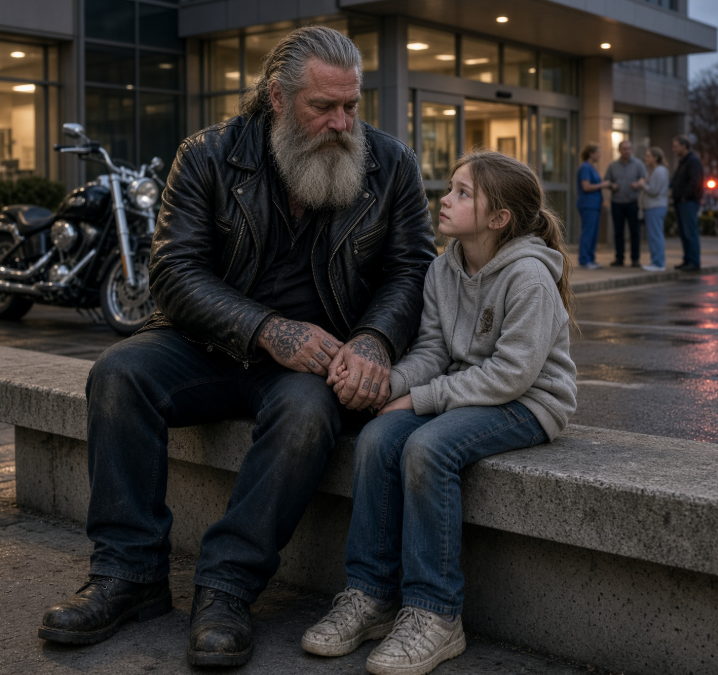
Cole lowered himself carefully onto the concrete.
For several seconds, neither spoke.
Traffic moved beyond the hospital driveway.
Somewhere behind them, an ambulance siren started and faded.
Cole noticed a hospital visitor sticker stuck crookedly to the girl’s sweatshirt.
AVA BROOKS.
He did not stare at it.
“You got somebody inside?”
Ava nodded.
“My mom.”
“Is she sick?”
Ava looked down at her hands.
“No.”
Cole waited.
He had learned from his daughter that silence could sometimes do more than questions.
Ava sniffed.
“She works here.”
“What does she do?”
“She’s a nurse.”
Cole nodded.
“That’s hard work.”
“She used to like it.”
The words were quiet.
Used to.
Cole looked at the glass doors.
“What happened?”
Ava hesitated.
Then she asked, “Are you a bad guy?”
Cole almost smiled.
“Depends who you ask.”
She studied the tattoos on his hands.
One was an old eagle across his right wrist.
Another was a faded date along his knuckles.
June 18.
Ava pointed.
“What’s that date?”
Cole looked down.
For one second, his face changed.
“My daughter’s birthday.”
“You have a daughter?”
“I did.”
Ava stopped breathing for a moment.
Kids understood certain things faster than adults.
“I’m sorry.”
“Thank you.”
“Did she die?”
Cole looked toward the parking lot.
“Yes.”
Ava shifted closer without thinking.
“How old?”
“Ten.”
“I’m nine.”
“I figured somewhere around there.”
“Was she sick?”
Cole nodded.
“Leukemia.”
Ava looked down again.
“My dad died.”
Cole turned toward her.
“When?”
“Three years ago.”
“I’m sorry.”
“He had a heart attack.”
Cole did not tell her that nine-year-olds should not know how to say heart attack without stumbling.
He did not tell her she looked too young to have learned the word funeral.
Instead, he said, “Sounds like you and your mom have been carrying a lot.”
Ava’s mouth trembled.
“My mom says we carry each other.”
Cole felt something tighten behind his ribs.
His daughter Lily used to say things like that.
Small sentences that sounded bigger than the people speaking them.
He looked away.
Ava suddenly reached over and took his hand.
Cole froze.
It was not fear.
It was memory.
For years, he had avoided holding children’s hands.
Not consciously.
He simply found reasons not to.
At the repair shop, when customers brought their kids, Cole might fist-bump them.
When his sister’s grandchildren visited, he would ruffle their hair.
At charity rides, if children wanted photographs, he stood beside them with his hands in his pockets.
But Ava’s fingers closed around his without warning.
Small.
Warm.
Trusting.
Exactly like Lily’s.
Cole swallowed hard.
He did not pull away.
For a while, they sat like that.
A tattooed biker everyone avoided.
A frightened little girl nobody had noticed.
Then Ava whispered, “They’re firing my mom.”
Cole looked at her.
“Who is?”
“The hospital.”
“Why?”
Ava rubbed her thumb across one of his knuckles.
“Because she told the truth.”
Cole’s expression changed.
“What truth?”
Ava looked toward the doors.
“She said people are taking money.”
Before Cole could ask more, the doors opened.
A woman in pale blue scrubs came outside quickly.
She was probably in her mid-thirties, with tired brown eyes and hair pulled into a loose bun. Her face was blotchy from crying.
When she saw Ava sitting beside Cole, she stopped.
“Ava.”
The girl immediately stood.
“Mom.”
The woman hurried over.
Cole rose too.
Her eyes moved from his leather jacket to the tattoos to Ava’s hand still wrapped around his.
Fear flickered across her face.
Cole released the girl immediately.
“She was alone,” he said. “I just sat with her.”
The woman looked at Ava.
“Are you okay?”
Ava nodded.
“He’s nice.”
Cole gave a small shrug.
“Debatable.”
The woman almost smiled.
Then the hospital doors opened again.
Three people emerged.
A security officer.
A woman in a gray business suit.
And a tall man wearing an expensive navy jacket with a hospital identification badge clipped near his pocket.
Cole knew him before he read the badge.
The hair was grayer.
The face heavier.
But he knew him.
Graham Vale.
Executive Vice President, St. Gabriel Medical Center.
Eleven years earlier, Graham Vale had been director of patient administration.
Cole felt the world narrow around him.
Vale had stood in a hospital hallway while Cole begged for help.
Vale had adjusted his cuff links while Cole’s wife cried.
Vale had spoken calmly about forms, coverage, financial authorization, treatment protocols, and procedural limitations while Lily Mercer lay upstairs getting weaker.
Cole had heard that voice in nightmares for years.
Now the same man was walking toward him.
Vale did not recognize Cole.
Not yet.
His attention went to the nurse.
“Hannah, I told you to leave hospital property.”
Ava’s mother stiffened.
“I was getting my daughter.”
“You were instructed that your access privileges were suspended effective immediately.”
“I understand that.”
“Then you should understand that this discussion is over.”
Ava stepped closer to her mother.
Cole remained silent.
Vale noticed him.
His gaze traveled slowly over Cole’s clothes.
“Sir, is there a problem?”
“No.”
“Then I suggest you move along.”
Cole’s jaw tightened.
Hannah quickly said, “He was only sitting with my daughter.”
Vale looked at Cole again.
His face carried the effortless contempt of a man accustomed to deciding who belonged in which room.
“This is a medical facility, not a motorcycle clubhouse.”
The security officer glanced at Vale, visibly uncomfortable.
Cole’s eyes hardened.
Ava squeezed her mother’s hand.
Hannah said, “Mr. Vale, please. He hasn’t done anything.”
“I wasn’t speaking to you, Ms. Brooks.”
Cole felt something old wake inside him.
Not rage.
Rage had burned itself out years earlier.
What remained was colder.
“Then speak to me,” Cole said.
Vale frowned.
“I just did.”
“No. You performed.”
The woman in the gray suit looked away as if hiding a reaction.
Vale stepped closer.
“I’m going to ask you once to leave.”
“And I’m going to ask you once why a nine-year-old was sitting outside your hospital crying while her mother was being threatened upstairs.”
Hannah inhaled sharply.
Vale’s face changed.
“This is none of your business.”
“That’s what people say when they don’t want witnesses.”
The security officer shifted.
Vale lowered his voice.
“You do not know what you are talking about.”
“Maybe not.”
Cole looked at Hannah.
“But she probably does.”
Vale’s eyes flashed.
“Hannah Brooks is a disgruntled former employee who was terminated for serious breaches of internal policy.”
Hannah stared at him.
“That’s a lie.”
Vale barely looked at her.
“You removed confidential financial documents from restricted systems.”
“I copied evidence.”
“You stole records.”
“I reported fraud.”
“Enough.”
Ava flinched.
Cole noticed.
His voice became quiet.
“Don’t shout in front of the kid.”
Vale stared at him.
Something in Cole’s tone made even the security officer stop moving.
But Vale was a man who had spent too long surrounded by people who apologized when he insulted them.
“You need to leave.”
Cole did not move.
Vale nodded at the guard.
“Officer, remove him.”
The security officer hesitated.
“Mr. Vale, he isn’t actually inside the building.”
“He is harassing hospital personnel.”
“No,” Hannah said. “He isn’t.”
Vale turned on her.
“You are no longer hospital personnel.”
The humiliation in Hannah’s face was immediate.
Ava saw it too.
That mattered more to Cole than anything Vale said to him.
The girl had already lost one parent.
Now she was watching powerful adults strip dignity from the one she still had.
Cole knew that look.
He had seen it on Lily’s face the night two billing representatives discussed his family’s finances at the foot of her bed as though the child could not hear.
He had watched his daughter realize adults could talk about money while you were dying.
He had promised himself afterward that if he ever saw someone use power like that again, he would not stay silent.
Cole turned toward Hannah.
“What kind of fraud?”
Vale stepped between them.
“We’re done here.”
Hannah looked at him.
Then at her daughter.
Then at Cole.
Fear battled exhaustion in her face.
Finally she said, “The Children’s Hope Fund.”
Cole stopped breathing.
St. Gabriel’s Children’s Hope Fund.
Eleven years earlier, when Lily’s treatment costs had exploded, a social worker told the Mercers about it.
The fund had been created specifically for families whose insurance denied procedures or whose emergency costs pushed them into crisis.
Cole and his wife, Rachel, had applied.
They were denied.
Not because the fund was empty.
Not according to the letter.
Because their case did not meet “administrative eligibility criteria.”
Six months after Lily died, Cole discovered that the fund had raised more than four million dollars that year.
He never learned where all of it went.
Cole slowly looked at Vale.
The administrator finally studied his face more carefully.
Recognition did not come yet.
Hannah continued.
“They’re moving money out of it.”
Vale snapped, “Stop talking.”
Hannah’s fear disappeared for one second.
“No.”
That single word changed something.
Cole watched her straighten.
Maybe she had spent the entire afternoon being interrupted.
Maybe she had spent months being told to shut up.
Maybe Ava’s small hand in hers reminded her what surrender would teach her daughter.
Hannah said, “For almost four years, money from Children’s Hope has been transferred through consulting contracts, vendor reimbursements, and administrative service fees. Families are being told the fund is exhausted while millions are going somewhere else.”
The security officer stared at Vale.
The woman in the suit looked down.
Cole’s voice was almost a whisper.
“How much?”
Hannah looked at him.
“At least eight million that I can prove.”
Vale moved toward her.
“If you say another word, Hannah, I will personally make sure every hospital in this state knows why you were terminated.”
Cole stepped between them.
He did not touch Vale.
He did not need to.
Vale stopped.
Cole was several inches taller.
For the first time, the executive seemed to notice the strength beneath the leather jacket.
But Cole’s voice stayed controlled.
“You just threatened a whistleblower in front of witnesses.”
Vale laughed once.
“You think because you watched a few television shows you understand employment law?”
“No.”
Cole reached into his jacket.
The security officer immediately put a hand near his radio.
Cole slowly removed his phone.
“I understand recording laws.”
Vale looked at the phone.
Cole had been recording since the moment Vale told Hannah to leave hospital property.
Hannah stared at him.
Vale’s face tightened.
“You don’t have permission to record me.”
“We’re standing outside in a public entrance.”
Cole slipped the phone back into his pocket.
Vale pointed toward the street.
“Get off this property.”
Cole looked at Hannah.
“Do you have copies?”
She said nothing.
“You don’t have to tell me where.”
Her eyes filled.
“Yes.”
Vale said, “Those documents are stolen hospital property.”
Hannah turned toward him.
“My sister died waiting for a surgery your charity told her it couldn’t help pay for.”
That silenced everyone.
Even Cole.
Hannah’s voice shook now.
“She was twenty-eight. She had a congenital heart condition. She needed a specialized procedure. Her insurance fought us for months. Children’s Hope denied the emergency grant.”
Vale said nothing.
“After she died, I stayed here because I thought maybe I could help other families navigate the system better than we did.”
A tear slipped down her cheek.
“Then three months ago, I found a transfer from the Children’s Hope account to a consulting company called Vantage Meridian.”
Vale’s expression changed.
It was small.
But Cole saw it.
Hannah saw it too.
She continued.
“Two hundred and forty thousand dollars. No patient attached. No service report. Just ‘strategic administration.’ Then I found another.”
Vale’s voice went cold.
“You accessed files outside your authorized role.”
“I found twenty-seven payments.”
“You misunderstood internal accounting.”
“I checked the company registration.”
Hannah took a step toward him.
“You know whose name was on it?”
Vale said nothing.
“Your brother-in-law.”
The security officer slowly lowered his hand from his radio.
Ava looked up at her mother.
Cole felt the old coldness deepen.
Vale adjusted his jacket.
“You are making defamatory accusations while emotionally unstable from a disciplinary proceeding.”
Hannah actually laughed.
It was a broken sound.
“There it is.”
“What?”
“The thing you always do.”
Vale’s face hardened.
“You call people confused when they understand you perfectly.”
Cole looked at him.
Recognition finally began forming in Vale’s eyes.
He stared at Cole’s beard.
Then the tattooed date on his hand.
Then his face.
“Have we met?”
Cole answered quietly.
“Room 614.”
Vale’s expression became blank.
Cole continued.
“Pediatric oncology. Eleven years ago.”
Hannah looked between them.
Cole said, “My daughter’s name was Lily Mercer.”
Vale’s face lost some color.
Cole watched the memory return.
Lily.
Rachel.
Cole.
The denied grant.
The argument in the hallway.
The security escort.
Vale whispered, “Mr. Mercer.”
“Now you remember.”
Ava looked up at Cole.
Hannah stared at him.
Vale recovered quickly.
Executives like him had built careers on recovering quickly.
“I remember your family’s unfortunate circumstances.”
Cole’s eyes changed.
“Unfortunate circumstances.”
Vale shifted his weight.
“I’m sorry for your loss.”
“No, you’re not.”
“That’s unnecessary.”
Cole took one step closer.
“You looked me in the face while my daughter was dying and told me there was nothing else the hospital could do financially.”
“That was more than a decade ago.”
“You told my wife the charity fund had limited resources.”
“It does.”
“You told us families had to accept difficult realities.”
“I was explaining policy.”
“My daughter was ten.”
Vale lowered his voice.
“Your daughter’s clinical outcome was not caused by financial administration.”
Cole’s fists clenched.
For the first time, the security officer looked worried.
Ava noticed too.
She moved beside Cole.
Not behind her mother.
Beside him.
Her hand found his again.
The effect was immediate.
Cole looked down.
His fingers relaxed.
Vale saw it.
Perhaps that was the first moment he understood that the frightening man in front of him was not what he had assumed.
But understanding did not make him kinder.
It made him defensive.
“I will not stand here and be blamed for a child’s death because a grieving father has spent a decade looking for someone to hate.”
Hannah whispered, “You should stop talking.”
Vale ignored her.
Cole’s face went very still.
“I did hate you.”
Ava looked up.
Cole continued.
“For a long time.”
Vale said nothing.
“I hated the doctors. The insurance company. The hospital. God. Myself.”
Cole’s voice remained calm.
“But hate gets heavy after a few years.”
He looked toward the windows above them.
“So I started looking at paperwork instead.”
Vale’s eyes narrowed.
Cole said, “I requested the fund’s public tax filings.”
Hannah’s face changed.
“I pulled charity reports. Board disclosures. vendor payments that appeared in public records. I filed complaints. Most went nowhere.”
Vale gave a thin smile.
“That should tell you something.”
“It did.”
Cole looked at him.
“It told me somebody with money was good at making things disappear.”
Vale’s smile vanished.
Hannah whispered, “What did you find?”
“Not enough.”
Cole looked at her.
“Until tonight.”
Vale immediately said, “Do not speak with him.”
Hannah stared at Vale.
Then slowly turned back to Cole.
“What do you need?”
“Hannah.”
“What do you need, Mr. Mercer?”
“Cole.”
She nodded.
“Cole.”
He glanced at Ava.
“A safe place to talk first.”
Hannah’s shoulders dropped.
“I don’t know where that is anymore.”
Cole pointed toward his motorcycle.
“My shop is twelve minutes away.”
Ava’s eyes widened.
“You fix motorcycles?”
“Motorcycles. Cars. Trucks. Anything that comes in making the wrong noise.”
For the first time that evening, she smiled.
It was tiny.
But it was there.
Vale stepped forward.
“If Ms. Brooks leaves with confidential records, law enforcement will be contacted.”
Cole looked at the security officer.
“Sounds like he should call them.”
Vale stared at him.
Cole said, “Actually, call everybody.”
Then he walked toward the parking lot with Hannah and Ava.
Nobody stopped them.
Cole’s repair shop occupied an old brick garage near the railroad district.
The sign said MERCER MOTOR & MACHINE in faded white letters.
By eight o’clock, the service bays were dark except for one row of overhead lights.
Ava wandered slowly between motorcycles while Hannah sat in Cole’s small office gripping a paper cup of coffee.
Cole called one person.
Her name was Dana Reeves.
She had been a reporter when Lily died.
Back then she worked for the Westfield Sentinel.
Cole contacted her after discovering discrepancies in St. Gabriel’s charity reports.
Dana investigated for six weeks before her editor abruptly killed the story.
Two months later, she left journalism and became an attorney specializing in nonprofit fraud and whistleblower cases.
Cole had kept her number.
When she answered, he said, “It’s happening again.”
Dana arrived twenty-seven minutes later.
She was fifty now, sharp-eyed, short-haired, wearing sneakers, black slacks, and a raincoat despite the clear weather.
She walked into the office carrying a laptop bag.
When she saw Hannah, she stopped.
“You’re the nurse?”
Hannah nodded.
Dana set down the bag.
“How much documentation do you have?”
Hannah hesitated.
Dana sat across from her.
“Before you answer, I am an attorney. I’m not your attorney unless we establish representation, but I know enough to tell you that copying employer files can create legal complications depending on what you took and how you accessed it.”
Hannah looked frightened again.
Cole leaned against the doorframe.
Dana continued.
“If you uncovered financial misconduct, there are protected channels for reporting it. We need to determine what you have, what you already reported, who retaliated, and whether patient information is involved.”
“No patient records.”
“Good.”
“Accounting summaries. Vendor invoices. internal emails. transfer authorizations.”
Dana leaned forward.
“Who authorized the transfers?”
Hannah looked at Cole.
Then back at Dana.
“Graham Vale.”
Dana became very still.
“All of them?”
“Not all. But most.”
“Who else?”
“Chief financial officer. Two board members. And someone named M. Vale on consulting approvals.”
Cole said, “His brother-in-law?”
Hannah shook her head.
“I thought so at first.”
Dana caught the distinction.
“At first?”
Hannah looked pale.
“I was wrong.”
She opened her purse and removed a flash drive.
“This morning I found incorporation records attached to an old compliance email. Vantage Meridian wasn’t registered to his brother-in-law originally.”
Dana plugged the drive into a separate offline laptop.
“Who was it registered to?”
Hannah swallowed.
“His wife.”
Cole stared at her.
Dana began opening files.
For ten minutes, nobody spoke.
Ava sat on a stool outside the office drawing on the back of an old parts invoice.
Inside, Dana moved from document to document.
Her face became more serious with each one.
“These are real?”
“Yes.”
“Unaltered?”
“Yes.”
“Original metadata?”
“As far as I know.”
Dana opened a spreadsheet.
Her eyebrows lifted.
“Jesus.”
Cole stepped closer.
“What?”
Dana turned the screen.
Rows of payments filled the display.
Consulting.
Outreach.
Strategic administration.
Vendor coordination.
Grant management.
Dana pointed at totals.
“Over the period she downloaded, Vantage Meridian received 5.8 million dollars.”
Hannah said, “There are two other companies.”
Dana looked at her.
“What companies?”
“Halcyon Civic Partners and Children First Logistics.”
Dana typed quickly.
Cole watched her search records Hannah had saved.
Then Dana leaned back.
“Halcyon shares a mailing address with Vale’s private foundation.”
Cole felt sick.
“And Children First?”
Hannah whispered, “Owned by the hospital board chair’s son.”
The room went quiet.
Ava appeared in the doorway.
“Mom?”
Hannah instantly closed the laptop halfway.
“Yes, honey?”
“Can I have water?”
Cole pushed away from the wall.
“I’ll get it.”
Ava followed him into the garage.
Cole opened a small refrigerator near the tool lockers and handed her a bottle.
She looked at the motorcycles.
“Which one is yours?”
“The black one outside.”
“Do you go really fast?”
“Sometimes.”
“Isn’t that dangerous?”
“So is crossing the street if you don’t pay attention.”
Ava considered this.
“My mom hates motorcycles.”
“Smart woman.”
Ava smiled again.
Then she noticed a framed photograph above Cole’s workbench.
A little girl sat on a red motorcycle wearing an oversized helmet.
A younger Cole stood behind her.
Ava walked toward it.
“Is that Lily?”
Cole nodded.
“She wanted her own bike.”
“She looks happy.”
“She usually was.”
“What happened when she got sick?”
Cole stared at the photograph.
At first he thought about changing the subject.
Then he remembered how adults had spoken around Lily instead of to her.
He had hated that.
So he answered.
“She got bruises all over her legs. Then she got tired. Doctors ran tests.”
“And it was cancer.”
“Yes.”
“Did they try to fix her?”
“They tried.”
Ava looked at him carefully.
“But the hospital did something bad?”
Cole sat on the edge of his workbench.
“The doctors didn’t do something bad.”
He wanted that distinction clear.
“There were good doctors here. Great nurses too. Some fought like hell for her.”
“Then who did?”
Cole looked toward the office.
“People who treated money like it mattered more than people.”
Ava took a sip of water.
“Mr. Vale?”
Cole did not answer immediately.
“At the time, I thought he was just cold.”
“And now?”
“Now I want proof before I decide what he was.”
Ava nodded as though this made sense.
Then she said, “My mom always says being sure is more important than being loud.”
Cole smiled faintly.
“She sounds smart.”
“She is.”
Ava’s face darkened.
“She cried in the bathroom last night because she thought I was asleep.”
Cole said nothing.
“She said we might lose our apartment.”
His chest tightened.
“My mom has money saved, but not a lot. My dad used to make more.”
Cole looked down.
Ava continued.
“Mr. Vale said nobody would hire her.”
“When?”
“I heard him today.”
Cole lifted his head sharply.
“What exactly did he say?”
“He said if she went outside the hospital, he’d make sure she never worked as a nurse in this state again.”
“Did anyone else hear it?”
“I did.”
“Anyone besides you?”
Ava thought.
“Mrs. Patel.”
“Who’s that?”
“She works in the office with my mom.”
Cole walked quickly back toward the office.
“Dana.”
The attorney looked up.
“We have another witness.”
By midnight, there were four.
Hannah called Priya Patel, a hospital billing analyst who had worked beside her for six years.
At first Priya refused to talk.
Then Hannah put the phone on speaker and said, “He fired me.”
The line went quiet.
Priya whispered, “What?”
“He fired me and threatened to blacklist me.”
Another silence.
Then Priya said, “I told you this would happen.”
“I know.”
“You should have stopped.”
“I couldn’t.”
“You have a daughter.”
“That’s why I couldn’t.”
Priya began crying.
It took several minutes before she spoke again.
“I have emails.”
Dana looked up.
“What emails?”
Priya heard the stranger’s voice and panicked.
“Who is that?”
Hannah explained.
Priya nearly hung up.
Dana took over calmly.
“Ms. Patel, do not forward anything to me tonight. Do not access anything you are not authorized to access. Do not delete anything. Do not warn anyone. If you already possess evidence lawfully, preserve it exactly as it exists.”
Priya breathed heavily.
Then she said, “There was an audit.”
Hannah stared at the phone.
“What?”
“Two years ago.”
“I never heard about an audit.”
“Nobody did.”
Priya lowered her voice.
“Internal compliance flagged the Children’s Hope transfers.”
Dana began taking notes.
“What happened?”
“An outside auditor came in for three days.”
“And?”
“He left.”
“Why?”
“I don’t know.”
“Was there a report?”
“Yes.”
“Where is it?”
“I only saw part of it.”
Priya swallowed.
“It said the fund had ‘material conflicts of interest’ and recommended immediate suspension of three vendors.”
Dana looked at Cole.
“What happened after that?”
“The vendors stayed.”
“And the auditor?”
“He was removed.”
“By whom?”
Priya whispered, “Vale.”
Cole closed his eyes.
The story was becoming familiar.
Not identical.
Worse.
A system designed to help vulnerable families had become a source of private money, and anyone who questioned it had been moved aside.
Dana asked, “Do you know the auditor’s name?”
Priya did.
By one-thirty in the morning, Dana had found him.
Thomas Kell was sixty-two and living in Ohio.
He answered on the fourth call.
When Dana explained why she was contacting him, he said, “I wondered how long it would take.”
Cole listened from across the office.
Thomas Kell described the audit.
He had identified unexplained vendor payments, related-party contracts, inflated administrative fees, and grant-denial practices that appeared designed to keep more money available for internal transfers.
Dana asked him why he had not gone to regulators.
“I did.”
Everyone stopped.
“What happened?”
“I sent my report to the state charity bureau.”
“And?”
“Three weeks later, St. Gabriel claimed my audit had been incomplete and methodologically flawed. Their lawyers sent an eighty-page rebuttal.”
“Did the state investigate?”
“Briefly.”
“What was the result?”
“No formal action.”
“Why?”
Kell sighed.
“You would have to ask them.”
Dana said, “Do you still have your files?”
“No.”
Cole’s shoulders sank.
Then Kell added, “But I have something better.”
“What?”
“A recording.”
Vale had called him after the audit.
Kell suspected what the conversation would be about and recorded it legally from his own home.
He had never released it because Vale carefully avoided explicit admissions.
But in one portion, Vale said something that made Cole’s skin go cold.
“Charity isn’t about giving every desperate family what they ask for, Tom. It’s about controlling resources. The public gives because stories make them emotional. Our job is to be less emotional than they are.”
Dana asked Kell to repeat the sentence.
He did.
Cole looked through the office window at Ava sleeping on a battered leather couch beneath one of his work jackets.
His hands shook.
Lily had been one of those stories.
A photograph in a brochure.
A bald little girl holding a stuffed dog while St. Gabriel asked donors to “help children fight.”
Cole remembered finding Lily’s picture in a fundraising mailer two months after her death.
He had never authorized it.
Rachel had collapsed on the kitchen floor when she saw it.
The hospital had denied their grant.
Then used their dead daughter’s face to raise money.
Cole had kept the mailer.
For eleven years.
At two in the morning, he went to a locked cabinet beneath his desk and pulled out a cardboard box.
Dana watched.
“What’s that?”
“Everything.”
Inside were denial letters.
Billing statements.
Charity brochures.
Newspaper clippings.
Tax returns.
Notes.
Emails.
A photograph of Lily.
And the mailer.
Dana picked it up carefully.
There was Lily.
Eight months into treatment.
Smiling weakly.
Underneath her photo:
YOUR GIFT GIVES CHILDREN LIKE LILY A FIGHTING CHANCE.
Dana stared at Cole.
“Did you approve this?”
“No.”
“Did Rachel?”
“No.”
“Was Lily alive when this went out?”
Cole shook his head.
“She’d been dead seven weeks.”
Hannah covered her mouth.
Dana flipped the brochure over.
The Children’s Hope Fund logo was printed beside a donation form.
“What year?”
Cole told her.
Dana returned to the laptop.
She opened public financial records from that year.
Her fingers moved.
Then stopped.
“Cole.”
He looked over.
“The fund reported its largest annual fundraising total that year.”
“How much?”
“Six point two million.”
Cole stared at Lily’s photograph.
His voice barely worked.
“And they denied us twenty-eight thousand.”
Nobody said anything.
At three-thirty, Dana told Hannah to sleep.
Hannah refused.
At four, Cole made coffee.
At five, Ava woke and asked if her mother still had a job.
Hannah sat beside her on the couch.
“No, baby.”
Ava’s eyes filled.
“Because you told?”
“Yes.”
“Would you do it again?”
Hannah looked at her daughter.
Then at Dana.
Then at Cole.
“Yes.”
Ava nodded.
“Okay.”
That simple answer nearly broke her mother.
Hannah pulled Ava into her arms.
Cole turned away.
At seven-fifteen, Dana made the first formal call.
Not to the hospital.
Not to the media.
To the state attorney general’s nonprofit enforcement division.
Then to federal investigators because some of the charity funds involved Medicare-linked community benefit programs and interstate vendors.
Then to a whistleblower protection attorney she trusted.
By eight-thirty, something unexpected happened.
People began coming to the shop.
The first was Priya Patel.
She walked in shaking.
“I called in sick.”
Hannah stood.
Priya crossed the garage and hugged her.
“I’m sorry.”
“For what?”
“For being scared.”
“You were protecting your family.”
“So were you.”
Priya had brought no documents.
Dana had told her not to.
But she brought memories.
Dates.
Names.
Meetings.
Statements.
At nine-ten, another employee arrived.
Miguel Santos.
Former grant coordinator for Children’s Hope.
Vale had fired him eighteen months earlier for “performance issues.”
Miguel had a different story.
“I was instructed to increase denials.”
Dana asked, “By whom?”
“Senior administration.”
“Specific name.”
Miguel hesitated.
“Vale.”
“How?”
“He said approvals had become unsustainable.”
“Were they?”
“No.”
“How do you know?”
“Because our available balance was increasing.”
Cole leaned forward.
Miguel continued.
“They wanted us to deny requests for technical reasons.”
“What kind of technical reasons?”
“Missing signatures. Income documents older than thirty days. Applications filed after procedures instead of before. Insurance appeals not fully exhausted.”
Hannah looked sick.
“People in emergency situations.”
Miguel nodded.
“Cancer. Pediatric surgeries. Transplants. Cardiac procedures.”
Cole’s voice became rough.
“Eleven years ago too?”
Miguel looked at him.
“I wasn’t there then.”
Cole nodded.
Dana said, “Was anyone ever told to target certain families?”
“Not exactly.”
“What were you told?”
Miguel looked ashamed.
“To prioritize cases that could produce strong community engagement.”
Nobody spoke.
Hannah whispered, “Meaning?”
Miguel swallowed.
“Families willing to appear in campaigns. Donor events. Media. Families with stories that photographed well.”
Cole slowly stood.
Dana said, “Cole.”
He walked away.
Not toward Miguel.
Toward the back garage door.
He pushed it open and stepped into the alley.
The morning sun hit him in the face.
For several seconds he stood with both hands on his head.
Lily.
They had used her picture.
Maybe that was why a photographer had come into her room one afternoon.
Cole remembered now.
A “hospital community team.”
Rachel had been exhausted.
Lily liked the stuffed dog the photographer gave her.
Somebody had slid a release form among a stack of medical papers.
Had Rachel signed without knowing?
Had Cole?
He could not remember.
That was the cruelty of those months.
Everything blurred.
Fear.
Bills.
Doctors.
Consent forms.
Blood counts.
Needles.
Insurance appeals.
He remembered sitting in a stairwell one night with thirty-two dollars in his checking account and a voicemail from the mortgage company.
He remembered Rachel selling her wedding jewelry.
He remembered Lily apologizing because treatment was expensive.
A ten-year-old apologizing for cancer.
Cole punched the brick wall once.
Pain shot through his hand.
He stared at his knuckles.
The back door opened.
Ava stood there.
Cole immediately lowered his hand.
“You shouldn’t be out here.”
“Mom said you might need somebody.”
Cole almost laughed.
“Your mom sent you?”
Ava shook her head.
“No.”
She walked beside him.
“You’re bleeding.”
“It’s nothing.”
“My mom says people say that when it’s something.”
Cole looked at her.
“That woman has too many sayings.”
Ava smiled.
Then she took his hand carefully.
The same hand he had hit against the wall.
“Did you miss Lily today?”
“Every day.”
“Does it hurt every day?”
Cole looked toward the sky.
“Not the same way.”
“What does that mean?”
“At first, missing somebody feels like drowning.”
Ava listened.
“Later, you learn how to carry the water.”
She seemed to think about this.
“Does it get lighter?”
“Sometimes.”
“Did you stop being sad?”
“No.”
“Then how do you keep going?”
Cole looked back through the open door at Hannah.
At Dana.
At strangers arriving because one woman had finally refused to stay silent.
“You find something worth doing with the sadness.”
By noon, six former employees had contacted Dana.
By three, there were eleven.
Someone had leaked the news of Hannah’s termination internally.
Employees knew why.
Most had suspected pieces of the truth.
Few had seen the whole picture.
One former accountant described vendor invoices that made no sense.
A social worker described families being denied despite ample funds.
A pediatric surgeon said administrators pressured staff to stop directing families toward Children’s Hope because “availability had tightened,” even during years when donations increased.
Then came the person nobody expected.
Dr. Evelyn Marsh.
Seventy-one years old.
Retired pediatric oncologist.
She had treated Lily.
When Cole saw her walk into the garage, he could not move.
Dr. Marsh recognized him immediately.
“Oh, Cole.”
He looked at the woman who had once sat beside Lily’s bed after her shift ended and read Charlotte’s Web because Rachel was too exhausted to keep her eyes open.
Her hair was silver now.
She walked with a cane.
Cole hugged her.
For nearly a minute neither spoke.
Then Evelyn pulled back and touched his face.
“You look like hell.”
Cole laughed through tears.
“So do you.”
“That’s age. You don’t have my excuse.”
Hannah watched them.
Dana asked Evelyn why she had come.
The doctor looked at Cole.
“Because I should have come eleven years ago.”
Cole frowned.
Evelyn sat.
She placed both hands on her cane.
“Lily qualified for a Children’s Hope grant.”
Cole’s face went blank.
Nobody moved.
“What?”
Evelyn looked devastated.
“I recommended approval myself.”
Cole stared at her.
“The letter said we weren’t eligible.”
“I know.”
“Then what are you saying?”
“The medical committee approved her.”
The room blurred.
Cole gripped the back of a chair.
Evelyn continued.
“Her case met every clinical requirement. She had a treatment option at an outside center that might have extended remission. Your insurer called it experimental.”
Cole remembered.
Boston.
A specialist.
A trial combined with a targeted therapy.
They needed money for travel, temporary housing, and treatment costs insurance refused.
Twenty-eight thousand dollars initially.
Maybe more later.
They never got there.
Evelyn’s eyes filled.
“I signed the recommendation.”
Cole could barely speak.
“Who denied it?”
Evelyn closed her eyes.
“Administration.”
“Who?”
“I never saw the final signature.”
“Who, Evelyn?”
She looked at him.
“Graham Vale chaired the financial exception committee.”
Cole walked away.
His chest felt like it had split open.
All those years he had told himself Lily probably would have died anyway.
Doctors had been clear.
The treatment was uncertain.
No promises.
But uncertainty was not nothing.
A chance was not nothing.
Even one more month was not nothing.
He turned back.
“Why didn’t you tell me?”
Evelyn cried openly now.
“Because I was a coward.”
Cole stopped.
“The hospital told us the appeal had been reviewed properly. I challenged it internally. Then I was warned that discussing funding decisions with families violated policy.”
“You let us think she didn’t qualify.”
“Yes.”
“My wife blamed herself.”
“I know.”
“No, you don’t.”
Cole’s voice rose for the first time.
“Rachel spent three years asking whether we filled out something wrong.”
Evelyn covered her mouth.
“She stopped sleeping. She thought she failed Lily.”
“I’m sorry.”
“She died thinking that.”
Hannah gasped softly.
Cole’s voice cracked.
“Rachel died four years after Lily.”
Evelyn wept.
“I’m sorry.”
Cole turned away.
Ava stood near her mother, frightened.
Cole saw her.
He forced himself to breathe.
Then Evelyn said something that stopped him.
“I brought my journal.”
Cole looked back.
During Lily’s treatment, Evelyn kept contemporaneous notes about cases where administrators interfered with clinical recommendations.
Not patient charts.
Personal professional notes.
Dates.
Meetings.
Names.
One entry described Lily’s case.
“Vale says fund cannot become ‘open faucet.’ Wants stronger donor-facing cases prioritized. I objected. Mercer child denied despite committee recommendation.”
Dana read it twice.
Then a third time.
“This is evidence.”
Evelyn nodded.
“I know.”
“Why keep it?”
“Because some part of me knew one day I might need to admit what happened.”
Cole looked at her for a long time.
He wanted to hate her.
Part of him did.
But he also remembered her sleeping in a chair beside Lily after a twenty-hour shift.
People were rarely only one thing.
Cowardice could live beside kindness.
Fear could corrupt good people without making their goodness imaginary.
That did not erase responsibility.
It made responsibility harder.
Cole said, “You’re going to testify.”
Evelyn nodded.
“Yes.”
“Publicly.”
“Yes.”
“You’re going to tell Rachel’s family too.”
Her face crumpled.
“Yes.”
Cole looked at Lily’s photograph.
“Then start telling the truth.”
The story broke forty-eight hours later.
Not because Cole leaked it.
Dana insisted they first preserve the evidence with investigators.
But someone inside St. Gabriel saw state agents arrive.
By noon, local reporters were outside the hospital.
By evening, national outlets had picked it up.
ST. GABRIEL EXECUTIVE ACCUSED OF DIVERTING CHILDREN’S CHARITY FUNDS.
HOSPITAL WHISTLEBLOWER SAYS MILLIONS REDIRECTED FROM SICK FAMILIES.
The hospital issued a statement.
It described the allegations as “mischaracterizations by a recently terminated employee.”
It announced an independent internal review.
Then Graham Vale made his biggest mistake.
He held a press conference.
Cole watched from his shop television with Hannah, Ava, Dana, and several former employees.
Vale stood behind a podium in a dark suit.
Hospital logos filled the wall behind him.
He looked composed.
Concerned.
Professional.
He said St. Gabriel had always placed patients first.
He said administrative fees were legitimate.
He said vendor relationships had been properly reviewed.
Then a reporter asked about Hannah.
Vale replied, “It is unfortunate when a former employee facing disciplinary concerns attempts to redirect attention through sensational accusations.”
Hannah closed her eyes.
Ava whispered, “He’s lying.”
Cole said, “Yes.”
Another reporter asked whether Children’s Hope had denied medically eligible families while transferring millions to affiliated companies.
Vale replied, “No family has ever been denied solely for the financial benefit of this institution.”
Dana leaned toward the television.
“He should have stopped three sentences ago.”
A reporter asked about Vantage Meridian.
Vale said his wife had “no operational involvement” in the company during the relevant period.
Dana opened one of Hannah’s files.
A transfer authorization carried an electronic approval.
G. VALE.
A second authorization showed quarterly payments.
A third contained an email.
Graham, Leslie wants the next Vantage distribution processed before fiscal close.
Vale continued speaking.
Then someone asked about Cole.
“Mr. Vale, a man named Cole Mercer says his daughter was denied assistance eleven years ago despite medical approval. The hospital later used the deceased child’s photograph in Children’s Hope fundraising material. Were you involved in the denial?”
Vale’s face changed.
Only slightly.
But millions of people would eventually watch that moment.
His answer became the sentence that destroyed him.
“Mr. Mercer has carried understandable grief for many years, but grief can distort memory.”
Cole stared at the television.
Ava looked at him.
Hannah said, “Oh my God.”
Vale continued.
“The medical and charitable decisions related to his daughter were thoroughly reviewed at the time.”
Dana stood.
“That’s it.”
She grabbed her phone.
“What?”
“He put Lily’s case in issue publicly.”
Cole understood.
Vale had called him unreliable.
Emotional.
Distorted by grief.
So Dana released documents that did not rely on Cole’s memory.
Dr. Evelyn Marsh’s dated journal entry.
The original grant recommendation.
The denial.
The fundraising brochure.
Public financial filings.
And, with Thomas Kell’s permission, the audio recording.
Within hours, the story changed.
It was no longer about accounting.
It was about children.
Families began contacting journalists.
One mother described selling her car after a grant denial.
A father showed a rejection letter received two weeks before his son’s transplant.
Another family said St. Gabriel had photographed their daughter for a charity gala while refusing to reimburse travel for the very treatment featured in her story.
Former donors demanded answers.
A retired teacher said she had left $400,000 to Children’s Hope in her will and immediately contacted her attorney to change it.
The hospital board called an emergency meeting.
Vale was placed on administrative leave.
He called it temporary.
It lasted nine hours.
At eleven-thirty that night, investigators executed warrants at St. Gabriel administrative offices, Vantage Meridian, and two private residences.
By sunrise, Graham Vale had resigned.
But resignation was not justice.
Cole knew that.
Hannah knew it too.
Three weeks later, Hannah received a letter from another hospital offering an interview.
Then another.
Then six.
The threat that Vale would destroy her career had collapsed almost as fast as his own.
Still, she did not celebrate.
“I don’t want to be famous for this,” she told Cole one evening.
They sat outside the repair shop while Ava did homework inside.
“You won’t be.”
“I already am.”
“For now.”
Hannah looked tired.
“People online call me brave.”
“You are.”
“No.”
She shook her head.
“I spent months knowing something was wrong before I said anything.”
Cole looked at her.
“You were scared.”
“Exactly.”
“Brave people are scared.”
“That sounds like something printed on a coffee mug.”
“Probably is.”
She laughed.
Then her face became serious.
“I almost deleted everything.”
“When?”
“The night before I reported it.”
“Why didn’t you?”
“Ava.”
Cole nodded.
“She was asleep on the couch.”
Hannah looked through the garage window at her daughter.
“I kept thinking about what I would tell her if this ever came out later. That I knew? That I stayed quiet because we needed health insurance?”
“That would have been human.”
“It would also have been wrong.”
Cole said nothing.
Hannah looked at him.
“Would you have fought if Lily hadn’t died?”
The question surprised him.
“I don’t know.”
“I mean after. All this paperwork. Complaints. Years of it.”
Cole stared down the street.
“No.”
Hannah waited.
“I would have taken her home and lived my life.”
“Do you feel guilty about that?”
“Sometimes.”
“Why?”
“Because grief turned me into somebody useful.”
Hannah frowned.
“That isn’t something to feel guilty about.”
“You’d be surprised what grief can make you feel guilty about.”
Cole picked at an old scar on his wrist.
“For years I thought if I had been smarter, richer, calmer, better educated—something—I could have saved her.”
“You were her dad.”
“I was supposed to.”
“You were supposed to love her.”
Cole looked at Hannah.
She said, “You did.”
His eyes filled.
“You don’t know that.”
“I watched you sit with my daughter when you thought nobody was watching.”
Hannah’s voice softened.
“I know exactly what kind of father you were.”
Cole looked away.
A month after the investigation began, the hospital’s board chair resigned.
Two weeks later, the chief financial officer followed.
Then federal prosecutors announced charges.
Wire fraud.
Conspiracy.
Tax offenses.
Obstruction.
Misuse of charitable assets.
The charging documents alleged that executives and affiliated vendors had diverted more than eleven million dollars over nine years.
Some money had purchased legitimate services.
Much of it had not.
There were luxury consulting trips.
A lake property.
Vehicles.
Private school tuition routed through a reimbursement company.
Political donations disguised through intermediaries.
And payments to entities controlled by relatives.
The worst document, at least to Cole, was an internal presentation titled GRANT SUSTAINABILITY MODEL.
One slide categorized applicants.
Category A: high donor engagement.
Category B: moderate community value.
Category C: low external impact.
Children.
Sick children.
Rated partly by donor value.
Lily’s file had been coded B-minus.
Cole found out during a meeting with prosecutors.
He sat silently after they told him.
The investigator across from him, a woman named Erin Walsh, closed the folder.
“You don’t have to stay.”
Cole looked at her.
“What did B-minus mean?”
Walsh hesitated.
“We’re still interviewing people involved in the program.”
“What did it mean?”
She answered carefully.
“Evidence suggests administrators considered fundraising potential alongside financial and clinical factors.”
Cole stared at the table.
“Lily wasn’t useful enough.”
“I would not phrase it that way.”
“But they did.”
Walsh said nothing.
Cole laughed once.
Then covered his face.
For eleven years, he had imagined hundreds of explanations.
Bureaucracy.
Bad timing.
Limited funds.
Paperwork.
Insurance rules.
He had never imagined the truth could be both more complicated and more cruel.
Lily had become valuable after she died because her photograph raised money.
While alive, she had not scored high enough.
Cole left the federal building and rode for three hours.
No destination.
No plan.
Just highway.
When he finally stopped, he was at a cemetery.
Lily was buried beside Rachel.
Cole had not consciously chosen the route.
He stood between their stones with his helmet in one hand.
For a long time, he said nothing.
Then he sat in the grass.
“They knew.”
The wind moved through maple trees overhead.
“They knew she qualified.”
His voice broke.
“I’m sorry.”
He rubbed his face.
“I’m so damn sorry.”
There were apologies he had repeated for years.
Sorry he had not made more money.
Sorry he had not understood the insurance appeal faster.
Sorry he had yelled at Rachel in the hospital cafeteria.
Sorry Lily had heard them argue.
Sorry he had told her Boston would probably happen when it never did.
Sorry he had spent years after her death becoming angry enough that Rachel sometimes said she had lost both of them.
He touched Lily’s stone.
“You didn’t cost too much.”
That had haunted him most.
One night, when Lily was very sick, she overheard her parents talking about bills.
She whispered to Cole later, “Dad, am I costing too much?”
He had told her no.
But he had hated himself because the world around them kept saying yes.
Cole pressed his palm against the cold granite.
“You were worth everything.”
His shoulders shook.
“I should’ve told you that every day.”
A voice behind him said, “I think she knew.”
Cole turned.
Ava stood several yards away.
Hannah was beside her.
Cole quickly wiped his face.
“What are you doing here?”
Hannah held up her phone.
“Your sister called me. Said nobody knew where you were, but she thought you might come here.”
Cole sighed.
“My sister talks too much.”
Ava walked closer.
She carried a small bouquet of yellow daisies.
“Mom said these were Lily’s favorite.”
Cole looked at Hannah.
“Your sister.”
“Of course.”
Ava placed the flowers beside Lily’s stone.
Then she put two white roses beside Rachel’s.
Cole swallowed.
“Thank you.”
Ava sat in the grass.
Hannah remained standing a respectful distance away.
Ava looked at Lily’s headstone.
“Did she like motorcycles?”
“She loved them.”
“Did your wife?”
Cole laughed.
“No.”
“What did she say?”
“She told me if I ever put Lily on a motorcycle, she’d bury me under the garage.”
Ava giggled.
Cole smiled.
For the first time in years, the cemetery did not feel only like a place where his life had ended.
There was a child laughing there.
Life beside death.
Warmth beside stone.
Ava asked, “Do you think Lily would like me?”
Cole looked at her.
“I think she would have gotten you into trouble within ten minutes.”
“Good.”
Hannah sat down beside them.
They stayed until sunset.
The court case took fourteen months.
During that time, Graham Vale remained free on bond.
His attorneys attacked the evidence.
They described the charity’s accounting as complex but legal.
They claimed employees misunderstood administrative structures.
They suggested Hannah had copied files because she was angry about a promotion.
Then they attacked Cole.
An old arrest from his twenties appeared in a defense filing.
Disorderly conduct after a bar fight.
His motorcycle club friendships were mentioned.
Photographs from charity rides were posted online with captions suggesting he belonged to a criminal gang.
A television commentator called him “an aggrieved biker with a vendetta.”
Cole’s customers started getting anonymous messages.
One said Mercer Motor & Machine was owned by “a violent felon.”
Cole had never been convicted of a felony.
A supplier abruptly suspended his commercial account.
Someone spray-painted LIAR across the garage door.
Ava cried when she saw it.
Cole did not.
He spent two hours removing the paint.
Hannah stood beside him.
“They’re trying to scare you.”
“No.”
“They are.”
Cole scrubbed harder.
“They’re trying to make me angry.”
“What’s the difference?”
“If I get scared, I disappear.”
He dipped the brush in solvent.
“If I get angry, I become exactly what they’re telling people I am.”
Hannah watched him.
“So what are you going to do?”
“Clean the door.”
She smiled.
Then grabbed another brush.
They cleaned it together.
A week later, someone threw a brick through the office window.
This time Cole did get angry.
Not because of the glass.
Ava had been sitting at that desk twenty minutes earlier.
He installed cameras.
Police increased patrols.
Dana documented every incident.
Then something changed.
People began showing up.
The first was an older man whose granddaughter had received treatment at St. Gabriel.
He handed Cole five hundred dollars.
Cole refused it.
The man put the money on the workbench.
“Fix somebody’s car who can’t pay.”
Then came a teacher.
A firefighter.
Three nurses.
A mother whose child had survived lymphoma.
Twenty bikers from neighboring clubs.
Former patients.
People Cole had never met.
They repainted the garage door.
Fixed the window.
Restocked damaged supplies.
One woman brought cookies.
Another brought a sign.
It read:
HE STAYED.
Cole stared at it.
“What’s that mean?”
Ava smiled.
“I made it.”
“You made this?”
“I came up with the words.”
“Your handwriting got really professional.”
“Mom helped.”
Hannah shrugged.
“Barely.”
Ava explained.
“When everybody else was scared of you at the hospital, you stayed with me.”
Cole looked at the sign again.
HE STAYED.
Two words.
They hit harder than any speech.
Ava said, “You can hang it in the office.”
Cole did.
The trial began in March.
By then, Graham Vale had rejected two plea offers.
He insisted he had done nothing criminal.
For three weeks, prosecutors built the case.
Accountants explained transfers.
Former employees described pressure.
Vendors testified about fake work.
Emails showed Vale approving contracts benefiting relatives.
One message said:
DENY EXCEPTIONS UNTIL Q4. WE NEED TO PROTECT LIQUIDITY.
Another:
PATIENT FACING SPEND CANNOT KEEP OUTPACING DEVELOPMENT VALUE.
Vale’s attorneys argued those phrases were normal business language.
Then Dr. Evelyn Marsh testified.
Cole sat behind prosecutors.
Evelyn walked slowly to the witness stand with her cane.
She described Lily.
Her diagnosis.
Her treatment.
The Boston option.
The grant committee recommendation.
Then the prosecutor asked, “Was Lily Mercer medically approved for charitable assistance?”
“Yes.”
“What happened?”
“Administration denied funding.”
“Was that decision consistent with the clinical committee’s recommendation?”
“No.”
“Did you object?”
“Yes.”
“What were you told?”
Evelyn looked across the courtroom at Vale.
“I was told the fund could not become an open faucet.”
“Who said that?”
“Graham Vale.”
A murmur moved through the gallery.
Vale did not look at Cole.
Evelyn’s attorney had warned her cross-examination would be brutal.
It was.
Defense counsel suggested her memory was unreliable.
They mentioned her age.
They questioned why she had waited eleven years.
Finally he asked, “Doctor, isn’t it true that guilt has influenced your recollection?”
Evelyn looked at him.
“Yes.”
The lawyer paused, surprised.
Evelyn continued.
“I feel enormous guilt.”
He recovered.
“So you admit emotional bias?”
“I admit cowardice.”
The courtroom became silent.
Evelyn looked toward Cole.
“I knew a family had been misled, and I was afraid of losing my position.”
She turned back to the attorney.
“That does not make my records false.”
The defense lawyer tried to interrupt.
Evelyn kept speaking.
“It makes my silence shameful.”
Cole bowed his head.
After court, Evelyn found him in the hallway.
“I’m sorry.”
Cole looked at her.
“I know.”
“I don’t expect forgiveness.”
“I know.”
She nodded.
Then Cole said, “But I’m trying.”
Evelyn cried.
“So am I.”
Hannah testified two days later.
Vale’s lawyers tried to make her look bitter.
They displayed her termination notice.
Read internal warnings.
Questioned why she copied financial records.
Asked whether she had ever argued with a supervisor.
Hannah remained calm.
Then the lawyer made a mistake.
“Ms. Brooks, isn’t it true that your personal history influenced your fixation on the Children’s Hope Fund?”
Hannah looked at him.
“My sister died.”
“Yes, and that tragic experience understandably created strong emotions.”
“It created questions.”
“Emotional questions.”
“Numbers aren’t emotional.”
The jury watched her.
Hannah continued.
“A payment is either there or it isn’t. A company is owned by somebody or it isn’t. A transfer was approved or it wasn’t.”
The lawyer said, “But your interpretation—”
“My interpretation didn’t send five hundred and eighty thousand dollars to Mr. Vale’s wife.”
The prosecutor objected to the argument.
The judge instructed the jury.
But the moment landed.
Then Ava’s name came up.
The defense lawyer asked if Hannah had discussed the case with her daughter.
“Yes.”
“You exposed a nine-year-old child to complex workplace disputes?”
Hannah’s face changed.
Cole sat forward.
The lawyer continued.
“Could that have contributed to the emotional scene outside the hospital on the evening of your termination?”
Hannah stared at him.
“My daughter was sitting outside alone because Mr. Vale ordered security to remove her from the executive waiting area.”
A murmur moved through the courtroom.
The lawyer stopped.
That fact had not been widely reported.
The prosecutor stood.
“Your Honor, may we approach?”
After discussion, the judge allowed limited questioning.
Hannah explained.
She had been called unexpectedly to an administrative meeting at the end of her shift.
Ava had just arrived with a neighbor who could not stay.
Hannah asked if the child could sit outside the office.
For twenty minutes she did.
Then Vale became angry when Hannah refused to sign a confidentiality agreement.
He ordered an assistant to have Ava taken downstairs.
A nine-year-old girl had been sent outside while her mother was being fired.
The defense had opened that door itself.
The next morning every newspaper carried the detail.
Vale’s public image collapsed.
But the most powerful testimony came from someone prosecutors almost did not call.
Cole.
He walked to the witness stand wearing a dark suit borrowed from his brother-in-law.
No leather.
No boots.
No visible club patches.
But his tattoos remained.
He did not hide them.
The prosecutor asked about Lily.
Cole answered slowly.
He described her obsession with strawberry milkshakes.
Her love of motorcycles.
Her hatred of math.
How she named every IV pole Frederick.
The jury smiled.
Then he described the cancer.
The bills.
The denied treatment.
The charity.
The brochure.
The prosecutor handed him Lily’s fundraising mailer.
Cole’s hands shook.
“Is this your daughter?”
“Yes.”
“Was this image used with your permission?”
“I don’t remember giving permission for this campaign.”
“Did the Children’s Hope Fund assist your family?”
“No.”
“How much were you seeking?”
“Initially, twenty-eight thousand dollars.”
“How much did the fund report raising that year?”
“Over six million.”
The prosecutor paused.
“What did you believe for eleven years?”
Cole looked at the jury.
“That we didn’t qualify.”
“What do you believe now?”
The defense objected.
Sustained.
The prosecutor rephrased.
“What did you later learn?”
Cole swallowed.
“That the medical committee approved Lily. Administration denied it.”
“Mr. Mercer, did you begin investigating St. Gabriel after your daughter died?”
“Yes.”
“Why?”
Cole looked toward Vale.
“At first?”
“Yes.”
“Because I wanted someone to blame.”
Vale’s attorneys looked pleased.
The prosecutor asked, “And later?”
Cole took a breath.
“Because I started finding things that didn’t make sense.”
“Did your anger cause you to fabricate evidence?”
“No.”
“Alter documents?”
“No.”
“Threaten Mr. Vale?”
“No.”
“Did you ever assault him?”
“No.”
“Why not?”
The question surprised everyone.
Cole looked toward Ava sitting in the gallery beside Hannah.
Then he said, “Because being angry at a man and becoming like him are two different things.”
The courtroom went silent.
On cross-examination, Vale’s attorney attacked immediately.
“Mr. Mercer, you despise my client, don’t you?”
“I did.”
“You did?”
“Yes.”
“So now you feel no hostility?”
“I didn’t say that.”
The lawyer approached.
“You blame him for your daughter’s death.”
“I blame him for what the evidence says he did.”
“Is that a yes?”
“No.”
The attorney frowned.
Cole continued.
“Cancer killed my daughter.”
That answer mattered.
Cole knew it as he said it.
He could have exaggerated.
Could have told the jury Vale murdered Lily.
Could have made the case emotionally cleaner.
But it would not have been true.
Lily might have died even if she went to Boston.
Cole knew that.
The doctors knew that.
Truth mattered most when the lie would have been easier.
He continued.
“But he helped take away an option her doctors believed she deserved.”
The attorney said, “An option with no guarantee.”
“Yes.”
“So you cannot say Lily would have survived.”
“No.”
“Then your grief has nothing to do with these criminal allegations.”
Cole leaned slightly toward the microphone.
“You asked if I blame him for her death.”
“Yes.”
“I don’t.”
The attorney waited.
“I blame him for deciding her chance mattered less than his numbers.”
Nobody moved.
The defense ended cross-examination soon afterward.
Graham Vale testified in his own defense.
That was the final mistake.
He denied personal benefit.
Then prosecutors showed transfers connected to his household expenses.
He said his wife handled finances.
They showed emails.
He said he did not remember them.
They played Thomas Kell’s recording.
Vale claimed his words were taken out of context.
Then the prosecutor displayed the internal grant categories.
A.
B.
C.
She asked, “What is donor engagement?”
Vale explained fundraising outcomes.
“What is community value?”
He described public awareness.
“What category was Lily Mercer?”
Vale hesitated.
“I don’t know.”
The prosecutor placed the document before him.
“B-minus?”
“I don’t recall.”
“It is written here.”
“I can see that.”
“Who approved this model?”
Vale looked at the document.
“My office participated.”
“Your signature is on the final page.”
“Yes.”
The prosecutor walked closer.
“Mr. Vale, was a dying ten-year-old child assigned a lower priority partly because your organization believed her case had limited donor value?”
“No.”
“What does B-minus mean?”
“It involved multiple factors.”
“Name them.”
Vale began discussing sustainability.
Clinical urgency.
Resources.
Insurance.
Public development.
The prosecutor waited.
Then asked, “What is public development?”
Vale hesitated.
“Fundraising.”
“And donor value?”
“Fundraising potential.”
The courtroom became completely silent.
The prosecutor nodded.
“No further questions.”
The jury deliberated for two days.
Cole refused to sit inside the courthouse while they waited.
He stood outside near a row of motorcycles.
Dozens of bikers had come.
Not to intimidate anyone.
They stayed across the street in the designated public area.
Quiet.
Some wore leather vests.
Some were veterans.
Mechanics.
Electricians.
Teachers.
A retired judge who rode a Harley on weekends.
Cancer survivors.
Parents.
People who knew what it was like to be judged from a distance.
Ava walked among them handing out bottled water.
When the message came that the jury had reached a verdict, everyone went inside.
Cole sat beside Hannah.
Ava sat between them.
The clerk read the counts.
Guilty.
Guilty.
Guilty.
On the fourth count, guilty.
On the fifth, not guilty.
Then guilty again.
Graham Vale stared straight ahead.
His wife cried behind him.
Cole felt no triumph.
That surprised him.
He had imagined this moment for more than a decade without knowing exactly what form it would take.
He thought justice might feel like fire.
Instead it felt like something unclenching.
Beside him, Hannah covered her face.
Ava leaned into her.
Cole put an arm around both of them.
Months later, Vale received a federal prison sentence.
Other defendants received sentences or entered plea agreements.
Several forfeited assets.
Civil settlements recovered millions for the charity.
The state imposed governance reforms on St. Gabriel.
The entire Children’s Hope board was replaced.
Independent financial oversight became mandatory.
Families who had been improperly denied assistance were invited into a restitution process.
No amount of money could return the dead.
Everyone understood that.
Restitution was not resurrection.
Justice could not rewrite hospital rooms.
It could not give Lily Boston.
It could not give Hannah her sister back.
It could not erase eleven years from Cole’s life.
But it could stop the lie.
Sometimes that was the first form healing took.
St. Gabriel offered Hannah her job back.
She declined.
Instead, she joined a nonprofit patient advocacy organization helping families appeal insurance denials and understand medical-assistance programs.
She earned slightly less money at first.
She slept much better.
Priya became an internal compliance investigator.
Miguel returned to nonprofit work.
Dr. Marsh volunteered with an ethics board teaching young physicians how to document and challenge administrative interference.
And Cole?
Cole went back to fixing motorcycles.
Mostly.
His life did not suddenly become simple.
He still woke from dreams about Lily.
Still visited Rachel’s grave.
Still hated hospitals.
Still sometimes sat in his truck outside St. Gabriel and stared at the sixth floor.
But things had changed.
One Saturday morning, a woman came into the shop with a broken-down minivan.
Three children waited inside.
Her transmission repair would cost more than she had.
She started crying when Cole gave her the estimate.
“I can’t do it.”
He looked at her.
“What do you need the van for?”
“My son has dialysis three times a week.”
Cole glanced toward the office.
The sign Ava made still hung on the wall.
HE STAYED.
He walked back to the woman.
“Leave the keys.”
“I just told you I can’t afford it.”
“I heard you.”
“I don’t want charity.”
“Good.”
Cole handed her a business card.
“Because I’m terrible at charity.”
She stared at him.
“What is this?”
“A repair.”
“How much?”
“Whatever you can pay.”
“I can’t—”
“Lady, if you keep arguing, I’m charging you extra.”
She laughed through tears.
Three days later the van was fixed.
Cole started a small emergency repair fund after that.
No applications longer than one page.
No donor scoring.
No photographs required.
No public stories unless people volunteered them.
He named it Lily’s Road Fund.
When Dana asked why road instead of hope, Cole said, “Hope sounds like something you sit around waiting for.”
“And a road?”
“You move.”
The fund grew.
Bikers held rides.
Local businesses donated.
A tire distributor gave supplies.
A credit union matched contributions.
Within a year, Lily’s Road Fund had paid for eighty-three vehicle repairs for families traveling to medical treatment.
Ava kept the number on a dry-erase board in Cole’s office.
She had become a permanent presence at the shop.
At ten, she knew how to check tire pressure.
At eleven, she could change oil with supervision.
At twelve, she announced she wanted her own motorcycle.
Hannah said absolutely not.
Cole wisely remained silent.
Ava turned to him.
“Tell her Lily rode.”
Cole looked at Hannah.
Hannah pointed a wrench at him.
“Choose your next words very carefully.”
Cole cleared his throat.
“Motorcycles are extremely dangerous.”
“Coward,” Ava muttered.
“Survivor,” Cole replied.
By then, people around Westfield knew Cole.
Some still crossed the street when they saw him.
He never cared.
Others recognized him from the trial.
He cared about that even less.
What mattered were smaller things.
Ava’s school play.
Hannah bringing dinner when he worked late.
The Christmas ornament Ava made with Lily’s name on it.
The first time Cole could tell a story about his daughter and laugh before he cried.
The day Hannah placed a framed photograph in his office.
It showed Cole and Ava outside St. Gabriel on the evening they met.
Neither remembered anyone taking it.
Cole sat on the concrete planter.
Ava beside him.
Her hand inside his.
His motorcycle blurred in the background.
Hannah had received the photograph from a nurse who witnessed the scene from upstairs.
Under the picture, Hannah had written:
The night one person stayed.
Cole stared at it for a long time.
Then he replaced Ava’s old handmade sign with the framed photograph.
He kept the sign too.
Years passed.
St. Gabriel changed leadership.
The hospital created a permanent independent patient-assistance trust, legally separated from hospital operating finances.
A memorial wall was built near the pediatric wing for children whose stories had been used in fundraising campaigns.
Families were invited to decide whether names and photographs could appear.
Cole almost refused.
Then Ava said, “Lily deserves to be remembered for herself.”
So Cole submitted one photograph.
Not the hospital picture.
Not the bald child holding the stuffed dog.
He chose Lily on his motorcycle.
Oversized helmet.
Gap-toothed grin.
Hands gripping handlebars far too big for her.
Under the photograph, the plaque said:
LILY MERCER
She loved strawberry milkshakes, motorcycles, bad jokes, and being alive.
Nothing about cancer.
Nothing about charity.
Nothing about tragedy.
Just Lily.
On the morning the memorial opened, Cole stood in front of the photograph alone.
For several minutes, he smiled.
Then someone slipped a hand into his.
Cole did not have to look.
Ava was thirteen now.
Almost as tall as Hannah.
Braces.
Longer hair.
Same silver-star habit, though now the stars were painted on her motorcycle boots.
Hannah had finally compromised and allowed Ava to ride as a passenger with Cole on short trips.
She wore more protective gear than some professional racers.
Cole had not argued.
Ava looked at Lily’s photograph.
“She looks cool.”
“She was.”
“Cooler than me?”
“Not even close.”
Ava elbowed him.
“You’re supposed to say no.”
“I don’t lie to children.”
“You lied last week when you said Mom’s casserole was good.”
Cole lowered his voice.
“That was survival.”
Hannah approached behind them.
“I heard that.”
Cole straightened.
“I said it was incredible.”
“You said survival.”
“I was discussing Lily.”
Ava started laughing.
Hannah shook her head.
“You two deserve each other.”
The ceremony began.
Hospital officials spoke.
Families spoke.
Dr. Marsh spoke briefly.
Then the new director of the patient-assistance trust invited Cole to say something.
He had refused three times.
Now everyone looked at him.
Cole sighed.
“I hate microphones.”
Ava pushed him forward.
He walked to the podium.
Hundreds of people stood in the courtyard.
Doctors.
Nurses.
Families.
Reporters.
Bikers.
Donors.
Former employees.
Cole looked at the crowd.
Eleven years earlier, he would have used the moment to speak about Graham Vale.
About corruption.
About what had been taken.
He no longer wanted Vale to occupy that much space in Lily’s story.
So Cole spoke about staying.
“When my daughter got sick, a lot of people stayed.”
His voice was rough.
“Nurses stayed after shifts. Doctors stayed when they could’ve gone home. My wife stayed awake so many nights I don’t know how she survived them.”
Cole looked toward Dr. Marsh.
“Some people got scared. Some made mistakes. Some stayed quiet when they should’ve spoken.”
Evelyn lowered her head.
Cole continued.
“And some people who had power used it badly.”
He paused.
“But I’ve learned something since then.”
He looked at Ava.
“Most of us don’t get to choose the worst thing that happens to us.”
The courtyard became silent.
“We don’t choose cancer. We don’t choose grief. We don’t choose who betrays us, who underestimates us, who decides we aren’t worth helping.”
Hannah’s eyes filled.
“But we do get choices afterward.”
Cole looked at Lily’s photograph.
“You can leave.”
His voice softened.
“Or you can stay.”
Nobody moved.
“Staying doesn’t always mean standing beside a hospital bed. Sometimes it means telling the truth when your job is threatened. Sometimes it means admitting you were wrong. Sometimes it means fighting paperwork for ten years when everyone tells you to move on.”
A few people laughed softly.
“Sometimes it means sitting beside a scared kid because nobody else noticed she was alone.”
Ava began crying.
Cole smiled at her.
“That part turned out to be pretty important.”
She wiped her eyes.
Cole looked back at the crowd.
“The night I met Ava, everybody saw what they expected to see when they looked at me.”
He glanced down at his tattoos.
“Leather jacket. Tattoos. Big motorcycle.”
A few bikers smiled.
“I was used to it.”
He shrugged.
“People moved away.”
Then he looked at Ava.
“She didn’t.”
The silence deepened.
“She took my hand.”
Cole’s voice broke slightly.
“And for the first time in a long time, I remembered that these hands had once belonged to somebody’s dad before they belonged to an angry man.”
Hannah covered her mouth.
Cole breathed.
“Ava thought I stayed with her that night.”
He shook his head.
“The truth is, she stayed with me.”
That was all he had planned to say.
So he stepped away from the microphone.
The applause began quietly.
Then rose.
Cole disliked applause.
It always made him uncomfortable.
He walked directly toward Ava.
She hugged him.
Not carefully.
Not politely.
She hit him with enough force that he took half a step backward.
“You made me cry,” she said.
“You cry too easily.”
“So do you.”
“I had dust in my eye.”
“Outside?”
“Very aggressive dust.”
Hannah hugged him too.
For a moment, Cole stood between them beneath Lily’s photograph.
He looked around the courtyard.
Years earlier, he had believed justice meant making the people who hurt you hurt too.
He no longer believed that.
Consequences mattered.
Prison mattered.
Repayment mattered.
Truth mattered.
But revenge had never returned a single thing he lost.
Justice was different.
Justice was Hannah helping another frightened family win an insurance appeal.
Justice was Priya teaching employees how to report fraud safely.
Justice was Dr. Marsh telling young doctors what silence had cost.
Justice was a repaired minivan carrying a child to dialysis.
Justice was money raised in Lily’s name actually reaching people who needed it.
Justice was Ava growing up knowing that telling the truth could be terrifying and still worth doing.
Justice was a dead girl’s father finally understanding that he had not failed her simply because he could not save her.
Several months later, Cole was locking the garage one evening when he heard a motorcycle approaching.
Ava stood beside him wearing a backpack.
She had just turned fourteen.
Hannah’s car was across the street.
The motorcycle stopped.
A stranger climbed off.
Big guy.
Leather vest.
Tattoos.
Gray beard.
For half a second, Cole saw himself years earlier.
A woman walking past immediately pulled her child closer.
The biker noticed.
His shoulders dropped slightly.
Cole recognized the look.
The stranger approached.
“Cole Mercer?”
“Depends.”
The man smiled.
“I heard you help families with medical travel.”
“Sometimes.”
“My niece has surgery in Cincinnati next month. My sister’s car blew a transmission.”
Cole unlocked the garage again.
“Bring it Monday.”
The man hesitated.
“She can’t afford much.”
“Didn’t ask.”
The biker looked at him.
Then at the Lily’s Road Fund sign.
“Why do you do this?”
Cole glanced toward Ava.
She was sitting on the concrete planter outside the shop, tying her boot.
For one strange second, the world folded in on itself.
A hospital.
A frightened child.
An empty seat.
A hand reaching toward his.
Cole looked back at the man.
“Because somebody should stay.”
Years later, Ava would remember that sentence more clearly than anything else.
She would remember the first night too.
She would remember being nine years old outside St. Gabriel, terrified that her mother had lost everything.
She would remember employees passing her without noticing.
She would remember the heavy sound of a motorcycle.
The black jacket.
The tattoos.
The man everyone watched with suspicion.
She would remember wondering whether she should be afraid.
Then she would remember how carefully he sat down.
How he never asked too many questions.
How he did not tell her everything would be fine when he had no way to know.
How he simply stayed.
People would later tell the story differently.
They would say Cole Mercer exposed a multimillion-dollar charity scandal.
They would say a biker helped bring down a corrupt hospital executive.
They would say a whistleblower nurse, an old doctor, an attorney, investigators, and former employees uncovered years of fraud.
All of that was true.
But Ava always believed the real story started before the documents.
Before the warrants.
Before the courtroom.
Before the verdict.
It started on a concrete planter outside a hospital when nearly everyone who saw Cole Mercer decided who he was from a distance.
They saw the leather jacket.
The tattoos.
The scars.
The heavy boots.
The huge motorcycle.
They saw a man they thought they understood.
Ava saw something else.
She saw a place beside her that had been empty.
Then she saw someone fill it.
Cole never became less intimidating with age.
His beard grew whiter.
His tattoos faded.
His shoulders remained broad.
The motorcycle remained loud.
People still sometimes moved aside when he entered a room.
He eventually found that amusing.
Because the people who knew him moved closer.
Hannah.
Ava.
The families his fund helped.
The bikers who volunteered every summer.
The nurses who remembered Lily.
The strangers who became friends.
On Lily’s eighteenth birthday, years after she should have turned eighteen herself, Cole rode alone to the cemetery.
He brought two strawberry milkshakes.
One for him.
One he placed beside the headstone.
“Don’t tell your mother,” he said.
He sat in the grass.
A breeze moved through the trees.
For once, he did not apologize.
He told Lily about the repair fund.
About Ava’s first motorcycle lesson.
About Hannah nearly having a heart attack when Ava stalled the bike.
About the hospital memorial.
About Dr. Marsh.
About the families.
Then he became quiet.
“I kept thinking I had to make what happened mean something.”
He touched the stone.
“That was stupid.”
The cemetery answered with wind.
“You already meant something.”
His eyes filled.
“You didn’t need to become a lesson.”
Cole took a sip of milkshake.
“You were my kid.”
He smiled.
“That was enough.”
When he finally stood to leave, he touched Rachel’s stone too.
“I think I’m okay.”
He laughed softly.
“Mostly.”
He put on his helmet.
Then he stopped.
For years, he had believed healing meant reaching some day when grief disappeared.
That day never came.
Something better did.
Grief stopped being the only thing left.
There was laughter around it.
Work around it.
People around it.
Purpose around it.
Love around it.
Lily was still gone.
Rachel was still gone.
Nothing honest could change that.
But their absence no longer erased everything that remained.
Cole rode back toward town.
The evening light stretched across the road.
At the garage, Ava was waiting.
She was older now.
College applications sat on Cole’s desk because she wanted to study healthcare law.
Hannah claimed Cole had corrupted her.
Cole said the hospital had done most of the work.
Ava heard his motorcycle and stepped outside.
Cole parked.
She tossed him a set of keys.
“What’s this?”
“My car.”
“What happened?”
“Weird noise.”
“Define weird.”
“Like a metal duck getting murdered.”
Cole stared at her.
“That is surprisingly useful.”
“I learned from the best.”
He opened the garage.
Ava followed.
On the office wall hung the same photograph.
A nine-year-old girl.
A frightening-looking biker.
Two strangers on a hospital planter.
Hands joined.
Under it were the words that had become the quiet rule of Cole’s life.
HE STAYED.
That was what people usually remembered in the end.
Not how somebody looked when they walked into your worst day.
Not whether their clothes made you nervous.
Not whether strangers whispered about them.
Not whether they carried scars where everyone could see them.
You remembered who sat down.
Who listened.
Who believed you when powerful people said you were lying.
Who stood beside you when standing beside you became inconvenient.
Who did not disappear when your pain became complicated.
The world had looked at Cole Mercer and seen someone frightening.
Ava Brooks had looked at him and seen an empty hand beside hers.
She reached for it.
And that simple act changed two lives, exposed a secret that had hurt countless families, forced powerful people to answer for what they had done, and gave one grieving father a reason to use his pain for something other than anger.
Sometimes the hardest-looking people are carrying the softest hearts.
Sometimes the quietest people are holding the loudest truths.
Sometimes justice begins with documents, evidence, testimony, and courage.
And sometimes it begins much earlier than that.
Sometimes it begins when the whole world moves away from someone.
And one person stays.