Every Time Dad Tried to Fix Something, the Cat Showed Up to Supervise—Then We Realized He Wasn’t Watching the Work at All
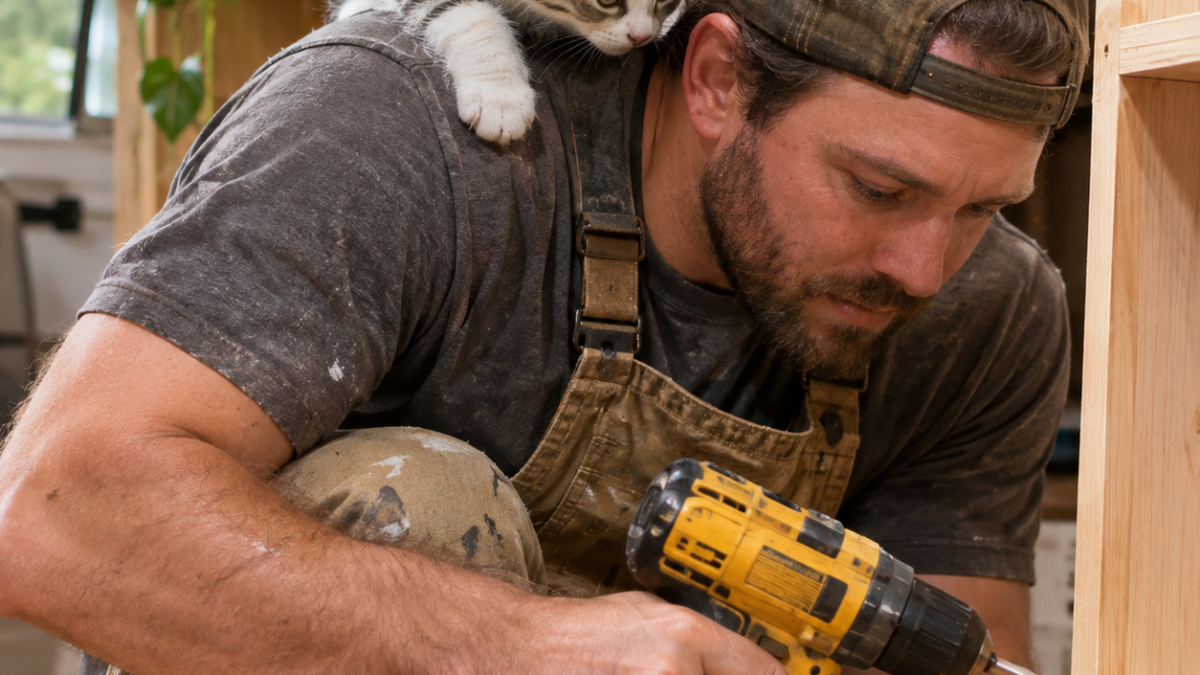
Every Time Dad Tried to Fix Something, the Cat Showed Up to Supervise—Then We Realized He Wasn’t Watching the Work at All
Every time Dad opened a toolbox, crawled under the car, painted a wall, tightened a screw, or tried to repair something around the house, one of our cats appeared within seconds and stared at him like a tiny supervisor who tolerated absolutely no mistakes.
We laughed when they sat on his tools, blocked his flashlight, inspected screws, climbed onto his back, and even returned to supervise repairs for things they had personally broken.
But after enough weekends of watching those little paws follow Dad from room to room, we finally understood that the cats didn’t care whether the shelf was level or the engine ran—they simply wanted to be wherever he was.
There are two kinds of people who repair things around a house.
The first kind lays out the tools, reads the instructions, measures twice, checks the parts, and works in peace.
The second kind owns cats.
Dad belonged to the second group.
It did not matter whether he was fixing a cabinet hinge or rebuilding half an engine.
The moment a toolbox opened, management arrived.
Usually without warning.
Sometimes management arrived before Dad had even figured out what he was doing.
He would kneel beside a broken drawer, reach for a screwdriver, and suddenly a furry face would appear directly between his eyes and the screw.
“Can you move your face?”
The cat stared at him.
“No?”
Still staring.
“Not over there either?”
The cat stepped directly onto the tool he needed.
Dad sighed.
“Fine.”
Somewhere behind the camera, someone started laughing.
This happened so often that eventually nobody asked how the cat knew Dad was working.
The cats always knew.
They could sleep through the television.
Sleep through people talking.
Sleep through somebody opening the front door.
But the tiny click of a toolbox latch?
Eyes open.
Head up.
Engineering emergency.
One afternoon, Dad was assembling a piece of furniture on the floor.
It should have been simple.
A few wooden panels.
Several screws.
Metal brackets.
Instructions printed in that special language furniture companies use where every drawing looks almost—but not quite—like the actual part in your hand.
Dad spread everything out carefully.
For approximately twelve seconds, he had full control of the project.
Then the little engineer arrived.
A gray cat walked into the room with the calm expression of someone who had been called to inspect a major construction site.
She did not rush.
Professionals never rush.
She walked around the pieces once.
Sniffed a board.
Stepped over the screws.
Sat down.
And stared directly at Dad.
Dad looked at her.
She looked at him.
“All right?”
No response.
“Everything going according to plan?”
PART2:
Still nothing.
Dad picked up a bracket.
The cat leaned closer.
He turned it.
She narrowed her eyes.
Dad laughed.
“You don’t approve?”
She sniffed it.
Apparently not.
The family started calling her the engineer.
Not assistant.
Engineer.
Assistant implied Dad was in charge.
That would have been inaccurate.
The little engineer followed every step.
Board moves?
She moves.
Screwdriver comes out?
She gets closer.
Dad checks the instructions?
She places one paw directly on the page.
No mistakes allowed.
At one point Dad reached for a screw and discovered it was missing.
He looked around.
“Where did it go?”
The cat looked innocent.
Too innocent.
Dad checked beneath the board.
Nothing.
Under the instruction sheet.
Nothing.
Then someone noticed a tiny paw resting suspiciously over something shiny.
“Move your paw.”
No.
“Come on.”
The paw stayed.
Dad gently lifted it.
There was the screw.
The cat looked personally offended by the accusation.
After that, Dad began counting parts before and after the supervisor arrived.
It did not help much.
Cats have excellent inventory-management skills.
Mostly for relocating inventory.
Painting projects were even worse.
Paint is attractive to cats for reasons nobody understands.
Possibly because humans become extremely emotional when cats approach it.
Dad once started repainting a wall in the hallway.
He laid down plastic.
Opened the paint.
Rolled the first section.
Then felt the unmistakable sensation of being watched.
He turned.
A cat sat three feet away.
Perfectly upright.
Eyes fixed on the roller.
Dad continued.
Roll up.
The cat’s head moved up.
Roll down.
Head down.
Up.
Down.
Up.
Down.
Dad stopped.
The cat stared at him.
“You checking every stroke?”
The cat blinked.
He rolled again.
Head followed.
Someone behind him started laughing.
Dad pointed the roller.
“You are making me nervous.”
The cat took one step closer.
“Don’t.”
Another step.
“Absolutely not.”
Another.
Dad put one hand out.
“No blue cat today.”
The cat sat down.
For a moment it appeared the negotiation had succeeded.
Then Dad turned back to the wall.
One paw touched the plastic.
Another.
She began approaching the paint tray.
Dad spun around.
“No.”
She froze.
That face.
Cats have a special expression when they are caught doing exactly what they were told not to do.
It says:
I have no idea what you are talking about.
I was simply walking in this direction for reasons unrelated to your ridiculous paint.
Dad returned her to a safe chair.
She remained there.
Watching.
Every brushstroke.
Every corner.
Every time he dipped the roller.
A contractor would have charged hundreds of dollars for that level of supervision.
The cat accepted payment in chicken.
Dad never formally agreed to those terms, but apparently they were standard.
Cooking was another department under feline management.
One evening Dad was seasoning dinner.
The family had learned not to leave meat unattended for obvious reasons.
Dad added salt.
Pepper.
A little spice.
Then realized there was a face beside the counter.
Not touching anything.
Just watching.
Serious.
Focused.
The host of the evening meal had arrived to inspect quality.
Dad looked over.
“You checking the seasoning?”
The cat leaned forward.
Sniff.
Another sniff.
Dad moved the bowl away.
The cat followed.
“Too much pepper?”
The cat said nothing.
“Not enough?”
Still nothing.
This was how every cooking conversation went.
Dad asked questions.
The cat provided mysterious silence.
Then later, if food dropped, she gave immediate feedback.
Fastest review system in the house.
Sometimes the supervisor’s motivations were less professional.
Dad could be under the sink fixing a pipe, and a cat would appear simply because Dad was lying on the floor.
From a cat’s perspective, a human lying on the floor is an invitation.
Why else would anyone do that?
Dad would reach into the cabinet.
The cat would climb onto his stomach.
“Really?”
She settled.
“I need to move.”
Purr.
“I actually need both hands.”
More purring.
Dad tried to slide sideways.
The cat adjusted.
Perfect balance.
Now she was lying on his chest.
Dad stared upward.
“Guys.”
Nobody came to help.
They came to film.
“Can I get this done?”
Laughter.
“Anybody?”
More laughter.
The cat looked comfortable.
Project delayed indefinitely.
This became a theme.
If Dad crawled under something, a cat climbed on him.
Under the car?
Cat on chest.
Under a table?
Cat on back.
Behind an appliance?
Cat inspecting from shoulder level.
To the cats, Dad was not lying in an awkward position because he was working.
He had simply become furniture.
One weekend he was beneath the car changing something near the front wheel.
He had a flashlight.
Wrenches.
Grease everywhere.
Dad’s shirt was already dirty.
Then little paws appeared at the edge of the car.
“Don’t come under here.”
The paws came closer.
“Seriously.”
A face appeared.
The cat looked at him.
Dad sighed.
“What are you doing?”
The cat crawled underneath.
There was barely enough room for Dad.
The cat did not care.
She stepped directly onto his chest.
Then sat.
Dad laughed despite himself.
“Under the car. On top of me. Excellent.”
Someone filming said the cat looked like a mechanic.
That was generous.
Mechanics normally help.
This mechanic added weight.
Dad reached for the wrench.
The cat sniffed his hand.
He tried to turn.
She adjusted.
He slid one shoulder.
She adjusted again.
Finally he gave up for a moment and scratched her head.
Instant purring.
That was probably what she wanted.
Grease on Dad.
Dust on the floor.
Metal above them.
And somehow she looked completely content.
Not because she cared about the car.
Because Dad was there.
That was the first clue nobody really noticed.
We were too busy laughing.
The cats had a strange relationship with tools.
Screwdrivers were fascinating.
Wrenches were acceptable.
Tape measures were enemies.
The tape measure caused immediate chaos.
Dad could pull the yellow tape out three feet.
Click.
Cat eyes widened.
Five feet.
Body lowered.
Eight feet.
Ready to attack.
“Don’t.”
The tape moved.
Pounce.
Dad yelled.
Someone laughed.
The cat grabbed the tape.
Dad tried to pull it free.
The tape retracted slightly.
That made everything worse.
Fast moving yellow snake.
Now the cat was fully committed.
“Let go.”
No.
“Come on.”
No.
Dad tried negotiating.
“You don’t even know what this is.”
That argument never worked.
Cats do not need to understand an object to own it.
Eventually Dad began using rulers when possible.
Much safer.
Except rulers could also be pushed off tables.
No system was perfect.
One time Dad needed someone to hold a flashlight.
He made the mistake of saying it out loud.
“Can you hold the light straight?”
A cat sat beside him.
Someone laughed.
Dad looked at the cat.
“Well?”
The cat stared.
“Your one job.”
The flashlight beam pointed at the wall.
Dad moved it.
The cat pushed the flashlight with one paw.
Beam moved away again.
“Not there.”
Paw.
“Stop.”
Paw.
Dad laughed.
“Fine. You’re fired.”
The cat remained.
Termination procedures in that house were ineffective.
Another time, someone genuinely tried to make the cat useful.
Dad was installing a small part.
“Can you help me put that in there?”
He held the piece out.
The cat reached.
For one hopeful second, it looked like she might actually cooperate.
Then she knocked the piece under the cabinet.
Dad stared.
“What the hell?”
Everyone exploded laughing.
The cat walked away.
Job complete.
We learned that feline productivity must be measured differently.
Human productivity:
Finish task efficiently.
Cat productivity:
Increase emotional engagement.
By that measurement, they were excellent workers.
One orange cat had especially short legs.
He followed Dad everywhere.
Workshop.
Garage.
Kitchen.
Back porch.
If Dad moved to another room, tiny legs started immediately.
Pat-pat-pat-pat.
He was never far behind.
The problem was that he tired quickly.
Dad would walk into the garage.
Cat followed.
Dad knelt.
Cat arrived.
Dad stood and moved to the other side.
Cat followed.
After enough trips, the little guy simply flopped down.
Dad looked back.
“You tired?”
The cat remained on the floor.
“Come on.”
Nothing.
Dad picked him up.
The cat immediately relaxed against him.
So much for supervision.
Now the supervisor needed transportation.
Dad carried him to the next work area.
Nobody questioned the arrangement.
One family member laughed:
“Those short little legs follow Dad everywhere even if they do get tired.”
That was exactly it.
Where Dad went, he went.
Even if halfway there his body decided otherwise.
Sometimes the cats physically joined the work.
Dad once repaired a chair.
He turned it upside down.
The cat climbed inside the frame.
Now Dad had to work around her.
“Scoot.”
No.
“I need that screw.”
Nothing.
“Girl.”
Nothing.
He reached past her.
She moved one paw.
Directly onto the screw.
“Of course.”
Later, when the chair was upright again, she sat on it first.
Quality assurance.
A repaired chair must pass load testing.
The cat took this responsibility seriously.
She turned around twice.
Sat.
Looked at Dad.
Approved.
Bookshelves required similar inspection.
Dad assembled one in the living room.
Tall wooden shelves.
The minute he stood it upright, a cat climbed into the bottom space.
Dad looked over.
“Really?”
The cat sat.
Then moved to the second shelf.
Then third.
Dad watched.
“I haven’t even anchored it yet.”
The cat continued.
Someone said:
“She’s testing whether it fits.”
Apparently.
Human books were secondary.
The true question was shelf-to-cat compatibility.
The cat reached the upper shelf.
Turned around.
Sat perfectly.
Dad shook his head.
“I built you a six-foot cat tree.”
The cat blinked.
Maybe that was what she thought.
Later, when books were added, she looked offended.
Who had filled her new apartment with paper?
Another job involved a chain.
Dad was explaining something mechanical.
“So right here is the chain, and it goes—”
Cat walked directly through the middle.
Dad stopped.
“Where are you going?”
The cat climbed onto the seat.
Dad stared.
“Are you on the seat now?”
The cat settled.
He looked toward the other workers.
“How much do they pay you guys an hour?”
Everyone laughed.
The cat’s rate remained confidential.
Probably higher than Dad’s.
One cat actually appeared to demonstrate techniques.
Dad struggled with a small object.
The cat reached out.
Paw.
Tap.
Move.
Dad stared.
“Are you showing me?”
The cat did it again.
Someone joked that when the boss himself steps in to demonstrate, you know he has years of experience.
Maybe.
Or maybe the cat simply wanted the moving piece.
Either way, Dad let him have the moment.
“You got it?”
Paw.
“Better than me?”
Paw.
“All right.”
There is something humbling about being corrected by an animal who sleeps eighteen hours a day.
The cats also became very interested in lunch breaks.
Dad did not take enough of them.
If he was focused on a project, hours could pass.
The cats disagreed.
One afternoon he sat at a workbench.
Measuring.
Marking.
Sanding.
A cat jumped onto the bench.
Dad moved her gently.
She came back.
He moved her.
Back again.
Then she put one paw on his wrist.
He stopped.
She leaned forward.
Head against his arm.
Dad sighed.
“You telling me to stop?”
Purr.
He scratched her cheek.
She pressed closer.
“Lunch?”
Purr.
Someone behind him said:
“She’s reminding you it’s break time.”
Dad looked at the clock.
It actually was.
The cat had better labor standards than the humans.
Later that day, she got a treat.
Union success.
Not every supervisor was innocent.
One repair was necessary because the cat had caused the damage.
This detail made the inspection especially funny.
Something had been knocked loose.
Nobody saw it happen.
Nobody needed to.
The evidence was circumstantial but overwhelming.
Object previously stable.
Cat previously near object.
Crash.
Cat running away.
Now Dad was on the floor fixing it.
And who arrived?
The suspect.
She sat beside the repair.
Watched.
Very closely.
Dad looked at her.
“You did this.”
The cat stared.
“You are supervising repair of your own crime scene.”
Slow blink.
“No remorse?”
None.
She leaned closer to inspect.
Dad laughed.
“Unbelievable.”
The family started calling her the culprit.
She remained until the job was finished.
Maybe she wanted to ensure Dad restored her favorite destruction target correctly.
Cats support sustainability.
Why break something new when Dad can repair the old thing for repeated use?
One of the sweetest cats had no interest in tools at all.
He simply wanted physical contact.
If Dad sat down, he came.
If Dad knelt, he rubbed against him.
If Dad lay beneath something, he found the nearest exposed part of Dad and settled there.
People liked to joke:
“Who’s guarding who?”
Nobody knew.
Sometimes Dad would be outside working.
The cat would sit near his legs.
Watch the yard.
After a while, the cat would curl up and nap.
Dad continued working.
The cat slept.
Technically poor supervision.
Emotionally perfect.
The cat had chosen the worksite because Dad was there.
Once Dad stopped moving for a moment, the cat leaned against him and fell asleep.
No productivity.
No inspection.
Just trust.
That was when the jokes about “bosses” became softer.
Because yes, the cat looked like a supervisor.
But supervisors do not usually fall asleep against your boot.
Another cat seemed almost therapeutic.
Dad could come home tired.
Sit down after working.
The cat approached.
No wild behavior.
No demanding.
Just climbed beside him.
Head against his arm.
Purring.
Someone said:
“Who says cats are mean? This guy is pure therapy.”
Dad smiled.
The cat stayed.
Sometimes after a long day, Dad did not need help fixing anything.
The cat fixed Dad.
No tools required.
That happened more often than anyone talked about.
Dad was the person everyone called when something broke.
Door.
Car.
Shelf.
Cabinet.
Fence.
Toy.
Appliance.
He was always repairing something.
But nobody asked who repaired him when he was tired.
The cats seemed to know.
They did it by sitting nearby.
Following.
Purring.
Interrupting at exactly the moment he was taking himself too seriously.
Dad could be frustrated with a bolt that refused to move.
Then a paw appeared.
He laughed.
Frustration broken.
Maybe that was useful after all.
One evening Dad came in covered with grease.
Hands black.
Shirt dirty.
Face tired.
He sat down before washing up.
A cat ran toward him.
Dad held his hands away.
“Don’t. I’m filthy.”
The cat did not care.
Rubbed against his leg.
Dad smiled.
“You’re going to get grease on you.”
Purr.
“Seriously.”
The cat climbed onto his lap.
Dad laughed.
There was something almost absurdly sweet about it.
Cats care very little about whether you look presentable.
Grease.
Sweat.
Paint.
Dust.
If you are their person, you are their person.
The cat did not see a dirty mechanic.
He saw Dad.
That was enough.
Sometimes Dad attempted to work somewhere high to escape.
It never worked.
He climbed a ladder.
Looked down.
Cat below.
Then somehow—
cat above.
“How did you get up there?”
No answer.
Cats treat vertical space as a personal challenge.
If a human reaches a place, a cat considers it proof that place is accessible.
Dad once climbed onto a platform to repair something near the ceiling.
He turned around.
There was the cat.
“What?”
Cat sat.
“How?”
Nothing.
Dad laughed.
“You are impossible.”
The cat looked down over the room like a manager surveying a factory floor.
Some bosses need the big picture.
This one found the highest seat in the house.
Then Dad had to finish the job while also making sure the cat did not decide to leap onto his head.
Efficiency dropped.
Entertainment increased.
Some jobs required delicate work.
Tiny screws.
Wires.
Connectors.
The family would joke:
“Can a boss this fluffy handle something that delicate?”
Apparently yes.
A paw would move quickly.
Tap.
Tap.
Tap.
Usually in exactly the place Dad did not want.
Fast little paws.
Productivity way up.
Or down.
Depending on whose report you read.
Dad occasionally tried setting boundaries.
“This requires no cats.”
The cat entered.
“I don’t need any help.”
Closer.
“I don’t need any help, girl.”
She climbed onto the workpiece.
Dad looked at the camera.
“See?”
The cat sat.
That was the end of the argument.
Dad’s mistake was believing declarations had authority.
Cats operate under another legal system.
Possession is everything.
If cat sits on project, project becomes cat property.
If cat sits on instructions, instructions are void.
If cat enters box, box is permanently reassigned.
Dad eventually accepted this.
Adaptation is important.
The cats adapted too.
They learned the sound of Dad’s work clothes.
The difference between the everyday drawer opening and the tool drawer opening.
The garage door.
The workshop light.
The way Dad said “where is that thing?”
That phrase meant searching was about to happen.
Searching was a group activity.
Dad would walk around.
Cat followed.
“Where did I put the ten-millimeter wrench?”
Cat looked.
Dad opened drawer.
Cat inspected drawer.
Another drawer.
Cat inspected.
Eventually Dad found it.
The cat accepted full credit.
Of course the ten-millimeter wrench disappeared frequently.
That may be universal.
Possibly cats are involved globally.
No evidence yet.
There was also paper.
Cats and paper have a relationship no engineer understands.
Dad could have important instructions spread on a table.
The cat ignored every empty surface.
Walked directly onto the page he needed.
“Can you move?”
No.
Dad tugged the paper.
Cat increased weight.
“How are you suddenly forty pounds?”
This is one of the great mysteries of cats.
A twelve-pound cat can become heavier than a refrigerator when sitting on something you need.
Dad pulled again.
Nothing.
“Come on.”
The cat lay down.
Meeting adjourned.
That was usually when Dad took his lunch break.
Maybe the supervisors really were managing his schedule.
One cat liked to sit directly on Dad’s shoulder while he worked.
At first, this seemed cute.
Then the cat grew.
The shoulder habit remained.
Dad would stand at a workbench.
Cat climbed up.
Front paws over one shoulder.
Back paws balanced.
Tail near Dad’s face.
Dad continued.
Someone laughed.
“That’s more weight.”
Dad adjusted.
“I feel like Winnie is not too much weight for you.”
Dad made a face.
Winnie settled deeper.
Apparently weight concerns were personal criticism.
Dad tried to move.
Winnie held on.
Now the job included resistance training.
Cats are excellent at combining departments.
Supervision and fitness.
Another cat had an obsession with Dad’s hand movements.
Whenever Dad tightened something, she watched the wrist.
Turn.
Turn.
Turn.
Then her paw moved in a little circle.
People laughed.
Was she copying him?
Maybe.
Was she trying to catch the tool?
Also possible.
But after enough repetitions, it started to look like she understood the pattern.
Dad turned.
Cat paw turned.
Dad stopped.
Cat stopped.
He looked over.
“You doing this too?”
The cat reached again.
It was impossible not to smile.
That was the charm of these moments.
Nobody knew exactly what the cat understood.
Maybe nothing.
Maybe more than we thought.
Cats spend an enormous amount of time observing people.
They know routines.
They know which cabinet contains food.
Which door leads outside.
Which person gets up earliest.
Which chair Dad uses.
Which sound means he is leaving.
Which sound means he has returned.
They know when we are upset long before we say anything.
Why wouldn’t they notice work?
Dad changed when he worked.
Different posture.
Different sounds.
Different focus.
Tools appeared.
The room changed.
The cats learned that too.
And perhaps, over time, Dad’s work became part of their routine.
Saturday morning.
Coffee.
Garage.
Dad.
Tools.
Cat.
That sequence repeated enough that eventually the cats seemed to consider themselves essential.
Maybe they were.
One morning Dad opened the garage.
No cat.
He began working.
Five minutes.
Ten.
Still none.
He actually looked around.
“Where is everybody?”
Someone laughed.
“You complaining?”
“No.”
“You said you never need help.”
“I don’t.”
Pause.
“Still weird.”
A few minutes later tiny paws appeared.
Dad smiled immediately.
“There you are.”
The cat walked in.
No rush.
Sat beside the toolbox.
And somehow the room felt normal again.
That was when the family started realizing the relationship worked both ways.
Dad complained constantly about feline supervision.
But he expected it.
When it did not happen, he noticed.
The interruptions had become company.
The inconvenience had become part of the ritual.
Without the cat, a repair was simply work.
With the cat, it became a story.
That distinction mattered.
Dad did not need help holding screws.
He needed someone nearby.
The cat gave him that.
Cats often do affection quietly.
Dogs might explode with joy.
Cats may simply appear in whatever room you occupy.
They do not always climb into your lap.
Sometimes they sit four feet away.
Follow when you move.
Sleep while you work.
Look up occasionally to make sure you are still there.
That is how some cats say:
I choose this place because you are in it.
Dad’s cats chose workshops.
Garages.
Under cars.
Beside paint cans.
On bookshelves.
Not because those places were comfortable.
Because Dad was there.
One afternoon he was working outside in cold weather.
The cat followed.
After a while the little body began looking tired.
Dad noticed.
“You cold?”
The cat stayed close.
Dad picked him up.
Placed him inside his jacket for a minute.
Just the head showing.
Everyone laughed.
Dad continued checking something with one hand.
Cat warm against his chest.
Perfect.
The project took longer.
Nobody cared.
Some supervisors bring clipboards.
This one came with whiskers.
Another evening, Dad had been working for hours and looked exhausted.
The cat climbed onto the table.
Placed one paw against his arm.
Dad stopped.
“What?”
The cat pushed its head into his hand.
He scratched.
Work stopped completely.
Someone said:
“Lunch break.”
Dad looked at the clock.
It was closer to dinner.
He laughed.
“Okay. You win.”
The cat purred.
Winning was never in doubt.
We often describe cats as independent.
They are.
That does not mean distant.
Independence and attachment can exist together.
A cat may refuse to come when called.
Then follow Dad to six different rooms.
Ignore an expensive bed.
Then sleep on Dad’s work jacket.
Reject being picked up.
Then sit beside him for two hours.
Cats choose the terms.
But when they choose you, the consistency can be extraordinary.
Dad could spend an entire afternoon moving between garage and yard.
The cat followed every transition.
Not because food was involved.
Sometimes food was inside.
The cat still chose Dad.
That is attachment.
The funny “boss” videos only showed the visible part.
Boss watching every move.
Boss sitting on tools.
Boss checking repairs.
Boss inspecting bookshelf.
Boss demanding lunch.
But underneath all of it was proximity.
Dad kneels.
Cat comes close.
Dad lies under car.
Cat lies on Dad.
Dad climbs.
Cat climbs.
Dad cooks.
Cat watches.
Dad rests.
Cat rests.
The project changes.
The behavior does not.
Stay near Dad.
That was the real job.
One scene made that especially clear.
Dad was beneath a vehicle again.
The cat crawled under.
Instead of stepping on him immediately, the cat lay beside his shoulder.
Dad continued working.
Metal sounds.
Tools clicking.
The cat closed its eyes.
Eventually asleep.
Someone filming whispered:
“Who’s guarding who?”
Nobody knew.
Maybe neither.
Maybe both.
Dad was fixing the machine.
The cat was making sure Dad did not do it alone.
Later, when Dad crawled out, the cat woke.
Stretched.
Followed him away.
Job finished.
Not the car job.
The other one.
Stay with Dad.
That job had gone perfectly.
There were afternoons when the cats seemed genuinely interested in what Dad was doing.
The serious face.
Head tilted.
Eyes moving between tool and hand.
It looked like understanding.
Someone would joke:
“The boss found a mistake in step three.”
Dad would inspect the piece.
“Did I?”
The cat stared.
Dad looked again.
Sometimes he actually had.
Pure coincidence?
Probably.
But after a few of those moments, nobody risked ignoring the supervisor.
“Wait.”
Dad would check.
“Okay, we’re good.”
The cat looked away.
Approval.
One delicate repair involved tiny moving pieces.
Dad worked slowly.
The cat watched.
No interference for once.
The family was shocked.
“Look how good she’s being.”
Dad whispered:
“Don’t say it out loud.”
Too late.
Paw.
Dad closed his eyes.
Everyone laughed.
Cats understand timing.
Comedians could learn from them.
Another favorite scene involved a donut.
Not an actual repair-related necessity.
Someone asked:
“Make a donut?”
The cat was nearby.
Immediate attention.
Dad laughed.
Suddenly all engineering responsibilities disappeared.
Food-related meeting.
This was another pattern.
Cats could maintain intense focus on mechanical tasks until a food word appeared.
Then project abandoned.
The supervisor had priorities.
Dad respected that.
Some evenings, the cat would sit beside a mug.
Coffee.
Espresso.
Dad working late.
The cat’s eyes barely open.
Someone joked:
“Somebody’s ready for bed.”
The cat looked like an exhausted manager waiting for the final employee to leave.
Dad kept working.
Cat yawned.
Dad looked over.
“Go sleep.”
No.
The cat stayed.
Eyes closing.
Head lowering.
Still there.
That scene was funny until you thought about it.
The cat could have gone anywhere comfortable.
Bed.
Couch.
Blanket.
Instead, he stayed beside Dad until he could barely keep his eyes open.
Maybe cats supervise bedtime too.
Dad finally stopped.
“Fine.”
He put the tools away.
The cat stood.
Stretched.
Followed him inside.
That happened enough that the family began teasing Dad.
“The cat is making sure you don’t work too much.”
Maybe.
Dad was not good at stopping.
The cat was.
There is wisdom in sleeping eighteen hours a day.
One weekend Dad tried to repair something without letting the cats into the room.
Door closed.
Peace.
He worked for several minutes.
Then:
Scratch.
Scratch.
Scratch.
Dad ignored it.
Scratch.
Meow.
Scratch.
Someone outside laughed.
Dad sighed.
Opened the door.
Cat walked in without acknowledging him.
Straight to the project.
Sat down.
Dad closed the door again.
“Happy?”
The cat began grooming.
Apparently.
Dad told everyone later:
“I don’t need help.”
Nobody believed him anymore.
The house had dozens of examples.
Dad fixes cabinet.
Cat watches.
Dad builds shelf.
Cat tests shelf.
Dad works under car.
Cat lies on chest.
Dad cooks.
Cat tastes.
Dad paints.
Cat monitors.
Dad uses phone.
Cat interrupts.
Dad tries to rest.
Cat rests too.
The job itself almost did not matter.
Eventually even Dad admitted:
“He just wants to be close.”
He said it quietly once while holding the orange short-legged cat.
The little guy had followed him through the garage until he became tired.
Dad picked him up.
The cat rested his chin near Dad’s arm.
Someone joked about the supervisor getting lazy.
Dad scratched under his chin.
“No. He just wants to be close.”
The room became quiet for half a second.
Then someone laughed to keep things from getting too emotional.
But the sentence stayed.
He just wants to be close.
That explained nearly everything.
Cats do not fill out time sheets.
They do not care about bolts.
They do not understand structural engineering.
They may think a bookshelf is simply an unusually organized cat tower.
They do not know whether Dad’s repair will pass inspection.
But they understand presence.
Dad is here.
So I am here.
Maybe the greatest compliment a cat can give someone is repeated proximity.
They have options.
Cats are excellent at leaving.
If they do not like a room, they leave.
If the noise is unpleasant, they leave.
If they are bored, they leave.
If a person bothers them, they definitely leave.
So when a cat repeatedly chooses a noisy garage full of tools and strange smells because Dad is working there, that choice means something.
Maybe not in human words.
But something.
The family began documenting more of these scenes.
Not intentionally at first.
Someone always had a phone nearby.
Dad would start complaining.
“Guys.”
Camera opens.
“Can I get this done?”
Cat sits on project.
Laughter.
Video saved.
Later those clips became little pieces of family history.
Not because the shelf mattered.
Nobody remembered the shelf model.
Nobody remembered what bolt Dad tightened.
But they remembered the cat sitting on his shoulder.
The grease mark on the fur.
The way Dad laughed.
The little paws following him.
That is what survives.
People think photographs preserve events.
Often they preserve relationships.
A blurry video of a cat ruining a repair can become more precious than a perfectly finished room.
The room changes.
Furniture changes.
Cars change.
Tools disappear.
But there is Dad on the floor.
Cat beside him.
And everyone laughing.
Years later, that can mean everything.
One cat became especially famous in the family for “helping” Dad.
Whenever someone asked where the cat was, the answer was often:
“With Dad.”
Where’s Dad?
Garage.
Then the cat was probably garage too.
Basement?
Cat in basement.
Outside?
Cat at window or door waiting to join.
The animal had built a map of Dad’s movements.
Not because he was monitoring him.
Because following had become a routine.
Dad occasionally pretended to be annoyed.
“Why are you following me?”
Tail up.
No answer.
“I’m going right back.”
Cat followed anyway.
Dad went to grab one tool.
Cat came.
Dad returned.
Cat returned.
Thirty-second trip.
Full escort.
This was apparently required.
Security detail.
One time Dad walked outside carrying something bulky.
Cat followed too closely.
Dad stopped.
“Move.”
Cat stopped.
Dad stepped left.
Cat stepped left.
Dad right.
Cat right.
Dad laughed.
“Are you trying to kill me?”
No.
Just maintaining formation.
The family compared it to having a tiny foreman who did not understand workplace safety.
Another cat liked sitting directly where Dad needed to kneel.
Dad approached.
Cat remained.
“Can I have that spot?”
Cat looked away.
“Please?”
Nothing.
Dad attempted to kneel beside.
Awkward.
Cat stretched.
Occupying more space.
Dad stared.
“You did that on purpose.”
Probably.
Cats understand leverage.
At some point Dad began bringing a spare cushion to projects.
Not for himself.
For the cat.
That was when we knew the supervisor had won completely.
He placed the cushion nearby.
Cat sat.
Dad worked.
Everyone stared.
“You made him a work chair?”
“No.”
“What is that?”
“It keeps him off the parts.”
“That’s a cat chair.”
“It’s practical.”
The cat curled up.
Work chair.
Absolutely.
Dad had adapted his workflow around feline management.
One cushion led to another.
A small stool near the workbench became “the cat stool.”
No one officially named it.
Everyone knew.
If Dad worked, cat sat there.
Sometimes.
Other times the cat ignored it and sat on the instructions.
Because cats must preserve independence.
Still, the fact that Dad created a place mattered.
The relationship had moved from:
Get out of the way.
To:
Here, sit beside me.
That is how love often works.
Not grand gestures.
Small accommodations.
A chair.
A blanket.
Moving dangerous tools higher.
Checking before closing cabinets.
Leaving a door slightly open.
Dad would never call these things emotional.
He called them practical.
The family knew better.
One afternoon the cat stretched across Dad’s lap while he was trying to repair something small.
Dad did nothing for almost five minutes.
Someone asked:
“Aren’t you going to finish?”
Dad looked down.
“He’s comfortable.”
That was it.
The man who used to say:
“I need to get this done.”
Now delayed the job because the supervisor was sleeping.
No one said anything.
The transformation was obvious.
Cats are extremely skilled at rewriting priorities.
Dad might have planned to finish before dinner.
Cat falls asleep.
Tomorrow is fine.
The project can wait.
That is a lot of power for an animal weighing twelve pounds.
There were tougher jobs too.
Outdoor repairs.
Heavy pieces.
Long afternoons.
One day Dad struggled with something genuinely difficult.
The cat stayed nearby almost the entire time.
Nobody joked much because Dad looked tired.
When he finally finished, he sat down.
The cat climbed beside him.
Dad scratched his head.
Someone said:
“Somebody earned a big dinner.”
Dad answered:
“Yeah.”
Nobody knew whether he meant himself or the cat.
Probably both.
At dinner, the cat received something special.
Compensation approved.
Another day, Dad was frustrated enough to swear at a part.
The cat jumped.
Dad immediately softened.
“Sorry.”
He reached down.
“Didn’t mean you.”
That moment said more than all the jokes.
Dad could be angry at a machine.
The second he realized the cat was startled, his voice changed.
Gentle.
Animals notice tones.
Dad knew.
The cat approached again.
Work resumed.
No hard feelings.
A house full of animals changes the way people express frustration.
You become aware that somebody small is listening.
Maybe that is another form of supervision.
One cat loved being brushed while Dad worked.
This made no sense logistically.
Dad held tool.
Cat rubbed against leg.
Dad worked.
Cat rubbed again.
Finally Dad grabbed a brush.
Several strokes.
Cat happy.
Dad returned to job.
Two minutes.
Rub.
Brush.
Work.
Rub.
Brush.
At some point the repair took twice as long.
Dad did not complain.
Much.
The family said he had created the delay.
He denied it.
Evidence was strong.
Then came the little cat who wanted to play rock-paper-scissors.
Dad moved his hand.
Cat paw moved.
“Want to play?”
Dad made a fist.
Cat watched.
He opened.
Paw touched.
Someone laughed.
Nobody followed official rules.
The cat probably won anyway.
Cats are good at games where rules remain unclear.
Sometimes Dad’s conversations with the cats sounded completely human.
“You ready?”
Meow.
“Okay.”
Meow.
“We doing this?”
Blink.
“All right.”
Someone would ask:
“Did the cat agree?”
Dad:
“Yeah.”
Nobody questioned it.
Living with animals creates a language outsiders cannot always hear.
A meow means one thing in one house and something else in another.
A tail flick.
A look.
A paw placed on the wrist.
Dad understood more of these signals over time.
The cats understood him too.
When he said:
“Back.”
They often moved.
Eventually.
When he said:
“Hot.”
They learned not to approach certain things.
When he said:
“Come on.”
They followed.
When he called a specific name, ears turned.
That mutual learning made the work scenes safer.
Dad adapted.
Cats adapted.
The chaos never disappeared.
It became organized chaos.
One repair required Dad to move a heavy object.
The cat insisted on standing nearby.
Dad stopped completely.
“Move him first.”
Someone carried the cat away.
Dad moved the object.
Thirty seconds later—
cat returned.
Of course.
Cats do not understand exclusion zones.
They understand curiosity.
Dad finished.
Then gave the cat a head rub as if the whole thing had been a successful joint operation.
Nobody received injuries.
Project complete.
Excellent team.
The cat received full credit.
The family joked that the real boss always took credit after employees did the work.
Very realistic workplace.
One cat loved boxes from hardware purchases.
Dad would buy a tool or part.
Use it.
Meanwhile the cat ignored the expensive item and occupied the box.
Dad:
“I paid eighty dollars for what’s inside.”
Cat:
Box.
Dad:
“You could at least inspect the tool.”
Cat:
Box.
Eventually Dad stopped throwing boxes away immediately.
Again—
workflow adapted.
The supervisor required office space.
Maybe that was why the cats seemed so good at “work.”
Dad had slowly built their presence into every project.
A stool.
A box.
A safe area.
A quick head scratch.
A treat afterward.
Nobody planned it.
Traditions rarely begin with meetings.
They form because something happens often enough that everyone expects it.
Saturday repair became:
Dad gets tools.
Cat arrives.
Someone films.
Dad complains.
Cat ignores complaint.
Work happens.
Everyone laughs.
At the end—
Dad scratches cat.
That was the ritual.
Some days there was no repair.
Dad simply sat in the garage cleaning tools.
The cat still arrived.
That was when the truth became impossible to ignore.
No moving parts.
No interesting screws.
No tape measure.
No paint.
Nothing to inspect.
Still there.
The cat sat beside Dad.
Because the tools had never really been the attraction.
Dad was.
One evening Dad sat on a low stool organizing sockets.
Cat jumped beside him.
No interference.
Just sat.
Dad continued.
Minutes passed.
The cat leaned against his thigh.
Dad stopped sorting for a second.
Touched the little head.
Then kept going.
No laughter.
No joke.
Nobody even filmed at first.
It was too ordinary.
Maybe that is why it was one of the most honest scenes.
Affection often hides in ordinary things.
Dad working quietly.
Cat beside him.
No performance.
No command.
Just two creatures who had developed the habit of sharing space.
Later someone filmed ten seconds.
That tiny clip became a favorite.
Not because anything happened.
Because nothing needed to.
People often ask whether cats love people.
The answer depends on what they expect love to look like.
Cats may not express it with human behavior.
They do not write thank-you notes.
They do not say:
I appreciate your tireless maintenance of household infrastructure.
They simply follow.
Stay.
Sleep beside you.
Rub against you.
Wait at the door.
Insert themselves into whatever you are doing.
If Dad’s cats had wanted peace, there were quieter rooms.
If they wanted warmth, there were softer places.
If they wanted sleep, there were beds.
They chose the garage floor.
The workbench.
Dad’s chest beneath the car.
The shelf he was building.
The stool beside him.
Choice is meaningful.
That became the emotional center of all those ridiculous videos.
At first, everyone saw a furry boss.
Then they saw a companion.
The supervisor title stayed.
Of course it did.
It was too funny to lose.
But the jokes changed.
“Boss is here.”
Dad smiled.
“Boss checking your work.”
Dad gave the cat a scratch.
“Boss says lunch.”
Dad took the break.
“Boss tired.”
Dad carried him inside.
The role had become affectionate shorthand.
The cats were not management.
They were family.
One afternoon someone asked Dad directly:
“Do you actually work better with him watching?”
Dad looked at the cat.
The cat sat on a toolbox.
Dad thought.
“No.”
Everyone laughed.
Then he added:
“But I like him being here.”
That answer was perfect.
No exaggeration.
No sentimental speech.
Dad would work faster alone.
Definitely.
But faster was not the same as better.
Some things take longer and make life richer.
A cat sitting on your wrench is one of them.
Eventually the household had accumulated dozens of stories.
The time the cat climbed the ladder.
The time the cat stole the screw.
The time the supervisor caused the damage being repaired.
The time Dad crawled under the car and found the cat on his chest.
The time the cat fell asleep during “guard duty.”
The time the bookshelf became a cat tower.
The time Dad asked for help and immediately regretted it.
The time the flashlight pointed everywhere except the work.
The time the lunch-break reminder was actually correct.
These stories were small.
No emergency.
No rescue.
No dramatic ending.
Just life.
That is sometimes what makes them valuable.
Not every story about animals needs tragedy before affection matters.
Sometimes a cat is loved because he interrupts a repair.
Sometimes laughter is enough.
One night Dad was finishing something late.
The cat sat beside the espresso mug, barely awake.
Eyes closing.
Dad worked.
The cat fought sleep.
Head dipped.
Lifted.
Dipped again.
Dad noticed.
“Go to bed.”
The cat stayed.
“You’re falling asleep.”
Stayed.
Finally Dad put the tool down.
“Okay.”
The cat stood immediately.
Dad laughed.
“You were waiting for me?”
Maybe.
They walked inside together.
That scene stayed with me because it showed the relationship without comedy.
The cat did not want the repair.
He wanted Dad to finish.
Or at least wanted Dad wherever he was.
When Dad left, the cat left.
Simple.
The next weekend, another project.
Toolbox opened.
Tiny paws arrived.
Dad looked down.
“There he is.”
Not:
Go away.
Not:
I don’t need help.
Just:
There he is.
That is how you know someone has become part of the routine.
You notice when they appear.
You miss them when they do not.
The cats learned Dad’s body language too.
When he was concentrating, they sometimes sat quietly.
When he was frustrated, one would rub against him.
When he was relaxed, they climbed closer.
When he sat down suddenly, somebody might jump into his lap.
Animals become good at reading the people they live with.
Probably better than we realize.
Dad thought he was the one watching them.
They were watching him too.
Maybe that is why they seemed to know when he needed interruption.
A stuck bolt can make a person angry.
A cat stepping onto your stomach turns anger into laughter very quickly.
Therapy.
Free of charge.
Well—
not entirely free.
There were food costs.
Veterinary bills.
Furniture damage.
Treats.
But emotionally free.
One cat followed Dad into the workshop after a difficult day.
Dad sat without doing anything.
The cat jumped onto his lap.
No tools.
No project.
Dad rubbed his head.
For several minutes, neither moved.
Someone walking past saw them.
Did not speak.
That quiet scene explained everything.
When Dad was working, the cat followed.
When Dad was not working, the cat still followed.
The work had only been the stage.
The relationship was the story.
That is why those little videos resonated with people.
They looked at a cat under a car and saw their own pet.
A dog lying beside a workbench.
A rabbit following someone through the kitchen.
A bird sitting on a shoulder while dishes were washed.
Pets do not understand every human task.
They understand togetherness.
We like having them around.
They like having us around.
The rest is details.
One final bookshelf project captured the whole thing.
Dad unpacked the wood.
Cat arrived.
Dad laid out screws.
Cat sniffed them.
Dad assembled the sides.
Cat walked through.
Dad stood the frame.
Cat climbed in.
Dad sighed.
“I knew this would happen.”
The cat moved to the middle shelf.
Sat.
Dad waited.
“Can I finish?”
No movement.
He laughed.
Someone behind the camera said:
“Boss has to test it.”
Dad shook the shelf gently.
Stable.
The cat remained.
Dad smiled.
“Approved?”
Slow blink.
Dad reached up.
Rubbed the cat’s head.
Then continued working around him.
That was their relationship in one image.
Dad built the thing.
The cat made it harder.
Dad complained.
The cat stayed.
Dad adjusted.
The work got done.
And at the end, the cat remained beside him.
People online might have called the cat a supervisor.
The boss.
The engineer.
The mechanic.
The inspector.
The foreman.
All good names.
But the best description was simpler.
He was Dad’s little shadow.
Covered in grease sometimes.
Sitting on instructions.
Blocking the light.
Testing shelves.
Interrupting lunch.
Creating more work than he solved.
But always there.
Years from now, nobody is going to remember whether Dad tightened the bolt correctly on the first try.
Nobody will care what brand of shelf he assembled.
Nobody will remember the exact wall color.
The car will probably be gone.
The tools may change.
The house might change too.
What people will remember is Dad laughing beneath the car because a cat had climbed onto his chest.
They will remember the tiny supervisor asleep beside the toolbox.
The short legs following him through the garage.
The paw on his wrist saying enough work.
The cat sitting on a shelf that had not even been finished.
Dad pretending to be annoyed.
The cat pretending not to care.
And everyone in the background laughing because they knew exactly what was happening.
The cat had not come to inspect the repair.
He had come for Dad.
That was why every job needed cat approval.
Not because the cat understood construction.
Not because Dad needed technical advice.
Because in that house, fixing something was simply another opportunity to spend time together.
And if the job took twice as long because a furry little boss insisted on watching every move?
Dad eventually decided that was probably fine.
The repair could wait a few minutes.
The cat was already where he wanted to be.








